



Abstract
Health communication research on fentanyl-specific social media data often promises to leverage online discussions to (1) strengthen our understanding of the synthetic opioid crisis and (2) potentially reveal domestic abuse of the drug (e.g. ‘surveillance’). As demonstrated within, both promises typically fall short given theoretical and methodological limitations. Using state-of-the-art topic modeling on platform-wide data, the following reveals dozens of ways that fentanyl is discussed publicly on Facebook—providing stronger empirical grounds for future interdisciplinary research. The results also show official government reports (e.g. drug seizures)—not actual real-time conditions like overdoses—best explain the frequency of fentanyl posts on Facebook. Meaning, it is likely that external (agenda setting) factors like fentanyl news coverage, and the official release of public health and drug information drive these posts—not personal accounts of abuse. More theoretically well-informed, and empirically grounded work is therefore needed in this growing body of online fentanyl research.
Introduction
A record 107,000 Americans died of drug overdoses and poisonings last year, largely driven by synthetic opioids like fentanyl... COVID-19 caused supply problems for dealers, so they are increasingly mixing cheap and deadly fentanyl into heroin, cocaine and methamphetamine... “Parents, PLEASE talk to your kids about the dangers of fentanyl.'” - Anonymized, Facebook public posts on Fentanyl.
As the quotes above suggest, fentanyl clearly commands a great deal of attention in US public discourse. Such discussion ranges widely, originating from candidates running for President of the United States and their political parties, to public health officials, journalists, and individual stories of deep personal loss. This widespread interest is understandable, given fentanyl’s massive effects: indeed, the synthetic opioid is now considered the primary contributor (DEA, 2024) to the one million drug overdose deaths seen in the US over the last two decades (Klobucista & Ferragamo, 2023).
Academic research on fentanyl—and the opioid crisis more generally—reflects this broad interest. Beyond the obvious medical (e.g. Jalal et al., 2020), and pharmaceutical research (e.g. Armenian et al., 2018), the synthetic opioid sees varying discussion in drug policy (e.g. Uusküla et al., 2020), political behavior (De Benedictis-Kessner & Hankinson, 2024), and political economy (Mulligan, 2024), to name just a few examples of this interdisciplinary interest.
In the field of health communication (e.g. see Arendt, 2021), though, we are primarily interested in how fentanyl is discussed both on traditional and social media platforms, and how that information can advance our understanding of the synthetic opioid crisis. As I elaborate on below, a growing body of this health communication work also proposes that such fentanyl-specific discourses on social media are predictive of real-world conditions. Take for example, research that utilizes this online content to strengthen ‘real-time understanding of drug trends’ (e.g. Bunting et al., 2023) or identify regional drug abuse (i.e. Arendt, 2021).
Two issues arise from this growing body of health communication research, though. To date, this social media research generally relies on (1) technologically obsolete text analysis methods and limited social media datasets—though notable exceptions do exist. As a result, we currently lack a comprehensive empirical map of these online discussions for future interdisciplinary research. Most critically, though, (2) some of this literature’s theoretical assumptions (i.e. real-time predictive and ‘surveillance’ capacity) run directly counter to well-established communication theories that stipulate such online fentanyl discourses may be driven by other factors, like official reports that prompt news coverage and further online discussion. Whether such theoretically poor assumptions, or methodological limitations are actually problematic, though, demand further investigation.
This paper looks to address both concerns, by applying state-of-the-art topic modeling to platform-wide data from the world’s largest social media site, Facebook, and statistically investigating the frequency of these discussions within the context of other relevant data (i.e. public health and law enforcement reports). The purpose is to provide a more sophisticated account of communication surrounding the drug across an entire social media platform, while demonstrating the need for a more theoretically sound understanding of the drivers of these online discourses. In turn, the goal is to develop the groundwork for future (more well-informed) research in this area.
While the topic model to come identifies dozens of ways that fentanyl is discussed on social media over the last 8 years, law enforcement activities spark the largest share of engagements on Facebook—an initial finding that emphasizes the prominence of drug seizure reporting in prompting fentanyl discussion online. As further analysis suggests, fentanyl discussion on Facebook is largely predicted by US CBP border seizures (and perhaps 6 month lagged overdose reporting from the CDC)—not actual real-time deaths from the drug itself. Such an outcome indicates these online fentanyl discussions are likely driven from official reports, not the current effects of the drug in the US. Change point analysis also hints that more recent spikes in border seizures influence the future frequency of fentanyl social media content, and highlights the COVID-19 pandemic as another potential change point worth considering.
As I argue below, these empirical observations offer stronger grounds for future research while questioning the theoretical foundation of literature that assumes social media chatter predicts the real-time domestic effects of fentanyl. Before discussing these findings in more detail, though, I now briefly outline the literature that informs the research to come.
Literature
Fentanyl Communication
This journal’s audience needs little education on the value of online communication, particularly as a tool to advance public and individual health in the modern era. Social media, as is well understood, represents something of a double-edged sword in this field (e.g. see Schillinger et al., 2020): for example, the decentralized, dispersed, and ubiquitous nature of these platforms can help keep the wider general public more informed than at any point in our social history, yet at the same time can also promote and spread harmful mis and disinformation that ensure the opposite. If nothing else, the wealth of Coronavirus pandemic-specific social media literature reflects such concerns.
Given the substantial—recent—public interest in the detrimental effects of fentanyl, health communication literature has started to focus on how the synthetic opioid is discussed across various mediums. From a traditional institutional standpoint, for example, such work explores communicative aspects like news media coverage of the opioid crisis (e.g. Goodman et al., 2024) and prominent news frames of fentanyl itself (Gunning et al., 2024). Research on these fentanyl-specific discourses on social media is similarly growing, From examining—increasing—fentanyl posts (e.g. on reddit: Bunting et al., 2023), and online misinformation about the synthetic opioid (Beletsky et al., 2020), to mapping social media responses to fentanyl reporting (Russell et al., 2019) and satirical coverage (Ittefaq et al., 2023), tracking self-reported misuse (Garg et al., 2021) and even illicit sales of the drug on these platforms (Al-Rawi, 2019). Social media data therefore offers a great deal of potential insights into the fentanyl crisis. Despite this potential, though, the field suffers from two persistent limitations. The following will elaborate on those two limitations and their consequences for the field.
Technologically Obsolete Methods
Topic modeling is one valuable method we use to categorize vast social media datasets for further analysis. Traditionally, the Latent Dirichlet Allocation (LDA) algorithm has been deployed to accomplish such a task, a rudimentary process that leverages word frequences (i.e. ‘bag of words’) to sort topics within a predetermined number of categories. The methodological concerns with this approach are well-documented (e.g. see Maier et al., 2018), ranging from inappropriate text preprocessing and model parameter selection to poor interpretive validity and reliability. But one needs to know very little about the technical process to see immediate shortcomings: namely, the algorithm—with no prior knowledge of the English language—is asked to place documents into a predetermined number of topics based purely on word frequency within the dataset. In fact, the wealth of additional procedures used to address LDA’s limitations further hint at these core concerns. For example, some preprocessing techniques look to strengthen LDA’s accuracy by stemming words, removing stop words (e.g. prepositions), and dropping frequent or infrequent terms. Others look to improve the eventual model by iteratively testing for the optimal statistical ‘coherence’ of topics, or widen the algorithm’s scope by looking at frequency of phrases (e.g. bi or trigrams) instead of individual words. The widespread use of such remedies cast additional doubt on the accuracy of the overall approach, both in how text is prepared and examined, and how these methodological tweaks are deployed to help the algorithm produce more seemingly appropriate outputs.
Social media research on fentanyl has used LDA to explore fentanyl themes (Parker et al., 2023). To name a few examples, LDA has been utilized to assess state legislator social media responses to the fentanyl crisis (Stokes et al., 2021), and wider discourses about opioid drug abuse more generally (e.g. Ittefaq et al., 2023; Nasralah et al., 2020). Parker et al. (2023) represent a good starting point for critique: here, after preprocessing tweets (e.g. stopwords) and examining coherence scores to arrive at an optimal number of topics, the study argues that ‘brand’ name references to the drug on Twitter often echo political “talking points”, in contrast to ‘street’ tweets which discuss abuse. Parker et al.’s (2023) broad data collection strategy points to another methodological limitation of LDA, as they used dozens of keywords for generic and street drugs in their data extraction from Twitter. Meaning, LDA would likely struggle to meaningfully categorize content across this wide range of drugs, and instead separate data based on the frequency of individual drug references (e.g. place drug-specific references in separate topics). The results show as much (e.g. see Table 4 in Parker et al. (2023)), and the authors quite rightly acknowledge LDA struggles with this noisy data when they find “multiple social uses for a term (e.g. Sonata) muddled topic clarity” (Parker et al., 2023).
Ittefaq and colleagues (2023) use LDA to model YouTube comments in response to three different John Oliver broadcasts on the opioid epidemic and criticisms of pharmaceutical companies. Their figures suggest the algorithm sorted full comments—instead of individual sentences, meaning the model would be unlikely to account for different arguments present within the same post. Ittefaq et al. (2023) find an incredibly narrow range of topics (i.e. 7 in 2018, 3 in 2019, and 6 in 2020) in the comments on the three videos. This narrow finding reflects another well-known concern with LDA: namely, the algorithm’s penchant—alongside coherence and perplexity diagnostics—to squeeze seemingly noisy data into a curiously small range of predetermined topics. Take their 2019 episode data as the primary example. Logically one would expect more than a mere three topics to emerge from 3578 comments.
Again, these methodological critiques of LDA are by no means restricted to health communication literature (Maier et al., 2018), but such fentanyl-specific examples do suggest the field may also have uncritically adopted the method at times. A great deal, though, has changed since LDA’s introduction nearly two decades ago. The development of large language models—combined with other machine learning algorithms—is perhaps the most obvious advancement. BERTopic (Grootendorst, 2022) represents the forefront of topic modeling using this new technology. The process relies on large language model embeddings, typically trained from billions of sentence pairs, which are then dimensionally reduced and clustered via machine learning algorithms. Consider the advancement much like the introduction of Chat GPT, but instead of a unidirectional transformer where attention is merely focused on predicting the next word (like with Chat GPT), BERTopic deploys bidirectional sentence transformers which casts direction both forward and backward. Meaning, the large language model embeddings are considerably more precise for categorization (in multidimensional space) than a mere bag of words algorithm.
To date, though, only a handful of peer-reviewed published papers deploy this sophisticated method on fentanyl social media data (e.g. see Lokala et al., 2024). For example, in an advancement on Parker et al.’s (2023) work, Rao et al. (2024) similarly look to distinguish ‘street’ and ‘brand-name’ fentanyl references, and emotional valiance, on X/Twitter. Rao et al.’s (2024) use of BERTopic helps distinguish much more nuance in street-name discussions on Twitter (i.e. finding dozens more topics), though they rely on an older pre-coded lexicon-based algorithm to determine sentiment, which exhibits some of the same methodological shortcomings as LDA outlined above.
Raza and colleagues (2023) similarly explore tweets referencing fentanyl use (alongside three other prescription medications), ultimately producing five distinct fentanyl-specific topics (i.e. emotional states, medical and non-medical use, treatment, side effects). The issue here, though, is by broadening the data collection to multiple drugs—much like Parker et al. (2023)—there exists little opportunity to decipher a larger range of topics in how fentanyl is discussed; to do so would require modifying the default clustering parameters to produce substantially more topics for qualitative assessment (though it appears they may have also used BERTopic’s unique hierarchical merging algorithm to condense topics, as hinted in Figure S6 in their Online Supplement). This is to say nothing of the limited space necessary in a standard academic paper to discuss multiple drugs and the numerous additional methods deployed in the paper. This is presumably why Raza et al. (2023) only investigate five fentanyl-specific topics in their dataset.
The field therefore currently stands in an interesting position. On the one hand, existing LDA work on fentanyl social media data is clearly methodologically outdated. On the other, emerging research using BERTopic shows promise, but itself has also done little to fully explore how fentanyl is discussed online. This represents the first gap in the literature the current study looks to address. Having outlined the methodological shortcomings of the field, I now turn to its theoretical limitations.
Social Media Data and Fentanyl’s ‘Real-Time’ Effects
Some of this fentanyl-specific literature also seeks to leverage social media for its potential to expose real-time conditions on the drug’s use and effects. For example, Garg et al.’s (2021) assessment of over 6 thousand r/Fentanyl posts (and comments) on reddit deployed expert-trained machine learning classifiers to identify low and elevated risk in self-reported synthetic opioid use. Real-time conditions have also been investigated on the supply side; for example, see Al-Rawi’s (2019) social media analysis that exposes how drug dealers strategically market and sell fentanyl online.
These more narrow approaches with online data certainly offer potential insight into fentanyl, including in a real-time capacity. However, when larger or more indiscriminate sets of social media communications are examined for these real-time insights, problems may arise. Typically, such research investigates the “mining” (Paulose et al., 2018) of social media data for its potential “monitoring” (e.g. Balsamo et al., 2019; Smith et al., 2025) and supposed “surveillance” (Black et al., 2020) capacity. Indeed, the approach is so widespread that entire meta-analyses are conducted to assess studies with these claims (e.g. see Sarker et al., 2020). Given the field’s methodological shortcomings outlined above, it is also noteworthy that some of this same surveillance-focused literature relies on LDA’s decades old simplistic bag of words or sentiment analysis to realize this promise of real-time insights (e.g. Nasralah et al., 2020; Parker et al., 2023; Paulose et al., 2018).
Beyond the methodological concerns, there also exists a core conceptual failing in some of this literature. Namely, problems are most likely to occur when studies extract general online references to the synthetic opioid and look to correlate that discussion with real-time conditions. For example, take research that indiscriminately collects tweets mentioning the fentanyl keyword on Twitter, conduct term association based on sentiment analysis via pre-coded dictionaries, and summarily conclude their results “demonstrated fentanyl abuse and aftermaths in the real world” (Paulose et al., 2018). The core conceptual assumption here is that generic references to fentanyl online can be used to reveal ongoing abuse of the drug—even with supposed regionally geo-located data (Balsamo et al., 2019). In fact, some studies look to expand this same supposed surveillance capacity to generic data collection with references to dozens of different drugs (e.g. Nasralah et al., 2020).
Studies that promise to monitor the real-time effects of fentanyl via modeling generic references to the drug online therefore make a considerably flawed theoretical assumption. Namely, that individual (ab)use drives these online conversations, not other factors. Communication scholarship best explains this assumption as deeply theoretically flawed , with agenda setting theory representing the central concern.
As over half a century of communication literature demonstrates, what people consider important (i.e. worthy of discussion) directly corresponds to what media cover most prominently (McCombs & Shaw, 1972). For a variety of reasons, news media has a tendency to rely directly on official sources for information (Herman & Chomsky, 1988), and in turn the spread of information the public sees in news coverage tends to narrowly represent a handful of elite sources (Bennett, 1990).
The influence of traditional media gatekeepers in setting the agenda during a social media era is certainly subject to a great deal of attention. For some, organic social media discussion now supersedes traditional media coverage as the predominant force (e.g. see Boynton & Richardson, 2016). Others find a more equal power relationship between the mediums in telling audiences what to think about (Gilardi et al., 2022). And yet, evidence persists that legacy media still wields considerable agenda setting influence, even in this hybrid media environment (e.g. see Langer & Gruber, 2021).
This theoretical work in communication therefore casts some doubt on the assumption that large collections of fentanyl-specific online posts might indicate with any precision how many are using the drug, overdosing, or otherwise at risk. Consider the following hypotheticals informed by agenda setting theory: a spike in online fentanyl discussion might simply correlate with news reports involving the overdose of a celebrity, the announcement of a major seizure of the synthetic opioid, or even the issue salience of fentanyl ahead of an election.
This paper offers initial steps to address both the theoretical and methodological issues raised in the literature review. First, the analysis to come looks to investigate the assumed theoretical relationship between real-time conditions and online fentanyl discussion. Next, the following also continues to advance methodologically cutting-edge online research by topic modeling a wide-ranging fentanyl discussion across an entire (the world’s largest) social media platform: Facebook. In order to so, I present the following three research questions:
Methods
To answer these three research questions, this study draws from several datasets. Facebook data was extracted from CrowdTangle—the platform approved API for researchers. All Facebook posts were searched for the (case-insensitive) keyword ‘fentanyl’, producing nearly half a million (geo-filtered US) posts starting in April 2016 and ending in September 2023. For further comparison, (US) Google Trends data was also extracted using the same parameters. Finally, in order to test the assumed predictive capacity of official reports on these Facebook posts, fentanyl overdose and seizure data was collected from the Centers for Disease Control and Prevention (CDC) and the U.S. Customs and Border Protection (CBP) agency.
This data was examined in two ways. First, the study to come explores the potential linear relationship between public fentanyl posts on Facebook and the CDC overdose and CBP seizure figures (via ordinary least squares regression and change point analysis). The CDC overdose data is reported on a 6 month lag, therefore allowing the model to test whether fentanyl’s ‘real-time’ effects or (lagged) official government reports best explain post frequency on Facebook about the synthetic opioid.
Next, the Facebook data is examined via state-of-the-art topic modeling, via a modified version of Grootendorst’s (2022) BERTopic pipeline. That is, all sentences discussing fentanyl on Facebook were embedded using an off-the-shelf large language model (i.e. all-MiniLM-L6-v2), which were then dimensionally reduced from 384 dimensions via UMAP and TSNE (which leverages TSNE’s ‘clumpy’ algorithmic tendencies to reduce erroneously categorized noise—see Phillips, 2025), and soft clustered into topics via HDBSCAN. A more technically detailed discussion of the process can be found in our work elsewhere (e.g. see Phillips et al., 2024). Put more simply, this process uses large language model technology with machine learning algorithms to categorize over 700 thousand sentences discussing fentanyl on Facebook into similar topics. Given the modeling process typically produces dozens of topics, readers are further presented with a simplistic thematic analysis of the topics below. That is, I have collapsed the topics where possible into a handful of thematically similar categories—based purely on a qualitative assessment of the topics’ representative words and sentences. All code used in this project, and additional data, can be found in the Online Supplement; please see the Data Availability statement for more information.
Results
Figure 1 provides an initial visual comparison of the attention fentanyl received online in the US (on Facebook and on Google) against reported fentanyl overdoses and seizures in the country. Note the data is normalized (x-axis) and locally estimated scatterplot smoothing over time (y-axis) is used. The solid blue line shows US Facebook public posts between 2016 and 2023. Most notably, the data reveals gradual increasing interest in fentanyl on Facebook until mid-2019, which clearly declines during the pandemic, only to see attention spiking in early 2023 (roughly accumulating about 18 thousand posts a month). Google Trends (purple) shows an almost identical curve, indicating the CrowdTangle Facebook data accurately reflects online public interest in fentanyl during this time. Fentanyl Facebook posts versus seizures, overdoses, and Google searches. Note: Crossed circles represent trend change points, crossed squares represent outlier change points.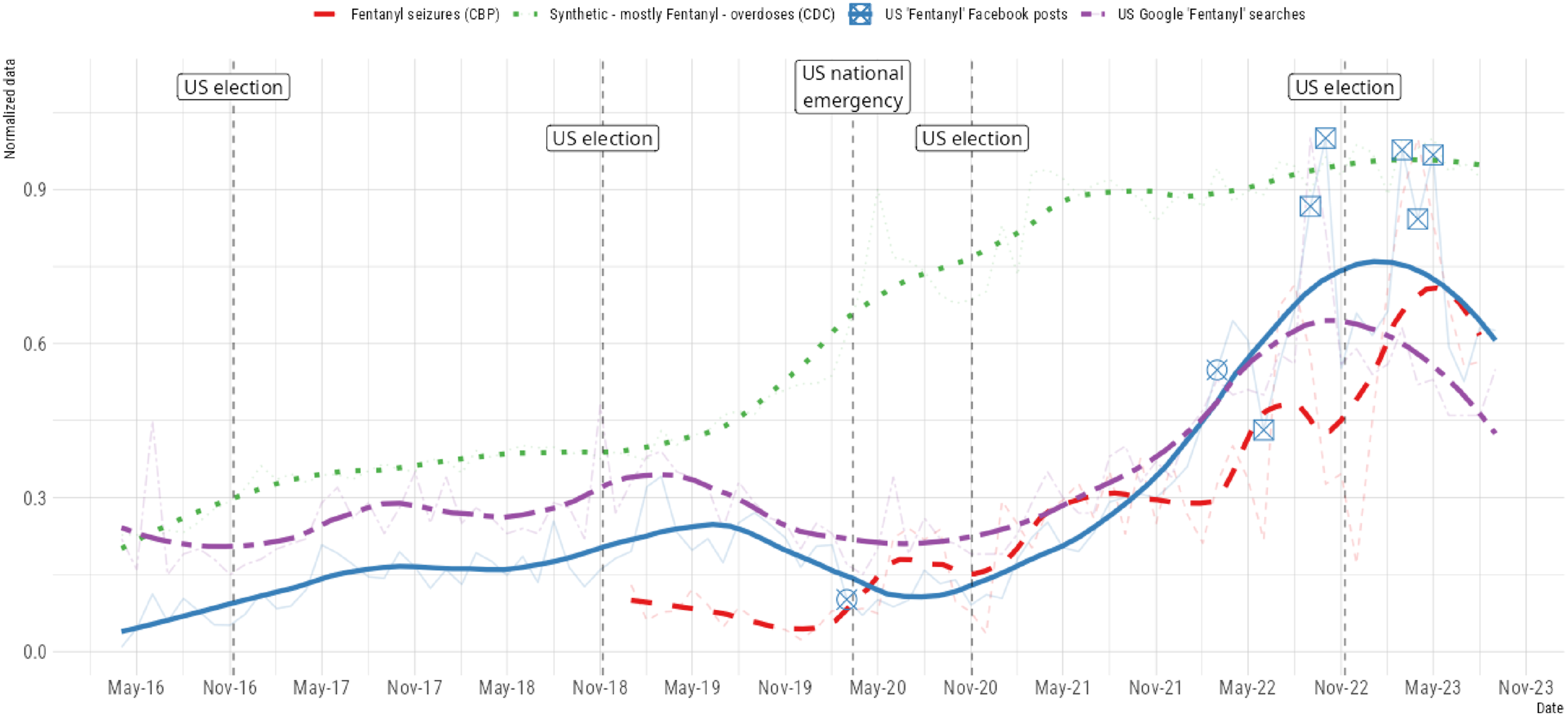
The green dotted line represents monthly synthetic—mostly fentanyl—overdoses in the US, as reported by the CDC. Given fentanyl’s prominence in synthetic overdose reporting, this data is routinely used to represent fentanyl’s lethal effects on the US population. As the figure shows, synthetic opioid overdose deaths gradually rise between 2016 and mid 2019, mirrored by an increase in Facebook posts and Google searches. The onset of the pandemic produces a notable divergence though: despite overdoses rising sharply, Facebook posts and Google searches on fentanyl clearly declined. As of mid 2023, deaths appear to have largely stabilized at nearly 7 thousand a month. In contrast, fentanyl seizures as reported by US CBP (i.e. the red line) appear to correlate much more closely with the Facebook and Google data, spiking at well over 3 thousand pounds in March 2023.
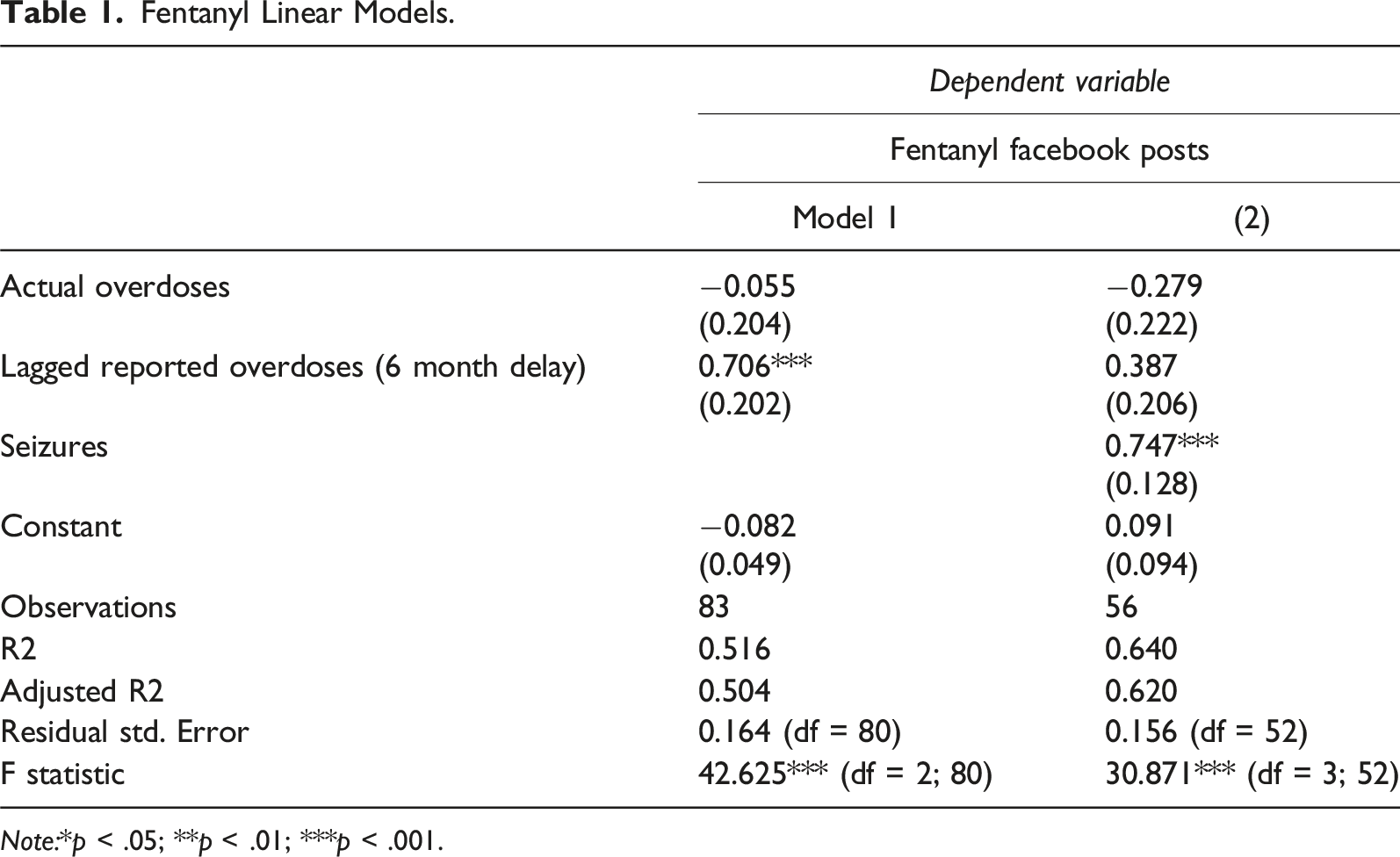
Fentanyl Linear Models.
Note:*p < .05; **p < .01; ***p < .001.
To reiterate, CDC overdose data is reported on a 6 month lag, so while actual overdoses represent the real-time monthly deaths in the US as a result of synthetic opioids, the lagged reporting of these figures to the general public occurs 6 months later. Thus the lagged reported overdoses variable represents CDC announcements of deaths 6 months prior, and the actual overdoses variable reflects real-time effects of synthetic opioid deaths. The models therefore suggest that CDC’s lagged reporting announcements better explain fentanyl posts on Facebook than actual overdoses in the country, though CBP’s seizure reports clearly operate as the best predictor.
Returning to Figure 1, change point analysis tends to reinforce this conclusion that external events influence the frequency of fentanyl discussion on Facebook. The crossed shapes in Figure 1 depict change points (both trend and outlier) as identified by the Bayesian Estimator of Abrupt change, Seasonal change, and Trend (RBEAST) package (Zhao et al., 2019), with diagnostics found in the Online Supplement. The two trend change points (i.e. crossed circles) point to the March 2020 (93% probability) and March 2022 (100%) as important months where the timeseries changes. The outlier changepoints largely identify heightened noise in late 2022 (September and October 2022; 99%) and early 2023.
Topic Model of Fentanyl Sentences From (Public) Facebook Posts (2016–2023).
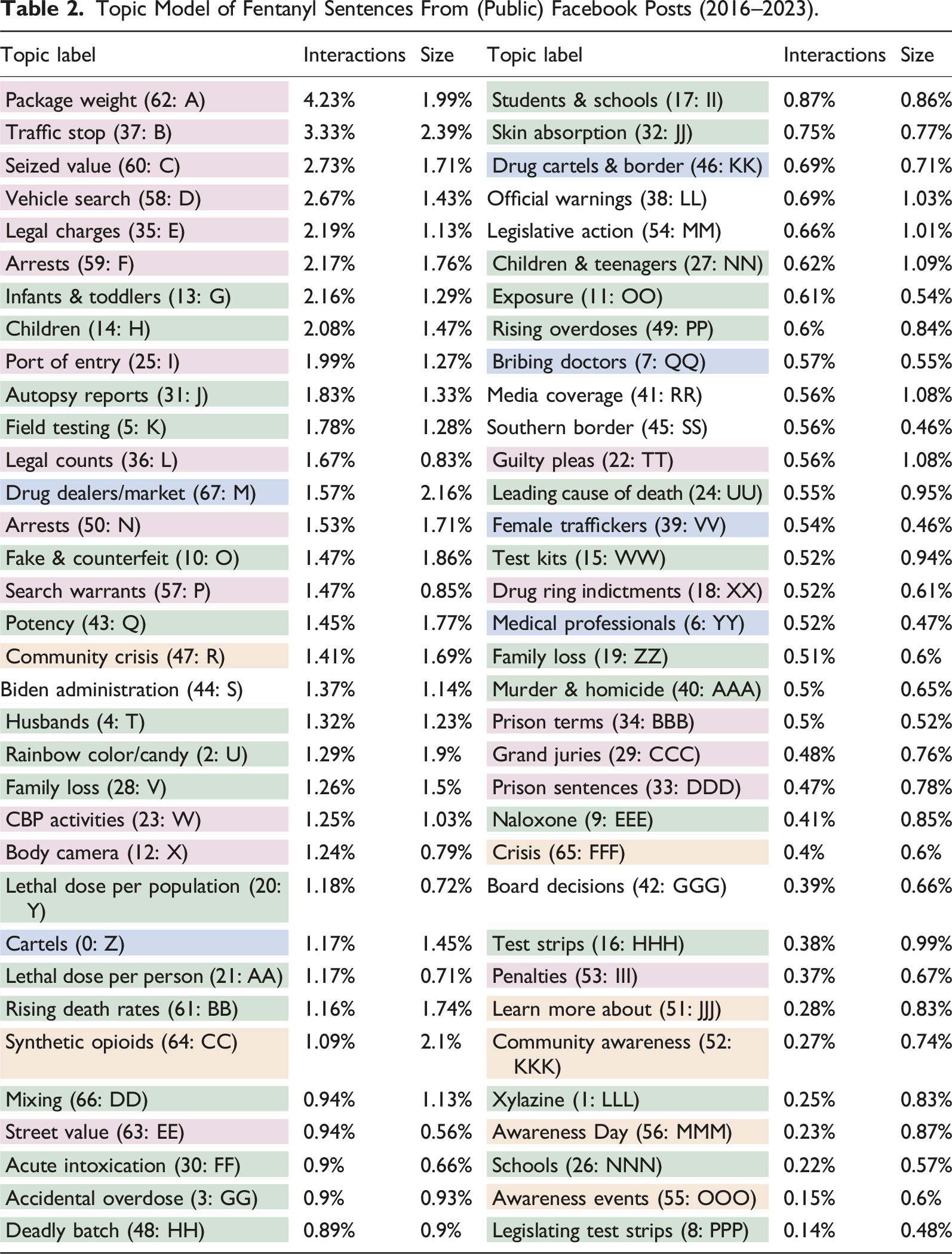
A broad qualitative overview of the model suggests that these topics generally fit within one of four themes. In descending order of interactions, the four themes are: law enforcement (shaded purple: 22% of the data; 30% of interactions), health (green: 31% size; 29% of interactions), dealers (blue: 6% size; 5% interactions), and awareness (orange: 7% size; 4% interactions).
Law enforcement (purple) discussion prompted the most engagements across all four themes. Typically, these topics highlighted reports on CBP activities (W) like traffic stops (B) and the characteristics of arrests (F) and drug seizures, like package weight (A) and value (C & EE). Legal proceedings involving the synthetic opioid were also expressed within this theme, including charges (L), guilty pleas (TT), and prison sentences (BBB & DDD): U.S. Customs and Border Protection reported a 1,066% increase in fentanyl seized in south Texas during fiscal year 2021, the agency said this week. - 2022–01-09 (CBP Activities: W) In total, troopers seized approximately 286 pounds of suspected fentanyl pills - or approximately 1,297,000 pills - from the vehicle. The estimated street value of the fentanyl seized is approximately $5.1 million... - 2023–02-22 (Street value: EE)
Health (green) topics largely focus on the lethality of fentanyl. For example, topics in this theme explored the effects of fentanyl on infants and toddlers (G), children (H), teenagers (NN), and otherwise inflicting general family loss (V). Though broader medical discussions (e.g. estimated lethal doses) are also found within: She wanted to put the baby to sleep and thought she was adding cocaine to the bottle, the Sheriff said. 9-month-old Fla. baby dies after teen mom put fentanyl in his bottle... - 2023–07-15 (Infants & toddlers: G) Two men arrested in the largest fentanyl bust in New Jersey history were sentenced to prison Friday, after authorities said they had enough lethal doses to kill the entire population of New Jersey and New York City combined. - 2018–01-30 (Lethal dose per population: Y) This is a tragedy. Fentanyl overdoses have become the leading cause of death for adults between the ages of 18 and 45. We need to get serious about stopping the flow of drugs into our neighborhoods. - 2021–12-19 (Leading cause of death: UU)
The dealers (blue) theme represents topics that fixate on those responsible for distributing the drugs and the illicit marketplace where they are sold. Although cartels (Z & KK), and other drug traffickers (VV) understandably see great deal of attention among these topics, some medical professionals also stand accused: John Kapoor, the founder and former chairman of Insys Therapeutics, was found guilty of racketeering conspiracy for directing a scheme to bribe doctors across the country to prescribe a highly addictive fentanyl spray. - 2019–05-03 (Bribing doctors: QQ) Mexican cartels are smuggling fentanyl into our country at record rates, through ports of entry and on the backs of illegal immigrants. We must take action now to close our borders to curb the influx of this deadly substance. - 2023–02-16 (Drug cartels & border: KK) A nurse working at a Florida hospital has pleaded guilty to stealing fentanyl and replacing the powerful pain medication with saline. - 2022–04-15 (Medical professionals: YY)
Finally, the awareness (orange) theme conveys information (CC & JJJ) about the fentanyl crisis largely through events (OOO): Today is National Fentanyl Prevention and Awareness Day. Illegally made fentanyl is among the most common drugs in overdose deaths. Join us in raising awareness of the dangers of fentanyl and learn how to protect yourself, your loved ones, and our community. - 2023–08-22 (Community awareness: KKK) Learn more about: ∼The dangers of fentanyl ∼ The risks of mixing drugs ∼ How naloxone can save lives ∼ Reducing stigma toward drug use & recovery https://cdc.gov/stopoverdose - 2022–01-20 (Learn more about: JJJ)
Discussion and Conclusion
While there is little space to more deeply explore each individual topic in the results section, please note the Online Supplement provides considerably more empirical data for future researchers to exploit (e.g. containing 100k words from these topics and the posts from which they originate, dozens of individual topic timeseries, and other valuable data). Having briefly outlined this study’s primary findings, though, the topic model results above provide the groundwork to answer the current study’s research questions.
The model indicates 68 topics best explain the spread of fentanyl discussion within the data. A general qualitative assessment of these topics, however, suggests fentanyl is largely conceptualized within one of four themes: law enforcement (22% of the data; 30% of interactions), health (31% size; 29% of interactions), dealers (6% size; 5% interactions), and awareness (orange: 7% size; 4% interactions). In this way, the model reveals such online discussions can be represented by a narrow thematic set, but there nevertheless exists notable variation within the themes. For example, the health theme contained dozens of topics that identified the lethal nature of the synthetic opioid on various subsets of the population (e.g. infants & toddlers (G); children & teenagers (NN); husbands (T)). In this way, the model still holds insights for researchers looking to more deeply explore individual online discussions specific to the synthetic opioid.
From a thematic perspective, law enforcement-type discussions were clearly the most popular on Facebook. Indeed, law enforcement topics represented the top 6 interactions-producing categories in the data (i.e. package weight (A) 4.23%; traffic stop (B) 3.33%; seized value (C) 2.73%; vehicle search (D) 2.67%; legal charges (E) 2.19%; and arrests (F) 2.17%). These topics also prompted a greater share of their interactions than their frequency (i.e. size), emphasizing the interactive quality of these posts. The timeseries analysis further points to relationships between (this popular) law enforcement theme online and real-time domestic conditions, which leads to the final research question:
Figure 1 and the regression models in Table 1 offer the most immediate findings for future research. Namely, that CBP’s monthly reported fentanyl seizures significantly explained the number of fentanyl-discussing Facebook posts. As fentanyl seizures went up, so too did Facebook posts on the synthetic opioid. In fact, a closer look at the change points in early 2022 and 2023 tend to come as spikes in fentanyl busts occur during the start of North American spring.
As a result, the regression models indicate CBP’s seizure data far surpassed CDC’s overdose figures as a means of predicting fentanyl posts on Facebook. This is all the more interesting because fentanyl overdoses clearly increase rather dramatically during the COVID-19 pandemic, yet online interest in discussing the drug at this same time notably declines. Change point analysis flags the onset of the pandemic (March 2020) specifically as a moment where the timeseries shifts: meaning, the decrease in fentanyl discussion during this time—despite increasing overdoses—also represents a shift in this timeseries.
The regression models further reveal a critical discrepancy between actual and lagged reported overdoses in the country as predictors for this online discussion. Specifically, lagged reported overdoses (i.e. released by the CDC on a 6 month lag) appeared to better explain fentanyl posts than actual monthly overdoses. Put another way, CDC announcements on synthetic opioid deaths from 6 months prior better predict current post frequency than actual overdose deaths from the drug at the time.
The results therefore tell us two things. First, Facebook discussion of fentanyl largely follows movement in CBP seizure reports, not overdoses. Second, fentanyl discussion on Facebook also more closely follows CDC reports on overdoses from 6 months ago than actual overdoses at the time. Official reports from the CBP and CDC therefore appear to prompt this online discussion.
From a communication scholar perspective, theories like indexing (Bennett, 1990), sourcing (Herman & Chomsky, 1988), and agenda setting (McCombs & Shaw, 1972) help explain why official reports from the CBP and CDC more accurately predict Facebook discussions than actual fentanyl deaths. That is, news media’s penchant to cover government reports (e.g. indexing, sourcing), and the public’s tendency to consider prominent reporting as important (e.g. agenda setting), likely underpin this relationship.
For example, take the fixation on law enforcement activity within the data, as the topic model suggests. Such discussion of law enforcement activity is likely driven mostly by official reports (e.g. announcements of traffic stops (B); seizure weight (A) and value (C)). In turn, these official reports fuel additional online discussion about fentanyl. The same theoretical process explains why CDC’s lagged reported overdoses better explain discussions than actual real-time overdoses in the country. That is, official reports prompt further posts about overdoses, not real-time deaths from fentanyl in the US.
Theoretically, such a result offers obvious consequences for the health communication field in particular. Recall that some health communication scholars interested in fentanyl see value in examining social media data for its promise to offer real-time insight into the public health crisis, but if social media discussion is following official reports and not organically representing actual conditions then unforeseen problems arise.
Such a claim obviously demands justification, though regrettably doing so unfortunately requires singling out particular contributions. For example, some have recently used state-level Google searches for fentanyl as a metric for determining a relationship with regional overdose deaths (Arendt, 2021). Arendt (2021) quite clearly acknowledges that such searches come from a wide pool of addicts and non-addicts alike, but as Figure 1 shows, Google Trends data follows a near identical path to this study’s Facebook fentanyl discussions: meaning, these Google Searches are more likely responding to official reporting of fentanyl seizures (and perhaps, 6-month lagged announcements), not exposing regional fentanyl use or abuse.
Again, Arendt (2021) represents just one example, though. As I outline in the literature, the drive to ‘mine’ social media data as a means of surveillance and monitoring of drug abuse is in some spaces persistent in the literature. Some unquestionably take a more careful methodological approach than others, but in my initial assessment none engaged with robust communication theories like agenda setting to theoretically ground their assumptions. The results above indicate the field might gain from reconceptualizing how official reports likely drive this social media content. The purpose here is not to single out or unfairly critique existing contributions, but to highlight that empirical evidence likely demands a theoretical and methodological adjustment going forward.
The same could just as easily be said for the current research, though. From a replication perspective, it is vital that others look to check whether the conclusions above hold with new methods and with new data. Future research should also be wary of the potential limitations of the current study. For example, the present study’s social media data falls quite short of more robust data sources like representative surveys or experiments; meaning, the topic model results within are certainly not generalizable and speak only to the online discourse occurring on Facebook at the time. My expertise in communication offers a similar limitation, in the sense that scholars with other backgrounds may similarly find theoretical models from other fields that explain the behavior shown within. Regardless, the hope is that the current study offers stronger grounds for well-informed research to come, while deepening our understanding of fentanyl discussion online and what drives it.
Supplemental Material
Supplemental Material - “Get This Deadly Drug off Our Streets, and End This Crisis”: Discussing Fentanyl (in the US) on Facebook and Examining the Agenda Setting Factors that Drive This Online Content
Supplemental Material for “Get This Deadly Drug off Our Streets, and End This Crisis”: Discussing Fentanyl (in the US) on Facebook and Examining the Agenda Setting Factors that Drive This Online Content by Justin Bonest Phillips in Journal of Drug Issues.
Footnotes
Declaration of Conflicting Interests
The author declared no potential conflicts of interest with respect to the research, authorship, and/or publication of this article.
Funding
The author received no financial support for the research, authorship, and/or publication of this article.
Disclosure
The author is a member of a team that has been granted a Facebook research award, and been contracted by Meta, for separate projects. Those funds were not used for the current paper, nor did they award influence this study in any way.

Data Availability Statement
Supplemental Material
Supplemental material for this article is available online.
Author Biography
References
Supplementary Material
Please find the following supplemental material available below.
For Open Access articles published under a Creative Commons License, all supplemental material carries the same license as the article it is associated with.
For non-Open Access articles published, all supplemental material carries a non-exclusive license, and permission requests for re-use of supplemental material or any part of supplemental material shall be sent directly to the copyright owner as specified in the copyright notice associated with the article.
