



Abstract
Emotion is a fundamental aspect of human experience. Studies have shown cultural differences in emotional experiences in everyday contexts, but little research has explored how these differences manifest in musical encounters. This article reports two studies investigating how culture influences the perception of emotions in music, incorporating cultural factors (self-construal) and interpersonal and intrapersonal models of emotions (socially engaging vs. socially disengaging). Study 1 used an online questionnaire, where participants from various cultural backgrounds reflected on the emotions they perceived their favorite music to be expressing. This study found that interdependent self-construal was positively associated with the intensity of positive socially engaging emotions perceived in favorite music, while independent self-construal was positively associated with the frequency of negative socially disengaging and negative general emotions, alongside the intensity of positive general emotions. Study 2 employed a listening experiment, where participants from Singapore, China, and the United Kingdom listened to their favorite music and reported the emotions they perceived their music to express. This study found that interdependent self-construal directly influenced the frequency of positive socially engaging emotions perceived in favorite music and mediated between-country differences in these emotions. However, independent self-construal directly influenced the frequency and intensity of aesthetic emotions. Overall, our results show that the emotions individuals perceive in their favorite music are a product of their self-construal. Furthermore, these findings underscore the importance of integrating specific cultural variables and embracing culturally informed emotion models in cross-cultural research on music and emotions.
As Judith Wright said, “feelings or emotions are the universal language and are to be honored. They are the authentic expression of who you are in your deepest place.” Emotion is indeed a fundamental aspect of human experience, transcending cultural boundaries while simultaneously reflecting cultural specificity. Significant empirical research has demonstrated that emotional experience and expression vary across cultures (for an overview, see Tsai & Clobert, 2019). For example, emotions tend to be more interpersonally focused in East Asian or collectivistic cultures, whereas they are often more intrapersonally oriented in Western or individualistic cultures (e.g., Kitayama et al., 2006, 2009). Despite extensive studies on cultural differences in everyday emotional contexts, little research has explored how these differences manifest in musical encounters. After all, music is a universal phenomenon, present in every culture (Mehr et al., 2019), and the affective experience it elicits is a critical component of musical engagement for many individuals (Swaminathan & Schellenberg, 2015). This raises the intriguing possibility that cultural differences in everyday emotional experiences may also extend to the musical domain. This article seeks to address this gap by examining how culture influences the perception of emotions in music. By doing so, it aims to contribute to a deeper and more nuanced understanding of cultural diversity in music psychology, enriching our knowledge of the interplay between music, emotion, and culture.
Emotions, Culture, and Self-Construal
We define culture as an expansive array of tangible and intangible ideas that guide individuals’ thoughts, feelings, and behaviors (Adams & Markus, 2004; Markus & Hamedani, 2019). Within this framework, culture may reside “outside the head” in cultural products and practices (e.g., music) as well as pervasive ideas (e.g., collectivistic and individualistic values; Morling, 2016). In addition, culture may reside “inside the head” in individuals through psychological constructs such as motivation, cognition, and emotion. Central to this perspective is the idea of mutual constitution, where culture and individuals continuously shape each other (Markus & Kitayama, 2010; Tang, 2024).
Markus and Kitayama (1991) theorized that national variations in collectivism and individualism give rise to interdependent and independent self-construals, respectively. Self-construal refers to how individuals perceive themselves in relation to others. Empirical studies have shown that people of non-Western, primarily East Asian cultures, have a more dominant interdependent self-construal, viewing the self as interconnected with others within their social milieu (S. E. Cross et al., 2011; Markus & Kitayama, 1991, 2010). Conversely, people from Western cultures have a more dominant independent self-construal, viewing the self as a relatively autonomous entity, separate from others. Although collectivism-individualism and interdependent-independent self-construal share conceptual similarities, they represent distinct levels of analysis: the former reflects broad-scale entities like nation-states, while the latter represents individual-level constructs.
Self-construal theory acknowledges that individuals actively engage with and potentially shape the cultures they are a part of, whether consciously or unconsciously (Hong & Mallorie, 2004; Markus & Kitayama, 2010; Oyserman, 2011). Consequently, individuals may possess both interdependent and independent self-construals, which can vary between and within cultural contexts (Oyserman et al., 2002). In other words, different self-construals may be activated depending on the prevailing social-cultural setting. Considering the idea that music engagement is culturally embedded (Becker, 2010; Clarke, 2011; Frith, 1996; Tang, 2024), this implies that music not only reflects cultural meanings but may also evoke specific self-construals. Therefore, it becomes imperative to consider the implications of these self-construals on our music listening experiences, including our emotion perception of music.
Considerable research has demonstrated that collectivism-individualism and interdependent-independent models of self affect emotional experiences outside of musical contexts (Markus & Kitayama, 1991; Mesquita et al., 2016; Triandis, 1994; Tsai & Clobert, 2019). In collectivistic cultures, emotions are perceived to stem from and belong to interpersonal relationships, whereas in individualistic cultures, emotions are seen as originating within the individual. In a series of investigations, Uchida et al. (2009) found that Japanese participants produced more emotion words in social contexts, while American participants produced more emotion words when focusing on themselves. For instance, Japanese athletes used more emotion words compared with their American counterparts when discussing their relationships. Moreover, Japanese students inferred more emotions when athletes referenced relationships or were depicted with teammates, whereas American students inferred more emotions when athletes centered on themselves or were depicted alone. This suggests that emotions are perceived as interpersonal phenomena in interdependent cultures, whereas they are seen as intrapsychic experiences in independent cultures.
An important corollary is that emotions are more socially oriented in collectivistic cultures, whereas emotions are more self-focused in individualistic cultures (Markus & Kitayama, 1991; Mesquita et al., 2016; Tsai & Clobert, 2019). Within collectivistic cultures, the affective process is characterized by the primacy of intersubjectivity, which arises from the interdependence with others. Consequently, individuals with an interdependent self-construal might be more sensitive to emotions that facilitate connections with others, described as socially engaging emotions. Conversely, in individualistic cultures, the affective process centers on personal subjective experience. Thus, individuals with an independent self-construal might be more sensitive to emotions that distinguish themselves from others, termed as socially disengaging emotions.
Several studies have provided empirical support for these hypotheses (Eid & Diener, 2001; Furukawa et al., 2012; Jakubanecs et al., 2019; Savani et al., 2013). For example, Kitayama et al. (2000, 2006) found that Japanese participants reported socially engaging emotions (e.g., feeling connected, friendly, guilty, ashamed) more frequently and intensely, whereas people from Western countries (i.e., Germany, the United Kingdom, and the United States) reported socially disengaging emotions (e.g., feeling superior to, proud, angry, frustrated) more frequently and intensely. Boiger et al. (2013) further found that Japanese participants perceived shameful situations to be more likely to occur, while Americans anticipated anger-inducing ones. Similarly, Leu et al. (2010) showed that across differently-valenced situations (i.e., positive, negative, and mixed), East Asians reported more socially engaging emotions, while North Americans reported more socially disengaging emotions. Based on these findings, it is possible that individuals might be more likely to perceive socially engaging and socially disengaging emotions in certain culturally relevant music.
Preferred Music and Culture
One type of culturally relevant music is preferred music, defined as an individual’s liking for one piece of music over another (Hargreaves et al., 2015). Research has demonstrated that music preferences are closely linked to factors such as personality, cultural identity, and cultural values (Boer et al., 2013; Brittin, 2014; Dys et al., 2017; Rentfrow & Gosling, 2006). For instance, Huang et al. (2020) found that Chinese college students predominantly preferred Chinese pop music, reflecting their shared cultural background. Similarly, music preferences can convey meaningful information about racial identity. Studies have shown that preferences for rap, hip-hop, and soul genres tend to be associated with Black individuals, whereas preferences for rock, alternative, pop, country, and folk genres are more commonly associated with White individuals (Marshall & Naumann, 2018; Rentfrow et al., 2009). Furthermore, Andrews et al. (2022) found that personal and cultural values explained differences in music preferences more effectively than personality traits alone.
These findings suggest that an individual’s dominant self-construal may be reflected in their preferred music, which in turn influences the emotions they perceive in that music. Building on this, the present study examines the emotions individuals perceive in their favorite music. Specifically, we hypothesize that interdependent and independent self-construals will be associated with more frequent and intense perceptions of socially engaging and socially disengaging emotions, respectively. In the following section, we review cross-cultural research in music psychology related to this hypothesis.
Cross-Cultural Research in Music Psychology
Music Preferences
Researchers have identified cross-cultural differences in the musical features of preferred music. An analysis of Spotify streaming data across 51 countries revealed regional variations, with music in Asia tending to be more relaxed and music in Latin America more intense than that of Oceania, Europe, and North America (Park et al., 2019). Similarly, Liew et al. (2021) found that Taiwanese popular music is characterized by high acousticness, Japanese music by high energy, and American music by high speechiness. Further comparison of Spotify’s Top-50 charts showed that playlists in East Asian countries (Japan, Taiwan, Hong Kong, and Singapore) scored higher on instrumentalness, while those in Western countries (Australia, Canada, the United Kingdom, and the United States) scored higher on danceability (Liew, Koh, et al., 2023). In addition, Singaporean playlists featured more socially oriented lyrics and “we” pronouns, whereas American playlists contained more angry lyrics (Liew, Uchida, et al., 2023). These findings align with earlier research showing that Chinese popular song lyrics emphasize collectivistic themes, while U.S. song lyrics reflect more individualistic values (Rothbaum & Tsang, 1998; Rothbaum & Xu, 1995).
Taken together, these cross-country differences in musical features reflect underlying sociocultural differences and affordances for emotion. In particular, variations in lyrical content (Liew, Uchida, et al., 2023; Rothbaum & Tsang, 1998; Rothbaum & Xu, 1995) support the proposition that interdependent and independent self-construals may be reflected in preferred music, which may also be linked to socially engaging and socially disengaging emotions. While musical features offer insight into the types of emotions that music may convey, they do not fully explain the specific emotions that individuals perceive in their favorite music. Consequently, the present study sought to investigate whether self-construal is associated with the perception of socially engaging and socially disengaging emotions in favorite music.
Functions of Music
Given that many people report listening to music for its emotional impact (Juslin & Västfjäll, 2008), examining music’s functions across cultures may offer insight into the emotions it conveys. Boer and Fischer (2012) found that the social bonding function of music was equally prevalent in collectivistic (Hong Kong, Philippines, Brazil, and Singapore) and individualistic countries (New Zealand, Germany, and the United States). However, another study by Boer et al. (2012) revealed that participants from Kenya and the Philippines reported experiencing family bonding through music most strongly, followed by those from Mexico and New Zealand, while participants from Germany and Turkey reported it less frequently. Further analysis indicated that the social bonding function was negatively associated with secular values. These findings suggest that collectivism-individualism may not directly determine whether one uses music for social purposes.
In contrast, Granot et al. (2021) found that during the COVID-19 pandemic, participants from collectivistic countries (Argentina, Brazil, China, Colombia, and Mexico) rated music as more effective in achieving togetherness goals compared with participants from individualistic countries (Italy, Netherlands, Norway, Spain, the United Kingdom, and the United States). This discrepancy with previous research may stem from differences in the countries sampled or the framing of survey questions, as participants were asked about music functions more broadly without reference to specific music. Nonetheless, Granot et al.’s findings demonstrate that even in times of collective threat, individuals in collectivistic cultures rely more on their social groups for coping. Thus, music that conveys socially engaging emotions may play a critical role in facilitating this bonding process. Despite these inconsistencies, the overall association between the social functions of music and collectivistic cultures, alongside traditional values, support the notion that socially engaging emotions expressed through music may align with interdependent self-construal.
Specific to preferred music, Saarikallio et al. (2021) found that mood management functions were more prevalent among Indian participants, whereas self-enhancement functions were more prevalent among Finnish participants. Conversely, Schäfer et al. (2012) reported that Indian participants associated their favorite music with background use, emotion regulation, and self-regulation, while German participants linked it to prompting memories and social bonding. These mixed results suggest a complex relationship between culture and the functions of preferred music. While self-enhancement functions may be more common in individualistic contexts, implying a connection between socially disengaging emotions and independent self-construal, social bonding functions were also observed in an individualistic country like Germany, seemingly contradicting this association. Such inconsistencies may arise from the use of nationality as a proxy for collectivism and individualism, potentially oversimplifying the nuanced dimensions of cultural differences (Santos et al., 2017). We propose that self-construal theory provides a more nuanced framework for understanding these results. As a measure of individual differences, interdependent and independent self-construals vary within cultural contexts, meaning that individuals in collectivistic (e.g., India) or individualistic countries (e.g., Finland and Germany) may possess both types of self-construal. This variation implies that the functions of preferred music depend on the individual’s self-construal, rather than solely on the cultural context. Therefore, the present study incorporates self-construal as a key measure in examining how culture influences the emotions perceived in favorite music.
Emotion Perception in Music
Music psychologists have distinguished between two facets of affective experience with music: emotion perception and emotion evocation (Juslin, 2016). Emotion perception pertains to the emotions conveyed by music, regardless of whether the listener felt those emotions. Emotion evocation, on the other hand, refers to individuals’ emotional responses elicited by music. In this article, we focus on the former, the emotions that individuals perceive music to express.
Cross-cultural research in music and emotion has grown in the last decade (Sauvé et al., 2023), particularly in the area of emotion perception. Scholars have proposed several theoretical models to explain the cross-cultural perception of emotion in music, including the cue-redundancy model (Balkwill & Thompson, 1999), the fractionating emotional systems model (Thompson & Balkwill, 2010), and the dock-in model of music culture (Fritz, 2013). Despite their differences, these models converge on the idea that listeners rely on two types of cues to decode the musically expressed emotion: psychophysical cues—any property of sound that can be perceived independent of musical experience, knowledge, or enculturation (e.g., tempo, rhythm, timbre); and culture-specific cues—culturally determined conventions (e.g., scales and harmonic relationships).
Based on these models, three empirical patterns emerge. First, individuals can reliably identify emotions in unfamiliar music using psychophysical cues (Adachi et al., 2004; Athanasopoulos et al., 2021; Balkwill & Thompson, 1999; Balkwill et al., 2004; Bodner, 2014; Fritz et al., 2009; Kwoun, 2009; Laukka et al., 2013). Second, listeners are better at identifying the intended emotion from culturally familiar music because they can also rely on culture-specific cues (Argstatter, 2016; Laukka et al., 2013). Third, people from similar cultural backgrounds tend to report similar emotion perceptions, likely due to a shared understanding of culture-specific cues (Hu & Lee, 2012, 2016).
These studies have emphasized how musical cues inform cross-cultural emotion perception. However, they have overlooked other psychological mechanisms. In response, Susino and Schubert (2017) proposed the Stereotype Theory of Emotion in Music, whereby cultural stereotypes influence emotion perception in music. They argued that listeners filter the emotion they perceive in music based on the stereotypes of the encoding music culture. Only when such stereotypes are absent, the musically expressed emotion may be interpreted more freely through psychophysical and culture-specific cues. In subsequent studies, Susino and Schubert (2019) found that emotions attributed to certain genres aligned with stereotypical associations of their originating cultures—for example, peace and calm for Japanese Koto music, and anger and aggression for heavy metal music. Although only a few associations were found, this provides some empirical support that stereotyping competes with musical cues when perceiving emotions in music.
Despite the insights offered by existing research, three key limitations warrant attention. First, most theories focus narrowly on musical cues, overlooking alternative psychological mechanisms such as stereotyping (Susino & Schubert, 2017, 2019). The limited support for the Stereotype Theory of Emotion in Music highlights the need to consider other factors that might influence cross-cultural emotion perception.
Second, culture was vaguely defined with cross-cultural differences attributed primarily to enculturation to music conventions. Researchers often assumed that participants would be familiar with music from their own culture and therefore recruited participants from different nations and utilized music from various countries, typically classical music traditions (e.g., Hindustani, Japanese traditional, and Western classical). However, cultural difference extends beyond enculturation and familiarity with (classical) music genres. It encompasses patterns of ideas, practices, institutions, or artifacts generated by people, who are also influenced by culture (Adams & Markus, 2004). This broader conceptualization raises questions about the exact mechanisms by which culture, beyond enculturation and familiarity, influences emotion perception in music. In addition, the focus on classical music genres limits generalizability to more ecologically relevant forms like popular music. Hence, better conceptualizations of culture and the inclusion of diverse music genres are needed to advance research on cross-cultural emotion perception of music.
Third, previous studies have predominantly relied on discrete (or basic) emotion models (e.g., happiness, anger, sadness, and tenderness; Ekman, 1992; Izard, 1992). To our knowledge, only one study (i.e., Wang et al., 2021) incorporated the two-dimensional circumplex model comprising valence and arousal (Russell, 1980). By restricting the types of emotions to basic emotions, it opens the question of whether there is diversity in the spectrum of emotions perceived in music across cultures. Interestingly, the researchers did not include aesthetic emotions despite its unique relevance to music (Coutinho & Scherer, 2017; Menninghaus et al., 2019; Zentner et al., 2008). Aesthetic emotions are emotional responses that emerge from an individual’s engagement with and appreciation of the music (e.g., awe, wonder, moved, and inspired) rather than concerns for survival or well-being (e.g., scared or happy). Crucially, these emotion frameworks are implicitly rooted in Western conceptualizations of emotions, which posit emotions as internal psychological states belonging to the individual, separate from their context or relationships (Becker, 2010; Tsai & Clobert, 2019). Such emotions may not accurately reflect the emotional experiences of individuals from non-Western cultures. For instance, Benamou (2003) observed discrepancies in the internal organization and connotations of emotional categories between Javanese and Western music. To address these limitations, the present study incorporated cultural factors (self-construal factors) and culturally sensitive emotion models (socially engaging vs. socially disengaging) to investigate how culture influences emotion perception of music.
Overview of the Present Studies
In this article, we examined the emotions individuals perceive in their favorite music, aiming to advance knowledge on how culture influences the character of these emotions. We situated this exploration within the meaning-making processes that individuals engage in while listening to their preferred music, moving beyond classical music genres to include more ecologically relevant musical styles. Preferred music was chosen because of its unique significance to individuals, reflecting both individual and cultural influences from collectivistic and individualistic contexts (Andrews et al., 2022; Boer et al., 2013; Brittin, 2014; Granot et al., 2021; Marshall & Naumann, 2018; Rentfrow & Gosling, 2006; Rentfrow et al., 2009). In addition, cultural dimensions such as masculinity, long-term orientation, and indulgence have been associated with cross-country differences in album and artist preferences, though not in genre preferences (M. Liu et al., 2018). Accordingly, the present study asked participants to indicate specific musical works, as analyzing album and artist preferences alongside cultural variables may yield greater explanatory power for understanding cross-cultural variation in emotion perception of music (Brisson & Bianchi, 2022; Tang, 2024).
We theorize that music engagement is culturally inflected (Becker, 2010; Clarke, 2011; Fram, 2023; Frith, 1996; Tang, 2024). In other words, music and listeners share a symbiotic relationship, wherein they continuously define and shape one another through ongoing, interactive exchanges of musical elements and listener perceptions. While we acknowledge that our studies did not control for specific musical features across participants’ favorite music, which might influence emotion perception, we align with prior studies that similarly examined emotions in preferred music (e.g., Saarikallio et al., 2021; Schäfer et al., 2012). We argue that such an approach provides a valuable foundation for exploring the diversity of emotions in music across cultures. Drawing on the evidence from cultural psychology regarding cross-cultural differences in everyday emotional experiences and cross-cultural research in music psychology on music preferences and functions of preferred music, we hypothesized that interdependent and independent self-construals would be associated with more frequent and intense socially engaging and socially disengaging emotions perceived in favorite music, respectively.
The central aim of this research was to investigate the role of self-construal in the perception of emotions conveyed by favorite music across cultures. We addressed the research question: Is self-construal, both between and within cultures, associated with the frequency and intensity of emotions perceived in favorite music? In Study 1, we adopted an exploratory approach comprising an online questionnaire where participants were asked to reflect on the emotions they perceived in their favorite music. Building on the findings from Study 1, Study 2 employed a listening experiment, in which participants listened to their favorite music and subsequently completed a questionnaire about the emotions they perceived. Both studies received ethical approval via the University of Sheffield’s Ethics Review Procedure, as administered by the Department of Music and the Department of Psychology.
Positionality and Theoretical Framework
In these investigations, we adopted a post-positivist stance, striving for objective knowledge while recognizing the inherent constraints, situatedness, and socially constructed nature of theories (Matney, 2019). At this stage, we disclose our positionalities to clarify our motivations and theoretical orientations. All of us share an ethnic Chinese background, were raised in Southeast and East Asian countries, and have pursued advanced degrees in the English language. Thus, we are cognizant of the dynamics and tensions between dominant theories and ideologies from various cultural traditions. Recognizing the prevalence of WEIRD (western, educated, industrialized, rich, and democratic) frameworks in psychological research (Broesch et al., 2020; Henrich et al., 2010; Masuda et al., 2020), we sought to embrace conceptualizations of culture and emotion grounded in cultural psychological theories (Markus & Kitayama, 2010; Zhu & Han, 2008).
Our perspective aligns with the idea that culture and individuals are continually and mutually shaping one another (Markus & Kitayama, 2010). Within the music context, emotion perception of music is culturally embedded, such that emotional meaning emerges from the interactions between particular listeners and musical events (Becker, 2010; Tang, 2024). This perspective resonates with constructionist (Cespedes-Guevara & Eerola, 2018; Lennie & Eerola, 2022) and active sense-making approaches (Schiavio et al., 2017) to emotions in music. To capture the intricacies of cross-cultural similarities and differences, we integrated emotion models from non-Western cultural traditions.
Study 1
For Study 1, we adopted an exploratory approach using an online questionnaire to investigate the role of self-construal in emotion perception of favorite music across cultures.
Method
Participants
Participants were recruited in two ways. First, participants were recruited via an online advertisement distributed by the researchers and the researchers’ contacts at universities in Singapore, China, Hong Kong, the United Kingdom, and the United States. Participants were notified that they could be entered into a draw to win one of five £10 (~US$13) Amazon gift cards. Second, participants were recruited via Amazon Mechanical Turk (MTurk) administered by CloudResearch (Litman et al., 2017). They were paid US$1 after completing the online questionnaire. Participants who did not complete the questionnaire or had missing responses were removed. Four hundred and thirty-five participants were included in the final analysis, of which participants reported 33 nationalities and 20 ethnicities, living in 11 different countries (see Supplementary Materials Appendix A).
Materials
Emotion Checklist
We first compiled emotion terms found in previous music and emotion research, such as the Geneva Emotional Music Scale (Zentner et al., 2008), the Geneva Music-Induced Affect Checklist (Coutinho & Scherer, 2017), and adjective scales (Juslin & Laukka, 2004); the two-dimensional circumplex model of emotions comprising valence and arousal (Kallinen & Ravaja, 2006); and prior cross-cultural work on music and emotions (Juslin et al., 2016). We also included emotion terms found in cross-cultural psychology pertaining to socially engaging and disengaging emotions (Kitayama et al., 2000, 2006; P. Liu et al., 2022). The initial list consisted of 202 emotion words (or phrases). Subsequently, synonyms were grouped together, and duplicates and word derivatives (e.g., joy and joyful; relax and relaxation; sad and sadness) were removed. After some discussion with other music and emotion scholars, the terms were further distilled into the final emotion checklist comprising 32-word (or phrase) pairs measuring socially engaging emotions (7-items), socially disengaging emotions (6-items), aesthetic emotions (5-items), positive general emotions (7-items), and negative general emotions (7-items; see Supplementary Materials Appendix B). Intensity of these emotions was measured using a 7-point Likert-type scale (from 1 = not at all intense to 7 = very intense).
This emotion checklist was first translated into Chinese by Tang (first author). Two bilingual translators (one native Mandarin-speaker and one native English-speaker), who were masked to the study’s hypotheses, back-translated the emotion checklist—that is, the native Mandarin-speaker translated the English version back into Chinese and the native English-speaker translated the Chinese version back into English. Discrepancies between versions were discussed and resolved by changing either the Chinese and/or English terminology. In cross-cultural research, it is imperative to establish not only linguistic semantic equivalence (i.e., similar meanings between cultures) but also conceptual equivalence (i.e., the construct “makes sense” in other cultures; Boehnke, 2022; Broesch et al., 2020; Cohen, 2019). This method of back-translation, involving individuals from East Asian and Western cultures, helps to ensure both semantic and conceptual equivalence.
Self-Construal
Self-construal was measured using Singelis’ (1994) Self-Construal Scale (SCS). The SCS consists of 15 items to measure interdependent self-construal and 15 items to measure independent self-construal using a 7-point Likert-type scale (from 1 = strongly disagree to 7 = strongly agree). The Chinese version of the SCS was obtained from T. Singelis (personal communication, November 17, 2022) and had been used in previous studies (Li et al., 2006; Yu et al., 2016). Cronbach’s alpha for the present study (all participants combined) was .84 and .82 for the interdependent and independent scales, respectively.
Procedure
Prospective participants were invited to participate in the study through a link on the online advertisement or through MTurk. Upon accessing the link, they completed the informed consent form before starting the online questionnaire. Participants were first instructed to report and think about their favorite music. Thereafter, they were asked to reflect on the emotions that they perceived their favorite music to be expressing and the emotions that they felt while listening to it. Previous research has validated the use of retrospective online questionnaires to assess music emotions across cultures (Juslin et al., 2016; Saarikallio et al., 2021). This method allows participants to carefully consider their experiences and contextualize them through reflective insight regarding the emotions they perceive their favorite music to convey. After selecting all relevant emotions using the emotion checklist, participants rated the intensity of their selected emotions. Subsequently, they completed the SCS and demographic questions (e.g., age, gender, education level, and musical expertise). Regarding musical expertise, Zhang and Schubert (2019) found that years of musical training and the musician rank item (i.e., “Which titles best describes you?”) of the Ollen Musical Sophistication Index (OMSI; Ollen, 2006) were the best single-item measures for estimating musicality. Thus, we used these items as proxies of musical expertise. The online questionnaire was hosted by QualtricsXM and took approximately 15 min to complete. Participation was voluntary and participants could skip any questions they did not want to answer.
Data Analysis
The frequency of emotions was calculated by summing the number of emotions selected within each emotion type, while the intensity of emotions was calculated by averaging the intensity ratings of selected emotions within each type. To make meaningful comparisons, participants were grouped together using nationality because national differences in collectivism-individualism have been argued to give rise to interdependent-independent self-construals (Markus & Kitayama, 1991). Given the wide representation of nationalities (see Supplementary Materials Appendix A), participants were further grouped together based on the cultural distance hypothesis, which assumes that cultures are similar if they are geographically close to one another (Elfenbein & Ambady, 2003). Subsequently, we conducted a multilevel regression analysis with participants nested within regions. For this article, we focused on the emotions that participants perceived their favorite music to express. The analysis of felt emotions will be presented in a separate forthcoming report. All analyses were conducted using SPSS®28.
Results
Demographic Characteristics
Participants were divided into nine regions: the United States (n = 215), Canada (n = 38), Brazil (n = 2), the United Kingdom (n = 88), Europe (n = 15), East Asia (n = 26), Southeast Asia (n = 32), South Asia (n = 11), and dual nationality (n = 7). See Table 1 for more information regarding participant characteristics.
Study 1 Participant Characteristics.
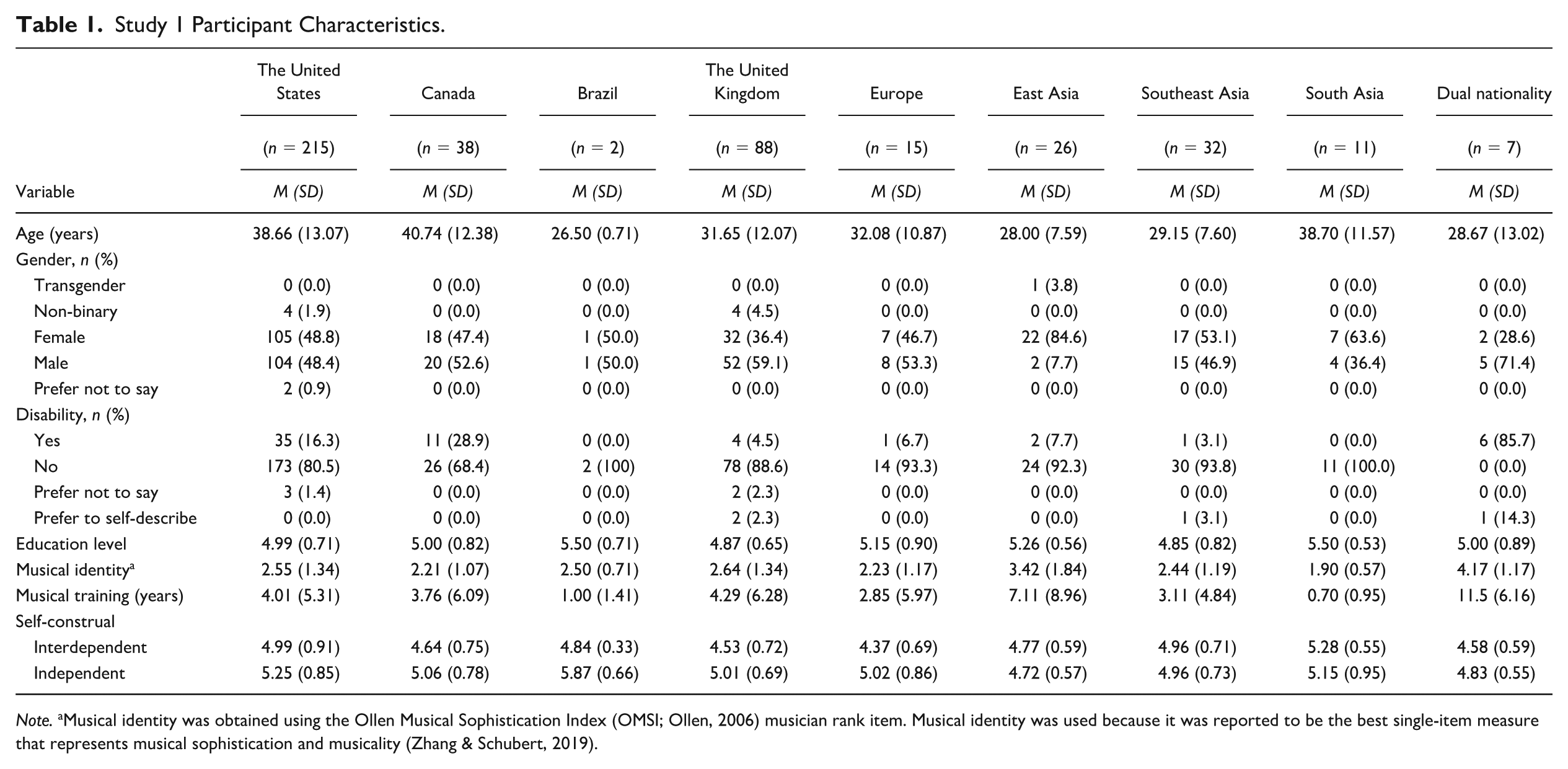
Note. aMusical identity was obtained using the Ollen Musical Sophistication Index (OMSI; Ollen, 2006) musician rank item. Musical identity was used because it was reported to be the best single-item measure that represents musical sophistication and musicality (Zhang & Schubert, 2019).
Participants’ chosen music spanned a broad range of styles, including folk, classical, rock (e.g., Japanese rock, funk rock, alternative rock, slow rock, hybrid rock), disco, country, pop (e.g., Spanish pop, Mando-pop, Canto-pop, K-pop), electronic dance music, rap, hip-hop, soul, Schlager, video game soundtracks, fusion, movie soundtracks, trance, show tunes, gospel, and contemporary Christian music. The distribution of musical styles was relatively consistent across regions, with a diverse representation in each. The United States displayed the greatest diversity of musical styles, while Brazil reported the fewest styles. Some regional variations were also noted. For instance, Mando-pop and Canto-pop were more commonly featured in East and Southeast Asia, while Anglophone pop music was reported across all regions. The full list of music titles and artists is available in the Supplementary Materials Appendix C.
Multilevel Regression Analysis
We conducted a multilevel regression analysis, using restricted maximum likelihood with Satterthwaite approximation for degrees of freedom, nesting participants within regions. We allowed the intercept by region to vary randomly. Regional means of interdependent and independent self-construal were calculated by averaging the respective self-construals of participants within each region. We did this to reflect between-region differences in self-construal (Level 2). Regional-mean-centered self-construals were calculated by subtracting the regional-means of interdependent and independent self-construals from each participant’s interdependent and independent self-construals, respectively. We did this to reflect each participant’s within-region variance in self-construal (Level 1). Given the relatively small number of regions (n = 9) and that some regions had a small sample size (i.e., n < 10), interdependent and independent self-construals were analyzed separately to minimize the risk of overfitting and type II error (false negative). Specifically, regional-mean and regional-mean-centered interdependent self-construals were entered as predictors of the frequency and intensity of the emotion types in Model 1, and regional-mean and regional-mean-centered independent self-construals were entered as predictors in Model 2.
Frequency of Emotion
In Model 1, the results showed that interdependent self-construal was not significantly associated with the frequency of all emotion types. This suggests that interdependent self-construal was not associated with the frequency of various emotion types perceived in favorite music between participants across different regions.
In Model 2, the results showed that only the regional-mean of independent self-construal was significantly associated with the frequency of negative socially disengaging emotions (b = 1.69, SE = 0.45, p = .004) and negative general emotions (b = 1.97, SE = 0.67, p = .017). There were no significant associations between independent self-construal and the frequency of the other emotion types. This suggests that between-region variation of independence, not within-region variation of independent self-construal, was positively associated with the frequency of negatively socially disengaging and negative general emotions perceived in favorite music (see Table 2).
Study 1 Multilevel Regression Analysis Results for Frequency of Emotion Types.
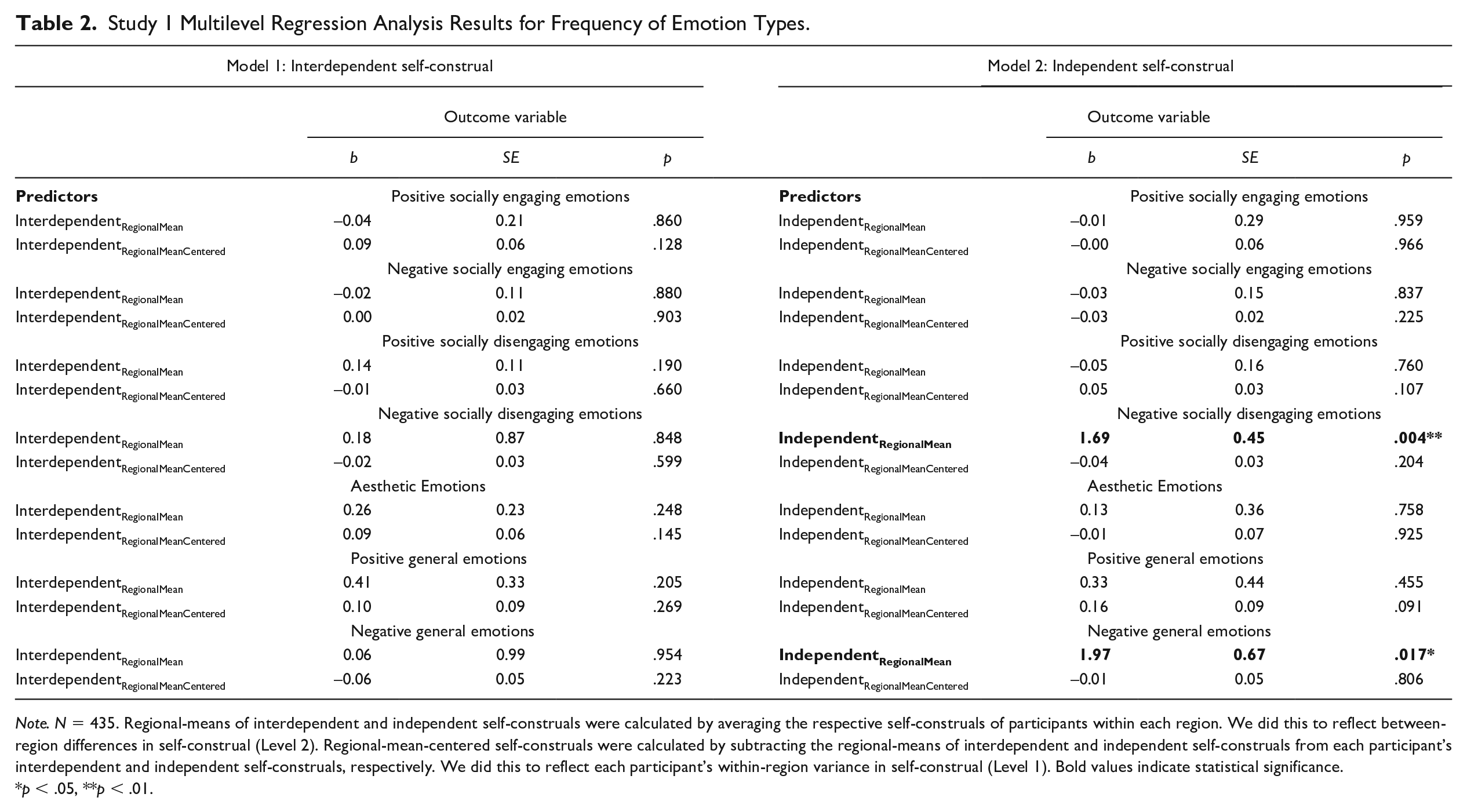
Note. N = 435. Regional-means of interdependent and independent self-construals were calculated by averaging the respective self-construals of participants within each region. We did this to reflect between-region differences in self-construal (Level 2). Regional-mean-centered self-construals were calculated by subtracting the regional-means of interdependent and independent self-construals from each participant’s interdependent and independent self-construals, respectively. We did this to reflect each participant’s within-region variance in self-construal (Level 1). Bold values indicate statistical significance.
p < .05, **p < .01.
Intensity of Emotion
In Model 1, the results showed that only the regional-mean-centered interdependent self-construal was significantly associated with the intensity of positive socially engaging emotions (b = 0.37, SE = 0.17, p = .030). There were no significant associations between interdependent self-construal and the intensity of the other emotion types. This suggests that within-region variation of interdependent self-construal, not between-region variation of interdependence, was positively associated with the intensity of positive socially engaging emotions perceived in favorite music.
In Model 2, the results showed that only the regional-mean-centered independent self-construal was significantly associated with the intensity of positive general emotions (b = 0.57, SE = 0.16, p < .001). There were no significant associations between independent self-construal and the intensity of the other emotion types. This suggests that within-region variation of independent self-construal, not between-region variation of independence, was positively associated with the intensity of positive general emotions perceived in favorite music (see Table 3).
Study 1 Multilevel Regression Analysis Results for Intensity of Emotion Types.
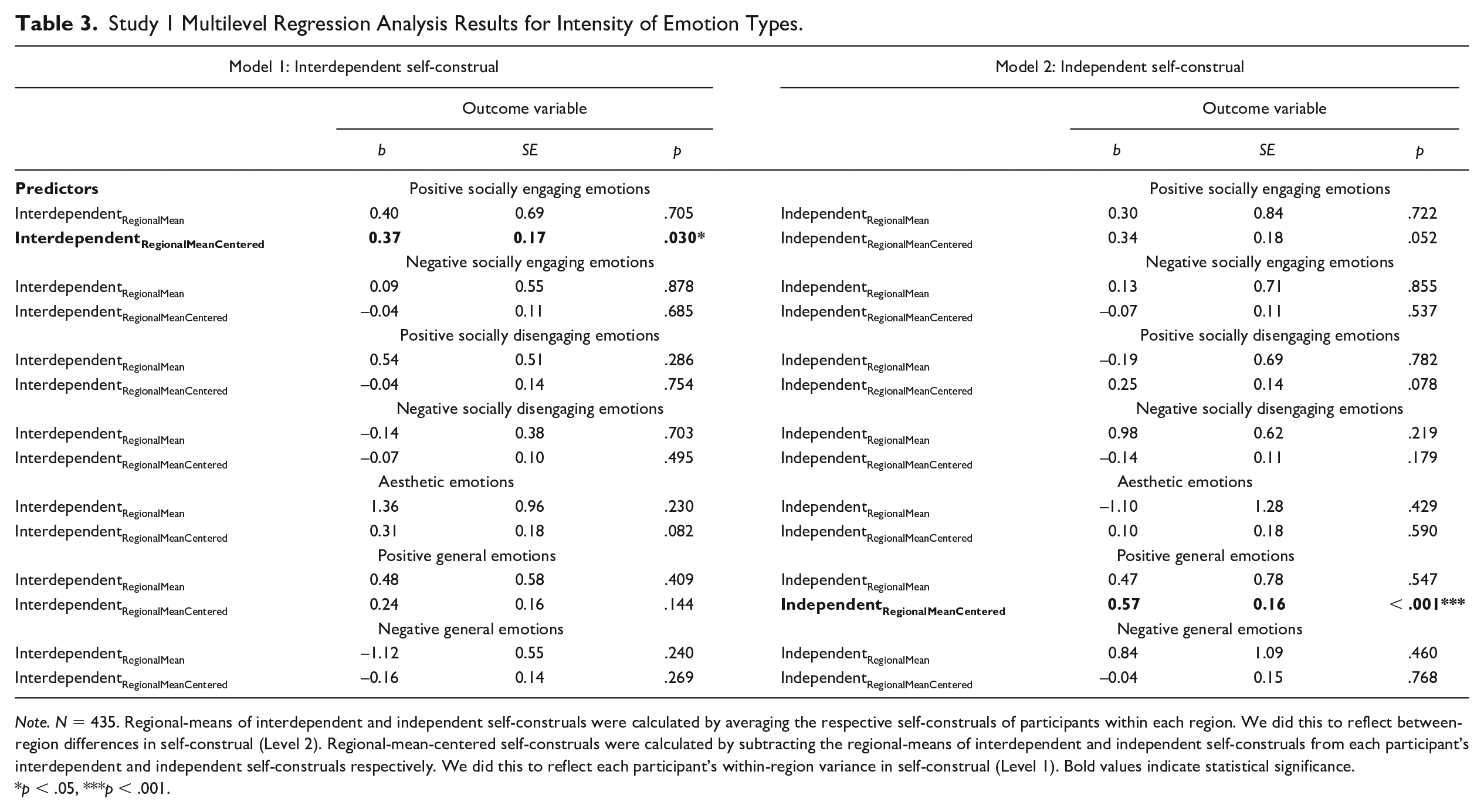
Note. N = 435. Regional-means of interdependent and independent self-construals were calculated by averaging the respective self-construals of participants within each region. We did this to reflect between-region differences in self-construal (Level 2). Regional-mean-centered self-construals were calculated by subtracting the regional-means of interdependent and independent self-construals from each participant’s interdependent and independent self-construals respectively. We did this to reflect each participant’s within-region variance in self-construal (Level 1). Bold values indicate statistical significance.
p < .05, ***p < .001.
Discussion of Study 1
Study 1 comprised an online questionnaire to investigate the role of self-construal in the perception of emotions expressed by favorite music across cultures. We found preliminary support for our hypotheses: independent self-construal was linked to the frequency of negative socially disengaging emotions, while interdependent self-construal was associated with the intensity of positive socially engaging emotions perceived in favorite music. These findings align with prior research showing that individuals from Western countries reported socially disengaging emotions more frequently in everyday contexts, whereas those from East Asian countries reported more intense socially engaging emotions (Boiger et al., 2013; Furukawa et al., 2012; Jakubanecs et al., 2019; Kitayama et al., 2000, 2006; Leu et al., 2010). Importantly, Study 1 extends previous between-country studies by highlighting that between-region variation in independence was positively associated with negative socially disengaging emotions in the music domain. This finding aligns with prior evidence that American Top-50 music featured more angry lyrics (Liew, Uchida, et al., 2023). In other words, individuals in independent or individualistic cultural contexts perceive more negative socially disengaging emotions (e.g., angry, disappointment, resentment) in their favorite music.
Unlike previous between-country studies investigating emotions in everyday contexts, we found that within-region variation of interdependent self-construal was positively linked to the intensity of positive socially engaging emotions perceived in music. This suggests that although individuals across regions may perceive socially engaging emotions in their favorite music, the intensity of these perceptions varies based on individual differences in interdependent self-construal. That is, individuals within any given culture with a more salient interdependent self-construal may exhibit heightened sensitivity to socially engaging emotions in their favorite music, as these emotions are instrumental in fostering collectivity and strengthening interpersonal relationships. This may be because music is crucial for social bonding across all cultures (Savage et al., 2021; Tarr et al., 2014; Trehub et al., 2015).
We also found that independent self-construal was associated with both negative and positive general emotions. Specifically, between-region variation of independence was positively associated with the frequency of negative general emotions perceived in favorite music. This implies that individuals in regions with higher levels of independence reported more frequent negative general emotions in their favorite music compared with regions with lower independence. One explanation may lie in cultural differences in emotion display rules, where individualistic cultures tend to view the expression of negative emotions as more appropriate than collectivistic cultures (Matsumoto, 1990). Another explanation may be drawn from popular music trends: recent studies have shown that lyrics in popular songs from Canada and the United States have become emotionally darker (i.e., fewer positive emotions and more negative emotions) in recent years (Blais-Rochette et al., 2022).
This study also revealed that within-region variation of independent self-construal was associated with the intensity of positive general emotions perceived in favorite music. This finding aligns with previous research showing that individuals with an independent self-construal tend to prefer high arousal positive states, such as excitement, enthusiasm, and elation (Kim et al., 2014; Tsai, 2007). Consequently, they are more likely to prefer people and activities that reflect this ideal affect (Bencharit et al., 2019; Sims et al., 2014; Tsai et al., 2019; Tsai, Louie, et al., 2007). For example, Tsai, Miao, et al. (2007) demonstrated that European Americans were more likely than Hong Kong Chinese participants to choose the CD featuring high arousal positive emotions, as depicted by its cover of a man surfing on a large wave and fictitious reviews emphasizing high energy and invigoration. While such studies show between-country differences, our findings indicate that within-region variation in independent self-construal plays a significant role too. Specifically, individuals across regions might perceive positive general emotions in their favorite music, but the intensity of these emotions may vary depending on their independent self-construal. Taken together, our findings underscore the nuanced role of cultural dimensions in shaping emotion perception of music within and between regional contexts.
Although this online study included a wide range of nationalities, we acknowledge that the unequal distribution of participants across regions is a limitation. In addition, these findings are contingent upon the participants’ ability to accurately recall their favorite music and the emotions it conveys, which introduces potential biases in memory and perception. Previous cross-cultural research in music psychology has utilized listening experiments to investigate emotion perception. Studies have shown that real-time music listening can influence the specificity and intensity of ratings across emotion categories (Fuentes-Sánchez et al., 2021, 2022; Kreutz et al., 2008). To address these limitations, we designed Study 2, incorporating a real-time listening task to better capture participants’ perception of emotions in their favorite music.
Study 2
For Study 2, we recruited participants from three countries and conducted a listening experiment to investigate the role of self-construal in the perception of emotions expressed by favorite music across cultures. The selected countries represent different positions on the collectivism-individualism spectrum, based on Hofstede et al.’s (2010) individualism index. Specifically, we selected China (scoring 20 on the index) to represent a collectivist culture and the United Kingdom (scoring 89) to represent an individualist culture. Singapore (also scoring 20) was included to capture a hybrid sociocultural context, reflecting both collectivistic and individualistic values.
Although Singapore shares the same score as China on Hofstede et al.’s (2010) individualism index, its culture embodies a mix of Eastern and Western values (Chang et al., 2003). Traditional Asian values are deeply ingrained in familial and social interactions, while Western influences permeate through formal education, legislation, and mass media (Ang & Stratton, 1995; Brooks & Wee, 2014; Ho, 2006; Sheehy, 2004; Tamney, 1996). Singapore’s Bilingual Education Policy further reinforces this hybrid sociocultural identity by ensuring that Singaporeans are proficient in both their mother tongue language (of their ethnicity) and English, facilitating the coexistence of Eastern and Western cultural influences (Dixon, 2005; Pakir, 1993). As such, Singapore presents a unique sociocultural context for comparison against China and the United Kingdom.
In this study, we examined whether self-construal mediated the relationship between country and the types of emotions perceived in favorite music, offering a nuanced perspective on how cultural contexts shape emotional experiences with music. Building on the results from Study 1, we hypothesized that interdependent self-construal would mediate the relationship between country and the perception of socially engaging emotions, while independent self-construal would mediate the relationship between country and the perception of socially disengaging emotions perceived in favorite music.
Method
Participants
Participants were recruited from the University of Sheffield in the United Kingdom, Henan University in China, and Singapore Management University in Singapore. Participants in the United Kingdom and Singapore were recruited using the institutional psychology subject pool system. In addition, publicity materials were distributed at the three universities through internal email communications, social media, and on campus bulletin boards. Participants either received course credit or cash vouchers (£5 in the United Kingdom, CN¥30 in China, or SG$5 in Singapore) as compensation for participating in this study. A total of 309 participants (102 participants residing in the United Kingdom, 107 in China, and 100 in Singapore) were included in the final analysis. Reported nationalities and ethnicities can be found in the Supplementary Materials Appendix D.
Materials
We used the same measures from Study 1 in Study 2. Cronbach’s alpha for the present study (all participants combined) was .73 and .76 for the interdependent and independent self-construal scales respectively.
Procedure
Prospective participants first registered their interest and indicated their favorite piece of music. Upon arrival at the lab, participants completed the informed consent form. Thereafter, participants listened to “Twinkle Twinkle Little Star” to ensure that volume levels were appropriate and the headphones were positioned comfortably. Once ready, the researcher instructed participants to pay attention to the emotions that they perceived their favorite music to be expressing and the emotions that they felt while listening to it. Participants then proceeded to listen to their favorite music on the relevant music streaming service (e.g., Spotify or QQ Music). During this listening task, participants were presented a screen with a prompt reminding them to pay attention to the emotions that they perceive their favorite music to be expressing and the emotions that they felt while listening to it. After listening to the music, participants chose all relevant emotions using the emotion checklist and rated the intensity of their selected emotions. Subsequently, they completed the SCS and demographic questions. The questionnaire was hosted by QualtricsXM and the entire listening experiment took approximately 30 min to complete.
Data Analysis
We conducted a mediation analysis to determine whether self-construal mediated the relationship between country and perceived emotions. For this study, we focused on the emotions that participants perceived their favorite music to express. The analysis of felt emotions will be presented in a separate forthcoming report. All analyses were conducted using SPSS®28.
Results
Demographic Characteristics
The one-way analysis of variance (ANOVA) showed that there was a statistically significant difference between countries regarding age, F(2, 304) = 5.81, p = .003, education level, F(2, 306) = 7.06, p = .001, musical identity, F(2, 306) = 202.68, p < .001, and musical training, F(2, 306) = 34.91, p < .001 (see Table 4). Post hoc analyses with Tukey’s HSD (using an α of .05) showed that, on average, participants in the China group were older than participants in the UK group, and that participants in the China group had higher education levels and musical expertise than both the UK and Singapore groups. This was expected because participants from China were mostly recruited from the music department.
Study 2 Participant Characteristics.
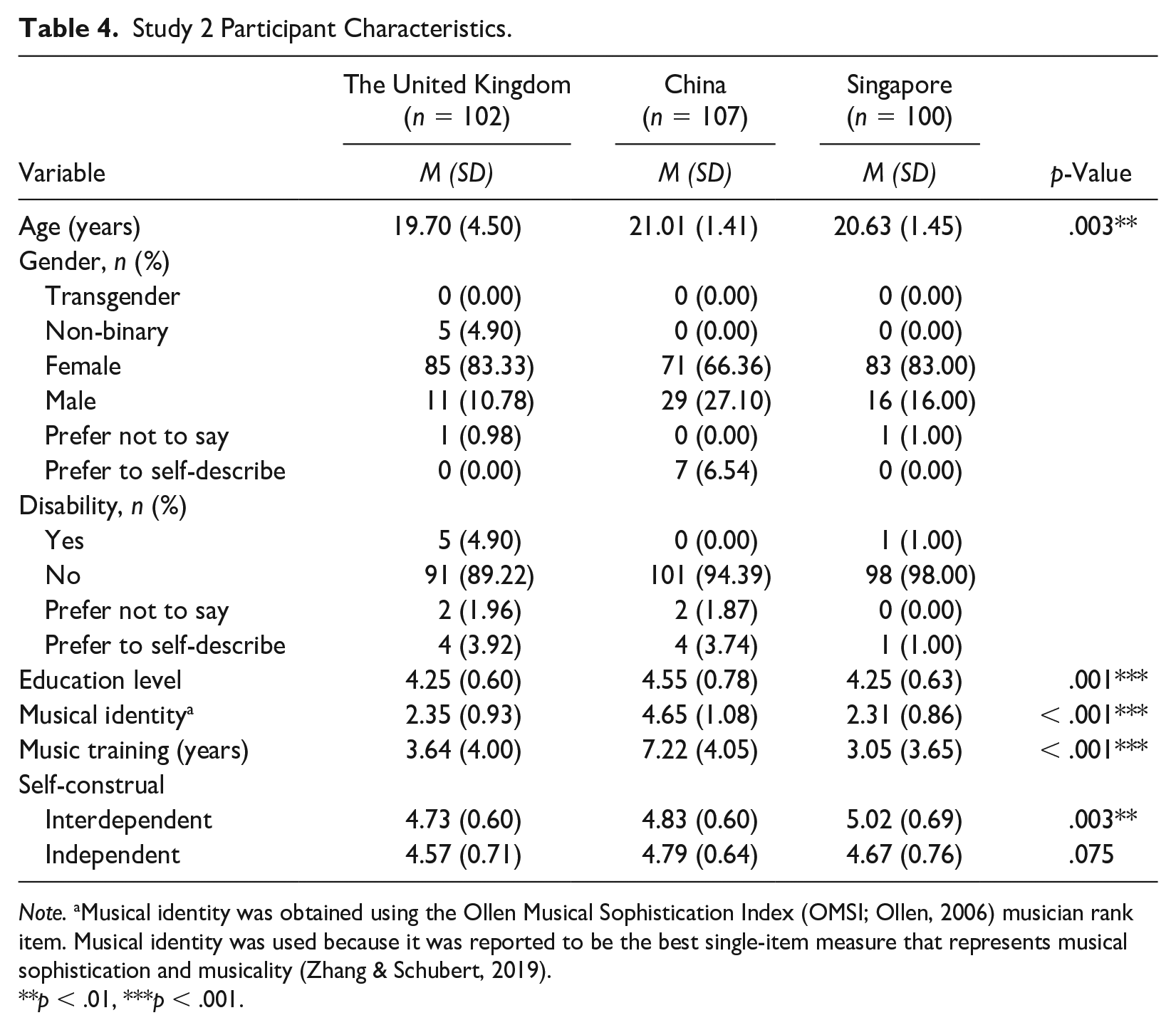
Note. aMusical identity was obtained using the Ollen Musical Sophistication Index (OMSI; Ollen, 2006) musician rank item. Musical identity was used because it was reported to be the best single-item measure that represents musical sophistication and musicality (Zhang & Schubert, 2019).
p < .01, ***p < .001.
The one-way ANOVA also showed that there was a statistically significant difference between countries in interdependent self-construal, F(2, 306) = 5.76, p = .003 (see Table 4). Post hoc analyses with Tukey’s HSD (using an α of .05) showed that, on average, participants in the Singapore group had higher interdependent self-construals than participants in the U.K. group. There were no significant differences in independent self-construal between countries, F(2, 306) = 2.61, p = .075. This aligns with prior research showing that individualism is rising in numerous countries around the world (Santos et al., 2017).
Participants’ chosen music encompassed a wide range of styles, including alternative, folk, indie, pop, classical, rap, hip-hop, R&B, and rock. A diverse array of musical styles was reported within each country. Consistent with Study 1, some variations were observed between countries: Chinese-pop, Mando-pop, and K-pop were only reported in China and Singapore, while Anglophone pop music was reported across all countries. The full list of music titles and artists is available in the Supplementary Materials Appendix E.
Role of Self-Construal Between Country and Perceived Emotions
We conducted a mediation analysis using Hayes’ (2017) PROCESS (v.4.2) Model 4 to assess whether self-construal mediated the relationship between country and perceived emotions. Country was entered as a multicategorical predictor using indicator coding (the United Kingdom was dummy coded as 0), interdependent and independent self-construals were entered as the mediators, and perceived emotions were entered as the outcome variable. Musical identity and musical training were transformed into a composite musical expertise score (i.e., musician rank item × years of musical training). Age, education level, and musical expertise, which significantly differed between countries, along with gender were included as covariates. Using an ordinary least squares (OLS) regression model, we first regressed the outcome variable onto both self-construals, along with the dummy-coded country variables and covariates. Mediation analyses were conducted only when significant direct effects emerged. All standard errors and confidence intervals were calculated on 5,000 bootstrapped iterations.
Frequency of Socially Engaging Emotions
The results showed that both interdependent self-construal, b = 0.25, t(298) = 2.67, p = .008, and independent self-construal, b = 0.17, t(298) = 2.05, p = .041, were significantly associated with the frequency of positive socially engaging emotions. The subsequent mediation analysis revealed a significant indirect effect of China-UK on the frequency of positive socially engaging emotions through interdependent self-construal (b = 0.05, SE = 0.0, 95% CI = [0.00, 0.12]) but not through independent self-construal (b = 0.02, SE = 0.02, 95% CI = [−0.01, 0.07]). Furthermore, the direct effect of China-UK on positive socially engaging emotions, after controlling for both self-construals, remained significant (b = −0.52, SE = 0.17, p = .002). Thus, interdependent self-construal partially mediated the differences in the frequency of positive socially engaging emotions between the China and UK sample.
Similarly, the results indicated a significant indirect effect of Singapore-UK on positive socially engaging emotions through interdependent self-construal (b = 0.07, SE = 0.03, 95% CI = [0.02, 0.15]) but not through independent self-construal (b = 0.01, SE = 0.02, 95% CI = [−0.02, 0.06]). However, the direct effect of Singapore-UK on positive socially engaging emotions, after controlling for both self-construals, was not significant (b = 0.09, SE = 0.15, p = .554). Therefore, interdependent self-construal fully mediated the differences in the frequency of positive socially engaging emotions between the Singapore and U.K. sample.
The results showed that both interdependent self-construal, b = −0.02, t(298) = −0.47, p = .639, and independent self-construal, b = 0.01, t(298) = 0.18, p = .858, were not significantly associated with the frequency of negative socially engaging emotions.
Frequency of Socially Disengaging Emotions
The results showed that both interdependent self-construal, b = 0.04, t(298) = 0.78, p = .439, and independent self-construal, b = 0.07, t(298) = 1.53, p = .127, were not significantly associated with the frequency of positive socially disengaging emotions. Similarly, the results showed that both interdependent self-construal, b = −0.08, t(298) = −1.79, p = .230, and independent self-construal, b = −0.05, t(298) = −1.20, p = .075, were not significantly associated with the frequency of negative socially disengaging emotions.
Frequency of Aesthetic Emotions
The results showed that independent self-construal, b = 0.31, t(298) = 3.77, p < .001, but not interdependent self-construal, b = 0.13, t(298) = 1.37, p = .172, was significantly associated with the frequency of aesthetic emotions. The subsequent mediation analysis indicated a non-significant indirect effect of China-UK on the frequency of aesthetic emotions through independent self-construal (b = 0.04, SE = 0.03, 95% CI = [−0.02, 0.12]). Similarly, the results showed a non-significant indirect effect of Singapore-UK on the frequency of aesthetic emotions through independent self-construal (b = 0.03, SE = 0.04, 95% CI = [−0.04, 0.10]). Thus, independent self-construal did not mediate the differences in the frequency of aesthetic emotions between the China and U.K. as well as Singapore and U.K. samples.
Frequency of General Emotions
The results showed that both interdependent self-construal, b = 0.08, t(298) = 0.54, p = .593, and independent self-construal, b = 0.22, t(298) = 1.69, p = .092, were not significantly associated with the frequency of positive general emotions. Similarly, the results showed that both interdependent self-construal, b = −0.13, t(298) = −1.51, p = .133, and independent self-construal, b = −0.04, t(298) = −0.50, p = .614, were not significantly associated with the frequency of negative general emotions. See Table 5 for the mediation analysis results for the frequency of perceived emotions.
Study 2 Mediation Analysis for Frequency of Emotions.
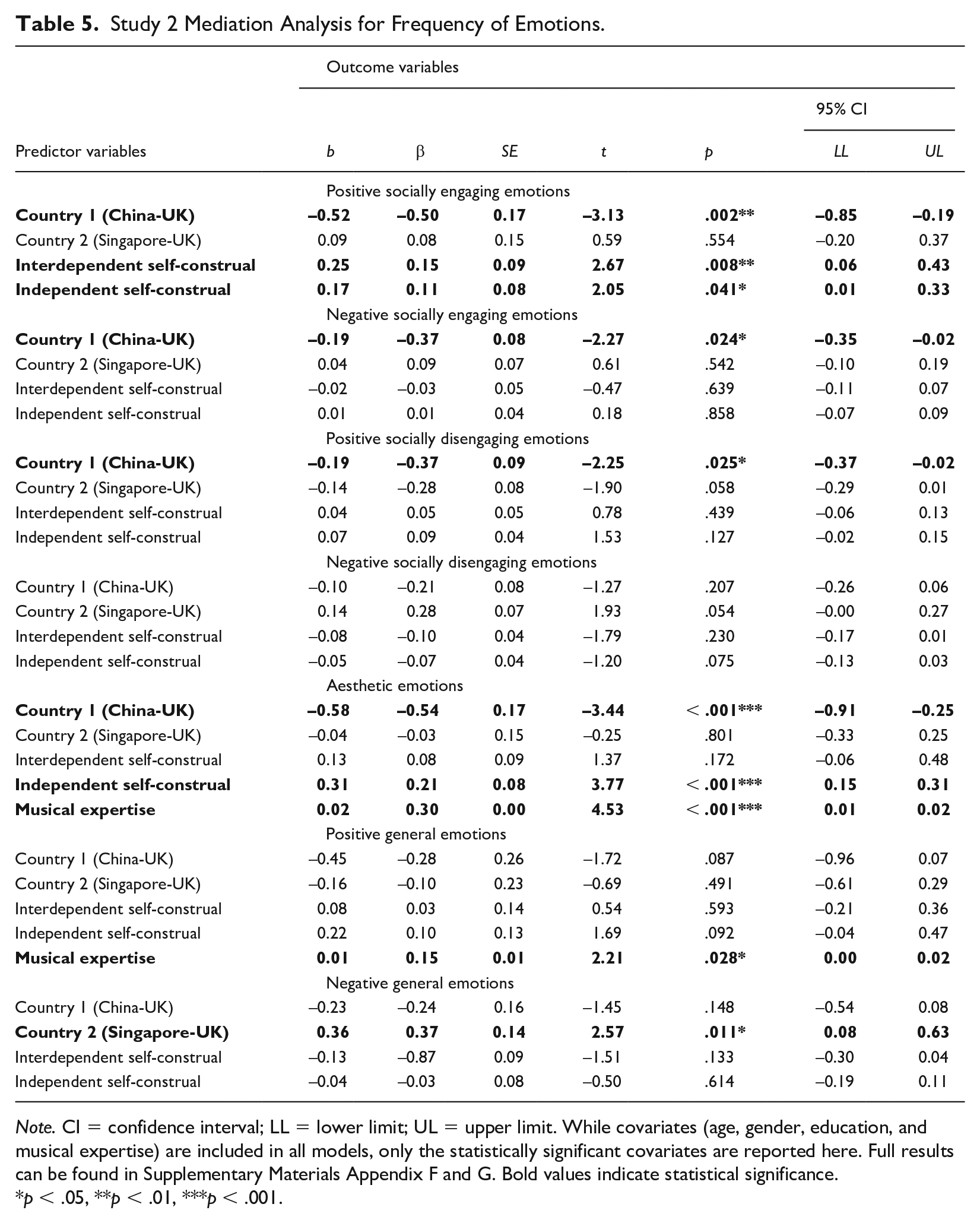
Note. CI = confidence interval; LL = lower limit; UL = upper limit. While covariates (age, gender, education, and musical expertise) are included in all models, only the statistically significant covariates are reported here. Full results can be found in Supplementary Materials Appendix F and G. Bold values indicate statistical significance.
p < .05, **p < .01, ***p < .001.
Intensity of Socially Engaging Emotions
The results showed that independent self-construal, b = 0.45, t(298) = 2.08, p = .039, but not interdependent self-construal, b = 0.41, t(298) = 1.70, p = .089, was significantly associated with the intensity of positive socially engaging emotions. The subsequent mediation analysis showed a non-significant indirect effect of China-UK on the intensity of positive socially engaging emotions through independent self-construal (b = 0.02, SE = 0.02, 95% CI = [−0.01, 0.07]). Similarly, the results revealed a non-significant indirect effect of Singapore-UK on the intensity of positive socially engaging emotions through independent self-construal (b = 0.01, SE = 0.02, 95% CI = [−0.02, 0.06]). Therefore, independent self-construal did not mediate the differences in the intensity of positive socially engaging emotions between the China and U.K. as well as Singapore and U.K. samples.
The results showed that interdependent self-construal, b = 0.03, t(298) = 0.15, p = .881, and independent self-construal, b = 0.15, t(298) = 0.85, p = .396, were not significantly associated with the intensity of negative socially engaging emotions.
Intensity of Socially Disengaging Emotions
The results showed that interdependent self-construal, b = 0.11, t(298) = 0.54, p = .593, and independent self-construal, b = 0.25, t(298) = 1.31, p = .191, were not significantly associated with the intensity of positive socially disengaging emotions. Similarly, the results showed that interdependent self-construal, b = –0.24, t(298) = −1.47, p = .142, and independent self-construal, b = −0.20, t(298) = −1.37, p = .170, were not significantly associated with the intensity of negative socially disengaging emotions.
Intensity of Aesthetic Emotions
The results showed that independent self-construal, b = 0.58, t(298) = 2.52, p = .012, but not interdependent self-construal, b = 0.22, t(298) = 0.85, p = .395, was significantly associated with the intensity of aesthetic emotions. The subsequent mediation analysis revealed a non-significant indirect effect of China-UK on the intensity of aesthetic emotions through independent self-construal (b = 0.03, SE = 0.02, 95% CI = [−0.01, 0.08]). Similarly, the results showed a non-significant indirect effect of Singapore-UK on the intensity of aesthetic emotions through independent self-construal (b = 0.02, SE = 0.02, 95% CI = [−0.03, 0.07]). Thus, independent self-construal did not mediate the differences in the intensity of aesthetic emotions between the China and U.K. as well as Singapore and U.K. samples.
Intensity of General Emotions
The results showed that interdependent self-construal, b = 0.25, t(298) = 0.99, p = .325, and independent self-construal, b = 0.29, t(298) = 1.31, p = .192, were not significantly associated with the intensity of positive general emotions. Similarly, the results showed that interdependent self-construal, b = −0.05, t(298) = −0.20, p = .843, and independent self-construal, b = −0.02, t(298) = −0.08, p = .935, were not significantly associated with the intensity of negative general emotions. See Table 6 for the mediation analysis results for the intensity of perceived emotions. The full mediation results can be found in Supplementary Materials Appendix F and G.
Study 2 Mediation Analysis for Intensity of Emotions.
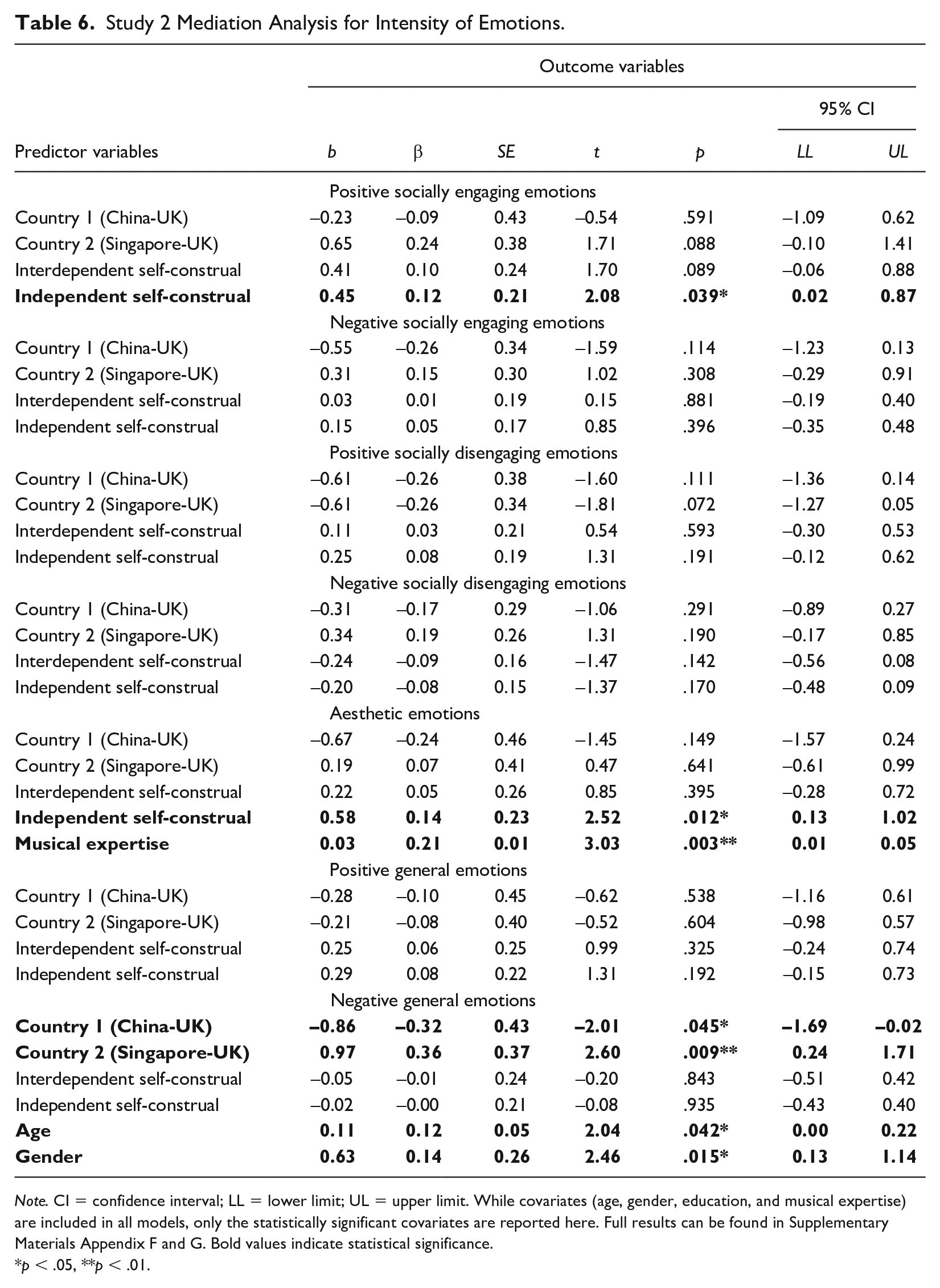
Note. CI = confidence interval; LL = lower limit; UL = upper limit. While covariates (age, gender, education, and musical expertise) are included in all models, only the statistically significant covariates are reported here. Full results can be found in Supplementary Materials Appendix F and G. Bold values indicate statistical significance.
p < .05, **p < .01.
Discussion of Study 2
Study 2 incorporated a listening experiment across three countries to investigate the role of self-construal in the perception of emotions expressed by favorite music across cultures. We found partial support for our hypotheses: only interdependent self-construal mediated the relationship between country and the frequency of positive socially engaging emotions perceived in favorite music. This mediation effect supports the notion that cultural contexts shape self-construal, which in turn influences both the music individuals prefer and the types of emotions they perceive in it (Markus & Kitayama, 1991, 2010; Tang, 2024). Our findings align with previous research showing that individuals from collectivistic cultures report socially engaging emotions more frequently in everyday contexts compared with those from individualistic cultures (Boiger et al., 2013; Furukawa et al., 2012; Jakubanecs et al., 2019; Kitayama et al., 2000, 2006; Leu et al., 2010). Unlike most studies, which operationalized collectivism and individualism by comparing East Asian and Western countries, this study highlights the positive relationship between interdependent self-construal and socially engaging emotions in the music domain.
Furthermore, the results revealed a significant positive correlation between interdependent self-construal and the frequency of positive socially engaging emotions, underscoring its impact on the emotion perception of favorite music across and within cultural contexts. Although cultural contexts may affect the types of music individuals have access to, the prevailing self-construal plays a crucial role in influencing the meaning-making processes individuals engage in as they listen to their preferred music. These processes ultimately shape the emotions they perceive. Specifically, interdependent self-construal, with its emphasis on intersubjectivity, likely enhances sensitivity to socially engaging emotions, affective states that promote social bonding.
Contrary to our hypothesis, independent self-construal did not mediate the relationship between country and socially disengaging emotions perceived in favorite music. Instead, our findings revealed that independent self-construal was significantly positively associated with the frequency and intensity of positive socially engaging emotions. These results diverge from previous research, which demonstrated that individuals from individualistic cultures reported more frequent and intense socially disengaging emotions than those from collectivistic cultures (Boiger et al., 2013; Furukawa et al., 2012; Jakubanecs et al., 2019; Kitayama et al., 2000, 2006; Leu et al., 2010). This discrepancy may stem from differences in the contexts in which emotions were examined. While prior studies focused on emotions in everyday social contexts, our research explored emotions within the music domain. It is plausible that participants in our study did not prefer music that conveys socially disengaging emotions.
A cursory review of participants’ reported favorite music titles and artists (see Supplementary Materials Appendix E) indicated that many songs featured themes of love and social connection. Examples include Lovers Forever by Benjamin Kheng, Always With Me (亲爱的旅人啊) by Zhou Shen (周深), and Miss Missing You by Fall Out Boy. These selections reflect broader trends in popular music, which showed that social connectedness words were more prevalent than self-focus or group-focus words in the lyrics of famous songs from Canada and the United States (Blais-Rochette et al., 2022). Furthermore, music is a complex stimulus, where lyrics may reflect both interdependent and independent self-construal. For instance, songs like When I Was Your Man by Bruno Mars, What I Miss (我怀念的) by Stefanie Sun (孙燕姿), and I Won’t Give Up by Jason Mraz explore themes of love while simultaneously emphasizing individual agency. These cursory findings suggest that participants’ preferred music choices, steeped in interdependent themes yet tinged with independent elements, may explain the observed association between independent self-construal and socially engaging emotions. This also implies that, while music preferences are often highly personal, individuals across cultural contexts may gravitate toward music that conveys socially engaging emotions (Boer & Fischer, 2012; Boer et al., 2012; Granot et al., 2021). Collectively, these findings support the idea that music is universally important for social cohesion (Savage et al., 2021; Tarr et al., 2014; Trehub et al., 2015). Future research could conduct a more thorough analysis of the participants’ reported favorite music, examining the relationship between musical elements (including lyrics) and self-construal.
Our study also showed that independent self-construal was significantly positively correlated with the frequency and intensity of aesthetic emotions perceived in favorite music. Aesthetic emotions are defined as discrete emotions that invariably entail an appreciation of the object being evaluated, such as music (Menninghaus et al., 2019). This conceptualization contrasts markedly with Asian aesthetics. For example, Japanese aesthetics eschew the concept of the subject and the need for transcendence, focusing instead on the experience hic et nunc (Sasaki, 2011). Similarly, Chinese aesthetics prioritize the moral and educational functions of music, emphasizing its role in fostering social harmony rather than valuing beauty as an isolated construct (J. Liu, 2013).
These differences suggest that current theorizing and understanding of aesthetic emotions in music are predominantly rooted in Western philosophical traditions and, by extension, Western models of emotions. Consequently, these emotions may align more closely with individualistic or independent models of self. Individuals with a stronger independent self-construal might focus more on their personal experiences with their favorite music, making them more sensitive to aesthetic experiences. They may also be more inclined to critically evaluate the music or express personal judgments about it. Conversely, individuals with a stronger interdependent self-construal may exhibit greater humility and be less inclined to pass personal judgment on another person’s work. Alternatively, they might base their aesthetic judgments on the reactions of others rather than relying solely on their perceptions. As participants in this study listened to their favorite music alone, they lacked the social cues from others that might typically inform their aesthetic judgments. This may explain the positive relationship between independent self-construal and the perception of aesthetic emotions in favorite music. Future research could explore this hypothesis further by comparing participants from other Western countries or independent cultures and conducting group listening experiments.
General Discussion
The central aim of this research was to investigate the role of self-construal in the perception of emotions expressed in favorite music across cultures. Through two studies, we examined whether self-construal, both within and between cultures, was associated with the frequency and intensity of emotions perceived in favorite music.
Our studies provided converging evidence of the association between interdependent self-construal and socially engaging emotions perceived in favorite music. In Study 1, within-region variation in interdependent self-construal was positively associated with the intensity of positive socially engaging emotions. Study 2 further demonstrated that interdependent self-construal not only directly influenced the frequency of positive socially engaging emotions but also mediated between-country differences in these emotions perceived when participants listened to their favorite music. Collectively, these findings extend previous cross-cultural research on emotions in two significant ways. First, they expand research from everyday emotional contexts to the music domain. Second, they move beyond cross-cultural comparisons between countries to emphasize the role of interdependent self-construal in shaping socially engaging emotions perceived in music. These results illustrate that positive socially engaging emotions—such as love, affection, and connectedness—are conveyed through individuals’ favorite music both within and across cultures, supporting music’s universal capacity to foster social bonds and bring people together (I. Cross, 2001; Savage et al., 2021; Tarr et al., 2014; Trehub et al., 2015).
Our studies provided limited evidence of an association between independent self-construal and socially disengaging emotions perceived in favorite music. In Study 1, between-region variation in independent self-construal was linked to the frequency of negative socially disengaging emotions. However, this association was not observed in Study 2. We propose that this discrepancy may be attributed to differences in methodologies. Study 1 asked participants to recall their favorite music and its associated emotions, likely encouraging them to reflect on general impressions. In contrast, Study 2 required participants to listen to their favorite music, which may have heightened their awareness of specific emotions conveyed in the music. Another possible explanation lies in the introspective nature of recalling memories and emotions, which inherently focuses on the individuals’ experience. This process might have unintentionally primed independent self-construals during Study 1, emphasizing personal affective responses to music. In Study 2, the real-time listening component may have shifted participants’ focus toward the music instead. These methodological differences may account for the inconsistent findings between the two studies.
We initially assumed that individuals with a more dominant independent self-construal would prefer music that emphasizes their personal subjective experience and individuality. However, across both studies, participants appeared to prefer music that highlighted their intersubjectivity and social connections. A cursory review of participants’ favorite music titles and artists from Study 1 (see Supplementary Materials Appendix C) revealed that their favorite music often reflected interdependent themes, similar to those observed in Study 2. Examples include Codinome Beija-Flor by Cazuza, Euphoria by BTS, and Can’t Help Falling in Love by Elvis Presley. That said, some participants’ musical selections potentially conveyed socially disengaging emotions, such as Dynamite by BTS, Speechless by Naomi Scott, I Am What I Am (我) by Leslie Cheung (张国荣), and My Way by Frank Sinatra. These choices indicate that socially disengaging emotions may be present but are not dominant in participants’ music preferences. Future research could conduct a more thorough analysis of participants’ favorite music, examining the prevalence of these emotions expressed in music. Future research could also directly investigate the relationship between independent self-construal and socially disengaging emotions by employing music stimuli that explicitly conveys (or are intended to convey) such emotions.
Our studies also revealed other significant associations. In Study 1, between-region variation in independence was linked to the frequency of negative general emotions, while within-region variation in independent self-construal was associated with the intensity of positive general emotions perceived in favorite music. Study 2, however, found a significant direct effect of independent self-construal on the frequency and intensity of aesthetic emotions. Similarly, we argue that this inconsistency may be explained by the different methods used in each study. Previous research has shown that although melodies tend to be better remembered than lyrics, lyrics serve as more effective cues for recalling specific music (Peynircioğlu et al., 2008). Consequently, it is possible that participants in Study 1 relied on lyrics to recall semantic knowledge about their favorite music. Furthermore, cultural differences in auditory processing may have influenced these results. For instance, Asians (Japanese and Filipinos) have been found to focus more on auditory context, whereas North Americans prioritize word meanings (Ishii et al., 2003, 2010; Kitayama & Ishii, 2002). Taken together, these findings suggest that participants with a more dominant independent self-construal, alongside the memory recall method that could have primed independent self-construal, might have used lyrics to recall and decode the emotions expressed by their favorite music, leading to the observed associations with positive and negative general emotions in Study 1. In contrast, participants in Study 2 listened to their favorite music, engaging with it as a holistic stimulus. This listening experience likely shifted their focus toward the music as a gestalt, potentially facilitating the perception of aesthetic emotions. This methodological difference may account for the observed association between independent self-construal and aesthetic emotions in Study 2. Future research could investigate this further by examining how self-construal influences the use of musical and lyrical cues in decoding musically expressed emotions. Such research could clarify whether these mechanisms vary across cultures and musical contexts.
Our findings raise several questions for future research. For instance, as music comprises a gestalt of multiple components (i.e., lyrics, melody, timbre, harmony, rhythm, tempo), how does self-construal, both between and within cultures, influence the use of these elements to decode musically expressed emotion? In addition, how might self-construal shape musicians’ use of these components to convey emotions through music across diverse cultural contexts?
One strength of our approach is that it extends previous cross-cultural research in music psychology regarding music preferences, functions of music, and perception of emotion in music, which has mostly compared individuals from different countries. By articulating specific psychological mechanisms, such as self-construal, our study goes beyond the influence of enculturation and familiarity with specific music cultures. This allows us to explore why and how people from different cultures perceive emotions in music. Furthermore, our inclusion of participants’ culturally relevant music, namely their favorite music which spans a wide array of styles, broadens the scope beyond classical music genres typically studied in cross-cultural music emotion research.
Another critical contribution is the inclusion of culturally informed models of emotions. Previous cross-cultural research in music psychology has predominantly adopted discrete (or basic) emotion models grounded in Western paradigms that conceptualize emotions as intrapsychic experiences. The preponderance of Western emotion models in cross-cultural research limits the exploration of cultural diversity in affective experiences with music. By employing culturally informed emotion models (i.e., interpersonal vs. intrapersonal), alongside culturally relevant music (i.e., favorite music) and specific cultural factors (i.e., self-construal), we were able to account for emotions recognized across both non-Western and Western cultures, such as socially engaging and socially disengaging emotions. This approach also allowed us to address both individual- and group-level cultural variations. For cross-cultural research in music psychology to thrive, we advocate that as researchers, we should make explicit our epistemological and ontological assumptions, and embrace both etic and emic theoretical perspectives. This balanced approach ensures a deeper understanding of the diversity and complexity of emotional experiences with music across cultures.
As this research examined cross-cultural differences in emotion perception through the lens of preferred music, our findings may also offer insights into why certain music become favorites. Two theories underpin the relationship between music preference and cultural identity (Boer et al., 2013). According to the identity expression theory, identity drives music preferences, whereby self-construal influences the music that individuals prefer. Our findings demonstrate that regardless of whether individuals exhibit dominant interdependent or independent self-construals, they tend to prefer music that conveys socially engaging emotions. This may reflect music’s universal role in facilitating social bonding (Savage et al., 2021; Tarr et al., 2014; Trehub et al., 2015), making music that expresses such emotions particularly appealing across cultures.
The identity construction theory, on the other hand, suggests that music preferences shape identity, meaning that individuals use music to construct and reinforce specific self-construals. However, our findings challenge this idea. If music preferences influenced self-construal, individuals with dominant independent self-construals would be expected to prefer music that conveys socially disengaging emotions, aligning with prior cross-cultural research. Yet, our results do not support this expectation. An important caveat lies in our focus on emotion perception rather than felt emotion. Previous research has shown that perceived and felt emotions do not always align (Evans & Schubert, 2008; Kawakami et al., 2013). Thus, it is possible that for individuals with independent self-construals, listening to music that conveys socially engaging emotions may paradoxically evoke socially disengaging emotions. In this case, music preference might shape self-construal not through the emotions conveyed by music, but through the emotions it induces. This poses an intriguing hypothesis for future research.
Even as we consider the strengths of our studies, we also acknowledge its limitations. First, the unequal distribution of participants across regions (Study 1) and the differences in age, education levels, and musical expertise between groups (Study 2), poses a limitation. Studies have shown that these factors may influence emotional responses to music to varying degrees (Di Mauro et al., 2018; Kawakami et al., 2013; Ladinig & Schellenberg, 2012; Pearce & Halpern, 2015; Vieillard et al., 2012). We included these demographic variables as covariates in Study 2, which minimized the impact of these limitations. Nevertheless, future research should aim to replicate our findings with more comparable samples across cultures to enhance the generalizability of the results. Second, our research examined cross-cultural differences in the perception of emotions using only a single favorite music selection. This choice was made due to practical constraints (i.e., questionnaire length) but may have limited our ability to detect differences. Also, the decision to use favorite music was grounded in prior evidence showing that personality and cultural identity were associated with music preferences (Dys et al., 2017; Huang et al., 2020; Marshall & Naumann, 2018; Rentfrow & Gosling, 2006). Consequently, an individual’s prevailing self-construal may be reflected in their favorite music and its expressed emotions. We acknowledge that certain musical features may inherently afford specific kinds of emotions, and so future research could standardize and utilize multiple music stimuli to systematically examine cross-cultural differences and similarities when perceiving different types of emotions in music. In addition, this article focused on the emotions that participants perceived in their favorite music. We acknowledge that distinguishing between perceived emotions (those recognized in the music) and felt emotions (those experienced while engaging with music) can be challenging. To address this issue, our studies explicitly emphasized this distinction to participants by using separate questions to assess perceived and felt emotions. This approach aimed to minimize ambiguity and ensure clarity in participants’ responses. Third, our study utilized a cross-sectional survey design, precluding causal inferences between self-construal and the perception of emotions in music. One plausible theoretical explanation for our findings is that individuals’ emotional experiences while recalling or listening to their favorite music might activate a particular self-construal. While we are unable to address this limitation within our current design, it would be prudent to suggest that self-construal and music experience influence each other, based on the notion that the self and cultural factors mutually constitute one another (Markus & Kitayama, 2010; Tang, 2024). This dynamic interaction more likely influences the emotions perceived when listening to music. Fourth, the categorization of emotions was determined a priori. While this approach provides a structured framework for analysis, we acknowledge that emotions are inherently nuanced within and between cultures, and may not neatly fit into discrete categories. Nonetheless, our findings underscore the value of incorporating culturally sensitive models of emotions in cross-cultural research, enabling a more nuanced understanding of how culture shapes emotional experiences.
In conclusion, our research highlights the importance of integrating specific cultural dimensions (i.e., self-construal) and embracing culturally informed emotion frameworks in cross-cultural explorations of emotion perception in music. Our findings suggest that different ways of engaging with music (i.e., recalling music in Study 1 and listening to music in Study 2) can influence the types of emotions perceived. These studies provide novel evidence of the role of self-construal in shaping emotion perception in music across and within cultures. Specifically, interdependent self-construal was consistently linked to positive socially engaging emotions in favorite music, while independent self-construal was associated with negative socially disengaging emotions. Independent self-construal was also associated with positive and negative general emotions, as well as aesthetic emotions. These results demonstrate that the cultural shaping of emotions in everyday contexts also extends to the music domain. In essence, our research reveals that our sense of self, specifically the degree to which we perceive ourselves as interconnected or distinct, influences both the frequency and intensity of emotions perceived in personally meaningful music. This research introduces a novel approach to cross-cultural investigations of emotion perception in music. By examining the role of self-construal, incorporating culturally relevant forms of music, and adopting culturally informed models of emotions, we contribute a more nuanced understanding of cultural diversity in music psychology.
Footnotes
Declaration of Conflicting Interests
The author(s) declared no potential conflicts of interest with respect to the research, authorship, and/or publication of this article.
Funding
The author(s) disclosed receipt of the following financial support for the research, authorship, and/or publication of this article: This work was supported by the Arts & Humanities Research Council (grant number AH/R012733/1) through the White Rose College of the Arts & Humanities. We thank Huanhuan Qin, Jiaqi Feng, Mengqi Ji, and Chi-Ying Cheng for assisting with the listening experiments. We are also grateful to Nikki Dibben, Renee Timmers, and the anonymous peer reviewers for their constructive feedback on earlier versions of this manuscript.
