




Abstract
This study used a person-centered approach to distinguish groups of bicultural (national and ethnocultural) individuals in culturally diverse Mauritius. We focused on experiences of harmony or conflict among blended bicultural individuals and used representative data from the three numerically largest ethnocultural groups (Hindus, Creoles, and Muslims; Ntotal = 1,768). Cluster analyses indicated three groups of individuals with different identity profiles: conflicted blends (50%), harmonious blends (41%), and low blends (9%). Conflicted compared with harmonious blends were more concerned about keeping their ethnic group distinct and about the societal recognition of cultural diversity. In addition, higher social distance vis-à-vis outgroups was found among conflicted blends compared with harmonious blends. The findings for the three identity profiles are discussed in relation to existing theories on bicultural identity, Mauritius’ approach to ethnocultural diversity, and the country’s three main ethnocultural groups.
Keywords
Increasing numbers of people find that the conflicts are not between different groups but between different cultural values, attitudes, and expectations within themselves.
Combining national and ethnocultural group membership in one’s sense of self often involves making choices and facing challenges (e.g., Berry, 1997; Bourhis et al., 1997). 1 It is likely that different groups of individuals exist regarding how they combine and experience the combination of their national and ethnocultural group membership. They might, for example, differ in the extent to which they blend both identities in their sense of self and how much they view both cultural identities as compatible (Benet-Martínez & Haritatos, 2005; Huynh et al., 2011; Miramontez et al., 2008; Schwartz et al., 2019). In this study, we aim to distinguish subgroups of individuals with different combinations of bicultural blendedness and compatibility to gain a further understanding of people’s bicultural identity experiences. 2
To this end, we use a person-centered approach which allows to identify and describe subgroups or “types” of people within a population. A person-centered approach “treats the individual as the unit of analysis by identifying subgroups of people who share a set of characteristics that differentiate them from other subgroups of people” (Osborne & Sibley, 2017, p. 289). Whereas a variable-centered approach focuses on separate variables and how they relate to each other, a person-centered approach can map the heterogeneity of a population. This approach has been used, for example, for examining intergroup attitudes (see Meeusen et al., 2018) and acculturation profiles (Capielo Rosario et al., 2019). We further examine the meaningfulness of distinguishing subgroups of bicultural individuals by investigating how these subgroups differ in their experience of their ethnocultural group membership, how they feel about other ethnocultural groups, and how they think cultural diversity should be approached within the broader society.
Research has emphasized the challenging and stressful experiences of bicultural identities but has also highlighted the beneficial outcomes it might have (see Verkuyten, 2018). For example, bicultural individuals might need to reconcile dual group loyalties, combine potentially contrasting norms and values, and might experience identity conflict (Chryssochoou & Lyons, 2011; Hirsh & Kang, 2016; Rudmin, 2003; Vivero & Jenkins, 1999). However, bicultural identity has also been found to be associated with relatively high well-being and psychological and sociocultural adjustment (Berry, 1997; Nguyen & Benet-Martínez, 2013). These different implications have been related to the broader societal context (Chryssochoou & Lyons, 2011; Huynh et al., 2011; Phinney & Devich-Navarro, 1997). In general, minorities in multicultural, settler societies (e.g., Canada, New Zealand, and the United States) tend to have more compatible national and ethnic identities, whereas in more culturally homogeneous, nonsettler societies (e.g., Germany and Norway) these two identities tend to be less compatible (Phinney et al., 2006). A bicultural sense of self seems easier to develop and maintain in multicultural societies due to the particular historical and sociopolitical context (see also Fleischmann & Phalet, 2016). However, this does not necessarily imply that in these societies a bicultural identity is subjectively harmonious and cannot be conflictual. As indicated in the quote above, also in a multicultural society people might be struggling with finding a balance between different expectations, behaviors, beliefs, norms, and values that are related to their belonging to the broader society and their ethnocultural group membership. Thus, even in relatively successful multicultural societies bicultural individuals might experience inner conflicts.
The current study examines this issue using nationally representative survey data from the three main ethnocultural groups (Hindus, Creoles, and Muslims) in Mauritius. Mauritius is a small and highly (ethnically, religiously, linguistically, culturally) diverse settler society in the Indian Ocean that does not have a native population. All ethnocultural groups are considered indispensable in the composition of the nation (“rainbow nation,” see also Sidanius et al., 2019) and the country has been described as a strong candidate for “truly successful polyethnic societies” (Eriksen, 2004, p. 79). Nevertheless, individuals can experience their national and ethnocultural belonging as challenging and intergroup tensions are not absent (Eriksen, 1998; Ng Tseung-Wong & Verkuyten, 2015b). As such, Mauritius forms a unique context for examining whether there are distinct subgroups of individuals regarding their feelings of harmony/conflict in their bicultural self-understanding, and whether these different groups have different evaluations of their ethnocultural group membership, different feelings toward ethnocultural outgroups, and different beliefs about plural Mauritian society.
Theoretical Approach
Harmonious and Conflicted Blendedness
People have multiple identities that can be combined in different ways. For example, bicultural individuals might consider one group membership as more important than the other (e.g., feeling more Chinese than American) or they may identify equally with both groups and alternate between them depending on the circumstances (e.g., feeling more Chinese in one situation and more American in another). Alternatively, bicultural individuals might understand themselves as being culturally mixed or blended (Chinese American; Benet-Martínez & Haritatos, 2005; Roccas & Brewer, 2002).
In general, the more people feel to be a mixture or blend of their nation and ethnocultural group, the more they are typically assumed to experience the combination of both cultures as harmonious rather than conflictual. 3 However, research has found correlations of nearly zero between feelings of cultural mixture and inner conflict (e.g., Benet-Martínez & Haritatos, 2005; Ward et al., 2018), suggesting that a blended bicultural sense of self can be experienced as comfortable and harmonious (living with two cultures) or as difficult and stressful (living between two cultures). Thus, there might not only be individuals with a harmonious blended bicultural identity, but also with a more conflicted form of bicultural blendedness. We expect to be able to distinguish these two subgroups of blended bicultural individuals, while exploring the possibility that there are also individuals with non-blended self-understandings (e.g., alternating bicultural or monocultural).
Characterizing Harmonious and Conflicted Blended Identities
In addition to empirically identifying subgroups, or types, of individuals with harmonious blended identities and conflicted blended identities, it is important to examine whether these subgroups differ on several key characteristics. In this way, the validity of the subgroup distinction can be further examined and the understanding of different forms of blended self-understandings improved. In this study, we focus on the degree to which people wish to express their ethnocultural group membership as a way of validating different forms of bicultural blendedness. Following existing research, we focus on correlates in (a) the psychological domain by investigating the feeling of positive distinctiveness that one’s ethnocultural group membership can give; (b) the intergroup domain by examining ethnocultural threat, social distance, and support for collective action; and (c) the societal domain by investigating the endorsements of different types of multiculturalism. In general, we expect the subgroup of individuals with a conflicted, compared with a harmonious, blended identity to be more concerned about the continuity and position of their ethnocultural group and to be less positive about other groups and societal diversity. The main reason is that research on ethnic socialization and enculturation (Hughes et al., 2006) indicates that from early on children have ethnic socialization experiences within their family and ethnocultural community. The ethnocultural community tends to have a primary meaning for people’s sense of self. This makes the ethnic culture and one’s ethnic group belonging a familiar and secure frame of reference, especially for those who have difficulties in combining different cultural identities.
Regarding the psychological domain and according to social identity theory, individuals strive to achieve and maintain a sense of positive distinctiveness (Tajfel & Turner, 1979), that is, a positive sense of self and a feeling of being distinct from others (Vignoles, 2011). Ethnocultural group membership can contribute to having a sense of positive distinctiveness. At the same time, national group membership generally concerns perceiving those who would otherwise be classified as ethnocultural outgroup members, as common ingroup members. When people feel that a superordinate identity compromises valued subgroup identities, they tend to emphasize their subgroup identity (see, e.g., Hornsey & Hogg, 2000). Similarly, we expect that conflicted blends derive more positive distinctiveness from their ethnocultural group compared with harmonious blends (Hypothesis 1 [H1]).
In the intergroup domain, concerns about the positive distinctiveness of one’s ethnocultural group might relate to a higher sensitivity to ethnocultural threat. Especially when this threat originates from other groups that are part of the nation, feelings of conflict are likely to arise. After all, people want their group to be accepted and treated fairly by others, and the more so if these others belong to a common ingroup (Tajfel & Turner, 1979). In line with this, higher perceived ethnic discrimination has been found to relate to higher feelings of national and ethnocultural identity conflict (Benet-Martínez & Haritatos, 2005; Fleischmann & Phalet, 2016; Huynh, 2009). Therefore, we expect that a higher level of perceived threat toward one’s ethnocultural group characterizes conflicted blends more than harmonious blends (Hypothesis 2a [H2a]).
Forms of bicultural identity might also relate differently to social distance toward ethnocultural outgroups. The dual identity model of intergroup relations theorizes that other groups will be evaluated relatively positively when people have a dual identity (Dovidio et al., 2007). Dual identifiers perceive members of other groups as part of a shared superordinate category, while simultaneously being able to value their subordinate group membership. The implicit assumption in this model seems to be that bicultural individuals feel comfortable with being a member of both groups, as with harmonious blends. However, when a dual identity goes together with feelings of insecurity and conflict, outgroup rejection is more likely as a way of protecting the ethnocultural ingroup (Hornsey & Hogg, 2000). Therefore, we expect that higher social distance vis-à-vis ethnocultural outgroups characterizes conflicted blends compared with harmonious blends (Hypothesis 2b [H2b]).
On the behavioral intention level, individuals can participate in forms of collective action that aim to enhance the position and status of their ethnocultural group as a whole (e.g., Tajfel & Turner, 1979; Wright, 2001). Research shows that bicultural identifiers are more likely to support such collective action, because they feel that their ethnocultural group should be treated equally and fairly, and their national identification makes them feel entitled to make group claims and act collectively (e.g., Simon & Grabow, 2010; Simon & Ruhs, 2008). Willingness to participate in collective action requires that people feel comfortable with both group belongings and this willingness is less likely when a bicultural identity goes together with feelings of inner conflict and uncertainty (Simon et al., 2013). Therefore, we expect that lower willingness to participate in collective action on behalf of their ethnocultural group characterizes conflicted blends more compared with harmonious blends (Hypothesis 2c [H2c]).
In the societal domain, different forms of multiculturalism have been distinguished and proposed as ways of dealing with multiple identities (Hartmann & Gerteis, 2005). So-called “fragmented pluralism,” for example, can be visualized with an image in which a relatively weak national community encompasses relatively strong subgroups and as focusing on making these subgroups thrive according to their own values and traditions. In contrast, “interactive pluralism” (or “interculturalism,” Meer & Modood, 2012) not only emphasizes clearly defined subgroups but also a strongly defined shared national community. Like fragmented pluralism, it supports ethnocultural group maintenance but additionally emphasizes the importance of cross-cultural dialogue and mutual recognition. The interactive aspect of interactive pluralism with its possibilities of change might be perceived as subgroup threatening because it risks the blurring of boundaries between ethnocultural communities. Because the subgroup of individuals with a conflicted blended identity are likely to be more concerned about ethnocultural distinctiveness, we expect these individuals to be more supportive of fragmented pluralism (Hypothesis 3a [H3a]) and less supportive of interactive pluralism (Hypothesis 3b [H3b]), than those with a harmonious bicultural identity.
Bicultural Identities in Mauritius
In Mauritius, diverse ethnocultural groups are perceived as being intrinsic parts of the nation and dual identities are represented as the national ideal (Ng Tseung-Wong & Verkuyten, 2013). The most common images of Mauritian society are those of a “rainbow” and a “fruit salad”: a unified nation in which separate ethnocultural groups can be distinguished like the separate colors in a rainbow or the separate fruits in a salad bowl. Group-specific cultural celebrations and events are recognized as public holidays and various cultural centers, trust funds, and language speaking unions exist (e.g., the Islamic Cultural Center and the Tamil Speaking Union). As a result, it is claimed that the “co-existence among Mauritians of Indian, African, European and Chinese ancestry has led to a sharing of cultures and values, a collective participation in festivals and increased understanding between people of different backgrounds” (Government of Mauritius, 2014, para. 1). At the same time, keeping the ethnocultural groups distinguishable from each other is considered important. For example, an Archbishop of Mauritius argued that “the colors of the Mauritian rainbow had to be kept separate ‘for the arc-en-ciel to remain beautiful’” (in Eriksen, 1997, p. 177). In line with this, intimate social relationships, especially marriage, tend to be within the boundaries of one’s ethnocultural community (Nave, 2000; Ng Tseung-Wong & Verkuyten, 2015a) and “mixed” children tend to take on the ethnocultural identity of only one of the parents (Nave, 2000).
In line with the discourse of national unity amid ethnocultural diversity, high levels of national and ethnocultural identification as well as a positive correlation between both have been found (Ng Tseung-Wong & Verkuyten, 2010). Bicultural identification is common among Mauritians (Ward et al., 2018) and being “only Mauritian” is sometimes perceived as problematic (Ng Tseung-Wong & Verkuyten, 2013). However, ethnocultural identification tends to be stronger than national identification (Ng Tseung-Wong & Verkuyten, 2010) and ethnocultural group tensions and negative group stereotypes are not uncommon (e.g., Boswell, 2006; Eriksen, 1998). Thus, although it can be expected that most people consider themselves a bicultural blend, this blended identity does not have to be harmonious and might be experienced as conflictual. Furthermore, even in a society as Mauritius there might be a subgroup of individuals that does not have a sense of self that involves a mixture of their ethnocultural and national group (see also Phinney & Devich-Navarro, 1997; Roccas & Brewer, 2002).
An additional question is to what extent different bicultural identities are characterized by similar proportions of individuals from different ethnocultural groups in Mauritius. The three numerically largest ethnocultural groups are Hindus (around 50% of the population), Creoles (around 25%), and Muslims (around 17%). 4 Creoles are the most marginalized group in Mauritius. They face more negative stereotypes, have a lower status in Mauritian society, and have benefited the least from the government’s diasporic approach to multiculturalism (Boswell, 2004; Eisenlohr, 2006; Eriksen, 2004). 5 Therefore, we expect that fewer Creoles, compared with Hindus and Muslims, will have a harmonious blended bicultural identity (Hypothesis 4 [H4]). While examining this, we will control for education, age, and gender.
Data and Methods
Data
Data for this study were collected by research agency De Chazal Du Mée (DCDM) Research 6 between February and August 2016. We developed the questionnaire and DCDM Research set quota to recruit a representative sample of the population aged 18 years and older in terms of ethnocultural background (limited to Hindus, Creoles, and Muslims), region, socioeconomic class, gender, and age. 7 Based on our instructions and guidelines, DCDM trained the interviewers for a full day and after the training the interviewers went door-by-door to recruit respondents and interviewed maximum one individual per household who fitted the quota given to them. Each interview was administered face-to-face to gain trust of the respondents for the relatively sensitive topics of views on Mauritian society and its different groups. 8 Interviewers were not informed about the study’s hypotheses. An interview took, on average, 1 hr and was conducted in the language of the respondent’s preference (English, Creole, or French) to facilitate the understanding of the questions. Participants were not compensated for their participation.
Regarding the variables of interest for this study, there were only two cases with missing data for the control variable education. These two cases were excluded from the data set, resulting in information about 1,768 people (43% Hindus, 29% Creoles, 28% Muslims; Mage = 42.1 years, SDage = 15.3; 51% females, 49% males; mode of highest level of completed education: secondary school [61%]).
Measures
Unless indicated otherwise, the items used in this study were measured on a 5-point disagree–agree scale. For all scales, we inspected the results of principal component and reliability analyses and, based on these, computed average sum score variables. The means and standard deviations of these average sum score variables are given between brackets.
The measure of bicultural blendedness concerned three items of the hybrid identity style scale which has been validated in Mauritius (Ward et al., 2018). Respondents’ (dis)agreement was asked with the statements, “I am a blend of [ethnocultural group] and Mauritian,” “I see myself as a cultural mixture of [ethnocultural group] and Mauritian,” and “I am a ‘mélange’ of Mauritian and [ethnocultural group].” The items formed a reliable scale (Cronbach’s α = .79) and loaded on a single component (component loadings λ .81 ≤ .85; M = 4.57, SD = .87).
The measure of bicultural conflict/harmony was similar to the conflict items of the bicultural identity integration scale (Benet-Martínez & Haritatos, 2005; see also Ward et al., 2018) and concerned the items “I am conflicted between the Mauritian and [ethnocultural group] ways of doing things,” “I feel caught between the [ethnocultural group] and Mauritian cultures,” and “I feel that it is very difficult to move between these two cultures” (λ .71 ≤ .82; M = 2.89, SD = 1.29). Cronbach’s α for this three-item scale was .65 which is not unusual with a small number of items (Briggs & Cheek, 1986; see also Ward et al., 2018). In line with previous research (e.g., Benet-Martínez & Haritatos, 2005; Ward et al., 2018), blendedness and conflict were very weakly correlated with each other (r = .08, p = .001).
Positive distinctiveness based on one’s ethnocultural group membership was measured with two items about distinctiveness, “Being [ethnocultural group member] gives me the feeling that I am different from other people in the world” and “Being [ethnocultural group member] gives me the feeling that I am special,” and two items about positive feelings “Being [ethnocultural group] makes me feel positive about myself” and “Being [ethnocultural group] makes me feel proud” (see Smeekes & Verkuyten, 2013; λ .74 ≤ .79). The four items formed a reliable scale (α = .73; M = 3.90; SD = 1.08).
Perceived group threat was measured with six items with the following four loading well on a single component: “I am afraid that other groups will have more rights in society than people of my ethnic group,” “I fear that other groups have more political power than people from my group,” “I am sometimes afraid that the distinctive culture of my ethnic group is undermined by other groups,” and “I have the impression that other groups will take away jobs from people from my group” (λ .75 ≤ .89; α = .86; M = 3.39, SD = 1.38). The items “I am worried that the ancestral language of my ethnic group is going to disappear slowly but surely,” and “I sometimes feel that other group in Mauritius go against the core values and beliefs of my ethnic group” did not load well on this component (λ < .6) and were therefore not considered in the analysis (see Table A in the Online Appendix for the results of the analysis with all six items).
Social distance was measured by asking how unacceptable or acceptable certain forms of intergroup contact are (1 = acceptable, 5 = unacceptable; after reversing the codes). Six forms of contact were included in a principal component analysis, with the following four loading on a single component: “working alongside people from other ethnic groups than your own,” “running a business together with people from other ethnic groups,” “living in a neighborhood with many people from other ethnic groups,” and “going to clubs or organizations attended by many people from other ethnic groups” (λ .73 ≤ .80; α = .76; M = 1.64, SD = .87). The other two items on intermarriage loaded on another component and were not considered further (see Table B in the Online Appendix for the results of the analysis with all six items). 9
Willingness to participate in collective action was measured by the items “How likely is it that you would sign a petition against discrimination if you felt that people from your own ethnic group or religion were discriminated against?,” “ . . . would donate money for an anti-discrimination campaign if you felt that people from your own ethnic group or religion were discriminated against?,” and “. . . would hold a peaceful march to protest against discrimination if you felt that people from your own ethnic group or religion were discriminated against?” (λ .78 ≤ .82; 1 = unlikely, 5 = likely; α = .72; M = 3.83, SD = 1.07).
For the societal domain, participants were presented with the following introduction: “For achieving or maintaining harmonious ethnic diversity in Mauritius, how important are the following aspects, according to you?” For the seven items, there were two components that had an Eigenvalue higher than one (30.7% of the variance and 23.6% of the variance, respectively). The components could be interpreted as fragmented and interactive pluralism. Items mainly loading on fragmented pluralism (λ .60 ≤ .74; λinteractive_pluralism −.27 ≤ .17) were “people not marrying outside of their ethnic group,” “each ethnic group having their own language newspapers and TV programs,” “parents being able to raise their children according to their own ethnic culture,” and “each ethnic group having their own political representatives” (α = .63; M = 3.45, SD = 1.10). Items mainly loading on interactive pluralism (λ .67 ≤ .81; λfragmented_pluralism −.15 ≤ .20) were “promoting the celebration of religious and ethnically-specific festivals and holidays such as Diwali, Eid, Easter, and Chinese New Year among all citizens,” “learning in schools about the specific histories of all group,” and “having classes related to diversity of ethnic groups as part of the school curriculum” (α = .64; M = 4.54, SD = .82).
For ethnocultural group membership, three dummies were used based on people’s self-labeling: Hindu, Creole, and Muslim. Taking into account potential sociodemographic group differences, we controlled for age (in years), gender (0 = men, 1 = women), and education. Highest level of education was measured on a 5-point scale—none (1), primary school (2), secondary school (3), undergraduate degree (4), and postgraduate degree (5)—and the variable was treated as an interval variable.
Analytical Approach
In the first part of the analyses, we investigated whether a subgroup of harmonious blended biculturals and a subgroup of conflicted blended biculturals could be identified, and also if there were other subgroups of individuals. To this end, we used a person-centered approach by performing k-means cluster analyses in SPSS 24. We estimated clusters based on two variables: the average sum score for bicultural blendedness and the average sum score for bicultural conflict. With k-means cluster analysis respondents were grouped together in clusters and we used the Euclidian distance measure (IBM, n.d.) to estimate one to seven-means cluster models and to identify the best fitting one. 10 Each analysis initially selected the N cases that were farthest apart as cluster centers, based on their values of the two clustering variables, and the other cases were assigned to the nearest center (IBM, n.d.). That is, for a two-means cluster analysis the values of the two cases that were farthest apart on the bicultural blendedness and conflict variables were used as initial cluster centers and the other cases were assigned to the cluster center they were closest to. To find the best fitting clustering of respondents into the specified number of clusters, the analysis recalculated the cluster centers until either minimal improvement of the model or the maximum number of iterations was reached. For each final solution, the averages of both clustering variables were computed per cluster as well as all distances between each case and the center of the cluster the case had been assigned to.
To evaluate the optimal number of clusters, we created a scree plot with the average distances between cases and their cluster centers, examined so-called “elbow points” for the statistically optimal solution (Trevino, 2016), and considered the theoretical interpretation of the clusters. After establishing the most appropriate model, cluster membership was saved for each respondent and used in the second part of the analyses, where we examined whether individuals in the identified clusters differ on the various correlates. To this end, we performed multinomial regression analyses. First, we estimated a model with the correlates in the psychological, intergroup, and societal domain and in a second model we added ethnocultural group membership and the control variables.
Results
Bicultural Identity Clusters
According to the k-means cluster analysis, the optimal number of clusters that could be identified was three. The average distance between cases and their cluster centers decreased relatively sharply between the two- and three-means cluster solutions while it remained relatively stable afterward; the elbow point was at three clusters (see Figure A in the Online Appendix). Moreover, the three-means cluster solution made sense theoretically.
The two largest clusters consisted of individuals who scored highly on bicultural blendedness (91% of all respondents) and could, as expected, be further divided in conflicted and harmonious blends (see Table 1). Fifty percent of the full sample scored highly on blendedness and average to highly on feeling conflicted between both group memberships (conflicted blends), and 41% scored highly on blendedness and had rather low scores for conflict (harmonious blends). 11 One other cluster was found and consisted of individuals who had relatively low scores for blendedness and low to slightly high scores for conflict (9% of all respondents; low blends).
Results From a Three-Cluster Model of Bicultural Identities (N = 1,768).
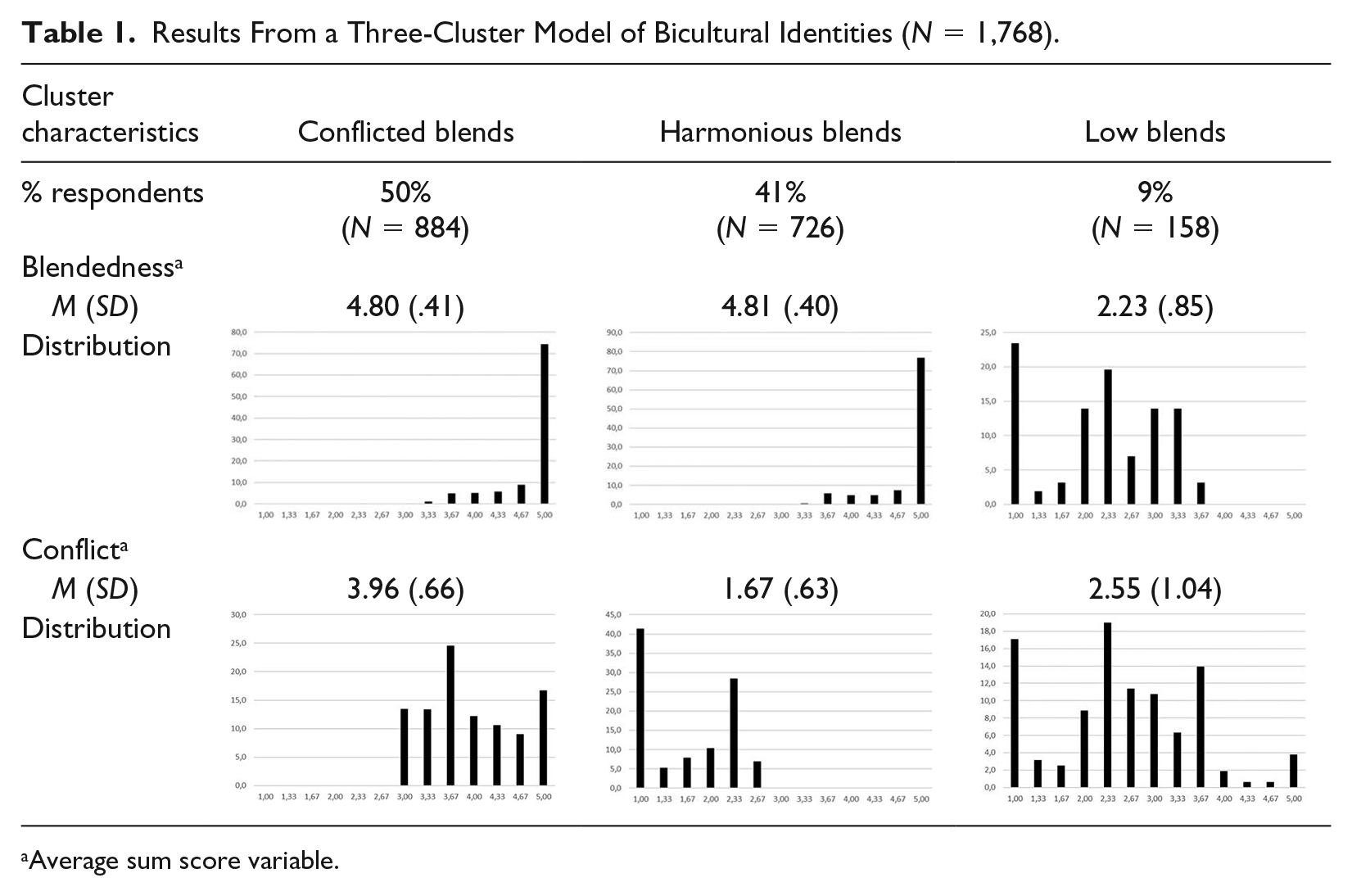
Average sum score variable.
Characterizing Bicultural Identities
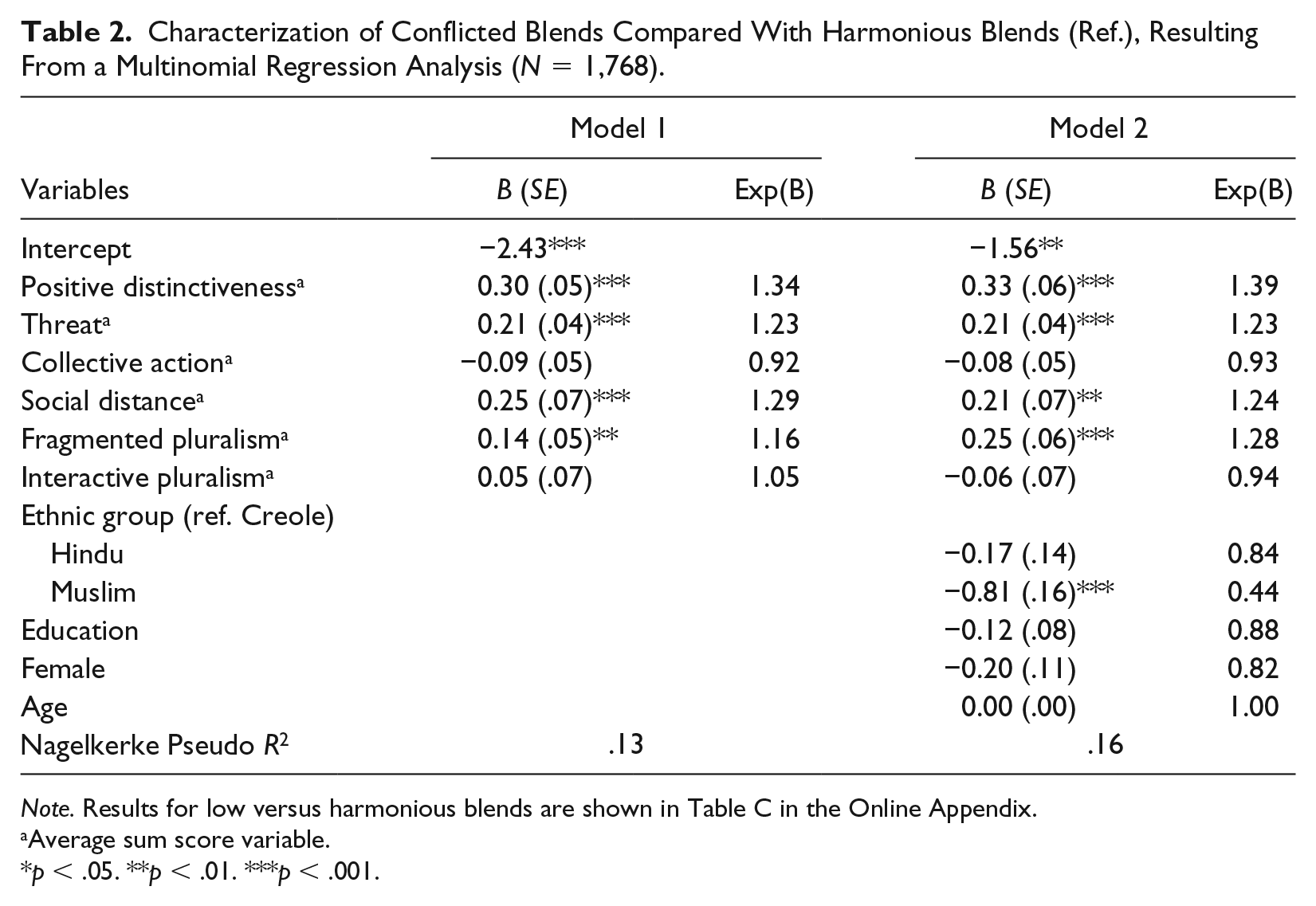
To characterize the harmonious versus conflicted blended identity clusters, we used multinomial regression models (Table 2). The correlations between the different “predictors” did not exceed .41 (for the variables positive distinctiveness and fragmented pluralism, p < .001), which indicates that there was no problem of multicollinearity.
Characterization of Conflicted Blends Compared With Harmonious Blends (Ref.), Resulting From a Multinomial Regression Analysis (N = 1,768).
Note. Results for low versus harmonious blends are shown in Table C in the Online Appendix.
Average sum score variable.
p < .05. **p < .01. ***p < .001.
Regarding the characterization of the subgroup of individuals with a conflicted rather than harmonious blended bicultural identity, we found, in line with the expectations, that conflicted blends were characterized by higher levels of positive distinctiveness based on their ethnocultural group (H1), higher levels of perceived ethnocultural threat (H2a), higher social distance (H2b), and stronger endorsement of fragmented pluralism (H3a). However, no significant differences were found between the two subgroups in terms of lower willingness to participate in collective action (H2c) and lower support for interactive pluralism (H3b).
Furthermore, not taking into account any other variables, Creoles were indeed more likely to be in the conflicted than harmonious cluster, compared with Hindus and Muslims (BHindu = −.27, p = .024; BMuslim = −.38, p = .005). However, taking into account the correlates in the three different domains and the control variables, only the difference between Creoles and Muslims was significant (Table 2, Model 2). Hypothesis 4 was thus partially supported.
Finally, we examined the characterization of the group of low blended individuals (see Table C in the Online Appendix) and we highlight the main outcomes. Low blends turned out to be less willing to participate in collective action and supported interactive pluralism less than both conflicted and harmonious blends. They also had higher social distance than harmonious blends but did not differ significantly from conflicted blends in this regard. Furthermore, low blends felt less positively distinct based on their ethnocultural group than conflicted blends and supported fragmented pluralism more than harmonious blends. Hindus were less likely to have a low blended identity than a harmonious or conflicted blended identity compared with Creoles. Muslims were more likely to have a low blended versus conflicted blended identity than Creoles, but these two groups did not significantly differ regarding having a low blended versus harmonious blended identity.
Discussion
With the current study, we aimed to go beyond the existing work on bicultural identity by examining experiences of harmony and conflict among individuals who self-identify as a cultural blend of their national and ethnocultural community. Using a person-centered approach and representative data collected among the three numerically largest ethnocultural groups in Mauritius, we found three subgroups, or “types,” of individuals based on their bicultural identity experiences.
The great majority of participants (91%) indicated that they felt a cultural mixture. However and in agreement with research indicating that both harmonious and conflicted blended biculturalism exists (e.g., Benet-Martínez & Haritatos, 2005; Ward et al., 2018), we found a large group of blended individuals with a conflicted blended bicultural identity and another, somewhat smaller group with a harmonious blended identity. Importantly, this means that even in a context where multiculturalism and dual identities are the national ideals and intercultural relations are known to be quite harmonious (Eriksen, 1998; Ng Tseung-Wong & Verkuyten, 2013), experiences of psychological bicultural conflict are common. Thus, as Phinney (1999) noted, conflicts can exist between different cultural values, attitudes, and expectations within persons rather than between groups.
The expectation that the continuation and position of one’s ethnocultural community is of greater concern for conflicted than harmonious blends was confirmed and this further validated the empirical distinction between the two types of blends. More specifically, conflicted blends derived more positive distinctiveness from their ethnocultural group, perceived more threat to their ethnocultural group, and supported fragmented pluralism more. The finding that Creoles tended to be less likely to have a harmonious blended identity also supports this interpretation of concern about one’s ethnocultural group and its position in Mauritian society. Creoles have a relatively marginalized status in Mauritian society and their ethnocultural background is not recognized in Mauritius’ ancestral approach to cultural diversity (e.g., Boswell, 2004; Eisenlohr, 2006).
Furthermore, the premise of the dual identification model (Dovidio et al., 2007) that dual identifiers have relatively positive outgroup attitudes is put into perspective by the finding that conflicted blends perceived higher social distance toward ethnocultural outgroups than harmonious blends. Thus, conflicted bicultural blendedness might pose a potential risk for positive intergroup relations, although the average level of social distance tended to be rather low in Mauritius.
It also was expected that the group of conflicted blends would be less willing to participate in collective action on behalf of their ethnocultural group because they would not feel sufficiently comfortable taking action as ethnocultural group member vis-à-vis the national community. However, no difference in willingness was found between harmonious and conflicted blended individuals. It might be that the measures we used did not clearly require taking a position. Especially signing a petition and donating money can be sufficiently anonymous for conflicted blends to be willing to participate.
Finally, we explored the characterization of the group of low blended bicultural individuals who had a variety of feelings regarding bicultural conflict, whereas earlier research generally tends to associate low blendedness with high conflict (e.g., Benet-Martínez et al., 2002). Concerning potential concerns about one’s ethnocultural group membership, the group of low blended individuals seemed to mainly differ from conflicted blends psychologically (experiencing less positive distinctiveness based on their ethnocultural group) and from harmonious blends in their view on society (supporting fragmented pluralism more). Furthermore, in line with expectations of the dual identity model (Dovidio et al., 2007), they experienced higher social distance than harmonious blends.
Although low blendedness has been associated with identity compartmentalizing (e.g., Benet-Martínez & Haritatos, 2005), the higher social distance among low compared with harmonious blends seems to indicate that low blends were characterized by an ethnocultural identification that dominates their national identification. This interpretation is also supported by the relatively high likelihood for Muslims to be in the low blended identity cluster because they form a relatively tight community around their faith (Hempel, 2009). Moreover, a dominant ethnocultural identification among low blends would be in line with their low to only slightly high feelings of bicultural conflict. Given that they tend to orient themselves toward one of the group memberships, their feelings of conflict regarding combining both might be relatively low. Instead, when low blends would be characterized by situationally alternating national and ethnocultural identification, higher feelings of bicultural conflict would have been more likely because alternation is generally perceived as a rather conflicting experience (Benet-Martínez et al., 2002; Nguyen & Benet-Martínez, 2013).
Limitation
An important and novel contribution of the current study is that we used a person-centered approach to identify different types of bicultural individuals based on their experiences of both bicultural blendedness and conflict. However, a person-centered approach is sensitive to the variables that are used (Osborne & Sibley, 2017). This means that the identity clusters do not necessarily generalize to other measures of bicultural blendedness and conflict. Thus, it would be useful to investigate, for example, whether the findings are similar when explicit questions about bicultural harmony are also used. Although research found that harmony items (e.g., “I find it easy to balance both cultures”) and conflict items loaded on a same scale (Huynh, 2009), a person-centered approach including also harmony items might be able to identify other bicultural identity profiles, for example, within the low blended category. Although a group of low blended individuals was found, there was quite some variation in their experiences of inner conflict. Furthermore, given the rather skewed distribution of the blendedness items, it might be investigated to what extent similar findings are found when, for example, a 9-point scale would be used. Although we do not have any reason to expect that conflicted blends have a different degree of blendedness than harmonious blends, a 9-point scale might be better able to determine this.
It might also be possible that the ease with which an individual is harmonious blended does not only depend on the superordinate identity of feeling Mauritian but is also related to whether one feels a blend of different ethnocultural groups in Mauritius. This would mean that the person-centered approach should consider other group belongings. However, although this possibility is likely for the small group of “mixed” individuals, it is less likely for the majority of the population that supports the country’s emphasis on “keeping the colors of the Mauritian rainbow distinct” (Ng Tseung-Wong & Verkuyten, 2015b).
Conclusion
Using unique data from Mauritius—a nation built upon cultural diversity—we showed that a blended bicultural sense of self does not necessarily preclude feelings of psychological conflict. Cluster analyses revealed a large subgroup of conflicted blended individuals, in addition to harmonious blended individuals and a relatively small group of low blends. This pattern of findings indicates that even in a relatively harmonious and successful multicultural society, conflicts within blended bicultural individuals are not uncommon. Moreover, these conflicts turned out to relate to identity feelings and attitudes toward other groups and society in general.
Supplemental Material
von_der_Werf_App – Supplemental material for Forms of Blended Bicultural Identity: Identity Conflict and Harmony in Culturally Diverse Mauritius
Supplemental material, von_der_Werf_App for Forms of Blended Bicultural Identity: Identity Conflict and Harmony in Culturally Diverse Mauritius by Femke van der Werf, Maykel Verkuyten, Borja Martinovic and Caroline Ng Tseung-Wong in Journal of Cross-Cultural Psychology
Footnotes
Acknowledgements
We thank Peter van der Heijden and Dave Hessen for their statistical advice and participants of the Migration and Social Stratification seminar at Utrecht University, the Netherlands, who gave feedback on an earlier version of this article for their comments.
Declaration of Conflicting Interests
The author(s) declared no potential conflicts of interest with respect to the research, authorship, and/or publication of this article.
Funding
The author(s) received no financial support for the research, authorship, and/or publication of this article.

Supplemental Material
Supplemental material for this article is available online.
Notes
References
Supplementary Material
Please find the following supplemental material available below.
For Open Access articles published under a Creative Commons License, all supplemental material carries the same license as the article it is associated with.
For non-Open Access articles published, all supplemental material carries a non-exclusive license, and permission requests for re-use of supplemental material or any part of supplemental material shall be sent directly to the copyright owner as specified in the copyright notice associated with the article.
