




Abstract
Dealing with cultural diversity is one of the key challenges in contemporary societies, with Japan being no exception. However, relatively little is known about how minority group members are viewed by members of the dominant group. The current paper presents a study that evaluated three hypotheses that are related to these issues with a survey of 210 Japanese adult participants. The study also examines moderating roles of national identities in acculturation expectations and psychological functioning in the dominant group. Perceived security about the society in terms of national culture, and personal conditions in a multicultural society predict the most tolerant form of acculturation expectation. This association is mediated by one's multicultural ideology. Although acculturation expectations are not predictive of psychological functioning, particular national identity (i.e., internationalism) alleviates the negative effect of the closest form of expectation (exclusion) on psychological problems. The study implies the need for analysis on culture-specific constructs of multicultural society in perceptions and attitudes in the dominant group in Japanese society.
Keywords
Japanese society is becoming culturally more plural and complex, with many people of various cultural backgrounds migrating to the country for various purposes. As of the end of December 2019 before the COVID-19 outbreak occurred, foreign residents comprised approximately 2.93 million, taking up over 2% of the entire population (Japan Ministry of Justice, 2020). Although this proportion is not as large as in other countries, it shows a steady growth of foreign population in the relatively traditional and culturally homogeneous society. As daily intergroup interactions between newcomers and the local populations have been increasing, intercultural relations have become a key concern in society. The current study aims to investigate how Japanese people as a dominant cultural group understand the intergroup relations in the transitional times. While the main hypotheses and concepts examined are based on what has been proposed in the global project, Mutual Intercultural Relations in Plural Society (MIRIPS, Berry, 2012, 2017), we also consider individual-level national identity as a potential moderator of the outgroup attitudes and psychosocial functioning in Japanese contexts (Grozdanovska, 2016).
Berry’s (2012, 2017) study of acculturation and intercultural relations proposed three hypotheses for both dominant and nondominant groups, but the current study limits the focus to those relevant to dominant groups. In acculturation research, the focus often goes to the members of nondominant, ethnocultural, and immigrant groups (e.g., Bourhis et al., 1997; Sam & Berry, 2016), even though it is equally important to understand these attitudes among members of the dominant group, as they go through the acculturation process to achieve social solidarity (Berry, 2006, 2011b). By acculturation, we mean the changes that individuals experience as they adapt to living in contact with people who have other cultural backgrounds. One of these changes is the set of expectations that individuals have about how people should acculturate (see below). These changes take place in a broad context of intercultural relations among diverse groups in the society. Research on acculturation and intercultural relations needs to be mutual, since dominant and nondominant peoples live in these intercultural situations together (Berry, 2017). In the following paragraphs, we describe each of the main hypotheses in the international project along with a few related concepts and suggest specific hypotheses of the current study in the Japanese context.
Main hypotheses in the MIRIPS study
Multiculturalism hypothesis
There are some important concepts to consider. Multicultural ideology refers to the views held by the dominant group members regarding how they themselves should change to accommodate the other groups (Berry et al., 1977). This includes the views that cultural diversity is beneficial for a society and its individual members, and that such diversity should be shared and accommodated equitably among all groups. Perceived security is considered to reflect one's sense of confidence to live and interact in a culturally plural society. One key issue is whether promoting cultural pluralism in a society can create a sense of security for members of both the dominant society and nondominant groups. Alternatively, does multiculturalism (that is, promoting both cultural heritage maintenance and intercultural contact) lead to a sense of threat among members of the dominant group? Such threat can be related to the potential loss of cultural heritage, including language (cultural security), a lowering of their economic status (economic security), and their safety and peace (personal security).
Based on these ideas, the multiculturalism hypothesis proposes that dominant group members’ feelings of security about their economic, cultural, and personal conditions (i.e., perceived security of their home country) would promote tolerance toward nondominant groups and multicultural ideology. Studies suggest that the perceived security of the dominant group is positively related to their multicultural ideology and positive attitudes toward immigrants (e.g., Berry et al., 1977; Ward & Masgoret, 2008). On the other hand, perceived threat undermines tolerance and multicultural ideology. It has been shown that security in one's own identity in both personal and social domains underlies the possibility of accepting ethnocultural groups and immigrants to the society, whereas threatening the identity and place can lead to hostility toward the others (Kruusvall et al., 2009).
In the current study, we focus on Japanese people's sense of security about their multicultural society and how it affects their acculturation expectations toward ethnocultural groups. We hypothesized that perceived security would be associated positively with multicultural ideology and tolerance. We also expected that multicultural ideology and tolerance would mediate the relationship between perceived security and acculturation expectations (H1).
Contact hypothesis
The contact hypothesis proposes that direct intercultural contact would reduce prejudice and promote tolerance, multicultural ideology, and acceptance attitudes. Initially suggested by Allport (1954), this hypothesis has been supported in various ethnocultural groups in multiple countries (e.g., Christ et al., 2014; Pettigrew & Tropp, 2006), as well as among dominant group members. A few studies have examined the contact effect among Japanese groups in their international contact with non-Japanese groups such as British (Greenland & Brown, 1999), Americans (Imamura et al., 2011), and Australians (Kudo & Simkin, 2003). To our knowledge, however, those Japanese samples are mostly from immigrant groups, which implies a lack of studies that examined Japanese people from the dominant group. In the current study, we hypothesize that the degree of contact with ethnocultural group members (ingroup members) would be positively (negatively) associated with outgroup tolerance, multicultural ideology, and acceptance attitudes (H2).
Integration hypothesis
Acculturation expectations
Groups and individuals living in culturally plural societies engage each other in several ways. According to the framework of Berry (2003), there are two underlying issues when examining how individuals in both the nondominant and dominant groups may relate to each other: to what extent the groups and their individual members want to maintain their culture and identity (cultural maintenance) and to what extent they want them to engage in daily interactions with members of other groups in the society (cultural contact). Focusing on the dominant group's perspectives, there are two underlying issues: the views of dominant group members regarding how they expect nondominant groups to acculturate and relate to the larger society (Berry, 2017); and how dominant group members should themselves acculturate (e.g., Kunst et al., 2021). By combining these two issues, four ways of acculturating are distinguished, respectively, for the nondominant groups’ strategies for their own acculturation, and the dominant groups’ expectations about how others should acculturate: integration/multiculturalism (high cultural maintenance and high contact); separation/segregation (high maintenance and low contact); assimilation / melting pot (low maintenance and high contact); and marginalization/exclusion (low maintenance and low contact).
Rooted in these concepts, the integration hypothesis proposes that dominant group members’ acculturation expectations toward the minority groups may also affect their own psychological functioning and well-being. In particular, this hypothesis proposes that the multiculturalism expectation that embraces both cultural maintenance of the minority group and intercultural contact with them would promote self-esteem, life satisfaction, and sociocultural adaptation and reduce psychological problems, whereas the exclusion expectation (that rejects both cultural maintenance and contact) would undermine such psychological functioning and cause them problems. So far, this hypothesis has been frequently examined in nondominant and immigrant groups focusing on their actual strategies (cf., Hui et al., 2015; Schmitz & Berry, 2011). Two meta-analyses (Berry et al., in preparation; Nguyen & Benet-Martinez, 2013; Stogianni et al., 2021) suggest that immigrants’ use of the integration strategy of acculturation to the dominant society promotes their sociocultural adaptation (e.g., academic achievement, job skills, achievement, and career success) and psychological adaptation (e.g., life satisfaction, self-esteem, positive affect). Our study aims to examine the effect of the most inclusive expectation (multiculturalism) in the dominant group in Japan. We hypothesized that the two poles of acculturation expectations (multiculturalism and exclusion) would be, respectively, positively and negatively associated with psychological functioning (H3).
The Japanese case
Is Japan becoming a culturally plural society?
Multiculturalism in Japan seems to have two aspects. As the ethnic or cultural diversity has increased in terms of the size of foreign populations, Japanese people appear to be positive about cultural diversity and acceptance of minority group members (Nagayoshi, 2021). However, according to the recent survey, a majority of the people hold the views that when the economy is in a downturn and jobs are scarce, employment opportunities for Japanese residents should be prioritized and that a more rigorous crackdown on illegal immigrants is desirable (Nagayoshi, 2021). Indeed, a few scholars point out that Japanese people tend to have ambivalent attitudes toward multiculturalism (Bradley, 2014; Stockwell, 2021).
Even though many citizens accept Japanese society as multicultural, it is noticeable that their understanding or acceptance of diversity is limited to a division between Japanese and foreigners or “Japanese” and “others.” They accept the “others” as a foreign group in the society, in the form of melting pot (Ishiwata, 2011), or in other words, “visitors” (Nagayoshi, 2021). This idea is well embedded in the Japanese model of “multicultural coexistence” (tabunka kyosei) that replaces the universal term multiculturalism (tabunka shugi). Also translated as “symbiotic multiculturalism” maintaining the biological roots, the term tabunka kyosei is criticized for its lacking cultural inclusiveness, as it tends to allow differences to remain as melded (Graburn & Ertl, 2008). Interestingly, the “multicultural coexistence” model in Japan sounds similar to the Indian model of the coexistence strategy and expectation in India (Mishra et al., 1996, 2017). Both models suggest relationships between the dominant group and ethnic minorities in each society that accept or tolerate the other, with no positive evaluation of them (as is the case in the integration strategy).
However, there are a few aspects that make the Japanese model different from the Indian model. First, compared to the long multicultural history of India that comprises many great civilizations, the birth of many religions of the world, and foreign invasions over many centuries (Mishra et al., 2017), the immigration history of Japanese society is not so long. This may be partly associated with its geographical isolation as an island country (shimaguni) (Dale, 2012). In Japanese history, it is only during the colonial period in early 20th century when the large number of foreigners (Taiwanese and Korean peoples) came to settle (Bradley, 2014). Since the Edo period in the 18th century or even before that, the core idea about Japanese national and cultural identity has been largely based on the ideology of the Japanese-ness (nihonjinron) that emphasizes the country as “one nation, one civilization, one language, one culture, one race.” This view was recently seen in an official speech of a former International Affairs and Communications Minister (Japan Times, 2005).
Another challenge of Japanese multiculturalism is the lack of strong support or legislation for promoting a multicultural society at the national policy level that does not match the new framework (Aiden, 2011; Bradley, 2014; Nakamatsu, 2013). In the absence of a consistent national approach that accompanies policies to accept the settlement of minority groups rather than as temporary visitors, the model is pursued rather passively, making minority group members either voluntarily assimilate to the dominant society, or keep the identity of their own culture only (i.e., the separation strategy). Indeed, despite the governmental slogan and positive public responses toward multiculturalism, there is suspicion regarding the readiness of the society to be open toward multiculturalism (Burgess, 2007; Nagayoshi, 2021). In these transitional times of multiculturalization, where there is limited evidence about the ambivalent views about multiculturalization of society, it is important to investigate people's attitudes toward ethnocultural groups and immigration, and to examine how they are associated with their expectations about migrant groups’ acculturation. In addition, do these views affect their own psychosocial functioning and adaptation to the increasing multiculturalism in Japan?
Nationalism in Japanese society
Japanese people's ambivalent attitudes toward ethnocultural groups may reflect value conflicts between outgroup tolerance and outgroup antagonism. The former value, as reflected in recent analysis (Nagayoshi, 2021), has been rising along with rapid globalization, whereas the latter may be derived from long-held attitudes about the nation. Social identity theory suggests that people are motivated to view their ingroup favorably to other outgroups because it helps them derive a sense of social belongingness and self-worth from their ingroup memberships (Tajfel & Turner, 2004). Of various aspects of national attitudes, it would be useful to focus on Japanese nationalism. This attitude has its long roots in the national history and culture of the country, which has sometimes empowered the restoration and advancement of the nation; but other times had distorted views of history and international relations, resulting in international conflicts left unsolved (Matthews, 2003). Social media sources reveal the pervasive neo-nationalism in recent times in Japanese society (Mitchell et al., 2015). It may affect people's views of and attitudes toward acculturation of migrant groups into the country through various routes (Brooks et al., 2016). Many studies suggest that nationalism is associated with exclusive attitudes toward immigrants over the world (for review, see Schmidt & Quandt, 2018).
Karasawa (2002) presents four different aspects of Japanese national identities: three epic aspects (patriotism, nationalism, and internationalism) and an emic aspect in the country (one's commitment to national heritage). Among the three universal aspects, internationalism reflects outgroup tolerance and inclusiveness the most, whereas nationalism is the most closed-minded and exclusive form because it involves such ideas as the need for protecting one's own nation's interest and superiority of ingroup and its members to the outgroup. To our understanding, however, there is a lack of empirical investigation of associations between Japanese nationalism and attitudes toward ethnic minorities and their psychological consequences on psychological functioning. One follow-up study that employed the concept of Japanese national identities is Tsukamoto et al. (2013), where Japanese students’ interethnic bias was examined in relation to the individual level of nationalism. However, they only focused on the role of essentialistic beliefs among those with low nationalism and rarely touched on the current issue.
There is empirical evidence that national identity is positively associated with well-being (Smith & Silva, 2011) and psychosocial functioning (Schwartz et al., 2009). However, those studies have only focused on one's sense of belongingness to his or her nation, independent of how the person locates the nation in relation to other nations and ethnocultural groups. Depending on the contents of the national identity, how it affects one's well-being or psychological functioning may differ. To our understanding, no study has investigated different types of national identity in relation to well-being and psychological functioning. We expected that the recent form of national identities in Japanese society may have particular importance in understanding individuals’ multicultural identity and attitudes toward ethnocultural groups in the country, as well as their psychological functioning in this social transition (Varma, 2007).
The current study adopts the four aspects of national identities (Karasawa, 2002). In particular, the associations between acculturation expectations and psychological functioning suggested in the integration hypothesis would be moderated by national identity. We hypothesized that the effects of the two poles of acculturation expectations (i.e., multiculturalism and exclusion) on psychological functioning would be moderated by positive and negative forms of national identity (i.e., internationalism and nationalism).
Current study
Based on these considerations, the current study aims to provide a contribution to current knowledge about Japanese people's beliefs, attitudes, and expectations toward the minority groups in the society. Most research to date has examined intercultural attitudes in contexts that are culturally heterogeneous societies (e.g., Australia, Canada, and United States). In contrast, relatively little is known about these issues in more homogeneous societies (as is the case for some societies in East Asia, Berry, 2011a; Leong & Berry, 2009). Lee and Tanaka (2010) examined the acculturation processes among Korean Japanese people based on the model of acculturation strategies (Berry, 2003). However, their descriptive study only focused on identifying multicultural identity (among the migrant group only), and did not examine the associations with other important constructs such as perceived feelings of the dominant society, identity, and psychosocial functioning. As Japanese society becomes more culturally complex, it is vital to understand how individuals deal with diverse intercultural contexts. The present study is an initial step toward exploring the attitudes of dominant group members (Japanese) toward multiculturalism and the acculturation of ethnocultural group members in Japan.
Overview
The current study aims to test the three main hypotheses in the MIRIPS project (Berry, 2012, 2017): multiculturalism hypothesis (H1), contact hypothesis (H2), and integration hypothesis (H3), and test moderating roles of national identity on the integration hypothesis. First, the Multiculturalism Hypothesis proposes that perceived security would be associated positively with multicultural ideology and tolerance. We also hypothesized that multicultural ideology and tolerance would mediate the relationship between perceived security and acculturation expectations (H1.). Second, the Contact Hypothesis proposes that intercultural contact would be positively (negatively) associated with multiculturalism expectation (segregation, exclusion, and melting pot) (H2). Third, the Integration Hypothesis proposes that the acculturation expectation of multiculturalism would be associated with higher levels of self-esteem and life satisfaction and lower levels of psychological problems (H3). As a secondary goal, we also examined whether national identity of nationalism (internationalism) would positively (negatively) moderate the positive associations between multiculturalism and positive psychological functioning in H3.
Methods
Participants
210 Japanese adults (male 50%, mean age = 45.10 y/o, SD = 14.18) whose nationalities and cultural background are both Japanese were recruited from across the country through an internet survey company. This study was approved by the first author's university Institutional Review Board (IRB). All participants were provided with informed consent. The study was conducted under the ethical regulation of the survey company.
Given the recent recommendation about adequate sample size to test each of the MIRIPS hypotheses (Berry et al., in preparation), our sample size was small and the study was underpowered. Thus, results presented in this paper should be interpreted with caution.
Materials
We employed the standard MIRIPS questionnaire with some modifications according to the Japanese cultural context. It included scales measuring the main constructs as described below, as well as items asking for demographic information such as age, gender, educational level, income status, and prefecture of residence, which were included in the first part of the questionnaire. The Japanese version of the National Identity Scale (NIS, Karasawa, 2002) was borrowed from the previous researcher through personal contact. All other original items were translated into Japanese by two bilingual speakers. Except for the items “attitudes toward specific ethnocultural groups,” which were rated on a scale that ranged from 0 to 100 for each target group, all others were provided on five-point Likert scales.
Demographic variables
Of the demographic items included, the two income variables were log-transformed, given their high skewness as is typical for income variables.
Contact
We asked the number of foreign friends on a scale ranging from 1 (“none”) to 5 (“5 friends or more than 5”), as well as frequencies of meeting with them on a scale ranging from 1 (“never”) to 5 (“daily”). The variable intercultural contact was created by multiplying the number and frequencies of meeting with foreign friends (Berry et al., 2006). In the same way, we asked the number of Japanese friends and frequencies of meeting with them and created the variable ingroup contact.
Security
The scale (13 items) included three domains: cultural, economic, and personal security. Because of the low reliability within and across the three domains, we selected 6 positive items only from the combined set (a = 0.52). Example items for each aspect are “I feel culturally secure as a Japanese” (cultural security), “This country is prosperous and wealthy enough for everyone to feel secure” (economic security), and “A person's chances of living a safe, untroubled life are better today than ever before” (personal security).
Acculturation expectations
We calculated mean scores of 15 items that reflect either of the four categories: multiculturalism (a = 0.68) (e.g., “I feel that foreign residents should maintain their own cultural traditions but also adopt those of Japanese”), segregation (a = 0.66) (e.g., “I feel that foreign residents should maintain their own cultural traditions and not adapt to those of Japanese,” exclusion (a = 0.58) (e.g., “Foreign residents should not engage in either Japanese or their own group's social activities”), and melting pot (a = 0.70) (e.g., “Foreign residents should engage in social activities that involve Japanese only”). One item of the exclusion variable (“I don't want to have either Japanese or foreign friends”) was dropped because of the reliability problem. This item does not really reflect one's view of what members of minority groups ought to do, but focuses on individual disposition about social belongingness.
Multicultural ideology
This scale measures one's general views of multiculturalism. Because the full set of the scale (10 items) showed poor reliability, we selected five positive items only (a = 0.80). An example item says, “We should recognize that cultural and racial diversity is a fundamental characteristic of Japanese society.”
Tolerance/prejudice
There were two subscales: ethnic tolerance (6 items, a = 0.74, e.g., “It is good to have people from different ethnic and racial groups living in the same country”) and attitudes to social equality (5 items, a = 0.64, e.g., “We should promote equality among all groups, regardless of racial or ethnic origin”). They were combined to create the tolerance scale (a = 0.80).
Acceptance of others
This was created by computing mean scores of attitudes toward immigrants and attitudes toward ethnocultural groups (Berry, 2012). Specifically, attitudes toward immigrants involved two subscales: perceived consequence of immigration (11 items, a = 0.87) and attitudes toward the number of immigrants. As the full set of the latter variable showed poor reliability (a = 0.51), we omitted one item with poor inter-item correlation (“In future, I would like to see Japan have a smaller/larger population”) to improve the reliability (a = 0.71). This item may be irrelevant to the target concept because it does not explicitly describe how the population size in the future might relate to the number of immigrants. For attitudes toward specific ethnocultural groups, participants were asked to indicate attitudes to each of the six minority groups that are considered to be representative minority groups in Japan (Chinese, South Asians, Westerners, Korean Japanese [old-comers], Koreans [newcomers], and Brazilians) using an attitude thermometer ranged from 0° (“extremely unfavorable”) to 100° (“extremely favorable”). The 6 items showed good reliability (a = 0.88), implying that attitudes toward those ethnic groups are consistent.
Self-esteem, life satisfaction, psychological problems, and adaptation
Psychological functioning was operationalized with self-esteem, life satisfaction, and psychological problems. Rosenberg’s (1965) 10 items (e.g., “I feel that I have a number of good qualities”) were used to measure self-esteem (a = 0.85). Life satisfaction was measured with 5 items (a = 0.90) of Satisfaction with Life Scale (SWLS, Diener et al., 1985, e.g., “In most ways my life is close to my ideal”). Psychological problems were measured with 2 items (r = 0.95, e.g., “I feel tired”).
National identity
NIS (Karasawa, 2002) consists of 33 items, each of which reflects one of the four subscales, commitment to national heritage (11 items, e.g., “Every time I hear Kimigayo, I feel strongly moved”), nationalism (7 items, e.g., “The Japanese people are among the finest in the world”), patriotism (8 items, e.g., “If I were born again, I would like to be born Japanese again”), and internationalism (7 items, e.g., “Japan should open its doors to more foreigners in many areas”). As the full set of internationalism showed poor reliability (a = 0.495), we used four positive items only to improve the reliability (a = 0.63). Reliabilities of all other scales were ranged from 0.73 to 0.88.
Results
Descriptive statistics
Educational level had 205 missing values, and accordingly we removed this variable from the analyses. In that education can be an important factor that affects outgroup tolerance and nationalist attitudes (Howard, 1989; Karasawa, 2002; Sharma et al., 1995), the lack of this factor in the analysis may have limitations. Household income and personal income also had 48 and 39 missing values, respectively. There were no missing values for other variables in the study. The mean values for each of the main variables for the total sample and each gender are shown in Table 1. Also, multicultural ideology, tolerance, acceptance attitudes, and national identity of internationalism were higher for female than male participants, t(208) = −2.24, −3.25, −2.28, and −2.23, respectively, ps = .03, .001, .02, and .03, respectively. Males had a higher melting pot expectation for ethnocultural groups than females, t(208) = 2.35, p = .02. Correlations showed that age was positively related to integration expectation, r = 0.25, p < .001, self-esteem, r = 0.35, p < .001, sociocultural adaptation, r = 0.27, p < .001, commitment to national heritage, r = 0.31, p < .001, patriotism, r = 0.15, p = .03, and nationalism, r = 0.20, p = .003, and was negatively correlated with psychological problems, r = −0.27, p < .001.
Skewness, kurtosis, means, and standard deviations for key study constructs.

Note: aOnly positive items are computed. (AE) indicates that the variable is a type of acculturation expectation. (NIS) indicates that the variable is a type of national identity.
The estimates for skewness and kurtosis for all variables are shown in Table 1. These values are all within the conventionally used cutoffs of −3 and +3. Thus, the deviations from normality do not appear to be substantial. The intercorrelations among the main variables in the study show that all coefficients are in the expected directions and are less than 0.90 (Table 2). This is the cutoff value commonly used for detecting multicollinearity (Tabachnick & Fidell, 2013). In separate analyses, we found that the income variables did not significantly predict any of the outcomes of the study, and thus they were excluded from the main analyses.
Correlation matrix of all variables.
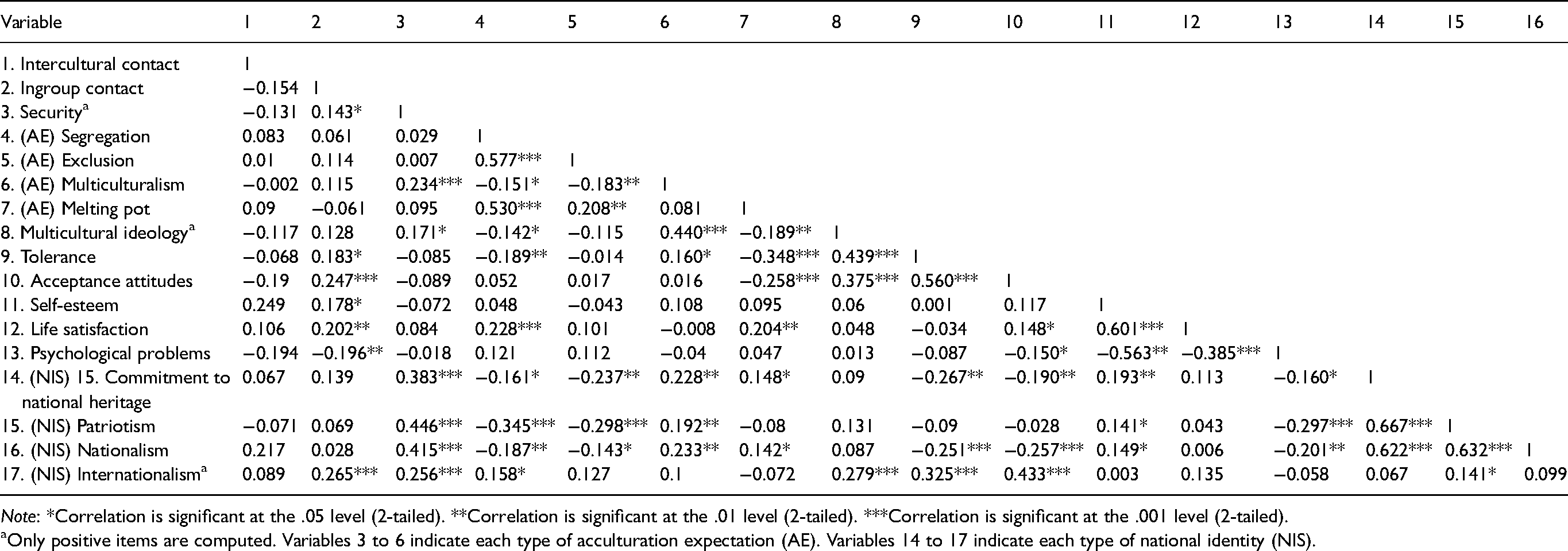
Note: *Correlation is significant at the .05 level (2-tailed). **Correlation is significant at the .01 level (2-tailed). ***Correlation is significant at the .001 level (2-tailed).
Only positive items are computed. Variables 3 to 6 indicate each type of acculturation expectation (AE). Variables 14 to 17 indicate each type of national identity (NIS).
For readers who may want to compare the scores of the main variables in the current Japanese sample with those in other countries in the MIRIPS project with the same measures, we provide means and SDs of the focal variables examined in dominant groups of other countries in Appendix A.
Main analyses
We used path analyses with full information maximum likelihood to test our hypotheses. Three different models were tested. Age and gender (male = 0, female = 1) were controlled for in all models (Inguglia et al., 2020; Musso et al., 2015). A Comparative Fit Index (CFI) cutoff value of 0.90, a Root Mean Square Error of Approximation (RMSEA) cutoff value of 0.07, and a Standard Root Mean Square Residual (SRMR) cutoff value of 0.08 were considered indicative of adequate fit (e.g., Kline, 2015).
H1: Multiculturalism hypothesis
In this model, multicultural ideology and tolerance served as potential mediators between perceived security and the four outcomes of multiculturalism, melting pot, segregation, and exclusion. In almost all cases, age and gender were not significant predictors of multiculturalism, melting pot, segregation, and exclusion, and thus predictive paths from age and gender to these variables were removed in the final model. The fit indices for the final model are presented in Table 3, showing acceptable fit. The parameter estimates are presented in Table 4. R-squared values are reported in Table 5. To summarize significant direct effects, feeling of security was positively associated with multicultural ideology and multiculturalism expectation but not with tolerance. Multicultural ideology was positively associated with the multiculturalism expectation, and tolerance was negatively associated with the melting pot expectation. To determine whether the indirect paths were significant, bootstrapping with 10,000 re-samples was performed. Confidence intervals for all indirect paths included zero, except for one path: Security → Multicultural ideology → Multiculturalism (95% CI = 0.004–0.183). This leads to the conclusion that multicultural ideology mediated the associations between feelings of security and multiculturalism expectation. Higher levels of security are associated with higher levels of multicultural ideology and higher levels of multicultural ideology are associated with higher levels of multiculturalism expectation.
Fit indices for the final models.

Path analysis for multiculturalism hypothesis.

Bold values denote statistical significance at the p < 0.05 level.
R-squared values for all models.

H2: Contact hypothesis
As shown in Table 3, this model fit the data well. R-squared values are reported in Table 4, and the parameter estimates for this model are shown in Table 5. However, the contact hypothesis was not supported in our Japanese sample. The results, although nonsignificant, were rather opposite—contact with ethnocultural group members tended to be negatively associated with the positive attitudes (tolerance, multicultural ideology, and acceptance attitudes). In contrast, contact with ingroup members positively predicted tolerance and acceptance attitudes toward ethnocultural groups.
H3: Integration hypothesis
As shown in Table 2, this model fit the data well. The parameter estimates for this model are shown in Tables 6 and 7, and R-squared values are reported in Table 5. Neither of the acculturation expectations predicted psychological functioning outcomes. Strangely, those who have discriminative expectations tended to show higher levels of psychological functioning.
Path analysis for contact hypothesis.

Bold values denote statistical significance at the p < 0.05 level.
Path analysis for integration hypothesis.

Bold values denote statistical significance at the p < 0.05 level.
Post hoc analysis for the integration hypothesis
It is likely that national identity moderates the relationship between acculturation expectations and psychosocial functioning. Specifically, it was hypothesized that the effects of the two poles of expectations (i.e., multiculturalism and exclusion) on various aspects of social functioning would be moderated by national identity. Therefore, we examined the moderating effects of four dimensions of national identity on the associations between multiculturalism and exclusion as predictors and self-esteem, life satisfaction, and psychological problems as outcomes. Given the large number of moderators and the impossibility of testing all of them in a single path analysis, we tested the moderation hypotheses in 24 separate analyses using the process macro (Hayes, 2017). In all analyses, we controlled for age and gender. We found one significant moderation effect, which is reported in Table 8. The relationship between exclusion expectation and psychological problems was moderated by internationalism, suggesting that the associations were larger for individuals with low levels of internationalism. Results from the simple slope analysis is presented in Table 9 (see also Figure 1). Although the individual effects were not significant, the association between the exclusion expectation and psychological problems tended to decrease from positive to negative as internationalism increased, suggesting that the negative effect of minority group exclusion on a person's psychological problems becomes weaker when he or she has a high level of internationalism relative to national identity.

Results of the simple slope analysis.
Moderation regression analyses.

Bold values denote statistical significance at the p < 0.05 level.
Simple slope analysis for the moderation effect.

Bold values denote statistical significance at the p < 0.05 level.
Discussion
This is the first empirical study we are aware of that examines Japanese people's acculturation expectations and their relationships with psychological constructs in relation to the three major hypotheses in the acculturation literature: multiculturalism hypothesis, integration hypothesis, and contact hypothesis. We also attempted to examine moderating roles of national identity in outgroup attitudes and consequent psychological functioning. The findings provide partial support for the multiculturalism hypothesis for the dominant group in Japan. The contact hypothesis was not supported in the current study; we did not find intercultural contact effects on the multicultural attitudes of the Japanese participants. Although the integration hypothesis was not supported, further analysis on the moderation of national identity implied that national identity may be involved.
Security, multicultural ideology, and multiculturalism expectation
Regarding the multiculturalism hypothesis, feelings of confidence in one's identity, measured with perceived economic, cultural, and personal security, had positive effects on multicultural ideology and the most inclusive form of acculturation expectation (i.e., multiculturalism), but not on outgroup tolerance. Furthermore, the association between perceived security and multiculturalism expectation was mediated by one's multicultural ideology. Overall, in partial support of the multiculturalism hypothesis (Berry, 2017), our findings imply that Japanese people's confidence in their security promotes the acceptance of ethnocultural groups regarding how they should acculturate to the larger society (i.e., acculturation expectation), and that this relationship is affected by their views about how to manage intergroup relations in culturally diverse groups (i.e., multicultural ideology).
People's awareness of multiculturalism is just starting to grow in Asian regions, including Japan (Castles & Davidson, 2000; Iwabuchi et al., 2016). It is possible that these more homogeneous people's views of cultural plurality are fundamentally different from those of people in societies that have experienced more immigration. Moreover, there can be a lack of public agreement of the cultural plurality in Japanese society (Sekino, 2021). Given all these possibilities, it is necessary to conduct in-depth analysis on lay theories of multiculturalism in contemporary Japan. Conducting cognitive interviewing (Willis, 2005) would be a good direction to achieve the goal. Interdisciplinary approaches will be also helpful in illuminating the public view, because public attitudes are often affected by the policy that encourages or inhibits multiculturalization (Sekino, 2021).
Issue of outgroup tolerance
Tolerance was negatively associated with the melting pot expectation of acculturation. This finding is noteworthy in relation to the pervasive idea of “multicultural coexistence society” (tabunka kyosei shakai) in Japanese society. As described earlier, this popular idea of multiculturalism actually limits the integrative relationships between Japanese and ethnocultural groups into the larger society (Bradley, 2014; Chapman, 2006; Nakamatsu, 2013). Until recently, the idea has been mixed with the Japanese-ness (nihonjinron), that emphasizes cultural homogeneity and social conformity (Bradley, 2014; Dale, 2012; Japan Times, 2015). In this notion, ethnocultural groups are implicitly reinforced to give up their own cultural heritage and be absorbed into the Japanese culture. Among the four types of acculturation expectation (Berry, 2017), the closest one to this idea may be the melting pot expectation. In this regard, the current finding about the effect of intolerance on the melting pot expectation suggests that the challenge of promoting multiculturalism in society may lie on the issue of tolerance toward ethnocultural groups. Tolerance promotes prosocial behaviors as increasing trust in others (Vives & FeldmanHall, 2018); thus, this value can be an important factor that enhances harmonious interactions in multicultural society. Therefore, it is important for future research on Japanese multiculturalism to keep more focus on individual-level and social-level tolerance.
Contact and outgroup attitudes
In the present study, intercultural contact did not have a significant impact on participants’ level of their acceptance attitudes, nor their multicultural ideology, and tolerance. In contrast, ingroup contact tended to show positive effects on those outcome variables. Allport (1954) has suggested that intercultural contact promotes mutual acceptance, but especially so when optimal conditions are present: equal status between the groups, common goals, intergroup cooperation, and the support of authorities, law, or custom. In the current study, however, contact was examined only based on the number of foreign friends and frequency of meeting them, which may be insufficient for understanding specific contexts and relationships. Although intergroup contact is supposed to lead to lessened prejudice and more favorable intergroup attitudes, in some conditions, especially in those where encounters between members of different groups are marked by perceived threat or hostility, contact can worsen intergroup attitudes and increase prejudice (Allport, 1954). In relatively homogeneous societies like Japan, even a small negative contact could have a powerful impact on individuals’ attitude formation and maintenance because of a low level of tolerance (Ikeda & Richey, 2009). Thus, in conditions where the valence of contact is not identified (as in the present study), no significant effects of contact may result from compound effects between positive and negative contact. Furthermore, attitudes toward the outgroup are affected by not only direct contact but also by a range of indirect contact, such as extended contact, vicarious contact, and imagined contact (Árnadóttir et al., 2018). For the effects of those factors not identified, results of the current study do not provide a complete answer to the contact effect in intercultural relations.
Inconsistent with the previous research in Italy (Inguglia et al., 2020), those who have more contacts with ingroup members showed higher levels of tolerance and acceptance attitudes toward ethnocultural groups. In cultural contexts where intercultural contact is rare, even the experiences of ingroup contact might be beneficial for outgroup attitudes. For example, personality research suggests that those who have positive peer relationships in both quantity and quality are higher in agreeableness and conscientiousness scores (Asendorpf & Wilpers, 1998). Agreeableness, along with openness toward experiences, is understood to be positively associated with tolerance and outgroup attitudes (Turner et al., 2014). Combined these together, it is possible that in relatively homogeneous contexts, contact experiences even with ingroup members may imply one's personality and other individuality, which are associated with higher levels of tolerance and acceptance in intergroup relations. Different types of contact and each of their functions as well as meeting in traditionally homogenous societies all need to be investigated in future research.
Additionally, there were often significant gender and age effects observed: older female participants tended to have a positive identity and attitudes toward outgroups than young male participants did. This pattern would be in line with the argument that focuses on males’ perception of immigrants as potential competitors regarding economic considerations (Dancygier & Donnelly, 2013). If such a perception is an important factor for attitude formation, negative attitudes toward immigration would ease as people are ageing and leaving the workforce. Given the sharp gender gap of economic participation in Japan (OECD, 2012), it is plausible that the perception and consequent negative attitudes are more salient in men than women, as implied by the current findings.
Inclusive expectations on psychosocial functioning
The integration hypothesis was not supported in this study, since the multiculturalism expectation did not predict any of the psychosocial functioning variables (self-esteem, life satisfaction, and psychological problems). The extension to and evaluation of the integration hypothesis with members of dominant groups was first carried out on a large-scale international project (Berry, 2017). In that study, support was found in 12 of 20 national (i.e., dominant) samples, compared to support found in 20 of 24 ethnocultural (i.e., nondominant) samples. This suggests that being involved in the national culture, and one other culture, does not have the same beneficial consequences for the dominant national group it has for nondominant ethnocultural groups. There is thus a need to examine the integration hypothesis among some nondominant groups in Japan.
Moderation analyses showed that the relationship between the exclusion expectation and psychological problems was moderated by internationalism (i.e., general openness toward other cultures). It is noteworthy that this moderation effect was particularly significant when the level of moderator was low. The relationships between exclusion and psychological problems appeared to be positive when internationalism was low, whereas the relationships turn negative when internationalism was high. This finding implies that non-interculturalists (those who deny international cooperation and unity) experience more psychological problems when they have exclusion expectations toward the other ethnocultural groups than interculturalists. Effects of expectation for ethnocultural groups acculturating to the larger society on psychosocial functioning may not be straightforward, and can be better illuminated when one's particular national identity is also considered.
Limitations and future directions
There are some limitations of the present study. First, although the sample size is in accordance with the recommended minimum size to conduct path analyses (N = 200) (Berry, 2011a, 2011b), the current size is small, referring to the recent recommendation (Berry et al., in preparation). Therefore, the results should be interpreted with caution and need to be replicated in future research. Second, reliabilities of some variables (security, multicultural ideology, and internationalism) were problematic, calling for caution in interpreting the related models. This limited reliability of some scales may be due to their origin in Western societies, where the history and overall context of acculturation and intercultural relations is so different from Japan. This issue needs to be clarified through follow-up studies with larger Japanese samples that examine some indigenous concepts, besides the one implied in this study (co-existence). If the same problems are observed for certain variables repeatedly, it would be plausible to hypothesize that some acculturation-related constructs are culture specific, so that the standard measure developed overseas would not be suitable for measuring Japan-specific concepts. Perceived security, multicultural ideology, and national identity of internationalism were rearranged with positive items only in our analyses. The low inter-item correlations of negative items of each target concept may be consistent with van Sonderen et al.’s (2013) suggestion that reversing the wording of items in a long survey can be ineffective because they can cause inattention or confusion, increasing response bias. This problem seems more salient in non-Western groups (Church, 2010). Thus, there may be a need for more care when examining the current concepts in certain cultural groups. Conducting in-depth analysis, as discussed earlier, would be also helpful to improve the research.
Finally, given that intercultural relations in every society are reciprocal (Berry, 2017), there is strong need to focus on nondominant groups in Japan as well. A few studies have attempted to investigate acculturation issues among particular ethnocultural groups, mainly Zainichi Koreans (Korean Japanese) (e.g., Lee & Tanaka, 2010; for review Nagayoshi, 2021). However, more systematic evaluation of these acculturation issues in different migrant and ethnocultural groups in Japan is an urgent task.
Conclusion
The study provides partial support in a Japanese sample for the three acculturation-related hypotheses (Berry, 2017). Overall, perceived security about the society as a whole, national culture, and personal conditions in a multicultural society predict multiculturalism expectation, which is mediated by multicultural ideology. Although the integration hypothesis was not supported in the Japanese context, particular national identities tend to moderate acculturation expectation and psychological functioning. Future studies should look into these complex relationships further. The present study also suggests the need for a more elaborated examination of both intercultural contact and ingroup contact and their effects on acculturation and well-being in multicultural societies.
Supplemental Material
sj-docx-1-pac-10.1177_18344909221090996 - Supplemental material for Japanese people's attitudes toward acculturation and intercultural relations
Supplemental material, sj-docx-1-pac-10.1177_18344909221090996 for Japanese people's attitudes toward acculturation and intercultural relations by Joonha Park, John W. Berry and Mohsen Joshanloo in Journal of Pacific Rim Psychology
Footnotes
Acknowledgements
We would like to thank Dr. Dmitry Grigoryev for helping us in improving the initial manuscript.
Declaration of conflicting interests
The author(s) declared no potential conflicts of interest with respect to the research, authorship, and/or publication of this article.
Funding
The author(s) received no financial support for the research, authorship, and/or publication of this article.

Supplemental material
Supplemental material for this article is available online.
References
Supplementary Material
Please find the following supplemental material available below.
For Open Access articles published under a Creative Commons License, all supplemental material carries the same license as the article it is associated with.
For non-Open Access articles published, all supplemental material carries a non-exclusive license, and permission requests for re-use of supplemental material or any part of supplemental material shall be sent directly to the copyright owner as specified in the copyright notice associated with the article.
