




Abstract
Rebels rely on the support of their civilian constituency, but often victimize them to enforce compliance. Scholars know relatively little about how rebels strategize violence against civilians in conflicts where the rebel constituency overlaps with the government’s political support base. This gap is problematic because the rebel constituency comprises a diverse group with varying attitudinal and behavioral characteristics. Offering a novel typology of rebel constituency members —loyals, disloyals, fence-sitters, and free-riders—this study examines the impact of rebel constituency support for the government on the rebels' targeting of their civilian constituency. Leveraging an original dataset of the PKK’s coercive acts targeting civilians in Kurdish-majority provinces of Turkey between 2014 and 2019, I proxy rebel constituency support for the government with district-level data on incumbent party victory in the 2014 municipal elections and employ a regression-discontinuity approach. I find that the spatial distribution of loyal and disloyal rebel constituency members is crucial in explaining subnational variations in civilian victimization, specifically who is targeted and where. This study enhances our understanding of rebels' use of coercion to alter their constituencies' political allegiances and calls for greater attention to individual or community-level characteristics of civilians, beyond ethnic or identity-cleavages, in rebel-civilian interactions.
Rebel constituencies are the ethnic, religious, or identity-based social groups that the rebels claim to represent (Akcinaroglu and Tokdemir 2018, 358). Yet, ethnic, religious, or identity cleavages do not necessarily translate into wartime political loyalties (Kalyvas 2006). The rebels' ethnic or identity-based constituency and the government’s political support base may overlap (Ottmann 2017; Polo and González 2020; van Baalen and Terpstra 2022). In other words, the rebel constituency’s loyalties may be divided between an ethnic or identity-based affinity for the rebels and political support for the government. This study examines how the political loyalties of the rebel constituency shape the rebel-led victimization of civilians within that constituency by accounting for the diverse attitudinal and behavioral characteristics of these individuals.
I assert that the rebel constituency comprises a diverse group of individuals with varying levels of attitudinal and behavioral support for the rebellion. While some constituency members may possess attitudinal support for political violence, their responses to rebel demands for resources such as food, shelter, information, or taxes can range from compliance to non-compliance. I introduce a 2 × 2 typology of rebel constituency members based on these two dimensions: loyals (supportive of violence & compliant with rebel demands), free-riders (supportive of violence but non-compliant), fence-sitters (non-supportive of violence but compliant), and disloyals (non-supportive of violence & non-compliant).
Individual political loyalties are private information, especially during conflict where individuals have incentives to hide their true loyalties (Fjelde and Hultman 2014). However, the rebel constituency’s electoral mobilization in support of the government can serve as an invaluable shortcut for identifying loyal constituency populations. The spatial distribution of loyal, disloyal, fence-sitter, and free-rider rebel constituency members, as reflected in election results, is, thus, crucial for understanding the spatial variations in rebel-led victimization of constituency members.
In examining the relationship between the rebel constituency’s political loyalties and the rebel-led victimization of civilians, I focus specifically on who is targeted and where. Responding to recent calls in the literature to analyze the patterns of rebel violence by considering targets and repertoire (Gutiérrez-Sanín and Wood 2017), this study goes beyond the conventional distinctions between selective and collective violence (Balcells and Stanton 2021), lethal and non-lethal violence (Nordås 2011), and terror and restraint (Weinstein 2007).
I theorize that targeting specific segments of the rebel constituency can help rebel groups influence civilian attitudes and behavior, thereby shifting civilian loyalties in their favor. Rebels strategically use violence against civilians to provoke the government and intimidate non-compliant constituency members without directly harming loyal, compliant members. To avoid harming loyals, rebels avoid indiscriminate violence and instead specifically target particular groups within their constituency. More specifically, I hypothesize that rebels target local public workers and other individuals deemed as “traitors” in subnational localities, where civilian loyalties are divided, but electoral preferences still favor the government. This intimidation tactic aims to coerce free-riders and disloyals into compliance. In contrast, in localities, where civilian loyalties are divided but the government does not have majority electoral support, rebels target pro-government local politicians to provoke the government to resort to indiscriminate violence, which could increase the rebel constituency’s attitudinal support for political violence.
To test these hypotheses, I focus on the PKK (Partiya Karkerên Kurdistanê) conflict. The PKK has waged several armed campaigns against the Turkish state, advocating for an independent Kurdistan in the Southeastern provinces of Turkey, where ethnic Kurds constitute the majority. To overcome the reporting biases in publicly available datasets (Davenport and Ball 2002; Krüger et al., 2013), I collected a rich, novel incident-level dataset of the PKK’s violent and coercive acts targeting civilians in Kurdish majority provinces of Turkey between 2014 and 2019. The dataset includes 572 incidents, of which 242 have not been recorded by the GTD (National Consortium for the Study of Terrorism and Responses to Terrorism (START) 2022), UCDP-GED (Sundberg and Melander 2013), and ACLED (Raleigh et al., 2010) datasets. The dataset records the characteristics of the targeted civilians, such as public workers, local incumbent party officials, and alleged state informants.
I use district-level data on incumbent party victories in the 2014 municipal elections to proxy the rebel constituency’s support for the government and conduct a regression-discontinuity (RDD) analysis. The RDD analysis compares the districts where the incumbent party won the elections by a close margin with those where the incumbents lost by a close margin. By restricting the analysis to close elections, an RDD approach can estimate the causal effect of incumbent party victory on the rebel-led victimization of civilians. I find robust support for the premise that rebels target different segments of their constituency across subnational localities with varying levels of electoral support for the government.
This study makes at least three contributions to our understanding of the rebel-led victimization of civilians. First, many extant works assume that ethnic cleavages can serve as proxies for wartime political loyalties (Fjelde and Hultman 2014; Lilja and Hultman 2011; Posen 1993). I challenge this assumption by using the PKK’s ethnic Kurdish constituency as an illustrative case of how rebel constituencies can overlap with the government’s support base. My findings expand our understanding of rebel’ use of coercion and provocation as strategic instruments to alter the wartime political loyalties of their constituencies. Secondly, there has been growing attention to microstudies focusing on sub-national variations in rebel violence against civilians (Balcells and Stanton 2021). This study explains the ample spatial variation in the PKK’s violence against civilians by using district-level data. And third, the study’s empirical strategy relying on a regression-discontinuity approach enables us to make a causal argument about the relationship between civilian loyalties and rebel-led victimization of civilians. Consequently, this study demonstrates how scholars can utilize quasi-experimental settings to gain insights into the micro-dynamics of conflict processes.
Rebel-Led Victimization of Civilians
The intensity of rebel-led victimization of civilians varies subnationally (Balcells 2017; Balcells and Stanton 2021; Balcells and Steele 2016). To explain this variation, scholars have proposed theories linking rebel behavior to civilian populations' political allegiances. For example, rebels are argued to refrain from victimizing the ethnic constituency they claim to represent and instead target non-coethnics (Fjelde and Hultman 2014; Hägerdal 2019). Alternatively, rebels may purposely target their coethnics to control and coerce civilian collaboration (Aydin and Emrence 2015; Lilja and Hultman 2011).
However, using ethnic cleavages as proxies for wartime political loyalties can lead to imprecise conclusions if rebel and government constituencies are not easily distinguishable. Civil conflicts, including those where ethnic identities play a part, are characterized by diffuse and shifting allegiances between conflict actors and civilian populations (Kalyvas 2006). Rebel constituencies are not entirely homogeneous groups. Although the rebel constituency may overlap with a specific identity group, many members of that identity group choose not to follow the rebels' goals or tactics (Gowrinathan and Mampilly 2019).
Rebel Group Constituencies and Divided Civilian Loyalties
Rebel group constituencies may be ideologically predisposed to sympathize with the overarching political goals of the rebel movement. However, civilian preferences for acting as loyal supporters of the rebel group are not predetermined (Asal et al., 2019; Ottmann 2017; Polo and González 2020). Instead, such preferences are shaped by civilians' attitudinal and behavioral characteristics. Attitudinal characteristics refer to civilians' beliefs, values, and opinions about the conflict. In civil conflict literature, attitudes typically refer to civilians' perceptions of warring sides (Lyall, Blair and Imai 2013; Hirose, Imai and Lyall 2017), while the broader literature on political violence also examines individuals' attitudes towards using violence for political purposes. Khalil, Horgan and Zeuthen (2022, 429) evaluate attitudes based on individuals' “extent of sympathy for ideologically justified violence”. Rebel constituencies involve diverse sets of individuals with varying levels of attitudinal support for ideologically justified violence (Moskalenko and McCauley 2009). Some constituency members normatively support political violence, whereas others may completely disapprove of it (Kruglanski et al., 2014).
Nevertheless, attitudes do not necessarily translate into behavior, as there can often be disconnects between attitudes and behavior, especially in the context of political violence (Khalil, Horgan and Zeuthen 2022). Behavioral characteristics refer to civilians' observable actions during the conflict, or, in other words, their “extent of involvement in ideologically justified violence” (Khalil, Horgan and Zeuthen 2022, 429). Constituency members who possess attitudinal support for political violence may not personally engage in or aid violent activities (Lichbach 1995; Moghaddam 2005; McCauley and Moskalenko 2008). In other words, not all constituency members who support the use of violence comply with rebels' demands to join militancy or aid the rebel group. Compliant civilian behavior, when it occurs, can range from sharing vital information about counterinsurgent forces with rebels (Condra and Wright 2019; Fjelde and Hultman 2014) to adhering to rebel demands for regular tax payments (Gilbert 2022).
A Typology of Rebel Constituency Members.
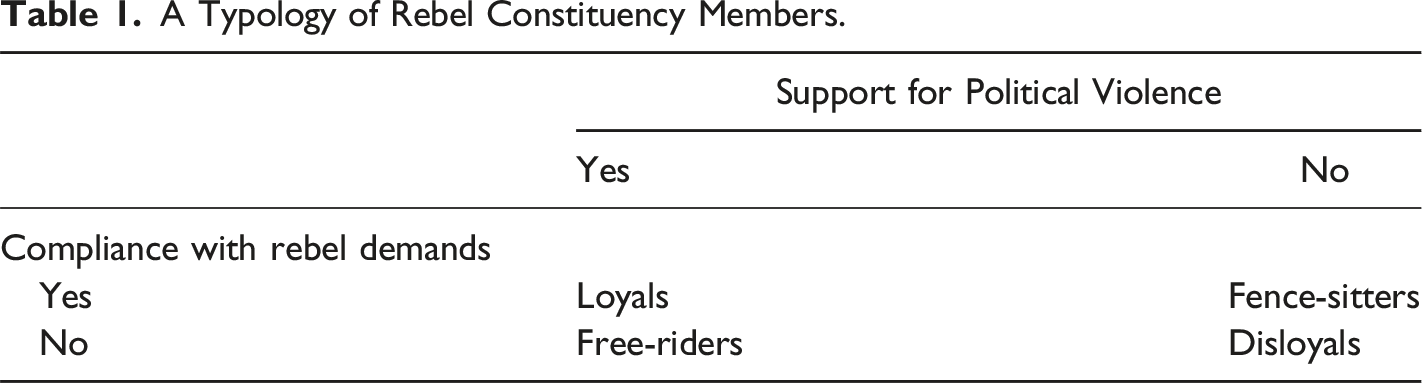
Rebel groups' ultimate goal may be to turn every constituency member into loyalists to maximize attitudinal and behavioral support for the rebellion. Yet, this may not be possible due to individuals' varying risk-tolerance levels. In this context, rebels' best chance would be to keep loyals loyal, persuade fence-sitters to become loyal by convincing them of the normative justification for political violence, and coerce free-riders and disloyals to become compliant, at the very least. Below, I discuss how rebel groups can strategically utilize violence against specific segments of their constituency to alter attitudes and behaviors.
Rebels' Target Groups Amidst Divided Civilian Loyalties
Rebel-led victimization of rebel constituency members is a tool for coercing civilian compliance by demonstrating the detrimental consequences of denying support to the rebel group (Balcells and Stanton 2021; Wood 2010) and provoking the government into indiscriminate retaliation with the hope that repression would radicalize moderate constituency members (Findley and Young 2012; Kydd and Walter 2006).
The coercion and provocation mechanisms are strategic instruments to alter wartime political allegiances. Consequently, rebel-led victimization of rebel constituency members aims to radicalize fence-fitters by provoking government repression and intimidating free-riders and disloyals to coerce them into compliance. However, while doing so, rebels must avoid harming large segments of their constituency, as indiscriminate violence can cause a backlash and drive loyals away from the rebels (Condra and Shapiro 2012; Lyall, Blair and Imai 2013).
This raises the question of how rebels identify loyal, disloyal, fence-sitter, or free-rider constituency members. It is difficult, if not impossible, for the rebel group to determine individual political allegiances since individuals living in conflict zones have incentives to hide their true loyalties (Fjelde and Hultman 2014). As a result, rebel groups often rely on heuristics to assess civilian loyalties (Hägerdal 2019). When rebel and government constituencies can be clearly distinguished, rebels can use ethnicity as a proxy for political loyalties (Posen 1993). However, ethnicity is often not a reliable proxy for political allegiances (Hägerdal 2019) because ethnic cleavages often transect cross-cutting political cleavages (Kalyvas 2006).
In conflicts where some members of the ethnic group that rebels claim to represent are loyal to the government, using ethnic cleavages as a proxy for political allegiances is not viable. In such cases, the rebel group must rely on alternative tools, such as information revealed through political mobilization patterns (Balcells and Steele 2016; Steele 2011). Rebel constituencies' electoral mobilization in support of the government can serve as an invaluable shortcut for evaluating civilian loyalties. By observing the election outcomes, rebels can identify disloyal and fence-sitter sub-local populations (Steele 2011). Using this information, rebels can tailor their violence against rebel constituencies across different localities.
Existing works documented that spatial dynamics of rebel violence are influenced by the degree of competition between rebels and the government. For example, Kalyvas’s (2006) prominent theory of the logic of violence in territorial conflicts explains that rebels' targeting of civilians is prevalent in areas where rebels are militarily strong but not the strongest actor. In other words, rebel groups exacerbate violence against civilians in areas where control is contested.
Rebel-led victimization of rebel constituencies that overlap with the government’s political support base may follow a similar logic. Rebels are unlikely to be able to effectively target co-ethnics in subnational localities where the vast majority of co-ethnics support the government. Given the importance of loyal rebel constituencies in sustaining the rebellion (Asal et al., 2019), rebel forces may be intelligence-wise too weak to perpetrate violence where they lack a loyal support base that provides them with assistance and sanctuary. Rebels are also unlikely to victimize co-ethnics in subnational localities where only a negligible minority supports the government. If the victimization of civilians is taken as a tool for co-opting the loyalty of the constituency (Balcells and Stanton 2021; Wood 2010), the rebel group will avoid alienating their loyal supporters by causing grievances among populations that overwhelmingly favor the rebels. Therefore, rebel-led victimization of rebel constituency will be concentrated in localities with contested or divided civilian loyalties.
The idea that violence is concentrated in contested areas is not new. However, the specific targets of such violence remain an open question in the literature. Are rebels primarily targeting sympathizers of a rival group? Are they only targeting those thought to be aiding the government? Existing studies document ample variation in the target groups of rebel violence against civilians (Gutiérrez-Sanín and Wood 2017). If rebel violence against civilians aims to shift constituency attitudes and behaviors, rebels must carefully choose who to target and where to target them to maximize their chances of altering their constituency’s allegiances. The spatial distribution of loyal, disloyal, fence-sitter, and free-rider rebel constituency members factors in these targeting decisions.
Contested Localities that Marginally Favor the Government
In localities where rebel constituency loyalties are divided but still favor the government, there likely are many non-compliant rebel constituency members: free-riders and disloyals. Rebels' priority in these areas would be to intimidate and coerce free-riders and disloyals into compliance (Balcells and Stanton 2021; Wood 2010). Indiscriminate targeting of the constituency can intimidate free-riders and disloyals but also alienate loyals (Lyall, Blair and Imai 2013). What strategies can intimidate free-riders and disloyals while sparing harm to loyals and fence-sitters?
I argue that targeting local public workers and other locals deemed as “traitors” can be an effective rebel strategy for coercing compliance without alienating those who already comply with rebel demands. Although individual loyalties are private information, rebels can propagandize that those who work for the government are traitors and deserve punishment. For example, the PKK frequently targeted doctors and teachers working for public hospitals and schools, and construction laborers working in government-funded projects in Southeast Turkey (Aydin and Emrence 2015). By terrorizing local public workers and other locals deemed as “traitors”, rebels were able to intimidate free-rider and disloyal constituency members into coerced compliance while avoiding alienating loyals (Masullo and O’Connor 2020). Through the coerced compliance of free-riders and disloyals, rebels can gain majority support in a contested area where divided loyalties initially favored the government. We should, therefore, expect that:
Rebels will frequently target local public workers and other locals deemed as “traitors” in localities where loyalties are divided, but civilian preferences still favor the government.
Contested Localities that Marginally Favor the Rebel Movement
In localities where loyalties are divided but still favor the rebel movement, there are likely many compliant rebel constituency members: loyals and fence-sitters. Since loyals, who are both supportive of violence and complaint with rebels, are already the ideal constituency members, persuading the fence-sitters of the normative justification of violence should be the priority of the rebel group. Rebels can provoke the government to retaliate against the rebel group constituency, which may push the fence-sitters closer to the rebel side (Findley and Young 2012). Indiscriminate rebel violence can provoke the government into a disproportionate repressive response but also push fence-sitters closer to the government side. What else can provoke the government into repression while preserving the rebels' loyal support base?
One potential strategy is targeting pro-government local politicians, which can effectively provoke the government to resort to large-scale repression, thereby potentially radicalizing fence-fitters. Rebels groups are known to employ violence against local politicians. For example, in 2022, FARC launched a wide-scale violent campaign to intimidate mayors (Dal Bó, Dal Bó and Di Tella 2006). Similarly, New People’s Army is thought to be behind the killings of local politicians in the Philippines (Kreuzer 2022).
The literature provides substantial evidence that dissident violence leads to increased government repression (Curtice and Behlendorf 2021; Davenport 1996; Lawrence 2017). States react to violent dissident challenges by responsive repression (Carey 2010). Although government response to dissident violence can be conciliatory, conciliatory accommodations are rare (Ginkel and Smith 1999). Repression, as an alternative to accommodation, can be much cheaper (DeMeritt Jacqueline, 2016; Pierskalla, 2010).
Given these dynamics, targeting pro-government local politicians can be an exceptionally efficient tool for provoking repression 1 , more so than targeting the general public. Governments seek to preserve the status quo, and hence, they may violently respond when their authority is threatened by non-state actors (DeMeritt Jacqueline, 2016). The targeted harassment or assassination of pro-government politicians represents a symbolically powerful challenge to the political authority of the incumbent party. In this sense, rebel violence against pro-government local politicians serves as “focal events” that can drastically increase the oppression of the rebel constituency members (Truex 2019).
Even if rebels can provoke repression through the targeting of pro-government local politicians, can this provoked repression convince fence-sitters to support political violence? Recent survey experimental evidence suggests that the effects of repression on dissent are momentous. For example, Curtice and Behlendorf (2021) find that repression spurs dissent across a diverse range of civilians regardless of proximity to repressive acts. More strikingly, the backlash effect holds for those identifying as government supporters. Through provocation of government repression, rebels can radicalize fence-sitters, perhaps even a portion of disloyals, and potentially gain full support in a contested area where divided loyalties initially only marginally favored the rebel movement. We should, therefore, expect that:
Rebels will frequently target pro-government local politicians in localities where loyalties are divided, but the government does not enjoy majority support.
Empirical Design
In examining the relationship between political loyalties and rebel-led victimization of civilians, I focus on the PKK (Partiya Karkerên Kurdistanê) conflict in Turkey. I proxy political loyalties with district-level electoral outcomes. More specifically, I proxy rebel constituency support for the government with incumbent party victory. As for rebel-led victimization of rebel constituency members, I draw on a rich, novel dataset of the PKK’s violent and coercive acts targeting civilians in Southeast Turkey.
The selection of the district as the level of analysis is guided by the difficulties associated with obtaining data at a level below the district. Even local news sources frequently omit details regarding the village/neighborhood where the incident occur, making it challenging to systematically collect such granular information. This scarcity of information is especially pronounced for three types of incidents: (1) low-lethality incidents that do not attract much media attention, (2) non-lethal incidents, such as harassment of local business owners, for which the media wishes to keep the victim’s identity confidential, and (3) roadblocks/identity checks occurring outside of residential areas. A study using a village/neighborhood-level analysis would over-exclude these sorts of incidents, producing a much less representative sample of the PKK’s coercive activities. Therefore, the district-level is the most granular level at which I could collect data, making district-level analysis the best, practically feasible research design.
Despite the practical feasibility of district-level analysis, there are inherent concerns with testing hypotheses pitched at the group-level with data at the district-level. An ideal test for my hypotheses would involve a direct measure of the rebel group’s assessment of civilian loyalties at the level the group conducts these assessments 2 . Without access to such data, I am bound to work with certain assumptions -such as that rebels observe electoral outcomes to look for cues about civilian loyalties- and opt for a district-level analysis aimed at gauging variations in electoral behavior. Consequently, I cannot directly estimate the precise changes in rebels' beliefs about civilians. Instead, I infer these belief updates by observing changes in rebel behavior.
The Turkey Case
The PKK conflict is one of the most protracted civil conflicts in the world. The PKK launched an armed campaign to advocate for an independent Kurdish state in 1984. The conflict evolved into a high-casualty civil war in the early 1990s. During the war, the PKK employed conventional guerrilla tactics against security forces and terrorism against civilians in both the countryside and urban centers. The Turkish state’s response involved the victimization and repression of civilians.
Although the PKK often targets civilians in Western Turkey, its violent activities are mostly confined to the country’s Southeast, where ethnic Kurds constitute the majority. The PKK’s constituency -ethnic Kurds- is divided in its political loyalties. The incumbent Justice and Development Party (AKP) has electoral strongholds in many Kurdish-majority provinces across the Southeast. The Peoples' Democratic Party (HDP) -closely associated with the Kurdish political movement in Turkey- also has many electoral strongholds in the region. Other opposition political parties have little electoral presence in the region.
I employ a regression discontinuity design (RDD) to examine how divided political loyalties, manifested in close elections in Kurdish majority Southeast Turkey, impact the rebels' victimization of their constituency members. The RDD approach compares the incidents of rebel-led victimization of civilians in districts where the incumbent party won the 2014 municipal elections by a close margin with those in districts where the incumbent party lost to the pro-Kurdish political party by a close margin.
The period of my empirical analysis spans from March 2014 to March 2019; it covers one electoral cycle from the 2014 municipal elections to the next municipal elections. The reasons for choosing this period are threefold. First, from 1990 to 2009, pro-Kurdish political parties were closed by the Turkish Constitutional Court, severely restricting Kurdish voters' voting choices in elections. Thus, incumbent party victories in Kurdish majority provinces between 1990 and 2009 might not fully reflect civilian support for the government. Second, peace talks between the government and the PKK took place between 2012 and 2015. The PKK’s violent activities declined radically in this period, making it an inadequate time frame to study rebel-led civilian victimization. However, the conflict resumed after the talks broke down in 2015. Finally, I exclude the period after 2019 due to allegations of electoral fraud in the 2019 municipal elections. The dataset, spanning from 2014 to 2019, thus, covers a period where the PKK intensified its violent activities, and the rebel constituency was relatively free to express their support for different political parties in fair elections.
Sample and Data
The dataset covers electoral districts with a substantial Kurdish population where the incumbent party (AKP) competed with the pro-Kurdish political party (HDP) in the 2014 municipal elections 3 in the 2014 municipal elections. First, I identify the districts with a substantial Kurdish population 4 using the Kurdish Insurgency Militants (KIM) Dataset (Tezcur 2016). Then, I identify the competitive districts where the incumbent party competed with the pro-Kurdish political party, using official data from Turkey’s Supreme Election Council. I consider the districts (1) where AKP came first and HDP came second and (2) where AKP came second and HDP came first to be of relevance.
The final analysis data consists of a panel of 516 observations drawing upon 86 competitive districts 5 over the 2014–2019 period. The unit of observation is competitive district-year. Approximately 60 percent and 40 percent of the observations in my data contain values for the incumbent party vote margin that lie within 20 percent and 10 percent intervals around the cutoff point, respectively. This statistic suggests that a considerable percentage of districts in my sample witnessed close elections decided by small percentages of votes.
Dependent Variables
To construct the dependent variables concerning the PKK-led victimization of the Kurdish constituency, I collected a rich, novel incident-level dataset of the PKK’s violent and coercive acts targeting civilians in Kurdish majority provinces between 2014 and 2019.
The existing incident-level databases covering rebel-led civilian victimization worldwide suffer from several limitations that make them less than ideal for this study. To begin with, the GTD, GED, and ACLED overwhelmingly rely on reports from international news agencies. This creates two challenges. First, they tend to under-count small-scale, low-casualty, or non-lethal incidents (Davenport and Ball 2002; Krüger et al., 2013). Secondly, the district indicators of these datasets suffer from missing data. Finally, the precise characteristics of individuals targeted and reasons for why they were chosen as victims are often not recorded in existing datasets. For example, GED records the number of civilian casualties but lacks indicators concerning the characteristics of the civilians targeted. Similarly, ACLED categorizes rebel-perpetrated incidents as a battle, remote violence, or violence against civilians but does not indicate who precisely was targeted. The GTD’s target sub-type indicator is intended to capture the characteristics of the individuals targeted but also suffers from missing data.
To overcome these limitations, I compiled a new dataset using international and domestic sources published in English and Turkish 6 . The incidents are included in the dataset if (1) the incident occurred in provinces in Southeastern Turkey with significant Kurdish-speaking populations 7 , (2) multiple sources cite evidence that the PKK committed the act 8 , and (3) the incident involved killing, injuring, intimidating, or harassing civilians. Following Balcells (2017) and Balcells and Stanton (2021), I define a “civilian” as a noncombatant who is not a soldier in charge of a weapon and does not work in a job related to the military. The date, province, and district are recorded for each incident. The dataset further records whether the incident was lethal or non-lethal 9 . The dataset includes 572 incidents of PKK-led civilian victimization in Southeast Turkey between 2014 and 2019. Of these incidents, 242 have not been recorded by any of the aforementioned datasets. The coding protocol for the dataset is included in Appendix 1.
The dataset further classifies the civilians targeted in the incident into eight types: • Public employees such as governors, mayors, doctors, teachers, utility workers, and construction workers employed in government-funded infrastructure projects (N = 131) • Local politicians associated with the incumbent party or other pro-government political parties (N = 35) • Local business owners (N = 16) • Civilian local officials such as village chiefs (N = 8) • Ethnic Kurdish civilians accused of being informants (N = 6) • Children kidnapped to be recruited (N = 6) • Others deemed as “traitors”, such as civilians who were kidnapped from their homes and whose incumbent party association cannot be confirmed (N = 20) • Bystanders in an attack intentionally targeted civilians, such as in a bombing in a public space (N = 201)
Descriptive Statistics.
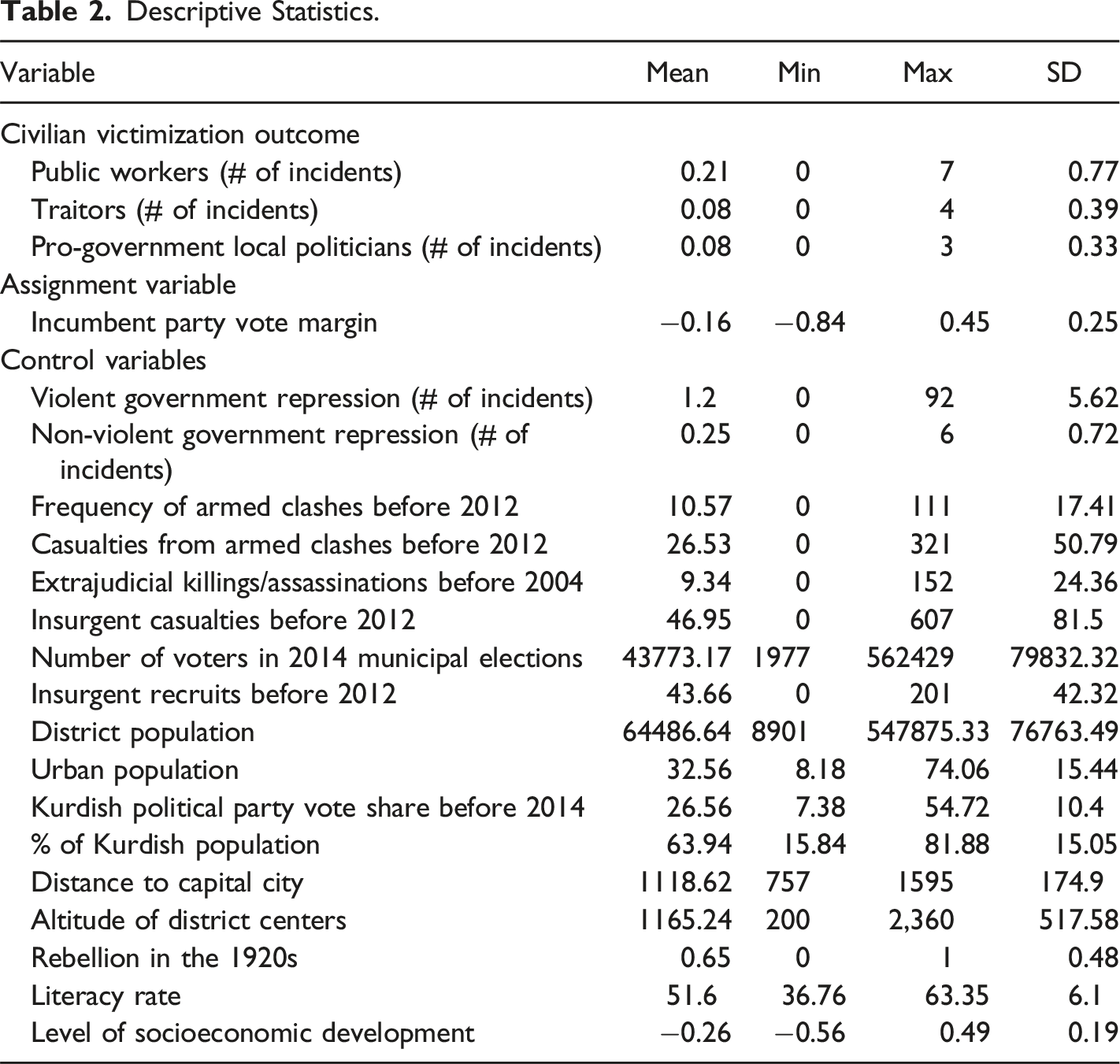
Figure 1 maps the three types of civilian targets on a map of Southeastern Turkey. All maps show ample variation in the spatial distribution of incidents. The vast majority of districts experienced at least one incident. The targeting of public workers and those deemed traitors seems to follow similar spatial trajectories. In contrast, the targeting of the pro-government local politicians presents a different picture, as border districts rarely experience violence against local politicians. Moreover, some districts experienced high levels of rebel-led civilian victimization while their neighboring districts did not experience any. Taken together, these variations suggest that there are district-level factors that affect the PKK’s targeting of its constituency members. Mapping the dependent variables, 2014–2019. Note: The legend denotes the number of incidents. Districts greyed out are not included in the analysis because they either did not have a significant Kurdish population or a political party other than the incumbent, or the pro-Kurdish party came first or second in the 2014 municipal elections.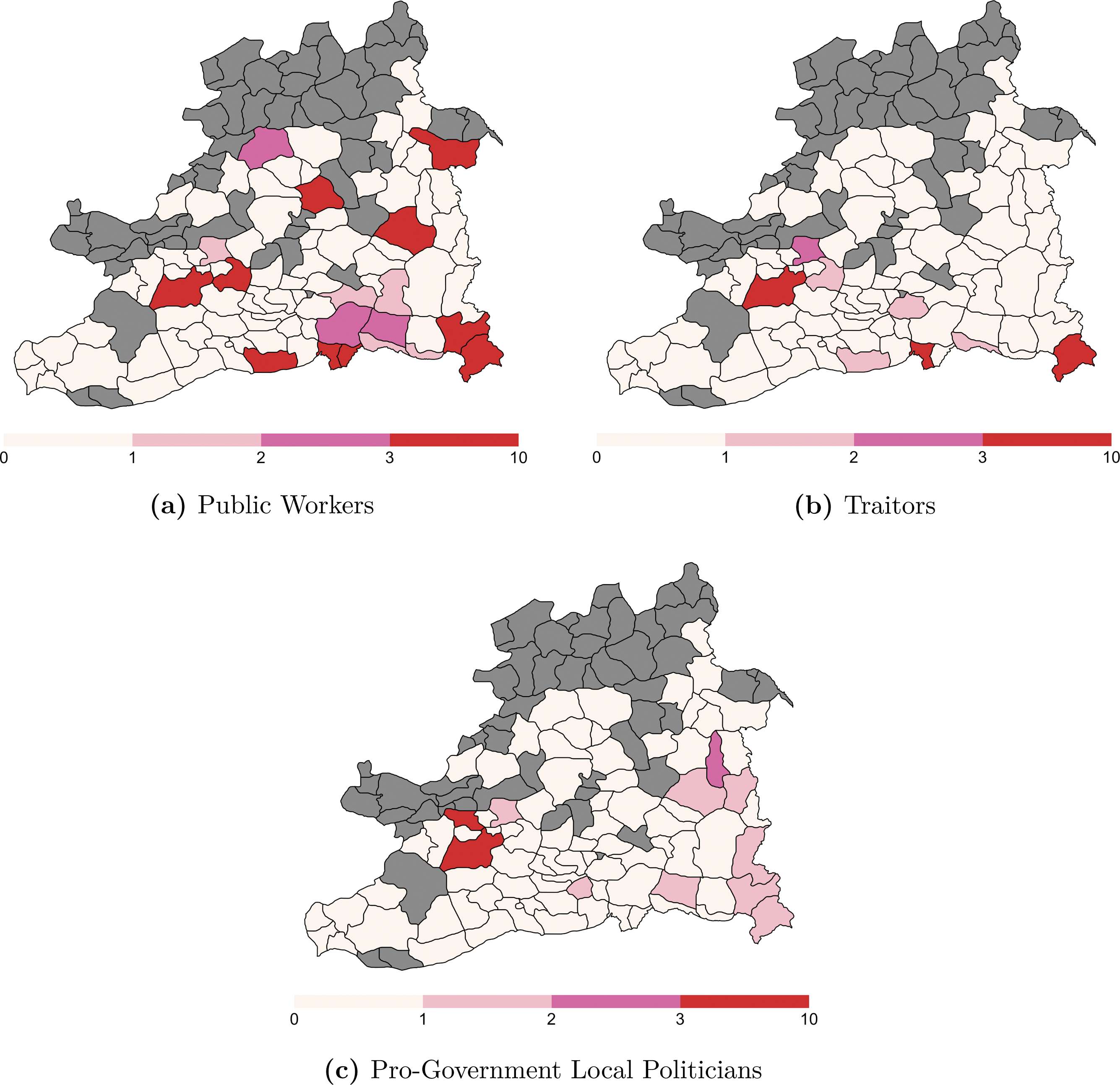
Identification and the Assignment Variable
Using traditional statistical approaches to test the effect of civilian loyalties on rebel violence is problematic because patterns of support for the government are not random. Instead, they are likely influenced by prior incidents of rebel -or government-led civilian victimization. I use a regression discontinuity design (RDD) to overcome the problems of endogeneity and selection bias (Imbens and Lemieux 2008).
I proxy rebel constituency support for the government with incumbent party victory in elections. An RDD takes advantage of the fact that the party affiliation of the winner changes discontinuously at a certain cutoff point of the assignment variable. My assignment variable is the incumbent party vote margin in the 2014 municipal elections. This margin is defined as the difference between the incumbent party’s vote share and the pro-Kurdish political party’s vote share. Thus, the cutoff point is zero. Positive values of the assignment variable fall into the treatment group: districts where the incumbent party won (N = 24). Negative values fall into the control group: districts where the pro-Kurdish political party won (N = 62).
The districts where the incumbent party won by a large margin are likely substantially different from districts where they lost by a wide margin. For example, PKK activity may historically be sparse in districts where the incumbent party won by a large margin. However, in districts with close elections, election outcomes are plausibly determined by idiosyncratic factors rather than systematic district characteristics. With this insight in mind, we can treat incumbent party victory as occurring randomly around the cutoff point. The districts where the incumbent party candidates barely won can serve as a counterfactual for districts where they narrowly lost. Thus, by estimating the models on observations whose values for the assignment variable lie within the proximity of the cutoff point, the causal effect of incumbent party victory on rebel violence can be estimated.
Figure 2 maps the assignment and treatment variables on a map of Southeastern Turkey. Panel A illustrates a significant variation in the assignment variable across districts. In Panel B, red districts are those the incumbent party lost, whereas blue ones are those the incumbent party won. Some degree of spatial clustering of red districts is visible. Yet, many blue districts border red districts. More importantly, Panel C, which only maps close elections, shows no clustering of red or blue districts. The lack of a clear spatial pattern for close elections is suggestive of close election outcomes being determined by idiosyncratic factors rather than by systematic district characteristics. Assignment and Treatment Variables, 2014 Municipal Elections.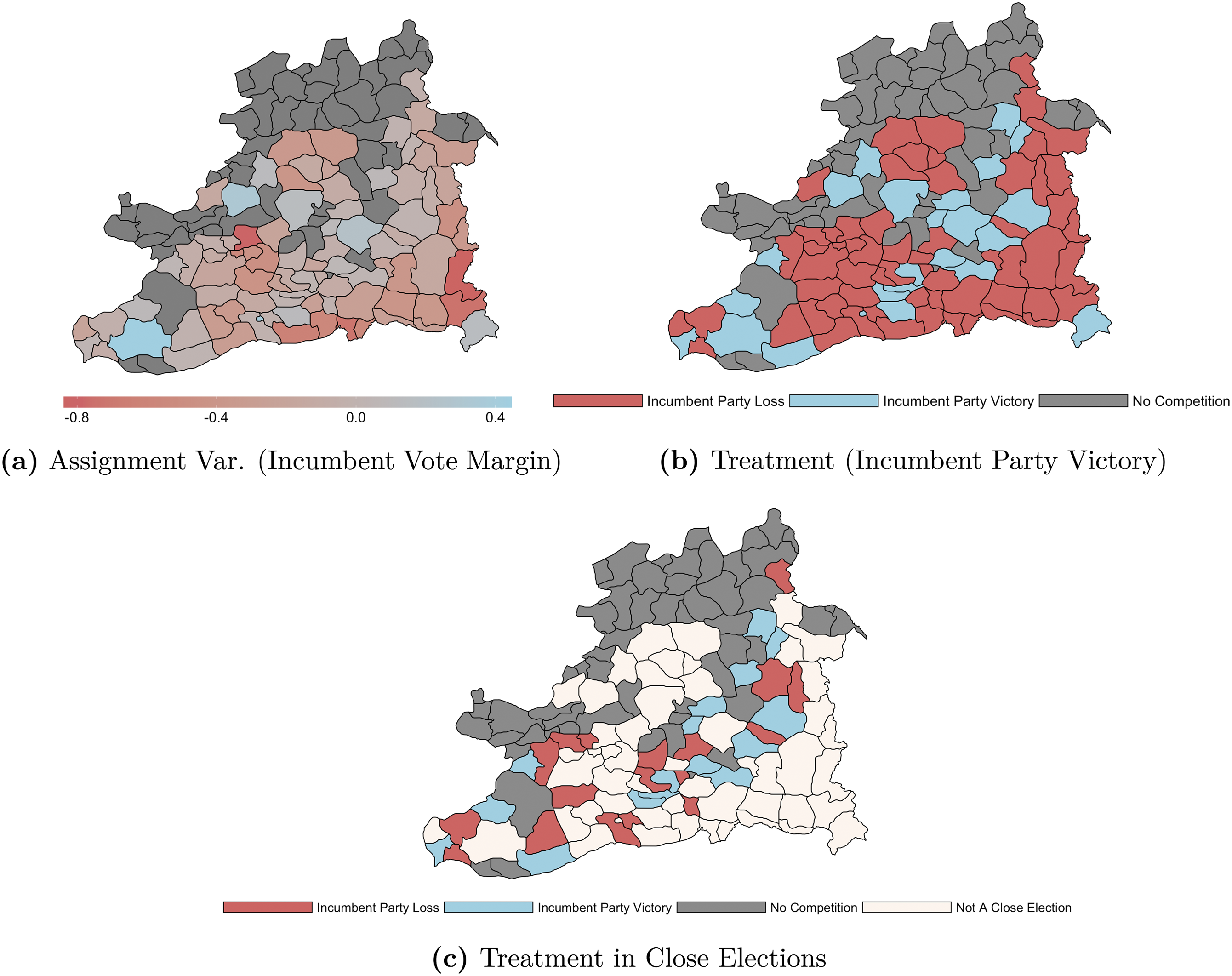
For an RDD to yield a reliable estimation of the causal effect, three identifying assumptions need to be met. First, there needs to be a discontinuity at the cutoff of the assignment variable. That is to say, observations whose values for the assignment variable are above the cutoff point receive the treatment, whereas others do not. This assumption is quickly met with election data. The districts where the vote margin was positive received the treatment (e.g., incumbent party victory).
The second assumption is that the assignment variable should not have been manipulated to influence the treatment outcome. Such manipulation might have occurred if the incumbent party manipulated election results. V-Dem’s Free and Fair Elections indicator, which captures the extent to which “election violence, government intimidation, fraud, large irregularities, and vote buying” (Free and Fair Elections Index 2022) are absent, assigns Turkey a score of around 0.65 for the 2014 Municipal Elections. Although this is not a very high score, given the troubled history of the country’s electoral democracy marked by military coups, it signifies a relatively free and fair election atmosphere. Furthermore, I test for the validity of the no-manipulation assumption using a McCrary test (McCrary 2008). This discontinuity test was not significant, indicating no violation of the assumption (see Appendix 2).
Finally, all factors relevant to the outcome, besides treatment, must vary smoothly at the cutoff value. I conducted balance tests to ensure that districts where the incumbent party barely won and barely lost are similar in other relevant aspects.
Control Variables and Balance Tests
Balance Tests on Control Variables in Close Elections, 2014–2019.
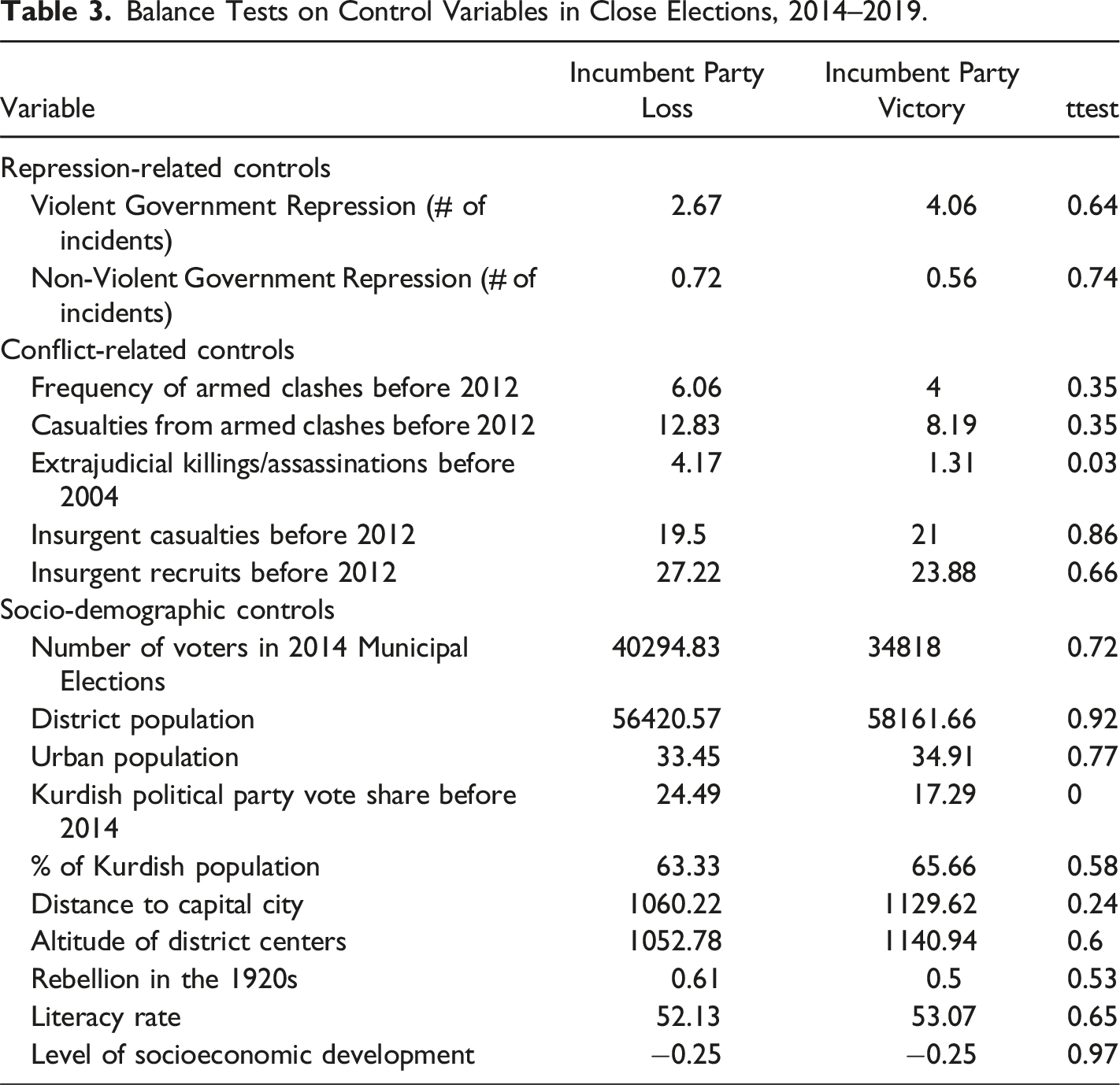
The second column reports the mean value of each covariate in districts where the incumbent party won by less than a 10 percent margin, whereas the third column does the same for districts where they lost by less than a 10 percent margin. The last column reports the t-statistic on the difference of means. In most cases, the characteristics of districts with close elections do not statistically differ across treatment and control groups in close elections. Two characteristics are statistically different: the number of extrajudicial killings and political assassinations before 2004, and the pro-Kurdish political party vote share before 2014. However, Figure 4, presented in the next section, illustrates that control variables, including extrajudicial killings and vote shares before 2014, vary smoothly at the cutoff value, suggesting that all factors relevant to the outcome, besides treatment, run smoothly around the threshold. Thus, one can use the districts where the incumbent party barely won as a counterfactual for districts where they narrowly lost.
Results
I conduct discontinuity regressions to estimate the average treatment effect of an incumbent party victory on PKK violence. This approach considers the estimation of the average treatment effect as a form of randomization (Jacob et al., 2012). It restricts the regression analysis to observations where the running variable (e.g., incumbent party vote margin) values lie close to the cutoff point. Therefore, the analysis allows the researcher to assess the effect of the incumbent party victory as if it were randomly assigned near the cutoff point (vote margin = 0).
Local Public Workers and Other Locals Deemed as “Traitors”
I hypothesize (H1) that rebel groups target local public workers and other locals deemed “traitors” in districts where civilian loyalties are divided, but electoral preferences still favor the government. Since close elections signal divided loyalties, I expect that the incumbent party’s victory in a district increases the PKK’s targeting of local public workers and the so-called traitors in that district.
Support for the Government and the PKK’s Targeting of Specific Constituency Members, 2014–2019.
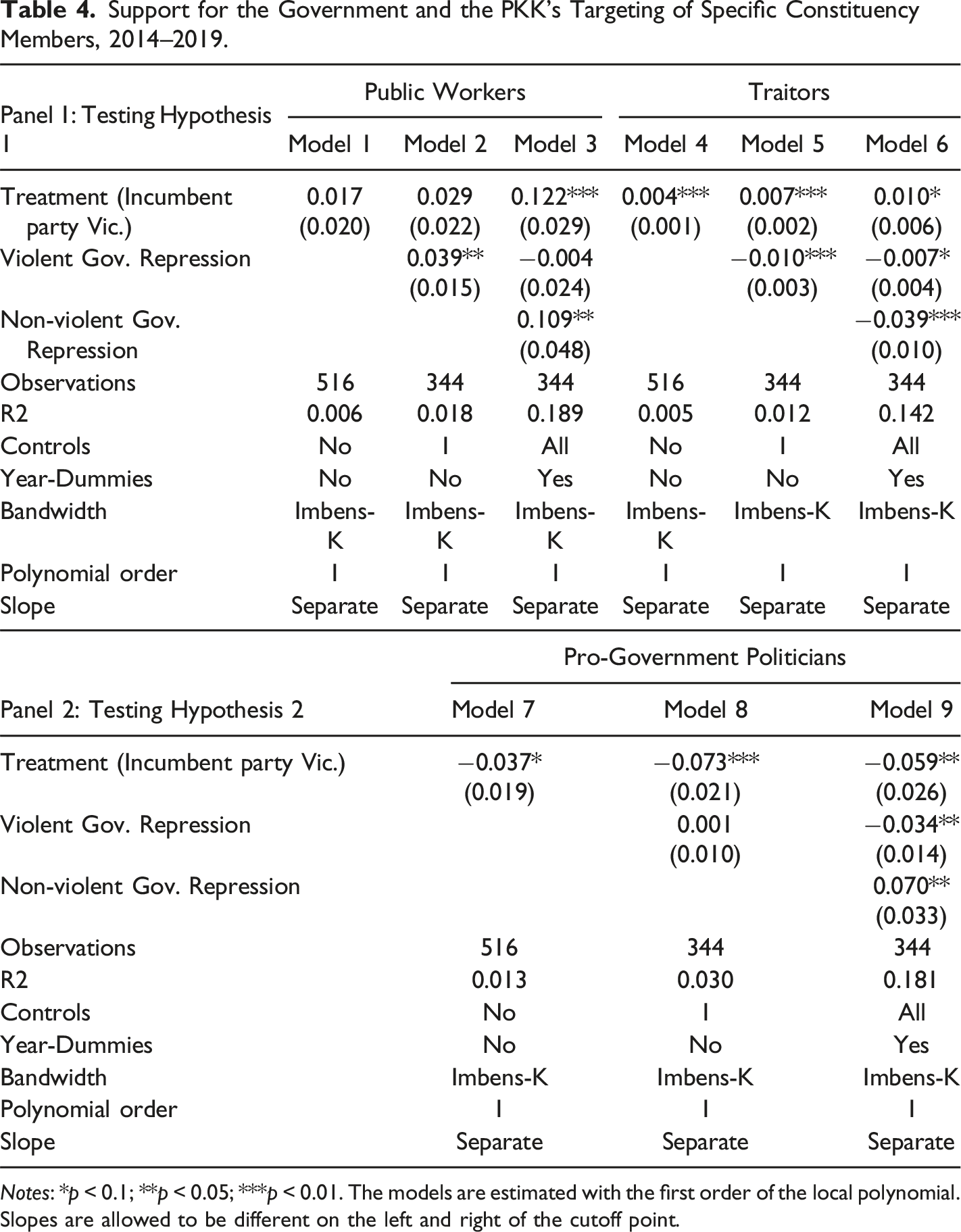
Notes: *p < 0.1; **p < 0.05; ***p < 0.01. The models are estimated with the first order of the local polynomial. Slopes are allowed to be different on the left and right of the cutoff point.
Across Models 1–6, I find support for H1. The results from different model specifications yield robust evidence that incumbent party victory has a statistically significant positive effect on the PKK’s targeting of so-called traitors (Models 4–6). The inclusion of controls does not change the central finding that incumbent party victory increases PKK’s violent and coercive acts against locals deemed “traitors”. The results regarding the targeting of local public workers are more mixed. Although the coefficient on incumbent party victory is positive across Models 1–3, it is only significant in the extended model. When all the controls are included (Model 3), incumbent party victory is found to aggravate the PKK-led incidents targeting local public workers.
The upper side of Figure 3 shows the benchmark results regarding the targeting of local public workers and other locals deemed “traitors”. The y-axes represent the number of incidents of corresponding PKK acts. The positive values on the x-axes correspond to the incumbent party victory, whereas the negative values correspond to the pro-Kurdish political party victory. The evidence for H1 is illustrated by the discontinuous upper jumps in the number of incidents targeting local public workers (Panel A) and those deemed “traitors” (Panel B) right at the cutoff value. Both graphs show a discontinuity in the PKK’s targeting of these segments of its constituency right at 0, where the elections switch from a pro-Kurdish political party victory to an incumbent party victory. Effect of incumbent party victory at the discontinuity point. Note: The graphs use the extended models (Models 3, 6, and 9). The y-axes represent the number of incidents of corresponding PKK acts. The x-axes represent the assignment variable. The black vertical lines at zero represent the cutoff value. The dots are the bin averages. The red line shows the regression line.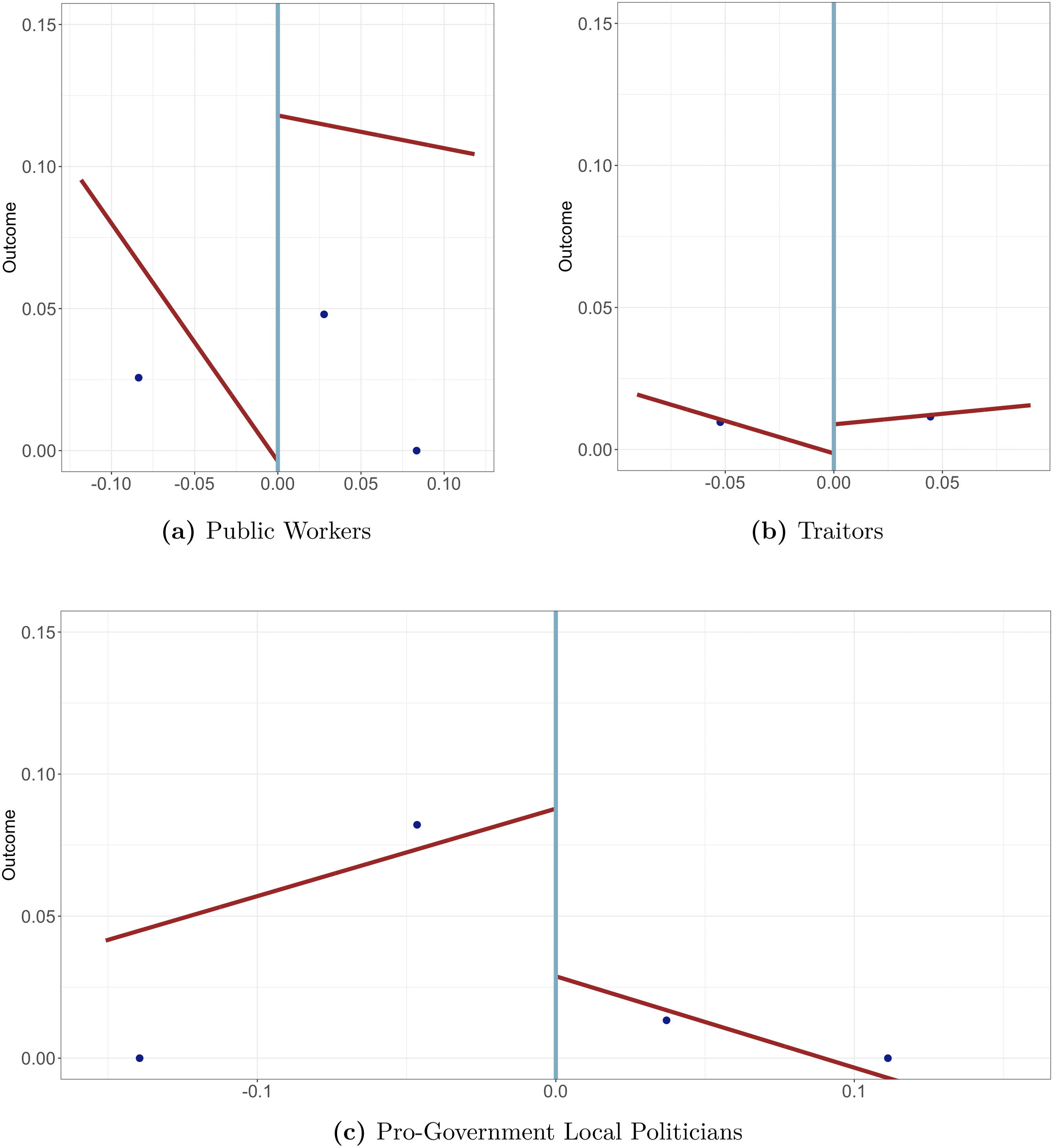
Pro-Government Local Politicians
I hypothesize (H2) that rebels target pro-government local politicians in localities where loyalties are divided, but the government does not enjoy majority electoral support, suggesting that the incidents targeting pro-government local politicians should concentrate in districts where the pro-Kurdish political party has won the elections by a close margin. Thus, I expect that the incumbent party’s victory in a given district decreases the PKK’s targeting of co-ethnic pro-government politicians in that district.
Panel 2 of Table 4 summarizes the results from the regression discontinuity analyses of the PKK’s targeting of pro-government local politicians. The dependent variables in all models are the logged number of incidents of corresponding PKK acts. Model 7 is a simple model without controls. Model 8 controls for government violence against civilians, whereas Model 9 includes all controls.
The results, providing support for H2, are consistent across different model specifications (Models 7–9). They show a statistically significant negative effect on the PKK’s targeting of pro-government local politicians following an incumbent party victory. Incumbent party victory significantly decreases the targeting of pro-government local politicians. Including controls in the extended models does not change these findings. In Panel C of Figure 3, evidence for H2 is illustrated by the discontinuous lower jump in the number of incidents involving local politicians. The discontinuity in the PKK’s targeting of pro-government politicians at 0, where the elections switch from a pro-Kurdish political party victory to an incumbent party victory, supports the hypothesis (H2) that rebel groups target pro-government local politicians in subnational localities where loyalties are divided, but the government does not enjoy majority support.
The R-squared values of the simpler models are notably low. The fully extended models, which incorporate various controls, exhibit higher R-squared values. This increase in the R-squared values due to the inclusion of controls underscores the contribution of additional factors in explaining the variance in our dependent variables. However, the primary goal of this study is to identify causal relationships rather than to explain the total variance in the dependent variables. Although the models yield low R-squared values, they successfully isolate the effect of my primary variable of interest-incumbent party victory. Taken together, these findings support my hypotheses and elucidate that the spatial variation in rebels' targeting of different rebel constituency members can be explained by civilians' political loyalties.
Robustness Checks
The results from the discontinuity regressions of the average treatment effect support the study’s hypotheses. However, as indicated above, an essential assumption of the RDD is that no other relevant indicator besides the treatment changes at the same cutoff value. Some of my control variables might be correlated with the incumbent party’s victory. Yet, Figure 4 shows that these pre-treatment characteristics, except the distance to the capital, are continuous around the cutoff value. Furthermore, no control variables display a statistically significant discontinuity at 0 since the confidence intervals on the left and right of the cutoff value overlap. These graphs illustrate that the regression discontinuity design successfully randomizes the control variables around the cutoff value. Randomization of the pre-treatment covariates. Note: The dots are the bin averages. The solid line represents the polynomial regression. The dashed lines denote the 95 percent confidence intervals.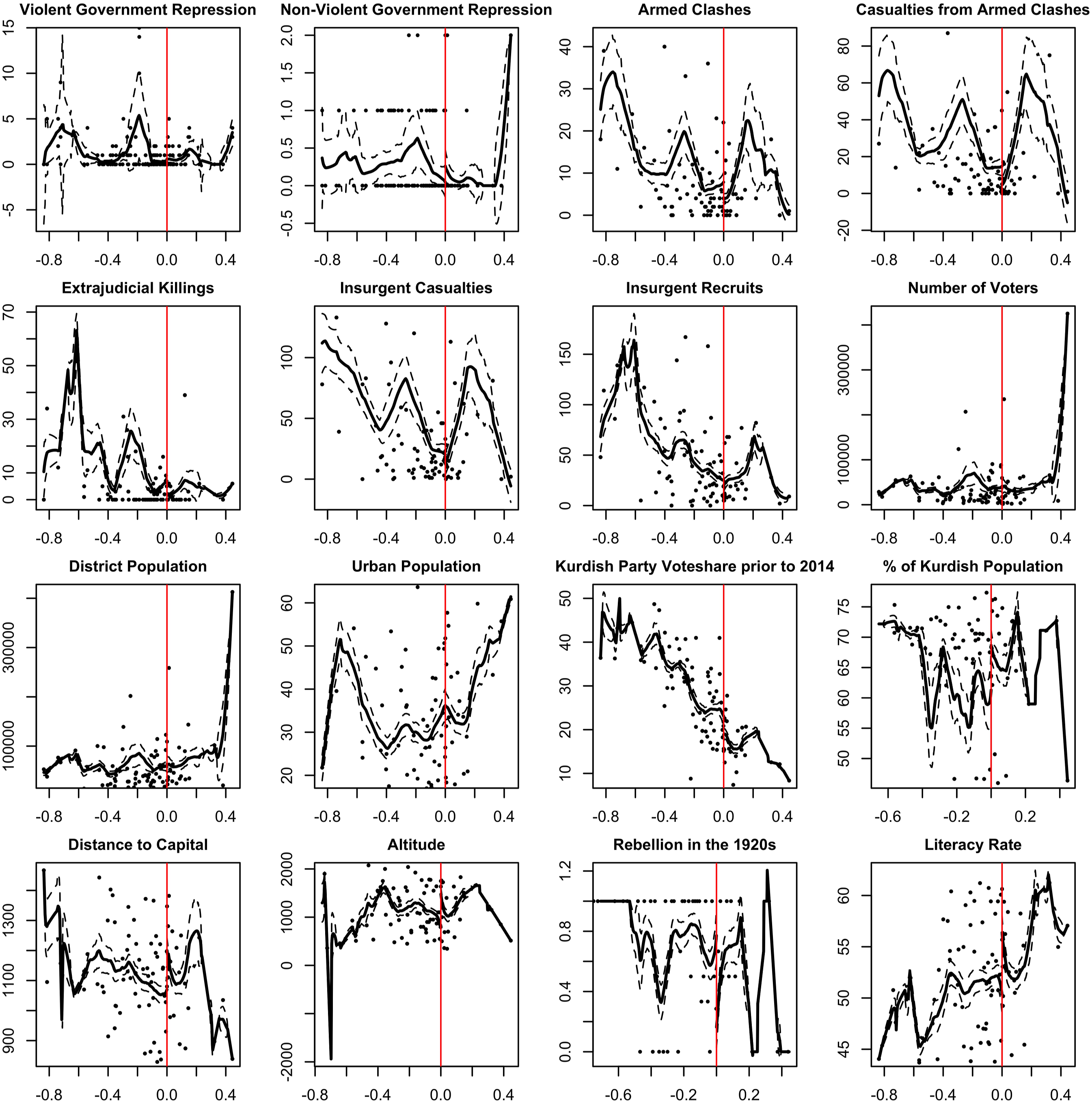
Although balance tests and discontinuity assessments provide evidence that the RDD approach can overcome the problems of endogeneity, it is still important to acknowledge that present-day political loyalties, especially Kurdish citizens' perceptions of the Turkish state (Loyle and Onder 2023), have been shaped by the legacies of previous waves of PKK violence. For example, the PKK’s raids of co-ethnic villages perceived to be pro-government in the late 1980s and early 1990s likely cultivated and consolidated civilian loyalties. To address this potential endogeneity bias further, I have conducted additional analyses that utilize data from two historical and political phenomena that emerged independently of PKK violence in the 1980s–1990s but are predictive of close elections and incumbent party victories: (1) the geographical distribution of dissident tribal populations and (2) the incumbency status of the candidates running in the 2014 elections. In models presented in Appendix 10, I use the number of Kurdish tribes that participated in the Sheikh Said rebellion in 1925 as a percentage of the total number of tribes living in the district 14 and whether the incumbent party’s candidate in the 2014 elections was the then-municipal head of that district 15 to approximate incumbent party victory. The results are largely congruent with the primary findings.
I also address the possibility that other treatments happening simultaneously might contaminate the effects of incumbent party victory. For example, the appointment of trustees to municipalities won by the pro-Kurdish party in 2016 could contaminate the effects of incumbent party victory if the rebel group evaluated trustees as potentially “allegiance-altering” phenomena. The RDD models presented in Appendix 11 control for whether a district municipality was assigned a trustee in 2016 16 and yield results congruent with the main results.
I provide additional robustness checks the Appendices. First, I estimate my models on different bandwidths ranging from 0.05 (5 percent vote margin) to 0.20 (20 percent vote margin) and visualize the estimated coefficients on the treatment variable (Appendix 5). Several other bandwidths yield statistically significant results in the same direction, suggesting my results are not sensitive to bandwidth selection.
Next, I estimate my models by progressively increasing the polynomial order and visualize the estimated coefficients on the treatment variable (Appendix 6). Most results are robust to using other polynomial orders. For example, the estimated effect of the incumbent party’s victory on the targeting of public workers is positive and significant in first-, second-, and fourth-order polynomial regressions. Similarly, the impact of the treatment on the targeting of pro-government politicians is negative and significant in first, second, and fourth polynomial-order regressions.
I also only run my models with incidents included in the existing databases with worldwide coverage (e.g., GTD, UCDP-GED, and ACLED). As detailed in the Empirical Design section, these datasets tend to under-count small-scale, low-casualty, or non-lethal incidents. Using only existing databases, I cannot estimate the impact of incumbent party victory on the targeting of so-called traitors because they only record 12 incidents involving such individuals, none of which occurred in one of the districts with close elections. In comparison, my novel dataset includes 26 incidents involving individuals deemed traitors, which allowed me to estimate the treatment’s impact on targeting these individuals. This discrepancy illustrates the need for more fine-grained incident-level data to model civilian victimization. That being said, as presented in Appendix 7, the models run with existing databases yield similar results regarding the targeting of public employees and pro-government politicians.
Finally, I considered that my dependent variables may not be independent because rebels evaluate their potential targeting choices against each other (Onder 2023). I use an incident-level version of my original data to run multinomial logit models that treat the target as a nominal variable with three categories: public workers, traitors, and pro-government local politicians. The results reported in Appendix 12 are comparable to the main results in that incumbent party victory is found to be associated with an increase in the probability that rebels will target collaborators and a decrease in the likelihood that rebels will target pro-government politicians.
Conclusion
This study departs from existing studies by focusing on how rebels strategize their targeting of civilians in the wake of divided civilian loyalties and overlaps between the rebel constituency and the government’s political support base. In doing so, I presented a typology of rebel constituency members based on individuals' support for political violence and compliance with rebel demands (e.g., loyals, fence-siters, free-riders, disloyals) and theorized how the subnational spatial distribution of these categories informs rebels' civilian-victimization strategy. I also sought to go beyond the usual distinction between selective and collective violence and examine who gets targeted and where. I conjectured that rebels strategize violence to keep loyal constituency members loyal, provoke government retaliation to radicalize moderates, and eliminate the so-called “traitors” to coerce disloyals into compliance. Accordingly, rebels prioritize targeting certain groups over others in different localities with varying levels of rebel constituency support for the government.
My results support the scholarly wisdom that rebel-led victimization of civilians is a tool for provocation and coercion. Yet, my findings strongly suggest that rebel strategies of civilian victimization are more complicated than what the usual co-ethnics vs. non-co-ethnics or selective vs. collective targeting dichotomies suggest. For example, I show not only that the PKK frequently targets co-ethnic Kurds but also that it targets different segments of the Kurdish constituency in different localities.
Notably, there are a few caveats and remaining questions worth mentioning. First, who gets targeted can be context-dependent. The targeting of public workers was a popular strategy of the PKK. In other conflicts, rebels may target other segments of their constituency. While my work speaks directly to the role of civilian loyalties in shaping a separatist rebel group’s behavior in a geographically confined conflict, potential group-level variation in targeting choices should be explored further. Future studies can investigate the extent to which my central theoretical premise -that rebels need to intimidate free-riders while also sparing harm to loyals- is generalizable to center-seeking or religiously motivated rebel groups fighting conflicts where rebel activity is more geographically dispersed, or rebel constituencies are defined in cross-national terms.
Secondly, I have examined my research question in the case of a rebel movement that had an affiliated political party. The rebels' victimization of rebel constituencies in the absence of electoral competition in the conflict region remains a question. Furthermore, how the PKK assessed civilian loyalties in previous periods (e.g., 1980s, 1990s) when the pro-Kurdish political parties were not present is another remaining question. The study of wartime allegiances needs to further call into question how rebel groups discern civilian loyalties in the absence of strong cues, such as those provided by election results.
Finally, I have not interrogated the extent to which electoral support for the government may or may not translate into material support for the security forces fighting the rebels. Furthermore, in focusing on rebel strategies, I have not examined how civilians navigate the conflict. Civilians, being resourceful actors with individual agency, may devise strategies to remain neutral during conflict. The extent to which rebels' coercion and provocation strategies succeed in altering civilian loyalties in the long run needs to be explored in future research.
Understanding how civilian allegiances shape rebel strategies of civilian victimization is an important step in understanding the consequences of rebel-civilian interactions during and after conflict. This study has broad implications for the study of rebel-civilian interactions. First, my theoretical framework proposes an innovation in conceptualizing the variations in political loyalties of individuals in conflict zones. My typology of rebel constituency members not only offers theoretical justifications for why rebel violence against civilians follows different trajectories in different subnational localities but also opens up new avenues for scholars who study rebel-civilian interactions. Secondly, by gauging data that records the unique characteristics of the civilians being targeted, I highlight how rebels can strategically customize their civilian victimization strategy to alter wartime political loyalties. In this regard, this study calls for greater scholarly attention to scrutinizing individual or community-level characteristics of civilians, beyond ethnic or identity-cleavages, in rebel-civilian interactions.
Supplemental Material
Supplemental Material - How Civilian Loyalties Shape Rebel-Led Victimization of Rebel Constituencies
Supplemental Material for How Civilian Loyalties Shape Rebel-Led Victimization of Rebel Constituencies by Ilayda B. Onder in Journal of Conflict Resolution
Footnotes
Declaration of Conflicting Interests
The author(s) declared no potential conflicts of interest with respect to the research, authorship, and/or publication of this article.
Funding
The author(s) received no financial support for the research, authorship, and/or publication of this article.

Data Availability Statement
The datasets generated during and/or analyzed during the current study are available at https://doi.org/10.7910/DVN/AKAR6Q
Supplemental Material
Supplemental material for this article is available online.
Notes
References
Supplementary Material
Please find the following supplemental material available below.
For Open Access articles published under a Creative Commons License, all supplemental material carries the same license as the article it is associated with.
For non-Open Access articles published, all supplemental material carries a non-exclusive license, and permission requests for re-use of supplemental material or any part of supplemental material shall be sent directly to the copyright owner as specified in the copyright notice associated with the article.
