




Abstract
International weapons transfers send military capabilities, make arms production economically feasible, and construct security relations. They influence buyers’ and sellers’ foreign policies, domestic politics, and military spending behavior. However, data availability has limited their study to the bipolar Cold War and unipolar post-Cold War periods. We thus introduce the Interwar Period International Trade in Arms (IPITA) data, covering dyadic transfers of small arms, light weapons, ammunition, explosives, and major conventional weapons in the years 1920–1939. The IPITA data will offer new avenues to study the drivers, dynamics, and consequences of arms transfers, both in past and future multipolar systems.
Introduction
With the Russian invasion of Ukraine, international arms transfers have re-emerged as a key topic in international relations. Which countries do (not) send weapons to Ukraine has regularly made news reports. The conflict led Germany, a global Top-5 arms exporter, to revise its policy on shipping armaments to conflict zones. But even before, research on the arms trade has undergone something of a renaissance as numerous recent publications study its drivers as well as consequences from a multitude of theoretical and empirical perspectives (e.g. Grant 2018; Mehrl and Thurner 2020; Pamp et al. 2021; Spindel 2023; Thurner et al. 2019; Willardson and Johnson 2022). These contributions enhance our knowledge about the arms trade at a time when its policy relevance is becoming very clear once again.
At the same time, our systematic understanding of arms transfers remains restricted by data limitations. The temporal coverage of existing arms trade datasets is confined to the period since 1950 or, in the case of small arms and light weapons (SALW), only to a few selected years after the end of the Cold War. This affects our understanding of the role of arms transfers in the lead-up to historically important events such as World War II. But it also implies, arguably more importantly, that our empirical insights about the arms trade rest very much on the bipolar Cold War and unipolar post-Cold War international systems. These were dominated, respectively, by two and then a single Superpower, but preceded, and increasingly also followed (Posen 2011; Schweller and Pu 2011), by multipolar systems with more than two countries at the top. There is an extensive literature on the consequences of polarity and the balance of power in the international system, often rife with disagreement, but most scholars agree that these configurations are associated with differences in states’ behavior, alliance-making, and systemic stability (see e.g. Braumoeller 2012; Jervis 2009; Niou, Ordeshook, and Rose 1989; Wagner 1993; Waltz 1979). This suggests that what we know about arms transfers in uni- and bipolar systems will not necessarily generalize to the multipolar settings characteristic of the nineteenth century, the Interwar years or, possibly, contemporary and future international politics. From this perspective, studying the international relations of the period before the systemic shift induced by World War II can be understood as benefiting our knowledge not just of historical but also current and future events. So far, however, we lack the arms trade data necessary to engage in this research.
We introduce the Interwar Period International Trade in Arms (IPITA) dataset to address this gap. IPITA offers comprehensive, dyadic data on the arms trade in the Interwar years. It covers transfers of military aircraft, ships, armoured fighting vehicles, as well as small arms and light weapons including artillery, ammunition, and explosives between independent countries, as well as some colonies and non-state actors, for the period 1920-39. In the following, we discuss how these data were collected, provide some descriptive insights on arms transfers between the two World Wars, and apply the new data to study how weapons imports and exports affected the Interwar demand for military expenditures. These results join other early evidence in showing how the structure, drivers, and consequences of weapons transfers in the multipolar Interwar years differed from those observed in the bipolar Cold War period, but also the unipolar years after its termination, which dominate our understanding of the arms trade (Mehrl, Seussler, and Thurner 2022, 2023). Before introducing the IPITA data, we start by discussing what data on international arms transfers currently exists.
Existing Arms Trade Datasets
Without a doubt, the most prominent and commonly used dataset on international arms transfers is the SIPRI (2023) Arms Transfers Database. The SIPRI data contain dyadic information on major conventional weapons (MCW) transfers, beginning in the year 1950, fully rely on open source information, and are updated yearly. The data specify the sender and recipient, the delivery and, where possible, order date, the weapon type, the number of transferred weapons, as well as their Trend-Indicator Value (TIV) for a given transaction. The TIV is intended to measure the military or strategic value of a transfer. It is based on the production costs of a set of weapons for which this is known, TIVs for other weapons are then estimated based on their size, performance, technical details, and production year. The large majority of senders and recipients in the SIPRI data are governments, but the data also cover reported transfers involving non-state actors such as rebel groups. In contrast, they do not include information on transfers which occurred clandestinely or were made public by neither the sender, recipient, nor a third-party (see SIPRI 2023). SIPRI data can thus be used to investigate the drivers and consequences of MCW transfers, imports, and exports during the Cold War and post-Cold war periods. Along these lines, existing research uses these data to study how arms imports affect domestic conflict and state repression (Johnson and Willardson 2018; Mehrl and Thurner 2020; Moore 2012; Pamp et al., 2018b; Sullivan, Blanken, and Rice 2020; Suzuki 2007), in what ways weapons transfers influence interstate relations (Beardsley et al. 2020; Krause 2004), whether arms sales are related to defence spending (Blum 2019; Pamp et al., 2018a; Pamp and Thurner 2017), and under which conditions countries trade MCW with each other (e.g. Akerman and Seim 2014; Bove, Deiana, and Nisticò 2018; Comola 2012; Fritz, Thurner, and Kauermann 2021; Martínez-Zarzoso and Johannsen 2019; Thurner et al. 2019; Willardson and Johnson 2022).
However, the SIPRI data do not offer information on transfers of SALW. This information is available from the Norwegian Initiate on Small Arms Transfers (NISAT 2017). The NISAT data specify the sender and recipient, the delivery date, the weapon type, and the financial value of transferred weapons for a given transaction. These data are collected from customs data, most importantly the UN Comtrade Database, and span the period 1962-2017. However, the data are generally considered reliable only for the post-Cold War period and academic applications of it are accordingly limited to these years. The NISAT data thus provide for SALW what the SIPRI data do for MCW, albeit for a shorter time period and with transfer volumes being expressed in terms of financial instead of military value. That being said, the NISAT data have been used somewhat less commonly to systematically investigate and test the drivers and consequences of the small arms trade, with the only published work we are aware of being Baronchelli, Caruso, and Ricciuti (2022), Baronchelli and Caruso (2023),Lebacher, Thurner, and Kauermann (2021), Mehltretter (2022), and Mehrl and Thurner (2020).
Finally, information on arms transfers is also available from the World Military Expenditures and Arms Transfers (WMEAT) series, published first by the United States’ Arms Control and Disarmament Agency and then the Bureau of Arms Control, Verification and Compliance Releases within the State Department. WMEAT data are currently available for the period 1964-2019 and contain financial information on the value of transferred MCW as well SALW. However, the WMEAT data do not distinguish between MCW and SALW and also do not report weapon type-specific information. What is more, the data are not in dyadic format but instead aggregate each importer’s or exporter’s entire yearly transfer activity (see US Department of State 2021). As such, WMEAT data have mostly been used to study the demand for arms imports (Goodhart and Xenias 2012; Smith and Tasiran 2005, 2010).
Especially in combination, the SIPRI, NISAT, and WMEAT datasets provide rich information on the arms trade, allowing researchers to systematically investigate its structure and test both its drivers and outcomes. At the same time, these efforts are currently limited to the years after World War II as a result of data availability. SIPRI, NISAT, and WMEAT cover the Cold War and Post-Cold war periods, meaning that the very large majority of quantitative literature on the arms trade is concerned with these periods. Present datasets do not span previous years, implying that, with one exception, existing research on the Interwar arms trade is unable to engage in hypothesis testing, instead mainly relying on historical methods (e.g. Grant 2018; Harkavy 1975; Krause 1992). The sole exception is Eloranta (2002) who collects SALW transfer data for nine European medium powers and the period 1920-37 to investigate the drivers of both their imports and exports. Earlier, Sloutzki (1941) and Harkavy (1975), respectively, collected global data on SALW and MCW transfers in the 1930s but use them only for descriptive purposes. Unfortunately, the raw data used in these three publications pertain only to a limited set of countries or years, do not offer dyadic information, and, most importantly, are not publicly available. This means that even in terms of descriptive, quantitative assessments of the Interwar arms trade, the data tables presented by Sloutzki (1941) and Harkavy (1975) represent our best knowledge, with later work simply reprinting them (see Krause 1992; Laurance 1992).
There is thus a clear gap regarding systematic, global quantitative data that covers the transfer of SALW as well as MCW in the entire Interwar period at the dyadic level. The IPITA data goes a long way towards filling this gap. IPITA includes dyadic, yearly information on MCW and SALW transfers which can be further distinguished by more specific weapon types and covers the years 1920 until 1937 (SALW) or 1939 (MCW). These data thus facilitate the quantitative study of the drivers and outcomes of arms transfers in the years between the two World Wars.
The IPITA Data: Collection and Construction
The IPITA data consist of two parts, one covering the trade in SALW and artillery and the other MCW transfers. The SALW and artillery data are collected from a series of publications by the League of Nations, the Statistical Year-Books of the Trade in Arms and Ammunition, and cover the period 1920-1937. The MCW data are separate as military ships, aircraft, and armoured fighting vehicles were not covered by the yearbooks, instead had to be collected from a wide variety of primary and secondary sources, and cover the years 1920-1939. As a result, the data collection and construction process for the two parts of the IPITA data was different and we hence discuss them separately. We summarize this process for both parts below and offer more details in the detailed technical report in the supplementary material.
IPITA Data on Small Arms, Light Weapons, and Artillery
This part of the dataset is entirely constructed from the League of Nations’ (Various Years) Statistical Year-Books of the Trade in Arms and Ammunition. The first yearbook was published in 1924 and, after a break in 1925, their publication resumed in 1926 with the last volume being published in 1938. The resulting series of year-books contain dyadic directed data on imports and exports of arms for a varying number of reporting countries, dominions, and colonies 1 .
Similar to the NISAT (2017) and SIPRI (2023) data, the information presented in the yearbooks was gathered from annual foreign trade and customs statistics which states had been invited to send to the League secretariat. In cases where this was not done, the secretariat also attempted to gain these statistics from other openly accessible sources. The most elaborate discussion of these data is provided by Sloutzki (1941). The author points out that there is no “guarantee that the customs declarations, no matter how official, always conform to reality”, that “figures [do not] take account of the clandestine trade in arms”, that “certain countries have ceased to publish data on their foreign trade in war arms after the [1934] failure of the Disarmament Conference” and that data on MCW are excluded Sloutzki (1941, 64). With these caveats in mind, however, Sloutzki (1941) uses parts of the yearbook data to explore the basic structure and development of the 1930s arms trade as these data, while not perfect, are the best ones available. Later assessments by historians and arms trade specialists follow this judgement (Eloranta 2002; Hauner 1986; Hilbert 1989; Kohnke 1968) and rely on Sloutzki’s (1941) initial presentation of the data (Harkavy 1975; Kohnke 1968; Krause 1992). At the same time, these issues also apply to contemporary arms trade data which, like the yearbooks, are collected from customs and other open source material, exclude clandestine transfers, and miss transactions reported by neither their sender nor recipient.
We thus extracted raw SALW trade data from scans of the fourteen published yearbooks 2 . Scans were then made machine-readable using Optical Character Recognition (OCR), machine-converted into tabular data, and automatically reformatted so that each row refers to one report of a dyadic transfer. To guard against errors induced by this process, the resulting data were checked manually at each step. Because each yearbook reports on several previous years, we then combined duplicates and re-checked near-duplicates to investigate whether they are modified reports of the same observation or actually different transfers 3 . These duplicate checks were done iteratively, first after obtaining the raw data in the correct format, then again after correcting scanning errors or standardizing trading entities, and again throughout the data cleaning process. Observations where values appeared off or did not match across yearbooks were also compared to the source documents, allowing us to identify and correct further errors. After all known errors had been corrected, we carried out three rounds of manually checking one randomly selected percent of observations from the fully cleaned and processed data against the yearbook entries they resulted from. After each round, the uncovered errors were studied to find their (random or structural) source which was then corrected. The number of such errors decreased significantly with each round of checks, resulting in the decision that a fourth round would be unnecessary.
One likely reason the yearbooks have only found limited use as a source of data so far is that most information within them lacks standardization. A large part of the data cleaning process was thus the standardization of weapon categories, weight units, as well as financial values into a single, constant currency. We converted all weights into metric tons and all financial values into 1928–29 US$. For weapon categories, we first combined substantively identical categories which differed only on their wording, e.g. “pistols and revolvers”, “revolvers and pistols”, and ”pistols & revolvers”. Second, we coded all resulting categories following a modified PRIO Weapons Types scheme as used in the NISAT Small Arms & Light Weapons Database, with adjustments made to accommodate the data and take the state of weapons technology in the Interwar period into account. Because countries’ national trade statistics differed in the scope and detail of their reporting, this coding scheme is hierarchical with a given transaction being assigned to its most detailed suitable category as well as coarser ones above it (see supplementary materials). In a last step, we tackled that while the large majority of observed transfers contain information on their financial value, 7.0 percent do not but instead only on their weight or the number of transferred items. Where possible, we estimate the financial volume of these transfers. Most observations include financial value as well as weight, the number of items, or other measures. We thus use the observations where multiple measures of volume exist to regress their financial value on the other measures, obtain linear predictions from these models, and employ them as estimates of the missing values. This process is done separately for each coded weapons category. For full transparency, we report trade volumes both with and without these estimated values in the provided dataset.
IPITA Data on Military Aircraft, Ships, and Armoured Fighting Vehicles
Because the yearbooks do not cover transfers of military aircraft, ships, and armoured fighting vehicles (AFV), we collected data on these MCW transfers from numerous primary and secondary sources. This required delineating which items we consider to be weapons and which one not. For military ships, we follow existing work on naval power (Crisher and Souva 2014) and consider those vessels covered in the standard volumes on fighting ships, Conway’s Fighting Ships, 1906-1921 and 1922-1946 (Gardiner, Chesneau, and Budzbon 1980, 1985). Out of these, we further omitted ships that are operated by the military but are civilian types, such as trawlers and icebreakers, or were transferred in order to be scrapped immediately.
Armoured fighting vehicles refer to tanks and armoured cars, meaning that, by design, included vehicles have both a minimum amount of armour protecting them as well as armaments. This excludes normal cars and trucks operated by the military, tracked vehicles used for towing which may optically resemble small tanks but have neither armour nor weapons, as well as cases where a civilian chassis was imported and then furnished with armour and weapons to turn it into an improvised armoured car. In contrast, this rule includes vehicles which are designed to carry weapons but, in the specific instance of their delivery, are not (yet) equipped with them.
Aircraft were included if they were, at least partially, designed to serve a specific military purpose and to carry weapons. As such, we include planes with some sort of attack function (be it fighting other planes, bombing, or ground attack) and armed reconnaissance aircraft, but also planes which were designed to serve both as transports and bombers. We exclude aircraft designed explicitly for the civilian market, even if they were purchased with the intention to use them for fighting, autogyros, transport planes without bombing capacities, as well as trainer aircraft. The last omission in particular is relevant as military and civilian flying schools often operated the same types of planes in the 1920s and 1930s. Again, we include aircraft which were designed to carry weapons but did not do so when being transferred.
For all three types of MCW, broad reference works that seek to detail all (or most) types of the respective weapon category produced and traded in the Interwar period provided a starting point for data collection. Data collection was then successively refined to cover more specific reference works on individual countries’ armed forces, individual types or producers of arms, and specific conflicts 4 . For military ships, we began with the Conway’s volumes and then cross-checked and consolidated the resulting data using further publications on fighting ships of the Second World War. For each ship, these reference works state the shipyards where it was built, the countries operating it throughout its existence, when vessels were resold or, at least, when a newly bought ship was commissioned into service. For the few unclear cases, country-specific sources were then used. To collect data on AFV, we also began with general reference works but then used more specialized sources giving detailed information on tanks and armoured cars in specific countries or conflicts, often produced by specialized military historians but also interested independent researchers. Finally, the aircraft data collection proved more complicated than for the other two types of MCW due to the much larger number of different models, producers, and transfers. For this reason, data collection initially used very general works on the history of combat aircraft and national air forces but then switched to country-, producer-, and conflict-specific accounts, allowing us to use references for the majority of existing countries as well as most of major aircraft producers. As compared to the data extracted from the yearbooks of the League of Nations, the data on major conventional weapons, due to the nature of its collection process, has a more open-ended character with revisions being possible if and when new data sources become available. However, these data are saturated in the sense that the most recently added sources provided no or only very little additional information.
Data Structure
We provide the IPITA Data in the transfer-sender-recipient-reporter-year format, giving the most detailed possible information on the transferred weapon type and, for SALW, indicating whether the transfer was reported by the sender or receiver 5 . To capture transfer volumes, we report a transfer’ financial value in 1928–29 US$ for SALW and, for MCW, the number of transferred weapons as well as, specifically for ships, their displacement. Each transfer-dyad contains information on its minimum and maximum volume as, in the yearbooks, the numbers reported by the same country sometimes changed while for MCW, sources do not always agree on how many weapons were ultimately delivered. When using the IPITA data to investigate the drivers and consequences of the Interwar arms trade, the analyst thus has to decide what weapons type-level to aggregate the data to, whether to use dyads or total imports or exports, whether to rely on minimum or maximum volumes, and, in case of the SALW data, whether to rely on information reported by the importer, exporter, or both. The first choice will depend on whether one is substantively interested in transfers of e.g. all weapons, only aircraft, or only rifles. The second one similarly depends on the substantively motivated unit of analysis, e.g. total arms importers make sense in studies of military spending or internal armed conflict. For the third choice, the standard approach is to use the smaller, more conservative trade volume. Finally, there are least three approaches regarding whether to rely on SALW data reported by the importer, exporter, or a combination of both. Especially for small disagreements, one may again use the smaller, more conservative value. One can also choose based on whether the analysis is more interested in importer- or exporter-side factors. And finally, one can ask which side can be considered to be more trustworthy or have less to hide, either regarding specific countries or importers vs. exporters as a whole. On the latter, more general question, Bromley and Cóbar (2020) suggest that importers are less reliable in reporting arms transfers than exporters while Sloutzki (1941, 65) also finds that they reported less trade in the Interwar years than exporters did. At the same time, countries more often reported their “general” trade, including transit and transshipments, instead of “special” trade, excluding these goods, for imports than for exports 6 . As a general guideline, it thus appears sensible to mainly rely on exporter-reported observations and to use importer-provided ones only where exporter data is unavailable.
To facilitate the use of these data, we also provide a set of more aggregated dataframes, beyond the fine-grained observations of individual transfers. On one hand, we provide a weapon type-sender-recipient-reporter-year datafile of MCW transfers where weapon transfers of the same type (that is, armoured vehicles, aircraft, or ships) within the same directed dyad are aggregated. And on the other hand, we provide two weapon level-sender-recipient-reporter-year datafiles for the data on SALW and artillery where all qualifying observations are aggregated to level 100 (“All weapons, parts, explosives and ammunition”) and 150 (“All barrelled weapons”), respectively. Other aggregations can be performed from the fine-grained transfer-sender-recipient-reporter-year datafiles we provide.
Descriptive Statistics
We now offer some descriptive information on the IPITA data, both as a first perspective on the Interwar arms trade and to hint at the types of analysis they may be used for. For this, we use the minimum reported transfer volumes and, for the SALW transfer-data, focus on information provided by exporters which we augment with importer-reported transfers in case of missingness.
In Figure 1, we differentiate between SALW and three types of MCW, aggregate over all transfers in a given year, and thus show how trade volumes in these four kinds of arms developed in the Interwar years. While ships were most actively traded in the very early 1920s, before the Washington Naval Treaty came into effect, the SALW trade peaked in the late 1920s, and both aircraft and, especially, AFV were traded mostly in the second half of the 1930s. Figure 1 also shows that while the temporal trends of aircraft and AFV transfers were similar as both kinds of arms were the newly emerging military technologies of the period, the former were much more commonly traded than the latter, with only AFV deliveries in the mid-1930s coming close to any of the yearly aircraft transfer totals. Total yearly arms transfer volumes.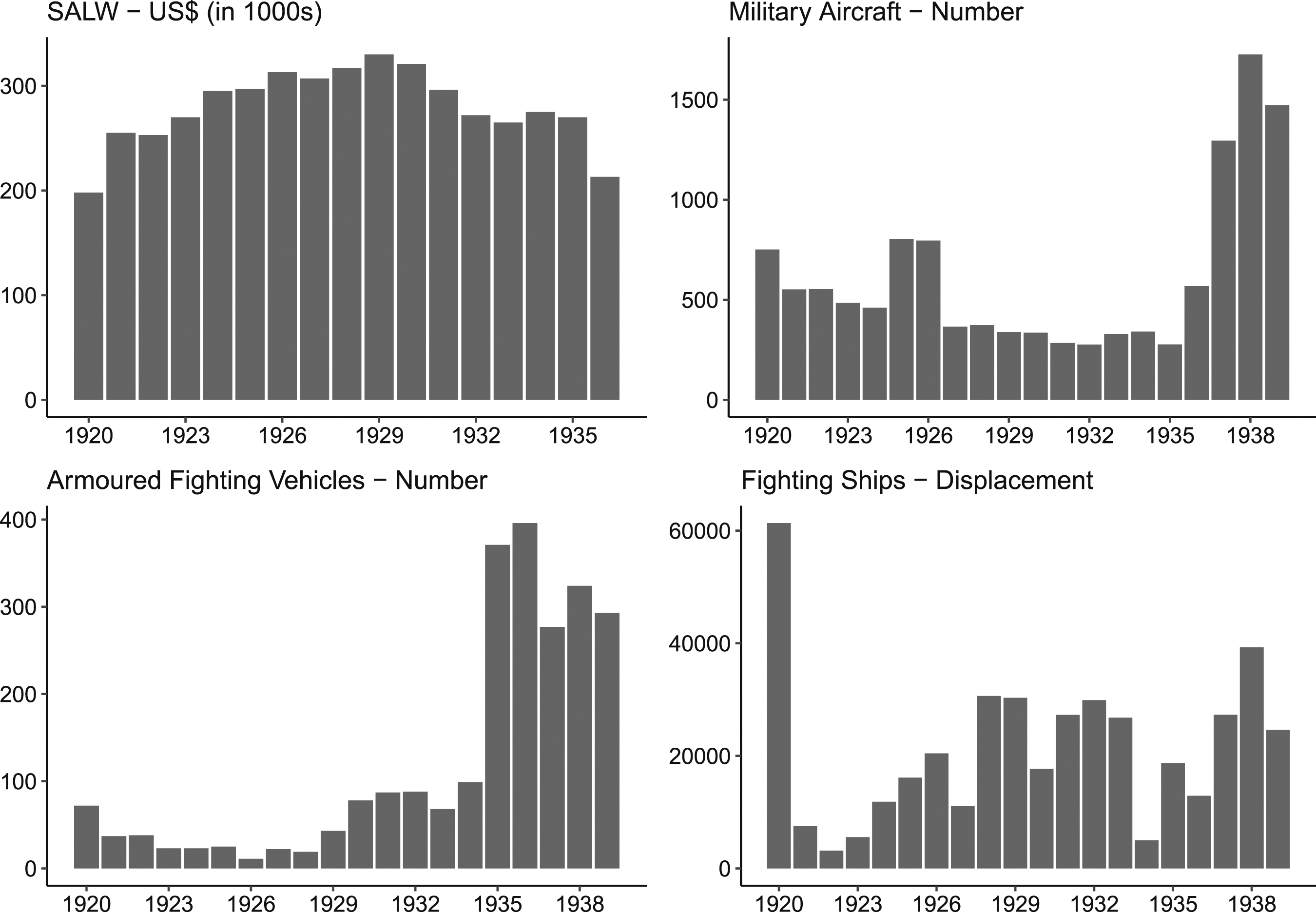
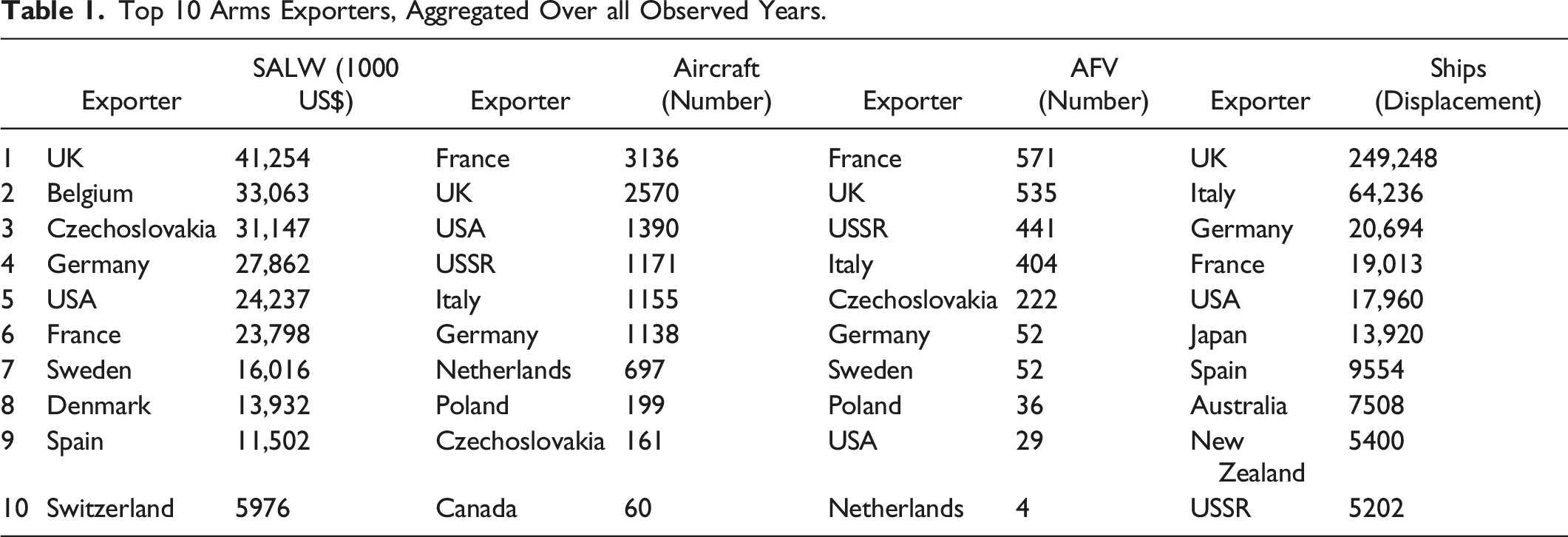
Top 10 Arms Exporters, Aggregated Over all Observed Years.
Top 10 Arms Importers, Aggregated Over all Observed Years.
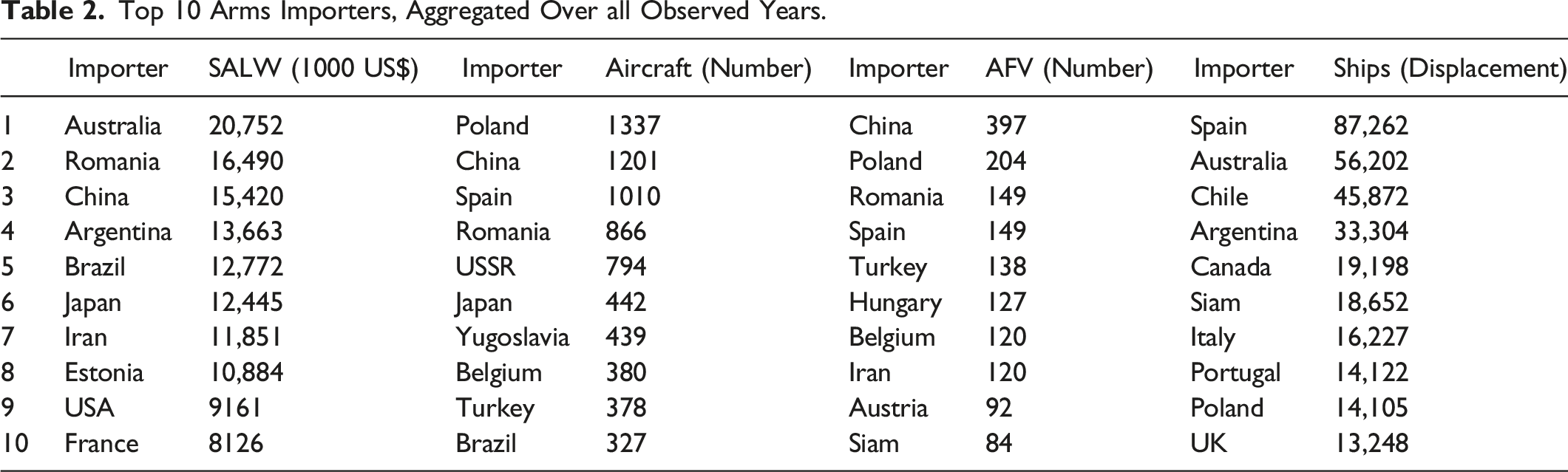
Table 2, in turn, presents the period’s top importers of arms. Its first column shows that Australia was the top importer of SALW in the Interwar period and, no doubt, a major customer for British weapons. It is followed by a mix of Eastern European, Asian, and South American countries. Among them, China is found to have imported the third most weapons, unsurprising given its near-constant state of civil war throughout the Interwar years. Accordingly, the Chinese government was also one of the top importers of aircraft and armoured fighting vehicles, with further arms going to some of the warlords fighting against it and each other. Spanish imports of arms rose dramatically once the civil war there erupted while Romania and Poland sought to build up armies in defence against the USSR and Germany, respectively. Spain also shows up as top importer of warships, though these imports mainly occurred before the civil war, followed by five non-European countries with long coastlines. Interestingly, Italy and the UK also show up as top importers of warships, with the latter re-obtaining vessels it had earlier supplied to its dominions in Oceania while the US and France exhibit non-negligible imports of SALW, potentially hinting at the more commercial nature of the trade in small arms.
Finally, the IPITA data can not only be investigated in terms of importers or exporters, but also from a network perspective. Recent studies on the Cold War and post-Cold War arms trade show that these transactions now form a global network with implications for system-embedded interstate politics (Beardsley et al. 2020; Thurner et al. 2019). As shown in Figure 2 for the year 1930, network structures emerging from dyadic transfers can also be observed in the Interwar arms trade. Panel 2a presents the MCW transfer network, where a directed tie exists between countries i and j if i transferred at least one military aircraft, AFV, or ship to j. It is visible that top MCW exporters in terms of trade volume, such as the UK, France, and the US, also had the most outgoing ties while China is at the core of the network as a main importer. There are numerous importer countries with only a single supplier. Interestingly, a tendency towards triadic closure is really only visible between the UK and US, with both exporting to Spain, Japan, and China while trading with each other. Instead, arms exporters more often shared recipients without trading with each other. This is a notable difference to the Cold War system (Thurner et al. 2019). The networks of international arms transfers in 1930. (a) major conventional weapons (MCW) (b) small arms and light weapons (SALW).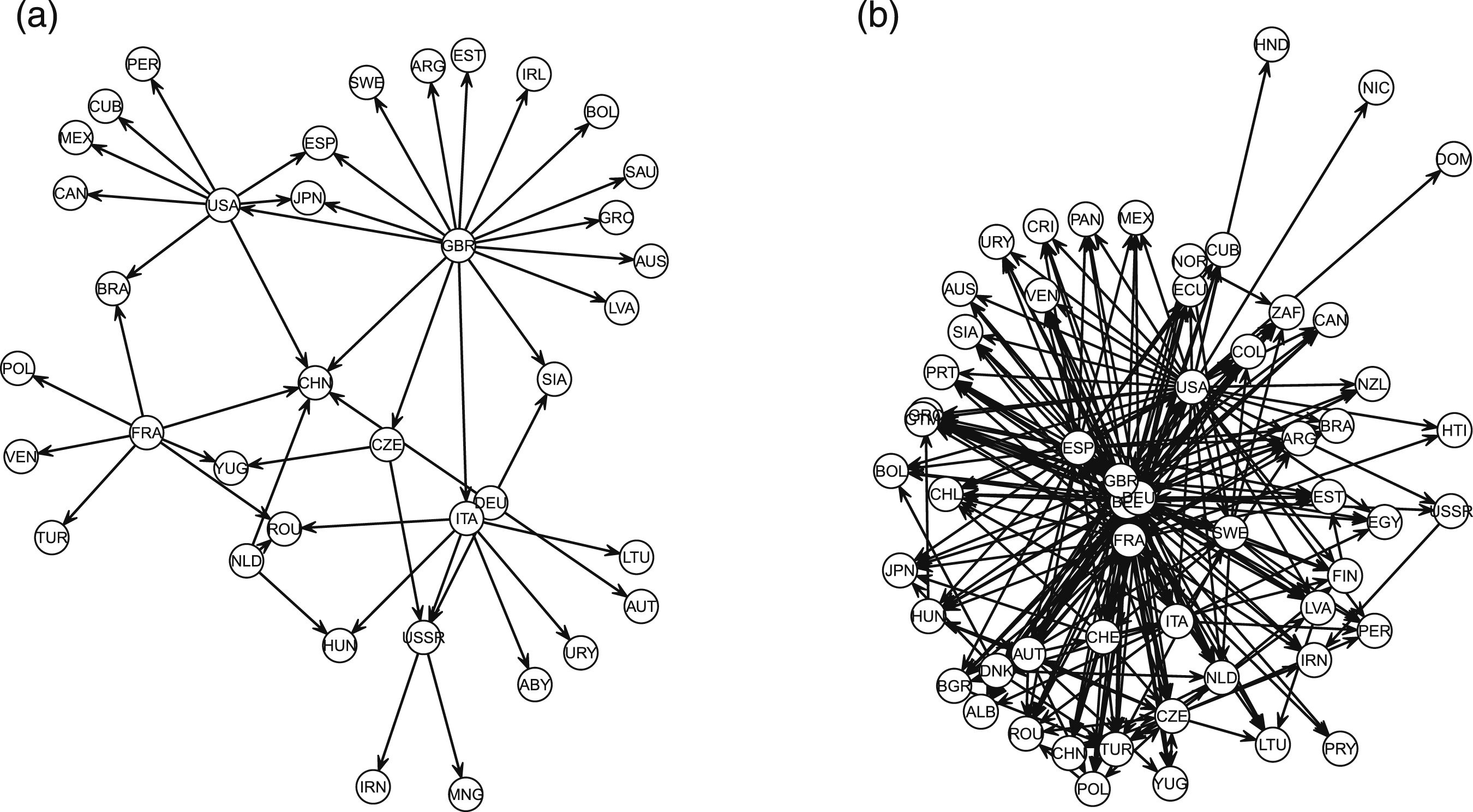
Panel 2b shows the SALW trade network, a directed tie exists if i transferred weapons worth at least 100 US$ 7 to j. As compared to 2a, it becomes clear that this network has more participating states, transfer ties, and an overall higher density. The SALW market thus had more, and more active, participants than the trade in MCW. It is also visible that much fewer countries had a single supplier of SALW than MCW. But beyond these general statements, the network in 2b is already too dense for further visual inspection, necessitating the use of network analysis methods. These methods also allow inspecting multiple of the yearly networks at once.
As an example, Figure 3 plots how the centralization of both the SALW and the MCW trade networks developed over the period between the two World Wars. Because arms transfers are directed ties, we can distinguish between In- and Out-Centralization (see Wasserman and Faust 1994), which capture to what extent the network revolves around a central core of, respectively, importers and exporters. Figure 3 shows that both arms transfer networks were more centralized in terms of exporters than importers, i.e. few exporters transferred weapons to many importers, that both In- and Out-Centralization were more pronounced for the SALW than the MCW market, and finally that especially Out-Centralization underwent substantial changes over time, decreasing for SALW but increasing for MCW in the 1930s. Centralization in the MCW (solid lines) and SALW (dashed lines) networks.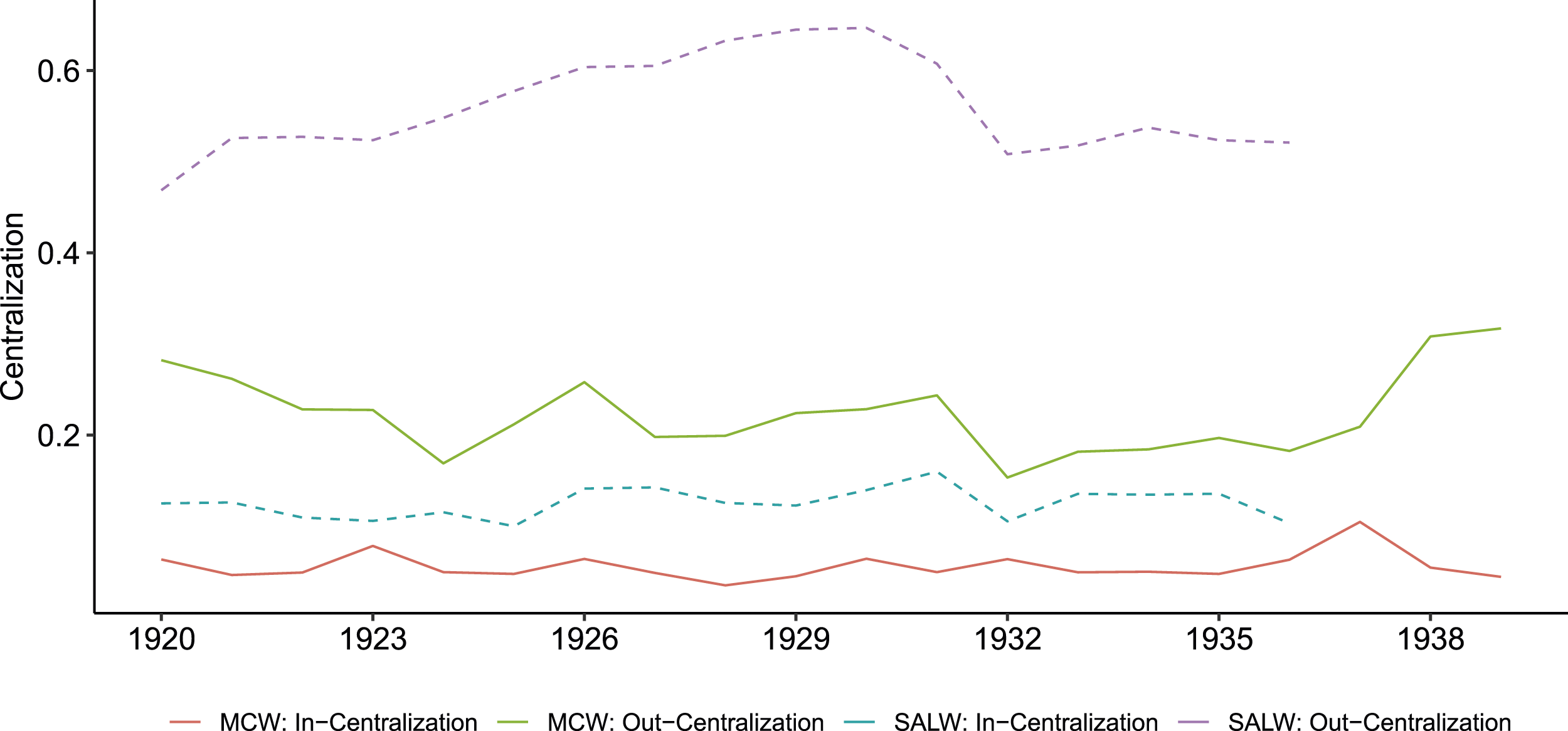
An Application: International Arms Transfers and the Demand for Military Expenditures, 1920-37
Finally, we present an application of the IPITA data. A major benefit of these new arms trade data is that they allow us to re-investigate established findings on the drivers and consequences of arms transfers and to check whether they also hold when examining not the bipolar Cold War or the unipolar post-Cold War orders, but instead the multipolar Interwar system. This is especially relevant for arguments which include a specifically temporal component. For instance, Pamp and Thurner (2017) find that weapons imports had a positive effect on defence spending after the Cold War but not during it. They attribute this to the arms trade becoming more commercialized after 1989 whereas free transfers in the form of military assistance decreased. The Interwar arms transfer system is usually regarded as highly commercial (Harkavy 1975, 98), arguably even moreso than the post-Cold War system, meaning that arms imports should be associated with higher military expenditures there. But at the same time, the multipolarity and economic situation of the 1920s and 1930s meant that many transfers at the time involved barter deals and large credits, factors which Pamp and Thurner (2017) identify as potentially reducing such a positive effect. But even if theoretical arguments have no explicit scope conditions regarding time and space, temporal generalizability is an important, albeit underappreciated, facet of quantitative conflict research (Fordham 2020). Along these lines, Pamp and Thurner (2017) propose that arms exports reduce the defence spending of democracies because their exports usually go to allies, thus increase their security, and accordingly allow them to reduce their own investments in security. But as noted in later research by the same authors, this substitution effect may depend on alliance commitments being sufficiently loose to allow free-riding and hence not apply to the Cold War years (Pamp et al., 2018a). How a country’s defence spending is influenced by its arms imports and exports thus appears to depend quite substantially on the examined period. We take this as a motivation to examine the relationship between arms transfers and military expenditures in the years 1920-37, replicating Pamp and Thurner’s (2017) empirical models with the IPITA data.
While the original models focus on MCW only, we include variables for both MCW and SALW because IPITA includes data on both kinds of weapons
8
. We measure MCW imports and exports as the total number of MCW received and sent, respectively, in a given year while SALW transfers indicate the total financial value of the transferred weapons. We log-transform these variables and, following Pamp and Thurner (2017), lag the export measures by 1 year. Otherwise, our model specifications mirror those reported in their tables two (imports) and four (exports), albeit drawing on alternative data sources where necessary due to the different period of observation. We present the results of a total of eight panel models, four each for arms imports and exports, in Figure 4. Following Pamp and Thurner (2017), these models employ country- and year-fixed effects, control for GDP, population, intra- and interstate conflict, the extent of democracy, and neighbours’ military spending and conflict, and use heteroskedasticity and autocorrelation consistent (HAC) standard errors. They differ in how they capture time dependence. Importantly, the export models include only countries which exported a non-zero amount of weapons at least once. We offer additional detail on the specification of these models in the supplementary material. International arms transfers and military expenditures.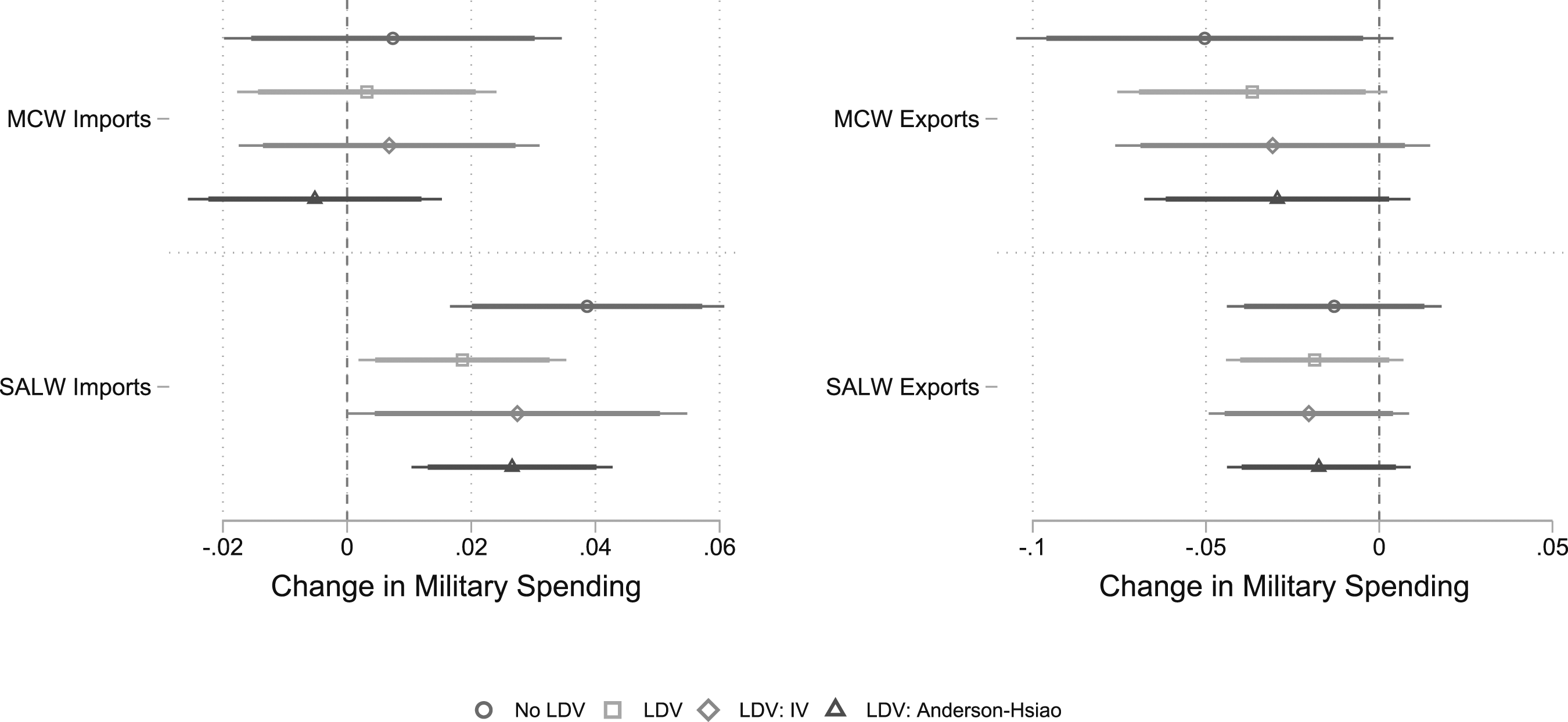
The left panel of Figure 4 indicates that in the Interwar years, SALW imports were associated with increased military expenditures as they exhibit a positive and statistically significant coefficient across all specifications. In contrast, the coefficient estimate of MCW imports is consistently closer to and statistically indistinguishable from zero. This divergence may be due to the SALW trade being more commercial than MCW transfers (see Lebacher, Thurner, and Kauermann 2021), though many studies consider the Interwar arms trade as a whole to have been very economically oriented (see e.g. Harkavy 1975; Laurance 1992). The lack of an association between MCW imports and military expenditures, which exists in the post-Cold war period (Pamp and Thurner 2017), may be seen as a sign that the Interwar trade in MCW was not as commercial as the literature assumes, though barter deals and large credits were arguably also more common for MCW than SALW transfers. The right panel of Figure 4 offers some, albeit weak evidence in line with the expectation that MCW exports reduce defence spending as their coefficient is statistically significant at the 90%-level in the first two models. This effect becomes insignificant once we instrument for the lagged dependent variable and SALW exports exhibit no statistically significant effects in any specification. Sending MCW may thus have allowed exporters to free ride on the security provided by allies in the Interwar years, though this result is sensitive to modelling choices and based on the small sample of countries which actually exported weapons at the time. In sum, these results demonstrate the applicability of the IPITA data to reassess existing empirical findings and to obtain new insights on the arms trade, indicating that the findings of Pamp and Thurner (2017) travel quite well to the Interwar period while suggesting that the commercial orientation of the period’s arms trade may be overstated (see also Mehrl, Seussler, and Thurner 2022).
Conclusion
This article introduces IPITA, a new dataset on arms transfers in the Interwar years. IPITA provides dyadic information on weapons sent between independent countries, as well as some colonies and non-state actors, for the period 1920-39, covering military aircraft, ships, armoured fighting vehicles, as well as small arms and light weapons including artillery, ammunition, and explosives. Here, we have made the data collection process transparent, offered some descriptive insights on the arms transfer system of the Interwar years, and applied the data to show that in the period, imports of SALW, but not MCW, were associated with increased military expenditures whereas there is some evidence that exports of MCW, but not SALW, resulted in reduced defence spending.
As with all data, IPITA also has some limitations that require discussion. The small arms and light weapons data rely on customs data, meaning that they depend on countries’ reporting, are subject to reporters’ different rules on what goes (and goes not) through customs, and miss transfers that occurred clandestinely or through other non-customs channels. Because the source documents offer no standardization across reporting units, we had to standardize across weapon types and different currencies as well as estimate financial values for transfers where none were given, potentially inducing measurement error. The MCW data, covering military aircraft, ships, and armoured fighting vehicles, were collected from a wide range of primary and secondary sources. They may thus miss transactions not reported in any of these sources whereas for some transfers, sources gave delivery dates and numbers only as ranges of years or amounts. Again, this introduces some imprecision and measurement error. And finally, it is currently difficult to compare transfer volumes of different weapon types with each other as IPITA includes no catch-all volume indicator such as SIPRI’s (2023) TIV. Extending the TIV to Interwar military technology and/or small arms and light weapons thus appears as an important methodological next step for arms trade research.
Since the IPITA data provide a significant extension to the period for which data on MCW and SALW transfers is available, we next highlight some important considerations for researchers seeking to combine Interwar and post-WW2 data and use them together in their analyses. On a technical level, this combination is possible, albeit not straightforward, because, in the case of MCW, different datasets employ different units of measurement: as discussed above, we report unit numbers for MCW whereas the WMEAT data report financial values and SIPRI mainly relies on trend indicator values. That being said, SIPRI data also enumerate unit numbers, thus facilitating the combination of datasets, while our data not only mirror NISAT in the use of financial values for SALW, but even apply the NISAT weapons coding scheme. In addition, for applications that require binary data, such as most network analysis approaches, the different datasets can be binarized separately using thresholds the researchers judge to be comparable and then combined. From a technical perspective, combining these datasets hence requires some work but is possible by using unit numbers as measurement unit for MCW and financial values, standardized to the same currency and year, for SALW, or by binarizing the data.
However, and depending on the specific application, researchers should also consider whether it is appropriate to combine pre- and post-World War II data in the same analysis. On one hand, weapons technology, especially in the case of combat aircraft and armoured fighting vehicles, underwent rapid changes between the 1930s and 1950s with, for instance, the introduction of jet engines and air-to-air missiles in the former, that were reflected in changes in the cost, strategic value, and longevity of weapons. Comparing unit numbers across periods thus has clear limitations, though applying TIV valuations to the IPITA data would assuage this point. But on the other hand, the international political system within which arms transfers happen changed significantly after World War II. As such, some important covariates for inferential analyses of the post-World War II arms trade, such as United Nations voting behavior (see e.g. Martínez-Zarzoso and Johannsen 2019), are unavailable for the Interwar period while more generally, it may require substantial theoretical assumptions to model the effects of other covariates (including, potentially, arms transfers themselves) as if they were the same during these different historical periods. We thus recommend that researchers think carefully about whether it is theoretically appropriate to combine Interwar and post-World War II arms trade data within the same descriptive or inferential analysis. Alternatively, they may follow Mehrl, Seussler, and Thurner (2023) and present separate models testing the same hypotheses for these different periods which, while more complicated in terms of modelling and presentation, allows accounting for their differences in available data and expected theoretical dynamics.
Taken together, IPITA contributes to research in political science, economics, and history. Political scientists can, for instance, use IPITA to study how and whether arms transfers were used as foreign policy tool or contributed to war and peace within and between countries in the multipolar setting of the Interwar years. Economists can employ IPITA to research the demand for arms imports, when arms producers decide to export weapons regardless of their potential negative security externalities, and how these transfers affect importers’ and exporters’ spending on other goods. And for historians of the Interwar years, IPITA allows situating detailed archive-based research on, e.g., armaments procurement decisions, military technological cooperation or shifting foreign policies, within a broader, comprehensive picture of the period’s global arms trade and security interdependencies. IPITA will thus contribute to our understanding of an important historical period as well as of contemporary phenomena in political and economic international relations.
Supplemental Material
Supplemental Material - The Interwar Period International Trade in Arms: A New Dataset
Supplemental Material for The Interwar Period International Trade in Arms: A New Dataset by Marius Mehrl and Paul W. Thurner in Journal of Conflict Resolution
Supplemental Material
Supplemental Material - The Interwar Period International Trade in Arms: A New Dataset
Supplemental Material for The Interwar Period International Trade in Arms: A New Dataset by Marius Mehrl and Paul W. Thurner in Journal of Conflict Resolution
Supplemental Material
Supplemental Material - The Interwar Period International Trade in Arms: A New Dataset
Supplemental Material for The Interwar Period International Trade in Arms: A New Dataset by Marius Mehrl and Paul W. Thurner in Journal of Conflict Resolution
Footnotes
Acknowledgments
We thank Camelia Abdelgelil, Sophia Arlt, Johannes Brannath, and Daniel Seussler for their diligent research assistance, Oliver Pamp for his assistance with the application, and especially Andreas Fischer for his extensive research assistance and support of this project. We are also grateful to Tamara Enomoto, Joe Maiolo, Nic Marsh, and Siemon Wezeman for their help and encouragement in the early steps of this project. We would also like to thank the editor, Paul Huth, and two anonymous reviewers for their feedback on an earlier version of this paper. The authors gratefully acknowledge support from the German Research Foundation (DFG) for the project TH 697/11-1: Arms Races in the Interwar Period 1919-1939. Global Structures of Weapons Transfers and Destabilization.
Declaration of Conflicting Interests
The author(s) declared no potential conflicts of interest with respect to the research, authorship, and/or publication of this article.
Funding
The author(s) disclosed receipt of the following financial support for the research, authorship, and/or publication of this article: The authors gratefully acknowledge support from the German Research Foundation (DFG) for the project TH 697/11-1: Arms Races in the Interwar Period 1919-1939. Global Structures of Weapons Transfers and Destabilization.

Data Availability Statement
All supplementary and replication material for this article are available online.
Supplemental Material
Supplemental material for this article is available online.
Notes
References
Supplementary Material
Please find the following supplemental material available below.
For Open Access articles published under a Creative Commons License, all supplemental material carries the same license as the article it is associated with.
For non-Open Access articles published, all supplemental material carries a non-exclusive license, and permission requests for re-use of supplemental material or any part of supplemental material shall be sent directly to the copyright owner as specified in the copyright notice associated with the article.
