




Abstract
Although conflict issues – the stated goals of actors engaged in conflict – hold a privileged position in many theoretical explanations of the occurrence, dynamics, and resolution of civil war, global issue data are scarce beyond datasets that focus on specific thematic areas. This article aims to bring issues into the forefront of civil war scholarship by presenting the UCDP Conflict Issues Dataset (CID). This global yearly dataset contains 14,832 conflict issues – divided, at the most disaggregated level, into 120 sub-categories – raised by armed non-state groups involved in intrastate armed conflict in 1989-2017. By bringing issues back in, the UCDP CID provides opportunities to reevaluate several central questions about the onset, duration, intensity, and resolution of civil war.
Keywords
Introduction
“The political object is the goal, war is the means of reaching it, and means can never be considered in isolation from their purpose,” Carl von Clausewitz asserted in 1832. Surprisingly, almost 200 years later, our knowledge concerning conflict issues – i.e. these ‘political objects’ – remains scarce. Johan Galtung (1996) conceptualized conflict as constructed out of attitudes, behaviors, and contradictions (or issues). Wallensteen (2002) reconstructed this so-called ‘conflict triangle’ into parties, behaviors, and the issues at stake. Over the past decade, our knowledge of two of the three cornerstones of this conflict triangle – parties and behaviors – has improved radically. 1 Similar strides are lacking, however, concerning the third aspect of the triangle: the issues at stake. 2 While issues hold a prominent position in the study of inter-state conflicts (c.f. Holsti 1991; Randle 1987; Vasquez and Mansbach 1984), they have not received equal recognition for the most common type of conflict in the post-World War II era: intra-state conflicts (civil wars). Theories on conflict resolution generally emphasize the need to understand what issues underlie the parties’ positions to resolve conflict (Diehl 1992; Fisher and Ury 1987; Rubin, Pruitt, and Kim 1994). Thus, one of the cornerstones of conflict theory remains underdeveloped in terms of available empirics and hypothesis-testing; a gap that impedes our possibilities to understand and resolve civil wars. To remedy this situation, this article introduces the UCDP Conflict Issues Dataset (UCDP CID); a global and time-variant dataset on rebel groups’ stated goals in armed conflicts. 3
By presenting the CID, we aspire to bring issues into the fore of civil war scholarship. The dataset focuses on the stated demands that rebel groups communicate through official documents or their leadership in relation to a specific armed conflict dyad. The dataset contains 14,832 conflict issues – divided into a four-tier typology with, at the most disaggregated level, 120 sub-categories – raised by armed non-state groups involved in civil conflict in 1989-2017 (see Figure 1 for an overview of the tier system). We use a comprehensive approach that allows for groups to hold numerous conflict issues while accounting for the fact that issues may vary over time. Thereby we are not only interested in conflict issues in the initial phase of a conflict – those that might have motivated the initiation of an insurgency – but also consider later stages of conflict. The CID dataset encompasses conflict issues raised across the full civil war cycle divided into three clusters: Conflict Goal Issues, Conflict Dynamics Issues, and Conflict Resolution Issues. On top of providing comprehensive information about what rebel groups fight for, the data also include Actor Characteristics (for all 329 rebel groups included) concerning ideology, ethnicity, religious affiliation, and geographical scope of the stated demands. Visual illustration of the CID’s four-tier coding system.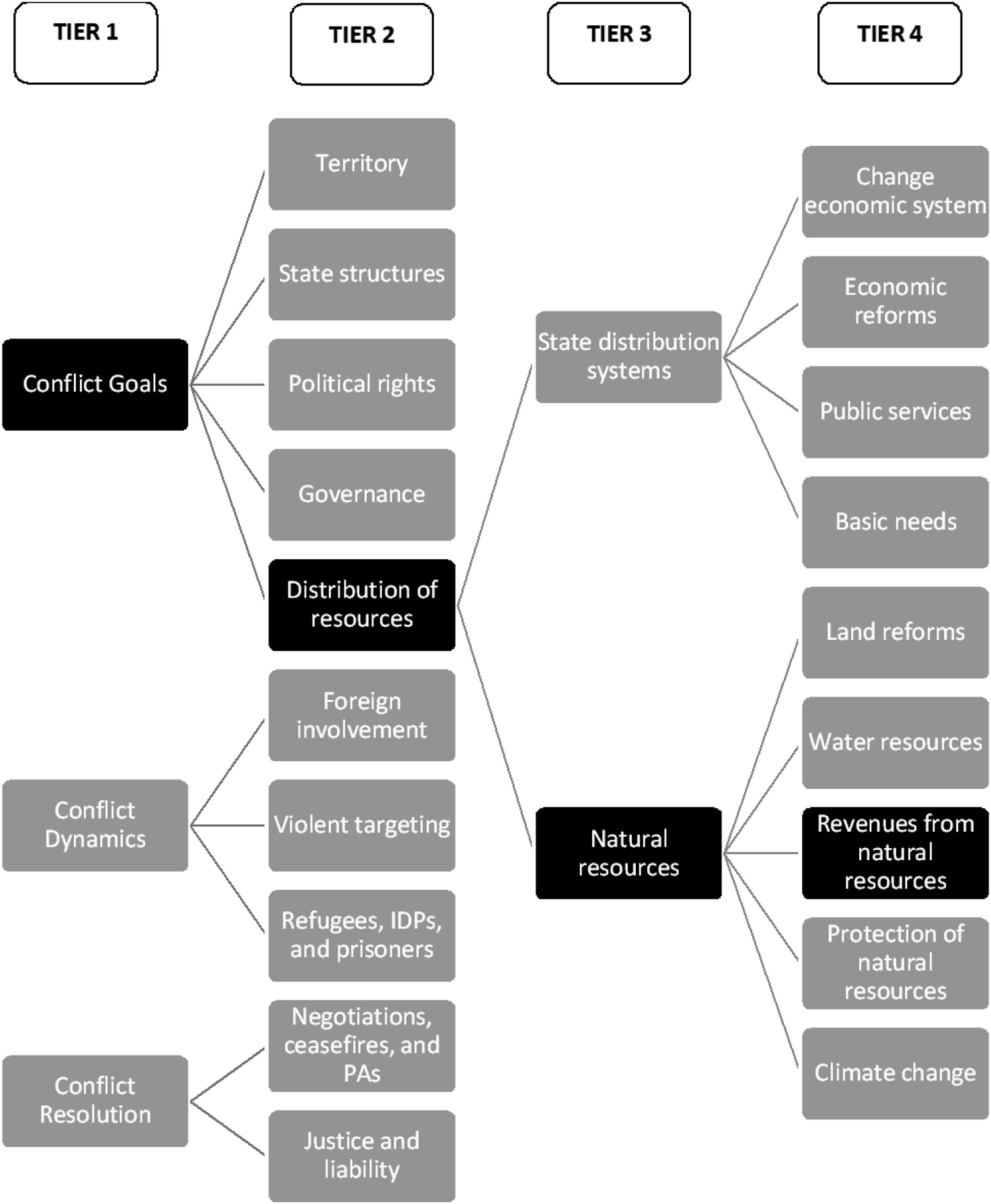
By bringing issues in – and by facilitating a better match between theoretical expectations and empirical cross-case analysis – CID opens up a wide swathe of research opportunities. First, CID enables addressing a new range of questions, such as the impact of issues on the onset, duration, intensity, and resolution of civil war. Likewise, the data facilitates examining issues as an outcome variable, for instance why groups emphasize particular issues and not others. Second, the new data mean that several central questions can be reevaluated in better detail. Concerning the ‘greed and grievance’ debate (Collier and Hoeffler 2004; Murshed and Tadjoeddin 2009), CID opens up the black box of grievances to examine what grievances groups actually declare and their impact. The dataset also facilitates new ways of evaluating peace agreements. Whereas research on the content and implementation of peace agreements have provided important knowledge (c.f. Jarstad and Nilsson 2008; Joshi and Darby 2013), peace agreements cannot be properly assessed without data on the issues raised during the conflict. If we do not know what the parties are fighting for, we cannot know whether peace agreements address the conflict issues or not; studying only included provisions fails to account for issues that defy being brought to the negotiating table. Third, by providing data on conflict issues and actor characteristics (such as ideological profiles), CID connects to research recognizing ideology as a core component of conflict (c.f. Leader Maynard 2019; Sanín and Wood 2014), and facilitates studying relationships between ideologies, issues, and civil war. One could, for example, examine how a group’s ‘issue signature’ shapes conflict behaviors such as targeting of civilians, or restraint in violent conduct. 4 A fourth useful application of the dataset is as a tool for case selection. For both most-similar and most-different designs, the CID provides scholars with an easy tool to establish similarities (or differences) in conflict issues, which facilitates robust comparative studies. CID also allows a researcher interested in a particular topic (such as amnesty or transitional justice) to identify the universe of cases.
In what follows, we first outline the need for a new dataset and define ‘conflict issues’. Next, we present the dataset’s organizational structure and the coding process. We then provide some descriptive statistics and two illustrative empirical applications.
Why a New Dataset?
A prime reason for the paucity of cross-case examinations of conflict issues is a lack of data. 5 Many large-N analyses of civil war have therefore depended on the UCDP’s division of incompatibilities being over ‘government’ or ‘territory’. However, the separation into conflicts over territory and conflicts over government was never meant to be used as a classification of what an armed conflict was ‘about’; it was created to separate between if a rebel group challenged a government for authority over the whole of a state or parts of its territory (Heldt 1993). Three other factors make this dichotomy sub-optimal for analyzing conflict issues. First, the definition subsumes different empirical phenomenon under the same heading. For example, conflict goals for independence and autonomy – two categorically different aspirations – are conflated as ‘territory’. Second, it allows for only one incompatibility, despite rebels pursuing more than one political goal at any given time. Third, the dichotomy treats incompatibilities as time-invariant, creating an illusion of conflicts concerning the same issue across time and thus missing fluctuations such as when demands shift from independence to autonomy.
In a welcome development, a few datasets related to conflict issues have emerged in the last years. Below we review the datasets most relevant for CID. A first group of datasets focuses on actors other than rebel groups. For example, the Ethnic Power Relations–Organizations (EPR-O) dataset provides information about organizations representing ethnic groups (Vogt, Gleditsch, and Cederman 2021) and the Minorities at Risk Organizational Behavior data (MAROB) focuses on ethnic minorities (Asal, Pate, and Wilkenfeld 2008). EPR-O includes claims from ethnic organization that relate either to aspirations for power (or influence) at the national government level or territorial demands such as autonomy or secession. MAROB codes five different dominant political grievances (eliminating discrimination, increasing remedial policies, strengthening autonomous status, creating a separate state, and other). The Non-violent and Violent Campaigns and Outcomes data (NAVCO) covers mass movements demanding regime change, anti-occupation, and secession (Chenoweth and Shay 2022), and von Uexkull and Pettersson’s data concern issues in non-state conflicts in Africa (von Uexkull and Pettersson 2018).
A second group of significant datasets focuses primarily on rebel groups but hones in on particular subsets of the universe of conflict issues. Cunningham (2014) focuses on groups that seek self-determination, either by violent or non-violent means, and differentiates between demands such as cultural autonomy, independence, and irredentism. Another important strand has focused on religious issues and differentiates between various religious claims (Svensson and Nilsson 2018; Toft 2007). Other datasets focusing on issues, demands, or grievances include the Governmental Incompatibilities Data Project (GIDP), which captures maximalist claims from dissident organizations in conflicts over government (Cunningham et al. 2017),
Finally, a third group of datasets have focused on rebel groups and not concentrated on a specific sub-set of issues. The dataset by Tokdemir et al (2021) captures five categories of rebel demands (policy concessions, territorial autonomy, territorial independence, regime change, and global regime modifications) whereas Lutmar and Terris’ (2019) differentiate between seven different ‘rebel group goals’ categories (secessionism, irredentism, autonomy, greater political power/rights, government overthrow, unknown/undecided, colonial independence). 6
While all these data collections are impressive, the UCDP CID comes with several perks in relation to existing data. First, the CID does not restrict itself to a particular type of rebel group, such as religious or ethnic, but contains information on all opposition groups involved in armed intrastate conflict in UCDP’s data irrespective of type and magnitude. Second, whereas many previous datasets tend to be focused on one specific ‘theme’ (such as maximalist demands, religious issues, or self-determination demands), CID captures a broader universe of issues across the entire conflict cycle. Third, the CID’s broader scope entails that the data encompasses and expands upon those categories of issues identified by previous data collections, such as the five categories provided by Tokdemir et al. (2021) and the seven delivered by Lutmar and Terris’ (2019). At the lowest level of disaggregation, the CID contains 120 categories. Fourth, the CID maintains direct links to the family of UCDP datasets and thus has high interoperability.
Defining Conflict Issues
Definitions of conflict issues predominantly exist in the literature on interstate conflict. Inspired by Rosenau’s pioneering work (Rosenau 1966), Mansbach and Vasquez aspired to build an issue-centered paradigm for international politics (Mansbach and Vasquez 1981; Vasquez and Mansbach 1984) and defined issues as “contention among actors over proposals for the disposition of stakes among them” (1981, 59). They argued that actors seek particular objects (such as certain territory) since attaining them could fulfill more abstract values such as freedom. Theoretically, they distinguished between stakes, proposals, objectives, and values. Others have kept the conceptualization simpler. Randle defined an issue as “a disputed point or question, the subject of a conflict or controversy” (1987), Holsti (1991, 18) as “the stakes over which two or more parties contend”, and Diehl (1992) succinctly declared, “an issue is what states choose to fight over”.
The sub-concept of ‘stakes’ takes center stage in many definitions. Holsti sees stakes as the “fairly concrete” (1991, 18) object to be owned or divided by contending parties. He distinguished stakes from values, arguing that values such as ‘glory’ are difficult to pinpoint empirically. Values can also be a by-product of conflict rather than its initial objective, such as in how European monarchs received glory from their conquests. The concrete stake, or the object to capture, should thus take precedence in determining what makes an issue. Contention is underlined across definitions: two or more parties disagree over either some form of ownership (such as who should run a government) or a particular policy. Based on these insights we define ‘conflict issues’ as: “a statement suggesting concrete changes to societal structures or policies controlled by other actors”
We capture the theoretical notion of concreteness by honing in on “societal structures or policies”, thus avoiding abstract notions such as ‘freedom’ or ‘brotherhood’. It may be important that a group seeks freedom, but we focus on what changes to structures or policies a group asks for in order to reach such freedom. We capture contention through referring to “controlled by other actors”, signaling that something becomes an issue only when its existence or distribution is disputed between two or more parties. 7 As argued by Rosenau and others, issues are as much about perceptions as reality (Rosenau 1966), making it more important for definitional purposes that a challenger experiences there to be contention, rather than establishing whether the changes an issue specifies are grounded in reality. Thus, for a group proclaiming that it fights for democracy, this constitutes a conflict issue no matter the factual degree of democracy. Additionally, an issue needs to be ‘stated’ by the actors themselves. We are not interested in how outsiders infer issues, as such interpretations of what rebels are fighting for are qualitatively different from the goals pronounced by the groups. We here follow Holsti’s (1991) preference for issues to be derived straight from the horse’s mouth rather than inferred through analysis. In sum, our definition captures the core components on which there is overall agreement in previous literature and avoids the pitfalls of attempting to capture things that are vague or abstract.
After establishing our theoretical definition of conflict issues, we should clarify a few operational attributes. As the CID covers armed conflict, a conflict issue needs to be stated by an organized armed non-state actor to be included in the dataset. We focus on the opposition side of a conflict, as these are the challengers to the status quo. This emphasis serves to link our definition to civil wars and allows separating between rebel groups and other non-state actors (such as protest movements and political parties).
Another important consideration when defining conflict issues concerned whether to classify issues based on the form of change or the content of change demanded. Though we saw the value of differentiating between issues based on content – for example, through classifying outcomes in the form of ethnic or religious content – there were also disadvantages with such classifications. Comparing the Khmer Rouge and the Islamic State captures the dilemma. Both movements proclaimed as one of their main goals the overthrow of the government and the creation of a new political system: the form of change is thus the same. The contents of such change, however, starkly differs with the Islamic State wishing to create an Islamic state and the Khmer Rouge a Communist one. To cover both the form and content of change, we let issues be focused on the pronouncements of the form of change (of a policy or a structure) and complement this with ‘actor characteristics’ that capture the group’s ideology, religion, ethnicity and geographical scope of the demands. Combining conflict issues with actor characteristics allows identifying the form of change as well as its likely content. For instance, an Islamist group demanding change of the judicial system (form of change) is probably asking for a move towards sharia (content of change). 8
Presenting the UCDP Conflict Issue Dataset (CID)
Below we introduce the UCDP CID by describing its organizational structure, the coding procedure and identified limitations.
Typological Organization: A Four-tier Hierarchy
The CID contains 14,832 stated conflict issues and actor characteristics for all 329 groups in the dataset. We have organized the identified issues into a four-tier hierarchical system based on four organizing criteria: (1) phase of the conflict cycle, (2) the thematic category of an issue, (3) the form of change requested, and (4) the degree of change demanded. We arrived at this structure through a process of abduction. Though Holsti (1991) warns that theoretically derived typologies tend to create categories that define procedures and distributions, rather than the actual stake or issue, the process warranted some basis in previous theory to link data to existing research. To accommodate these two positions, we applied an abductive approach (c.f. Chapter 4 in Jackson 2016). Beginning with some existing overarching categories of conflict issues we pursued some initial empirical enquiry and then looped back to develop the typology. 9 We repeated this exercise until we deemed our coding scheme sufficiently comprehensive; i.e. capturing repeatedly raised relevant issues. Figure 1 illustrates the four-tier system and highlights in black how the issue of ‘Revenues from natural resources’ fits into the tiers.
Conflict issues occur across different times during a conflict. Whereas certain issues are predominantly raised at a group’s inception, other demands appear later. Consequently, we separated issues into three distinct phases of a ‘conflict cycle’ at Tier 1. Conflict Goal Issues includes demands related to a group’s preferred political and societal system or functioning after conflict. The Conflict Dynamics Issues cluster contains demands related to, for example, military conduct or foreign involvement. Conflict Resolution Issues includes issues about how to end a conflict including demands related to ceasefires and peace agreements.
Tier 2 contains ten thematic areas. Conflict Goals comprise five themes: ‘territory’, ‘state structures’, ‘governance’, ‘political rights’ and ‘distribution of resources’. The Conflict Dynamics cluster covers three: ‘foreign involvement’, ‘violent targeting’ and ‘refugees, IDPs and prisoners’. The two last themes ‘negotiations, ceasefires and peace agreements’ and ‘transitional justice and liability’ are under the Conflict Resolution umbrella. Tier 3 subdivides the data into 35 more specific categories of the form of change that the group demands, distinguishing, for example, between ‘state redistribution structures’ and ‘natural resources’ within the ‘distribution of resources’ category. Tier 4 encompasses 120 categories capturing the specific issue derived from the rebel group’s statements. Conflict issues often range from rather narrow to more total. Whereas some Marxist groups demanded a complete overhaul of the economic system, other groups requested more humble economic reforms. To not conflate total and less extensive goals, we distinguish issues in terms of their scope at Tier 4. We have, for example, created separate categorizations for ‘oust full executive’, ‘oust head of executive’, and ‘reform executive’. 10
Furthermore, some groups do not formulate demands in relation to one’s own group, but in the form of denying something for another group. In Northeast India, for example, several groups have, as part of a sons-of-the-soil dynamic, asked for decreases in the rights of other groups (often termed ‘settlers’ in their vocabulary) rather than increases for themselves. Consequently, Tier 4 contains both categories regarding gaining, for instance, political rights but also a demand for the restriction of such rights. Mirror-image categories (gaining versus removing rights, for instance) have been added where this was relevant based on the empirical material. We deem that these distinctions will be valuable for scholars interested in in-group and out-group attitudes and for distinguishing between different forms of contention.
To exemplify, we turn first to the Ivorian rebel group MPIGO that desired to oust President Gbagbo. One coder identified the following statement: “According to Felix Doh (MPIGO’s leader), Mpigo's objective is now to “seize Abidjan to overthrow Gbagbo””. The CID codes this statement as an issue within ‘Conflict Goals’ (Tier 1), ‘State structures’ (Tier 2), ‘Executive’ (Tier 3), and finally ‘Oust head of the executive’ (Tier 4). Furthermore, the leader of the Darfurian rebel group SLM/A, Abdul Wahid al-Nur; declared “… the oil and mineral resources in the region belong to the people of Darfur and should remain unexploited while the conflict continues”. This statement is coded as ‘Conflict Goals’ (Tier 1), ‘Distribution of resources’ (Tier 2), ‘Natural resources’ (Tier 3), and finally ‘Revenues from natural resources’ (Tier 4).
Actor Characteristics
In addition to issues, the CID also contains ‘actor characteristics’ concerning a group’s ideology, religion, ethnicity, and the geographical scope of demands made. As was described above, these characteristics add ‘content’ to the otherwise form-oriented issues. Combining issues and actor characteristics thus allows capturing both form and content of change. For instance, if two different groups have demanded a change in the economic system but group A has Socialism as one of its characteristics, whereas the other is identified as Islamist, the characteristic provides insight into the desired content of a similar form of demand.
Example of Coding of Actor Characteristics.

Dataset Structure and Data Inclusion
We provide both a rebel-government dyad-issue-year and a dyad-year dataset. In the first iteration, each observation is an issue expounded by a rebel group in relation to a specific dyad and a specific year. In the second format, each issue comes in the form of a dummy variable per dyad-year. Dyad inclusion was based on the UCDP Dyadic Dataset version 18.1 covering 1989–2017 (Harbom, Melander, and Wallensteen 2008). A dyad is included in the dataset if it was active (saw more than 25 battle-deaths in a calendar year) in at least 1 year during this period: amounting to 329 rebel actors and 360 civil war dyads.
Our coders searched for conflict issues for every year that each dyad was active during this period and 1 year after its activity had ceased. Some of the included dyads started before 1989. To create a starting baseline, and because many fundamental issues are declared when a group is founded, we start by coding the year that the group was established and then move to our set time period. For example, when coding the Government of Sudan-SPLM/A dyad, we began by recording issues declared in 1983 (the year SPLM/A was founded) and then issues between 1989 and 2017. The dataset displays the specific year an issue is stated but with cases recorded prior to 1989 coded as in year 1000 to avoid conflation with the period of full coverage. The last active year in the Government of Sudan-SPLM/A dyad was 2004, so the last year CID includes this dyad is 2005. If no issues are identified in a calendar year no issues are recorded, nor are they carried forward from previous years: it is up to the user to decide for herself if such actions are useful for the research being done.
For easy aggregation and compatibility with other UCDP datasets, each observation contains standard ID codes as well as our actor characteristics. The dataset also provides numeric and text codes for making use of our tier system.
The Coding Procedure
Guided by a codebook (available in the online appendix) and a set coding protocol for identifying conflict issues, the coders began by collecting all documentation from the UCDP Conflict Encyclopedia’s back end (where all sources for UCDP data are stored). Thereafter the coders identified official documents such as founding documents, manifestos, communiques, leaflets and websites published by rebel groups. When official sources were exhausted, coders turned to established databases of conflicts and conflict actors, such as the Africa Research Bulletin and Mapping Militant Organizations. The coders then resorted to scanning a set of other sources, such as, Twitter feeds, and YouTube videos.
In the next step, sources such as interviews and news reporting were extracted from Factiva, totaling approximately 100,000 articles. We relied on a modification of UCDP protocols for both the design of search strings and for sources that are known to contain valuable information regarding specific groups and conflicts. An important feature of Factiva is that it translates local news from all corners of the world to English. In addition, our team included people native in Arabic, English, French, German, Italian, Spanish, and Portuguese, which further expanded the material we could cover. We also assigned key documents in other languages for professional translation. In line with our definition, we gathered statements directly attributed to the group in the form of official documents, or statements from group leaders or spokespeople. The codebook provides a more thorough discussion about sources and the coding protocol.
To ensure inter-coder reliability, the project manager and the coders discussed issues and the statements from which these were drawn at weekly meetings. All coders underwent a 2-week training program and worked fulltime in the project. At the stage of the data’s completion, the PIs checked all issues manually for consistency and validity.
Limitations
As for all open-source data collection exercises, our data contain reporting biases and information effects (Weidmann 2016). First, some rebel groups attract more attention than others, which makes it easier to both identify these groups’ issues and record a higher number of them than for lesser known groups. Second, groups vary in how frequently they communicate statements, which impacts the number of issues registered. Third, the availability of information over time varies due to the advent of digital media and the ebb and flow of local news sources. To counter the distorting effects these factors may have we only recorded each type of issue once per calendar year. Thus, if a highly communicative group states the same issue repeatedly in the same calendar year we only register it once. Despite these precautions, the increased availability of sources over time may still affect the number of issues recorded, making it seem as if though this number has increased over time.
Figure 2 demonstrates, however, that this does not seem to be the case. There is no obvious time trend from 1989 to 2017 in the total number of issues recorded, nor for the number of issues by active fighting dyads. To an extent time effects appear to be less of a concern. Reporting biases are more difficult to address. Controlling for the number of sources identified per rebel group is unfortunately not a feasible approach as coding from many sources can be indicative of the availability of both plentiful and scarce information. Highly communicative and high-profile groups receive much coverage and the coding is thus sometimes based on many sources. But more secretive or ‘uninteresting’ groups can also be coded from many sources as the coder needs to scour more source material. Number of issues and number of issues by active dyads over time.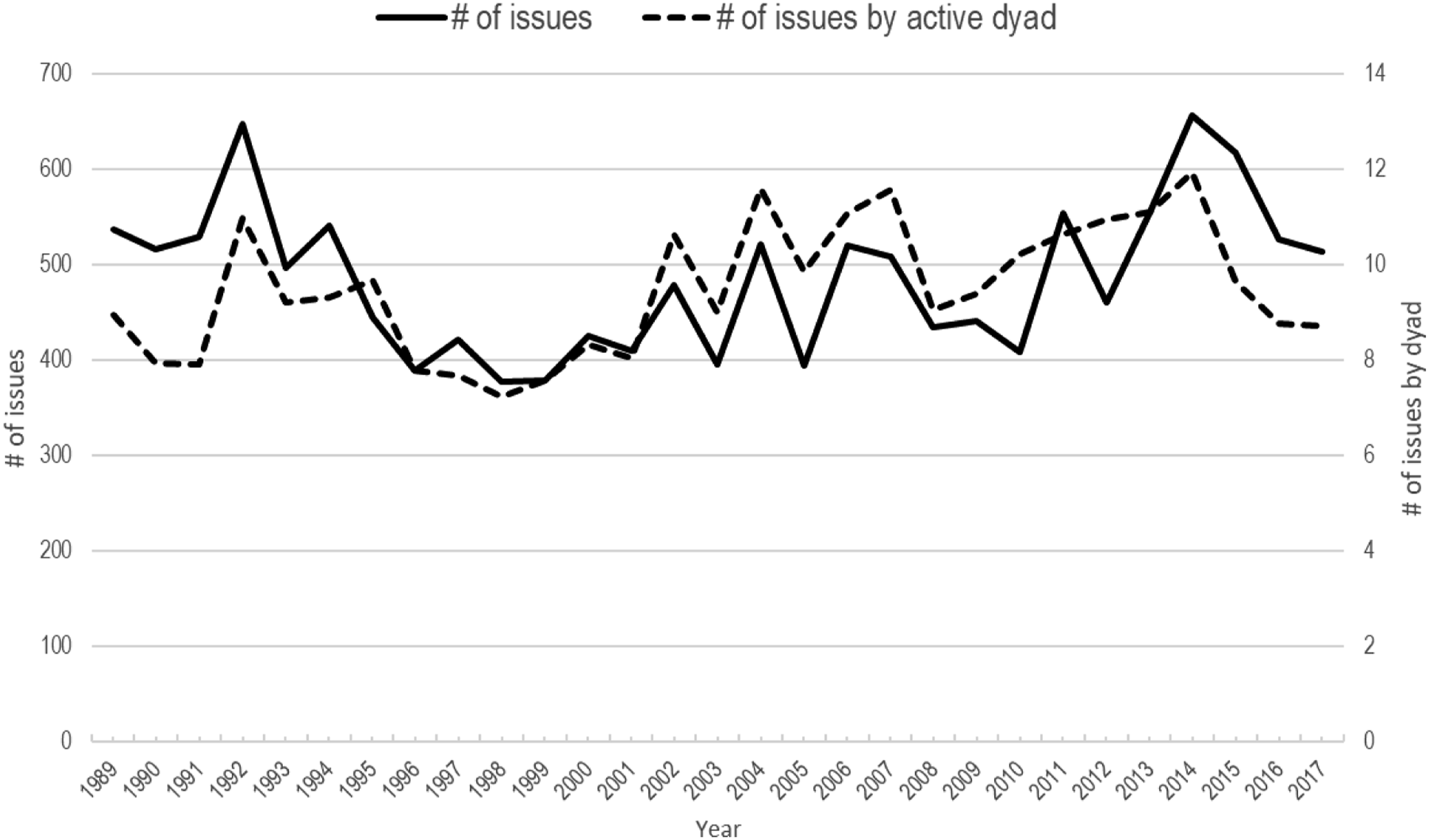
Other aspects of the data concerns how to deal with the durability and salience of issues. With ‘durability’, we here mean for what period an issue should be viewed as ‘active’: is an issue stated in 1989 still relevant in 1999? There is no easy answer available but the structure of the dataset – where each issue is recorded only for the year it is stated – allow researchers to make their own choice in this regard. Hence, the analyst can decide to, for example, restrict the research to issues stated at a group’s inception, only examine issues stated 5 years prior to a peace agreement, or carry issues forward indefinitely. The CID also allows groups to retract issues, and when this happens, it is marked in the dataset.
The data do not directly tackle the issue of salience – the fact that not all issues are equally important – and its structure gives equal weight to a wish to oust the full executive and a demand for the freedom of expression. We refrain from constructing our own measure of salience as that would go against our approach of letting the groups’ statements be in focus. Nonetheless, the CID facilitates multiple opportunities to examine how salience influences civil war. One opportunity is to use the frequency, or continuity, of a particular issue as an indication of how important one group perceives a particular issue. Another strategy is to examine only the issues one considers as most salient, be it the issues related to identity, religion, or territorial demands. Whereas totality does not equal salience, the CID’s differentiation between goals based on the extent of the requested change (i.e. oust full executive or oust head of executive) constitutes another potential avenue.
It is also worth discussing the merits and drawbacks of taking statements at face value. It is possible (and in some cases perhaps likely) that the issues pronounced are not actual aspirations since groups may state goals to attract recruits or external sponsors, or as part of a negotiation tactic. However, we have confidence in the benefit of our approach. First, there exist plenty of analyses attempting to distill what a conflict is ‘really’ about. 11 Data on conflict issues can complement or contrast such information. Additionally, even if a user questions if a group is sincere in what it demands, the data can still serve as a basis for exploring what signals rebels send to various audiences.
Finally, our approach to collecting issues broadly means that the data include issues of a varying nature where some are more comparable than others. While CID includes both ‘independence’ and ‘transitional justice’, we do not argue that these are comparable types of issues. Instead, comparisons within a specific cluster (e.g. goals/dynamics/resolution) might be more pertinent than analysis across all issues for many purposes.
Descriptive Statistics: Conflict Issues Across the Conflict Cycle
This section presents descriptive statistics for each of the three phases of the conflict cycle (Tier 1).
Conflict Goal Issues
The CID contains 14 832 conflict issues: 57 percent are Conflict Goal issues, 28 percent Conflict Dynamics issues, and 15 percent Conflict Resolution issues. The Conflict Goals cluster subsumes political aspirations on how groups wish to organize society after a conflict has ended. CID structures these issues into five thematic areas at Tier 2.
First, territorial demands contains geography-based adjustments of political control such as independence or autonomy. These account for 11 percent of the Conflict Goal issues and are shown in striped bars in Figure 3. Second, state structures (33 percent, black bars) encompasses demands on changing the arrangement of the political system and adjustments related to five different components of the state: executive, parliament, judiciary, security sector, and bureaucracy. Third, governance (14 percent, speckled bars) contains categories such as corruption, elections, and rule of law. Fourth, political rights (26 percent, white bars) distinguishes between different forms of rights such as civil, cultural, and religious rights. Fifth, distribution of resources (16 percent, grey bars) captures demands such as change of the economic system, land reforms, and distribution of revenues from natural resources. Number of issues coded in the Conflict Goals category.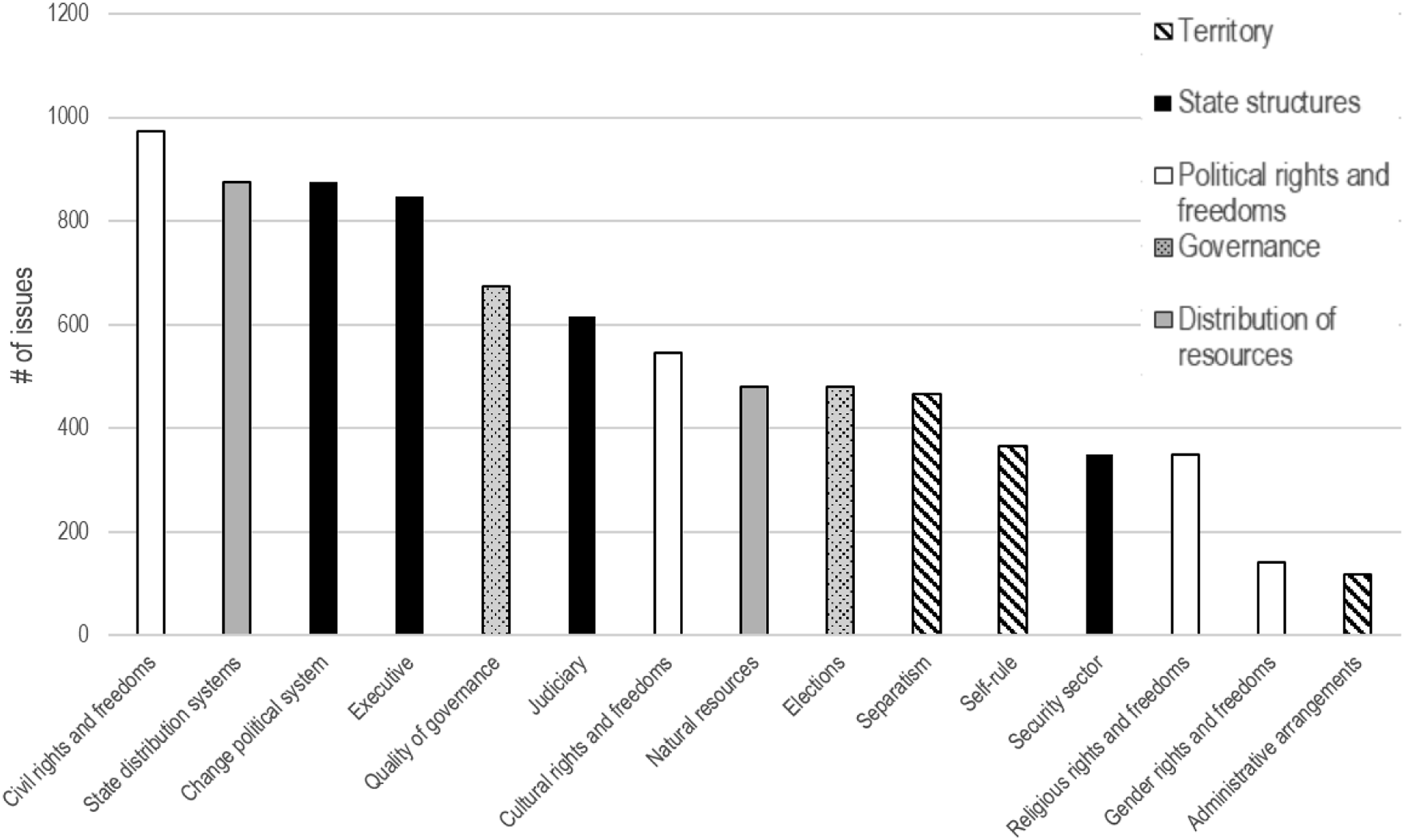
The Conflict Goals cluster is the one most closely related to UCDP’s incompatibility concept. Of the CID’s five thematic categories, territorial and state structures are similar to UCDP’s incompatibility over territory and government, whereas the other three themes fall outside this definition. Hence, while UCDP’s stated goal of incompatibility functions well to detect political conflicts – its intended purpose – a large portion of all conflict goal issues fall outside this definition.
Figure 3 presents the 15 most common Conflict GoaliIssues at Tier 3. The most stated Conflict Goal issue is demands for civil rights, followed by three categories almost tied for second place. State distribution systems subsumes issues spanning from the complete overhaul of the economic system to demands for basic needs (housing, water, food, etc.). Change political system distinguishes between demands for changes to a democratic, Socialist, and Islamic system. In the executive structures category, most demands concern ousting the head of the executive or the full executive.
Next, we examine the Conflict Goals cluster in relation to UCDP incompatibilities. We first explore all conflicts that UCDP classifies as government conflicts and then repeat this for territorial conflicts. Figure 4 shows the 20 most common issues at Tier 4 in government conflicts. Number of issues coded in UCDP-designated ‘government’ conflicts.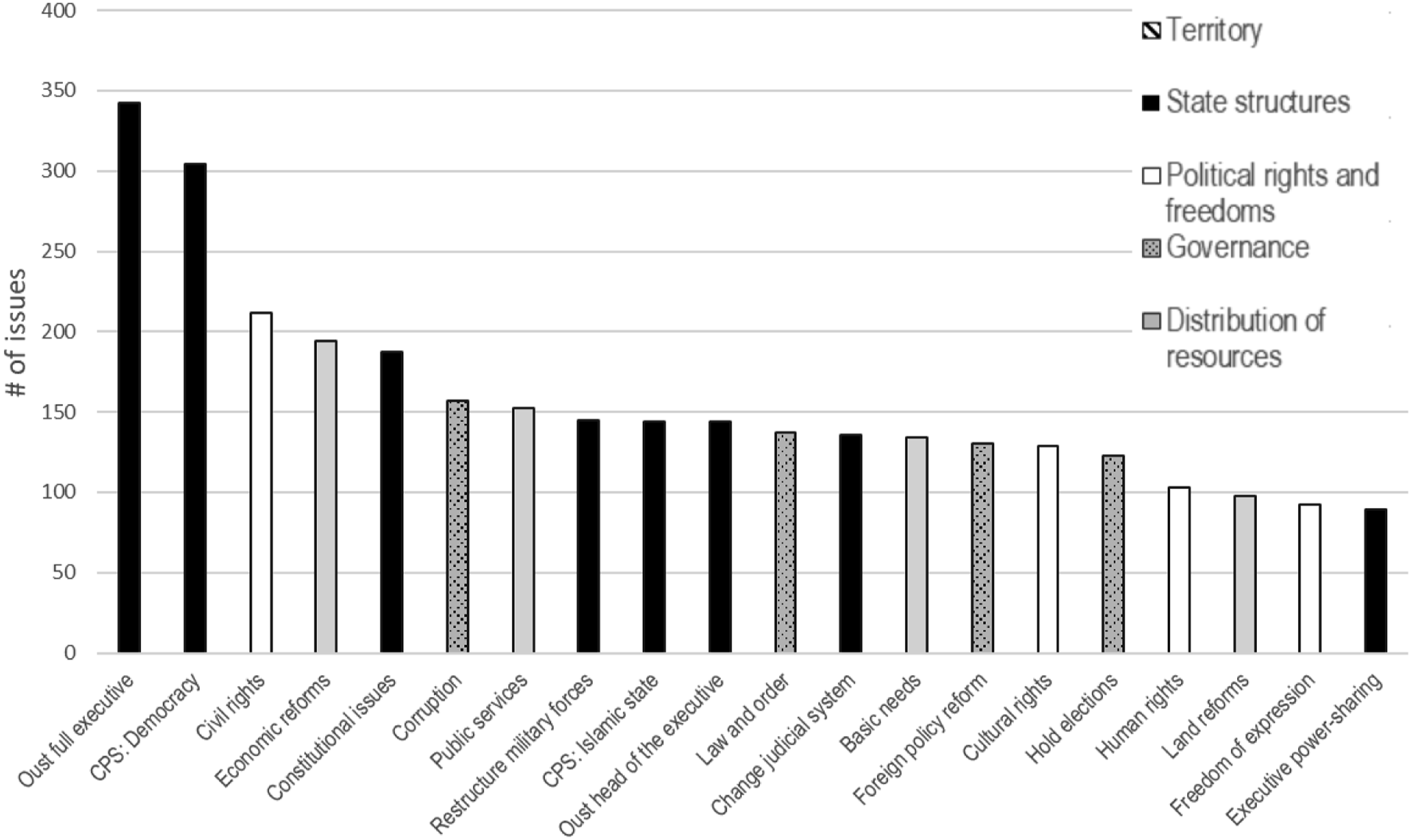
Figure 4 reveals the prominence of issues related to state structures (black bars), both in relation to the executive and a change of the political system (CPS: Democracy; CPS: Islamic State) for government conflict. Many issues also concern governance (speckled bars) including issues concerning the constitution, corruption, and elections, and political rights and freedoms (white bars) such as civil rights, human rights, and freedom of expression. Interestingly, the figure also reveals the high presence of issues that concern distribution of resources (gray bars) – a category that concerns incompatibility over government less directly – such as economic reforms, public services, and basic needs. Conflicts over government thus often incorporate a wide array of economic grievances that go unnoticed when not looking beyond the government/territory dichotomy. Our data show that rebels in government conflicts frequently make demands across four of our five thematic categories for Conflict Goals. However, territorial adjustments are uncommon, indicating that the government incompatibility category does not extensively overreach.
Turning to territorial conflicts, Figure 5 displays the 20 most common issues (Tier 4) in this category. As expected, issues related to territory dominate, with independence the most numerous issue, and with autonomy and federalism highly prevalent (striped bars). Clearly, however, territorial conflicts contain a much wider scope of issues than ‘purely’ territorial issues. Visible here in how state structures issues (black bars) such as changing the political system, political rights and freedoms (white bars), and distribution of resources (gray bars) are all relatively prevalent in territorial conflicts. Our data thus demonstrates that a dichotomous approach obscures important issues. This exercise also shows that conflict issues concerning four of our thematic categories – state structures, governance, political rights, and distribution of resources – are prominent across the government/territory dichotomy. Number of issues coded in UCDP-designated ‘territorial’ conflicts.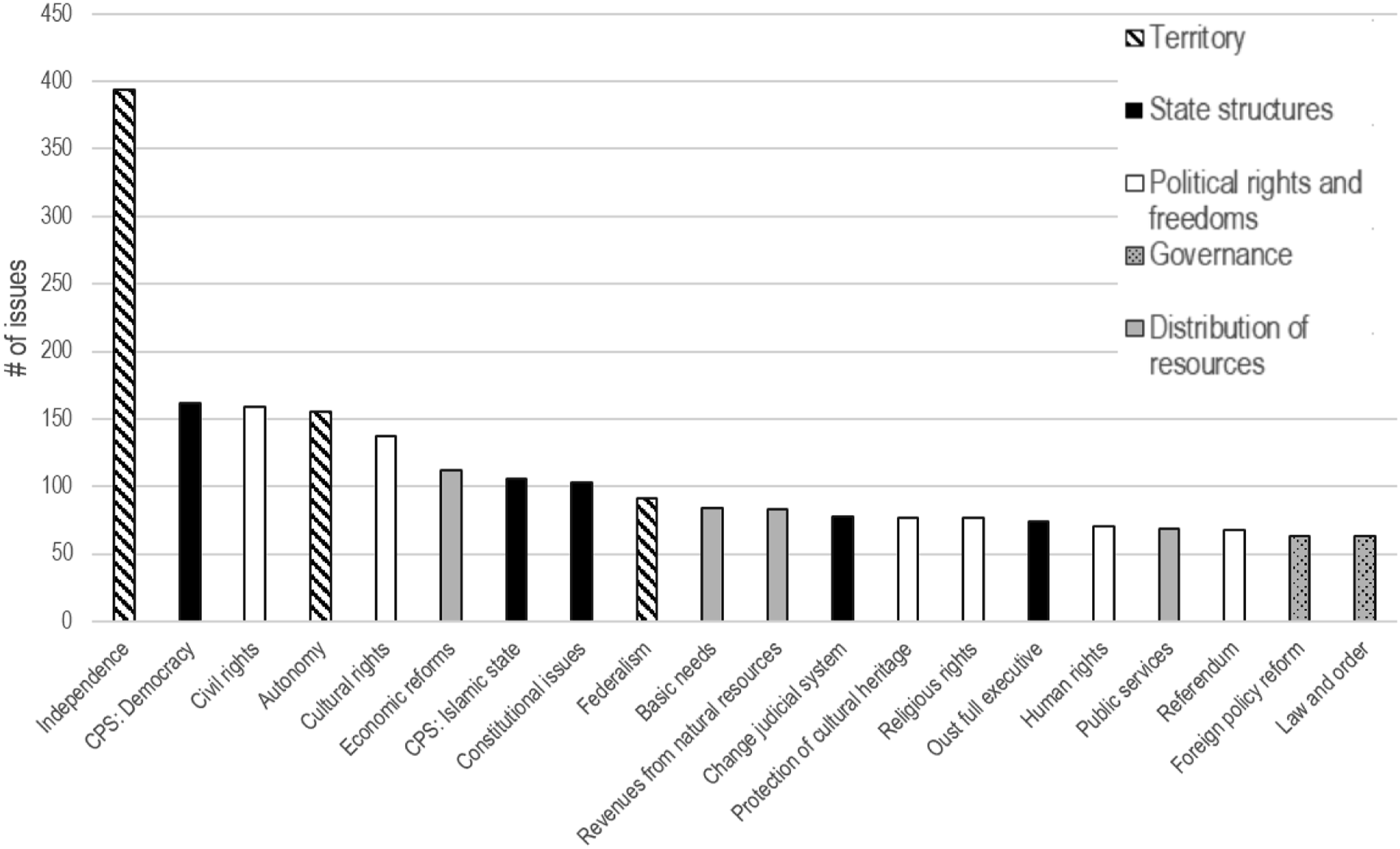
Conflict Dynamics Issues
Turning to Conflict Dynamics issues, the CID divides this cluster into three themes at Tier 2 (presented in Figure 6). The foreign involvement category (white bars) contains issues demanding an increase, or decrease, of foreign involvement. Foreign involvement can take many forms and the CID recognizes twelve different types of involvement (at Tier 4), such as financial support, humanitarian aid, and military intervention. Where feasible, categories are mirrored to capture demands for both increases and decreases in foreign involvement. These issues account for about 60 percent of the total of Conflict Dynamics issues. Thus, not only does foreign involvement affect conflict dynamics in civil wars (c.f. Karlén 2022), rebel groups also perceive foreign involvement as a fundamental part of the conflict. The second thematic area, violent targeting, captures issues related to violent conduct within an armed conflict (grey bars, 27 percent). This category contains demands for protection from collective targeting, desires to collectively target others, and issues related to military conduct. Concerning collective targeting, we capture, for instance, the LRA’s statement declaring that a key motivation for their war being the Ugandan government’s plan to annihilate the Acholi people. Within the violent targeting category, almost 70 percent of the issues concern being collectively targeted or suffering atrocities at the hands of an adversary, potentially displaying a strong motivational role for survival and protection of one’s communal group in sustaining conflict (Posen 1993; Wucherpfennig et al. 2012). Our third category, Refugees, IDPs and prisoners, (black bars, 13 percent) is fairly self-explanatory; it captures demands concerning refugees’ and IDPs’ right to return and demands on release of prisoners. Number of issues coded in the Conflict Dynamics category.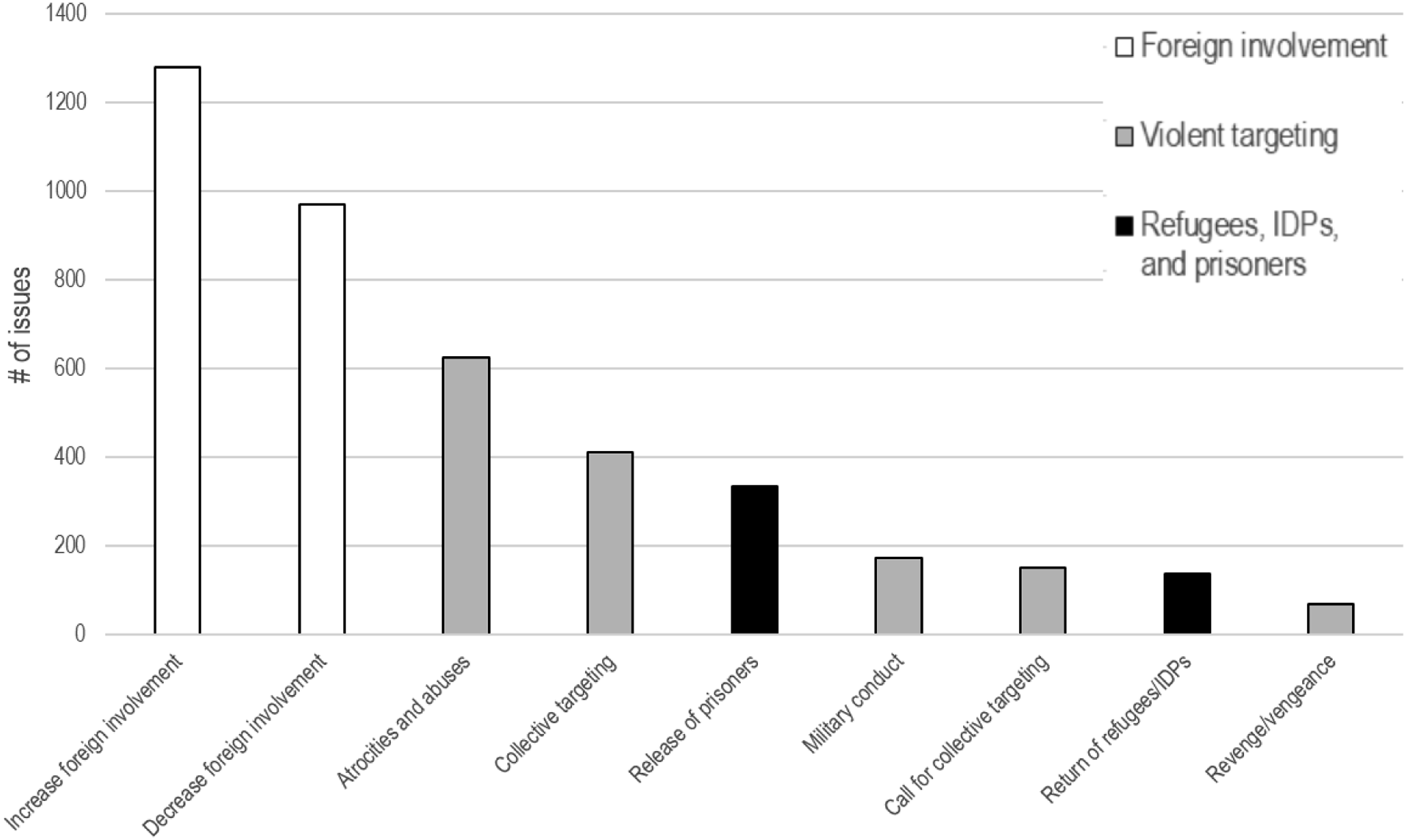
Figure 6 further reiterates the prominent position of demands regarding increases and decreases in foreign involvement. CID includes close to 2 200 (about 15 percent of the entire dataset) issues related to the external component of civil wars, which opens up new opportunities to examine those internationalized civil wars that constitute a large share of armed conflicts (Davies, Pettersson, and Öberg 2022.) The most common demand for increased foreign involvement entail that outside actors use some form of influence in the ongoing conflict, that foreign mediators or monitoring missions be dispatched, and demands for political support from outside actors. Concerning decreasing foreign involvement, removal of foreign influence is the most frequent issue followed by withdrawal of foreign forces. The graph also shows the prominence of issues regarding atrocities and abuses, and collective targeting, which allows for analyses of how statements about violent targeting relates to the actual targeting of civilians and the severity of fighting.
Conflict Resolution Issues
The Conflict Resolution cluster covers issues concerning how to resolve a conflict, as well as reparations after war. This cluster is divided into two larger thematic categories (Tier 2) with 80 percent of the Conflict Resolution issues concerning Negotiations, ceasefires, and peace agreements. Within this theme, prominent categories include calls for negotiations and ceasefires, demands for the implementation of peace agreements, issues related to opposing peace agreements, and DDR issues. The remaining 20 percent concerns Transitional justice and liability. This theme captures truth and reconciliation processes, amnesties, the recognition of wrongdoing, and issues about compensation and restitution.
Issues related to negotiations dominate this sphere with approximately 1200 out of 2200 coded issues. Thereafter follows issues related to liability, containing demands such as requests for amnesties, compensation for crimes committed during conflict, and prosecutions. Issues within the ceasefire and peace agreements cluster range from requesting a ceasefire to demands for the implementation of a peace agreement. In comparison to the other categories, rebel groups rarely call for truth and reconciliation processes.
Two Illustrative Empirical Applications
To illustrate potential uses of the dataset, we next conduct two simple empirical applications. First, we combine the conflict issues data with actor characteristics to show how these two features complement and contextualize each other. Thereafter we use regression models to tentatively study the relationship between conflict issues and conflict severity.
Issues and Actor Characteristics
The CID’s actor characteristics are useful for distinguishing between different types of groups; amplifying the CID’s utility for case selection and for the study of ideology in conflict. Below we embark on one such approach and study how stated issues vary along basic ideological lines. In terms of ideology, the CID classifies groups across the ideologies of Socialism, Islamism, Nationalism/conservatism, anti-Communism, anti-Zionism, and Decolonization. 12
The radar graph in Figure 7 displays differences in the relative importance of stated issues at Tier 2 when comparing groups that have recorded Socialist, Islamist, and Decolonization agendas (three of the most common classifications). The graph displays the proportion of each Tier 2 category in relation to the total number of issues each group type has stated; this consequently describes a form of ‘issue profile’. Because our actor characteristics are not mutually exclusive, a group’s ideological orientation can span across more than one of these categories. Thus, a group coded as, for example, both Islamist and Socialist, appears in the data within both these categories. Distribution of Tier 2 issue categories by actor ideology.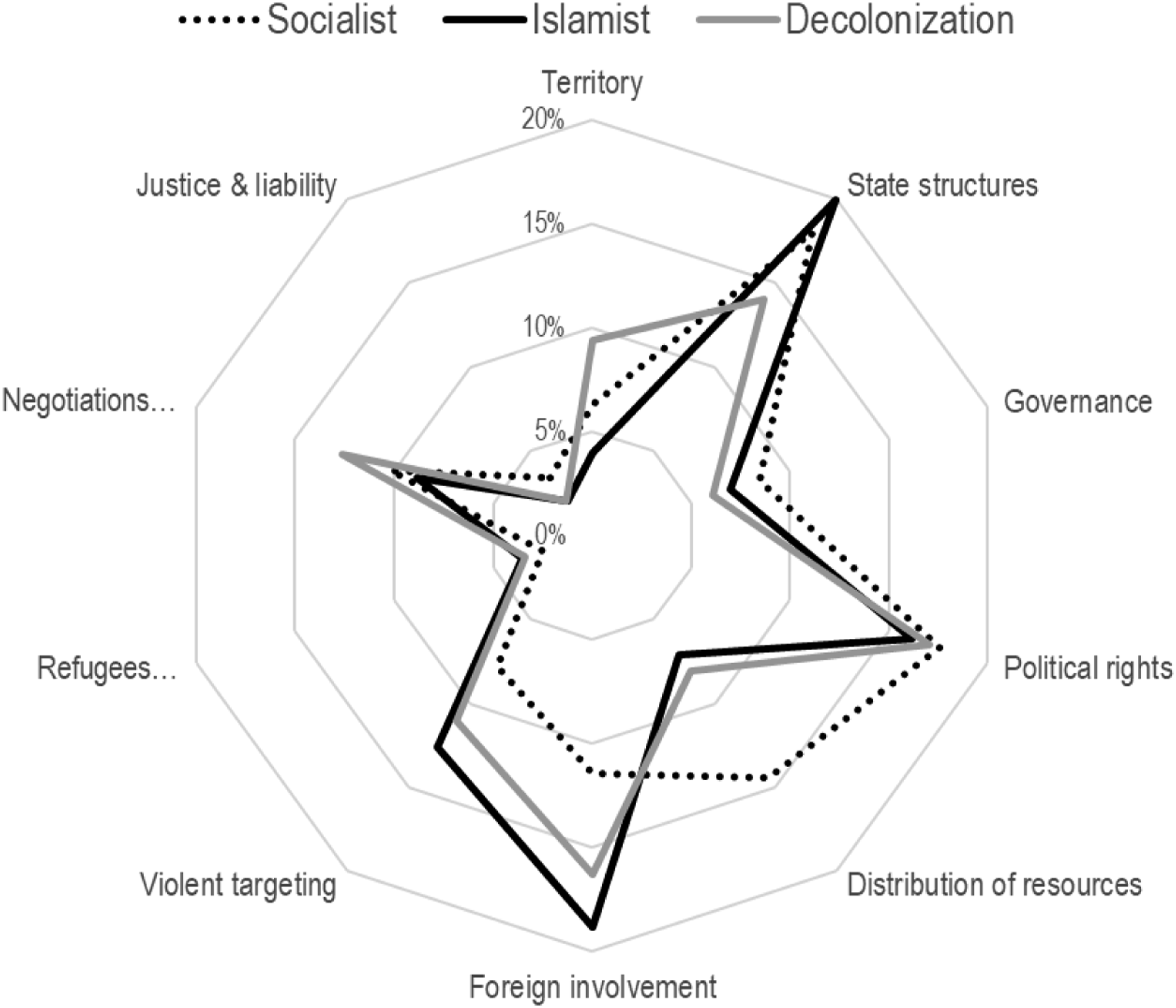
Figure 7 reveals several interesting aspects of the relationship between ideological orientation and conflict issues. A first observation is that whereas groups with different ideologies have distinct issue features they also largely overlap. Reconnecting to the previous discussion about content and form, the figure shows that groups motivated by different forms of ideology sometimes make demands related to the same form of change and are in this regard not different creatures. That said, there are also some distinct differences.
First, groups that espouse an ideology of Decolonization are almost twice as likely as other groups to have conflict issues related to territory, and are much less likely than others to state demands for changes in state structures. This likely represents a more ‘localized’ nature of such struggles, where rebel goals focus on the rights of an ethnic or communal group rather than the whole state.
Second, Socialist groups are distinctly different from others in how much they value distribution of resources. Although such issues also feature among Islamists and Decolonization movements, the economic sphere is more prominent among Socialist groups. The importance of distribution of resources also shows that Socialist groups have comparatively ‘total’ goals in that they are not content with changing the political structure of a state, but also seek its economic transformation.
Third, Socialist groups are less concerned with issues related to foreign involvement. Islamists, on the other hand, frequently stress these issues. This is likely a consequence of the internationalized nature of many Islamist conflicts, as well as grievances about foreign influence in Muslim countries (56 percent of their issues within the foreign involvement category concern demands for less intervention by foreign countries). Concerning groups with a Decolonization profile, their foreign involvement demands are predominantly requests for increased involvement by outside actors, which account for 62 percent of the stated issues for these actors. This state of affairs may indicate that these groups are relatively weak in relation to the government that they fight.
Fourth, another distinction relates to violent targeting, with Socialists again differing from Islamist and Decolonization groups. To a significantly higher extent groups with an Islamist or Decolonization orientation proportionally state more issues related to atrocities and abuses as well as being targeted by governments as a collective, indicating that these Conflict Dynamics issues play a larger role in the motivations of Islamist and Decolonization groups.
When analyzing how ideological orientation relates to issues it is important to note that the CID is a four-tier dataset and that the level of aggregation influences results. Unless disaggregated, the tier system may conceal variations between groups. For example, all three types of groups appear to place the same proportional importance on the political rights category. However, as revealed in Figure 8, a different picture emerges when analyzing the proportion of different issues within the political rights category. Distribution of issues within Political rights category by actor ideology.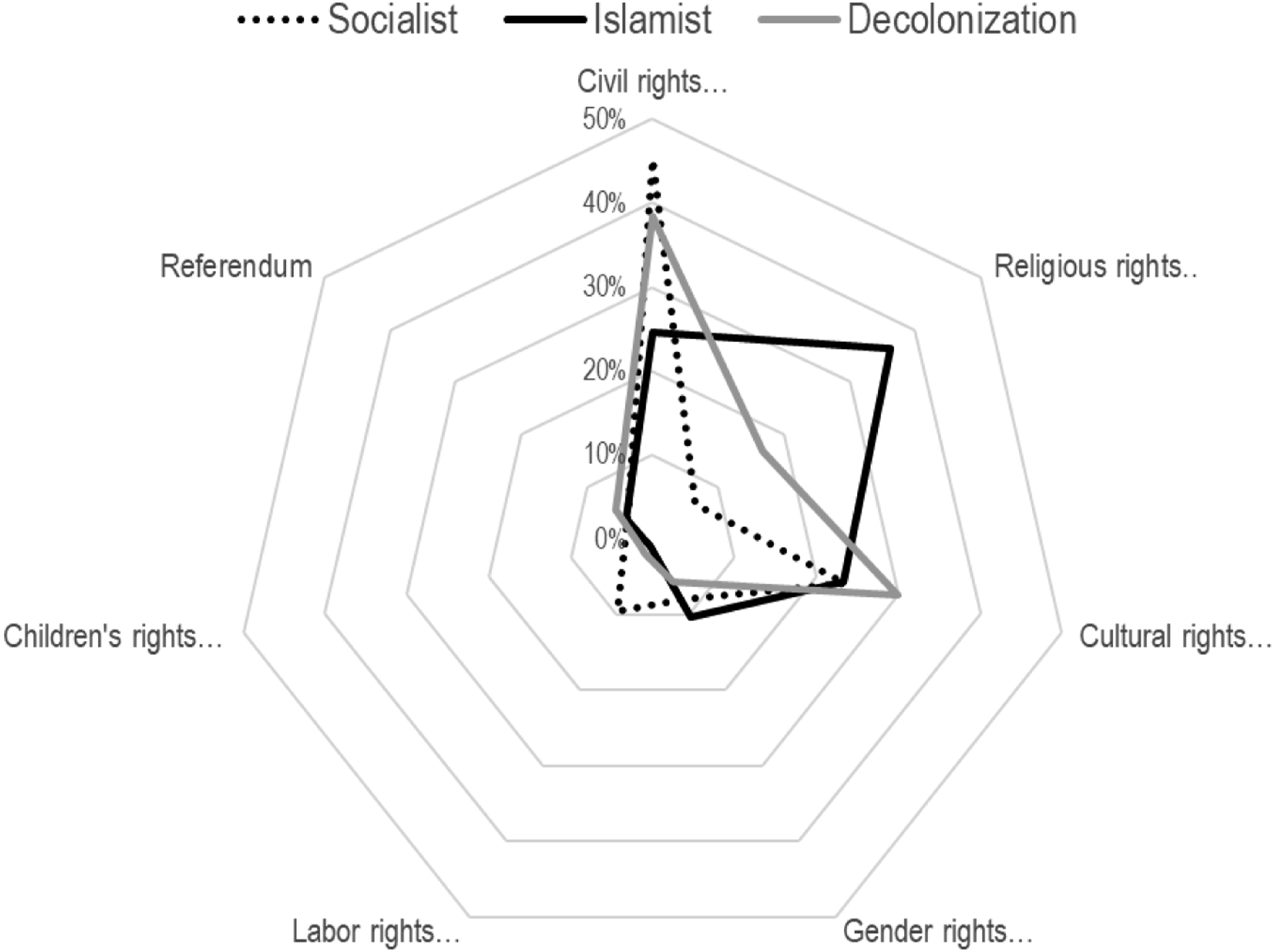
While almost 50 percent of the stated issues for Socialist groups are within the realm of civil rights (general political rights, freedom of association, etc.), only about 25 percent are of the same type for Islamist groups. Islamists are instead focused on religious rights, with almost 40 percent of their issues concerning rights being oriented towards religion. In addition, Decolonization groups have a comparatively higher proportion of cultural rights issues, which reflects these groups often representing minority groups feeling occupied by an outsider. This graph also shows that while Socialist groups focus on rights that are ‘purely’ political, Islamist and Decolonization groups are overall more concerned with rights related to group identities.
Overall, applying actor characteristics to the issue data allows for the creation of relatively distinct ‘issue profiles’ across different types of groups. Our issues data can thus be useful for understanding how and to what extent certain conflict issues are linked to ideological (and other) orientations. One way to delve further into such an approach would be the application of latent class analysis or factor analysis to discover clearer clusters of issues.
Issues and Conflict Intensity: An Application
As a final demonstration of the possible applications of CID, we run a few regression models with issues data as an independent variable and conflict intensity as the dependent variable. The purpose of this exercise is not to conduct a thorough investigation of the relationship between issues and intensity. Instead, we want to inspire future investigations of this topic by showing the utility of CID for such inquiries.
Although one might expect that specific issues relate to more intense armed conflicts, the focus for this application is the number of issues. We do this for two reasons. First, scholars have argued that conflicts with more issues are more complicated to resolve due to the nature of a complicated bargaining situation (Pillar 1983; Jensen 1995). Second, the existence of many issues may suggest that groups have comparatively high stakes in a conflict, which may be linked to more intense forms of conflict. Rather than covering all issues, we hone in on Conflict Dynamics Issues. We select this cluster because the category is dominated by factors related to the external dimension of war and violent targeting, two groups of issues that we deem likely to influence civil war severity. Having many stated issues in the dynamics cluster can be indicative of a conflict having entered a cycle of large-scale foreign interventions, or a cycle of vengeance. Concerning the first cycle, foreign intervention may not only cause more intense combat (Lacina 2006) but should also spur calls for some foreign states to leave the country and others to come in with assistance. In terms of the second negative cycle, one can envisage cycles of revenge in the form of the Violent targeting issues included in the dynamics cluster: such motivations for violence have been shown to matter in civil wars (Balcells 2010; Jok 2014). Irrespective of the theoretical foundation, it is of interest to explore if the number of conflict dynamics issues stated has any association with conflict intensity.
To investigate this, we used the CID to construct a dyad-year dataset from 1989 to 2017 with a main independent variable that counts the number of Conflict Dynamics issues per dyad year. As issues can be stated in 1 year and be thought to be ‘in force’ also in coming years although not restated, we employed a last observation carried forward function for this variable. This variable is also log transformed to account for skewness. To measure conflict intensity we rely on the UCDP Dyadic Dataset 18.1 (Harbom, Melander, and Wallensteen 2008) which measures the number of battle-related deaths per dyad-year. Relying on dyad-level measurements for conflict intensity partly resolves the problem of conflict-level data being dependent on hostile actions in separate dyads, although violence in a dyad may still affect violence in a second. We crop our dataset to include only years in which battle-related deaths took place, thus in the end comparing only within active years of armed conflict.
We used a series of control variables related to previous findings on intensity (Lacina 2006; Eck 2009) and commonly used controls in the study of civil war. To account for the possibility that external support both breeds grievances and intensifies conflict (Lacina 2006), we include a dichotomous variable capturing if a dyad-year received external support (ext_sup) from the UCDP External Support Dataset (Meier et al. 2022). To consider the option that ethnically diverse countries with politically repressed groups spawn issues as well as intensify conflict (Eck 2009), we include a measure on if the country of a dyad contains discriminated or excluded populations from the EPR data (Cederman, Wimmer, and Min 2010). Lacina (2006) and Eck (2009) also both identified that the political system of a country may affect intensification, and we thus include a democracy index from V-Dem (v2x_polyarchy; Coppedge et al. 2019). We also included more basic controls such as the log of GDP per capita and the log of population from V-Dem (Coppedge et al. 2019). Finally, to partially account for autocorrelation we include a 1-year lagged version of the dependent variable (battle-deaths). All other control variables were also lagged 1 year.
Figure 9 below presents the results from two models with a full set of controls in the form of coefficient plots. We employ a negative binomial model due to over-dispersion on the dependent variable and to account for contagion between observations (Long 1997): independence between time-series observations of conflict intensity within the same dyad seems too strong an assumption. Additionally, we specify two different types of models: one with fixed effects (to account for country-level traits) and one with standard errors clustered at the country-level (to account for observations within countries that may be dependent on each other). The unit of analysis is the dyad-year and positive coefficients denote an association between an independent variable and higher levels of battle-related deaths. Models 1 and 2 both display the models with controls, but with Model 1 employing fixed effects and Model 2 clustering on countries. Coefficient plots of the relationship between # of conflict dynamics issues and conflict intensity.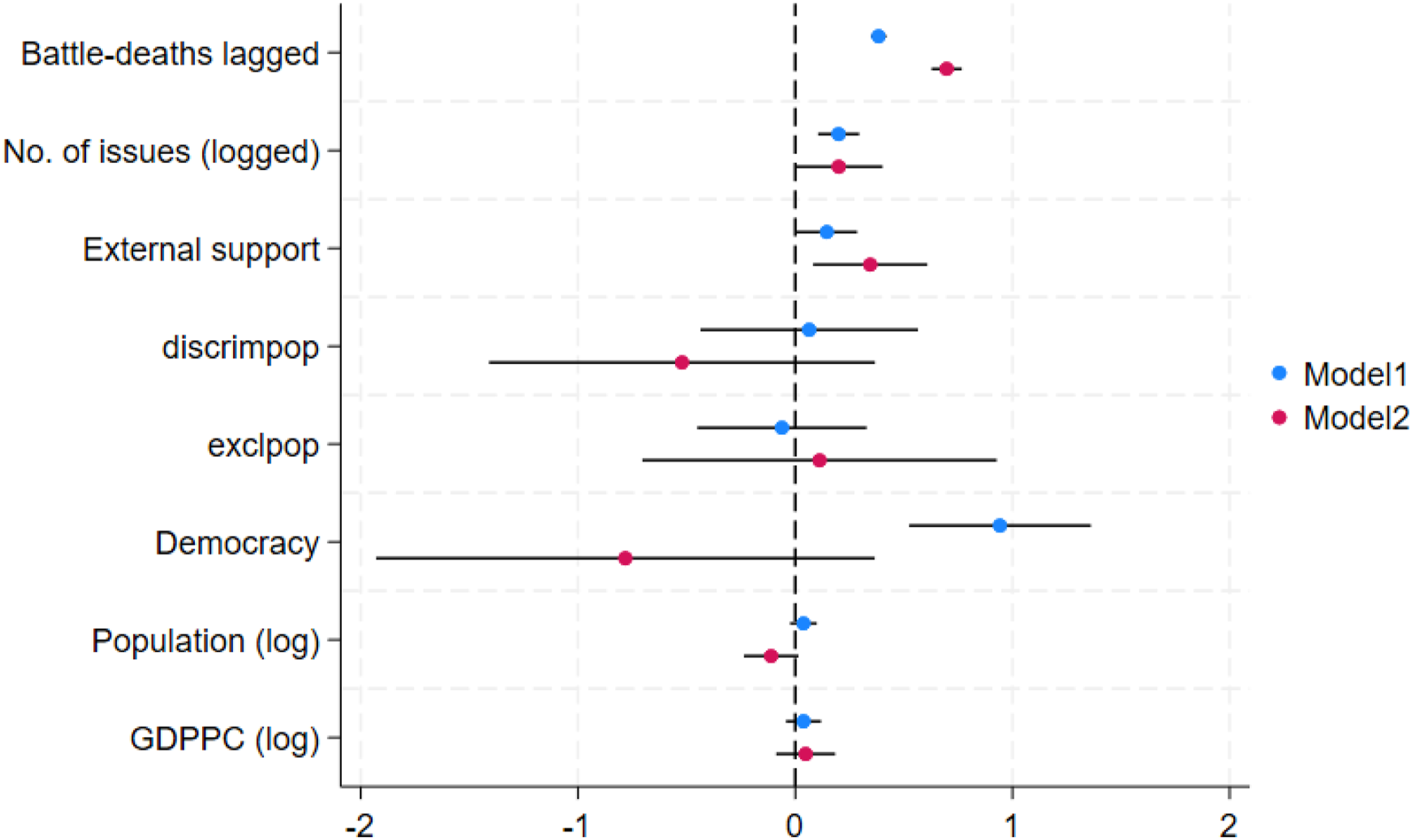
We can first note that a statistically significant and positive bivariate association exists between the count of Conflict Dynamics issues and the number of battle-related deaths. These effects are retained in Models 1 and 2 when controls are introduced: in both models, the count of dynamics issues is associated with comparatively higher levels of conflict intensity.
The strength of this association can be demonstrated by comparing the expected count of battle-deaths when the issue dynamics variable is set to its minimum, mean, and maximum value (using Model 2 with clustered standard errors). 13 At the minimum (0), the expected count stands at 296 deaths, at the mean (1.1) at 642, and at the maximum (2.8) at 2300. Changing the independent variable one standard deviation above the mean renders an average increase in the number of fatalities to 996 in a dyad-year. We see this as a relatively substantial effect of the association between conflict dynamic issues and intensity of civil war. Importantly, however, this exercise cannot reveal if it is a higher number of conflict dynamic issues that increase conflict severity or the other way. It is highly plausible that increased severity would result in an increased number of demands from the rebels concerning issues such as increased foreign involvement or protection against collective targeting. Furthermore, as for all analyses built on open-source material, reporting bias may influence the results. Despite this endogeneity problem, we deem the association as such interesting.
Overall, these models and results should be interpreted with caution and be viewed only as an example of possible applications of the UCDP CID. Although there is theoretical reason to assume that the number of conflict issues relates to conflict intensity, the cluster used here is a broad category, which may obscure important variations. Future research would do well to investigate the effects of conflict issues on war severity more in depth.
Conclusions
The UCDP CID is a novel conflict dataset that provides users in the research community the opportunity to conduct analyses of the motives, grievances, and goals that underlie civil wars: something that has hitherto been difficult due to a dearth of data. As stated in our introduction and demonstrated through our empirical applications, the data open up for a plethora of analyses.
First, as was preliminarily demonstrated in our analysis of how issues related to conflict intensity, there are a number of hypotheses related to the foundations of civil war research that can now be tested. Primarily we here envision analyses similar to ours concerning conflict intensity, but also cross-case analyses of which issues (or which clusters of issues) contribute to the duration of civil wars and their impact on negotiations. Several avenues are possible. One could, for example, conduct latent class analysis to expose specific configurations of issues that inhibit negotiated solutions to conflict, or analyses of which issues accompany our most durable conflicts. Another option is to inquire which issues and clusters of issues that are most amenable to conflict resolution.
Second, we would like to emphasize the possibilities that our dataset creates for the study of ideology in conflict. In our application we were able to demonstrate differences in the importance of issues across ideological classifications. Although our ideological categories are relatively aggregated, they can be used – in combination with the issues data – to test theories on the effects of different ideological constructs on a wide number of dependent variables. One could, for instance, delve further into analyses of whether similar issues but diverging ideologies entail different effects for conflict duration in a cross-case setting (Keels and Wiegand 2020) or how certain ideological and issue configurations affect conflict dynamics such as targeting (Thaler 2012).
Third, another potential avenue for further research concerns applying our issues data to peace agreement and negotiation studies. With the UCDP CID it is now possible, for instance, to match actual demands made by rebel groups with proposals given in peace negotiations and the actual compromises made in peace agreements. Peace agreement research has seen impressive intellectual and empirical growth in recent times, with detailed datasets emerging on their contents (Joshi and Darby 2013; Pettersson, Högbladh, and Öberg 2019) including novel ways to study them at different levels of analysis (Brosché and Duursma 2018; Quinn, Joshi, and Melander 2019). Our data open up many new avenues in this sphere.
In conclusion, we hope that the UCDP CID and its focus on the actual issues at stake in armed conflicts will help to bring issues back into the study of civil war. The theoretical prominence of issues, goals, and stakes deserves an empirical equivalent to facilitate more rigorous tests by the research community of some of the foundations of conflict theory.
Supplemental Material
Supplemental Material - What They Are Fighting For – Introducing the UCDP Conflict Issues Dataset
Supplemental Material for What They Are Fighting For – Introducing the UCDP Conflict Issues Dataset by Johan Brosché and Ralph Sundberg in Journal of Conflict Resolution
Supplemental Material
Supplemental Material - What They Are Fighting For – Introducing the UCDP Conflict Issues Dataset
Supplemental Material for What They Are Fighting For – Introducing the UCDP Conflict Issues Dataset by Johan Brosché and Ralph Sundberg in Journal of Conflict Resolution
Supplemental Material
Supplemental Material - What They Are Fighting For – Introducing the UCDP Conflict Issues Dataset
Supplemental Material for What They Are Fighting For – Introducing the UCDP Conflict Issues Dataset by Johan Brosché and Ralph Sundberg in Journal of Conflict Resolution
Footnotes
Acknowledgments
We appreciate the excellent comments from reviewers and the editor. We are grateful to Peter Wallensteen for useful discussions, to Gabrielle Lövquist who acted as an excellent project manager and to all coders involved: Cecilia Borella, Louis-Alassane Cassaignard Viaux, Noah Celander, Stefano Cisternino, David Edberg Landeström, Tania Estrada, Andrew Fallon, Tobias Gustafsson, Tim Gåsste, Nanar Hawach, Annika Leers, Magnus Lundström, Sebastian Raattamaa, Tom Renvall, Jakob Schabus, Robin Sällström, Theodor Stensö, Anna Svedin, Theo Valois Souza Ferreira, and Inge Volleberg.
Declaration of Conflicting Interests
The author(s) declared no potential conflicts of interest with respect to the research, authorship, and/or publication of this article.
Funding
The author(s) disclosed receipt of the following financial support for the research, authorship, and/or publication of this article: We are thankful for funding from Marianne and Marcus Wallenberg Foundation (grant 2018.0018), Riksbankens Jubileumsfond (IN20-0007) and Swedish Research Council (grant no. 2020-03936, 2015-01235).
Data Availability Statement
Replication data for the article's analyses is available at the Harvard Dataverse (Sundberg, 2023). The UCDP CID itself is available for downloading at  .
.
Supplemental Material
Supplemental material for this article is available online.
Notes
References
Supplementary Material
Please find the following supplemental material available below.
For Open Access articles published under a Creative Commons License, all supplemental material carries the same license as the article it is associated with.
For non-Open Access articles published, all supplemental material carries a non-exclusive license, and permission requests for re-use of supplemental material or any part of supplemental material shall be sent directly to the copyright owner as specified in the copyright notice associated with the article.
