




Abstract
Ceasefires are common in civil conflict. Yet we have surprisingly little comparative analysis of why and under what conditions they occur. A ceasefire provides temporary relief from the costs of conflict, but also generates its own costs. Building on this logic, we argue that conflict parties are more likely to accept the costs associated with a ceasefire when the conflict costs are greater, in particular, when: violence is intense; there are higher levels of ‘collateral damage’; and the parties lack international support. Second, we contend that ceasefires are also more likely in those periods in which the audience costs associated with entering into an arrangement are lower, specifically, when the parties have some form of ‘political cover’, such as during mediation. We find support for both arguments in an analysis of a new dataset capturing all ceasefire in civil conflict from 1989-2020, using a series of dyad fixed effect models.
Keywords
Introduction
Ceasefires are arrangements between conflict parties to suspend violent hostilities from a specific point in time (Clayton et al. 2022a). They are a common feature in civil conflict. Between 1989 and 2020, 2202 ceasefires were declared globally, and 21% of all conflict years produced at least one ceasefire arrangement (Clayton et al. 2022b). In 2020 alone, new ceasefire arrangements arose in conflicts from Colombia, to Sudan, Myanmar and Yemen. Why do conflict parties enter into a ceasefire? And under what conditions are ceasefires more likely to occur?
A rich body of case and practitioner literature illustrates how ceasefires support peacemaking (Åkebo 2020; Chounet-Cambas 2011a, 8; Mahieu 2007, 209; Smith 1995, 155-160); and war making (Crocker, Hampson, and Aall 1999; Smith 1995; Toft 2010) (for a summary of the literature see, (Clayton et al., 2022a). Recent studies offer useful frameworks to consider the functions that different types of ceasefire can play at different points in a bargaining process (Clayton and Sticher 2021; Sticher, and Vukovic 2021), and how ceasefire outcomes should be considered (Clayton, Nathan, and Wiehler 2021).
Despite the emerging body of research on ceasefires, the prior deficit of suitable data means that we lack a systematic, global assessment of the conflict factors and conditions that are more likely give rise to ceasefires. The prior lack of comparable data also means that we only have limited knowledge about the extent to which insights gained in a particular case can be generalized to the broader population of civil conflicts.
Understanding the role that ceasefires play in shaping conflict dynamics, and the contribution they make in peace processes, first requires a foundational understanding of the conditions under which different forms of ceasefire arise (i.e. the data generating process). Moreover, research on patterns of civil violence and conflict management processes would also both benefit from a clearer understanding of where and when ceasefires are more likely to appear.
To address this lacuna, we consider the strategic calculation that conflict parties face when considering a ceasefire during civil war. Most simply, a (bilateral) ceasefire (if honored by both sides) provides temporary relief from the costs of conflict. 1 But entering into a ceasefire also carries costs, such as potentially allowing an opponent an opportunity to rearm and regroup, and triggering audience costs from those that remain supportive of the violent struggle. States also risk legitimizing the non-state group (and any gains that they have made), while non-state groups must in effect consent, albeit temporarily, to the status quo in which the state maintains its position of ascendency.
Building on this logic, we develop two arguments. First, we argue that conflict parties are more likely to accept the costs of ceasefire when the costs associated with conflict are greater, in particular, when: conflict violence is more intense; there are higher levels of ‘collateral civilian damage’; the parties lack international support; and the conflict continues for long periods. Second, we contend that ceasefires are also more likely in those periods in which the audience costs associated with entering into an arrangement are lower, specifically, when the parties have some form of ‘political cover’ (see, Allee and Huth 2006; Beardsley 2010). We focus on three forms of cover: mediation; religious holidays; and the 2020 United Nations call for a Global Ceasefire to fight the Covid-19 pandemic.
Utilizing the new civil conflict CeaseFire data (CF), we provide the first systematic global analysis of ceasefire declarations from 1989-2020. In the analysis we focus on all non-definitive ceasefire (i.e. non-permanent ceasefire) that match conflict dyads recorded by the UCDP Armed Conflict Dataset. 2 We estimate a series of conflict-dyad fixed effects models that allow us to offer new insights on the specific conflict dynamics associated with ceasefires, and thus when ceasefires are more likely.
In what follows, we first discuss the strategic calculation that faces conflict parties considering a ceasefire, we then discuss conflict costs and political cover, setting out our argument for how these factors shape the ceasefire process. We then present our research design and finally our results.
The benefits and costs of ceasefires in civil conflict
Ceasefires provide conflict parties numerous benefits. For those seeking to manage or resolve their dispute, ceasefires can: allow access to humanitarian aid (e.g. Aary 1995); suspend violence (without addressing the incompatibility) (Hanson 2020); contain violence (Chounet-Cambas 2011b); signal peaceful intent (Bara and Clayton 2022; Clayton and Sticher 2021); demonstrate command and control (Åkebo 2020; Höglund 2011); increase civil society participation (Pinaud 2020); and create an environment more conducive for negotiations (Smith 1995).
Ceasefires can also serve so-called ‘devious intentions’, meaning conflict parties commit to an arrangement for reasons other than seeking peace (c.f. Richmond 1998). The military benefits ceasefires can provide include: buying time to resupply and regroup forces (Chounet-Cambas 2011b, 7-8; Mahieu 2007, 210-211); providing a psychological break to increase the morale of the troops, or domestic constituents (Mahieu 2007, 210); and consolidating territorial control (Sosnowski 2020; Woods 2011).
It is challenging for conflict parties to determine whether their opponent desires a ceasefire for peaceful or devious reasons ex ante, as motives may be mixed, shift over time, and the parties have clear incentives to conceal any non-peaceful motivations. As such, while both sides may welcome many of the benefits accrued from a ceasefire, not least the mitigation of conflict costs, they are also likely to be wary of affording benefits that might enhance the military position of their opponent.
Audience costs are another obstacle for conflict parties seeking the benefits of a ceasefire. Ceasefire negotiations can also often resemble the structure of Putnam’s (1988) two-level game, whereby the negotiations between leaders at one level are shaped by how both leaders anticipate the reaction of the domestic constituents. Any such ‘cooperative’ behavior might be seen as a concession or signal of weakness, generating discontent amongst supporters (and creating opportunities for outbidding from political opponents). Constituents often need to consent to major policy changes, such as making peace with the enemy, and often decide on the political future of the leaders (Debs and Goemans 2010). Intuitively, we might expect that domestic populations would be supportive of cooperative behaviors that move the parties towards peace, in particular ceasefires that promise temporary respite from violence (Brutger and Kertzer 2018; Kertzer and Brutger 2016). Yet domestic constituents often adopt relatively “hawkish” policy preferences (Allee and Huth 2006, 222). This creates significant audience costs if leaders attempt to deviate from their conflictual posture (Kertzer and Brutger 2016). On many occasions, leaders intentionally generate such audience costs in an attempt to strengthen their bargaining position, for example by promising never to make a concession, or enter into dialogue with the other side (e.g. “we don’t talk to terrorists”). (Fearon 1994). Yet if military victory proves untenable, and they fail to extract sufficient concessions from their opponent, it creates a ‘bargaining bind’ in that even though both parties might desire a ceasefire, the anticipated audience costs prevent the parties from taking the necessary cooperative actions (Fearon 1997).
The costs and benefits discussed so far broadly apply to all conflict actors. In addition, there are some strategic calculations that differ between state and non-state actors. For the non-state group, the most significant ceasefire cost is to accept the status quo where the state remain superior. In intra-state conflict, the non-state actor seeks a significant shift in the distribution of power within the state (Gleditsch et al. 2002). Violence is the means through which the group achieves their leverage over the state, and thus in principle, they are likely to be resistant to a ceasefire (in the absence of sufficient concessions or military progress) that might release the hard-fought pressure on the state (Mahieu 2007). Similarly, the state, as the power-holder, often favour a ceasefire if it helps to sustain the favourable status quo.
Yet non-state groups can also gain recognition and legitimacy from a ceasefire. During conflict the state usually dismiss non-state challengers as criminals or terrorists, undeserving of a political voice. A ceasefire can provide non-state groups with legitimacy, potentially increasing access to international aid and third-party support. In some cases, these non-state benefits provide strong incentives for the state to resist a ceasefire. 3 Beyond concerns relating to the immediate opponent, the state often fear that a ceasefire agreements might inspire other groups to mobilize, fight harder or longer for similar concessions (though see, Bara and Clayton 2022). This mechanism has been found for peace agreements (Bormann and Savun 2018; Walter 2009), but is also likely to apply to ceasefires that temporarily legitimize any gains that the non-state group has achieved on the battlefield. 4
A ceasefire is thus always a strategic decision for conflict parties, whereby the potential benefits of entering an arrangement must be weighed against the possible costs. Many of the factors that shape this consideration are effectively unobservable, as they are highly subjective and depend on the conflict parties’ reading of the conflict situation. However, the key factors are those that shape the costs of conflict. When the costs of conflict increase, conflict parties are likely to be more willing to take on the costs associated with a ceasefire. We also know from prior research several of the observable conditions that shape the costs of conflict. Similarly, some observable shifts in the external context are also likely to impact the strategic calculations underlying the adoption of a ceasefire. In particular, some conditions are likely to provide political cover, meaning actors have some means of saving face which reduces the costs associated with entering into an arrangement. In the following discussion we set out how conflict costs and political cover impact conflict parties decisions surrounding ceasefires.
Conflict costs
Civil conflict requires significant financial, material, and human resources (Collier and Hoeffler 2004; Gates et al. 2012). Sustaining violence for prolonged periods requires maintaining an armed force of sufficient size, strength and military readiness, as well as ensuring the force maintains the necessary basic supplies and war-making assets (Balcells and Kalyvas 2014; Collier, Hoeffler, and Söderbom 2004; Cunningham, Gleditsch, and Salehyan 2009). Conflict also complicates the provision of public services, not least the maintenance of security (for states and insurgents, see e.g. Arjona (2017)), making it more challenging to retain constituent support (Kalyvas 2000). Conflict can also reduce extractive capacity and incoming revenue, placing resources under yet further pressure (Costalli, Moretti, and Pischedda 2017; Koubi 2005; Humphreys 2005). Conflict costs depend on technologies of rebellion adopted by the non-state group (see, Balcells and Kalyvas 2014), but regardless of the form that violence takes, conflict is always costly. 5
A ceasefire can temporarily reduce many of these conflict costs. 6 If a ceasefire is agreed (and honored) by all conflict parties, there follows a relatively violence-free period that should reduce many of the costs. The durability of a ceasefire varies greatly according to its design and the function it is intended to perform (Clayton and Sticher 2021), and almost all ceasefires suffer some violations (Bara, Clayton, and Rustad 2021). Yet on average, ceasefires tend to produce at least a few weeks of relative calm on the battlefield (Clayton and Sticher 2021). Thus, the immediate benefit afforded by all ceasefires (that are honored) is a temporary relief from the costs of conflict.
The patterns of violence vary greatly across conflict, with significant differences in the configuration of repertoires, targeting, frequency, and technique (Gutiérrez-Sanín and Wood 2017). We focus specifically on changes in the frequency of deadly forms of violence, as well as the presence or absence of external support. We acknowledge that lethal violence is not always a good proxy for other forms of violence, and that our approach captures but a few dimensions of conflict costs. Moreover, certain costs are distributed asymmetrically, as on the battlefield gains for one side are often reflected in loses for the other, meaning not all periods are equally costly for all parties. For example, when the state disproportionally suffers the costs of conflict we would expect the non-state group to be more resistant to a ceasefire. Yet all else being equal, periods of intense violence impose costs on both parties, and can often be tough for many belligerents to maintain, thus we expect that increases in factors associated with greater conflict costs are likely to increase the probability of a ceasefire. Given the scarcity of systematic research that explores the determinants of ceasefires, this seems a logical point of departure.
‘Battlefield’ violence
The frequency and intensity with which the parties engage strongly shapes the costs of the conflict. In particular, the number of casualties, material damage and drains on supplies are critical dimensions. Variation in the technologies of rebellion likely account for much of the variation in costs across conflicts (Balcells and Kalyvas 2014), and may well impact the propensity of the participants to engage in a ceasefire. Yet we are more concerned with changes in the patterns of violence within conflicts. Here, we expect that increases in the frequency of violence within a conflict increases the costs for all involved and should therefore also increase the likelihood of a ceasefire.
7
For example, in South Sudan, a ceasefire was signed in July 2018 following the loss of four hundred people, the most violent period in more than a year (Sundberg and Melander 2013). An imperfect, but relatively established proxy for the frequency of conflict violence is the number of conflict party fatalities (see, Lacina 2006). From this discussion we derive our first hypothesis.
Civilians are also often caught up in civil wars. It is common for conflict violence to produce ‘collateral damage’, that is the “incidental loss of civilian life, injury to civilians and damage to civilian objects…caused by an attack on a lawful target” (International Committee of the Red Cross 2021). ‘Collateral damage’ can increase conflict costs in at least three ways.
First, collateral civilian damage can turn a domestic population against the armed actor(s) deemed responsible (Condra and Shapiro 2012; Lyall, Blair, and Imai 2013; Schutte 2016), reducing the supply of information and weakening an actor’s war fighting effort (Kalyvas 2000; Kalyvas and Kocher 2009).
Second, there is pressure from international actors, in particular liberal democratic states (Johns and Davies 2019), to avoid civilian casualties (though see, Salehyan, Siroky, and Wood 2014). Conflict parties are then more likely to come under international pressure, potentially increasing conflict costs, in periods with increased collateral damage.
Finally, while collateral damage is unintentional, it is not random, or evenly distributed across a dispute. The likelihood of civilians being inadvertently caught up in the violence is correlated with the patterns of violence (Cronin 2013). Consequently, an increased number of unintentional civilian fatalities is likely to be representative of shift in the pattern of violence. Higher unintentional civilian casualties are more likely during periods of particularly aggressive military operations, which, as we set out above, are likely to increase conflict costs.
Of course, the impact of collateral damage is likely to depend on the theatre of operations (e.g. urban or rural), the local political environment, and the actor seen to be responsible for the violence (Condra et al. 2010; Condra and Shapiro 2012). If, for example, one actor is seen to be solely responsible for the violence this might strengthen civilian support for the other side. However, all else being equal, we expect that periods with higher collateral damage are costlier for conflict parties, and thus more likely to see a ceasefire.
Civilian targeting by non-state groups
Civilian casualties are not always unintentional. Over the last 30 years almost one million civilians were killed in intentional attacks by conflict parties (Pettersson and Öberg 2020). This form of violence goes by many names, including one-sided violence, terrorism and civilian targeting. A burgeoning body of research explains the causes of this form of violence (for an excellent review, see, Balcells and Stanton 2021). Targeting civilians offers non-state groups an opportunity to generate revenue, increase recruitment and punish unsupportive populations, while at the same time undermining state governance structures (Humphreys and Weinstein 2006). This places additional demands on state resources, who need to provide some form of protection to vulnerable communities, and respond to possible downstream effects, such as mass displacement.
Prior research provides some evidence to suggest that civilian violence has the ‘power to hurt’, and can be effective at pushing the state to concede to political negotiations and concessions (Thomas 2014; Wood and Kathman 2014). Yet in the case of one-sided non-state violence, the additional costs imposed on the state (and its constituents) are likely to be counterbalanced by increases in the costs associated with a ceasefire. Indeed, the state would likely suffer greater audience costs if it were to respond to an increase in civilian atrocities with a commitment to suspend hostilities. Since civilian loyalties often shift according the patterns of violence (Kalyvas 2000), when civilians are targeted by non-state groups, they are often punished through the withdrawal of vital support (Lyall, Blair, and Imai 2013; Pechenkina, Bausch, and Skinner 2019), or the active collaboration with the opposing force (Clayton and Thomson 2016; Schutte 2016). The public backlash against non-state groups has previously been shown to undermine attempts to achieve political goals through negotiation (Abrahms 2012; Fortna 2015).
We expect that this effect will be particularly pronounced with regards to ceasefires, as unlike other concessions (e.g. starting negotiations), that can be sold to the public as part of a mixed strategy of engagement (e.g. talking while fighting), a ceasefire commits to a suspension of military operations, which is likely to be a difficult pill to swallow for communities who have recently suffered at the hands of the non-state group. We therefore expect that periods in which non-state groups increase one sided violence should be less likely to produce a ceasefire.
Conflict duration
The conflict costs, and thus probability of a ceasefire, are likely to vary across the duration of a dispute. Prior research has shown that the initial onset of violence reveals important information about the capabilities and resolve of the conflict parties, the costs associated with violence, and the likelihood of victory/defeat (Fearon 1995; Wagner 2000). This can help resolve problems of asymmetric information that often stand in the way of an agreement, and so increase the likelihood of a ceasefire in the early phases of a conflict. Yet after this initial bump in the availability of information, it is subsequently likely to require longer periods of fighting for conflict parities to update their knowledge and preferences (see, Sticher and Vukovic 2021). As such, ceasefire should be more likely in the earlier periods of a dispute and then decline over time.
However, as the duration of a conflict increases, it often becomes clear that neither actor is likely to prevail, as both sides have insufficient strength to overcome their opponent, but sufficient strength and resolve to continue the conflict indefinitely. In this case, even if the parties can endure the immediate costs that a conflict produces, the anticipated costs of an indefinite conflict can shift the decision calculus between fighting and a ceasefire. Duration provides a good proxy for the longer-term costs of fighting, as a long history of conflict should lead conflict parties to expect more cumulative costs in the future. Thus as the duration of a conflict increases, so should the likelihood of a ceasefire.
We therefore expect a non-linear relationship whereby a ceasefire is more likely in the initial months, following this the likelihood of a ceasefire is likely to decline until sufficient time has passed for a mutual recognition of the likely future cumulative costs and unlikelihood of military victory to become clear. This is akin to mediation, which has been shown to be more likely to be successful ‘early’ and ‘late’ in the duration of a conflict (Greig 2001; Greig and Regan 2008; Regan and Stam 2000).
External support
The capacity of conflict parties to sustain costly violence can be shaped by the support that they receive from other actors. Interested states commonly intervene in support of one side or the other. When a third party provides military support, either through troops, supplies or military technology, this can significantly shift the balance of power within a conflict (Wood, Kathman, and Gent 2012). The effect that this has on the likelihood of a ceasefire is likely to vary depending on the actor receiving the support.
The state is usually the stronger party, holding a significant military advantage (Cunningham, Gleditsch, and Salehyan 2009). The state is only likely to concede to a ceasefire when the non-state group impose sufficient costs. Previous research has shown that non-state groups are more likely to force concessions from the state, including ceasefires, when their capacity more closely approximates (or on rare occasions exceeds) that of the state (Clayton 2013, 2016; Gent 2011; Hultquist 2013).
The introduction of external support for the state is likely to increase the power asymmetry, allowing the state to sustain costly conflict for longer periods, counterbalancing the pressure that rebels impose. In contrast, support for the non-state group is likely to strengthen their military capacity, and push the parties closer to parity, which in turn will increase the cost of the conflict. External support on behalf of the non-state group is often particularly important, as rebels tend to have fewer resources, less training and are poorer equipped (Cunningham 2010), and thus benefit enormously from the external support. The support provided by other states can also free up the groups from resource acquisition activities that take up time and resources, creating more capacity that can be redirected at the war effort (Salehyan, Siroky, and Wood 2014).
8
This increases the capacity of the non-state group to impose costs upon the state, this has previously been shown to increase the likelihood of negotiated outcomes (Balch-Lindsay, Enterline, and Joyce 2008; Cunningham, Gleditsch, and Salehyan 2009; Gent 2008), which we also expect to extend to ceasefires.
Political cover
The prior discussion sets out how increased conflict costs raise the likelihood of a ceasefire. But the likelihood of a ceasefire is also determined by the costs that entering into an agreement imposes on the conflict parties. When ceasefires are ‘cheaper’, we should expect conflict parties to be more likely to consider their adoption. To this end, we are again not here concerned with the broader purpose that might underlie the adoption of a ceasefire. As we discuss above, prior research has shown that peaceful and devious intentions can underlie the adoption of a ceasefire. Instead, we are here concerned with how moments of political cover that can arise during a dispute impact the conflict party’s propensity to enter into a ceasefire arrangement.
Political cover is a means through which a conflict party can minimize the domestic audience costs associated with (in our case) a ceasefire (Allee and Huth 2006; Beardsley 2010; Druckman 1977). Recall that often conflict parties are reluctant to enter a ceasefire due to the expected audience costs (often resulting from previous hardline statements) that offset any potential benefits. Political cover is a means to ‘save face’ when conceding to a suspension of hostilities with the enemy. In their seminal work, Allee and Huth (2006) show that when states anticipate audience costs associated with making voluntary negotiated concessions, they often seek political cover. Specifically, states find political cover in delegating responsibility for necessary concessions to an international legal body, which makes it easier for leaders to justify the desired concessions. This is more likely when states expect to suffer significant audience costs from concessions, specifically in disputes that are highly salient for domestic constituents, and when states are accountable to domestic political opposition (Allee and Huth 2006; also see, Gent and Shannon 2010).
Mediation
Building on this work, Beardsley (2010) extends his analysis to international crises, and how mediators can provide political cover. Mediators are likely to be less effective than legal rulings, as the outcome is participant controlled and non-binding, and thus not so easily shouldered on the third party (Beardsley 2010; Gent and Shannon 2010). Nevertheless, Beardsley finds that mediation is also used by conflict parties as a form of political cover. He finds that mediation is more likely when there is a greater threat of domestic audience costs for cooperative behavior, and when the conflict parties have a higher propensity to make concessions.
The political cover afforded by mediation should also extend to ceasefires. Conflict parties seeking a suspension of hostilities are likely to suffer lower costs if the ceasefire occurs in the context of mediation. In this case, the costs of conceding to a ceasefire can be mitigated by the mediator, who bears some responsibility for the act (Beardsley 2010). In some cases, conflict parties may turn to mediation seeking cover for a ceasefire. In other cases, the mediator may help the parties to agree a ceasefire that was otherwise not possible, for example by enhancing the flow of communication, improving the design of the process, and providing positive and negative inducements (Beardsley et al. 2006). In this case, the political cover provided by mediation, rather than motivate the onset of the process, can make a ceasefire more likely. For example, during the negotiations between the Government of El Salvador and the FMLN, the non-state group were unwilling to consent to a ceasefire absent sufficient progress in the political negotiations. Alvaro De Soto, the UN Mediator, eventually managed to broker a deal by framing the agreement as a concession and gesture of good will to the United Nations Secretary General, not the government, thereby providing political cover that was successful in producing a ceasefire agreement (de Soto and Frazier 2021).
United Nations call for a global ceasefire
Political cover can also arise spontaneously in response to events beyond the parties’ control. For example, natural disasters provide a ‘common enemy’ that might reduce the audience costs associated with a ceasefire. In this case, a ceasefire is not seen as a concession to an enemy, but a necessary response to a unique threat posed to constituents. In most cases, this type of political cover is likely to be geographically and temporally limited. However, the covid-19 pandemic offers a rare opportunity to explore this effect on a global level.
On the 23 March 2020, as the threat posed by the pandemic became evident, Guterres (2020), the United Nations Secretary General appealed for a global ceasefire to “put armed conflict on lockdown and focus together on the true fight of our lives.” This call was subsequently supported by almost all states, major religious figures and non-governmental organisations (Ceasefire tracker 2020). This created a unique period of political cover for any armed groups seeking a ceasefire for humanitarian, military or political reasons. The threat posed by the pandemic also created incentives for humanitarian ceasefires, and in itself provided a form of cover for conflict parties. But Guterres’s call provided a unique a clear justification that should have reduced the costs associated with initiating a ceasefire in the following period. For example, the Philippine Communist Party agreed to a 3 week ceasefire the day after the call, while Sudan rebel groups responded by extending the already ongoing ceasefire agreement.
Religious holidays
Finally, periods of shared significance can provide political cover for a ceasefire. When the state and non-state group both agree the significance of a certain period, this creates cover for cooperative actions. The first ever ceasefire between the Colombian government and the ELN (in 2017-2018), for instance, was directly linked to the visit of Pope Francis to Colombia. A common period of shared significance are religious holidays. If both parties share the same religion, a ceasefire can be justified in relation to the religious need, rather than as a concession to an opponent. Prior research has shown that violence on religious holidays can often be disapproved of by civilians (Reese, Ruby, and Pape 2017), which should reduce audience costs associated with a ceasefire. Indeed, previous findings suggesting that violence is often reduced during religious holidays, may be in part a result of the political cover that this provides for a ceasefire.
Research design
Data structure
We test our hypotheses on all dyads in intra-state conflicts between 1989-2020 as defined by the Uppsala Conflict Data Program (UCDP) (Gleditsch et al. 2002; Pettersson, Högbladh, and Öberg 2019). 9 We use a dyad-month structure – each observation is a month from a particular conflict dyad. Note that a country may have several on-going conflicts at any given point in time, and each of the conflicts may have several dyads. A conflict-dyad enters our data on the month of the first fatality assigned by the UCDP Georeferenced Event Dataset (GED) (Sundberg and Melander 2013), and remains in our data each month until there are at least 2 months with no recoded fatalities. Importantly we exclude all dyad months following a ceasefire in which there are no recorded fatalities, assuming that the ceasefire is in effect and that the dyad as such is not at risk of a new ceasefire.
We choose the dyad-month as we are interested in when ceasefire occur, and which conditions correlate with their emergence. The dyad-month is practically the most disaggregated temporal unit available to analyze conflict event data. 10 While many conflict events are precisely dated, a significant portion of the UCDP GED is not. A dyad-day dataset would therefore be very vulnerable to measurement error, whereas a dyad-year model would fail to pick up the dynamic element at the core of our study.
The dyad-month data structure produces 19,513 observations spread across 387 distinct dyads in 109 conflicts, with a total of 809 dyad-months (4.2%) with ceasefires. Most dyads never see any ceasefire (234). Of the 153 conflict dyads that do see a ceasefire, the number of ceasefires varies greatly, between 1 (54 instances) and 61 (the conflict between Philippines and CPP 11 ) months with ceasefires.
Dependent variable
Our dependent variable is ceasefire onset. For this we draw on the new Civil Conflict CeaseFire (CF) dataset (Clayton et al. 2022b). The CF dataset is the most comprehensive collection of ceasefire data currently available. In total, the CF dataset captures 2202 ceasefires in 109 civil conflicts between 1989 and 2020. The CF dataset adopts a broad definition of a ceasefire as ‘an arrangement by or between conflict parties to suspend violent hostilities from a specific point in time’. This definition captures the full range of related security arrangements which conflict parties might use to temporarily suspend or terminate hostilities, including arrangements labelled as truces, cessation of hostilities, armistices, and preliminary ceasefire agreements (Clayton et al. 2019; Clayton and Sticher 2021; PILPG 2013). In this way, the CF dataset considers ceasefire an umbrella term capturing all arrangements that meet the above definition. 12
We only
Importantly, we focus on the declaration of a ceasefire from a specific point of time, regardless of whether violence does indeed decline from the predetermined time or if the ceasefire was in fact implemented. Thus, a ceasefire does not have to produce a break in hostilities in order for us to treat it as a ceasefire.
Independent variables
From the theoretical discussion above we derived a series of hypothesis that either relate to conflict costs or political cover. In the following we discuss the operationalization of the hypotheses in more detail.
Combatant fatalities are calculated using the total non-civilian battle deaths for each month using the UCDP GED dataset (Sundberg and Melander 2013). This includes the sum of state fatalities, non-state armed group fatalities, and fatalities to which the group cannot be identified (i.e. in the GED Data deaths_unknown). The variable is log-transformed using the formula ln(x+1) to avoid log of 0. See Appendix B for a justification.
Collateral civilian fatalities are captured using the number of civilian deaths that result from violence between the state and non-state group, but where there was no clear intent on the part of either organized actor to target the civilians. 14 Over the past 30 years the share of civilian deaths has been around 20-25% of total deaths. This is also taken from the GED data, and log-transformed using the formula ln(x+1) to avoid log of 0.
One-sided non-state armed group violence is captured by assigning all one-sided events (i.e. intentional killings of civilians) in UCDP GED associated with a rebel organization for a specific country and month to the dyad associated with this rebel group. 15
Duration is measured as the cumulative number of active months a dyad has seen up until each dyad-month observation. We log-transform this variable and include first and second polynomials to catch our theorized effect of an early high probability of ceasefires, followed by a quick drop and a gradual increase.
External support is captured using two dummy variables. The first is coded 1 when a foreign government supports the local government, and the second is coded 1 if the opposition is supported. This is taken from the UCDP/PRIO Armed Conflict data, which also indicates the support of other actors (i.e. side_a_2nd, and side_b_2nd variables).
Mediation is identified using information from the Civil War Mediation dataset (DeRouen, Bercovitch, and Pospieszna 2011) measured annually at the conflict level. 16
UN call for a global ceasefire is captured with a dummy variable coded 1 for March 2021, the month in which the United Nations Secretary General announced the call. This was also the month in which covid-19 was declared a pandemic. We expect that the political cover to be highest in the immediate aftermath of the call. In robustness checks we also explore other specifications of this variable.
Religious holidays are captured using the most significant Christian and Islamic religious holiday. For majority Christian countries, we code December = 1. For majority Islamic countries, we code Eid al-Fitr as 1 in the appropriate month. This is based on data from Pew Research (2015). See Appendix D for a discussion of alternative holidays.
Modelling approach
We analyse our data using fixed effects panel OLS regression models with robust standard errors clustered on the dyad (Abadie et al. 2017; Angrist and Pischke 2008, 221). 17 The dependent variable is dichotomous and highly skewed. The panel can be viewed as a discrete duration design, where the theoretical observation is the active conflict-dyad period, which is then divided into sub-units (months) to capture conflict dynamics.
A fixed effect set up is well suited to identify the circumstances that trigger a ceasefire. It allows us to evaluate how changes in the key covariates within a dyad influence the likelihood of a ceasefire, while effectively controlling for many potential omitted variables, such as economic development, political incompatibility, or conflict contestation. This is the most suitable means for identifying which factors changing during a conflict correlate with ceasefire onsets, helping to explain when a ceasefire is more likely to occur.
A disadvantage with this approach is that it makes every invariant country-, conflict- or dyad-specific variable redundant. This is not a problem in our case, as each of our key independent variables are dynamic and do shift during conflict. Fixed effects do not deal well with omitted factors that can change rapidly during the conflict, nor does fixed effects ensure that these sub-units meet the i.i.d. criterion. We therefore run robustness checks without fixed effects to further assess the validity of our results, these are reported in Appendix F.
A key question separating the linear probability model and a logit model is whether we believe the effects are multiplicative or additive. We discuss this in greater detail in Appedix F, where we show that both a pooled logit and a conditional logit estimator are mostly consistent but less conservative than our OLS estimates.
We control for proximity to previous ceasefire and use cluster-robust standard errors to counter heteroscedasticity or non-identical distribution of residuals (Abadie et al. 2017; Cameron and Miller 2015). This is consistent with King and Roberts (2015) critique of robust standard errors as the model misspecification in this case stems directly from the data structure. Taken together with the fixed effects models, we believe that this is the most conservative modelling choice available. The temporal control is based on the decay function transformation of time (Raknerud and Hegre 1997) with a half-life parameter of 1 month. We run alternative approaches for both standard errors and temporal control reported in Appendix E and G.
Analyses and results
Regression Results From Full Sample.
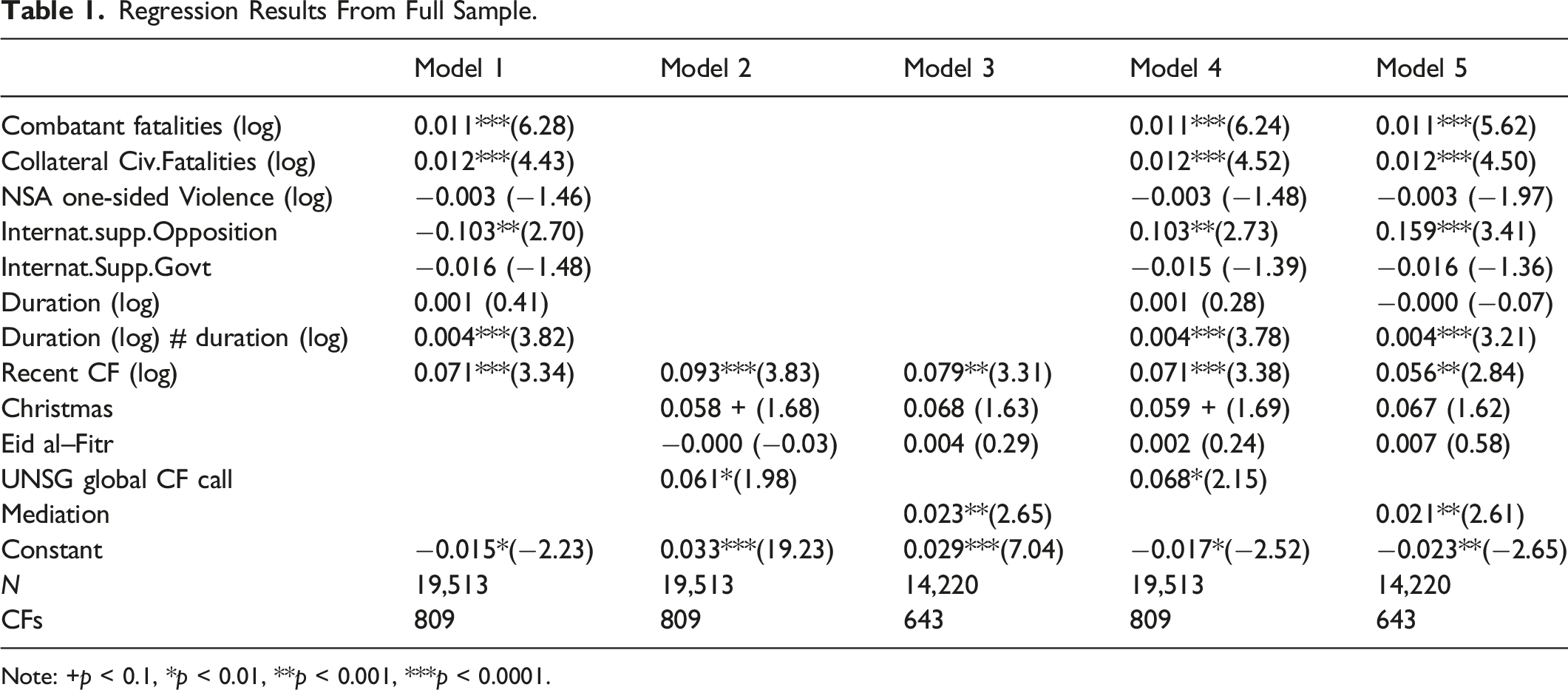
Note: +p < 0.1, *p < 0.01, **p < 0.001, ***p < 0.0001.
Hypothesis 1, that combatant fatalities are positively associated with ceasefires, is strongly supported. In models 1, 4 and 5 the measure of combatant fatalities shows the expected positive result, which is significant in all specifications. Substantively, for every doubling of casualties, the probability of a ceasefire increases by 1pp. An increase from 25 Battle Related Deaths to 1000 BRD leads to an increase of almost 4pp per month and 36pp per year. Figure 1
18
illustrates the substantive effect in in the range minimum (0) to 95th percentile (at 1096). Minor conflicts have a low likelihood of ceasefires in general, but the marginal effect of an additional fatality is quite large for minor conflicts. Increasing the number of fatalities from 1 to 150 per month increases the likelihood for ceasefire by 4.9pp. Increasing from 150 to 1000, in contrast, adds only 2.1pp to this likelihood.
19
Hypothesis one is supported. Effect of combatant fatalities on monthly probability of ceasefire.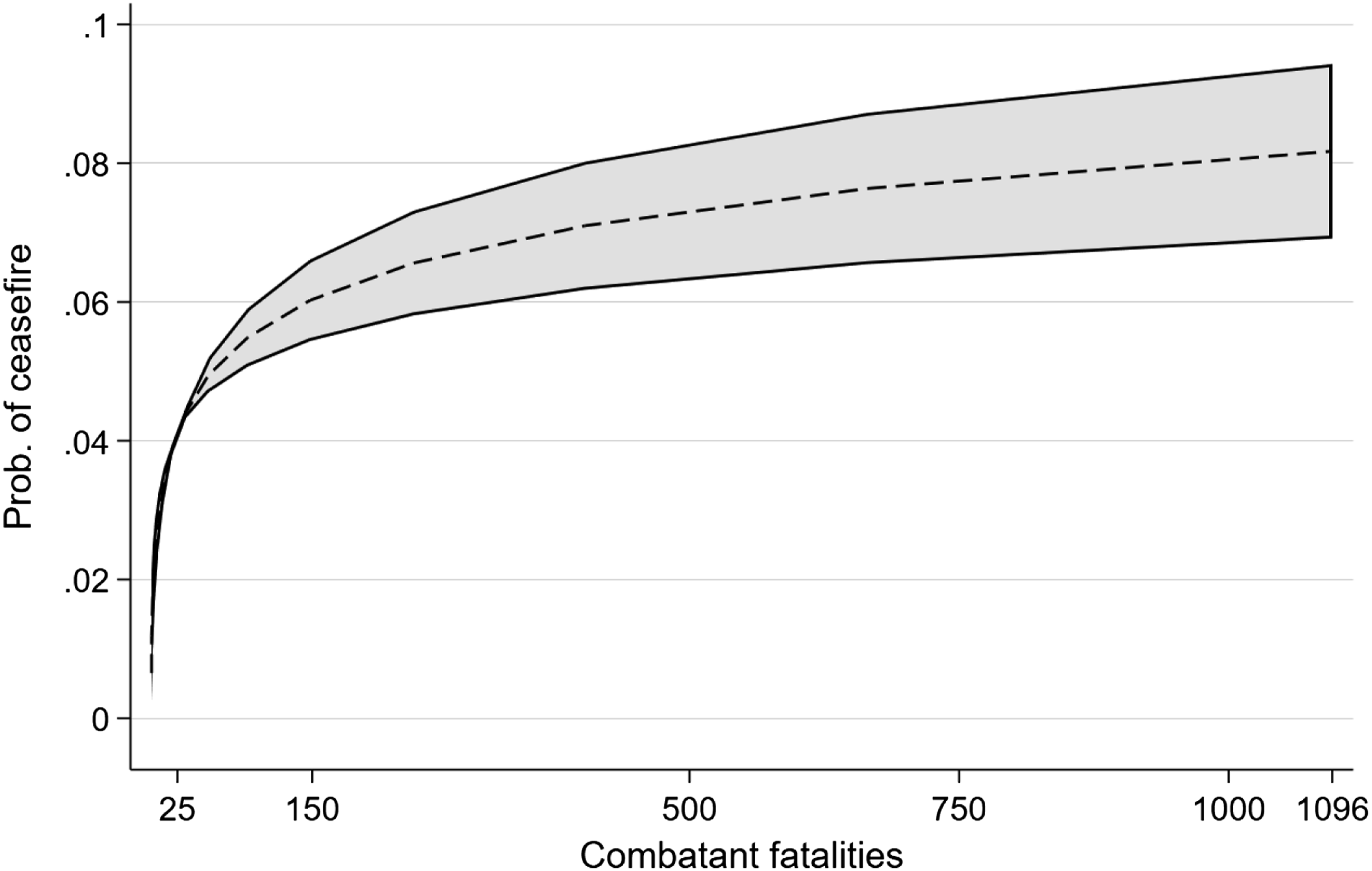
The second hypothesis stated a similar expectation regarding civilian collateral fatalities. Again, we find a positive and significant result across all models. These fatalities have a slightly larger marginal effect, but they are less frequent. Hypothesis 2 is also supported. Figure 2 is similar to Figure 1 in that the X axis range is minimum to 95th percentile.
20
We see a very similar effect, albeit at a different scale. The marginal effect of an additional civilian fatality is much higher, but the prevalence of these is also much lower. Moving from 0 to 25 civilian fatalities increase the likelihood of a ceasefire by about 3.8pp, while changing from 25 to 50 increases the likelihood by about 0.8pp. Hypothesis 2 is then supported. More costly conflict, whether measured through combatant or unintentional civilian fatalities, increases the likelihood of a ceasefire. Effect of collateral civilian fatalities on monthly probability of ceasefire.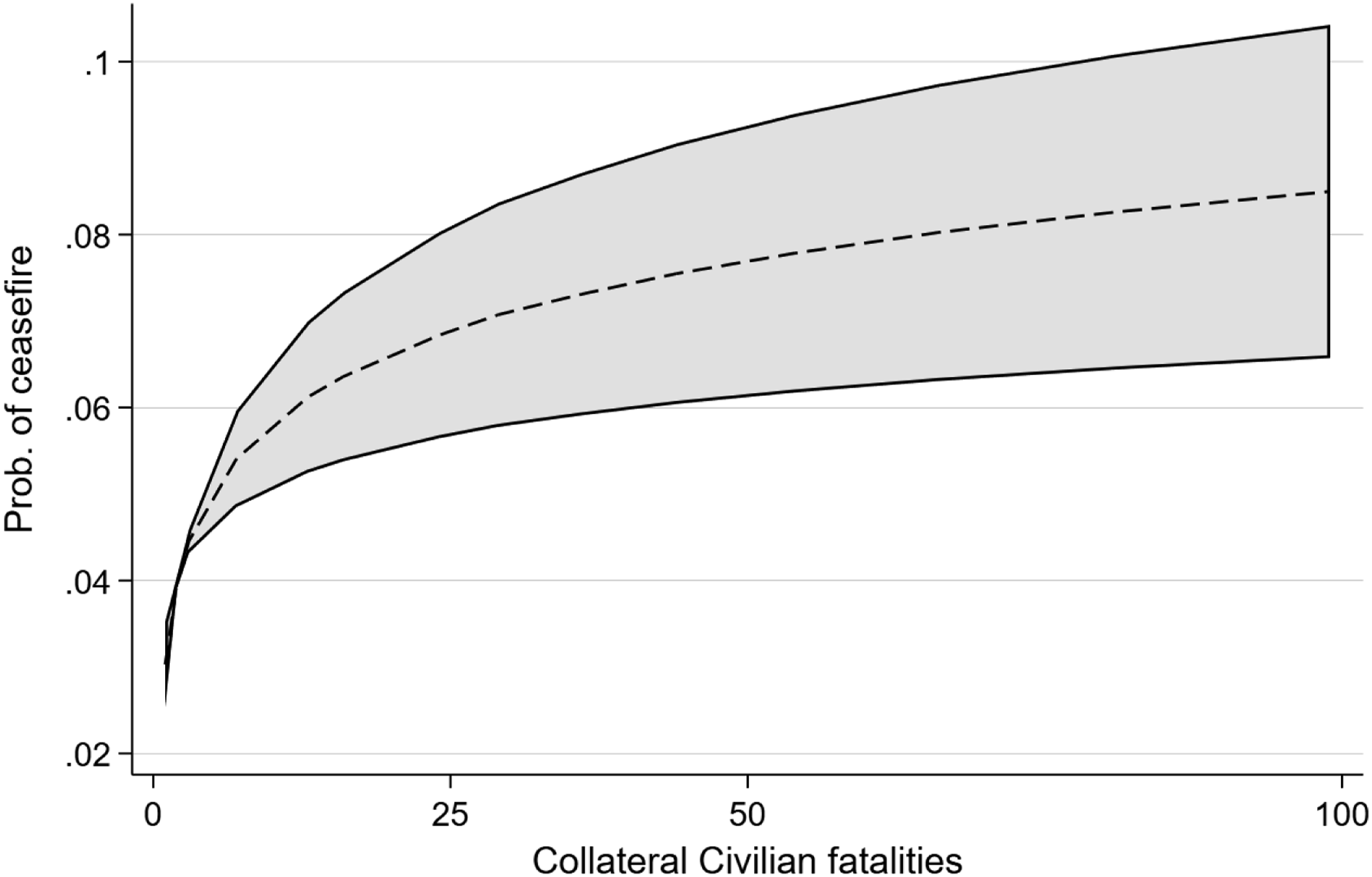
Regression Results from Bivariate and Univariate Sub-Samples.
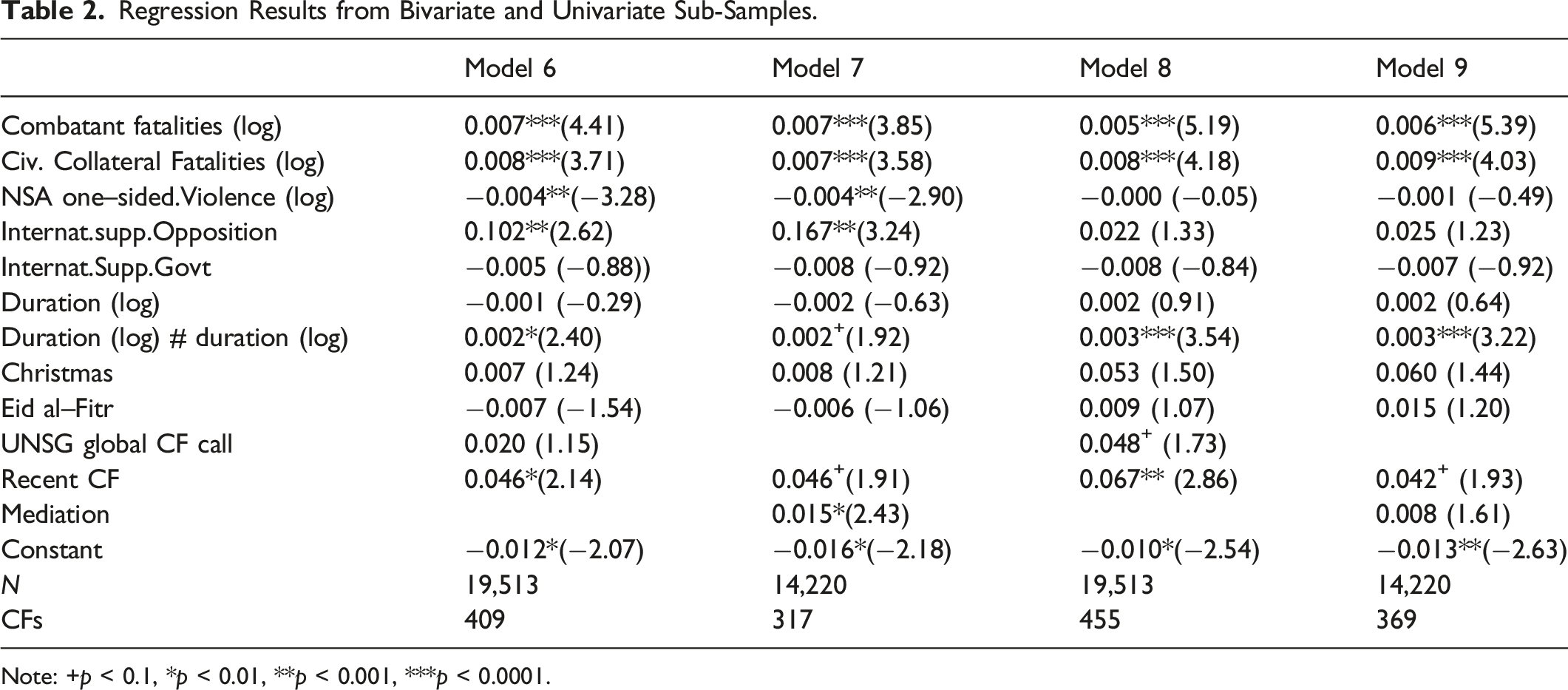
Note: +p < 0.1, *p < 0.01, **p < 0.001, ***p < 0.0001.
Hypothesis 4a and 4b posits that ceasefires are more likely in the initial phase of a conflict, before dropping down to a low level and gradually increasing from that level. We find support for both these hypothesis. This is best understood with reference to Figure 3. Initially the likelihood of a ceasefire is at its peak at 8.4% this then declines rapidly to 4% after 9 months. The turning point seems to be around 29 months, at which point the likelihood of a ceasefire is only 3.4%. The likelihood of a ceasefire then increases again, but slowly. The monthly probability reached 5% at 18 years and 6% at 30 years. Both hypothesis 4a and 4b are then supported. Effect of dyad duration on monthly probability of ceasefire.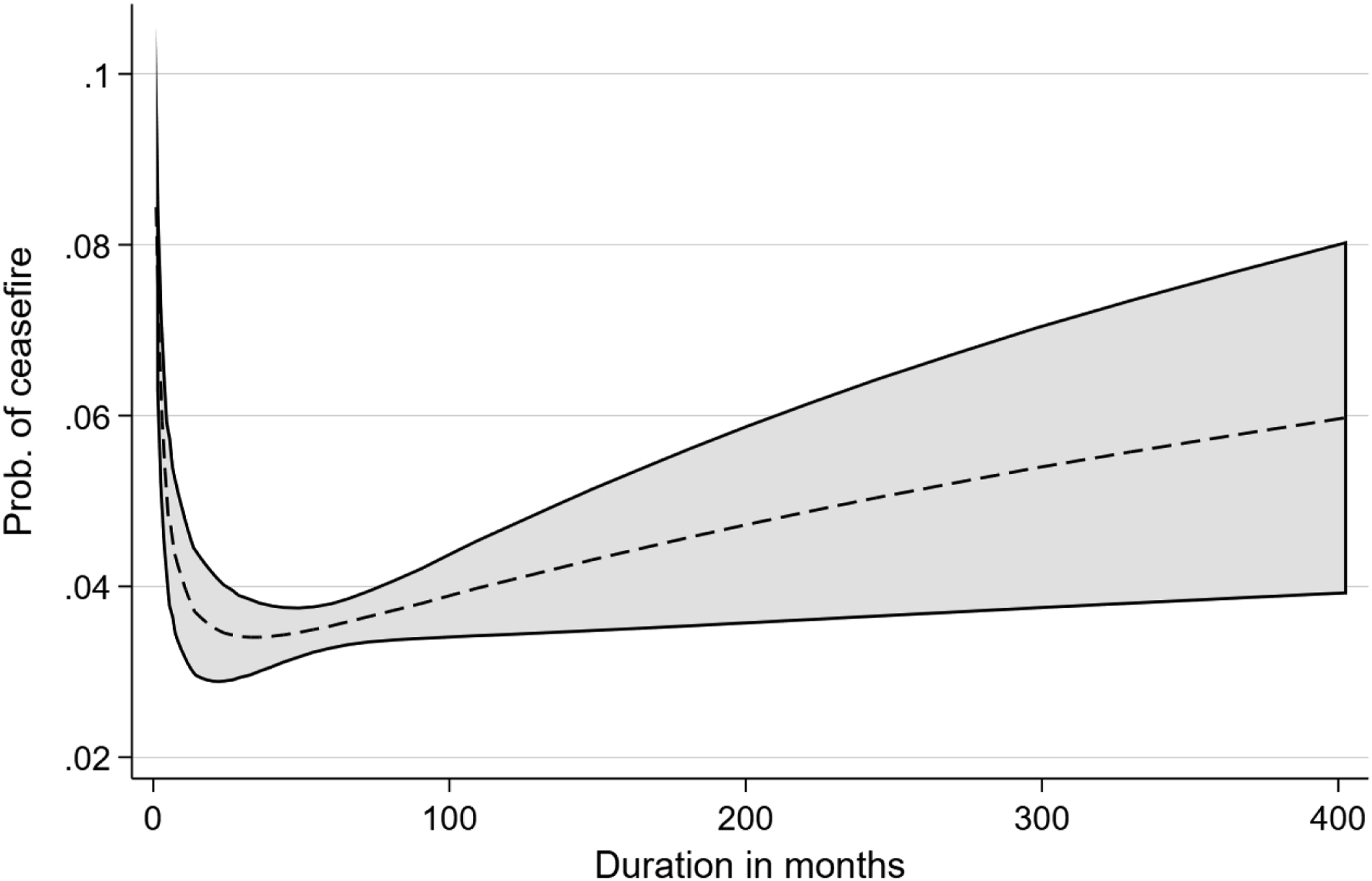
The fifth hypotheses set out our claim that external support for the non-state armed group will increase the likelihood of a ceasefire by reducing the power asymmetry in civil conflict, whereas external support on the government side is expected to have the opposite effect. External support for the non-state group does indeed increase the likelihood of a ceasefire in the range of 10-15pp per month, supporting Hypothesis 5a. As a further test of this argument, we turn to Table 2. If external support does indeed increase the relative capacity of the non-state group, and thus their capacity to extract concessions from the state, then we would expect to see an increased likelihood in bi/multi-lateral ceasefires that also involve the state. That is indeed what we find, offering further support for Hypothesis 5a. At the same time, support for the rebel side is a rare phenomenon, so we interpret this result with some caution.
We do not however find support for the government-based hypothesis. As expected, the variable shows the negative sign, but is not significant in any model. Prior research suggests that support for the government may be less influential on the relative distribution of power than support for the non-state group, which might in part explain this result.
Next, we turn to the analysis of political cover. First, we explore if mediation impacts the likelihood of ceasefire. Recall that mediation reduces the audience costs associated with a ceasefire, as the outcome can be partially attributed to the third party. This should be particularly the case with regards to bilateral ceasefires, as in the presence of a mediator agreements with an opponent can more easily be ‘sold’ as a concession to the process or mediator, rather than to the other side. We find support for this argument, the mediation variable is positive and significant in all models, though the effect is relatively modest at 2pp per month. 21 As expected, the impact of mediation is more important for bi-lateral agreements. 22
Turning to the UN call for a global ceasefire, we find that in March 2020, the month in which the initiative was announced the probably of ceasefire increased by around 6pp. It does therefore seem that the global call provided sufficient cover to encourage conflict parties to enter into a ceasefire. In the Appendix L we run additional analysis to determine if the effect can be seen in the months preceding the call, which might point to a more general response to the emerging threat of the pandemic, or in the following months, when the global community rallied in support of the initiative and the crisis escalated. We find that only in March 2020 does the probability of a ceasefire increase significantly. As the threat of the pandemic, and political pressure behind the global call, arguably increased in the following months. That we only find an effect in March points to the important role of political cover. All conflict parties who saw the political cover as sufficiently significant as to shift their decision calculus appear to have signed a ceasefire in March, meaning that by April, there were far fewer conflict parties whose reluctance to enter into a ceasefire could be solved by cover. Unsurprisingly, given the sudden nature of the UNSG call’s, the effect is limited to unilateral ceasefire. These arrangements can be announced more quickly, taking immediate advantage of the cover and placing the other side under pressure to reciprocate.
The final hypothesis asserts that religious holidays can be used as a political cover. The evidence is mixed. Christmas has a fairly strong coefficient around 6pp, which is par with the Security Council global call (but obviously happens every year), but the Christmas effect is only statistically significant at the 10% level and does not hold up when we look separately at unilateral and bilateral arrangements. The most plausible interpretation is that political cover is relevant for both unilateral and bilateral ceasefires, and that context dictates which type is chosen in specific situations. We find no effect from Eid al-Fitr. We therefore find only limited evidence that religious holidays offer political cover.
Robustness
To assess the robustness of our results we estimate some additional models. We provide full detail of all the robustness checks in the appendix.
Conclusions
Ceasefires are common during civil conflict. Yet we still know very little about why and under what conditions ceasefires more generally occur. To that end, we have situated and conceptualized ceasefires as part of a broader understanding of the conflict process. We find that conflict dynamics are strongly associated with the likelihood of ceasefires. More intense fighting increases the likelihood of a ceasefire, whereas one-sided rebel violence towards civilians has a negative effect, in particular on bilateral agreements. International support for the rebels increases the likelihood of a bilateral ceasefire, while support for the government side is inconclusive. Ceasefires are more likely early in a dispute, and then become less likely for some time before eventually increasing again.
We find partial support for the political cover hypotheses. Mediation does increase the likelihood of ceasefires; future research should attempt to do more to distinguish between the different mechanisms through which mediation might lead to a ceasefire to tease out the independent effect of political cover. The UNSG call for a global ceasefire in March 2020 did lead to a significant jump when controlling for conflict dynamics, though a number of studies have subsequently shown that these arrangements had little effect (Gowan 2020). Christmas is associated with more ceasefires, but not Eid al-Fitr. Future studies could explore how the characteristics of societies, including religion and ideology, shape the ceasefire process.
This study is only a first step towards building robust comparative knowledge on the causes of ceasefires. We must delve deeper into the mechanisms and improve our understanding of why and when belligerents declare ceasefires. In this, we also need research that focuses on different forms of ceasefire (e.g. non-state ceasefire though see, Duursma 2022; Lundgren, Svensson and Karakus 2022), and consider a wider range of context factors (e.g. see, Braithwaite and Butcher 2022). We also need research designs that get more squarely at the causal impact of various features of conflicts on ceasefires. It is also not yet clear how differences across conflicts, including the type of warfare, characteristics of non-state groups, and ideologies, shape the ceasefire process, and if arrangements that emerge in different contexts produce heterogenous effects. Developing this knowledge is a necessary step in understanding the various functions that ceasefires play during intra-state conflict.
Supplemental Material
Supplemental Material - Costs and Cover: Explaining the Onset of Ceasefires in Civil Conflict
Supplemental Material for Costs and Cover: Explaining the Onset of Ceasefires in Civil Conflict by Govinda Clayton, Håvard Mokleiv Nygård, Siri A. Rustad, and Håvard Strand in Journal of Conflict Resolution
Footnotes
Acknowledgements
The authors thank the editor of JCR and anonymous reviewers.
Declaration of Conflicting Interests
The author(s) declared no potential conflicts of interest with respect to the research, authorship, and/or publication of this article.
Funding
The author(s) disclosed receipt of the following financial support for the research, authorship, and/or publication of this article: This project was made possible by generous funding from the Folke Bernadotte Academy [DNR-17-00427], the Swedish Research Council [2018-01520], the Centre for Security Studies at ETH Zürich, and the Norwegian Ministry of Foreign Affairs [Conflict Trends QZA-21/0177].

Supplemental Material
Supplemental material for this article is available online. See www.ceasefireproject.org.
Notes
References
Supplementary Material
Please find the following supplemental material available below.
For Open Access articles published under a Creative Commons License, all supplemental material carries the same license as the article it is associated with.
For non-Open Access articles published, all supplemental material carries a non-exclusive license, and permission requests for re-use of supplemental material or any part of supplemental material shall be sent directly to the copyright owner as specified in the copyright notice associated with the article.
