




Abstract
This article introduces the Civil Conflict CeaseFire (CF) dataset. The CF data covers all ceasefires in civil conflict between 1989 and 2020, including multilateral, bilateral and unilateral arrangements, ranging from verbal arrangements to detailed written agreements. In total, the CF data includes 2202 ceasefires across 66 countries and 109 civil conflicts. The data feature information on the actors involved in the ceasefire, and the class, purpose, coverage, and end date of the ceasefire. The CF data provide an empirical basis to assess the conditions that give rise to ceasefires, how ceasefires affect the dynamics of conflict, and the role of a ceasefire in the peace process. This article presents the rationale underlying the data collection, the coding rules and procedures, and how this data can be used for analysis.
Introduction
Why do different types of ceasefires occur? 1 How do they affect the dynamics of conflict and violence? And in what way do they relate to, and ultimately shape, a peace process? Researchers currently lack suitable data on ceasefires that would allow them to answer these and many related questions (Clayton et al. 2022a). In this article, we introduce the ETH/PRIO Civil Conflict CeaseFire (CF) dataset, the first comprehensive global dataset covering the full range of state-based ceasefire arrangements in civil conflicts between 1989–2020. In total, the CF data provides information on 2202 ceasefires across 66 countries in 109 civil conflicts, and involving 4091 declarations by 469 different governments and non-state armed groups. This human-coded data includes the full range of unilateral, bilateral, and multilateral arrangements, and a series of additional variables featuring, for example, the purpose, class, and outcome of all arrangements.
All ceasefires have been mapped onto and made compatible with the UCDP/PRIO Armed Conflict Dataset (ACD, Gleditsch et al. 2002) and the UCDP Dyadic Conflict Dataset (Pettersson, Högbladh & Öberg, 2019). The CF dataset makes it possible for the research community to tackle important theoretical questions and model more adequately issues related to ceasefires, which until now has been an omitted variable in many analyses of civil conflict and patterns of violence (Clayton et al. 2022a). Moreover, the data allow the community to offer novel insights into important policy questions related to the management and mitigation of violence and peace processes.
To begin, we present the need for this new dataset. We then discuss the specifics of the data, including the conceptual definitions, data structure, and coding approach, followed by a series of descriptive statistics and simple statistical analyses. We conclude by discussing how the CF data opens up multiple avenues for future research and its potential for impact on policy and practice.
Why a New Ceasefire Dataset?
Ceasefires are a relatively common feature in civil conflict. The CF data suggest that around 21% of all conflict-years feature a ceasefire. 2 Most conflicts will experience multiple ceasefires across the period of active hostilities (on average 20 in the CF data, with a median of 12). Yet despite the frequency of ceasefires, a lack of suitable data has meant researchers have been unable to systematically assess the causes of ceasefires and how ceasefires affect civil conflict.
Existing listings of ceasefires in other datasets are biased towards certain types of cases, or incomplete and outdated. For example, the UCDP Peace Agreement Dataset (Harbom, Högbladh & Wallensteen 2006; Pettersson, Högbladh & Öberg 2019) contains only ceasefires that are part of a formal peace agreement. The UCDP Conflict Termination Dataset (Kreutz 2010), on the other hand, does not identify individual ceasefire agreements at all, but does report whether an ended conflict did so as a result of one or several ceasefire agreements. 3 In both cases, the samples are limited to ceasefires that (attempt to) bring an end to the conflict altogether, excluding the broader set of ceasefires that occur during conflict. This lacuna fundamentally limits researchers’ ability to examine the effects of ceasefires, since the broader set of ceasefires (beyond those that attempt to generate a long-term stop in the violence) used during conflict are excluded. Indeed, it is possible to accurately assess the conditions under which ceasefires are most effective only if we consider ‘successful’ cases alongside those that fail, and consider those agreements that seek to serve more limited short-term purposes separately from those that attempt to bring a permanent end to conflict (Clayton, Nathan & Wiehler 2021).
An older dataset created by Fortna (2008) to study the effectiveness of peacekeeping in civil wars does not suffer from this bias, but is outdated (1989–1999), coded only for a subset of major civil wars, and contains only 63 ceasefires that lasted at least 1 month.
The dataset closest to our collection is the PA-X Peace Agreements Database, which contains more than two hundred ceasefire agreements (Bell & Badanjak 2019, 455; see also, Clayton & Sticher 2021). Yet the PA-X collection is limited to written agreements, and has a very broad definition of a ceasefire that fails to distinguish between ceasefire and related agreements (e.g. agreements that mention a ceasefire, but do not include a commitment to stop hostilities). Our CF data suggest that the vast majority of ceasefires are declarations without a written document (68%). The written agreements included with the PA-X are then a subset of the ceasefires in our dataset. Out of the 2202 ceasefire we have coded, 236 of them correspond to the PA-X data. Without previous knowledge on how the impact of verbal declarations differs from written agreements, studies of ceasefire impact need a full sample that include both. To make it possible to study these and related questions, our CF data include a variable that links ceasefires to the corresponding ceasefires in PA-X.
To summarize, while some ceasefires are included in other datasets, none of those datasets were created for the primary purpose of research on ceasefires in intra-state conflict. As a result, they reflect an incomplete and potentially biased sample of ceasefires. The new CF data represent a more comprehensive collection that does not suffer from these biases.
Ceasefires and Conflict Dynamics
Research now reveals much about why conflict occurs, escalates, and ultimately terminates. Yet the prior lack of suitable data has prevented researchers from incorporating ceasefires into their analysis and this is problematic. For example, studies seeking to explain or predict the intensity of civil violence, or the escalation or de-escalation of a dispute, might seriously underspecify their models if they fail to account for ceasefires. As a case in point, the current gold-standard in conflict prediction, the Violence Early-Warning System (ViEWS) project, integrates leading conflict research and utilizes cutting-edge simulation techniques to predict the likelihood of political violence (Hegre et al., 2019). As for most conflict-prediction systems, prior violence is an important predictor in the ViEWS model. Yet, as shown by Clayton et al (2022b) an increase in fatalities is also associated with an increase in the likelihood of a ceasefire, which should significantly lower the likelihood of short-term future violence. Moreover, Bara and Clayton (2022) show that ceasefires in one dyad can increase the government’s reputation for cooperation, which can lead to violence also declining in other dyads within the same state. Until now the lack of appropriate data has prevented researchers from incorporating or controlling for such effects in their models. The CF data, therefore, offer researchers – including those at the ViEWS project 4 – a tool to more suitable to control for the confounding effect of ceasefires in their analysis.
In addition, other forms of violence are also likely to be influenced by a ceasefire. We realize that violence during a ceasefire might appear a contradiction in terms, but multiple studies have shown that not all forms of violence end with a ceasefire (Åkebo 2016; Höglund 2005; Jarman 2004; Kolås 2011). In fact, rather than ending conflict and/or violence, ceasefires might transform or shift the use of violence. For example, while ceasefires might reduce battle-related fatalities, this might not be true for one-sided violence, sexual violence, or even cyber warfare (Kane & Clayton 2020). It is also unclear how the violent behavior of conflict parties varies depending on whether or not they are included in a ceasefire, and the extent to which ceasefires might inadvertently contribute to conflict escalation rather than resolution. A number of studies make reference to this possible “dark side” of ceasefires (Luttwak, 1999; Mahieu, 2007; Kolås, 2011), but as yet there is only limited empirical assessments of these possible effects (see, Lundgren, Svensson & Karakus 2022). Therefore, there is a need for greater knowledge about how ceasefires influence patterns of violence during civil war (Gutiérrez-Sanín & Wood, 2017) and the CF data offer the first opportunity for such an investigation.
Ceasefires and Conflict Management
Conflict management research has in the past tended to conceptualize ceasefires as an outcome of a peace process, in essence, considering ceasefires as a positive outcome equivalent to a partial or full peace settlement (Bercovitch & Houston 1993; Beardsley et al. 2006; Bercovitch & Fretter 2007; Clayton 2013; Clayton & Gleditsch 2014). Adopting a similar approach, Fortna (2003, 2004) broadly equates ceasefires with peace agreements by assessing ceasefires according to the length of the subsequent period of peace.
This approach is problematic because it considers ceasefires as an end in-and-of-itself, and not as a step or phase in the broader peace process. The new CF data, in contrast, allow us to consider in greater detail the phases of a broader peace process and how ceasefires relate to that process (or not). In this way, the CF data also enable us to study at a more granular level how agreements to curtail violence during a peace process affect the post-conflict period and, potentially, the propensity for conflict recurrence. Of course, in some cases ceasefires do manage to suspend violence for a long period, either as part of a peace agreement (e.g. Burundi, 2008), or without such an accompanying agreement (e.g. Cyprus 1974). Yet, this is only the purpose of a relatively small sub-set of ceasefires. In the majority of cases, ceasefires are not intended to be a long-term solution, particularly in the context of civil wars. Indeed, practitioner guidance is quite clear in considering ceasefires to be transitional arrangements (Haysom & Hottinger 2004), and a number of case studies stress the transitory nature of ceasefires (Åkebo 2016).
The CF data capture all of ceasefires that take place during state-based conflict. 5 Consequently, for the first time, researchers have access to information on all ceasefires, and not just those that were the outcome of a mediated process or those that successfully terminated violence for some period. This inclusion is significant, as it means researchers can now explore a far broader range of questions relating to the conflict management functions that ceasefires can perform. For example, what increases the likelihood of the parties entering into a ceasefire? (e.g. see, Clayton et al. 2022b); How does the broader political context shape the outcomes of ceasefires (e.g. see, Braithwaite & Butcher, 2022); and how do ceasefires influence the negotiation process?
Conceptualizing Ceasefires
The CF data define ceasefires as arrangements that include a statement in which at least one conflict party commits to stop violence temporarily or permanently from a specific point in time.
To meet our definition of ceasefire, we require that an arrangement: (1) Includes a declaration (written or verbal) in which at least one actor commits to stopping violence. This criterium distinguishes ceasefires from other breaks in armed violence that might occur during conflict;
6
(2) Specifies an exact point in time at which the arrangement will be initiated. We include the time requirement to distinguish ceasefires from more general statements that an actor might make committing to stop fighting at some point in the future; and (3) Includes a commitment to stop rather than only reduce violent activity. This stipulation distinguishes ceasefires from a broad range of other arrangements that seek to reduce or contain violence, but fall short of stopping violence. Building on UN practice, Clayton, Mason and Sticher (2020) refer to these other arrangements that fall below our threshold of a ceasefire as “de-escalation measures.” One example is the agreement the US attempted in 2021 with the Taliban to ‘reduce violence’ in Afghanistan (Gibbons-Neff 2021).
The CF data are built on a very broad definition of ceasefire that captures the full range of related arrangements, including everything from unilaterale verbal arrangements to written multilateral agreements. As such, we use “ceasefire” as an umbrella term to capture all arrangements that fulfill our definition, which includes agreements that might otherwise be labelled as a ‘truce”, “armistice”, or “cessation of hostilities.” While it is true that there exist certain similarities in the common understanding of these concepts, there is no clear consensus in either academia or communities of practice around the most appropriate criteria to categorize the different forms of such arrangements. As a result, terminology is used inconsistently, with different actors often using different terms to refer to the same or similar concepts, or using the same concept to refer to quite different arrangements. 7 We adopt a broad definition of ceasefire, but classify types of ceasefires according to a series of identifying characteristics, which we present in the next section.
Coding Ceasefires
To identify and classify ceasefires we rely primarily on the Factiva database, produced by Dow Jones International. Factiva is the most comprehensive global news database containing more than 1.8 billion news articles from more than 33,000 news sources in 200 countries and in around 30 languages. This database includes major global news organizations, such as Reuters, the Associated Press, Agence France Presse, Xinhua, as well as local radio, television and newspaper reporting in local languages and translated by BBC Monitoring. Factiva provides an advanced search engine where researchers can search for specific keywords and topics, and delimit these searches to the countries of interest. 8 We pilot tested a number of different search strings, seeking generate the most comprehensive collection of sources while avoiding capturing excessive unrelated articles. Following a 3-month pilot in which we coded five conflicts randomly selected from the UCDP data, we settled on a search string. 9
Next, we limited our geographic scope to those countries that have suffered at least one civil conflict between 1989–2020 as defined by the UCDP/PRIO ACD (Gleditsch et al. 2002). However, we did not limit our data collection to ‘active’ conflict years; we coded the 3 years before and following an armed conflict. 10 Including these 3-year buffers on each end of the conflict makes it possible to explore, for instance, the role played by ceasefires in attempting to manage any violence that might reoccur in a post-settlement period. Our instincts were confirmed: we found 749 11 actor-ceasefire declarations taking place in years when the UCDP does not record an active conflict. This finding offers interesting evidence of conflict management efforts taking place outside of what the UCDP considers to be conflict. Similarly, we also code a number of ceasefires that take place between the state and armed actors, even if those actors do not relate to a UCDP conflict. These actors are given new actor identification numbers in our dataset. Both these aspects represent interesting avenues for future research.
Applying the search string to the relevant countries produced a corpus of more than 1,250,000 news articles. These articles were evaluated by human coders 12 to assess if they identified any ceasefire. When a ceasefire was identified, the coders recorded a series of identification variables, such as the date of declaration, date of the declaration entering into effect, the location of the ceasefire, and actors involved. Then, we coded descriptive variables (discussed below) and noted any unique or contested elements in a short text comment.
Several resource-intensive measures were taken to ensure inter-coder reliability and data quality. Before working on the articles, each coder mock coded training cases to ensure their understanding of the codebook aligned with the rest of the group. During the coding, continuously refined guidelines (which are available as an appendix to the codebook) helped the coders address ambiguous coding decisions. After finishing a country, the coding was checked in detail by one of three experienced coders. In almost all cases, more than 90% of the material was coded consistently. Any major disagreements or differences of opinion were then discussed in monthly group coding meetings with the project leader. Finally, we developed a natural language processing model to predict which articles in the corpus contained a ceasefire that met our definition. We trained our model on a subset of the data, and then used the model on a random sub-sample of the coded countries. The predicted articles were then compared with the ceasefires we had coded. This comparison revealed almost no additional ceasefires, suggesting that all our coders were accurate and consistent in identifying ceasefires. 13 In sum, all the information included in the CF data has been checked by a minimum of two human coders, usually more.
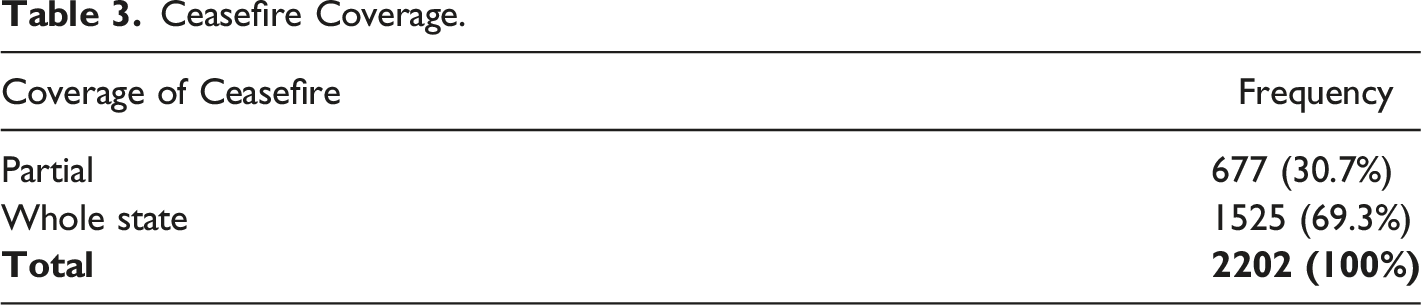
There are well known limits to using news sources to code data on armed conflicts. Weidmann (2015) shows that, in particular, conflict-events occurring in remote areas and as indirect events are underreported. In both cases, Weidmann (2015, 1146) concludes that “media-based event collections can serve as valuable bases for empirical research, if these limits of precision are taken into account.” It is possible that these same systematic biases are also a problem in our attempts to capture ceasefires. Specifically, it is possible that brief, localized agreements in rural areas within the state’s periphery (e.g. short truces to collect dead from the battlefield) are more likely to be missing from our data given the lower likelihood of reporting. However, ceasefires are typically events of crucial importance in a conflict, and, thus we believe they are more likely to be reported in the media, especially when they are nationwide agreements. For this reason, we include a variable (discussed below) that distinguishes between ceasefires that cover the whole state or a more localized area (e.g. Homs in Syria). Researchers concerned about possible measurement bias can choose to exclude partial agreements that are more likely to suffer from this problem.
Data Structure
The dataset has a directed actor-ceasefire structure. A ceasefire can be declared by one (unilateral ceasefire), two (bilateral ceasefire), or several actors (multilateral ceasefire). We know from prior research that state-based civil conflicts often include more than one non-state actor (Pettersson, Högbladh & Öberg 2019). This possibility necessitates detailed data not only on which actor declared a ceasefire, but also the actor(s) ‘targeted’ by the arrangement. In many cases the government might declare a ceasefire with only one of a number of non-state groups. For example, in Colombia, the government entered into ceasefires with the FARC that did not include the ELN. On other occasions, a ceasefire can be signed between the government and a non-state group, with other non-state groups joining the ceasefire later. For example, the Myanmar government and eight non-state groups signed the Nationwide Ceasefire Agreement in 2015 and, 3 years later, two more groups joined – the New Mon State Party and the Lahu Democratic Union. And sometimes, conversely, multiple non-state groups may enter into a multilateral agreement with the state, but one of more of these groups may later decide to abandon the ceasefire while other actors continue to honor the agreement.
To accommodate these various actor constellations, as well as the dynamic nature of inclusion within a ceasefire, our unit of analysis is the “actor-target-ceasefire combination.” Accordingly, a unilateral ceasefire has as many lines in the database as addressees; a bilateral ceasefire has two lines; and a multilateral ceasefire between the government and n non-state conflict parties has 2*n lines. All observations that are part of one joint ceasefire declaration, or of the same unilateral declaration, are given a common ceasefire ID, but separate actor and dyad IDs.
14
Actor and dyad IDs are based on the UCDP actor dataset.
15
To illustrate the CF data setup, we present six examples in Figure 1. Each panel represents a different ceasefire constellation. In each case an arrow points from the actor declaring the ceasefire to the target of the ceasefire. Each arrow would be a line of data, and the dotted boxes signify which ceasefire would been given the same ID. Civil conflict ceasefire data structure.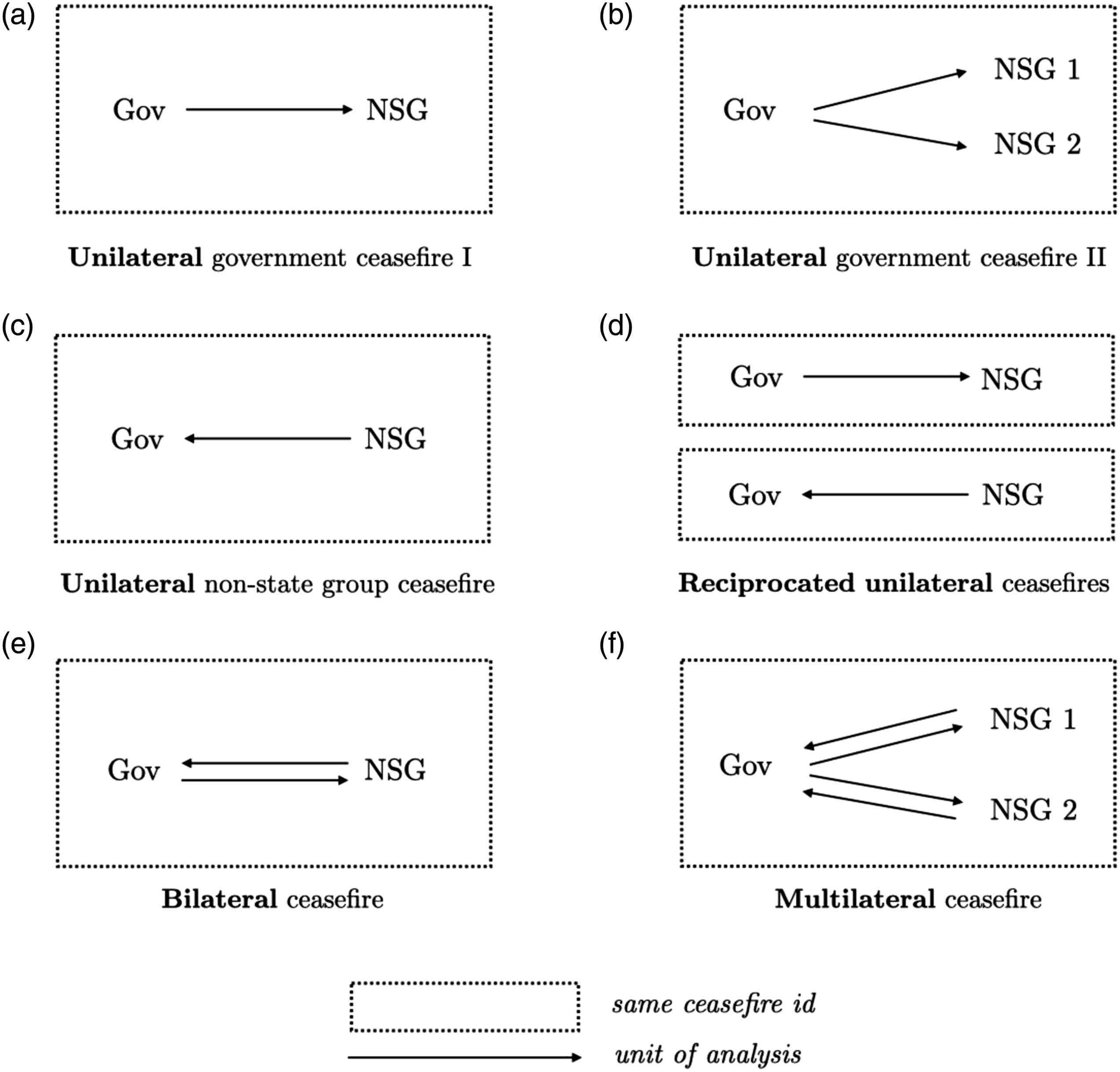
In panel (a), the government declares a unilateral ceasefire towards one non-state group that is not reciprocated. For example, in 2014, Israel declared a (unreciprocated) four-hour unilateral ceasefire towards Hamas to allow the delivery of humanitarian aid.
In panel (b) the government declares a unilateral ceasefire towards multiple non-state groups, which is also not reciprocated by either group. For example, in 2019, the military in Myanmar simultaneously declared unilateral ceasefires towards the National Democratic Alliance Army and the Palaung State Liberation Front. 16 The number of addressees corresponds here to the number of lines of data, i.e. while box (a) produces one line of data, box (b) results in as many lines as non-state groups (e.g. in panel (b), we have two lines of data). In the case of box (b) there are two lines of data although there is only one declaration. To capture this, both observations share a common ceasefire ID.
In panel (c), a unilateral ceasefire is declared by a non-state group toward the government. For example, in 1996, the Basque separatist group, ETA, declared a unilateral ceasefire towards the state as an invitation to the Spanish government to open negotiations. This graphic representation follows the same coding logic as panel (a). 17
In panel (d) both conflict parties declare unilateral ceasefires that cover the same time period. For example, the Philippines government and the Communist non-state armed group (CCP) separately declared unilateral ceasefires for the holiday period. While these cover the same time period, the parties were careful to stress that these were unilateral agreements. As such, in the CF data, these items are listed as two separate unilateral ceasefires with separate ceasefire IDs.
In panel (e) the government and non-state groups jointly declare a bilateral ceasefire. For example, the conflict between the Government of Colombia and the FARC ended in 2016 with a peace agreement that included a definitive bilateral ceasefire. These agreements are recorded as two lines with a shared ceasefire ID. 18
Finally, in panel (f), the government enters into a multilateral ceasefire agreement with multiple non-state groups. For example, the nationwide ceasefire in Myanmar was an agreement between the state and 10 separate non-state groups. As noted above, a multilateral ceasefire between the government and n non-state conflict parties has 2*n lines.
Geographic and Temporal Distribution of Ceasefires in Civil Conflict
The CF data provides a corpus of 4091 actor-target-ceasefire observations between 1989 and 2020. These observations involve 469 actors in 66 countries, and produce 2202 unique ceasefire IDs. As explained above, the CF data builds on, and is fully compatible with, the UCDP/PRIO ACD and dyadic dataset. A number of ceasefires involve actors not included by UCDP, either because they do not reach the fatality threshold or have not specified an incompatibility. In the end, the data include ceasefires in 109 armed conflicts between 231 dyads. Between 1989 and 2020, 21.2% of all conflict years featured at least one ceasefire.
Figure 2 presents the geographic distribution of the ceasefires captured in the CF data. Countries in white have, according to UCDP, not suffered a conflict since 1989. A limited number of countries suffered conflict, but did without any ceasefires; these countries are depicted in the lightest grey. Those countries in which a ceasefire was declared are shaded in color – a darker shading indicating the larger number of ceasefires. The five countries that featured the most ceasefires are Sudan (169 ceasefires), India (167 ceasefires), the Philippines (157 ceasefires), Syria (140 ceasefires), and Israel (103 ceasefires).
19
Geographic distribution of ceasefires in the civil conflict ceasefire dataset.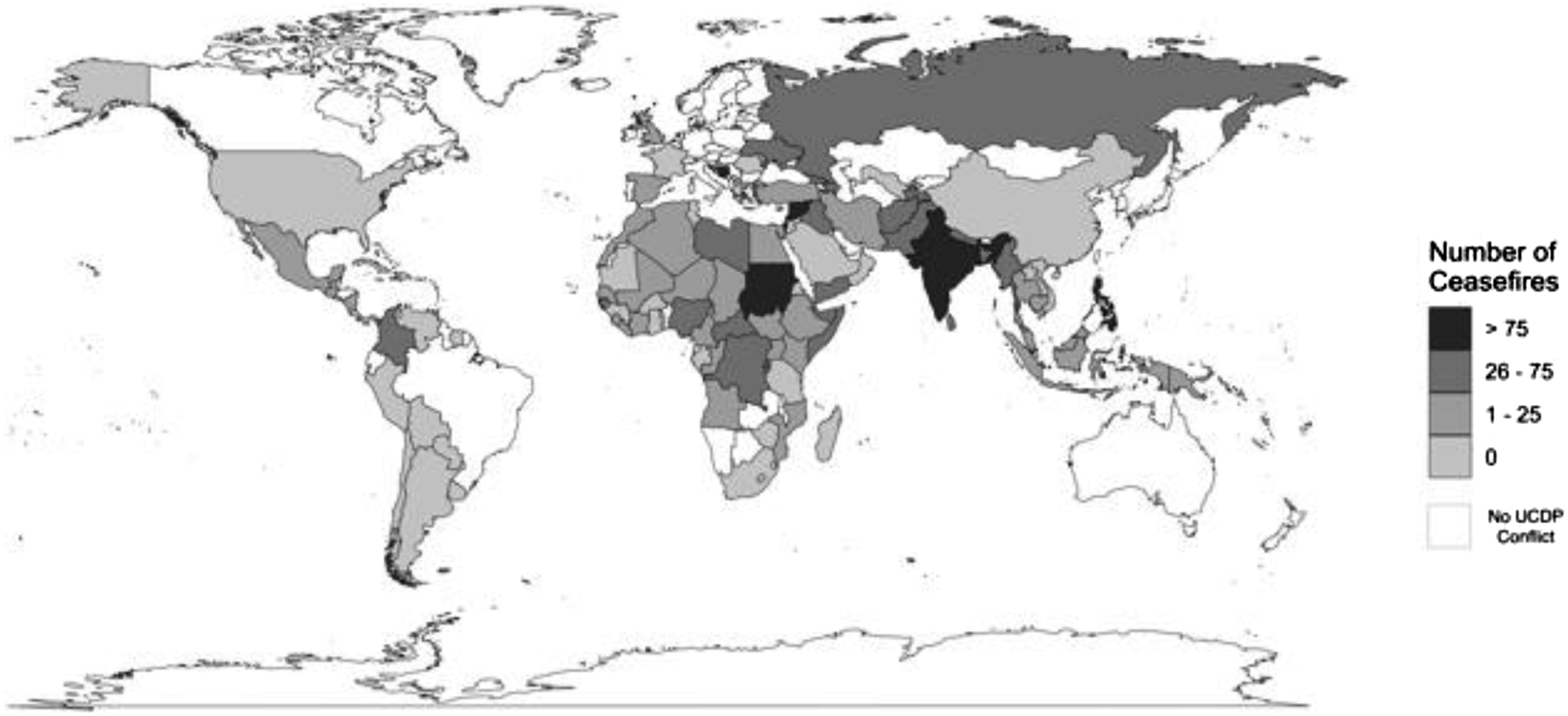
Ceasefires, like conflict, are a global phenomenon. The spatial clustering of ceasefires globally has changed across time, broadly in alignment with the locations of armed conflict. As is evident in Figure 3, in Latin America, we observe most ceasefires between 1989 and the early 1990s, largely driven by the processes seeking to end the conflicts in El Salvador, Guatemala and Nicaragua. Moving into the mid-1990s, most ceasefires were recorded in Europe, relating to the inter-connected conflicts in the former Yugoslavia. Since 2014, we again observe more ceasefires in Europe, due primarily to conflict in Ukraine. Ceasefires in Africa over the time period of the dataset occurred relatively consistently, peaking in the early 2000s due to the conflicts in the Democratic Republic of Congo and Sudan. Ceasefires in Asia are also common and consistent, occurring regularly in conflicts in India and Myanmar. Finally, ceasefires in the Middle East were relatively rare in the 1990s and early 2000s, with most ceasefires in this period relating to Lebanon and the Israeli-Palestinian conflict. However, over the last decade, due to conflicts in Syria and Yemen, we see a sharp increase in ceasefires. Regional distribution of ceasefires by year.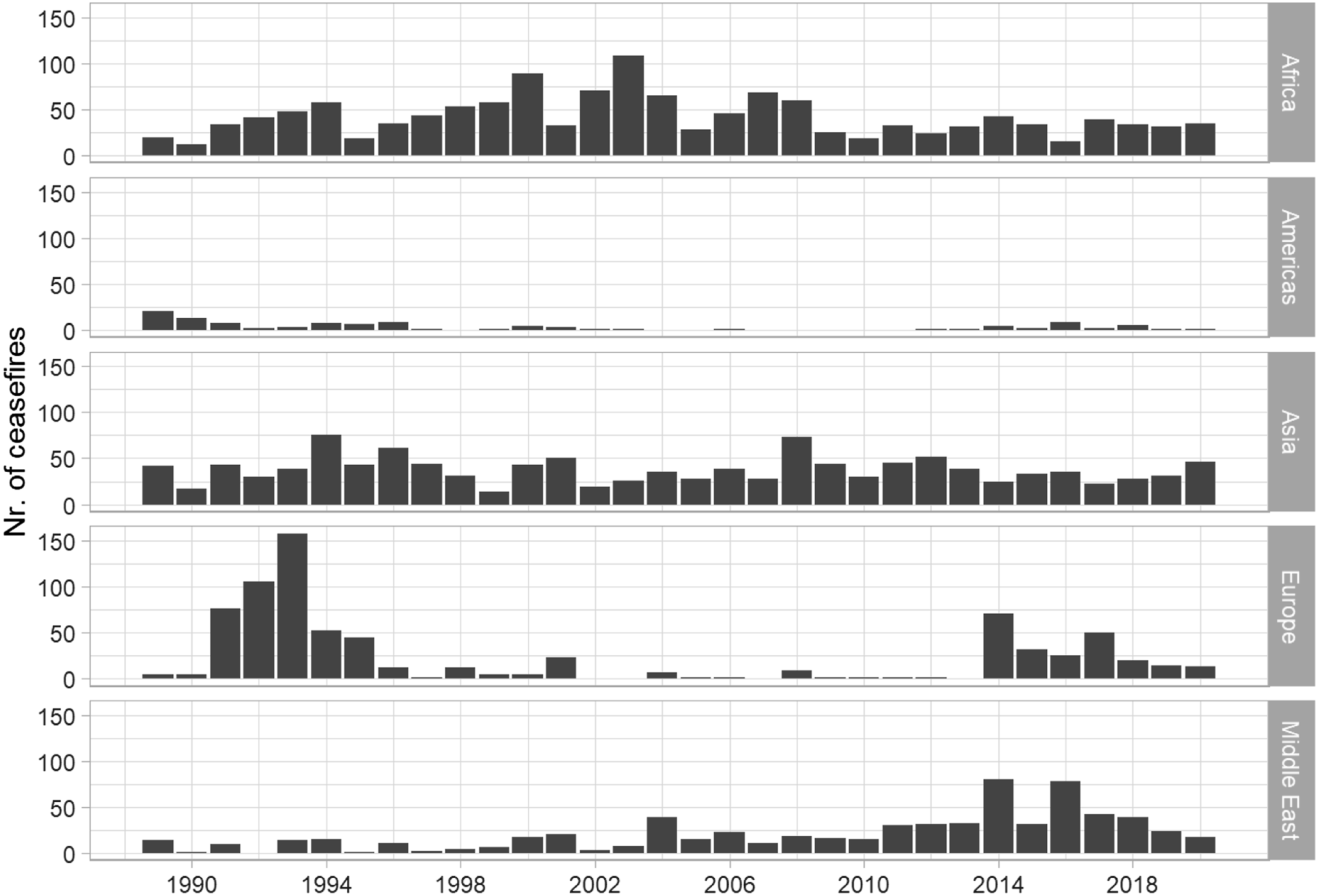
Classifying Ceasefires
The CF data capture the full range of ceasefire arrangements but also highlight important differences between the different forms of ceasefire. We introduce some of the most important variables here (and provide full details in the accompanying codebook).
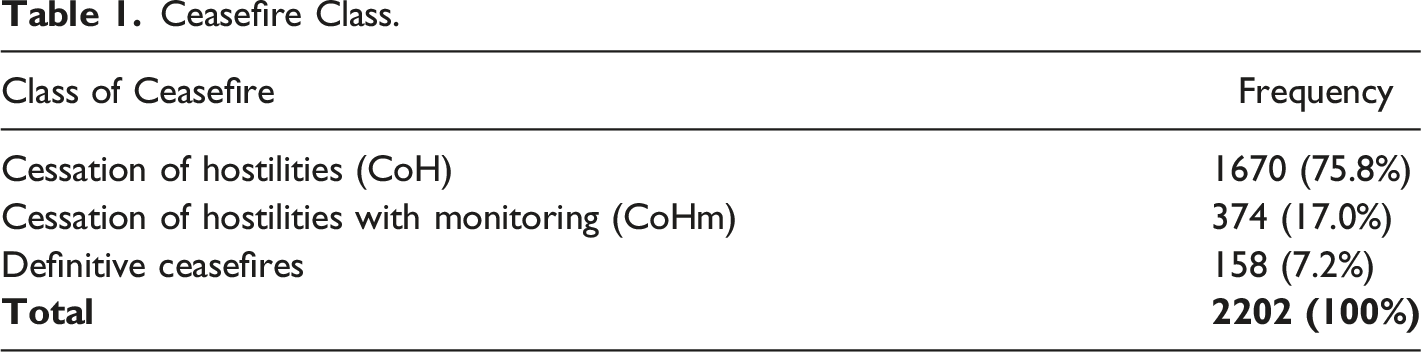
Ceasefire Class.
Stated Purpose. 24
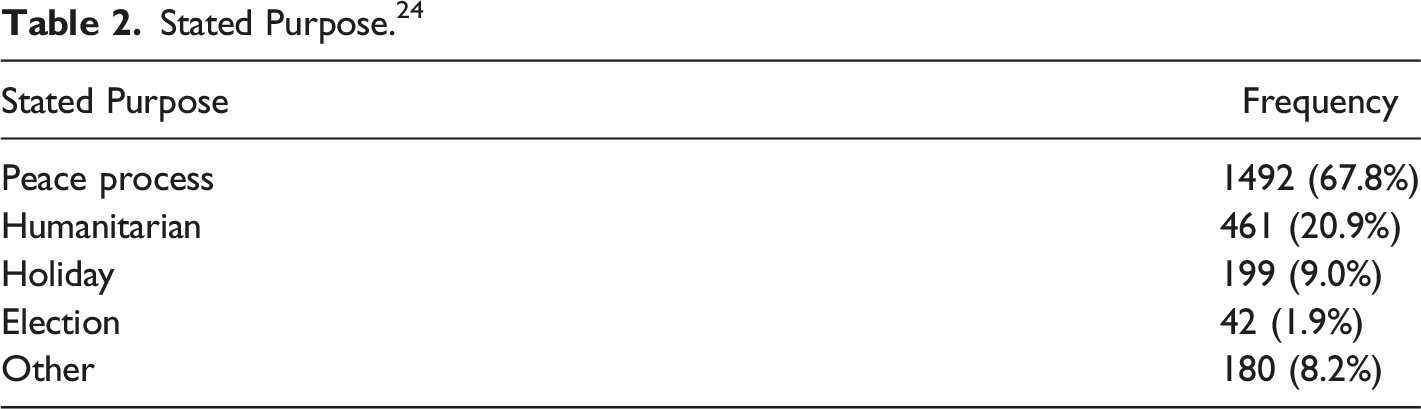
The stated purpose is considered humanitarian when, at the point of initiation, a conflict party associates the arrangement with the provision of life-saving or relief-distributing activities such as aid delivery, vaccinations, the release of hostages, or the evacuation of civilians from specific areas. For example, in Sudan between 1991 and 1995, a number of ceasefires were signed to allow for millions to be vaccinated against polio. Approximately 20% of our ceasefires have this purpose.
The stated purpose relates to a peace process when conflict parties associate the arrangement with tasks relating to the peaceful resolution of the dispute, including fulfilling a precondition for negotiation, signaling a desire for dialogue, or as an outcome of an ongoing negotiation. For example, in 2005 the government of Sri Lanka and the Tamil Tigers initiated a ceasefire with the stated intention of initiating a new round of peace talks. The majority of ceasefires are related to peace processes, and approximately 2/3 of all the ceasefires in the dataset have this as a stated purpose.
The stated purpose is coded as holiday when, at the point of initiation, a conflict party associates the arrangement with the celebration of some particular (typically religious) holiday, such as Christmas, Eid or Ramadan. For example, in 2021 the government of Afghanistan and the Taliban agreed to a short-term ceasefire for Eid.
The stated purpose relates to an election when a ceasefire is initiated prior to, during, or following a local or national election. For example, in August 2009, the government of Afghanistan and the Taliban also agreed on a 24 hour ceasefire to allow for holding the presidential and provincial elections.
Finally, we also provide written details on other less common stated purposes, such as when parties agree to an exchange of prisoners, one or both parties fighting a third party, or the visit of important persons. For example, in Colombia, the ELN declared a ceasefire in 2017 to mark the visit of Pope Francis.
Ceasefire Coverage.
Ceasefire Constellation.
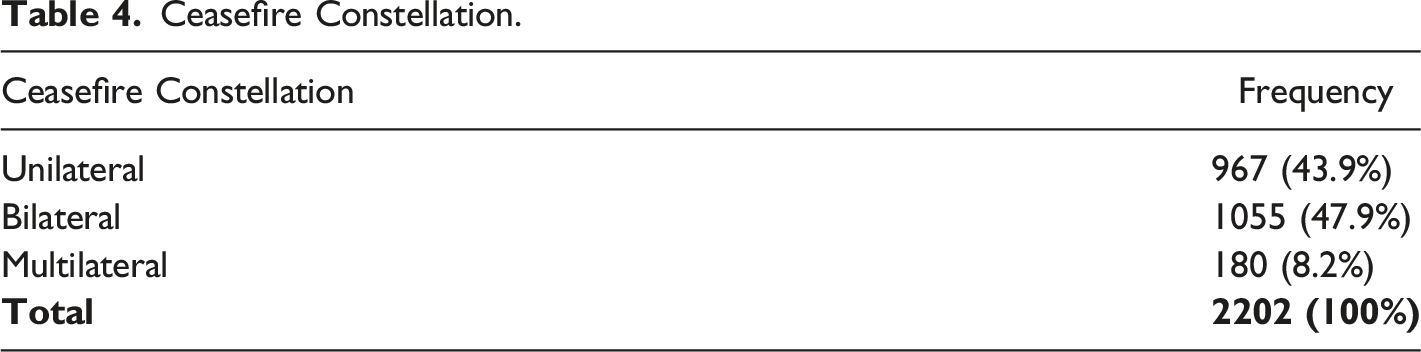
First, as we illustrated in Figure 1, a number of ceasefire declarations actually belong to the same arrangement and are hence initiated as part of the same event (e.g. signing of an agreement text). To capture this instance, we include a measure of whether an agreement (at the point of conception) is a unilateral, bilateral, or multilateral arrangement.
Secondly, we include a variable renewal to capture if an arrangement is renewing an ongoing agreement. In the data, 487 of the 2202 arrangements are renewals.
Duration of Ceasefires
The CF data offer precise information on the start date of all ceasefires, recording both the declaration and effect date. Capturing the end date is inherently more challenging.
21
Some ceasefires are designed to last for a specific period of time, or as long as it takes to complete a specific task, whereas others are open-ended. Additionally, ceasefires with a specific sunset clause can be extended. Where possible we captured the ending of a ceasefire using media reports accessed through Factiva. We provide the date on which the ceasefire “ended,” which can happen in one of four ways: 1. the ceasefire never started according the parties’ statement; 2. the ceasefire ended at the previously fixed date or after/when parties declared an objective was met; 3. the ceasefire failed, according to international actor or the conflict parties’ statements; or 4. the ceasefire ended because ceasefire was superseded (i.e. extended) by a follow-up agreement.
22
Given the difficulty identifying this information we were able to capture end dates for only 1271 (57.8%) of our 2202 ceasefires.
In addition the manually coded end dates, we estimate ceasefire end dates based on their performance. We use casualty figures from the UCDP Global Events Data (GED) (Sundberg & Melander 2013). The events listed in GED are fine-grained, with temporal durations disaggregated to single, individual days. We calculate the number of days from the point at which a ceasefire enters into effect until the conflict produces a single fatality, 25 or more fatalities, or 100 or more fatalities.
Almost all ceasefires suffer some violations, and thus the single fatality threshold is an extremely high threshold for success (Bara, Clayton & Rustad 2021). Conversely, 100 fatalities represent a fairly significant level of violence, and so in many cases represent a low bar for a ceasefire to clear. The 25-fatality threshold, which represents the most commonly used threshold for the onset and recurrence of civil conflict, would therefore logically seem to be the most appropriate. However, the three duration variables offer different means to assess the impact of a ceasefire, or to construct variables capturing the ‘active period’ of a ceasefire. If, for example, a researcher determines that the “active period” of a ceasefire should be from the day the ceasefire enters into effect until the conflict produces 25 battle-related deaths, this situation can be simply calculated using these variables. The CF data also record the intended duration of ceasefires; therefore, ceasefires only intended to last for a limited period of time can be assessed accordingly.
There are, of course, a number of problems with calculating the end of a ceasefire in relation to conflict fatalities. In some cases, a ceasefire might endure despite widespread violations, while in other cases it might technically fail before violence restarts. On a technical level there are other challenges. First, a local ceasefire might be effective in a specific location while the dyad at large continues to produce casualties. For this reason, we only estimate end dates for nationwide ceasefires. 23 Secondly, while UCDP commendably seeks to differentiate casualties between the parties in a conflict, this is often not possible because it is often not clear if violence in a dyad was associated with the actor who previously declared the ceasefire. These limitations to our data should then always be considered prior to being used in analysis.
Figure 4 shows the distribution of the duration of failed ceasefires according to the 1, 25 and 100 fatality thresholds. As expected, the 1 fatality threshold indicates that a very large share of ceasefires fail immediately. The median is only 10 days, supporting our earlier assertion that in most cases the 1 fatality threshold is too tough a metric against which to judge a ceasefire. The 25 and 100 fatality lines look quite similar: unimodal with a median duration of 65 days and 193 days, respectively. Duration of failed ceasefires, over three different estimates of end dates.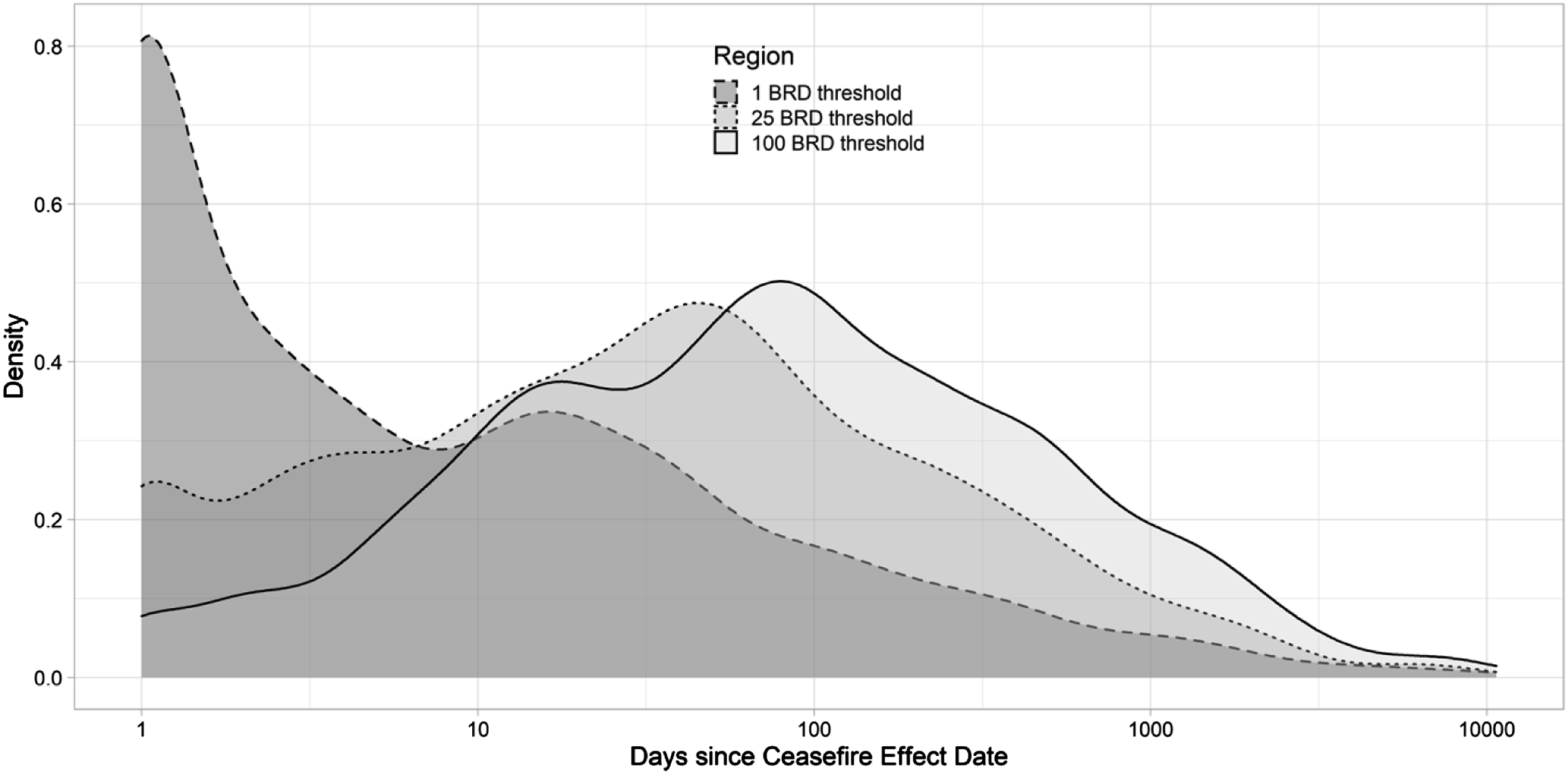
Next, to illustrate the differences in the corpus of ceasefires, we undertake a simple multivariate analysis to assess the impact of the different ceasefire classifications on the duration of an arrangement. Figure 5 presents the results from two Cox regressions for the 25 and 100 fatality thresholds for the termination of a ceasefire. The dots indicate the point estimates for the two different thresholds, and the tails are the 0.05 confidence intervals. When the points appear to the left of the central line, this indicates a negative hazard or a longer duration. When points lie on the right side of the line, this indicates a positive hazard or shorter duration. When the tails do not cross the line, this indicates statistical significance. Cox regression on three measures of ceasefire duration.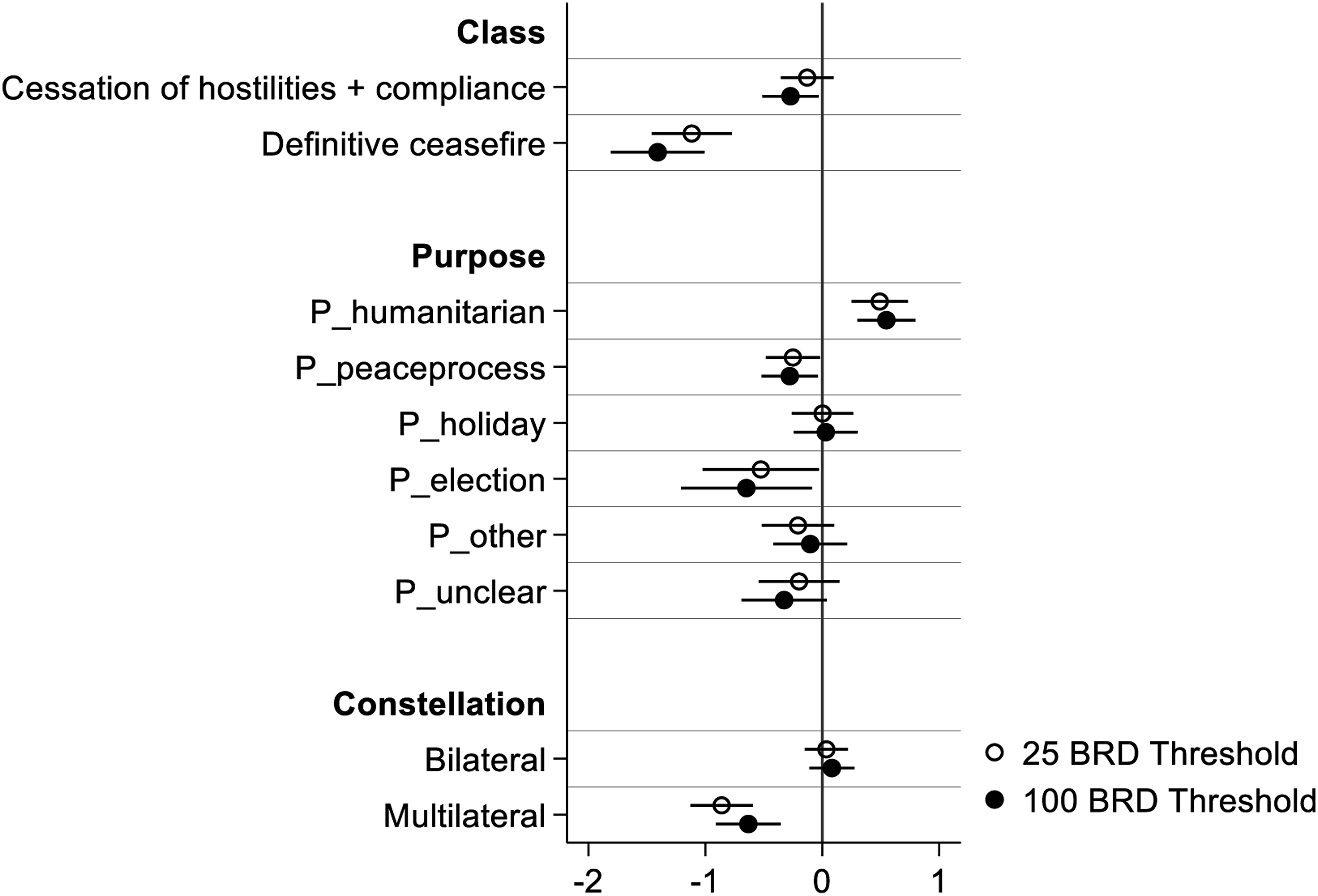
First, we assess ceasefire class. We use CoH arrangements as the reference category, and include CoH with compliance and definitive ceasefires in the model. As logic would suggest, definitive agreements, which often occur as part of a peace agreement, have the longest duration regardless of the threshold used. In line with recent research, we also see that the inclusion of monitoring tools increases the duration of CoH (Clayton & Sticher 2021). It is also interesting to note that the results are stronger for the 100 fatalities which indicates that monitored and definitive ceasefires are less likely to see a return to large-scale violence. Future research should explore which specific compliance monitoring tools are most effective, and consider other sub-classes of ceasefire that might exist within the broad category of CoH.
Second, we assess ceasefire type. Humanitarian ceasefires are shown to be the most likely to be followed quickly by renewed violence, which probably reflects the challenging contexts in which they are needed, and the short-term aspirations of most of these agreements.
Interestingly, election ceasefires seem to be the most durable. This condition perhaps reflects the more stable contexts in which they occur, but this certainly warrants closer future investigation. Peace process ceasefires are the second most durable type, though interestingly there seems to be no differences between the 25 and 100 fatality thresholds. Future studies might explore the extent to which the timing of a ceasefire matters – for example, distinguishing between those arrangements that happen prior to or during a peace process, and assessing how the durability of a ceasefire is shaped by what happens at the negotiating table.
Finally, we explore the constellation of an agreement. Our expectation is that unilateral ceasefires would be shorter than bilateral and multilateral agreements. It is interesting to observe that there is no difference between bilateral agreements and the unilateral agreements (which is the reference category) regardless of threshold. Bilateral agreements are just as likely to fail as unilateral agreements. This finding warrants further inspection and points to the need to more clearly distinguish between unilateral and reciprocated unilateral arrangements. Multilateral agreements are more stable than the other constellations of ceasefires, but this difference is larger at the 25-fatality threshold. A reasonable hypothesis for this finding is that when multiparty arrangements fail, they fail more violently than the unilateral or bilateral arrangements. Put differently, a unilateral and bilateral failure moves more slowly to the 100-fatality threshold than a multi-lateral arrangement.
Conclusion
This article introduces a novel dataset on ceasefires. The dataset covers all arrangements wherein at least one conflict party declares, temporarily or permanently, an intention to stop violence. The data cover all countries included in the UCDP/PRIO ACD from 1989 to 2020. The CF dataset is considerably broader in scope and more detailed than existing resources. We have provided a detailed discussion of our conceptualization of ‘ceasefire’ and our procedures for collecting and codifying this globally comparable data. We have also provided a first introduction to using the data and to what the landscape of ceasefires looks like.
We have not conducted any systematic analyses of the causes or the consequences of ceasefires here. However, given how common ceasefires are, it is clear we need a concerted effort to better understand, at the very least, (1) how, why, and when ceasefires are called, (2) how they impact conflict dynamics, and (3) how they are related to and in turn shape broader peace processes. Indeed, along many of these streams of analyses, ceasefires appear to constitute an important omitted variable. Theoretically, more research is needed to understand how ceasefires are affected by and, in turn, affect patterns of violence in a broad sense (Gutiérrez-Sanín & Wood, 2017). We hope this new database will be a useful tool for the conflict research community as they continue to grapple with these fundamental issues.
Policy makers and practitioners have a pressing need for more rigorous and systematic knowledge about ceasefires. Ceasefires have become a standard tool in the international community’s toolbox when dealing with conflicts. Ministries of Foreign Affairs across the globe invest considerable resources in negotiating, facilitating, and monitoring ceasefires. Indeed, the United Nations has staff dedicated specifically to supporting ceasefire negotiations. These policy makers and practitioners often have access to high-quality research to support their work, but knowledge of ceasefires is limited compared to other related fields, such as peacekeeping or mediation. We hope the CF dataset, and its use by the conflict research community, can start to amend this inadequacy and ensure that our understanding of the various features of ceasefires are put on firm scientific footing to the benefit of the millions of people living with war across the globe.
Supplemental Material
Supplemental Material - Introducing the ETH/PRIO Civil Conflict Ceasefire Dataset
Supplemental Material for Introducing the ETH/PRIO Civil Conflict Ceasefire Dataset by Govinda Clayton, Håvard Mokleiv Nygård, Håvard Strand, Siri A. Rustad, Claudia Wiehler, Tora Sagård, Peder Landsverk, Reidun Ryland, Valerie Sticher, Emma Wink and Corinne Bara in Journal of Conflict Resolution
Footnotes
Acknowledgements
The authors thank the editor of JCR, anonymous reviewers, participants at the PRIO/ETH Oslo Ceasefire Conference and other authors in this JCR special section for excellent comments and constructive suggestions that significantly improved this manuscript. This article is part of an ongoing cooperation between researchers and practitioners who are working on ceasefire mediation (see,  ). The authors gratefully acknowledge the collaboration with, and contributions of, many researchers and practitioners who contributed to this project, in particular Julian Thomas Hottinger and Georg Stein from the Swiss Federal Department of Foreign Affairs (FDFA). For research assistance we are very grateful to Andrea Graber, Boas Lieberherr, Belinda Wong, David Lander, Fredrik Methi, Henrik Elster, Noah Golub, Jamila Issa, Julie B. Penverne, Juan Diego Duque, Julia Palik, Phyllis Steiner, Rafaela Catena, Bintu Zahara Sakor, Sunniva Unn Hustad, Stergiani Nikou, Vera Huter and Julia Schlosser.
Declaration of Conflicting Interests
The author(s) declared no potential conflicts of interest with respect to the research, authorship, and/or publication of this article.
Funding
The author(s) disclosed receipt of the following financial support for the research, authorship, and/or publication of this article: This work was supported by the Stiftelsen Folke Bernadottes Minnesfond.
Supplemental Material
Supplemental material for this article is available online.
ORCID iDs
Notes
References
Supplementary Material
Please find the following supplemental material available below.
For Open Access articles published under a Creative Commons License, all supplemental material carries the same license as the article it is associated with.
For non-Open Access articles published, all supplemental material carries a non-exclusive license, and permission requests for re-use of supplemental material or any part of supplemental material shall be sent directly to the copyright owner as specified in the copyright notice associated with the article.
