




Abstract
Ceasefires are arrangements through which conflict parties commit to stop fighting. They are a common part of intra-state conflict. Existing research on intra-state ceasefires is largely limited to case studies and guidance notes for the policy and practice community. What has to date been lacking is a complementing body of comparative quantitative analysis to identify broader ceasefire trends and test the wider applicability of theory. Recent advancements in ceasefire data offer new opportunities to broaden the research agenda on ceasefires. This special section sets out the current state of the art in ceasefire research and provides the intellectual foundations to advance a new sub-field of quantitative ceasefire research. We discuss the conceptual challenges facing the study of ceasefires, offer a brief overview of ceasefire research focusing on the functions, timing, and sustainability of arrangements, and discuss the collective contributions of the articles included within this special section, and the implications for research and practice.
Ceasefires are arrangements through which conflict parties commit to stop fighting. They are a common part of intra-state conflict, each year occurring in about 30% of conflicts in the Uppsala Armed Conflict Data (see Figure 1). Between 1989 and 2020 there were at least 2202 ceasefires across 66 countries, in 109 civil conflicts (Clayton et al. 2022a). The relatively high proportion of armed conflicts each year that feature at least one ceasefire underscores the prevalence and, consequently, the potential importance of such arrangements. Yearly number of active internal armed conflicts with ceasefires, globally, 1989–2018.
2
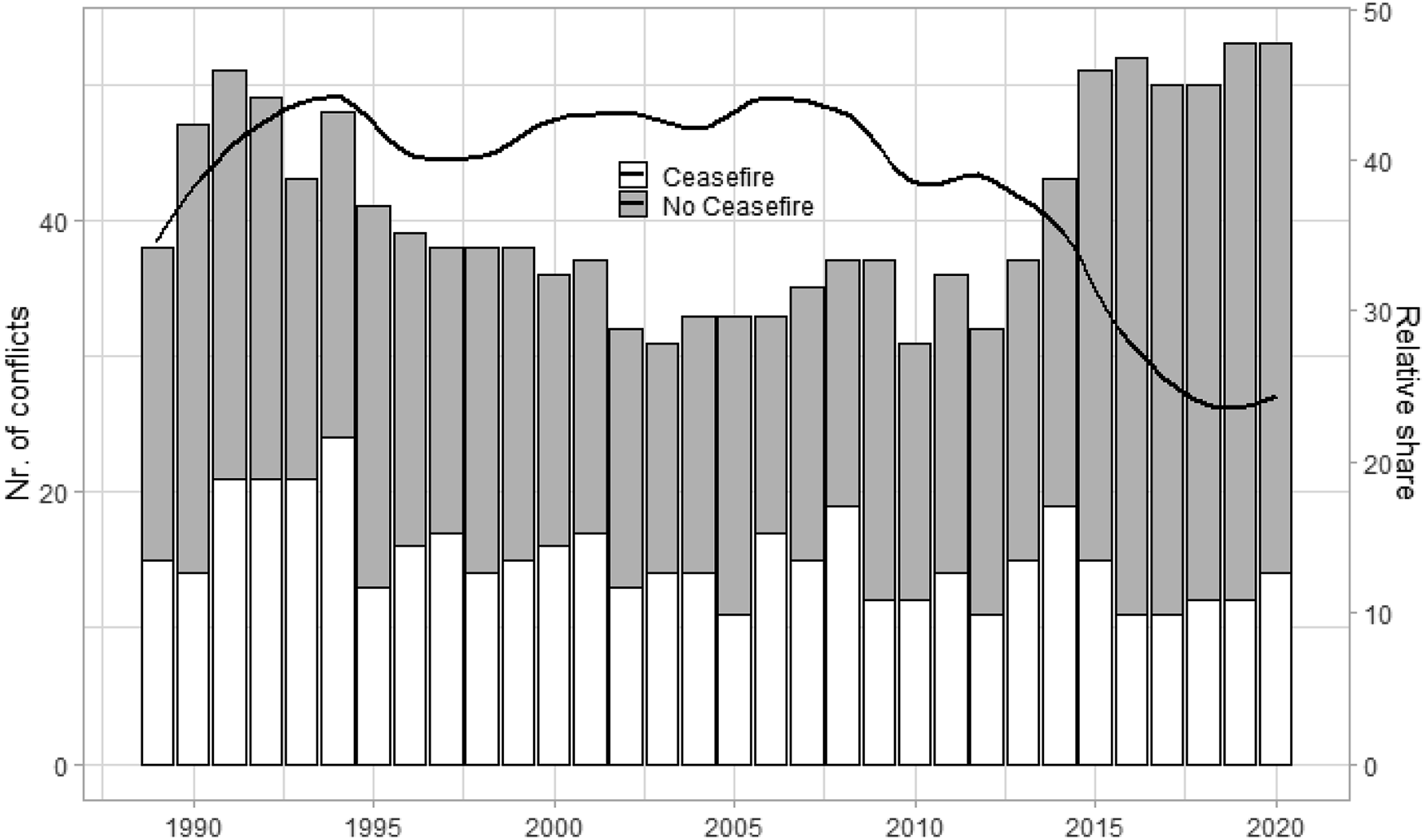
Presumably some of these ceasefires are little more than cheap talk or scraps of paper that never have any effect, while others are an integral part of the dynamics of a dispute. Balcells and Kalyvas (2014) argue that “warfare matters”—showing that the type and manner of technologies of rebellion used by actors impacts fundamental issues such as the severity, duration, and outcome of civil wars. Ceasefires are part of the “technology” used by armed actors for a range of motivations (Clayton et al. 2022b; Clayton & Sticher 2021). Thus, failing to understand the causes and consequences of ceasefires risks leaving a significant blind spot in our understanding of intra-state conflict.
A bourgeoning body of literature now focuses on ceasefires. Earlier work tended to consider ceasefire as part of a broader analysis of peacemaking processes (e.g. Darby and MacGinty 2003). Now increasingly researchers focus specifically on ceasefires, developing the conceptual (e.g. Clayton, Nathan, and Wiehler 2021), theoretical (e.g. Åkebo 2016, Sticher 2021a), and empirical (e.g. Verjee 2019; also see, Bara, Clayton, and Rustad 2021) foundations of the field. Most existing research is case analysis, or guidance notes tailored specifically for the policy and practice community that offers process design advice based on the practical experience of the authors (e.g. Haysom and Hottinger 2004; Chounet-Cambas 2011; Brickhill 2018; Buchanan, Clayton, and Ramsbotham 2021; Clayton et al. 2019).
What has to date been lacking is a complementing body of comparative quantitative research to help us identify which elements of case study results can generalize and are typical of broader trends, that can test common hypotheses about ceasefire, and that can illustrate and help us understand how trends in ceasefires change over time. The lack of quantitative work around ceasefires is born largely from the prior lack of suitable data. As a result, the flourishing quantitative research program examining the causes, dynamics, and consequences of civil conflicts (cross-nationally or as in-depth country case studies) has paid little attention to the role of ceasefires (c.f. Blattman and Miguel 2010; Davenport et al. 2019; Pettersson, Högbladh, and Öberg 2019). 1 The availability of new data, most notably the ETH/PRIO Civil Conflict CeaseFire (CF) dataset (see Clayton et al. 2022a), provides an opportunity to broaden the research agenda on ceasefires, creating a better fit between theory and data, and the chance to flesh out and test many of the possible mechanisms through which ceasefires might alter the trajectories of conflict.
This special section sets out the current state of the art in ceasefire research and provides the intellectual foundations to advance a new sub-field of quantitative ceasefire research. First, we discuss the conceptual challenges facing the study of ceasefires. Second, we offer a brief overview of the existing research, focusing specifically on the functions, timing, and factors that shape the sustainability of ceasefires. In each case we discuss and contextualize the important contributions made by each of the articles assembled in this issue. Finally, we discuss the collective contributions of the articles and the implications for research and practice.
What is a Ceasefire?
There is no agreed upon definition of “ceasefire” in the academic nor in the policy domain, meaning the term is not used consistently. Ceasefires, generally speaking, can be traced back to as early as 776 BC, when in ancient Greece a truce often accompanied the Olympic games to ensure that the athletes and spectators could take part without fear of attack (United Nations 2021). 3 In the Middle Ages, the Catholic Church used a “truce of God” to suspend warfare on days of religious significance. 4 Over time the sporting and religious connotations were lost, and by the early 1600s the term “truce” had taken on something close to the contemporary meaning, that is, “an agreement by which warlike acts are for a time abstained from, though the state of war continues” (Bailey 1977, 461). Throughout the 19th and early 20th centuries, “truce” and “armistice” were both used to refer to periods in which hostilities were suspended, though any differences between the two terms were applied inconsistently (Mohn 1952). At that point the newly formed United Nations (UN) first introduced the term “ceasefire” and the related “cessation of hostilities,” though these were originally expressions that the UN used to call for a stop in violence, rather than types of arrangement (Bailey 1977).
Today the general meaning of the term “ceasefire” is widely understood, but conceptual confusion remains. Often the label of “ceasefire” is used to refer to very different arrangements, while many similar arrangements receive different labels. 5 This makes sense from the perspective of those negotiating the ceasefires, who require a certain amount of linguistic flexibility to navigate the political and cultural sensitivities often associated with the term. 6 But this makes less sense for researchers, who require some clarity of concepts as a necessary precondition for theory development, normative analysis, and empirical investigation (Goertz 2020).
The articles in this special section all broadly follow Clayton et al. (2022a), and consider ceasefires as arrangements that include a commitment by at least one conflict party to stop violence. In this, we consider “ceasefire” to be an “umbrella term” covering the family of similar arrangements including related terms such as “cessation of hostilities,” “truces,” “armistices,” “windows of silence,” and “humanitarian pauses.” Examples include the “Nuba Mountains cessation of hostilities” in Sudan, the “nationwide ceasefire” in Myanmar, and the long-standing “truce” in Kashmir. The special section thus benefits from, and contributes to, a growing conceptual clarity emerging from recent data developments (see, Clayton et al. 2022a).
What are the Functions of a Ceasefire?
All ceasefires share the same immediate objective: to stop violence. But the underlying purpose varies greatly across arrangements (Lane 2016, 12; Clayton, Nathan, and Wiehler 2021).
In the first instance, ceasefires can be conceived of as short-term temporary arrangements that serve only a limited purpose, such as the delivery of humanitarian aid (e.g. Aary 1995) or the collection of dead from the battlefield. For example, during the Bosnian civil conflict numerous short-term ceasefires allowed the delivery of vital supplies to support the beleaguered population.
In a second case, ceasefires are instead used as a conflict management tool. Here the intention is to restrict the devastating effects of violence without necessarily moving the parties closer towards peace (Zartman 2001; Rothchild 2002). If a political solution remains elusive, a ceasefire can be used to terminate violence without addressing the incompatibility, such as the long-standing arrangement on the Korean Peninsula. Long-term conflict management ceasefires of this sort have occurred in about one-third of all separatist conflicts since 1989 (Hanson 2020). In other cases, ceasefires can be used to contain (rather than stop) violence, as is exemplified by the Minsk agreements that contained and limited violence in Ukraine from 2015 until the Russian escalation in early 2022. These outcomes are less stable than settlements that address the underlying political incompatibility, but in a challenging and intractable context can still represent a successful form of conflict management (Gartner and Melin 2009).
A third purpose for a ceasefire is to advance efforts to peacefully resolve a dispute. Existing research has overwhelmingly focused on this purpose (e.g. Smith 1995; Crocker, Hampson, and Aall 1999; De Soto 1999; Bercovitch and Houston 2000; Zartman 2001, 2015; Mahieu 2007; Höglund 2011; Åkebo 2016, 2019; Winokur 2018). Collectively, this work has revealed a number of ways in which a ceasefire can positively impact a peace process, including: sending a credible signal of peaceful intent (Clayton and Sticher 2021); building confidence in the process (Clayton et al. 2019); demonstrating command control and internal cohesion of an armed force (Höglund 2011; Åkebo 2020); increasing civil society participation (Pinaud 2020); increasing popular support for a peace process (Sticher 2021b); creating an environment more conducive to negotiations (Smith 1995); and creating structures to enhance communication and trust between the parties (Brickhill 2018). Moreover, a definitive (i.e. permanent) ceasefire sets out the terms under which the military dimension of the conflict ends, and is typically negotiated as part of a comprehensive peace agreement (Clayton et al. 2019).
One article in this special section develops existing knowledge on how ceasefires can shape a peace process. Bara and Clayton (2022), show that ceasefires can be used to generate a cooperative reputation that can strengthen efforts to find peace in other conflict dyads involving the same state. While prior studies have tended to focus only on the dyadic interaction between the state and a rebel group, the authors focus on the broader conflict environment, arguing that non-state actors use the state’s actions toward other similar non-state actors to assess their credibility. When a state enters (and honors) a ceasefire with one rebel group, it generates a positive reputation, which increases the likelihood of agreements with and a de-escalation of violence toward other actors.
The final function of a ceasefire is as a strategic tool to advance a political or military objective (Sticher and Vukovic 2021). This includes allowing an armed force to rearm, regroup, and recover from a period of costly violence, or consolidating territorial control (see e.g. Toft 2010; Clayton et al. 2022b). Ceasefires can also serve state-building purposes, for both the state (Woods 2011; Sosnowski 2019) and non-state actors (Kolas 2011; Sosnowski 2020; Waterman 2020), and facilitate the development of illicit economics (Dukalskis 2015). In this case a ceasefire might limit and contain rather than stop violence altogether (Jarman 2004; Höglund 2005; Kolas 2011). Ceasefires for so-called devious intentions—that is, reasons not related to the peaceful resolution of a dispute (Richmond 1998)—have been observed from Northern Ireland (Craig 2014), to Sri Lanka (Åkebo 2016), Myanmar (Core 2009), India (Kolås 2011), and the Democratic Republic of Congo (Milton-Edwards 2017).
When do Conflict Parties Agree to a Ceasefire?
Existing research on the timing of ceasefires focuses mainly on the appropriate sequencing of a ceasefire in a broader process of substantive negotiations. Ceasefires can occur prior to, during, or at the end of negotiations seeking to resolve the contested incompatibility (Mahieu 2007, 208–209). Ultimately, a durable termination requires a resolution of the contested incompatibility and an agreement on how to end the violence. The sequence in which the agreements are adopted can have consequences for the overall peace process (Touval 1995; Darby and MacGinty 2003; Ramsbotham, Woodhouse, and Miall 2011; Milton-Edwards 2017).
The benefits of an early ceasefire are quite clear. In principle, a ceasefire can produce a break in the violence that saves lives, allows the distribution of humanitarian aid, and improves the situation for civilians. As discussed above, a ceasefire can also create an environment more conducive to negotiation (Smith 1995, 155; Mahieu 2007, 209). There is then often pressure to push for an “early” ceasefire prior to agreements on the substantive issues (Touval 1995, 336).
Yet entering a ceasefire can also create problems that hinder attempts to find substantive agreements. Warring parties are often more willing to settle when conflict is costly and carries significant risks (Zartman 2001). Fighting can generate information that might be needed to locate an equitable deal (Wagner 2000). A ceasefire can then reduce the “ripeness” of the conflict by restricting the flow of information and the costs that create incentives for the parties to move toward peace. Ceasefires can also provide an opportunity for groups to rearm and regroup (Clayton et al. 2022b), provoke fragmentation when there is mixed support (Höglund 2011; Duursma and Fliervoet 2021), and undermine negotiations if the arrangement breaks down (Crocker, Hampson, and Aall 1999; Dukalskis 2015).
Considering this ethical challenge, Mahieu (2007) argues that ceasefire are most effective once the outline of a solution has been identified, even though the negotiation of the details might not yet have been agreed (see also, Hottinger 2008, 30). Touval (1995) argues instead that, given the difficulty predicting the future trajectory of any conflict, priority should be given to short-term factors over which there is more control, meaning a ceasefire should be developed as soon as possible. Brickhill (2018, 27) suggests better connecting the ceasefire with efforts to address the parties’ incompatibility, arguing that different means of temporarily halting violence can be used as a sequence of entry points, where the process is developed step-by-step using different forms of ceasefire and related agreements, producing what he terms a “cascade of ripeness”.
Beyond questions of sequencing, Clayton et al. (2022b) show that the timing of ceasefires is shaped by patterns of conflict violence, whereby conflict parties are more likely to enter into a ceasefire in periods when the costs associated with conflict are greater; in particular, when conflict violence is more intense, when there are higher levels of “collateral civilian damage,” when the opposition has international support, and when the conflict either has just started or continues for a long period. They also show that ceasefires are more likely when the audience costs associated with entering into an arrangement are lower, specifically, when the parties have some form of “political cover” (e.g. during mediation or religious holidays). Bara and Clayton (2022) in the aforementioned study in this issue, also speak to the timing of ceasefires, showing that a ceasefire in one dyad increases the likelihood of ceasefires in the following months in other dyads in the same country.
International actors can also shape the timing of ceasefire arrangements (Duursma 2021). Conflict management research has consistently shown mediation to increase the likelihood of conflict parties reaching agreements including ceasefires (Bercovitch and Gartner 2006; Clayton 2013). In an important extension of this work, Duursma (2022), in this special section, explores the role that peacekeepers play in facilitating non-state ceasefires, that is, ceasefires between non-state groups in African civil conflicts. Ceasefires during civil war need not always include the state. In fact, Duursma finds evidence of 461 non-state ceasefire agreements in African civil conflicts between 1989 and 2019. While prior research has highlighted a number of ways in which non-state conflicts affect the broader civil war (e.g. Fjelde and Nilsson 2012), it says little about the factors that shape ceasefire between non-state groups, where the state is not involved. Duursma argues that when peacekeepers are present there is a greater likelihood of non-state ceasefires as they are well equipped to build trust between the parties and have a unique ability to engage with government actors who might otherwise undermine the process. He also suggests that non-state actors are more willing to take part in a ceasefire when there are more peacekeepers present to create secure conditions for negotiations, provide vital logistics, and apply pressure on the parties. Through a statistical analysis of the new African Peace Process dataset, Duursma reveals this important and previously hidden function of peacekeeping missions.
What Makes Ceasefires Last?
Peacemakers generally seek durable ceasefires. An important task for researchers seeking to support these efforts is then to identify the conditions associated with ceasefire “failure.” The primary determinant of ceasefire sustainability is always the political will of the conflict parties. Ceasefires only occur when the conflict parties see strategic benefit in stopping fighting, and will always end if one or more of the conflict parties believe that a better deal can be achieved through renewed violence (Smith 1995, 4). As a result, ceasefires are more likely to break down if they are imposed (Werner and Yuen 2005; Henderson and Lubell 2013, 390; Duursma 2021), or occur before the conflict parties recognize the favorability of peace (Sticher and Vukovic 2021).
The provisions included within a ceasefire are also key in shaping their durability. Beyond the common commitment to stop fighting, the contents of a ceasefire vary greatly. Some arrangements are verbal and include no details on the specificities, while others are comprehensive written documents that detail factors including: the process to separate the forces; lines of disengagement; areas of control; cantonment; demilitarized zones; redeployment and rotation of troops; codes of conduct; what constitutes a violation; and details on how incidents will be managed (Haysom and Hottinger 2004, 10; Chounet-Cambas 2011; PILPG 2013, 12; Lane 2016, 14–15; Barsa, Holt-Ivry, and Muehlenbeck 2017; Brickhill 2018; Forster 2019). The contents of a ceasefire often reflect the political will of the parties, meaning that the specificity of arrangements tend to increase as the parties move closer toward a settlement. Practitioners stress the importance of specificity in ceasefire agreements, arguing that while constructive ambiguity might be useful in a peace agreement, it seriously undermines the sustainability of ceasefires (Smith 1995; Haysom and Hottinger 2004).
Provisions can also be designed to help overcome common bargaining challenges (Clayton and Sticher 2021). Focusing mainly on inter-state conflict, Fortna (2003, 2004, 2008) showed that the durability of peace increased when ceasefires included provisions to increase the credibility of commitments between the parties (though see also Lo, Hashimotom, and Reiter 2008; Werner and Yuen 2005; Henderson and Lubell 2013, 390). More recently, Clayton and Sticher (2021) show that during civil conflict the bargaining logic that motivates a ceasefire, as well as the independent effect of agreement design, both influence the duration of the break in violence. Monitoring is here shown to be particularly important. All ceasefires normally suffer some violation, and thus the creation of monitoring institutions and processes to allow the conflict parties to exchange information and resolve problems that arise is particularly important for sustainability (see Potter 2004; Buchanan, Clayton, and Ramsbotham 2021).
Beyond national-level ceasefires, researchers have recently begun to explore other sub-national or “local” ceasefire arrangements (e.g. Karakus and Svensson 2020; Sosnowski 2020) which suspend hostilities within a section of the larger battlefield These local arrangements are a common but poorly understood part of conflict (also see Duursma (2022)). Lundgren, Svensson, and Karakus (2022)
Beyond the contents of an agreement, the broader context within which a ceasefire takes place is also likely to impact its durability. Practitioner literature often stresses the importance of context, yet existing ceasefire research says relatively little on the topic. Braithwaite and Butcher (2022), in this special section, offer one of the first attempts to address this lacuna, focusing on how the broader anatomy of a resistance campaigns, including and beyond civil war battlefield, conditions ceasefire durability. They find that ceasefires are less effective at suspending violence (and thus sustaining the ceasefire) when there is a greater number of dissident groups mobilizing against the government. On the other hand, if the dissident groups can form a united front, the ceasefire is more likely to produce a sustained suspension of violence. The paper represents a notable advancement in our understanding of why ceasefires have heterogenous effects on conflict dynamics and shows the importance of the broader context of dissent occurring during the ceasefire.
Implications for Research and Practice
Collectively, this special section makes several important contributions to knowledge, with implications for both research and practice. First, the articles identify a set of general conditions that shape the role of ceasefires in civil conflict. These conditions can be used to identify potentially favorable entry points for peacemakers. Second, the special section contributes new insights on the dynamics of armed conflict and highlights how ceasefires constitute an important omitted variable in the study of armed conflict. Third, by providing novel data on ceasefires, the special section expands greatly on the number of questions on the causes, dynamics, or consequences of ceasefires that can be studied and answered using quantitative methods.
For practitioners, we note in particular that contexts favorable to ceasefires are shown to be those with a recent history of collaboration between the conflict parties (Lundgren, Svensson, and Karakus (2022)), and other state-non-state dyads (Bara and Clayton (2022)). Successful ceasefires are also shown to create an environment more favorable for political settlements by providing cover for rebels. In contrast, contexts with more dissident groups are shown to be less favorable for ceasefires, though this effect can be somewhat mitigated if dissidents can unite in a common front (Braithwaite and Butcher (2022)).
That context matters should not be surprising to anyone, but the articles included here show the potential for quantitative analysis to provide greater specificity regarding which factors matter, when, where and to what extent. Moreover, quantitative methods are well suited to identify changes over time. Consider, for instance, the fact that the rise of IS may have reduced the relative frequency of ceasefires (see Figure 1), and thus made ceasefires less relevant regardless of other factors. Also, quantitative methods provide measures of uncertainty that are important both for policy design and for the accumulation of knowledge. Some of the findings in this special section appear genuinely robust, which would lead us to predict their effect in all conflicts. Other effects are potentially important, but the large uncertainty estimate associated with the finding tells us that we do not yet know the conditions that trigger the effect.
An example of a relatively robust finding is that ceasefires that include implementation mechanisms (e.g. monitoring, step-wise provisions, or UN support) are more effective at deescalating local violence (Lundgren, Svensson, and Karakus (2022)), producing non-state agreements (Duursma (2022)), and generating the cooperative reputation that leads to reciprocal behavior in other dyads (Bara and Clayton (2022)). This complements prior quantitative work on this topic (see Fortna 2004; Clayton and Sticher 2021).
The local aspect is important. Sub-national factors are a key component of civil conflict dynamics (Kalyvas 2000), and many of the determinants of ceasefires appear indeed to be driven by local phenomenon, such as battles. Research discussing the micro-foundations of civil war has only recently begun to incorporate local peacemaking efforts, and to understand the role played by local ceasefires (Turkmani et al. 2014; Karakus and Svensson 2020). As we have seen, local or non-state ceasefires potentially follow a different logic than ceasefires between a state and a non-state group, which might condition the impact of international peacemaking efforts. This represents a fruitful avenue for future research.
More research is needed to address many unanswered questions relating to how the context conditions both the causes and consequences of ceasefires. For example, do ceasefires function differently in conflicts fought over different issues (e.g. ideology, religion, ethnicity)? Does the technology of rebellion matter for ceasefires? Do ceasefires serve different functions for different types of group? Do wartime social networks and local institutions matter for ceasefires, and how do ceasefires influence these structures?
The effects of ceasefires not only depend on the circumstances in which they occur, as ceasefires themselves are also heterogeneous. Ceasefires can be declared verbally or in writing; be uni-, bi-, or multilateral arrangements, include quite different provisions, and serve very different purposes. We still know relatively little about how, why, and when ceasefires are used for more strategic or even “devious” purposes, including ceasefires that are not meant to achieve peaceful aims, or “containment” ceasefires that attempt to stabilize a situation without moving the parties toward peace. Conceptualizing and categorizing different types of ceasefires, and identifying their conditional effects is a pressing task for researchers, one that would benefit from close collaboration with practitioners who perhaps more intuitively grasp these differences given their extensive on-the-ground experiences.
Finally, the special section shows the importance of examining how knowledge gained about ceasefires in certain forms of conflict (e.g. inter- and intra-state) extends to other forms of contestation. We know from prior research that third-party mediation increases the likelihood of ceasefires during inter- and intra-state conflict (Bercovitch and Gartner 2006; Clayton 2013). Duursma
Conclusions
Practitioner and policy-making communities spend considerable amounts of time and resources on facilitating, mediating, and attempting to sustain and build upon ceasefires, yet ceasefires have been one of the least studied elements of conflict management – especially from a quantitative approach. The individual articles in this special section address different problems faced by practitioners, but they do so under a common conceptual umbrella.
The gap between policy-makers and quantitative academic researchers has been increasingly lamented over the last decade, with many arguing that quantitative conflict and international relations research is becoming irrelevant to the problems faced by practitioners (Walt 1998). Until recently ceasefire research offered an example of this. This special section was born from an ongoing collaboration between researchers, practitioners, and policy-makers working on ceasefires. The articles included here each attempt to address the aforementioned inadequacy by systematically developing knowledge of relevance to policy and practice.
Policy-relevant findings in statistical studies differ from case studies in that the former quantify not only the effect but also the uncertainty. Uncertainty in quantitative studies may arise from several problems, and these are all relevant for practitioners. Sometimes our data are not good enough, sometimes our models are unable to separate the signal from the noise, and, sometimes the conceptual confusion behind the model obfuscates the interpretation of the results. This uncertainty must be kept in mind when the results are used to illuminate policy.
While these findings will not always be surprising to those working with ceasefires, this generation of new robust evidence can still be important in confirming intuitions, strengthening understanding, and provoking additional reflections and questions. We hope that a quantitative research agenda focused on civil conflict ceasefires will continue to develop and support the efforts of those working to resolve deadly and destructive conflict.
Supplemental Material
Supplemental Material - Ceasefires in Civil Conflict: A Research Agenda
Supplemental Material for Ceasefires in Civil Conflict: A Research Agenda by Govinda Clayton, Håvard Mokleiv Nygård, Siri Aas Rustad, and Håvard Strand in Journal of Conflict Resolution
Footnotes
Acknowledgements
The authors thank the editor of JCR, anonymous reviewers and participants at the PRIO/ETH Oslo Ceasefire Conference and other authors in this JCR special section for excellent comments and constructive suggestions that significantly improved this manuscript. This article is part of an ongoing cooperation between researchers and practitioners who are working on ceasefire mediation. The authors gratefully acknowledge the collaboration with, and contributions of, Julian Thomas Hottinger and Georg Stein from the Swiss Federal Department of Foreign Affairs (FDFA).
Declaration of Conflicting Interests
The author(s) declared no potential conflicts of interest with respect to the research, authorship, and/or publication of this article.
Funding
The author(s) disclosed receipt of the following financial support for the research, authorship, and/or publication of this article: The authors are grateful for the generous funding from the Folke Bernadotte Academy [DNR-17-00427], the Swedish Research Council [2018-01520], the Centre for Security Studies at ETH Zürich, and the Norwegian Ministry of Foreign Affairs

Notes
References
Supplementary Material
Please find the following supplemental material available below.
For Open Access articles published under a Creative Commons License, all supplemental material carries the same license as the article it is associated with.
For non-Open Access articles published, all supplemental material carries a non-exclusive license, and permission requests for re-use of supplemental material or any part of supplemental material shall be sent directly to the copyright owner as specified in the copyright notice associated with the article.
