




Abstract
“Ending impunity” is often heralded as the key mechanism for stopping rape in war. Yet, little systematic evidence or analyses exist of the relationship between impunity (or lack thereof) and sexual violence. We argue that amnesties signal impunity and permissiveness for sexual violence, which can perpetuate and instigate more sexual violence by rebels. Trials, on the other hand, signal a nonzero probability of punishment, which could have a deterrent effect. Studying all intrastate armed conflicts in the period 1989–2011, we find in line with the impunity signal that amnesties are associated with sexual violence by rebels, but we are not able to demonstrate a deterrent effect of trials. While the study prevents us from conclusively saying that ending impunity would be an effective policy tool to stop sexual violence in war, the association between amnesties and subsequent sexual violence is a testament to the perils of impunity.
Introduction
Conflict-related sexual violence is now widely acknowledged as a global security problem, and various studies have also found that the use of sexual violence can influence the trajectory and ending of wars (e.g., Nagel 2019; Chu and Braithwaite 2018). Several high-level meetings and UN Security Council resolutions have addressed the problem and discussed solutions (i.e., UNSCR 1325, 1820 (2008), 1888 (2009), 1960 (2010), 2106 (2013), 2122 (2013), and 2493 (2019)).
However, the ability of peacekeepers to reduce sexual violence in general is weak (Johansson and Hultman 2019), and sexual violence is still rampant in many conflicts (Nordås and Nagel 2018). Systematic evidence on what can be done to stop sexual violence in war is still a priority for scholars working in this area (Nordås and Cohen 2021).
Activism and scholarly attention from legal and feminist studies have strengthened the perceived moral and legal responsibilities to prosecute sexual violence crimes (Krause 2015). UN Security Council Resolutions 1960 (2010) and 2106 (2013) have emphasized ending impunity through justice systems and legal frameworks as the foremost preventative measure, and the UN Special Representative on sexual violence has warned against granting amnesty to perpetrators of sexual violence. 1 There seems to be a near consensus in policy circles, amongst high-level officials and activists, and in the NGO sector, that ending impunity, meaning the exemption from punishment or injurious consequences, is the solution “par excellence” to the problem of sexual violence in war (Houge and Lohne 2017). 2
This notion that ending impunity can solve the problem of wartime sexual violence has been criticized by scholars as too simplistic, and probably rightfully so. 3 Kirby (2015), for instance, criticizes the aim of ending impunity as it “fails to fully reckon with the lack of evidence for strong deterrence effect” (p. 457). Although the field of law has had a long interest in the issue of conflict-related sexual violence and several studies have looked at how sexual violence has been included in international court cases after war and genocide (Askin 2003; Campbell 2007; Franklin 2008), the wider impacts of a justice response remain understudied, and the link has not undergone systematic empirical testing.
Amnesties for wrongdoing can signal that sexual violence is permissive and can be perpetrated with impunity, and we assume that this can perpetuate and instigate more sexual violence by rebels. Trials on the other hand should signal that there is not impunity, and that punishment is plausible, incurring additional costs on sexual violence. This could produce a deterrent effect, and the size of this effect should be affected by the scope and volume of trials.
To address the links between impunity and violence, we conduct a systematic analysis of all internal armed conflicts in the period 1989–2011 and ask how granting of amnesties and justice processes (trials) during conflict could affect subsequent perpetration of sexual violence by rebels. We find that, in accordance with our expectations, sexual violence is more likely in the wake of amnesties, which we present as the peril of impunity. 4 Amnesties of all kinds are associated with more sexual violence, but amnesties that are unlimited and unconditional are particularly problematic. This finding has serious implications for the presumed trade-off between using amnesties as an instrument for ending conflicts, and the security of civilians in war zones. Trials do not have any clear deterrent effect in the current analyses. The lack of a clear finding associating trials and sexual violence may be due to the relative infrequency by which sexual violation forms part of during conflict trials in the period under study. Trials may also occur after a conflict has ended, and therefore only affect other ongoing conflicts or future conflict behavior. Such possible long-term effects and effects beyond the conflict in question are difficult to measure.
The article proceeds by first presenting the existing literature on causes of sexual violence in war and reasons for restraint before explaining our argument about the possible effects of amnesties and during conflict trials as signals of impunity and punishment, respectively. We then present the data and analyses that support the argument for amnesties, but give no clear support for the argument about trials. We end by discussing implications of the findings, current limitations, and directions for future research.
Causes of Sexual Violence and Reasons for Restraint
Wartime sexual violence varies significantly (Cohen and Nordås 2014; Wood 2006). Well-documented cases of restraint (Hoover Green 2018; Muvumba Sellström 2019; Wood 2009) comes with the impetus to understand not only drivers of sexual violence but also how restraint can be incentivized, which is also a necessary basis for theorizing what might stop sexual violence in war.
Scholars have emphasized both principal-agent and small-group dynamics as drivers of violence and restraint; and also grounded theorizing in ideas about costs and benefits for commanders, soldiers, and organizations. Several scholars have highlighted organizational factors to explain variation. By some accounts, sexual violence is the result of lack of oversight and control (Butler et al. 2007), meaning the violence is primarily opportunistic. By other accounts, it is a socialization tool borne out of the need to increase cohesion in groups with members recruited by force (Cohen 2013, 2016) or as child soldiers (Cohen and Nordås 2015). In this view, sexual violence is more accurately seen as an evolved practice than as opportunistic violence—not ordered but tolerated by commanders (Wood 2018). Ideological groups (Sarwari 2020), groups that invest in political training (Hoover Green 2018), and organizations that elect their leaders through a democratic process (Sawyer et al. 2020) reportedly commit less sexual violence, while those that extort producers of natural resources are more often reported as perpetrators (Whitaker et al. 2019). Systems of internal control can attempt to inculcate strong norms against sexual violence but may ultimately fail to restrain soldiers due to organizational deficiencies and lack of effective control and oversight, as Marks (2013) argues was the case for the RUF in Sierra Leone. In other cases, a strong central command can effectively prohibit sexual violence, such as with the FMNL in El Salvador, and LTTE in Sri Lanka (Cohen 2016; Wood 2009).
Scholars, but mainly advocacy communities, also emphasize sexual violence as a weapon of war (Crawford 2017), suggesting that commanders’ stance toward sexual violence is to promote it as policy for strategic reasons, possibly including ordering perpetration. A range of reasons and anticipated benefits can be behind such a policy, such as spreading terror, shifting the ethnic balance in a contested area, enforcing population displacement, or providing “reward” for soldiers particularly when they are unable to provide other forms of compensation to their soldiers (Wood 2014, 16).
Both perpetration of sexual violence by an armed group and restraint on such behavior can be perceived to have beneficial or costly consequences for the group (and/or the individuals in these groups). Sexual violence can therefore to some extent be analyzed through a cost-benefit framework, where increased costs relative to perceived benefits will determine the prevalence of abuses. Some of the writings on sexual violence as a weapon of war (inadvertently) assume that the strategic benefits are dominant, because of the framing of rape as an effective and cheap weapon of war (Crawford 2017; Wood 2012). However, this will tend to over-predict the use of sexual violence. In fact, most armed organizations do not engage in widespread sexual violence (Cohen and Nordås 2014).
Reasons for restraint have been framed in terms of the potential costs to leaders and organizations. Although rape could reap “private benefits for the perpetrator, including sexual gratification, as well as acceptance and prestige among a group of violent strangers,” it can come with costs to the group, such as reputational costs (Cohen 2013, 465). This occurs in particular if an armed group “sees itself as the embryo of a new, more just social order” (Wood 2009, 141) and wants to preserve their legitimacy both within the group and to the outside world and their constituents. Another cost is the fact that rape carries grave risks to the perpetrator such as “the possibility of contracting debilitating sexually transmitted diseases, the emotional toll of the intimate contact required, and the fact that rape takes longer to commit than other, more time-efficient violations” (Cohen 2013, 465). Externally imposed costs such as via risk of punishment by courts have to a much lesser extent been systematically assessed in existing literature, perhaps in part due to “the paucity of prosecutions for crimes of sexual violence…[which] continue to leave an impunity gap”. 5
Ending Sexual Violence? Theorizing the Effects of Impunity and Justice Mechanisms
Our theoretical framework of how to understand the possible effects of amnesties and trials, rests on the basic assumption that if the perceived costs of engaging in sexual violence increases, this should decrease prevalence of violence, all else equal. We argue that there is a signal of impunity—and hence low externally imposed costs—embedded in amnesties; and a contrasting signal of (possible) punishment from trials—that, in principle, may increase costs and deter future violence.
Various forms of sanctions and punishment could influence the perceived and real costs of committing violence. International naming and shaming of governments has been suggested as one such mechanism, although the effects on rebel groups are unclear, and the effect even on governments can vary depending on the type of violation in question (Hafner-Burton 2008). Whether and how naming and shaming may reduce conflict-related sexual violence is therefore undecided. Related, increased perception of costs can occur with high risk of detection and punishment. Justice processes could therefore affect the perceived costs of sexual violence, act as a deterrent, and thereby in principle reduce the prevalence of such atrocities. On the other hand, if the risk of being caught is slim and trials are few and not leading to severe punishment, this could send the opposite signal to would-be perpetrators that sexual violence can be carried out with impunity, and that it is not considered a serious crime and punishable offense.
The Signal of Impunity: Amnesties
Amnesties may be seen as strong signals that human rights violations during conflict can be forgiven, is permissible, or at a minimum that no-one must be accountable to the victims for the crimes committed. Based on this view, we can assume that this signal of impunity and permissiveness can be taken as a carte blanche for committing all kinds of violations, including sexual violence. Therefore, when governments grant amnesties, even if the aim is to end conflict by offering rebels an easy exit from insurgency, we could expect sexual violence to continue unabated or even escalate. This tendency could be reinforced by the public discourse emphasizing the problem of impunity for sexual violence crimes. We therefore initially expect that conflicts where amnesties have been granted will be associated with continued or more use of sexual violence by rebels that keep on fighting, all else equal. Furthermore, the more common amnesties have been in the recent past, and the more people have been included in them, the stronger the signal, and the more likely we are to see sexual violence occur in the present.
In contrast to this view of amnesty as a signal of impunity, some recent research considers amnesties to facilitate truth telling and reconciliation, as opposed to “enforced public amnesia” (Jeffery 2014, 18). In this perspective, amnesties do not necessarily imply forgiveness, and can be limited, or transactional/conditional (i.e., demanding cooperation with investigations). They are also sometimes overturned, and perpetrators put on trial at a later stage, which might muddle the signal of impunity. Overall, empirical findings indicate that amnesties do not lead to more violence in general (Dancy et al. 2019). While amnesties do not often bring peace (Jeffery 2014, 110), they are associated with decreased one-sided violence according to some analyses (Dancy et al. 2019). The effects on sexual violence are undecided, as few studies have been conducted, and the two most relevant existing studies focusing on African rebel groups come to opposite conclusions (Lindgren 2011; Muvumba Sellström 2015).
In sum, however, we expect continued or increased prevalence of sexual violence by rebel groups in the wake of amnesties, and that this effect will be amplified with stronger signals of impunity: when there are high accumulated numbers of amnesties granted, when amnesties embrace widely, and when they have no limitations or conditions.
The Signal of Punishment: Trials
Trials send a signal to rebels of risk of punishment for war crimes. This increases the potential costs of perpetrating violence, including sexual violence, and should therefore act as a deterrent, all else equal. If that holds, we can expect a reduction in the occurrence of sexual violence in response to this signal.
However, if a rebel organization already perceives large benefits from committing sexual violence, they might be willing to take the potential future costs of punishment. This should be particularly true if the signal is relatively weak, meaning relatively few trials occur, and the probability of suffering serious legal consequences is low. In principle, the outcomes of the trials can also either reinforce or weaken the signal of punishment such that trials that lead to effective punishment strengthen the signal and increase deterrence. Contrary, acquittals or low punishment for assumed guilty parties could undermine the otherwise assumed deterrent effect of trials. Trials with acquittal or low perceived punishment might even signal de facto impunity and have a similar effect to what we discussed above for de jure impunity in the form of amnesties. Yet, studies within criminology highlight how the deterrent effect of punishment is primarily a function of the probability of being caught and punished (e.g., Bun et al. 2019). We can therefore assume that more trials and broader targeting of individuals put on trial impact the presumed deterrent effect, more so than harsher sentencing. Justice processes can also potentially have stronger effects on perceived costs of violence if the scope of trials and/or people put on trial is wider, for example if trials focus narrowly on rebel leaders, or also on rank and file.
A caveat for the presumed deterrent effect of trials is that some individuals and organizations might not be able to adjust their behavior in response to such a signal. For individual soldiers, the risks of going against strong commanders and peers who expect or order sexual violence to be part of the repertoire of violence might find they do not have true exit options from continuing to commit these types of violations despite awareness of potential future trials and punishment. Or, they might reasonably choose to minimize their risk of harsh punishment or even death from defection today (by their commanders or peers), over the risk of possible punishment (by a court) in the future. Even commanders who might in principle be responsive to the signal of punishment by during conflict trials, could be unable to reign in their troops and restrain the use of sexual violence, for lack of effective command and control, or unwilling to restrain the use of sexual violence due to fear of a backlash of mutiny from within its own ranks. This could be the case, for example, if commanders rely on sexual violence as “reward” and lack other available reward structures, or they depend on wartime rape as a cohesion-building mechanism following forced recruitment. In such cases, the choice can seem to stand between sexual violence and the broader organization’s or battalion’s demise. Lastly, if some crimes are persecuted and others are not, there could plausibly be strategic substitution away from the prosecuted crimes. If trials do not focus on sexual violence, which has historically been the case, there could be an implicit understanding amongst rebel groups that this type of violence is tolerated, and that we would see shift to the use of sexual violence relative to other violence. If so, it could undermine the proposed deterrent effect of trials in general on sexual violence.
In sum, our basic assumption to be tested is nonetheless that, all else equal, the signal of punishment from trials will have a deterrent effect on sexual violence by rebel groups as the number of cases and/or breadth of people on trial accumulates.
Last, what is likely to be the relative importance of the two signals of amnesties and trials? When governments grant amnesties to insurgents these are most often wide-reaching offers of pardoning to whole groups of rebels. In fact, most incidences of amnesty target large groups of combatants (and their commanders), and not only specific individuals (Loyle and Binningsbø 2018). They are invited to “come out from the bush,” hand in weapons, denounce violence, and sometimes promised monetary or other compensation if they lay down arms. Such offers send strong and broad signals to insurgents that the violence they have committed will not be punished, neither at the time of the amnesty offer nor, probably, in the future. Trials, on the other hand, mainly target specific individuals and focus on specific incidences of wrongdoing. Even if a trial specifically addresses sexual violence (which historically rarely happens), the signaling effect is arguably much lower (or the cost-benefit calculations for most insurgents might be largely unaffected) than for amnesties—given that so few perpetrators and events are targeted. This is of course not a predetermined pattern. Nevertheless, to date our expectations based on this empirical regularity is that the permissive effect of amnesties on sexual violence is stronger than the deterrent effect of trials.
Data and Methodology
To systematically study the relationship between impunity and sexual violence, we use data from the Sexual Violence in Armed Conflict (SVAC) dataset (Cohen and Nordås 2014) which includes data on reports of perpetration of sexual violence by armed groups involved in intrastate armed conflict. Sexual violence is hard to measure consistently due to a range of possible sources of bias. The data feature presenting the SVAC dataset discusses these in some detail (ibid.). Despite possible shortcomings, the SVAC dataset is the most established and widely used dataset that exists to date. We focus here on rebel groups and use a measure of prevalence of sexual violence by all rebel groups in each year of active conflict. 6 We pair the SVAC data with data on judicial and quasi-judicial processes from the During-Conflict Justice (DCJ) dataset (Loyle and Binningsbø 2018). This dataset covers all justice processes addressing conflict-related wrongdoings during internal armed conflicts between 1946 and 2011. The dataset includes trials, truth commissions, reparations, amnesties, purges, and exiles based on information gathered from news sources, primarily through the databases Lexis Nexis and Keesing’s World News Archive. For our purposes, we examine only government-initiated trials and amnesties that specifically target rebel perpetrators. 7 Both the SVAC and the DCJ data are based on the UCDP/PRIO Armed Conflict Dataset (Gleditsch et al. 2002).
We run ordered logistic regression models with all years of internal armed conflict between 1989 and 2011 as the observational units. We cluster the observations on country to account for non-independence, assuming that rebel use of sexual violence in a particular conflict year is non-independent within countries, but independent across different countries.
The main dependent variable (SV by rebels) used in our analysis is from the SVAC dataset and is based on US State Department reports of sexual violence prevalence, measured annually on an ordinal scale coded from 0 to 3 (from no reports of sexual violence to reports of massive sexual violence).
The two central explanatory factors are government-initiated amnesties and trials targeting the rebel group(s). 8 The independent variables are cumulative counts of amnesty years and trial years, with 0 for all conflict years prior to the first year an amnesty or trial was initiated. Thereafter, the amnesty and trial variables have value 1 until the next year an amnesty or trial was initiated, when the value increases to 2, and similarly, the variable values may increase over time if subsequent amnesties and trials are initiated. 9 The highest cumulative counts were 18 amnesty years (Colombia in 2009) and 23 trial years (Israel in 1996).
Control Variables
We include control variables expected to influence the use of sexual violence conducted by rebel groups as well as impacting the signaling effect of amnesties and trials. First, we control for the lethality of conflict, with the log of (the best estimate) annual number of battle deaths using UCDP Battle-Related Deaths Dataset (Pettersson and Eck 2018) version 5-2014. This dataset records the total number of combatants (both government and rebel) and civilians killed in battle-related activities in a given conflict year. Second, we anticipate the longevity of conflict may have an effect, increasing both the chance that rebel groups start using sexual violence and the chance of seeing justice processes and amnesties. Thus, we include a variable measuring the accumulated conflict duration in years, up to the year in question. Third, we assume that the type of conflict may influence the use of sexual violence by rebels and include a dummy variable recording if the armed conflict was over territorial issues (1) or over government (0). Both variables are from the UCDP/PRIO Armed Conflict Dataset (Gleditsch et al. 2002). Fourth, it may also be that rebel capacity has an influence on the ability to use sexual violence, potentially that weak rebels are not able to target government forces directly and rather turn to civilian abuse. To investigate this claim, we use the Non-State Actor dataset (Cunningham et al. 2009; 2013), which measures rebel strength relative to the government. We include a dummy variable taking the value 1 if the rebels were much weaker or weaker than the government (weak rebels) and 0 if they were at parity, stronger, or much stronger. 10 We also include two variables capturing internal dynamics of rebel groups: fifth, whether the rebel group has a strong central command (Cunningham et al. 2009; 2013) and sixth, whether the rebel group uses force to recruit (some of) their members (forced recruitment) (Wood and Thomas 2017). 11 Finally, there is reason to expect sexual violence has become a more common or more commonly reported rebel strategy over time, partly because of the increasing attention to the problem of conflict-related sexual violence by practitioners, activists, policy-makers, and academics since the early 1990s (e.g., Cohen et al. 2013). Thus, we include a year variable controlling for a potential time trend.
Results
In Figure 1 we illustrate the relationship between government-initiated DCJ processes and sexual violence committed by rebel groups with a graph showing the accumulated numbers of amnesty years and trial years on the X-axis and the likelihood of rebels using sexual violence on the Y-axis, based on bivariate logistic regressions of the two relationships. We see that both rising numbers of amnesties and trials increase the likelihood of sexual violence, though the effect is stronger for amnesties than for trials, as expected. Predicted probability of sexual violence by rebels, by accumulated amnesty years and trial years, 1989–2011.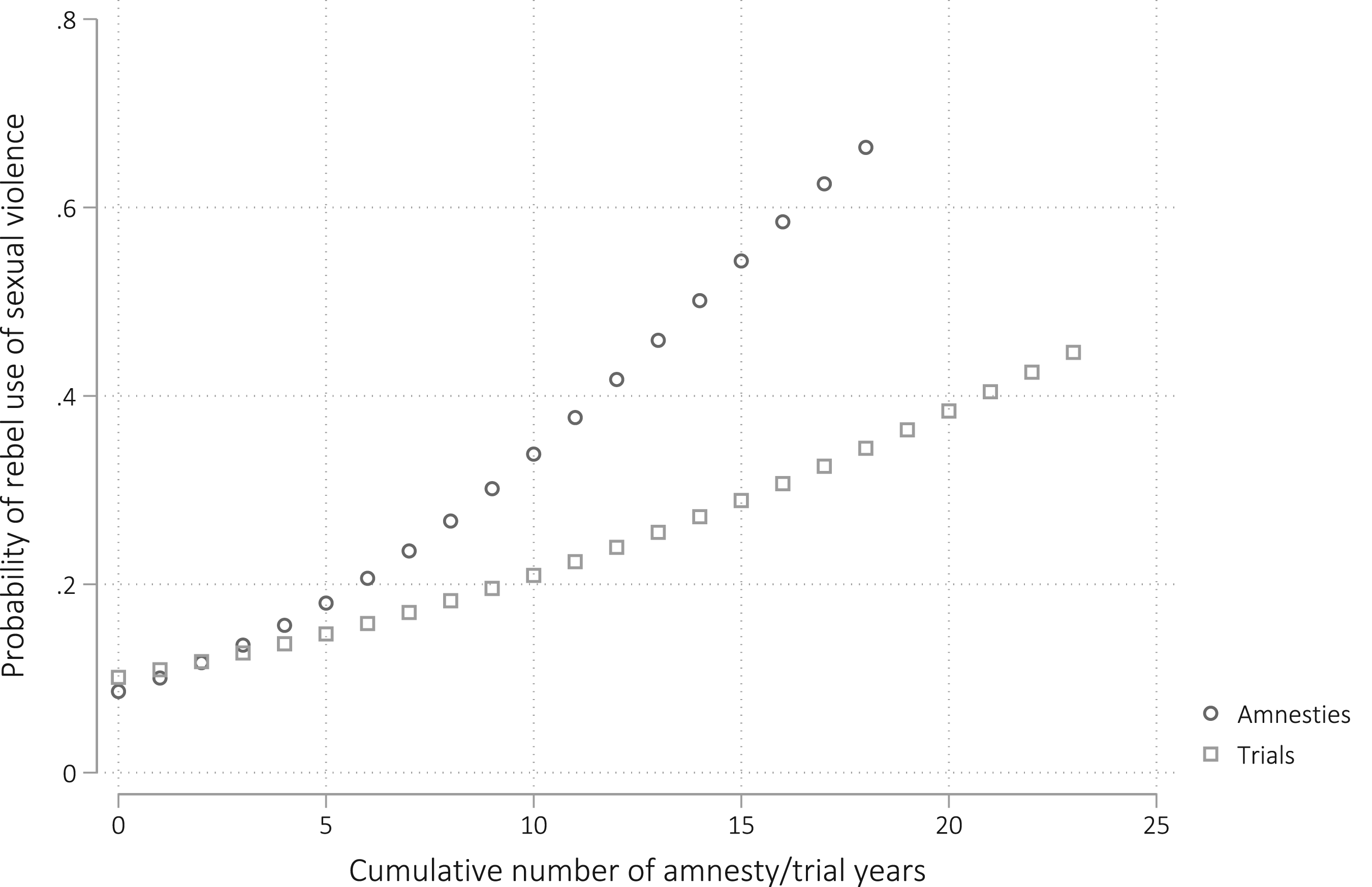
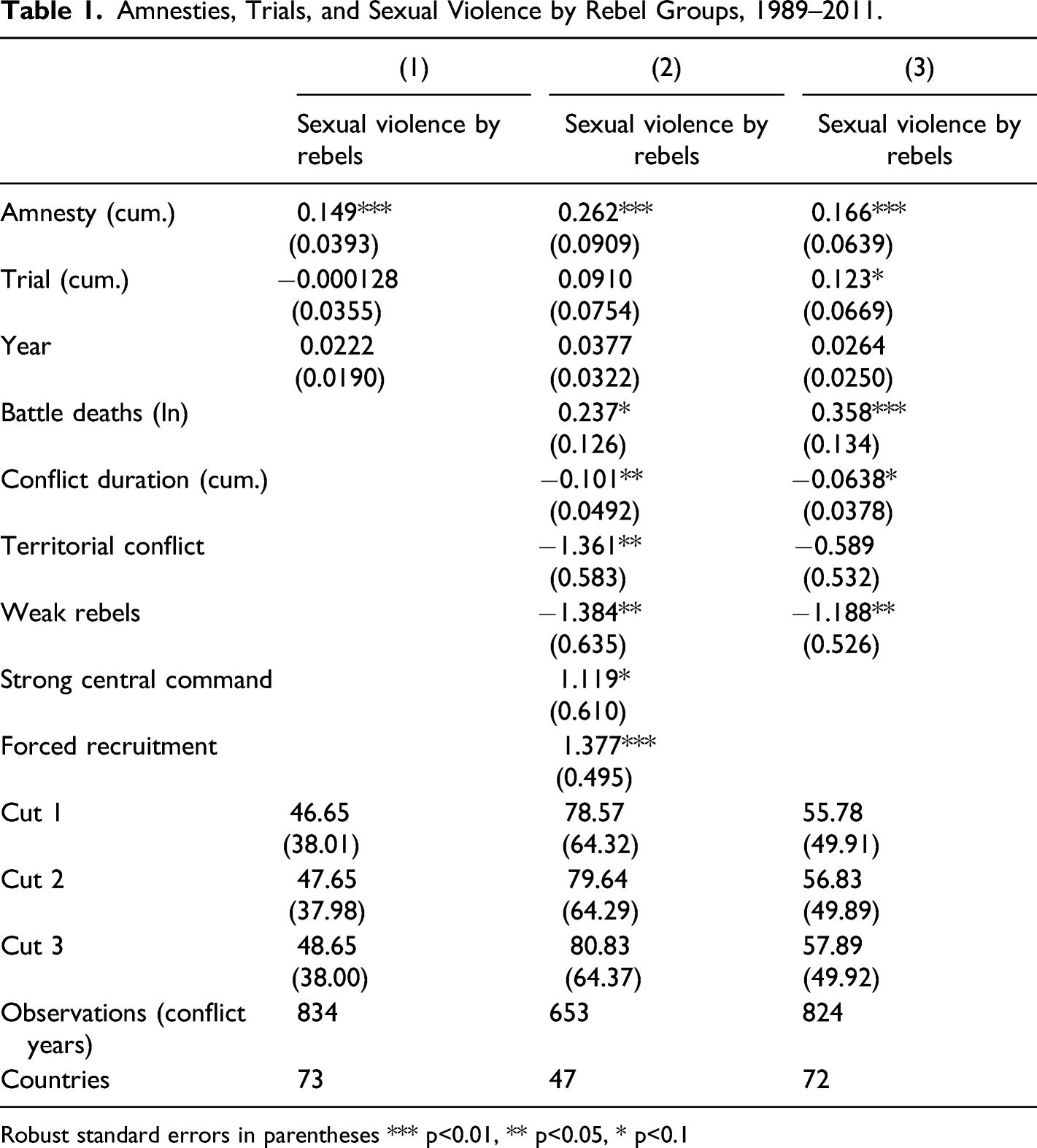
Amnesties, Trials, and Sexual Violence by Rebel Groups, 1989–2011.
Robust standard errors in parentheses *** p<0.01, ** p<0.05, * p<0.1
Trials targeting rebels, on the other hand, have no significant relation to sexual violence. This contradicts our expectation that conflicts where there have been trials would see subsequently less sexual violence than other conflicts. As discussed above, however, this could be an indication that the signal of punishment is weaker from trials than the signal of impunity from amnesties, in that relatively few individuals are directly affected by trials. We could therefore argue that insurgents assessing the relative risk of punishment are not likely to be significantly shifting their assessment of risk based on a few trials, and that more extensive punishment schemes must be in place for the signal of ‘end to impunity’ taking effect. Alternatively, trials might end with various types of settlements and punishments, although complete acquittal is rare (Loyle and Binningsbø 2018). Particular details of trials might also produce varying outcomes, for example who the defendants are, or whether the verdicts explicitly mention sexual violence as an offense or not. Occurrence of trials might therefore be a mixed signal, a weak signal, or even have little signaling effect, depending on particularities related to the trials and the setting. We disaggregate trials—as well as amnesties—to investigate such differences below.
The variable designed to pick time trends (Year) has no significant effect in Model 1, indicating no clear patterns of overall increase or decrease in use of sexual violence by rebel groups between 1989 and 2011. 12
To provide additional tests of our expectations and further scrutinize the findings in Model 1, we add the full set of control variables in Model 2. 13 Here, the effects of the main variables of interest remain the same: Amnesties are associated with significantly higher likelihood of sexual violence by rebels, whereas trials have no discernable effect.
Among the control variables in Model 2 we find that battle deaths are significantly associated with higher levels of sexual violence whereas accumulated conflict duration, territorial conflict, and weak rebels all are negatively associated with sexual violence. Having a strong central command and using forced recruitment seem to make rebels more likely to use higher levels of sexual violence during armed conflict, the latter being in line with existing research on rape in civil war (Cohen 2013). However, due to larger numbers of missing values for these two variables, which reduces the sample in Model 2 with 22% compared to the full population of conflict years between 1989 and 2011, we remove them from our final model.
In Model 3 the effect of accumulated amnesties remains the same as in Models 1 and 2, supporting our expectation that amnesties signal impunity and make rebels more likely to commit higher levels of sexual violence. In Model 3, there is also an unexpected positive and significant association between accumulated trials and levels of sexual violence. 14 While the effect is weak and not very robust (see below section with robustness checks), this could indicate that rather than a deterrent effect, trials for one type of crime may have a substitution effect in increasing the prevalence of other types of crimes such as sexual violence.
Akin to the results in Model 2, also Model 3 indicates that more severe armed conflicts in terms of battle deaths are associated with higher levels of sexual violence committed by rebel groups, which is in line with assumptions that civilian victimization and general conflict lethality are associated (e.g., Kalyvas 2006). A similar finding is not evident in systematic studies of sexual violence (Cohen and Nordås 2014, 2015), possibly due to the current analysis’ restricted focus on rebel groups in intrastate armed conflict and conflict years only.
Further, even if we expected longer-lasting conflicts would be more likely to have both DCJ processes and sexual violence, compared to shorter conflicts, when taking into account accumulating use of amnesty and trial processes over time, additional conflict years (accumulated conflict duration) are associated with significantly less sexual violence. 15 In Model 2, we find that separatist rebel groups in territorial conflicts seem to perpetrate less sexual violence than rebel groups fighting for control over the government. This could to some extent contradict claims made in previous literature that ethnic conflicts are likely to see more sexual violence than other conflicts (see Cohen 2016 for a review). However, this relationship is not significant in Model 3.
Perhaps surprisingly, Models 2 and 3 both indicate that relatively weak rebel groups are likely to use less sexual violence than rebel groups which are stronger or at parity with the government. This contradicts Wood (2010), who argues that weak insurgents have an incentive to target civilians because they lack the capacity to provide sufficient benefits to entice loyalty. Our finding could in part be explained if groups engaging in sexual violence are more likely to be operating in very weak states, making the relative power balance more easily in favor of insurgents. This echoes the finding by Cohen (2013, 461) that “state weakness … (is) associated with increased wartime rape by rebel groups”—as these are cases where rebel groups are likely to be found to be relatively stronger. However, several differences between the current study and Wood (2010) could also account for the difference, such as the fact that Wood’s study looks at killings of civilians (one-sided violence), not sexual violence, and that his study focuses on insurgencies in Africa specifically. Future studies could investigate weak versus strong rebels and sexual violence in more depth.
Disaggregating Amnesties and Trials
The analyses in Table 1 reflect our theoretical assumption that legacies of amnesty, expressed through accumulating numbers of them, signal impunity and make rebels likely to commit more sexual violence during conflict. Whereas it is this accumulating effect we are interested in, we acknowledge that amnesties can take a variety of forms, and that certain characteristics of them may have stronger influence on rebels’ use of sexual violence than others. Similarly, while accumulating trials do not have the anticipated effect in our analyses, this may be due to differences among the trials in the sample. Thus, we ran Model 3 from Table 1 with independent variables capturing different categories of amnesties and trials. 16
The DCJ dataset contains various variables that describe the individual justice processes in more detail. This includes measures of the scope and rank of targets—how many people are affected and whether they are civilians, rank and file, or elites—and specific descriptions unique to each type of process. In the Online Supplement (S2 and S3) we show full models examining a handful of such descriptive variables. Figure 2 below shows point estimates and confidence intervals for four models that yield significant differences between certain categories of amnesty and trials. It is important to note, however, that the findings are not directly comparable to the results in Table 1, as the disaggregated amnesty and trial variables are summaries of the justice efforts initiated by the government towards the rebels in a particular year,
17
in contrast to the previously examined effects of amnesties and trials accumulated over time. Coefficient plots for disaggregated amnesties and trials and sexual violence by rebel groups, 1989–2011 (Control variables omitted).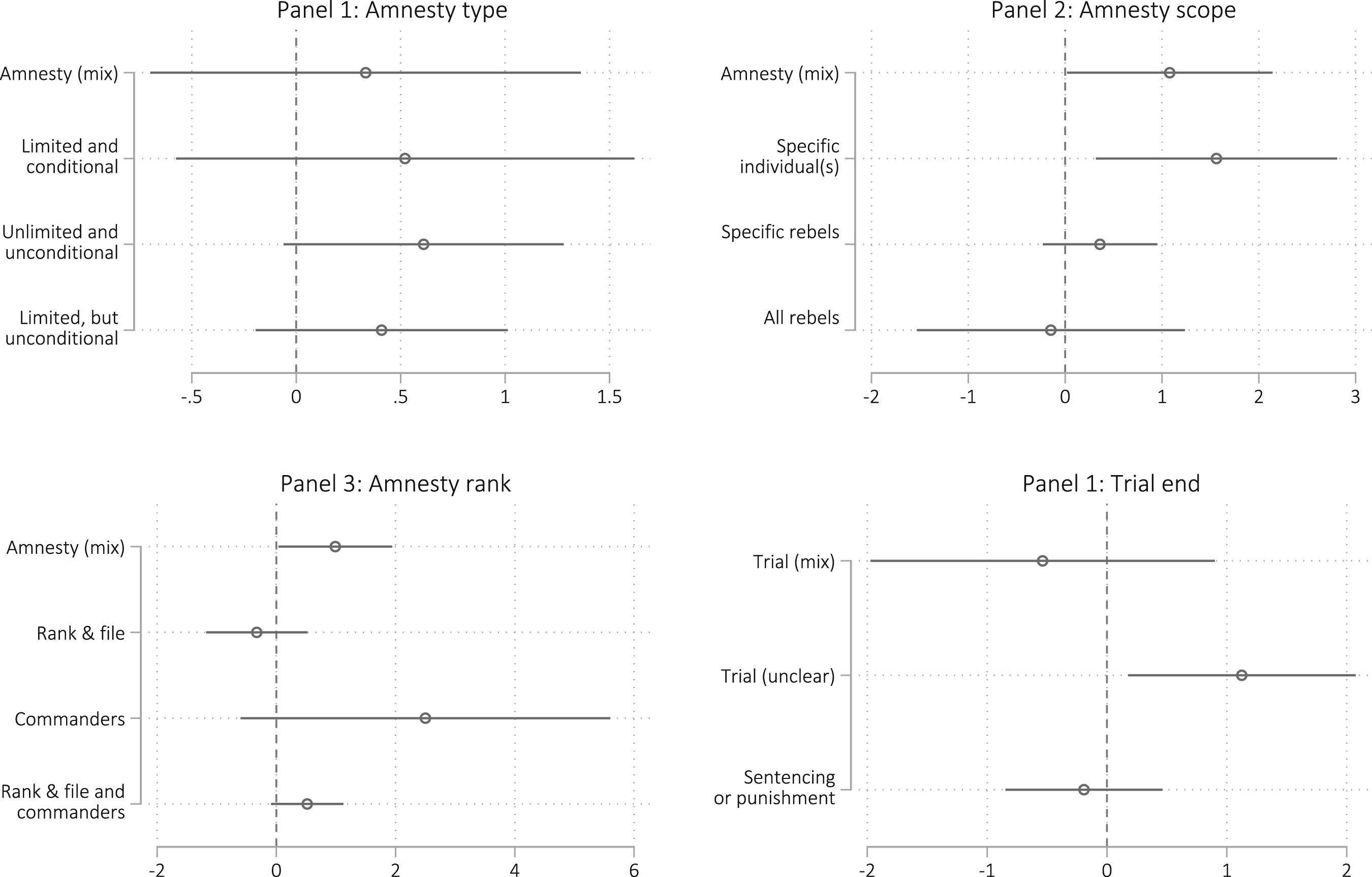
The amnesties in the DCJ dataset are categorized according to whether they are limited or not (e.g., in terms of crimes or perpetrators covered), and whether there are any conditions on them (e.g., laying down arms or denouncing rebellion). In Panel 1 in Figure 2 we show how these different types of amnesties are associated with levels of sexual violence. While all coefficients are positive, only amnesties without any conditions or limitations (“Unlimited and unconditional”) are associated with significantly higher levels of sexual violence by rebel groups compared to situations of no amnesties. These are probably the amnesties that send the strongest carte blanche signal of no costs for previous crimes, as they contain no demands on the recipients.
Panel 2 in Figure 2 shows the relationships between the scope of an amnesty, that is, how many people were affected by it, and the likelihood that rebels will commit more sexual violence. Amnesties targeting large groups (“specific rebel groups” or “all rebel groups”) are not associated with any significant difference in levels of sexual violence compared to no amnesties. However, amnesties targeting only specific individuals, or cases where there are multiple amnesties in one year with diverse scopes (“Amnesty (mix)”), are associated with rebel groups committing subsequently higher levels of sexual violence. Although the reason for this is difficult to ascertain, one possibility is that amnesties for particular high-profile cases gain more attention and notoriety, and that this increases the signal effect.
In Panel 3 in Figure 2 we show the rank of the rebels given amnesties and its relationship with sexual violence. The categories displayed distinguish between amnesties granted to only one rank (“Rank & file” and “Commanders”) and multiple ranks (“Amnesty (mix)” and “Rank & file and commanders”). 18 Most amnesties fall into the last category. The amnesties granted to specific ranks are not significantly different from no amnesties in terms of rebel use of sexual violence, but multiple-targeting amnesties are associated with higher levels of sexual violence. Overall, the disaggregated amnesty variables are weaker than the accumulated measure. This is to be expected given the construction of the variables (annual vs cumulative), as the accumulated measure arguably captures a more clearly reinforced signal of impunity.
Turning to trials (see Online Supplement S3), the indecisive results from Table 1 are repeated. While hardly any of the different trial categories are significantly related to levels of sexual violence, the analyses reveal how they pull in opposite directions. In Panel 4, we show how the ending of a trial process relates to sexual violence. The DCJ dataset includes a variable reporting the last available information about the specific trial processes. Unfortunately, this variable does not code the trial outcome, but captures the media attention to the trial. However, if we assume media coverage is an important signaling channel, it is interesting to note that “unclear trials” have a positive and significant effect on higher levels of sexual violence committed by rebel groups. In contrast, trials with public sentences or punishments seem to be associated with less sexual violence. When a trial process does not send any signal of risk of punishment—when no information about a verdict is revealed—rebel groups are likely to use more sexual violence.
Robustness Checks
Whereas we consider the above Model 3 the most appropriate model theoretically, we ran additional analyses to check the robustness of our findings (See Online Supplement). First, the SVAC data use three different sources to code SVAC: The US State Department’s annual Human Rights reports, Amnesty International’s annual and periodic special reports, and Human Rights Watch’s annual and periodic special reports. Thus, to check the robustness of our findings with the USSD variable, we ran Model 3 from Table 1 with dependent variables from AI and HRW as well (Online Supplement S4). There are quite a lot of discrepancies between the reported SVAC prevalence by various groups depending on which source is used. This is a testament to the inherent difficulties of observing wartime sexual violence. Still, the coefficient for the cumulative amnesty variable remains positive and significant when using Amnesty International data and weakly significant at a 0.1 level when using data from Human Rights Watch. The cumulative trial variable is positive and significant with AI data, but not with HRW data. The results point in the same direction as Table 1, strengthening our argument that amnesties signal impunity and increase the likelihood of sexual violence, while trials do not have the anticipated deterring effect.
Second, in Table 1 we add up conflict years with dichotomous measures of amnesties and trials, but given our assumption about a cumulative effect it could be relevant to also add the total numbers of amnesties and trials for each year. Replacing the amnesty and trial variables in Model 3, Table 1, with cumulative absolute numbers does not change the effect of amnesty, but the effect of trials becomes insignificant (Online Supplement S5). Even if the accumulated absolute number of trials could represent our theoretical assumption equally well, we consider the yearly dichotomous measurements more comparable—both among trials and with amnesties—and place greater emphasis on the results in Table 1.
Third, we also tested alternative operationalizations of our control variables (Online Supplement S6). As sexual violence may be more related to civilian victimization than people killed on the battlefield, we ran an analysis where we substituted battle deaths with one-sided violence committed by the rebels (data from Eck and Hultman 2007) in Model 3. With this change the positive effect of number of amnesty years on the prevalence of sexual violence remains significant, whereas cumulative trials turn insignificant. The effect of one-sided violence (log-transformed to avoid skewness) on sexual violence is positive and significant, indicating that conflicts with high levels of civilian victimization also are likely to be more plagued by sexual violence.
Rather than controlling for territorial conflict we included a related measure of ethnic mobilization (Forsberg 2014), which records whether the rebel group recruited members based on ethnic identity or not. This replacement did, however, not affect the relationships between cumulative amnesty years or cumulative trial years and rebel use of sexual violence. The ethnic mobilization variable has a positive and significant influence on the level of sexual violence. This is in line with a common assumption that ethnic conflicts are more prone to sexual violence, but contrary to findings by Cohen (2013), based on an analysis of major civil wars from 1980–2009, and separating ethnic from non-ethnic wars.
Fourth, whereas we are primarily interested in the armed conflicts and the rebel groups fighting them, factors associated with the country where the conflict took place may also influence the effect government-initiated amnesties and trials have on sexual violence. Thus, in Online Supplement S7, we add various country characteristic variables to Model 3. When controlling for political regime, 19 the effect of cumulative amnesty years remains the same as in the main model, but trial years turn insignificant. Political regime itself has a negative, but insignificant, effect on sexual violence. In years after a government becomes a member of the International Criminal Court, 20 the effect of amnesties and trials remain significant, while the ICC variable itself is positive and significant. That is, rebels in countries which are ICC members are likely to use more sexual violence than rebels in countries which are not. When including the level of development in the country in which conflict takes place, measured as ln-transformed GDP per capita (Feenstra et al. 2015), the effect of cumulative amnesty is still significant, though only weakly, while the positive effect of cumulative trials is significant at a 0.05 level. Level of development also in itself has a strong negative and significant effect on of sexual violence. That is, richer countries are less likely to see rebel groups using sexual violence. We also tested an indicator of rule of law from the V-Dem project (Coppedge et al. 2019), but the variable is insignificant and does not alter the findings for the other variables.
Finally, we added a demographic control variable, total population in the country (log-transformed, also from Feenstra et al. 2015), which has a negative, but insignificant effect on the level of sexual violence prevalence in a conflict. Including population in the model does not change the effect of cumulative amnesty on sexual violence, which remains positive and significant. 21
Discussion and Conclusion
The emphasis on ending impunity as a key preventive measure is strong in the popular debate. For example, UN Security Council Resolution 2106, adopted in 2013, “emphasized more consistent and rigorous investigation and prosecution of sexual violence crimes as a central aspect of deterrence, and ultimately prevention.” 22 There is also considerable concern both in policy circles and in the NGO sector that impunity can hamper efforts to “stop rape in war” which is reflected in the UK-led Declaration of Commitment to End Sexual Violence in Conflict adopted after the Global Summit in 2013, which more than 150 countries have signed (Krause 2015). The Chair’s summary after the Global summit claims that the summit was “sending a message that the era of impunity for wartime sexual violence was over, sending fear into the hearts of would-be perpetrators.” 23 In other words, ending impunity is expected to end sexual violence through deterring soldiers from raping through fear of prosecution. This is also in line with the prominent policy discourse of “rape as a weapon of war,” which suggests that the problem of sexual violence in war can be solved through deterrence from increased prosecution and punishment (Houge and Lohne 2017; Krause 2015). In sum, ending impunity is often presented as the (or at least the most prominent) solution to wartime sexual violence.
However, ending impunity as a natural prescription assumed to counter the problem of wartime sexual violence, has been repeatedly stated without systematic testing for impact. 24 As few studies have assessed the “ending impunity” argument empirically across a wide range of cases, we do not know whether legal measures have a real deterrent effect, or to what extent impunity fuels further violence.
This article presents a theoretical framework for understanding the relationship between justice and impunity on the one hand and sexual violence on the other and is the first to systematically study this relationship empirically across a wide set of conflicts and conflict actors. We argue that amnesties—general pardon often given to large numbers of individuals involved in acts of war—send a strong signal that sexual violence can be perpetrated with impunity. This signal decreases the perceived costs of this behavior for armed groups and can therefore temper the rates of perpetration of sexual violence. As the first study to do a large-N comparative analysis of this relationship, we find empirical evidence to support the claim. Our analyses show that the more amnesties are offered to rebels over the course of the conflict, the more likely are rebel groups to use sexual violence. This finding brings up the often perceived difficult-to-consolidate relationship between justice and peace. While Snyder and Vinjamuri (2004) claim that amnesties, in contrast to trials, may strengthen peace after conflict, and Mallinder (2007) argue in favor of democratically approved amnesties, our findings suggest that absence of justice do not bring peace to all civilians in conflict-affected societies.
In contrast to the strong relationship between amnesties and sexual violence, we find no significant deterrent effect of trials during conflict, rather, more trials are (weakly) associated with more sexual violence. We argue that the lack of a systematic effect of trials could be due to the more incremental process of holding individuals accountable through the legal system, and that trials send only a weak signal about the risk of being held accountable for wrongdoings. It is also possible that a substitution effect is at play whereby trials that do not explicitly focus on sexual violence (which has historically been the case) indirectly lead to adaptation among rebel groups to use sexual violence as a tactical substitute for violence that is being punished. For some rebel groups, commanders might already have factored in risk of future punishment in their stance towards the use of sexual violence by their troops; and/or they might also lack the organizational resources to effectively reign in unwanted behavior by soldiers, which could undermine the proposed deterrence effect. Rebel soldiers might also not respond to the signal of future punishment due to the present-day fear of punishment by peers for refusing to participate in sexual violence acts. Future research could consider ways of investigating these possibilities, as well as the perceptions of impunity among armed group members, as was done by Muvumba Sellström (2015) for several rebel groups in Africa.
Overall, it is perhaps unsurprising that trials during conflict have often failed to address sexual violence, and we might expect ipso facto that the impact of trials could be minimal. Disclosure of sexual violence often takes a long time, due to stigma, fear of retaliation, or lack of confidence in the judicial system (Seelinger 2017). For these types of violations, some never step forward to seek justice, and for many survivors it is particularly difficult to share experiences of rape or other sexual abuse. Indeed, if trials occur late, are drawn-out, lead to minimal sentencing or no effective punishment, do not mention sexual violence explicitly as a punishable offense, and only affect a few select individuals, trials might even be interpreted as a sign that such abuses are de facto tolerated. 25 As a result, the deterrent effect might be negligible. One conclusion to draw from this is that victims and witnesses need full protection when choosing to seek justice, that trials need to be scaled up, made more efficient (while keeping with due process), so that the real risk of being caught and punished for violating the laws of war are significantly heightened.
Despite showing some quite consistent results in support of the dangers of impunity for continued sexual violence in war, there is still a lot more we need to know about how to prevent sexual violence. Future research should therefore tackle several related questions. First, future research should learn more about the exact nature of trials—who specifically ends up on trial, what offenses are being considered (e.g., whether and how sexual violence is included), what types of evidence is used, what sentencing has taken place, and which punishments are being given and by whom. Trials is a heterogeneous category, where the specific form it takes, the outcome that is reached, and who is included could conceivably lead to very different downstream effects. Studying this in more disaggregated ways or through in-depth case studies could give a stronger basis for evaluating the possible signaling effects of trials on subsequent conflict behavior, and also for strengthening judicial processes for combatting wartime sexual violence. More work is also needed on the exact processes of deterrence, and whether and how ending impunity in one case (or against one actor) could send signals also to other relevant actors (see Hillebrecht (2016) on the deterrent effect of the ICC in Libya).
Related, future research should systematically analyze the impact of international trials and tribunals on the prevention of sexual violence. The current study only includes domestic processes during conflict. As there have been relatively few international processes that have focused on sexual violence, the empirical material is somewhat limited, but with time we should be able to better document and analyze the effects of such trials on the fight against sexual violence in war. 26
Second, we also see a need for theorizing and modeling the decision to use different justice mechanisms, and whether and how we need to consider this a two-stage (selection) process that ultimately matters for reducing wartime sexual violence. For example, amnesties are sometimes used to attempt to trigger defections where this is deemed feasible to achieve (Loyle, Binningsbø, and Gates 2017). The implication of this can be ambiguous. On the one hand, some groups use gang rape to overcome cohesion problems (Cohen 2013), which suggest that these groups are candidates for amnesties if they are perceived as more likely to have soldiers break rank. On the other hand, sexual violence has been found to indeed have the effect of building cohesion (Nagel and Doctor 2020). This could imply that these groups are not in fact perceived to be strong candidates for amnesties if defections are deemed unlikely. This and other potential endogenous patterns or selection effects should be studied in more detail in future work.
Third, future research should also study how ending impunity may or may not be useful in preventing sexual violence by states, as the current analysis sheds light only on the relationship between amnesties and trials and sexual violence by insurgents. However, states are frequent perpetrators (Cohen et al. 2013; Cohen and Nordås 2014, 2015; Leiby 2009), meaning that any attempt to ending sexual violence in war must address how to stop state forces from committing such atrocities. We need better documentation and analyses of the processes through which ending impunity might be implemented to effectively end state violations. This could also build on the insights of Loken et al. (2018) on how states may use legal accountability in sexual violence cases as part of a politico-military agenda to build political legitimacy.
Last, future research should also study post-conflict justice processes, how they impact sexual violence and other forms of violence post-conflict. Impunity for sexual violence during war could have consequences for post-conflict violence. In Peru, for instance, research shows civilian adoption of rape to be a significant problem in the post-conflict years (Boesten 2014), and heightened levels of intimate-partner violence have been documented in areas more affected by conflict violence in general and conflict-related sexual violence in particular (Østby et al. 2019). The lack of consideration for sexual and gender-based violence in the transitional justice process has been highlighted as a reason why Peru today is very high on the world ranking of registered sexual violence and the highest ranking in South America (Boesten 2014, 6-7). The perils of impunity can therefore be a long legacy of violence that future research as well as policy-responses should try to understand, prevent, and alleviate.
Supplemental Material
sj-pdf-1-jcr-10.1177_00220027221078330 Supplemental Material for Conflict-Related Sexual Violence and the Perils of Impunity
Supplemental Material, sj-pdf-1-jcr-10.1177_00220027221078330 for Conflict-Related Sexual Violence and the Perils of Impunity by Helga Malmin Binningsbø and Ragnhild Nordås in Journal of Conflict Resolution
Footnotes
Acknowledgments

Declaration of Conflicting Interests
The author(s) declared no potential conflicts of interest with respect to the research, authorship, and/or publication of this article.
Funding
The author(s) disclosed receipt of the following financial support for the research, authorship, and/or publication of this article: The authors gratefully acknowledge financial support for this study from the Research Council of Norway (grant #262425).
Supplemental Material
Supplemental material for this article is available online.
Notes
References
Supplementary Material
Please find the following supplemental material available below.
For Open Access articles published under a Creative Commons License, all supplemental material carries the same license as the article it is associated with.
For non-Open Access articles published, all supplemental material carries a non-exclusive license, and permission requests for re-use of supplemental material or any part of supplemental material shall be sent directly to the copyright owner as specified in the copyright notice associated with the article.
