




Abstract
One of the most shocking aspects of civil war is the prevalence of sexual violence committed by armed groups. Recent research identifies many of the factors driving this horrific phenomenon. What is generally lacking, however, is an understanding of the factors that can prevent conflict-related sexual violence. We argue that women’s economic rights are key. Women’s economic rights provide women with the ability to flee dangerous war zones, work in less vulnerable environments, and access to safe housing. We test our claims using a global sample of civil conflicts from 1989 to 2019. We find evidence that the presence of robust women’s economic rights is associated with significantly lower levels of observed sexual violence in civil conflicts, even after controlling for a variety of potential confounders. Additionally, we probe the possibility of egalitarian gender norms driving our results by examining the relationship between women’s political empowerment and conflict-related sexual violence. We find no relationship between women’s political empowerment and conflict-related sexual violence. Importantly, we continue to find a negative relationship between women’s economic rights and conflict-related sexual violence even when accounting for women’s political empowerment, suggesting women’s economic rights have an independent effect on conflict-related sexual violence. Our findings highlight the importance of enhancing women’s economic rights in the global fight against wartime rape. Providing women with greater economic agency has the potential to curb sexual violence in conflicts around the world.
Civil war is highly destructive to a country and its population. One of the most shocking aspects of civil war is the prevalence of sexual violence committed by armed groups against civilians, primarily women (United Nations Security Council, 2021). More than 55% of civil wars from 1989 to 2019 experienced some form of conflict-related sexual violence (CRSV), such as rape or forced prostitution. 1 A growing body of research documents this phenomenon and explains why some armed groups commit such horrid atrocities. Scholars highlight how armed groups use CRSV to weaken an opponent or strengthen one’s own military unit (Cohen, 2013; Doctor, 2021; Leiby, 2009). Our study builds on this research by considering whether extending rights to women can make them less vulnerable to exploitation in conflict settings and, consequently, reduce the amount of CRSV observed in civil war.
We argue that women’s economic rights are critical for shielding women from CRSV during armed conflict. Armed groups may have incentives to commit CRSV against women, but economic rights provide women with resources to avoid being victimized during war. Economic rights provide women with the ability to flee dangerous war zones, as well as access to less vulnerable work environments and to safe housing. Moreover, we argue that simply expanding women’s political empowerment is insufficient to reduce CRSV. When a country collapses into civil war and institutions break down, economic rights – and the resources they provide – become more important for women’s safety than political empowerment.
We test our claims using a global sample of reported CRSV (Cohen and Nordås, 2014a, 2014b) during civil conflicts from 1989 to 2019 (Gleditsch et al., 2002). We find robust evidence that countries with substantial women’s economic rights have significantly lower levels of CRSV. This result holds when controlling for various country, conflict, and regional-level factors. We find no evidence that greater women’s political empowerment is associated with lower levels of CRSV. The lack of a relationship between women’s political empowerment and CRSV is important because it supports our argument that economic rights are key for shielding women during conflict.
Additionally, it casts doubt on the idea that the relationship between women’s economic rights and CRSV is spurious. That is, if the relationship between economic rights and CRSV were, for example, due to countries with more robust women’s economic rights also having stronger gender egalitarian norms, then we would anticipate women’s political empowerment – another factor expected to be strongly associated with gender egalitarian norms (Paxton et al., 2025) – to also predict lower levels of CRSV. Furthermore, we formally assess the sensitivity of our results to potential confounders more generally and show a relatively high degree of confounding is necessary to change our conclusions.
Our findings are important because they point to a policy prescription for reducing women’s vulnerability during civil conflict. Economic rights provide women with resources and mobility that help them avoid wartime exploitation. This finding is consistent with recent claims by intergovernmental organizations and nongovernmental organizations about the importance of economic rights for ending wartime rape. For example, reflecting on the Angolan Civil War, the Committee on the Elimination of Discrimination Against Women emphasized that, ‘widespread poverty among women and poor socio-economic conditions are among the causes of the violation of women’s human rights’ (Chinkin, 2007: 12). Until now, such claims were not backed by generalizable empirical evidence. Our analyses provide initial evidence that investment in enhancing women’s economic rights can curb CRSV in future conflicts.
Sexual violence in armed conflict
Sexual violence is a horrifying feature of armed conflicts that is receiving increased scholarly attention (Nordås and Cohen, 2021). Early research focused on several conflicts that experienced widespread CRSV, such as the former Yugoslavia and Rwanda (e.g. Niarchos, 1995; Sharlach, 1999). During this period, scholars and policymakers largely considered sexual violence an inherent feature of war. Wood (2006), however, shows there is significant variation in sexual violence across conflicts and over time. These findings inspired comparative case studies exploring variation in CRSV (e.g. Farr, 2009; Leiby, 2009), and ultimately large-N global datasets measuring the prevalence of CRSV.
The most expansive data – the Sexual Violence in Armed Conflict (SVAC) dataset – was developed by Cohen and Nordås (2014a, 2014b), and focused on a broad array of sexual violence committed by state and non-state actors during armed conflict, such as rape, sexual slavery, and sexual torture. Two of the most important contributions of the data were (1) systematically documenting patterns of CRSV across space and time, and (2) facilitating a new research program examining the causes and consequences of wartime CRSV using quantitative analyses.
One longstanding theoretical approach motivating many analyses facilitated by these data contends that CRSV is opportunistic. According to this perspective, some combatants have a desire to sexually exploit others, and the lawlessness of war affords them that opportunity (e.g. Wood, 2009). Other scholars suggest a more strategic motivation where CRSV is used as a weapon of war and can help groups win conflicts by demoralizing the enemy and discouraging others from taking up arms against them (Leiby, 2009). More recently, studies suggest that CRSV is a tolerated (but not necessarily an ordered or delegated) practice used to strengthen armed groups (Cohen, 2013; Cohen and Nordås, 2015; Nagel, 2021; Nagel and Doctor, 2020; Wood, 2018). Cohen (2013, 2017) argues that armed groups deploy wartime rape to recruit fighters and build cohesion. In other words, engaging in CRSV may not only hurt the enemy but also enhance an armed group’s effectiveness. Consistent with this argument, factors that weaken cohesion among armed groups, such as the introduction of foreign fighters (Doctor, 2021) or the recruitment of child soldiers (Faulkner and Welsh, 2022), are associated with higher levels of CRSV. Factors that improve groups’ cohesion – such as an electoral process for selecting rebel group leaders – by contrast, are associated with lower levels of CRSV (Sawyer et al., 2021).
Armed actors have varying motives for engaging in CRSV, but what is less clear is what can be done to mitigate, or at least limit its frequency. Scholars emphasizing the opportunistic nature of CRSV often stress the need for commanders to restrain their fighters (e.g. Butler et al., 2007; Green, 2016; Whitaker et al., 2019). However, this solution relies on the efforts of the armed groups themselves. In many cases this may not be feasible, especially if commanders do not prioritize restraining their fighters, or when CRSV is aiding a group’s war efforts. Thus, a more promising strategy for combating CRSV must go beyond prescribing actions for groups focused on winning a war.
Sending peacekeepers may seem like an obvious strategy for preventing CRSV, especially since evidence shows large numbers of peacekeepers substantially decrease civilian deaths during civil war (Hultman et al., 2013). Kirschner and Miller (2019) find that some types of peacekeeping missions are associated with lower levels of CSRV. However, Johansson and Hultman (2019) find that peacekeepers often struggle to prevent CRSV and they are only effective when armed groups have a high level of internal control. Combined with a growing body of research highlighting the sexual abuses committed by peacekeepers (Karim and Beardsley, 2016; Horne et al., 2020; Moncrief, 2017), these findings cast doubt on the promise of peacekeeping ending sexual violence in war zones.
Punishing CRSV committed during conflict also seems like a plausible deterrent. Binningsbø and Nordås (2022) reason that holding trials intended to punish combatants for war crimes would increase the cost of perpetration and may discourage CRSV. Impunity, by contrast, signals permissiveness and may perpetuate the practice of CRSV. Although they find a relationship between impunity and higher levels of sexual violence among rebels, they do not uncover evidence that trials deter CRSV (Binningsbø and Nordås, 2022). Thus, legal responses appear insufficient for preventing CRSV.
In the next section, we argue that improving women’s economic rights in a country provides women with the resources necessary to protect themselves if war were to occur. In other words, improving women’s economic rights offers an avenue for preventing CRSV that does not rely on the efforts of armed groups or ill-equipped peacekeeping missions.
Women’s economic rights and CRSV
Armed groups often have incentives to engage in CRSV against women. We take this as the starting point for our theory. If actors have incentives to engage in CRSV, how can it be prevented?
Scholars emphasize the importance of gender equality in curtailing CRSV against women (Alsaba and Kapilashrami, 2016; Cohen, 2013; Ní Aoláin et al., 2011; True, 2012). For example, Davies and True (2015: 497) suggest, ‘[g]ender inequality varies significantly across countries and high-risk situations and, as such, it can and needs to inform strategies of prevention’. We argue that one of the most important gender inequalities with clear consequences for women’s security in the context of civil war is economic rights. Women’s economic rights range from rights regarding restrictions on workplace opportunities to rights concerning freedom of movement and the ability to own and administer assets. 2 Thus, building on previous research that assesses the effect of country-level factors on CRSV, such as political institutions (Willis, 2021) and state capacity (Lee and Tomashevskiy, 2023), as well as the broader human rights literature that examines the constraining power of democracy and political rights on aggregate human rights violations (e.g. Conrad and Moore, 2010; Davenport and Armstrong, 2004; Jones and Lupu, 2018), we examine how women’s economic rights influence overall levels of sexual violence during armed conflict.
In non-conflict settings, women’s economic rights provide women with resources and a wider range of employment opportunities. Women with more economic rights have higher wages, more bargaining power within the household, and a higher status in society, and experience less susceptibility to economic shocks (Iversen and Rosenbluth, 2006; World Bank, 2021). Women’s economic rights clearly improve the quality of women’s everyday lives during peaceful times. However, it is unclear if women’s economic rights protect women during a civil war, especially when institutions break down and governments may lose their enforcement capacity of these rights. We contend women’s economic rights become even more important in the face of civil war.
Whether armed groups engage in CRSV against women depends partly on the opportunities and difficulty of perpetuating CRSV. Where women have strong economic rights, armed groups have fewer opportunities to target them, and CRSV becomes less pervasive. Specifically, we argue that stronger women’s economic rights provide women with the ability to flee dangerous war zones, access less vulnerable work environments, and secure safe housing during civil war. All three mechanisms illustrate how economic rights can render women less vulnerable to CRSV when civil wars break out, and thus, decrease observed overall levels of CRSV. Drawing on examples from conflicts around the world, we discuss each of these factors below.
Ability to flee and avoid dangerous war zones
One devastating consequence of civil war is forced displacement. When conflicts sufficiently disrupt society, civilians must often flee to protect themselves. Conflicts over the past decade demonstrate unprecedented levels of forced displacements (United Nations High Commissioner for Refugees (UNHCR), 2020). Displacement disrupts people’s livelihoods, upends their economic security, and, more specifically, exposes women and girls to gender-based violence. We argue strong economic rights better position women to flee safely by avoiding dangerous war zones, thus reducing the likelihood they fall victim to CRSV.
Perhaps the most relevant rights for women fleeing conflict zones pertain to mobility: the right to travel outside their home, apply for a passport, and travel outside the country. A lack of these basic rights makes it even more dangerous and challenging to flee conflict zones. Yet, in 2023, ‘55 economies worldwide continue to limit a woman’s freedom of movement. In 14 economies, a woman cannot freely leave the home, and in 10 economies a woman cannot travel abroad in the same way as a man. In 34 economies, a woman cannot freely choose where to live in the same way as a man’ (World Bank, 2023).
A report on Rohingya women in Myanmar illustrates the importance of women’s freedom of movement: refugees fleeing violence without access to proper travel documents ‘are compelled to use irregular means to travel, relying on networks of brokers to pass through internal checkpoints and international borders’ (Win and Brinham, 2022: 5). This carries the risk of women and girls being arrested for illegal travel where they may be sentenced to detention for three to five years for immigration violations, and sometimes subject to CRSV by soldiers or police. For example, upon release, ten women and girls who were sentenced to the Sittwe prison for traveling without permission reported that instead of directly being sent to jail, ‘they were held in the forest for three to four days and were repeatedly raped by police’ (Win and Brinham, 2022: 14).
Under the Taliban administration, women in Afghanistan face similar restrictions limiting their right to travel outside the country or more than 75 kilometers without a spouse or male guardian (World Bank, 2023). After the United States withdrew from Afghanistan in 2021, dozens of women traveling without a male guardian were denied the right to board flights departing Afghanistan. As a result, women were forced and continue to remain in the conflict zone where they are vulnerable to sexual violence perpetrated by the Taliban and resurging ISIS (Amnesty International, 2023). More generally, restrictions on women’s mobility render them particularly vulnerable during conflict because women often need to flee without men.
During conflict, the right to own and sell assets such as livestock or land is also critical for women who need money to flee. Nonetheless, as of 2023, 76 economies still restrict women’s property rights (World Bank, 2023). One woman from Yemen – where women have severely limited economic rights – was fortunate enough to sell her gold earrings to pay to evacuate the conflict zone on a fishing boat. She explained: ‘The most important thing is money [. . .] If you have money, you can be mobile’ (Syeed, 2017: 20). But, where weak economic rights exist, women cannot earn money or own and sell assets, and their ability to make major financial transactions may require their husband’s consent. Thus, even women who have family wealth may not be able to liquidate their assets if they live in a country where women do not have economic rights. This is particularly problematic for women who lose their spouses to war or are forced to flee alone. By contrast, where women have economic rights, they are more likely to have access to money and assets, facilitating their ability to leave a conflict zone.
Beyond needing resources for safe navigation during civil conflict, people often leverage their networks for information about the safest routes to travel and safe locations to flee to (Adhikari, 2012). For instance, refugees relay ‘information on the best and safest routes, on which towns are friendly to migrants and which not, on the real prices for taxis, on where to find a hostel and whether police can be trusted’ (Dubinsky, 2015). Yet, where women do not have the right to work in the same ways as men, they are not integrated into the economy and may be less likely than men to have reliable networks for obtaining timely information (Petesch, 2011; United Nations (UN) Women, 2019). Instead, women’s networks are more likely to be ‘small, informal, and oriented to daily coping and voluntary community activities’ (Petesch, 2011: 25). Reports from Iraq (Kaya, 2018) and Syria (UN Women, 2019) similarly describe women as having less access to timely information than men due to smaller networks and social isolation. Even when women lacking economic rights are forced to take on traditionally male-dominated roles during war, they face social censure for violating traditional gender roles, resulting in isolation from critical networks (Lindsey-Curtet et al., 2004).
Where women have enhanced economic rights, they are more likely to have networks they can leverage for obtaining information. Women’s labor force participation enables them to develop stronger, more robust social networks. For instance, research in Bangladesh finds that factory work aids women from poor rural communities in developing and expanding their social networks (Amin et al., 1998). Beyond the specific relationships they develop at work, labor force participation may lead women to join other informal networks and develop critical civic skills (Schlozman et al., 1994). These networks – and their ability to transmit timely information – may prove vital for women fleeing war-torn areas.
Finally, these same factors shape women’s ability to safely return to their home. In Syria, for instance, even in the face of ongoing conflict, more than 143,000 refugees returned; but, ‘Syrian refugees report challenges in accessing accurate and up-to-date information on key issues that influence their decision to return (e.g. security, legal issues, return procedures)’ (UN Women, 2019: 2). Notably, women have less information than men owing to smaller networks, restricted access to smartphones, and lower literacy rates. This information problem ‘puts refugees in positions to be exploited or abused, with higher risks for women and girls due to their gendered vulnerabilities’ (UN Women, 2019: 2). In the absence of information regarding unsafe environments, women may have an increased likelihood of returning to risky, vulnerable circumstances, serving as an indirect consequence of the impacts of restricted economic rights on gendered informational asymmetries.
Taken together, women’s economic rights can make it safer for women to flee war zones and even to return amidst ongoing conflict. Economic rights – ranging from the right to freedom of movement and the right to own and sell property to the right to work in the formal labor force in the same way as a man – provide women the necessary resources to navigate the dangers of fleeing and returning, thus reducing the likelihood they fall victim to CRSV.
Less vulnerable work environments
Although many people are forcibly displaced during civil conflict, it is also not uncommon for citizens to stay put during conflict, attempting to continue their livelihood activities amid unrest. Accounts of women experiencing CRSV while working in unsafe or vulnerable environments abound (Bastick et al., 2007; True, 2012; United Nations Security Council (UNSC), 2022). Whether women have sufficient economic rights – e.g. the right to work outside the home and earn money in the same way as a man and rights that protect them from workplace discrimination and harassment – often determines their exposure to vulnerable work environments. Women across 69 economies face legal obstacles regarding employment with 30 economies failing to prohibit gender discrimination in employment, 43 failing to address workplace sexual harassment, and 19 limiting women’s ability to get a job in the same way as men (World Bank, 2023: 25–26). Beyond this, 93 economies do not legally mandate equal pay for men and women (World Bank, 2023: 27).
When women do not have strong economic rights, they are often forced to pursue livelihood activities that may put them at risk, particularly during civil conflict. Where women have weak economic rights, they are limited to participating in the informal labor sector – jobs such as tending to crops and livestock in open fields, collecting and selling firewood, or running small goods kiosks in unsafe areas. Even during peaceful periods, women’s economic vulnerability and participation in the informal labor force increase their risk of exposure to sexual exploitation (Chynoweth and Patrick, 2007).
As some armed actors have incentives to engage in CRSV, women working in the informal labor sector may be further vulnerable to CRSV (True, 2012). For instance, women working in remote, open fields are visible to people passing by. If they are accosted or attacked there is nowhere for them to escape, rendering them defenseless. Given how susceptible women are when working in remote areas, it is not surprising there are countless stories of women being kidnapped and/or raped while working in the field or commuting on foot to remote areas for work (Bastick et al., 2007). As one report from Myanmar explains, ‘perpetrators took advantage of survivors being alone in remote locations, such as working on farms or rice paddies or searching for food outside villages, calculating that there would not likely be assistance and/or witnesses nearby’ (UNSC, 2022: 49).
By contrast, in places where women have stronger economic rights, they may have more opportunities to pursue work in the formal labor market, enabling them to evade working in isolated areas where they are more vulnerable to attacks. Strong economic rights for women are typically associated with greater access to education, control over financial assets, a broader set of vocational skills, and financial literacy. A 2021 World Bank study of 179 economies from 1991 to 2019 finds that independent of a country’s economic development, women’s legal economic rights are associated with higher levels of female employment, lower rates of poverty among women workers, and fewer women working in vulnerable work environments.
During periods of heightened risk, women in the formal sector may be shielded from returning to work when doing so would put them in harm’s way, as during civil unrest. This is because such jobs are more likely to come with benefits such as paid time off, sick leave, and accommodations for employees in the wake of disaster. In Indonesia, for instance, women have the right to work in government salaried jobs. When economic activity diminished during the Maluku Islands sectarian conflict, most Indonesian women in government jobs continued receiving their salaries (Petesch, 2011: 19).
Another key aspect of women’s economic rights is property rights – rights to inherit, own, and control assets such as land and property. Access to property and land can provide women with more security and independence during conflict because they can liquidate their assets and avoid vulnerable work for longer periods of time. But, in 76 economies worldwide, women do not have full property rights (World Bank, 2023: 34).
In the Philippines, where men and women have equal rights to inherit assets, a United States Agency for International Development report explained that a woman from North Cotabato in Mindanao, ‘had to flee her village in 1999, but she had enough time to sell off the family’s cows first [. . .] This cash turned out to be critical during the year and a half her family spent in an evacuation center, where the government and private organizations were not providing enough food’ (Petesch, 2011: 16). The report finds that owing to inheritance practices in the Philippines and Indonesia, ‘ownership of land and other large assets provided women with security, independence, productive capital, and resilience in the face of conflict’ (Petesch, 2011: 16).
In short, women’s economic rights allow women to avoid working in jobs that render them more vulnerable to CRSV. Where women have economic rights, they are more likely to find employment in the formal labor sector where they will face less exposure to violence. Moreover, women’s property rights, such as inheritance practices and the right to own and manage assets, are critical for helping them weather periods of unrest and insecurity, reducing their reliance on work in vulnerable places.
Access to safe housing
Finally, women’s economic rights are central to ensuring access to safe housing during perilous times, a key factor for reducing their vulnerability to rape and sexual assault by armed actors. As True (2012) explains, during crisis, gendered economic inequalities are often exacerbated. Consequently, ‘women are less able than men to protect themselves from violence or abuse and from being in situations such as poor housing or employment where they are highly vulnerable to such violence’ (True, 2012: 122). Where women have strong economic rights – such as strong property rights and gender-based equalities in the workplace – they are more likely to secure safe housing and invest in security measures. Although safe housing is not sufficient in and of itself to guarantee women’s safety, insecure housing renders women more vulnerable to CRSV.
When the government does not protect women’s right to earn a reliable income or their right to own and sell assets, women are more likely to end up in insecure housing during civil conflict. In Iraq, where ISIS took young women as sex slaves and subjected them to torture and sexual abuse, a group of women taking shelter in an unfinished building in Tilkaif explained that they feared sexual violence. They elaborated: ‘There are safety concerns, especially among the women, from the approaching insurgent groups to the areas where [we] live’ (International Organization for Migration (IOM), 2016: 14). Iraqi women in an irregular settlement in Salah al-Din likewise recount that living in unfinished buildings without doors and/or locks is terrifying: ‘I can’t sleep at night because I am afraid that armed men may suddenly enter this caravan and hurt my daughter’ (IOM, 2016: 38).
Even camps for internally displaced persons (IDPs) often lack basic security measures necessary to reduce women’s risk of sexual violence from armed actors. A study on camps produced by the International Organization for Migration that surveyed more than 1,000 camps in Iraq in 2016 describes, ‘IDPs living in camps and camp-like settings fear – and are at risk of – gender-based violence, partly because their homes are not adequately configured or protected (most do not have proper partitions, locks or doors) against assault, which particularly affects women and girls’ (IOM, 2016: 6). When women have economic rights, they have more resources and networks to identify and secure housing in safer camps or avoid camps altogether.
Finally, economic rights are important for safe return. Women who do not have the right to inherit or own property face challenges reclaiming or obtaining new housing upon return if they are not accompanied by a man. Recognizing this challenge, a UN Women (2019: 3) report focusing on refugees and IDPs returning to Syria amid ongoing hostilities, advised, ‘[a]ccess to shelter and housing are essential for returnees to Syria. The realization of HLP [i.e. housing, land, and property] rights can enable critical autonomy, and support women’s protection and empowerment’. Property rights – a key component of women’s economic rights – influence whether women can acquire adequate shelter upon returning to war-torn areas.
In sum, when women have stronger economic rights, they can legally buy and own property. Beyond this, economic rights better position women to afford safe housing and potentially avoid underserviced camps. Thus, by providing women with safe housing during conflict, economic rights reduce women’s vulnerability to sexual violence.
Hypothesis
There are multiple ways women’s economic rights can affect CRSV. Stronger economic rights make it more likely that women safely flee a conflict zone, reduce their likelihood of working in vulnerable spaces, and increase their likelihood of accessing safe housing. We do not view these as competing mechanisms and contend that they operate simultaneously to limit opportunities for CRSV. This should curb the bottom-up practice wherein recruits engage in personal opportunism (Wood, 2018) and disrupt the feasibility of CRSV being used to foster cohesion among recruits (Cohen, 2016). Women’s economic rights should thus decrease the overall observed levels of CRSV. This discussion leads to our main hypothesis:
Hypothesis: In countries with stronger women’s economic rights, the prevalence of sexual violence during periods of civil conflict will be lower.
Women’s political empowerment
We contend that it is women’s economic rights, and not simply women’s political empowerment, that reduces the prevalence of CRSV. We acknowledge that women’s political empowerment is extremely important and can lead to better outcomes for women during peaceful periods. In fact, Willis (2021) shows that the expansion of women’s political empowerment is associated with less violence against women in some regimes during peaceful times. However, during conflict, government institutions and accountability mechanisms break down. Whereas economic rights provide women with the resources they need to weather periods of unrest, political institutions – that safeguard women during peaceful periods – are not reliable. During periods of unrest, governments may be unable to restrain rebel groups or control their armed groups. At the very least, preventing CRSV against women from armed actors may not be a priority for governments trying to win a civil war.
Importantly, if women’s political empowerment is not related to CRSV, this also reduces concerns of endogeneity. One concern is that the relationship between women’s economic rights and the prevalence of CRSV is driven by gender norms. In other words, countries with stronger women’s economic rights could have less prevalence of CRSV because of gender-egalitarian attitudes, and not women’s economic rights themselves. As gender norms are challenging to measure, our conclusions could suffer from omitted variable bias. However, if this is the case, we should also observe a significant relationship between women’s political empowerment and CRSV. This is because we would also expect gender egalitarian norms to be associated with women’s political empowerment. But, if women’s political empowerment is unrelated to CRSV and women’s economic rights have a distinct impact on the prevalence of CRSV, this casts doubt on the idea that any estimated relationship between women’s economic rights and CRSV is spurious and due to unmeasured gender norms.
Research design
To test our hypothesis, we utilize the SVAC Dataset (Cohen and Nordås, 2014a, 2014b) which covers CRSV committed by armed groups in all state-based conflicts from 1989 to 2019. 3 The list of conflicts come from the UCDP/PRIO Armed Conflict Database, which requires a minimum of 25 battle-related deaths to be considered a conflict-year (Gleditsch et al., 2002). We restrict our unit of analyses to active civil conflict years, i.e. we exclude interstate and extrasystemic conflicts. 4 We do this to ensure we are testing our hypothesis using observations where fighting is taking place in the focal country. Including other types of conflicts would incorporate cases where the focal state is fighting on another country’s territory, such as the United States fighting in Iraq in 2003. This allows us to evaluate the constraining power of women’s economic rights in war-torn settings, which are the backdrop for our theory. These coding decisions provide us with 173 conflicts and 1,243 civil conflict-year observations.
Dependent variable: Prevalence of CRSV
The SVAC dataset collects information on CRSV committed by both government and rebel forces. CRSV includes any instance of (1) rape, (2) sexual slavery, (3) forced prostitution, (4) forced pregnancy, (5) forced sterilization/abortion, (6) sexual mutilation, and (7) sexual torture. 5 SVAC includes an ordinal variable that ranges from 0 to 3 to capture the prevalence of CRSV. The quantitative variable is coded based on assessments of qualitative reports from the US State Department, Amnesty International, and Human Rights Watch. The SVAC data report results from each of these sources independently. We utilize the highest value coded from the three sources. 6 A score of 0 indicates there was a report issued on the conflict but there was no mention of CRSV. A score of 1 indicates there were reports of some, but isolated, sexual violence, a score of 2 captures cases where the reports indicate sexual violence was common, and a score of 3 is reserved for cases where there were reports of massive amounts of sexual violence. 7
Since our theory suggests women’s economic rights should leave women less vulnerable to all forms of CRSV, regardless of the type of armed group, we do not distinguish between different forms of CRSV, and we do not disaggregate the data by type of armed group. 8 Our dependent variable simply codes the highest level of sexual violence in the conflict year. The distribution of this variable is presented in Figure 1, which shows that most conflict-years (55%) have no reports of sexual violence, but there are conflict-years in each category of sexual violence, including 91 (8%) with reports of massive amounts of CRSV.
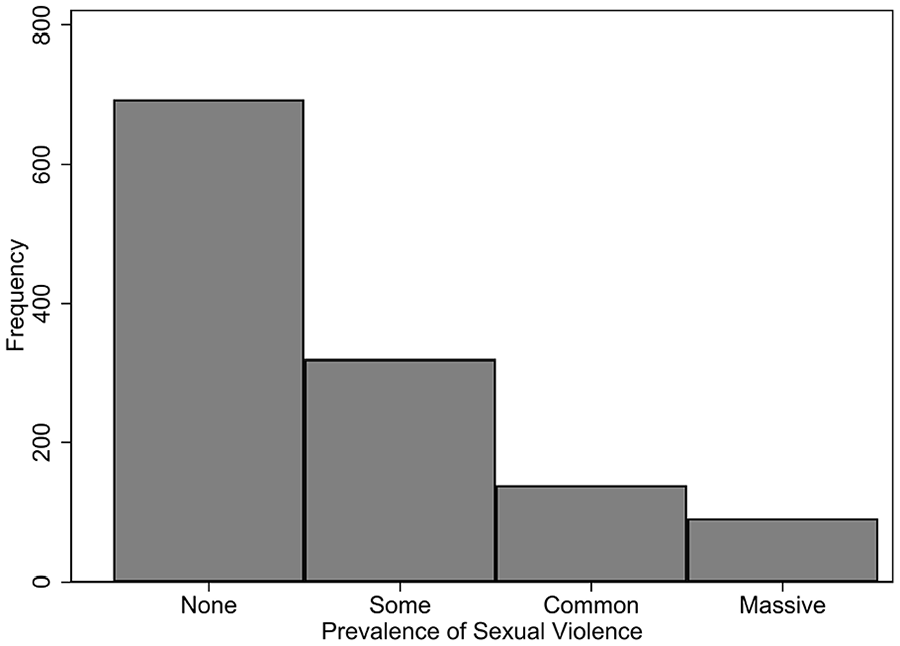
Frequency distribution of CRSV.
Independent variable: Women’s economic rights
Our theory and examples show a broad set of women’s economic rights are important for reducing CRSV. Thus, to test our hypothesis we need to utilize a composite index that captures the full range of economic rights. More specifically we require a measure that captures rights that facilitate the mechanisms outlined in our theory. Rights that permit women’s mobility – for example, whether women are allowed to travel outside the country without a man, obtain passports, choose where to live, or even travel outside their homes without a male escort – are all essential for women who flee during civil conflict. Rights that protect women in the workplace – whether they can get a job in the same way as a man, work in industry jobs, and are not subject to gender-based discrimination – shape their ability to work in less vulnerable environments. Likewise, rights to possess assets – whether women can own property, inherit assets from parents or spouses, and exercise administrative authority over assets – all determine whether women can access necessary resources to flee and find safe housing. 9 Our measure of women’s economic rights explicitly accounts for these different factors.
We measure women’s economic rights using the World Bank’s Women, Business and the Law index, which is available for all conflict years in our analysis (World Bank, 2023). 10 The index uses 35 ‘yes’ or ‘no’ questions to capture aspects of domestic laws that restrict or enable women’s economic opportunities. 11 These questions are organized into eight different categories: mobility, workplace, pay, marriage, parenthood, entrepreneurship, assets, and pension. These items are combined to produce a variable that ranges from 0 to 100; higher scores indicate better economic rights. Specifically, for each category, the proportion of items that are answered yes is calculated, and then the average is taken across all eight categories to arrive at a country’s final score each year. The score captures women’s economic rights at the start of the observation year. 12
Notably this measure captures the codification, not enforcement, of women’s rights. 13 As a result, this measure provides a conservative test of our expectations because some countries in our sample may be coded as having high levels of economic rights, but they may not be implemented in practice, leaving some women vulnerable to CRSV. Nevertheless, a growing body of evidence shows women’s formal economic rights, as measured by Women, Business, and the Law, are associated with the intended outcomes of the law such as women’s participation in the workforce (Sever, 2022), a decline in the share of women who are vulnerable workers (Lo Bue et al., 2022), and female employment at the firm level (Amin and Islam, 2022).
Importantly, there is significant variation in the women’s economic rights measure in our sample. The median score is 57, and the 10th and 90th percentiles are 33 and 75, respectively. Thus, our sample includes countries with low women’s economic rights, such as Sudan in the 1990s with a score of approximately 24, and countries with high women’s economic rights, such as the Philippines in the 2010s with a score of approximately 79. The distribution of this variable is presented in Figure 2.
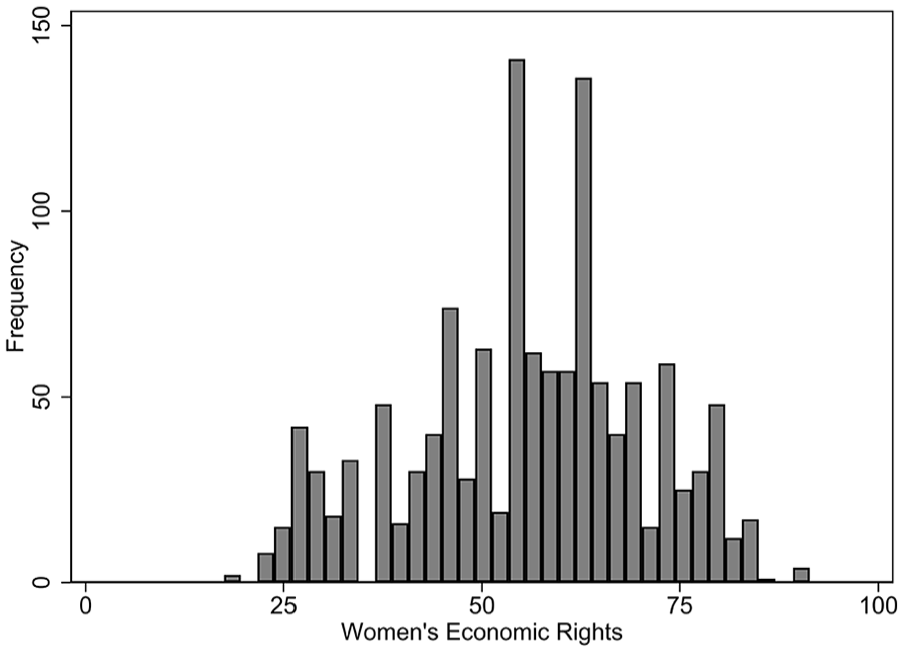
Frequency distribution of women’s economic rights.
Independent variable: Women’s political empowerment
As discussed above, we also want to estimate the relationship between women’s political empowerment and CRSV to test whether it is women’s economic rights that are key, or women’s rights more generally, and address concerns of endogeneity. To measure women’s political empowerment, we rely on V-Dem’s women’s political participation index (v2x_genpp) (Coppedge et al., 2021), which captures the extent to which women are represented in formal political positions, more specifically the percentage of women included in the legislature and assessments of women’s political power vis-à-vis men. Importantly, the variable captures features of gender equality that are distinct from our measure of women’s economic rights. 14
The V-Dem variable ranges from 0 to 1, where higher values indicate greater women’s political empowerment. As with women’s economic rights, there is significant variation in this variable in our sample, allowing us to test our claims. The median value is 0.77, and the 10th and 90th percentiles are 0.38 and 0.95, respectively. Our sample includes civil war countries with low degrees of women’s political empowerment, such as Afghanistan – prior to its new constitution in 2004 – with a score of approximately 0.17, and countries with high degrees of women’s political empowerment, such as Uganda since the mid-1990s with a score of approximately 0.97.
Control variables and estimation
To better isolate the relationship between women’s economic rights and CRSV and rule out potential alternative explanations, we include several control variables, most notably, region-fixed effects, to ensure we compare conflicts in the same region. For example, our analysis only compares the CRSV in the Democratic Republic of the Congo to other civil conflicts in Africa rather than the civil conflict in the United Kingdom or Colombia. This is important because there is significant heterogeneity in CRSV and women’s economic rights across regions, with Africa and the Middle East experiencing the highest levels of CRSV and lowest levels of women’s economic rights. Thus, we want to rule out that our results are driven by unobserved regional factors that are associated with both CRSV and women’s rights. The region-fixed effects are based on the UCDP/PRIO coding of five distinct regions: Europe, the Middle East, Asia, Africa, and the Americas (Gleditsch et al., 2002). Africa serves as our baseline category.
We also control for conflict intensity because more intense conflicts may include more CRSV. More specifically, for the annual number of battle deaths and conflict duration (Gleditsch et al., 2002; Pettersson et al., 2021).
Lastly, we control for country-specific factors. We control for whether the country is a democracy in a given year, to ensure the estimated relationship between women’s economic rights and CRSV does not capture differences between democracies and non-democracies. To code democracy we rely on V-Dem’s continuous electoral democracy index (v2x_polyarchy) (Coppedge et al., 2021). We also control for a country’s level of development using the natural log of gross domestic product (GDP) per capita to ensure differences in national wealth are not driving our results, which are also obtained from the V-Dem project.
To estimate these relationships and test our hypothesis, we use an ordinal logistic regression model, given that the dependent variable is ordinal. However, our conclusions are the same when we dichotomize CRSV and use logistic regression or maintain the ordinal variable and use OLS regression (Online Appendix Tables A11 and A12). In all our analyses, the standard errors are clustered at the conflict level to account for non-independence between conflict years within the same conflict.
Empirical results
We present the key bivariate relationship between women’s economic rights and CRSV in Table 1 and the relationship between women’s political empowerment and CRSV in Table 2. We then report models that add in the different sets of control variables. 15 This helps assess the robustness of our main findings to the inclusion and exclusion of the other variables. In our ordinal logit models, a positive coefficient estimate indicates that an increase in the explanatory variable increases the probability of observing a higher category of CRSV.
Ordered logit regressions of CRSV, 1989 to 2019.
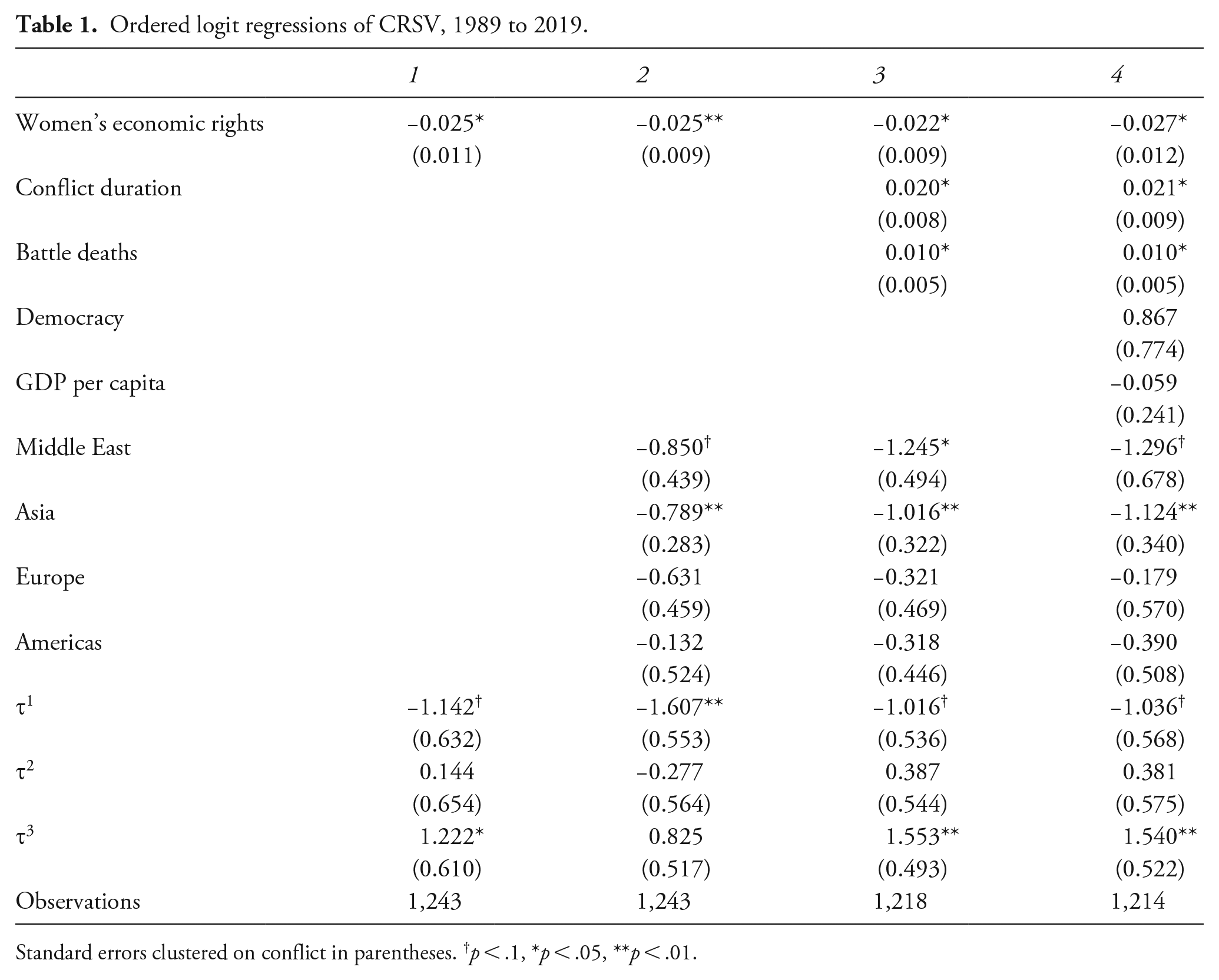
Standard errors clustered on conflict in parentheses. †p < .1, *p < .05, **p < .01.
Ordered logit regressions of CRSV, 1989 to 2019.
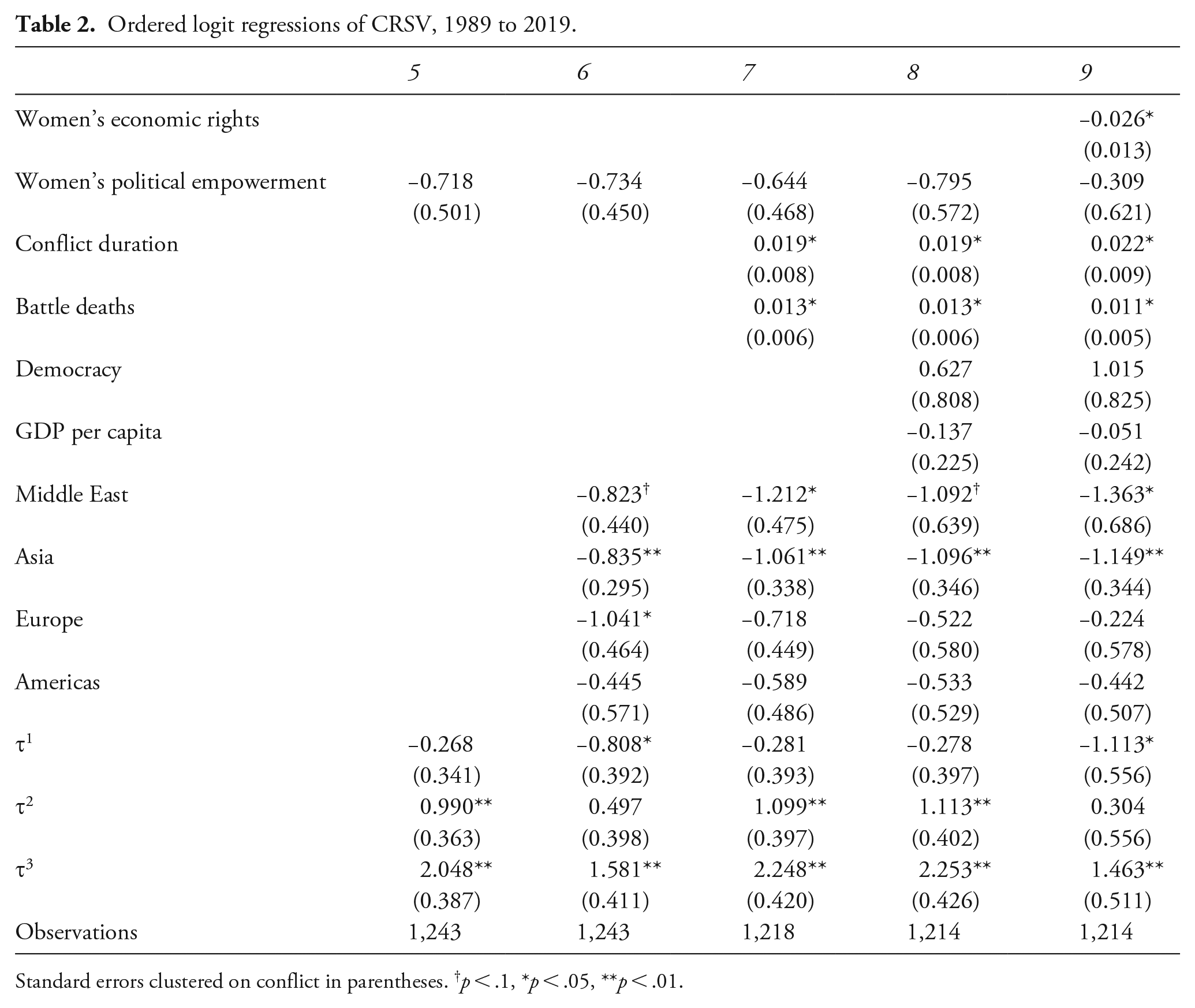
Standard errors clustered on conflict in parentheses. †p < .1, *p < .05, **p < .01.
Table 1 shows that the coefficient associated with women’s economic rights is negative and statistically significant in all models. This suggests that as women’s economic rights increase, we are less likely to observe higher levels of CRSV. Additionally, based on assessments of Akaike Information Criterion (AIC) scores, we find that adding women’s economic rights improves the explanatory power of the model. 16 To more fully evaluate our hypothesis, predicted probabilities need to be generated. More specifically, we need to assess the effect of women’s economic rights on the probability of observing each category of CRSV and gauge whether the effects are substantively meaningful. We graph these relationships from the minimum (17) value of women’s economic rights in our sample to the maximum (92). Figure 3 reports these quantities with 95% confidence intervals. 17 The estimates are based on Model 4 while the regional variables are set to the baseline category, Africa, and the other variables are held at their means.
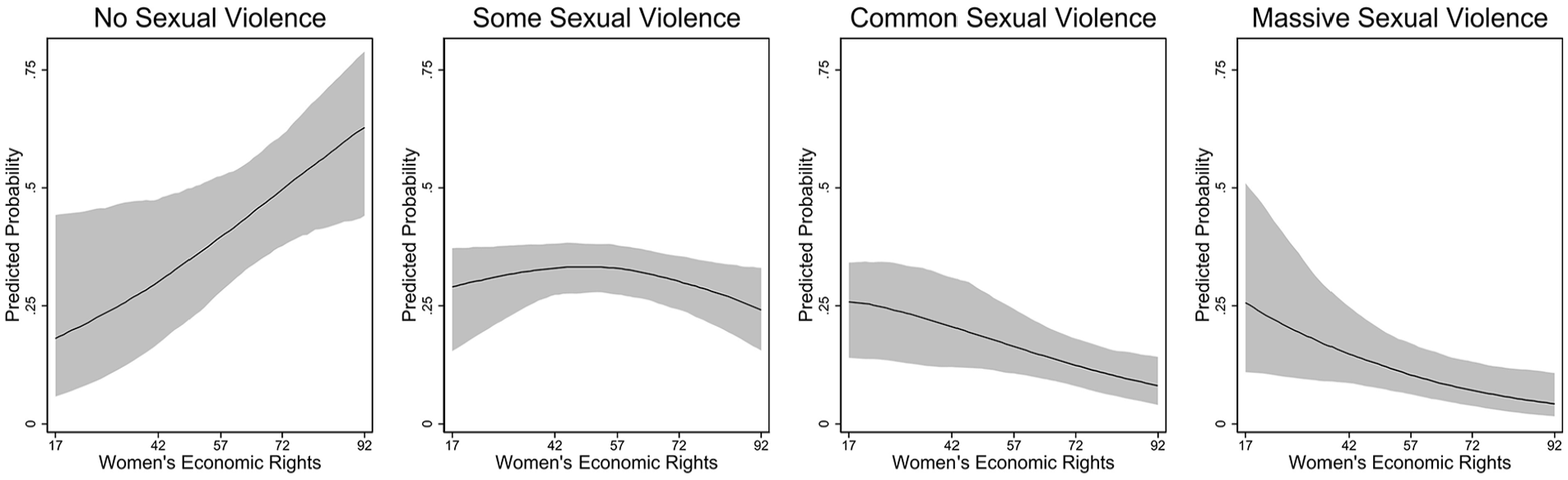
Predicted probabilities of CRSV.
Figure 3 provides strong support for our hypothesis. For example, the far-left panel in the graph shows that increases in women’s economic rights significantly increase the probability of observing no CRSV. To probe the relationship further, we compare a country with women’s economic rights one standard deviation below the median (42), such as the DRC from 2004 to 2016, to one with rights that are one standard deviation above the median (72), such as the Philippines in the early 2000s. At one standard deviation below the median of women’s economic rights, the predicted probability of observing no CRSV is 0.30. This increases to 0.50 when women’s economic rights are one standard deviation above the median, a first difference of 0.20 [0.03, 0.34], and a 67% increase in the probability of observing no CRSV.
Examining the other panels in the figure, results show that increasing women’s economic rights negatively affects observing conflicts where CRSV is common, but it has an even greater effect on the chances of observing massive amounts of CRSV. At one standard deviation below the median of women’s economic rights, the predicted probability of observing massive CRSV is 0.16. This decreases to 0.08 when women’s economic rights are one standard deviation above the median, a first difference of −0.08 [−0.17, −0.01], and a 50% decrease in the probability of observing massive CRSV.
Taken together, these results provide strong support for our hypothesis. Increases in women’s economic rights increase the probability of observing no CRSV and decrease the probability of CRSV being common or massive. What we want to establish now is whether women’s economic rights are essential to reducing CRSV or if women’s political empowerment has the same effect. We assess this in Table 2.
Table 2 shows that women’s political empowerment does not have a statistically significant relationship with CRSV in any of the models. This suggests women’s political empowerment may not be enough to restrain CRSV. It also reduces concerns that non-modeled factors, such as gender norms in a country, are driving the relationship between women’s economic rights and CRSV. Since one would also expect women’s political empowerment to be associated with broader gender norms, we would expect such factors to produce a relationship between women’s political empowerment and CRSV if these factors were driving the results. 18
In Model 9 in Table 2, we include both women’s economic rights and women’s political empowerment in the same model. This is a hard test for our hypothesis because, unsurprisingly, women’s economic rights and women’s political empowerment are highly correlated (.54). Even when controlling for women’s political empowerment, women’s economic rights continue to have a negative statistically significant effect on CRSV. Moreover, the coefficient associated with women’s political empowerment remains insignificant. The results from this model, combined with the results discussed above, provide substantial evidence that women’s economic rights decrease CRSV, and empowering women politically is insufficient for reducing CRSV.
While the lack of a relationship between women’s political empowerment and CRSV casts some doubt on the idea that unmeasured gender norms are driving the association between women’s economic rights and CRSV, we assess the sensitivity of our results to omitted variable bias more generally. Specifically, we use techniques suggested by Cinelli and Hazlett (2020) to probe the sensitivity of our main finding to potential confounders. We do this by evaluating how strongly an unmeasured confounder would have to be associated with CRSV and women’s economic rights to reduce the estimated effect to zero. We compare the effect of a hypothetical confounder to the control variables that capture the intensity of the conflict (i.e. battle deaths and conflict duration), which are strong predictors of CRSV. The sensitivity analysis indicates that the effect of an unmeasured confounder would need to be twice as strong as battle deaths or three times as strong as conflict duration to eliminate the estimated effect of women’s economic rights on CRSV (Online Appendix Figures A1 and A2). Thus, to substantially change our result, the empirical models would need to omit a far more influential factor than the theoretically and empirically important conflict intensity variables, providing us additional confidence in our conclusions.
Conclusion
Sexual violence is a pervasive feature of civil conflicts. Given the anarchic nature of war, stopping armed groups from engaging in CRSV is difficult. In this research, we argue that strengthening women’s economic rights is one strategy to shield women from CRSV. Women with greater economic rights are more likely to have the ability to safely flee dangerous war zones, be exposed to less vulnerable work environments, and have access to safe housing. An empirical analysis of civil conflicts from 1989 to 2019 supports our claims.
On the one hand, given that women in countries with limited economic rights face higher levels of CRSV, our work indicates that women’s fates are somewhat constrained owing to the economic structures in place in their society. On the other hand, our finding that increases in women’s economic rights are associated with lower levels of CRSV demonstrates that when afforded the opportunity to do so, women exercise agency to enhance their safety in periods of civil unrest. In doing so, our work provides additional evidence of women leveraging their intuitional setting to proactively respond to collective threats (Kreft, 2019).
Additionally, we find no evidence that women’s political empowerment decreases CRSV. We argue this is because governmental institutions and mechanisms of accountability lack the force needed to restrain armed groups during periods of war. This has important policy implications for groups interested in promoting women’s human rights during periods of both peace and war.
Our research indicates that if the international community wants to limit violence against women during armed conflict, it should do more to incentivize countries, especially those vulnerable to civil conflict, to improve women’s economic rights. The viability of this policy recommendation relies on women’s economic rights and CRSV being causally related. Establishing causation with observational data, however, is notoriously difficult. Recognizing this difficulty, our analysis takes several steps to isolate the effect of women’s economic rights on CRSV and assess the sensitivity of the relationship to potential confounders, all of which increase confidence in the claim that women’s economic rights play an important role in reducing CRSV.
The international community recognizes strengthening women’s rights as an important goal, even beyond the impact it might have on CRSV. In the 1995 Beijing Declaration and Platform for Action, the United Nations Commission on the Status of Women declared women’s economic empowerment, women’s political empowerment, and the elimination of violence against women as priorities. International organizations, non-profits, and countries that carry out democracy assistance have been able to influence domestic laws in developing countries to enhance women’s political empowerment, such as through encouraging the adoption of gender quotas (Bush, 2011).
Undoubtedly, these efforts have produced unprecedented improvements in women’s rights around the world, but many of these countries continue to have notoriously weak women’s economic rights. Consequently, organizations focused on reducing wartime violence against women should aim to promote women’s economic rights in the same way the international community has promoted the adoption of gender quotas and other initiatives to improve gender equality.
It is important to note that our study aggregates and examines women’s rights at the country level. Although women’s rights apply to all women, rights may be unequally enforced or implemented such that more vulnerable women in society do not experience the same level of economic rights as others and thus may be uniquely at risk of CRSV. Future research should seek to disentangle what individual-level factors make some women more vulnerable to CRSV. This can guide the design and implementation of national policies to ensure all women – not just the most privileged – can avail themselves of economic rights afforded by the law. However, future research should take care when navigating important ethical concerns associated with studying individual experiences with CRSV (González and Traunmüller, 2023).
Footnotes
Acknowledgements
We thank Dara Cohen, Jillienne Haglund, Jaclyn Johnson-Avalos, and Ashley Leeds for their generous feedback. We thank Regina Gonzalez Reyes for excellent research assistance. Earlier versions of this research were presented at the annual meeting of the Kentucky Political Science Association in 2022.
Replication data

Funding
The author(s) received no financial support for the research, authorship, and/or publication of this article.
Notes
TIFFANY D BARNES, b. 1982, PhD in Political Science (Rice University, 2012); Professor of Government, University of Texas at Austin (2024–present); Professor of Political Science, University of Kentucky (2012–24); most recent book: Working Class Inclusion (Cambridge University Press, 2023).
JESSE C JOHNSON, b. 1984, PhD in Political Science (Rice University, 2012); Associate Professor of Government, University of Texas at Austin (2024–present); current main interest: conflict and security.
ANNE MARIE MCATEE, b. 2000, BA in International Studies (University of Kentucky, 2021); Candidate for Doctor of Jurisprudence, Vanderbilt University Law School (2022–present); Authorities Editor, Vanderbilt Journal of Transnational Law (2024–present).
GARGI VYAS, b. 1994, PhD in Political Science (University of Kentucky, 2021); Assistant Professor, Creighton University (2022–present); Visiting Assistant Professor, University of Kentucky (2021–22); current main interest: economic sanction effectiveness.