




Abstract
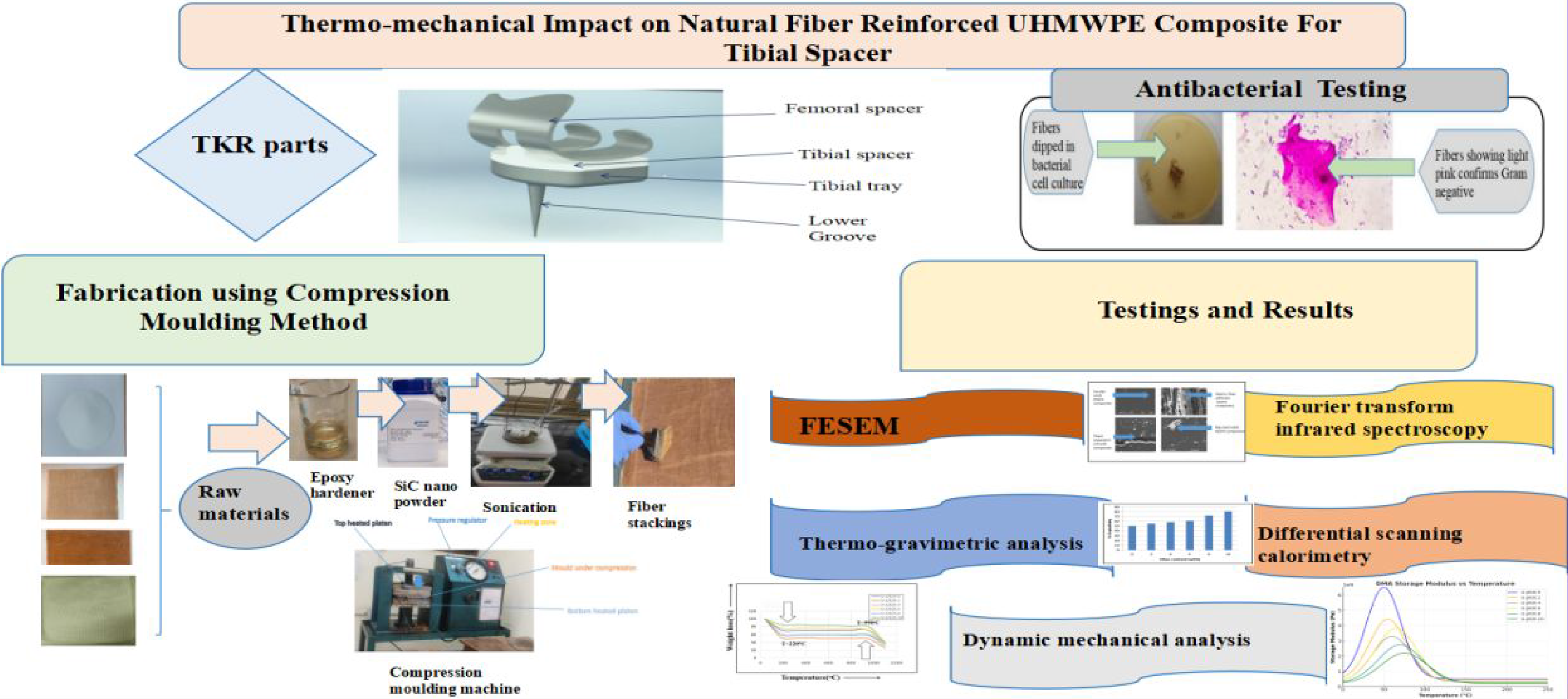
Natural fiber composites have expanded the uses of traditional technical plastics, such as polyethylene, to include a variety of biomedical implants. However, assessment of temperature-dependent mechanical characteristics is needed for knee implant applications. The comfort of knee mobility is largely dependent on the tibial spacer. The current work describes the use of compression moulding to create nano silicon carbide reinforced jute, kenaf and kevlar hybrid filled (i.e., 0, 2, 4, 6, 8, and 10 wt%) ultra high molecular weight polyethylene (UHMWPE) composite. The produced composites have shown superior inhibition against Gram staining testing, as per biocompatibility test. Thermogravimetric analysis (TGA), differential scanning calorimetry (DSC), fourier transform infrared spectroscopy (FTIR) and dynamic mechanical analysis (DMA) have all been used to analyze the thermo-mechanical nature of the suggested composites. It was found that in comparison to pure UHMWPE composite, the produced composite filled with 8 wt%,10 wt% fiber and 3 wt% n-SiC filled shown good thermo-mechanical properties. In comparison to pure UHMWPE, it demonstrates improvements of about 80% and 84.6% in storage modulus & loss modulus for 10wt% jute, kenaf and kevlar hybrid filled UHMWPE composites. The DSC data showed that melting points stayed constant but crystallization temperatures increased with a decrease in crystallinity. Thus, the test validated the composite that was suggested as a suitable replacement for metallic tibial spacer implants.
Keywords
Get full access to this article
View all access options for this article.