




Abstract
This article examines the trading structures within which UK publishers operated in the markets of Empire and Commonwealth and, in doing so, concentrates on the development there of Penguin Books. It proposes a model of this development mapped onto a movement from the colonial to the postcolonial to the globalized. A discussion of the Traditional Market Agreement 1947–1975 presents this as a significant factor in the postcolonial phase while the Penguin Africa Library acts as a case study of the specific operations of Penguin during this phase. The article concludes with an account of the transition of Penguin from independence to take-over by Pearson Longman.
Keywords
Introduction
The structures of UK publishing, and the relationships between these and overseas markets and jurisdictions, changed greatly after the Second World War. Initial representation of UK publishers by independent agencies based in overseas territories moved to the establishment of wholly owned overseas branches of UK publishers carrying out the agency functions of import and distribution and finally resulted in those overseas branches evolving beyond import to the autonomous publication of their own locally commissioned titles. This model can be mapped onto a movement from colonial to postcolonial to globalized with the qualification that a differential rate in the application of the model existed between settled (faster) and administered (slower) territories. From the 1970s, independent UK publishers increasingly merged or were taken over to create, together with their overseas branches, global transnationals. It bears some resemblance to Kenichi Ohmae’s five-stage model of globalization: the export-orientated company in stage one opens up overseas branches in stage two, before in stage three relocating production to key markets, where in stage four they create copies of the parent company to provide a full service to those markets, but these copies are then consolidated with the centre in stage five to create the globalized, transnational corporation (Ohmae, 1994). However, the three-phase movement, from agents to branches to transnational, models more effectively the development of the publishing industry (compared to pharmaceuticals or cars).
In the postcolonial phase of operation, the Traditional Market Agreement (TMA) was used by UK publishers from 1947 to 1975 to consolidate commercial control over those territories which were seeking the greater cultural and political autonomy that would eventually lead to independence, beginning with India in 1947 itself. This article uses the example of Penguin Books, at the time one of the most successful independent UK publishing companies, to explore the nature of these changes, particularly the transition from Empire to Commonwealth, and the different business and publishing strategies adopted to accommodate them. In the case of Penguin, these strategies cannot be divorced from its overall cultural mission, in particular, its emphasis upon informal education ― as opposed to the provision of school and academic textbooks for formal education. The democratization of knowledge was the more obvious goal of a number of specialist series ― Pelicans (with the key involvement of Krishna Menon), Penguin Specials, Penguin Classics, and later the Penguin Africa Library ― but was also fundamental to all of Penguin’s endeavours. This did not mean that the commercial imperative took second place to educational, cultural, and political ambitions but that the two co-existed within the company, yoked together by the stubborn vision of its founder, Allen Lane (McCleery, 2002). This did not make Penguin unique but it did place it among a minority in the publishing sector of the time.
The eventual move by Penguin into more formal educational publishing followed an agreement with the then Longmans Green for postcolonial, that is, Commonwealth, exploitation of the Penguin lists. This was supplemented by a strengthening of Penguin branches and representation in the USA, Canada, Australia, and New Zealand. However, the nature of international publishing had changed by the early 1970s in ways that Penguin, borne along by a fading post-war momentum, and with a dimming vision and dynamism on the death of Allen Lane, found it hard to adjust to. The company eventually merged with its erstwhile distributor, Longman, to form a key component of the global conglomerate, Pearson Longman. Examining Penguin over this period provides not only a specific account of its development but also represents the general position of the UK publishing industry within the wider context of international publishing, particularly its relationship to Empire/Commonwealth.
The reasons for choosing Penguin are pragmatic, in that its archive is both extensive and freely accessible, and also principled, in Penguin’s representativeness in its structural development. That choice also acknowledges the distinction that in its volume publishing Penguin took on an informal educational mission that became more institutionalized as the company sought to exploit its overseas markets. The Penguin African Library, in particular, represented an attempt to inform UK readers about a continent, the constituent countries of which, from Nigeria to the Congo to South Africa, began to dominate international headlines; while reflecting back to Africans themselves, aspects of the continent hidden from them or about which they wished to know more. However, the country focus of the essay is chiefly on the settled rather than the administered territories of Empire: that is, on Australia, Canada, New Zealand, and South Africa. These are the countries where the evolution of the publishing model from postcolonial to globalized happened more quickly. An examination of Penguin also redresses the balance in the sense that most existing discussions of postcolonial publishing focus on one publisher, Heinemann, and one set of titles, the African Writers’ Series (Low, 2002; Currey, 2003; Clarke, 2003). While the latter was obviously important, to both writers and readers, it is not representative of the course of publishing over this key period 1948–1972. Indeed, an even wider study is needed than can be offered here in focusing upon Penguin.
The Penguin mission
The formal educational mission of Penguin from the 1960s grew out of what has been recognized more generally as the integrated commercial and cultural mission of Penguin from its foundation in 1935. From the beginning, this was expressed as the concern to publish good books at low prices, specifically a mixture of the safe middle-brow such as Agatha Christie’s detective fiction with the slightly more stretching, such as Penguin no. 1, André Maurois’s Ariel – a life of Percy Shelley. The publication of non-fiction, for readers outside the formal institutions of school or university, was an organic growth of this mission and found its own distinctive branding in series such as Pelicans or Penguin Classics. The market for the former was particularly strong during the period immediately before and during the Second World War. In turn, the strength of that market provided a platform for the confident launch of the Classics series after the war. Yet the war, and some of its consequences, expected and unforeseen, changed the UK, and the international book market, utterly ― and in ways that Penguin struggled at times to cope with. By 1960 the company had moved into publications that sought to cater for both the autodidact and students at school or university. By 1964 a transition policy, and concomitant large-scale investment, had begun to move the company in a more exclusive manner into the formal education market, in the UK and overseas, where intense and unfamiliar competition forced it into a more nakedly commercial attitude.
The various stories of the origins of Penguin have been well covered elsewhere (Lewis, 2005; McCleery, 2006a). What requires emphasis here in discussion of its mission is the wider cultural context of 1935: Victor Gollancz founded the Left Book Club in the following year; and BBC Radio under Lord Reith, Director General from 1927 to 1938, was based on the public service imperative to “inform, educate and entertain” or, as a later historian was to term it rather pejoratively, “to provide cultural uplift for the lumpen masses” (Hendy, 2003: 5). Rose (2000) has demonstrated the power of the desire for learning among the working-class, and aspirant and actual middle-classes, of this period. While this informal educational market was not necessarily a popular one, it was a market that publishers and public broadcasting could serve successfully. In 1937 Pelican was started with much prompting from W.E. (Bill) Williams and Krishna Menon to provide subject-guides for the reader without access to formal education or within the context of Extension or Extra-Mural services, or the Workers’ Educational Association (founded in 1903). The Pelican series ran from 1937 to 1990 with about 2,900 titles: Kitto’s The Greeks sold 1,258,000 copies, while a supposedly more popular title like Vance Packard’s The Hidden Persuaders sold only 303,000 copies. And in the context of this journal, it might be worth noting that Evans’s Short History of English Literature sold 700,000 copies (PA: DM1294/4/2/1). The Penguin Specials were also founded in 1937 in the context of increasing awareness of the turn of events in Continental Europe. One hundred and sixty titles were produced, selling over 250,000 copies. In the immediate post-war period, Penguin Classics was established (1946). Dictionaries followed, as did Pevsner’s The Buildings of England, the Penguin Shakespeare, and the Pelican History of Art among many others. During the War itself, members of the Armed Forces had proven a vast reservoir of autodidacts, eager to read not just to pass the long periods of inactivity between short bursts of action, but also to learn in preparation for the renewed post-war Britain that was promised as their reward for victory. This was given formal force through Bill Williams’s involvement in the Army Board of Education (and indeed his post-war chairmanship of the newly established Arts Council that sought to make the best of culture available to the widest possible audience ― as Reith had been doing at the BBC) (Meredeen, 2008).
These non-fiction series sold well in the countries of Empire/Commonwealth. Even in 1938, Pelicans, with their overt didactic purpose, were outselling Penguins in India and Williams was dispatched there to investigate why this should be so (PA DM1819/27/2/6). He discovered a culture of self-improvement and a reverence for the left-wing authors found in Penguin and Pelican colours: Shaw, Wells, Cole, Haldane, and Laski. In 1951, Williams made a similar tour to Nigeria and the Gold Coast (Ghana) where he found a situation that paralleled pre-war India. The sales of Penguins and Pelicans had increased in West Africa at a higher rate than in any other territory in the immediate post-war period. This provided the impetus to establish a series of West African Penguins from 1953 under the general editorship of David Kimble, a series which eventually contained 14 titles, latterly as the Penguin African Series until its cessation in favour of the Penguin African Library. Williams joined Kimble, who was then Director of the extra-mural department of the University College of the Gold Coast, on a further tour of Ghana (Gold Coast) in 1960, during which they visited all the teacher-training colleges and spoke to groups from the People’s Educational Association (modelled on the UK Workers’ Educational Association). The demand for Penguins and Pelicans from these constituencies was very high; possible competitors such as Longman and OUP were concentrating on the formal educational, schools market that provided them, and others, with a steady and predictable turnover. Williams and Kimble took with them on their tour 1,000 copies of titles from the West African series and had sold most of them after 10 days. This evidence of sales in Africa, coupled with the increasing appearance of Africa in UK headlines, from the Sharpeville Massacre to the Biafran War, prompted the development from 1961 of the more ambitious Penguin African Library under the general editorship of Ronald Segal (titles in the series were designated by Penguin ― and here ― using the AP prefix).
Home and abroad
Penguins and Pelicans were sold in Africa through agents operating on behalf of the company; in other markets branches of the company were founded after use of agents had established and grown local demand. The company’s ability to fulfil informal educational needs in these markets led to commercial success, particularly in those countries where the company grew through the creation of autonomous publishing branches. Table 1 below (based on PA DM1663/1) gives the number of titles sold within these territories in the early 1950s.
Number of titles sold per territory
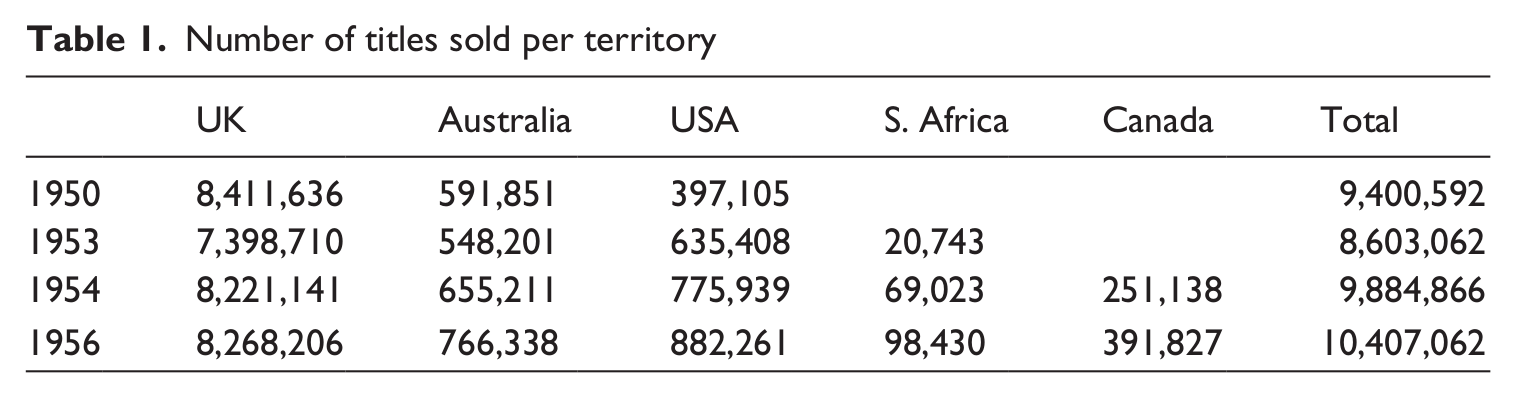
The countries represented in this table took quantities of titles published in the UK based on their own judgement of what their local market would bear and sold on to that market. The rest of the world was handled by the Export Department in the UK. So, for example, in the case of the Penguin African Library, Penguin Books Inc. (Baltimore) subscribed to 6,000 of each of the series from the UK, although, “with the exception of A Short History of Africa, this series has done only moderately well” (PA DM1107/AP13). Low sales, indeed, of the series led to the US branch declining to take South Africa: The Struggle for a Birthright by Mary Benson (AP18, 1966) and only 2,500 of African Trade Unions by Ioan Davies (AP19, 1966). Australia took very few of the Penguin African Library, perhaps indicating at best an Asian perspective, at worst an isolationist one.
The first Penguins were sold in Australia in 1935–1936 through an agent. Penguin Australia was founded in Melbourne in 1946, initially acting as an importer and distributor (a function carried out after 1970 for Longman and other Pearson imprints such as Ladybird). The market for Penguins and Pelicans in Australia grew rapidly from 1946 but it was not until 1963 that Penguin Australia began to originate its own titles. The first three ― To the Islands by Randolph Stow, Kangaroo Tales edited by Rosemary Wighton, and Three Australian Plays ― had become 30 titles six years later. Three Australian Plays had sold 240,395 copies by 1983, that figure exceeded only by Picnic at Hanging Rock: 350,097. By 1983 as well, sales of Australian-originated Penguins exceeded for the first time those of imported titles; in 1984 Penguin Australia issued 115 new titles, of which 85 were Australian originals; Australian Penguins, particularly children’s titles, were being exported to the parent company in the UK and to sister companies in the USA, Canada, and New Zealand. Penguin Australia’s profit before tax had risen from AUD$81,000 in 1966 to AUD$2,532,000 in 1984 (PA DM1294/4/5/1/9).
That same movement from agency to wholly owned importer to wholly owned publisher, mapping onto the move from a colonial through postcolonial to a globalized trading perspective, can be seen also in the development of Penguin in New Zealand. The first Penguin agent was appointed in New Zealand in 1942. Initially, books were sold in assorted gross lots with booksellers having no choice in the range of titles made available to them. In 1955 Penguin Books (NZ) Ltd was registered as a wholly owned subsidiary but remained largely dormant until 1973 with the functions of importing and distribution continuing to be handled by a succession of agents. The reason for this hiatus of almost 20 years was quite simply the personal way in which Allen Lane managed Penguin until his death in 1970: he had been to school with one of the agents and became a close friend of another when the latter was working for the British Council. In 1973, Penguin New Zealand took over the agency functions, making in that first year NZ$18,999 profit before tax, and in 1980 published the first New Zealand-originated Penguin, Beyond Reasonable Doubt by David Yallop. This non-fiction investigation of a mistrial for murder sold 45,000 copies on publication and marked the beginning of a publishing programme as successful as, though on a smaller scale than, that of Australia (PA DM1294/4/5/5/5).
The post-war exploitation of these markets was a factor not only of the type of titles Penguin was publishing but also of the Traditional Market Agreement (TMA). Trading relationships in publishing were governed by the TMA, a non-statutory concordat arrived at in 1947 between UK publishers (Bryant, 1979; De Bellaigue, 2004). Until its termination in 1975 after an Anti-Trust suit brought in the USA in 1974 in which Penguin was one of the co-defendants, the TMA divided the markets for English-language books into those that were exclusive to one or other of the UK or US editions and those that were “open” where both editions competed against one another. UK publishers tended to exercise their monopoly in those territories, with the occasional exception of Canada, which had constituted part of the former Empire, the new Commonwealth. New Zealand, South Africa and, to a greater extent, Australia, were key protected markets for the UK publishers, including Penguin. No British publisher would buy or sell rights in a particular title unless a monopoly was ceded over sales in the Traditional Market. The list below comprises those countries and territories that UK publishers regarded as their Traditional Market in 1947:
Aden
Anglo-Egyptian Sudan
Ascension
Australia
Bahamas
Barbados
Basutoland
Bermuda
British Guiana
British Honduras
British North Borneo
British Somaliland
British South-West Africa
British Togoland
Brunei
Burma
Canada
Ceylon
Cocos Island
Cyprus
Egypt
Eire
Falkland Islands
Fiji
Gambia
Gibraltar
Gold Coast (including Ashanti and N. Territories)
Great Britain (including Isle of Man and Channel Islands)
Hong Kong
India
Iraq
Jamaica (including dependencies of Cayman, Turks and Caicos Islands)
Kenya
Leeward Island
Malaya Union
Malta and Gozo
Mauritius (including Rodriguez)
Native States of India
Newfoundland (including Labrador)
New Guinea Territory and Islands
New Zealand (including Ross)
Nigeria and British Cameroons
Northern Ireland
Northern Rhodesia
Nyasaland
Pacific Islands: British Solomon Islands; Tonga; Western Samoa; Nauru Island; New Hebrides; Gilbert and Ellice Islands; Norfolk Island (Australia); Union Islands (New Zealand); Pitcairn Island
Pakistan
Palestine
Papua Territory (Australia)
Sarawak
Seychelles
Sierra Leone
Singapore
South Africa
Southern Rhodesia
St Helena
Swaziland
Tanganyika
Tasmania
Transjordan
Trinidad and Tobago
Tristan da Cunha
Uganda
Windward Islands
Zanzibar and Pamba
Contracts for the publication of specific titles would condense this list as “British Commonwealth and Empire as constituted in 1947”; or by the early 1960s as “British Commonwealth and Empire as constituted at the date of this agreement together with the Republic of South Africa, the Irish Republic, Burma, Egypt, Iraq, Israel, Jordan and the British Trusteeships with the rest of the world an open market except the USA, its dependencies and the Philippine Islands”. From the mid-1960s some UK contracts omitted Israel; while others, in the face of aggressive US competition, clarified the position of Canada by specifying “UK and Commonwealth including Canada”.
The TMA was significant because of the dependence of the UK on its overseas markets. Exports accounted for 40% of the total British books manufactured in 1961; 25% of these were destined for Australia alone (Johanson, 2000). Even after the demise of the TMA, and a consequent slump in UK exports, Australia represented 11.8% of Penguin’s turnover and New Zealand 1.6% (1984 figures) (Field, 1986). The UK domestic market is small and publishers here have always relied on strong export sales, except for those obviously committed to a niche market. The TMA protected those sales from US encroachment for the best part of 30 years. For some time, moreover, publishers could depend on a common legal framework within most of the territories specified within the TMA, in terms of both a foundation of English legal principles and practices and a tendency, even after independence, to look to precedents set in the courts of London (McCleery, 2006b). The desire of the markets in the TMA territories was increasingly for educational material, both formal textbooks and other reading that came informally into that category. By 1958, Penguin was both a very successful publisher of the latter material and needed to expand beyond a rather static domestic market.
The Penguin African Library
The West African series had given, as noted above, the company confidence that its distinctive titles would find a ready market throughout Africa (though East Africa was always seen as having less potential than other areas because of relatively low rates of literacy) (PA DM1819/1/4). The founding of the Penguin African Library not only provided the opportunity to extend the geographical scope of the titles but also to target them at UK as well as African readers. This attempt to interest UK readers gave the titles a more pronounced political note than their West African predecessors. Ronald Segal, based in London, was appointed general editor of the Penguin African Library and its first title was his own African Profiles in 1962 (AP1). Segal, who was only 29 at that point, had arrived in London with Oliver Tambo in exile after the banning of the ANC in South Africa in 1960. He re-established his journal Africa South in London as a platform for his committed anti-apartheid stance and for exploration of the challenges faced by the wider continent. One of the consequences of the political nature of the Penguin series was that a high proportion of the titles, including the first, had to be reviewed by libel lawyers. Another may have been the low take-up of the Library in the USA, as remarked above.
More generally, the series was very successful: it sold very well in India; and translation rights in individual titles were sold to German, Swedish, Italian, Japanese, and Catalan (the first for Penguin) publishers. The single largest bestseller was Oliver and Fage’s A Short History of Africa published in April 1962 (AP2). By August 1962, it had overall sales of 7,600, of which 3,600 were exported to Africa and a further 750 to South Africa, and by the following month that total had risen to 11,400. A reprint was needed. African Profiles had been banned in South Africa because Ronald Segal was a “Proscribed Author” and this provoked a concern that his name appearing as General Editor of the Penguin Africa Library on all its titles would result in a blanket ban, particularly damaging to the commercial prospects of the bestseller, A Short History of Africa. The proposal was made by Longman, Penguin’s agent in South Africa, that Segal’s name should be dropped from the reprint of A Short History of Africa and indeed from any other titles that might find a ready market in South Africa. However, the Penguin management decided to go ahead with the reprint of A Short History of Africa including Segal’s “Preface”. This was not altogether an assertion of principle as Penguin was prepared to print an edition omitting Segal specifically for the South African market if the authorities there reacted adversely to the “standard” edition. The South Africans ignored or were ignorant of Segal’s connection to the title and no special edition was required.
However, other titles in the Penguin Africa Library could not be so readily the focus of a South African blind eye. Of the eventual 42 titles in the series, four were contributed by Ruth First, another Proscribed Author in exile. Govan Mbeki’s South Africa: The Peasants’ Revolt (AP9, 1964) had been smuggled out in instalments from Robben Island, where the author was imprisoned with fellow ANC members. Penguin dispatched copies to the author’s friends in South Africa under plain wrapper from a private residential address in London. Royalties, from the print run of 25,000 priced at 3/6d, were transferred, without mention of author or book, to an equally anonymous account in a Cape Town bank. Brian Bunting’s The Rise of the South African Reich (AP12, 1964) also acted as a red rag to the Boer bull, provoking protests and requiring careful vetting for possible libels on first publication and again in an updated edition in 1969. Sales of Father Cosmas Desmond’s The Discarded People (AP32, 1971) actually increased when the author was placed under house arrest by the South African police. The final title in the series, South Africa: An Historical Introduction by Freda Troup (AP42, 1975) had already been banned in South Africa in its hardback edition so Penguin did not ask Longman to distribute the paperback there.
It should not be concluded that the Penguin Africa Library covered only South Africa, however topical and passionate an issue. The breadth of the continent was covered in the series; and these other titles also sold well. Portugal in Africa by J.P. Duffy (AP3, 1962) was a fast-seller, 11,200 copies by the end of July 1962, but not a bestseller, perhaps because the decolonization movement in Portugese Africa took a further decade to reach news headlines and television screens. East Africa: The Search for Unity by A.J. Hughes (AP11, 1963) was a steady-seller: from publication it sold 2,500 copies each year until a new edition in 1969 was produced in a print run of 15,000, with 500 going to Australia, 6,000 to the USA, and 8,500 for UK sales and export to other markets. Other titles in the series covered the Maghreb and Egypt. Nor were all polemical. Modern Poetry from Africa, edited by Gerald Moore and Ulli Beier (AP7, 1963), was sufficiently popular to be reprinted in 1968 (and 1984 and 1998). It was eventually followed by Africa in Prose edited by O. R. Dathorne and Willfried Feuser (AP24, 1969). Yet all were political in the sense that the very publication of the series was significant in its contemporary context. The titles were adopted in academic courses, particularly in anglophone Africa’s burgeoning higher education systems, and extracts were licensed for use in course readers, especially in the USA.
The success of the series resulted in unsolicited proposals arriving through the post: The Development of Modern Nigeria by O. Arikpo (AP21, 1967) and Africa in Social Change by P.C. Lloyd (AP22, 1967) were two such that were accepted and published. This may be indicative that Segal no longer exercised exclusive editorial control over the series even when his name appeared as general editor. An increasing number of titles were not original commissions but paperback reprints or revisions of existing (successful) hardbacks produced by other publishers. African Outline: A General Introduction by Paul Bohannan (AP17, 1964) was an initiative of Tony Godwin, the Penguin Managing Editor, after reading a review of the US hardback edition. Choosing titles that had proven commercial success and critical acclaim reduced the risks in publishing the paperback editions.
Home again
By 1958 the role that Penguin was playing and could play in education had led to overtures from the then Longmans Green about collaboration. The tenor of the correspondence in the Penguin Archive leaves no doubt that the latter, rather than Penguin, was the more eager suitor with most to gain from access to Penguin’s list and brand identity. For his part, Mark Longman stressed his company’s large overseas network for educational and academic publishing on a global scale: in Africa, India, the Far East, Australasia, the West Indies, and Canada (PA DM1663/2). Penguin realized the advantages of this two-fold expansion of its markets ― geographic and sectoral ― and signed, rather tentatively perhaps, an agency agreement with Longmans Green. The latter would hold Penguin stock locally in its overseas offices and pass orders to Penguin in the UK. Such stock was held on the basis of a 7.5% commission for the first year and 10% for the further four years the contract was to run. The USA, Canada, Australia, and New Zealand were initially excluded from this agreement as Penguin felt relatively secure in those territories in terms of its own representation and market intelligence. (Longmans Green would represent Penguin in South Africa.) The sales figures given in Table 1 above bolstered that sense of security. These figures also helped, however, to engender a strong sense of complacency in Penguin, a feeling that the triumphs of 1935–1950 were being perpetuated into the “New Elizabethan” age and little in terms of mission, design, or marketing needed in turn to change.
However, change came gradually to the company, and was often the source of conflict between Allen Lane and his chief managers in editorial and sales, particularly the young “whizz kids” he occasionally appointed when he thought that the “old guard” had to be kept on their toes. Tony Godwin, Managing Editor at the time of the commissioning of the Penguin African Library, was one such: appointed in 1959, dismissed in 1967. By the early 1960s, as outlined above, a more formal entry into educational publishing had been decided on: “a highly competitive and specialized area of publishing”, as Jeremy Lewis (2005: 374) notes in his magisterial biography of Lane; it represented “dangerous waters” that demanded a specialized sales force, specialist suppliers, and specialist marketing and promotion ― but seductive because it seemed to be simply an institutionalization of Penguin’s prior role in informal education. Lewis (2005: 375) also quotes 10,000 copies of the Penguin Classics edition of Vasari’s Lives of the Artists being sold in a year after its adoption as textbook by the new UK Open University. Change was in the air in education and Penguin felt it was entitled by birthright to catch the tide of expansion in the UK and overseas. It could also cash in on the growth of a self-conscious revolution in teaching methods, for example in mathematics. After all, Penguins, as has been stressed throughout this article, had always appealed to learners. A report to the Penguin Board on 17 July 1959 about markets in Australia noted that: “As one would expect, the ‘college’ type of shop tried to stock the complete range, while the popular stores, like Myers, complained about the lack of picture covers and terms” (PA DM1663/3). In the UK, by 1968, 80% of Penguin’s sales were being generated through 18% of available paperback outlets, chiefly bookshops, rather than Woolworths or CTNs (Confectioner, Tobacconist, Newsagent).
In 1964, Penguin was appointed, jointly with Longmans Green, as publisher for the Nuffield Foundation’s Science Teaching Project, providing a set of innovative teaching materials for a five-year secondary course in physics, chemistry, and biology. It had all the potential of a cash cow. However, the move into education generally had demanded an investment of £500,000. All the cows would need to be milked hard to recoup that. The Sunday Times noted at the time that the school textbook venture was “currently squeezing Penguin’s margins but should reach the break-even point next year” (that is, in 1969) (Financial Editorial, 1968). A long period of milking from 1964 to 1969 also required the maximization of overseas sales in its TMA-protected markets. And yet when Penguin transcended the divisive categories of formal and informal education, as it had done in the past, it could do so very successfully from all perspectives. This was true in the case of the first UK paperback edition of Joyce’s Ulysses, issued in 1969 under the supervision of Lane, to commemorate his 50 years in publishing. It retained traditional Penguin values such as the typographical cover; it was still a novel that had a sense of risk about it; and a deliberate decision was taken to keep the retail price at the point where it would fit the student pocket. It was promoted as an academic book. Copies of Richard Ellman’s Afterword were printed separately and circulated for free to academics and academic bookshops, the “college” type of shop noted earlier in Australia (McCleery, 2011). It was a cultural and commercial success ― as Lady Chatterley’s Lover had been and as Pelicans had been since 1937, and the other Penguin Classics since 1946. Penguin was capable of this success without sacrificing its mission. Lord of the Flies and Animal Farm sold in vast numbers to schools in the UK and overseas; the latter had sold 700,000 copies up to 1962 (PA DM1294/4/2/1). However, the move into formal educational publishing and its need to exploit overseas textbook markets put a strain on the governance and the management structures of Penguin and contributed to its loss of independence.
The end of Penguin
Penguin Books had been incorporated, distinct from the Bodley Head, as a private limited company on 15 January 1936, with all the shares held by Lane and his two brothers. In 1961 the status of the company was changed to that of a public limited company with its shares available to trade on the Stock Exchange. Lane gave two reasons for this in a memo to all Penguin staff in April 1961: firstly, “to assure, as far as is humanly possible, that the future conduct of the firm will be on the lines which we have followed since our earliest days” ― in other words, he was very conscious of the distinctive Penguin mission and wished somehow to build it into the structure of the company rather than having it depend on his personal vision or that of anyone else (such as Bill Williams); and, secondly “to protect my family after my death” through the establishment of a share-owning Trust ― a plausible and honourable motivation (PA DM1819/16). The share issue was very successful: it was oversubscribed by a factor of 150. Within a short time, the four-shilling shares were being traded in at five to seven shillings above the offer price of 12 shillings: providing to many who bought them a large instant return; and, when sold for this quick profit, enabling a consolidation of holdings that defeated the initial rationed allocation of 200 shares per applicant. Lane’s thinking here is unclear. He surely must have been aware of two consequences of this public flotation: first, that other publishers, or indeed other companies of any sort, could build up a share in Penguin (as McGraw-Hill was to do, owning eventually 17% of it) and, through that holding, influence the policies and direction of the company – Lane put a lot of faith in his own 51% holding; and that, second, the value of the shares on the Stock Market would be an intangible, but nonetheless potent, influence upon the company mission. Even small sales of shares after an unpopular or uncommercial venture could bring the share value down and inculcate a reluctance to do anything like that again. The corollary was also possible: the pressure to provide healthy dividends to keep up the share value (and the value of his children’s inheritance) would curb innovation and result in market-chasing rather than market-leading.
The merger with, or takeover by, Pearson Longman when it did take place, in a precipitate fashion after Lane’s death in 1970, was based to a great extent on chasing the formal educational market ― prefigured over a decade earlier in the initial agency agreement with Longmans Green. It was also a reaction to a threatened takeover by McGraw-Hill, the US educational and academic publisher, which, as noted earlier, had bought up 17.3% of Penguin shares on the open market as a platform for a fuller bid. (Such a takeover would have given McGraw-Hill access to the TMA-protected markets nurtured by Penguin.) Better a British corporate takeover than a North American one seemed to be the xenophobic rationale. Some of the rhetoric in support of the merger with Longman as part of the Pearson Group was hyperbolic: Christopher Dolley, then Managing Director of Penguin, and formerly manager of Penguin Education, forecast a 50% increase in company profits due to the merger, based on increased sales generated through the entry through Longman into educational publishing ― begging the question what Longman had been doing previously when the (agency) relationship with Penguin had been contractual. However, it was the sort of rhetoric designed to appeal to the anonymous figures of the Stock Market. Lord Boyle, formerly Edward Boyle, a Conservative MP, then acting Chairman of Penguin, claimed in a letter to all shareholders that the Longman deal “was the best prospect for maintaining the company’s independence, integrity and tradition for offering good reading at acceptable prices” (PA DM1819/21/3). The new company was 60% Pearson, 40% Penguin.
Conclusion
Penguin had, and was, to change after 1970 although its earlier mission echoed on and provided a form of comfort, the comfort of being perceived a national institution while, as Jeremy Lewis (2005: 402) states, it was “for better and for worse, no different from any other corporate publisher”. What had made Penguin distinctive in its list, design, and mission had gone. Penguin sought to maintain its UK market lead over other paperback publishers such as Pan ― the latter’s On Her Majesty’s Secret Service had sold initially 1,500,000 million copies but only 45% through bookshops, while Return to Peyton Place had sold 700,000 copies. Picture covers were introduced as were film and TV tie-ins; a more popular frontlist was bought and the backlist was severely pruned (McCleery, 2007).
In March 1990, on the closure of the Pelican series, a Penguin spokesman explained that Pelican was now “a bit worthy, a bit hard going” (Yates, 2006: 107). This was no longer the Penguin mission. The Pearson conglomerate now possesses global interests in educational publishing. It exemplifies the devolved and segmented model of transnational conglomerate in which branch companies operate within global markets and each pursues a particular sector. It is the epitome of a globalized rather than a post-colonial company, the phase that Penguin moved through from 1948 to 1972.
Footnotes
Acknowledgements
I would like to thank Penguin Books for permission to quote from the Penguin Archive, held at the University of Bristol, and the staff at Special Collections, University of Bristol Library, particularly Hannah Lowery, for unfailing generosity and support. I would also like to thank James McCall who read an early draft of the essay and offered sound advice. If I did not always follow it, that is my responsibility alone.
Funding
This research received no specific grant from any funding agency in the public, commercial or not-for-profit sectors.