




Abstract
This article examines private wildlife conservation in South Africa’s Eastern Cape as a contested form of climate governance that reproduces climate injustice. Drawing on qualitative interviews and focus groups with community members and reserve officials, the study applies a decolonial climate justice framework to analyse how enclosure operates under conditions of drought. The findings show that private reserves secure land, water and ecological resilience through capital-intensive adaptation strategies, while externalising climate risks to neighbouring, land-insecure communities. Conservation enclosures thus function as elite climate adaptation regimes rather than neutral land uses. The article argues for more equitable, rights-based approaches to conservation governance.
Introduction
South Africa is a country characterised by extreme income and wealth inequalities. In fact, the World Bank opines that South Africa is the most unequal country in the world, with a Gini index of 67 (World Bank, 2022). Chatterjee et al. (2022) further crystallise the situation by highlighting that The top 10 percent of South African wealth holders own more than 85 percent of household wealth, while the top 1 percent wealth share reaches 55 percent. The top 0.01 percent (about 3,500 adults) own a higher share of wealth than the bottom 90 percent as a whole (about 32 million individuals) (p. 19).
The World Bank (2022) identifies race, differences in educational and disparities in employment outcomes, respectively, as the three top drivers of inequality in South Africa. It is therefore clear that the inequalities experienced in South Africa are structurally driven. For instance, the fundamentally unequal distribution of land, stemming from historical discrimination against Black African people, is the root cause of persistent disparities in rural South Africa (World Bank, 2022). Despite three decades of land restitution and redistribution initiatives aimed at correcting this imbalance, successful land reform remains a significant challenge (Makgetla, 2020).
The persistence of extreme structural inequality provides the critical context for understanding contemporary land struggles, particularly the expansion of private conservation areas. This phenomenon is acutely visible in the Eastern Cape province, where vast tracts of rural land, often highly sought after by historically disadvantaged communities, have been converted into exclusive privately owned game reserves and conservation landscapes, legally secured through fencing, surveillance and wildlife ownership regimes (Angwenyi et al., 2021; Maphosa et al., 2025).
Drawing on Achille Mbembe’s logic of enclosure (Mbembe, 2017), we argue that this spatial conversion constitutes a ‘colonizing enclosure’ which is a form of exclusion where land is removed from the circuits of social, political and economic claims by local communities and repurposed for global ecological and financial value. These private conservation areas, while ostensibly promoting biodiversity, simultaneously reproduce historical racialised and class-based spatial segregation, effectively denying access to, and agency over, ancestral lands for productive livelihoods (Koot et al., 2022). This denial of access exacerbates the challenges faced by neighbouring communities, who are often relegated to precarious, peri-urban spaces or communal land under immense pressure.
While studies such as Koot et al. (2022) have powerfully employed Mbembe’s framework to illuminate ‘green apartheid’ and the dynamics of exclusion within the wildlife economy, our paper extends this analysis by focusing on the novel nexus of enclosure and climate justice in the Eastern Cape. To do so, the paper utilises a decolonial climate justice framework to analyse these boundaries. Existing studies have paid limited attention to how these enclosures operate as climate governance instruments that redistribute climate risks and adaptive capacity. This article advances the literature by analysing private conservation not only as a spatial and political–economic enclosure, but as an elite climate adaptation strategy that secures water, land and ecological resilience within fenced landscapes while externalising vulnerability onto neighbouring communities. By empirically tracing how drought, water access and adaptation decisions intensify enclosure at reserve boundaries, the paper contributes a climate justice perspective that extends enclosure debates beyond biodiversity and political economy alone. In doing so, the paper demonstrates that enclosure is not merely reproduced but actively intensified through climate adaptation practices, as private wildlife conservation mobilises drought, water security and resilience strategies as both justificatory and operational logics of exclusion.
In practice, these dynamics of externalised risk are manifesting through the acute environmental pressures facing the marginalised in poor rural communities of areas such as the Eastern Cape province. The Eastern Cape is already vulnerable to the effects of climate change, including prolonged droughts, shifting rainfall patterns and increased frequency of extreme weather events (Gidi et al., 2024; Mahlalela et al., 2020). These climate risks disproportionately impact the poor and landless, whose reliance on marginal land and rain-fed agriculture is increasingly untenable.
We argue that these private game reserves create a dual problem. First, they constrain the adaptive capacity of surrounding communities by limiting the adaptation space. This is enabled by their ‘land grabbing’ practises. While much of this land was already privately owned, its conversion to conservation strengthens control, excludes competing land claims and shields it from redistribution, justifying the term ‘land grabbing’. Consequently, by enclosing large, often ecologically resilient areas, they reduce the territorial options available to communities who might otherwise rely on diverse ecological resources or shift their livelihoods in response to climate stress. Second, these private reserves deepen existing vulnerabilities as the economic cum ecological enterprises they engage in tend to be exclusionary. The creation of exclusive, high-value conservation landscapes next to impoverished communities highlights the deep climate injustice inherent in South Africa’s development path. The communities most exposed to climate shocks are simultaneously excluded from the resources such as land, water, flora and fauna, which we argue could offer pathways to resilience.
This article therefore examines the specific community struggles that emerge at the contested boundaries of these privately owned conservation landscapes in the Eastern Cape. By analysing these conflicts through the conceptual lens of the logic of enclosure and climate justice, we seek to uncover how structural inequality, the legacy of land dispossession and the crisis of climate change converge to define the current reality of rural precarity. Therefore, this article is underpinned by three interrelated research questions:
How does the logic of ‘conservation enclosure’ in the Eastern Cape’s private game reserves reinforce or transform pre-existing patterns of rural livelihood precarity and land dispossession?
In what specific ways does the intersection of climate change and conservation enclosure exacerbate structural inequalities and intensify resource conflicts at the contested boundaries of these landscapes?
What are the practical and conceptual possibilities for a decolonial alternative to the current model of conservation enclosure, particularly concerning community rights, governance and the pursuit of climate justice?
In terms of organisation, after this introduction, the article proceeds to discuss in sufficient detail its key conceptual imperatives covering Achille Mbembe’s logic of enclosure, decoloniality and climate justice. Subsequently, the study’s methodological underpinnings are explained, which is followed by a presentation and discussion of findings. The article terminates with a conclusion and recommendations.
Exploring the ‘logic of enclosure’ and ‘climate justice’
Achille Mbembe’s concept of the ‘logic of enclosure’ anchors this article’s conceptualisation of the spatial conversion of land for private conservation. It moves beyond mere physical boundaries to analyse how power operates by controlling space and defining who belongs. Mbembe (2017) uses the phrase ‘logic of enclosure’ to describe the historical and philosophical mechanisms through which race has been used. This logic functions to divide and organise human populations through systematic categorisation, fix and distribute these groups by assigning them distinct positions within a social hierarchy and ultimately allocate them to impermeable spaces. This allocation confines racialised populations to separate, restrictive and unequal spaces, encompassing both material confinement and conceptual or symbolic restriction. Critically, we argue that the spatial conversion of land for private conservation replicates this logic, using environmental goals and private ownership to establish new forms of enclosure that marginalise local, often poor and indigenous, populations. Importantly, this does not imply that private conservation simply reproduces colonial relations in an unaltered form; rather, it selectively reactivates and reworks colonial spatial logics through contemporary legal, environmental and market-based mechanisms, producing new configurations of exclusion that are formally post-colonial but materially continuous with earlier regimes of dispossession. However, rather than simply validating Mbembe’s framework, this study analyses how private conservation actively strengthens these enclosures by creating a strict colonial separation between humans and non-humans. By turning wildlife into a private commodity, these enclosures reify a ‘pristine’ nature that excludes local livelihoods (Thakholi and Büscher, 2021; Thakholi and Koot, 2023).
Furthermore, the ‘logic of enclosure’ is a spatial expression of Mbembe’s broader concept of necropolitics. This is in essence the power to determine who may live and who is exposed to death or marginalisation (Mbembe, 2019). When applied to conservation, these enclosures produce ‘death-worlds’ for those excluded by restricting access to vital resources, livelihoods and ancestral lands. This process is best understood through Li’s (2010) framework of ‘To make live or let die’. In the Eastern Cape, the enclosure functions to ‘make live’ the wildlife and the high-value tourism economy, while ‘letting die’ the (ex-)farm workers who are considered a ‘surplus population’ rendered redundant by the shift from labour-intensive livestock to capital-intensive conservation. Building on these debates, scholars have shown that biodiversity conservation and wildlife tourism in South Africa are not race-neutral projects but are deeply shaped by historical and contemporary racial hierarchies. Kepe (2009) demonstrates that race continues to structure conservation governance in Africa, influencing who is excluded from land, who participates in decision-making and who benefits from conservation outcomes. He argues that conservation practices frequently reproduce colonial and apartheid spatial logics, resulting in the marginalisation of Black rural communities while privileging elite, often white, interests. Drawing more broadly on cultural critiques of space and spectacle, Ndebele’s (2006) analysis of elite consumption and spatial insulation in South Africa provides a useful lens for interpreting private conservation landscapes as curated spectacles that depend on distance from the ordinary realities of dispossession and poverty. Read together, Kepe and Ndebele illuminate how private conservation enclosures function not only as economic and ecological projects, but as racialised spaces of belonging that secure privilege through exclusion. These dynamics should therefore be understood not as the persistence of a singular colonial project, but as the uneven reassembly of racialised power through conservation, tourism and climate governance in the post-apartheid present. This application demonstrates the enduring relevance of Mbembe’s work in analysing how state and private power create segregated, unequal spaces which are not only based on race, but also on socio-economic status and environmental designation.
Several studies have shown how local communities are marginalised through ‘green grabbing’ (see Koot et al., 2022; Thakholi, 2016). This dynamic directly engages with the principles of Climate Justice. The enclosure of hitherto public spaces to advance biodiversity conservation in general and climate change mitigation in particular at a global scale constitutes a deep injustice by denying the most vulnerable populations the resources necessary for their adaptation and survival. It argues that this ‘new green apartheid’, as described by Koot et al., (2022) in the context of wildlife economies, is an injustice because it denies the most vulnerable populations access to the land and resources necessary for climate adaptation and livelihoods. As argued by Bullard (1990) in his seminal work on environmental racism, systemic inequality determines the disproportionate burden of environmental hazards, a principle extended here to argue that the burdens of climate solutions (i.e. land loss for conservation) are unfairly placed on the marginalised.
Mbembe’s logic of enclosure provides a powerful lens for interpreting the racialised and violent dimensions of contemporary conservation, yet it requires grounding in the concrete political–economic processes through which land is enclosed and value is produced. In the southern African context, these processes are most clearly articulated in the literature on farm conversions and private wildlife conservation, which traces how former livestock farms are transformed into wildlife estates through legal, infrastructural and discursive mechanisms that consolidate land control and marginalise competing claims.
The logic of enclosure, farm conversions and the rise of the South African Wildlife economy
The body of work on farm conversions and the rise of the South African wildlife economy highlights that this shift, driven by economic incentives and conservation legislation, frequently leads to the displacement of farm dwellers and the tightening of control over land. Spierenburg and Brooks (2014) provide a foundational analysis, detailing the ‘social consequences’ and the ‘contestations over wildlife, property and agrarian futures’ that arise when commercial farmers shift from livestock to game. This transition is often rationalised by claims of better economic returns, reduced labour costs and promoting ‘sustainable agriculture’ (Manyani, 2020). Manyani (2020), in her study of the arid Nama Karoo, further unpacks these motivations, finding that the switch is primarily spurred by economic factors, which, among other things, include rising production costs and market fluctuations. Pasmans and Hebinck, (2017) further conceptualise this as the ‘squeeze of conventional agriculture’, where the narrowing gap between production costs and product value forces landowners to diversify into ‘economies of scope’. In the Eastern Cape, this economic pressure drives a transition towards high-value wildlife commodities such as trophy hunting and eco-tourism, which are marketed as more resilient alternatives to traditional ranching.
However, Manyani also notes that the switch is also increasingly driven by ecological considerations, including drought management and climate change concerns. Crucially, Manyani (2020) notes that game farming remains deeply controversial: while proponents claim it promotes biodiversity and sustainable agricultural practices, critics argue it is often driven by a desire to evade land reform through the strategic manipulation of ‘conservation narratives’. This reinforces the characterisation of such conversions as a form of land consolidation and green grabbing (Büscher and Ramutsindela, 2016; Koot et al., 2022).
This process of dispossession is most vividly documented in the local ‘Cradock studies’, which collectively provide a holistic view of the structural exclusion inherent in the wildlife economy. While Zungu (2017) characterises the conversion as a form of ‘de-agrarianisation’ that severs historical socio-economic links between the land and township residents, providing virtually no ‘spin-off’ benefits for the local poor. Mkhize (2012) documents the internalised vulnerability of farm workers and dwellers. Mkhize finds that game farms are synonymous with a constant threat of evictions and precarious tenure, where dwellers often depend on the ‘grace of the employer’ rather than enforceable rights. This vulnerability is compounded by the fact that game farming often generates minimal new employment compared to the agriculture it replaces, leading to the ‘silent displacement’ of families whose labour is no longer required (Pasmans and Hebinck, 2017). The conversion to game farming in the Eastern Cape facilitates ‘social invisibility’ by re-ordering the landscape into a ‘wild’ space that renders Black farm dwellers physically and legally redundant (Brandt and Spierenburg, 2014). By erasing historical ties and labour from the land's narrative to satisfy industry aesthetics, this framing strategically delegitimises the claims of residents. Ultimately, this symbolic enclosure serves as a tool for dispossession by facilitating the eventual displacement of those remaining on the land (Brandt and Spierenburg, 2014). Consequently, the ‘hard enclosure’ of the fence is mirrored by a symbolic enclosure that closes out the local population from the socio-economic life of the region (Andrew et al., 2013). In the face of such exclusion, Pasmans and Hebinck (2017) note that ‘poaching’ often emerges as a form of social contestation, whereby local residents attempt to reclaim birthrights to natural resources and bushmeat within these commodified wilderness landscapes.
The physical and legal mechanism of this exclusion is anchored in the Game Theft Act 105 of 1991. This Act fundamentally altered the legal status of wildlife in South Africa by establishing that ownership of game is not lost even if the animals escape, provided the land is ‘sufficiently enclosed’. The 1991 Act made the physical fence a legal requirement for property rights, formalising what Büscher and Thakholi (2024) describe as ‘hard enclosure’. In practice, this enclosure begins with the statutory requirement of a 2.1 metre-high fence, a prerequisite for obtaining a ‘Certificate of Adequate Enclosure’. This certificate is essential for landowners to legally claim, trade and manage wildlife as private property. Furthermore, regulations mandate that these fences be electrified if the owner stocks ‘dangerous’ wildlife, effectively creating a high-security barrier that signals the transition from a shared agrarian landscape to a securitised conservation enclave (Büscher and Thakholi, 2024; Spierenburg and Brooks, 2014). As Pasmans and Hebinck (2017) observe, this process of ‘fencenization’ represents a radical break from the past; it terminates the historical ‘co-evolution’ of commercial and communal farming, where neighbours might once have shared grazing or breeding stock, and replaces it with an absolute barrier that prioritises the protection of high-value private property over local livelihood needs.
The Act has been amended several times to adjust its implementation and enforcement. The Justice Laws Rationalisation Act 18 of 1996 served a primarily administrative role by extending the Act’s application across the entire national territory of South Africa (Republic of South Africa, 1996). Subsequently, the Judicial Matters Amendment Act 62 of 2000 introduced technical updates to the sentencing regime, specifically amending Section 6 to align penalties for game theft with those found in the Magistrates’ Courts Act, including fines and imprisonment for up to 15 years (Republic of South Africa, 2000). While these were procedural adjustments, a more material shift occurred through Proclamation R46 of 2011, which transferred the administration of the Act to the Cabinet member responsible for policing (Republic of South Africa, 2011). This amendment has a significant effect on the conservation landscape as it signals the securitisation of the wildlife economy. By integrating the protection of private wildlife property into the national policing apparatus, the state effectively reinforces the logic of enclosure through sanctioned enforcement.
This securitised enclosure has profound implications for resource distribution. Marcatelli’s body of work provides a critical empirical link between land property and water access. Marcatelli (2018) identifies a ‘land–water nexus’ in South Africa, where access to water remains fundamentally dependent on land ownership and property relations. She argues that post-apartheid water reforms have inadvertently strengthened this nexus, allowing private nature conservation to tighten its control over water for the purposes of capital accumulation. Furthermore, Marcatelli (2015) illustrates how the transition to a ‘green economy’, which is often framed as a sustainable alternative to livestock farming, effectively functions to ‘suspend’ the redistribution of resources. In this context, conservation becomes a tool that legitimises continued white control over water while surrounding communities face increasing scarcity. Ultimately, Marcatelli and Büscher (2019) conceptualise this structural exclusion as ‘liquid violence’, where the ‘naturalisation’ of resource inequality results in the physical and social dispossession of (ex-)farm workers who are forced to rely on precarious municipal supplies while abundant water remains locked behind the reserve’s ‘hard enclosure’. Furthermore, the ‘logic of enclosure’ is not maintained solely through physical barriers, but through a paternalistic governance that Ekeland, (2022) theorises as the ‘ambiguous parcel’. Drawing on ethnographic work in a rural Eastern Cape of Alexandra, Ekeland argues that private food aid provided by local elites, including game farm owners, often generates community tension because it undermines the dignity of the recipients. Unlike state assistance, which is viewed as a ‘rightful share’ and a matter of citizenship, local private charity is perceived as ‘intimate’. This intimacy carries a high risk of public humiliation and future indebtedness to the very landowners responsible for the community’s spatial and economic exclusion. Within this framework, charity does not dismantle the enclosure; rather, it reinforces the paternalistic dependency that characterises the post-colonial present, making survival contingent on the ‘grace’ of the encloser rather than on enforceable rights (Ekeland, 2022).
This practice violates the tenets of distributive Justice by failing to share climate benefits and burdens equitably. Distributive justice in the context of climate change is defined by two fundamental fairness problems: the Just Target Question, which is about striking a fair balance between the harm caused by climatic changes and the difficulty of the policies needed to prevent them, and the Just Burden Question, which concerns how the financial and social costs of combating climate change should be fairly shared among countries and individuals (Caney, 2018).
Beyond violating the principles of distributive justice, the burdens of climate solutions which are disproportionately carried by the marginalised also violate the other critical components of climate justice which are procedural and recognitional justice (Schlosberg, 2007). These two are violated by excluding communities from meaningful participation in land-use decisions and ignoring their traditional ecological knowledge and rights. This omission highlights the need for a framework that moves beyond institutional or liberal definitions of justice. As Sultana (2022) theorises, climate justice must be understood as an ‘embodied lived reality’ of ongoing coloniality. In the Eastern Cape, ‘biodiversity conservation’ and ‘climate change mitigation’ are not merely ecological goals; they function as the moral justifications for ‘green grabbing’. By framing private land as a ‘global carbon sink’ or a ‘biodiversity hotspot’, landowners legitimise the exclusion of local communities, effectively using the language of climate urgency to hedge against land reform and consolidate private control (Andrew et al., 2013; Sultana, 2022). A decolonial climate justice lens, therefore, reveals that these enclosures are not just spatial boundaries, but mechanisms that redistribute climate vulnerability along historical racial and class lines. Thus, Mbembe’s framework provides the critical lens to analyse how contemporary conservation practices perpetuate the historical marginalisation that Climate Justice seeks to dismantle.
Decoloniality and the perpetuation of coloniality
This paper adopts a decolonial perspective to frame the enduring nature of these injustices. Decoloniality insists that the logic of enclosure is a material expression of coloniality – the ongoing, unaddressed systems of power, knowledge and being that persist beyond formal political independence (Mignolo, 2011; Ndlovu-Gatsheni, 2020; Quijano, 2000). The imposition of Western-derived, exclusionary conservation models, which prioritise fortresses and separating man from nature, represents a coloniality of knowledge, systematically overriding the context-specific knowledge systems and self-determination of local land users (Chilisa, 2017). Some scholars have argued that settler and colonial systems disturb Indigenous peoples’ capacity to adapt to climate change, rendering them perpetually vulnerable (Whyte, 2018). To address this challenge, some scholars have argued for genuine decolonial ecology, which they opine is one that confronts the historical violence of colonial capitalism as the root cause of the crisis, not merely its environmental symptoms (Ferdinand, 2022). The analysis, therefore, moves beyond simply critiquing the current effects of green grabbing to exposing its colonial lineage, asserting that a just solution requires the fundamental dis-enclosure of space and power to restore epistemic and territorial sovereignty to the marginalised.
To conclude this section, the theoretical framework provides the scaffolding necessary to interrogate the ‘decolonisation of enclosures’. By applying Mbembe’s ‘logic of enclosure’, we diagnose private conservation not merely as a land-use shift, but as a spatial expression of necropolitics that reproduces racialised ‘death-worlds’ through resource dispossession. This diagnostic informs a climate justice critique, framing the Eastern Cape’s conservation landscape as a violation of distributive, procedural and recognitional fairness; here, the ‘green’ transition functions as a ‘new apartheid’ that shifts the burden of climate mitigation onto the most vulnerable. Ultimately, decoloniality serves as the overarching lens, asserting that these injustices are symptoms of an enduring coloniality of power and knowledge. Together, these tools reveal that a just transition requires more than policy reform; it demands a fundamental ‘dis-enclosure’ of space and power to restore territorial sovereignty and achieve genuine climate justice.
Materials and methods
Research approach and epistemological orientation
This study adopts a qualitative interpretivist research approach to examine how communities living adjacent to privately owned conservation landscapes experience enclosure, livelihood change and climate stress. An interpretivist approach is appropriate because the study is concerned with meaning-making, lived experience and locally grounded interpretations of power, exclusion and adaptation. The analysis focuses on how enclosure and climate change are experienced, narrated and contested by different actors, including community members, community leaders and reserve officials within historically unequal rural landscapes.
Study area and research context
The study was conducted in the Makana Local Municipality in the Eastern Cape Province of South Africa, focusing on the communities of Kraabos, Seven Fountains and Alicedale. This region has undergone a profound socio-ecological transformation over the past three decades, marked by the large-scale conversion of commercial livestock farms into privately owned wildlife and tourism reserves. This process has accelerated since the late 1990s and early 2000s and has resulted in land consolidation, intensified fencing and the reconfiguration of agrarian livelihoods, particularly for former farm dwellers and land-poor rural households (Spierenburg and Brooks (2014)).
The expansion of private game reserves such as Lalibela and Amakhala reflects broader structural shifts in the Eastern Cape’s rural economy, including declining profitability of extensive livestock farming, increased exposure to climatic variability and the growing attractiveness of wildlife-based tourism and conservation as alternative land uses (Mkhize, 2012; Zungu, 2017). While these transitions have generated new revenue streams for landowners and investors, they have simultaneously displaced labour, restricted access to land and water and intensified livelihood precarity among neighbouring communities.
The study area is also characterised by acute vulnerability to climate change, particularly recurrent and prolonged droughts that have severely affected agricultural productivity, surface water availability and household food security. Recent studies document how drought conditions in the Eastern Cape disproportionately affect already marginalised rural populations, who rely on insecure water infrastructure, social grants and informal livelihoods to cope with climatic stress (Effossou et al., 2025; Maphosa et al., 2025).
Kraabos and Seven Fountains function as the immediate ‘frontiers’ of the conservation enclosure. Characterised by informal housing and a profound lack of basic service delivery, these settlements are inhabited largely by former farm workers and their descendants, a population rendered ‘superfluous’ by the transition from labour-intensive livestock farming to capital-intensive wildlife tourism. The spatial proximity of Kraabos to the conservation enclosure is particularly stark; the settlement is located just one kilometre from the Amakhala Game Reserve reception and approximately three kilometres from the N2 highway. This immediate physical closeness highlights a significant geographic paradox, as the community remains structurally excluded from the regional economy despite its location. Similarly, Seven Fountains is situated approximately five kilometres from the Lalibela Game Reserve. In both instances, these short distances underscore a rigid spatial divide where marginalised, land-insecure communities exist in the immediate shadow of high-end private conservation estates yet are separated from the resources and economic life within the fence. Although the Extension of Security of Tenure Act (ESTA) was introduced to protect farm dwellers from arbitrary eviction, it has provided limited protection in this context (Brandt and Spierenburg, 2014). In the Eastern Cape, farm conversion to private wildlife conservation has often enabled displacement through indirect mechanisms rather than formal eviction processes. These include the termination of employment-linked residence, withdrawal of housing and basic services, pressure to relocate and the reclassification of land following conversion (Mkhize, 2012).
Alicedale, while physically more distant as it is located approximately 35 kilometres from the Lalibela entrance, represents a different dimension of the enclosure’s reach. As a semi-rural settlement, it possesses comparatively better housing infrastructure and established township services; however, this veneer of stability masks a ‘chronic economic marginalisation’. The community’s historical link to the land has been severed, leaving residents dependent on seasonal, low-wage employment as trackers, cleaners or security guards within the reserves (Maphosa et al., 2025).
Collectively, these sites are spaces where historical land dispossession is not merely a memory, but an ongoing reality enforced by the 2.1 metre electrified ‘hard enclosure’ of the game reserves. These settlements therefore represent the material manifestation of the ‘logic of enclosure’, where the protection of high-value biodiversity is achieved through the systematic exclusion and ‘letting die’ of the local poor.
The selection of Lalibela and Amakhala Game Reserves as primary study sites was purposive, as both exemplify the ‘profound socio-ecological transformation’ characterising the Eastern Cape’s shift from agrarian production to high-end wildlife tourism. These reserves are not merely ecological spaces but represent a ‘strategic enclosure’ of land. While Amakhala officially frames its history as a conservation initiative by descendants of 1820 British settlers seeking to restore the Zuurveld’s natural heritage, this ‘return to nature’ was precipitated by the severe droughts of the 1990s (Amakhala Game Reserve, n.d.). The transition from sheep and cattle ranching to a unified 8500 hectare wildlife estate was an economic pivot that transformed a shared agrarian landscape into a securitised enclosure. This process effectively severed the historical socio-economic ties of the local Black population, whose presence on the land was erased in favour of a curated ‘wild’ spectacle for tourism. Relatedly, Lalibela Game Reserve serves as a particularly stark example of wildlife commodification; the reserve is currently engaged in a substantial ‘ecosystem reset’ initiative, which involves the expansion of protected wilderness through the acquisition and rehabilitation of former agricultural lands, including specialised peach and prune farms (Design News, 2025).
These reserves are particularly well-suited for this study due to their stark spatial proximity to multiple land-insecure communities, creating a ‘contested commoning’ landscape where elite conservation and extreme poverty coexist. Lalibela, for instance, was acquired approximately 6 to 7 years ago from private farmers who had already initiated a history of displacement by removing former labour tenants. The site selection highlights a ‘New Green Apartheid’ dynamic: while the reserves are multi-million-dollar assets that secure their own resilience, the adjacent communities face high unemployment rates and limited access to natural resources.
Access to communities was facilitated through local municipal structures and community leadership, who assisted in introducing the research team and identifying participants. Access to reserve officials was negotiated directly with reserve management. Participation across all sites was voluntary.
Participant selection and sampling strategy
A total of 63 participants were selected using a maximum variation sampling strategy, designed to capture diverse experiences and perspectives across social position, livelihood status, age and institutional affiliation. This approach was appropriate given the study’s aim of examining how conservation enclosure and climate stress are differentially experienced across the fence.
The sample included community members (n = 58) drawn from Kraabos, Seven Fountains and Alicedale. Participants comprised former farm dwellers with long-standing historical ties to the land, elderly residents with lived experience of farm conversion, youth facing limited employment opportunities and small-scale livestock owners navigating declining access to grazing and water. This diversity allowed the study to capture intra-community differentiation, including varying degrees of dependence on conservation employment and social grants.
To capture the perspective of the enclosers, the study also included reserve managers and conservation officials (n = 5) from Lalibela and Amakhala. These participants were selected based on their involvement in land management, conservation decision-making, water security strategies and community relations. Including both community and reserve actors enabled a relational analysis of how enclosure is enacted, justified and contested.
Sampling continued until thematic saturation was reached, meaning that additional interviews yielded no substantively new insights. Practical considerations, including time and access constraints, also informed the final sample size, consistent with qualitative research standards (Lakens, 2022).
Data collection: focus groups and interviews
Primary data were collected through Focus Group Discussions (FGDs) and semi-structured interviews. The FGDs, conducted with community members in Kraabos and Seven Fountains, were designed to capture collective narratives of displacement, shared experiences of climate stress and communal responses to the restrictive presence of the reserves. The semi-structured interviews provided a space for more detailed, personal accounts of life before and after enclosure, particularly regarding the loss of access to ancestral sites and the challenges of sustaining livelihoods under conditions of surveillance. Interviews with reserve officials focused on management priorities, water security strategies and the formal protocols governing community relations. This combination of methods ensured that the data captured both the broad social impacts of enclosure and the specific, often emotional, nuances of individual lived experiences.
Data analysis: thematic interpretive analysis
Data were analysed using thematic interpretive analysis. Transcripts were read iteratively to identify recurring patterns, contradictions and points of tension across participant narratives. Coding was both inductive, allowing themes to emerge from the data, and theoretically informed, guided by concepts such as enclosure, exclusion and climate justice. Rather than treating interview excerpts as direct representations of reality, the analysis interprets them as situated accounts shaped by power relations, historical experience and material conditions. Particular attention was paid to the differences between community and reserve narratives, the silences and hesitations in accounts of eviction and dependency and how climate change is framed as either an ecological concern or a lived survival issue. This approach responds directly to reviewer concerns about limited ethnographic depth by foregrounding relational dynamics and internal contradictions, rather than relying on isolated illustrative quotes.
Ethical considerations
Ethical clearance was obtained from the University of Fort Hare Inter-Faculty Human Research Ethics Committee (Approval No. EFF001-25). All participants provided informed consent and were assured of confidentiality and anonymity. Pseudonyms are used throughout the paper, and identifying details have been removed to protect participants, particularly given the sensitive nature of land relations and employment dependency in the region.
Results
The findings presented here emerge from interviews and FGDs conducted across the Kraabos, Seven Fountains and Alicedale communities neighbouring the privately owned conservation landscapes of Lalibela and Amakhala. These perspectives are juxtaposed with insights from reserve officials to highlight the divergent lived realities at the conservation frontier. Four interrelated themes are identified: (1) spatial exclusion and the policing of kinship, (2) the role of digital surveillance in criminalising livelihoods, (3) exclusionary economics and the limitations of tokenistic charity and (4) compounded climate vulnerability and the aspirations for decolonial alternatives.
Living with the fence: enclosure, surveillance and kinship policing
Across the three communities, the private conservation reserves have imposed a rigid, surveilled spatial order that fundamentally restricts historical rights and freedoms. The conversion of vast tracts of land into private estates was experienced by communities not as a consultative process, but as an act of dispossession and forced change. As a community member in Seven Fountains recounted: ‘As far as I know, we were not consulted directly. We were living here and were informed about it, but I don’t think we had much say in the process’ (Interviewee #5). This lack of involvement was echoed in Alicedale, where another resident noted that while farms were being converted, ‘there was no involvement of us in that process. We were told that we should no longer walk in the forest’ (Interviewee #3). This transition often precipitated forced displacement and acute vulnerability, leading to the creation of informal settlements where, as one community leader observed, people suddenly evicted without compensation struggle to find stable housing. Furthermore, for those who remain, tenure precarity persists; in Kraabos, residents explained that while they are allowed to reside in certain areas, management refuses to issue title deeds, opting instead to lease the land back to the community.
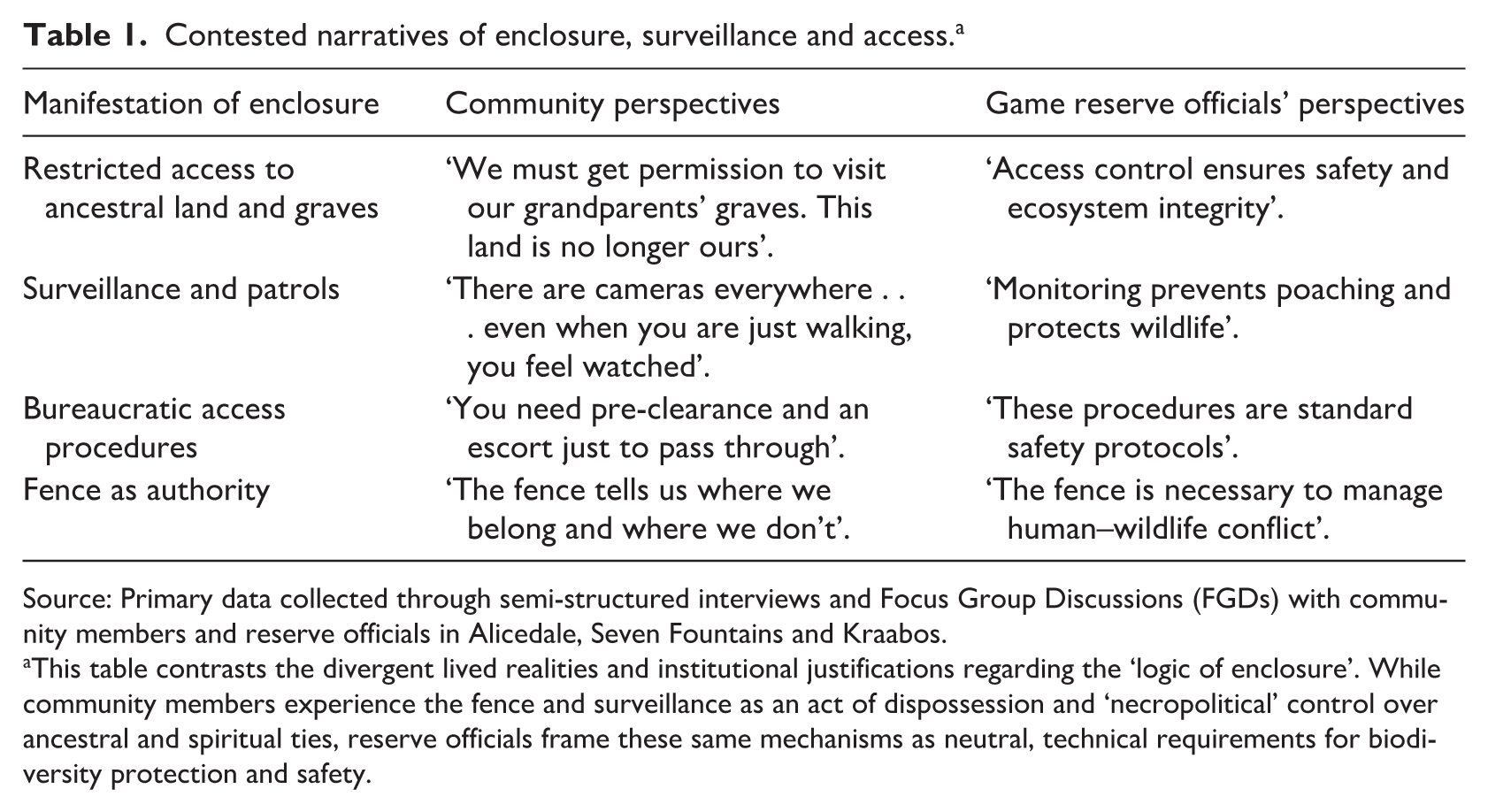
This newly enclosed space is maintained by an intense system of bureaucratic control and physical barriers that transform ancestral rights into monitored permissions. As illustrated in Table 1, a profound disconnect exists between the lived experience of residents and the strategic rationale of reserve management. While community members observe that ‘the fence tells us where we belong and where we don’t’, reserve officials frame the same structure as a neutral tool ‘necessary to manage human–wildlife conflict’. This ‘authority of the fence’ effectively replaces historical freedoms with a regime of authorisation. One long-term resident explained that where they were once free to visit family on the land, they now face a humiliating process: ‘My uncle has to report first and get pre-clearance and then there would be a detective accompanying you and it has to be stated the duration you will stay. Before those things didn’t happen’ (Interviewee #1, Alicedale).
Contested narratives of enclosure, surveillance and access. a
Source: Primary data collected through semi-structured interviews and Focus Group Discussions (FGDs) with community members and reserve officials in Alicedale, Seven Fountains and Kraabos.
This table contrasts the divergent lived realities and institutional justifications regarding the ‘logic of enclosure’. While community members experience the fence and surveillance as an act of dispossession and ‘necropolitical’ control over ancestral and spiritual ties, reserve officials frame these same mechanisms as neutral, technical requirements for biodiversity protection and safety.
The enclosure further denies access to vital resources like firewood and medicinal plants, enforced not just by physical guards but by modern digital surveillance. Table 1 highlights the community’s perception that ‘there are cameras everywhere’, a sentiment reinforced by participants who noted that resource collection has become a controlled, surveilled process. Even when access to the forest is granted for firewood, residents report being monitored by drones. While reserve officials justify these patrols by stating that ‘monitoring prevents poaching and protects wildlife’, the technological gaze heightens the sense of exclusion and renders ordinary survival activities visible and potentially criminal.
This spatial control extends with particular tragedy into the spiritual realm through restricted access to ancestral graves. Accessing these sites for ritual and remembrance is subject to the same bureaucratic escorts as any other visit, a requirement residents narrate as a fracture of the bond between the living and the dead. An elder community member expressed the profound distress of having to ask permission from ‘a young man who wasn’t born here’ to speak to grandparents lying inside the fence (Interviewee #9, Alicedale). While officials justify these restrictions as essential to ‘ensure safety and ecosystem integrity’ and to maintain the ‘exclusive viewing experience’ for international guests (Table 1), the community perceives this as a closure of the gates to their past. As one resident concluded, the land has become a place where even the dead are guarded by private owners, making it impossible to maintain a traditional life when the graves of ancestors are held behind a high-premium, securitised barrier.
Climate stress amplifies these dynamics. During drought periods, wildlife movements into settlements increase, intensifying encounters at the fence line. Some residents interpreted these incidents as evidence that conservation prioritises animals over people, while others, especially those linked to reserve employment expressed reluctance to report breaches for fear of blame or job loss. Together, these accounts show enclosure as an ongoing, negotiated process shaped by dependence, fear and uneven power.
Exclusionary economics and tokenistic benefits
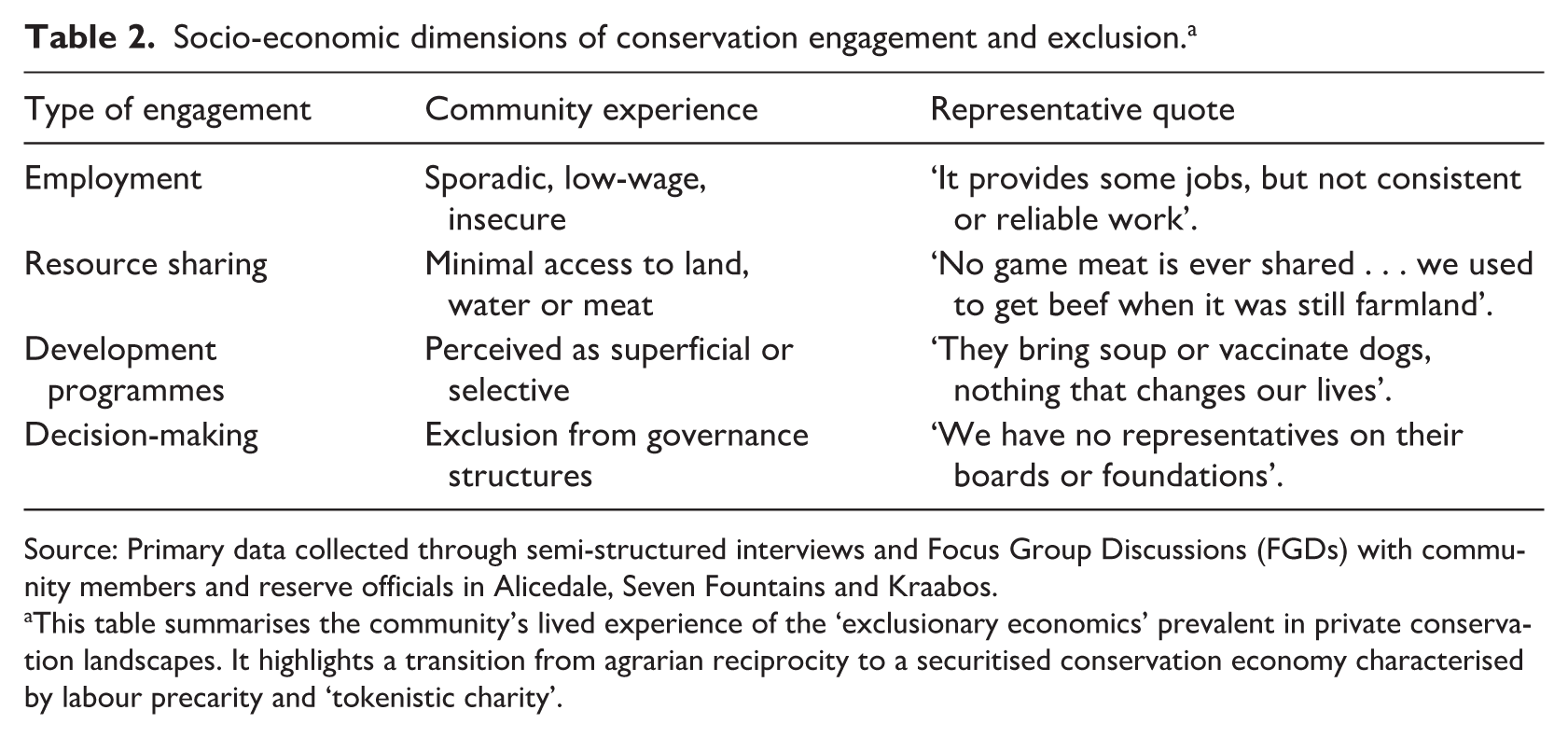
Livelihoods emerged as a central axis along which experiences of enclosure diverge. Employment within reserves provides income in a context of high unemployment, yet it simultaneously functions as a disciplining mechanism. Participants employed directly or indirectly by reserves often emphasised gratitude and pragmatism, noting that ‘there are no other jobs here’. However, as Table 2 illustrates, this employment is frequently experienced as ‘sporadic, low-wage and insecure’, with one resident from Kraabos observing that ‘it [Amakhala game reserve] provides some jobs, but not consistent or reliable work’ (Interviewee 31). This economic model is fundamentally exclusionary, concentrating benefits among a select few while the overall impact on the wider community remains marginal or non-existent. As an interviewee from Seven Fountains summarised: ‘Honestly, no, not really. It’s not active in supporting us directly . . . for those who don’t work there, I’m not sure if there’s much benefit at all’ (Interviewee #4). In contrast, reserve management views these same opportunities as vital economic contributions, framing the reserves as primary engines of regional development. Reserve officials emphasise that they are ‘providing jobs and economic opportunities’ in a depressed labour market, maintaining that their professional management of private assets is the most viable path for ‘long-term sustainability’ (Key Informant #1).
Socio-economic dimensions of conservation engagement and exclusion. a
Source: Primary data collected through semi-structured interviews and Focus Group Discussions (FGDs) with community members and reserve officials in Alicedale, Seven Fountains and Kraabos.
This table summarises the community’s lived experience of the ‘exclusionary economics’ prevalent in private conservation landscapes. It highlights a transition from agrarian reciprocity to a securitised conservation economy characterised by labour precarity and ‘tokenistic charity’.
The conversion of farms into reserves eliminated historical access to land and livestock, removing traditional livelihood sources and norms of resource sharing. Participants contrasted the current exclusion with the ‘cattle farm’ era, where farmers provided beef at the end of the year as a standard practice. An FGD participant in Kraabos lamented that while game reserve owners promised to provide animals to prevent hunting, ‘that was not honoured’ (Table 2). This shift represents a regression from agrarian reciprocity to a restrictive conservation economy where, as noted through the findings, ‘no game meat is ever shared’. Reserve officials justify this change by prioritising the protection of wildlife for ‘tourism sustainability’ and ‘ecosystem management’, arguing that unmonitored resource extraction or livestock presence would disrupt animal behaviour and the ‘exclusive viewing experience’ they provide to international guests (Key Informant #2).
The ‘support’ provided by the reserves is frequently narrated as superficial or tokenistic charity rather than structural empowerment. Examples of this racialised paternalism include reserve staff coming to the township to ‘sell their unwanted second-hand goods’ or providing services that arguably serve the reserve’s own interests, such as vaccinating local pets to protect animal health. While management emphasises development programmes like bursaries or ‘soup kitchens’, community members perceive these as symbolic gestures: ‘They bring soup or vaccinate dogs, nothing that changes our lives’ (Table 2). From the perspective of the officials, however, these initiatives are presented as robust community development and bursary programmes intended to foster social upliftment and environmental education.
This dependence is further entrenched by the systemic denial of land tenure. The absence of title deeds for community land, where management prefers to ‘lease the land to us’ prevents residents from accessing state housing or loans, perpetuating a cycle of insecurity. The total exclusion from decision-making, where residents have ‘no representatives on their [game reserves] boards or foundations’ (Table 2), ensures that the conservation economy produces survival for a few but structural subordination for the many. While officials defend these structures as necessary for the ‘professional management of private assets’, this tension underscores how private conservation landscapes act as barriers to both economic sovereignty and climate justice.
Compounded vulnerability and resource denial
The conservation enclosures exacerbate local vulnerability to climate stress by curtailing access to land, water and ecological resources vital for adaptation. Participants described worsening drought conditions, unreliable municipal water supply and the growing inequality between reserves and neighbouring communities. This intersection of climate stress and enclosure governance creates a severe violation of distributive justice, as the enclosure effectively transfers climate risk onto the community while reserving adaptive infrastructure for the private estate.
The most pressing impact on the community is the exacerbation of water scarcity and the resulting increase in human–wildlife conflict. Residents of Alicedale and Seven Fountains reported a growing disparity in access compared to the reserves. A Community Leader from Alicedale highlighted the impact of drought, stating: ‘Water scarcity is a major issue for us. Sometimes, we only receive water every two days . . . We are often reliant on the department for water supply, but they are not always responsive’. This water insecurity is directly linked to the prioritisation of infrastructure within the reserves: ‘The conservation area has water sources, and they’re able to manage better because they have boreholes’ (Interviewee #11, Alicedale).
Community members also expressed fear over wildlife encroachment during drought, recounting incidents where animals roamed near settlements in search of water. Small-scale farmers highlighted that irregular rainfall and lack of irrigation support had made production almost impossible. This extends to food security, where the community noted a structural prioritisation of wildlife: ‘Game meat is given to animals. They can also buy cattle to feed lions and cheetahs but nothing for us’ (Alicedale FGD).
The impacts of climatic changes are not affecting the communities only. Game reserve officials indicated that conservation areas are not immune. A Game Reserve Official (Key informant #3) indicated they have ‘definitely observed the effects of climate change’, noting a period 5 years prior when ‘certain areas were almost completely void of grass, and the animals had to be fed manually’. An Ecologist (Key informant #4) corroborated this: ‘With rivers drying up, we’re losing waterbirds . . . a drastic reduction in bird life . . . definitely connected to water availability’.
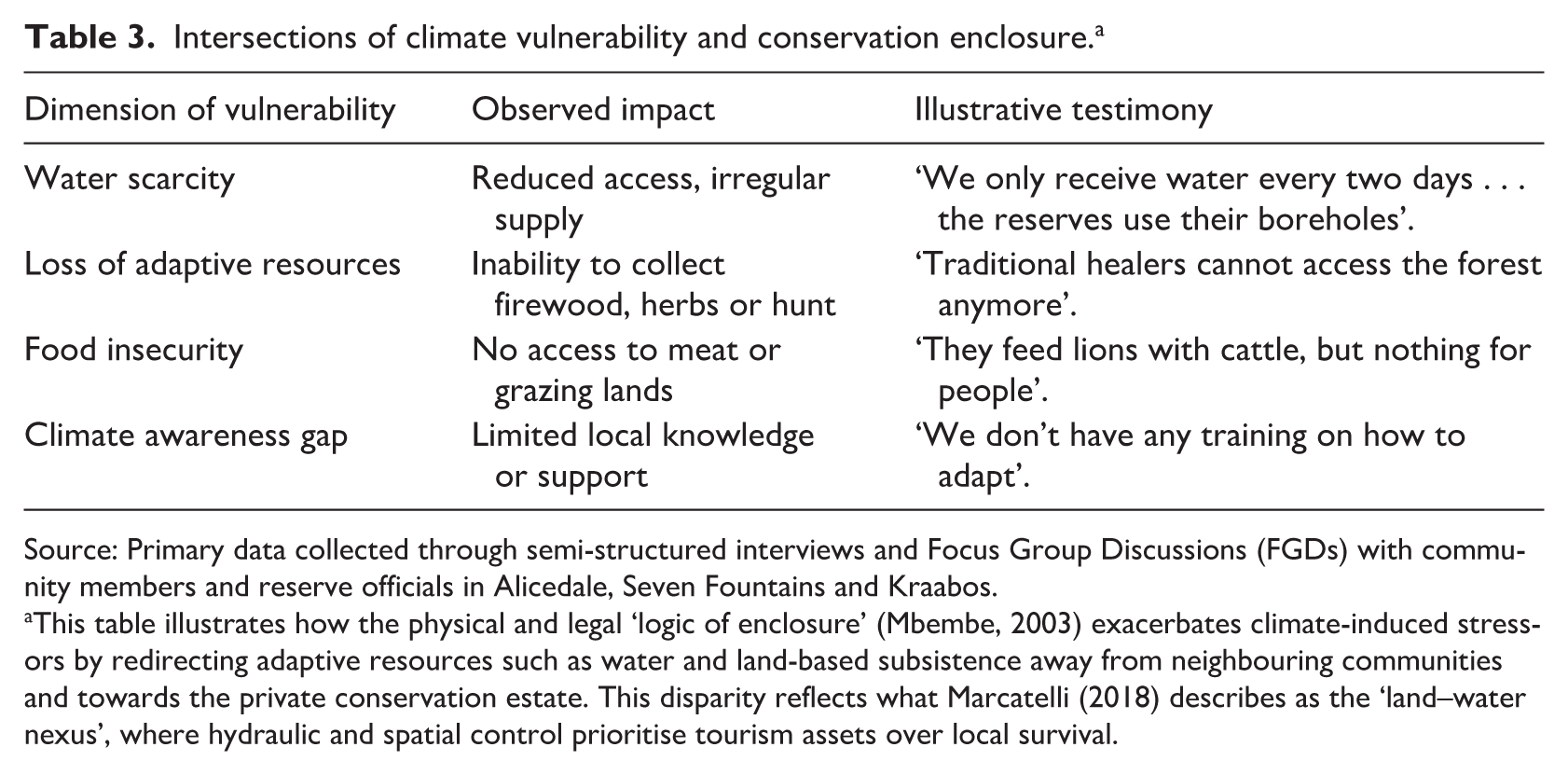
In response, reserves have adopted internal adaptation strategies that ‘reset’ the ecosystem, such as ‘reduc[ing] the stocking rates’, manual feeding, and ‘sourcing water by drilling boreholes’. While reserves undertake these capital-intensive measures to protect their own ecosystems, their support for community adaptation remains minimal. An Ecologist stated that training for community members, such as in ‘anti-poaching unit’ work, aims to enhance their ‘employability and life skills’ rather than direct climate resilience. This mismatch is noted by a Community Leader: ‘We don’t have any community projects focused on climate adaptation . . . right now, there’s a lack of information on how to adapt’ (Table 3).
Intersections of climate vulnerability and conservation enclosure. a
Source: Primary data collected through semi-structured interviews and Focus Group Discussions (FGDs) with community members and reserve officials in Alicedale, Seven Fountains and Kraabos.
This table illustrates how the physical and legal ‘logic of enclosure’ (Mbembe, 2003) exacerbates climate-induced stressors by redirecting adaptive resources such as water and land-based subsistence away from neighbouring communities and towards the private conservation estate. This disparity reflects what Marcatelli (2018) describes as the ‘land–water nexus’, where hydraulic and spatial control prioritise tourism assets over local survival.
A Game Reserve Official articulated the fundamental constraint and the official logic regarding climate change programming: Climate change, though critical, isn’t a conversation that resonates when a family is struggling to put food on the table . . . within the community, the focus is often on day-to-day survival, not long-term environmental changes (Key informant #1).
The official further highlighted the difficulty of intervention responsibility and the boundary of their mandate: Ultimately, the question is whether it’s our responsibility as a game reserve to raise climate change awareness or if this should be driven by government or educational institutions (Key informant #1).
This finding confirms that the enclosure creates a significant climate awareness gap and an adaptation gap, structurally limiting the community’s capacity to cope with climate stress while simultaneously excluding them from the resources such as the surplus water and meat used to sustain predators, which if availed to the community, could offer resilience.
Authority, legitimacy and aspirations for decolonial alternatives
Despite the significant control exercised by private conservation authorities, their legitimacy remains deeply contested as residents distinguish between de facto power and the moral right to govern land tied to local ancestry. While participants acknowledged that officials claim ‘access control ensures safety and ecosystem integrity’, they countered this with narratives of foundational exclusion. The data reveal a profound lack of procedural justice; residents repeatedly noted they ‘were not consulted or compensated’ during the farm-to-reserve conversion. One interviewee from Alicedale recalled the arbitrary nature of this transition: ‘. . . these [game reserves] were converted from the farms and there was no involvement of us in that process. We were told that we should no longer walk in the forest’ (Interviewee #3). This perceived lack of moral authority is compounded by the absence of formal recognition, with community leaders in Kraabos fighting for title deeds while reserves prefer a model where they ‘want to lease the land to us’, effectively maintaining a landlord–tenant relationship rather than one of co-ownership.
Participants articulated clear normative claims that point towards decolonial alternatives, moving beyond a desire for more ‘charity’ towards a demand for sovereignty and shared governance. These aspirations are not abstract; they are grounded in the restoration of dignity and the reclamation of cultural space. A core demand is the removal of the humiliating ‘detective’ requirement for visiting ancestral sites. One elder emphasised that a decolonial future requires an end to the spiritual violation where residents must ‘ask permission from a young man who wasn’t born here’ to visit graves (Interviewee #9, Alicedale). This suggests a shift towards a ‘porous’ boundary model where ancestral land is accessible as a right of lineage, not a security-cleared privilege.
Furthermore, the data suggest that a decolonial alternative must address the structural redistribution of resources, particularly concerning climate justice. Residents argued that reserve infrastructure, such as high-capacity boreholes and surplus meat used to feed predators, should be treated as a communal common during climate crises. The current asymmetry, where ‘traditional healers cannot access the forest anymore’ (Table 3) while reserves prioritise the feeding of lions over people, is viewed as a relic of colonial land logic.
As a practical recommendation for this alternative model, one resident suggested a shift towards institutionalised consultation and joint stewardship: ‘There should be a way where we are not just told what to do, but we are part of the board . . . to make sure the community also benefits from the rain and the land’ (FGD Participant).
Discussion
This study examined how privately owned conservation landscapes in the Eastern Cape function as sites where historical land dispossession, contemporary conservation practices and climate change intersect to reproduce rural precarity. By mobilising Mbembe’s logic of enclosure within a decolonial climate justice framework, the article advances a novel argument: private conservation operates not only as a political–economic enclosure but increasingly as an elite climate adaptation regime. This regime secures ecological resilience and resources within fenced landscapes while externalising climate vulnerability onto neighbouring, historically dispossessed communities. In addressing the research questions, the discussion demonstrates that conservation enclosures do not merely reinforce pre-existing inequalities; they actively rework them under the moral authority of biodiversity protection and climate urgency. In doing so, they transform conservation into a mechanism of climate governance that privileges private accumulation and ecological security for a few, while constraining adaptation pathways for the many.
Enclosure as colonial climate governance
The spatial and surveillance practices documented in the findings reveal that private conservation enclosures in the Eastern Cape reproduce a distinctly colonial mode of governance. The fence, supported by security patrols, cameras, drones and bureaucratic permission regimes, operates as a ‘technology of rule’ that defines who belongs and who accesses resources. This aligns closely with Mbembe’s logic of enclosure, where space is partitioned to organise populations into racialised hierarchies of value and entitlement. However, this study finds that this logic is now intensified through environmental discourses; conservation is framed as a rational response to ecological degradation, masking what Thakholi and Koot (2023) describe as the ‘primitive accumulation’ required to sustain white belonging in the ‘wild’ landscape.
The requirement for prior clearance and escorts to visit ancestral graves exemplifies how enclosure extends beyond economic exclusion into the regulation of kinship and spirituality. Such practices reflect what Mbembe conceptualises as necropolitical governance, namely forms of sovereignty that exercise power over life, death and the conditions under which populations are allowed to exist (Mbembe, 2003). In this case, the governance of conservation landscapes extends into the spiritual realm, regulating the relationship between the living and their ancestors. By policing the living–dead relationship, reserves exercise a ‘sovereign power’ that produces a violent rupture of ancestral continuity. These practices are formalised by the Game Theft Act (Republic of South Africa, 1991), which, as Brandt and Spierenburg (2014) argue, transforms the fence into a moral boundary that criminalises the presence of Black bodies. Such land consolidation under the guise of biodiversity serves to strengthen private control against democratic land reform, turning conservation landscapes into enclosed territories where ‘ecological security’ is pursued through systematic exclusion (Andrew et al., 2013).
From green grabbing to climate risk externalisation
While existing scholarship has shown how private wildlife conservation constitutes ‘green grabbing’ (Hall, 2011), this study extends that literature by demonstrating how enclosure redistributes climate risk through the land–water nexus. Similar to what Marcatelli (2017) highlights in the Limpopo province, water is often the hidden element of enclosure in the Eastern Cape; the findings show that during drought, reserves mobilise significant adaptive capacity through private boreholes, while neighbouring communities receive municipal water only every 2 days. This asymmetry reveals that private conservation functions as a climate buffer for elites, insulating enclosed landscapes while exposing surrounding communities to the full impacts of climate stress.
This finding addresses the second research question by showing that climate change is not an equaliser but a mechanism through which enclosure is deepened. The fence does not merely separate land uses; it separates adaptive futures. Those inside are protected, while those outside are left to cope with volatile conditions using depleted resources. The prioritisation of wildlife water needs over human consumption reproduces a colonial ordering of vulnerability, where tourism economies are rendered more deserving of protection than impoverished human communities. This reflects a distributive injustice where the survival of the fittest is ecologically engineered through capital-intensive infrastructure.
Tokenistic inclusion and the failure of climate justice
The study further reveals that the limited benefits offered, such as sporadic employment, bursaries and soup kitchens, do not mitigate exclusion but entrench dependency. These practices resonate with the concept of the ‘ambiguous parcel’ (Ekeland, 2022), where private aid substitutes for rights-based redistribution while reinforcing paternalistic power relations. Such interventions tend to soften the appearance of enclosure without altering its structural foundations. From a decolonial climate justice perspective, this represents a failure across distributive, procedural and recognitional dimensions.
Procedural justice is undermined by the systematic exclusion of communities from governance; as noted in the findings, residents have no representation on reserve boards. Recognitional justice is denied through the erasure of community knowledge, which reserve officials often misrecognise as a lack of ‘climate awareness’. The official narrative that climate change ‘does not resonate’ with communities ignores the fact that for residents, climate change is an immediate condition experienced through water scarcity. This misrecognition allows reserves to define climate responsibility narrowly, confining it within the fence and justifying the ‘letting die’ of those outside (Li, 2010).
Decolonial alternatives and the possibility of dis-enclosure
Meaningful alternatives to conservation enclosure must move beyond inclusionary rhetoric towards structural ‘dis-enclosure’. This requires a shift from viewing communities as passive beneficiaries or labour reserves to recognising them as co-stewards with enforceable rights to land and water. A decolonial climate justice approach necessitates reconceptualising conservation landscapes as shared socio-ecological systems where resources are treated as commons rather than private assets.
These aspirations, grounded in the restoration of human dignity, align with scholarship calling for the dismantling of the ‘coloniality of power’ that underpins contemporary environmental governance (Mignolo, 2007; Whyte, 2018). Ultimately, the legitimacy of private conservation depends on its ability to disrupt historical injustices. Moving forward, the ecosystem reset currently underway in reserves must expand its scope beyond the rehabilitation of flora and fauna to include the dismantling of the physical and symbolic fences that continue to partition the Eastern Cape’s social and spiritual landscape.
Conclusion and implications
This study empirically grounds the logic of enclosure within the lived realities of climate stress, reframing private wildlife conservation in the Eastern Cape as a contested form of climate governance. By examining hard enclosures, the analysis demonstrates how climate change is mobilised to legitimise the sequestration of land and water, while simultaneously deepening structural inequalities. The findings reveal a form of enclosure that secures the resilience of high-value tourism assets through capital-intensive adaptation such as private boreholes while externalising climate risks onto neighbouring communities experiencing ‘liquid violence’.
Theoretically, the study advances a decolonial climate justice perspective by showing how enclosure operates as an ontological strategy that partitions the landscape into ‘valuable’ nature and ‘superfluous’ humanity. By bringing Mbembe’s necropolitics into dialogue with Tanya Murray Li’s notion of ‘letting die’, the analysis illuminates how abandonment is normalised within conservation-led adaptation regimes.
Against this backdrop, the study proposes a qualified and incremental reconfiguration of conservation governance. First, regulatory interventions must limit the exclusive appropriation of water and other natural resources by private reserves during droughts when neighbouring communities lack reliable access. Second, institutionalised mechanisms for community representation must replace tokenistic charity with enforceable arrangements for benefit-sharing and adaptation planning.
Crucially, the findings suggest that climate justice in enclosed conservation landscapes cannot be achieved through benevolence or corporate social responsibility alone. Rather, it requires confronting the asymmetries of power that allow private conservation estates to secure climate resilience while surrounding communities remain exposed. While such reforms face significant political and economic obstacles, given the centrality of private land to national biodiversity strategies and the entrenchment of elite interests, they nonetheless represent critical entry points for rethinking conservation as a shared socio-ecological project rather than an exclusionary adaptation enclave. In this sense, the study contributes to broader debates on climate justice by demonstrating that the future of biodiversity conservation in Southern Africa will ultimately be judged not only by ecological outcomes, but by whose lives, livelihoods and adaptive capacities are prioritised in a warming world.
Footnotes
Acknowledgements
The authors extend gratitude to Zolani Sita and Gcobisa Ngumbela for participating in the data collection phase of the study and also contributing in the processing of the data.

Ethical considerations
The research protocol, including the procedures for obtaining consent, was approved by the University of Fort Hare (IFHREC) Inter-Faculty Human Research Ethics Committee and the approval number is EFF001-25 (projects). The research was carried out following the guidelines of the ethics committee listed in the ethics statement.
Consent to participate
All participants in this study provided freely-given, informed written consent prior to their involvement. Participants were fully appraised of the study’s purpose, procedures, potential risks and their right to withdraw at any time without penalty.
Consent for publication
Not applicable.
Author contributions
MM conceptualised the study. He participated in data collection, processing and analysis. In terms of writing he contributed to the introduction, analytical framework, methodology and findings. KAE contributed to the drafting of the data collection tools and also participated in data collection, processing and analysis. In terms of writing he contributed to the sections on presentation and discussion of findings.PM supervised the entire process from initiation to the closing stages. All elements of the manuscript were reviewed by him. All authors reviewed the manuscript.
Funding
The authors disclosed receipt of the following financial support for the research, authorship and/or publication of this article: This work was supported by the National Research Foundation of South Africa under the Future Earth Africa Hub Leadership Centre project [Grant Number: UID 151339].
Declaration of conflicting interests
The authors declared no potential conflicts of interest with respect to the research, authorship and/or publication of this article.
Data availability statement
The original contributions presented in the study are included in the article; further inquiries can be directed to the corresponding authors.