




Abstract
Tropical forests are home to a rich biodiversity, and protected natural areas (PNA) represent one of the approaches adopted for conserving this biodiversity. However, PNAs are under constant threat of becoming too isolated in a landscape matrix frequently hostile to most of the species they harbor. A new system of conservation has recently been proposed in the form of areas under private protection (privately protected areas or PPAs) that complement the existing PNAs in their task of conservation. The objective of this study was to document the richness of mammal species that inhabit a 100 ha fragment of rain forest and pasture decreed as a PPA in southeastern Veracruz, Mexico, and to compare it to two nearby PPAs and one PNA of contrasting conservation values. Mammals were monitored in the three climatic seasons of the year through direct observation, track identification, and the use of Tomahawk, Sherman, and camera traps, as well as mist nets. We recorded 32 mammal species—including seven threatened species—belonging to 28 genera and 15 families. These results are important considering that 29 and 14 species have been reported for two other PPAs in the region that are 10 times larger. However, large mammals of the Orders Carnivora, Artyodactyla, and Perissodactyla were absent and are probably locally extinct. We propose that, under specific favorable conditions, forested PPAs can make an important contribution to strategies designed for biodiversity conservation in tropical ecosystems, by helping to conserve endangered species of both medium- and small-sized mammals.
Introduction
The biological diversity of tropical forests around the globe represents a resource that offers benefits to current and future generations (Toledo, 1988). However, because of the need to feed a growing human population and inequity in the distribution of income, forests have been cut down to make way for agricultural use, livestock grazing, urban areas, and industrial zones (Altieri & Toledo, 2011; Laurance, Sayer, & Cassman, 2014). This has led to fragmentation of the landscape (i.e. large tracts of the forest have become separated from each other and reduced to small isolated fragments) and has altered the distribution and abundance of many communities of plants and animals (Fahrig, 2003). In general, it is assumed that there will be more species in larger forest fragments than there are in smaller fragments; however, the effects of fragmentation on biodiversity are complex and the magnitude and direction of these changes depend on the type of organism and ecosystem, the time elapsed since fragmentation and the landscape structure, among other factors (Fahrig, 2003; Pardini, Souza, Braga-Neto, & Metzger, 2005).
In general, conservation initiatives tend to emphasize the preservation of large tracts of habitat through protected natural areas (PNAs) and ignore small forest fragments. PNAs represent one of the approaches for conserving biodiversity; however, particularly in the tropics, they are inadequate because of the constant threat of becoming isolated and suffering reductions in area, or being the subject of illegal changes in land use to agricultural fields, cattle pastures, or urban development (Halffter, 2005; Toledo, 2005). Nevertheless, small isolated fragments that offer a variety of food resources and shelter can serve as reservoirs for a high diversity of plant and animal species, helping to sustain a significant portion of the local biodiversity (Harvey, Guindon, Haber, Hamilton, & Murray, 2008) and thus contributing to the gamma diversity of the larger geographic region. In this way, many organisms that are less sensitive to disturbance can maintain viable populations within such fragments. In addition, the presence of small protected fragments, frequently under private ownership, may complement or strengthen connectivity (movement of organisms) among large but isolated PNAs.
There are a number of concepts and definitions that refer to private conservation, but in this article, we use the term privately protected area (PPA) coined by the International Union for the Conservation of the Nature (IUCN). A PPA is a protected area, as defined by the IUCN, under private governance, i.e. individuals and groups of individuals; non-governmental organizations (NGOs); corporations—both existing commercial companies and sometimes corporations set up by groups of private owners to manage groups of PPAs; for-profit owners; research entities (e.g. universities, field stations) or religious entities. (Stolton, Redford, & Dudley, 2014)
This concept is based on the important cornerstones of nature conservation (objective), management categories (management), and the governance of the territory (property ownership).
In Mexico, there are several ways of joining these voluntary conservation schemes. In this context, areas can receive certification as, for example, Areas Voluntarily Destined for Conservation (Áreas Destinadas Voluntariamente a la Conservación) certified by the National Commission of PNAs (Comisión Nacional de Áreas Naturales Protegidas, CONANP), or as a Unit of Wildlife Management and Use (Unidad de Manejo y Aprovechamiento de la Vida Silvestre, UMA); both certifications are awarded with the objective of conservation by the Ministry of Environment and Natural Resources (Secretaría de Medio Ambiente y Recursos Naturales, SEMARNAT), or as a Private Conservation Area (APC for its name, Área Privada de Conservación, in Spanish) recognized by the Ministry of the Environment of the state of Veracruz (Secretaría de Medio Ambiente de Veracruz, SEDEMA). In Mexico, PPAs cover an estimated 0.25% (487,300 hectares) of the land. These areas could play an important role in connecting the protected areas managed by the government; however, they are usually neglected by governments, ignored by the international organizations that register conservation schemes, and overlooked in regional conservation strategies (Zaragoza-Quintana, Mac Swiney-González, & Hernández-Betancourt, 2015).
Southeastern Mexico, which is the northernmost limit of the Neotropical biogeographic region, was once covered by vast areas of tropical forest but is currently home to a wide variety of petrochemical industry facilities. This industry has become a force of great economic importance in the Coatzacoalcos and Tonalá River basins in particular, with impacts at both regional and national levels. However, these activities and their by-products pose a threat to human settlements, wildlife populations, and ecosystems (Sommer & Oropeza, 2010). Among the actions taken by the private sector to compensate for the damage done to the environment, some companies have opted to participate voluntarily in the protection and conservation of biodiversity and other ecosystem services, within the legal frameworks that currently exist. Among various actions taken to compensate for the environmental impact of its industrial activity, the company Braskem Idesa established a PPA known as the Area for the Protection and Development of Ceratozamia (APDC, Área de Protección y Desarrollo de Ceratozamia in Spanish), with the principal aim of protecting rescued and cultivated specimens of the endangered cycad Ceratozamia miqueliana, but with the additional benefit of preserving an important proportion of the biodiversity that was present in the region prior to industrial development.
Integrating historical land use and landscape structure and assessing the biodiversity of a forest patch or a protected area are minimal actions that nevertheless help to evaluate the conservation value of a patch or area (Banks-Leite, Ewers, Kapos, Martensen, & Metzger, 2011; Ferraz et al., 2014; Whitworth, Downie, von May, Villacampa, & MacLeod, 2016). Assessing the biodiversity present in a PPA is therefore an important aid for evaluating whether its conservation objectives are being met. Since monitoring several biological groups is rarely conducted due to the logistical challenge implied (but see Whitworth et al., 2016), it is often necessary to utilize indicator groups. Mammals play an important role in ecosystems by providing essential services, such as regulating insect populations, seed dispersal, pollination, and ecosystem engineering (Beck, Thebpanya, & Filiaggi, 2010). They also act as indicators of general ecosystem health and are sensitive to anthropogenic disturbances that cause changes in the environment (Feldhamer, Drickamer, Vessey, Merritt, & Krajewski, 2014). In general, it is assumed that the presence of mammals, especially top predators, in relict forests is an indicator of the state of conservation of the site, following the rationale that wildlife species require a habitat with sufficient carrying capacity for their biological requirements (Farneda et al., 2015; Hernández-Huerta, 1992) and because top predator mammals promote biodiversity by regulating mesopredator density (Ripple, Wirsing, Wilmers, & Letnic, 2013; Ritchie & Johnson, 2009).
The objectives of this case study were (a) to document the species richness, as an important component of diversity, of the mammals that inhabit the privately protected APDC in southeastern Veracruz; (b) to compare it with other similar PPAs and a large PNA of the region; and (c) with this and other information, to assess the value of this PPA for the conservation of mammals.
Methods
The study was conducted in the APDC, located in the town of El Chapo, municipality of Ixhuatlán del Sureste, in the southeastern region of the state of Veracruz (Figures 1 and 2). This region of southeastern Mexico has undergone substantial changes in terms of the development of human activities that have brought about a gradual deterioration of natural resources and loss of natural capital such as the quality of the water and air and soil fertility, as well as the modification and fragmentation of the landscape. In the area, there were formerly vast tracts of tropical forests that were used for agriculture during the pre-Hispanic times. Subsequently, farmland disappeared to be replaced by grassland and was used in ranching; logging also gradually modified the landscape, mainly in the hills where evergreen and tropical rain forests were found. During the colonial period and first half of the 19th century, the industry and the functioning of the Port of Coatzacoalcos dominated activities, and in the 20th century, the territory was modified significantly by the development of activities related to the extraction of petroleum and derived industries, as well as the urbanization associated with these activities (Sommer & Oropeza, 2010).
Location of three privately protected areas and the core areas of the Los Tuxtlas Biosphere Reserve in southeastern Veracruz, Mexico. Location of three privately protected areas in the lower Coatzacoalcos basin, with major landscape traits. APDC: Area for the Protection and Development of Ceratozamia; JEP: Jaguaroundi Ecological Park; TEP: Tuzandépetl Ecological Park.

The APDC is located at an average elevation of 60 m a.s.l., receives an average annual rainfall of 1800 mm, and has an average annual temperature of 27℃. It covers 130 hectares, of which 100 are destined for conservation. Fifty percent of the vegetation within the property is induced pasture for livestock with some isolated trees, and the other 50% is remnant secondary tropical evergreen forest. The most representative tree species include Coccoloba hondurensis, Miconia argentea, Guazuma ulmifolia, Cupania dentata, Cecropia obtusifolia, and Bursera simaruba. The matrix in which this and another two nearby PPAs are immersed is composed of pastures and scattered villages, small towns, and patches of secondary vegetation (Figure 2).
As part of a monitoring program of terrestrial vertebrates in the APDC, mammals were monitored in the months of April, July, and December of 2015 and 2016, which are representative of the dry, rainy, and “nortes” seasons, with the latter characterized by cold fronts and strong winds from the north. Sampling was carried out along five transects, an average of 900 m in length and established in such a manner as to represent the heterogeneity of the PPA including areas of preserved tropical evergreen forest and pasture (Figure 3). Transects were surveyed by day and at night over 10 days per season using direct and indirect methods in order to maximize the recording of mammals (Munari, Keller, & Venticinque, 2011; Thornton, Branch, & Sunquist, 2011). Direct methods included trapping and sighting and indirect methods included the identification of tracks, pellets, scat, bones, and other signs (Salvador, Clavero, & Pitman, 2011), interpreted with the aid of specialized keys and field guides (Aranda, 2000; Medellín, Arita, & Sánchez, 2008; Reid, 1997). To catch small mammals, Sherman traps (7.6 × 8.9 × 22.9 cm) were set along transects (Bovendorp, McCleery, & Galetti, 2017) only during the dry and rainy seasons of 2015. In each season, 21 traps were baited with a mixture of oats and vanilla, and set for five nights (one night per transect), separated by 20 m, for a total of 210 trap-nights. To catch medium-sized mammals, three 91.4 × 30.4 × 30.4 cm Tomahawk traps (five nights-transect per season) were baited with sardines and set in areas of forest and pasture, in sites where there were signs of medium-sized mammals, under fallen trees and in cavities, for a total sampling effort of 45 trap-nights (Santos-Filho, Da Silva, & Sanaiotti, 2006). In addition, in order to record the presence of medium- and large-sized mammals, eight camera traps, baited with sardines, tuna, and broken eggs, were active for 10 days and placed on rotation in both the pasture and the preserved area, in sites near water bodies (streams and ponds), and at the entrance of potential burrows (Caravaggi et al., 2017; Cassano, Barlow, & Pardini, 2012; Silveira, Jácomo, & Diniz-Filho, 2003; Srbek-Araujo & Chiarello, 2005; Tobler, Carrillo-Percastegui, Leite Pitman, Mares, & Powell, 2008). In 2015, three camera traps (Tasco model W/Night Vision BK, Clam, 119215C 5 MP) were set, and in 2016 five (Bushnell model Trophy Cam HD Low-Glow 2015 – 119774) were set. Total sampling effort was therefore 80 trap-days. For the registration of tracks and other signs, transects were walked in the morning (6:00–9:00 a.m.) and evening (18:00–21:00 p.m.) by the same two people, simultaneously (Marshall, Lovett, & White, 2008) covering an average distance of 3 km in each season (18 km of total sampling effort). To capture bats, two mist nets were hung in the forest and another two in the pasture from 19:00 to 24:00 h, three nights each season, for a total of 144 net-hours. The nets were 9 m long by 2.5 m high and were hung at random along paths and gaps in the vegetation; total sampling effort was 8100 net m2 h (sensu Straube & Bianconi, 2002). To record elusive or nocturnal arboreal mammals, from May to September 2016, 11 non-baited camera traps (Bushnell model Trophy Cam HD Low-Glow 2015 – 119774) were placed in the canopy of 11 trees (average height 15 m), pointing randomly at the branches (Bowler, Tobler, Endress, Gilmore, & Anderson, 2016). Cameras were active for 90 days, but were not set simultaneously (Cotsell & Vernes, 2016; Whitworth, Braunholtz, Huarcaya, MacLeod & Beirne, 2016).
The Area for the Protection and Development of Ceratozamia, a privately protected area, showing the area covered by rain forest and the routes used to set the traps and for the direct observation of mammals.
We followed the nomenclature of Ramírez-Pulido, González-Ruiz, Gardner, and Arroyo-Cabrales (2014). The landowner did not authorize the collection of fauna or flora in his PPA; however, there were no doubts about species identification so voucher specimens were not collected. Once identified and photographed, captured mammals were released. The results are reported as observed species richness only, because (a) different sampling methods and efforts were used, (b) the sensitivity of camera traps differed according to the models used, (c) some species were recorded by more than one method, and (d) captures were low (≤10 individuals or indirect records) for all species. A detailed report on the efficiency of the different methods used will be published elsewhere.
Attributes Used to Estimate The Conservation Value of Three Privately Protected Areas and a Biosphere Reserve of Southeast Veracruz in Mexico.

Results
List of Mammal Species Recorded Within the Privately Protected Area for the Protection and Development of Ceratozamia (APDC) in Southeastern Veracruz, Mexico.

Note. Family, species, type of vegetation, season (dry, rain, nortes), and method of recording are provided for each record. The following methods were used: CF: camera trap on the forest floor; CC: Camera trap in the forest canopy; TT: Tomahawk trap; Sh: Sherman trap; T: track; O: direct observation, N: mist net. The extinction risk or conservation status of the species, according to the Official Mexican Standard NOM-059 and the CITES Appendix in which it is included, is also given for those species that are listed: D: in danger of extinction; SP: special protection; Th: threatened. I: endangered, trade prohibited; III: trade allowed only on presentation of the appropriate permits or certificates.
Of all the species recorded, seven are of conservation concern: five species are listed in a risk category, according to the Official Mexican Standard NOM-059: C. derbianus, T. mexicana, A. palliata, C. mexicanus, and P. flavus, with the population of the latter considered to be in decline by the IUCN (2016) and six are included in one of the Appendices of the Convention on International Trade in Endangered Species of Wild Fauna and Flora (CITES, 2016; Table 2).
Seventeen species were recorded in both the forest and pasture: D. marsupialis (common opossum), P. opossum (gray four-eyed opossum), Dasypus novemcintus (nine-banded armadillo), S. floridanus (eastern cottontail), S. aureogaster (red-bellied squirrel), S. deppei (Deppe’s squirrel), C. mexicanus (hairy dwarf porcupine), P. leucopus (white-footed mouse), C. latrans (coyote), P. flavus (kinkajou), P. lotor (raccoon), and the bats P. personatus, C. sowelli, A. jamaicensis, A. lituratus, D. phaeotis, and S. parvidens. Eleven species were found exclusively in the rain forest: C. derbianus (Derby’s woolly opossum), M. mexicana (Mexican mouse opossum), T. mexicana (northern anteater), A. palliata (mantled howler monkey), M. macroura (hooded skunk), N. narica (coati), and the bats C. perspicillata, G. soricina, C. senex, U. bilobatum, and R. tumida and four species were recorded exclusively in the pasture: the bats P. parnellii, C. godmani, S. bilineata, and D. rotundus. Mammal richness was greater in the rain forest than in the pasture and comparable among seasons in the rain forest, but reduced in the dry season in the pasture.
Characteristics of the privately protected areas (PPAs) and protected natural areas (PNA) in southeastern Veracruz, Mexico.
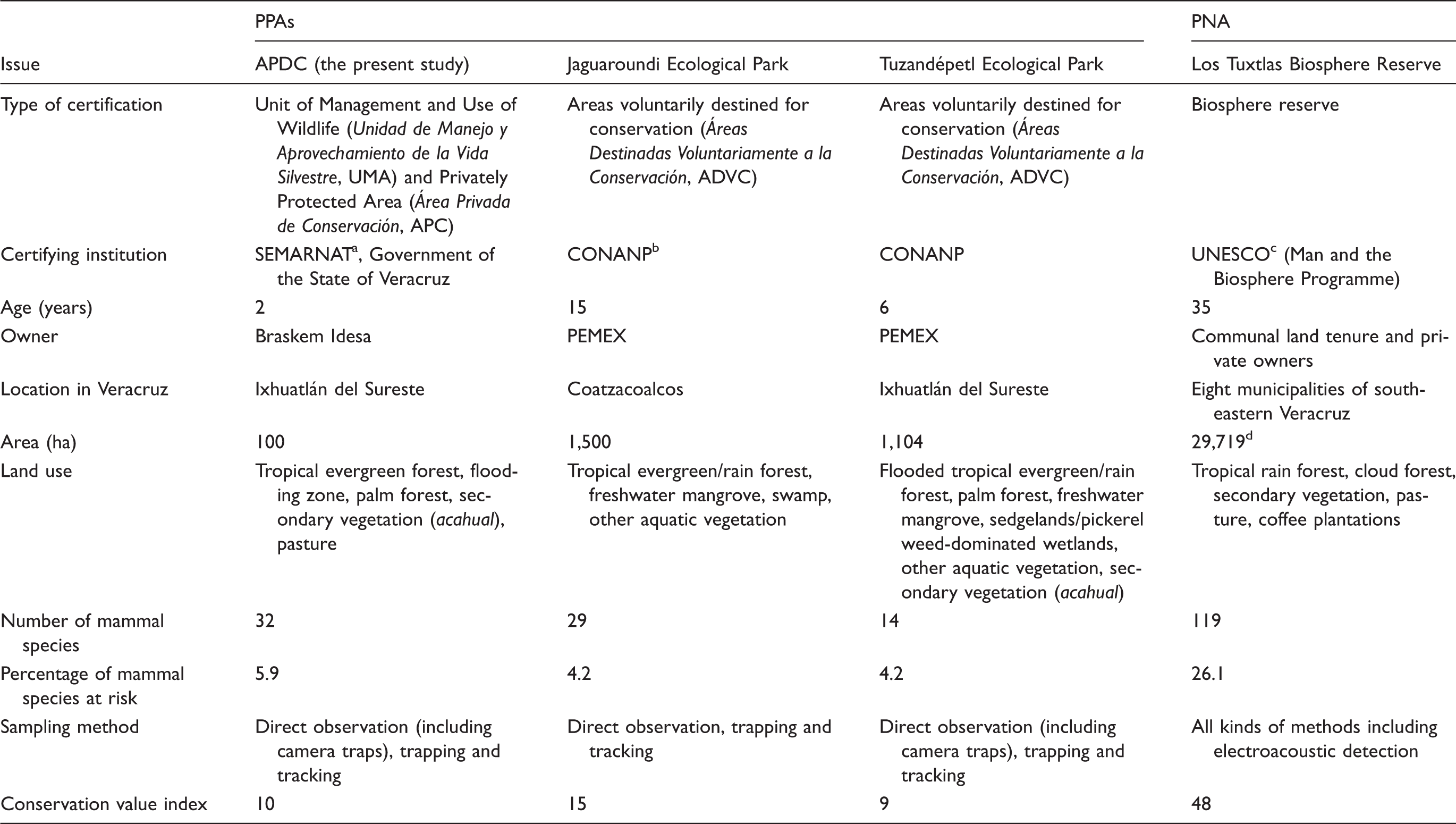
Note. APDC: Area for the Protection and Development of Ceratozamia.
Secretaría de Medio Ambiente y Recursos Naturales (The Federal Ministry of the Environment).
Comisión Nacional de Áreas Naturales Protegidas (The National Commission for Protected Natural Areas).
United Nations Educational, Scientific, and Cultural Organization.
Total of its three core areas only.
Discussion
Our results indicate that the Area for the Protection and Development of Ceratozamia PPA maintains a high richness of mammals despite its reduced area and the modification of its original vegetation. As expected, large mammals such as big felids and ungulates (species that are the main prey of felids) are locally absent. However, the remnant rain forest of the PPA still maintains rare and elusive arboreal species of medium-sized mammals, some of which are of conservation concern.
On comparison of our results with those of other mammal inventories conducted in PPAs in southeastern Veracruz, comparable or greater mammal richness was recorded in areas with similar vegetation and climate, but which were much larger in area. For instance, in the Jaguaroundi Ecological Park, with an area of 1,500 hectares, 29 species of mammals were recorded (Herrera et al., 2008), while in the Tuzandépetl Ecological Park, with an area of 1,104 hectares, 14 species were recorded (Álvarez-García et al., 2012). In the latter PPA, the relatively low number of species is puzzling considering that the sampling employed the same complementary methods as used in our study. In spite of its smaller area, the APDC had the greatest proportion of mammal species at some conservation risk of the PPAs compared. Useful habitat in the Ceratozamia PPA covers approximately 50% of the park and this area is very important because, in an area of less than 50 ha, it hosts important arboreal species such as T. mexicana, P. flavus, C. mexicanus, A. palliata, M. mexicana, and C. derbianus, all of which are currently listed as threatened or in danger of local extinction. These species are important pollinators (M. mexicana) or seed dispersers (P. flavus, C. mexicanus, A. palliata, C. derbianus) that contribute to forest regeneration and function (Charles-Dominique et al., 1981). In this sense, further studies of the composition and structure of the forest vegetation are required, together with estimates of the feasible minimum area, in order to obtain the information necessary for ensuring the conservation of medium-sized arboreal mammal species.
No large mammal species were recorded in this study, probably because the area and its surroundings have been strongly affected by land use change (forest conversion to cattle ranching) and hunting, but also because the reduced area of the PPA may be insufficient to sustain viable populations (Hernández-Huerta, 1992). Interviews with local inhabitants revealed that there have been no large mammals present in the area in recent decades. These locally extinct species include the jaguar (Panthera onca), cougar (Puma concolor), white-tailed deer (Odocoileus virginianus), brocket deer (Mazama temama), white-lipped peccari (Tayassu pecari), and tapir (Tapirella bairdii). On the other hand, based on the descriptions of our informants and reports of mammals in the surroundings of the PPAs compared, the following species are likely to be present at some point during the year, or be transient: Geoffroy’s spider monkey (Ateles geoffroyi), agouti (Dasyprocta mexicana), paca (Cuniculus paca), ocelot (Leopardus pardalis), jaguarundi (Herpailurus yagouaroundi), margay (Leopardus wiedii), long-tailed otter (Lontra longicaudis), long-tailed weasel (Mustela frenata), and collared peccari (Dicotyles crassus). It is also possible that the more elusive and rare species, such as the grison (Galictis vittata) and silky anteater (Cyclopes didactilus), could have been recorded with a greater sampling effort. Many species of rodents (Order Rodentia) and two of shrews (Order Soricomorpha) could have been missed due to low sampling effort and many species of bats (Order Chiroptera) went unrecorded either because their high echolocation capabilities allowed them to detect and avoid the mist nets or because they forage above the canopy. These species belong to the Vespertilionidae and Molossidae families and are more likely to be recorded using electroacoustic detection methods. However, the absence of bat species of the subfamilies Glyphonycterinae, Lonchorhininae, Micronycterinae, and Phyllostominae (Family Phyllostomidae) in the APDC is not unexpected since these are known to be vulnerable to disturbance of the primary forest, such as its conversion to cattle ranching (Fenton et al., 1992; Gonçalves, Fischer, & Dirzo, 2017). At any rate, our estimation of mammal species richness is conservative, although still comparable with the other PPAs in which similar sampling methods were used. In spite of this, the main drawback of the APDC for the conservation of a high diversity of mammals, particularly larger mammals, is its reduced area. The absence of large mammals strongly suggests that greater effort is required in terms of ecological restoration to promote connectivity among forested areas. Some urgently needed actions are the establishment of more small protected areas, private or public, and delimitation of biological corridors to facilitate the movement and presence (by providing resources) of these species.
Based on our results, it appears that PPAs in tropical ecosystems can harbor some mammal species of conservation concern, thus contributing to their maintenance at a regional scale. We are aware, however, that species richness is only one component of diversity and that information on species abundance would give a more complete picture of the conservation value of protected areas by assessing changes in community structure and determining whether populations are resident or transient. Moreover, we acknowledge that the conservation value of a PNA depends to a considerable degree on the nature of the matrix that surrounds them (Prevedello & Marcus, 2010; Ricketts, 2001) and on the landscape structure and history (Ferraz et al., 2014; Pardini et al., 2005). We lack images of sufficient quality and resolution with which to perform such an analysis at the very fine scale of the PPAs; however, based on our own observations, we suggest that the matrix of the few protected areas in the southeastern region of Veracruz is a repetitive mosaic of pastures, villages, isolated crops, and secondary vegetation. Finally, it is important to note that our estimated conservation values are relative to the areas under comparison. As such, the indices of conservation values may vary depending on the manner in which the levels of the area attributes are chosen, whether other attributes are considered or how those attributes are related algebraically. In our case, we weighted the area of the compared protected areas heavily because this parameter differed by several orders of magnitude.
Implications for Conservation
PPAs can make an important contribution to strategies designed for biodiversity conservation by helping to protect and conserve endangered species of both medium- and small-sized mammals and, by extension, the wildlife, in general. These areas offer a viable option for the conservation of natural environments since, unlike PNAs, which are subject to government budget availability, PPAs have their own funding. The PPAs should be incorporated into regional and national schemes of biological conservation through natural areas throughout the tropical regions that share a high degree of stress on their forests and a high rate of landscape fragmentation due to the expansion of the agricultural, cattle ranching, and industrial frontiers (Gascon, da Fonseca, Sechrest, Billmark, & Sanderson, 2004). Such a network of PPAs in any tropical region would fit well with an original, recently proposed conservation scheme—the Archipelago Reserve (Halffter, 2005)—and importantly would help to maintain the biological connectivity of landscape, assuring genetic flux among preserved forest patches and the permanence of meta-populations of most species (Anand, Krishnaswamy, Kumar, & Bali, 2010).
However, the effectiveness of PPAs in conserving biodiversity will depend on the quality and composition of the surrounding matrix in which they are imbedded, that is, the quantity, size, and dispersion of other forest remnants, biological corridors (riparian forests, living fences, etc.), and crops; as well as the manner in which they are managed (Pardini et al., 2005). In this latter respect, the current plans for more projects of industrial plants and facilities to be installed in the region are of great concern for the studied PPAs, since they pose a great threat to connectivity among remnant forests and to their size and shape (Figure 2). These changes will impact animal and plant populations, causing inbreeding depression or even local extinction, unless a Territorial Environmental Zoning program is both implemented and enforced. On the other hand, we recommend that the creation of PPAs not be taken lightly, simply to fulfill the mitigation requirements of environmental impact assessments or to create an image of environmental responsibility, but rather that they be founded on accurate inventories and fundamental studies of the conservation value of these areas that can demonstrate their viability for the protection of biodiversity in the long term.
Footnotes
Acknowledgments
We thank Braskem Idesa for the support provided to carry out this study in the Ceratozamia Area of Protection and Development and especially Roberto Bischoff (VPE Latin America), Antonio Santos Souza Galvão (Sustainability), and Ana Luisa Martínez López (Environment). We are also grateful to Luis Ernesto Alarcón for helping monitor and identify the species and to José Alberto Toto Hernández and David Antonio Suárez Reyes for support in the field. The valuable comments of an anonymous reviewer helped to refine the focus and thus enhanced the contribution made by the article. Bianca Delfosse and Keith MacMillan revised the English.
Declaration of Conflicting Interests
The author(s) declared no potential conflicts of interest with respect to the research, authorship, and/or publication of this article.
Ethical Approval
When handling animals in the field, codes of good practice were strictly followed.
Funding
The author(s) received no financial support for the research, authorship, and/or publication of this article.