




Abstract
This paper addresses the pervasive absence of student verbal participation in the virtual classroom in a developing country context. While student non-verbal participation is not new, it has taken on new significance in the context of the virtual classroom as many institutions of higher learning continue to embrace online teaching post-COVID-19. The study focuses sharply on Botswana. A structured questionnaire that sought to capture students’ perception of the extent and impact on learning of student non-verbal participation in the virtual classroom was distributed to students at the largest university by student population in the country. Since the study is set in a developing country context, and such contexts are usually characterized by a pervasive lack of resources, the questionnaire also sought to capture students’ perceptions of the availability of resources to participate in virtual classrooms. The data collected were subjected to quantitative methods of analysis, with the help of STATA. The study revealed that student non-verbal participation in virtual classrooms is not unique to developed countries. The study also highlighted that students have different preferences regarding non-verbal participation in the virtual classroom: some prefer classroom engagement, while some prefer to listen to instructors rather than speak. The emerging policy implication is that it is essential for instructors to balance the needs and expectations of these different categories of students. There is an emerging literature that considers how instructors can enhance interaction in the virtual classroom. The best approach depends on context. The study also underlined the important role that institutions of higher learning can play in making online teaching accessible to students from different social backgrounds through program design. At the University of Botswana for instance, all students are introduced to information and communications technology (ICT) training in the first year of their programmes, equipping them with the necessary skills to gainfully participate in virtual classes. In terms of resource availability, the study revealed gaps that require policy intervention: there is a need for the government to consider subsidizing government-sponsored students to purchase digital devices within the context of their scholarships; it is also important for the government to continue investing in ICT infrastructure and developing pricing policies that make internet services accessible.
Introduction
This paper analyses the extent and impact on learning, of student non-verbal-participation in virtual classrooms in institutions of higher learning in Botswana. A virtual classroom is a teaching and learning environment in which teaching and learning are facilitated through digital-based platforms. A virtual classroom can take place in a synchronous setting, where learners have an opportunity to interact with the instructor in real time, or in an asynchronous setting, where learners interact with the content in their own time and space (Pena-Levano and Melo, 2022). In many developing countries, Botswana included, the virtual classroom rose to prominence at the height of COVID-19, which forced drastic changes in teaching methodologies. In a very short period of time, instructors were forced to modify their content to facilitate virtual teaching and learning. The shift to digital platforms presented unique challenges to instructors and students (Beans et al., 2020; Chimbunde, 2021; Izhar et al., 2021; Maphalala and Ajani, 2023; Mengistie, 2020; Mphahlele et al., 2021; Pena-Levano and Melo, 2022; Taru, 2020). Some have persisted post-COVID-19 in contexts where digital-based teaching and learning platforms continue to be used. Botswana is one such case, where institutions of higher learning have continued to use digital platforms to facilitate teaching and learning post-COVID-19. However, very little research has been done in this context to understand some of the key aspects of online teaching, which have an impact on educational outcomes. This is reflected in the limited empirical evidence on the subject. The literature search on Botswana revealed a study carried out by Mphahlele et al. (2021). The study, which was carried out during implementation of movement restrictions associated with COVID-19, relied on student queries submitted to faculties on the challenges they were experiencing with online teaching. The study highlighted the need for digital equity to facilitate access to online classes. The current study is a significant departure from Mphahlele et al. (2021). The study focuses on an increasingly observed phenomenon of non-verbal participation of students in the virtual classroom. Verbal participation in the classroom encompasses contributing to discussions, asking questions and/or commenting in the classroom. An increasing number of studies describe virtual classrooms (synchronous) as deathly quiet and characterized by lengthy pauses as instructors wait for student responses that never come (Bannink and Van Dam, 2021; Malesic, 2022; Weiner, 2020). It is notable that the majority of studies that have examined this phenomenon have been carried out in developed country contexts. In developing countries, and in particular in Africa (Botswana included), the focus has tended to be on issues relating to access to digital infrastructure to participate in virtual classes (Faturoti, 2022; Mphahlele et al., 2021; Onigbinde et al., 2022). This is not surprising given the pervasive lack of resources in the African context. Classroom interaction and the potential impact on educational outcomes remain largely unexplored. Beyond the significance of the study to Botswana therefore, the study contributes to the understanding of classroom interaction in the African context. The study relies on data collected through an online survey in the largest public university by student population in the country. With the help of STATA, quantitative approaches are used to analyse the data.
Online learning during and post-COVID-19: A survey of the literature
Prior to the outbreak of COVID-19, very few institutions had made significant progress in weaning themselves off from the traditional face-to-face mode of teaching in developing countries (Chimbunde, 2022). The institutions which had attempted to do so were either offering distance education or practising blended teaching (Kaisara and Bwalya, 2021). The sudden and complete shift to virtual teaching and learning brought with it many challenges for institutions of higher learning in developing countries, particularly Sub-Saharan Africa, where lack of resources tends to be widespread. A report by UNESCO (2020) underscores the pervasiveness of the problems related to virtual teaching and learning in Sub-Saharan Africa, with an estimated 82% of students thought not to have access to the internet because of pricey bundles, weak network signals, and poor network coverage (Beans et al., 2020; Chimbunde, 2021; Izhar et al., 2021; Mengistie, 2020; Taru, 2020). Other researchers highlighted instructors’ inexperience in delivering content online and inability to competently use different online teaching tools and students’ inexperience with online teaching platforms (Mphahlele et al., 2021; Pena-Levano and Melo, 2022).
Of particular interest to this study is participation of students in virtual classrooms. Classroom participation is regarded as one aspect of student engagement, and one of the essential elements of successful learning activity (Frisby, 2015; Ko et al., 2016; Saritepeci and Cakir, 2015). It is generally defined as the verbal interaction among participants in a learning environment (Lei et al., 2018). Other researchers have considered different dimensions of participation: affective, cognitive and behavioural. The affective dimension encompasses students’ feelings and commitment to learning (Akpur, 2021; Voelkl, 1997). The cognitive dimension incorporates students’ motivational goals and self-regulated learning skills. The behavioural dimension involves academic and multitasking activities conducted by students in or outside the classroom. In the context of digital learning environments, classroom participation may also include contributing to discussions, asking questions and commenting through digital images and message chats (Svihus, 2024).
Notwithstanding the various constructs of classroom participation, there is a general agreement that students tend to benefit when they actively respond to instructors’ questions to further expand, negotiate and develop their knowledge and analytical skills (Bakhtin, 1986; Johnstone, 2002). Akpur (2021) emphasizes that as students practice and participate in class activities, they are likely to get more feedback and the more in-depth they learn, the more they can cope with complex situations. Sinclair and Coulthard’s (1975) Initiation-Response-Follow-up model of classroom interaction recognises the importance of classroom talk as it elicits feedback from the instructor, an important aspect of learning missing in the absence of participation in the classroom. Engaging in educational activities is also thought to help individuals develop lifelong learning skills, and therefore build the necessary structure to lead a more productive life post-school life (Akpur, 2021).
Numerous studies have shown that student non-verbal participation has become a common feature in virtual classrooms, with classrooms characterized by one-way communication that lacks dynamism (Bannink and Van Dam, 2021; Ho et al., 2022; Malesic, 2022; Weiner, 2020). It should be clear though that student non-verbal participation in the classroom is not confined to virtual classes (Ho et al., 2022). However, it has taken on new significance in the context of the virtual classroom. As more and more institutions of higher learning embrace digital platforms, an understanding of the different facets and challenges associated with digital teaching and learning environments is necessary. Classroom participation is one such aspect. This is especially important in developing countries, where there is limited empirical evidence on the subject. The existing literature shows that reasons for student non-verbal participation in virtual classrooms are varied: reluctance to interrupt lecturers (this has cultural undertones, with students choosing not to interrupt lecturers out of perceived respect), reluctance to be open and share vulnerabilities, complexity of the material and fear of losing face (Hewitt, 2005; Ho et al., 2022; Liu et al., 2008; Murphy and Coleman, 2004; Schellens et al., 2005). A subset of the literature posits that student non-verbal participation could be suggestive of internalization of input by students, which allows them to think about their responses before verbalising them. According to De Guerrero (1991), this mental process allows learners to devote adequate time to thoughtful participation, and thus meaningful learning. It is notable that there is lack of uniformity in the empirical evidence on the impact of student non-verbal participation in virtual classrooms. This underlines the importance of context-specific studies to avoid erroneous policy focus. The current study builds on the existing literature to investigate the extent and impact on learning, of non-verbal participation of students in virtual classrooms in developing countries, with a case study of Botswana.
The study addresses the following research questions (RQs):
RQ1: Do students have the requisite resources to participate in virtual classrooms?
RQ2: To what extent is non-participation a common feature in the virtual classroom?
RQ3: What are the possible reasons for student silence in virtual classrooms?
RQ4: Can meaningful learning still take place without non-verbal participation of students in the virtual classroom?
Methods of data collection and analysis
The data for this study were collected from 134 University of Botswana students through responses to an online survey using convenience sampling. Convenience sampling, sometimes referred to as availability sampling, is a non-probability sampling method where data is collected from an easily accessible and available group of people (Edgar and Manz, 2017; Stratton, 2021). The appeal of the method lies in its simplicity and cost-effectiveness (Sexton, 2022; Speak et al., 2018). Participants for the study were drawn from the seven faculties at the University of Botswana. The faculties of Social sciences (43%) and Business (25%) students dominated the sample, reflecting the popularity of online teaching in the two faculties. Students from the Faculty of Engineering represented about 2% of the sample. This is not surprising given that almost all the programmes are practical, and classes are ordinarily physical to permit practical demonstration. Respondents were more or less evenly spread from first-year (23%) to fourth-year (20%) undergraduates. Graduate students accounted for only 8% of the sample. Sixty-four percent of respondents had at least one module taught online, while 15% had at least three modules taught online. Seventy-two percent of respondents were women, with men accounting for 26%. One percent of respondents identified as non-binary, and a further 1% preferred not to say. In terms of age, 84% of respondents were in the age range (16–24), while 10% were in the range (25–34). Only 6% were aged 35 and older.
The data collected was analysed using STATA. The questionnaire contained four sections in line with each research question. For each of the questions, the questionnaire contained items or statements that students had to rank on a Likert scale. For question (i), items relating to access to a device, a five-point Likert scale with frequency descriptors, Never, Rarely, Sometimes, Often and Always was used. For internet connectivity, a six-point Likert scale with frequency descriptors, Never, Rarely, Sometimes, Not Sure, Often and Always was used. For issues of cost and affordability of internet bundles, respondents were asked to indicate whether internet services were: not affordable at all, somewhat affordable and affordable. For questions (ii) to (iv), a six-point Likert scale with frequency descriptors, Never, Rarely, Sometimes, Not Sure, Often and Always was used. The data was analysed using Microsoft Excel, and a frequency count of the responses was carried out and tabulated in terms of percentages and presented in the form of tables and figures. 1
Results and discussion
RQ1: Do students have the requisite resources to participate in virtual classrooms?
This question sought to understand students’ perceptions of their ability to participate in virtual classrooms due to lack of knowledge of the use of online learning technology (use of a computer, browsing the internet, and online learning platforms such Moodle and MS Teams), lack of access to a device (computer, laptop, tablet or smartphone) that allows them to participate in virtual classes, cost of internet bundles, as well as stability and speed of internet connection (on and off campus). The majority of students indicated they had enough knowledge of online learning technology to allow them to participate in virtual classes (see Figure 1). A combined 3% indicated they are either proficient or advanced in the use of online learning technology, with a further 43% indicating they are at an intermediate level. Only 4% of respondents indicated they were beginners. A cross-tabulation of proficiency in the use of online learning technology and the age of the respondent does not show any significant differences in proficiency in the use of online learning technology between younger respondents and older ones, who are likely to be mature age entry students (see Appendix 2). This result is not surprising because all programmes at the University of Botswana are designed in such a way that all students (regardless of background and the type of high school they attended, public or private) are introduced to information and communications technology (ICT) training in the first year. Given that the survey was carried out in the second semester, the majority of students would have been introduced to online learning tools. In terms of policy, this result underlines the importance of programme design that attempts to address the digital divide inherent in developing country contexts. It is notable that ICT courses are not available for many high school learners, particularly public school learners. Higher education institutions can play a significant role in bridging the gap to make digital learning platforms accessible to a wider pool of students. As emphasized by Matende (2023), ICT has become the harbinger of global socio-economic interaction. It is essential therefore that learners be equipped with the necessary skills to allow them to compete in the global space, and this can be achieved through deliberate program design in higher education institutions.
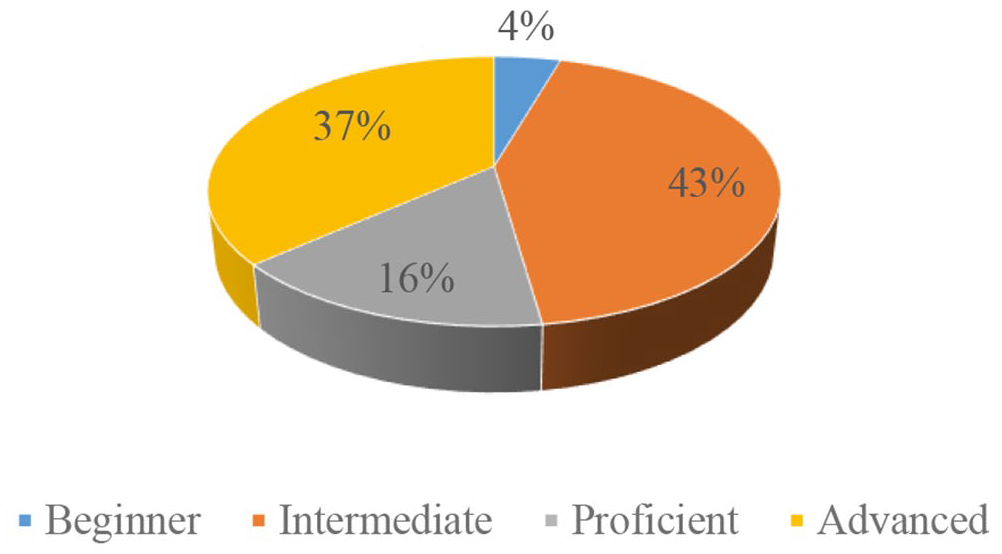
Proficiency in online learning technology.
UNESCO (2020) highlights the pervasive lack of resources for online teaching in many developing country contexts. To understand the extent to which the problem exists at the University of Botswana, students were asked how often they had access to a device to participate in virtual classes. Figure 2 summarizes responses to the question. Seventy-three percent of students said they always have access to a device. Eight percent indicated they sometimes had access to a device. A combined 6% indicated they rarely had access or never had access to a device. While the extent of the problem is perhaps not big given the percentage of students who always have access to a device, this result is consistent with UNESCO (2020) and reveals where intervention is necessary. The university does provide computer access to students. However, not every student will have access to a computer when they need one. Like every other resource, the computers are limited. It is notable that the majority of higher education students in Botswana, including University of Botswana students, are funded by the government. Table 1 summarizes the different categories of sponsorship for higher education. One of the limitations of the sponsorship is that it does not cover the purchase of digital devices (e.g. laptops, notebooks, etc.), with the result that learners from poor backgrounds struggle to acquire devices. Most of them have to trade off some of the essentials they are supposed to purchase with their living allowance so they can purchase smart mobile phones. At the very least government should be looking at subsidizing higher education students to allow them to purchase the devices. It is worth mentioning that recently, the government adopted a school digitalization plan, the intention of which is to build ICT infrastructure, including the supply of laptops to secondary school students. It is difficult to argue with the likely long-term benefits of this strategy. However, one would expect short-term to medium-term gains from accommodating higher education students as higher education institutions continue to embrace digital learning platforms.

Access to a device (computer/laptop/tablet/smartphone).
Types of sponsorship for higher education in Botswana.

Source: Department of Tertiary Education Financing. https://tef.gov.bw/ (accessed 2 September 2024).
Mphahlele et al. (2021) highlighted internet connectivity problems encountered by many higher education students during the COVID-19 era. To determine the extent of the problem in the post-COVID-19 period, students were asked whether they had access to stable internet, both on and off-campus. The responses are summarised in Figure 3. The results are not uniform. Thirty-five percent of respondents said they always had access to stable internet connectivity off campus, while 18% said they always had access to stable internet on campus. Thirty-six percent said they sometimes had stable internet connectivity on campus, while 14% said they sometimes had stable internet connectivity off campus. Overall, the results are suggestive of the need for investments in internet connectivity infrastructure. Figure 4 summarises responses on affordability of internet services. According to Kolobe and Sekwati (2021), Botswana has one of the highest broadband prices in the Southern African Development Community region. It is thus not surprising that 25% of respondents indicated that internet services are not affordable at all. A further 52% indicated internet services are somewhat affordable. During COVID-19, the University of Botswana, along with other institutions of higher learning in the country provided students with mobile phone cards loaded with airtime to allow them to participate in online teaching and learning activities. The strategy was appropriate as a stop-gap measure. Given competing needs for resources, it has not been possible for institutions of higher learning to continue this post-COVID-19. This has meant that students have to allocate some of their living allowances to purchase internet bundles that would allow them to attend virtual classes. Some are not able, given their less-than-privileged backgrounds and the need to support their families. The University does have Wi-Fi hotspots around campus, but the connectivity is very unstable. While the solution is not straightforward, the answer lies somewhere between the development and provision of ICT infrastructure, pricing policies of internet providers, and protection of consumers by the regulator (Kolobe and Sekwati, 2021).
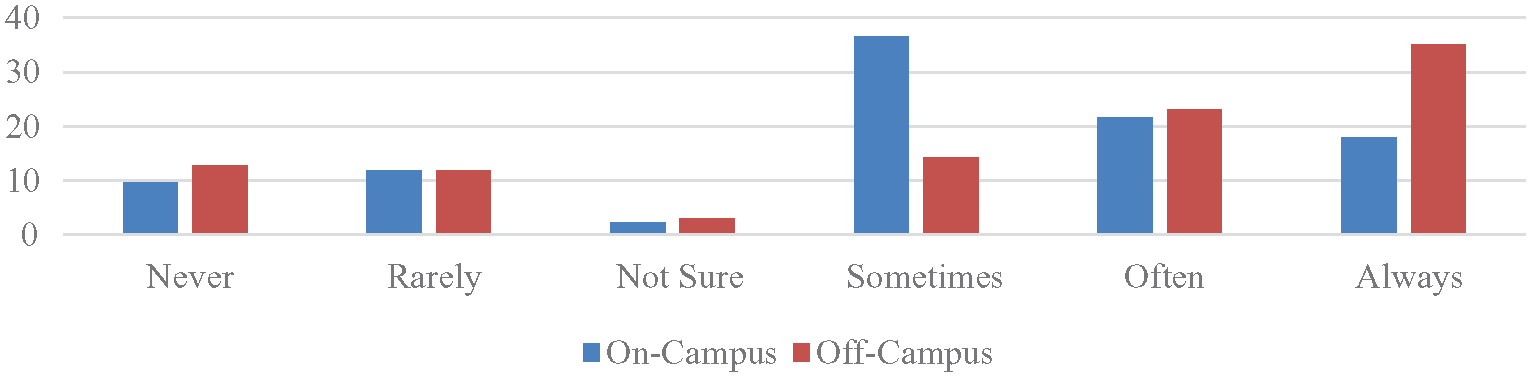
Internet connectivity (on-campus & off-campus).
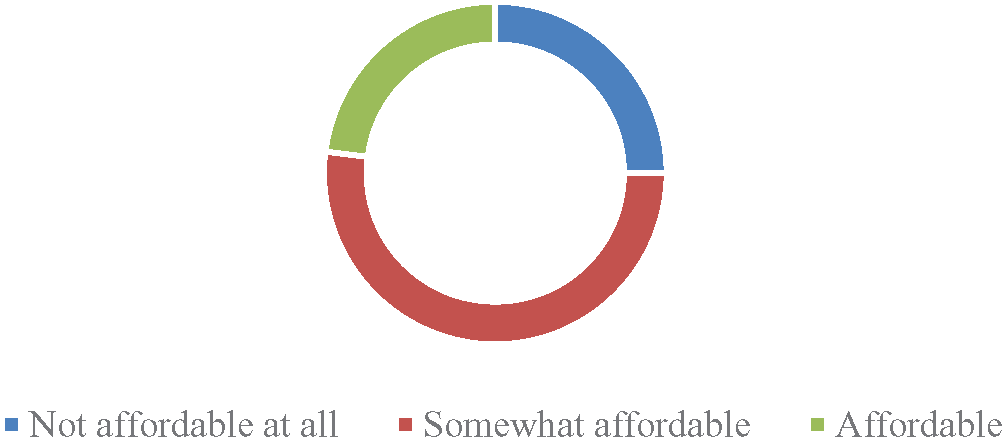
Affordability of internet services.
RQ2: To what extent is student silence a common feature in the virtual classroom?
To assess the extent to which students perceive student silence as a common feature in the virtual classroom, students were given six statements and asked to rank them using a six-point Likert scale, consisting of frequency descriptors, never, rarely, sometimes, not sure, often and always (Cronbach’s alpha score of 0.641). Students’ responses were subjected to a frequency count and then tabulated in terms of percentages. The results are presented in Table 2. Forty-two percent of respondents said they sometimes found their online classes engaging (Item 1). Only 10% said they never found them engaging. Ten percent said they never felt awkward. Twenty-one percent said they are sometimes interested in speaking up in virtual classes, while 17% said they are never interested in speaking out in online classes. On confidence, 17% said they are never confident in speaking up in online classes (Item 3). Thirty-four percent said they sometimes speak out whenever their lecturers ask questions in class (Item 4). Results suggest that students prefer other forms of communication in the virtual classroom rather than speaking out (see Items 5 and 6). Twenty-one percent and 22% said they often and always (respectively) prefer typing in the chatroom to speaking out. Twenty-six percent said they use the chatroom to respond to lecturers’ questions. Overall, the results suggest that students are conscious of the lack of participation in the virtual classroom. The results are consistent with other studies (Ho et al., 2022; Mahyoob, 2020).
Responses to whether student silence is a common feature in the online classes.

Examination of Figure 5 suggests that students are not necessarily content with the lack of participation in the virtual classroom, with 21% saying they often feel awkward when no one speaks up when the lecturer asks questions in the virtual classroom. A further 24% said they always feel awkward when no one speaks up. Twenty-three percent said they sometimes feel awkward (see Figure 5).
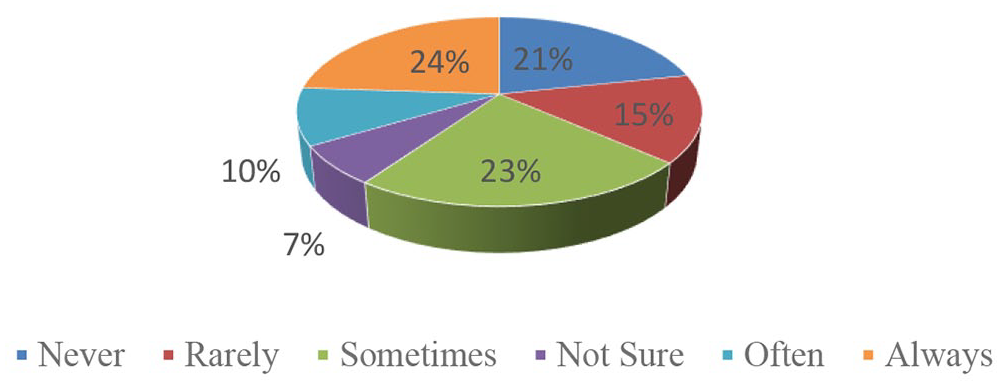
Feeling of awkwardness due to student silence.
RQ3: What are the possible reasons for student silence in virtual classrooms?
Students were asked to rank on a six-point Likert scale, a category of statements reflecting some of the possible reasons for lack of verbal participation in the virtual classroom (Cronbach’s alpha score of 0.912). Results are presented in Table 3. Forty-two percent of respondents said the main reason they don’t speak out in virtual classes is that they do not want to interrupt their lecturers, while 30% said they always prefer to listen to their lecturer rather than verbally ask questions in class. The results are consistent with Ho et al. (2022) who found over 50% of respondents indicated they do not want to interrupt their instructors while they are speaking (also see, Hewitt, 2005; Liu et al., 2008; Murphy and Coleman, 2004). Noteworthy, there is a cultural context to this result, where students feel it is impolite to interrupt an elderly person while they are speaking. The principle of botho (meaning respect) very much influences social interaction in Botswana. Twenty-two percent said they don’t speak because everyone’s attention will be on them. Eighteen percent expressed fear of being judged if they speak up (Item 16). A further 22% said they would rather let other people speak before they do (see Table 3). There are varied reasons why students don’t speak in virtual classrooms, but it seems a significant number prefer to listen to their instructors rather than speak up, while some prefer not to interrupt instructors out of perceived respect.
Reasons for student silence in virtual classes.

RQ4: Can meaningful learning still take place without verbal participation of students in the virtual classroom?
To analyse perceptions regarding the impact of non-verbal participation on learning, students were asked to indicate whether they think meaningful learning can still take place without non-participation (Cronbach’s alpha score of 0.327). The results are summarised in Figure 6. Twenty-three percent of respondents claimed that meaningful learning always took place without student participation, while 22% said meaningful learning is sometimes achieved without participation. A cross-tabulation of the statement ‘I prefer to listen to my lecturer rather than verbally ask questions or make comments during the online class’, and ‘I think that meaningful learning can still take place without speaking up in online classes’ shows that 63% of those who answered ‘always’ to the former also answered ‘always’ to the latter (see Appendix 2.2). However, 24% of respondents said meaningful learning could never be achieved without student participation, while a further 24% said it is rarely achieved. Overall, almost half of the respondents said meaningful learning can still (always and often) take place without student participation, and the other half said meaningful learning rarely takes place or never takes place without participation of students. Table 4 summarizes students’ responses regarding the feedback they receive in virtual classes. Twenty-eight percent said they often receive more feedback from their lecturers in the online classes than the physical classes. Appendix 2.3 shows the results of cross-tabulation of the statement ‘I receive more feedback from my lecturer in the online class than the physical classes’ and the statement ‘can meaningful learning still take place without speaking up in online classes’. Results suggest that the majority of those who answered always and sometimes to the former also answered always and sometimes to the latter. Twenty-two percent of respondents indicated that misunderstandings often occur in virtual classes. Appendix 2.4 presents the results of cross-tabulation of the statement ‘can meaningful learning still take place without speaking up in online classes’ and the statement ‘frequent misunderstandings occur in online classes’. A quarter of those who answered ‘never’ to the former, answered ‘always’ to the latter. This suggests that students who believe that meaningful learning can never take place without verbal participation also believe that frequent misunderstandings occur in virtual classes, and would probably benefit from interaction.
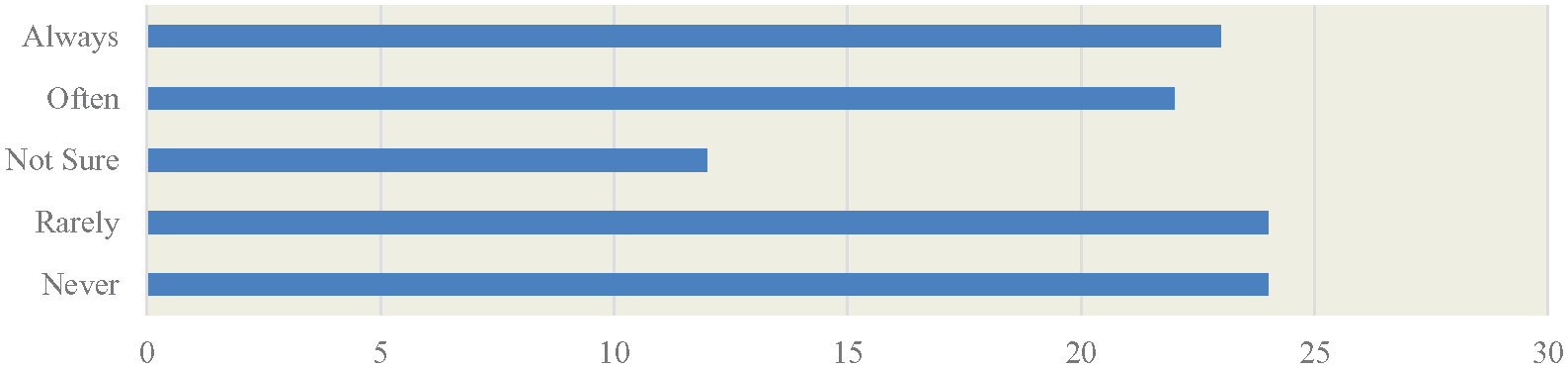
Responses to can meaningful learning take place without non-verbal participation.
Teaching and learning in virtual classes.

Overall, the results indicate a preference for interaction for some students. The issue that arises is how to enhance interaction for such students so that all students equally benefit from virtual classes. It is difficult to balance the demands of both students. However, educators need to match student expectations with the richness of their teaching styles. Pourabedin and Biglari (2024) highlight strategies educators can employ to enhance student engagement in virtual learning environments. These include: incorporating interactive elements such as polls, quizzes, and breakout rooms to encourage students to actively engage with the content and with each other, utilizing game-like elements in the learning process, such as points, badges, and leaderboards; encouraging students to work in groups on projects; tailoring learning experiences to meet individual student needs and preferences; providing timely and constructive feedback to students; and integrating various multimedia resources, such as videos, podcasts, and interactive simulations. As emphasized by Ratten (2023), there is no single solution, rather depends on context.
Policy implications
This study revealed that student non-verbal participation in virtual classrooms is not unique to developed country contexts. The study highlighted the following policy implications on student non-verbal participation in the virtual classroom:
(i) Students have different preferences in relation to verbal participation in virtual classrooms: some students prefer to listen, while some prefer engagement. It is difficult to balance the demands of both students, but it is important that educators match student expectations with the richness of their teaching styles.
(ii) Higher education institutions can play an important role in bridging the digital divide observed in learners from different backgrounds through programme design that ensures that digital learning platforms become accessible to all.
(iii) The need for government to consider subsidising students who are on government sponsorship to access digital devices such as laptops and notebooks.
(iv) It is important for governments in developing countries to invest in the provision of ICT infrastructure; and develop Internet pricing policies that facilitate access.
Footnotes
Appendix 1: Data Collection Instrument
Appendix 2: Cross tabulations
Declaration of conflicting interests
The authors declared no potential conflicts of interest with respect to the research, authorship, and/or publication of this article.
Funding
The authors received no financial support for the research, authorship, and/or publication of this article.
