



Abstract
What do non-electoral turnovers tell us about the relationship between elections, executive turnover, and democratisation? Can they contribute to democratisation? To gain insight into these questions, we consider the experiences of Southern Africa. While transfers of executive authority have become commonplace in Southern Africa, they do not necessarily coincide with elections and rarely involve partisan turnover. Neither the mode nor the form of executive turnover corresponds clearly with prior assessments of democracy. This study examines recent non-electoral turnovers in Zimbabwe (November 2017), South Africa (February 2018), and Botswana (April 2018). This research finds that non-electoral transfers of presidential authority in Southern Africa represent efforts by dominant parties to manage factional conflicts and enhance their ability to benefit from incumbency in competitive elections. While non-electoral turnover in executive authority might promote democracy under some conditions, they do more to sustain dominant party rule and a stagnate level of low-capacity democracy.
Introduction
Within the six months from November 2017 to April 2018, three Southern African countries experienced non-electoral transfers of presidential authority. In November 2017, after thirty-seven years in power, Zimbabwean President Robert Mugabe resigned under pressure from his own party, Zimbabwe African National Union - Patriotic Front (ZANU-PF). A few months later, in February 2018, a lengthy intra-party struggle culminated with the forced resignation of South Africa’s president, Jacob Zuma, more than a year before his second and final term as president ended. The third non-electoral transition took place in April 2018 in Botswana. In this case, President Ian Khama did not resign under pressure from his own party. Rather, he handed power to his vice president, Mokgweetsi Masisi, because he had reached the constitutionally mandated maximum of ten years in office.
The reception of new presidents in Zimbabwe, South Africa, and Botswana reflects a fervent hope that, although not the product of elections, a change in leadership either indicates or creates the opportunity for democratisation. Are the processes by which these individuals ascended to power democratic? Do non-electoral transfers of executive power contribute to democratisation in Southern Africa? While non-electoral turnover in executive authority might promote democracy under some conditions, the recent transitions in Southern Africa, rather than supporting democratisation, strengthen entrenched dominant parties in two ways. Non-electoral turnovers help dominant parties manage factional conflicts and allow the incumbent party’s candidate to fully benefit from the advantages of incumbency. By strengthening a dominant party system, non-electoral executive transfers of power have helped contribute to a stagnant level of democratisation and states that can be thought of as “low-capacity” democracies Tilly (2007).
Democratisation in Southern Africa
Southern Africa can be thought of as a region with specific characteristics that differentiate it from the rest of Africa (Bauer and Taylor, 2005). States in the region have one-party dominant systems based on “liberation” movements that gained political control after the fall of colonisation or, in the case of South Africa and Namibia, the apartheid system (Southhall, 2013). Compared to the rest of the African continent, these states have generally been more stable, economically prosperous, and have allowed some degree of political competition; thus, it makes little sense to see them as having authoritarian political systems. However, given the reality of the one-party rule, this region presents a challenge to how democratisation has been thought about in the past.
A useful measure for examining the unique process of democratisation in South African states is provided by Tilley (2007). There are four significant aspects of this conceptualisation of democracy: breadth of political inclusion, equality of citizens in the political process, protection from arbitrary state treatment, and mutually beneficial consultation between the state and citizens. Using this approach, states can become more or less democratic based on how they perform in these areas. This leads to four central categories: high-capacity undemocratic, low-capacity undemocratic, high-capacity democratic, and low-capacity democratic.
The major distinction this article will focus on from Tilly (2007) theory is the difference between high-capacity democratic regimes and low-capacity democratic regimes defined as:
High-capacity democratic: Frequent social movements, interest group activity, and political party mobilisations; formal consultations (including competitive elections) as high points of political activity; widespread state monitoring of public politics combined with relatively low levels of political violence
Low-capacity democratic: As in high-capacity democratic regimes, frequent social movements, interest group activity, and political party mobilisations plus formal consultations (including competitive elections) as high points of political activity, but less effective state monitoring, higher involvement of semi-legal and illegal actors in public politics, and substantially higher levels of lethal violence in public politics.
States in Southern Africa fall clearly into the category of low-capacity democratic, and the persistence of the one-party dominant rule and non-electoral transfers of executive power has perpetuated this cycle. Much of this reality has to do with the states that the current regimes in Southern African inherited. During colonialism and apartheid, these states were characterised by extreme inequality, lack of representation for large sections of the population, and state weakness. While the dominant party model of liberation movements made sense to force regime change in Southern Africa, in government, this model has perpetuated many of the pre-existing problems that existed in the region and has led to a weak state structure centred around the one-party rule (Southhall, 2013). The main reason why states in Southern Africa continue to be low-capacity democracies is the perpetuation of one-party dominant systems. The lack of a competitive opposition and non-state actors’ ability to influence policies has led to states that are beholden to powerful economic interests, undermining average citizens’ ability to influence the political process.
The above discussion on democratisation can be thought of in contrast to Levitsky and Way and 18’s (2002, 2010) concept of “competitive authoritarianism.” While this concept may work for understanding democratisation in much of the world, it is not suitable for understanding democratisation in the Southern African region because most states cannot be thought of as either “competitive” or “authoritarian.” For instance, Botswana is identified by Levitsky and Way (2010) as an example of a competitive authoritarian state. This characterisation is misleading because while Botswana has a political system that is not competitive in the sense of strong opposition parties, there is an open press, and the government is often viewed as performing relatively well (Acemoglu et al., 2002). Thus, it does not make sense to place Botswana in a conceptual category with clearly authoritarian states, such as Cambodia or Russia. Furthermore, it is hard to determine whether most other states in Southern Africa, such as Namibia and South Africa, should be thought of as competitive authoritarian. Both of these states also lack competitive elections, but similar to Botswana, both opposition parties and civil society groups are fully legal and active.
Globally, one-party dominant democracies are relatively rare. Four cases are generally given as examples: Labour Party in Israel, Christian Democrats in Italy, Social Democratic Party in Sweden, and Liberal Democratic Party (LDP) in Japan (Pempel, 1990). Of these only, the latter two have continued to have a dominant role in the countries’ political systems. There are similarities between the strategies of one-party dominant states in Southern Africa and these other cases. For instance, Japan’s LDP non-electoral executive turnover has been a common way to manage factional rivalries and give a new candidate a better chance of increasing LDP support in the next election. Two notable examples were the transitions from Yoshirō Mori to Junichiro Koizumi in 2001 and from Shinzo Abe to Yoshihide Suga in 2020. However, there are three major differences when comparing the nature of democratisation in Southern Africa with Japan and Sweden. First, unlike in Southern Africa, where dominant party states reinforce each other, this is not the case with Japan and Sweden as both are surrounded by states that have long been competitive multi-party democracies. Second, in both cases, opposition parties have formed governments; thus, opposition parties have a track record of being able to gain executive power. Finally, Japan and Sweden are clear examples of high-capacity democracies, with very high levels of education, infrastructure, and health care that outperform most other states.
Many popular measures of democratisation, such as Cheibub et al. (2010), Freedom House (2018), Huntington (1993), Polity (2017), and Przeworski et al. (2000) do not capture the complexity of democratisation in Southern Africa. There is little in these measures, especially those that focus more on the procedural elements of democratisation, capturing the role that non-electoral transfers of power have played in perpetuating the one-party rule and low-capacity democratisation. So while these measures might give a “bird’s-eye view” of democratisation globally, more in-depth analysis is needed to better understand specific cases. Thus, this study has chosen Tilly (2007) approach for examining states in Southern Africa because there are no clear cut-off points as in other democratisation measures. Furthermore, this approach allows for a focus on procedures and the process of democratisation and for qualitative comparisons to be made between states.
Incumbent Advantage and the Limits of Elections in Africa
Thinking of Southern Africa as a region, with unique processes in terms of democratisation brings into question some of the past literature on democratisation in Africa. As will be discussed in this section, some of the major findings in Africa more broadly do not apply to one-party states in Southern Africa. One-party dominant states, in which non-electoral executive transfers have been central to perpetuating the one-party rule, have brought about a dynamic that is mostly unique to the region but also one that brings up questions about the process of democratisation in Africa more broadly.
A common finding in the literature is that the incumbent electoral advantage is common in Africa (Rakner and Van de Walle, 2009; Reyntjens, 2016). The incumbent electoral advantage is an essential dynamic in African elections. For instance, Cheeseman (2010) finds that among non-founding elections in Africa from 1990 to 2009, incumbent heads of state only lost 12 per cent of the time. However, in elections in which there was no incumbent head of state, an “open seat election,” party turnover took place 45 per cent of the time. Thus, elections in which there is no incumbent provide unique opportunities for opposition parties. However, while this trend exists in sub-Saharan Africa, the region of Southern Africa contradicts this as non-electoral executive transfers of power within dominant party systems, have rarely led to clear opportunities for opposition parties and have served to reinforce the one party rule.
In influential studies, Lindberg (2006a, 2006b) argues that even if elections are unfair and do not produce an alteration in power, they still lead to a higher level of democratisation in African states. His central argument is that voters and institutions become more conducive to a higher level of democratisation through the process of holding elections. This happens through experiencing regular election cycles and the procedures and expectations commonly associated with this type of political activity. Furthermore, African elections that produce party turnovers in power increase support for the democratic process among the electorate (Moehler and Lindberg, 2009). Regular elections appear to be an essential factor, in creating the conditions, for a higher level of democratisation in some states. For instance, Nigeria held many flawed elections until 2015, when an election that was widely viewed as legitimate took place (Cassani and Carbone, 2016). However, elections are a necessary but not sufficient condition for democratisation.
In Southern Africa, elections have served to reinforce and legitimise low-capacity democracy and authoritarian rule in some cases. Elections that are designed to be unfair and non-competitive are part of what Schedler (2002) terms the “menu of manipulation” available to authoritarian incumbents. Incumbent leaders have a whole host of strategies they can implement to survive politically. Since the 1990s, holding elections that serve to rubber-stamp the existing political structure has become an increasingly common and attractive strategy for incumbent politicians and dominant political parties. In some states, elections serve to help the ruling party mobilise support, gain valuable information on the population overall, and appease foreign donors, without having anything to do with a possible transfer of political power (Cheeseman and Klaas, 2018). Non-electoral transfers of power can also be added to the “menu of manipulation” in terms of perpetuating one-party rule, especially in cases where this has become institutionalised, such as Botswana.
It is essential, especially when studying Southern Africa, that the lack of party turnover through elections is not overemphasised when examining democratisation. In many cases, electoral party turnover in Africa has led new leaders to continue many of the authoritarian tactics of previous officeholders and has not led to an increase in democratisation (Rakner and Svåsand, 2013; Wahman, 2012, 2014) . Some research sheds doubt on elections as a common pathway to democratisation in Africa. Bogaards (2013) finds that only five states in Africa have democratised through elections and two of these reverted to authoritarianism. Thus, overly focusing on party turnover through elections will overlook some of the most important aspects of democratisation.
An important area of focus from states in Southern Africa is party institutionalisation. Riedl (2014) finds that well-institutionalised party systems in African states, such as Ghana or South Africa, often have authoritarian origins. In these states, voters often have longstanding party preferences, and parties take consistent ideological positions. Paradoxically, if a founding election takes place without a strong incumbent, the party system often becomes fractured, and ultimately the state becomes less democratic. Thus, competitive party institutionalisation and democratisation are viewed as separate processes that do not necessarily reinforce each other (Randall and Svåsand, 2002) .
Levels of party institutionalism in African states vary widely by region, and while some of the dynamics that have led to different party systems in Africa may be unique to the continent, much of the theoretical development about party institutionalism more broadly applies to African states as well (Weghorst and Bernhard, 2014). In some cases, constitutional crisis or highly competitive elections may serve to deepen party institutionalisation (Bob-Milliar and Paller, 2018). When looking at the Southern African region, there appears to be a higher level of party institutionalisation than in other African states. Furthermore, party systems are more stable and more reflective of distinct ideological positions than in the rest of the continent. However, since many states in Southern Africa inherited their dominant one-party systems as part of a regime change, those within these parties, and even outside observers, may view them as being more or less synonymous with the state itself (Southhall, 2013). Over time, non-electoral transfers of power have reinforced this process of party institutionalisation but not necessarily a higher level of democratisation, thus leading to stagnant low-capacity democracies.
Non-Electoral Executive Transfer as a Strategy for the African National Congress (ANC)
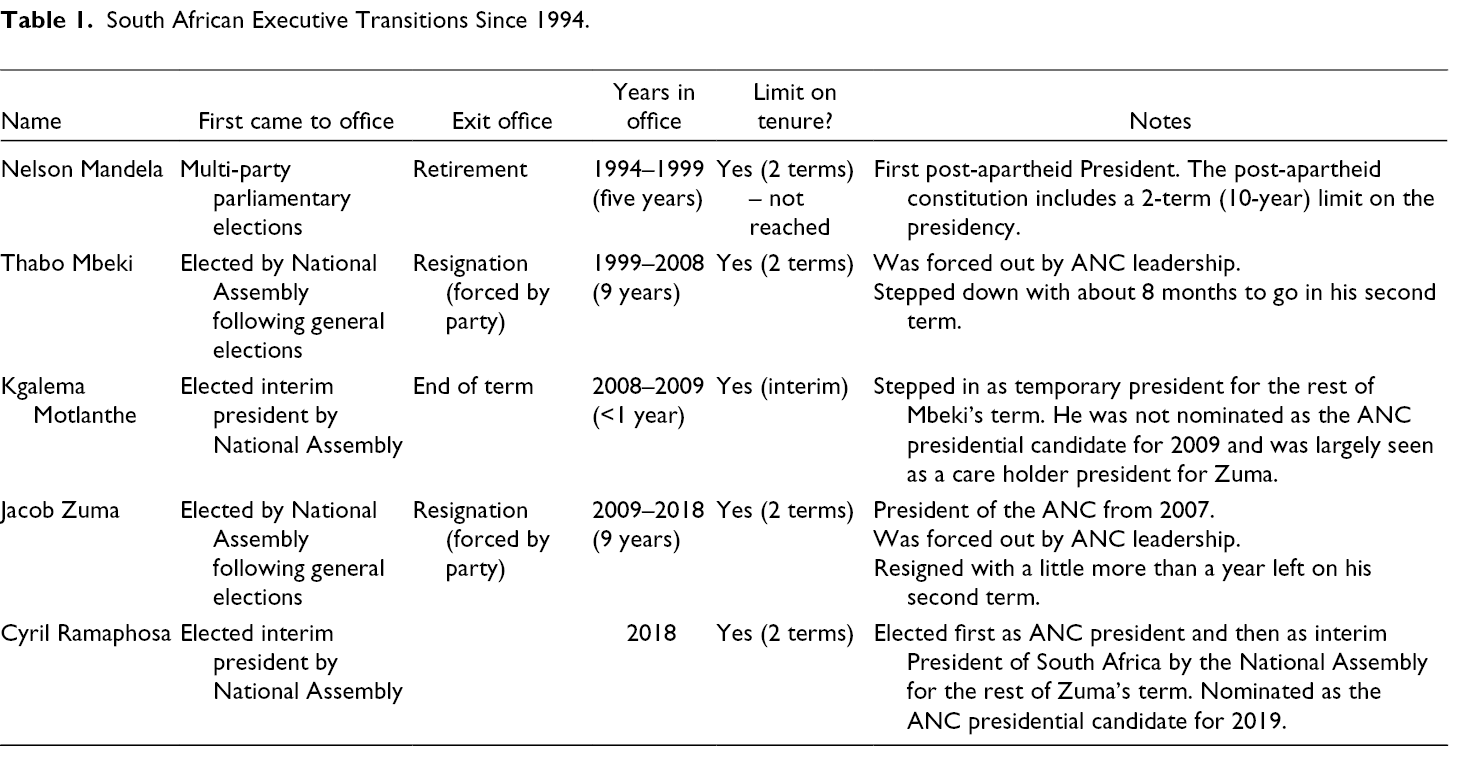
The case of non-electoral transfer of power in South Africa is particularly notable. Non-electoral transfer of power is not part of the formal rules of the African National Congress (ANC). However, it might as well be, as four out of the five post-apartheid presidents came to power this way and two unpopular long-serving presidents have been forced to step down before their term ended because of party pressure and concerns about possible electoral losses. Thus, the ANC in South Africa is a clear example of non-electoral executive transfers’ usefulness to maintaining one-party control of government and institutionalising low-capacity democracy.
Leadership for the ANC is formally supposed to occur through national conferences, which take place about one and a half years before general elections. These events could channel factional infighting into clear support for a slate of candidates in the upcoming election. While candidates are chosen during the elective conference, they are not supposed to take office until after the forthcoming election. In practice, non-electoral transfers of power have taken place twice after an opposing faction within the ANC had their chosen candidate win in 2007 and 2017, resulting in one of many factors that forced out Thabo Mbeki and Jacob Zuma before their term limit was over. The 2007 and 2017 ANC national conferences came to define both the intense factional infighting that was taking place in the party and the unpopularity of the incumbent president. Thus, non-electoral transfers of executive power have become a political strategy for the ANC partially due to the results of national conferences. These events have brought about a perception that if new leadership is not presented before the upcoming election, the party could face declining electoral support, thus contributing to the viability of non-electoral transfers of executive power as a strategy.
In early 2018, support for former South African President Jacob Zuma, and his party the ANC, was reaching critically low levels. Ever since the transition from apartheid in 1994, the ANC had dominated national politics. However, with an election coming up in 2019, Zuma had become an apparent liability for the party. Rival politician Cyril Ramaphosa had defeated Zuma’s former wife and handpicked successor, Nkosazana Dlamini-Zuma, to become president of the ANC in late 2017. By early 2018, Zuma was seen as a lame duck president and eventually was forced out of the presidency by ANC leadership, paving the way for Ramaphosa to take his place as president of South Africa.
While these events in South Africa gained global attention, they were part of an overall trend in Southern Africa, in which non-electoral transfers of power have been taking place in the executive branch of government. Zuma himself benefited from a non-electoral transfer of the presidency when Thabo Mbeki was also forced out by ANC leadership, in this case about a year before the 2009 election. Similar to Ramaphosa, Zuma had become head of the ANC before Mbeki was forced out, thus leading to a lame duck presidency, which in both cases would not last until the upcoming election. Mbeki was replaced by Kgalema Motlanthe, who was primarily viewed as an interim president before Zuma became president after the election.
Allegedly, Mbeki had instructed prosecutors to pursue Zuma for corruption after he had resigned as deputy president in 2005. The possibility that Mbeki had selectively used law enforcement to try to defeat a political rival was seen by many in the electorate as being overly authoritarian. After the courts agreed and dismissed the charges against Zuma, on account that they had been politically motivated, Mbeki’s presidency was in danger. Furthermore, Mbeki’s neo-liberal economic policies had become widely unpopular (Gevisser, 2007). These issues became a focal point for widespread opposition to Mbeki’s continued presidency both within the ANC and without.
Right after Mbeki resigned, there was speculation that the underlying motivation by ANC leadership to force him out was to avoid a political crisis that could damage the party ahead of an upcoming election (Lindow, 2008). Given the dominance of the ANC over the South African political system, the only threat was that factional infighting could lead to multiple political parties. Zuma was able to capitalise on trade unions, the South African Communist party, and left-wing opposition to Mbeki’s economic policies. This is ironic given that Zuma had not supported left-wing factions in the ANC previously, and his presidency eventually led many on the far left of the ANC to break away and form a separate political party, the Economic Freedom Fighters (Southhall, 2013). Some disillusioned Mbeki supporters founded the Congress of the People (COPE) party, but this party never gained widespread support. Thus, by Mbeki stepping down, the ANC was able to enter the 2009 elections mostly unscathed by the political drama that had taken place over the previous years. The non-electoral transfer of power that had taken place between Mbeki, to a caretaker government led by Motlanthe, and then after the election to Zuma, reinforced the dominant position of the ANC in South African politics.
While enjoying initial popularity, Zuma’s presidency would become mirrored in severe corruption scandals and a stagnant economy. While Zuma did win re-election in 2014, support for the ANC dropped considerably. In 2016, support for the ANC in local elections, especially among urban voters in Johannesburg and Nelson Mandela Bay, had dropped to a point where opposition parties were able to build coalitions and remove the ANC from government (Malala, 2016). Thus, Zuma was a definite liability, as many within the ANC had started to oppose him openly.
By 2018, it was inevitable that the ANC would have to remove Zuma or face further losses. In December 2017, when the ANC held internal elections to replace Zuma as party president in anticipation of his term limit, Cyril Ramaphosa defeated Zuma’s chosen successor and former wife, Nkosazana Dlamini-Zuma, by a very narrow margin. Confronted with certain defeat in an upcoming no-confidence vote, Zuma was forced to resign two months later, allowing Ramaphosa’s ascension to the presidency more than a year before regularly scheduled elections in 2019. Had Nkosazana Dlamini-Zuma been elected ANC president, it is likely that Jacob Zuma would have remained in office longer. After all, Zuma had survived eight previous votes of no confidence, including a vote by secret ballot in August 2017.
Once again, a non-electoral transition would take place to help the ANC’s chances in the upcoming election, when Ramaphosa would take over. High expectations and excitement often called “Ramaphoria” came about as the transition took place. The economy responded positively as South Africa’s currency, the rand, quickly gained in value (Tshwane, 2018). After a few months, the initial phenomena of “Ramaphoria” seemed to be over as the South African economy continued to struggle (Maier, 2018). However, there is little doubt that the non-electoral transition that took place between Zuma and Ramaphosa helped the ANC win in the 2019 election, although with a smaller margin of victory than in the past. To some degree, the ANC was viewed favourably by an electorate that was increasingly tired of Zuma. Also, Ramaphosa had many of the advantages of incumbency that he would not have had if Zuma would have stayed in office. For the second time, the ANC leadership was able to bring about a non-electoral transfer of power, as not just a reaction to specific leaders or events, but as an electoral strategy to continue the party’s dominance over South African politics.
South African democracy has become paradoxical. Since the transition to constitutional democracy in 1994, South Africa was often portrayed globally as a successful democratic transition model. However, when one examines South Africa closely, many institutional, cultural, and economic factors commonly associated with democracy are not present (Mattes, 2002). While South Africa has had five presidencies since independence, all have been from the ANC, and four of the five came to the presidency under circumstances that involved non-electoral transfers of office. These transfers have helped the ANC avoid factional and electoral crises. However, non-electoral executive transfers of office have not made the political process more competitive and responsive in South Africa, contributing to a stagnant level of democratisation.
South African Executive Transitions Since 1994.
Zimbabwe: A Non-Electoral Transfer of Power as the Result of Factional Conflict
On the surface, Zimbabwe’s non-electoral transfer of power would seem unique, as it took place mostly outside of the institutional process in a more authoritarian political context. However, in many ways, the upshot of factional conflicts within ZANU-PF that led to Robert Mugabe’s ouster and Mnangagwa’s presidency would had similar results to other cases examined in this study. Similar to other parties in Southern Africa, non-electoral transfers of power allowed ZANU-PF to perpetuate its dominance over Zimbabwe’s political system and perpetuate a system of low-capacity democracy in which democratisation appears to be stagnant for the foreseeable future.
From the early 2000s onward, the political conflict between ZANU-PF and the Movement for Democratic Change–Tsvangirai (MDC-T) gained most of the coverage in the international media. However, just as important for domestic political outcomes was factional infighting among ZANU-PF (Munier, 2016, 2020). Ultimately, it would be factional infighting within ZANU-PF that would be the driving force behind the non-electoral transfer of power between Robert Mugabe and Mnangagwa.
While executive succession within ZANU-PF is supposed to take place within an elective congress and a complex party constitution that outlines the rules for choosing new leaders exists, these processes have served as a rubber stamp on the Mugabe and Mnangagwa presidencies. Thus, elective congresses have reflected the power distribution between different factions within ZANU-PF and have not had the same level of political significance as in Botswana and South Africa. Similar to other areas of factional competition within ZANU-PF, electoral conferences and the formal rules of ZANU-PF can be selectively used by one faction to gain an advantage over others (Matyszak, 2014). However, in the one non-electoral transfer of power that has taken place between Mugabe and Mnangagwa, formal rules and procedures for succession played a very minimal role.
Throughout his tenure as president, Mugabe often played major factions within ZANU-PF off against each other. Two longstanding factions within ZANU-PF were led by Mnangagwa, who became vice president in 2014, and Joyce Mujuru who was vice president from 2004 to 2014. The faction led by Mujuru had more ties to Western businesses, as she and her husband, Solomon Mujuru, had investments in many economic sectors. This faction began to decline after WikiLeaks documents were released, exposing a plot by the Mujurus with Western governments to remove Mugabe in 2007 (The Herald, 2014). Solomon Mujuru died in 2011, and after Mugabe easily won re-election in 2013 he moved to replace Joyce Mujuru in 2014. Thus, while the Mujuru faction was an important force in ZANU-PF inter-party politics and the Mujurus were seen by many as the successors to Mugabe, they ultimately lost out.
With the decline of the Mujuru faction, Mnangagwa and his allies were able to capitalise on this. Mnangagwa became vice president in 2014 and started to be viewed as Mugabe’s likely successor. Mnangagwa had long been the preferred candidate of the army to succeed Mugabe, possibly while Mugabe was still alive. During this period another faction developed in ZANU-PF, made up mainly of young Zimbabweans, called the G-40. Grace Mugabe has been viewed as the leader of this faction, but it is important to point out that Robert Mugabe himself supported this faction over the last few years of his presidency (Tinhu, 2016).
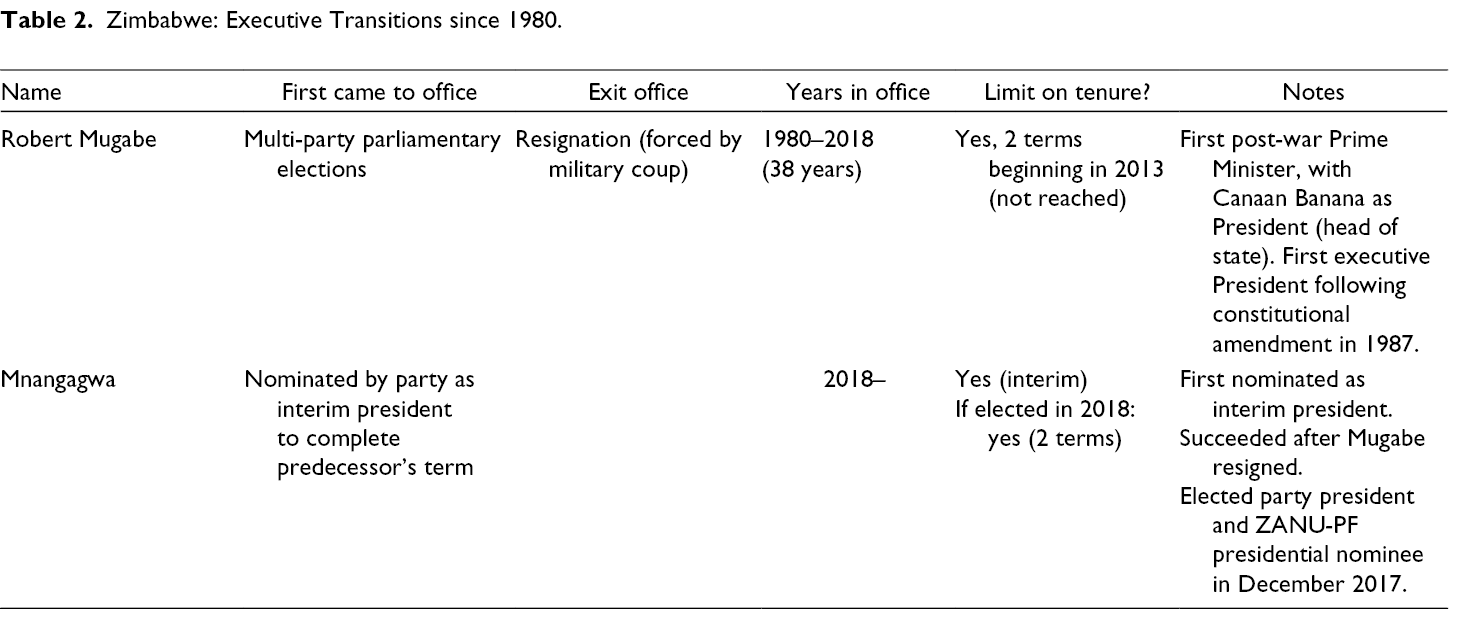
In November 2017, years of factional infighting with Zimbabwe’s ruling party ZANU-PF came to a critical juncture when Robert Mugabe dismissed his vice president, Mnangagwa, to clear the way for his wife, Grace Mugabe, to become president. After thirty-seven years in office and at the age of ninety-three, Robert Mugabe was planning once again to seek re-election in 2018 as the candidate of ZANU-PF. In November 2017, these plans would be thwarted as a “coup” took place in which army loyalists, who supported Mnangagwa, placed the Mugabe’s under house arrest and seized the state apparatus. These developments were met positively by many Zimbabweans and the international community, who were tired of Robert Mugabe’s long rule. Many observers and those involved in these events refrained from calling them anything that could be interpreted in negative terms, such as a “coup” or “military takeover.” The relative lack of violence that took place, along with Robert Mugabe’s eventual decision to step down instead of being formally impeached, has led some observers to call this the “world’s strangest coup” (Mackintosh, 2017).
While getting rid of Robert Mugabe would appear to be a move towards democratisation, it would serve to reinforce the dominance of ZANU-PF and empower the faction of ZANU-PF that was closest to the military. In fact, Constantino Chiwenga, the long-time general of the Zimbabwean military, who helped orchestrate the removal of Robert Mugabe, became the vice president and Minister of Defence. There is speculation that Chiwenga, along with other senior military leaders, was able to use the executive transfer of power to become an even more dominant force in Zimbabwean politics (Mhaka, 2018). The consolidation of military power under Mnangagwa has made Chiwenga a likely presidential contender in the future and one of the most powerful people in Zimbabwean politics presently.
After taking over the executive, Mnangagwa’s main slogan became “Zimbabwe is open for business” (Quest and McKenzie, 2018). The time in which Mnangagwa was president preceding the election allowed ZANU-PF to present a positive discourse around building the economy and infrastructure. This would have been difficult to do had Robert Mugabe stayed in office or run for President again. According to the African Development Bank (2018), some positive economic changes in Zimbabwe have taken place; however, real GDP was expected to grow very gradually at 1 per cent in 2018 and 1.2 per cent in 2019. Nonetheless, in the time preceding the election, Mnangagwa was able to make big promises and predictions about economic growth, without enough of a time frame in which voters could evaluate these plans.
On 23 June 2018, an apparent assassination attempt, with a grenade, took place during a Mnangagwa rally in Bulawayo (Baynes and Stubley, 2018). Notably, Mnangagwa blamed the G-40 faction as the likely culprits behind the attack and not his main electoral rival, Nelson Chamisa, and the MDC-T (Saunyama, 2018). While those responsible for the attack are likely to remain unknown, it is notable that Mnangagwa appears to have viewed a faction of ZANU-PF as being more of a threat to his continued rule than electoral opponents.
Before the elections, Malunga (2018a) identified a series of significant problems that had already surfaced: non-transparent voter rolls, lack of ballot secrecy, an Electoral Commission tied to ZANU-PF, military interference on behalf of ZANU-PF, and a media that overtly favoured ZANU-PF. All these problems persisted before, during, and after the election (Malunga, 2018b). Before the elections were to be held on 31 July 2018, some started to call for Chamisa and the MDC to boycott inevitably unfair elections (Tinhu, 2018). Ultimately, it appears Chamisa and the MDC felt as though their support was so overwhelming that they could win, even if the elections were unfair. There is also speculation as to whether Chamisa would be allowed to become president if he won the election, given that this would amount to military generals handing over power to a forty-year-old civilian (Ndawana, 2018).
When the elections took place on 31 July 2018, most international observers initially reported that the elections had been fair and peaceful, despite issues raised by the MDC (Mwarumba et al., 2018). Two days later, widespread deadly protests broke out when the House of Assembly results were announced giving ZANU-PF 179 seats and the MDC 88 seats (Moyo, 2018). On 3 August 2018, the Zimbabwe Electoral Commission declared Mnangagwa the winner, with 50.8 per cent of the vote to Chamisa’s 44.3 per cent (ZBC, 2018). The four days it took to release the vote count and the narrow 0.8 per cent by which Mnangagwa gained enough votes to avoid a runoff led to questions about the independence of the Zimbabwe Electoral Commission. Joyce Mujuru, who had left ZANU-PF and ran for president in 2018 as part of the People’s Rainbow Coalition, received just under 13,000 votes (ZBC, 2018). Thus, Mujuru and her supporters appear to no longer be a force in Zimbabwean politics.
The 6.5 per cent of votes by which the Zimbabwe Electoral Commission claimed that Mnangagwa won the election was notable as well. Cheeseman and Klaas (2018) find that when an election is rigged, it is best for the winner to get somewhere between 5 and 15 per cent more votes. This range makes it so that very close elections, which can be most easily scrutinised, are avoided. However, this range still sounds competitive and believable. In some cases, authoritarian leaders may even lower their vote count in a rigged election, in order to fall within a certain range.
Given election irregularities and questions about the independence of Zimbabwe’s electoral institutions, Chamisa and the MDC pursued a court case to challenge the results. After the supreme court ruled unanimously that the election had been legitimate, Mnangagwa was inaugurated on 26 August 2018 to a “subdued” audience (Mutsaka, 2018). While Chamisa and the MDC continue to argue that they won the election, many Zimbabweans are exhausted with politics, especially after the uncertainty since late 2017. In February 2019, the government released a new currency, the RTGS dollar, to replace the US dollar, which had often been used for exchange. The new currency quickly lost value, and the Zimbabwean economy faced many problems in early 2019 (Kaledzi, 2019).
It is clear that ZANU-PF gained an electoral advantage from Mnangagwa having become interim president about seven months before the election. The ability of Mnangagwa to use the benefits of incumbency helped him win an election in 2018 that was marred by irregularities if not outright election fraud (Malunga, 2018b). This is especially apparent when thinking about what would have happened if Mugabe had stayed in office until the 2018 election, or had even run for president again as the ZANU-PF candidate. The non-electoral transition that took place allowed Mnangagwa to use a whole host of benefits that are commonly associated with incumbents in elections, which alone would have given him an advantage. Further, the non-electoral transition allowed Mnangagwa and his faction to utilise the whole machinery of ZANU-PF and other state institutions, to an extent that would have been impossible otherwise. While some may see the end of Mugabe’s rule as being a positive step, it is important to question whether the transition that took place has led to a higher level of democratisation in Zimbabwe or if this transition served to reinforce ZANU-PF rule over the country? Ultimately, by looking in depth at this case, the latter appears to be more likely. Thus, while some things in Zimbabwe have changed, much has stayed the same, including the level of democratisation which has stagnated under a continued one-party dominant rule.
Zimbabwe: Executive Transitions since 1980.
Botswana: Institutionalising Non-Electoral Executive Transitions
Superficially, because it was triggered by a constitutional limit on presidential tenure rather than a looming vote of no confidence or coup, the 2018 transition in Botswana appears entirely different from those in Zimbabwe and South Africa. The conditions under which Botswana limited presidential tenure, however, both confirm the influence of factional rivalries on non-electoral transfers of executive power and demonstrate how they can help dominant parties manage internal conflict. Furthermore, the Botswana Democratic Party (BDP) has been able to institutionalise non-electoral transfers of executive power more overtly than neighbouring states, and this has proven to be a very successful strategy.
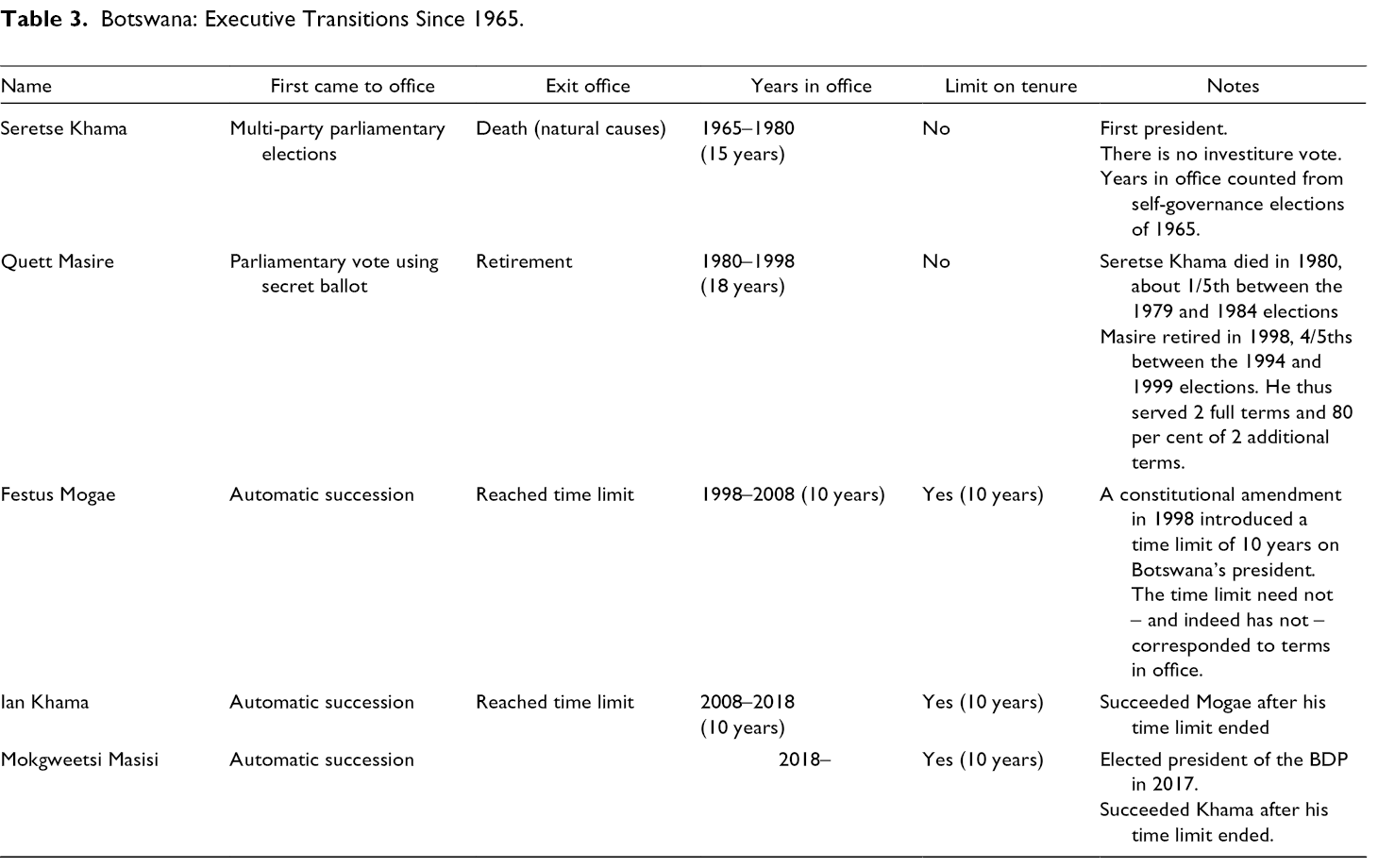
In the mid-1990s, a sharp rise in the opposition’s electoral support in Botswana’s 1994 general election was due to the willingness of BDP activists to form cross-party alliances against factional rivals. In response, the BDP decided to create opportunities for generational renewal to reduce the risks of overt and potentially destructive factional fighting. The BDP responded by introducing limits on the tenure of both the party and national presidencies, and by encouraging several senior politicians to retire. Thus, the then president, Quett Masire, retired shortly after the term limit had been adopted (Masire and Masire, 2006). Because the limit on presidential tenure is expressed in years rather than terms in office, Masire’s mid-term retirement created a recurring discrepancy between presidential tenure and the electoral cycle.
In Botswana, constitutional provisions for presidential succession between elections imply that, as a president approaches the ten-year limit, the vice president becomes a nearly guaranteed successor. Because the vice president must be an elected member of parliament and is subject to a confirmation vote in parliament, a nominee must command at least some partisan and popular support. Nonetheless, many in Botswana see this as a tactic to perpetuate BDP dominance (Cochrane and Brown, 2019). If the BDP were to lose an election then term limits not coinciding with the electoral timetable would not work to the BDP’s favour, but the current process makes it less likely that a party turnover will occur.
Botswana: Executive Transitions Since 1965.
Soon after the transition from Ian Khama to his chosen successor, Mokgweetsi Masisi, in 2018 a feud began that led the former to leave the BDP and back the Botswana Patriotic Front (BPF) in the 2019 election. Nonetheless, with incumbent advantage, the BDP, led by Masisi retained a large legislative majority after the 2019 election, sending opposition parties into disarray. In fact, in early 2020, there are reports that Ian Khama plans to re-enter the BDP, likely because his political influence is limited outside of the party (Seven, 2020). Thus, this election reinforces the idea that political power in Botswana lies mainly with the BDP and not with any one leader within it. Voters had time to get used to Masisi in office, and it is clear he ran a successful campaign, but the primary reason for the BDP’s continued success is an institutionalised advantage, and regular non-electoral transfers of power are an essential part of this.
Have These Transitions Led to More Democratisation?
Executive turnover might appear to be symptomatic of democracy, or at least as an avenue for democratisation, even when it occurs outside of the electoral process. It does, after all, underline the limits of executive power and, especially, personal power. To the extent that executive turnover adheres to constitutional procedures, it is also consistent with and could even be said to reinforce the rule of law. Some non-electoral mechanisms of executive turnovers, such as parliamentary votes of no confidence and presidential term limits, are widely viewed as supporting democracy. Resignations in the face of scandals or poor performance might reflect accountability to popular pressures. Free and fair elections, after all, represent a procedure for realising democracy, but they are neither necessary nor sufficient for democracy. Nonetheless, to the extent that non-electoral executive succession circumvents the electoral process, it reduces the influence of voters relative to other actors. Consequently, it has the potential to limit rather than reinforce democracy. This potential seems significant when non-electoral executive turnovers reflect the veto power of non-elected actors or systematically buffer the competitive pressures on incumbent parties.
In Southern African, non-electoral transfers of executive authority do signal the limited power of incumbent presidents and take place in the shadow of competitive elections. However, non-electoral transfers of executive authority also empower non-elected actors rather than the electorate, leading to stagnant low-capacity democracy. This contradicts accounts that see elections as a common pathway to democratisation (Cassani and Carbone, 2016; Lindberg, 2006a, 2006b; Moehler and Lindberg, 2009). Zimbabwe, South Africa, and Botswana all hold regular multi-party elections that are competitive enough to make electoral turnover plausible, even if it has not yet occurred. In 2008, rather than win re-election outright, Mugabe retained the presidency because the opposition front-runner withdrew from the presidential run-off in the hope of ending violent attacks on his supporters. Likewise, most voters in Botswana (53 per cent) opted for a party other than the BDP in 2014; the party owes its two-thirds majority in parliament to the disproportionality of first-past-the-post elections in multi-party systems. Even in South Africa, party splits and growing disenchantment represent real threats to the ANC’s electoral dominance. In all three cases, the non-electoral transfer of executive power enabled a dominant but embattled incumbent party to instal a new leader at least six months prior to regularly scheduled elections and then win those elections. If, as Cheeseman (2010) has argued, electoral turnover of the presidency is much less likely when an incumbent is seeking re-election, then these non-electoral transfers do more to reinforce the dominance of entrenched incumbent parties than they do to promote democratisation.
Institutionalising Incumbent Advantage as a Strategy
Beyond strengthening the electoral prospects of dominant parties in Southern Africa at the expense of incumbent presidents, non-electoral transfers of executive power respond to factional conflicts within these “big tent” parties. Intra-party dynamics influence whether non-electoral transitions occur, their timing and mode, as well as the choice of successor. In Zimbabwe and South Africa, incumbent presidents have been forced to resign by their own political parties. In Zimbabwe, Mnangagwa succeeded Robert Mugabe as president after years of sometimes deadly factional infighting within ZANU-PF. Mnangagwa’s Lacoste faction finally gained the upper hand over Grace Mugabe’s G-40 faction only when the military intervened on his behalf. In contrast with Zimbabwe, the military did not intervene in the transitions in South Africa and Botswana. As in Zimbabwe, however, factionalism figures prominently. In South Africa, factional infighting carried Zuma to power, dogged him throughout his time in power, and ultimately resulted in his ouster.
In Botswana as in Zimbabwe and South Africa, non-electoral transfers of executive power reflect factional conflicts within incumbent political parties. In contrast with the other two countries, however, presidents in Botswana retain considerable, if bounded, discretion in selecting their successors. This can be seen in the contrasting fates of Khama’s and Zuma’s chosen successors. Despite considerable grumbling following Mokgweetsi Masisi’s appointment as vice president in 2014, his election as BDP president with 75 per cent of the vote in July 2017 signalled that the party has rallied behind Khama’s chosen successor.
Botswana has institutionalised non-electoral presidential successions, with an expectation that they will yield electoral benefits. Concerning the most recent transfer, Africa Confidential (2018) claims that “[t]he goal is to allow Masisi to use his incumbency to help win the general election in October 2019. By then, he hopes he will have obtained the same air of permanence that benefited his predecessor.” More generally, this arrangement ensures that, when term limits force a president to step down, the incumbent party’s candidate fully benefits from the advantages of incumbency without worrying about potential sabotage by the outgoing president.
The ANC has achieved similar ends through less institutionalised means. No post-apartheid president has served two full terms in office. While Nelson Mandela retired after a single first term as president, Thabo Mbeki – like Jacob Zuma – resigned under pressure before the end of his second term. Mbeki, like Zuma, had become increasingly controversial and, in both cases, the ANC would have faced a more critical electorate had the term-limited presidents not resigned well in advance of elections.
Even the less institutionalised transition in Zimbabwe improved ZANU-PF’s prospects in the July 2018 elections. While the transition responds more to factional infighting within ZANU-PF than electoral pressures, many citizens welcomed having a new head of state for the first time since 1980 and were willing to give Mnangagwa a chance. It is theoretically interesting that, compared to Botswana and South Africa, Zimbabwe has the most competitive and least democratic political system. Elections in Zimbabwe have been far closer, with the opposition MDC making more inroads into government than opposition parties in Botswana and South Africa. All of this has taken place in a political context marred by non-state actors infringing upon the political system and a weak state in many regions of the country. Thus, Zimbabwe presents a good example of how political competition does not necessarily lead to higher levels of democratisation and might even hinder democratisation in a state where a dominant political party has to use a wide variety of authoritarian tactics to appease the electorate and undermine a viable political opposition. In time, non-electoral transfer of power has become one of these tactics or another part of the “menu of manipulation” available to dominant party states (Schedler, 2002).
In Botswana, South Africa, and Zimbabwe, electorates had time to evaluate their new leaders before voting. This gives these new leaders the many electoral advantages that come from incumbency and reinforces the dominant parties’ position in these states overall. This is particularly the case when we think about what could have happened if unpopular incumbents had stayed in office longer, further damaging the legitimacy of dominant party rule. Time will tell if non-electoral transfers of power are enough for dominant parties to maintain their dominance in Southern African states; it is likely that these strategies will help and, in turn, lead to a system of stagnant low-capacity democratisation. -3
Footnotes
Declaration of Conflicting Interests
The author(s) declared no potential conflicts of interest with respect to the research, authorship, and/or publication of this article.
Funding
The author(s) received no financial support for the research, authorship, and/or publication of this article.
Author Biography
Email: