




Abstract
The COVID-19 pandemic that occurred in March 2020 resulted in the global economy grinding to a halt because of the various measures that were put in place by governments to stem the tide of the pandemic. While various sectors of the economy were hit hard, the micro, small and medium-sized enterprise (MSME) sector is believed to have borne the brunt of the economic shutdown that came about because of COVID. The focus of this paper is therefore to examine the experiences of MSMEs with COVID-19 in Ghana. Based on the experiences of 25 business owners in the MSME sector that were interviewed, it is argued in the paper that given that the pandemic exacerbated the challenges that MSMEs already faced, the development and implementation of various support programmes to the sector would be crucial to the economic recovery that would hopefully occur in the post-COVID period. The attempts to ensure the continued contribution of MSMEs to Ghana’s economy in the post-COVID period would be dependent on the adoption of policies that entail the provision of financial support through loans, loan guarantees and grants; and assisting MSMEs in their use of digital technology to help them with communication and marketing to their customers would be a step in the right direction.
Keywords
Introduction
Micro, small and medium-sized enterprises (MSMEs) are an active and vibrant force for economic growth, innovation, job creation, and boosting national gross domestic product (GDP) (Fubah and Moos, 2022; Muriithi, 2017; Ngek, 2014). While MSMEs contribute to the economies of countries in various ways, the outbreak of the novel coronavirus (COVID-19), which was first detected in December 2019 in Wuhan, China, and spread worldwide in the first quarter of 2020, precipitated a global economic crisis by halting business operations for both MSMEs and big businesses (Nchanji, 2021). Often grappling with financial, administrative, human capacity, and marketing-related challenges, the MSME sector is believed to have been the hardest hit and disproportionately affected by the unexpected economic changes that occurred because of COVID-19 (Acquaah et al., 2021; Nkansah et al., 2024). Given the contribution of MSMEs to the economies of countries, their experiences, and the challenges they faced because of COVID-19 raised concerns regarding their survival in Ghana.
The primary purpose and objective of this research study was therefore to explore Ghanaian MSMEs’ experiences with COVID-19 to better understand how it changed the economic landscape of their activities, business outcomes and expectations, and examine the socioeconomic support such as tax reliefs, financial aid, and other monetary reliefs, including soft loans that the Ghana government offered to MSMEs and the effectiveness of these support during COVID-19. In addition, it discusses their effectiveness during COVID-19 and how lessons learned during the pandemic can be used to subsequently improve support for the MSME sector to make it much more efficient and profitable in the post-COVID-19 period. In exploring these issues, the research was guided by the following questions: (1). What has been the impact and business experiences of MSMEs with COVID-19 in Ghana? (2) What was the diverse range of policy measures implemented by the Ghana government to support the MSME sector and how did these supporting policies impact the business operations and survival of MSMEs? and (3) What were the lessons learned and what further support do MSME owners in Ghana need from the government to foster resilience and survival in the post-COVID-19 period?
The experiences of MSMEs in Ghana with COVID-19 were likely to differ or vary across and among individuals and their businesses, and specific evidence and data about it have now emerged. Among the works that have examined COVID’s impact is the study by Amewu et al. (2020), which estimated the economic costs of COVID-19 policies and external shocks in Ghana, with a focus on agri-food system impacts. Similarly, Aidoo et al. (2021) examined how adaptive resilience in the form of perseverance and retrenchment influenced the performance of Ghana MSMEs during the COVID-19 pandemic. While this research has been significant in terms of its contributions to the literature, works and studies on Ghana that have been based on in-depth qualitative approaches and interviews with MSME business owners are generally missing. Much of the extant research (Aidoo et al., 2021; Nkansah et al., 2024; Schotte et al., 2023) is quantitative in nature and use approaches such as structured online survey questionnaires. However, the use of these methods often provide information and analyses that are aggregated, and often fail to capture the personal experiences of MSME business owners. Using the experiences of 25 business owners who were interviewed in Accra, Ghana in 2022, this paper addresses this fundamental weakness and fills the gap in the literature by transcending the quantitative approach that has underpinned the discussions regarding the impact of COVID on the operations of MSMEs in Ghana. Aside from building on the works undertaken quantitatively, the contribution of this paper to the literature on COVID-19 and MSMEs in Ghana is twofold. First, it offers qualitative insights and builds on and adds to the literature on the challenges MSMEs in Ghana faced during COVID. Apart from subjectively interpreting the social phenomena around them (Dunwoodie et al., 2023), the use of interviews helped to explore and obtain sufficient information from the business owners of MSMEs that enabled us to fully understand the impact of COVID on their individual personal experiences. In addition, it helps us to understand the complexities MSMEs faced in coping with the COVID pandemic that occurred from the early 2020. A second contribution of the paper is that it highlights the intervention measures pursued by the Ghana government and the consequences of this support on the operations of MSMEs in Ghana. The findings from this research would thus represent part of the broader effort to shed light on how the Ghana government and policy makers can formulate the practical policies and the right programmes to facilitate, promote and develop the the MSME sector in the post-COVID period.
The paper is structured as follows: the first section presents a theoretical discussion and reviews the literature on MSMEs. The next section looks at the response of the Ghana government to COVID-19. The research methodology and data collection process are provided in section ‘Ghana’s MSMEs sector and government response to COVID-19’. Section ‘Data collection and social characteristics of interviewees’ discusses the findings of the research, with a particular focus on the impact of COVID-19 on MSMEs in Ghana. The final section discusses the policy implications of the research and makes recommendations on how MSMEs can be assisted to make them more viable and resilient in the post-COVID-19 period.
Theoretical discussions and literature review on MSMEs
In the last three decades, interest in the activities of MSMEs has grown rapidly as their potential to facilitate economic development has come to be recognized (Child et al., 2022). The interest and focus on MSMEs can be explained by the increasing adoption of a neoliberal approach to development, which places emphasis on market-oriented policies and the removal of state regulation in business activities (Lafferty, 2020: 152). As stated by Parry (2016: 1077), neoliberalism is based on the view that economic growth and prosperity is better realized in an economic system that is controlled by market forces rather than government controls, and favours larger numbers of small firms rather than a small number of large firms. In addition, neoliberalism advocates an economic model that allows free international competition rather than protected national markets, as well as privileges personal freedom and individual liberty over state control. Through such an approach, small businesses and entrepreneurship, according to Parry (2016: 1077), assume a critical position within global markets that are increasingly unpredictable and competitive. Thus, neoliberal theory asserts that the private sector, including the MSME sector, holds the key to the industrial and economic development process in developing countries (Arthur, 2006).
Despite their increasing recognition and interest in their operations, the literature on MSMEs is filled with conflicting and contradictory research findings on the contribution that they make to these economies. For Sun et al. (2022), SMEs are considered one of the most important aspects that contribute to economic growth and support the increasing GDP of many countries. As advocates contend, the MSME sector is a source of economic viability (Zutshi et al., 2021). It is an active and vibrant force for economic growth and development and increased public revenue (Abisuga-Oyekunle et al., 2020; Fiseha and Oyelana, 2015; Muriithi, 2017; Ngek, 2014). MSMEs have the potential to create many jobs over diverse sectors with greater geographic diversity, as well as elevating people out of poverty (Cordes and Marinova, 2023). In addition, as Muriithi (2017) points out, MSMEs account for more than 95% of all firms in the Sub-Saharan Africa region, and for approximately 60% of private sector employment. Moreover, MSMEs increase competition and entrepreneurship and thus have external benefits of economic efficiency, and productivity growth (Abisuga-Oyekunle et al., 2020). Apart from being characterized by flexibility in decision-making and fostering inclusive economic development and contributing to social cohesion, Disse and Sommer (2020) note that a substantial share of national value added is attributed to MSMEs, and the MSME segment is strongly associated with positive economic growth. Disse and Sommer (2020) add that MSMEs are vital for advances in productivity and innovation, as small and young firms may introduce new, efficient technologies or make small modifications in order to adapt innovations to the local or national contexts or benefit from knowledge spillover. Furthermore, MSMEs have, as noted by Arthur (2006), generated enormous enthusiasm among policy makers because they have the potential to develop a local entrepreneurial class and serve as an instrument for reducing poverty. Finally, MSMEs enhance individuals’ capacity to care for themselves and their families and provide jobs for the youth, thereby helping to alleviate poverty (Kuada, 2021).
Notwithstanding being depicted positively, some writers (Crick et al., 2018; Poole, 2018) are critical of the role of MSMEs. This is because of the rich body of literature that highlights the various barriers (financial, human capacity, management skills, corruption, and regulations) that limit MSME’s ability to facilitate business expansion and growth. As both Wang (2016) and Beck and Demirgüç-Kunt (2004) indicate, some critics emphasize the advantages of large firms over MSMEs. According to Beck et al. (2004), large enterprises may exploit economies of scale and more easily undertake the fixed costs associated with research and development, boosting productivity. Moreover, apart from the view that MSMEs are neither more labour intensive nor better at creating jobs than large firms, sceptics doubt the crucial role of MSMEs and instead emphasize the importance of the business environment facing all firms, big and small (Beck et al., 2004). Furthermore, MSMEs are often associated with low productivity, reduced competitiveness, a lack of innovation capabilities, and being focused mainly on survival, thereby providing a relatively large number of employees with only subsistence income (Crick et al., 2018). Despite these concerns, advocates believe that it is because of the signs of growth, innovation, and sustainability that MSMEs demonstrate (Abisuga-Oyekunle et al., 2020) that supporting them becomes critical for the economies of countries, especially given the challenges they faced with the advent of COVID-19.
Ghana’s MSMEs sector and government response to COVID-19
The small-scale sector has a long history in Ghana, with market women and other business owners being heavily involved in the cottage and craft, cloth-making and extractive small-scale sectors. However, for the first-quarter century after independence in 1957, the Ghana government pursued the goal of large-scale state-led industrial development. As Ackah et al. (2016: 51) note, at the core of the state-led development strategy was the development of large-scale,
capital intensive state owned manufacturing industries, and heavy government investment in infrastructure, domestic production of previously imported consumer goods, processing of exports of primary products (agricultural and mining), and the expansion and development of building materials and electrical, electronic, and machinery industries.
Initial success was followed by the virtual collapse of the manufacturing sector during the severe economic crisis of the late 1970s and early-1980s. The structural bottlenecks that characterized the activities of the large-scale industries, coupled with the economic crisis that Ghana experienced in the 1970s and 1980s led to an unprecedented increase in small-scale industrial activity, and a situation where they offered employment opportunities to the unemployed and others facing economic insecurity (Ackah et al., 2016: 52). Thus, from the mid-1980s, in conjunction with structural adjustment policies and market reforms, there emerged an increasing interest in the active promotion of the activities of MSMEs. Although MSMEs have been a key feature and integral part of the Ghanaian economy, since the 1980s, there has been a significant and distinct shift in interest in both policy and theory towards the role of MSMEs in the development process (Smillie, 1991), with the rise of neoliberalism as the prescription for economic development, playing an important theoretical role. With the massive layoff of public sector employees that accompanied the implementation of neoliberal policies, many individuals in Ghana sought employment in the MSME sector. This was consistent with the neoliberal perspective that sees the private sector as the engine of socioeconomic growth and development in society (Arthur and Arthur, 2017). The importance of MSMEs in Ghana is epitomized by the fact that not only does the sector’s contribution to GDP stand at about 49% (Quartey et al., 2017), but it also absorbs 70% of the non-agricultural labour force (Aidoo et al., 2021; Amoah and Amoah, 2018). It is for such reasons that the detection of COVID-19 meant that policy measures had to be adopted to not only deal with the health concerns, but also the negative economic consequences, especially on the MSME sector in Ghana.
As various writers (Tuffour et al., 2022) have pointed out, the first two cases of COVID-19 in Ghana were confirmed on March 12, 2020. By July 3, 2020, Ghana had 4518 confirmed COVID-19 cases and 139 deaths (Zhang et al., 2020). These cases of COVID-19 not only resulted in an unexpected economic shut down, but also, an estimated 42,000 people losing their jobs in Ghana in the first 2 months of the pandemic (Aduhene and Osei-Assibey, 2021). The detection of COVID-19 led the Ghana government to adopt a number of measures to curb the spread of the disease and mitigate its impacts on the population (Dauda and Imoro, 2022). The interventions ranged from self-isolation, quarantine, social distancing, and treatment of infected persons to border closures, partial lockdowns, and distribution of social welfare relief packages to sections of society (Dauda and Imoro, 2022; Zhang et al., 2020). These measures were important because of the negative impact that the pandemic was having on the economies of countries, including the MSME sector. As the OECD (2020) has pointed out, the coronavirus pandemic affected economies, especially MSMEs, on both the supply and demand sides. On the supply side, MSMEs experienced a reduction in the supply of labour, as workers were unwell or needed to look after children or other dependents while schools were closed, and movements of people restricted. Furthermore, supply chains were interrupted leading to shortages of parts and intermediate goods. On the demand side, a dramatic loss of demand and revenue for MSMEs severely affected their ability to function and caused severe liquidity shortages. Furthermore, consumers experienced loss of income, and heightened uncertainty, which in turn reduced spending and consumption (OECD, 2020).
Considering that MSMEs are the backbone of most economies, Tuffour et al. (2022) note that an attack on their operations deepen economic crises. As a result, it is important to recognize the means through which their operations can be resuscitated in order for the sector to contribute to the economic growth of a country. Thus, it was a welcomed development that at the height of COVID-19, the Ghana government developed an economic stabilization and recovery programme as well as put in place various supports and initiatives to mitigate the negative impact of the pandemic on the lives and livelihoods of Ghanaians, especially the needy and most vulnerable (Danquah et al., 2024; Tuffour et al., 2022). One such initiative was the Ghana COVID-19 Alleviation and Revitalization of Enterprises Support (Ghana CARES) Obaatanpa Programme, which provided relief and essential supplies, among others, to people living in areas that had been locked down with support from the World Bank (Dauda and Imoro, 2022). There was also cash and in-kind transfers to support households, and ‘moderate’ economic stimulus programmes (Uzir et al., 2022; Wrigley-Asante and Frimpong, 2024). A separate initiative that was geared towards the MSME sector was the Corona Virus Alleviation Programme Business Support Scheme (CAP-BuSS) that was announced by the President of Ghana on April 5, 2020, in a televised address. According to Akuoko et al. (2021) in response to the outcry by informal workers and their reaction to the government’s COVID-19 protocols, the CAP-BuSS package was implemented between May 2020 and January 2021. Under this initiative, the Ghana government dedicated GHS 600 million (Ghana cedis) to be deployed through the National Board for Small Scale Industries (NBSSI) and supervised by a loan committee (Danquah et al., 2024). This financial support was given to the MSME sector as they were distressed by the impact of COVID-19 (Danquah et al., 2024). According to Ghana’s Ministry of Finance (2020), the CAP-BuSS was part of the GHS¢1.2 billion (about US$200 million) approved by Parliament to address the disruption to economic activities due to the pandemic. CAP-BuSS, in collaboration with the business and trade associations and selected commercial and rural banks, provided a soft loan scheme with a 1-year moratorium and 2-year repayment period for MSMEs. The objectives of the CAP-BuSS, as indicated by Ghana’s Ministry of Finance (2020) as well as Danquah et al. (2024), was to provide an emergency relief fund for MSMEs and entrepreneurs in Ghana, establish a comprehensive and financially sustainable emergency relief fund package for MSMEs, and provide them with technical assistance to ameliorate the impact of COVID-19.
Furthermore, there was the suspension of utility payments to reduce the economic pressure on MSMEs. As Tuffour et al. (2022) point out, the government instituted two policies on utilities. First, the government absorbed 50% of businesses’ electricity bills for about six months from March 2020, and absorbed the water bills of MSMEs for the entirety of 2020. This was a way to help and provide some relief to MSMEs for their lost income. Tuffour et al. (2022) add that the Ghana government undertook several monetary measures targeted at businesses and MSMEs. Apart from reducing its interest rate from 16% to 14.5% to provide some relief to MSMEs that borrow, the central bank also deployed measures, including lowering reserve requirements for commercial banks from 10% to 8.50% and capital conservation buffer for lenders from 3.00% to 1.50%, to improve liquidity. Moreover, to provide some relieve to MSMEs, the Bank of Ghana decreased the cost of fund transfers when using mobile money services. The government also ensured lower interest rates for firms that borrowed and provided longer tenure of payment conditions to such firms that borrowed (Tuffour et al., 2022). According to Ayisi-Boateng et al. (2020), the Government of Ghana and its agencies demonstrated commitment and commendable efforts in the fight against COVID-19 in the country.
Data collection and social characteristics of interviewees
It is in the context of the intervention measures undertaken by the government that this research on the impact of COVID-19 on MSMEs in Ghana was undertaken. While there are varying definitions, the MSME sector in Ghana is classified based on the number of employees: micro-enterprise (less than five employees); small enterprise (5–29 employees); and medium enterprise (30–99 employees) (Amoah and Amoah, 2018). MSMEs in Ghana, as Abor and Quartey (2010) point out, are generally labour-intensive and mostly engaged in retailing, trading or manufacturing. The data and information for this paper was collected in September and October 2022 by interviewing 25 MSME business owners in Accra. Twenty-five business owners were interviewed to help achieve the purpose of the research because beyond that number, the information business owners were providing reached a saturation point and was thus not adding or providing any new and insightful information to the data that were already collected. Accra was selected for this study because it is the political and administrative capital of Ghana, the largest region in terms of population and economic activity, and thus often occupies the attention of policymakers in the country. With a long history of entrepreneurial activities that dates back to the pre-colonial period, Accra is the most industrialized and urbanized city in the country and has a strong presence of MSMEs. As the economic activities and dynamics of the operations and activities of MSMEs in Accra are similar to most other parts of the country, the findings from Accra, while not necessarily reflective and representative of the whole country, are applicable to other parts of the country and give a sense of the impact of COVID-19 on the operations of MSMEs in Ghana. While some of the interviewees were purposively selected, ‘snowball’ sampling, described by Noy (2008) as a popular and most widely employed sampling method in qualitative research in the social sciences, was also applied. The use of snowball sampling means that some of the interviewees were selected based on the suggestions and recommendations from research participants about who else might be useful to talk to.
The in-depth interviews with the 25 business owners were semi-structured with open-ended questions. The qualitative thematic approach was employed because it is well known for analytical and conceptual rigour and well suited to explain various phenomenon. The use of a descriptive approach was particularly useful because it offered the opportunity to get information and insight into the complexities and nuances of their business experiences and impact of COVID-19 at the micro-level. The interviews were mostly conducted in person. Where in-person interviewing was not possible, interviews were conducted via telephone or WhatsApp, a free-of-charge, advertising-free mobile messaging app, which has more than one billion users in 180 countries and has been shown to produce similar high-quality data as that of face-to-face discussions and interviews (Kaufmann and Peil, 2020; Manji et al., 2021). The interviews were not recorded by any digital device. Rather, the responses were handwritten as stated by the interviewees during the interview process. The data were then analysed, identifying key themes and patterns that explored the impact that COVID-19 had on MSMEs and how government support and policy helped to ameliorate some of the challenges.
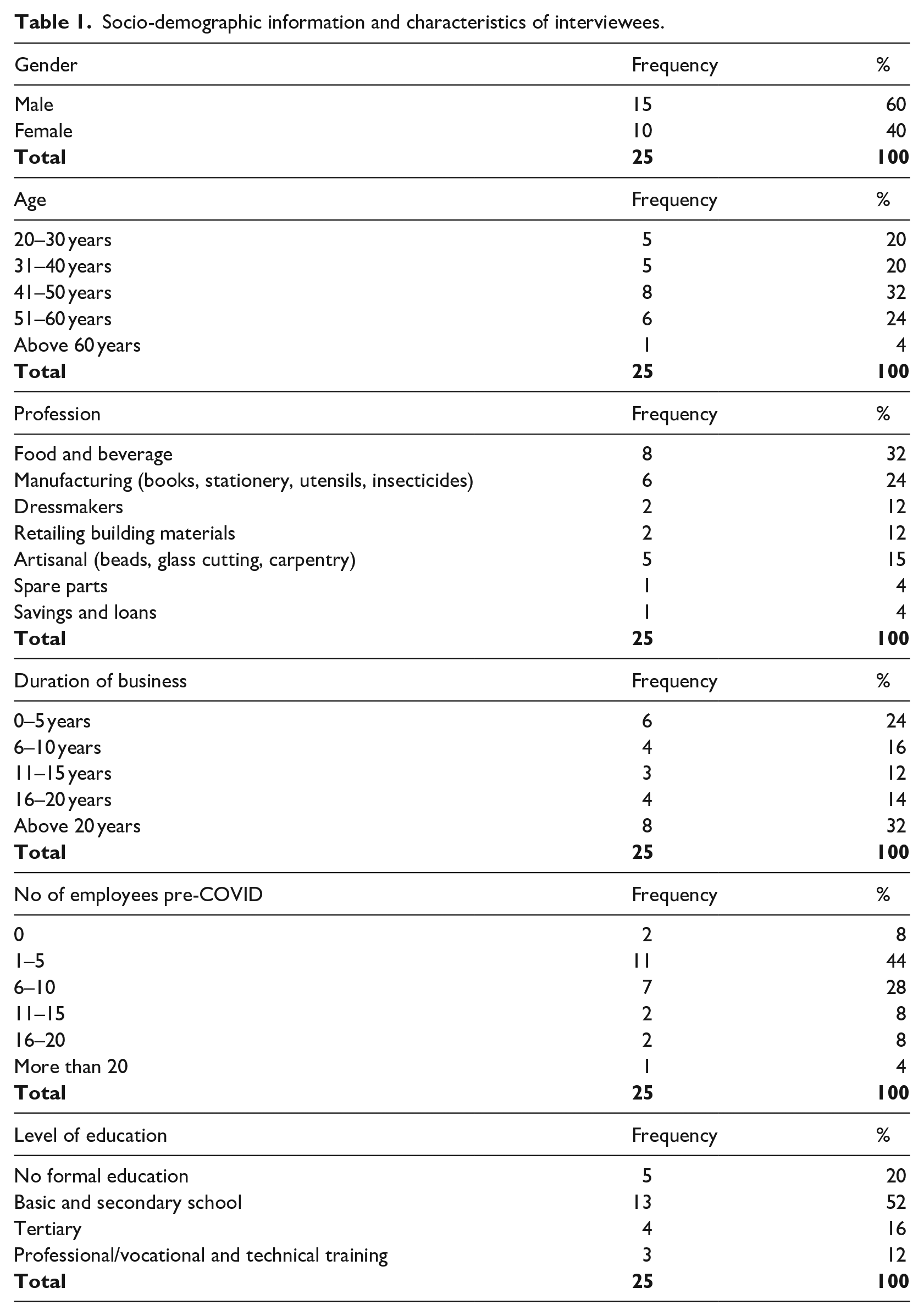
As the socio-demographic characteristics presented in Table 1 shows, the 25 interviewees comprised 15 males and 10 females. Of the 25 interviewees, five (20%) had no formal education, 13 (52%) had basic and secondary education, three (12%) had vocational/technical training, while the remaining four (16%) had tertiary education. While five (20%) of the business owners interviewed were in the 20–30 year age bracket, the same number of interviewees (20%) were in the 31–40 age group. Also, while 8 (32%) and 6 (24%) were in the 41–50 and 51–60 age groups respectively, one interviewee (4%) was above 60 years old. Table 1 also shows that while six (24%) of the MSMEs had been established not more than five years ago, four (16%) had been established between 5 and 10 years ago, while another three (12%) had been established between 10 and15 years ago. Finally, eight businesses (32%) were more than 20 years old, which is surprising, given the generally low rate of survival of MSMEs in Ghana. When asked to explain their decision for getting involved in the MSME sector, the reasons given by interviewees included the desire to make a living, earn extra money to supplement family income, or becoming self-employed. Finally, the employment levels for the businesses before the COVID-19 pandemic began were as follows: two businesses (8%) had no employees, while 11 businesses (44%) and seven (28%) businesses had between 1–5 and 6–10 employees, respectively. While two other businesses (8%) had 11 to 15 employees, another two (8%) businesses had 16–20 employees. Finally, one business (4%) had more than 20 employees. Considering the definition of MSMEs in Ghana, it can be said that the large majority of business owners interviewed had micro and small-sized businesses.
Socio-demographic information and characteristics of interviewees.
Findings of the experiences of MSMEs with COVID-19
This paper examined the experiences of MSMEs in Ghana regarding the impact of COVID on their businesses through in-depth interviews. In the process, one of the main themes that emerged was how MSMEs faced challenges regarding the lack and limited access to adequate finance. Although MSMEs play a critical role in Ghana’s economy, the extant literature and available evidence has demonstrated that they are often constrained by a number of challenges such as the lack of financial support, poor management, corruption, lack of training and experience, poor infrastructure, and insufficient profits (Quartey et al., 2017; Arthur and Arthur, 2017). MSMEs in Ghana often face capital costs that exceed those available to larger enterprises, and they have extremely limited access to commercial credit because bank lending to MSMEs is characterized by high administrative costs and the perceived risk of default. Moreover, apart from being typically financially fragile (Belghitar et al., 2021; Rao et al., 2023) and less resilient and responsive in dealing with the costs associated with the impacts of this pandemic (Korankye, 2020), MSMEs face challenges such as their inability to work remotely due to lack of resources, inadequate facilities, and lack of technology to undertake e-commerce business activities (Acquaah et al., 2021).
With the COVID-19 pandemic exacerbating the problems that MSMEs already faced, it is unsurprising that one of the most significant impacts on the business performance observed by MSME business owners interviewed in this research pertained to the limited access to finance and credit. Because of the lack of financial support and the lower incomes, MSMEs in Ghana faced what Pedauga et al. (2021) describe as severe liquidity shortages and solvency problems. Moreover, according to Hossain et al. (2022), since MSMEs rely heavily on the velocity of money, a sudden fall in regular trade demand disturbs their cash inflow and hampers their ability to pay staff salary. As gleaned from the interviewees, this is exactly what businesses in Ghana had to contend with. The struggle to raise capital as well as the lack of access to credit facilities could be attributed to the fact that MSMEs do not have the collateral needed to get a loan from lenders (Fubah and Moos, 2022). The overriding explanation given by the 25 interviewees, all of whom were negatively impacted financially by COVID-19, is that MSMEs often lack access to adequate finance, both short term credit and long-term capital, because of their bad relationship with the traditional banks and financial institutions. As one interviewee stated:
I did not have enough cash on hand that would last me more than a week. My monthly earnings fell to less than half of what I made before COVID-19.
1
Another interviewee responded as follows:
I have not received any financial support even though some of the banks approach me that if I need financial assistance I should call on them. I did not go because I already have a loan that I am having difficulties paying. I had taken a loan before the COVID-19.
2
A third asserted:
Small businesses in Ghana generally lack the requirements, which banks and financial institutions often seek in order for them to provide us with the credit for our business. The banks often want us to provide collateral security in the form of tangible assets such as houses and landed property but many of us don’t have it.
3
We therefore see that as a result of COVID-19, the already existing challenge for MSMEs to obtain financial support for their businesses from banks and other traditional banks and lending institutions worsened. In fact, 19 of the 25 (76%) business owners indicated that they had to look for alternative sources in order to maintain their businesses. As Arthur and Arthur (2017: 41) have pointed out,
the lack of adequate access to credit and capital from the banking sector in Ghana means that there is a huge burden on MSMEs to raise by themselves substantial amounts of capital for business activities from personal sources or through family support, informal means and social networks.
The problems associated with securing funds weakens the financial positions of MSMEs and exposes them to financial risk and spending reductions (Adam and Alarifi, 2021). It is because of experiences like these that Chamlee-Wright (1997) argues that while the sight of Western-type banking institutions in the larger cities of Ghana might give one cause for optimism, the majority of MSMEs never enter through the doors of such institutions. Apart from the unwillingness of MSMEs to accept the practices of formal banking institutions, the banks are also reluctant to serve the needs of MSMEs. The inability of MSMEs to raise or provide the initial deposit required to establish savings accounts within the formal sector, coupled with the substantial collateral that is demanded by the banks as security before loans are granted, serve as a deterrent to bank credit for MSMEs. For Ninsin (1992), African governments have generally preferred large-scale and capital-intensive enterprises, and there is a bias against the MSME sector such that often little or no financial and instrumental support is provided to them. Thus, notwithstanding the optimism regarding the role and contribution of MSMEs in helping with the economic and industrial development process in Ghana, MSMEs have difficulty obtaining the necessary credits and are forced to operate outside formal financial markets and institutions.
Relatedly, Zutshi et al. (2021) have pointed out that MSMEs faced a resource crunch for covering fixed operating costs such as rent and mortgage payments, utilities, and insurance. The interviewees’ responses below capture the sentiments of many regarding the challenges they faced because of COVID-19, especially as it relates to the lack of inputs for production. As an interviewee put it:
much of the little savings that had been put away was lost because of the government lockdown that affected the ability of people to buy my goods.
4
For another interviewee,
the underlying reason behind the poor performance was that I had to temporarily shut-down my business and lay off employees for a period during the pandemic.
5
A third interviewee summarized the situation as follows:
When it (COVID) started, we were at home unable to work. When it (COVID) happened like that what to eat is difficult because small saving that you have, you will spend everything, because where you get the income you are unable to go to work. Secondly, when you stop business and lock the business for some time, for instance, you go for loan, and it will go against you. You will have difficulties in paying the loan. I am still talking about the problems, when we came back from the lockdown, prices had spiked, items that were sold for GHs 20 are now being for GHs 30. Even for nowadays, let say for about six months, if you purchase material after use and go back to make another purchase, prices will increase. All these have affected my profit margin.
6
Such responses from interviewees builds on Khambule’s (2022) findings that the COVID-19 pandemic undermined the sustainability element of MSMEs by not only wiping out their savings, but also, their ability to cope and resist the COVID-induced shocks and vulnerabilities.
Another theme of the adverse effect of COVID-19 was that many of the MSMEs in Ghana had to temporarily close their businesses. The consequence of temporarily closing their businesses, as reported by the interviewees, was that they had fewer working hours, which resulted in employee/staff reduction, and there was reduced availability of labour. Aside from the lack of business activity, many of their employees were scared of coming to work for fear of getting infected by the virus because of interactions with potential customers. Thus, although MSMEs generally have a small number of employees, these levels, according to all the interviewees, fell even further by almost 50% because of pandemic-related restrictions. The consequence was that the MSMEs experienced a reduction in their productivity levels. For instance, listening to the experience of a male interviewee with a post-secondary education involved in the manufacture of books and stationery, helped explain how external developments such as the Russian–Ukraine war exacerbated the challenges that his business was already experiencing because of COVID-19. As he put it:
The way it affected my business is that you see when COVID-19 came down, then Russian– Ukraine invasion started, which had made prices of our materials to go up more than 100 percent. A material that cost GHS 250 cedis now it cost GHS 400, so now I cannot do production. Now if I have taken orders for production and don’t charge well, I will operate at a loss.
7
For a second interviewee:
the fact that I was not able to pay workers and therefore had to lay them off was a major area of concern.
8
As succinctly articulated by another:
It (COVID) affected my business greatly. I am not getting orders, and even the completed orders are not paid for. Business is very slow.
9
A seamstress summarized the negative impact of COVID-19 as follows:
There was no social gathering like wedding, funeral, and church service, so nobody will sew dress and keep it. Thus, money does not flow into the business.
10
A final interviewee agreed:
COVID has affected my business in the way that the place that I import was closed down, unless you make order that they bring the items to you. It is also risky in a way if you are not lucky and gets into the hands of wrong people, you will lose money.
11
These statements are consistent with the findings from Schotte et al. (2023), whose work on the impact of COVID-19 lockdown policies in Ghana showed a persistent nationwide decline in both earnings and employment, and particularly on the livelihoods of business owners in the MSME sector. As Wrigley-Asante and Frimpong (2024) note, lockdowns in Ghana resulted in a drop in sales and profit margins of MSMEs, leading to lower income, savings and investment. This affirms the findings of Sheridan et al. (2020) who noted that the government shutdown amplified spending cuts among citizens. It also corroborates Pedauga et al.’s (2021) observation that because of COVID-19, MSMEs experienced a reduction in labour supply, human mobility restrictions, self-isolation, large decreases in capacity utilization, and interruptions in supply chains.
Furthermore, the Ghana government policy of shutting down economic activity through the imposition of ‘lockdowns’ and the social distancing measures had a major negative impact on MSMEs in Ghana in terms of lost productivity, value chain disruptions, and decreasing consumer demand (Acquaah et al., 2021: 2). Ali et al. (2021) note that social distancing halted public gatherings and forced the closure of factories, while the lockdowns and movement control disrupted supply chains and the production of goods and services. Given that many small businesses serve the consumer through face-to-face interactions, Harel (2021) notes that they were adversely affected by the COVID-19 pandemic the most, due to the restrictions and closures imposed by the authorities. Tuffour et al. (2022) add that MSMEs have been the most vulnerable to social distancing because they are predominantly located in sectors that have been significantly affected by the restrictions in movements. With social distancing laws, coupled with the closing of physical operations of businesses, and thus a loss in economic activity, the responses elicited from 20 of the 25 (80%) of the MSMEs interviewed for this research were that they experienced a steep decline in revenues and business turnover and returns during the lockdown period. Two (8%) business owners indicated that despite the complete absence of consumer demand for their products and thus no financial returns, they continued paying their workers. For these two business owners, they did so to demonstrate their commitment to their employees, although it came at a financial cost to them.
As one interviewee noted,
I had no other way to survive economically and thus had to look elsewhere, including relying on donations from our church, friends and family in order to make ends meet.
12
For another interviewee:
The customers are not coming because they don’t have money. When you sew their orders, they will not come for it. You will come to work and come sit for a whole day nobody will be coming.
13
In addition, as indicated earlier, the Ghana government implemented social interventions and financial protection schemes to support vulnerable groups in society, including MSMEs. Twenty out of the 25 (80%) of the interviewees suggested that they were aware of the existence of support for MSMEs. However, some of them had not bothered trying to access them because they felt the application process was complicated, cumbersome and ineffective. As one interviewee stated: ‘The government had announced intervention, but I did not avail myself for any of them.’
14
The reason given by another respondent was the fact that beneficiaries of government support programmes were expected to disclose information that they deemed private and confidential. As he noted, he passed on applying for the support because disclosing the information that government wanted was something he was unwilling to do. For this interviewee, the benefits that would come from getting the support was very little when compared with the private information that would or could become public.
15
While some of the interviewees had not applied, at the same time, more than half of the respondents who had applied for various supports indicated that they were unsuccessful because they believed that there was favouritism and political affiliations influencing the granting of the supports. The statements that follow were typical of the challenges in accessing the COVID-19 financial support programmes:
I have applied for the COVID-19 support fund that the government initiated. I have applied but did not receive it up to now. I think the government is playing politics with it and only giving it to their political supporters.
16
For a second interviewee:
The government started the financial assistance programme and I applied but did not hear from them, so I have to sit somewhere and think about myself.
17
Similarly, another interviewee stated that:
I heard about NBSSI loan and support, and I applied but did not receive it, but the person who introduced me got it, but I did not get it. So, I have to access loan from my bankers to start the business again.
18
Another said:
I have not received any financial support from the government, and nobody even approach me for any financial assistance.
19
Thus, although the Ghana government took the right steps with the introduction of the various financial support arrangements for MSMEs during COVID-19, unfortunately, many of the interviewees held that they did not get support from the various support initiatives. This is because they did not know about them or thought that they would be unsuccessful with applications due to their lack of networks with officials associated with the disbursement of the funds. It is in this regard that Dauda and Imoro (2022: 12) argue that although the Ghana government’s social interventions and support packages brought some respite to various vulnerable groups, including MSMEs, ‘such initiatives hardly achieve lasting impacts as they are temporarily, sporadic, and ad hoc’. It is in this vein that Dauda and Imoro (2022) argue that not only were the government’s social interventions very superficial, but they also failed to address the teething challenges that the pandemic brought to light. The evidence from these interviews supports the argument of Hossain et al. (2022: 2) who pointed out that not only did MSME entrepreneurs face obstacles such as ‘operational disruption, supply chain disruption, a shortage of internal funds to handle recurring operating expenditure, the risk of bankruptcy’, but also a ‘paucity of government stimulation packages’ made their situation much worse.
Finally, a much more positive theme that emerged from the interviews was that because of the challenges that they faced, many of the MSMEs were forced to be creative and adapt their operations in order to survive (Acquaah et al., 2021). Highlighting how the COVID-19 pandemic impacted the livelihoods of Ghanaian women in informal cross-border trading, Wrigley-Asante and Frimpong (2024) noted that they used a variety of adaptation strategies and coping mechanisms including digital tools to get themselves through those difficult times, including the utilization of various social networks to facilitate their businesses. The fact that this current paper found evidence of creativity and adaptations, based on what the interviewees said, was unsurprising because as Fubah and Moos (2022: 4) note, ‘during global disruptions such as COVID-19, businesses must strive to cope with the emerging threats, adapt to turbulent environments, change processes, and still meet the needs of stakeholders’. This is shared by Engidaw (2022: 4) who observed that ‘a lot of small businesses find creative ways to succeed during COVID-19, from expanding into new markets to finding new ways to deliver their products and services’. Among the strategies the MSMEs in Ghana adopted was the use of digital tools and social media to market their products and entice customers in the absence of face-to-face operations and sales. Papadopoulos et al. (2020) have called attention to the importance of digital technologies (DTs) to secure MSME business continuity and their operations. As they indicate, the use of DT in extreme disruptions may help people stay connected and facilitate their smart working situation. In fact, one of the 15 business owners for this study, a female with a vocational education, and who made use of digital tools and social media platforms to promote and market her products as well as communicate with customers stated that:
I was able to sell my goods using social media and I incurred very little costs doing so. I found it to be very convenient and effective. So, I would continue using social media even after we get back to face-to-face sales.
20
For another interviewee:
With everyone including my customers staying at home, I had to find an alternative to reach them, and social media, especially Instagram, WhatsApp and Facebook did it for me.
21
Another interviewee added that she had learned from her friends regarding how she could employ various digital tools to market and reach customers. As she stated:
My friend told me that she used Instagram and Facebook to connect with her friends and customers even before the start of COVID and continued using it during COVID. She told me how I could use it. I tried it and sales picked up, so I think it was a very useful advice from her.
22
This innovative approach is consistent with the findings of the OECD (2020) that many MSMEs resorted to digital sales channels to market their products when COVID-19 began and led to the shutdown of their businesses. As Endris and Kassegn (2022) point out, MSMEs have embraced technological innovations in creating new opportunities as well as expanding their businesses. In particular, high mobile phone penetration has brought opportunities to MSMEs in rural and urban areas of Africa. The use of digital tools and resources was of great support and assistance to the MSMEs in their communications with their customers. The trend and keenness of MSMEs to go online and make use of technology for marketing purposes and to keep their businesses operating during the COVID-19 pandemic (Engidaw, 2022), was a step in the right direction. The usefulness of DT tools not only stems from the ability to reach a wide customer base at a relatively low cost (Harel, 2021), but also, as Guo et al. (2020) point out, the use of DT helps MSMEs to survive and cope with the negative repercussions of the COVID-19 pandemic.
Implications of findings and policy recommendations
In light of the foregoing findings from this paper, we are reminded that since MSMEs play a critical role in the economies of countries like Ghana, programmes and support and government policy to address the negative impact of COVID-19 on MSMEs in Ghana would be a step in the right direction. First, given that access to funds from banks and financial institutions is scanty for MSMEs, the Ghana government should ensure that finance and credit are made more easily accessible to them (Arthur, 2006), especially in the COVID-19 period. To address the particular financial concerns, business owners suggested that in order to reduce the burden that they were financially dealing with, and to get better access to capital, it was necessary for banks and other lenders to offer them an increased timeframe to repay their loans. During the COVID-19 period, the government took the right step with the introduction of various financial support arrangements for the MSMEs, but in order to sustain the MSMEs, these support should not be a single event. A key theme and suggestion to emanate from the interviews was the need for financial support for MSMEs. The interviewees suggested that financial supporting schemes, including special loans, suspension of interest and principal payments, and other temporary tax relief, were helpful initiatives that government and financial institutions can offer MSMEs in order to deal with some of the financial challenges that they have had to deal with during the COVID-19 period. These measures would, as Díez et al. (2022) argue, help mitigate immediate risks such as MSMEs running out of liquidity and going bankrupt. For the OECD (2022), while loans, loan guarantees and grants, as well as deferral of payments and job retention schemes helped to avoid an increase in MSME bankruptcies, it argues that going forward, governments may wish to adopt other means that can help to foster diversification of SME finance instruments, including Fintech. These approaches, as suggested by the OECD (2022), can help MSMEs to prosper in a post-pandemic recovery likely to be characterized by continued high levels of MSME debt and challenges in risk assessment for certain types of firms and sectors.
Furthermore, while there were some stimulus packages to support the MSMEs and the public during COVID-19, Khambule (2022) argues that developing countries faced an uphill battle because of the widespread informality and the working poor. As he notes, with a significant number of people active in the informal economy without social protection, this creates the conditions that contribute to high levels of poverty and unemployment and may undermine the attainment of the SDGs on ending world hunger and poverty. It is in this vein that Khambule (2022) argues that the loss of employment in many sectors of the economy resuscitates the need for governments across the world to implement inclusive social protection policies and governance models to reduce the socioeconomic impact of the pandemic on informal workers. Accordingly, Khambule (2022) opines that post-COVID-19, governments should not only treat the MSME sector as a safety cushion for the unemployed but should also be proactive in ensuring that the safety cushion is protected against the vulnerabilities in the sector. From these results, policy implications include the need to develop a social security scheme and dedicated funding for informal workers and enterprises to mitigate against unexpected shocks and vulnerabilities. Likewise, the fact that business owners in Ghana had the perception of the government being biased in their selection of the MSMEs who benefit from various COVID-19 support programmes is an issue that needs careful examination, since it deters firms from seeking assistance from government agencies. Furthermore, issues surrounding the complex and laborious process that MSMEs encounter in accessing loans particularly in challenging times such as the pandemic needs to be looked at. A simplified process targeted at MSMEs, which would make capital accessible to them, should be paramount for government and policy makers.
With an ongoing challenge to MSMEs in Ghana involving the lack of market sophistication (Arthur, 2006), it is good that many MSMEs have begun employing digital tools to market their products. Given how business owners in this research made use of digital tools to market their products during the COVID-19 period, this is an area that can further be developed to support MSMEs in Ghana to survive and thrive. Supporting MSMEs in Ghana to be better equipped digitally to build their brand online and engage in digital marketing would strengthen their prospects of survival and residence in the post-COVID period. While encouraging businesses to go online represents a step in the right direction, United Nations Conference on Trade and Development (UNCTAD) (2022: 30) notes that ‘many firms offer goods or services that are based on close physical contact and a localized geographic catchment, such as the numerous informal sector retail vendors found across much of the developing world’. Therefore, going online would not necessarily help every business. Despite this, encouraging MSMEs to go online is important because of the benefits that come with it. The introduction of new technologies and digital tools would have huge benefits for the MSMEs. Particularly, there are increased prospects of growth in market opportunities for MSMEs if the necessary efforts and resources are provided by the government and stakeholders. Thus, going online calls for improvements in the necessary digital infrastructure and the need to close the digital divide since the lack of reliable and consistent Internet and electricity access (UNCTAD, 2022) are some of the issues that have bedevilled the digitalization process in many African countries, including Ghana. As the UNCTAD (2022) notes, in 2017 for example, only 7% of households in Africa had subscribed to high-speed Internet services. In spite of these, there is no denying that the use of social media and ‘online trading has been a major enabler of access to new and existing customer markets for small-scale entrepreneurs’ (UNCTAD, 2022: 31). It is in this regard that Wrigley-Asante and Frimpong (2024) recommend that women in the informal and MSME sector need to be provided with institutional support as well as bettering their access to DTs and platforms such as mobile telephony and electronic transfers and other communication tools to streamline their commercial dealings.
Finally, while COVID-19 led to many challenges and problems for MSMEs, at the same time, it also served as a catalyst for new and creative modes of business activities since some MSMEs made the most of unforeseen opportunities and showed the desire to be successful in the face of the severe challenges. The emergence of MSMEs in Ghana that specialized in the sale of nose masks, sanitizers and veronica buckets 23 attests to the pandemic being a catalyst for business creation. However, the problem of access to capital still remained problematic as these new business initiatives could not operate as they would have wanted as their capital base was grossly inadequate. In any case, with exposure to new business survival strategies occurring at a rate faster than one could ever have imagined, it is important that the lessons from the MSMEs’ experiences is captured while they are fresh. This research has thus made a novel contribution by not only highlighting how MSMEs in Ghana identified and responded to the negative consequences of COVID-19, but also, advanced our understanding of how government policy might be developed to improve and support MSMEs in the post-COVID-19 period. Moreover, examining and understanding how COVID-19 affected the MSMEs sector, helps us to answer the question of the lessons learned from the experiences of MSMEs in Ghana, and how they will adapt and transition their businesses in the post-COVID period. The findings of this research are particularly relevant for policy makers who are interested in ensuring that MSMEs are back on their feet in the post-COVID-19 period. In addition, in the broader context of facilitating development and economic recovery in the post-COVID-19 period, the business-level data and evidence from the research offers benefits and provides insights for government policymaking bodies supporting MSMEs. We also see that the advent of the COVID-19 pandemic was not all gloom for the MSMEs as some positives emerged. However, overall, there is the urgent need to address the seemingly incessant problem of capital finance and support for MSMEs in Ghana.
Conclusion
The focus of this paper was on the experiences of MSMEs in Ghana during the COVID-19 pandemic. In examining the activities of MSMEs in Ghana, we realize that they face several structural barriers in their businesses, which were worsened during the COVID-19 pandemic. Thus, the efforts by the government of Ghana to assist MSMEs to deal with the impact of COVID-19 on their operations was a welcomed development. While MSMEs were offered some support by the Ghana government during the pandemic, it was simply not enough to meet their needs, resulting in their critique of the intervention programmes. Indeed, the most difficult part of the experiences and challenges of MSMEs as indicated in this research, was on the financial problems they faced. While the presented findings from this research might not be new in terms of what MSMEs experienced during the pandemic, it reinforces the prevailing narrative about MSMEs being part of the most vulnerable sector in the economy of countries like Ghana. With MSMEs contending with a wide variety of challenges, the paper has argued for various types of support in order for the sector to continue with its critical role in the post-COVID-19 period. This is because although a substantial amount of industrial activity takes place through the activities of MSMEs, the state plays an instrumental role in providing the foundation upon which they can become an engine of broad-based growth. Thus, the task for helping the MSME sector lies with the government, since evidence from around the world shows that the state has played a catalytic role in the process of economic and industrial development in the period after external shocks like COVID-19. Until government shows such commitment and provides sufficient assistance and resources to the MSME sector, its desire to build a strong economy in the post-COVID period in Ghana is unlikely to be attained. Apart from the provision of financial support, assisting MSMEs to use digital tools and social media to market their products would be equally useful. In sum, the issues explored in this paper have shed light on patterns across various MSME categories and how Ghana government policy might be developed in the post-COVID-19 recovery period to support them.
Footnotes
Funding
The author(s) disclosed receipt of the following financial support for the research, authorship, and/or publication of this article: Peter Arthur’s contribution to this research was supported with funding from the Dalhousie University Sabbatical Leave Grant.
