




Abstract
This paper investigates the discursive strategies deployed by Boko Haram terrorists (BHTs) to manipulate targets to accept their ideologies. Drawing insights from the discursive strategies by Reisigl and Wodak in critical discourse analysis, 10 BH statements released between 2009 and 2021 were qualitatively and quantitatively analysed. This paper examines the discursive tools BHTs typically deploy to authenticate their activities and manipulate their target to win and invite them to their side. Examining BHT accounts using this approach is capable of building opposing accounts capable of reducing terrorism in Nigeria, and by implication, in Africa and the world over.
Introduction: Boko Haram, terrorism and discourse
The 2016 report of the Global Terrorism Index (GTI) records the 10 countries that have been mostly affected by terrorism, the number of deaths recorded in each of them and the terrorist organisation involved in the attacks from 2000 to 2015 including Iran (50,538; ISIS), Afghanistan (22,730; Taliban), Nigeria (17,097; Boko Haram), Pakistan (14,953; Tehrik-i-Taliban), India (7835; Maoist) and so forth. With a global drop in terrorism-induced deaths as of 2020, according to the 2020 report of the GTI, Nigeria still ranked third after Afghanistan (9592), Iraq (8682) and Nigeria (8314). Interestingly, Nigeria dropped further to the sixth position by the 2022 GTI report thus: Afghanistan (9109), Iraq (8511), Somalia (8398), Burkina Faso (8270), Syria (8250) and Nigeria (8233). Despite Nigeria’s drop in position, the number of deaths within a time frame of 2 years can still be seen to hover around 8000 (GTI, 2022); and the country remains within the first 10 most affected countries across the world.
Terrorism is the ‘deliberate creation and exploitation of fear through violence or the threat of violence in the pursuit of political change’ (Hoffman, 1998: 43). For this study, terrorism can be seen as a criminal act directed against a state and intended to create a state of terror in the minds of a government, a group of persons or the public. Boko Haram (BH), a group identified with different terrorist activities has since been categorised as a terrorist organisation (GTI, 2016). Historically, the BH movement was founded in 2002 by Mohammed Yusuf in the city of Maiduguri to establish a Sharia government. It is an outgrowth of the Maitatsine uprising of the 1980s and the religious and ethnic tensions that followed in the late 1990s (Adesoji, 2011; Osisanwo, 2016). Boko Haram terrorists (BHTs) have been attacking African countries, especially Nigeria, and other countries in the North Region of Cameroon, Niger and Chad. The group is opposed to what it perceives as a Western-based incursion that erodes traditional values, beliefs and customs among Muslim communities (Osisanwo, 2016). Since 2010, the group has engaged in endless attacks on the Nigerian State, principally, attacking villages and towns in the northeast. Such states were later declared the Islamic Caliphate of Boko Haram terrorism in the Northeastern States of Borno, Yobe and Adamawa in 2014 (Adesote et al., 2022). With the attacks, the BHTs were able to capture different towns which they declared as their territories. In August 2014, they took over Gwoza town and the BHT leader, Abubakar Shekau, ‘declared the town a Caliphate and hoisted their flags in Ashigashiya ward of Gwoza Local Government Area’ (Adesote et al., 2022: 139). Besides Gwoza, they later gained partial or full control of other villages and towns including Bama, Dikwa, Ngalla, Kala-Balge and Gwoza (Borno State); (Madagali, Michika and Mubi (Adamawa State); and Gujba and Gulani (Yobe State) (The News, 24 November 2014 : 45).
The Nigerian State, like other states in the world, has been combating BHTs using different approaches. The administration of Dr. Goodluck Jonathan (2009–2015) introduced both kinetic and non-kinetic approaches towards defeating the BHTs, yet the two approaches recorded limited success – the group was neither incapacitated nor fully defeated (Adesote and Akande, 2023). In particular, the Buhari administration that lasted between 2015 and 2023 claimed to have spent US$1 billion on equipment and weaponry to reclaim territories (This Day, 2023) initially captured by the BHTs during the administration of Dr Goodluck Jonathan. The attempt to defeat terrorists with such approaches in Nigeria has only decimated the BH activities, albeit transiently. Usually, the BH group, which thrives on ideology, regroups and recrudescing ideologically both within and without virtual spaces. While it is crucial to sustaining the military suppression therefore, it is more important to deploy other methods that will run concomitantly, especially methods that will go a long way in exposing their dogmas, countering their projected philosophies and demoting their ideologies through counter-media publicity, assurances to the threatened and counter-recruitment campaigns. One good method, therefore, is to deploy counter-terrorist discourse that is useful in combating terrorism. Combating terrorism is a multidisciplinary task that should involve security agencies, media and legal practitioners, computer specialists, psychologists, sociologists and others. Scholars from the disciplines have risen to the occasion from different angles, responding appropriately to terrorism. Linguists have also been contributing their quota towards ensuring the countering of terrorism. However, how sufficient is the contribution even though the language is quite pivotal to terrorists’ persuasive endeavours and ideological leanings? More attention needs to be paid to the linguistic strategies deployed by terrorists in their talks and statements to further deconstruct the constructed positions in terrorists’ constructs.
Existing linguistic studies on terrorism, especially outside Africa, have examined terrorists’ upheaval vis-a-vis different media constructions and representations (Altheide, 2009; Nacos, 2002) and terrorists’ rhetoric (Braddock and Horgan, 2016; Taylor, 2013); some have examined terrorists’ ideological orientations as Islamists, fundamentalists and so forth (Macdonald, 2003); and others have considered the wars on terrorism by political leaders (Ivie, 2005). In particular, previous studies have also engaged terrorist-related matters across the world; in the Middle East, the majority of such studies have focused on the Al-Qaeda terrorists and the 9/11 attacks (Blanchard, 2007) and some on ISIS/ISIL (Cockburn, 2015; El-Nashar and Nayef, 2019). In Africa, some studies have been on Boko Haram (Odebunmi and Oloyede 2016; Osisanwo, 2016, 2019, 2020), some on Al-Shabaab (Chiluwa, 2015), among others, especially about representations by the media. However, despite the considerations, previous studies have not sufficiently explored the statements of terrorists, especially BHTs with emphasis on their manipulation tactics for recruitment. Yet, the examination is capable of building opposing accounts useful in reducing terrorism and impairing terrorists’ arguments in Nigeria, and by implication, in Africa and the world over. The most related study with a similar consideration is undertaken by El-Nashar and Nayef (2019) albeit examining the statements of ISIS. This research endeavour focuses on selected statements of one of the foremost terrorist groups in Nigeria and the African continent, Boko Haram. This study beams its research light on manipulation for recruitment or sustenance of numerical strength within the BH group, which is believed to have implications for terrorism discourse in general. While linguistic scholars from the West have done a lot on other terrorist organisations, there is still much to be researched on BHTs, as this paper attempts to undertake. This paper examines the manipulative discursive strategies for recruitment purposes as engaged by BH commanders/leaders in their statements. Drawing insights from the discursive strategies of Reisigl and Wodak (2009 [2001]), selected BH statements are subjected to discourse analysis to uncover the manipulative strategies deployed to recruit new members and sustain the group’s ideology and escapades. This approach, which enables us to dissect the linguistic features in the data, will reveal the recruitment and manipulative strategies used by BH, and potentially assist the state in combating BH terrorism through counterterrorism discourse revelation. Presently, we examine manipulation as a discourse strategy, and subsequently, terrorism and recruitment.
Discourse and manipulation in text and talk
Manipulation involves a process of controlling another person to the advantage of the controller. Manipulation is defined by Van Dijk (2006) as a ‘complex phenomenon which involves social power abuse, cognitive mind control, and discursive interaction’ (p. 359). One of the most engaging views in this regard was undertaken by Van Dijk (2006). Van Dijk (2006) claims that manipulation is a ‘communicative and interactional practice, in which a manipulator exercises control over other people, usually against their will or against their best interest’ (p. 360). Manipulation as a discourse enterprise has been viewed socially, cognitively and discursively. Whereas socially, manipulation has to do with illegitimate domination, endorsing social inequality; cognitively, it involves mind control, interfering with the processes of understanding, knowledge and ideologies; discursively, it involves the formats of ideological discourse, emphasising Our good things and Their bad things (Van Dijk, 2006). Manipulation is a notion that takes place in communicative contexts, involving text and talk: in scripted messages or during a speaker’s delivery. Thus, it involves the deployment of the writer’s or speaker’s power to control the minds or beliefs of the recipients – readers or listeners. As argued by Van Dijk (1997), manipulation does not only involve power, but abuse of power, that is domination. Hence, manipulation entails using discourse to exercise illegitimate influence to make others believe the manipulator and engage in the desires of the manipulator, against the best interests of the manipulated (Chouliaraki, 2005; Rojo and Van Dijk, 1997). This position is like those of de Saussure and Schulz (2005) who posit that ‘to manipulate a human being may be about using a person, i.e. have that person adopts specific behaviours, to fulfil the needs and interests of the manipulator, regardless of the ones of the manipulated’ (p. 5). In a bid to achieve their goals, terrorists deploy manipulative tactics as discourse strategy and as an ‘intentional plan of practices adopted to achieve a particular social, political, psychological or linguistic aim’ (Reisigl and Wodak, 2009 [2001]: 94). Such manipulative discursive strategies, which are targeted at recruiting new members, sustaining old members and winning more apologists, are intentionally crafted to present self-credibility and justify attacks on others. Usually, the manipulative endeavour aims to ensure numerical strength and sustenance of their activities.
Van Dijk (2006) undertakes a study on discourse manipulation, drawing samples from the UK Prime Minister’s policy presented to the members of parliament (MPs) on the need to join the United States in a war against tyranny and terrorism. Van Dijk (2006) notes that
the overall strategy of positive self-presentation and negative other-presentation is very typical in this biased account of the facts in favour of the speaker’s or writer’s interests while blaming negative situations and events on opponents or the others (immigrants, terrorists, youths, etc.) (p. 373).
With the engagement with the discourse, Van Dijk itemises some salient aspects of manipulation including ideological polarisation, positive self-presentation by moral superiority, emphasising the speaker’s power, discrediting the opponents, and emotionalising the argument with passionate beliefs. One salient area of concern in the discourse is his position on ‘moral superiority’, by which he means ‘allowing debate, respect for other opinions, struggling for democracy, holding firm, etc.)’ (Van Dijk, 2006: p. 378). Concerning terrorists, like BH, religion is mostly used to show superiority over others. Thus, the manipulated are talked down at via religious moral superiority where BHT canvasses to practice a religion that is superior to others who practice inferior religion: that is ‘Self’ as religious and ‘Other’ as irreligious as we discuss later in samples 13–14, 20–21. The study concludes, noting that MPs are ‘victims of the political situation in several ways, and can thus be manipulated’ (Van Dijk, 2006: 380). Van Dijk (2006) argues further that ‘by accepting the reasons provided by Blair in his speech legitimating the war, they are manipulated not only into accepting specific beliefs . . . ’ (p. 380). Manipulation, therefore, has great creative potential and includes such key elements as the ‘negative’ intent of the speaker or writer and the covert character of influence. Manipulative functions of discourse create a masked layer of linguistic data that is not easily separated from purely informational content. Wodak (2015) says such overt or covert discourse features can be described as ‘manifest or latent’, and specifies that one of the goals of a discourse analyst is to ‘demystify the—manifest or latent—persuasive or “manipulative” character of discursive practices’ (p. 3). This paper posits that BH’s speech is laden with both overt and covert ideologies; thus, in some cases, not covering up and in other covering up the manipulation of the minds of the recipients.
Conceptual clarification
The aim of this paper remains to track and identify the manipulative discourse strategies deployed by the BH leaders in the statements to woo and recruit new members, retain old members and sustain their numerical strength. This paper, therefore, seeks to answer this research question: What manipulative discourse strategies potentially index recruitment tactics in the selected BH statements? To prosecute the set objective, we draw insights from the discursive strategies by Reisigl and Wodak (2009 [2001]) to explore the multifarious manipulative devices used for membership recruitment and retainment purposes in the selected BH statements. The framework comprises four primary discursive tools: Reference/Nomination, Predication, Perspectivisation, and Argumentation. However, for this paper and to have sufficient space for the discussion and analysis of data both quantitatively and qualitatively, only the aspects that can be easily quantified will be given quantitative consideration. The referential/nomination strategies deal with the use of referring expressions to typically construct in-groups or out-groups. It involves the use of deictics (person, place and time), anthroponyms (personal names) and metaphors. In the data under consideration, names of places are identified and will be considered under ‘Toponyms’ (El-Nashar and Nayef, 2019). The predication strategy focuses on the attributes assigned to or associated with social actors or individuals represented in the discourse. It involves the use of positive or negative attributes to discursively qualify the referents, based on the writer’s or speaker’s perception. Predication strategies assign (positive or negative) evaluations and attributions to the constructed groups, actors, events or actions and they can be realised linguistically via stereotypes, evaluative adjectives, appositions and clauses (relative, conjunctional, participial, conditional). Perspectivisation strategies refer to speakers’ involvement and how they position their points of view, for example, through narrating, describing, reporting and so on. The strategies deal with how a speaker’s or writer’s point of view is positioned to express involvement or distance as evident through the use of positive Self-representation and negative Other-presentation. Here, the deictic ‘us vs them’ and the inclusive ‘we’ are key discourse markers in constructing perceived in- and out-groups, which can strengthen a sense of belonging among the members of these imagined communities (Renaut, 2019). Argumentation strategies have to do with the use of justification of positive or negative attributions through topoi, and can be constructed through different techniques. For the quantitative analysis, Sketch Engine, especially the Word Sketch, was deployed. Sketch Engine proves very useful in tracking the occurrences of all word classes. It is useful in tracking the occurrences of deictic elements that either point to in-group or to out-group members, attributive adjectives and so forth.
Methodology
The data for this paper contain 10 BH statements, which are all directed to the Nigerian State and Nigerians – young and old, with contents addressing BH’s demands and expectations. The statements, which totalled 8575 words, were originally video-recorded or written predominantly in Arabic and Hausa languages between 2009 and 2021; they were subsequently translated into English. Such English translations are often carried out by English-speaking members of the groups because the membership of the group varies and includes very educated professionals from northern Nigeria, and other neighbouring countries (Agbiboa, 2013; Chiluwa, 2017). The data focus is on the translated versions (not the videos); and the translated versions are believed to have represented the aim, objectives and goals of BH. Although it is a bit difficult to access the statements, since it is unlawful to possess them, they are still available on different online sites to verify the identity of text. Since the possession of extremist texts can end in prosecution (Baker and Vessey, 2018; Droogan and Peattie, 2016), and due to the need to forestall recirculation, we offer only token samples of the data in this article. The selected statements cover a period from 2009, the year that officially marked the institutionalisation of Boko Haram in Nigeria, until 2021, the year the government of President Muhammadu Buhari claimed to have killed the foremost leader of the group, known as Abubakar Shekau. Two of the statements were made by the first leader and founder of the group, Mohammed Yusuf; one was made by the next leader who served in an acting capacity, Mallam Sanni Umaru; and the remaining seven were made by the longest-serving leader of the group during this period of study, Abubakar Shekau. The statements focus on different issues ranging from address to President Goodluck Jonathan and President Muhammadu Buhari (at different times); address to the Emir of Kano, Sanusi Lamido Sanusi; threat to sell abducted schoolgirls; address to members; and address to Nigerians, including government, the military, Christians and young minds. A common denominator in all the statements is the deployment of manipulative and or persuasive strategies to free the self from guilt and win the heart of readers to self.
Analysis
This paper analyses 10 statements released by BH to manipulate and persuade listeners or recipients through the brandishing of successes, emphasis on promises and release of threats to attack non-apologists. The following sub-sections analyse and discuss the framework of analysing BH manipulative and persuasive discursive strategies, comprising Reference/Nomination Analysis, Predication, Perspectivisation and Argumentation.
Reference/nomination analysis
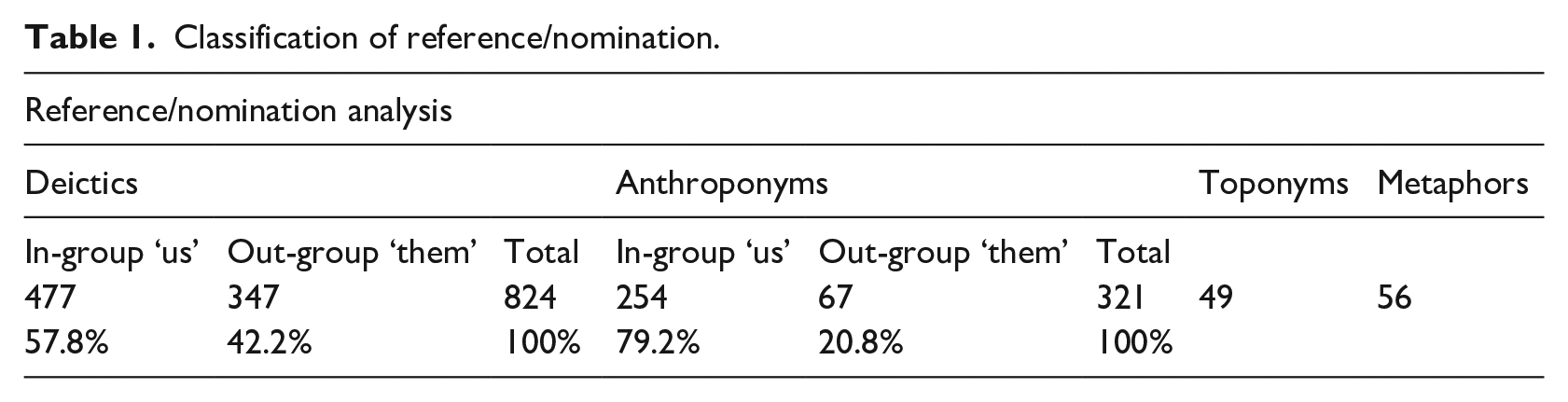
This part discusses Deictics, Anthroponyms (i.e. personal names), Toponyms and Metaphors. Since it has been found that names of places were also recurrent in the data, we have added Toponyms to the analysis. Table 1 shows the number of occurrences of the five subcategories under this tool.
Classification of reference/nomination.
Deictics
Deixis or deictic expressions refer to definite referring expressions that point to their referents in terms of location, time and place: they refer to time, place or situation in an utterance or interaction. The view that deixis entails ‘spatio-temporal context and subjective experience of the encoder of an utterance’ (Green, 2006: 178) emphasises the issue of authorial perception. For this paper, the emphasis is on the person deixis and is exemplified by personal and objective pronouns. Table 1 shows that the total number of deictic occurrences in our data is 824, out of which 477 (57.8%) refer to BH members – the in-group or ‘us’ – and 347 (42.2%) specify the ‘other’ – the out-group or ‘them’. The percentile difference between in-group and out-group deictic occurrence indicates that the statements address in-group members more than out-group members, praising the good qualities of in-group members rather than denigrating dissenters. This agrees with the finding of Braddock and Horgan (2016) but contradicts El-Nashar and Nayef (2019). However, the difference may be occasioned by the kind of data gathered. The difference may not constantly remain the same in all speeches.
1. That’s why we must do what Allah told us to do. If we follow His will, He will protect us . . . He who obeyed was rewarded . . . We are Muslims (February 2009).
In sample 1, there is the deployment of religious blackmail, mind control and incentivisation. The speaker deploys the deictic elements, we, us, He, His to show that he is addressing members and reaching out to others. The speaker builds his deictic expressions around the superior being, Allah. The first expression which stipulates that they are doing Allah’s bidding is a clear manipulative signal that Allah sides with BH. The subsequent clauses and expressions deployed different strategies to convince unsuspecting listeners or readers of the benefits of membership. The conditional clause ‘if we follow His . . . protect us’ further associates the gains of BH membership to the relationship with Allah with assured protection as one of the gains. The speaker goes further to deploy incentivisation strategy by promising that that whoever ‘obeyed was rewarded’. Though the expression ‘we are Muslims’ seem to indicate that membership is not for non-Muslims, it is a subtle mind control strategy and religious blackmail strategy to Muslims who do not associate with them to follow their path.
Anthroponyms
Anthroponyms involve the use of personal names as identifiers in texts to suggest certain positioning to listeners, readers or recipients. The mentioned names are either those of Self or Other. Table 1 shows that the total number of anthroponyms in our data is 321, out of which 254 (79.2%) refer to BH members – the in-group or ‘us’ – and 67 (20.8%) specify the ‘other’ – the out-group or ‘them’. Whereas names associated with in-group are mentioned with positivity and reverence, out-group members’ names are mentioned with negative representations such that the speaker denigrates world and Nigerian leaders and others to appear credible to unsuspecting listeners. In addition, the speaker constructs the Nigerian State and world powers as evil to appear credible to recipients. While the speaker plays the victim card in sample 2, he plays the card of the prospective villain who should be feared in sample 3.
2. This is a message and an appeal to Goodluck Jonathan, the Christian leaders, and all the others . . . They’ve killed many of our Muslim brothers; they have destroyed our mosques and chased us away, driven us out, and yet they continued to capture us and kill us (11 January 2012).
3. Prophet Muhammed took slaves himself during Badr war . . . killed many and because of this, I will also kill Obama, if I catch him. I will kill Jonathan, if I catch him (8 May 2014).
In sample 2, the name of the Nigerian President, Goodluck Jonathan, is cited in the statement to chastise him and others for fighting, attacking, capturing and killing BH members. The victimhood strategy here portrays the State as evil and BH as victims and invites would-be members and other apologists to pity parties. This is also achieved through the process of mentioning the names of other world leaders such as Abraham Lincoln, Bill Clinton, Barrack Obama (former US leaders), Benjamin Netanyahu (Israeli Prime Minister), John Kerry (US Secretary of State), Ban Ki Moon (UN Secretary-General) and so on. The intention in sample 3 is to show the power superiority and capability of BH membership to overpower both world and Nigerian leaders, portraying them as helpless leaders who will be executed once they are caught for their opposition to BH. The identification with the personal names of the leaders potentially instantiates terrorists’ hegemonic ideology of overwhelming triumphalism deliberately designed to sediment and manipulate current members and would-be recruits. In other contexts, when they reference in-group members, they identify them with such exaggerated egoism, for instance, I am Abu Muhammad Abubakar Bin Muhammadinil Shekawi, Imamu Jamaa’ti Ahlulsunna Lidda’awati Wal Jihad or the mention of the name of the group: Jamā’at ahl as-sunnah lid-da’wah wa’l-jihād which means ‘People Committed to the Prophet’s Teachings for Propagation and Jihad’. The name Allah (God) is most predominantly mentioned 216 times. The strategic mention of Allah in the data is deployed by the writer to seek celestial authorisation, thus discursively manipulating readers/listeners that God is on the side of BH and against the Other, and potentially inviting or enticing would-be members to their side.
Toponyms
Toponyms, that is, names of places are mentioned at different times and contexts in the data. Table 1 shows 49 as the total number of toponyms in our data. The mention of such places in BH’s narration transmits their perception of and interaction with the mentioned countries and places. While the mention of some countries or world powers like America, England, France, and China shows threat, the mention of some others like Yemen, Pakistan, Afghanistan, and Nigeria portrays dominance. The mention of specific states, cities, towns and territories within the Nigerian space like Borno, Kaduna, Abuja, Maiduguri, Yobe, Adamawa, Kaaba, Baga, Sambisa and Giwa comes with pride to assure readers and listeners of the successes and victories of the BH as conquerors who are more powerful from the Nigerian State. This, the BH does, to promote expansionist and domineering ideologies, thus manipulating the audience’s mind with ease and painting self as more powerful to further gain the trust of the invited would-be recruits. The narrative reveals BH’s control of the cities and states to portray their self-pronounced caliphate. Sample 4 gives a representation of the context.
4. We thank God for making us enter Baga and Doro-Baga in victory. We have today declared Baga as part of our territory and one of our operational base (20 January 2015).
In sample 4, toponyms play an important role in extenuating BH’s attack on Baga and Doro-Baga where the rhetor shows satisfaction that the community has been dominated by BH and added to their territories. The discursive recruitment strategy significantly displays power and dominance, thus manipulatively portraying BH as powerful to the reader and would-be recruits.
Metaphors
Metaphors are deployed as a manipulative tool in the BH speeches to display a symbolic representation of reality. Table 1 shows 56 as the total number of metaphors in our data. Such symbolic representations either soften or heighten the effect of the actions on their target, including would-be recruits. They achieve this through appeal to fantasy of archetypal hero, making their audience believe in potential gains or incentives from carrying out the commands. In sample 5, the rhetor deploys a metaphoric expression in ‘heart is tied to a bird flying to paradise’ to make the audience believe in the dividends of engaging in the activities of BH or practising Shahadah.
5. . . . heart is tied to a bird flying to paradise . . . if you do the shahada, your body remains on the ground, but your eyes can already see paradise (September 2008).
6. Is it not amazing that we who started with sticks and machetes, are today the biggest headache to the almighty Nigerian soldiers? (20 January 2015).
Shahadah is an Islamic oath and creed, and it is one of the Five Pillars of Islam. The Shahada is a belief in the oneness of God, and the acceptance Muhammad as God’s Messenger. This is one of the beliefs of BH members, and members who carry out the actions and activities are manipulated to believe their hearts are tied automatically to a bird that flies to paradise. In addition, BH members portrayed themselves hyperbolically as depicted in the expressions ‘your eyes can already see paradise’ (sample 5) and ‘biggest headache’ (sample 6). Whereas the former adds to the legitimation of BH’s actions, the latter enhances the aggrandisement of its activities. The superlative rendition – ‘Biggest headache’ metaphorically amplifies the impact of its activities and actions at overpowering the Nigerian State. Thus, BH’s metaphorical usage enhances BH’s linguistic insight, thus, enhancing BH’s intent on recruiting and wooing new members and retaining old members. The essence of such a metaphoric strategy as averred by Sopory and Dillard (2002) and corroborated by El-Nashar and Nayef (2019) reinforces BH’s credibility and curtails counterarguments.
Predication
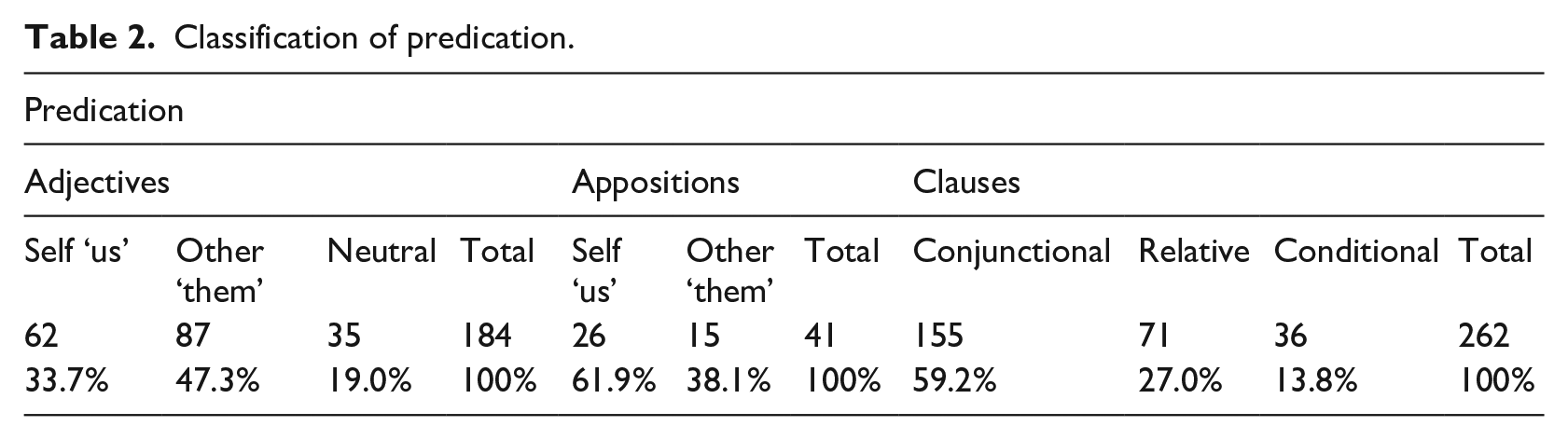
This part discusses how lexico-grammatical features are deployed for discursive manipulation and recruitment under Adjectives, Appositions, Collocations and Clauses. Table 2 presents the number of occurrences of the four subcategories under the predication.
Classification of predication.
Adjectives
As presented in Table 2, three categories of adjectives, constituting a frequency count of 184, were identified in the BH speeches: positive (62 = 33.7%), negative (87 = 47.3%) and neutral (35 = 19.0%). While the positive adjectives defined and represented ‘Self’ – old and would-be members, the negative adjectives defined and represented ‘Other’ state actors, Christians, world leaders and others who oppose that stance of BH. The frequency and percentile representations imply that even though the speeches are directed at different people and written at different contexts, the speakers concentrated more on condemning and denigrating the state and other non-believers in the ideological inclinations of BH than addressing members.
7. I pledge to Allah, my God. To be Faithful Loyal and Honest (20 January 2015).
8. The death of a believer is a sweet death (September 2008).
9. What we have in our armoury now . . . is enough to execute a victorious war against the whole Nigeria (20 January 2015).
10. The Nigerian flag . . . is a useless flag . . . (20 January 2015).
11. Nigeria is dead; her constitution is dead!! (20 January 2015).
12. Stupid Jonathan, no matter your infidel status you will be surprised (20 January 2015).
As evidenced in samples 7–12, positive adjectives are associated with activities involving BH members. In sample 7, the rhetor played upon Nigeria’s nationality and anthem and associated faithfulness, loyalty and honesty with self in the promissory statement ‘I pledge to Allah, my God. To be Faithful Loyal and Honest’ to connote the significance of committed members and their relationship with Allah. Despite the general conception of ‘death’ and ‘war’ to be negative nouns, the speaker qualified both with positive adjectives ‘sweet’ and ‘victorious’ since they refer to BH members. On the contrary, samples 10–12 denigrated others, using negative adjectives to portray Nigeria and the president of the same: sample 10 used the adjective ‘useless’ to qualify ‘Nigerian flag’ – the symbol of Nigeria; sample 11 used the ‘dead’ twice to represent Nigerian and the constitution of same; and sample 12 used the adjective ‘stupid’ to represent the administrative head of Nigeria, Former President Jonathan. While the positive adjectives are used to manipulatively sell the BH team to new members or would-be recruits, the negative adjectives are also used to show supremacy over the Nigerian state.
Appositions
Apposition is a relationship between two grammatically parallel structures or elements where the first element identifies the second. The two elements are placed adjacent to each other and have the same referents, though with different names. As shown in Table 2, there are 41 appositions discovered in the data, out of which 15 (38.1%) positively reference BH members and supporters, while 26 (61.9%) negatively suggest state actors and non-BH apologists. Samples 13–15 are illustrative:
13. I speak in the name of religion, Allah, Islam, the religion of the Holy Koran, and not that of democracy (17 December 2014).
14. All of you unbelievers in Nigeria, Buhari and your likes . . . listen to me now (25 September 2016).
15. That very soon, we shall stir Lagos, the evil city . . . (9 August 2009).
Appositive elements in samples 13–15 are used as discursive manipulation strategies to control the minds of the readers, listeners and new/would-be recruits. Sample 13 impresses the significance of the religious association of BH members in the minds of the targets. The words Allah, Islam are associated with the Islamic religion ‘the religion of the Holy Koran’, clearly distinguishing it from democracy. This subtly controls the mind of an average Muslim to see the course and ideological pursuit of BH as religiously agreeable to them. Contrarily, samples 14 and 15 negatively identify the ‘out-group’. Sample 14 defines President Buhari and his likes as ‘unbelievers in Nigeria’. Sample 15 defines the most populous city in Nigeria as ‘the evil city’ with a promise to cause a commotion there in no distant time, thus manipulatively sending fear to inhabitants, especially non-BH apologists.
Clauses
Clauses are grammatically deployed to impress BH ideology in the recipients. Out of the different clausal configurations in the data, three types, as shown in Table 2, are identified for analysis: Conjunctional (155 = 59.2%), Relative (71 = 27.0%), Conditional (36 = 13.8%). The clauses are organised in the data for different reasons. Samples 16–22 exemplify the clauses.
16. They asked Allah not to give them too heavy a burden, that He have mercy on them, and that He grant them victory over the infidels (February 2009; Conjunctional).
17. We want to reiterate that we are warriors who are carrying out jihad in Nigeria and our struggle is based on the traditions of the holy prophet (September 2008; Relative).
18. If you turn to Islam, then you will be saved (8 May 2014; Conditional).
19. He said Himself that if you follow His way, He will give you the strength to accomplish His will (11 January 2012; Conditional).
The conjunctional clause (59.2%) is the most preponderantly deployed clausal typology in the data. Conjunctional clauses typically function to connect a clause to another, using conjunctives such as ‘and’, ‘or’, ‘but’, ‘nor’, ‘for’, ‘yet’ or ‘so’. They have been deployed in the data to join and give different information within a single sentence as evident in sample 16. The relative clauses (27.0%) have been deployed as manipulative tools to give more information about specific subjects, individuals or activities from the vantage position of BH. The additional pieces of information, otherwise presented in adjectival clauses, are deliberately crafted to control the thinking of the addressees. For instance, sample 17 reiterates the duty of BH ‘warriors’ using the relative clause to give more information or define them as a group of people ‘who are carrying out jihad in Nigeria’ following ‘the traditions of the holy prophet’ thus deliberately and manipulatively marketing BH to the recipients. The addition of ‘holy prophet’ depicts the deployment of religious sentiment to canvass for more supporters. The conditional clauses (13.8%) are also deployed as manipulative or persuasive tools to invite new members and impress in the minds of old members the benefits or conditional rewards of engaging in some activities, especially in the name of BH. Despite being the least observed in the clausal typologies accounted for, it is the most meaning-motivated of the three clauses, especially because of the conditionalities spelt out to the recipients. In sample 18, the writer references Islam as the only religion that guarantees safety. Thus, the condition for anyone to be safe and saved is that they ‘turn to Islam’. Similarly, sample 19 references Allah, that is ‘follow(ing) His way’ as the only condition for receiving ‘strength to accomplish His will’. Both samples deploy religious blackmail and incentivisation to deliberately and manipulatively control the minds of recipients, especially would-be members to recruit them to accomplish BH’s objectives.
Perspectivisation
Perspectivisation has to do with the slanted ideological positioning from which a speaker perceives others in each discourse. In our data, BH pitches its discourse from the vantage position of the writer or speaker, presenting self positively and others as dissenters through negative labels. The underlying perspectivisation in the speeches index ideological polarisation into two main strategies which include (positive) self-presentation and (negative) other-representation (Van Dijk, 2006).
Positive self-representation
Positive self-presentation relates to the projection of the positive image of the ‘in-group’. In the data, BH presents its members and their activities as good, perfect, and Godly to manipulatively arrest the goodwill of the audience and pitch self as good to recipients for self-credibility to would-be and recruits. This is carried out using three main strategies: alleged God-backed testimonials about BH, religious collectivisation and flaunting self-success as evidence. Samples 20–23 are illustrative.
20. I do what Allah commands. I obey Allah and I don’t brag. I’m nothing. I’m just trying to be saved by Allah. The Koran is our light (17 December 2014).
21. We are Muslims. We do what Allah orders us to do (February 2009).
22. This is a message to Muslims to wage war against infidels who are not doing what Allah said (8 May 2014).
23. Allah helped His followers do the work in Maiduguri. We killed the infidels in the Giwa barracks (25 March 2014).
The alleged God-backed testimonial is deployed by the claim that Allah is with ‘us’, the ‘in-group’ and against ‘them’, the outgroup as exemplified in samples 20 and 21. In sample 20, The writer involves Allah in the BH’s action as a command directly from Allah, which Allah expects all to execute. This strategy manipulatively invites others to approve of their actions and inactions and join them in executing Allah’s commands. The other strategy is the use of Religious sensationalisation and collectivisation where BH preaches religious sentiments that all Muslims are potential members of BH and are collectively doing the bidding of Allah. Therefore, any contrary opinion to their ideologies is a revolt against Islam and Allah. Sample 21 identifies the religious affiliations of members using the collective WE-pronoun thus: ‘we are Muslims’. The sample goes further to expressly identify the task required of Muslims – carry out the order of Allah. This is further pontificated in sample 22, where the writer makes it clear that ‘Muslims . . . wage war against infidels’ or the non-supporters of BH. This projects the claim that Allah is with ‘us’, the ‘in-group’ and against ‘them’, the outgroup, and manipulatively controls the mind, inviting unsuspecting Muslims indicating that is the divine path to follow. The writer also flaunts Self-success as a strategy to positively portray the in-group. Sample 23 reveals the speaker’s confession boastful revelation of BH being the brain behind the killings at the Giwa Barracks through the help of Allah; thus implying that success is assured for members of the group since they are doing Allah’s bid. Therefore, others should join them.
Negative other-representation
Negative other-representation relates to the projection of a negative image about the ‘out-group’. Negative other-representation relates to Staszak’s (2008) Otherness, which projects the denigration of Other as bad and evil in the representations and implicates Other as not belonging to their group. The constructions maintain and reproduce social inequality, oppression and discrimination between BH and the Nigerian State, reflecting and reinforcing the fact that both groups hold different dominant social structures and ideologies and that the state and all other non-apologists of BH are dissenters. Three main strategies are identified for discussion in this situation: Other infidelising, labelling Other as God’s and BH’s enemies, tagging others as killers and deploying emotional blackmail to manipulate the recipients. The general categorisation of all non-apologists as dissenters and infidels cuts across the state actors, the West, Christians and so forth. Sample 23 is illustrative of the portrayal of the Other as an infidel.
24. They are enemies of Islam and the prophet of Islam (20 January 2015).
25. That Boko Haram lost over 1000 of our Marty members killed by the wicked Nigerian army and police mostly of Southern Nigeria extraction (9 August 2009).
Labelling Other as God’s and BH’s enemies and tagging others as killers are evident in samples 24 and 25, with the deployment of emotional blackmail to manipulate the recipients.
Argumentation
Argumentation aims at ‘justifying and legitimising the adoption of exclusionary actions or policies directed towards the out-group and encompasses topoi and fallacies that are used in justifying actions’ (Reisigl and Wodak, 2009 [2001]: 75). Hence, it has to do with the use of justification of positive or negative attributions through topoi. Following the view that formal logic is unable to explain everyday arguments, different scholars, including Fairclough (2003), Toulmin (2003) and Wodak (2009) have examined argumentation from different angles and developed different models of practical reasoning. Whereas Fairclough (2003) specifies the logical parts of argumentation as Ground, Warrant, Optional Backing and Claim, Toulmin (2003) classifies argumentation into obligatory (Claim, Ground, Warrant) and optional (Backing, qualifier, and rebuttal) elements, Wodak (2009) classifies argumentation into Premise, Warrant and Conclusion. Despite the perceived differences in the classifications, they involve almost the same argumentative process. Within the framework of our data, we posit that BH deploys argumentative strategies, in the construction of in- and out-group identity, as manipulative and recruitment tools to discursively instil its ideological leanings on their targets, using mind control, religious blackmail, emotional appeal and subtle threat. The following examples are illustrative:
26. If you turn to Islam then you will be saved (8 May 2014) [TOPOS: ADVISE TO ISLAMISE].
27. I will not release your girls unless you release our captured members (8 May 2014) [TOPOS: THREAT].
28. Any infidel is a sheep to be sold, Jonathan, if I catch you, I will sell you, Obama, Bush I will sell you for peanut (8 May 2014) [TOPOS: THREAT].
29. If you say, I pledge to Nigeria my country, it is wrong and act of paganism (8 May 2014) [TOPOS: INSTIGATION TO DENATIONALISE].
30. Even if there are just three of you, I order you to grab your weapons and slaughter those infidel fools. Kill, kill, kill, slaughter, slaughter, slaughter! (8 May 2014) [TOPOS: PROVOCATION TO KILL/SLAUGHTER].
The samples are thus interpreted:
26. If you turn to Islam [Premise] then [Warrant] you will be saved [Conclusion].
27. Unless you release our captured members [Premise] then [Warrant] I will release your girls [Conclusion].
28a. If I catch you (Jonathan) [Premise] then [Warrant], I will sell you [Conclusion].
28b. If I catch you (Obama) [Premise] then [Warrant], I will sell you peanut [Conclusion].
29. If you say, I pledge to Nigeria my country, [Premise] then [Warrant] it is wrong and act of paganism [Conclusion].
30. Even if there are just three of you, [Premise] then [Warrant], I order you to grab your weapons and slaughter those infidel fools [Conclusion].
Samples 26–30 show how BH leaders deploy threats and other strategies to enforce their ideological leanings on their targets. In sample 26, they advise innocent or unsuspecting minds to convert and join their team to be saved. In sample 27, they threaten the State that the abducted Chibok girls will remain in perpetual captivity unless the State releases their captured members. In sample 28, they threaten to sell Nigerian and American presidents, if they are caught. In sample 29, they display their anti-nationalism ideology to invite others to denationalise from the Nigerian State by stopping to confess their pledge and nationality to Nigeria but to Allah, and by extension, to BH. Sample 30 depicts their display of absolute instigation to kill and slaughter all (infidels) that refuse to support their ideological beliefs. The power and vigour in the arguments, following from the different Premises, Warrants and Conclusions show deliberate dominance from the BH’s speech. The confidence-laden dominance threatens the weary-minded, islamises the faithless, convinces the undetermined, and invites the unsure. Thus, the speeches deploy religion, emotional appeal, mind control and threat to manipulate a potential recruit, and discursively instil its ideological leanings on them and others.
Discussion and conclusion
This paper has attempted to ‘read’ and, scrutinise terrorists ‘talk’ from the lens of Nigeria-domiciled BHTs. It tried to track and identify the manipulative discourse strategies and properties deployed by the BH leaders in their statements to invite, entice and recruit neophytes and new members, retain old members and sustain their numerical strength, to answer the question: What manipulative discourse strategies potentially index recruitment tactics in the selected BH statements? To do so successfully, the paper examined 10 BH statements released between 2009 and 2021 and directed to the Nigerian State and Nigerians – young and old, with contents addressing BH’s demands and expectations. The paper draws insight from the discursive strategies of Reisigl and Wodak (2009 [2001]) to explore the multifarious manipulative devices used for membership recruitment and retainment purposes in the selected BH statements. A common denominator in all the statements is the deployment of manipulative and or persuasive strategies to free self from guilt, win the hearts of readers to self and invite more members. The speeches give proof that BH discursively deployed manipulation to positively position its image and negatively represent the ‘Other’ to win more apologists, especially new and would-be recruits to its course. The revelation of BH posture is achieved through the quantitative and qualitative examination of the Reference/Nomination, Predication, Perspectivisation and Argumentation strategies in the speeches.
This paper has been able to engage in a re-reading of BH terrorists’ arguments in its statements, which are devoid of journalistic interference and provide valuable counter-narratives that will be useful to the State in reducing terrorism. It discovers that BH terrorists deliberately deploy sub-strategies such as religious blackmail to enforce its religious ideology, mind control to influence recipients, incentivisation to woo or entice more members, condemnation and denigration of the state and other non-believers in their ideological inclinations, victimhood game to portray the State as evil, villainhood-game to portray self as winner over the State and so forth. Some of the quantitative aspects of our paper, which are at variance with some extant studies show that BH choices are informed by what they intend to achieve at a given time. Reference to the ‘in-group’ surpasses those of the ‘out-group’; thus showing that the statements attempt to elucidate on eulogising the image and activities of the ‘Self’, while on the contrary faulting and condemning the ‘Other’. The preponderance in the quantitative analysis where the ‘out-group’ is badly referenced, portrayed and painted and the ‘in-group’ is greatly depicted and represented to justify BH’s actions and activities and present guiltlessness about Self. Person deixis, exemplified by personal and objective pronouns, revealed the dominance of in-group references over out-group deictic, indicating that the statements address in-group members more than out-group members. The discovery agrees with Braddock and Horgan (2016) but disagrees with El-Nashar and Nayef (2019). However, the difference may be occasioned by the kind of data gathered. The difference may not constantly remain the same in all speeches. The quantitative result of anthroponyms in our data shows the strategic dominance of BH members and affiliates, especially with the tactical move to own Allah – the in-group or ‘us’ over the ‘other’ – the out-group or ‘them’. Toponyms exhibited BH’s extensive control over some territories especially in the other part of Nigeria, to further show its self-proclaimed Islamic caliphate. Metaphor is deployed as a manipulative tool in the BH speeches to display a symbolic representation of reality, to either soften or heighten the effect of the actions on the target. The effect, thus, enhances BH’s intent on recruiting and wooing new members and retaining old members. In agreement with Sopory and Dillard (2002) and El-Nashar and Nayef (2019), the deployment reinforces terrorists’ credibility and curtails counterarguments. Predication revealed the lexico-grammatical features deployed for discursive manipulation. The statistical information revealing that negative adjectives and appositives outnumber positive adjectives and appositives showed speakers’ deliberateness in condemning and denigrating dissenters. While the positives are used to manipulatively market the BH team to new members or would-be recruits, the negatives are also used to show supremacy over dissenters, especially the Nigerian state. Clauses are grammatically deployed to impress BH ideology in the recipients. Perspectivisation indexed ideological polarisation between positive self-presentation and negative other-representation. Whereas positive self-presentation projected a positive image of the ‘in-group’, negative other-representation projected a negative image of the ‘out-group’. Argumentation was employed as a linguistic manoeuvre, following from the different Premises, Warrants and Conclusions showing deliberate dominance from the BH’s speech with an attempt to convince, invite and recruit new members. Hence, this paper concludes that BHTs project, protect and promote their ideologies through (socio)media publicity, subtle/real threat and recruitment campaigns.
Footnotes
Acknowledgements
The authors are very grateful to the blind reviewers of this paper for their invaluable comments.
Funding
The author(s) received no financial support for the research, authorship, and/or publication of this article.
