




Abstract
This paper critically explores the use of satire and humour by fast-foods outlets in South Africa and Zimbabwe to advertise and market their menu through digital media platforms, Facebook and Twitter. Using Nando’s South Africa and Mambo’s Chicken, in Zimbabwe, as case studies, we examine how satire and humour are used as advertising strategies, and as a reflection of these countries’ economic and political environments. Consumers are overwhelmed with information coming from different sources such as Television, radio, newspapers and Internet. The paper’s theoretical approach is gleaned from advertising and satire. We argue that through their encounter with food, consumers tend to understand the reason behind their ‘empty stomach’, and mediate on prevailing socio-political and economic issues.
Introduction
The field of advertising has attracted vast scholarly attention examining composition of television adverts, use of newspaper or magazine ads (Chibuwe, 2017) and reception of billboards in various shapes and colours (Aslam, 2006). Scholars agree that advertisements have remained ‘one of the most ubiquitous discourses’ (Dayag, 2001: 1). Indeed, it is worth stressing from the onset that advertising, whether print, broadcast, street or online, is part of our everyday lives. This paper thus critically explores the use of satire and humour by fast-foods outlets in Sub-Saharan Africa, with Zimbabwe and South Africa being cases in point. Using Nando’s South Africa and Zimbabwe’s Mambo’s Chicken, as case studies, we examine how these outlets advertise their menu through the digital media platforms, particularly Facebook and Twitter. Koneska et al. (2017) argue that companies today are faced with ‘attention deficit’, as consumers are overwhelmed with information coming from different sources which include television, radio, newspapers, Internet among others. Resultantly, companies, especially fast-foods outlets, have resorted to the use of satire and humour to advertise their products. We argue that through their encounter with food, consumers, for example, in unstable economies like Zimbabwe, tend to understand the reason behind their ‘empty stomachs’, and mediate on prevailing socio-political and economic issues. Our main concern, therefore, is to examine how the abovementioned food outlets have blended satire and humour with the sorts of prevailing social, economic and political issues in Zimbabwe and South Africa where these two fast-foods companies operate. We further argue that their advertisements are distributed through digital platforms to induce brand liking and outwit their rivals in the market.
As a brief background, we also argue that, generally, as Zimbabwe faces a multi-dimensional crisis (see Mhiripiri and Ureke, 2018; Ndzinisa et al., 2022; Tshuma, 2021), satire and humour have played a pivotal role in enabling citizens to negotiate their daily struggles (see Willems, 2011). We further observe that there are numerous comic videos and memes circulating on social media platforms that citizens share and laugh about, against their daily problems. On a daily basis, citizens have to endure long queues for fuel, cash and basic commodities such as meal-mealie (Ndlovu, 2018). More so, the state of healthcare and education system is on its knees curtailing citizens’ wellbeing (Ndlovu, 2018). Citizens use satire and humour to ridicule, laugh and speak truth to power, in some instances, mocking leaders for various incompetences (Msimanga et al., 2021). It is our observation that fast-food outlets appear to mirror society they operate in. Equally, South Africa has its own share of problems, albeit, with a lively democratic polity. While the country prides itself as a ‘rainbow nation’ that is, free of racial inequalities, reality has shown that it has many nations, with the black community still economically disadvantaged. More so, citizens are always at loggerheads with government over low salaries, poor housing and collapsing healthcare system. Yet again, South Africa has been scoring major social goals especially in various sports disciplines which have been the uniting factor for the country at odds with itself. Hence, soccer, rugby and cricket have all seen South Africans joining hands in support of their teams. It is our observation therefore, that these two fast-food outlets have appropriated some of the socio-economic and political developments in Zimbabwe and South Africa to craft adverts that speak to their consumers’ daily experiences. In turn, fast-food outlets have modelled their adverts that either celebrate sport achievements or with the aim of celebrating and mediating socio-economic and political struggles and achievements. Guided by these adverts, the study makes the following three arguments: First, we examine how satire and humour, which are used as advertising and marketing strategies, are a reflection of socio-economic and political environments in Zimbabwe and South Africa. Second, this paper argues that satire and humour are being used for both brand visibility and sustainability, as attention and awareness are one of the objectives achieved through humour (Beard, 2011). Finally, we postulate that selected fast-food outlets are using satire and humour as tools for strategic communication. This study draws from fast-food outlets from the two mentioned countries – South Africa and Zimbabwe – and compares how these two entities show the intersection of satire, humour and advertising in Sub-Saharan Africa as an emerging trend.
A review of satire and humour in advertising
Satire and humour are as old as human kind. In the African context – which this study is rooted in – satire was inherent in the traditional way of governance with the griot being given the authority to praise, poke and ridicule the King. With people seen as ‘subjects’ not ‘citizens’, their path in speaking ‘truth to power’ was sanctioned through the griot (see Ndlovu et al., 2019). In the post colony, subjects now turned citizens, ‘humour and ridicule have emerged as a means through which ordinary people attempt to deconstruct and construct meaning out of a reality that is decidedly surreal’ (see Obadare, 2009: 241). Resultantly, the theorisation of satire has largely been its use as a ‘weapon of the weak’ (Msimanga et al., 2021). In West African countries where coups have been rampant, satire in post-coup and authoritarian regimes, has been credited for being ‘iconic tools in the hands of society’s subalterns, used to caricature those in power, subvert authority, and, in some instances, empower themselves’ (Obadare, 2009: 245). In nation-states like Zimbabwe, memes and other satirical forms are instrumental in circumventing stringent media laws that prohibit people to directly ridicule the power bloc (Manganga, 2012; Mboti and Tagwirei, 2014; Msimanga et al., 2021; Siziba and Ncube 2015; Tshuma et al., 2021). In South Africa, scholarly work on satire has largely been on the representation of racial relations in post-Apartheid South Africa and the use of pornographic satirical humour in South Africa’s body politics (Mpofu, 2019). In Cameroon, however, Mbembe (2001: 142) examining satire notes that as a figure of speech, the image is always a conventional comment, the transcription of a reality, a word, a vision, or an idea into a visible code that becomes, in turn, a manner of speaking of the world and inhabiting it.
Thus, Mbembe’s comments draw on how satire in post-colonial Africa has provided an avenue for commenting on socio-political and socio-economic issues, especially in tight media landscapes.
Relatively few studies on advertising and marketing have been on politics. With African democracies still maturing, political advertising has been used for political campaigns (Zvayi, 2006). These aforementioned studies among others have focused on different media platforms not limited to billboard, television and newspapers (see Chibuwe, 2017). However, among the abovementioned cases, the use of satire and humour in advertising in Africa remains scant/blurred. This study aims to fill this academic gap by examining the use of satire and humour by fast-food outlets in South Africa and Zimbabwe. Humour is generally used in communication because of its ‘pleasure and comfort on entertainment’ (Fugate, 1998; Matsilele and Mututwa, 2022; Msimanga et al., 2022). More so, humour contains the unique emotion which converts resistance to persuasion. Research on the intersection between satire and humour in advertising has predominantly been theorised from a global North perspective with findings demonstrating that humour generates positively affect viewer’s mood, and that humorous advertisements elicit more positive feelings than non-humorous ads. These positive attributes may inspire a positive attitude towards the ad, increase source liking and heighten persuasion. However, there is concern that humour might not be effective as it diverts people from the actual message, thus, rendering humorous ads ineffective. As one of the pioneering studies on satire and humour in advertising in Africa, this study does not dwell on the debates on effectiveness, instead, it seeks to assess its use and relevance. However, we also acknowledge that studies have been done on sexually suggestive content and humour in Zimbabwe, using Mambo’s Chicken as a case study. Despite the controversies around the effectiveness of humour and satire in advertising, this study argues they (humour and satire) play significant roles in advertising. Indeed, as a big white elephant in African societies, influence of humour and satire in advertising cannot be ignored.
Theoretical perspectives: the carnivalisque and Integrated Marketing Approach (IMC)
We approach this study using a two-thronged approach mainly drawing from the carnivalesque and the Integrated Marketing Communication (IMC). We first draw on Bakhtin’s (1984) theory of the carnival. 1 The carnival was mainly inspired by hedonistic medieval festivals that constituted a ‘second world’ (Bakhtin, 1984: 154). The second world, as espoused by Bakhtin is a ‘free space’ that responds to temporary inversion of hierarchies, a subversion of rules and roles, values and symbols which are the basis of the established order and this is being done through parody and satiric language. Subversion is characterised by mock crowning and de-crowning, where those with less authority reverse the king’s power within the carnival (Bakhtin, 1984). The king represents those wielding institutional/political and economic power in society – and this power is subject to reversal in the carnival. We draw on these aspects and show how the two fast-food outlets use parody and mimic those with/in power as an advertising technique.
The carnival celebrates temporary liberation from the established order and truth. The space enables the breaking down of barriers, overcoming of power inequalities and hierarchies through free interactions (Patton and Synder-Yully, 2012). Karimova (2010) submits that the carnival is a form of political weapon that seeks to undermine hierarchy and authority bringing together people in a ‘common discursive’ body. In this way, the carnival easily disrupts established societal structures and norms by challenging dominant discourses, conquering power inequalities and societal hierarchies through humorous mockery. The carnival in this aspect is then conceptualised as ‘real cultural practice . . . not a textual entity’ (Stam, 1989: 88). We conceptualise social media where Mambo’s Chicken and Nando’s advertise as an arena of a carnival. Social media platforms are characterised by a ‘carnivalesque mode of expression’ (Karekwaivenevanhu, 2019: 56). Hess (2009) argues that social media provides a platform for ‘parody and pastiche [which] are vital forms of speaking out and resistance’ (p. 429). In the same vein, Burgess and Green (2009: 103) state that social media platforms are characterised by a sense and playfulness and affect. Papacharissi (2010) weighs in stating social media ‘provide irreverence, humour, unpredictability necessary for rejuvenating political conversation trapped in conventional formulas’ (p. 151). She further advances this view stating that social media platforms elicit ‘sarcasm, humour or satire which are equally important forms of political thought and expression’ (Papacharissi, 2010: 151).
The carnival also uses communicative devices such as language and symbols to express carnival messages that are understood by the audience (Prendergast, 2017: 48). Bakhtin (1984) draws on the use of billingsgate language and colloquialisms as they create an atmosphere of frankness that subvert power giving the world a different meaning. This also is in tangent with how every age uses its own peculiar language for expressions without any restrictions or euphemisms. This form of speech, as outlined by Bakhtin (1984) ‘is an idiom . . . a peculiar argot . . . and creates a . . . group of people initiated in familiar intercourse who are frank and free in expressing themselves verbally’ (p. 188). Satiric and humorous language is key within the carnival in poking fun at power by using colloquialisms and billingsgate language not only to speak back to power, but highlight important issues in society.
The concept of the carnival can also borrow from ‘the semantic and semiotic codes of cultural exchange between authority and the marginalised in society’ (Aschkenasy, 2007: 437). Such an understanding shows how tied the carnival, advertising and satire are as shown in the two case studies that we explore. For example, semiotic codes such as colours play a role in the carnival as Bakhtin (1984: 20) states that they (colours) are ‘vivid and colorful’ as compared to the ‘darkness’ (p. 41) of the official world. Colours have a fundamental function in political communication and play a role in interpreting cultures in society (Archer and Stent, 2011). They also work effectively at a time when social or political conditions are at a crisis (Archer and Stent, 2011: 124). Drawing on this perspective, colours as an element of the carnival have an important function in political communication, and the same can be said of the adverts used by Nando’s and Mambo’s Chicken.
We also draw on the IMC as a conceptual framework for the cases under study. IMC plans and promotes companies’ products and services, by sending clear, consistent and complementary messages that are ultimately intended to turn prospects into customers (Camilleri, 2018). The basis behind the concept is in raising awareness of the company’s products and services. Schultz and Kitchen (2000) weigh in further stating the concept is a strategic business process that is used to plan, develop, execute and evaluate coordinated measurable persuasive brand communication programmes over time with consumers, customer’s prospects and other targeted relevant internal and external audiences. The company as a corporate brand has to find a way to communicate itself well and consistently to various constituencies, delivering a message that is customer focused and oriented. One of the key elements associated with IMC is togetherness where organisations seek to be part of the society as they undergo their social struggles. Thus, through public relations and interactive marketing, for example, the company creates a bond with its stakeholders. IMC involves a combination of different promotional tools and these border around advertising, personal selling, sales promotions, direct marketing, interactive marketing, publicity and public relations (Camilleri, 2018; Schultz and Kitchen, 2000). Social media platforms are considered crucial elements in the execution of the communication strategy (Camilleri, 2018) and these are effectively used by Nando’s and Mambo’s Chicken in reaching out to customers.
Methodological perspectives
This qualitative study utilised social semiotic analysis to make sense of the adverts by the abovementioned fast-food outlets in Zimbabwe and South Africa. The study analysed adverts for the period between March 2019 and March 2020. The period was selected because it is characterised by a plethora of socio-economic and political activities. For Zimbabwe, the period saw the phasing out of the multi-currency system leading to a worsened economic situation (Tshuma, 2021). More so, prophets dominated the social scene by performing ‘miracles’ which changed the poor to be rich. Politically, the government had failed to change the country’s fortunes, as the country has plunged into the red (Muronzi, 2020). In South Africa, period is characterised by a further economic downfall as she was downgraded into a junk status. The country recorded a lot of success on the social sphere as their rugby team won the world cup and won the miss universe competition. The country also held its election within the selected period. During this period, Mambo’s Chicken produced 100 adverts while Nando’s South Africa had 67 adverts. These adverts had similar traits, that is, use of celebrities, using trendy moments, and also taping into the socio-economic and political environment. A total of 20 purposively selected adverts were analysed and the adverts were chosen based on the identified abovementioned issues. The importance of purposive sampling in this paper ‘lies in selecting in formation-rich cases for study in depth. Information-rich cases are those from which one can learn a great deal about issues of central importance to the purpose of the research . . . ’ (Patton, 1990: 169). Therefore, the first step involved a preliminary check of popular adverts that were commonly circulated and shared by users through social networking sites such as Twitter and WhatsApp. This permitted us to get a sense of issues that these adverts popularised. Second, we also monitored Twitter pages of these two fast-food outlets to gauge the most popular ads through users’ comments and interactions. Upon reading the adverts, we noticed trends in how most of the adverts were constructed. On this point, we discovered that most adverts reflected trending political, social and economic issues prevailing in these two countries. We also noted that there was use of satire, humour, grotesque and colloquialism which then informed the thematic categories below. The key idea of social semiotics is the layering of meaning in images. The two keys layers are denotation and connotation where the former involves giving descriptive features of a text while the latter, responds to issues such as ideas and values that are expressed through what is represented, and also the ways in which issues are reported (Van Leeuwen, 2005). This paper also looked at symbolic representations like colours and background content which mainly conveys salient meanings. Through social semiotics, this paper showed the context of production and the intended meaning that the fast-food outlets sought to convey.
Discussion of findings
This next section discusses findings that arise from analysed adverts. The findings demonstrate that humour and satire are used by fast-food outlets to reflect on socio-economic problems that are in place, improve on brand visibility and sustainability. This section will present and analyse findings which are organised along the following three themes:
Advertising and the reflection of society;
‘Imagine being allowed to come the whole night’: humour, grotesque and brand visibility;
Strategic Communication and fast food outlets: Humour, Celebrities and Colloquialisms.
Advertising and the reflection of society
The following analysis in this category will be on six selected adverts, three each, produced by Mambo’s Chicken and Nando’s, in Zimbabwe and South Africa, respectively. Within this thematic category, we argue and provide evidence that advertising pursued by the two fast-food outlets tends to craft adverts that are a reflection of social, economic and political environments prevailing in these two countries, essentially showing how they account for everyday life experiences. ‘These experiences give rise to cultural codes necessary to structure contextual situations in which communication and interaction are made possible’ (Mortelmans, 1998: 186). We, thus, deploy a semiotic approach to show how meaning of the text is constructed. The analysis will be done in two stages, explaining signifiers (denotations) followed by the discussion of the signified (connotations).
This first advert, Figure 1 by Mambo’s Chicken denotes first, red background. Sitting on this red background are blended texts of different sizes and colours. The main text of the advert is written in Zimbabwe’s Shona language that states ‘Tinopa Matutu eMachips, vano ziva nezvedu pupurai kana kubvunza kuti Togarepi kwa Mambo hakuna anodzingwa’. This is loosely translated as ‘We give plenty of chips and those who know us can testify or ask where you can sit, here at Mambos no one gets expelled’.

An advert by Mambos chicken satirising Zanu-PF legislator, Pupurai Togarepi.
A semiotic analysis of this advert shows that it is a signifier that uses codes and context to convey meaning. In the above advert, Mambo’s Chicken as a company and their fresh chips are the items on offer. When looking at the advert, we are attracted by the main text written in bold and block capitals. For instance, words such as ‘Matutu’ Pupurai’ ‘Togarepi’ connote the importance of the message being communicated through this advert. The intended purpose of the highlighted words is that they connote plenty chips one can get from a warm, free and hospitable Mambo’s Chicken. Indeed, there is context informing this form of persuasive communication. The advert is a direct reflection of political developments obtaining in the Zimbabwe’s ruling ZANU PF party. Matutu (Lewis) and Pupurai Togarepi are ZANU PF youth leaders who were demoted from their senior positions after they convened a press conference where they accused fellow senior party leaders of corruption and state capture. The colour red used in the advert could also denote Mambo’s Chicken possible association with the then opposition political leadership of MDC-A led by Nelson Chamisa. The political party used the colour red in their party regalia. Drawing from the carnivalisque, it celebrates this temporary liberation from the truth and established order and enables the breaking down of barriers, overcoming power inequalities and hierarchies through free and familiar interactions. As such, this advert uses the two political leaders and internal fissures to appeal to customers that at Mambo’s Chicken they are free unlike in a centralised system like that of ZANU PF where they can be censored or expelled.
Moreover, this advert is not just a reflection of political developments taking place within ZANU PF, it appeals, through satire, by making fun of the party’s failure to accept dissent. We also argue that this advert is thought provoking and those who crafted it knew it was going to be provocative, controversial and attractive on that account. The provocation lies in the fact that the company finds comfort in appealing to its customers by making fun of the ruling ZANU PF political problems. We also note the creators of this advert wanted to bring up a controversial political subject in a light and satirical manner at the same time seeking to appeal to their customers. The advert is probably aimed at reaching out at politically oriented audiences by blending politics and humour in packaging their adverts.
Another Mambo’s Chicken advert denotes a newspaper billboard. It is a portrait shaped advert denoting bold black texts sitting on plain yellow background. At the top of this advert is Mambo’s Chicken name and logo presented in red and black colours. This is followed by a newspaper-like headline text ‘We’re failing, go to Mambos: Fast Food Restaurants’. The last part of the advert on the bottom left denotes social media details while bottom right shows 24-hour opening days. This advert reflects socio-economic situation prevailing in Zimbabwe. As a brief context, this advert was crafted following a newspaper story citing President Emmerson Mnangagwa admitting that his government was failing to address the economic crisis while pleading for another chance in the 2023 general elections. The technique of taking using news making headlines into advertising and marketing is called Newsjacking. Thus, ‘newsjacking’ is the process of inserting one’s brand’s message into breaking news by offering relevant and concise comments. The benefit that Mambo’s Chicken might have enjoyed through ‘newsjacking’ is to establish credibility since they are priding themselves as better than other fast-food outlets. More so, the organisation might have managed to build valuable relationships with key journalists, and further raised awareness among a wide audience group.
Mambo’s Chicken can be conceptualised as a form of carnivalisque considering the mockery of President Mnangagwa. This shows that there is a ‘suspension of hierarchies’ with the world being turned up-side down as the ‘King can be a fool’ (Presdee, 2000). For Mambo’s Chicken, the value it derives from such a disruption is that new relations are established. The relationships are between them and their customers and their customers are free to express themselves as everything is brought together whether ‘high and low, sacred and profane, the wise and the stupid, through ridicule, mockery, and satire’ (O’Sullivan, 2016: 1038). We note that the fast-food outlet is cashing in on contemporary developments happening in the country to come up with adverts that appeal to the generality of Zimbabweans. A point is made here that the economic problems facing the country are affecting most Zimbabweans, therefore, a satiric advert is a strategy that might strike a responsive chord and appeal to audiences. Hence, the use of satire and humour is a currency at their disposal for market appropriation and manipulation by Mambo’s Chicken. Through satire and humour, Zimbabweans, who have faced a plethora of crises are brought together by Mambo’s Chicken to create a ‘communion’ and ‘do things together’ (Kozinets, 2002), resulting in more awareness of the products and its brand. This is also in line with the view that advertisements present several external signs besides the product that is advertised (Fugate, 1998). The consumer is urged at that moment to fill in the gap that is created between the product and the newly added signifiers.
Finally, from Mambo’s Chicken, is an advert in block capitals with white and yellow colours with the inscription ‘the search can now stop’ and a sub text sitting on a white Google-like search box with several results on thigh search which reads, ‘we have found the thigh’. Occupying the central part of the advert is a brown fried quarter chicken, thigh portion placed on a red background. Finally, anchoring the advert is Mambo’s Chicken company name, logos, social media details and weekend trading hours. Like the previous adverts, this campaign is promoting the brand of Mambo’s Chicken and its chicken menu in form of quarter chicken. This advert was crafted in the context of an incident relating to COVID-19 pandemic, witnessed in Zimbabwe. The incident is about a Thailand national who escaped from quarantine centre in Harare leading to authorities to search for him with the fear that he was going to spread Corona virus among communities. As such, those who created this advert appropriated this incident to connote a search, in this case, a search for much sought after chicken thighs by hungry customers. By bringing up trending, favourable incidents in marketing their products, Grossman (1997) postulates that the move is designed to deliberately ‘create favourable attitudes toward a new product by pairing it with a favourable existing product. Further, the advertiser may intend to associate a certain meaning with a new product by pairing it with an existing brand’ (p. 192). Concerning branding principles, we argue that Mambo’s Chicken brand represents a promise to consumers and other stakeholders. More than just an advertisement, the brand is presented as having the unique ability to differentiate the company from the rest of competitors. This is arguably a branding strategy that is meant to position the company within contemporary issues prevailing in the country by making it easy for customers to relate with the outlet because of its strategy to reflect on trending issues that affect them on a daily basis.
For Nando’s South Africa, political developments in the country could not go untapped. In Figure 2, the advert dominated by colour blue is designed in a landscape format with a two-tier text. Occupying the central part of the advert is the main text with a large font size inscribed in isiZulu language that reads ‘uzo thuma ba?’ loosely translated as ‘who will you send?’. Below the main text is another supporting smaller font size text denoting ‘SA deserves to be served well’. The text in this advert sits on backgrounded ‘x’ with the rest of the items of on ad denoting arrow-like shapes in red and yellow colours. The context of this advert relates to 2019 general elections in South Africa.
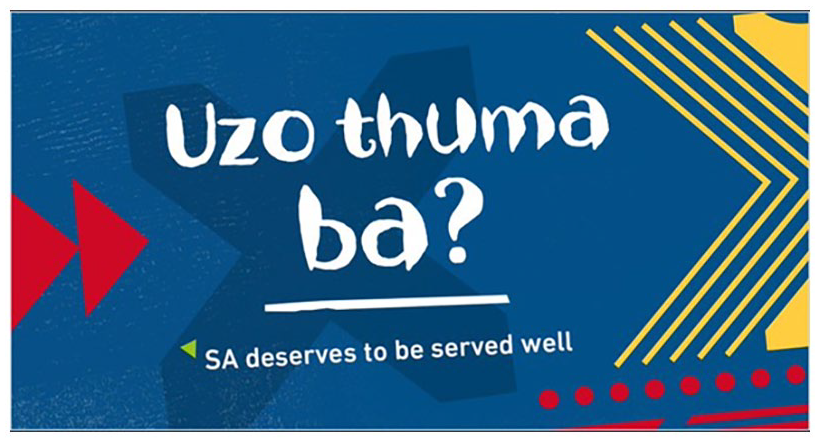
An advert by Nandos chicken satirising Cyril Ramaphosa’s 2019 presidential campaign.
As postulated earlier, fast-food outlets are coming up with adverts that reflect prevailing socio-political and socio-economic conditions in these respective countries. The advert was crafted on a day when President Cyril Ramaphosa was set to appoint his new cabinet of ministers. It is also important to note that the message was taken from ruling African National Congress (ANC) presidential candidate Cyril Ramaphosa campaign moto ‘Thuma mina’. Thuma Mina is a isiZulu phrase translated as ‘Send Me’. The use of the Moto is drawn from the late South African Jazz Ambassador, Hugh Masekela. In that context, Ramaphosa was calling on the South African electorate to support his candidature to presidency as the economic and political ‘messiah’. Hence, he appeals to enfranchised citizens so they can ‘send’ him to solve economic woes faced by the country. Furthermore, we contend that fast-food outlet, Nando’s, is conscious and also takes advantage of trending political discourses to craft messages that are expected to resonate with South African population. Indeed, the pun ‘South Africa deserves to be served well’ speaks to the broader aim of the advert of positioning Nando’s ahead of all fast food outlets. The company appeals to customers that they deserve better thus choosing Nando’s will serve their needs well. As this advert is part of a campaign targeted at South African consumers during crucial time, it can be impactful and provocative. We argue that the advert is impactful because it consciously places citizens into contemplating about complex socio-economic and socio-political issues South Africa is currently grappling with. In another advert that taps into political developments in the country, Nando’s designed an advert that speaks on the upheavals in the main opposition political party, Democratic Alliance (DA). Following the poor showing of the party in the 2019 general elections, a lot of focus was on party leader Mmusi Maimane, who was rumoured to have lost faith of the party leadership. His resignation was captured in the advert ‘Kuvuth’ mlilo DA’ (its burning in DA) and the sub text reads, ‘salang sentle bagaesto’ (keep well). DA’s blue colour is also used to accompany the advert. As a way of keeping Nando’s brand visible to South Africans, using such topical issues in advertising strengthens Nando’s to further develop brand loyalty.
Finally, besides politics, Nando’s developed adverts emanating from social issues taking place in society. One of the adverts titled ‘homeless’ combines black and grey colours as background but the colour black is predominantly used. It is a landscape mode format accompanied by white bold text written ‘homeless’, with the ‘less’ part of the word crossed out. The main text is supported by a smaller font inscription that reads ‘Joseph Shabalala, 1941-2020’. In this advert, Nando’s connoting the death of music legend, Ladysmith Black Mambazo lead vocalist Joseph Shabalala. The crossed out main text, Homeless, refers to the title of one of the famous songs of Black Mambazo, which invited them fame on international stage. The message promoted is that Shabalala has departed to his eternal home. What is striking about this advert is creativity that exhibits consciousness about social issues that relate to lived experiences of target audience. By simply denoting homeless, audiences are immediately reminded of the voice and person behind this famous song. Apart from connoting the death of Joseph Shabalala, Nando’s appears to be taking part in mourning the musician, a strategy of sympathising and associating with Shabalala followers. The black background in the advert is a symbol of mourning, as ‘black is the colour connoting mourning in most African contexts’ (Chibuwe, 2017). By joining everyone in mourning music legend Shabalala, Nando’s aims to score big from his following. The practice is part of the broader scope of IMC which ensures that through implementation there are downstream benefits like brand and financial performance. IMC products are well coordinated by various players through different means of communication and in this case, satire and humour are means of communication that are being used to coordinate product positioning, branding and identity. It can be argued that the two fast-food outlets in Zimbabwe and South Africa carefully constructed ads that reflected socio-economic and political situations prevailing in these two countries. This was achieved mainly by deploying satire and humour in a way that made the adverts palatable to situations prevailing in these countries in a humorous manner. We argue that satire has become an integral part of advertising in contemporary corporate world perhaps owing to its ability to make consumers to laugh through their stomachs. The next section analyses humour, grotesque and brand visibility.
‘Imagine being allowed to come the whole night’: humour, grotesque and brand visibility
Scholarship on humour and advertising argues that the former plays a crucial role in brand liking as attention and awareness are the best objectives that are achieved by the latter (Beard, 2011). The Internet has provided organisations with an opportunity to complement their ‘brick and mortar strategies’ online. Through humour, Mambo’s Chicken possibly proffers a strong brand promise. A brand offers a promise through assuring clients that the organisation stands for what it promises. Mambo’s Chicken adverts are offering a brand promise through written text (humour) and complemented by background colours. Colour is one of the major ingredients that influence the life of the product directly or indirectly. Mambo’s Chicken mainly uses red and yellow in their humorous adverts. Being mindful that any text is contextual, Mambo’s Chicken is new in the fast food retail industry and the use of selected colours is meant to announce its presence, offer a promise and make their brand more visible.
In one of their adverts of an ice cream, the message ‘ino-tonho-rera’ (its cold) is written on a yellow background. 2 Second, the colour yellow was used in another advert with a text which reads ‘Isu tikati 4 ndi 4 kwete past 4’ (when we say 4 we mean 4 not past 4). We have extended our deliveries to 4 pm. 3 Finally, Mambo’s Chicken used yellow in the advert; ‘We are failing, go to Mambos: fast-food restaurants’. 4 We argue that Mambo’s Chicken as a brand, offers a promise associated with yellow. Since yellow is reminiscent of the sun, it communicates hope, optimism, energy and creativity. Hence, it carries positivity. Mambo’s Chicken frames itself as a brand that keeps its promises as seen in the advert; ‘when we say 4 we mean 4 not past 4’. Mambo’s Chicken is framing itself as a brand that has, within short period of time, gained reputation of good serve delivery. Such a reputation is testified by their rivals who in the advert, ‘we are failing’, are admitting to have failed and have resorted to referring people to Mambo’s Chicken for better services. Hence, through humour, Mambo’s Chicken is building a brand that promises honesty and integrity with its food being of good standards. This is also supported by the organisation’s background information which says, ‘Mambo’s Chicken comes in as the brand that has perfected the art of good food and service without compromise’. 5 Supporting the abovementioned perspective, Luxton et al. (2015) argue that ‘brands offer value in terms of the perceived credibility and trustworthiness’ (p. 38).
Grotesque imagery is used to increase brand liking and purchase intentions. Phillips and McQuarrie (2010) characterise grotesque imagery as bizarre, deviant and odd. In a carnival, lower stratum of the body is used as a communication mechanism. Mambo’s Chicken used obscene and grotesque to bring their brand close to the people with particular focus being the thigh. In the advert, ‘We have found the thigh’ while its sub text reads, ‘the search can now stop’.
6
The words are on a red colour and the accompanying image is of a chicken thigh. In another advert (Figure 3), text reads, ‘our chicken thighs are open 24/2’ and it has a sub text which says, ‘imagine being allowed to come the whole night’. Grotesque is also used is another advert, ‘Size does matter’. The other sub text in red says, ‘hence you can’t be finished in
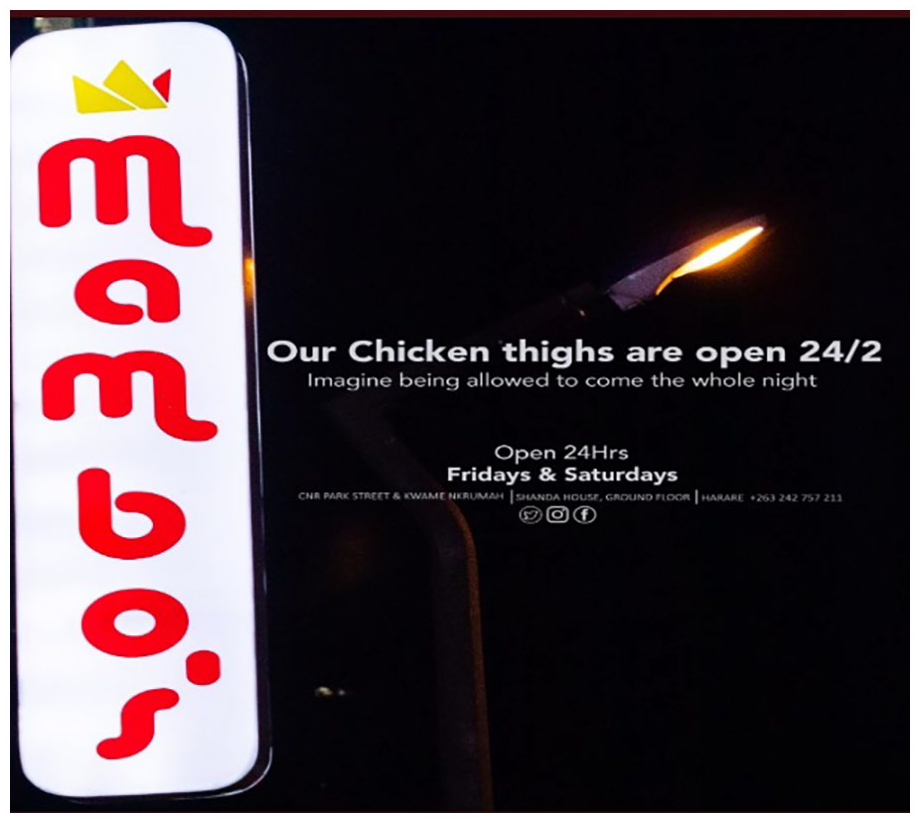
An advert by Mambo’s Chicken using the concept of grotesque imagery to induce brand liking.
Mambo’s chicken also increases its brand visibility through mockery and ridicule of topical issues in society. Since this study argues that social media is carnivalisque in nature, new social relationships are created online leading to ‘emotional bond’ caused by free thoughts, openness, ridicule and mockery (O’Sullivan, 2016). Some of the topical adverts were mainly on football games which generated a lot of interest and debate among soccer fanatics in Zimbabwe. When Liverpool was booted out of the Champions League by Atletico Madrid, Mambo’s Chicken produced an advert which read, ‘it takes 2-3 minutes to pull out a liver from a chicken’ with a sub text which said, ‘if it fails ask simeone else to do it’. Second, the loss of Manchester City to Manchester United by two goals to nil was captured in an advert which read, ‘We love to see a man united with his favourate meal . . . Sadza & Shebo 2.0US’. By tapping into the carnivalesque mode of football, Mambo Chicken’s brand inspire ‘communion’ and ‘communitas’ which speak of ‘being together’ and ‘doing together’, respectively (O’Sullivan, 2016; Turner, 1979). Therefore, Mambo’s Chicken brand brings people together and do (eat) together.
Nando’s also use humour for brand visibility and sustainability. Since Nando’s is an already established brand, sustainable brand growth is created by ensuring that existing loyal customers encourage other customers to become users and eventually loyal to the brand (Schultz and Block, 2015: 341). One of the ways in which Nando’s sustains its brand has been through tapping into social debates and discourses including soccer. With its trademark font size which distinguishes itself from other brands, Nando’s took to Twitter to celebrate Mamelodi Sundowns for being crowned champions of South Africa’s elite league in May 2019. The congratulatory message read, ‘Nishisa njengo pelepele’ (you are hot like peri peri) with a sub text which read, ‘Ma Brazilians a ko kasi’ (local Brazilians) and the background colour is mainly yellow and blue which are the team’s colours. In another occasion, when Caster Semenya, South Africa’s middle distance athlete, was involved in a legal battle with the International Association of Athletics Federations over testosterone-curbing regulations, Nando’s joined in solidarity to support the Athlete. The advert read, ‘Mokgadi was sebele’ (the real guider) with a supporting text reading ‘flavour isn’t their thing anyway’. The text sits on a dark green background. Such adverts are designed to sustain Nando’s brand through advertising and marketing their menu. By using the colour green which is associated with fertility, adventure, trustworthy, dependable (Aslam, 2006; Grieve, 1991) in the latter advert, Nando’s sought to grow its ‘brand outside the current base so that the brand continues to expand in terms of volume and profitability over time in a potentially unlimited way’ (Schultz and Block, 2015: 340). Also by focusing on topical issues, the benefit that Nando’s stands to gain is that people are bound to talk about the brand resulting in the organisation ‘promoting dialogue’ with consumers and an increase in brand appeal. Hence, Nando’s ensured that its brand thrives in both brick and clicks environments.
Another advert by Nando’s South Africa, Figure 4 utilises traditional blue, green and yellow colours. It denotes a landscape format with the main text presented in four lines. The background is blended colour blue. The white text positioned at the centre of the advert denotes ‘turns out finger licking isn’t good. Rather reach out for the soup’. What is striking is the third line of the text sitting on a green background unlike the rest written on the main blue surface. As a sign and signifier, the product being advertised here is Nando’s, of course disguised within COVID-19 pandemic prevention guidelines. The advert discourages finger licking, which is part of the prevention measures put in place against spread of COVID-19. However, it can be argued that those who created this advert took advantage of this current COVID-19 pandemic to de-campaign its direct competitors, KFC which uses ‘Finger licking good’ as their tag line. The discourse that ‘turns out that finger licking isn’t good’, gathers in one heap the pun hurled as invective against Nando’s competitors. Indeed, this could be a strategy to tout customers towards Nando’s through this thought provoking advert. Since advertisements aim at convincing consumers that the presented sign value in the ad runs parallel with their desires, we can think of them in terms of rhetorical devices. Hence, the development helps to sustains Nando’s brand equity ahead of its rivals, in this case KFC, in the fast-food outlets market. Resultantly, brand positioning is largely achieved as the pun used ensured that Nando’s can be easily distinguishable from its competitors. What stands out is that satire mainly through pun, in this instance, has greatly influenced advertisement among fast-foods outlets in Africa today. This permits consumers to make sense of and create meaning of the message the advertiser is sending. However, we observe how signs and symbols have communicated the product to the consumer. There is indeed a great deal of psychology behind what the advertiser sends out and through semiotics consumers’ brain responds to the visual and communication behind an advertisement.
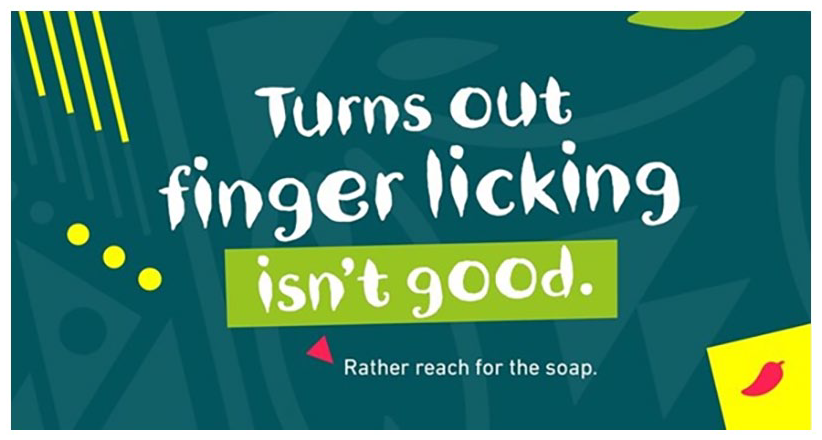
An advert by Mambos chicken making fun of KFC.
Strategic communication and fast-food outlets: humour, celebrities and colloquialisms
Strategic communication mostly involves communicating messages to advance the purpose of an organisation. By so doing, corporate organisations or businesses vie for communication that captures, ‘ . . . attention, admiration, affinity, alignment, and allegiance of constituents of all sorts- customers, employees . . . and society at large’ (Hallahan et al., 2007: 4). The message communicated is tailor made so that it is easily understood among the audience and strikes a responsive chord with potential customers. We draw on these aspects as a guideline to analyse humorous and sometimes satiric adverts by the two fast-foods companies. A predominantly striking feature about adverts used by both Nando’s and Mambo’s Chicken in the time frame we selected is the use of celebrities, society leaders or role models in humorous way as a strategic communication tactic. Using celebrities is a strategic communication tool as they act as spokespersons in advertisement to promote products and services of a company or product (see Kambitsis et al., 2002). In one of the adverts, Figure 5, Mambo’s Chicken makes use of prominent Zimbabwean pastor, Passion Java who is based in the United States. The words in the advert reflect an incident that went viral on social media platforms where he was praying in tongues during a church sermon at his Passion Java Ministries church. The advert reads,
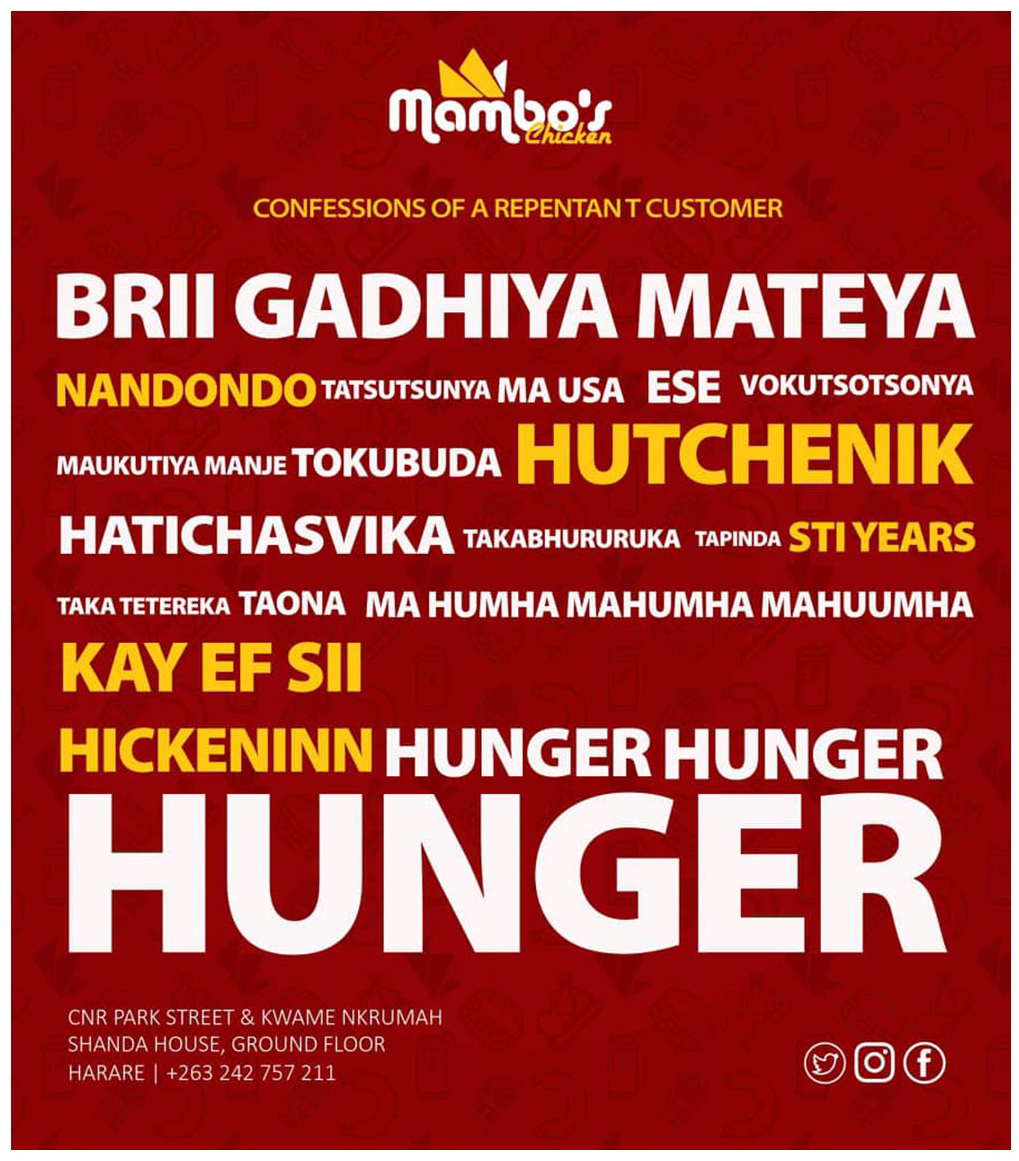
An advert by Mambo’s chicken satirising Zimbawe’s self styled Prophet, Passion Java.
The prayer in tongues herein reflects confessions of a ‘repentant customer’. The words ‘nandondo, stir years, kay ef sii, hickeninn, hutchenik’ are all emboldened in yellow and these are fast-food outlets that are in market competition with Mambo’s Chicken in Zimbabwe. For example, nandondo denotes Nando’s, Sti years – Steers, hickeninn – Chicken Inn and Hutchenik – Chicken Hut. The use of the colour yellow to highlight the rivals in Zimbabwe could mean that Mambo’s is degrading other fast food outlets mentioned in the advert. Bearing this in mind and alluding to the first sentences that read ‘Confessions of a repentant customer’, the advert attempts to downplay the service and quality of food services offered by the rivals mentioned herein. The advert urges customers to repent – that is, to stop buying food from other fast-food services mentioned in the advert and instead buy from Mambo’s Chicken only which offers quality service. This is also in tangent with their moto #EatlikeAKing. By doing so, Mambo’s chicken use strategic communication techniques to position themselves as ‘kings’ of food service in the fast-food industry with the greater ideal being for ‘survival and sustainable of the entity’. Of interest to note is also that the organisation motto #EatlikeAKing is made a ‘reality’ through satire and humour which this study is theorising as part of strategic communication, and we argue that it is intended to fulfil Mambo’s Chicken’s aim of treating their client like Kings.
The term ‘strategic’ is often associated with practice and the tactics used to implement strategy (Mintzberg, 1990). Mambo’s Chicken draws on the use of colloquialisms as a strategic communication tool to enhance familiarity with the message being communicated to customers. In one of their adverts, Mambo’s Chicken has a picture of a chicken wrap with the caption ‘Twabam: 7 Wrapped with Passion’. Mambo’s chicken once again draws their advert from prominent pastor Passion Java. The prominent pastor regularly uses the words Twabam to communicate with his followers, fans and congregants. The subsequent message ‘wrapped with passion’ is a suggestion of how meticulously prepared their food is. However, colloquial words drawn from Passion Java such as Twabam, Tatsutsunya, vokutsotsonya, are examples of street lingo now popularly used in Zimbabwe and subsequently used by the fast-food outlet so that the message is easily understood by followers on social media platforms. 8 Colloquialisms, a common tenet of the carnival, are mostly used by Mambo’s in informal communication/slang and are considered to be ‘metaphorical, playful, elliptical, vivid’ (Fromkin et al., 2013: 319). The use of colloquialisms in a carnival creates frankness, inspires certain attitudes and gives a different outlook of the world (Bakhtin, 1984). Such a form of communication and advertising draws customers closer to a brand and is a way of persuading them to buy Mambo’s Chicken. In this way, Mambo’s taps into this strategy so as to position their product differently from other fast-food stores in Zimbabwe mentioned in the advert.
Moreover, a well-chosen celebrity gains attention to a brand or product in the process of communication (Khatri, 2006). Khatri (2006) states that the endorsement of celebrities lends their names to advertisements for product or services for which they may not be experts in. Similarly, one of the adverts by Mambo’s Chicken uses Zimbabwean celebrity Desmond Chideme known as Stunner in the music circles. In the caption, the advert states, ‘Breaking News-Local Man is happy after being stunned by Mambo’s Chicken Wrap’. The advert comes soon after a story by a local publication with a story on the celebrity hitting hard times and returning to his previous residence in the high-density suburbs where his parents reside. 9 Mambo’s humorously use the celebrity who has ‘fallen on hard times’ to advertise their chicken wrap. Overall, the message in the advert is an attempt to show how the fast-food chicken outlets does not discriminate – but instead accommodates everyone despite their economic or social status and previous wrong doings committed. Furthermore, the use of the celebrity by the fast-food outlet is deliberate – given Stunners controversial past life as a celebrity. Much as scholars agree that it is important to first check a celebrity’s record before endorsement in adverts to determine the success of the brand (Kotler, 1991), Mambo’s Chicken rides on the popularity of the celebrity despite his stained past.
For Nando’s, the use of celebrities and prominent figures in society is prominent in their adverts. One of the adverts, for example, uses the current Miss Universe Zozibini Tunzi with a caption reading ‘South African Flavour-Now Available everywhere’. The advert celebrates the South African model for becoming Miss Universe. At the same time, the advert strategically markets the Nando’s brand. Similarly, another advert uses the current South African President Cyril Ramaphosa. The caption of the advert reads, ‘Ramapunctual – When making important decisions takes time’. The use of Ramapunctual is a combination of Ramaphosa and punctual. The advert pokes fun at Ramaphosa as he was always late to make announcements related to the COVID-19 pandemic on television stations in South Africa. At the same time, the advert praises Ramaphosa as evidenced by the caption by stating ‘When making decisions takes time’. By capturing happy moments and attaching their brand with ‘favourable attitudes’ is an attempt by Nando’s to align such good labels to their brand. This greatest art, the study argues, is part of strategic communication which is used to ‘maintain a healthy reputation for the communication entity in the public sphere’.
Continuing with the study’s argument that satire and humour are used for the benefit of the organisation, their value in branding is that they are ‘deliberate and purposive communication that a communication agent enacts in the public sphere on behalf of a communication entity to reach set goals’ (Hallahan et al., 2007). Hence, the use of South African rugby team was designed to market Nando’s. On the advert, the caption reads, ‘Siyakumafinals – So close we can taste it’. Loosely translated, ‘siyakumafinals’ is an isiZulu word when translated ‘We have qualified for the Rugby finals’. Nando’s rallies behind the South African Rugby team that eventually won the 2019 world cup in Japan. Strikingly, these three adverts do not use the faces/pictures of these two figures mentioned herein or of any food stuffs that are related to Nando’s. This is a strategic communication tactic used by the company so as to consciously keep the brand visible to the audience mind and also ‘compete in the market place, obtain competitive advantage and gain market share’ (Hallahan et al., 2007: 12). This works in conjunction with humour as it is meant to amuse, excite or mirth the audience or reader at the same time keeping in mind the Nando’s brand.
Conclusion
The findings suggest that humour and satire are key adverting and marketing ingredients being used by organisations in the global South. Tapping from the benefits of laughter and pairing their products with the positive or favourable attitudes that will be characterising given societies, fast-food outlets are able to increase and sustain their brands in a competitive market. Branding and strategic communication are the lifeblood of any organisation as they help to attract new customers and cultivate the existing base while positioning themselves in the market. While the study acknowledges the power and usefulness of satire and humour as demonstrated in the analysis, there is still a need to examine the negatives that sometimes emerges from grotesque. Hence, Mambo’s use of female body parts in advertising might attract scorn and severe criticism, especially from gender activists. Indeed, assuming that people will develop a liking towards a product because it is of any humorous format might be misleading. However, the study calls for further research to examine the reception of the adverts under the study. With organisations being driven by people’s perceptions to know their product preference, reception analysis will be crucial to understand the effectiveness of their campaigns.
Footnotes
Declaration of conflicting interests
The author(s) declared no potential conflicts of interest with respect to the research, authorship and/or publication of this article.
Funding
The author(s) received no financial support for the research, authorship and/or publication of this article.
