




Abstract
This exploratory study investigates the journalistic influences on science reporting in Southern Africa, filling the gap that is under explored. South Africa, Mozambique, and Zimbabwe are the selected cases. Methodologically, this qualitative study relied on in-depth face-to-face interviews and purposive sampling as designs. The study employed Reese’s and Shoemaker’s hierarchy of influences model as the preferred theoretical framework because it articulates diverse factors affecting news content, categorized from a micro-individual to the macro-social system level. This study found that lack of resources, limited knowledge of science by journalists, and preference for political and economic news have largely affected the quality and frequency of science reporting in Southern Africa.
The period 2020–2022 was largely dominated by the global coronavirus pandemic and later the monkeypox. These two diseases brought into sharp focus the importance of science journalism. Nguyen and Tran (2019) posits that “the news media, is the most efficient of all available science channels, play a crucial role in preparing peoples and nations across the globe to exchange, choose and progress with the right Science and Technology ideas and approaches” (p. 2). However, the role played by science journalists has come under increased pressure over the past few years. Some of the pressures are associated with the precarious nature facing the media industry, from the changing media business models that are seeing the emerging but well-funded small start-ups (Mabweazara and Matsilele, 2023; Mpofu et al., 2022) to the changing shrinking space when it comes to press freedom (Tshuma et al., 2022). Writing on this, Franks et al. (2023) note that “the profession of science journalism faces significant challenges including shrinking career prospects and job losses for science journalists” (p. 2). Elliott (2019) agrees postulating that science journalists face significant challenges as they seek to report on scientific research in socially beneficial ways. Elliott (2019) adds “ . . . science journalists have the opportunity to contribute to the open science movement by identifying and explaining major value judgments in scientific research for members of the public” (p. n.p.). Science journalism is largely understood to be the typology of journalism that covers science.
For the purposes of this paper, we define science journalism as communicating uncertainty, coverage of climate change, biological science, geomatics, medicine, and artificial intelligence (Balmer et al., 2009; Friedman et al., 1999; Nguyen and Tran, 2019). Murcott and Williams (2013) define a science journalist as “a specialist whose role is, broadly, to report scientific developments to a wider audience than that reached by the academic journals” (p. 152). This view is shared by Dorothy Nelkin (1995) noting that science journalism should provide three things to non-specialists: it should help people (1) keep apprised of scientific advancements, (2) assess the appropriateness of scientific research, and (3) make choices related to perceived personal risks.
The coverage of science is a topic of great interest to journalists, scientists, and science communication scholars, occasioning much research and commentary (Dunwoody, 2014). Science related topics like climate change have a direct impact to people live (Matsilele and Tshuma, 2023). Journalism presents science news within the context of real-world problems. This means journalists must factor political and social implications into their news stories about scientific issues, such as climate change or communicable diseases (Polman et al., 2012: 47). This is even more important, especially for countries in the Global South facing challenges around resources, public and private sector response, and citizenry trust when faced with science-related catastrophes which include cyclones and high temperatures (Matsilele and Tshuma, 2023; Msimanga et al., 2022 [2021]). We acknowledge the contestations around the term Global South that can be classified to identify “poorer” parts of the world or to address spaces and peoples negatively affected by globalization. Ultimately, linked to the second definition, the Global South is a term used by scholars and activists to refer to a transnational political subjectivity and subaltern resistance under contemporary capitalist globalization (Mahler, 2018). However, with observable science-related challenges globally, science journalism remains scant when it comes to the global South (Jamil, 2023b). This is rightly so because of the studies have tended to focus on politics and power contestation which is devoid from science-related matters. In this paper, we define science journalism as the coverage that “may also arise from interesting phenomena in daily life or from general news (such as scientific explanations behind a tsunami)” (Wormer, 2008: 4512). Summ and Volpers (2016) add that general reportage or current affairs issues can turn into science journalism when “the journalist refers to scientific expertise, cites studies, or includes scientific actors in the story to help explain certain events and incidents” (p. 776). Commenting on the importance of science journalism in this region, Nguyen and Tran (2019) intimated that “the professional practice of science journalism in the Global South is of significant importance to the course of national, regional and global development” (p. 975). Despite the growing importance of science journalism, academic research into this area is still limited especially in the Global South, and Southern Africa, in general. (Bauer et al., 2013; Jamil, 2023b; Nguyen and Tran, 2019).
In the specific context of Southern Africa, major concerns such as climate change, epidemics, and non-communicable diseases continue to have a huge impact on communities across the region. Nevertheless, news media reporting is substantially dominated by political, sports, and business news. Stories that focus solely on science rarely make news. Therefore, science journalism as a specialized area of reporting and research into this field has not grown well until yet. There are a few seminal cases worth mentioning like Van Zuydam’s (2019) study that explored the state of science journalism in South Africa, Appiah et al.’s (2015) study studied barriers faced by science journalists in Ghana. Claassen’s (2011) study investigated the relationship between media and scientists in South Africa, Appiah et al.’s (2012) study that looked at the future of science journalism in Ghana, and Hibler’s (1981) investigation sought to trace science journalism in West Africa. This study, therefore, seeks to fill the gap in scholarship on science journalism in Africa with a gaze on the sub-region, southern Africa. Specifically, the study seeks to understand the factors that influence the construction of science news in three southern African countries. Three countries that we focus on, South Africa, Mozambique, and Zimbabwe provide interesting insights, have experienced excessive effects of climate change, El Niño-induced drought, la nino, and recently the coronavirus pandemic making science journalism research of paramount. The study first gives a background of the selected countries. This is followed by a review of literature into prior studies related to science journalism in the Global South, and specifically Sub-Saharan Africa. The subsequent section will give an outline of the methodology used and this will be followed by discussion and concluding sections and remarks.
Background of the selected countries
The study’s selected countries, South Africa, Mozambique, and Zimbabwe are in the Sub-Saharan Africa, a region that has experience adverse weather conditions, such as El Niño, in recent memory. El Niño is a weather pattern of unusually warm water stretching across the surface of the Pacific Ocean, negatively affected the region. As a result, high temperatures were recorded that led to drought—reduced crop yields, cattle deaths and low dam levels due to less inflows (Lugalambi et al., 2011; Nakkazi, 2012). The impact of El Niño at the end of 2015/2016 left devastating social problems in Southern Africa that included over 500,000 children suffering from severe acute malnutrition and close to 3.2 million children were left exposed to lack access to safe drinking water (Sithole, 2016). The regional body, the Southern African Development Community (SADC) indicates that Mozambique, Zimbabwe, South Africa were the worst affected by El Niño. Of the three countries, Zimbabwe declared national drought emergencies with Mozambique declaring a red alert. Besides the effects of climate change, Mozambique, Zimbabwe, and South Africa were affected by the outbreak of listeriosis disease. With the disease being detected in South Africa, Mozambique, and Zimbabwe banned the importation of processed meat products from South Africa. As such, these three countries which share physical borders, also share common economic and social challenges that still require academic inquiry. Besides these countries sharing the above-mentioned issues, they share similar policies that govern science-related issues. For example, SADC Protocol on Environmental Management for Sustainable Development that promotes the effective management and response to impacts of climate change and variability. Thus, Zimbabwe, South Africa, and Mozambique are the signatories of this policy.
Literature review: science journalism in the global south: death or dearth?
Science Journalism in Africa remains an underperforming discipline (Nguyen and Tran, 2019). Although it is underperforming, the science journalism beat, remains critical and important in developing countries (Lublinski et al., 2014; Mbarga et al., 2012; Ndlovu et al., 2016), the loci of this research.
However, in the recent past, there has been an observable increase and interest in scholarly inquiry that focuses on the domain of science journalism in Africa and the global South (Massarani et al., 2005; Massarani and Buys, 2007; Matsilele and Tshuma, 2023; Nguyen and Tran, 2019). Most of this literature has shown that science journalism in global South, and Africa in particular, has a Western flair (Schäfer, 2010), thus largely neglecting the practice of science journalism with an African gaze. This has resulted in science journalism practiced and the news content being published without fact checking or consideration of local African realities (Massarani et al., 2005; Nguyen and Tran, 2019). Thus, what emerges from this literature is what can be predominantly termed “armchair” or “lazy journalism” as it regurgitates information from Western news outlets without any fact checking or analysis to see if the facts and statistics apply to an African perspective. Armchair journalism in this case could refer to journalists who receive reports in the newsroom and do not verify information. One of the main challenges is failing to find local sources who have expert knowledge on science-related issues to the lack of science-related knowledge. Further scanning of literature shows that journalists in the global South located in Latin American countries and developing countries in Asia mostly rely on “science institutions’ reports without any local comments and regional link” (Nguyen and Tran, 2019: 978) with the risk of reportage without local contexts. Although this “armchair” journalism exists, and, in most cases, produces newspaper reports that do not fit in localized contexts in the global South, there is still light at the end tunnel. Available academic inquiry on science journalism in the global South shows positive coverage of science and technology, medicinal innovations, and developments by Indian and Brazilian media (Massarani and Buys, 2007).
Available literature on science journalism in the global South also shows how it is “in the back seat” as stated by Nguyen and Tran (2019: 979). There are varied reasons to the beat “taking a back seat” and this could translate from a helicopter view, how science journalism in Africa is not recognized, if considered as a beat at all (Matsilele and Tshuma, 2023). Nguyen and Tran (2019) citing examples from Pakistan, Bangladesh, and Nepal further advance this point stating that “dedicated science teams and sections are a ‘luxury’ in newsrooms” (p. 979) a finding that resonates with Matsilele and Tshuma’s (2023) study that looked at environmental funded journalism in South Africa. This also spells out the death of science journalism in the Global South, and ultimately, sub-Saharan Africa, the focus of this research. This “death” means that the beat not being supported by editors and news corporations (Lublinski et al., 2014). Lublinski et al. (2014: 7) emphasize how editors, the lack of support and space for science-related issues impede on the development of science journalism. Thus, editors prefer stories that are developmental or sensational, relegating science journalism to the “terraces” or irrelevant pages and only topical day to day issues such as climate change and health-related issues being mostly covered (Appiah et al., 2015; Matsilele and Tshuma, 2023).
An important theme among the available corpora on science journalism is the working relationship that exists between scientists and journalists that is complex (Bauer et al., 2013; Lublinski et al., 2014; Ndlovu et al., 2016). While this is the case, such a working relationship has dire effects in a two-fold manner: First, journalists do not get to understand the abstract and complex scientific or innovative information that is meant to be communicated to the audience. Second, journalists are left to interpret and communicate inaccurate information to the audience. There are varying reasons to this complex relationship between the two camps that range from journalists claiming that they do not receive enough support from the scientists and innovators (Appiah et al., 2012). Appiah et al. (2012), for example, expands on how from a sample of journalists in Ghana further lament access to communication with scientists in Ghana. Conversely, scientists and innovators further stated that “Being misquoted is a common feature in science and health journalism” (Olet and Othieno, 2015: 5). To further show this complexity, scholarly inquiry has also shown that scientists do find the aspect of communication as an important part in line of duty (Ndlovu et al., 2016). Nguyen and Tran (2019) further show the complex relationship as scientists have insisted on reading the newspaper articles before they are published although this “clashes with journalistic professional standards” (p. 983).
While research has been done on the coverage of AIDS (Chanda et al., 2008; Kasoma, 2000; Kothari, 2015), public science communication (Ndlovu et al., 2016), climate change (Midttun et al., 2015), health and COVID-19 (Chiumbu et al., 2022; Evans, 2021; Matsilele, 2021; Wasserman et al., 2021), and science and technology domain (Lublinski et al., 2014); in this paper, we seek to understand the journalistic practices from the Southern Africa, mainly Mozambique, South Africa, and Zimbabwe. Thus, given the importance of science journalism in society, there remains a gap that seeks to understand the factors that influence the construction of science news in three southern African countries. Our scholarly inquiry stems from studies have called for a focus on researching more on local science-related stories, that is, from African countries (Mazzonetto, 2005; Olet and Othieno, 2015). In the next section, we outline the theoretical concepts to be adopted in this paper.
Theoretical framework: Reese’s and Shoemaker’s hierarchy of influences model
Journalism is frequently understood as a set of practices. Zelizer (2004) defines journalistic practice in terms of the routine work that they undertake. She suggests that journalists are involved in the work of “news gathering, breaking news, news writing, news making and production regardless of the differences in types, technology and audiences of the news media” (p. 42). Many journalism and media scholars suggest that journalists operate within specific local organizational, economic, and socio-political environments that shape their practices (Deuze, 2002; Gurevitch and Blumler, 2004; Keeble, 2005). How individual journalists construct news and operate within larger organizational, social, economic, and political environments, requires theoretical frameworks that helps to understand the interplay between individual agency (practice) and the diverse levels of influences. Therefore, this study is informed by Reese’s and Shoemaker’s hierarchy of influences model (2014). The hierarchy of influences is a five-level model that articulates diverse factors affecting news content, categorized from a micro-individual to the macro-social system level. The model involves five levels, namely: (1) individual, (2) routine, (3) organizational, (4) extra-media/or social-institutional, and (5) social systems levels of influence (Hanitzsch et al., 2010; Reese, 2019). Also deemed as a theoretical perspective, the model has come to be considered as one of the major concepts in journalism studies (Franklin et al., 2005).
At the heart of the model, is the individual level of influence, which suggests that journalists’ educational and socio-economic backgrounds, individual characteristics and traits do have influence on the news content he or she creates (Shoemaker and Reese, 2014; Shoemaker and Vos, 2005). Further than the individual level, the proponents of the model posit that journalists are influenced by the organizational environment within which they work and hence their routine work is influenced by organizational values, rules, policies, and structure. The organizational level influence recognizes that news is produced within entities that have their own policies and economic priorities. Beyond the organizational boundary, is another layer of influence that is “extra media” level that captures the influence of those that operate outside the organizational boundary including public relations companies, advertisers, news sources, government, and non-government organizations. The term “extra-media” has been lately revised as “social-institutional” to pool up the influence of all institutions that operate outside the boundary of news organizations, indicating the influence of larger institutional environment on news construction and journalistic practice. At macro-social systems level, journalists may face influences from social systems. This level focus on how ideological forces shape and influence journalists’ work and media content (Jamil and Appiah-Adjei, 2020).
Despite the frequent use of hierarchy of influences model in journalism studies, the model has been criticized for two main reasons. First, some scholars view that the model lacks clarity when explaining the boundaries between levels and hence is poorly demarcated to classify various influences (Anderson, 2013). Second, the advent of technology has transformed the news ecologies that appear as tightly bound networks and fields. Third, the model primarily focuses on influences on journalists’ agency (i.e. actions or practices) and does not recognize the changing dynamics of news making process with technological advancements and the changing role of involved actors in it (Jamil, 2022, 2023a). News making process is conventionally split up into news production, distribution, and reception. Regarding the last, the importance of interactivity and news consumer metrics mean that the news audience is no longer a passive recipient but an active agent in the journalistic process. Should we consider the varied level of influences affecting the agency of news consumers’ as active contributors of news content, for instance, as citizen journalists? The model does not help to clarify this concern. This study acknowledges the gaps in the hierarchy of influences model. However, the main rationale for using the model is that it helps identify systematic irregularities and constraints at various levels of institutional, organizational, and social structures that must be considered to understand better the dynamic interplay shaping and influencing journalists’ practice to report on science within the Southern African context.
Methodological premise
The study employed a qualitative method of in-depth face to face interviews to investigate a research question, precisely: what factors influence the construction of science news in Southern African countries? The rationale for using in-depth interviews was that it helped to explore science journalist practices in Mozambique, South Africa, and Zimbabwe. The interviews were recorded and lasted between 45 minutes to an hour. The interviews were conducted using a blend of two platforms: WhatsApp and Microsoft Teams. The two platforms were selected as the researchers did not have funding to travel for face-to-face interviews in the different destinations were journalists where located. Thus, the two platforms granted the researchers an opportunity to probe and seek clarity. However, WhatsApp’s encryption capabilities, enabled us to safeguard the privacy and confidentiality of the participants who did not want their confidentiality revealed. Moreover, this study used purposive sampling technique to recruit journalists in all three selected countries. Marshall (1996) states that through purposive sampling “the researcher actively selects the most productive sample to answer the research question” (p. 523). The logic behind using purposive sampling was selecting journalists who have knowledge of science journalism, since there are no specific science desks or a developed science beat in these countries employed as case studies. We interviewed a total of 14 journalists and our sample included managing editors, senior journalists, desk editors, and junior journalists. While this can be viewed as a limitation of the study, there are few journalists who cover science-related issues. There are also no fully fledged science journalism desks from the newsrooms sampled. All interviews for this study were conducted between May 2022 and July 2022. We purposively sampled journalists and newsrooms from the three countries selected as they were leading in the coverage of science-related stories (as shown in Table 1). For the Mozambique case, we interviewed four journalists drawn mainstream media houses that is Noticias and Carta de Moçambique, leading newspapers in Mozambique. For the South African case, we interviewed six journalists. Finally, from the Zimbabwean case, we interviewed four journalists who were drawn from the mainstream media. The selected journalists were from Zimpapers and Alpha Media Holdings which are the two leading media stables in Zimbabwe. Given that, as explained earlier, there are no fully fledged science journalism desks from the newsrooms the two stables were purposively selected because they housed journalists who have previously or still cover science-related issues.
Demographics of Journalists Interviewed.
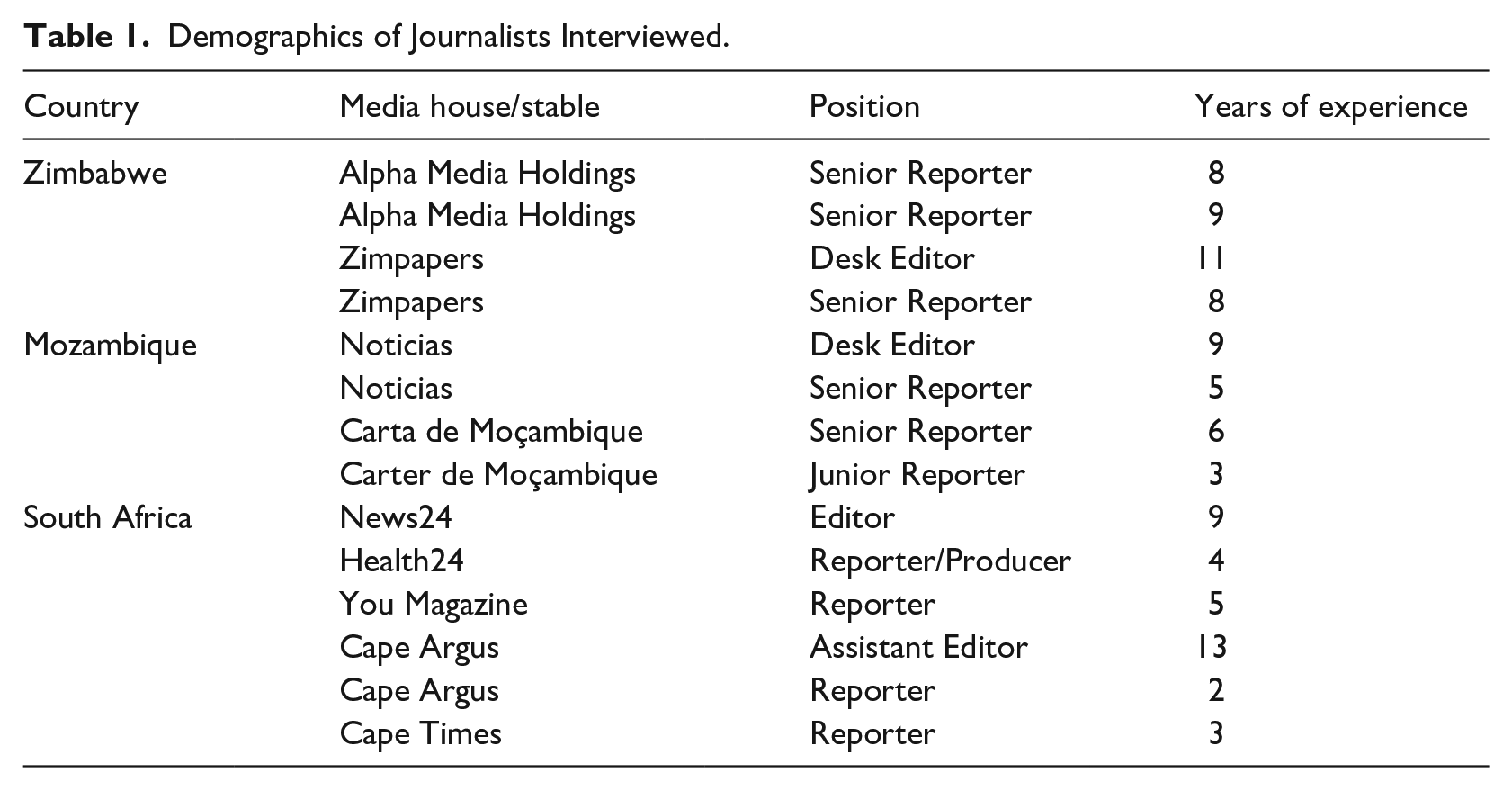
The following questions formed the basis for the interview guide for this study:
How do journalists’ background (i.e. education, age, experience, socio-economic class, ethnic origin, religion, and knowledge into science and COVID-related health issues) influence reports on science?
What routine level challenges affect the practice of science journalism?
How do organizational rules, policies, and resources affect journalists’ reporting on science? Are these policies and rules different in print and electronic media?
What are the institutional challenges that affect the journalists’ reporting on science during pandemic?
How do cultural and religious influence journalists’ report on science issues? Are there any other factors that affect journalists’ practices beyond individual, routine, organizational, institutional, and ideological levels?
This study uses deductive thematic analysis informed by Aronson (1994) and Braun and Clarke (2006) to analyze data. Deductive Thematic analysis was selected because it enables the interpretation of identifiable patterns of themes (Makwambeni, 2013). The process involved the following five main stages: which involve systematic procedures such familiarization with data, generating initial codes, identifying themes, reviewing themes, and naming the themes before writing the findings. The gathered data under five key themes that have emerged deductively from the interview data, namely: (1) Journalists Background and Science Journalism, (2) Routine Levels challenges and the practice of Science Journalism, (3) Organizational Rules and Science Journalism, (4) Institutional Challenges affecting the practice of Science Journalism, and (5) Cultural and Religious influences affecting Science Journalism.
Ethics
The journalists who participated in this study were fully aware of and understood what the study entailed to enable them to decide whether to participate or not. Hence, participants were informed prior to the interviews of the research and permission was sought to record the interviews. There were mixed reactions regarding interviewees having their identities known which led us to decide a uniform approach of not mentioning names. To guarantee informed consent, participants were required to give their permission by signing a consent form, which specified that they would be involved in the research, based on adequate knowledge about the study and what the study involved. This study also received institutional ethical clearance from a university’s ethical clearance committee.
Findings
Drawing on Reese’s hierarchy of influence model, this study highlights some common influences faced by the Southern African journalists in three selected countries: South Africa, Zimbabwe, and Mozambique. At an “individual level,” South African and Zimbabwean journalists both face difficulty to when reporting science because of a lack of knowledge on science, despite the fact some journalists do have science background. Journalists in Mozambique also encountered the same problem, showing how knowledge in science-related issues is important for reporting. At an “organizational level,” journalists in Zimbabwe and Mozambique highlighted their difficulty to report on science because of a lack of journalists’ trainings and workshops, as well as organizations’ preference for political and other human-interest news stories. On the contrary, in South Africa, journalists highlight how a lack of resources (especially financial) affect the development of investigative science journalism. At a “routine level,” South African and Zimbabwean journalists expressed their concern about a lack of investigative reporting skills on science topics. Journalists, in Mozambique; however, shared that they face routine-level influences because there is a lack of communication between scientists and reporters that creates problems for them to maintain accuracy of science reports. At social system and institutional levels, South African journalists did not share any specific influence. Nevertheless, journalists from Mozambique and Zimbabwe reveal that their respective governments do not invest in the development of science journalism through building science data repositories, and financial support for news organizations and journalists’ unions to facilitate science-reporting training. Table 2, below, summarizes the findings of this study.
Summary of themes and findings.
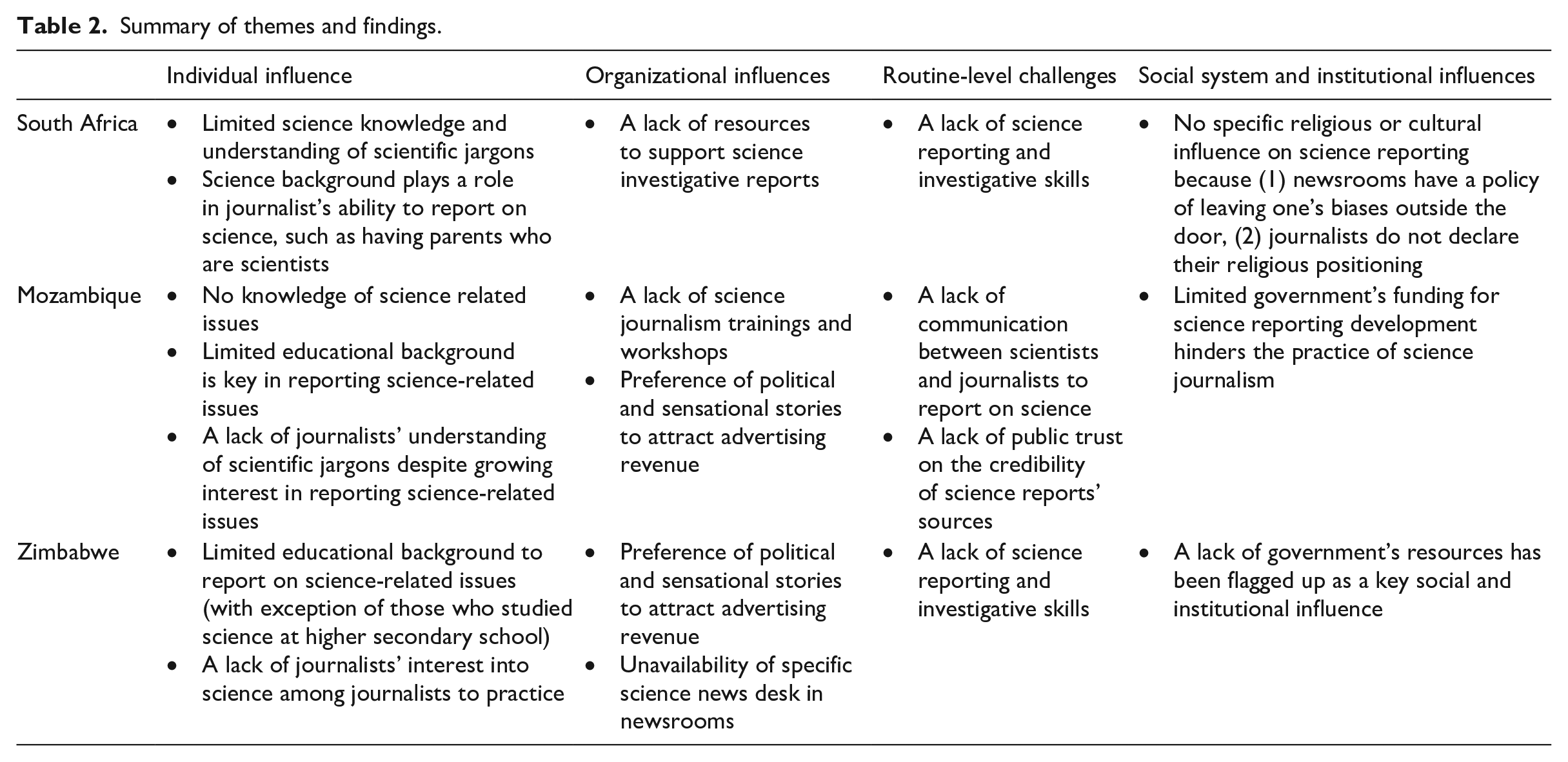
Individual influence
At the individual level, this study found that interviewed journalists said science reporting was largely influenced by their background knowledge about science. For some journalists, their faith or religious beliefs take precedence over nature or scientific explanation of events. An editor in a leading South African news organization, Journalist 1, said the following: A journalist’s background plays an important factor in influencing a journalist’s ability to report on science. Think about Aisha a journalist and daughter to Karim Abdul Karim, a leading medical scientist who was advising the minister of health when COVID-19 started. Certainly, her access to a top science expert parent would assist her in picking up science language due to the parent’s profession. So, background certainly frames the outlook as one would have been socialized in an area growing up.
The views expressed by the above interviewee were corroborated by another South African journalist, Journalist 2, said reporting on science had benefited a lot from his understanding of science, a subject he learnt in his previous studies. He added that I think having background in science will help improve your reporting because you will be aware of topics and terminologies. Even though someone without this background can do with a bit of research, for someone with that background as myself, I find my background helpful. I am sure my knowledge is aided by my interest and consistent exposure to science documentaries.
Another interviewee from a weekend South African publication, Journalist 3, had this to say: Your background certainly impacts on your approach to journalism, I am thinking of a journalist coming from a family with HIV/AIDS related deaths, such a journalist would report with much awareness. That kind of background for me influenced my reporting especially when it comes to science reporting.
A journalist with one of the leading South African science news outlets, Journalist 4, said her journalism was largely informed by religious beliefs. The journalist argued that “my background, and especially my religion, affects every avenue of my life. However, it hasn’t impacted my reportage on COVID-19, tech, or any science-related matters.”
Sharing similar views were journalists from Zimbabwe who argued that their personal experiences have a bearing in the way they report on science journalism. A Journalist from a daily newspaper, Journalist 5, said educational background shapes reporting. The journalist further said, “I did sciences at O’level but chose to do arts subjects later and journalism at tertiary level. My science background always prepares me to help explain or write about science related issues.” Such views were also echoed same sentiments as the Zimbabwean journalists. A journalist from Mozambique, Journalist 9, offered a more extensive response stating that education and interest are key drivers in understanding and reporting science journalism: Education and knowledge of science related issues are important key for one to be able to report on science journalism related issues. Most journalists do not understand the abstract science related terms and they shun away from reporting on these issues. Not only is the understanding of science related issues key, but interest is also important. Without interest, there is no motivation for science related journalism. For example, in Mozambique, we have had Cyclones such as Lanina and it is key that one understands the scientific reasons behind it. This enables one to put it down into writing.
Although some journalists from Mozambique said they lacked knowledge of science-related issues, a journalist from Mozambique, Journalist 10, mentioned how there is growing interest in reporting science-related issues especially climate change. This is in part because they are offered monetary incentives at workshops they are invited to attend. However, some journalists argued that religion and cultural beliefs play a crucial role in their work. Related to diseases that have been reported on the country like cancer and the recent COVID-19 pandemic, a journalist from daily newspaper in Zimbabwe, Journalist 6, mentioned how religious beliefs are central to reporting saying “my Christian beliefs guide my understanding of the world. So, when there are clashes between my faith and nature, my faith guides me.”
Routine-level influences
Regarding issues of routine-level challenges, lack of skills was raised as the major factor affecting journalists’ capacity to practice science reporting. Journalist 3 from South Africa had this to say: The challenge with most of our reporters is that science is not their forte, they only read science journals or reports when they want to write stories. The absence of routine in understanding science broadly and science reportage as a niche affect their ability to report on science. In most cases this is best illustrated by the fact that science reporting is most delegated to an entry level journalist.
A journalist from Brainstorm, a business technology publication, commenting on issues of routine-level challenges intimated that a lack of specialized understanding about specific niche topics: When I started working as a tech and business reporter, it was a huge leap for me to go from being a general reporter to a specialised journalist who needed to quickly adapt and understand jargon utilised within the sector. You cannot exactly ask the CEO of Deloitte why he thinks it’s important for people in the Global South to have access to data. You need to challenge them and ask good questions that are not watered down. Bring your A-game. Science journalists, and especially junior reporters, need to become experts very quickly to enable them to ask meaningful questions and engage in meaningful reportage that benefits society. While I may not have had a degree in data science, I needed to ask questions a data scientist would. Speak to white men with big bellies in suits who knew more than I did about the ICT sector. It was a big challenge as a woman of colour, but I excelled in time.
Related sentiments were raised in Zimbabwe. A journalist working for another daily newspaper in Zimbabwe, Journalist 7, said, My biggest challenge is that science reporting is a specialized field which needs a deeper understanding of things at hand. Technology keeps growing and evolving with Zimbabwe being left behind. Hence, reporting on tech related subjects or topics is like climbing Mount Kilimanjaro. It’s a mammoth task to do.
Another journalist from Zimbabwean publication, Journalist 6 further adds, There hasn’t been any effort to cultivate science reporting. You rarely see journalists themselves talking about science related issues. It’s all about politics, sport and entertainment. That’s on its own is a challenge and a serious setback because the field if science journalism will remain underdeveloped.
However, all four journalists from Mozambique further acknowledged the gap between journalists and scientists. This was clearly explained by a journalist 10 who stated, There is still a serious gap between scientists and journalists. What is difficult is sources, that in most cases are not forthcoming to comment on science related issues and accuse journalists of quoting wrong information. Again, there are instances when scientists want to read our stories, which is against editorial policy.
Organizational influences
Responding to organizational influence, Journalist 4 from South Africa said organization influence affects science journalism reporting. The journalist went on to say that “when I worked at Cape Argus, the company had far fewer resources than when I worked for Media24. The lack of resources had a big impact on the quality of news and the way information was disseminated to audiences.”
However, a Journalist from Zimbabwe, Journalist 8, indicated that the organization has largely been focusing on political reporting because the newspaper is the “mouthpiece of oppositional voices.” The journalist added more perspectives on science journalism stating that There is a lot of pressure from editors to come up with political stories that expose the Zimbabwean government. The emphasis is on politics because the assumption is that it sells while these other beats like science journalism can’t sustain the newsroom.
Another journalist from Zimbabwe, Journalist 7, indicated that there is lack of interest among journalists to practice science journalism because of the attitude among editors and the profession where the beat is not well developed: Journalists rarely write science related stories because they don’t sell. It is rare to have a story with a science stories. No journalists want to be seen as a mere auxiliary member of the newsrooms. More so, there is no effort from the institution to change such an attitude. I doubt this field will grow given the attitude that we have.
The same attitude exhibited by Zimbabwean journalists was also common among Mozambique journalists. Journalist from Mozambique, Journalist 10, mentioned how the science journalism beat is not supported and “non-existent.” The journalist explained how editors suppress the beat, preferring political or sensational stories that can attract advertisers. Climate change, they mentioned only becomes of interest if it is laden with political rhetoric. This was exclusively explained by the journalist from Journalist 10 who states, There is a lack of support by editors and advertisers for the science journalism beat. In most cases, stories are “buried” inside pages, and are not written well because of the lack of understanding of science issues. Editors only prefer political or sensational stories as they believe most audiences are interested in and such, and ultimately attract advertising revenue. Climate change, ICT or disease related stories only become of interest mostly when politicians address it. Hence journalists angle it as such, giving such stories a political bearing.
However, much as the story angle is on science-related issues, it is laced with political rhetoric. A journalist from Canal de Moçambique further indicated that both the journalist and politician responsible for such rhetoric do not have a full understanding of both science-related policies, rules, and at times, implications.
Social and institutional influences
On institutional and religious influences on journalistic reportage, an editor from a South African publication, Journalist 1, had this to say, We did not face any challenges regarding to institutional challenges when it comes to science reporting. We managed to report throughout the pandemic as journalists had clearance and categorized as frontline workers. Our journalists were also prepared to be vaccinated which made our job easier, we only had one in over a hundred who were not comfortable with vaccination. Religious wise, it is difficult to know if anyone would be influenced by religion as we do not have a policy around declaring one’s religious affiliation.
Echoing sentiments from Journalist 1, Journalist 3 said cultural and religious views did not affect reportage at all. This was an interesting response considering that responding to the question of how background affected reporting the interviewee had remarked that “My background, and especially my religion, affects every avenue of my life.” The same journalist in this instance observes that I know some religious zealots who openly claimed that COVID-19 wasn’t real and spoke about it on radio. Name withheld, is a perfect example. She worked for Radio 786 and although she had COVID-19, weeks later, on air, she claimed it was not real. Very irresponsible journalism.
The same views were expressed by Journalist 2 who noted that I do not experience any institutional challenges both from interviewees and my employer. I find it easier working with scientist because they are ready to come with stories, they believe the public needs to know, and this approach has support from my institution.
A South African journalist, Journalist 4 had a different take arguing that journalists reporting science end up rehashing positions of scientists stationed at leading universities because of their limited knowledge on science-related matters. On this he noted that One of the challenges that most science journalists face is they sort of reagitate findings of scientists. In most cases, these science journalists end up being coerced into pushing agendas of scientists as they lack knowhow to verify claims by scientists.
An overall recurring theme on science journalism Mozambique was the issues of lack of science journalism training and workshops. This, coupled with limited funding, hinders the practice of science journalism. This was clearly outlined by a journalist 10 who states, There is a lack of science journalism training, which hinders the beat. Although there are now many workshops on science, there still needs to be more where scientists can be invited from different disciplines such as medicine, computer science and climate to explain some of the concepts that need to be reported by the media. Furthermore, there is limited funding in our newsrooms.
Discussion
Science journalism is recognized as of huge importance especially after the onset of COVID-19 pandemic. However, the practice of science journalism is not without potential challenges for Southern African journalists. Specifically, journalists in of the Southern African countries including South Africa, Zimbabwe, and Mozambique, do reveal some common challenges they encounter to report on science.
Shoemaker and Reese’s (2014) hierarchy of influences of model suggests that individual journalists can face several influences because of their age, gender, educational background, experiences, and attitudes. These factors can affect the journalistic practice regardless of the context. What is striking in the selected Southern African countries of this study is that their practice of science reporting is not exclusively influenced of their age, gender, and attitudes. Rather they do face issues because of limited specialized scientific knowledge, though some journalists in Zimbabwe and South Africa do hold science qualification at higher secondary level. The challenge of lacking scientific knowledge confirms similar study conducted in Ghana where researchers (Appiah et al., 2015) found that 40.7% (57 journalists) of the 140 surveyed journalists indicated they lacked adequate knowledge to cover the science beat. These findings are not surprising given this issue of having specialized scientific knowledge to report on science is prevalent in many journalism landscapes of developing countries (Massarani, 2013). The complexity stems from the absence of news organizations and journalists’ unions consensus over what constitute as “specialized knowledge” to report on science, which is a diverse field of knowledge encompassing sub-fields of medicine, engineering, technology, environment, life, and earth sciences. Another issue that individual journalist may not be able to address themselves in South Africa, Zimbabwe, and Mozambique and of course in many other countries is the criteria of news organizations for specialized scientific knowledge. This study does reveal that individual journalists in these countries lack specialized knowledge, but what level of knowledge is required by news organizations in their respective countries need further investigation. Journalists’ attitudes into science reporting are crucial to be investigated in the selected Southern African countries of this study because Shoemaker and Reese emphasize that journalists’ work, and news content can be influenced by their individual attitudes toward any specific topic.
Noticeably, at a routine level, this study highlights the issues of a lack of reporting skills among journalists, a lack of public trust on the credibility of science news sources, and a lack of communication between scientist and reporters. Shoemaker and Reese, in the hierarchy of influences model, suggest that routine-level influences can manifest themselves within and outside of the news organization. Interestingly, this study does not reveal journalists’ difficulty in accessing the information or scientific data while news gathering in any of the selected Southern African countries. This may be perhaps because of better level of access to information in these countries as compared to other regions such as in South Asia and Middle East. However, it is crucial to further explore what sort of technical and resource issues they face in routine when reporting on science within and outside of the news organization. Because this study highlights the prevalence of resource constraint only in South African news organizations.
At an “organizational level,” interviewed journalists reveal how a lack of resources within news organizations (only in case of South Africa) and a lack of journalists’ trainings, and news organizations’ preference of political news all together affect their work on science reports. The hierarchy of influences models suggests that organizational rules, policies, and orientations do influence the news content and journalistic work. This study does not explicitly reveal how news organizations’ rules and policies influence science journalism practice, suggesting the need for research that explores how news organizations’ structure, rules, and policies shape science journalistic practice.
Furthermore, Folker (2015) suggests that cultural values do have influence on journalistic practices. Surprisingly, this study does not reveal any influence of journalists’ cultural, religious, and social contexts on their science reports. This implies that interviewed journalists do not see any influence of their respective social systems, except they acknowledge the institutional influence in forms of a lack of government’s funding and support for news organizations and journalists’ unions to facilitate science journalism.
Conclusion
This study sought to investigate journalistic influences on science reporting in Southern Africa. The central focus was to understand the factors that influence the construction of science news in three southern African countries: South Africa, Mozambique, and Zimbabwe. To understand the journalistic influences on science reporting, the study looked at four elements informed by the Reese’s and Shoemaker’s (2018) hierarchy of influences model. At individual level, the study found that science reporting was largely influenced by journalists’ personal background and their knowledge about science. At a routine-level challenge, skills deficit was raised as the major factor affecting journalists’ capacity to practice science reporting. Another influence that this study found was related to organizational resource limitation due to investment in other fields such as politics and business.
This study recommends more investment in science journalism training as part of journalism curriculum at universities and or skills advancement in partnership with international organization, private sector, and government. As intimated by Elliott (2019), science journalists can contribute to the open science movement by identifying and explaining major value judgments in scientific research for members of the public. This is more important now factoring challenges the world has faced recently due to the global coronavirus pandemic and now the monkeypox, but also the advances that are taking place within the artificial intelligence and machine learning fields that will be critical to the development of the African continent.
Footnotes
Funding
The author(s) received no financial support for the research, authorship, and/or publication of this article.
