




Abstract
A definitive element of labor market is gender-based occupational segregation. Most previous studies on the subject of gender and labor have concentrated on gender mainstreaming and glass ceiling in formal economy with little attention to gender and informal economy. Hence, there has been very little attention to men venturing into female areas of traditional informal economy of Africa. This article, therefore, contributes fresh insights and interesting new knowledge on the emerging gender dynamics in contexts of Africa’s informal economy usually dominated by women. This article investigates men’s involvement in hairdressing, an area commonly considered as women’s jobs, the factors that led men to engage in hairdressing, the unique challenges male hairdressers face as a result of working in a female-dominated field, and their coping mechanisms. Qualitative and quantitative data gathered were analyzed through Content analysis (qualitative data) and Statistical Package for the Social Sciences (SPSS; quantitative data). Quantitative data were analyzed at univariate and bivariate levels. The results show that a large percentage of the customers prefer Male Hairdressers as they believe male hairdressers are good at the profession. Findings suggest the country’s high unemployment rate is, largely accountable, for men’s venturing into the Hairdressing Industry as an adaptive mechanism in complicated and precarious socioeconomic context and tidal system of social change.
Introduction: gender-based culture and men in women’s world
The main aim of this article is to account for emerging contemporary gender dynamics of Africa partly driven by existential shifts and challenges in contexts. A major scenario of this shifts and emergence is the poorly/unregulated informal sector as a resilient cluster of life in precarious underdeveloped settings. Ibadan in Nigeria, a foremost and major traditional yet modernizing city, is chosen to empirically examine this shifting gender patterns and existential norms in the informal sector of Africa to engage silent realities and undercurrents as a major contribution to knowledge on gender, unemployment, informal sector, and underdevelopment of Africa. Informal employment in developing countries is crucial, pervasive, and definitive (Akanle et al., 2019). Many underdeveloped countries depend on their informal economic sectors to drive employment generation and enhance livelihood (Odunlami and Akanle, 2021). The informal sector of the economy is, however, poorly regulated and largely moderated by tradition and primordiality especially in Africa (Odunlami and Akanle, 2021). The informal economy/sector of Africa provides employment for most of the teeming youths and the significant older adults (United Nations, 2018). The informal sector is largely accessible and vibrant and devoid of government interference that commonly stifle competitiveness and vibrancy of the formal sector of underdeveloped countries (Odunlami and Akanle, 2021). This makes people who are unable to find work in the formal sector to seek survival in the informal sector and when new entrants get into the informal sector, the first contact is the traditionality that places people in operational remits on account of gender normativities (Akanle, 2020).
In developing-world cities, even the most casual viewers are familiar with street vendors, hawkers, and roadside shops selling things and providing services (Akanle, 2021; Olutayo and Akanle, 2009) to survive in contexts of excruciating poverty and reversed livelihoods. There are less obvious forms of informal employment, such as home-based garment assembly and manufacturing or industrial waste recycling. All of these contribute to the vibrancy of the sector and livelihood support provisioning of the informal sector. However, in the informal sector, a major worry has been who does what and how, and the issue of gender in society has frequently been portrayed as socially (re)produced in the informal sector of developing countries. Even though every human community has specified roles, rights, values, expectations, and other human activities that have subsisted over time, these normative roles allocation are preponderant in Africa especially in their traditional contexts.
African societies are traditionally separated along gender lines and this continues to play out (Oyewumi, 2000) even in the informal economic sector (Odunlami and Akanle, 2021). Contemporary work culture is divided along gender lines, with different economic functions designated for males and others designated for females (Barber, 2008). However, as society progresses, the definition of work culture is getting more ambiguous as a result of an innovation to survive harsh economy, modernization, globalization, and industrialization (Will, 2020). The rate of growth and progress in gender economic equality however vary across societies, demographics and systems (Agbonkhese and Aganbi, 2016). Economic spaces still have gender divides globally. In an attempt to blur unfair gender lines/divides, many developed countries have instituted approaches to blur gender lines across sectors including economy. Strategic state and other actors have however, not achieved much in blurring gender lines in Africa. What then is driving gender roles overlap in Ibadan? Despite increased efforts to remove obstacles that prevent men and women from participating in tasks that are considered suitable for the “other,” such as the creation of new job categories in every industry (Angouri, 2011), gender barrier remains in the economy of most African societies (see also Holmes and Schnurr, 2006; Padavic and Reskin, 2002). Given that men are more likely to hold positions of prominence and responsibility that are also financially rewarding, working in sectors dominated by women—where status and wages are low—would be particularly unexpected and challenging for the men (Williams, 1995). However, as the number of well-paid roles in industry and commerce (men’s employment) decreases due to contracted economy and increased women empowerment, more men are focusing on historically female-dominated jobs. For instance, in the United Kingdom, the proportion of men entering the nursing profession has consistently increased over the years Odunlami and Akanle (2021) the case is not different in the United States, for instance. There are characteristics associated with femininity in female-dominated workplaces, while there are characteristics associated with masculinity in workplaces (competitiveness, dominance, aggressiveness; Akanle, 2021). This is commonly known as gender stereotypes—the notion that one gender is incapable of playing the other gender (Oyewumi, 2000; Padavic and Reskin, 2002).
The gender stereotyping finds resonance in context of hairdressing characteristically mainstreamed to women. This is why male stylists make up very small percentage of the hairdressing industry ab initio. Stylists of both sexes, however, now tend to play active roles in the industry field (Agbonkhese and Aganbi, 2016). Gender ideology now plays key roles in salon practices and operations (Will, 2020). Hence, many of the world’s most talented stylists are men of the developed countries; this cannot be said of Africa with deep-rooted culture and norms guiding gender role-play (Barber, 2008; Will, 2020). Some professions have traditionally been viewed as better suited for men than for women (Agbonkhese and Aganbi, 2016). Women now occupy positions that were previously held by men (Barber, 2008). Lack of attention to factors that affect men, like declining male wages and labor force participation, as well as rising labor market uncertainty with nothing done to mitigate this threat means that many more men are more likely to be forced to turn to informal economy to ensure livelihood provision. This is looking for work in unfamiliar and formally ungoverned places they are traditionally unused to.
Biology determines people’s sex but gender is a cultural construct that restricts how each sex should function in society and governs the roles deemed appropriate for men and women (Kelan, 2010). This has a huge impact on occupational pathways and specialization in society. Language-based and nonlinguistic stereotyping of masculine and feminine behavior have resulted in gender divide this has led to the belief that women and men should behave and specialize in ways that are socially appropriate for their gender (Baxter, 2010). This gender gap has had a direct impact on the types of jobs considered suitable for men and women, leading to the classification of certain professions as only fit for one gender or the other (McDowell and Schaffner, 2011). Gendered jobs are shaped by the skills and attributes that men and women are deemed to have based on their sex (McDowell and Schaffner, 2011).
Liberal feminists consider roles in terms of gender roles and norms. Feminist roles portray women as caring for their families and children as a duty rather than a choice (Brym, 2004). The former is the concept that some jobs are better suited to one gender over the other. Many of today’s gender segregation in the labor market may still be accounted for by discrimination (Brym, 2004; Williams, 1995). However, young people’s perceptions that certain vocations are better or worse suited to them based on their gender help reinforce the myth. According to Williams (1995), men who work in traditionally female-dominated fields disrupt the gendered labor market and run the risk of being mistaken for girly or homosexual (see also Barber, 2008).
It is more difficult for men to reaffirm hegemonic masculinity in the workplace or in their lives as a whole if they work in a female-dominated field. As a result, men run the risk of being stigmatized and feminized. Bradley (1993) claims that men are able to overcome gendered labor barriers only in very few situations and circumstances. Bradley (1993) claims that men are able to overcome gendered labor barriers only in very rare circumstances. The disparity between men and women in the workforce and economic activity has narrowed as various trends in women’s and men’s employment and economic inactivity rates emerge, resulting in a partial gender revolution in employment relations. Recessionary cycles have boosted women’s employment while reducing economic inactivity, while male employment trends have been in the opposite direction (Odunlami and Akanle, 2021). This has been found to be emergent especially in context of the Coronavirus pandemic in Ibadan (Akanle, 2020; Akanle and Nwaobiala, 2020; Odunlami and Akanle, 2021). This has led to more men entering traditionally female-dominated industries such as nursing and childcare (Odunlami and Akanle, 2021). That is to say, job openings, economic activity, and employment rates have all fallen dramatically, while unemployment and poverty have risen and are still rising (Odunlami and Akanle, 2021). Unemployment and poverty are two major issues negatively impacting Nigeria. According to data from the National Bureau of Statistics (NBS), the proportion of people that are unemployed in Nigeria by the last quarter of 2020 was 33.3%, while the proportion of Nigerians living in poverty is in excess of 50% (The Punch, 2021).
The majority of workplace gender segregation research has focused on experiences of women in male-dominated occupations (Akanle, 2020, 2021; Oyewumi, 2000). Few studies have examined the gendered roles reversal in the informal economy particularly. Gendered-roles reversal is a situation where different genders take up roles that are untraditionally allocated to them over the years (Akanle, 2021). Usually, these traditional allocations of roles by gender are intergenerational (Akanle and Nwaobiala, 2020). There are reasons men usually do not operate in women’s traditionally allocated roles. A major reason is the culture that defines such women-dominated roles as less prestigious and poorly financially rewarding (Akanle, 2021). Female-dominated roles, in informal economy, are also usually seen as less skillful and less prestigious since women as so traditionally seen in Africa (Akanle and Odunlami, 2021). It can therefore be seen to be shameful and antinorming when men operate in traditional sector of women. Why are these men operating in the hairdressing space of Ibadan therefore?
One of the issues males have in a women-dominated industrial arena, according to, is attempting to strike a balance between the feminine essence of their work and the expectations of a hegemonically male gender regime. Lupton (2000) discovered that men in female-dominated occupations are afraid of becoming feminized and stigmatized. Gender segregation continues to have a significant impact on young people’s employment choices, even when aptitude is taken into account (Millward et al., 2006). Miller L and Budd J (1999) asked children between the ages of 7 and 11 if they thought certain professions were more suited for women, men, or equally acceptable for both genders. Toward the end of the study, the researchers noticed that both boys and girls had a gender-stereotypical view of numerous jobs. According to their responses, people’s preferences remained mostly restricted to jobs that met assumptions about the type of work they should be doing based on their gender.
Men (and women) who work in unusual occupations face varying degrees of stigma and scorn depending on their proportional numerical presence. Since the typical group will always be a token minority (no more than 15%) in any given field, Kanter predicts that it will face discrimination and stigma (Kanter, 1977). In contrast to male-dominated occupations, which tend to pay better and have higher social standing, men tend to avoid jobs with a preponderance of women. Others claim that men are afraid of being associated with feminine professions because it will stigmatize them (Williams, 1992, 1995). Contrary to popular belief, prior research failed to consider the impact of male attrition from female-dominated fields on gender segregation (Williams, 1993; Jacobs, 1993). When it comes to jobs with a high percentage of women, how long do men stay in those jobs? Exactly how different is it for men in high- and low-status occupations? Understanding the career paths of men and accounting for the persistence of occupational segregation necessitates thorough responses to these questions and inquiries. Jacobs’ (1993) well-documented example of token female workers who leave unconventional female occupations. For Jacobs, women face a lifelong system of social control that pushes them into sectors with a disproportionate number of women, further separating them on the basis of gender. Jacobs looked into the attrition of men from traditionally male-dominated fields of work. The stigma associated with men working in women’s occupations still exists, so women are generally hired for a limited time rather than for an indefinite amount of time, says.
Theoretically, men operating in women’s informal economy space are largely an unusual positive deviance as youth’s strategically innovate to cope with unemployment and shatter traditional occupational normativities. According to, Emile Durkheim (1858–1917) proposed the Positive Deviance Theory, which examines why some people behave the way they do. The morals (norms, values, and laws) of society, according to Emile Durkheim, are ingrained in people through socialization. Furthermore, Durkheim believes that children are indoctrinated with society’s rules and norms from an early age. He asserts that moral convictions have significant impacts on how people behave, what they seek, and who they are. A good example of this is gender norms, which are socio-cultural regulation that promotes socially acceptable behavior. Group members and social position holders are taught what is expected of them under certain circumstances, and sanctions are always attached when a norm is perceived as a regulation. There is less clarity about the rules and expectations of groups when people are separated by distance. When this occurs, people lose their sense of belonging to their communities. Durkheim coined the term “deviance.”
Group members and social position holders are taught what is expected of them under certain circumstances, and sanctions are always attached when a norm is interpreted as a regulation. It is possible that male hairdressers who rejected the traditional male gender role already knew the answer to their unemployment problems in their own neighborhoods, based on these concepts. To solve a mutually agreed-upon problem like unemployment, underemployment, or other societal financial crises using the available social assets (female clients). So the objective of this process is to use collective intelligence to solve a specific problem that calls for a behavioral or social shift. Over time, those in the hairdressing industry have developed long-term solutions to their problems since demonstrably beneficial atypical behaviors are already performed in those places and have provided solutions to the country’s current concerns. The capacity of this profession to bring solutions to some of the country’s problems has also changed the perception that it is a job that is not exclusively for women, but that anybody may do if they have a desire for it. This suggests that rather than simply knowing about the so-called feminine profession, male hairdressers have successfully transformed aspects of their men’s assigned roles and behaviors by performing it for specific strategic survival reasons in precarious situations and contexts of poor economic realities of Nigeria as microcosm of Africa’s underdevelopment.
Methodology
The study that informed this article adopted the quantitative and qualitative method in collecting data, which was carried out concurrently. The quantitative approach generated data in numerical form, while the qualitative approach was concerned with subjective understanding of attitudes, opinions, and beliefs. The time dimension to the research design of this study was cross-sectional. This article focused on industrialization in Ibadan with respect to prospects, challenges, and solutions to livelihood realities challenging gender normativities in the informal sector. The research setting was limited to Ibadan. Oyo State’s capital city, Ibadan, has a population of 2,550,593 people, making it Nigeria’s third-largest metropolitan area after Lagos and Kano, according to the 2006 census. There are 11 local government areas in the Ibadan metropolis. They are Ibadan North, North East, Ibadan North West, South East, and South West of the city. The remaining six Local Government Areas (LGAs), namely, Akinyele, Egbeda, Ido, Lagelu and Oluyole, Ona-Ara are rural LGAs.
The five urban local governments were purposively used for this study. The reason for the adoption of purposive sampling to selecting study locations was because the urban areas have large capacity for industrial activities which in turn accommodate businesses including in the informal sector. Therefore, it helped in the provision of adequate information regarding the subject matter (how male hairdressers navigate the industrial space) of the study. To select the interviewees for the in-depth interview in this study, snowballing sampling technique was engaged due to the difficulties of assessing the male hairdressers (see Odunlami and Akanle, 2021). We had to rely on an interviewees’ information to get other interviewees. This kind of technique is known as the referral sampling technique (snowballing). The male hairdressers were particularly hard to reach due to their little numbers in Ibadan. We had to rely on interviewees (the male hairdressers) and their customers to get access to interested male hairdressers.
For the quantitative components, using the Multi Stage Sampling procedure, the five urban local government’s areas were purposively selected (Akanle and Odunlami, 2021). The local governments were stratified into wards, the settlements and respondents were randomly selected. Taro Yamane’s techniques were used to determine a sample size of 400 from the target population (Adam, 2020). Random sampling was adopted to select respondents for the quantitative method. Every respondent was given equal chance of been selected against international best practice. The study conducted 53 in-depth interviews (IDIs; 33 male hairdressers and 20 customers of male hairdressers) spread across the five urban local government in Ibadan. In total, 400 copies of questionnaire were administered on randomly selected respondents for the quantitative component of the study. The quantitative data were analyzed at univariate and bivariate analyses levels using a statistical tool/software. 1 Content and thematic analyses were undertaken during qualitative data management. Ethical consideration of informed consent, anonymity, confidentiality, right of withdrawal, non-coercion, and beneficence were adhered to throughout the research. The purpose of this article is not to generalize findings but to provide contextual knowledge that has capacity to assist in better understanding of the problematic.
Based on necessities of Operationalization of Concepts, the informal economy is also known as the shadow or gray economy refers to economic activities carried out by individuals and business units with no formal contractual agreements (in law or practice; Odunlami and Akanle, 2021). In this study, the Male Hairdressers units are used as the informal sector and they are set up by individuals for economic activities. However, in the Nigerian context, informal traders are taxed by the local government authority (they issue different types of receipts to them for revenue; Akanle, 2021). Gender Normatives, as used in this study, are standards and expectations to which women and men generally conform within a range that defines a particular society, culture, and community at that point in time (Akanle, 2021). Gender norms are ideas about how women and men should be and act. Gender Stereotypes reflect people’s assumptions that individuals who share membership in some social group are also likely to share common characteristics. In the case of gender stereotypes, there is cross-cultural consensus about what characteristics are thought to distinguish men and women (Akanle, 2021). In the context of this study, gender stereotyping is wrongful when it results in a violation or violations of human rights and fundamental freedom. Traditional Informal Economy: The traditional world’s emphasis was on community and kinship, rural and village life, landed interests, monarchy, tradition, and religion while the modern world’s emphasis was on the individual and their immediate family, urban life, business and industrial interests, democracy, reason, and science (Odunlami and Akanle, 2021).
Findings and discussion
Reasons for venturing into male dressing
Findings suggest that men go into hairdressing due to a number of factors. Such factors include interest/passion/love for the profession, unemployment, financial gain/money, persuasion, and frustration. Most of the hairdressers interviewed claimed to venture into the industry for the love of it, passion they have for the profession and interest. In other words, they developed interest for hairdressing and went for it. According to a male hairdresser, Because I love the job since my young age, during my secondary school days whenever I am passing through Iyana Ipaja in Lagos it does freak me whenever I see guys making hair for ladies. It was then I decided to be one of the greatest hairstylist. (IDI/38 years old/Higher National Diploma (HND) certificate holder)
Also, another male hairdresser was of a similar opinion that he ventured into the occupation because of the interest he has for it: Matter of interest, I develop an interest in it since I started following my mum to the salon hence I had it in mind to go into it as I believe it is not meant for women alone. it is handwork that anybody can do. (IDI/23 years old/300Level undergraduate)
A male hairdresser interviewed maintains male hairdressers who went into hairdressing due to high unemployment level in country and the love they have for the occupation/hairdressing. According to one hairdresser (male), I love handwork, instead of me sitting at home I just decided to learn a handwork but I realized that a lot of people are already into barbing so I decided to learn hairdressing. (IDI/32 years old/National Certificate of Education (NCE))
A number of the male hairdressers claim they got into the profession due to frustration. They got tired of being idle (unemployed) and doing jobs that do not meet their needs. An interviewee responded in Yoruba language: Kin so ootoohun to sun mi siise hairdressing, ogun lo sun mi sibe, kowumi kin ko hairdressing, nigbati mi o rikan se kannimo lo ko hairdressing(translation) To be sincere, it’s frustration, family battle. I didn’t like it initially because I didn’t get a job (employment in the formal sector) that’s why I learnt it. (IDI/52 years old/HND)
Challenges and coping mechanisms
While some male hairdressers claim they do not face any special and particular challenge for being male hairdressers in Ibadan, the challenges many face include seduction, name-calling, nag/complaint, and discrimination. A male hairdresser was of the opinion that he did not really face challenges in the profession like some claim to have except for sexual harassment and seduction from the female clients: Not really that the challenges I encountered are much like that, you know when male are doing the job meant for female, one will see a lot of things. We have a lot of customers with different reason for coming, some people have special mission before coming to you, not that they want to make hair. Meanwhile, I may focus on doing the job and collect my money while she is interested in me. Sometimes as you have sitting; some girls will use this place (elbow) to raise guys private part to be sure if it’s hard. If it’s someone that is promiscuous, he will play along, if not, all of a sudden she may decide that one stop the work. (IDI/32/HND)
Similarly, another interviewee opines, Some girls want to use what they have to get what they want but me I like money o, like they want to use sex to get weaveons or get their hair done. (IDI/28/HND)
However, a male hairdresser (capturing common theme) claims that a major challenge he faces as a hairdresser is distance to his friends and family. That he does not really have time for his social life as most party times are his selling time: When you decide to be hairstylists you don’t have time for any other thing like going for parties because most women make their hair during weekends. (IDI/30/HND)
A lot of the male hairdressers interviewed insist people discriminate against them because they are believed to be doing women’s job. Some religious people are said to discriminate against men doing women job like male hairdressers. According to an interviewee, Muslims discriminates. Some Christians too discriminate. Some call me Alfa hairdresser and sometimes when I go to pray at the mosque, they keep saying it’s not allowed for a Muslim guy to be making hair for ladies. (IDI/38/HND)
According to another male hairdresser, Religious people like Muslims, Christians, like members of Deeper Life members, and some other religious sects are very selective.
According to another, Female hairdressers because they believe that the existence of male is actually taken them-off. They see us as competitors. (IDI/25/ (Ordinary National Diploma certificate, OND))
Some male hairdressers were of opinion that no specific set of people discriminate but rather a societal stereotype. According to an interviewee, Not sure, because people now understand that what a woman a man can do better and there are other jobs that women has taken over men as well. (IDI/40/BSc)
According to another interviewee, it is every gender that discriminates against male hairdressers. For him, It is everyone oo, it could be individual whether male or female. Like me, when I started learning this job, a lot of people started saying a whole medical Doctor because people usually called me doctor that time, what pushes you to hair dressing business? Prostitute (ise asewo) and whole lot of things. But my boss said I should not listen to them, I should follow my heart. I learn this job for 3 years, I decided to commit myself to it so I can have full knowledge of everything. You know some guys are in this job, some of them do not know how to braid, some of them do not know how to do Ghana weaving except fixing but I can do everything as far as hair making is concerned.
According to another, Then (sometimes ago) in Oyo town when I was making hair a lot of people will just be looking at me, then I won’t be able to concentrate. I could remember one day, I was making hair for one lady, and then the husband walked in and started shouting. You won’t believe he took the lady out of my shop that but later came to apologize. (IDI/40 years old/Senior Secondary Certificate in Education (SSCE))
For another interviewee, Like the other day, a woman came to wash her hair, then she said that a man has never touch her hair and then went outside to liaise with her husband and then she came back after the husband had granted her permission. (IDI/40/BSc)
For another male hairdresser, Wao! One experience that was crazy was after which I was done with a particular lady, she made a short hair which I thought it was well done like everyone around there loved the hair and they wanted to do the same style but she was crazy and mad about it and saying that it was not nice and she pulled it off and threw it back at me.
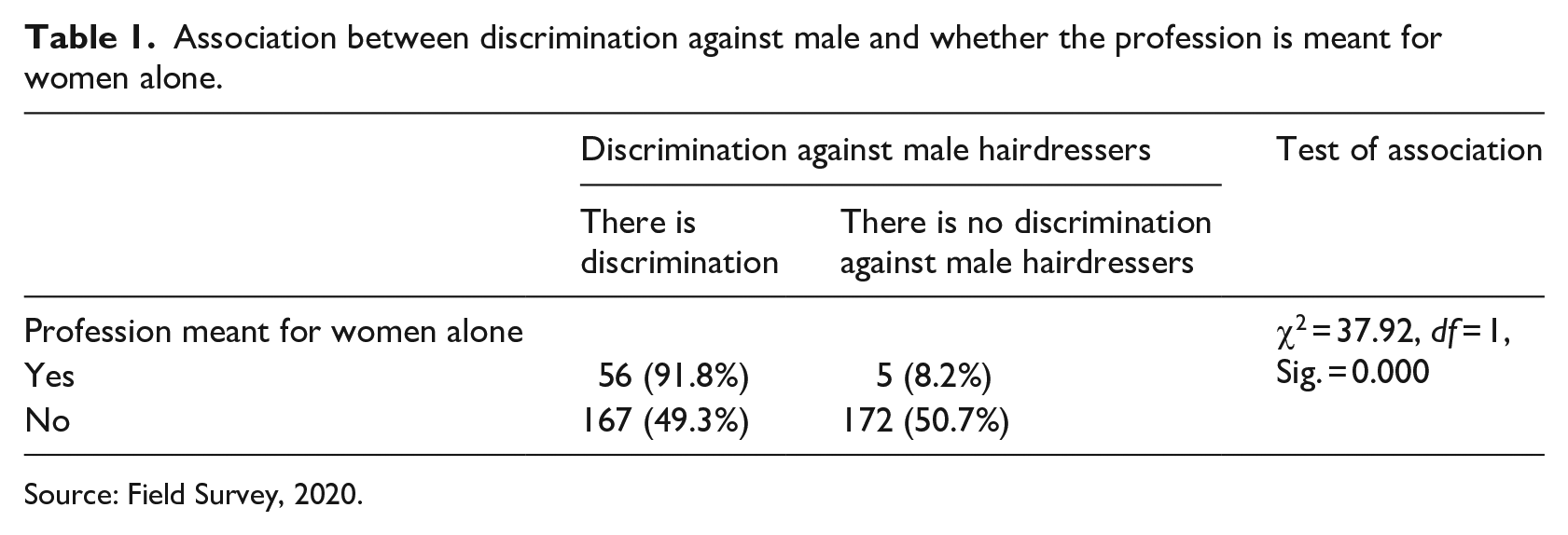
The study further investigated the association between discrimination against male hairdressers and whether the profession is actually generally considered meant for women alone within the worldviews of people in Ibadan metropolis. Table 1 indicated that there is a significant association between the discrimination against male hairdressers and whether or not the profession is considered meant for women alone in the study area (χ2 = 9.595, p < 0.05). People discriminate against male hairdresser primarily on the account that they believe hairdressing is a female job where men/male should not operate as culturally defined and determined. Most of the male hairdressers interviewed are of the view that the only coping mechanism they have come up with is denial. That is, they pretend as though the challenges do not exist even though the challenges actually exist in real terms. To them, the challenges do not exist as much as they get their monies and meet their needs. Interviewees are of the opinion that they are used to the challenges and the best they could do is to pretend like the challenges do not exist: We are used to it (laugh)when they do those things to me, I will pretend I did not know her plan, I will continue my work since I don’t have time for these kind things, because my brain is connected to money that time, no room for that, so that’s me. (IDI/40 years old/SSCE)
Association between discrimination against male and whether the profession is meant for women alone.
Source: Field Survey, 2020.
Another interviewee who captured modal perspective on coping mechanism observe, So whatever anyone says that’s their issue they can only try but not overcome. The problem is just that we take things too personal. I just ignore them there’s a lot of problem to be concerned about irrelevant things. (IDI/52 years old/HND)
Discussion of findings
From the data and findings in the article, the subject of gender as a cultural tool for social relations is revealed and noteworthy. The relationships between gender and cultural norms are empirically and contextually brought to bear in this article. Gender as given by society and reconstructed and deconstructed for livelihood by social actors in social systems, spaces, settings, and occupations in the informal sector are important in understanding the social and cultural ties of male hairdressers of Ibadan. Male hairdressers are not just monolithic categories and/or mechanical entities as they work in the informal economy but get relational gendered identities when taken in relation to their female counterparts. The gender and culturally moderated interfaces and normativities throw up the realities and existentialities of the male hairdressers that are key and illuminated. Gender epistemologies (Oyewumi, 2000) and social change in context of constructivities are therefore key in understanding the realities of informal economy in settings of unemployment, poverty, underdevelopment, and dynamism of Africa. Poverty as mentioned in this article includes those caused by chronic and acute unemployment among many who could not secure intended employment in the formal sector. Poverty, in this case, includes absolute poverty where people in underdeveloped contexts could not meet their basic needs due to widespread unemployment and social exclusion.
Many of the hairdressers interviewed indicated they got into the hairdressing sector because they love it and have passion for it. In other words, they became interested in hairdressing and pursued it for the love of it. These hairdressers chose the profession of hairdressing as a result of their personal interest in the profession over time. Majority of them also became interested in it because of someone they saw doing it at some point. Many of the male hairdressers were either directly or indirectly urged or encouraged to pursue a career in hairdressing. They did not get into the profession because they wanted to, but they grew to love it thereafter. They were persuaded to get something done rather than been unemployed perpetually. That is, to get employed, either because of the condition in their lives or because of encouragement from someone close to them.
The challenges male hairdressers face for being in a female-dominated profession are unique. One of the unique challenges they face is seduction. Some girls/ladies/women want to use what they have to get what they want. In other words, many ladies/girls/women often want to use their feminity as object of sexual negotiation and relation for fees. Many want to use sex to get weave-on or get their hair done.
Discrimination is another challenge they encounter as male hairdressers. The discriminations are mostly from Muslim and Christians faithful/adherents of different sects. For instance, some religious female customers do not allow male hairdressers to touch their hair except their husbands prompt them to so. A major challenge is separation of male hairdressers from their families (kinship networks) and friends (social networks) due to busy schedules especially on weekends and festive periods. This is also due to the distance from office and where friends and family live. Being male hairdresser is therefore often time consuming, laborious, and demanding especially as some women/females prefer very competent male hairdressers because they believe they are more tolerant, calmer and have better attention to details just as they are more professional. Female clients therefore often prefer male hairdressers barring religious reasons.
Common coping mechanism adopted by the male hairdressers is denial/pretending the discrimination does not exist so far they make money and meet their needs. Many male hairdressers generally ignore the challenges as they do not bother themselves about irrelevant things—discrimination—because the discriminations and challenges are irrelevant things and distractions to them—the male hairdressers. Male hairdressers innovate and adopt the various coping strategies because they are the best strategies they could come up with and which yield the result they want in their businesses. Traditionally, the hairdressing industry is dominated by women, but this is changing as the gender roles are being reversed. While hairdressing was originally considered a career for school dropouts due to the simplicity of the associated operations, modern European and American techniques as well as complicated globalized fashion demands and designs have elevated it to a higher level of sophistication (Oda, 2005). The hairdressing industry has undergone rebranding as a result of the large number of new entrants, including men who never considered it before. There are certain salons that have become very sophisticated to the extent they now provide graduation examinations and certificates to their trainees who do well on the test.
Conclusion
Customers, including females, patronize male hairdressers due to the preconceived notion that male hairdressers are good and better at their profession (hairdressing). Gender does not guarantee male hairdressers the loyalty of their female clients if they are not well skilled at what they do. The professional skills of male hairdressers play an important role in maintaining (female) clients. On maintaining/retaining patronage of clients, male hairdressers ignore challenges and discriminations and focus on their skills and business. Clients enjoy the male hairstylists’ approaches while receiving services. Clients (including females) appreciate the gentle, emotional, more humane, and romantic languages used by male hairdressers. Because of this, male hairdressers receive more business than female hairdressers because of their professional abilities and more friendly approach to clients and hairdressing. Clients generally have favorable opinions of men who work in the hairdressing space in context.
Male hairstylists foster enabling and accommodating work environments which encourage them to collaborate with other stylists (Cooperativism). For instance, it is possible to find a group of males who work together in a salon without fighting for customers. Nigeria’s high unemployment rate has driven men into the hairdressing industry. While many are in hairdressing as a vocation, many are into it as a means of livelihood to address the problem of youth. More macro researches are welcomed into the connections between gender and informal economy involvements in developing countries especially in Africa.
Footnotes
Funding
The author(s) received no financial support for the research, authorship, and/or publication of this article.
