




Abstract
This article explores how top and middle managers in geographically fragmented professional service organizations made decisions about hybrid work arrangements, following COVID-19 (and the end of mandatory working from home). The article reports a single case study of a regional banking corporation in a period when leaders across the organization had to choose between consolidating change or returning to pre-pandemic practices. By applying the concept of situated attention from attention-based view-theory, the article explores what managers in different contexts are attentive to through a potentially disruptive period. Managers’ attention capacity is limited and the issues and answers they allocate their attention to in the immediate chaotic period following a disruptive change in the organizational environment is important to our understanding of future solutions. Various management issues and answers are identified, and the analysis explores how these are formed by contingent considerations and pressures across the diverging micro-contexts of the single managers. The article provides a model of contextualized management types as they relate to different contexts in a regional/rural organizational environment.
Keywords
Introduction
Widespread use of working from home (WFH) during COVID-19 affected staff preferences and competencies, and organizational capacity for digitally enabled collaborative work. Handling the pandemic required social distancing, but many employees and organizations were surprised by how well they managed the disruptive shift to WFH (Edelbroek et al., 2023). When COVID-19 subsided, organizations needed to find a new normal of work arrangements and managers had to balance the diverging interests of diverse groups of staff and organizational goals (Barrero et al., 2021b). Hybrid work arrangements (HWA) became a preferred way of maintaining staff flexibility while regaining the benefits of physical presence at work. Hybrid work is understood as a work arrangement for employees that combines degrees of physical presence and WFH (Halford, 2005; van der Velden & Deprez, 2023). Working and leading in a hybrid arrangement requires new capabilities and in the initial, tumultuous period during and after the COVID-19-lockdowns it was unclear what these were (Bergum et al., 2023).
In professional service firms (PSFs), with their knowledge intensity, low capital investment requirements and a professional workforce (von Nordenflycht, 2010), it is relatively easy to quantify the short-term benefits of HWA (Empson, 2021). In PSFs, employee flexibility can readily be converted to financial gain, with commuting hours converted to productive capacity and costly real-estate burdens transferred to the employee (Empson, 2021). Hence, we expect the dilemmas associated with increased HWA to be amplified in contexts where short-term gains are readily available in the absence of an established consensus about best practice. Managers in PSFs are expected to be attentive to these dilemmas when implementing new work arrangements. However, we have limited knowledge on a deeper level of how these dilemmas could be manifested in the content of company policies or practices. Implementation of HR policy is never a straight line (Bondarouk et al., 2018) but a dynamic process (van Mierlo et al., 2018), where a multitude of organizational actors are involved in the social processes that precede the formulation of clear policies and practices (Bos-Nehles & Meijerink, 2018). These social processes are situated, meaning that they take place in contexts that help define what can be considered reasonable course of action. The micro-contexts of managers in a corporation vary a great deal across seemingly uniform environments. The attention-based view (ABV), introduced 25 years ago by Ocasio, included the key concept of situated attention (Ocasio, 1997). The situated attention of managers provides a theoretical concept that zooms in on the situated context of the manager making day-to-day decisions. This is especially relevant in relation to the current HWA changes, where foggy confusion of inexperience rule and a lack of concept clarity, in many cases leaves managers to their own best judgement when making decisions. The concept of situated attention grasps the general characteristics of a situation (See theory sections on social dynamics, materiality, temporality & strategic framing), to give us a way of understanding the intricate relationship between managers micro-context and their preferred choice of action preceding a possible process of policy formulation and implementation.
Situated attention have recently seen a revival in the research literature as a way of understanding how managers make decisions influenced by the situations they are in (Brielmaier & Friesl, 2023a, 2023b; Nicolini & Korica, 2021; Nicolini & Mengis, 2024). The specific situation after the COVID-19 lockdowns provided a unique opportunity to study how environmental jolts affect organizations in different contexts on the level of the individual manager. This article aims to understand what leaders saw as important management issues and answers during the transition to HWA regimes and how these vary across different contexts to better understand the different dilemmas managers in regionally based PSFs are confronted with. This brings me to the following twofold research question:
(1) What problems and solutions did professional service managers see in the immediate aftermath of COVID-19 regarding HWA? (2) How do these problems and solutions vary across different situations and organizational contexts?
And,
The period of reducing or consolidating new practices of WFH/HWA took place against a backdrop of limited management experience. Following COVID-19, initial surprise at how well organizations handled short-term goals and objectives turned into doubts about the long-term organizational consequences (Emanuel et al., 2023; Spicer, 2020). To understand the long-term consequences of such an unprecedented situation, a deeper understanding of the micro-foundations of management decision-making is necessary. Our findings show that managers’ attention did vary remarkably across different contexts. The professional service managers saw different answers to the same issues depending on the specific situation they were in. Our analysis contributes with rich, descriptive empirical evidence of how HWA evolves and how organizations simultaneously consolidate old practices and establish new ones. At the same time the article extends ABV theory by nuancing the concept of situated attention and developing a theoretical framework of situated attention that can account for the idea that similar issues call for different answers throughout the organization. Based on this nuance, the article suggests a conclusive theoretical model of how situated attention varies depending on the decision maker's organizational position relative to the organizational core with corresponding management metaphors that captures regional situational variations and points to the positional mechanisms that drive the development of HWA.
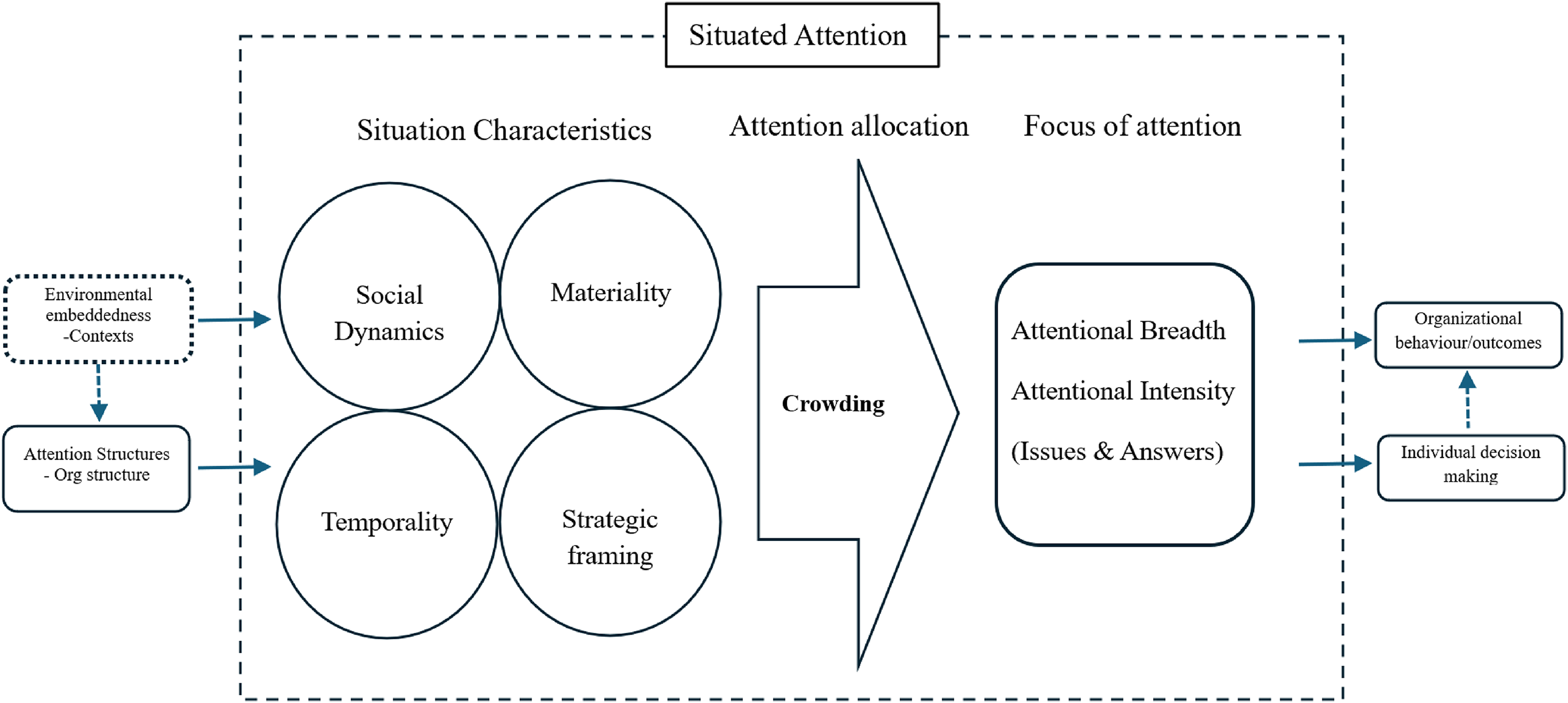
Situated attention.
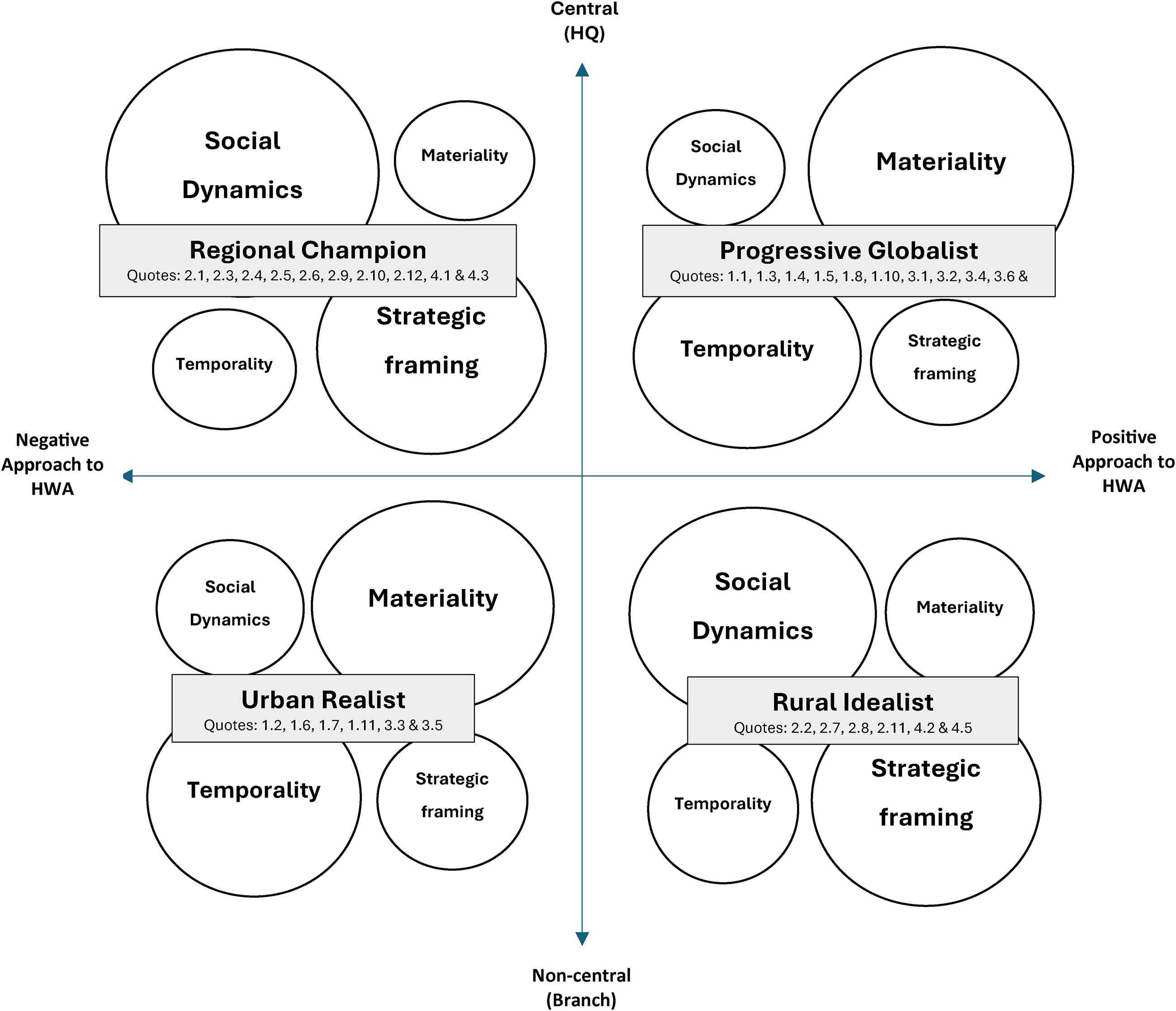
Variations of situated attention of HWA in the case organization.
HWA in Professional Service Firms
HWA is rapidly becoming a preferred term to capture efforts of balancing seemingly contradictory means and ends. For example, when utilizing the flexibility of an agile, digitally adept workforce, capable of working anywhere at any time, while still preserving the knowledge-sharing, creative and collaborative advantages of synchronized on-site office work (Gratton, 2021; Holdt Christensen, 2022). Similar concepts to HWA and WFH, such as telework, remote work, hybrid work (Bergum et al., 2023; Bloom et al., 2015; Halford, 2005; Holdt Christensen, 2022; Olson, 1983; Olson & Primps, 1984) have been studied at least since the upsurge of the personal computer in the 1980s (Zuboff, 1988). What is new, however, is the global scale of the collective change in the capacity and capabilities for digitally enabled collaborative work caused by COVID-19.
Defining a PSF has traditionally been difficult. One characteristic is that PSFs commonly perform work requiring specialized, institutionalized, and codified knowledge in service delivery. On the organizational level, PSFs often display governance structures involving considerable autonomy for practitioners (Hinings et al., 2015; von Nordenflycht, 2010). PSFs come in various forms, such as hospitals, law firms, and consultant agencies. Although these examples all deliver specialized, codified knowledge to clients/patients, they also display obvious differences in, for example, organizational goals or dependency on specific tools or capital investment. Von Nordenflycht provides a definition of a PSF that contains degrees and varieties of its central characteristics (von Nordenflycht, 2010). Here, PSFs are defined by one or more of the following characteristics: knowledge intensity, low capital intensity and/or a professionalized workforce. The classic PSFs like law or accountancy firms hold all of these, but hospitals could hardly be called “low in capital intensity”, since considerable capital and resources are tied to a specific building or workplace (von Nordenflycht, 2010).
Classic PSF's is also characterized by a homogeneity of professions, with, for example, lawyers or accountants’ dominating the professional identity of the organization. Neo-PSF's can be described as more heterogenic. Common examples of a neo-PSF are consultancies or marketing agencies, where many types of professionals collaborate toward the organizational goals. A central discussion in the concurrent professionalism-research is whether the type of professional we know from the classic understanding of the term (lawyer, accountant, doctors, academics, journalists, etc.) is changing with the fragmentation of the labor markets along with the rapid political and technological changes (Noordegraaf, 2020). Freelancing and shorter employment patterns is perhaps leading to dilution of the classic professions (Flatøy, 2023). Noordegraaf has recently argued—in a much-debated article (2020)—that we are seeing a shift that requires us to adjust the way we understand professionalism. A shift from a fixed or closed protective type profession with expert knowledge, autonomy and authority to a more open and relational connective type professional that is adaptive, critical and distributes expertise (Adams et al., 2020a; Noordegraaf, 2020; Noordegraaf & Brock, 2021). This discussion perhaps mirrors the need to nuance our understanding of PSF's to also include the types of corporations engaged in wider varieties of professional-type tasks, which is the case with neo-PSF's, as von Nordenflycht introduced (2010).
Individual professionalism is commonly understood to adhere to a form of professional identity. Empson et al. define the core activity of the professional specialist to be “…applying specialist knowledge to creating customized solutions to clients’ problems” (Empson et al., 2015). The professional specialist in knowledge-intensive work (Alvesson, 2000) presumably has the right tools, competencies, and responsibility to manage a disruption of the classic in-office working arrangement toward more flexible location-independent arrangements. Their primary activity has always been partly based on the rather intangible (and mobile) application of specialist knowledge to clients’ problems, involving extensive autonomy and contingent authority (Empson, 2021; Noordegraaf, 2020). But as Abbott pointed us to, it is the boundaries between entities (professional fields, for example) that are important, not necessarily the entities themselves (Abbott, 1995). And as many argue the professionals and the organizations they inhabit are situated in increasingly complex landscapes (Adams et al., 2020a). The political landscapes, the technological/digital landscapes and now with the ongoing transition to HWA the physical and geographical landscapes of the workplace is rapidly changing as well (Adams et al., 2020; Noordegraaf, 2020; Noordegraaf & Brock, 2021). To ask whether the transition to HWA is accelerating the connectivity change in professionalism or proliferating the protective professionalism of the old, is perhaps a false dichotomy. As Falconbridge et al. (2021) argue that it would be more fruitful to consider connective and protective professionalism as interlinked, since it apparently already co-exist in a sort of protected connectivism. It is argued that professional activity that increase connectedness, also gives rise to new forms of protectiveness (Faulconbridge et al., 2021).
The transition to HWA thus permeates existing boundaries (e.g., between family and work) and escalates complexity. Recent research suggest that professionals are confronted with challenges when the barrier between work and family is removed (De Clercq, 2020). They suffer a general reduction in energy as a consequence of continuous interference that a boundary free work/family situation might establish. This then backfires to the in-office work-hours where they are less prone to display voluntary task behavior, due to individual energy conservation behavior (De Clercq, 2020). They maintain the need for random socialization when at a distance, such as through unscheduled meetings (Sporsem et al., 2023), or work-related task conflicts (De Clercq & Pereira, 2021), as sources of knowledge-sharing and creative stimulation, but now through digital channels. Digitization in the post-COVID era can be argued to increase connectivity by pressuring professionals to connect to “outside” experts (Pareliussen et al., 2022) or to accelerate a wider transition to digital work practices (Björkdahl & Kronblad, 2021). However, the negative aspects of increasing physical distance between co-workers are not fully compensated by the digital channels (Emanuel et al., 2023). Emanuel and colleagues (2023) show that physical proximity between co-workers matters a great deal, for example, when junior employees learn from senior employees. In our view, these examples underline the relevance of understanding how PSF managers will think and act when presented with the possible dilemmas of HWA.
The dilemmas associated with HWA has spurred great interest from the scientific community as an opportunity to study a natural experiment of radically changed workplace conditions on a global scale (Adams, 2022; Ng et al., 2021). Studies approaching HWA/WFH from a descriptive employee-perspective indicate a strong employee preference for preserving some of this flexibility of where/when to work (Barrero et al., 2021a; Hansen et al., 2023; Šmite et al., 2022, 2023). Other studies target the presumably connected international phenomena known as “quiet quitting” and “the great resignation” that followed the pandemic. These studies support the impression that employees were reluctant to return to pre-pandemic employee-employer relations (Formica & Sfodera, 2022). Thus, a consensus on an HWA-balance is far from achieved, and the employee-perspectives still indicate a concept evolving, and that work arrangement preferences change when people and organizations gain greater real-world experience (Bloom et al., 2015).
Studies approaching HWA/WFH from a descriptive employee-perspective indicate that managers and leadership in general is in conflict and tend to prefer a return to the familiar normality of on-site office work, while still recognizing the strategic necessity of remaining competitive to attract talent in a situation where this talent seem to demand high degrees of flexibility (Barrero et al., 2021b; Contreras et al., 2020; Gratton, 2021). Top and middle management, however, is worried about losing central elements of their basic leadership ability with the loss of social interaction (Kirchner et al., 2021), and are afraid that the new flexibility will not be viable as an organizational form and a foundation for organizational culture, in the long run (Nachmias et al., 2022; Spicer, 2020). The literature review gives some indications of possible trajectories of the current changes, but only limited insight into the contextual dilemmas that managers are faced with. We expect PSFs to be in a formative period post-pandemic, where any individual or organizational preferences will be malleable to the emerging experiences, as consolidation, balancing and/or reduction occurs.
The Relevance of Situated Attention as a Theoretical Framework
The theory of the ABV was first developed by William Ocasio (Ocasio, 1997). It presents the basic assumption that the attention of decision makers is situation and context dependent. Ocasio defines attention as … the noticing, encoding, interpreting, and focusing of time and effort by organizational decision makers on both (a) issues: the available repertoire of categories for making sense of the environment and (b) answers: the available repertoire of action alternatives. (Ocasio, 1997, p. 189)
The ABV theory builds on classic works on organizations and manager behavior. Its foundation is an open systems view of organizations (Scott & Davis, 2015), where the context of organizations plays a crucial part in understanding manager behavior. Further, much like Herbert Simon's work on rich information, it also assumes that the organizational and the individual capacity for attention to details (and processing them) is limited (Simon, 1996; Sullivan, 2010). ABV shares the chaotic view of the contextual mess that fosters organizational solutions, as presented in the garbage can model of Cohen, March, and Olsen (Cohen et al., 1972). The recent revival of the ABV can to some extend be attributed to the concept of situated attention (Brielmaier & Friesl, 2023a; Ocasio, 2012) and its recent theoretical extensions (Nicolini & Mengis, 2024). Whereas the above-mentioned classical works lead to a rather narrow understanding of situatedness, limited to the specific occasions when an issue manifests itself in a decision-making setting, the situated attention concept is not constrained by the actual manifestation; it includes a broader notion of prior interactions affecting decision makers and their understanding of the issue in focus and thus the available repertoire of relevant answers (Ocasio, 2012). This form of gentle widening of situated attention to include the social baggage that individuals arrive at the situation with, aligns well with a dynamic understanding of HR implementation as a process (Bos-Nehles & Meijerink, 2018; van Mierlo et al., 2018), without escalating it to a level of institutional determinism that the novelty of the HWA phenomenon do not justify. The specific focus on the situatedness of managers offers interesting analytical perspectives. The HWA phenomenon may possibly constitute a wholly new situation established “overnight.” This requires a theoretical framework that is sensitive and open to radically new ways of thinking and acting.
The remarkable aspect of situated attention is that it directs the focus to the very specific situational context in which a manager “forms an opinion” about an issue or is influenced by those around him or her, which will then influence the answer the manager finds suitable (Brielmaier & Friesl, 2023a). An example of this is the case study by Fu et al. (2020), which revealed that the presence of a chief sustainability officer (CSO) had a certain positive influence on the corporate social responsibility (CSR) efforts in an organization—sustainability and social responsibility in this case being different organizational units. They explain this by arguing that the situated attention of the CSR-officer was influenced indirectly by the presence of a CSO (Fu et al., 2020).
COVID-19 was an example of a contextual event affecting the internal rationales in organizations, creating a novel situation for most decision makers. Organizations had limited experience and institutionalized practices to draw on. There was no clear direction for how to consolidate or reduce new HWA. While organizational behavior can often be viewed as involving some level of goal orientation in the organization (Bauer & Friesl, 2024), in this situation goal orientation would be a poor guide to understand management decisions, giving the limited collective goal consensus at the time. ABV rests on the premise that what decision makers do depends on their focus of attention, that is, the issues and answers they see in the specific context and situation they encounter. They allocate their attention according to this situatedness and structural configuration (internal roles, rules, resources, and relationships) of the organization is part of this situatedness (Ocasio, 1997, p. 188).
As mentioned, the concept of situated attention offers an open approach to the HWA phenomenon. It emphasizes that what decision makers do, how they decide to solve problems, is contextually situated. Combining this with the limited attentional capacity of managers, attention need to be considered as differentiated and inconsistent within the same organization (Nicolini & Mengis, 2024). Different types of attention are prominent in different parts of an organization at different times (Barreto & Patient, 2013; Joseph & Wilson, 2018; Ocasio, 2011). The individual manager, despite being part of the same organizational structure, still carries an individual view of the same problem. Individual managers might see different answers, affected by the different situations they encounter. The interactions they engage in, the physical meetings they attend, or the exchanges they engage in through digital channels provide leeway for different avenues of interpretation (Brielmaier & Friesl, 2023a, 2023b; Nicolini & Mengis, 2024; Ocasio, 2012). This makes attention inherently situation-dependent, and organizations thus can be understood as “systems of structurally distributed attention in which the cognition and action of individuals are derived from the specific organizational context and situations that individual decision-makers find themselves in” (Ocasio, 1997, p. 198). This also means that attention is less rigid and robust and more transient and perhaps temporary. As Ocasio put it, inspired by the garbage can model of Cohen et al. (1972): “Attention ebbs and flows depending on how problems, solutions, and participants become coupled in specific interactions, meetings, or email exchanges as choice opportunities” (Ocasio, 2012, p. 301).
Attention differs between the various organizational levels: from the individual/cognitive, via the situated group, to the structural organizational level. Ocasio (1997) argues that the focus of attention is found on the individual level and is linked to individual cognition and behavior. Situated attention is found on the level of social cognition. The structural distribution of attention encapsulates the changes on the organizational level, such as work coordination between headquarters (HQs) and branches (Ocasio, 1997). Studying this process of how managers’ attention is situated regarding HWA enables us to account for the (perhaps) non-deliberate, emerging features of how strategic agendas are formulated, communicated, and shared (Ocasio & Joseph, 2018). This helps us to operationalize the relevant elements from theory to explain managers’ attention. We are looking for the ways managers make sense of the contextual changes, and the possible action alternatives they see to address these issues. This may seem a very individual approach to the systemic and structured features of organizations often targeted. However, as Ocasio (1997) underlines: Individuals ultimately do the attending, individual attention is situated in the context of the firm's activities and procedures, and these situational contexts and the decision makers, issues and answers they are linked to are distributed throughout the firm. (Ocasio, 1997, p. 189)
The situated attention of decision makers has been used to analyze specific change phenomena such as absorptive capacity and innovation (Kim et al., 2016), mergers and acquisitions (Bauer & Friesl, 2024), crises (Kudesia & Lang, 2023), and strategies (Ocasio & Joseph, 2018). These studies demonstrate how relevant and valuable the ABV approach is to address specific contexts where no obvious, consensus-based goal orientation has been established to guide managers’ behavior in organizations. We therefore zoom in on situated attention in the same way, as opposed to the entire ABV theory, to grasp the initial attention of decision makers in a period of possible disruptive change dynamics brought on by massive contextual change.
Developing a Theoretical Framework for Situated Attention
Situated attention can be understood as a practice perspective where the particularities of any given situation inherently affect the attention of the involved actors (Nicolini & Mengis, 2024). According to Nicolini and Mengis (2024) any work practice is comprised of a range of mediatory element, like discursive elements or materiality, that are inherent to the actors and the situation that a work practice unfolds in. We view managers decision making as a work practice mediated by the situation. As Brielmaier and Friesl underlined we have only limited insight into the specific variables and mechanisms in a theory of situated attention, apart from what is already developed in the general ABV framework (Brielmaier & Friesl, 2023a; Ocasio, 2011). The HWA phenomenon is a rare opportunity to study a change situation on an unprecedented scale, which might have disruptive impact. The concept of situated attention offers a much needed open and explorative way of approaching this new phenomenon. Inspired by the literature review on HWA in PSFs and the theoretical ABV framework we can carve out a parsimonious theoretical model of situated attention. The model is focused on isolating key variables and mechanism, so that it is possible to convert the theory to a research design that will work in an open and explorative approach. As with the general model of ABV (Brielmaier & Friesl, 2023a; Ocasio, 2012) our model of situated attention is a sort of input/output model, where organizational structures and context change is inputs to an undisclosed form of situatedness that determines the output of individual and organizational behavior (Brielmaier & Friesl, 2023a). Our model granulates this black box of situatedness into three parts of a situated attention-process. The three parts are the characteristics of the situation, the attention allocation, and the focus of attention. These will be presented in the following sections along with the variables and mechanisms inherent to each (see Figure 1).
Characteristics of a Situation
The first part of the process within “the black box” is the characteristics of a situation. Several conceptualizations have been made to describe what constitutes a situation. Nicolini and Mengis (2024) argue that a situation is characterized by cultural, material, social, and historical arrangements in their practice-based view of situated attention (Nicolini & Mengis, 2024). In their review of 173 recent publications on ABV and situated attention, Brielmaier and Friesl (2023a) similarly argue that common characteristics include materiality, social dynamics, temporality, and the framing of the strategic setting. These differ only marginally from Nicolini and Mengis’ characteristics but include an element of timing and thus underline the possible temporality of a situation. This is a relevant addition considering the HWA phenomenon under study.
The first characteristic is the materiality. The material artifacts and the material environment that underpin a particular contextual interaction (Brielmaier & Friesl, 2023a). This could be the technology and digital tools necessary to carry out professional service work. Technology can enable HWA as well as limiting them. Some functions in a PSF corporation might require handling of sensitive data, making the function less prone to flexibility. In other situations, digital communication and collaboration tools are essential to enable HWA. Materiality also entails differences in other forms of material surroundings such as those in physical environments between the affordances (Gibson, 1977) of a specific physical office or an individual home office. The material surrounding of a situation is obviously a difficult thing to separate from the virtual surrounding that the new HWA depend on. The relativized physical distances that follow (Donnelly & Johns, 2021; Piezunka & Dahlander, 2015) gives way to different means of interactions through available materiality.
The second characteristic is the social dynamics that lay down the basic rules of a workplace. The social interactions, power mechanisms in hierarchies, delegation of authority or the collective mechanisms of group thinking are examples of social dynamics that affect situated attention. The study by Nicolini and Korica (2021) is an example of the social dynamics of power in hierarchies, where higher level managers affect (by distribution) the situational attention of lower-level managers (Nicolini & Korica, 2021). Group thinking is another well-known example of a social dynamics that has a great effect on the situated attention of managers (Aldag & Fuller, 1993). Group thinking describes the social dynamics where the desire for conformity in a group can result in overlooking obvious answers or lead to irrational or dysfunctional decisions. The social dynamics is obviously difficult to disentangle from the materiality in relation to digitally enabled collaborative work. This becomes especially clear in our case where the phenomenon of HWA is essentially a matter of the degree to which social dynamics are lifted out of the realm of physical presence and into the non-physical digital realm. One cannot be understood without the other. They are interdependent. Increased digital social dynamics means increased materiality and vice versa (Brielmaier & Friesl, 2023a).
The third important characteristic of a situation, according to Brielmeier and Friesl (2023a) is the temporality. Temporality is an elusive concept and has been a central theme in different disguises through much organizational research (Brielmeier & Friesl 2023a). Three aspects of temporality seem to be central to the situations that managers find themselves in when transitioning to HWA, namely temporal structures, time constraints and timing. Temporal structures, according to Brielmeier and Friesl (2023), are the time structures of work, like deadlines or meeting schedules. In our case temporal structures are relevant, for example, when the number of online meetings increases because of a lower threshold for calling for an online meeting than a physical meeting. Time constraints direct the focus to the pragmatism that guides decision-making under time pressure. Timing describes the particularities of the specific situation at hand. A global pandemic such as COVID-19 creates a specific timing of situated attention where, for example, certain forms of experience (best practice) are unavailable to everyone, while other forms of capacities suddenly are (digital competence).
The final characteristic mentioned by Brielmaier and Friesl (2023a) is the strategic setting, or what we understand as the dominant strategic purpose of the organization as it is understood and shared between participants. An example from our case of a specific framing of the strategic setting in the case organization is the regional/rural sense of communal obligation expressed in the strategic catchphrase; “For northern Norway!” and referred to extensively by most of our interviewees. With a historic backdrop as a private savings bank predating the expansion into other fields of expertise, such as finance, accounting and real estate, the bank still preserves the collective understanding of communal responsibility in the region, rural town or village. In this sense our understanding of the strategic framing combines cultural discursive arrangements and embodied historic experiences and learnings which Nicolini and Mengis emphasize as central characteristics of situated attention (Nicolini & Mengis, 2024). Framing the strategic setting also describes, for example, the way in which branch-specific competitive environments invoke a certain competitive logic affecting the situated attention.
Attention Allocation
This brings us to the next part of the process within the black box of situated attention. Essentially situated attention is about understanding what managers allocate their attention to, and why they allocate attention to specific themes and not to others. Attention allocation therefor is a central concept in our understanding of situated attention (Brielmaier & Friesl, 2023a).
Crowding
In Sullivans study of the rule-making process in the Federal Aviation Administration (Sullivan, 2010), it is shown that the capacity for making new rules goes down, as the amount of problems increase. It is argued that this is part of an institutional mechanism where the limited attentional capacity of the rule-makers results in reproduction of already existing rules in a process of crowding. The problem-identification, meaning the issues and answers they allocate attention to, is reduced to crowding-in well-known sets of rules and crowding-out interpretations requiring totally new perspectives (Sullivan, 2010). The flow (and amount) of new problems thus eventually meet the limits of the individual managers attentional capacity (Brielmaier & Friesl, 2023a). Certain themes are prioritized, based on individual bias and limits of attentional capacity (Piezunka & Dahlander, 2015; Tversky & Kahneman, 1974). In our case this limited attentional capacity of managers likely results in the prioritization of certain issues and answers and therefor a priority delegated to some situational characteristics but not necessarily all of them with equal attention, depending on the situation.
Focus of Attention
The last part of the process, the focus of attention, covers the zooming in on specific management themes (Issues and answers), brought on by the focus following a crowding in or out certain themes. The focus of attention to certain issues and answers can be elaborated by the concepts of attentional breadth and intensity of these issues and answer.
Attentional Breadth and Intensity
Attentional breadth meaning attention to many issues with limited answers to each. Attentional intensity meaning attention to few issues with many answers (Brielmaier & Friesl, 2023b). This concept indicate that a manager has limited attentional capacity and, that a prioritization is made, on a deliberate or intuitive level, when a decision is made. This prioritization of what to allocate attention to is affected by the situational circumstances. Whether breadth or intensity characterizes the focus of attention, it will potentially vary across the organization and between individual decision.
With these three parts of the situated attention process we have a way of studying how managers make decisions about the HWA phenomenon where limited experience rule. With limited experience we need a theoretical framework that is adapted to focus on the individual actor to better understand the possible collective and organizations behavior. The different combinations of attention allocation, resulting in different combinations of individual attention to issues and answers, thus over time affects the organizational behavior and outcomes, and thus the output side of the black box of situated attention (see Figure 1).
Research Design
A qualitative case study enabled us to study a contemporary phenomenon as it unfolded in real time in a specific context. Organizational responses to COVID-19 require a patient, open and context-sensitive understanding, which aligns well with an open, exploratory approach (Flyvbjerg, 2006). The current, perhaps fundamental, changes call for an in-depth focus to explore the micro-dynamics of the ongoing changes, especially through qualitative studies (Eisenhardt & Graebner, 2007). Suitable cases are those where arguments for a transition to a HWA regime are strong. Organizations that are fragmented across great distances, with internal distance between branches and divisions and external distance between business and customers are relevant (Young, 2006). These types of organizations and situations might amplify the dilemmas of the HWA phenomenon. In our view, regionally based PSFs constitute these organizational characteristics and thus are the perfect case environment to tease out some of the dilemmas associated with the HWA transition.
Case Description
We choose a regionally based private savings bank that fits the case selection criteria. The bank has approximately 950 employees spread over 15 branches and four subsidiary companies across different branches. The bank is part of a group that consist of a mother company (the private savings bank), and the subsidiary companies, a financial institute, an accounting firm, and a real-estate agent. Top managers are part of the executive team, which consists of eight top managers each responsible for a specific division in the corporation. Middle managers are those at all other levels in the organization. Most top managers have their main office in the HQ of the corporation, while two are in branches. Middle managers are spread across all branches and the HQ. A private banking company employ various knowledge workers such as classic professional specialists, like accountants and legal advisers, and neo-type professional specialists like finance advisers, management, and human resource (HR) consultants and can as such be analyzed as a neo-PSF (von Nordenflycht, 2010). The case organization comprises a range of contextual micro-variations spanning both urban and rural areas. The regional dynamics of the periphery, involving vast distances and little commuting, represents a different type of contextual environment from an urban context, with a high standard of infrastructure and easy access to public transportation (Bürgin et al., 2022; Sweet & Scott, 2024). At the time of data collection, the case organization had experienced two years of tough COVID-19 lockdown, followed by a gradual societal re-opening and diminishing social distancing imperatives.
The legislative framework that regulates our case organization in working environment issues is rather extensive. In Norway (where our case corporation resides) WFH had been regulated by a general Working Environment Act, 1 updated in 2002. However, following the exponential growth in WFH, the Norwegian Ministry of Labor saw the need to update the Act again, and new legislation came into effect in summer 2022, shortly after the last national COVID-19 lockdown. The new update specified the need for formal written agreements to prevent general deterioration of working environments. The updated WFH legislation only regulates work conducted in primary homes, not in, for example, cafés, libraries, vacation homes, or abroad. The regulation requires employers to formalize any permanent HWA/WFH arrangement, that is, recurrent and systematic (specified as one day or more a week, for more than two weeks). The legislation does not regulate WFH in short-term and/or sporadic situations. If an HWA/WFH agreement is reached, formalized, and made permanent, a detailed description must be signed, obligating both employee and employer. During our data collection, the national regulation was about to be implemented and the organization was gearing up to this, expecting a lot of requests for permanent HWA-agreements. During COVID-19, an internal survey had revealed that 85% of the staff wanted to keep at least one a day a week for WFH post-pandemic.
Data Collection
The case study was predominantly carried out based on in-depth qualitative interviews with top and line management across all divisions, branches and subsidiaries. Interviews were carried out on three different corporate locations during a 3-week period in the summer 2022 two months after the final national lockdown. During these three weeks the case organization provided a desk in an open-plan office in HQ, as well as access to meeting room facilities. In addition to the formal and scheduled in-depth interviews the researcher participated in day-to day activities and thus observed the general workflow and attended work-related meeting and social gatherings. These activities served as running validation of the interview-guide as well as inspiration for follow-up questions and nuance.
Key documents describing the WFH process were provided in advance of the in-depth interviews and is as such reflected in the interview-guide (specified below). In addition, the 3-week stay in the case-organization uncovered additional relevant material (formal guides, job-descriptions, templates, policies, strategies, meeting summaries, etc.). These also helped develop—and individualize—the general interview-guide, so it would be directed at the specific situations and contexts each informant had encountered. At the same time new informants were identified in-vivo through new material or via informal recommendations. Initially the focus was on HR management and practitioners, since they were responsible for developing and implementing new internal policies and regulations on HWA. But from this starting point further informants were selected using a snowball sampling method (Biernacki & Waldorf, 1981). Informants were encouraged to suggest colleagues who could share relevant information on HWA/WFH issues. Finally, 15 In-depth interviews were conducted with five Level-1 top managers, representing both HQ and branch positions, six middle managers also representing both HQ and branches, and four staff employees responsible for guidelines, policies, or projects related to HWA or WFH, where carried out before a level of redundancy was detected.
Interviews were based on a semi-structured interview guide and transcribed verbatim. A semi-structured approach was considered important given the in-vivo character of our phenomenon. We needed to be open to following the conversation trails within the themes that the Informants found important. The thematic interview guide was developed based on initial informal conversations with representatives of the case organization and the available descriptive documents. The basic interview guide was tested with a manager from the organization in advance. The basic topics of the guide were: (1) elaboration of the respondent's organizational position, (2) choices and practices related to HWA, (3) collaboration across intersections and the role of HR, (4) central/non-central differences, (5) organizational issues, (6) technology and competence, and (7) expectations for future developments. As mentioned, these only functioned as a semi-structured guide. Participation in the office environment, provided inspiration for delving in to deeper nuance by using examples and scenarios from the informants’ work-environment.
Data Analysis
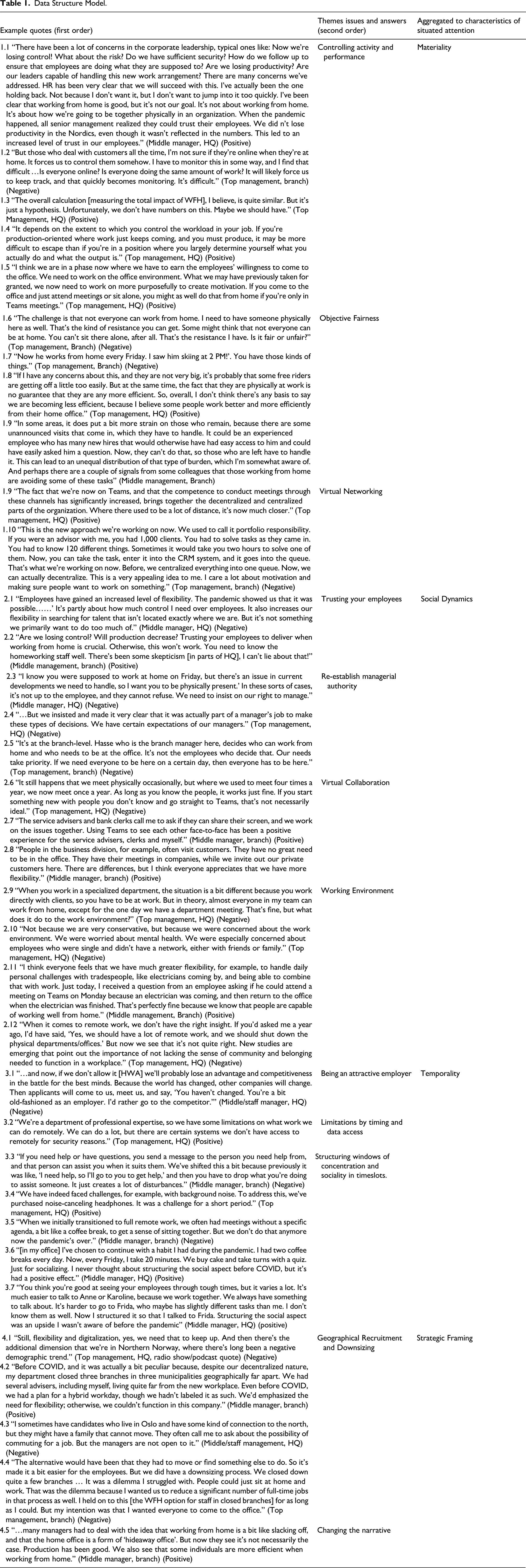
Returning to our model of situated attention our analysis is carried out backwards when compared to the progression through the tree parts of the situated attention process that we have presented above. Simply put, the quotes’ express themes that we interpret as the informants’ focus of attention. This mean that the process of attention allocation, and possible crowding in/out specific themes and thus disregarding some of the characteristics has already happened. The thematic analysis of the transcribed interviews started from an ambition of identifying themes as openly as possible. It was carried out following the basic idea of aggregated ordering of relevant quotes inspired by the Gioia method (Gioia et al., 2012). The first-order category in the data structure model (Table 1) represents the quotes where informants argue for different issues and answers.
The data analysis was performed by open coding, where we searched for statements that were understood as managers expressing issues and corresponding answers within themes, they found important related to the transition to HWA. Initially more than 150 unique items (subthemes) were coded. Through conversations with colleagues and peers, and through several re-readings of the material, the codes were aggregated to wider theme-categories still representing, as neutrally as possible, the issues and answers expressed by the managers from different parts of the organizations. The aggregated themes were then analyzed against the situational characteristics, to see if patterns of variability of the attention allocation of the managers would emerge across the different micro-environments in the organization. As part of this process, we would also evaluate whether the individual manager expressed mainly positive or negative attitudes toward escalating HWA demands from employees. This helped develop our understanding of how the different themes (issues and answers) expressed a deliberate or intuitive prioritization and attention allocation. In other words, we assumed that the themes the informants kept returning to, elaborated the most or discussed with passionate vigor, as opposed to themes being dismissed with short, perhaps more schematic or political answers, were the ones the individual manager allocated the most attention to. This part of the process can be described as axial coding (Gioia et al., 2012), where it is increasingly the theoretical framework of situated attention that affects the interpretations of the data. From this point it became clear that the same categories of issues/answers & characteristics were used to highlight different approaches to HWA. All four characteristics of the situations contribute differently to these, depending on the context. We differentiate between different positions in the quotes in the finding section below by stating the informant's organizational position in either top or middle management, followed by an indication of whether they are placed geographically in a branch division or in HQ.
Findings: Situated Attention of Hybrid Work Arrangements
This section presents various empirical findings structured according to the second-order categories, that is, the four dominant characteristics affecting the situated attention. Thus, in the findings chapter we describe findings through a presentation of each of the characteristics of situations, namely the materiality, social dynamics, temporality and the strategic framing. Within each section the progression is structured by presenting the themes (Issues & Answers) that we have ascribed to that specific characteristic. Example quotes are presented in the data structure model (see Table 1) and referred to by corresponding enumerations.
Data Structure Model.
Materiality
The Materiality section is comprised by three themes that we would ascribe to an attention to the materiality characteristic of the situation. First the control—theme, where the lack of solid knowledge to manage by and the absence of relevant system portfolio to accommodate this leaves several mangers in the dark when it comes to employee activity and performance. Second, the attention to objective fairness as the material surroundings afford a degree of flexibility or not and third the ability to do networking in the new arrangements.
Controlling Activity and Performance
Managers across the organizations saw increasing control issues following the transition to HWA. They expressed interest in detailed knowledge of the activity of their employees when they were WFH. There was a general feeling of doubt (Quotes 1.1 and 1.2) when the managers lacked face-to-face interactions with their staff. An informant from the HR department, who had advised managers from across the corporation on how to handle the transition to hybrid work, argued that managers feeling of doubt regarding performance and activity was widespread, but uncalled for, since no available information supported it. This was substantiated by several other informants (Quotes 1.1, 1.2, and 1.3). The issue of missing basic information about employee behavior during working hours inspired two different paths of responses. One was increased control through some form of activity monitoring, while the other was to engage in performance measurements (Quotes 1.2 and 1.3). The choice of solution to this issue for each manager was situationally dependent and varied somewhat between branches and HQ and between organizational levels. For frontline positions, where employees are in contact with customers, activity monitoring was often the choice (Quote 1.2). This informant, a representative of top management, clearly felt somewhat guilty at displaying worries about losing control. However, it was also framed as a matter of basic fairness to suggest that an even distribution of everyday burdens should be foremost in the mind of middle managers. This then legitimized engaging with the analytics team to figure out suitable ways of providing insight into activity and performance. Consensus about what to measure, however, had not been achieved to the extent where managers had access to data to guide decision-making. Performance measurements were less controversial to managers across the organization. Several expressed interest in numbers to account for the full impact of the transition to HWA. Although most managers did not seem to have hard evidence or grounds for suspecting underperformance, they were tempted by the possibility of validating their expectation that WFH was equally productive and not a way of slacking or freeriding for some staff.
This also exemplify that the organization was in a situation of uncertainty where the material surroundings and work tools perhaps wasn’t sufficiently in place to provide management with the platform and information the managers felt they needed to make the right decisions—neither in the physical office or in the digital world (Quotes 1.4 and 1.5). There was a tendency that the closer a manager was to HQ, the more the manager preferred a form of performance indicator to assist management decisions, while the further away (organizationally) a manager was from HQ, the more simple activity measurement tools were in focus. The concentration of the customer-oriented service tasks was higher the further away from HQ, while the concentration of specialist functions was higher at HQ. These types of work differ with regards to task autonomy and output measurability. The specialists often have the privilege of defining their own output and are thus eligible for self-leadership, as opposed to the workers in the production system, where the contribution is objectified and transparent. This also results in different foundational grounds for extending HWA flexibility across branch and HQ (Quote 1.4). Power to determine output increases with proximity to top management and HQ. It decreases the closer a function is to services with direct customer contact, involving middle managers and branches.
Objective Fairness
The limited experience with widespread WFH/HWA for an extended period also left the intuitive feelings of fairness unbalanced. Since task or position related internal differences as mentioned above gave different opportunities, HWA was expected to be interpreted as a privilege (Quote 1.6). The freedom to do leisure activities, like doing exercise or physical training, during working hours (Quote 1.7), would be considered unfair. At the same time others in the organization expressed basic attention to fairness but from a position of assuming different ability and needs, and there for a general optimism directed at the being able to bring about fairness with increased flexibility (Quote 1.8). While others again se the flexibility inherently allocating the workload disproportionally between people in HWA and people permanent at the office (Quote 1.9).
Networking
Networking within the organizations and with external relations is increasingly done virtually. COVID-19 necessitated a swift adaptation of work practices to new communication platforms and tools. Staff thus improved their virtual skills and digital competences quickly and accepted the new form of communication as a something that relativized distance between people. As a top manager from HQ explicitly states, “where there used to be distance, it's now much closer” (Quote 1.10). A new CRM (customer relationship management) system had recently been implemented, as well (Quote 1.11). The new system made possible a digital queue and assignment of tasks/cases to professionals and specialists independently of location. Something that apparently lowered the threshold for virtual networking, but in practice also lowered the possibility of working unsupported in an HWA/WFH arrangement.
Social Dynamics
In the social dynamics’ characteristics, we present four themes. Trusting your employees, re-establishing managerial authority, virtual collaboration and working environment. As mentioned in the theory section, the social dynamics are difficult to disentangle from the materiality when our theme is about working via digital channels. The reason behind bringing these four themes to the social dynamics rather than the tech-based material characteristics,’ is that these cover themes where the social–relational aspect was top-of-mind in the informants, as opposed to perhaps the more technical side of having the right digital tool for network, for example.
Trusting Your Employees
In general, the employees have gained flexibility. And while most managers we talked to agree with this (Quotes 2.1, 2.2, 2.8, and 2.11), several still expressed worries of the situation escalating. Especially in HQ where the span of control (and therefor the potential loss of control) was the largest, cautious approaches was expressed (Quote 2.1). A different approach to the issue of loss of control was expressed in branch offices and at the non-central level of the organization, where the loss of control necessitated increased trust in the employees (Quote 2.2). Setting employees free by trusting them was not so much a choice; it was a fundamental necessity for managers, despite legitimate skepticism. Trust was considered a basic prerequisite for a future of extensive HWA.
Re-Establishing Managerial Authority
There was a general worry that the managerial role throughout the organization had changed and that managers had lost legitimacy through increased WFH. Several expressed the importance of re-establishing managerial authority and discretion as something else than system-supported management information. Through the pandemic, and the lockdown periods of forced social distancing, the sense that managers had lost part of their authority, was prevalent. One middle manager from a branch office described a situation where employees now seemed to feel WFH was a basic right they had acquired. Regardless of company interests (Quote 2.3). Insisting that managers had a right to manage, and that they needed to re-establish this, was also matter of communicating to line managers that they were expected to re-assert themselves in the social hierarchies at the offices (Quote 2.4). Top management used the transition to consolidate a certain image of their preferred type of manager. At HQ level the arguments of re-establishing managerial authority were used to argue that managers had to claim authority by making individual decisions contingent on their position in the company (Quote 2.5). This was used to fend off arguments from lower levels for clear and distinct guidelines for when to allow HWA and when not to. Simultaneously it was subtly communicated that a further escalation of HWA was unwelcome. This then serves as an example of the hierarchical distribution of attention, where top level managers try to contain the situational variance by reiterating basic rules of appropriate social dynamics. The further away these arguments were from the HQ part of the organization, the less weight they seemed to have.
Virtual Collaboration
Increased contact between peers because of virtual collaboration, was described as a positive development. It required less effort to maintain remote relationships. However, it was also emphasized that virtual collaboration had drawbacks. While it requires less effort to maintain good working relationships with already established relations, it increases the effort to form new ones. Several managers mentioned the limitations of virtually establishing new teams of colleagues with no prior experience of working together (Quote 2.6). In this sense, virtual collaboration, despite overwhelmingly increasing, also drew attention to the difficulty of forming new work relationships at the HQ level with managers in knowledge intensive functions (Quote 2.6). While the same trend seen from a branch perspective, opened the organization to new relationships which was entirely positive (Quotes 2.7 and 2.8). Simulating face-to-face experiences virtually was top-of-mind in many interviews with managers. The tools available for digital and virtual collaboration are changing rapidly and the updated system portfolio and the newly acquired employee skills afford different types of interactions. The day-to-day ad hoc chatting and knowledge sharing between a junior and a senior professional (the water cooler moments) were no longer confined to the physical office space. They were increasingly also done online. In fact, one branch-leader with a formal HWA referred to Teams meetings as “face-to-face” as opposed to the phone calls of the old days. The threshold for online encounters had been lowered and was by some managers considered a sufficient substitute for (physical) face-to-face conversations, with subtle signals and just the right level of rich communication (Quote 2.7).
Working Environment
Though everyone agreed on the increased flexibility, several managers feared a loss of working environment and the positive and valuable elements of a well-functioning working community (Quote 2.9). In praxis several recognized the basic technical possibility of solving most tasks in the distance. But they argued against it based on a felt experience of losing valuable social time with colleagues how elusive and undefinable such a thing might be (Quote 2.9). From a HQ perspective the loss of work environment was also a matter of caring for the employees who might not have other social platforms to retrieve to (Quote 2.10). From a branch perspective the risk of losing valuable elements of the work environment was balanced against the positive elements of increasing work-life flexibility (Quote 2.11). Because the working environment was considered fragile the top management was reluctant to grant permanent admission to HWA or to formalize agreements at a level, they might be reluctant to accept on a broad scale and in the long run. They feared that losing a sense of community would be far easier than to rebuild it. So, they preached cautious conservatism (Quote 2.12). This was especially because they saw current events as still ongoing, constantly changing, and without the right data to make long-term decisions yet. They saw a general shift from initial excitement about the prospects of increased WFH and remote work to a level where physical offices seemed obsolete to a cautious approach, where preserving the office community and culture was an important part of being an attractive employer.
Temporality
Part of top management had a sense of timing that urged them to display some sense of calm in the face of seemingly permanent changes, while other parts of top management saw a need for fast adaptation to new ways of working, considering them vital to the immediate strategic needs of the organization. This we consider a sort of tactic move as a function of the chaotically changing times, and not a well thought out strategic consideration. In this section we present themes related to temporality by being issues and answer that were considered a temporary solution against the deeper interests of the informants. Like the feeling that some managers had, that they needed to be a flexible workplace to attract talent, though they really would prefer a return to the days of the physical office dominating. And the expression that for—the time technical hindrances prevented some functions to be granted flexibility. And finally, the way some practices have been carried from the structured reality during the WFH period to the partly physical reality in the current situation.
Being an Attractive Employer
Top management was reluctant to make detailed overarching, objective rules to guide lower-level decision-making, although they insisted on regulatory compliance. This was not only to re-establish managerial authority, but also because they found it necessary to attract talent and future employees. The context for recruiting employees to the region had changed in ways still not clear to the informants. However, one change that seemed to be consolidating in the attention of both middle and top management was the necessity of preserving some level of flexibility for staff. They did not want to be perceived as a regressive company, when compared to competitors (Quote 3.1).
Limitation by Timing and Data Access
It was uncontroversial in the organization to argue that “everyone” appreciates increased flexibility. Some top management representatives, however, frequently reminded us of the practical limitations of specific specialist functions, especially data and system dependent specialists where security issues were an example of an inflexibility difficult to overcome. They would, however, go to great length to extend as much flexibility as possible without risking data security (Quote 3.2). These types of specialists would predominantly be situated centrally at HQ. Increased data-driven complexity in the banking and finance sector necessitates certain types of functions to be carried out within the safety perimeter and technological affordances of HQ. This means increasing location dependency and limiting HWA for nonfrontline functions. This counters the arguments at branch level that it is frontline customer service that is location dependent. At HQ, the distinction between no customer contact for tech specialists and customer contact for business divisions (business customers) is used to argue who is eligible for HWA privileges. At branch level, almost the opposite logic is applied. Here those without customer contact, such as back-office administrators, are considered location independent, while staff with customer contact like bank clerks are considered location dependent.
Structuring Windows of Concentration and Sociality in Timeslots
Different forms of work require different types of environments, according to the managers. There were many open-plan offices in the corporation. To afford a knowledge sharing and collaborative environment while ensuring sufficient peace and quiet to prevent staff in deep concentration from being disturbed is a familiar challenge. Some managers preferred a structured and systematic approach with designated timeslots for quiet working even on the days people were at the physical office. This meant developing a practice of online communication (in one branch) as opposed to free conversation when at the physical office. A manager had established a practice with “silent hours” in the open-plan office where employees were only allowed to communicate by digital messaging, to ensure peace and quiet (Quote 3.3). One source of disturbance was internal knowledge sharing. Internal knowledge sharing could be controlled and focused by diverting it to designated timeslots (e.g., after lunch). In a financial advisory office, where workflow was business customer dependent, another source of disturbances came from customer inquiries, which could not be diverted to designated timeslots. Here, the solution was headphones to exclude background noise (Quote 3.4). An example of finding material answers to temporal issues. Both these approaches can be considered solutions to concentration issues and are a way of structuring work to enable windows of deep concentration in the open-plan office. They introduced these solutions in the post-pandemic period to counter employee arguments of frequent disturbances at the physical office and better affordance of deep concentration at the home office, thus using it to limit the need for HWA.
Structuring designated timeslots for social activity was also a widespread practice in this period. During COVID-19, many offices had naturally needed to designate timeslots for being sociable with colleagues online. These were meetings without an agenda, for small talk and coffee break-type conversations (Quote 3.5). From a branch perspective this practice quickly became obsolete when COVID-19 subsided, and face-to-face (the real version) interaction was possible again (Quote 3.5). However, at HQ, some offices continued the practice; it had brought valuable experience for the post-pandemic era. Several managers saw it as improving aspects of social life in the organization. A HQ middle manager argued that structuring the social aspect ensured that it actually happened, having experiences of forgetting to tend to social needs in times of high activity (Quote 3.6). Structuring social encounters by insisting on dedicated timeslots just for socializing obliges people to attend, in contrast to an everyday randomization of a social contact point, where you might miss specific colleagues for extended periods (Quote 3.7). Social distancing during COVID-19 made this manager aware of certain blind spots in the way they had social interactions at work. This indicates the manager's reflections on the quality of the social interactions. This manager realized that just seeing each other at work was not necessarily sufficient social interaction. Insisting on agenda-free chatting in dedicated timeslots seemed to have a function in that regard, so the practice was continued into the HWA period post-pandemic.
Strategic Framing
The strategic framing targets the strategic thematizations and reflections from the informants. Differentiating between what themes would be considered part of temporary tactics and what would be part of a more strategic long-term consideration is difficult. The delineation between these is based on our discretion of the intended longevity behind the theme. The section is comprised by the themes Geographical recruitment and downsizing and Changing the Narrative.
Geographical Recruitment and Downsizing
The historical backdrop of being the original regional private savings bank in the region was ingrained in the basic identity of the organization. It had maintained a recruitment principle of only hiring people living in the region and not enabling any form of trans-regional job commuting. This was somewhat challenged by what they saw as a strategic need to attract skilled workers in an escalating demographic marginalization (Quote 4.1). Being an organization based in an area with a decreasing population gave them additional responsibility to make the right decisions about the level of flexibility for remote work. The balance was about figuring out how to attract skilled workers (and possibly increase work migration to the region) without jeopardizing the office environment and the work community and culture. The organization had on some occasions used the HWA flexibility to maintain its regional obligations and local rootedness to keep jobs in peripheral areas, where they had to close branches with too little activity to maintain a full-scale branch (Quote 4.2). They used HWA to enable strategic downsizing while allowing the affected employees to work at home. On a trans-regional/national level, however, HWA were generally not accepted as a way of solving sometimes crucial recruitment problems in the organization (Quote 4.3), based in arguments of regional anchoring. This was a well-established logic in the organization. Apart from the historical obligations to the region, the logic/argument rests on the practical issue that a remote relationship, in everyday work or recruitment, will generally be less valuable than face-to-face interactions. A respondent from top management expressed a different dilemma attached to following a too liberal approach to instrumentalizing HWA as a solution in downsizing scenarios. It removed the most obvious and legitimate argument for laying off staff in the branch closing. Closing a branch was no longer enough to lay off an employee, since they could always work online. Managers needed to find a better argument, a dilemma some managers struggled with (Quote 4.4). This again is an example of the ambivalence management felt about giving up the in-office platform for their management position. In one sentence, the positive aspect of flexibility from the employee perspective is countered by the management dilemma of losing core arguments for management decisions regarding downsizing processes.
Changing the Narrative
The last finding related to the strategic framing addresses the changing of the general narrative of HWA, or WFH. Where the initial expectation was that home-office was the equivalent of a “hideaway-office”, where the unobserved employee could go about their private business and only being partly engaged in their official task-responsibilities. In Norwegian, the word for home (hjemme) and the word for hideaway (gjemme) are tauntingly close, leaving an almost too obvious path for adding the ironical double meaning to the concept (Quote 4.5). However, past the initial taunting, from a branch perspective, some managers express a shift in attitude toward colleagues at home office, and a general idea of at least equal efficiency at home office has rooted (Quote 4.5).
Findings: A Pattern of Situated Attention
The findings that I have presented above reveals a pattern of regularity through the seemingly irregular confusion of diverging attention of the individual managers. The theoretical framework directs focus to the situational characteristics of the individual attention. The attention of the managers cluster in a way that allows us to carve out four crude types of managers based on their general positive or negative attitude toward HWA (see Table 1) and their physical position in either HQ or a branch (Figure 2). Each of the four positions are crowding in/out different characteristics of the different forms of situated attention in the organization. This is illustrated by the size of the specific characteristic's bubbles. It indicates the amount of attention allocated to that specific characteristic. Large bubble meaning great attention. The model goes a bit further than depicting an objective description of the informants and their attention in an ultimate sense. It uses narratives to give illustrative examples and is as such also part of the analytical contribution of the study. Each manager type is supported by a reference to the enumerated quotes, to substantiate the model typology.
The four types are metaphorically labelled the Regional Champion, Progressive Globalist, Urban Realist and Rural Idealist. Despite a certain tackiness, the labels are intended to provide a level of relevant association for the reader. The model illustrates how attention allocated to different situational characteristics gives a fragmented pattern of situated attention. In the following, a rich narrative for each of the four typologies are provided.
The Regional Champion
The regional Champion is characterized by great attention to the social dynamics and the strategic framing. These were, for example, predominantly attentive to preserving the position of the organization as a regionally anchored service provider (strategic framing). They clearly stated that the organization should take steps to underline that the place of work was the office on site. They expressed a high degree of trust in their employees (social dynamics) and did not see great need for an increased control regime (materiality). They considered it important to maintain a strategy of predominantly recruiting from within the geographical region to preserve local anchoring (strategic framing). They managed functions characterized by a high degree of autonomy, knowledge intensity and low capital intensity, as in what von Nordenflycht would characterize as neo-PSFs (von Nordenflycht, 2010), but still their attention to practical mobility was overshadowed by their skepticism toward losing the local anchoring (strategic Framing) and the on-site work environment. They insisted on re-establishing the social aspects of working life, but were reluctant to formalize HWA agreements, opting for trust-based informal flexibility when possible (social dynamics). These managers we characterize as “regional champions” because their allegiance and sense of purpose is derived from contributing to a thriving regional civil society and a healthy economy as part of their strategic outlook. As such, the regional champion was reluctant to move too fast into a company setup dominated by HWA.
The Progressive Globalist
The Progressive Globalist is characterized by great attention to the materiality and temporality side of situated attention. As opposed to the regional champions the progressive globalists in the HQ displayed great attention to the emerging possibilities of global technological developments (materiality). As the findings indicate, we see types of managers that are trying actively to push or escalate an HWA transition but based on a logic of technological progress (materiality & temporality). From this position the need to transition to HWA is unavoidable and unproblematic, because the capability of close digital collaboration is escalating simultaneously (temporality). Therefore, working in HWA would not necessarily mean a loss of control (materiality). Several of these managers managed knowledge-intensive, specialist and digitally based types of work, which could be compared to PSFs engaged in technology development and R&D (von Nordenflycht, 2010). They downplayed the need for local anchoring and geographical recruitment (strategic framing) as something that would hinder their ability to attract the right talent. These managers were interested in creating working environments that were flexible and hybrid, yet with clear work output agreements (materiality) and rather extended HWA autonomy for their employees. This meant organizing in open plan offices, where technical solutions concentration issues where top of mind.. They provided tools to facilitate this, but saw no point in being rigid about it, since they found virtual collaboration to be effective. As such, the progressive globalist was positive about the transition to HWA.
The Urban Realist
The Urban Realist is similarly to the progressive globalist allocating great attention to materiality and temporality, but from a branch perspective and with different conclusion. Several branch managers expressed worries about losing additional control over employees if the HWA trend continued (materiality). In middle-sized regional towns this was particularly clear. Managers expressed clear intentions of quantifying through activity monitoring or performance measurements, as a necessity to account for WFH staff. These managers had employees that typically had direct customer contact and would be characterized as a different form of PSF’ with a lower degree of knowledge intensity, lesser autonomy, but higher degrees of professionalism (von Nordenflycht, 2010). They saw the on-site office as the natural workplace but accepted the changes as temporary (temporality) but used the increased digital competence as an opportunity to add coordination flexibility in building a new digital case systems to provide a more efficient way of allocating tasks in the future (materiality), but also to some degree undermining the physical work environment (social dynamics) and the preference for geographical recruitment (strategic framing). They did, however, see how this was counterproductive regarding the wish to keep people in the physical offices, and thus complemented it with a structured approach to maintain a work environment that afforded concentration in timeslots (temporality), to enable employees to use the office daily, free of disturbances. Routines of structured behavior in the office were seen as key elements in ensuring this. Virtual work and digital collaboration were associated with an increase in networking ability and relations beyond the boundaries of the specific branch. These managers were attentive to the HWA privileges that the knowledge-intensive functions throughout the organization had been given, and hence expressed a need for clear rules and overarching, objective criteria to inform their decisions about granting HWA privilege to employees. As such, the Urban realist was cautious in advancing HWA.
The Rural Idealist
The rural Idealist is allocating great attention to the strategic framing and social dynamics characteristics. Other branch managers were attentive to the risk of losing contact with the smallest rural communities, which for different reasons struggled to maintain sufficient levels of economic activity to justify a branch (strategic framing). In these places HWA enabled flexible patterns of employee commuting, to preserve local relations (social dynamics) and anchoring with the help of rural “agents”, who were commuting between smaller communities and a rural town center. These managers had employees, like the Urban realists, employees with functions characterized by low knowledge intensity, but a high degree of customer service (von Nordenflycht, 2010). However, the asymmetry associated with the privilege to have an HWA agreement for knowledge-intensive functions and the general need for flexibility to commute across rural distances led to great attention to a widespread expression of trust as a necessity (social dynamic). Unlike in other parts of the organization, this also applied to customer-related work with low knowledge intensity (von Nordenflycht, 2010). As such, Rural idealists were positive about increasing HWA.
Discussion
I would argue that one reason for the pattern of diverging attention is that for each individual manager some issues seem more prevalent than others given the differences in micro-context. This can be explained by a crowding effect (Piezunka & Dahlander, 2015; Sullivan, 2010). When the number or character of the problems they meet pushes their capacity limit (Sullivan, 2010), they prioritize their attention. The more complex a situation is, the sooner the capacity limit and crowding effects will set in. Managers across our case organization were perhaps a bit surprised by the complexity associated with a full transition to HWA. Managing the professional service workers would suggest a relatively easy transition to HWA/WFH, with the inherent mobility in specialized knowledge and extensive autonomy (Empson, 2021). The managers did, however, not act in unison and perhaps this suggests that that the intangible, knowledge intensive type of function aren’t as mobile as would be expected (Empson, 2021). It at least underlines that this mobility is dependent on several other factors, and not just the superficial identification of practical mobility of intangible knowledge. The cautious approach to HWA transition in Neo-PSFs, as our case bears witness to, tells a story of big differences between different parts of and organization and between different types of PSFs. Neo-PSFs are characterized by low capital intensity, high knowledge intensity and a low degree of professionalized workforce (von Nordenflycht, 2010). Perhaps part of the reason for the fragmented pattern is caused by the lack of a consensus around codified knowledge and the professional authority that follows (Hinings et al., 2015; Suddaby et al., 2019). In the PSF, or at least in a neo-PSF, the combination of extended autonomy and limited professionalization seems to also minimize the collective calibration of cognitive schemas/heuristic to lean on, in times of uncertainty. On one hand this creates conditions for widespread fragmentation and perhaps clashes of conflicting interests (Smite, 2023), and thus a limited alignment of the emerging HWA policy and intentions (Smite & Moe, 2024). On the other hand, this also necessitate a level of connectivity within the organization but between different branches when coordinating and reorganizing tasks and when they—on an ad hoc level—seek knowledge of how peers within the corporation handle the difficulties.
The dominating mechanism however is that with limited codified professionalism to bring about solid (and perhaps routinized) work-practices, my case study suggests that the capacity for attention also diminishes. This can be explained by crowding effects and overloading of new type problems (Sullivan, 2010). This escalates the fragmented behavior and subsequently results in a crumbling foundation for collective action in unison. This is a risk when managers see themselves as being pulled in all directions (Brielmaier & Friesl, 2023b).
In other words, in a situation of post-pandemic chaos, where no clear path forward was formulated at the organizational level, with limited knowledge of best practice and no institutionalized practices to lean on, neo-professional service managers (von Nordenflycht, 2010), are perhaps equally lost as is other forms of knowledge intensive types of work (Alvesson, 2000). I encourage further studies, for example, in a more classic PSF, to explore whether (or not) the same irregular pattern of fragmentation in transition to HWA can be observed.
The available repertoire of issues and answers (Ocasio, 1997) to the individual manager is constrained by the characteristics of the situation and the individual manager’s cognitive schemas or heuristics (Tversky & Kahneman, 1974). Both the external context (e.g., COVID-19 and HWA requirements) and the internal context (e.g., the PSF variables; the degree of knowledge-intensive functions, professionalism, or autonomy) determines the structural distribution of attention in the specific organization (Ocasio, 1997, p. 193; Swidler, 1986). In the PSF, or at least in a neo-PSF like the presented case organization, the combination of extended autonomy and limited professionalization seems to also minimize the collective calibration of cognitive schemas/heuristic to lean on, in times of uncertainty.
Recalling the black box of situated attention (see Figure 1), the internal varieties of situated attention (see Figure 2) can be considered the outcome of the situated attention-black box. It is the combined outcome of the individual decision-making and its effect on the organizational behavior, resulting in a fragmented and confusing pattern. Despite the seemingly confusing pattern, as the figure indicates, the model also displays some form of diagonal similarity. For example, the situated attention to social dynamics and the strategic framing is answered by negative approaches HWA by several managers placed in HQ (the regional champions), while the same situated attention are answered by positive approaches to HWA in a branch context (the rural idealist). This also applies (but in the opposite way) to the other diagonal (between the urban realist and the progressive globalist). This is interesting and is perhaps a key finding; namely that attention to the same issues can bring about completely opposite approaches to HWA. An example of this is that at HQ, several of our informants expressed a drawback of extended virtual collaboration as the rigidity arising from a limitation in acquiring new teams or networks. Already established teams and networks worked well, but forming new relationships online was difficult. Through a “the strength of weak ties”-perspective (Granovetter, 1973), it would be suggested that this is a problem because it will eventually result in fewer weak-ties relations and more strong-ties relations between workers. At HQ they were aware of this, and thus were, to some extent negative toward increased HWA. From a branch perspective the same issue of virtual collaboration, was seen as something enhancing social relations across the organization and strengthening the weak-ties relations with colleagues at other locations (Granovetter, 1973). It enabled them to extend their local anchoring in smaller communities as well as virtually ensuring a sense of connectedness to HQ and the central part of the organization (Noordegraaf, 2020; Pareliussen et al., 2022). This increased connectedness as seen from the decentral branches, escalated what could be characterized as the professional identity (Flatøy, 2023; von Nordenflycht, 2010) of the branch service workers. They saw an opportunity to contribute to other types of tasks requiring more skill and thus welcomed the change to participate in professional-type, knowledge intensive work in a cross-branch hybrid setting that seem to support a shift of professionalism toward the connectivity type at a branch level, while simultaneously spawning protective counter measures at the HQ level. Branch-based super-users of new case systems were delegated responsibility of project management and training other service workers across the decentral branches, thus enabling horizontal collaboration (connectivity) and to some extent limiting the need for vertical HQ distributional obstacles. At the HQ level, several managers expressed a need to retract the analytical and specialist type responsibilities and thus protecting the classic types of knowledge intensive professional functions. This resulted in what could be seen as a murky pattern of simultaneous protective and connective professionalism within the same neo-PSF (Adams et al., 2020a; Faulconbridge et al., 2021; Noordegraaf & Brock, 2021). A murky pattern based on the differences within the organizational micro-contexts and based on the varied situated attention of the managers (see Figure 2). This development might over time contribute to a new professional service worker identity based in fragmented decentral arenas, thriving on the connectivity made possible by increased digitization (Björkdahl & Kronblad, 2021; Flatøy, 2023; Pareliussen et al., 2022; von Nordenflycht, 2010).
The link between the managers and their context in our case thus becomes a question of understanding how the managers’ attention are formed by the characteristics of a situation. An example of this is the hybrid meeting technology that was implemented in the case corporation post pandemic. This can be viewed as an HWA issue which is answered by new technology situated in both the characteristics of materiality and social dynamics. For some managers (perhaps placed centrally), materiality dominates, and attention is directed to the digital competence of the employees and since it has changed drastically post-COVID, it thus presents no real barrier to HWA. For others (also placed centrally), the social dynamics was the dominant characteristic and the lack of richness in this type of communication or the way it structured meetings toward task-related conversations alone, made managers prone to worry about the developments as something to be opposed, thus limiting the HWA transition.
To sum up, this study contributes with rich descriptive empirical evidence of how our understanding of the HWA phenomenon evolves in PSFs. By applying a new theory of situated attention, the study reveals a fragmented pattern of different manager-attentions across the different micro-contexts in a seemingly similar PSF context. Thus, highlighting that different characteristics of the PSF type work and management can result in completely different attentions within the same organization.
Additionally, the study extends the theory of situated attention with a parsimonious and operational conceptualization of the theory (Nicolini & Mengis, 2024), as well as responding to the call by Brielmaier and Friesl (2023) to focus on situated attention that “capture the dynamics of individual action in particular situations” (Brielmaier & Friesl, 2023, p. 120). The study supports the argument that an organizational-level approach to the situatedness of attention can be too crude a filter, and that within the firm, on the individual manager-level, significant differences in situated attention may occur (Nicolini & Mengis, 2024). Finally, the article suggests a model of internal variance of managers’ attention. This model brings awareness to the vast internal differences that can unfold across seemingly similar circumstances, when transitioning to HWA in PSFs. It provides supportive arguments for a dynamic implementation perspective as well as practical applicability when organizations develop and implement HWA policies (van Mierlo et al., 2018).
Conclusion
This study documents the wide range of situated attention that is at play when managers make decisions about transitioning to HWA, following an unprecedented period of turmoil and chaos with a need for either consolidation or change. The article asked: What problems and solutions did professional service managers see in the immediate aftermath of COVID-19 regarding HWA? They saw a range of different issues and answers ranging from material opportunities and barriers to worries about the changing social dynamics. They acted on these in ways which varied from a conservative temporal approach to a progressive strategic approach. Most significant was the degree of variation in these types of managerial attention across the organization. This also represents the answer to the second part of our research question: How do these problems and solutions vary across different situations and organizational contexts? They vary greatly and as Figure 2 shows, the same issues lead to different answers in a seemingly chaotic manner, across the organizations. However, in this case, there was a structured pattern to this chaos. What managers are attentive to in their day-to-day decision-making will shape the way the organization behaves in the long run. By drawing on the theory of ABV, and the concept of situated attention, we uncover a process where managers across a PSF were attentive to different elements depending on their contextual circumstances. The article reveals issues and answers of managers as affected by the situated attention characteristics of materiality, social dynamics, temporality and framing the strategic setting. These are then aggregated into a model that shows how the different attentions cluster in different manager types across different micro-contexts in the organization.
Limitations and Practical Implications
One limitation of a single-case qualitative study is the limited generalizability. The study aim, however, was to provide detailed and valuable insights into a complex phenomenon rather than quantitative generalizability. This study complements the quantitative and descriptive employee-perspective studies and accounts of the HWA/WFH phenomena (Barrero et al., 2021a; Formica & Sfodera, 2022; Hansen et al., 2023; Šmite et al., 2022, 2023) with a qualitative account of managers’ ways of understanding and making sense of this unique and unprecedented situation. Further studies into how the framework of situated attention could uncover patterns of differences within other forms of PSFs—for example, classic PSF's. This would extend our theoretical understanding of HWA in PSFs. In this study, it is only implicitly suggested that managers’ situated attention is temporal, elusive and somewhat under constant change. A future study targeting whether and how managers change their attention allocation over time in a developmental/dynamic understanding of how situated attention evolve over time, would be theoretically and practically interesting.
One practical implication of this study is to increase practitioners’ awareness of the deeply distorting effect different contexts can have on seemingly similar issues. Depending on circumstances, the same issues of attention can lead to very different answers. Hence, organizations and managers in general need to be aware that different, autonomous (and perhaps laissez-faire) approaches to HWA/WFH across organizations will probably not lead to a convergent process toward homogeneous practices. It is equally possible, or perhaps most likely, that such an approach will lead to consolidation of different attentions that maintain opposing elements and tensions.
Footnotes
Acknowledgments
I would like to thank my supervisors, Trude Høgvold Olsen and Elin Anita Nilsen, for their patience and indispensable supervision, thorough reading and critical approach throughout this process.
Declaration of Conflicting Interests
The author declared no potential conflicts of interest with respect to the research, authorship, and/or publication of this article.
Funding
The author received no financial support for the research, authorship, and/or publication of this article.
