




Abstract
This paper introduces the use of a pain analogy in exploring employee reactions in organizational change processes. Perceiving the signaling function of an individual pain experience as a call to action, we present a conceptualization of transition pains: emotional pain experienced by organizational members related to processes of change in the context of disruptive external change (i.e., transition). The transition context leads to realignment of strategy, policies and work organization. When these are not aligned or even contradictory, this creates confusion and an individual can experience incongruences. Pain symptoms such as tension or stress may act as signals that there is an imbalance between job demands and resources. This perspective supports practitioners in the interpretation of responses during a change process and offers interventions focused on developing resources and reducing incongruences.
Introduction
Healthcare systems in developed countries are faced with challenges following rising costs due to emerging technologies, increase in chronic disease and an ageing population. These healthcare systems are increasingly identified as being unsustainable in their current design and often seemingly immune to reform (e.g., Broerse & Grin, 2017; Dickinson & Pierre, 2016; Fineberg, 2012; Plesk & Greenhalgh, 2001). Healthcare systems consist of highly specialized and fragmented domains that don't naturally work well together. Given these characteristics, we can ask if healthcare in its current form is fit for the future? This and similar questions have dominated (Dutch) healthcare since the beginning of this century. The challenges in healthcare have given rise to a call for fundamental change i.e., transition (Broerse & Grin, 2017; Johansen et al., 2018). Transitions are defined as fundamental changes in the dominant cultures, structures and practices of a societal subsystem that take place on the long term (Grin et al., 2010). Fundamental or radical change can be distinguished from continuous change as being disruptive in nature (Weick & Quinn, 1999) and pertaining to a ‘qualitative alteration of an organization's rules of organizing’ (Huy, 2002, p.31). In this way, radical change involves a break between an ‘old’ state and a ‘new’ state (Kump, 2019) and ‘the organization is required to move from known and established behavior patterns to new behaviors, of which the organization has no real experience’ (Todd, 1999, p. 238, italics in original) as opposed to incremental change or continuous improvement.
In the 2000's, Buurtzorg (Neighborhood Care) was a new organization for homecare that experimented with a new paradigm and new work organization based on self-management. This organization quickly became representative for the ‘new’ state and, as a transition experiment in a governmental transition program (Neuteboom et al., 2009), was supported in developing as a national example. The core idea was organizing care as close as possible to the patient, involving their community and cutting out all management layers in favor of self-managing teams of nurses (Johansen & Van den Bosch, 2017; Laloux, 2014; Van Dalen, 2010). This radically different organizational model of self-managing teams of nurses was widely copied, however, not always very successful and sometimes for the wrong reasons, e.g., budget cuts. One such organization looking to prepare for the challenges in healthcare by following the model of self-managing teams was our case study organization. Seemingly a frontrunner in fundamentally changing organizational structure and paradigm, employee reactions to this change process remained persistently critical over time and we undertook this research to find out why.
The disruptive character of external change in society implies that readjustment of organizational strategy, policies and work organization is necessary in order to survive these transformative changes (Rotmans & Loorbach, 2010). This process of readjusting or realigning strategy and policies within organizations is likely to come with adjustments in daily work organization, thereby affecting employees and their behavior. From an employee perspective, there is room for enrichment of the change management discourse with new or revisited concepts and ideas to support management practitioners looking to understand and support employee reactions to disruptive external change. Employee reactions to change (Klarner et al., 2011; Oreg et al., 2011; Straatmann et al., 2016) are somewhat understudied in change management literature as the focus often lies on management and managing change. Additionally, research into employee reactions to change is often quantitative in nature where as we aim to study employee reactions a little more in depth by using a qualitative approach.
Researchers have argued that change is often emotional and that negative emotions arise as a result of the disruption associated with change (Huy, 2002; Kiefer, 2005). Even if employees are generally willing to change, the change process can be a stressful burden (Vakola & Nikolaou, 2005; Tummers et al., 2015). During the change process, movement happens from the present situation to the new desired situation. This new situation results in job demands that require more effort and resources to achieve work goals. Drawing from the Job Demands-Resources model (Bakker & Demerouti, 2007), organizational change can be viewed as a job demand, in which individuals may experience higher levels of stress due to emerging needs of resources in the new setting (Edwards et al., 1998).
In this paper, we take a deep dive into an organization where employee reactions to change in this context are conceptualized as transition pains. We identified experienced pain (tension, stress, grief and anger) among employees as stemming from confusion. This confusion was created by incongruences in the process of realignment of strategy, policies and work organization to a changing context. The transition context can be seen as feeding ground for confusion as organizations are challenged to realign vision, strategy and policy with external societal changes. A gap occurs when strategy has been adapted to changes in the environment but not translated into daily practices. Moreover, this gap can be damaging to the well-being of employees (Rafferty & Jimmieson, 2017; Hinojosa et al., 2017) and thus painful. In this paper, we examine how the gaps in the process of realignment may be felt as job demands without there being sufficient resources to draw on.
Our main research questions are:
What happens within organizations, and specifically concerning employees, trying to realign with a disruptive changing context? How can the tensions within an organization be understood from a transition perspective and what does the transition perspective have to offer in dealing with these tensions?
This qualitative research adds a different perspective to the quantitative body of research on employees’ reactions to organizational change. By relating employees’ reactions to organizational change to the job demands-resources model, and developing a pain perspective, this paper provides a discourse and intervention options for change practitioners. Specifically, when operating in a transition context where human resource management may be crucial.
In section 2, the transition perspective is explored and we elaborate on the concept of incongruences as source for employee reactions that we term transition pains. Section 3 introduces our case and methods. Our case is illustrated in section 4 by a reconstruction and analysis of developments in the light of a changing environment. In section 5, we present examples of incongruences and further explore the relation to transition pains. We conclude this paper with a discussion on strengths and limitations and implications for research (section 6) and implications for practice (section 7).
Theoretical Perspective
In this section, we develop the theoretical perspective for analyzing our case study as an organization in the context of a transition. We give an introduction to the transition perspective and discuss the notion of incongruences as a key factor in understanding employee reactions.
Transitions Research
The field of sustainability transitions research (Grin et al., 2010; Loorbach et al., 2017; Markard et al., 2012) represents the social and academic interest in transformations in societal systems. Sustainability transitions research is related to many fields of research, including socio-technical systems (STS) theory, complex adaptive systems (CAS) theory, environmental and urban planning, actor-network theory (ANT), innovation studies and a wider body of governance literature. In transitions research, the main level of analysis is the societal (sub)system. Transitions are conceptualized as a specific type of social change: a process of radical, non-linear change in a societal subsystem (Grin et al., 2010) following a build-up of tensions that stem from persistent problems in the subsystem. The disruptive, non-linear character of transitions is a result of persistent problems associated with the dominant way in which a societal sub-system is organized: a regime. Rotmans and Loorbach (2010) understand a regime as the dominant culture, structure and practices or the preferred way of thinking, doing and organizing. Societal regimes (Rip, 1995) (fossil energy, intensive agriculture, car-based mobility or specialized healthcare) consist of technologies and institutions as well as shared values, rules and regulations, infrastructure and user practices. Such societal regimes develop path-dependently and thereby gradually reduce diversity and adaptive capacity. As the context changes (broader landscape trends such as demographic or technological changes, sustainability concerns), increasing pressures upon these regimes might trigger internal crises and start off a process of shock-wise and often disruptive reconfiguration (Grin et al., 2010). Organizations embedded within such a regime context (incumbents) often have co-evolved with this context and aligned with the dominant culture, structures and practices of these regimes, as we will see in our case study.
In transition studies, organizations (either incumbents, newcomers or system actors such as government bodies) are seen as actors who represent the dominant way of thinking, doing and organizing or as proposing an alternative to these dominant ways. The alternatives are described as niches where radical innovations or novelties can emerge (Geels & Schot, 2010). When a process of transition emerges, organizations are pushed to start rethinking their own organizational logics and model more fundamentally (Loorbach & Wijsman, 2013; Loorbach et al., 2014). While there is much work focusing on change-agents, policy and governance strategies for experimentation and emerging alternatives (e.g., Avelino & Rotmans, 2009; Avelino & Wittmayer, 2016; De Haan & Rotmans, 2011), only recently authors have started to explore strategic options for incumbents facing transitions (Bosman et al., 2014; Bosman, 2022; Hengelaar, 2017; Mühlemeier, 2019). For incumbents, a destabilizing regime implies that the dominant logic of the context in which they operate becomes unstable leading to uncertainties and challenging the status quo. We hypothesize that realignment of an incumbent organization in a transforming environment requires a transition at the organizational level. This research studies what happens within organizations trying to realign themselves to a changing context while simultaneously dealing with internal dynamics. Specifically, an organization in danger of collapse that turns to a new organizational model and paradigm based on self-management in order to be prepared for external changes in the healthcare system.
Our findings are based on a qualitative longitudinal study of a change process in an incumbent organization that operates in both the healthcare domain and social domain, both domains that have a transition context (Broerse & Bunders, 2010; Broerse & Grin, 2017; Johansen & Van den Bosch, 2017; Johansen et al., 2018; Van Raak, 2016). In the healthcare and social domains actors are experiencing pressure towards systemic change due to rising costs as the (Dutch) welfare state is becoming unaffordable with an ageing population, declining workforce and increasing health differences based on socio-economic status (RVS, 2023; WRR, 2021). Optimization within the existing system of healthcare has not been effective enough. In order to continue healthcare delivery, fundamental changes in culture, structure and practices (Frantzeskaki & De Haan, 2009; Van Raak, 2016) throughout the healthcare system are needed. Our study shows that this process of realignment is likely to cause confusion among employees as they experience incongruences between the organization's response to the external environment and internal policies and work organization. While many studies on transitions have focused on organizational level, less attention is being paid to employees’ experience of change (Gover et al., 2016; Michel & González-Morales, 2013), which argues for including research on Human Resource Management (HRM) since this field of expertise is particularly invested in the perspective of employees.
Incongruences and Employee Reactions to These Incongruences
There is a risk of creating incongruences between strategy, policy and the practice of day-to-day work when realigning organizational strategies in answer to regime developments. To date, change researchers have focused mainly on examining these incongruences at the organizational level. For example, Burgelman and Grove (1996) discuss the lack of alignment between strategic intent and strategic action and suggest that culture is the key to managing strategic incongruences: strong bottom-up and top-down forces in a confrontational/collegial culture that encourages debate and the capability to make clear decisions. Compared to incongruences on organizational level, relatively less attention in change research has been paid to incongruences experienced by employees and employee reactions to these incongruences (Khaw et al., 2022; Gover et al., 2016). In this paragraph, we first discuss literature on incongruences related to change. Second, we focus on employee reactions to these incongruences. Third, we introduce pain as an analogy to illustrate how signals given by employees during change can be recognized and understood.
Incongruences related to change have been described from several perspectives. Kump (2019) builds on the work of Nadler (1993) and Nag et al. (2007) by suggesting that problems arising with radical change are caused by emerging incongruences within an organization. Incongruences may emerge between an organization's practices, knowledge and identity (Nag et al., 2007). Kump (2019) has developed a model of interrelations between individual and collective practice, knowledge and identity within organizations that helps explain tensions and a sense of being ‘out of sync’ experienced by employees. The incongruences can be found between ‘what they do’ (practice), ‘what they know’ (knowledge), and ‘who they are’ (identity) (Nag et al., 2007). De Bree and Stoopendaal (2018) focus on the incongruence between formal and actual world in organizations in which a policy is introduced for external legitimacy but not actually implemented and effective (framed as decoupling). By researching the reverse process of connecting policy and practice in Dutch healthcare the authors found opportunities for reconnection through reflection on the inconsistencies between goal, system, practice and outcome through use of (cyclical) management systems (De Bree & Stoopendaal, 2018). From another perspective, Clay-Williams et al. (2015) characterize incongruences as the gap between work-as-imagined, described in guidelines and procedures, and work-as-done, the actual practice. In this conceptualization, instructions for work are not always compatible with other procedures used in the workplace. This can result in different or even incompatible assumptions of how work is accomplished by individuals because of the contradiction between the internal logic or consistency of a guideline or policy and the applicability of that logic to actual workplace activities. Where Kump (2019) and De Bree and Stoopendaal (2018) are more conceptual in their work on incongruences, the framework of work-as-imagined and work-as-done by Clay-Williams et al. (2015) helps to identify concrete incongruences between strategy, policy and the practice of day-to-day work which makes this framework useful for empirical research. Therefore, in our research, we use this framework to examine incongruences experienced by employees related to change.
Many researchers have been interested in the relationship between incongruences and employee reactions to these incongruences. In literature, individual resistance to change is often mentioned as a predominant employee reaction to incongruences. Although resistance may be one likely response to organizational change as this may pose real problems for individuals, many other individuals may actively attempt to cope with and adjust to such changes (Ashford, 1988; Blom, 2018). Nishii and Wright (2007) connect incongruences to employee reactions by distinguishing intended strategy on organizational level, actual practices that are implemented on group level, and perceived practices that are interpreted subjectively by each employee. Based on perceived change initiatives, each employee processes change in a way that elicits some reactions (Bondarouk et al., 2016). Nishii and Wright (2007) state that to achieve change goals, individuals’ reactions must be consistent or complementary enough across one another to have a positive outcome at the level of the job group. Although literature reports varied employee reactions, both negative – e.g., anxiety, tension - and positive – e.g., job satisfaction, commitment (Khaw et al., 2022; Benach et al., 2014), most researchers argue that primarily negative emotions arise because of the disruption associated with change (Huy, 2002; Kiefer, 2005; Loretto, Platt & Popham, 2010; Dahl, 2011; Bamberger et al., 2012; Rafferty & Jimmieson, 2017). Also, literature on organizational incongruences and the role of sense-making (Clegg et al., 2002; Hargrave & Van de Ven, 2017; Smith & Lewis, 2011; Sparr, 2018) mention negative employee reactions to incongruences. Clegg et al. (2002) state that incongruences in organizations can result from the demands that the external environment imposes on organizations. The authors point out that actions that try to resolve these incongruences may have an opposite effect due to complexity and imperfection of language. Hargrave and Van de Ven (2017) highlight that when people cannot reconcile incongruent elements, they react to them with confusion, ignorance, anxiety and defensiveness.
Incongruences as Driver for Transition Pains
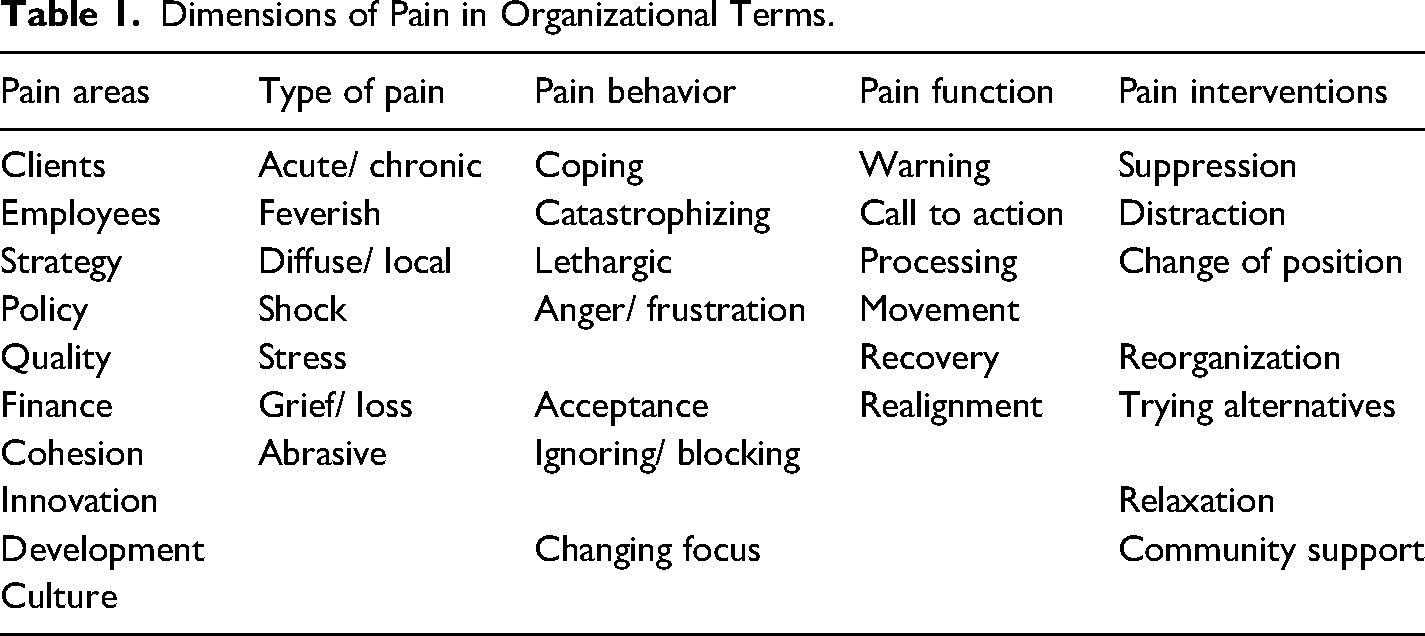
It is important to understand emotional aspects of how employees react to change to be able to interpret their actions and to facilitate them during change which may increase the likely success of organizational change (Beare et al., 2020; Albrecht et al., 2020). In our study, we conceptualize negative employee reactions to change as transition pains. The analogy of pain is well-known in organizational literature (e.g., Abrahamson, 2000; Flamholtz & Randle, 2015) and the field of Human Resource Management (HRM), where one aspect of the multidimensional concept of employee well-being (Grant et al., 2007; Van De Voorde et al., 2012) is ‘an employee's subjective experiences of pleasure and pain at work’. However, using pain discourse in relation to organizational practices is worth exploring further as it enriches the current discourse by adding an awareness of pain experience and its functions, thereby making pain more productive or functional (Goossens et al., 2021). In this way, we build on research and reviews (Kiefer, 2002; Klarner et al., 2011; Piderit, 2000) into the role of emotion in organizational change that challenges the negative connotation of emotion as the cause of problems or resistance to change ‘rather than an expression of the underlying difficulties’ (Kiefer, 2002, p. 40). Following Neilson (2016), we argue that pain is useful in the sense that it serves a double purpose: it signals (potential) damage (warning) and forces meaningful behavior to deal with the pain. Where pain in organizational literature and the field of HRM is often operationalized in a rather limited manner (bundling a variety of employee reactions into a pain construct), we suggest that it is important to enrich the dialogue on pain. Therefore, we propose the following conceptualization of transition pains: Emotional pain experienced by organizational members related to processes of change in the context of disruptive external change (i.e., transition), with acknowledgement of pain areas, type of pain, pain behavior, pain function and pain interventions. We found inspiration for this conceptualization in (neuroscience) pain literature (Van Cranenburgh, 2009) that describes different manifestations of pain and how people react to pain in different ways, also depending on the intervention. When we place employee reactions in a broader context of pain emotions it gives us the opportunity to better understand emotional signals sent by employees and to translate these employee reactions into something actionable i.e., management can try to shape these reactions by preventing pain-generating activities and focusing on pain-relieving activities.
Following this line of thinking, it is worth considering the job demands-resources model (JD-R model) of Bakker and Demerouti (2007). This model links pain-generating and pain-relieving activities to the concept of job demands and job resources. Job demands are job aspects that require sustained effort and are, therefore, associated with physiological costs (Demerouti et al., 2001; Bakker & Demerouti, 2017). Radical change can be viewed as a job demand, in which individuals will experience ‘pain’ in the form of higher levels of stress due to emerging needs of resources in the new setting (Edwards et al., 1998). Sometimes a new situation results in job demands that require more effort and resources to achieve work goals in the new desired situation. On the other hand, job- and personal resources foster engagement in change situations and thereby counteract health impairment – ‘pain’ - due to high job demands. Job resources refer to aspects of the job that help reach work related goals, reduce job demands and the associated costs, and stimulate personal growth and development (Demerouti et al., 2001; Tummers & Bakker, 2021). These job resources have been defined as the psychological, physical, technological, informational, and social supports and supplies available to employees to help them successfully adapt to, and adopt, organizational change (Albrecht et al., 2020). Previous studies have shown that providing job resources and support – ‘pain-relievers’ - is often necessary during times of transitions to enhance employee well-being and the likelihood of successful change initiatives (e.g., Wanberg & Banas, 2000; Van Emmerik et al., 2009; Goddard & Palmer 2010; Straatmann et al., 2016; Smollan, 2017).
Summarizing, in this study, we link incongruences perceived by employees (i.e., gaps between work-as-imagined and work-as-done) to employee reactions illustrated by using the analogy of pain and we use the job demands-resources model to identify potential pain-generating and pain-relieving activities.
Case and Methods
CASE
In this research, an exploratory case study was conducted. This case explores employee reactions to organizational dynamics from the perspective of transition studies. This transition perspective places organizational change in the broader context of disruptive societal change and looks at the tensions this may cause. How these tensions are experienced by employees is explored in this case study. For reasons of simplification, the case study organization is anonymized and referred to as CASE.
This case study was conducted at CASE, a foundation that supports people with psychiatric disabilities to develop skills towards maintaining a house(hold), social relations, a job and community involvement. CASE offers their clients supported living & housing and provides support to people in and around their own home. CASE operates on multiple domains: the social domain, mental healthcare and housing. Additionally, CASE operates within several different finance regimes, depending on the nature of the clients’ needs (short-term, long-term, forensic background, type of supported living). CASE operates since 1970. In 2011 CASE consisted of 6 housing locations with 170 clients, 198 home clients and 171 employees (in 7 teams). At the end of 2019 CASE numbered 10 housing locations with 204 clients, 426 home clients and 214 employees (in 16 teams).
CASE is a Dutch healthcare organization offering supported living services. The organization is part of the established regional healthcare regime. As such, CASE is an incumbent organization that experiences these internal organizational dynamics related to regime change. CASE operates on the border of two regimes: mental healthcare and social support. Box 1 gives a short introduction on CASE. In the past years, CASE has experienced a large number of changes in the social and mental healthcare domains, for the most a result of decentralization leading to a new finance structure with new financiers and new regulations. Additionally, landscape developments concerning a more challenging client population and a problematic labor market are of significant influence. These changes necessitated an organizational transition to cope with the demands from this new environment. The expected change in financial structure and regulations in healthcare and the social domain at the time, forced CASE to confront the fact that they were not well prepared for these external changes, and even in danger of serious financial problems. In 2013, a radical change was initiated to deal with this threat: a transformation in organizational and management structure: a new director and managers came in with a new paradigm towards client support and everyday practices. The main change for employees was the organizational structure through the introduction of self-managing teams, following the Buurtzorg example explained in our introduction. In this way, employees were introduced to a new way of thinking (culture) (the new paradigm), a new way of organizing (structure) (self-managing teams) and a new way of doing (practices). The new self-organizing teams were created by separating larger teams into smaller teams (12–15 people), all team leaders were let go and new regional management was responsible for 3–6 teams. The self-managing teams were responsible for almost all tasks for their own team and clients e.g., finding new personnel, quality management, facility management, safety, administration and client support. The new paradigm on client support presented a shift from ‘caring for somebody’ to ‘taking care that’. This shift meant client autonomy was made much more important, but also required a different way of working for the support workers and much more discussion and collaboration with clients (instead of taking over). Regional management was available at the head office but not generally at the client support location. The director and management were focused on external relations to develop the organization in terms of growth of number of clients and finding new areas of client support and new possible client groups. This transformation was presented as an important paradigm shift towards client and employee autonomy, however, the financial necessity of this reorganization was not disguised.
The process of adaptation was still ongoing at the end of the research period (2019). The changes initiated in 2013 and 2014 have had variable effects. The new vision and strategy and the general direction were not clear to all organizational members as they indicate to experience a lack of clarity and direction. This was especially apparent when the presented organizational vision and strategy did not always match everyday reality on the work floor. This empirical example of an organization where incongruences were regularly experienced makes CASE an interesting case to study.
Methods
In this case study, several research methods are combined. Overall, an extended case study was conducted. The timeline runs from 2011 to 2019. The years 2011–2015 were researched retrospectively. The research was conducted on site from 2016 to 2019. A historical analysis based on internal and external documents as well as interviews resulted in the reconstruction of a focused timeline for the research period 2011 to 2019. In the years 2017–2019, 17 interviews were conducted with key figures e.g., management (seven interviews) and with employees of CASE since at least 2011 (10 interviews). To adequately study the whole time period from 2011 to 2019, we looked to interview employees who had been working at CASE since at least 2010. There were not that many employees that met that criterium. The sample of long-working employees was therefore relatively small. All interviews lasted 1–1.5 h and were transcribed verbatim. Other data sources that gave insight to employee reactions were minutes from employee meetings, employee satisfaction surveys and organizational quality reports based on interviews. Additionally, from 2016 to 2019 the primary researcher conducted on site research in the role of company secretary. As company secretary, the researcher was able to attend strategy meetings for both management and employees as well as access a large number of documents to develop the timeline and historical analysis, e.g., minutes from different types of meetings, internal and external reports, strategic plans and periodic (financial) reports. In the role of company secretary, the primary researcher had a unique position to experience the organizational dynamics and add this perspective to the research. Permission to access documents and perform observations in the role of company secretary was granted by successive directors during the research period.
In the years 2017–2018, other focused scientific research was conducted at CASE resulting in a learning history of self-organization (Kreijenbroek, 2019). The research outcomes of this learning history were used in this case study to corroborate results.
The analysis has an abductive character as both inductive and deductive rounds of analysis were performed in a recursive and iterative process (Timmermans & Tavory, 2012). The gathering of data started with several orientational interviews and the document analysis (round 1). Using inductive coding this analysis resulted in a historical timeline and the identification of three distinctive time periods. The time periods are based on clear phases demarcated in practice. The first period is described in several (external) organizational reports and ends with the decision for the reorganization and the start of a new director and management. The second period is concerned with the actual reorganization and formation of self-managing teams and introduction of the new paradigm. The third period is the start of the consolidation period, when the new financial structure is introduced externally and the changes at CASE are consolidated. We labeled these three periods ‘critical’, ‘transformative’, and ‘adaptive’. These labels seem to best describe the general experience of change recipients, however, Lewins original typology of phases of (radical) change is recognizable: unfreezing, moving and refreezing (Lewin, 1947).
The research was originally aimed at uncovering how fundamental change in culture, structure and practices (Frantzeskaki & De Haan, 2009; Rotmans & Loorbach, 2010; Van Raak, 2016) was realized within an incumbent organization in a transition context. To focus the analysis three orientational interviews were conducted. These transcripts were coded using a coding scheme based on recognizing aspects of culture, structure and practices using the following description by Rotmans and Loorbach (2010):
culture refers to the collective set of values, norms, perspective (shared orientation) and paradigm; structure refers to the physical, economic and institutional infrastructure, including rules, regulations and collective actors; practice refers to routines, behavior, ways of handling and implementation at the individual level.
After these first interviews, we found that realizing fundamental change in the dominant way of thinking, doing and organizing was stagnating and decided to try and uncover the source of this stagnation. From the orientational interviews, we identified responses that we grouped as ‘pain’. We expanded the coding scheme to be able to identify these ‘pain reactions’ (Table 1).
Dimensions of Pain in Organizational Terms.
Additionally, this phase of analysis resulted in identifying incongruences as a useful (theoretical) concept to explore the internal organizational dynamics. This resulted in a refinement of the interview guide for the second round of interviews as well as a codebook for the analysis of these interviews and the collected observations (round 2). During the interviews we focused on the (experienced) changes in all three time periods, what was helpful to employees during these periods and what would have helped them during these periods. This deductive phase of analysis resulted in an empirically based description of the experiences of incongruences which we conceptualized as transition pain. Pain is used as an analogy for experienced tensions.
During the research, a process of continuous reflection was conducted to validate the outcomes and uphold the objectivity of the primary researcher. We have actively sought to reduce this bias by reflecting upon it, critical questioning by co-authors and validation of our findings with organizational members and the researcher that developed the learning history. The results of the interviews may have been influenced because respondents often knew the researcher as company secretary. However, the experiences shared throughout all interviews showed such a clear pattern that we do not believe that this has significantly influenced the results.
Periods of Change
Reconstruction
Our research focus begins in 2011 as this year is identified as the starting point for radical change. In 2011 the first signs of ‘trouble’ at CASE became visible: financially and through discussions on organizational structure. In 2012 problems increased as the negative financial impact of new regulations and finance structure (expected in 2015) became clear. The regime changes that were announced presented CASE with a changing external environment: new financial constructions to be arranged with multiple external partners (local municipalities) requiring CASE to be present as a player in the field and negotiate contracts rather than just focus on the own internal organization. Simultaneously, there was acknowledgement that the internal organization was not functioning properly and an independent investigation was commissioned. During this period tension was building within the organization as a growing number of people realized that the organizational culture, structure and practices, as well as its position in the field, were not sustainable. If changes were not made, from a financial perspective the organization would probably not be able to continue independently. This period of 2011–2012 is termed ‘critical’.
In reaction to both the changes in the environment and the internal problems, a large-scale reorganization was initiated in 2013 with a pivotal adjustment in organizational structure: the cancelation of the management layer of team leaders, introduction of self-organizing teams, downsizing the support team and the appointment of three regional managers. Concurrently, there was a change in director who was charged with positioning CASE as a leading player in the field and rebuilding a healthy financial position. The new director introduced a different paradigm towards client support. Following the vision behind the regime changes, this new paradigm focused more on assistance for clients to become self-supporting than on caring/taking over for somebody. This new paradigm was in line with the organizational changes in which the self-managing teams were introduced, but also contradictory to how client support was seen until then. Thus, requiring a different mindset for employees in both day-to-day client support as well as their individual and team responsibilities. This period of radical change in 2013–2014 is termed ‘transformative’.
From 2015 onward the mayor change in finance and regulations is implemented and the work processes are finetuned to adapt to the developments in the external environment and support the internal organization. This period of re-orientation in 2015–2019 is termed ‘adaptive’.
Critical Period
The critical period was characterized by a growing amount of tension. CASE in this period was a very internally oriented organization, primarily concerned with its own internal struggles. A sense of discomfort was first felt by the (mostly staff and management) employees who were aware of coming external developments in the regime, who recognized the need for transformative change and how ill-prepared the organization was. Respondents describe the discrepancy between the developments in the external environment and the internal focus of the organization in terms of unprofessional and non-committal. An important factor in this phase was identified by respondents as a lack of role clarity and low levels of group cohesion:
What is lacking is commonality, starting points and criteria, which regulate room for regulation, relationships and interaction; but also agreements about monitoring their follow-up and agreements about learning and development. (Change report)
So, it was a combination between no strategy, no clarity and therefore anarchy in the company where everybody just did as they pleased more or less. (Round 1 interview with hired change manager)
A: Doors were locked, everyone in offices, departments didn't communicate with each other and no insight into each others results. B: Everyone had their own folder on the computer with their own documents, nothing was shared. So there was a lack of cooperation. This is very illustrative of the relationships. A: It was difficult, nobody knew anything, nobody had a complete overview, there was no cohesion. B: People started filling in the blanks by themselves.
(Conversation between new director in 2013 (A) and secretary (B) illustrating the atmosphere)
The dysfunctionality within the organization was eventually recognized and acknowledged when the management is confronted with the financial repercussions of upcoming regime changes. This led to an external inquiry into the organizational culture, structure and practices. The change report at the end of 2012 states a lack of appropriate leadership as the main problem. Important to note is that most employees have not experienced this period as critical. Looking back, employees admit to a certain lack of professionalism, but in general were operating in a stable environment with clear organizational structure. The financial and organizational unsustainability was mostly felt by people working with staff support, the employees’ council and ‘outsiders’ such as interim management or the supervisory board. Among this group, there was frustration that no action was taken to address the regime changes.
Transformative Period
The report following the external inquiry signaled the start of a transformative period in which the organization aspired to become futureproof as well as handle the problems in culture and management. As such, the changes introduced at the start of the transformative period were felt as a great shock among many employees. Because the organization was lagging behind to begin with, there were multiple time-pressured changes in the process of realignment: in leadership, organizational structure, division of responsibilities and a new paradigm towards supporting clients. In this case, the radical actions in the transformative period were necessary to ensure the continuation of the organization. The necessity of the changes initiated was recognized by the organizational members who participated in the research. Respondents showed a good grasp of the developments in the external environment and the consequences for CASE. However, this period was experienced as emotionally demanding, fast-paced and chaotic:
It is always very chaotic and messy. And there is always something going on. And it's never easy-going. (Round 2 interview with support worker)
At CASE, the introduction of self-organizing teams was a disruptive experience as teams lost both their team leader and were confronted with new managers and a new director. Employees describe dealing with both shock and loss, as they experienced a multitude of changes at a fast pace without feeling support from management:
And then we started with the self-organization. At that point I thought: what will we be dealing with? It sounds very nice but at the same time also worrying. A team leader who is suddenly gone, while we’re not yet self-organizing. But the team leader is already gone. A bit like: you can't swim, but swim anyway. (Round 1 interview with staff employee, former support worker)
It was a period of ‘go figure it out yourself’. At least that was how it felt. (Round 2 interview with support worker)
Following the new organizational structure, employees were faced with role ambiguity due to different expectations in the way they did their daily work with clients but without instructions or support on how to realize these changes as the new manager operated at a distance due to a large span of control. The manager was not always on site to provide instructions, answer questions or discuss a new policy. This created stress among employees. Multiple respondents refer to changes that were implemented without regard for the necessary conditions or consequences:
Sometimes I get the idea that first something is done, and afterward we think about it. And that can be very frustrating on the work floor. Especially because there are so many changes (…) without stopping and thinking about this and what is necessary. (Round 2 interview with support worker)
When I look at the work floor, I think we could have done much better by paying more attention to those people, but that just didn't happen at that time. (…) I think the work floor has stayed behind when you look at our ambitions. Because we didn't engage them enough and also because we left things open-ended. We asked a lot of them, but also gave them every room to take a different approach. (Round 1 interview with manager support staff)
There was a distinct gap between employees/teams and the staff and management developing new organizational and strategic policies. The general feeling that the organization repeatedly acted in the fashion of ‘doing first, thinking later’ lead to situational constraints and incomprehension amongst employees and created stress and sometimes anger. Respondents identify a recurring pattern in these experiences caused by ‘acting without thinking about requirements or consequences’. In the years following this transformative period this theme would surface again repeatedly.
Adaptive Period
Following the transformational years two different periods of adaption are identified:
I) Perspective: From late 2015 through 2017 there were no large-scale changes
and new hope and perspective was emerging as to what kind of organization CASE could be. The vision for the future of the organization was able to develop. New initiatives were started and a new branding (Realizing Possibilities) was developed.
This was the phase of emerging consciousness, of ‘we are capable’. At a certain point there was the development of a kind of pride, reflected in the idea of Realizing Possibilities. (…) At this time you can see the development of the participation- and education center and people asking or suggesting ideas for organization of activities for clients. So people developed a certain pride of we can really make a change (Round 2 interview with regional manager)
II) Incongruences: Since 2017, the second adaptive period is recognizable in
which incongruences become more prominent as every day practices are not felt to be congruent with the new branding:
I realized that it looked better on paper than in practice. So, the ideas were well written down, the vision, the why do we do the things we do. But everyday practice did not seem to fit with that. (…) People were confused. Just no idea, what are we going to do, left or right? (…) It seemed as if a lot of employees in those teams just didn't have any knowledge. (Round 2 interview with former regional manager)
The experienced incongruences become more pronounced as the effects of new policy become noticeable, e.g., in the form of new client types and a more business-like approach to work efficiency. Role conflicts and not knowing what is expected of them causes stress among employees.
With the self-organizing teams we were expected to perform additional tasks for which I wasn't qualified, such as writing reports, using and teaching new digital programs. (…) We were expected to work and report differently, but without guidance, direction or training. This was awful. It caused a lot of stress for many people, certainly for me. (Round 2 interview with support worker)
In some parts of the organization employees experienced multiple changes in management. One respondent illustrates how this added to experienced workload and stress:
At location [X] we had three new managers in three years. And they all have their way of…you know, it's fine…if you’re pushed a bit in a certain way. But once you’re going in that direction then another manager comes and wants it a different way. That asks a lot of you. (…) Here we go again, what is expected of me this time? (Round 2 interview with support worker)
During the adaptive period CASE has seen a large turnover in personnel (up to 20% a year). In part, this turnover was due to the experienced demands placed on employees while they did not feel adequately equipped to realize these demands (e.g., supporting new types of clients with more severe problems), thus feeling continuous stress. Also, this was in part due to a felt lack of support from the organizational structure resulting from the self-organizing teams. The voice of these employees became heard through the exit-interviews. Though not part of this research it is probable that this high turnover rate in both personnel and management was not conducive to the change process and painful experiences were not discussed. The adaptive period was still recognizable at the end of this research in early 2020. The Covid-pandemic has brought its own dynamic to CASE and signals a new period outside of the span of this study.
Summary of Findings
The three identified periods are summarized in the findings in Table 2 and are identified by specific characteristics of culture, structure and practices. The use of time periods is a way of distinguishing specific characteristics in both external and internal dynamics. We do not mean to imply a linear process or a ‘before’ and ‘after’, but rather aim to clarify different dynamics and characteristics at certain time periods.
Summary of Findings in Terms Over External Developments and Developing Internal Culture, Structure and Practices.
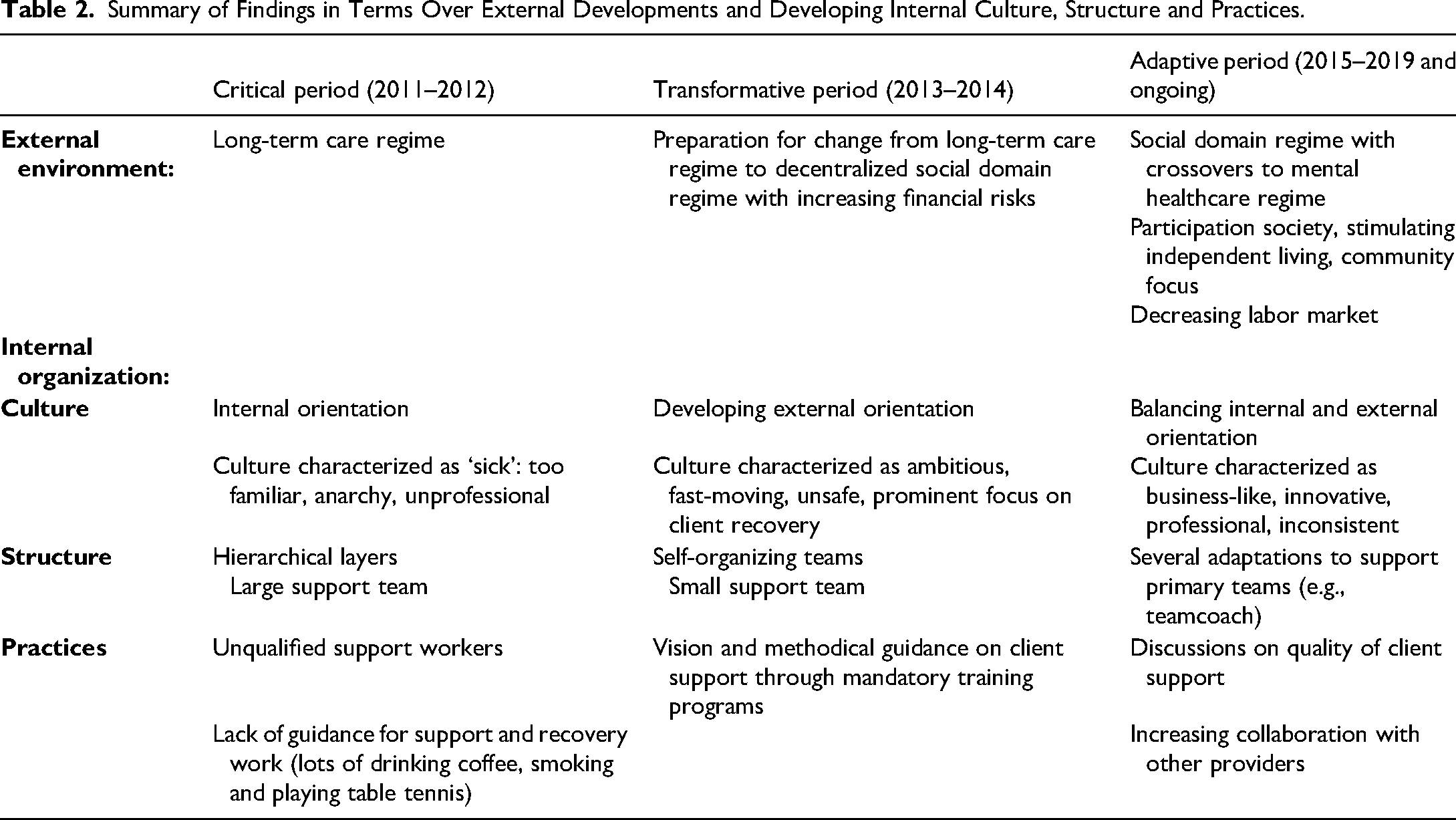
The findings illustrate how employees felt confronted with the changes in client support paradigm and organizational team structure, as well as the new (added) responsibilities. Looking at the findings and how employees felt unsupported through these impactful changes, the demands outweighed the resources they were provided with. Especially concerning the new responsibilities within the self-managing teams and skills needed to support new client groups with different demands, employees indicated a lack of information, communication, schooling and learning from experiences. This lack of investment in supporting employees during these changes, led to a diminished well-being under employees, visible in personnel turn-over rates and absenteeism due to illness.
Relationship Between Incongruences, Pain, Job Demands and Job Resources
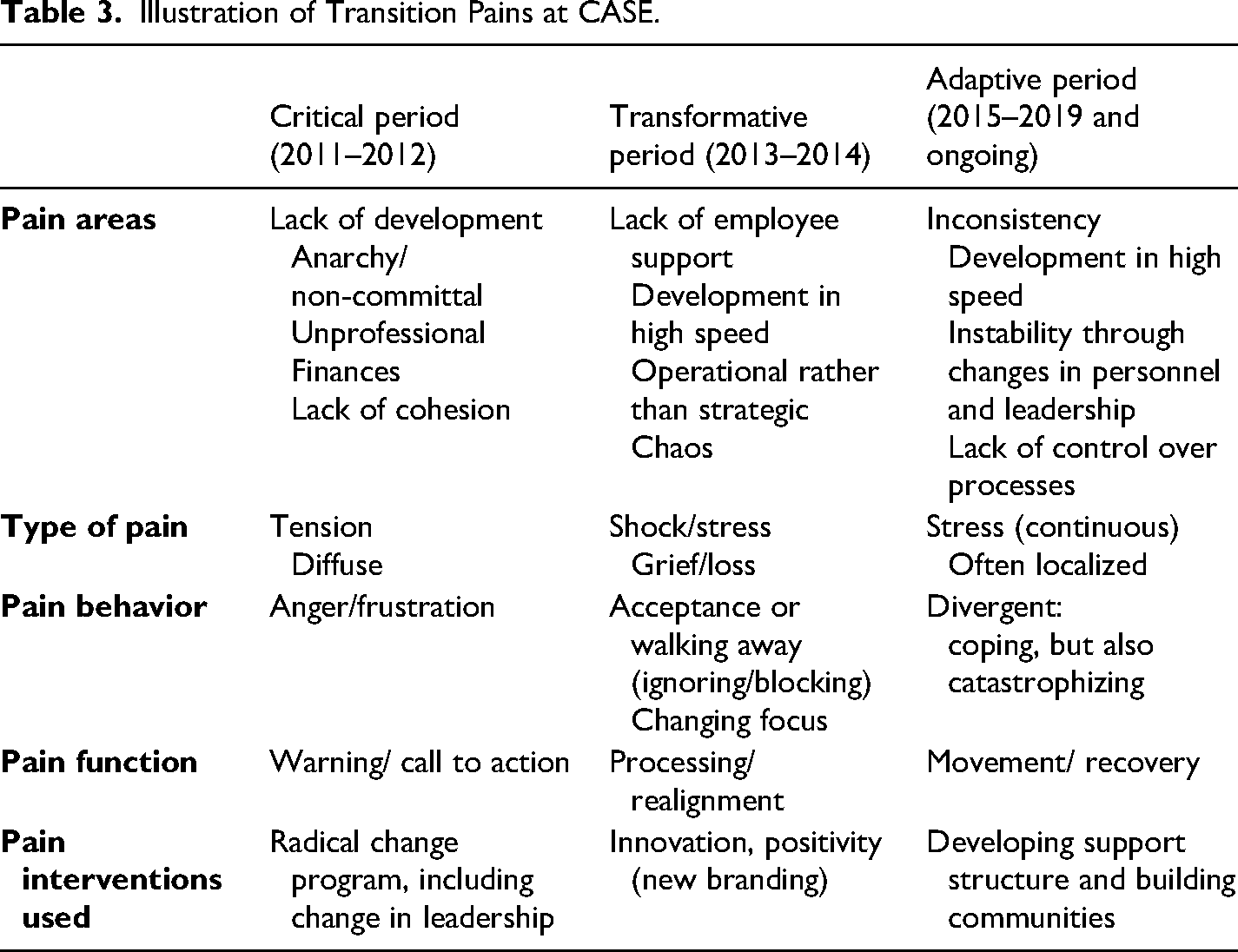
In our study, we encountered a myriad of employee reactions, illustrated by a frequent use of negatively charged words like stress, chaos, shock, frustration, worrying, confused and strong emotional responses such as experiencing something as awful or terrible by respondents. As discussed in section 2.3, we use pain as an analogy to illustrate the intensity and variation in employee reactions. Table 3 provides some examples where we combine pain terminology with empirical findings that are mostly case specific (although general enough to recognize in other settings) to develop the concept of pain in organizational terms. The acknowledgement of pain areas, type of pain, pain behavior and pain function provides language to discuss ‘what goes on’ within an organization realigning itself to a changing context.
Illustration of Transition Pains at CASE.
Support workers generally spoke about their own experiences, management generally spoke more about what they observed among support workers. Examples from the interviews that helped to build the pain vocabulary:
People were confused and lacked direction and self-confidence. I don't feel taken seriously. Our team leader was fired, he wasn't needed anymore and we had to figure everything out for ourselves. Literally. Oh, that was a terrible time. That was a very unpleasant experience for me. There was a lot unclear and that caused a lot of stress for many people. The new director retracted several decisions. That was a major relief for me. An increasing number of coworkers fall ill, are overworked or suffering from burnout. That was never the case in the past. The uncertainty caused a lot of tension for people, leading to unrest en tensions in the team as well as a lot of emotions. Contradictory policies cause a lot of frustration. There is no attention for how an individual is feeling. The expectations are high, that can make it difficult at times. After a certain point you experience a kind of fatigue for change.
The reactions as illustrated in Table 3 are symptoms of underlying issues that cause experienced pain by employees. Notable is that many respondents have identified a number of situations in which they experience incongruences between policy and practice. Table 4 illustrates some examples of these incongruences using the distinction by Clay-Williams et al. (2015) between work-as-imagined and work-as-done. In practice, people may experience something very different from the advocated policies. Repeated experiences of such lack of congruence can lead to frustration or uncertainty.
Examples of Experienced Incongruences When Policy and Practice Don't Match.
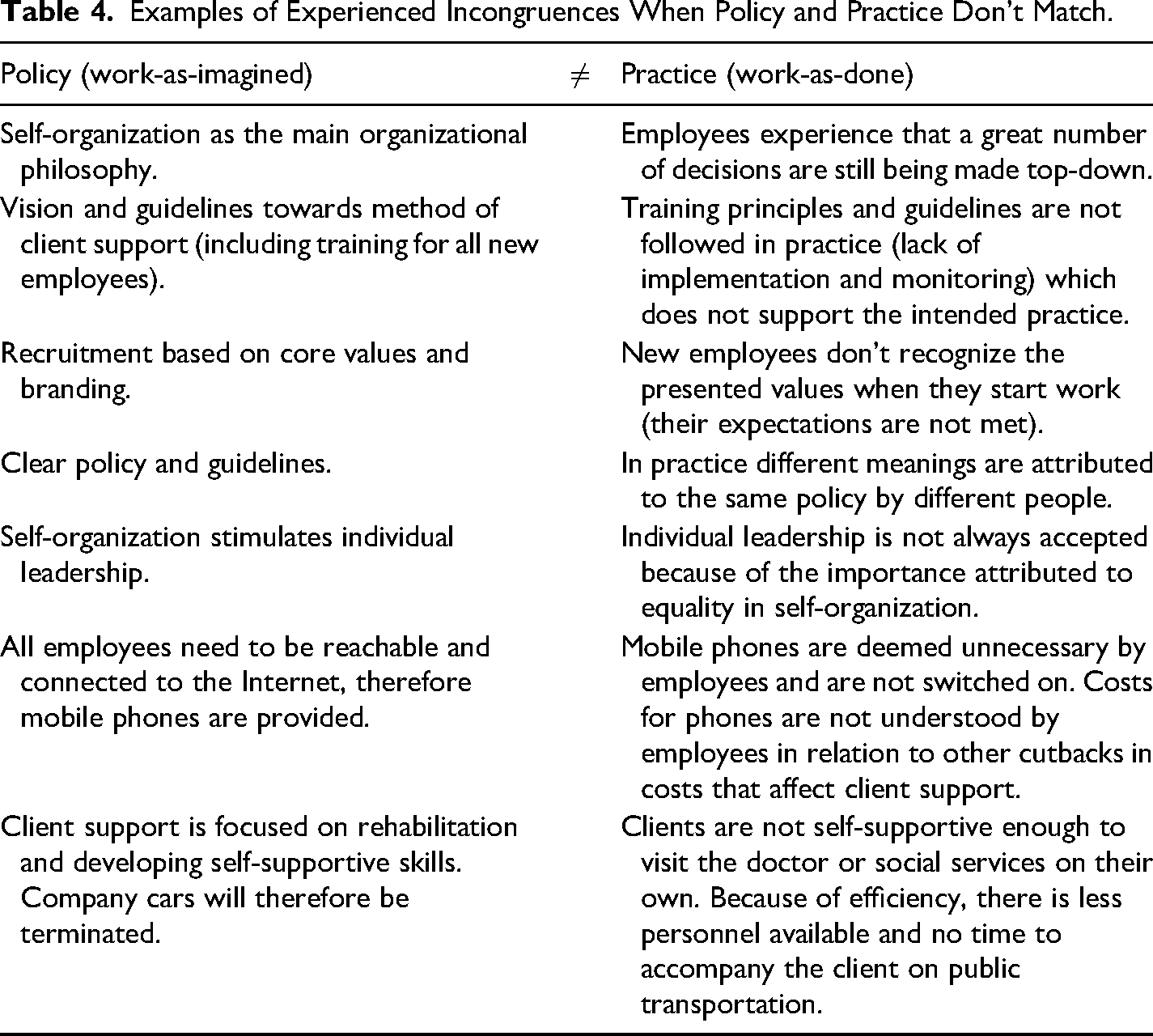
However, to find the root of the pain symptoms, we found that we had to go a step further than experienced incongruences. For example, an important source of incongruences seems to be a lack of information needed to attribute meaning to changes or choices made (sensemaking); to bridge the gap as it were. At CASE, the organizational structure of self-organization was chosen and rapidly implemented, but without developing an alternative supporting structure to replace the old one. Also, job design in relation to the psychological climate (Karanika-Murray et al., 2017) was neglected. The experienced chaos still has its effect on long-term employees who feel the ensuing gap was never properly addressed and therefore still causes (the same) problems with every new policy that has followed. The mentioned lack of support, information and connection to work practices, increased workload, time pressure, role conflict, role ambiguity, emotional demands and situational constraints by employees are examples of job demands (Bakker & Demerouti, 2017). Job demands can lead to a health impairment process: having high job demands—such as work pressure and role conflicts — generates pain reflected in symptoms such as stress, anxiety and tension (Lesener et al., 2019; Tummers & Bakker, 2021).
Pain symptoms can turn into behavior that reflects avoidance or resistance but is not actually that. It is behavior that signals that people are looking for ways to deal with pain. Pain can be suffered, suppressed, avoided, addressed, or even harnessed. For example, in our interviews the respondents regularly expressed cynicism towards organizational policies, especially if they experienced multiple occurrences of incongruence caused by job demands. Cynicism can also be interpreted as a reaction of someone who is tired and has little perspective of a better situation. Cynicism is a passive way of dealing with pain (suffering) as is ignoring or avoiding organization information. This passive way of dealing with pain points towards the absence of job resources for employees (Bakker & Demerouti, 2017). This finding is reinforced by the statement of respondents that new managers were not always able to support employees because they are busy with their own pain. No respondent mentioned examples of job resources provided by CASE during processes of change such as personal development opportunities, coaching and clarity regarding positions. They did mention the importance of a clear vision providing direction and even hope. Job resources can buffer pain symptoms caused by job demands and the absence of job resources may explain why pain is such a dominant emotion described by employees in this study. On a more positive note, we did find that some employees dealt actively with their pain by debating strategy and policy (addressing the pain, searching for meaning) or making suggestions, creating work-arounds to policy or trying to leave the pain behind by moving to another team or leaving the organization. These pain-relieving activities are mainly initiated by employees themselves. From the JD-R theory this can be identified as job crafting (Bakker & Demerouti, 2017). Employees craft their jobs when they proactively change their job demands and resources (Wrzesniewski & Dutton, 2001; Tims et al., 2013). For instance, a respondent mentioned that she tried to increase her sense of control during processes of change by asking for regular feedback from her supervisor. Thereby she increased her job resources which likely, as shown in many other studies, will improve her motivation (Hobfoll, 1989; Lesener et al., 2019). We conclude, based on our findings, that although CASE places significant job demands on employees during processes of change resulting in pain symptoms, they rely on employees to deal individually with these demands by job crafting and provide no additional pain-relievers – job resources – to employees.
Discussion and Implications for Research
In the Netherlands, the healthcare sector now faces the additional problem of a declining workforce. Already one in seven people work in Dutch healthcare and without change this is expected to be one in three people in 40 years’ time (WRR, 2021). This is an unsustainable development. With this challenge of a declining workforce in the light of rising demand for care, we feel it is important to address employee reactions to change in healthcare and their experiences at work in a disruptive context. There is little known about the tensions that employees may experience in the face of a declining workforce and the attention mostly goes to negative consequences such as absenteeism due to illness or burnout (WRR, 2021). Human resource management, specifically aimed at supporting current employees, is as relevant as ever in this challenging context.
Revisiting the Transition Perspective and Implications for Research
This case study has explored organizational attempts to align with a transforming context. The research illustrates how dealing with the tensions created by a disruptively changing context in turn creates tensions within organizations as employees are confronted with changes resulting from adjustments in strategy, policy or structure while still operating based on a different dominant logic. We have conceptualized the identified tensions as transition pains stemming from perceived incongruences. The pain analogy has proven useful as it encases a variety of symptoms that stem from these tensions (e.g., anxiety, frustration, stress) and illustrates the way individuals may experience change as pain when there is a disbalance between job demands and resources. The pain analogy allows for differences in individual responses, similar to each individual dealing with pain in his or her own way. Specifically, the pain analogy allows for feelings of loss that are inherent to change. The pain analogy has also been helpful in describing the specific characteristics of the tensions in the different phases of the change process. In this way, the pain language can be used to signal phases with different characteristics as well as individual experiences. We feel the pain analogy gives a necessary extra dimension to the discussion on employee reactions to change, specifically because it allows for a variety of tensions to be appreciated as signals of imbalance and that are recognizable in the way employees articulate their emotions and experiences.
The findings and conceptualization of transition pains enrich the vocabulary for studying organizational dynamics that play out in incumbent organizations in transitional environments. We hypothesized that realignment of an incumbent organization in a transforming environment requires a transition at the organizational level. This research has deepened the understanding of what happens to organizational members within organizations trying to realign themselves to a changing context while simultaneously dealing with internal dynamics. The incongruences-lens that has informed our conceptualization of transition pains, provides insights for transition dynamics at the organizational level and explicates how an imbalance between job demands and resources is at the root of transition pain. Specifically, the ‘messy and chaotic middle’ where the related patterns of build-up and break-down meet in transitions (Bogner et al., 2024) can be unraveled a little further with the vocabulary developed in this paper. As introduced in section 2, transitions are defined at the level of a societal (sub)system such as healthcare. This research adds both an organizational perspective and the individual (employee) perspective. Transition studies are not generally performed from an HRM perspective. This study has illustrated the relevance of using an HRM perspective when studying individual reactions in transitions. Although not specifically part of this research, we expect that the concept of transition pains can be applied and further added to when studying frontrunners and/or niches in addition to incumbents.
Known remedies to lessen organizational pain include discussions on improving information and communication, clarifying responsibilities related to organizational structure and designing or improving procedures. This type of ‘linear’ remedies seems to be based on the need or want to lessen the insecurity or uncertainty that is often the base for tension. In a way, they try to compensate for a sense of loss. The disruptive changes in society indicate that ‘old’ or ‘known’ solutions may not be adequate. From a transition perspective, we understand the tensions that are manifest within an organization trying to realign itself with a changing context as the result of a battle between the old, almost redundant, system and the new, but not fully materialized, way of doing things. This case study supports the idea that there is need for new remedies such as dialogue, participatory experimentation and capacity for compassion and to anticipate rather than react to transition pains with old remedies of linear problem-solving.
Although not explicitly mentioned by respondents, we do propose that it also helps to simply acknowledge the pain and show empathy as manager, change practitioner or colleague. Kanov et al. (2004) describe the use of compassion in response to suffering and how compassion is a capacity that can be developed at the organizational level as a collective response. Through values, practices and routines it is possible to develop the capacity for noticing pain and responding in support. For transition pains to be helpful in any process, they first have to be noticed and recognized as a signal. Following Kanov et al. (2004), change practitioners or managers could focus on developing the capacity for recognizing transition pains as signs of experienced dissonance and create room for these experiences, both in dialogue and in support.
Strengths and Limitations of the Research
This paper has brought together different fields of study by building a combined perspective from transition studies, organizational change management and human resource management. Even though the literature on organizational change management could already be called quite dense, the disruptive changes we increasingly experience in society, require a new perspective on possible problem-solving skills. By bringing together different fields of study, in an explorative study of fundamental organizational change and by conceptualizing transition pains, we add to the change management discourse in support of a broader perspective on problem-solving as described in the previous section.
Research on employee well-being and employee reactions in the field of human resource management is often performed in a quantitative fashion by developing and testing conceptual frameworks. This qualitative research deepens our understanding of what ‘goes on’ in organizations and possible ways to look at employee reactions to change. The transitions pain language offers a supporting discourse to discuss these employee reactions.
Limitations of this research can be found in the single-case study approach and the possible effect of convenient sampling as we did not involve former employees. The ideas and proposed relations from this study require more extensive empirical research and supporting development of theory. For future research, it would be interesting to look at organizational resources such as senior leadership engagement, strategic alignment, human resources (HR) management practices, and clarity of organizational goals (Albrecht et al. (2020; Biggs et al., 2014) as an addition to personal and job resources. The job demands-resources model combined with the language of transition pain may be helpful for developing concepts that can be used for supportive interventions for phase-out in transitions (Loorbach et al., 2017) by developing the idea of transition pain from an emotions perspective (Bogner et al., 2024).
Implications for Practice
Our research links incongruences during processes of change to the effect of these incongruences, namely pain symptoms. Also, our research sheds light on how to recognize and prevent the source of these incongruences by identifying job demands such as lack of support, information and connection to work practices. In addition, we found that employees individually try to relieve their pain by increasing their job resources, for example by job crafting. Our study highlights that there is a need for actionable job resources on the organizational level that can help employees reach change goals, reduce job demands and experienced pain, and stimulate personal growth and development.
Kiefer (2005) notes that negative emotions are not necessarily an expression of resistance to change, but more likely a consequence of experienced daily events that influence trust in management and organization and may lead to withdrawal. This study supports this idea by illustrating the build-up of transition pain through daily events in which employees experience a disbalance between job demands and resources. Depletion of resources may lead to lower trust in management and organization and be recognizable in withdrawal or other symptoms of transition pain. As such, transition pains can be identified and have a signaling function towards the need to balance job demands and offered resources. The pain analogy helps change practitioners and managers to better understand the struggle that organizational members can experience and the different ways in which they look to deal with pain. This increases our understanding of responses to organizational change, sometimes labeled as resistance to change. Our research indicates that incongruences are often not recognized as the source of pain and thus action is not taken by change practitioners or managers to reduce the incongruences. However, in the context of transition and disruptive external changes, and not forgetting normal human behavior of trial and error, incongruences are always likely to arise at some point. We did find that two elements are helpful for individuals to reduce the experience of incongruences and lessen the pain. A main point made by respondents was the importance of a sense of purpose, both individual (in this case supporting rehabilitation of clients) and knowing the ‘why’ behind policy. A sense of hope and perspective helped respondents deal with the incongruences. A second point we found was a need for some kind of support, e.g., people pulling the wagon to show the way, connecting with policy makers to help understand policy, dialogue with colleagues on the design of the work process and presence of management close by. Burgelman and Grove (1996) describe the importance of a confrontational/collegial culture that encourages debate and allows dissent and unanticipated invention. In this way, transition pains signal that dialogue is necessary that helps to discuss purpose of or reasons for change and expectations, exchange information and provide the opportunity to voice ideas about work improvement. Investment in creating these conditions (resources) by change practitioners, managers and supervisors may support a reduction in employee reactions that are predominantly fueled by negative emotions.
For change practitioners, managers as well as human resource professionals, this perspective of employee reactions stemming from pain following perceived incongruences, and experiencing a lack of resources to deal with this pain, helps to interpret employee reactions that may otherwise be labeled as ‘resistance’. By looking at these employee reactions as a possible signal of a lack of resources, provides a different range of reactions and interventions. For example, the need for compassion, a support structure (information, meaning, nearness of leadership, feeling equipped to work) and room for debate to help deal with incongruences that arise. Information about change, involvement in change, and opportunities for learning and development are change-related job resources that have consistently been associated with positive employee attitudes to change (Albrecht et al., 2020). In this way, it is not only employees who are supported in a change process, but also managers who are able to learn during transitions by continuously involving employees, upkeeping open dialogue to listen and learn about necessary resources from the employee perspective. This more ‘circular’ approach (as opposed to the more linear problem-solution approach) seems better fitting from the transition perspective that change and adaptation are continuous. Thus, the question is not how to eliminate tensions but how to learn to live and deal with them. In this way, change could be approached as an opportunity to learn and develop healthy adaptive practices within organizations: by anticipating change, involving people at an early stage, building capacity for compassion, accepting the existence of incongruences and supporting employees by attending to the balance between job demands and resources.
Footnotes
Acknowledgements
The authors would like to thank Fonteynenburg for serving as case study organization and specifically all respondents for sharing their experiences.
We are grateful for the constructive comments and suggestions from two anonymous reviewers that have helped to improve this article.
Declaration of Conflicting Interests
The authors declared no potential conflicts of interest with respect to the research, authorship, and/or publication of this article.
Funding
The authors received no financial support for the research, authorship, and/or publication of this article.
