




Abstract
The success of top-down digital change initiatives in higher education institutions (HEIs) largely depends on the support of professors as change recipients and catalysts within their departments. For effectively managing change, a better understanding of how process factors under management control (i.e., vision communication, change facilitation, participation opportunities, change coordination) simultaneously relate to professors’ cognitive and behavioral change support is crucial. Moreover, we examine how department-level IT resources as a context factor shape process–reaction relationships. Based on data from 1,400 professors nested in 258 departments within German HEIs, multilevel regression analyses support the relevance of vision communication, change facilitation, and participation opportunities — but not of change coordination. As department-level IT resources increase, vision communication more strongly relates to cognitive change support, pointing to unexplored higher-level boundary conditions of vision communication. Our study advances knowledge about mobilizing change support and managing top-down change with limited top-down influence to impose change.
Keywords
Leveraging digital technology is a key challenge for organizations in many industries (Loonam et al., 2018), notably for higher education institutions (HEIs), where digital technologies profoundly reshape the status quo (e.g., Benavides et al., 2020; Kämpfen & Maurer, 2018). As in other organizations, the top management of HEIs is launching initiatives to advance the use of digital technologies and to improve organizational services (e.g., teaching, administration, or research activities). Yet in pluralistic organizations, such as HEIs (Brès et al., 2018), top-down change initiatives can be particularly challenging to realize (Benavides et al., 2020; Bollard et al., 2016; Kopp et al., 2019). Particularly in Germany, which represents the national context in which this study is set, the sphere of influence of top management in HEI is often limited due to high degrees of autonomy, decentralized coordination, and loosely coupled departments (e.g., Hüther & Krücken, 2013; Ren & Li, 2013; Thorens, 2006). Moreover, how digital change is supposed to happen and what specific goals or technologies are to be employed is not defined for HEIs (Orr et al., 2020), but rather must cater to the needs of the different departments. Given these conditions, the top management's ability to bring about digital change largely depends on the change support of professors as change recipients and catalysts within their departments. Hence, HEIs’ top management needs to design the process of change in a way that enables and encourages the adoption of digital technologies and practices within the departments (Rampelt et al., 2019).
Following Kim et al. (2011), change-supportive attitudes and behaviors are of vital importance, particularly when the success of change requires that change recipients “actively participate in, facilitate, and contribute to a planned change initiated by the organization” (p. 1665). A key lever to elicit such change support, emphasized by practitioners (e.g., Kotter, 2012) and scholars (e.g., Stouten et al., 2018) alike, is the change process — that is, the way change is implemented. In organizations where top management faces constraints in directly imposing change, the design and arrangement of the change process play a crucial role. In this case, managing the process well becomes the most viable avenue to enhance change support and effectively shape outcomes of change (e.g., Herold et al., 2007; Oreg & Berson, 2019; Straatmann et al., 2016; Venus, Stam et al., 2019). Yet, the question of how process factors relate to change support among recipients who are simultaneously needed as catalysts of change in their areas of responsibility has not received a great deal of research attention so far (Oreg & Berson, 2019). Hence, for effectively realizing top-down change in contexts like HEIs, it is critical to better understand how process factors under top management control relate to change support of professors.
While key functions through which leaders in organizations can influence change recipients have been identified (Oreg & Berson, 2019), scholars have acknowledged the importance of the internal organizational context as an influential but under-researched factor (Johns, 2018; Rafferty, Jimmieson & Armenakis, 2013). Context factors refer to “situational or environmental stimuli that impinge upon focal actors” (Johns, 2018, p. 22) and provide “constraints and opportunities that affect the occurrence of organizational behavior and shape its meaning” (Johns, 2018, p. 22). Indeed, cognitive appraisal theory, which is increasingly used in change research (e.g., Fugate & Soenen, 2018; Oreg et al., 2018), suggests that the context can affect cognitive and behavioral reactions to change, leading to variations in individual responses to change. In other words, internal context factors reflecting “the physical and psychological setting within which the organizational change takes place” (Sverdlik & Oreg, 2022, p. 1) are likely to influence how recipients respond to the way change is implemented. Thus, internal context factors may help to explain why even well-designed change processes can encounter low levels of change support (Bouckenooghe, 2012; Herold et al., 2007; Rafferty, Jimmieson & Armenakis, 2013; Self et al., 2007).
Sverdlik and Oreg (2022) argue that organizational context factors relevant for reactions to change typically reside at the collective level because they reflect attributes relevant to groups, not just individuals. As in HEIs, professors primarily manage departmental resources themselves, internal contexts vary between the different departments (e.g., Kemp & Jones, 2007; Knight & Trowler, 2000; Selwyn, 1999). Specifically in Germany groups of professors from the same discipline control local resource allocation and lead their staff at a decentralized level. They autonomously decide how teaching, research, and administrative services within their department are conducted and can influence the degree to which IT resources are available. In the context of digital transformation in HEIs, IT resources represent an internal context factor of particular interest (e.g., Hagerer & Hoppe, 2020; Kopp et al., 2019) and may largely determine opportunities for adopting and supporting digital change initiatives (Stouten et al., 2018). Hence, knowledge about how department-level IT resources as an internal context factor shape process–reaction relationships is needed for effective change management (Rafferty & Restubog, 2010).
To advance our understanding of how to effectively mobilize professors’ change support, we examine how the process of digital change initiatives relates to their support and to what extent these process–reaction relationships are affected by the department-level context (see Figure 1). In particular, we focus on four process factors under top management control (i.e., vision communication, participation opportunities, change facilitation, change coordination) and differentiate professors’ cognitive and behavioral change support as they have been shown to be particularly salient in research and should be distinguished for a better understanding of change reactions (e.g., Bouckenooghe et al., 2021; Oreg, 2006; Oreg et al., 2011; Piderit, 2000). Moreover, we focus on the moderating influence of department-level IT resources as a relevant internal context factor (e.g., Hagerer & Hoppe, 2020; Johns, 2018).
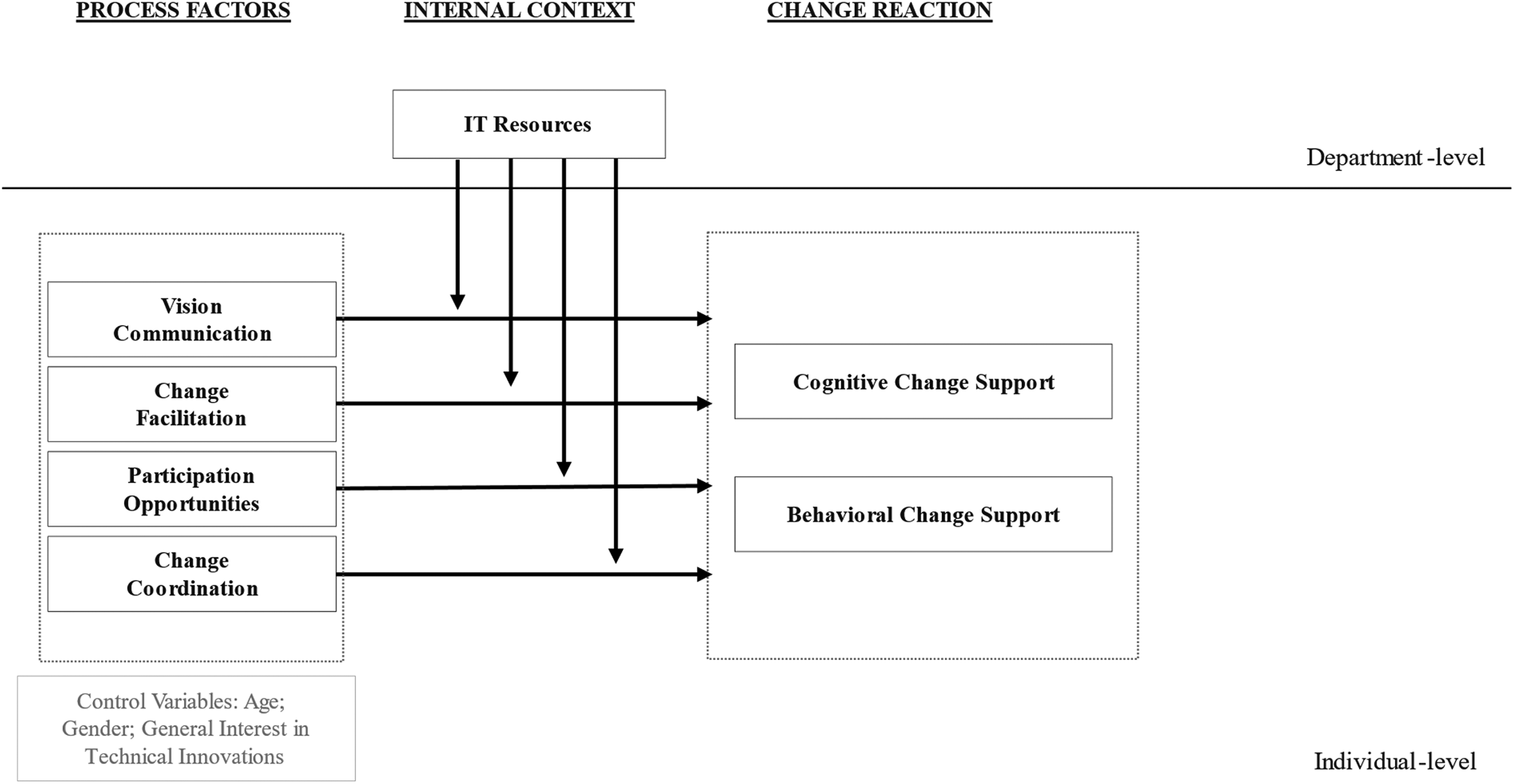
Conceptual research framework.
Our study makes important contributions. First, we build on and advance the understanding of recipients’ reactions to change (Bouckenooghe et al., 2021; Oreg et al., 2011) by simultaneously examining the relationships between multiple process factors under management control and specific components of explicit change reactions, namely cognitive and behavioral change support. In the selection of the process factors, our emphasis lies on malleable factors that offer practical tools for managers to actively shape employee reactions and bring about desired outcomes (e.g., Fugate et al., 2012). As such, we go beyond the “surface level” of attitude research (Bouckenooghe et al., 2021) and shed new light on the relative importance of key process factors for change support of recipients who are needed as change agents within their area of responsibility (Oreg & Berson, 2019). Second, we respond to calls for more insights on the role of internal context factors (Bouckenooghe, 2012; Herold et al., 2007; Johns, 2018) and for multilevel change research (e.g., Oreg et al., 2011; Rafferty, Jimmieson & Armenakis, 2013) by investigating how department-level IT resources shape individual-level process–reaction relationships. In particular, our study extends the growing body of research on vision communication (Berson et al., 2015; Rafferty, Jimmieson & Restubog, 2013; Venus, Stam et al., 2019) by identifying IT resources as a boundary condition in the context of digital change. Overall, our study provides important insights for managing digital initiatives in pluralistic organizational contexts with high dependence on recipients’ change support and a limited sphere of top-down influence to directly impose change.
Cognitive and Behavioral Support of Digital Transformation Initiatives
The use of digital technologies is not new to HEIs, for example, there has been considerable interest in e-education (e.g., Harasim, 2006), as well as the digitalization of administrative processes and services (e.g., Broucker et al., 2019; Broucker & De Wit, 2015). While the importance of digital technologies for the future of HEIs has been widely recognized (Abad-Segura et al., 2020), HEIs can benefit from a more proactive approach to “achieve a change process that enables HEIs to successfully leverage the use of digital technologies” (Kopp et al., 2019, p. 1449). Many HEIs in Germany are still in the process of strategically approaching their “journey to the digital age” (Bond et al., 2018, p. 5). At this point, the top management of HEIs would benefit from more insights on how to proactively mobilize change support of professors.
Although digital change is driven by new technological developments, it is not solely a technical matter. Indeed, navigating the human side of digital change is considered a critical management task for HEIs (Kopp et al., 2019). To successfully manage digital change initiatives, it is vital that the top management of HEIs act in line with the specifics of the pluralistic organizational context (Brès et al., 2018; Hagerer & Hoppe, 2020). HEIs often operate with loosely centralized coordination (Mintzberg, 1979, 1989) and with organizational structures in which top management has limited control over professors (Hüther & Krücken, 2013). These organizational characteristics are particularly relevant in German HEIs, where they are closely tied to the concept of academic freedom, which builds the foundation for professors’ high degrees of autonomy in research and teaching (e.g., Kinzelbach et al., 2021; Ren & Li, 2013; Thorens, 2006). As such, professors in Germany have control over the majority of decisions and resources within their departments (Hüther & Krücken, 2018). Consequently, professors’ change support is very important for realizing top-down digital change initiatives.
Prior research has shown that change recipients can influence whether change initiatives achieve their desired objectives (Bartunek et al., 2006; Huy et al., 2014; Oreg et al., 2011). Although research on reactions to change is growing, the nature of change reactions is often not explicitly differentiated (Bouckenooghe et al., 2021), limiting our current understanding of how change reactions are formed (e.g., Oreg et al., 2011). Regarding the valence of change reactions, the emphasis of research has shifted from studying change resistance to explaining how change support emerges (e.g., Rafferty, Jimmieson & Armenakis, 2013). Supportive reactions are associated with “seizing opportunities for improvement, motivating people to perform at a higher level” (Bouckenooghe, 2010, p. 508). Focusing on building change support – rather than handling resistance when it arises – allows for a more proactive approach to change management (e.g., Armenakis et al., 1993). Hence, we focus on change support as a positive explicit change reaction (Oreg et al., 2011).
Moreover, in line with previous research, we differentiate central components of change reactions (e.g., see reviews from Bouckenooghe, 2010; Bouckenooghe et al., 2021; Oreg, 2006; Oreg et al., 2011) and focus on (1) cognitive and (2) behavioral components of change support. Whereas cognitive change support (e.g., Oreg et al., 2011) describes a positive evaluation of change as being overall beneficial for the person and the organization, behavioral change support (e.g., Oreg et al., 2011) comprises behavioral activities or intentions to facilitate and contribute to the change (e.g., promoting or actively engaging in advancing the change). Differentiating cognitive and behavioral components of change support adds much-needed nuance to change research and change management. Indeed, previous research has found process factors showing relationships of similar (i.e., for change information) and of varying strength (i.e., for trust in management and social influence) with cognitive and behavioral components of change reactions (e.g., Oreg, 2006). However, more research is needed to guide organizational change management on how key process factors under management control simultaneously relate to cognitive and behavioral components of change support.
Process Factors and Professors’ Change Support
The high relevance of change support in the context of digital change initiatives in HEIs leads to an important question: how can we design change processes in a way that fosters professors’ cognitive and behavioral change support? To answer this question, it is important to identify factors “controllable by management” (Fugate et al., 2012, p. 893). In a recent review of leadership and organizational change, Oreg and Berson (2019) note that leadership research and change management research have identified similar sets of process factors through which leaders can affect reactions to change. They concluded that (visionary) change communication (related to visionary leadership), supportive change facilitation (also referred to as organizational change support 1 ; related to supportive leadership), and change participation (related to participative leadership) are key factors within the realm of management control for influencing change recipients’ reactions (Oreg & Berson, 2019). To account for the unique challenges posed by the decentralized structure in HEIs as pluralistic organizations (Brès et al., 2018; Claggett & Karahanna, 2018; Okhuysen & Bechky, 2009; Ren & Li, 2013), we additionally consider the influence of change coordination as an additional process factor under management control. Building on research that has linked process factors to supportive reactions (e.g., Jimmieson et al., 2008; Straatmann et al., 2016), we propose that each of the four identified process factors relates positively to cognitive and behavioral support (e.g., Oreg, 2006; Oreg et al., 2011). By considering how multiple process factors relate to cognitive and behavioral support, the study provides new insights into their relative importance and specific functions in the formation of change support.
Vision Communication
Vision communication refers to the “articulation of an abstract, future-oriented direction for the collective that appeals to desirable values and outcomes” (Venus, Johnson et al., 2019, p. 2667). As a prominent process factor in many scholarly and practitioner models of change management (Oreg & Berson, 2019; Stouten et al., 2018; Venus, Stam et al., 2019), vision communication has been found to affect both individual reactions to change and organizational outcomes of change (Oreg & Berson, 2019). With regard to reactions of change recipients, scholars point out that effective vision communication can enhance support for change (Griffin et al., 2010; Venus, Stam et al., 2019) and that visionary leadership is associated with more positive attitudes towards change (Oreg & Berson, 2019; Rafferty, Jimmieson & Restubog, 2013). By providing organizational members with vivid and clear images of a desirable future state, vision communication transports the goals and potential benefits of realizing change and is, therefore, likely to foster cognitive change support. Moreover, vision communication serves an uncertainty-reduction function, which can increase the tendency to enact supportive change behaviors when visions for change resonate with the recipients (Venus, Stam et al., 2019). If the professors understand and buy into the vision of the change, they are able to see how their own roles and contributions can align with the desired future state. Consequently, we propose that professors are more likely to react favorably to HEIs’ digital transformation initiatives when they perceive their top management as clearly communicating a compelling vision for digital transformation. Therefore, the following hypothesis will be tested:
Hypothesis 1: Vision communication is positively related to (a) cognitive change support and (b) behavioral change support.
Participation Opportunities
Providing organizational members with opportunities for participation — that is, involving them in the planning and/or decision-making of the change — has been emphasized as crucial in the change management literature (Stouten et al., 2018). Over the last decades, research has provided evidence that participation is positively associated with how people think and behave toward change (see reviews by Oreg et al., 2011; Oreg & Berson, 2019). Through participation opportunities, employees can voice their ideas and concerns, as well as influence the content and implementation of the change (e.g., Lines, 2004). As such, participation can provide employees with an increased sense of control over what is happening (Gagné et al., 2000). Indeed, Bartunek, Rousseau, Rudolph, and DePalma (2006) reported that change recipients who were afforded the opportunity to become involved in a change also perceived the change as more beneficial. If a digital change initiative in a HEI allows for participation and input from professors, it is likely to be evaluated more positively, implying a positive relationship between participation opportunities and cognitive change support. Additionally, Kim et al. (2011) argue that change recipients who are involved in the change have more opportunities (e.g., access to management) to engage in behavioral change support. Moreover, participation in change has been shown to make people develop a stronger sense of ownership and increased support, as they feel personally invested in its success (Hideg et al., 2011). In summary, providing participation opportunities is an essential process factor that can positively affect cognitive and behavioral change support. Hence, the following hypothesis is proposed:
Hypothesis 2: Participation opportunities are positively related to (a) cognitive change support and (b) behavioral change support.
Change Facilitation
Change facilitation refers to the provision of adequate supportive activities and assistance by the organization to help organizational members better cope with and adopt change (Caldwell et al., 2004; Oreg et al., 2011). Change facilitation can exist in different forms, such as training, guidance, or individualized coaching (Caldwell et al., 2004; Rafferty, Jimmieson & Armenakis, 2013). In their literature review, Oreg et al. (2011) note that specific supportive facilitation activities can reduce concerns about the change and can positively impact how recipients think and behave toward change. In their recent meta-analysis, Cavalcanti et al. (2022) reveal that perceived organizational facilitation is positively related to digital transformation intentions and behaviors. Moreover, previous research (e.g., Armenakis & Harris, 2002) suggests that change facilitation by the organization has a signaling function, as it communicates to organizational members that the top management is committed to the change and is willing to make considerable investments that contribute to its successful implementation. Hence, high levels of facilitation activities can increase the likelihood of change recipients buying into the potential benefits of the change and reduce uncertainties that may hinder them to enact support. Therefore, the following relationships are hypothesized:
Hypothesis 3: Change facilitation is positively related to (a) cognitive change support and (b) behavioral change support.
Change Coordination
Successfully coordinating organizational work under conditions of task interdependence and uncertainty (Faraj & Xiao, 2006) is central to creating, maintaining, and adapting organizations (Okhuysen & Bechky, 2009; Quinn & Dutton, 2005). In this study, we define change coordination as top-down activities that arrange the change governance (e.g., roles and responsibilities) and processes (e.g., integration of change efforts across departments) in ways that enable the organization to accomplish the desired change objectives (e.g., Quinn & Dutton, 2005). In other words, a well-coordinated change process is characterized by clear responsibilities of the involved actors and well-aligned activities across groups that consistently move in the same direction. Specifically, in HEIs aiming for digital change, there is a need to strengthen top-down change coordination to integrate and align efforts because loosely coupled departments often operate quite independently and autonomously (Han & Zhong, 2015). Kopp et al. (2019) recommend creating more transparency about digital change activities across departments. Indeed, change coordination can provide a better alignment and overview of change efforts within HEIs, allowing their top management to identify and embrace emergent digital changes in specific departments as best practice examples. According to Jääseklä et al. (2017), greater transparency about successful digital change efforts and their benefits is likely to foster positive evaluations of digital changes (cognitive change support) and to motivate the implementation of similar changes in other departments (behavioral change support). Thus, a well-coordinated change is likely to trigger more positive reactions, suggesting positive process–reaction relationships of change coordination with cognitive and behavioral change support. Thus, we hypothesize:
Hypothesis 4: Change coordination is positively related to (a) cognitive change support and (b) behavioral change support.
The Moderating Role of Department-Level IT Resources as an Internal Context Factor
While process factors are important levers for HEIs’ top management to create the required enabling and encouraging change process (e.g., Oreg & Berson, 2019; Rampelt et al., 2019), previous research indicates that the internal context in which change recipients are confronted with change initiatives can impact on how they react (e.g., Herold et al., 2007; O’Connor et al., 2018; Self et al., 2007). That is, internal context factors provide organizational constraints and opportunities which may function as enablers (e.g., trust in management or adequate technologies: e.g., Oreg, 2006; Shum et al., 2008) or as hindrances of change (e.g., high job demands, change turbulence, and interferences: e.g., Herold et al., 2007; Kanitz et al., 2022; O’Connor et al., 2018). To advance knowledge on how to mobilize professors’ support for digital change initiatives, we need to shed new light on how responses to the way change is managed may vary with the internal context (e.g., Johns, 2018; Sverdlik & Oreg, 2022).
Research on change appraisals (e.g., Fugate & Soenen, 2018; Oreg et al., 2018) suggests that cognitive and behavioral change reactions are not only a function of the process of change but also dependent on the available resources in the work environment for coping with the change. When change recipients appraise their context as a resource to cope with change (rather than as a hindrance), they are more likely to appraise the situation as controllable or challenging (rather than as overwhelming or threatening) which is more likely to translate into higher levels of support (Fugate & Soenen, 2018; Lazarus & Folkman, 1984). Following Fugate and Soenen (2018), who highlight that “individuals assess their goals and commitments in relation to the demands and opportunities in the context of change” (p. 110), the effectiveness of process factors will depend on whether the context fits with the aspired changes and provides more change-related opportunities than demands for engaging in change support. Acknowledging that characteristics of the internal context (e.g., group climate, facilities) are experienced by multiple individuals within the same context stresses the need for a multi-level perspective (e.g., Rafferty, Jimmieson & Armenakis, 2013).
The notion that context factors typically reside at the collective level (e.g., Sverdlik & Oreg, 2022) is especially relevant for pluralistic organizations, such as HEIs (e.g., Brès et al., 2018). Indeed, scholars report that departments in HEIs differ in terms of how they organize their research, teaching, or administrative resources (e.g., Kemp & Jones, 2007; Knight & Trowler, 2000; Selwyn, 1999). As professors within the same department can advance their own agendas (e.g., Brès et al., 2018) and act rather independently of other departments (Han & Zhong, 2015; Hüther & Krücken, 2018), separate departments provide different opportunities and challenges for digital change. For example, dealing with technological innovations in departments of computer science or engineering can lead to different conditions than in departments for which digitalization is a less central component. Since top-down digital change initiatives require professors to actively realize change within their departments, the way change is managed is likely to be appraised in light of their perceptions of the immediate department-level context. Hence, professors in different departments may react differently to the same process factor (e.g., communication of a vision) as a consequence of the differences in their immediate department-level context. Thus, examining department-related context factors as moderators can be helpful in explaining under which conditions process factors are more likely to increase change support (e.g., Fugate & Soenen, 2018; Oreg & Berson, 2019).
Available IT resources are a highly relevant internal context factor in general organizational settings undergoing digital change (e.g., Cavalcanti et al., 2022; Venkatesh et al., 2016) and particularly in HEIs (e.g., Hagerer & Hoppe, 2020; Kopp et al., 2019; Selwyn, 1999). For instance, Jääskelä, Häkkinen and Rasku-Puttonen (2017), as well as Kopp et al. (2019) point to the importance of adequate technological resources in fostering successful technology adoption in HEIs. Indeed, difficulties arising from insufficient IT resources are seen as critical barriers to digital change in HEIs (Margaryan et al., 2011). IT resources in German HEIs are largely managed at the department level, as the professors have a high degree of autonomy in administering and controlling the resources and activities within their departments (Hüther & Krücken, 2018). Hence, we focus on department-level IT resources which refer to available IT equipment and services within the departments, such as hardware (e.g., department-level servers, personal computers), software (e.g., communication tools, teaching, and research software), and existing IT services (e.g., departmental IT staff). As department-level IT resources largely determine opportunities for professors to effectively implement digital change and adopt digital practices in their area of responsibility, they may help to explain departmental variation in the relationship between process factors and change support.
While a few studies have investigated the moderating effects of contextual factors on leaders’ impact on responses to change (e.g., Oreg & Berson, 2019; van Knippenberg & Stam, 2014), it is – to date – unclear whether specific internal context factors, such as department-level IT resources, can impose boundaries to the effects of change process factors such as vision communication, change facilitation, participation opportunities, and change coordination (e.g., Berson et al., 2015; Berson & Halevy, 2014; Griffin et al., 2010; Oreg & Berson, 2011). Drawing on recent research that emphasizes the role of recipients’ perceptions of consistency in change implementation (Kanitz et al., 2022), we argue that professors’ change support will be more positive when a well-designed change process in terms of vision communication, opportunities to participate, change facilitation activities, and coordinated change efforts is matched with high department-level IT resources. In this positive case, professors within a department with high IT resources will perceive the change activities initiated by the HEI's top management and the IT resources within their department as consistent, giving them access to the necessary resources for experimenting with digital technologies and enacting the new practices. When IT resources are low, people within such departments lack the necessary resources in their immediate environment, and even if the change process is arranged well, vision communication, opportunities for participation, change facilitation, and coordination are less likely to translate into change support. In this case, the process of change may even lead to cynical reactions that undermine change support (e.g., Watt & Piotrowski, 2008), as the lack of fundamental resources to adopt the proposed changes is discouraging, and the top management may be perceived to be out of touch with departmental realities.
In summary, we propose that considering department-level IT resources will help to explain cross-departmental variation in how process factors relate to cognitive and behavioral change support. In particular, we propose that the expected positive relationships between process factors and professors’ change support become stronger with increasing department-level IT resources. Hence, the following hypotheses are tested:
Hypothesis 5: Department-level IT resources moderate the relationship of vision communication with (a) cognitive change support and (b) behavioral change support. Hypothesis 6: Department-level IT resources moderate the relationship of change facilitation with (a) cognitive change support and (b) behavioral change support. Hypothesis 7: Department-level IT resources moderate the relationship of participation opportunities with (a) cognitive change support and (b) behavioral change support. Hypothesis 8: Department-level IT resources moderate the relationship of change coordination with (a) cognitive change support and (b) behavioral change support.
Methods
Research Setting
Higher education institutions in Germany are an appropriate setting for examining how the process of change relates to change support of top-down change initiatives. Due to the high degrees of autonomy (i.e., constitutional academic freedom) granted to the professors in German HEIs, the ability of top management to directly impose change is limited (Hüther & Krücken, 2018) and, hence, the mobilization of professors’ change support through process factors becomes a critical top management task to realize any change. Moreover, German universities are organized and managed in similar ways so that important organizational factors such as job duties, structures, and incentives that may influence reactions to change are largely comparable across universities.
Most importantly, the realization of digital transformation initiatives in HEIs is a crucial issue in the German higher education system. In general, digital transformation can be described as “continuous change that can be triggered and shaped by episodic bursts, while the latter are inducing further continuous change” (Hanelt et al., 2021, p. 1187). Even before the COVID-19 pandemic, when this study took place, education researchers and policymakers called for leveraging new digital technologies in HEIs (e.g., Benavides et al., 2020). In particular, at a global, European, and national level, as well as state levels in Germany policies and agreements were implemented to foster digital change in HEIs (Hochschulforum Digitalisierung, 2017; OECD, 2020; Rampelt et al., 2019).
The vision of HEIs as “networked and open institutions” that “are central institutions of lifelong learning, on campus and on digital platforms”, provide “courses of study that are much more flexible and offer different learning pathways recognizing the diversity of the student population”, “cooperate[s] much more closely with other universities as well as the community and jointly develop[s] and provide[s] educational programmes” (Orr et al., 2020, p. 4), highlights the need for “a transformative process that substantially influences all activities of higher education institutions” (Rampelt et al., 2018, p. 28).
While digital technologies have been adopted in e-education (e.g., Harasim, 2006) and digital administration (e.g., Broucker et al., 2019; Broucker & De Wit, 2015), the emergence of new competitors in the higher education sector – such as profit-oriented universities, corporate universities, and digitalized education services – as well as higher expectations from students regarding the use of digital technologies for teaching and the labor market's demands for digitally competent graduates, have created additional pressure on HEIs to act (Keane et al., 2022; Kopp et al., 2019; Parsons & MacCallum, 2019). Indeed, HEIs are facing transformational change with shifts in the vision, business strategy, as well as in their practices and technologies used (Allen et al., 2007). Facilitating the “shift from teaching to learning” (Barr & Tagg, 1995, p. 13), new teaching formats (e.g., blended-learning, self-regulated learning) strongly build on the integration of digital technologies, but also impact the roles and professional identities of the professors. Moreover, digital technologies offer new independence of space and time, providing novel opportunities for teaching and student mobility as well as for new business models (e.g., offering paid digital courses for achieving nano-degrees). Given the benefits of new digital technologies – e.g., providing higher quality services and becoming more efficient and flexible (Blaschke & Hase, 2015; Bond et al., 2018), top management in HEIs is implementing planned top-down digital change initiatives to engage the professors and spur digital change within the HEIs. Yet, given the complex (e.g., outcomes are not predictable, little control of future developments) to chaotic (e.g., high uncertainty, strong reliance on individual autonomous agents) nature of the change (Cheung-Judge & Holbeche, 2021), mobilizing digital change is a challenge for HEIs’ top management (e.g., Benavides et al., 2020).
Data Collection and Sample
As part of a larger initiative, we collected data from professors who worked within a broad range of different departments across a large number of German HEIs (universities and universities of applied sciences). The sample of professors included those in Bavaria, Baden-Wuerttemberg, Lower-Saxony, and Saxony whose names, university affiliations, and contact data were publicly accessible on the internet. Overall, 14,562 professors were invited to complete an online survey starting in the 2018/2019 winter semester. The field phase ended in the summer semester of 2019.
We received valid responses from 1,936 professors from 563 distinct departments, representing a response rate of 13%. However, given the need to calculate department-mean-centered scores and to estimate department-level aggregate scores to measure our moderator – and especially given the aim of estimating department-specific slopes and hence departmental slope variance – we removed departments with fewer than 3 respondents. The resulting analysis sample comprised 1,400 professors from 258 distinct departments.
Of these professors, 78% were male; 17.0% were age 44 or under; 46.1% were between ages 45 and 54; and 36.4% were age 55 and over. The 258 departments, from which there were between 3 and 28 respondents, covered a broad spectrum of disciplines (see Appendix Table A1), with engineering (18.6%), economics (16.7%), and linguistics (10.1%) most strongly represented. The 258 departments were drawn from 78 different German HEIs (33.3% universities, 59.0% state-owned universities of applied science, and the remaining 7.7% either art colleges, clerical colleges, or private universities).
Measures
The survey was offered in German. All measures were carefully translated by bilingual scholars using a back-translation procedure (Brislin, 1970) and, when necessary, adapted to the HEI context. Unless stated otherwise, the items described below utilized a 7-point Likert-type response coding, ranging from 1 = “strongly disagree” to 7 = “strongly agree.” The survey included more questions than those included in our study, as the present study was part of a larger research project.
Preliminary Data Analysis
We initially considered the data to have a three-level structure – i.e., individual, departmental, and organizational levels – and had planned to partition outcome variance into components for each of these levels, enabling us to control for any clustering/non-independence within organizations as well as within departments. However, preliminary analysis revealed that, for the items measuring outcomes, less than 0.1% of their variance existed at the organizational level. Extrapolating the point made by Bliese et al. (2018) – that there is no bias in lower level parameter estimates to be expected by partitioning the variance into a further level when there is minimal higher-level variance and hence a single-level approach would do – to a two-level vs. three-level situation, one potential option would have been to proceed with a three-level model. However, given the absence of organization-level variance, the fact that our hypotheses were specified at just the individual and departmental level rather than the organizational level, the additional computational complexity in fitting a three-level model, and the unnecessary loss of parsimony in both presentation and explanation of results, we settled for a two-level approach, considering individual professors clustered within departments. That is, we build on and extend previous research focusing on process–reaction relationships at the individual level (e.g., Oreg et al., 2011) by considering influences from the collectively shared internal context at the department level (i.e., department-level IT resources).
To collectively examine the structural and discriminant validity of the multi-item measures, the predictor and moderator scales were tested together in one set of multilevel confirmatory factor analyses (MCFA), with the outcomes tested in a second set. This split was necessary given the large number of parameters that estimation within a single global model would have required.
First, we tested our hypothesized measurement model for the four primary predictors (change process factors: vision communication, participation opportunities, change facilitation, and change coordination), our individual-level control (general interest in technical innovations), and our moderator (department-level IT resources). The primary predictors and control construct were modeled at the individual level only, using department mean-centered items; the moderator was operationalized at the department level, using the department-level variance of the two IT resource items asked at the individual level.
This five-factor individual-level, one-factor department-level structure provided a satisfactory fit to the data (Chi-sq = 776.681 on 119 df, CFI = 0.965, RMSEA = 0.063, SRMR within = 0.038, SRMR between = 0.036) and outperformed several plausible alternatives, in which the individual-level factor structure consisted of 4 factors (change facilitation and change coordination merged), 4 factors (vision communication and change coordination merged), 3 factors (participation opportunities, change facilitation, and change coordination merged), or 1 factor. These comparisons are given in Appendix Table B1. To ensure that the fit of the model was not being boosted by the inclusion of the items comprising the individual-level control scale (general interest in technical innovations), we also reran the MCFA without these items: the model fit, as reflected by its fit indices, was also satisfactory (Chi-sq = 478.339 on 66 df, CFI = 0.974, RMSEA = 0.067, SRMR within = 0.035, SRMR between = 0.023).
Discriminant validity amongst the individual-level factors (i.e., that the measures were capturing distinct constructs) was supported by each of their average variance extracted (AVE) scores exceeding all but one of the squared correlations between factors (Fornell & Larcker, 1981), as summarized in Appendix Table B2. The sets of items measuring each individual-level factor exhibited satisfactory individual-level reliability, with multilevel McDonald's omega > 0.85 for each scale, and multilevel Cronbach's alpha ≥ 0.85 for each scale (see Appendix Table B3 for exact values). Given that the department-level measure of IT resources was created by taking the mean of individual respondents’ perspectives, we also checked the levels of agreement across individuals’ scores within each department for this measure and examined the group mean reliability, as recommended by LeBreton and Senter (2008). The within-department agreement for the department-level IT resources scale was assessed using the RWGj statistic (James et al., 1984), which is calculated by comparing an observed group variance with an expected random variance. Our sample exhibited moderate levels of agreement (mean RWGj = 0.504; median RWGj = 0.556); however, this was considerably attenuated by the low numbers of cases within many departments (LeBreton & Senter, 2008). The group mean reliability for departmental IT resources (ICC(2) = 0.593) was similarly affected by the small number of respondents per department, but was still moderate to strong (Fleiss, 1986).
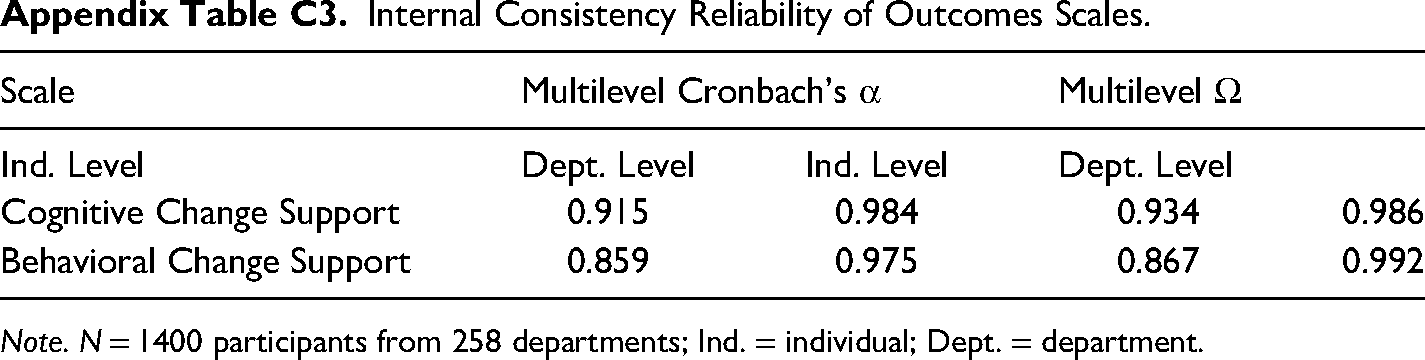
Next, we tested our hypothesized two-factor structure at both the individual and department level for the outcome scales (i.e., cognitive change support and behavioral change support). The results demonstrated a satisfactory fit for the two-factor model at the individual level only (Chi-sq = 174.918 on 19 df, CFI = 0.981, RMSEA = 0.077, SRMR within = 0.034), and its superiority to a one-factor model (Appendix Table C2). Extending to a MCFA with two factors at each level yielded an adequate fit (Chi-sq = 163.921 on 38 df, CFI = 0.986, RMSEA = 0.049, SRMR within = 0.037, SRMR within = 0.102). Discriminant validity amongst individual-level factors (i.e., that the measures were capturing distinct constructs) was again supported by factor AVE scores exceeding the squared correlations between the factors (Appendix Table C2). The sets of items measuring each of the predictors exhibited satisfactory individual-level and department-level reliability, with both multilevel McDonald's omega and multilevel Cronbach's alpha > 0.85 for each scale at each level (see Appendix Table C3 for exact values).
Hypothesis Testing
Having validated the multi-item scales within our research model, we created scale mean (composite) scores for each of them, centered our individual-level predictors around their departmental means, and created departmental mean scores to represent our moderator — department-level IT resources — which we centered around the grand mean to ease the interpretation of coefficients. We then fitted a series of multilevel structural equation models of increasing complexity to test our sequence of hypotheses.
We started with an unconditional model in which only the outcomes (behavioral change support and cognitive change support) were correlated: the outcomes, moderator, primary predictors of interest, and control variables were disconnected, with the variance of outcomes separated into within and between department components. We then, in sequence, added paths from the individual-level control variables of gender, age, and general interest in technical innovations to each outcome (model 2); and then from each individual-level predictor (i.e., vision communication, participation opportunities, change facilitation, and change coordination) to each outcome (model 3), for testing Hypotheses 1 to 4.
We extended this model by allowing the path coefficients for the effects of vision communication, change facilitation, participation opportunities, and change coordination on each outcome to vary between departments — i.e., making them random effects — as well as adding a department-level covariance structure between intercepts and slopes (model 4). Next, we attempted to explain this variation in slopes from our higher-level moderating variable, department-level IT resources: first allowing it to explain variation in the outcome (model 5), then to explain any variation in the effects of vision communication, change facilitation, participation opportunities, and change coordination on each outcome (model 6). This gave our final model as depicted in Figure 1, with this last step testing Hypotheses 5 to 8.
Where there was a significant moderation effect, conditional effects of the respective predictor (i.e., vision communication, change facilitation participation opportunities, and/or change coordination) on the respective outcome were calculated at low, medium, and high values of the moderator department-level IT resources, which corresponded to the 16th, 50th, and 84th percentiles of its distribution, as recommended by Hayes (2018). In addition to the tests of our hypotheses, as a robustness check, we reran our final model from the sequence described above (i.e., model 6) without the control variables, to see if the conclusions drawn were the same.
All of the analyses described above, as well as the MCFA and reliability calculations, were performed using Mplus software v8.5 (Muthén & Muthén, 2020). Full Information Maximum Likelihood (FIML) estimation was used to estimate each model. Models were compared by testing the change in the deviance (i.e., the change in −2*log-likelihood statistics). Two-tailed tests were used for testing model parameters, with statistical significance assessed at the p < .05 level. Confidence intervals and the effect sizes (the variance explained in the variable(s) being predicted at each stage) are reported throughout in the results section below.
Results
Descriptive statistics for, and bivariate correlations between, study variables are given in Table 1. Tests of model improvement and variance estimates at each level of the model for our sequence of models are given in Table 2. Estimates of path coefficients from our final model (model 6) are reported in Table 3.
Descriptive Statistics for, and Bivariate Correlations Between Key Study Variables at Individual Level ‡.
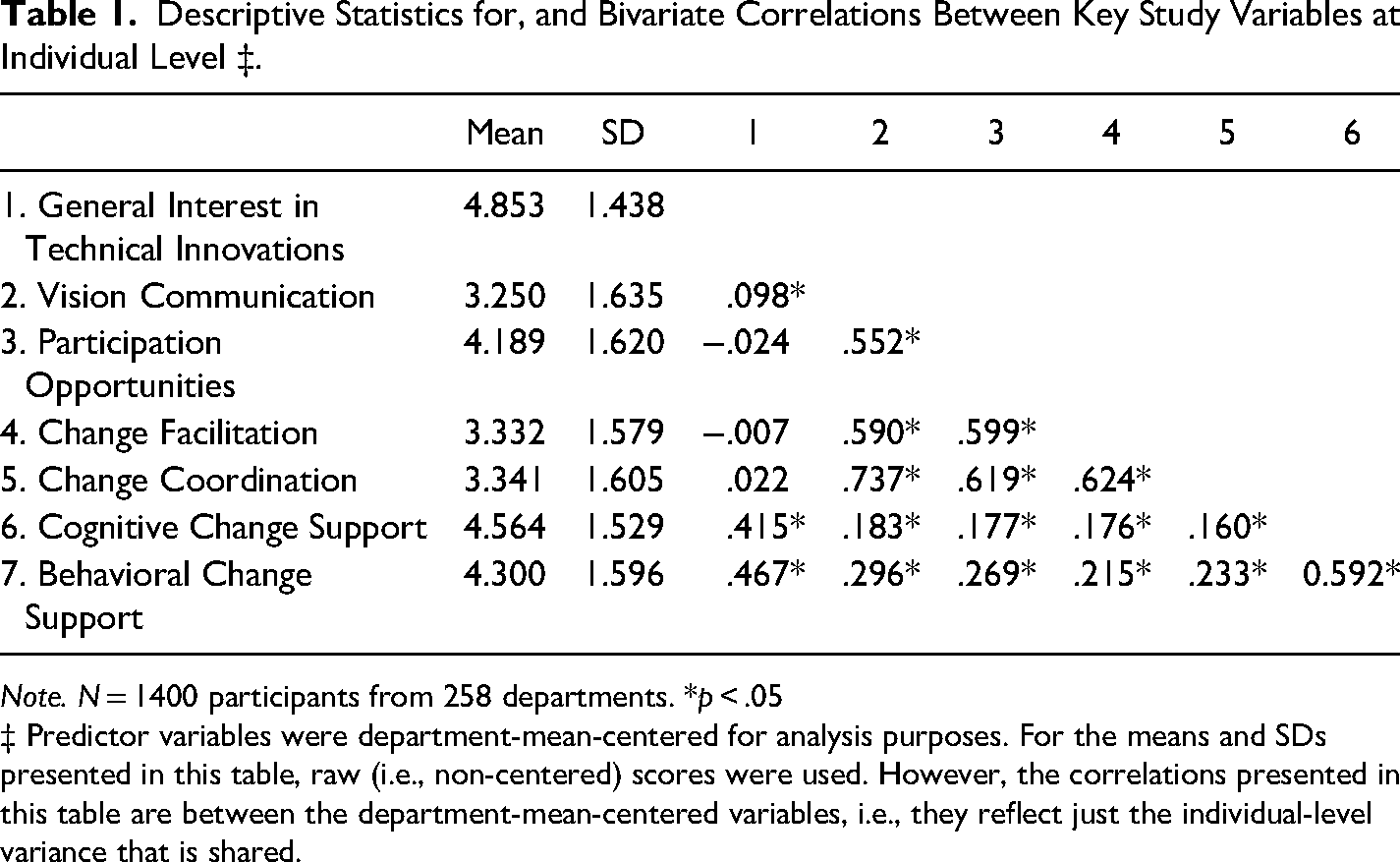
Note. N = 1400 participants from 258 departments. *p < .05
‡ Predictor variables were department-mean-centered for analysis purposes. For the means and SDs presented in this table, raw (i.e., non-centered) scores were used. However, the correlations presented in this table are between the department-mean-centered variables, i.e., they reflect just the individual-level variance that is shared.
Competing Multilevel Models for Effects of Vision Communication, Participation Opportunities, Change Facilitation, and Change Coordination on Cognitive Change Support and Behavioral Change Support, Moderated by Department-Level IT Resources.
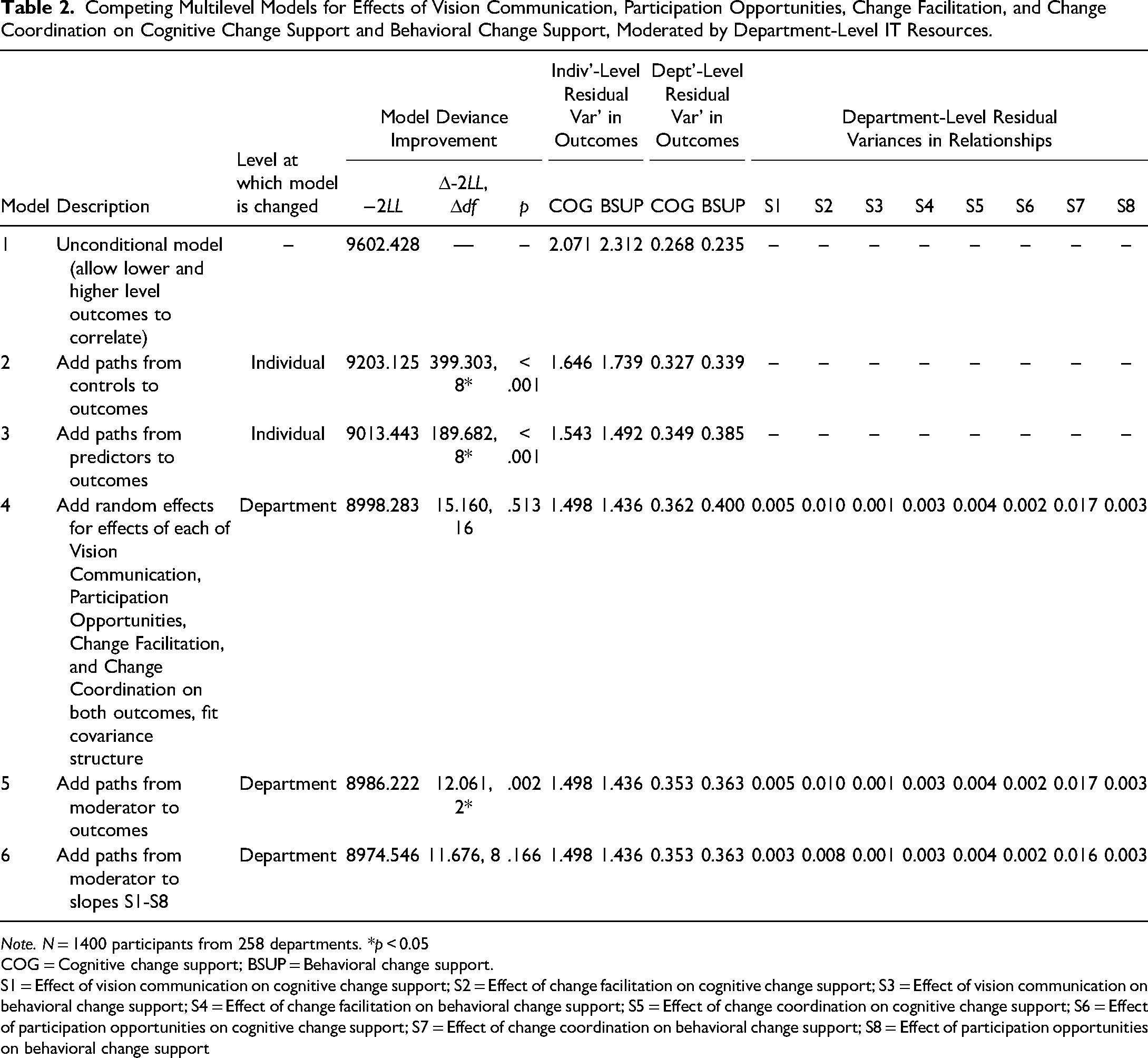
Note. N = 1400 participants from 258 departments. *p < 0.05
COG = Cognitive change support; BSUP = Behavioral change support.
S1 = Effect of vision communication on cognitive change support; S2 = Effect of change facilitation on cognitive change support; S3 = Effect of vision communication on behavioral change support; S4 = Effect of change facilitation on behavioral change support; S5 = Effect of change coordination on cognitive change support; S6 = Effect of participation opportunities on cognitive change support; S7 = Effect of change coordination on behavioral change support; S8 = Effect of participation opportunities on behavioral change support
Unstandardized Path Coefficients from Final Model for Individual-Level Effects of Vision Communication, Participation Opportunities, Change Facilitation, and Change Coordination on Cognitive Change Support and Behavioral Change Support, Moderated by Department-Level IT Resources.
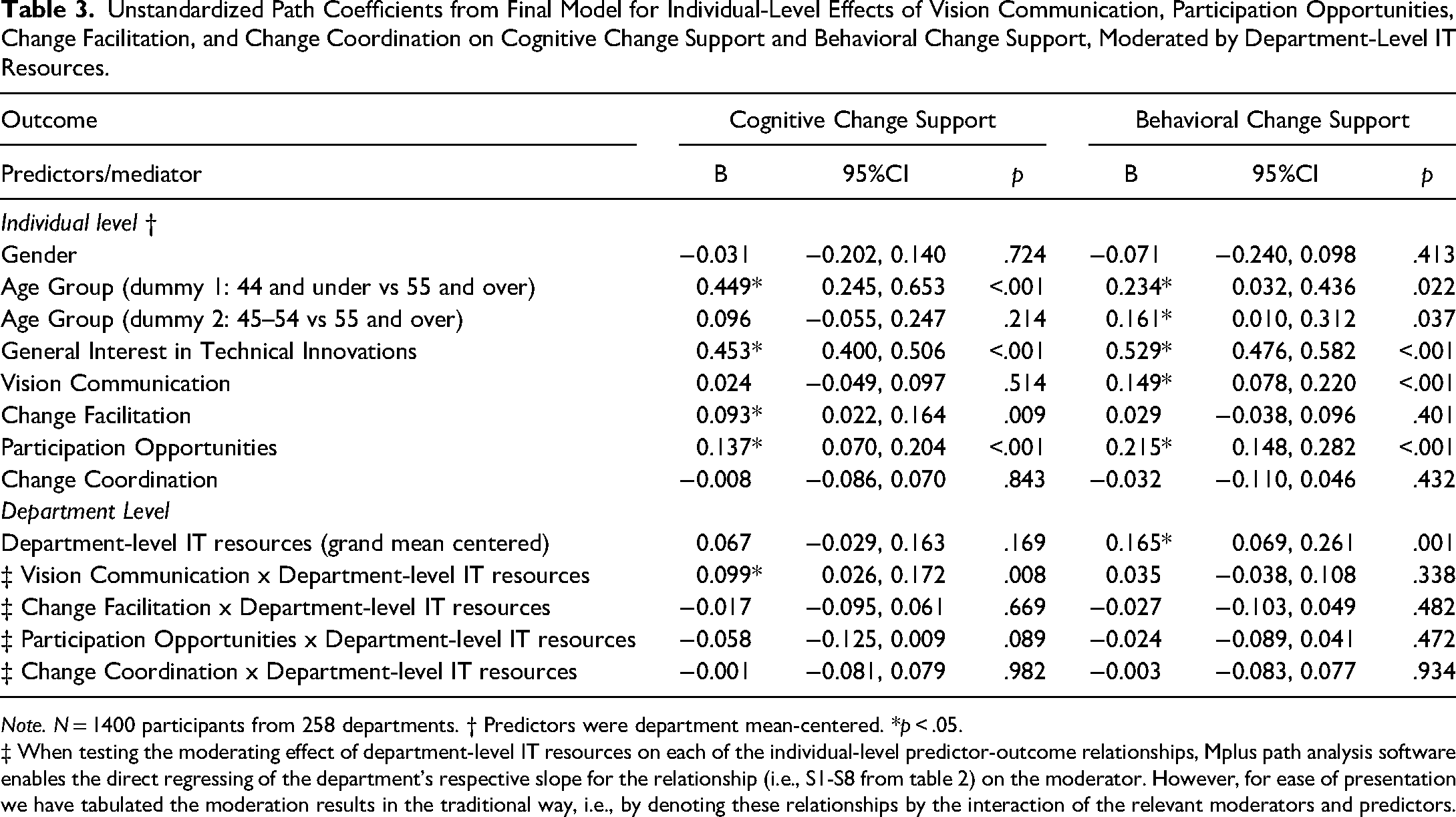
Note. N = 1400 participants from 258 departments. † Predictors were department mean-centered. *p < .05.
‡ When testing the moderating effect of department-level IT resources on each of the individual-level predictor-outcome relationships, Mplus path analysis software enables the direct regressing of the department's respective slope for the relationship (i.e., S1-S8 from table 2) on the moderator. However, for ease of presentation we have tabulated the moderation results in the traditional way, i.e., by denoting these relationships by the interaction of the relevant moderators and predictors.
Model fit was successively improved by adding our individual-level control variables (model 2) and then, in support of Hypotheses 1–4, by adding paths from each predictor to the outcomes at the individual-level (model 3 vs. model 2: ΔChi-sq = 189.682 on Δdf = 8, p < .001).
Beyond the control variables (see Table 3), there were significant positive main effects of participation opportunity (B = 0.137, p < .001) and change facilitation (B = 0.093, p = .009) on cognitive change support, as well as of participation opportunity (B = 0.215, p < .001) and vision communication (B = 0.149, p < .001) on behavioral change support. Collectively, the predictors explained a further 5% of the original individual-level variance in cognitive change support and a further 11% of the original individual-level variance in behavioral change support. Hence, the present results provide support for H2 (participation opportunities), as well as partial support for H1 (vision communication) and H3 (change facilitation), but do not support H4 (change coordination). Having allowed the effects of the process factors – i.e., vision communication, change facilitation, participation opportunities, and change coordination – upon each outcome to vary by department, and modeling the respective covariances, we then added paths at the department level from IT resources to each outcome (model 5). This significantly improved model fit (model 5 vs. model 4: ΔChi-sq = 12.061 on Δdf = 2, p = .002), with department-level IT resources being a significant explanatory variable for department-level variance in behavioral change support (B = 0.165, p = .001).
Finally, we allowed department-level IT resources to moderate the effects of vision communication, change facilitation, participation opportunities, and change coordination on each outcome (model 6). There was a significant effect of department-level IT resources upon the slope of the vision communication/cognitive change support relationship (B = 0.099, p = .008), explaining 40% of the slope variance. The relationship was enhanced at higher levels of department-level IT resources (see Figure 2), offering partial support for Hypothesis 5. A test of the simple slopes indicated that at relatively high levels of department-level IT resources (taken as the 84th percentile) vision communication had a significant positive effect on cognitive change support (B = 0.123, p = .020); this was not the case at relatively moderate levels (B = 0.024, p = .514) and at relatively low levels (B = −0.075, p = .151) of department-level IT resources. However, department-level IT resources did not explain significant slope variance in the effect of vision communication on behavioral change support, nor did it have a significant effect on the relationships of change facilitation, participation opportunities, or change coordination with either outcome — hence there was no support for Hypotheses 6 to 8.
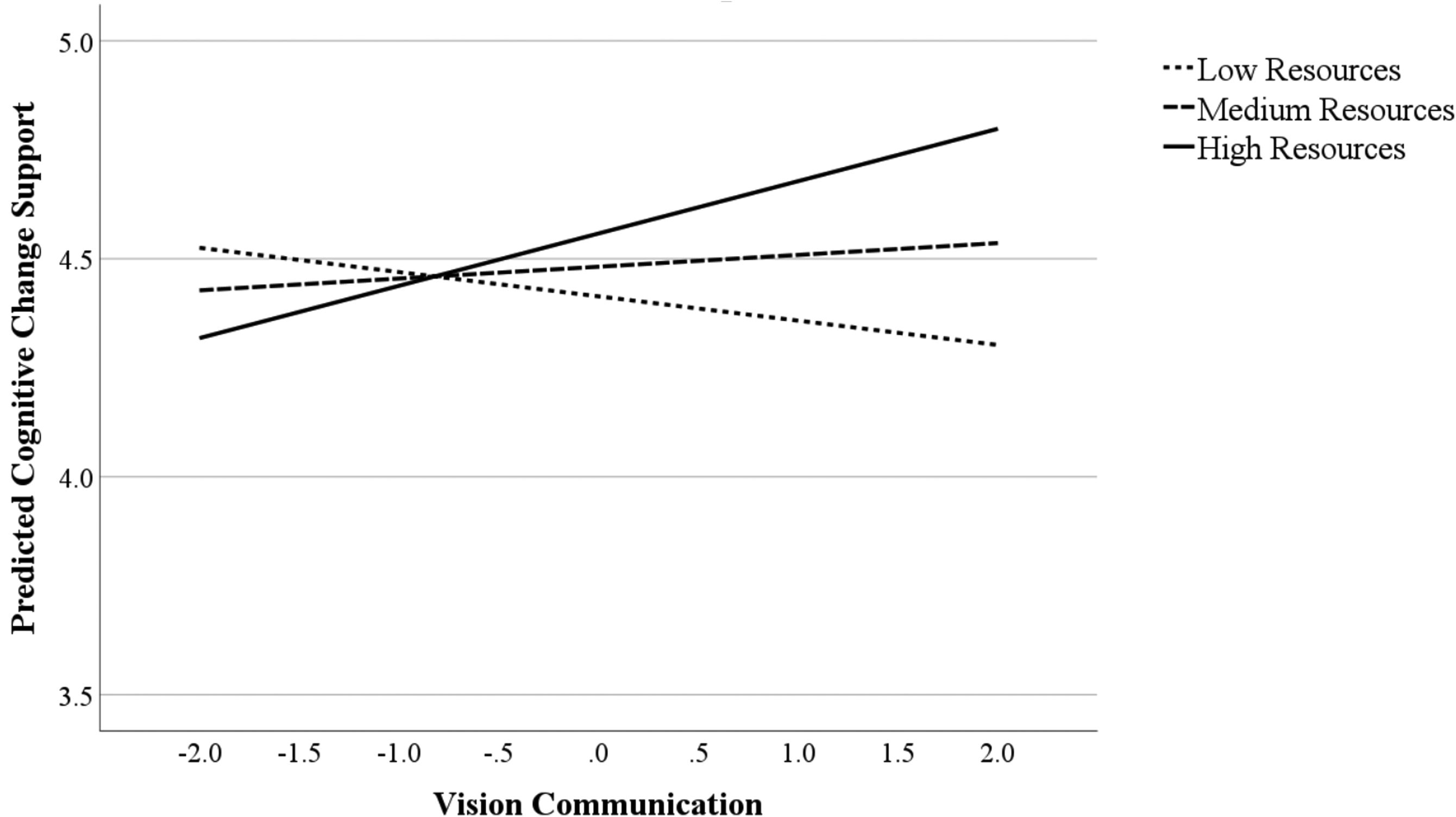
Effect of department mean-centered vision communication on predicted cognitive change support (adjusted for other covariates within the model), moderated by department-level IT resources.
Regarding our supplementary analyses, rerunning the final model without the control variables present did not change the pattern of the results nor the conclusions drawn. The model fit statistics and path coefficients for these robustness checks are available on request.
Discussion
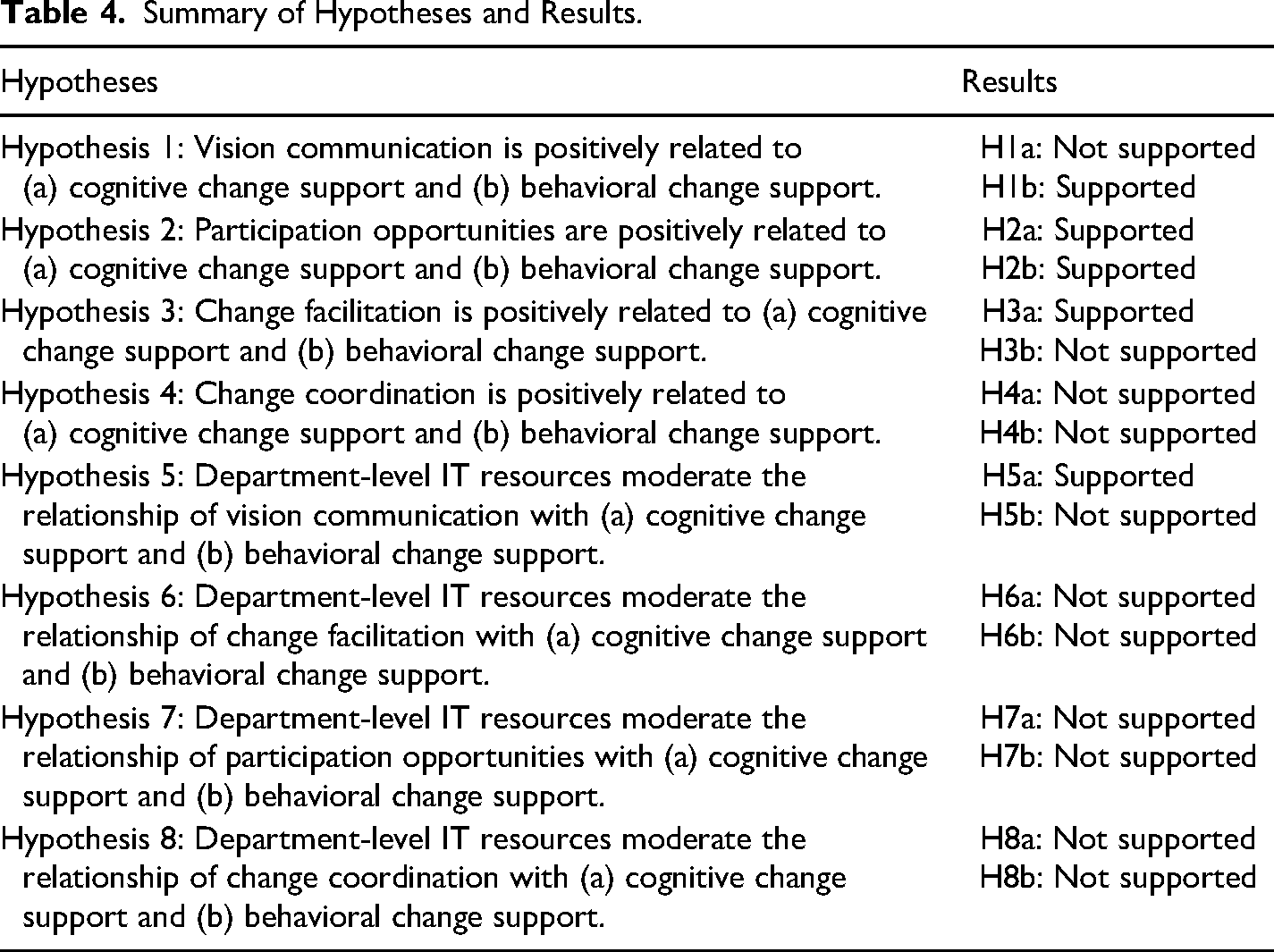
To better understand how to mobilize change support for top-down digital initiatives in pluralistic organizations, we examined the relationships between multiple process factors under management control and cognitive and behavioral change support of professors in a large-scale study of German HEIs. Acknowledging that the way change is managed is appraised by change recipients in light of their immediate work context, we additionally explored the moderating role of department-level IT resources for process–reaction relationships. Overall, the simultaneous examination of the process factors and distinction of cognitive and behavioral change support helped to identify specific process–reaction relationships and explain variations in professors’ change support (see Table 4). Beyond providing insights into the relative importance and functions of process factors, the results point to the need to consider the department-level context as a boundary condition and also change-related dispositions of the change recipients to successfully manage change. The fact that our hypotheses are often not completely supported points to added value of studying process–reaction relationships in a simultaneous and fine-grained manner and provides important knowledge for future studies and applications.
Summary of Hypotheses and Results.
Research Implications
Advancing Knowledge on Process–Reaction Relationships
We advance research on change process–reaction relationships (Bouckenooghe et al., 2021; Oreg et al., 2011) by studying multiple process factors at the same time and examining the relative strengths of their relations to cognitive and behavioral change support. Consistent with reviews identifying antecedents of reactions to change (e.g., Oreg et al., 2011; Oreg & Berson, 2019), we find that vision communication, participation opportunities, and change facilitation as process factors under management control are significantly related to change support. Moreover, in line with previous research distinguishing components of change reactions (e.g., Oreg, 2006; Oreg et al., 2011), our results confirm that cognitive and behavioral support are related yet distinct components of change support. The fact that not all hypothesized relationships are supported highlights that the higher resolution achieved by differentiating components of change reactions provides novel insights into how these process factors have varied relationships with what recipients think about the change and with how supportive they behave.
In particular, we found that only participation opportunities had significant relationships with both cognitive and behavioral components of change support. This result provides further evidence for the importance of participation opportunities as a process factor — especially in top-down change initiatives — to provide organizational members a “voice” and nudge them to actively engage with new initiatives (Kim et al., 2011; Lines, 2004; Wanberg & Banas, 2000). In contrast, change facilitation was significantly related only to cognitive change support, indicating that the explicit provision of guidance and assistance by the organization is associated with a more positive evaluation of the change, yet not automatically with showing change-supportive behaviors. Also, while change coordination might be particularly challenging for HEIs’ top management due to departments that work largely independently of each other (Han & Zhong, 2015; Hüther & Krücken, 2018), our results show that change coordination does not explain unique portions of variance in cognitive or behavioral support beyond the other process factors. This may indicate that change coordination might not be as relevant for how professors think or act about the change or that the coordination activities were not visible or strong enough to make a difference in how professors reacted to the digital change initiative.
Regarding vision communication (e.g., Oreg & Berson, 2019; Stouten et al., 2018), our results reveal a significant relationship with behavioral change support, which lends support to the uncertainty reduction function of visions (Venus, Stam et al., 2019). That is, communicating a vision can help to better understand which behaviors are needed to support the digital transformation and, hence, is associated with more change-supportive behaviors. Moreover, in the second step, our findings show that the relationship between vision communication and cognitive support becomes more positive with increasing department-level IT resources, attaining statistical significance only with higher IT resources. Hence, our results extend research on underexplored group-level boundary conditions of vision communication. Aligned with recent research on implementing change (Kanitz et al., 2022) and change appraisals (e.g., Fugate & Soenen, 2018; Oreg et al., 2018), the results indicate that a “misfit” between the communicated vision and the available department-level IT resources can impede the positive effect of vision communication on cognitive change support. As the inconsistency between the desired changes and the available IT resources within the department increases with department-level IT resources at medium or lower levels, the relationship of vision communication and professors’ change support is weakened — even trending towards a negative direction. Whereas prior research has mostly focused on the positive effects of vision communication (e.g., Oreg & Berson, 2019), our study shows that for understanding the effects of vision communication, it is important to account for specific group-level factors (e.g., change-related resources) as relevant boundary conditions. By ignoring such group-level factors, we may draw an overly pessimistic or optimistic picture of what can be accomplished by communicating visions. Instead, our results emphasize that we need to better understand the immediate working contexts in which process factors such as vision communication unfold their positive effect or do more harm than good (Oreg, 2006).
In addition to the identified process-reactions relationships, our results point to relevant relationships of general interest in technical innovations with cognitive and behavioral change support of professors. Hence, change-related dispositions of change recipients — such as general interest in technical innovations in the case of digital change initiatives — also relate to how they think about digital change and whether they show more change-supportive behaviors for digital change. As such, these findings lend further support to previous research suggesting change recipients’ dispositions as relevant factors influencing their change reactions (Oreg et al., 2011; Sverdlik & Oreg, 2022; Vakola et al., 2013). At the same time, our findings emphasize that process factors under management control can explain variance in change support beyond change recipients’ dispositions and hence, highlight that the way the change is managed presents a viable way for organizations to actively foster change support.
Extending Multilevel Research on Reactions to Change
Our findings clearly advance multilevel research on reactions to change (e.g., Park et al., 2011; Rafferty & Jimmieson, 2010; Shin et al., 2012) and support the conceptualization of reactions to change as a multilevel phenomenon (e.g., Rafferty, Jimmieson & Armenakis, 2013). By identifying department-level IT resources as a group-level boundary condition for vision communication, our results support the notion that recipients react differently to change processes depending on their shared internal contexts (e.g., Johns, 2006; Self et al., 2007). Although our focus was on the cross-level moderating effect of department-level IT resources, the present results also point to differential effects of context factors on cognitive and behavioral components of support at the department level. Indeed, our analyses reveal an exploratory positive effect of IT resources on behavioral support at the department-level. This result shows that the collective appraisal of IT resources within the departments explained differences in behavioral support between departments. In other words, available IT resources may provide organizational members with a context in which they are more likely to enact supportive behavior and experiment with digital technologies. These findings are an additional argument for a context-sensitive understanding of process–reaction relationships in organizational change research (e.g., Herold et al., 2007; Johns, 2018; Self et al., 2007).
When considering the multilevel structure of our data, a large portion of the variance of the change process factors and professors’ reactions was rooted at the individual level. Whereas this finding underscores the relevance of the individual-level perspective employed in studying reactions to change (Oreg et al., 2011), it also may be explained by the research setting of German HEIs. In particular, professors in German HEIs are organized in largely autonomous departments and cooperate within departments to manage a broad range of department-level issues largely independent of the HEI's top management. Yet, German HEIs are also characterized by strong chair sub-cultures within these departments (Hüther & Krücken, 2018). That is, the chairs — which are sub-units of the departments and are directly governed by one or two full professors — develop their own specific working contexts, which may reduce the potential for strong collective psychological processes at the department level. At the same time, substantial shared perceptions emerged for department-level IT resources, which are managed primarily at the department level. Taken together, these findings suggest that researchers should think carefully about the modeling of specific constructs at the appropriate level in their research context, and that researchers may start building models with the most granular levels of nesting (e.g., team- or department-level).
Practical Implications
While the German HEI context has its peculiarities, our research offers important implications for managing digital change in HEIs and other organizational contexts in which top-down change is strongly dependent on active change support of the recipients. For example, this can be the case in organizations with highly decentralized structures or with a broad portfolio of different products and/or services, or in organizations with rather autonomous branches. As in German HEIs, management of top-down change initiatives in pluralistic organizations will have to focus on designing the change process in a way that the recipients will react with change support. Whereas our study provides guidance on how process factors under management control can help to foster change support in multiple ways, it also reminds to be aware of contextual effects and change-related dispositions of the change recipients which may help to explain why even well-designed change processes encounter low levels of change support.
Going beyond broad leadership styles in providing practical prescriptions for managing top-down change (Oreg & Berson, 2019), the current results reveal how specific process factors under management control can serve specific functions in fostering change support. As a consequence, we suggest that it is not enough to focus on one process factor in isolation. Instead, multiple process factors must be considered at the same time and in relation to the contextual and personal preconditions for a holistic understanding of how to mobilize different components of supportive change reactions.
First, our findings emphasize that creating participation opportunities holds great potential to increase both cognitive and behavioral change support. Specifically, involvement of professors in the planning and decision-making of digital transformation was positively related to both cognitive and behavioral change support. Hence, top management in pluralistic organizations is well advised to provide participation opportunities instead of trying to prepare detailed change plans in a top-down manner and to make change recipients follow these plans.
Second, facilitating change has significant potential for managing top-down change. Our results show that change facilitation positively relates to cognitive change support among professors. Therefore, providing change facilitation activities such as offering training and assistance for new digital teaching, or providing opportunities for experimentation with digital technologies, may help professors get to know and adopt new digital practices more easily.
Third, the differential results for vision communication as a key process factor hold important practical implications. In particular, vision communication was positively related to the behavioral change support of professors, which underscores its relevance for the top-down initiation of digital change in HEIs. When provided with a compelling vision of the digital transformation communicated by the top management, professors were more engaged in actively supporting the change. While this finding is consistent with previous suggestions of change research, our study highlights important boundary conditions of vision communication that must be considered for effective organizational change management. In particular, the significant cross-level moderation effect of department-level IT resources reveals that considering the change-related conditions in the departments’ immediate work context is highly relevant for the effectiveness of vision communication. In particular, the positive effect of vision communication on cognitive change support only unfolded at high levels of department-level IT resources. It was weakened when medium or lower levels of IT resources were present and when inconsistencies regarding the aspired vision and the available IT resources seemed to have emerged. Hence, process factors such as vision communication do not bring about more change support in every case. As perceived inconsistencies emerge, they even have the potential to evoke negative reactions (Kanitz et al., 2022). Hence, top management should ensure that sufficient levels of IT resources are available when they communicate their vision for digital change.
In addition to making use of process factors and considering potential conflicts with existing context factors, general interest in technical innovations as a change recipient's disposition was related to both cognitive and behavioral change support. While dispositions can by definition not be managed directly, a more promising strategy for effective change management may lie in identifying and engaging people with high levels of change-relevant dispositions. Hence, HEIs’ top management may look out for professors with a high general interest in technical innovations as they can make good candidates for change champions and can provide input and advocacy for fostering digital change throughout the organization (e.g., Fugate & Soenen, 2018; Kanitz et al., 2023; Vakola et al., 2013). Yet, our findings also suggest that process factors hold great potential to proactively mobilize change support beyond individual tendencies to show interest in and experiment with new digital technologies.
Limitations and Directions for Future Research
Our study faces limitations that need to be considered when interpreting its results and that may serve as starting points for future research. First, the cross-sectional design of the current study does not allow us to make causal claims about the identified relationships. That is, to what extent cognitive and behavioral change support were produced by the process factors cannot be determined based on the current data. However, prior research is clearly suggesting that the process of change is an antecedent of reactions to change (for seminal reviews see: Oreg et al., 2011; Rafferty, Jimmieson & Armenakis, 2013). A worthwhile endeavor for future research would be to employ longitudinal or experimental designs that provide causal evidence of the effects, as well as allow for a more complex analysis of mediating mechanisms. For example, longitudinal designs with three or more points of measurement would allow for a closer examination of the psychological mechanisms underlying the identified process–reaction relationships. In particular, previous research has shown the value of the theory of planned behavior (Ajzen, 1991) for more fine-grained analyses of psychological mechanisms mediating between process factors and explicit reactions of change recipients (e.g., Jimmieson et al., 2008; O’Connor et al., 2018; Straatmann et al., 2016). With knowledge of the psychological mechanisms suggested by the theory of planned behavior (Ajzen, 1991) – that is, whether the influence of the process factors on change support is mediated by how they affect the recipients in their evaluation of the change, in perceiving a social pressure in favor of the change, or in feeling control over the implementation of the change – tailored interventions could be developed to foster change support.
Second, while the overall sample size is high and a large number of departments are represented, the number of respondents within most departments is small. This compromises statistical power when allowing slopes to vary at the department level and testing differences between those slopes for process–reaction relationships. Hence, for future research interested in the department-level or organization-level variation of process–reaction relationships, larger individual-level samples within departments are recommended to increase the power for detecting such variation. Moreover, it should be noted that the data was collected as part of a larger research project. Specific hypotheses on the role of department-level IT resources have been developed after preliminary analyses had shown the benefits of going forward with a two-level data structure. To further confirm and increase confidence in the current findings, we call for more research testing cross-level moderations of process-reaction relationships with additional context factors (e.g., competition forces faced by the departments). Moreover, the theoretical perspective of change appraisals also points to studying the interplay of context factors with individual dispositions as a promising avenue for future research.
Third, our study relied on data from the same source, which can raise concerns about common method variance (CMV; Podsakoff et al., 2012). We implemented several remedies to reduce CMV concerns. For instance, we explicitly stated the voluntary and anonymous nature of participation in the survey and provided information about the goals of the study and data handling. We also explored how CMV may have influenced our results and found that the measured constructs were distinct and reliable. Moreover, it is argued that for complex analyses like testing our cross-level moderation effect, artificial inflation by CMV is less of a concern, since CMV rather leads to potential underestimations (e.g., Lai et al., 2013; Siemsen et al., 2010). Nevertheless, future studies that incorporate data from multiple sources can help to rule out CMV concerns and further our understanding of the formation of change support.
Fourth, we focused on cognitive and behavioral components of change support. However, we have not included the affective component, which is also argued to be an important component of change reactions (Bouckenooghe, 2010; Oreg, 2006; Oreg et al., 2011; Piderit, 2000). Research on affective change reactions is still in an early stage (Oreg et al., 2018; van Dam, 2018), with only a small percentage of studies explicitly dealing with the affective component (Bouckenooghe et al., 2021). Hence, with more research on the affective component becoming available, future research that also examines specific process–reaction relationships for affective reactions is highly promising. Correspondingly, we call for research that considers recently developed theoretical frameworks, such as the affect-based model of recipients’ reactions (Oreg et al., 2018), to build even more holistic models for understanding the process antecedents of various components of change support.
Conclusion
In pluralistic organizational contexts such as HEIs, top-down change initiatives are particularly challenging. With little ability to directly impose change, the top management is largely dependent on the change support of professors as change recipients and catalysts of change. The good news is that the way the change is managed shows significant relationships with change support beyond change recipients’ dispositions (e.g., general interest in technical innovations). In particular, three key process factors under management control (i.e., participation opportunities, visionary communication, and change facilitation) positively, but differentially relate to cognitive and behavioral change support. Moreover, the study reveals that the way the change is managed is appraised in relation to the opportunities and demands in the context. In particular, department-level IT resources serve as higher-level boundary condition for the relationship between vision communication and cognitive change support. These insights advance our understanding of process–reaction relationships and indicate that beyond making use of the relationships between process factors and change support, there is a need for considering the local resources change recipients have available.
Footnotes
Acknowledgements
We sincerely thank the editor and the anonymous reviewers for their constructive and valuable feedback on strengthening the contribution of our manuscript and refining our research model to focus on how process factors relate to cognitive and behavioral change support within the context of department-level IT resources as higher-level boundary conditions rather than following a more complex mediation model.
Declaration of Conflicting Interests
The authors declared no potential conflicts of interest with respect to the research, authorship, and/or publication of this article.
Funding
The authors disclosed receipt of the following financial support for the research, authorship, and/or publication of this article: This research was funded by the Bavarian State Institute for Higher Education Research and Planning (IHF) and did not receive any specific grant from funding agencies in the public, commercial, or not-for-profit sectors.

Notes
Appendix
Internal Consistency Reliability of Outcomes Scales.
| Scale | Multilevel Cronbach's α | Multilevel Ω | ||
|---|---|---|---|---|
| Ind. Level | Dept. Level | Ind. Level | Dept. Level | |
| Cognitive Change Support | 0.915 | 0.984 | 0.934 | 0.986 |
| Behavioral Change Support | 0.859 | 0.975 | 0.867 | 0.992 |
Note. N = 1400 participants from 258 departments; Ind. = individual; Dept. = department.