




Abstract
Employee adaptability is of crucial importance in today's dynamic business environments. Yet, we still have limited knowledge of how the effects of individual adaptability are influenced by the work environment, and leaders in particular. In light of Uncertainty Reduction Theory, we hypothesized that employees with high adaptability will be more trustful toward change management and more supportive of the change, particularly when Leader-Member Exchange (LMX) is high. At two points in time, we collected data from 244 employees working in companies undergoing substantial organizational changes. Our main findings support the theoretical model, offering important insights into the mechanisms and boundary conditions involved in employees’ change responses. Practitioners should beware that while individual adaptability is a central element for change responses, it also largely depends on social relationships within the work context (i.e., LMX), suggesting the need to stimulate both in order to promote the appropriate change response.
Employees’ ability to adapt to changing and novel situations in the workplace is of utmost importance in today's dynamic work environment. Organizations face increased internal and external pressures ranging from political instability and social changes to technological advances and evolutions in organizational structures and processes that result in a workplace characterized by novelty, unpredictability, and complexity (Baard et al., 2014). Continuous innovation, globalization, business growth, economic crises, and changing legislation require organizations—and their members—to be flexible and efficient in order to survive and thrive (Ployhart & Bliese, 2006; Shoss et al., 2012). This increasing turbulence has led to a growing need for an adaptive workforce, with employees who are open to change and able to cope with uncertain work situations (Baard et al., 2014; Carpini et al., 2017; Jundt et al., 2015). We follow Ployhart and Bliese's (2006) conceptualization of employee adaptability as an individual's inclination to be flexible, open-minded, resilient and ready to actively change or fit new, changing, or ambiguous work environments.
Whether it is technological adaptation, updating skills and expertise, or dealing with mergers and acquisitions, these changes all require individuals to demonstrate adaptability in ideas, values, and behaviors (Ployhart & Bliese, 2006). Employees are expected to proactively address the challenges that arise from change implementation, where employee adaptability is crucial for organizations undergoing change (Cullen et al., 2014; Van Dam, 2013). As employee behavior occurs within a social system, employees’ perceptions of the social relationships in which they are engaged at work should be taken into account (Sweet et al., 2015). However, we still know little about the interplay between individual adaptability and contextual elements, namely how leadership behaviors and perceptions about the organization shape the impact of adaptability during organizational change (van Dam & Meulders, 2021).
Whereas individual adaptability is likely to affect employees’ change responses (Ployhart & Bliese, 2006), organizational actions put forth by change agents, such as supervising managers, also play an important, facilitating role. The exchange relationship employees have with their supervising leaders, that is, the Leader-Member Exchange (LMX) relationship, should be an important factor in determining the positive impact of employee adaptability on responses to change. LMX theory (Dansereau et al., 1975; Graen & Uhl-Bien, 1995) and Uncertainty Reduction Theory (URT; Berger & Calabrese, 1975) emphasize the role of reciprocity and predictability as key concerns in interactions, particularly in uncertain situations.
The purpose of this study is to examine whether LMX enhances the impact of employee adaptability on his/her change responses, that is, their trust in management and support for the change in light of URT and LMX theory. We focus on change support because “focusing on building change support—rather than handling resistance when it arises—allows for a more proactive approach to change management” (Straatman et al., 2023, p. 5). This study contributes to the literature in several ways. First, it calls attention to adaptability as a key individual characteristic that contributes to how individuals interpret change efforts. Previous studies have shown the relevance of other individual differences, such as self-efficacy (Stokes et al., 2010) and dispositional resistance to change (Oreg, 2006), for employees’ change responses. Adaptability, conceptualized as a central change-oriented characteristic, should be a central determinant of change attitudes and behaviors (Van Dam & Meulders, 2021), especially in a macroeconomic environment characterized by unwavering pressure and heightened uncertainty. Additionally, given its malleability, it can be targeted, by both individuals and organizations, for improvement and development (Ployhart & Bliese, 2006), pointing to its practical value. Second, a significant portion of change research has focused on the change process itself, showing for instance that change communication (Oreg, 2006), change participation (Wanberg & Banas, 2000), and the perceived changes at the job and work unit level (Fedor et al., 2006) predict employees’ change responses. This study moves beyond this focus on the change process by taking into account how individuals and the relationships they develop at work strengthen their trust in change agents as well as their inclination to be supportive of the change. In doing so, we assume a person-situation interaction perspective and reinforce the importance of moving beyond the strategic planning of change and taking individuals—namely the interaction between their characteristics and the relationships they develop in the workplace—into account in order to successfully implement change efforts.
Employee Adaptability and Organizational Change Responses
Adaptability is considered a key determinant of individuals’ successful adjustment to changes in the environment (Ashford & Taylor, 1990; Ployhart & Bliese, 2006). This view considers individual adaptability as a state-like characteristic that involves cognitive (e.g., situational awareness), affective (e.g., emotional regulation), and behavioral (e.g., proactivity) features (van Dam, 2013) and is changeable through experience and training (O’Connell et al., 2008; Zaccaro et al., 2009) and includes both proactive and reactive elements (Ashford & Taylor, 1990; Huang et al., 2014). As an underlying personal capacity, employee adaptability allows workers to handle ambiguity, change, and uncertainty (Baard et al., 2014). This conceptualization of adaptability has become a centerpiece in the performance (Campbell & Wiernik, 2015; Baard et al., 2014) and career management (Hamtiaux et al., 2013; Johnston, 2018) literatures and has demonstrated its usefulness for change management (Cullen et al., 2014; van Dam, 2013; van Dam & Meulders, 2021).
Several studies have demonstrated the importance of individual differences as antecedents to workers’ change responses. Change attitudes have been predicted by state-like personal characteristics, such as resilience (Wanberg & Banas, 2000), self-efficacy (Stokes et al., 2010), change efficacy (Holt et al., 2007) and self-esteem (Ashford, 1988) as well as trait-like characteristics, such as dispositional resistance to change (Oreg, 2006), mastery orientation (Caldwell et al., 2004; Campbell, 2006), and core self-evaluations (Judge et al., 1999). However, only adaptability is in line with the central tenet of URT (Berger & Calabrese, 1975) that argues that it is the individual him/herself that proactively engages in sensemaking about potential futures. That is, adaptable individuals are better equipped to make sense of the actions of others and reduce uncertainty about future possibilities, including those pertaining to change efforts where uncertainty is heightened.
Employee adaptability should not be equated with actual change responses as it is conceptually and empirically distinct from other change-oriented constructs. Employee adaptability is distinct from change process constructs such as change-related uncertainty (Cullen et al., 2014), change communication or participation, and more importantly, predicts change reactions, such as resistance to change (van Dam & Meulders, 2021). Although it has not been empirically examined, the distinction between adaptability and dispositional resistance to change should also be addressed. Dispositional resistance to change highlights an individual's tendency to find change aversive across contexts (Oreg, 2003). Employee adaptability is broader in scope as it taps into an individual's willingness or motivation to change or fit diverse task, social, or environmental features (Ployhart & Bliese, 2006). Moreover, despite its dispositional facet, adaptability is malleable and prone to learning making it changeable through training and other experiences (van Dam, 2013).
Although employee adaptability appears to have great relevance during organizational change, only a few researchers have paid attention to its role in dynamic and changing work situations. For instance, in the context of new technology adoption, which always involves a certain degree of uncertainty, Cullen et al. (2014) observed positive relationships of employee adaptability with perceptions of organizational support, job satisfaction, and supervisor’ ratings of job performance. Relatedly, Van Dam and Meulders (2021) found that adaptability predicted employees’ resistance to organizational change 4 weeks later. These findings are aligned with the active sensemaking argument of URT, and therefore we predict:
It is equally important to understand the mechanisms through which adaptability leads to high levels of support to the change. We propose that trust in management is an important uncertainty reduction mechanism through which adaptability translates into change support. Trust is central for the dynamics of organizational change (Ford & Ford, 2010; Neves & Caetano, 2006) and expresses that, in uncertain situations, employees believe that the behavior of organizational agents will be consistent and directed toward helping organizational members (Matthai, 1989). It is an indicator of the sensemaking process that attempts to forecast and anticipate potential futures (Weick & Quinn, 1999) and therefore a reflection of the uncertainty reduction process. Extant evidence indicates that trusting those who are responsible for the change is an important aspect of organizational change processes and a prerequisite for employees’ cooperation with the change (e.g., Dirks & Ferrin, 2002; Oreg et al., 2011).
Trust has been defined as “the willingness of a party to be vulnerable to the actions of another party based on the expectation that the other will perform a particular action important to the trustor, irrespective of the ability to monitor or control that other party” (Mayer et al., 1995, p. 712). For successful change, it is crucial that employees have confidence in their change management's reliability and integrity, and accept their vision (Neves & Caetano, 2006). This confidence in the integrity and proposed vision implies the recognition that there is risk entailed in the interaction (Mayer et al., 1995) and a willingness to make yourself vulnerable to the actions of the other party in light of that recognition.
Employees who have little faith in those responsible for the change, can alienate themselves from the change and engage in active resistance against it (Oreg et al., 2011). Research has found significant relationships between trust and employees’ change responses. For example, Agote et al. (2016) found that trust in the leader was associated with both positive and negative emotional responses to organizational incidents while Neves and Caetano (2009) found a relationship between affective commitment to change and trust in the supervisor. Trust in management in particular has been associated with aspects of the change process, and most notably resistance to change, across different studies. Regardless of whether resistance was measured unidimentionally (Oreg, 2006) or taking into account its subdimensions—affective, behavioral, and cognitive (Van Dam et al., 2008)—the negative association between trust in management and resistance to change as well as its role as a mechanism linking context and resistance to change appears to be fairly stable.
In light of URT, we argue that employee adaptability is also an important precursor of trust in management, which in turn should promote change support. We expect personal factors to be involved in how employees make sense of change and of the intentions of change agents, as they may differ in how they interpret the situation. This should be then reflected in the levels of trust in change agents. Adaptability and trust both encompass a strong emotional component (alongside a cognitive dimension, McAllister, 1995; van Dam, 2013). Highly adaptable employees, who are flexible and generally positive about changes, are likely to also assess those responsible for the change positively. Since they fear change less and actively try to make sense of uncertain situations, they should be confident that those responsible for the change are capable and trustworthy, which should translate into more support for the change process itself. These arguments are also in line with the general view that adaptability is associated with a positive orientation toward (aspects of) the change as well as positive emotions in change situations (Ployhart & Bliese, 2006; Van Dam, 2013). As such, we propose that trust in management should, at least partially, explain the relationship between adaptability and change support. Hence, we predict:
The Moderating Role of LMX
While adaptability is likely to enhance employees’ positive responses toward organizational change (Ployhart & Bliese, 2006), the daily work context is also important as it sets the stage for change implementation (Van Dam et al., 2008). Adaptive behavior, like all employee behavior, takes place within the sociopolitical arena of an organization, and therefore, the quality of the social exchanges should serve as an important condition for employees’ responses to change (Sweet et al., 2015). There is growing awareness that supervising managers affect how employees perceive and respond to organizational change owing to their proximity and day-to-day collaboration with their subordinates (Oreg & Berson, 2011). Within the complexity of organizational change, supervising managers are well-positioned to affect their employees’ sensemaking of the change effort through the LMX relationship they develop with their subordinates (Furst & Cable, 2008; Van Dam et al., 2008).
Both LMX theory (Dansereau et al., 1975) and URT (Berger & Calabrese, 1975) support the notion that LMX can enhance employees’ initial inclination toward the change. Rooted in social exchange theory (Blau, 1964), LMX theory holds that supervisors, through an ongoing series of interpersonal exchanges, develop unique relationships with each of their subordinates, which affects important leader and member attitudes and behaviors (Dansereau et al., 1975; Graen & Uhl-Bien, 1995). In support of this claim, research has found that supervisors behave differently toward employees in high versus low LMX relationships; for instance, they are more likely to share information, delegate authority, set challenging goals, and provide development opportunities to subordinates in high-LMX relationships (Bezuijen et al., 2010; Dulebohn et al., 2012; Graen & Uhl-Bien, 1995). In turn, and strengthening the exchange relationship, employees who experience high-LMX relationships respond positively to their leader's behavior, as indicated by increased job performance, citizenship behavior, job satisfaction, and retention (Dulebohn et al., 2012; Martin et al., 2016). As such, high-LMX employees “pay back” their supervisors by engaging in reciprocal behaviors (Ilies et al., 2007).
Regarding organizational change situations, supervising managers are more likely to involve their high-LMX employees by providing additional information and creating additional opportunities to participate in the change process as they become part of their leader's personal network (Van Dam et al., 2008). An important aspect of high-quality LMX relationships is the mutual sharing and provision of information. As intermediates between the strategic and operational level, supervising managers are in the position to pass down relevant information about the change to their subordinates and will more readily do so to employees in high-LMX relationships (Graen & Uhl-Bien, 1995). This provision of information is especially important in times of organizational change (Oreg et al., 2011), given its potential to help reduce uncertainty. According to URT (Berger & Calabrese, 1975), the reduction of uncertainty is a general human drive that impacts, among others, information seeking behavior and reciprocity. Uncertainty refers to individuals’ perception of the number of future alternatives, whereby a greater number of perceived alternatives produces a greater sense of uncertainty and a stronger drive to reduce this uncertainty (Bradac, 2001). By involving their high-LMX subordinates in the change and providing them with important change information, supervising managers reduce employees’ sense of uncertainty by narrowing the range of future alternatives, particularly for those that are already more malleable and adaptable.
LMX theory and URT thus predict that employees in high-LMX relationships should experience less uncertainty and develop more reciprocity during situations of organizational change. Findings of previous studies indicate that work context factors in general, and LMX in particular, can serve as a facilitator of employee responses in change situations. For instance, LMX has been found to moderate the impact of HRM practices on resistance to change (Furst & Cable, 2008), and Sweet et al. (2015) noticed how the interaction of LMX with perceived organizational support contributed to the prediction of employees’ adaptive performance.
In sum, LMX appears to be an essential condition that fosters employees’ inclination towards change. We build on these arguments to put forth the hypothesis that the impact of adaptability on trust in management and change support will rely heavily on the nature of their LMX relationship with their current supervisor. The flexibility and readiness to adjust to change that characterizes highly adaptable individuals should translate into a more positive outlook of change, especially when grounded in a high-quality LMX relationship. When LMX is high, the context itself signals to employees that uncertainty about the future behavior of those responsible for the change implementation (i.e., supervisors) is low, thus strengthening the effect of their natural adaptive skills on trust in management and change support. When LMX is low, individuals would perceive the context as charged with uncertainty, as their relationship with the supervisor is merely transactional, and therefore, even adaptable employees will find it difficult to trust change management or demonstrate support to the change. Based on this reasoning and evidence, we developed the following hypotheses:
Given that we also predict that adaptability should influence support to the change via increased trust in management, we apply the same reasoning to argue that LMX not only moderates the relationships predicted in hypotheses 3a and 3b, but also the process (through heightened trust in management) via which adaptability affects employees’ change support. Therefore, one final hypothesis was developed, which describes the overall moderated mediation effects illustrated in the research model depicted in Figure 1:
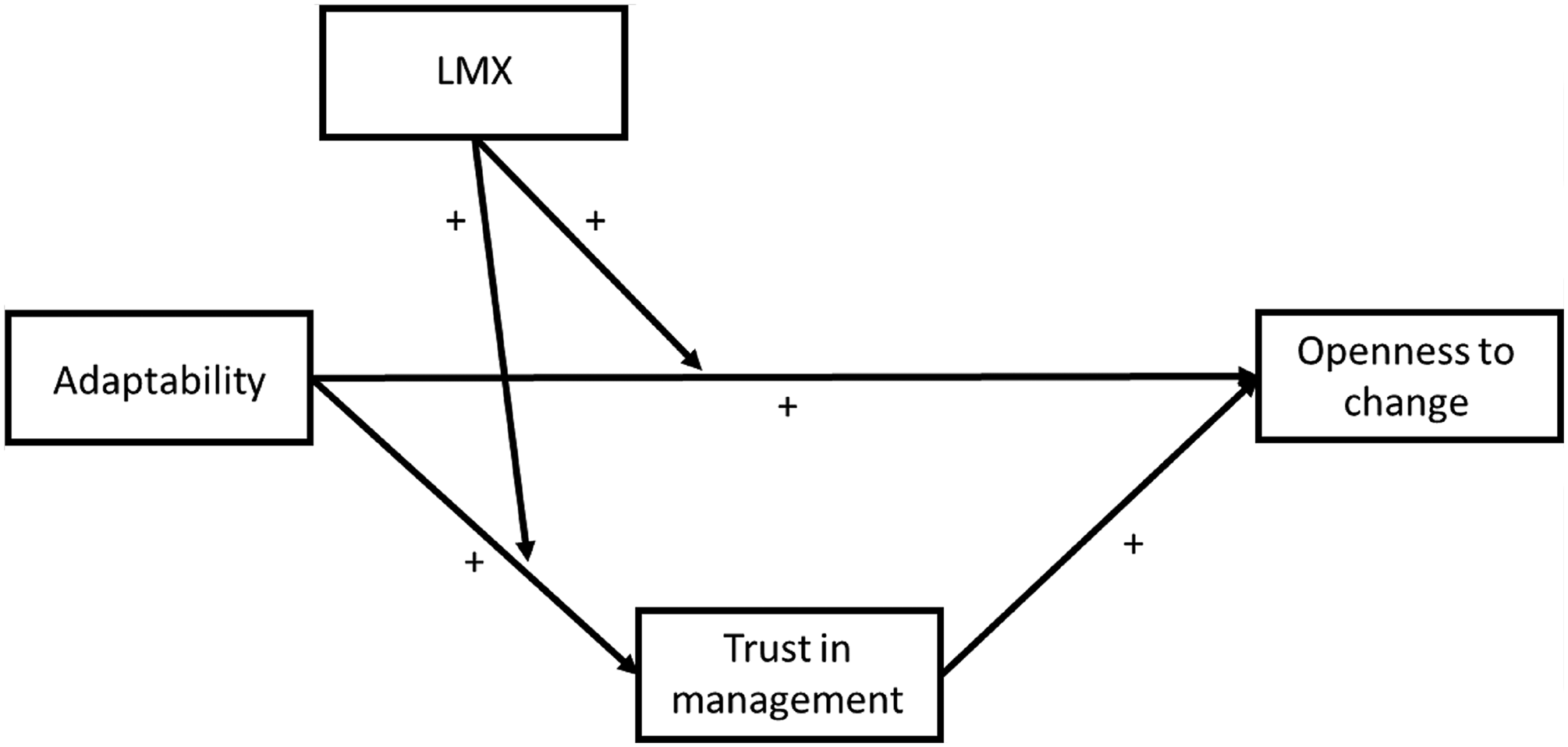
Research model.
Method
Sample and Procedure
Participants were Dutch employees of different organizations that were undergoing large-scale organizational changes. Data were collected at two times; a 4-week interval was chosen for several reasons. First, researchers have acknowledged that given the multitude of factors in place, there is no universal time lag to be used in organizational research (Menard, 2002). Second, there has been a call for the use of shorter time lags in the context of work, particularly when measuring attitudes and perceptions (Dormann & Griffin, 2015). Third, such a time lag is long enough to reduce the possibility that participants would remember their responses to the first survey (minimizing common method concerns); but not too long enough to cause substantial changes in work conditions or in the change process that might impact employees’ change responses. Fourth, and given the aforementioned points, we decided to follow the practice of prior organizational change research, which supported the usefulness of such interval (e.g., Neves et al., 2018). Respondents were recruited by approaching organizations and managers via email, telephone, or social media, explaining the purpose and conditions of the study. Approval was obtained from the Ethical Committee of the research institute that conducted the study (U2017/08969/HVM), implying that research participants were treated in accordance with the ethical guidelines of the American Psychological Association. Upon the organization's or manager's agreement to participate in the study, online questionnaires were distributed via a link in an email that was sent either directly to participants or through their supervisor or organization. In line with the APA ethical guidelines, the email explained the study's objective and emphasized that participation was voluntary and anonymous, and that participants could discontinue their participation at any point during the data collection. They were also informed that there would be a second data collection. In order to link the answers at times 1 and 2, participants made their own code by answering three questions (“What is your mother's year of birth?”; “What is your father's initial?”; “What are the two letters of your zip code?”). In this way, data collection was fully anonymous as it was not necessary to keep a list that linked codes to personal information.
In total 468 participants completed the questionnaire at time 1 and 244 participants completed the questionnaire at time 2 (response rate 52%). Attrition analyses with independent samples T-test indicated that there were no differences in demographic characteristics. However, dropouts reported a lower LMX relationship (3.49 vs. 3.69; t(466) = −2.74, p = .006) and more job insecurity (2.93 vs. 2.64; t(466) = 2.93, p = .004). The data of the 244 respondents who filled out both questionnaires were used for testing the research model. Mean age was 44.76 years (SD = 11.27); mean tenure was 13.95 (SD = 10.92); 40% were male. Education ranged from lower (28%) and higher (47%) vocational training to university (25%). Respondents reported that their organization was undergoing a change process that was either at the beginning (15%), in the middle (73%) or nearing the end (12%). The changes mainly related to restructuring (70%), with the possibility of involuntary turnover in 64% of the cases. In addition, the changes included mergers/take-overs (8%), and the introduction of new working methods (22%).
Measures
In line with Van Dam and Meulders’ (2021) measurement strategy, we used a five-point response scale, ranging from 1 (strongly disagree) to 5 (strongly agree). Our time 1 survey included demographic information and measures of adaptability, LMX, and trust in management. Our time 2 survey included measures of trust in management and change support. Because we are examining a process which includes mediating mechanisms with only two moments in time, method bias concerns might arise (Podsakoff et al., 2003). Thus, we measured our mediator at both times in order to minimize common method bias, as it allows us to compare time-lagged and cross-sectional versions of each part of our model. We examined a model with trust in management measured at time 1, which allowed us to test the time-lagged relationship between trust and change support; and we tested another model with trust in management measured at time 2, where it was possible to examine the time-lagged relationship between LMX and adaptability, and trust in management. McDonald's omega (ω) was calculated as an estimation of the scale's internal consistency.
Adaptability
To assess employees’ adaptability, Van Dam and Meulders’ (2021) 10-item Adaptability Scale was used; ω (time 1) was .91. An example item was: “I can quickly adapt to changes.”
LMX
Employees rated the LMX relationship with their supervisor using Graen and Uhl-Bien's (1995) seven-item LMX scale; ω (time 1) was .93. We chose the LMX-7 scale because it has strong psychometric properties (Gerstner & Day, 1997); it reflects “a relationship-based approach to leadership” (Graen & Uhl-Bien, 1995, p. 219), and meta-analytic evidence suggests its effects are similar to other LMX scales (Martin et al., 2016). Because the original scale uses multiple anchors (rarely-very often; not a bit-a great deal; not at all-fully; none-very high), we followed the procedure used by several LMX researchers (e.g., Eisenberger et al., 2010; Erdogan & Enders, 2007; Kacmar et al., 2003; Wayne et al., 2002), we changed the LMX anchors to strongly disagree–agree. An example item was “My working relationship with my supervisor is good.”
Trust in Management
Employees’ trust in management was measured with four-items based on Oreg's (2006) trust in management scale; ω was .91 (time 1) and .93 (time 2). We adapted the items by specifically targeting how management deals with the change effort. An example item was: “Overall I have the feeling that the people who are leading this change can be trusted.”
Change Support
To measure employees’ support to the change, we followed prior research (e.g., Straatman, 2023) and used Oreg's (2006) scale. Oreg (2006) originally argued that this is a “change attitude scale (…) involv(ing) positive and negative feelings towards the specific change, the behavioural items addressed employees’ intention to act against (or for, where negatively worded items were involved) the change, and the cognitive items involved employees’ evaluation of the worth and potential benefit of the change” (p. 85). Several authors have defended the notion of a continuum between support-resistance to change (Choi, 2011; Oreg, 2006; Oreg & Berson, 2011; Oreg & Sverdlik, 2011). Thus, this 15-item scale can be considered to measure either support or resistance to change. In this study, the negative items were recoded, such that a higher score would imply a more supportive attitude toward the change; ω (time 2) was .91. An example item was: “I think that it is good that the change is taking place.” Moreover, we treated the construct as unidimensional (Charoensukmongkol, 2017; van Dam et al., 2008; Walk, 2023) given that our main interest is in the interplay between adaptability and LMX rather than the examination of the nuances between cognition affect, and behavior. 1 To determine the structure of the change support scale we conducted two CFAs. A second-order change support model (χ2(87) = 330.88; comparative fit index [CFI] = .90; root mean square error of approximation [RMSEA] = .11; standardized root mean square residual [SRMR] = .07) presented a similar fit to the three-dimension model which separated the cognitive, affective, and behavioral components of change support (χ2(87) 330.88; CFI = .90; RMSEA = .11; SRMR = .07). When first-order and second-order models have equally good fits, the use of the second-order structure is recommended (Gerbing & Anderson, 1984).
Control Variables
Recently, Becker et al. (2016) argued that researchers should only include control variables that are theoretically relevant and potent, that is, those that predict at least one of the outcome variables. Based on the literature, we included job insecurity as a control variable. During organizational change, employees may develop concerns or insecurities regarding the continued existence of their job which likely affect their change responses (Ashford et al., 1989). Job insecurity was measured with a three-item scale of De Witte et al. (2010); ω (time 1) was .87. An example item was: “I think I will lose my job in the near future.” Additionally, organizational tenure was included as a control variable, as previous studies (e.g., Van Dam et al., 2008) indicate that higher tenured employees are inclined to oppose organizational change more than lower-tenured employees.
Analyses
The direct relationship between adaptability and change support was examined with linear regression analysis in SPSS. The other hypotheses were tested with bootstrapping analysis (Preacher et al., 2007) using Hayes’ Process macro (models 4 and 8) with 10.000 resamples (Hayes, 2018). We chose a bootstrapping approach given its robustness and accuracy in testing moderated mediation models (Preacher et al., 2007), particularly for smaller sample sizes (Shrout & Bolger, 2002; Hayes, 2013).
Before testing our hypotheses, we ran a series of CFAs to examine the distinctiveness of our constructs (see Table 1). We compared a four-factor model (with change support as a second-order construct) with a three-factor model (where we equated trust in management and LMX at time 1 as they presented the highest correlation), a two-factor model (where we equated all the variables measured at time 1), and a one-factor model where all variables loaded into a single factor. The best fitting model was the hypothesized four-factor model (χ2= 1189.25, df = 579, CFI = .90, RMSEA = .08, SRMR = .08). The average variance explained (AVE) and composite reliability (CR) were acceptable for all constructs (adaptability: AVE = .49, CR = .83; LMX: AVE = .66, CR = .90; trust in management: AVE = .71, CR = .88; change support: AVE = .55, CR = .91). The findings were similar when we substitute the time 1 measure of trust in management for the time 2 measure, demonstrating the robustness of our measurement model.
Means, Standard Deviations, Intercorrelations and Internal Reliabilty Estimates (in Brackets) of the Research Variables.
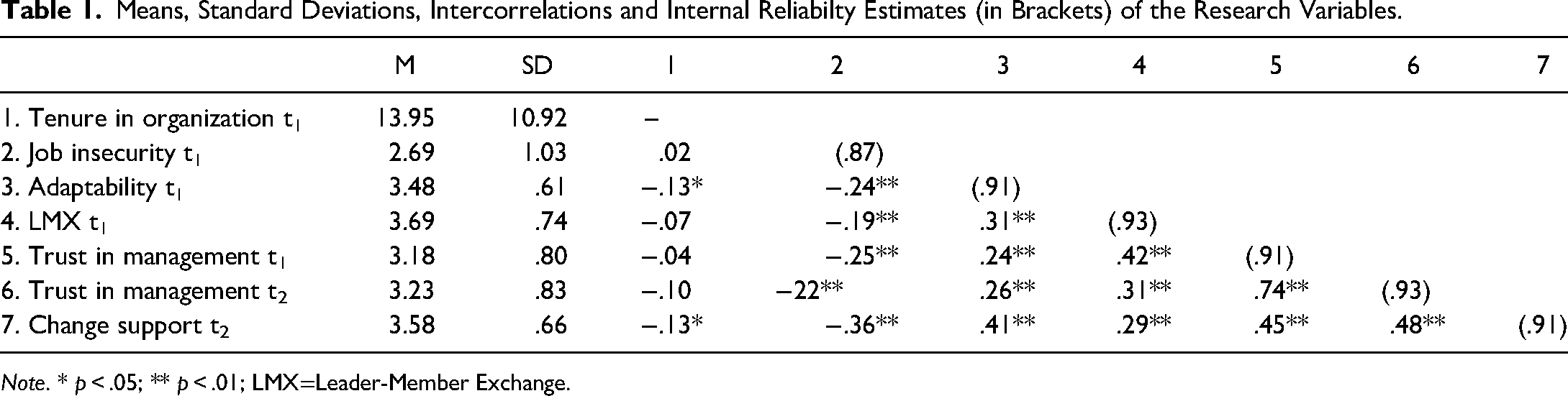
Note. * p < .05; ** p < .01; LMX=Leader-Member Exchange.
Results
Table 2 presents means, standard deviations, correlations, and internal reliabilities of the research variables. To ensure the findings were not affected by the inclusion of control variables, we ran our analytical models with and without them (Bernerth & Aguinis, 2016), and noted that the findings were similar. Below we present the outcomes of the analyses including the two controls: tenure and job insecurity.
Confirmatory Factor Analysis.
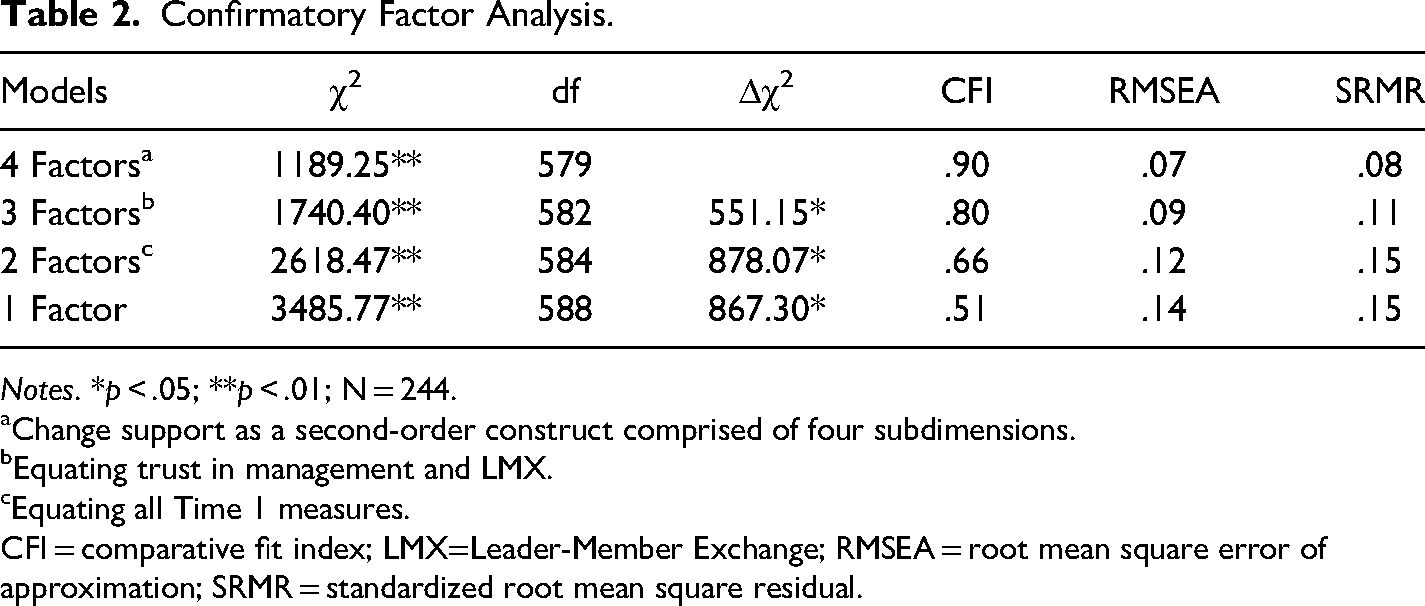
Notes. *p < .05; **p < .01; N = 244.
Change support as a second-order construct comprised of four subdimensions.
Equating trust in management and LMX.
Equating all Time 1 measures.
CFI = comparative fit index; LMX=Leader-Member Exchange; RMSEA = root mean square error of approximation; SRMR = standardized root mean square residual.
The outcomes of the linear regression analysis used for testing hypothesis 1 showed that employee adaptability (B = .36, CI [.24, .49]) was a significant predictor of change support at time 2, thus supporting hypothesis 1.
To investigate hypothesis 2, predicting that trust in management mediates the positive relationship between adaptability and change support, two models were tested, with the mediator measured at times 1 and 2, respectively. First, we examined each equation separately. Adaptability related positively to trust in management, measured both at time 1 (B = .26, CI [.09, .42]) and time 2 (B = .29, CI [.12, .46]). Trust in management related positively to change support, regardless of whether it was measured at time 1 (B = .27, CI [.18, .36]) or time 2 (B = .28, CI [.20, .37]). The indirect effect of adaptability on change support 4 weeks later via trust in management was significant both when the mediator was measured at time 1 (B = .07, CI [.02, .13]) and at time 2 (B = .08, CI [.02, .15]). Together, these findings support hypothesis 2.
Before testing the remaining hypotheses, that is, interaction and moderated mediation effects, the predictors were mean-centered (Aiken & West, 1991). The results of the analyses for the final moderated mediation models (model 8; Hayes, 2018) are presented in Tables 3 and 4. As predicted in hypothesis 3a, LMX was a significant moderator of the relationship between adaptability and trust in management, both at time 1 (B = .21, CI [.08, .35]) and time 2 (B = .24, CI [.09, .39]). Simple slopes analysis (Aiken & West, 1991; Dawson, 2014) show that when LMX was high, the relationship between adaptability and trust in management was significant (+1SD; time 1: B = .29, CI [.10, .48]; time 2: B = .39, CI [.18, .59]); when LMX was low (−1SD; time 1: B = −.02, CI [−.21, .16]; time 2: B = .04, CI [−.16, .23]) the relationship was not significant. This provides support for hypothesis 3a. Figure 2 shows the interaction plots using the procedure recommended by Cohen et al. (2003).
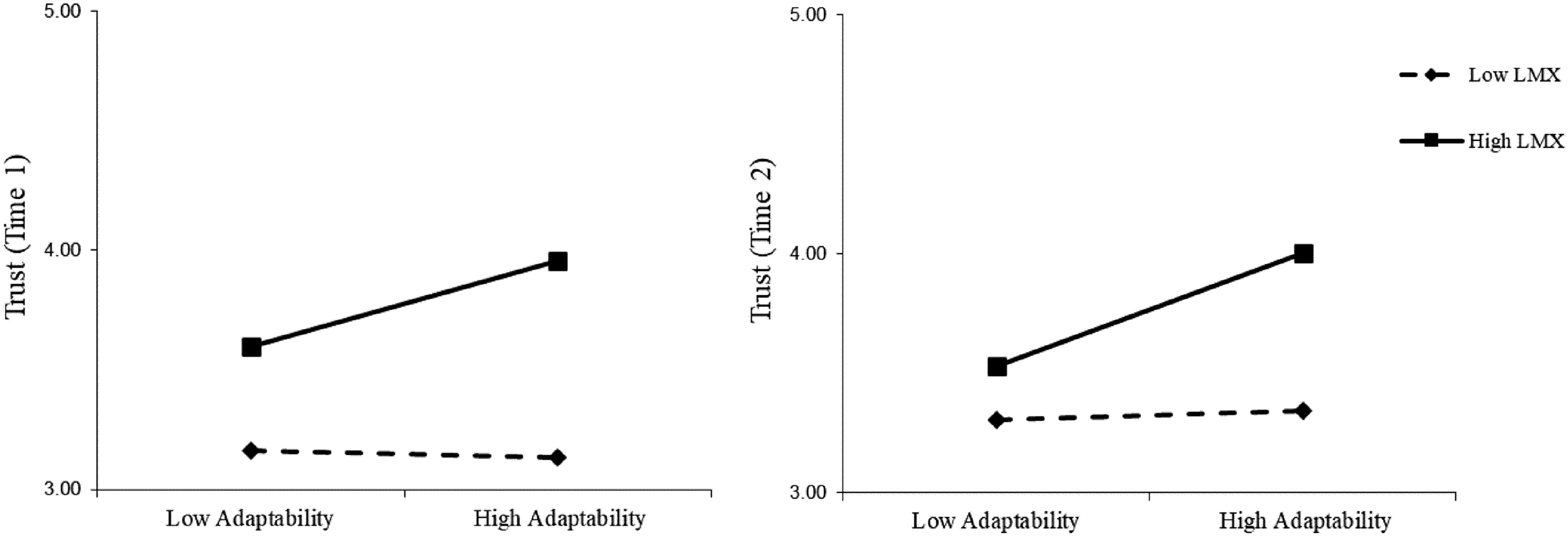
Interaction effects on trust in management (time 1 and time 2).
Outcomes Bootstrapping Analysis for Trust in Management (Model 8).
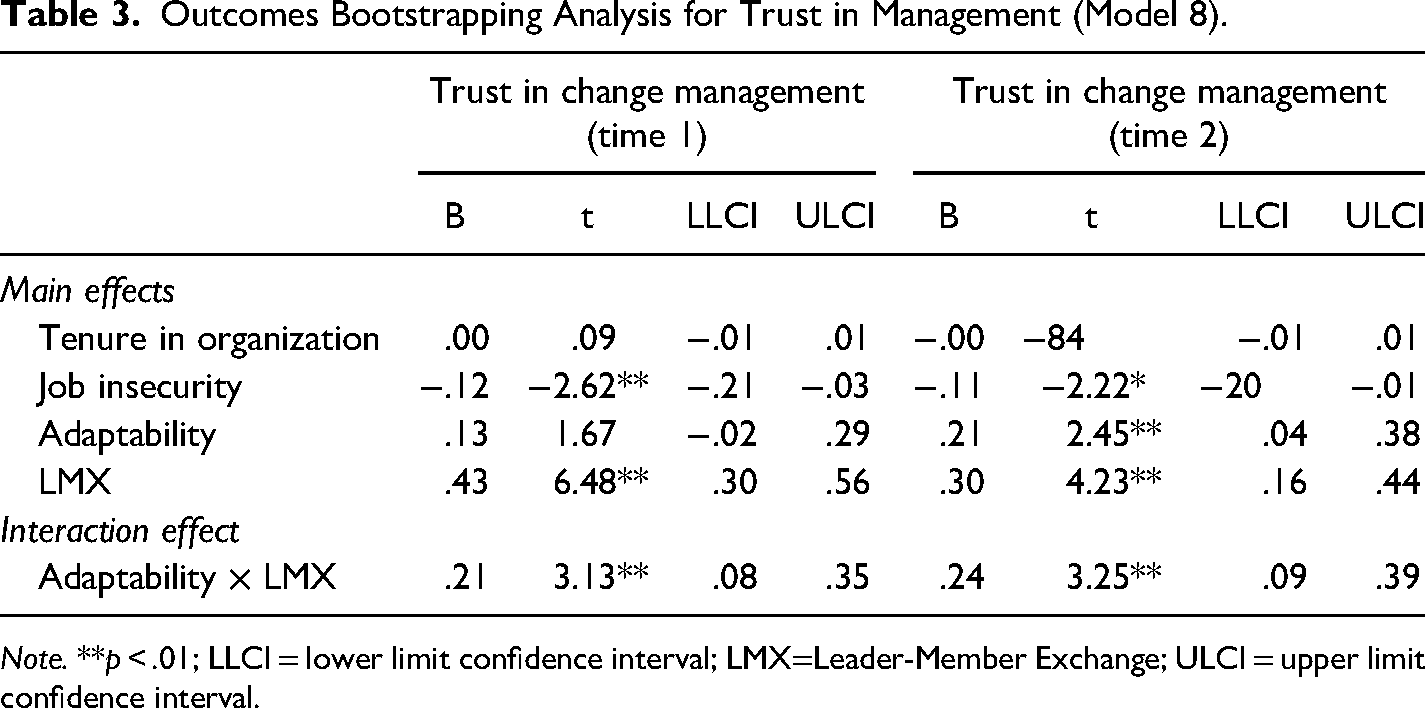
Note. **p < .01; LLCI = lower limit confidence interval; LMX=Leader-Member Exchange; ULCI = upper limit confidence interval.
Outcomes Bootstrapping Analysis for Change Support (Model 8).
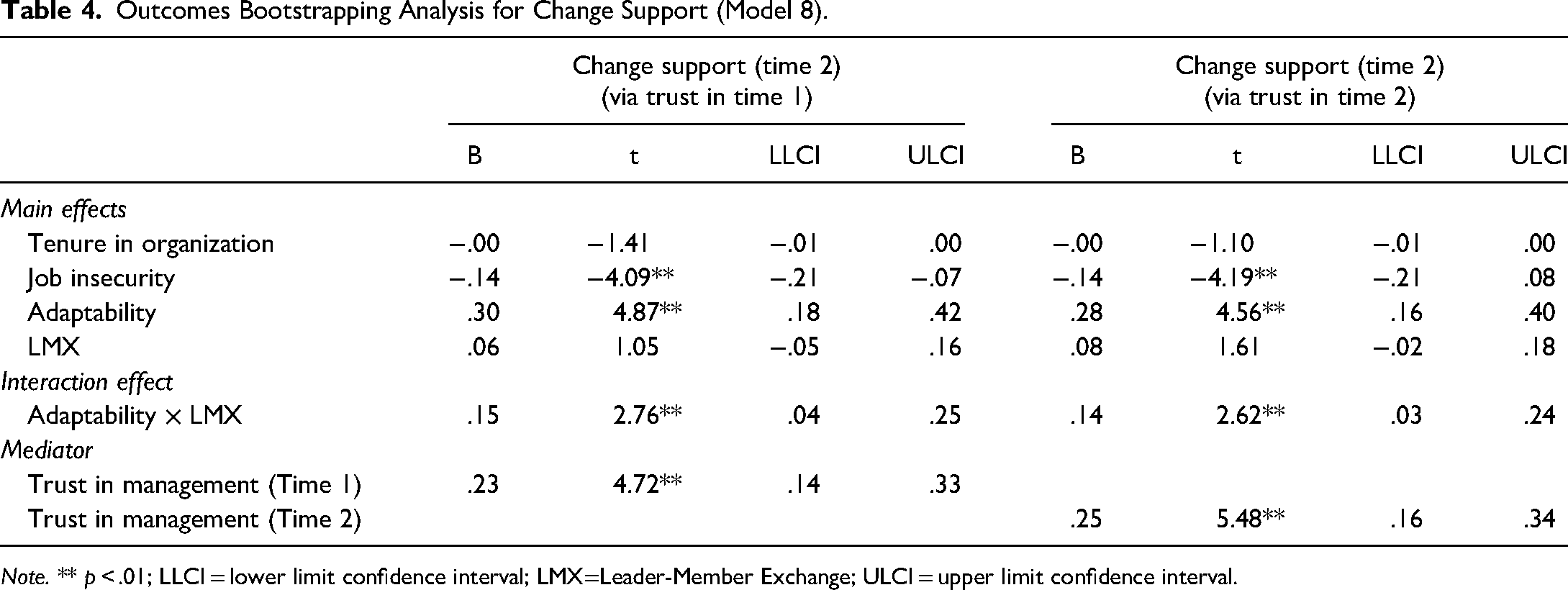
Note. ** p < .01; LLCI = lower limit confidence interval; LMX=Leader-Member Exchange; ULCI = upper limit confidence interval.
In line with hypothesis 3b, LMX also moderated the relationship between adaptability and change support 4 weeks later (B = .15, CI [.04, .25]). Again, simple slope analysis shows that when LMX was high, the relationship between employee adaptability and change support was stronger (+1SD; B = .41, CI [.26, .55]) than when LMX was low (−1SD; B = .19, CI [.05, .33]). The result was similar in the equation that included trust in management measured in time 2 (B = .14, CI [.03, .24]). When LMX was high, the relationship between employee adaptability and change support was stronger (+1SD; B = .38, CI [.23, .53]) compared to when LMX was low (−1SD; B = .18, CI [.04, .31]). These findings support hypothesis 3b (see Figure 3).
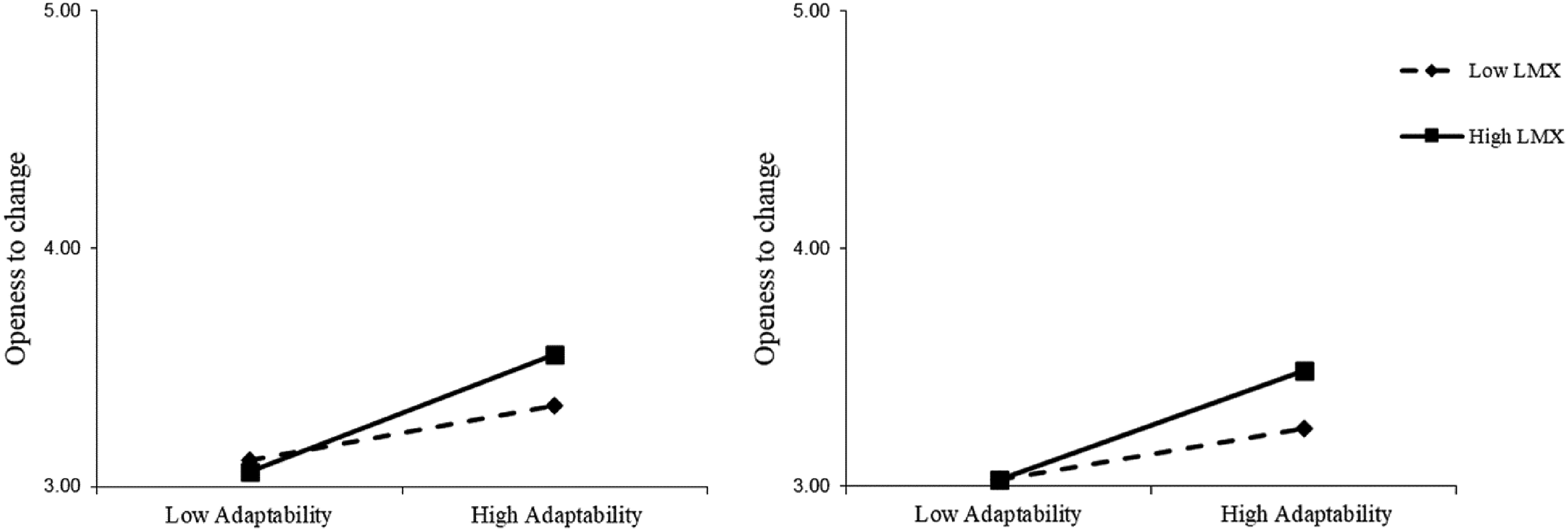
Interaction effects on change support (trust measured at time 1 and time 2).
In order to examine our moderated mediation hypothesis (hypothesis 4), we looked into the indirect effect at low (−1 SD) and high (+1 SD) levels of the moderator and the index of moderated mediation (Hayes, 2013). When LMX was high, the effect of adaptability on change support via trust in management was significant (+1SD; trust at time 1: B = .07, CI [.02, .14]; trust at time 2: B = .10, CI [.03, .18]); when LMX was low, the effect was not significant (−1SD; trust at time 1: B = −.01, CI [−.08, .05]; trust at time 2: B = .01, CI [−.07, .07]). The index of moderated mediation was significant for both models that measured respectively trust at time 1 (B = .05, CI [.01, .13]) and trust at time 2 (B = .06, CI [.01, .14]), supporting hypothesis 4. Our models explained 37% and 39% of the variance in change support, respectively.
Discussion
Building on Ployhart and Bliese's (2006) conceptualization of individual adaptability, and under the guidance of URT and LMX theory, this study provides new insights into (a) the role of individual adaptability for employees’ responses to an ongoing organizational change and (b) the work conditions (i.e., the LMX relationship) under which adaptability fosters employees’ change support.
First, the findings support the relevance of adaptability as an individual characteristic for employee change responses. Highly adaptable employees were more supportive to the change that was taking place in their organization, as measured one month later, compared to employees with low adaptability. This finding supports earlier research showing that better adapters show less resistance to change (Van Dam & Meulders, 2021), are more satisfied with their jobs, and are less likely to quit the organization (Cullen et al., 2014; Parent et al., 2012). Because employees’ support toward the change is an important prerequisite for change effectiveness (Oreg et al., 2011; Wanberg & Banas, 2000), this implies that employee adaptability contributes to successful change implementation. As such, this study provides empirical evidence for the assertion (e.g., Ployhart & Bliese, 2006; Shoss et al., 2012) that employee adaptability is crucial for organizations’ adjustments to dynamic and uncertain environments.
Second, our findings also identified one underlying mechanism of the adaptability-change support relationship. Compared to low adaptable employees, highly adaptable employees reported more trust in the managers who were responsible for the change, which in turn was an important precursor for their change support. Highly adaptable employees are flexible, open-minded, resilient and ready for change (Ployhart & Bliese, 2006), and therefore they are likely to appraise change situations differently than low adaptable employees (Fugate & Soenen, 2018). In doing so, we add to previous research (e.g., Dirks & Ferrin, 2002; Oreg, 2006), which asserts that trust is indeed an important mechanism for change acceptance. However, there are also studies that look at the proposed relationships in a different light. For example, Yean et al. (2022), relying on Social Cognitive Theory, propose that trust should promote more adaptability, which in turn would be associated with change readiness. Despite the cross-sectional design, which comes with its own set of limitations, their findings are reconcilable with our own given the malleability of adaptability (van Dam, 2013). We can foresee a positive spiral where adaptable individuals are able to reduce uncertainty by being more trusting, which in turn, via learning and modeling, helps them become even more adaptable. This possibility again reinforces the need for additional studies using designs that allow us to examine the nuances of the adaptability-trust dynamics and its implications for change-oriented behaviors.
Third, and directly related to the main goal of this study, LMX played an important role in these relationships. The findings suggest that LMX influences (i.e., moderates) how adaptability is transformed into higher levels of trust in management and change support, the latter also via increased trust (i.e., moderated mediation effect). This is aligned with Mayer et al.'s (1995) organizational trust model, as our findings suggest that, in order to determine whether employees trust change agents, we need to take into account personal characteristics, such as adaptability, as well as situational factors, such as the quality of the relationship between subordinates and supervisors. Highly adaptable employees who were in high-LMX relationships experienced more trust in the management responsible for the change, regardless of when trust was measured (time 1 or time 2). In support of the uncertainty reduction argument, adaptable employees’ responses to change rely heavily on the quality of the relationship they have with their supervisor. Interestingly, when LMX is low, the responses of individuals with high and low adaptability are quite similar. Together, the findings indicate that employee adaptability has a major role for employees’ change responses, especially when the quality of the LMX relationship is high.
Limitations and Implications for Future Research
This study has a number of limitations that should be addressed in future research. One limitation of our study concerns its partly concurrent design, in particular regarding the role of the mediator, that is, trust in management, and the directionality of its relationship with other variables. To minimize this limitation, we measured trust both at times 1 and 2. Model tests with the subsequent trust measure resulted in similar outcomes, and therefore reduced concerns about the design of our study. Moreover, our hypotheses are based on theory and prior empirical evidence, which supports the predicted relationships. Nonetheless, future studies should conduct a cross-lagged panel design and/or obtain data at three times, to avoid using concurrent data, and use different time lags in order to understand the complex process surrounding the development of change attitudes across time.
Although we were interested in the employees’ psychological processes and personal account of change, a second limitation relates to the use of only one source (i.e., employee), which could affect observed relationships. For example, one can imagine that supervisor ratings of employee support might diverge from the employees’ self-assessment. Although the implications of common-method bias are subject of discussion (Spector, 2019), we have used three strategies to deal with it: (1) we collected data across two waves as a means to prevent source bias (Podsakoff et al., 2003), (2) we examined the mediator at both times 1 and 2, revealing the same pattern of findings, and (3) we tested our model including a common method factor (another remedy proposed by Podsakoff et al., 2003). As expected, after the inclusion of the CMV factor, model fit improved (χ2(543) = 1012.07, CFI = .92, RMSEA = .06, SRMR = .08), signaling that some extent of method variance is present, which is expectable given that we rely on a single source of information. Common method variance explained 12.10% of the variance in the model, clearly below the 25% threshold (Williams et al., 1989). Nonetheless, future research should try to include other sources, such as ratings from peers and supervisors.
Moreover, and as one of our reviewers pointed out, we changed the original response-format of some of the scales so that they all use a five-point Likert type scale. Given that our study's main measure is captured by the adaptability scale developed by Van Dam and Meulders (2021), we followed their procedure and applied their measurement strategy for all the scales. Nonetheless, such approach may also increase the possibility that some of the covariation observed among the constructs is explained by the consistency rather than the content of the scales (Podsakoff et al., 2003). However, other authors do not share such concern and minimize the potential impact of changing from a seven- to a five-point scales (Heggestad et al., 2019). A third potential limitation is related to the dropout analysis. Although there were no demographic differences found between dropouts and those that completed both surveys, they did exist for LMX and job insecurity. Such differences may signal that more extreme cases (of either poor relationships with the leader or heightened job insecurity) might have been excluded from our model. Future research should attempt to examine more closely those that feel are more at risk, either due to poor relationships or intensified insecurity, as their responses might vary.
A fourth potential limitation concerns how we examine change processes. Given the clear overrepresentation of restructuring processes (70%), we did not take into account in our model the nuances that might come with different types of change. However, research conducted during a major restructuring process has shown that it is the appraisal of change, namely threat appraisal (i.e., concerns about potential future losses), that influences employee withdrawal (Fugate et al., 2012). This implies that we expect the same pattern of relationships to emerge, regardless of the type of change under examination. However, the strength of the associations might vary. For example, the moderating effect of LMX might be stronger in changes that require more from employees as such events might come with additional uncertainty, thereby enhancing the importance of establishing high-quality relationships with one's supervisor. Future studies should attempt to examine the challenges that come with specific types of changes as some might be charged with additional uncertainty (e.g., downsizing).
Despite these limitations, we believe that this study has several meaningful implications for future research. For example, this study complements work on adaptive performance (Baard et al., 2014; Jundt et al., 2015; Pulakos et al., 2000), by bringing adaptability as a malleable individual difference construct to this important domain of organizational behavior. While it is generally noted that employee adaptability is crucial for change effectiveness and organizational adaptation, very few studies have looked at the psychological processes (in our case, trust in management) by which adaptability operates. Nonetheless, and despite the recognition of the importance of trust, active responses to change rely on other mechanisms beyond trust, such as fairness, work design, or empowerment (Mishra & Spreitzer, 1998). Thus, and while this study examined trust as the main mechanism, future studies could focus on other potential mechanisms, such as change cynicism and perceptions of uncertainty and control (Van Dam et al., 2008).
Adaptability might also impact how employees appraise a specific change effort. As employee adaptability relates to individuals’ ability to deal with change, highly adaptable employees might be inclined to appraise a specific change more as a challenge than a threat which in turn may affect subsequent responses to the change (Fugate & Soenen, 2018). Moreover, there is evidence suggesting that these factors interact in predicting responses to change. For example, the impact of empowerment efforts on intentions to resist future changes seems to be bound to the existing levels of organization-based self-esteem (Neves et al., 2021). The interplay between these factors and trust in change agents should be further examined in future research.
In this study, we also proposed LMX to be an important condition within the work context that shapes the impact of adaptability. Although LMX research has focused mostly on the dynamics between subordinates and their supervisors, peer relationships, namely coworker exchange relationships (CWX), are also a central part of such dynamics (Omilion-Hodges & Baker, 2013; Sherony & Green, 2002). In terms of change management, future research should also examine how CWX influences uncertainty reduction. Being part of a strong peer network, characterized by close work relationships, should determine how individuals react to change. More interestingly, research should account for the interplay between the quality of relationships across multiple organizational stakeholders. For example, what are the implications for individual change reactions if there is a mismatch between the quality of the relationships with the supervisor and coworkers? Do they have a substitutive or multiplying effect? Moreover, other features of the work context and the change process might also affect the impact of adaptability on employees’ change responses, such as change climate (Rafferty & Jimmieson, 2010) and change communication (Oreg, 2006; Wanberg & Banas, 2000). In sum, more research on the mechanisms and boundary conditions involved is warranted.
While this study focused on employees’ attitude toward change, future research might also investigate other outcomes of adaptability. For instance, how does adaptability affect employees’ actual behavior? It is likely that highly adaptive workers will be more proactive and approach oriented (Ployhart & Bliese, 2006), showing supporting and adaptive behaviors, while low adaptive workers will be less proactive and more avoidance oriented (Carpini et al., 2017; Parent et al., 2012). Relatedly, adaptability might impact employees’ emotions and wellbeing during change. If adaptable workers perceive more control and challenge during a change situation, they will experience positive emotions and increased wellbeing, while low-adaptive workers may experience threat, loss of control and negative emotions during change (Van Dam & Meulders, 2021). Moreover, adaptability might impact learning outcomes during change (Ashford & Taylor, 1990), since highly adaptable employees are likely to be more open to new information and situations and, therefore, will learn more from the change than low adaptability employees, who will more likely resist the change effort. Finally, given the relevance of employee adaptability, its development is also an important issue. Adaptability is generally considered a state-like characteristic that is malleable and can be developed (Cullen et al., 2014; O’Connell et al., 2008; Ployhart & Bliese, 2006). I-Adapt theory (Ployhart & Bliese, 2006) asserts that individual adaptability can be affected by stable individual characteristics (i.e., cognitive competencies and personality), state-like individual characteristics (i.e., skills and knowledge), and situational and environmental requirements that can be either stable or fluctuating. The few studies that have investigated the predictors of adaptability support this notion, relating adaptability to stable dispositions (i.e., emotional stability, optimism, and openness to experience), malleable personal characteristics (i.e., education and employability), contextual variables (i.e., job security, supervisor support, and role clarity), and involvement in the change process (Parent et al., 2012; O’Connell et al., 2008; Van Dam & Meulders, 2021). More efforts are needed to systematically investigate relevant predictors of adaptability, as well as design and evaluate interventions aimed at enhancing employee adaptability (cf Zaccaro et al., 2009).
Practical Implications
A number of practical implications can be drawn from the findings of this study. Given the relevance of employee adaptability, organizations may want to increase the general level of the adaptability of their workforce, especially when they operate in highly dynamic environments. This can be accomplished in several ways, such as selection, training and coaching, and support within the daily work context. Moreover, it is important that managers and supervisors involve their employees in the change, and clearly delineate employees’ role in the future organization (Parent et al., 2012). In that case, employees will experience control over the change and better understand what is expected from them which, in turn, should strengthen their inclination to be flexible and actively adjust to the change.
The findings also emphasize that supervisors can facilitate change by building supportive and high-quality exchange relationships with their subordinates, addressing worries about the process and outcomes of the change, and thus increase workers’ trust in management. As such, supervisors need a positive attitude toward the change and promote the idea that adapting to the new situation is attractive as it will lead to better outcomes (Parent et al., 2012). Especially when a change has important (negative) outcomes, all parties need to engage in an extensive dialogue about the change in order to prevent a possible decline in employees’ confidence in management and ultimately in their support to the change.
Lastly, and although this is a minor issue pertaining to the effect of a control variable, it should be mentioned that employees’ perceptions of job insecurity were also related to both trust in management and change support. As Ashford et al. (1989) note, perceived job insecurity goes hand in hand with change efforts. Job insecurity undermines perceptions of control over the changing environment and has been related to negative change responses (Bordia et al., 2004), turnover intention (Ashford et al., 1989), and wellbeing indicators such as strain and negative emotions (De Witte et al., 2010; Nikolova et al., 2019). Our findings indicate that organizations may also increase employees’ change support by providing them with certainty about the continuation of their future employment.
Conclusion
Building on URT and LMX theory, our study showed how two change responses, trust in management and change support, can be improved when employees fulfill two conditions: one personal, that is, to be highly adaptable, and one relational, that is, have a high quality LMX with their supervisor. In doing so, we not only argue for the importance of individual adaptability for employees’ change responses, but also emphasize an important situational precondition, in this case LMX, for the success of the change process.
Footnotes
Declaration of Conflicting Interests
The author declared no potential conflicts of interest with respect to the research, authorship, and/or publication of this article.
Funding
The author disclosed receipt of the following financial support for the research, authorship, and/or publication of this article: This work was supported by the POR Lisboa, Fundação para a Ciência e a Tecnologia (grant number LISBOA-01-0145-FEDER-00772 [to the 1st author], UID/ECO/00124/2013 [to the 1st author]).
