




Abstract
Funeral services are related to the vital interests of human beings and are supposed to meet people’s social, psychological and spiritual needs. More and more people from the funeral service industry have realized the importance of bringing helping professionals into the funeral service industry to fill in service gaps. Based on the Strategies and Skills Learning and Development system, a practice framework for funeral social work is proposed. The framework incorporates services in direct service, education and training, administrative management and research development. It targets families, relatives and other related people of the deceased, staff and management and local communities.
Keywords
Introduction
This article articulates a practice framework for funeral social work. Most funeral service industries in the world are managed by for-profit companies in the private sector, focusing on funerals, cemeteries, cremations and supplies (Hawryluk and Kaiser Health News, 2022). The first author of this article, by chance, learnt that the third author of this article had started piloting social work service in a funeral home in China in 2008, with encouraging results (Jinan Shanquan Social Work Services Agency [JSSWSA], 2009). Subsequently, the first author developed an interest in social workers’ involvement in the funeral service industry and began doing some preliminary research. It has been found that the personal and social needs of both the families of the deceased and the staff in the funeral service industry have long been recognized, but social workers have not yet responded to the needs in an organized manner (Bern-Klug et al., 1999; Goldenhar et al., 2001; Korai and Souiden, 2017). People usually experience emotional vulnerability when losing a family member or a close one, and the vulnerability can make it challenging for them to make decisions on funeral affairs (Bern-Klug, 2004). Conflicts sometimes arise among family members when dealing with funeral affairs (Korai and Souiden, 2017). In addition, staff experience mental and psychological distress at work (Goldenhar et al., 2001; Wang et al., 2015) as well as misunderstandings and discrimination in life (Huang et al., 2021). In these situations, though the families and staff can find a therapist and attend sessions afterwards, they prefer receiving timely support from someone familiar with their circumstances and who understands their needs (Chen, 2012; Cui and Li, 2012). Moreover, instead of a death-denying culture, life and death education has been mentioned frequently by encouraging people to think about, talk about and acknowledge death (Huang et al., 2021). Especially after the breakout of the COVID-19 pandemic, discussion on life and death education and its support for people’s mental health has arisen (Phan et al., 2020; Yu et al., 2022). After discovering the potential of social workers’ involvement in the funeral service industry and its contribution to promoting the overall well-being of families, staff and the community, the first author started to work together with the third author and participated in direct psychosocial service provision and development based on the Strategies and Skills Learning and Development (SSLD) system (JSSWSA, 2009).
Social work in the funeral service industry emerged in China, and it has remained rare in other parts of the world (Huang et al., 2021). Although there is no scientific literature discussing the reasons for funeral social work not being developed in other countries and regions, we argue that the major influencing factor would be policy guidance. In China, the Department of Social Affairs is responsible for promoting funeral reforms, designing funeral policies and administrating funeral service organizations (Ministry of Civil Affairs of the People’s Republic of China [MCA], 2022b); the Department of Philanthropy Promotion and Social Work takes charge of formulating social work policies and advancing the professional development of social work (MCA, 2022a). Both departments are affiliated to the Ministry of Civil Affairs of the People’s Republic of China. Since social work is an emerging profession in China, to advance its development, the ministry has introduced a series of policies in order to encourage social work scholars and practitioners to explore the involvement of social work in other human services (China Charity, 2019). Hence, as a response to the governmental policies to promote reforms in the funeral service industry as well as the development of social work, a collaborative partnership between the two fields has been witnessed.
Despite the policy guidance, the involvement of social work in the funeral service industry is not widespread in China but is developing gradually (Zhang, 2013a, 2013b). Nevertheless, we argue the involvement of social work in the funeral service industry could fill the service gaps mentioned in the beginning. As well, there have been funeral directors in Europe and North America noting the need for psychosocial services in the funeral service industry (Bern-Klug, 2004; Burrell and Selman, 2022; Dyson, 2008). Therefore, we hope in writing this article to introduce the involvement of social work in the funeral service industry in China and propose a practice framework for funeral social work by reviewing current literature and learning from existing practice experiences. This article starts with an introduction to the roles and responsibilities of funeral social workers in China, discusses existing practice models for funeral social work, and proposes an approach to practice for social workers in the funeral service industry based on the SSLD system.
Roles and responsibilities of funeral social workers in China
China has, at the time of writing, a total population of approximately 1.41 billion, and 9.98 million Chinese died in 2020 (National Bureau of Statistics of China, 2021). As of the end of 2020, there were 4201 funeral service agencies in China, including 1722 funeral homes, 865 funeral management agencies, and 1536 public cemeteries (MCA, 2021). In addition, by the end of 2020, there were 669,000 registered social workers, an increase of 25.3 percent compared with 2019 (MCA, 2021). There is currently no specific number of Chinese social workers working in the funeral service industry; nevertheless, based on the existing experience, scholars have started to define the nature and scope of funeral social work, explored the services social workers provide and addressed social workers’ contributions to the funeral service industry.
Chen (2012), Cui and Li (2012) and Zhang (2013a) have elucidated the meanings of the term ‘funeral social work’. According to Cui and Li (2012), funeral social work can be understood as adopting professional social work methods to provide services in cooperation with staff in the funeral service industry and to work with the bereaved and their families to cope with various social, economic, familial, occupational, psychological and other challenges instigated by the death of the deceased. Chen (2012) and Zhang (2013a) have defined funeral social work as professional social work, that uses professional theories and methods in hospital mortuaries, funeral homes, cemeteries, communities, and other relevant settings to provide bereaved persons as well as staff with psychological counselling and support to improve the service level of the entire field.
A comprehensive funeral social work programme, therefore, has several components. First, funeral social workers provide grief support for the bereaved. The social work profession emphasizes the use of professional skills and methods to provide services for the families of the deceased in a grief situation, especially to provide them with emotional support and help them to transit out of the grief situation (Cui and Li, 2012). Moreover, social workers play a significant role in assisting people to participate in the process of funeral activities, decision-making, psychological counselling and interpersonal relationships (Bern-Klug, 2004). Second, funeral social workers provide mental health support for staff. The funeral service staff have been working in a sorrowful and depressing environment for a long time, and their jobs are monotonous and repetitive, which tends to result in various psychological issues, such as distress, depression, anger, feeling lonely or abandoned (Strom-Gottfried and Mowbray, 2006). The involvement of social work can alleviate staff’s psychological pressure, relieve their negative emotions associated with vicarious damage, and help them maintain healthy conditions for performing work duties (Cui and Li, 2012). Finally, funeral social workers provide services for the general public. Through social advocacy, community education and other forms, social workers can publicize funeral policies, popularize advancing funeral knowledge as well as promote death and life education, so as to enable community members to deal with death positively and to manage their life better (Huang et al., 2021).
Scholars also recognize the great importance of social work to the funeral service industry. The essence of social work is to help others help themselves by applying professional values, concepts and methods (Bogo, 2018). The goal of social work is to help vulnerable populations in society, promote social harmony and pursue social justice (Bogo, 2018). By actively involving and intervening in groups such as bereaved persons, funeral service staff and the general public, funeral social workers can meet the unique needs of different stakeholders in the industry, help them cope with issues in their daily life and work, and promote the overall social welfare (Huang et al., 2021).
Funeral social work practices in China
Three main funeral social work practice models have been documented in the literature. Zhang (2013a, 2013b) observed that a practice model for funeral social work consists of a set of relatively standardized professional service patterns, service processes and working methods for social workers in the funeral service industry, reflecting changes in social values associated with ongoing social development. The three main models are the crisis intervention model, public relations management model and grief support model.
The first model, the crisis intervention model, deals with victims in crisis. Most of the work such as embalming, refrigeration, antisepsis, farewell, cremation, burial, sacrificial rites and disposition of the remains of the victims is undertaken in the funeral home (Korai and Souiden, 2017; Zhang, 2013a). Compared with bereaved people in other situations, the funeral home plays a more significant role in crises (Zhang, 2013a). Due to the sudden death of the victims or the compensation dispute, family members are often emotional when they go to the funeral home to claim the remains and hold the farewell ceremony (Jeffrey, 2020; Zhang, 2013a). Moreover, during the COVID-19 pandemic, some jurisdictions have limited the number of people at funerals, and some places have had mass funerals without family members (Burrell and Selman, 2022 ; Yu et al., 2021). At this time, the funeral home not only undertakes the task of handling funerals but also deals with the emotions of the bereaved. On the one hand, it should meet family members’ needs, and on the other hand, it should ensure the orderly functioning of the funeral home and prevent emergencies of unstable factors (Jeffrey, 2020; Zhang, 2013a). In the management of crisis-related funerals, therefore, the social worker has to address the needs of the families and mediate their interaction with the funeral home to facilitate a smooth operation and responsive service. What is more, the application of technology plays an essential role during the pandemic as organizing remote funeral ceremonies and providing online services become primary alternatives to address people’s needs and ensure their safety (Uriu et al., 2021; Zhao et al., 2022).
The public relations management model is exemplified by the Shenzhen Civil Affairs Bureau (SCAB) in Shenzhen, China. The SCAB has established a social work service network for the ‘Palliative Care, Organ Donation’ project in Shenzhen to facilitate the involvement of social work in the funeral service industry by disseminating knowledge of palliative care, organ donation, and life and death philosophies to the public and linking relevant resources among various stakeholders in the community (Chinese Association for Life Care [CNAFLC], 2011). In addition to employing well-trained and well-qualified psychotherapists from Hong Kong and professionals with substantial experience in palliative care as supervisors, the social work service network integrates communities, nursing homes and hospitals to establish a one-stop integrated service model (CNAFLC, 2011; Zhang, 2013a). The trial of ‘palliative care + organ donation + social work + funeral services’ as an integrated one-stop service model is an original innovation in China (Zhang, 2013a).
The last model is the grief support model practised at the social work station at Chongqing Shiqiaopu Funeral Home (CSFH) in Chongqing, China. In 2012, the CSFH introduced full-time social workers from the Dongqing Social Work Services Center in Chongqing to help family members of the deceased by offering free grief counselling (Zhang, 2013a). Social workers pay special attention to family members of victims of accidents, those who lost their partners in middle age, and those who lost their young children (Chongqing City Dongqing Social Services Center, 2023). They reach out and engage with these clients through multiple venues. In addition, research shows the most sorrowful and challenging time for families of the deceased is often not when they are at the funeral home but when they have to face a new life alone (Lensing, 2001). Therefore, the social workers also distribute brochures on grief support to the families so that family members can contact the social workers afterwards when they need such services the most (Zhang, 2013a).
Towards a practice framework
The summary above shows that practitioners, service providers and social work scholars have begun to explore practice models for funeral social work. It is perhaps time for us to take stock of existing practice experience and conceptualization to work towards building a framework in order to guide future research and development in funeral social work. This section will propose a practice framework for social workers in the funeral service industry based on our own experience, the review of literature and resources, and key principles of the SSLD system.
SSLD system
SSLD is an intervention system that can address problems and challenges in life through systematic learning and development of strategies and skills that address unmet human needs. A key premise of the system is that human behaviours are driven by needs and problems in life are often manifestations of needs not being met (Tsang, 2013). Needs are not effectively addressed because behaviours directed towards them are ineffective (e.g. binge eating to cope with grief) or they incur a considerable social or personal cost (e.g. drinking and substance use to ease emotional pain) (Tsang, 2013). In the SSLD system, problems in life are translated into an understanding of underlying needs, leading to the articulation of realistic goals that are to be accomplished by more effective behaviour that can address the corresponding needs. Such effective behaviours, which take into account social realities and potential personal and social costs for the person, are conceptualized as strategies and skills (Tsang, 2013). When people learn and develop alternate strategies and skills that are effective in addressing their needs, they become less reliant on previous behaviours that are ineffective, socially inappropriate, or costly and damaging.
A typical SSLD intervention goes through the following steps: (1) establishment of a positive working relationship or therapeutic alliance (Greenson, 2008); (2) translating the problems or issues presented by the client into a systematic assessment of the client’s needs, circumstances, characteristics and capacity (N3Cs); (3) goal setting with specific attention to unmet needs; (4) designing an intervention plan, usually involving the learning and development of strategies and skills that directly address the unmet needs; and (5) implementation, ongoing monitoring and evaluation (Tsang, 2013). The SSLD system has been applied with positive results to a wide range of human service contexts including mental health (Tsang and Kim, 2010), health (Leung et al., 2018; Zhan et al., 2017), senior services (Tsang and Ip, 2018; Yang et al., 2015), dementia (Cheung et al., 2019; Li and Ho, 2019), settlement services (Tsang et al., 2014; Tsang and Li, 2017), sexuality (Chu et al., 2015) and student counselling (Fu and Duan, 2017; Tang et al., 2019).
We argue that the main difference between the SSLD system and other interventions is the second step, which is to identify clients’ needs by using the N3Cs assessment. Needs include physiological and material needs, psychological needs, social needs and spiritual needs; circumstances refer to the physical environment, social environment and the client’s status quo; characteristics can comprise the client’s demographics, personal characteristics, health; and capacity means the client’s strengths and recourses (Tsang, 2013). Using the N3Cs assessment to identify needs is a process of collaboration with the client. By discussing the purpose of the client’s disturbing behaviours together, the social worker does not tell the client what her or his needs are but allows the client to gradually figure out her or his own needs. After understanding her or his own needs, the client’s motivation to change will also increase. Here is an example we encountered in our practice. There was a conflict between two siblings on how to deal with their mother’s remains. The younger brother hoped to follow his mother’s last wish and cremate the body as soon as possible. But the elder sister had been reluctant to do so, and the disagreement between the siblings meant the staff at the funeral home had no idea what to do with the mother’s remains. After several sessions with the siblings, the social worker found out that the elder sister missed her mother so much and had attached her love and emotions towards her mother to the mother’s body. She believed that once her mother’s body was cremated and buried, the link between her mother and her would be broken, and she would completely lose her mother and have no emotional support any longer. It can be seen that after figuring out the client’s needs, we translated the conflict between the siblings into the strategy of meeting the elder sister’s emotional needs. Later, through the joint efforts of the siblings and the social worker to analyse the elder sister’s circumstances, characteristics and capacity, the elder sister chose to keep some meaningful relics of her mother to express her feelings and to receive follow-up grief support, and the initial issue was successfully resolved.
The SSLD system has several advantages as a practice framework. First, the system adopts a systems perspective (Tsang, 2013) and has been applied to bring about change in individuals and groups (e.g. Cheung et al., 2019; Fu and Duan, 2017; JSSWSA, 2009; Leung et al., 2018; Li and Ho, 2019; Tang et al., 2019; Yang et al., 2015; Zhan et al., 2017). It has also been used to bring about organizational change and service delivery (e.g. Chu et al., 2015). Within the funeral service context, the system can be used to address issues faced by clients, staff and management. Conceptually, SSLD values empowerment and self-determination, and encourages the full development of people’s potential; this is achieved through the emphasis on learning and developing new alternative strategies to address underlying needs, instead of relying on the original ineffective or dysfunctional behaviours. This approach always expands the client’s range of options, affording more choices. The learning and development contribute to the client’s sense of agency, autonomy and self-efficacy. As well, the system is designed to address individual and collective uniqueness by customizing intervention with reference to the N3Cs of the individual or the collective, be it a group, family, organization or community.
Proposed practice framework for funeral social work
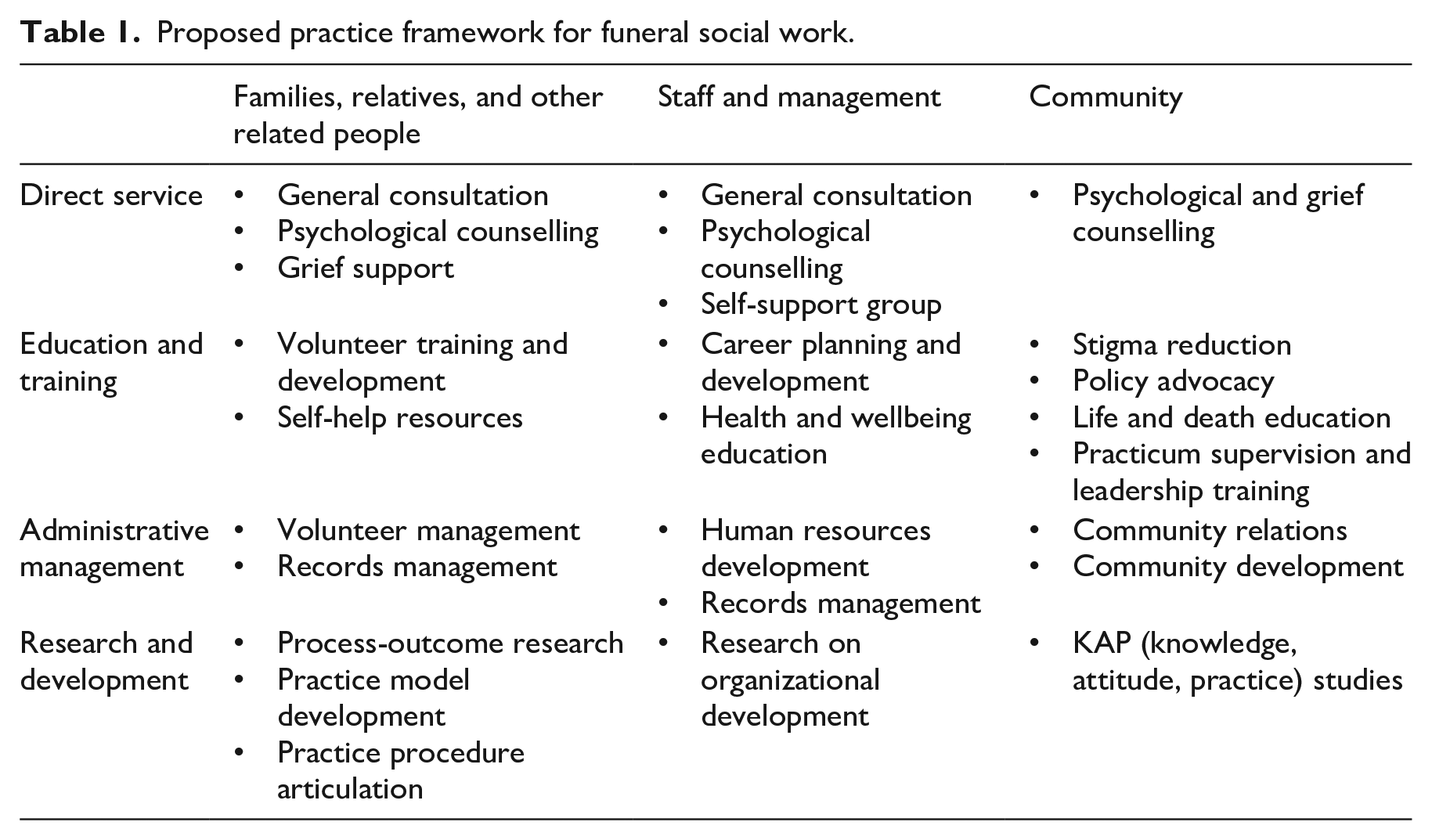
This section proposes a practice framework for social workers in the funeral service industry based on our own experience, the review of literature and resources, and our implementation of the SSLD system. The SSLD system has been adopted to support a multi-system service framework for funeral social work. Table 1 presents the proposed practice framework based on the principles of the system. We argue that funeral social work can be defined as a speciality within professional social work, which adopts social work knowledge, values, principles and methods to provide services for families, relatives, and other related people who seek funeral services, staff and management in the funeral service industry, and the community. Funeral social work aims to help people relieve mental stress, deal with negative emotions, shape a healthy system of life and death values, improve the overall service quality of the funeral service industry, and promote social justice and welfare. The services funeral social workers can offer include direct service, education and training, administrative management, and research and development. Compared with the description of funeral social work mentioned in the previous section, this proposed framework engages with broader constituencies; for instance, Cui and Li’s (2012) report did not include the staff in the funeral service industry. This proposed framework also has an expanded range of services beyond the psychological support typically emphasized (e.g. Chen, 2012; Zhang, 2013a). In the following subsections, we will operationalize how the practice framework can be applied to the respective target groups as the service user.
Proposed practice framework for funeral social work.
Services to families, relatives, and other related people
Funeral social workers work with those who seek funeral services; they can be the family members, relatives, or other people related to the deceased. We include not only the family members but also relatives and other related people because on some occasions, the dead bodies are taken to the funeral home by relatives, co-workers, and even strangers (Jeffrey, 2020). Social workers can provide direct services such as general consultation, psychological counselling, and grief support. In modern society, funeral services are not only limited to physical procedures like embalming, cremation, and burial but also devote considerable energy, time, and resources to addressing people’s psychological, social, and spiritual needs (Cui and Li, 2012). It is natural for the survivors to experience grief due to the death of a loved one; however, excessive grieving emotions can make individuals unable to make rational decisions on funeral arrangements and costs, and can severely damage their physical and mental health as well as future life arrangements, resulting in great negative impact (Bern-Klug, 2004). Based on clients’ N3Cs, social workers can conduct bereavement support or counselling for individuals, families, groups, and communities. In addition, some funeral homes promote special programmes for vulnerable populations and people with special needs, such as tangible services (e.g. simple inexpensive services) or financial support for low-income families (Basic Funerals and Cremation Choices, 2022). Some promote customized services for clients with various cultural and religious backgrounds (Jinan Second Funeral Home [JSFH], 2019). Hence, many prospective users may need the support of social workers to learn about such services and to access and utilize them effectively.
In terms of education and training and administrative management, social workers can assist with volunteer recruitment and management as well as play a key role in training and development. It has been reported that family members and relatives of the deceased are often interested in becoming volunteers in the funeral service field (Chu, 2006). It is also not unusual for the bereaved to have difficulties in funeral arrangements or experience emotional and mental health challenges after the funeral (Bern-Klug, 2004). Therefore, follow-up calls by social workers or volunteers to check on and respond to potential needs can be very beneficial. Finally, funeral social workers can develop self-help programmes, either in the form of manuals or online learning resources, for clients to help themselves transition from bereavement to a new life. Research and development activities can also be built into such services to track both processes and outcomes. Practice-based research on psychosocial intervention for service users and their families and friends will be of great value in informing both funeral services and associated social work interventions.
Services to staff and management
Staff in the funeral service industry can also be clients. Studies have shown that staff working in the industry experience extra working stress and pressure as well as misunderstandings in society. First, since the staff have to deal with dead bodies, death, and bereavement every day, negative emotions such as pessimism, anxiety, depression, and loneliness occur (Goldenhar et al., 2001). Second, as their working locations are usually far away from urban districts and large crowds, they can more frequently feel depressed (Wang et al., 2015). Third, staff may experience improper behaviours or injustice at work that happens in other professions as well, such as harassment and discrimination (Goldenhar et al., 2001). Finally, cultures such as traditional Chinese culture still influence people in that they regard death as a taboo topic and anything related to it is unlucky (Wang et al., 2015). In this case, staff working in the funeral service industry need to experience people’s misunderstandings, even from their families, relatives, and friends, which may lead to their self-isolation (Huang et al., 2021). Therefore, social workers can provide staff with direct services such as general consultation on mental health, working environment adaptation, interpersonal relationships, and other personal issues. Moreover, as staff find it is helpful to relieve their stress and solve their problems by sharing concerns and thoughts among themselves (Huang et al., 2021), social workers can facilitate self-support groups for them to help each other.
When it comes to the education and training component, social workers can help staff with career planning and development. Social workers can also provide staff with health and wellbeing education such as stress management skills and other self-care strategies to help them live a healthy life, improve their mental health functions, and prevent physical and psychological problems. As for administrative management, social work intervention and the values it promotes are often welcome by managers and administrators, for they contribute both to service quality and staff morale (Bogo, 2018). Thus, social workers can work with the management on human resources development. They also need to keep records of staff involved in services and training for follow-up activities and referrals. In addition, it has been our experience that consultation with management can enhance the creation of client-centred policies and practices (e.g. a clear map of procedures, a transparent fee structure, assigned ‘case-manager’ for customized service and emotional support). Finally, social workers can work with staff to conduct practice-based research on organizational development in order to improve working effectiveness and efficiency.
Services to the community
Social workers provide services for the public in the community as well. Social workers can outreach to schools and community centres when psychological and grief counselling services are needed. For the education and training component, first, social workers can help the general public better understand the staff’s work in the funeral service industry and reduce the stigma towards them. Second, since the funeral service industry nowadays advocates eco-funerals that are beneficial to the environment (JSFH, 2019), social workers can set up information booths or organize lectures in the community to promote eco-funerals and other policies among residents. Third, social workers can promote life and death education in the community. More and more studies emphasize the importance of life and death education among children and teenagers in helping them cultivate positive values and meanings of life (Huang et al., 2021). Take China’s case as an example. Since the discipline of social work has developed in recent decades in China, up to now, the profession of school social work across the country has not been institutionalized and developed on a large scale (Huang et al., 2021). On 6 April 2021, the Ministry of Education of the People’s Republic of China issued a draft guideline designed to protect minors at schools, and it mentioned that schools could provide students with mental health support by purchasing professional social work services (Zou, 2021). Currently, therefore, social workers can connect with local schools to develop relevant courses, and various innovative activities can be designed based on the youth’s age. This will also be an opportunity to build school social work programmes in China using the context of funeral social work. At the same time, promoting life and death education among adults is essential as well (Huang et al., 2021). Social workers can cooperate with colleges and universities to offer death-related programmes and other experiential learning activities. Social workers can also hold lectures or workshops, distribute brochures and put up posters on death, before-death planning, and after-death planning for middle-aged and older adults to help them take advantage of existing resources to live a desired life.
Social workers can provide practicum supervision for students of social work and other relevant funeral service programmes. For instance, in China, there are five colleges and three vocational secondary schools offering programmes related to funeral services (Hongxing News, 2022). And by the end of 2018, 82 colleges had established social work professional programmes, 348 universities had provided social work undergraduate programmes, 150 universities and research institutions had launched social work master’s programmes and 17 social work related doctoral programmes across the country (China Charity, 2019). The professional programmes offered in colleges usually focus more on the clinical practice of one specific area, such as youth’s learning disabilities, mental health in jails, domestic violence and senior care, while the programmes offered in universities teach theory, practice and research, and cover more general populations (China Charity, 2019). Thus, social workers can work with these schools on student practicum and offer volunteer training to help them develop leadership in the funeral service industry in the future. Regarding administrative management, social workers can deal with community relations and help with community development. And for research and development, knowledge-attitude-practice (KAP) studies can be carried out to make the public know more about the local death culture and design services that better meet the community’s needs.
Limitations
At the current stage of development, we argue the proposed framework has limitations and further research should be conducted to improve the framework. First of all, there is not much empirical research data, which is what is needed to take the development of this social work practice into the next stage. What is more, since social workers in funeral service are still exploring their direction and approach, their experience has not been consolidated into communicable theoretical formulations and principles of practice. Thus, empirical research on the experience and knowledge of service users and service providers can be carried out to provide a pool of data on practice issues, challenges and professional practice responses. The systematic collection of client and service process data can be utilized to inform service delivery and management decisions, as well as serve as secondary data for research. Second, not all of the components of the proposed framework have been tested and refined through research and development. As a result, specific service programmes, practice procedures and skillsets should be developed based on various populations and be tested through process-outcome research to establish the efficacy and generate findings that can be of immediate relevance to practitioners. Finally, as the development of the proposed framework has been primarily based on the experience in a few cities in China, implementation research can be undertaken in the future to study the framework in diverse communities (e.g. different ethnicities, cultures, religions) in other parts of China and the world.
Conclusion
Funeral services are related to the vital interests of human beings and are supposed to meet people’s social, psychological and spiritual needs. Social work advocates person-oriented values and has unique advantages in providing services, alleviating social conflicts and solving social problems. More and more people from the industry have realized the importance of bringing helping professionals into the industry to fill in service gaps, especially after the breakout of the COVID-19 pandemic. However, there is currently no holistic and comprehensive model to guide social workers’ practice work in this field. Based on the SSLD system, a practice framework for funeral social work is proposed. The framework incorporates services in direct service, education and training, administrative management and research development. It targets families, relatives and other related people of the deceased, staff and management, and local communities. Although the proposed framework covers various fields and populations, we suggest social workers can start with the area and target population they are most experienced in and familiar with if they want to practise funeral social work; agencies and organizations can also make their priorities to practice based on the organizational environment. Moreover, we hope to emphasize that the example of our experience is not intended as a model of best practice. Instead, we would like to explore this idea with more practitioners and scholars together. We hope the proposed framework will let the directors in the funeral service industry pay attention to customers’ unmet social, psychological and spiritual needs, and draw the attention of social work scholars to investigate the practice work in this field as well.
Footnotes
Declaration of conflicting interests
The authors declared no potential conflicts of interest with respect to the research, authorship and/or publication of this article.
Funding
The authors received no financial support for the research, authorship and/or publication of this article.
