




Abstract
A growing literature demonstrates increasing remunicipalization of local public services. Yet, while this literature is becoming extensive, many debates still exist about remunicipalization’s causes. This article reports the findings of a meta-analysis of the remunicipalization literature, focusing on the question: how do country, sector and method effects affect the findings of remunicipalization studies? I include articles on remunicipalization under different terms (‘remunicipalization’, ‘reverse privatization’, ‘insourcing’ and ‘contracting in’), using a large range of methods (case studies, surveys and document analysis) and covering a large period (1995–2019). I find 30 causes of remunicipalization that are considered and found in the literature. Political and pragmatic factors appear to be most frequently considered and found as causes of remunicipalization in the literature; environmental factors are less often considered but seem highly relevant. Moreover, I uncover large differences between the qualitative and quantitative literatures. I offer a research agenda to allow greater future synthesis in the remunicipalization literature.
Points for practitioners
The literature on remunicipalization is highly fragmented and remunicipalization can have many different causes. Remunicipalization appears to be both a political and a pragmatic trend, but the literature is still too fragmented to know for sure. Be aware of the potential biases and limitations in current research on (causes of) remunicipalization.
Introduction 1
Academics and practitioners in the domain of local government studies are gripped by the (contested) phenomenon of remunicipalization. Some researchers in the literature have declared remunicipalization quite strongly as a political trend, that is, as ‘a set of mobilisations against the neoliberal state’ (Routledge et al., 2018: 83) or, more broadly, as a response to a ‘privatization model in crisis’ (Becker et al., 2015: 76). Others have emphasized the pragmatic nature of remunicipalization, presenting it as ‘part of a pragmatic market management process’ (Warner and Aldag, 2019) ‘motivated by traditional concerns with contract management’ (Clifton et al., 2019). Whether politics or pragmatism, or another factor, underlies the remunicipalization trend remains debated.
Although there have been multiple literature reviews into remunicipalization (McDonald, 2018; Voorn et al., 2020; Wollmann, 2018), no synthesis of the academic findings about causes of remunicipalization has yet occurred. Previous review studies have had specific purposes, such as providing a typology of different types of remunicipalization (McDonald, 2018), explaining the remunicipalization trend in historical context (Wollmann, 2018) or challenging the idea that remunicipalization is a political trend (Voorn et al., 2020). Moreover, with the exception of McDonald (2018), these studies have generally stopped short of reviewing the more quantitative literature on the sources of remunicipalization, often published under different terms (‘reverse privatization’ or ‘insourcing’, or not explicitly using any term). Consequently, a synthesis of knowledge about (the causes of) remunicipalization is still missing, and the literature remains fragmented.
This article reports the findings of a meta-analysis of the literature on the causes of remunicipalization, providing an answer to the question: how do countries, sectors and methodologies affect the causes considered and found in remunicipalization studies? I describe the key causes of remunicipalization that are considered and found in this literature, and contextualize these findings against the background of the methods used, countries investigated and sectors studied. My aim is to identify what is studied and found about causes of remunicipalization, which findings can be generalized and which cannot, and what the limitations of current research are.
I find that the literature can be synthesized, and particularly that the findings of qualitative and quantitative research into remunicipalization can be integrated, by distinguishing between ‘proximate’ and ‘ultimate’ causes, and I provide a framework for this. I also find that different causes of remunicipalization are considered across different sectors, countries and methods. However, the meta-analysis shows that causes found are not substantively different across countries and across sectors. Methodology seems to be a core determinant of what causes are found, with the qualitative literature emphasizing political and pragmatic causes, and the quantitative literature emphasizing local government and environmental characteristics. Among other things, I emphasize the importance of qualitative studies addressing less immediate causes and quantitative studies addressing more immediate causes of remunicipalization.
The remainder of the article is organized as follows. In the second section, I explain the background of this study. In the third section, I present the methodology. In the fourth section, I present the outcomes of the meta-analysis. In the fifth section, I discuss the results in light of the theoretical concerns, provide the research agenda and discuss the limitations of the analysis. In the sixth section, I conclude.
Background
Remunicipalization and the state of the literature
Remunicipalization refers to the return of previously privatized (or contracted-out) services to municipal authorities. Other terms have been used to describe this trend, such as ‘insourcing’ and, most commonly, ‘reverse privatization’, though particularly in the European literature, the term ‘remunicipalization’ is increasingly the term of use.
Nonetheless, the term ‘remunicipalization’ hides a plurality of different types of privatization (or contracting-out) reversals. Remunicipalization can imply asset purchases by local governments, such as the purchasing of private energy companies by municipalities, as well as the ending of the contracting out (or outsourcing) of services to private firms. There is additional uncertainty in the literature as to whether the ending of public–private partnerships (PPPs) should be seen as a form of remunicipalization, or whether the change from privatization to intermunicipal cooperation would count as remunicipalization.
Ambiguity about what the term ‘remunicipalization’ means is one reason why the literature on remunicipalization remains fragmented. Another reason is that remunicipalization has been studied in many different ways, in many different places and for many different policy sectors: both qualitative and quantitative studies have been conducted to establish causes of remunicipalization; remunicipalization has been studied in many countries, including increasingly in the Global South; and remunicipalization has been studied in multiple policy sectors, such as the water, energy and transport sectors. In addition, causes of remunicipalization are studied using a range of terminologies (‘remunicipalization’, ‘reverse privatization’ and ‘insourcing’), leading to multiple strands of literature that do not frequently inter-cite. It is unsurprising that given this large number of contexts and terminologies of studies into the causes of remunicipalization, the literature remains fragmented. In this study, I will identify at least 30 different causes of remunicipalization considered in the literature, with surprisingly little synthesis.
The importance of review
Due to this fragmentation of the literature on (causes of) remunicipalization, the number of studies into the causes of remunicipalization that include a ‘previous literature’ section is low. Studies are frequently not embedded within the larger literature. Consequently, despite the large number of causes considered and causes found in the literature, the debate that takes place in the academic literature about (causes of) remunicipalization is limited. This is problematic, as it limits our understanding of context in remunicipalization processes, and providing room for more debate between studies is one reason why systematic review into the studies on the causes of remunicipalization is important. 2
Beyond this, systematic review is important for more general reasons. Systematic reviews help authors contextualize their findings based on extant literature, allow practitioners and researchers to quickly get acquainted with the field, and help to caution against individual findings, emphasizing synthesis instead.
Arguably, systematic review becomes more important when literatures become more fragmented, such as in the remunicipalization literature. This article therefore reports findings of a meta-analysis of the remunicipalization literature, so as to bridge differences between the different strands of literature.
Methodology
I conduct a systematic review (or meta-analysis) of the literature on remunicipalization following Preferred Reporting Items for Systematic reviews and Meta-Analyses (PRISMA) guidelines (Moher et al., 2015). My method consists of four phases, as outlined in the following (see also Figure 1).

Method.
Step 1: Systematic review and inclusion criteria
To systematically identify relevant studies, I searched for empirical studies in April 2019 and January 2020. No limit for appearance year was set, as all studies were deemed potentially relevant. Using ‘remunicipalis*’, ‘remunicipaliz*’, ‘insourcing’, ‘reverse privatis*’ and ‘reverse privatiz*’ as keywords, I searched Web of Science, PsycINFO and Business Source Complete. I chose these databases because of their complementary focus.
The articles incorporated in this study had to meet the following criteria in order to be included in this review:
Studies had to examine causes of remunicipalization, using a quantitative or qualitative approach. Research that did not produce new empirical material was excluded. In case a sample was used in multiple studies, only the study that provided the most information was included. If multiple studies provided the same information, the oldest study was used. Studies had to be published in article form. I thus explicitly excluded books, book chapters, government reports and other such materials, of which the peer-review status and author motives are unclear. Only studies published in English were included.
I recognize that some good studies have been conducted that do not fit these criteria, such as studies without novel empirical work (McDonald, 2018), research published in (chapters of) books (Lobina et al., 2019) and works in languages other than English (Bauer, 2012). However, introducing this research in this review may incur bias (when introducing work without new empirical material), especially when introducing non-peer-reviewed work (for (chapters of) books), and potential author misinterpretation (for works in other languages). These inclusion requirements are a limitation, albeit a conscious one, of this work, and I will revisit this limitation in more detail in the conclusion.
One last note on an item that is not an inclusion criterion: I do not require one particular specification of the dependent variable (remunicipalization) in the studies. Instead, I let studies freely vary on their specification of remunicipalization, including, for instance, both asset purchases and contract reversals, PPP and non-PPP organizations, and the retention of corporate structures or the return to bureaucracy.
Step 2: Scoping
One weakness of systematic review or meta-analysis is its dependency on the keywords of choice of the authors. In order to mitigate this dependency, I introduce an element of scoping research (see Arksey and O’Malley, 2005) by considering all included articles in step 1 and systematically going through their reference lists, including the newly found articles in the database if they met the inclusion criteria. Therefore, after identifying all studies in step 1, I considered the reference lists of these journals to identify studies that I missed because of my particular keywords. However, I added no new articles through this mechanism.
Step 3: Coding
The coding procedure (step 3) followed five phases (see Figure 2). In phase 3a, for all articles, I coded the ‘meta-data’: countries and sectors covered in the research, as well as whether studies were ‘quantitative’ or ‘qualitative’. To qualify as ‘quantitative’ studies, articles had to investigate a causal effect using a quantitative technique such as regression; descriptive statistics alone did not qualify to count as ‘quantitative’ research. All other techniques were considered qualitative.

Coding procedure.
In phase 3b, I coded for the specification of the dependent variable (remunicipalization) in the different studies. I consider, in particular: (1) whether the authors’ definition considers asset purchases or contract reversals; (ii) whether the remunicipalization considers a move away from full privatization or PPP; and (3) whether the outcome of remunicipalization is bureaucracy delivery or delivery through a municipally owned corporation. All may affect the causes of remunicipalization.
In phase 3c, for all articles, I code the causes considered in the research separately. For quantitative articles, these are straightforwardly the variables included in the regression. For qualitative articles, I went through the entire body of text in the articles and included all references to potential causes, coding them textually.
In phase 3d, I matched and categorized the different causes considered in the different articles, grouping them as much as possible along the lines they are presented in the articles (for instance, when authors introduce ‘fiscal stress’ as a variable under the subhead ‘Local government characteristics’, I retain that categorization wherever possible). I focused on matching causes considered in the quantitative literature with those in the qualitative literature to be able to make systematic comparisons. I distinguished between proximate, intermediary and ultimate causes based on the ‘immediacy’ of the cause. In particular, I distinguish between what are likely proximate causes (actual political and pragmatic contexts) and ultimate causes (the environments in which these political and pragmatic contexts transpire).
Finally, in phase 3e, I code the causes found (which were a subgroup of the causes considered). For the quantitative articles, these were the causes found as significant in at least one of the regressions at p < 0.05 (i.e. I include as causes found also variables that are significant in only one model specification). For the qualitative articles, these were the causes referenced in a relevant way in the results or conclusion sections, or their equivalent.
Coding was done by the author. The coding was fully and independently checked by an independent researcher. Differences in coding were resolved through discussion, and after recoding, (...) no differences remained.
Step 4: Analysis
The coding procedure created one large database of information of all the relevant studies. Due to the different methods and specifications of remunicipalization, meta-regression is impossible, and so I opted for meta-analysis. I use a quantitative approach of analysis here, asking questions such as ‘How many articles considered cause X?’ and ‘How many articles found Y as a cause?’ in order to remove author bias and to allow systematic comparison. I emphasize that this does not imply that I weigh all studies as equally valuable; rather, I opt not to make any claims about the value of particular studies and instead offer a broader overview of the literature.
After quantifying, I present several findings. I first consider the literature in aggregate: the countries and sectors studied; the methods used; and the causes considered and found. Second, I look for links between the different causes considered and found, and the variables explained in steps 1 and 2 – time, sector and method – and present the findings along these lines. Finally, I consider the implications of this analysis for the literature and present a research agenda for future work.
Findings
Included studies (and why others were excluded)
Before I describe details of the included studies, it is important to discuss the excluded studies. Unfortunately, many studies were excluded. Much more than most research, research about remunicipalization has mostly escaped the traditional peer-review processes, with perhaps the majority of cited work appearing in (sometimes politicized) reports and books, rather than in peer-reviewed articles. To the extent that remunicipalization studies appear in academic journals, these are often not the mainstream journals, to the point that many studies fall outside the (multiple) databases employed in this study. This nature of the remunicipalization literature as being largely outside of the scope of academic peer review makes any systematic literature review unavoidably incomplete, and this should be recognized as a limitation of this review, albeit, again, a conscious one. Nonetheless, I found 34 articles to be included in this review that fit the inclusion criteria. A summary of all studies included in this study is included as Table 5 in Appendix 1.
The included literature was quite diverse, though it has its biases. A plurality of the articles studied Germany (14 articles – 41%). Other countries that were studied often were the US (6 articles – 18%), France (4 articles – 12%) and Spain (3 articles – 9%). Not unusually, ‘Western, educated, industrialized, rich and democratic’ (WEIRD) countries are over-represented in the literature on remunicipalization, though, notably, articles include at least some work from countries outside of these countries, including Indonesia and Malawi. Beyond this, the literature was somewhat diverse in policy sectors and methods. Energy (10 articles – 29%) and water (9 articles – 26%) were the most frequently studied policy sectors; others, primarily transport and health services, remained behind. The majority of the articles used qualitative methods (19 articles – 56%), though there were quite a few quantitative studies (15 articles – 44%). There was some overlap here between methodologies and countries of study, with the quantitative literature mostly focused on the US and the qualitative literature mostly focused on Germany.
General findings
Causes considered in the literature
In total, I found 30 causes of remunicipalization considered in the literature. These considered causes were broadly divisible into six categories that often coincide (see, e.g., the special issue on remunicipalization in the Journal of Economic Policy Reform), following researchers’ own classifications. First, two important categories have emerged from the discussion/literature so far: (1) political causes and (2) pragmatic causes. ‘Political causes’ are pressures resulting from political actors, which may bring about immediate action. ‘Pragmatic causes’ are motives, either as described by policymakers or as interpreted by authors or the press. Furthermore, I distinguish (3) characteristics of the previous arrangement, (4) characteristics of the local government, (5) characteristics of the service delivered and (6) specific environmental causes. Table 1 provides an overview of the causes considered in the literature.
List of causes considered in the literature.
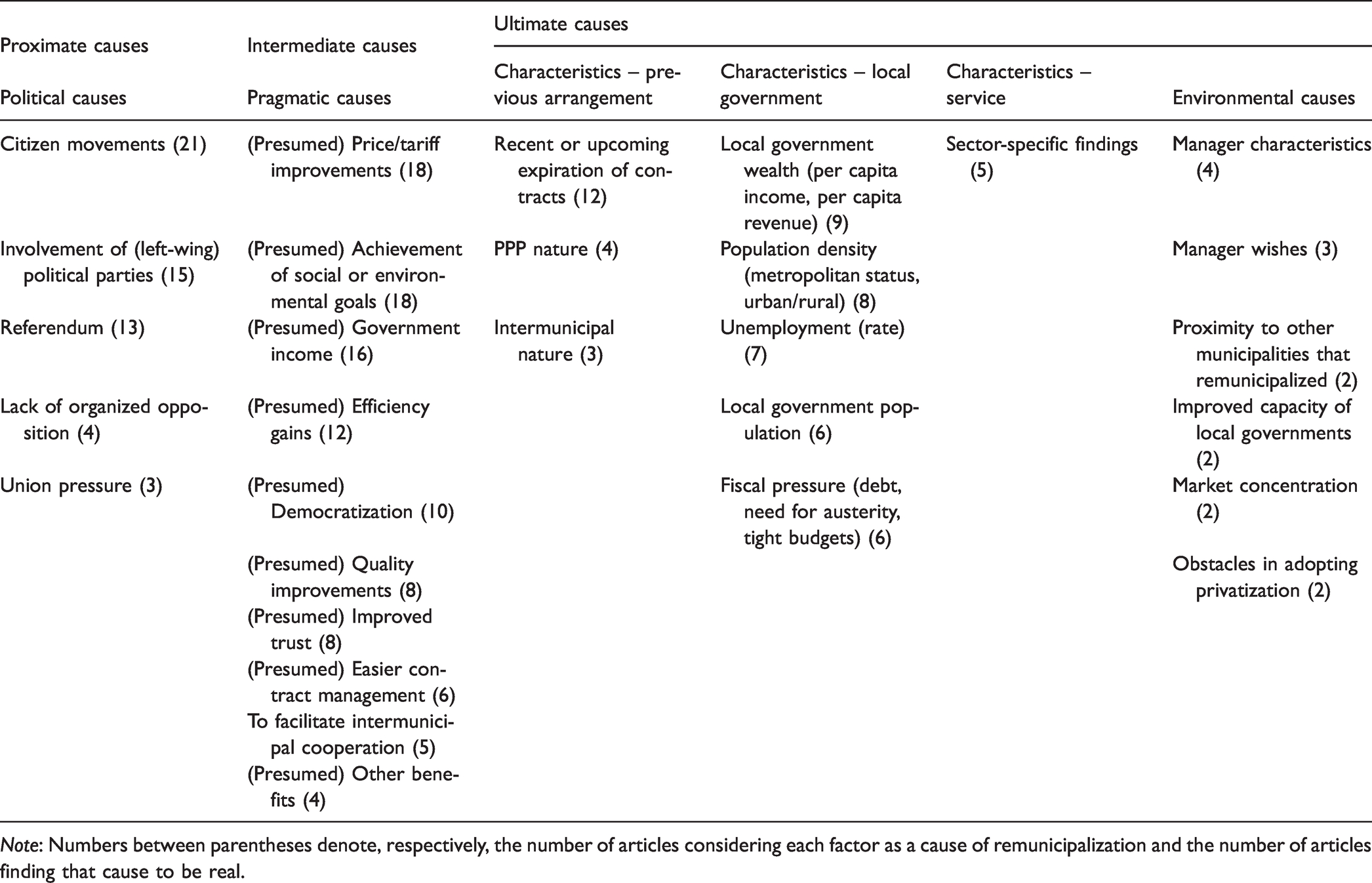
Note: Numbers between parentheses denote, respectively, the number of articles considering each factor as a cause of remunicipalization and the number of articles finding that cause to be real.
Generally, political and pragmatic factors appear to be most frequently considered as causes of remunicipalization in the literature. The most frequently considered political causes are citizen movements, the involvement of (left-wing) political parties and the presence of referenda. The most considered pragmatic causes of remunicipalization are (presumed) price or tariff improvements, (presumed) achievement of social or environmental goals, and (presumed) income for the government. However, various other factors are considered in the literature as potential causes of remunicipalization.
Causes found in the literature
The causes found largely follow the causes considered (see Table 2). However, some causes are found to be relevant more than others. In particular, political causes are often found when they are considered – the literature emphasizes the importance of particularly citizen movements and the involvement of left-wing parties in bringing about remunicipalization. Among the more pragmatic causes, (presumed) achievement of social or environmental goals or (presumed) democratization are often found to be causes of remunicipalization. Despite being often studied as causes of remunicipalization, less relevant appear to be: the presence of referenda; the (presumed) price, tariffs, efficiency and quality improvements; and most characteristics about the previous contract, the local government and the environment, including most variables that are often included as control variables in the quantitative studies.
List of causes found in the literature.
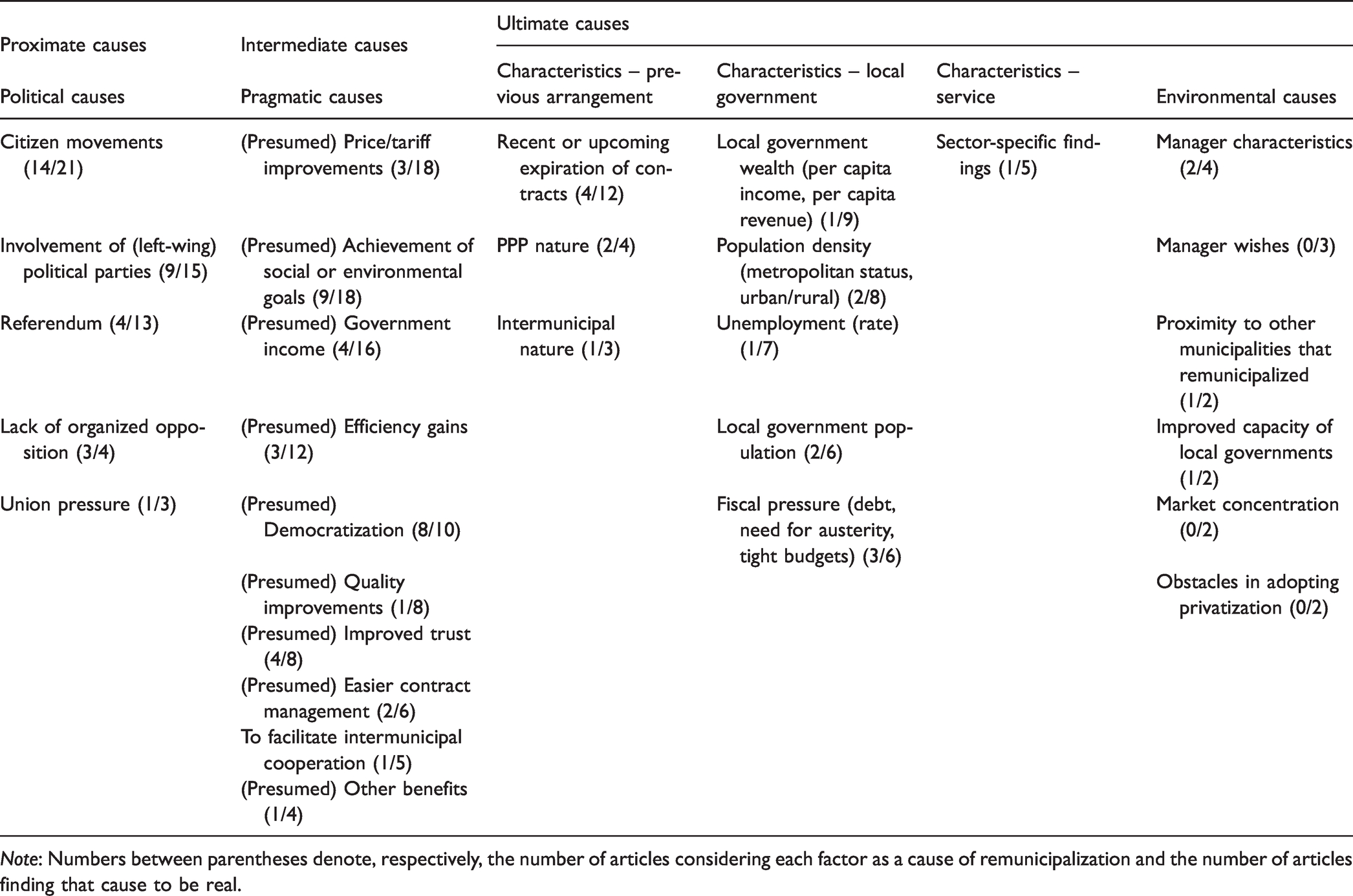
Note: Numbers between parentheses denote, respectively, the number of articles considering each factor as a cause of remunicipalization and the number of articles finding that cause to be real.
Findings by country, sector and method
Causes considered in the literature
My main aim is not to describe general causes considered and found, but to link the causes considered and found to country, sector and method of study. Table 3 tabulates how the different categories of causes considered line up with these study characteristics for the most prominent countries, sectors and methods studied (I tabulate categories here, rather than individual causes, because increased sample sizes allow us to make more meaningful inferences about the literature).
Causes considered by country, sector and method.
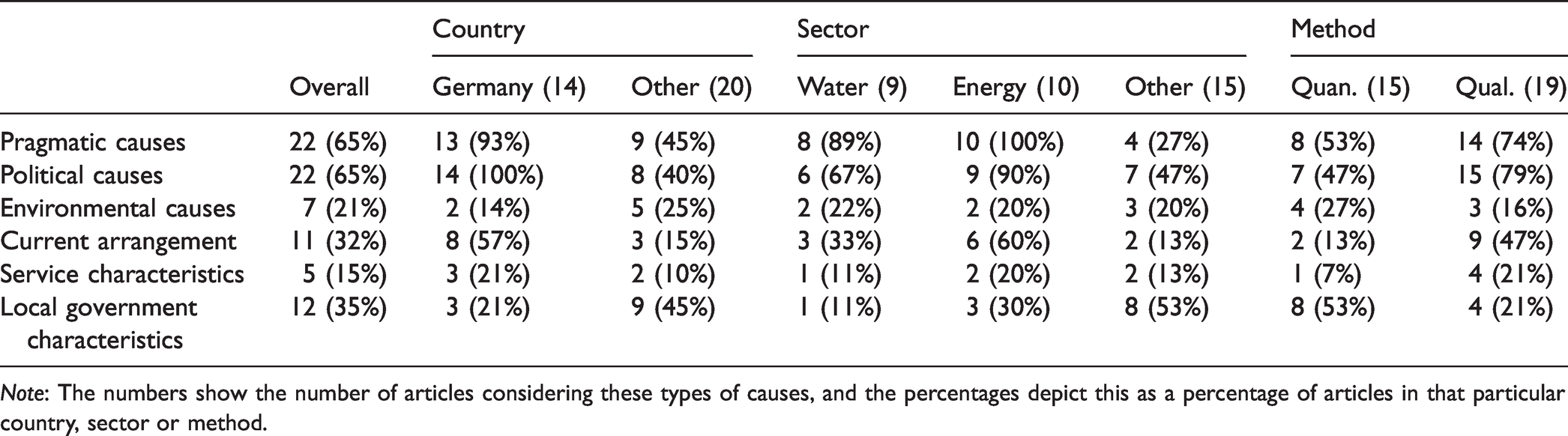
Note: The numbers show the number of articles considering these types of causes, and the percentages depict this as a percentage of articles in that particular country, sector or method.
The most influential study characteristic is the method of study. Both political and pragmatic causes are more frequently considered in the qualitative literature, as are characteristics of the current arrangement. Conversely, the quantitative literature has actively considered variables such as environmental factors (characteristics of managers and nearby municipalities) and local government factors (such as demographics), which are scarcely considered in the qualitative literature. This finding is, perhaps, not surprising. Many political and pragmatic causes are difficult to quantify, whereas for local government and environmental factors, collecting a large number of observations is relatively straightforward. Similarly, it is difficult to account for these local government factors in qualitative research, as these factors may have a more indirect influence.
Nonetheless, both in the quantitative literature and in the qualitative literature, further steps can be taken to more actively consider the currently less actively considered causes. The quantitative studies could more actively study pragmatic causes (for instance, presumed price or quality improvements) and details about current arrangements, which could be measured relatively easily through surveys. Next, a recommendation for future qualitative work is to more actively reflect on the role of demographics and environmental circumstances that are, perhaps, not immediately obvious.
There are also differences in the causes that are studied between countries and sectors. Pragmatic and political causes seem particularly studied in Germany and in the water and energy sectors. In contrast, the US-based literature more often considers the environmental and local government causes of remunicipalization. This is possibly related to the methodological differences between the different studies: while German studies were almost exclusively qualitative, studies in the US were exclusively quantitative.
Causes found in the literature
These differences in causes considered partially translate to differences in causes found, though differences between countries and sectors do not emerge here (see Table 4). Methodology seems to be the core reason for different causes found in the literature. Pragmatic causes and political causes are found at higher frequencies in qualitative work than in quantitative work. Meanwhile, environmental and local government characteristics are found to be relevant factors more often in the quantitative literature.
Causes found by country, sector and method.
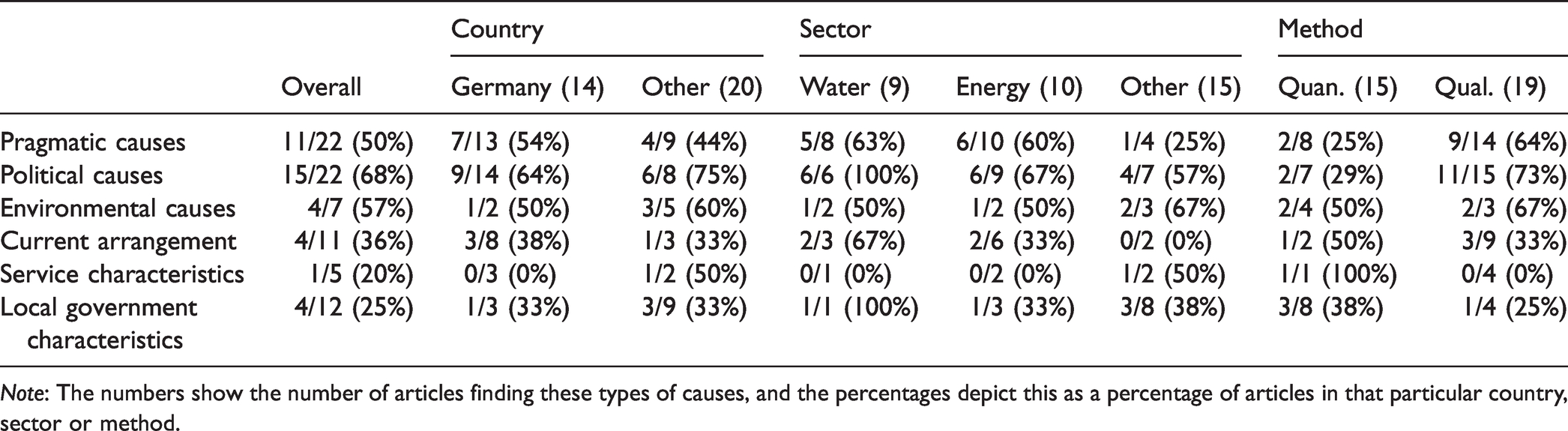
Note: The numbers show the number of articles finding these types of causes, and the percentages depict this as a percentage of articles in that particular country, sector or method.
Discussion
I identified a substantial difference between the variables studied in qualitative research and those studied in quantitative research. In particular, quantitative research pays limited attention to political and pragmatic variables, such as citizen participation, the existence of grass-roots campaigns or (presumed) potential price or quality improvements. This is despite the fact that the qualitative research shows these variables to be leading causes of remunicipalization. Meanwhile, many variables actively studied in the quantitative research, even when shown to be major causes, are not typically considered in the qualitative studies, such as government, management and market characteristics, as well as environmental variables such as population size. This shows that both literatures are subject to substantial limitations and that improvements can be made over current research practices.
I found other weaknesses in terms of the methods that only indirectly show up in the tables. For qualitative research, most of the variables I have labelled as ‘causes considered’ are, notably, also ‘causes found’ (see Table 3), showing that these case studies often offer limited consideration of alternative explanations and may (more) frequently incur a form of confirmation bias. Moreover, most causes considered and found in the qualitative studies are immediate causes, and more indirect (environmental) causes may be missed in this type of research. Meanwhile, the limitations of the quantitative research are the opposite: many control variables are often included with little or no effect, reducing parsimony in models with already small numbers of observations; moreover, many of the causes considered and found in this literature are indirect and environmental, without considering immediate catalysts. These limitations of both types of studies are demonstrated in the still-fragmented and little-integrated literature on remunicipalization, where these factors are often debated rather than temporally linked.
Indeed, I suggest that some findings can be aggregated between the literatures. It is likely that the proximate cause of remunicipalization is often political, as remunicipalization processes often seem to feature large (grass-roots) campaigns and political movements, particularly in larger cities (though due to a lack of systematicity in case studies, this may not be a generalizable finding). The intermediate cause of remunicipalization may be dissatisfaction with private service delivery, based on price or quality concerns, or concerns about social and environmental goals. Finally, the ultimate cause of remunicipalization may lie in the traditional background factors that cause privatization to fail or succeed, such as market concentration, contract management capacity of governments or the legal protections in place against regulatory capture. However, because of limited synthesis in the literature, we do not yet know the full story. Future studies should take into account this sequential nature of antecedents of remunicipalization, and my temporal framework may help to enable this.
I encourage future quantitative research to take into account more actively the pragmatic and political causes of remunicipalization. In particular, variables of citizen interest and grass-roots political movements have been shown (or argued) to be important in qualitative research but are rarely integrated in quantitative work. The same is true for variables based on (subjective) perceptions of price, quality and the possible achievement of social and environmental goals. Moreover, future quantitative research should strive for more parsimony in models by being more careful to include control variables that have been proven relevant, and should consider more mediation models (Hayes, 2017) to distinguish between what are likely proximate causes (actual political and pragmatic contexts) and ultimate causes (the environments in which these political and pragmatic contexts transpire).
Meanwhile, for future qualitative research, I emphasize the importance of indicating that political movements do not come from nowhere, and to pay more attention to the question of what caused these grass-roots movements to come into existence. It would be helpful if qualitative research more actively considered environmental variables, such as local government characteristics, demographics and cross-municipal learning. Moreover, the overlap between causes considered and causes found in the qualitative research points to a possible systemic confirmation bias in this literature, which should be avoided in future research by considering more actively alternative explanations in the literature, and/or by using more systematic case selection for these studies.
Conclusion
A growing literature demonstrates increasing remunicipalization of local public service delivery. Yet, while this literature is becoming extensive, it is also fragmented, with little synthesis of findings and with big debates still existing about remunicipalization’s causes. I offer a meta-analysis of the remunicipalization literature, focusing on the question: how do country, sector and method effects affect the causes of remunicipalization considered and found in the literature? I include articles on remunicipalization under different terms (‘remunicipalization’, ‘reverse privatization’ and ‘insourcing’), using a large range of methods (case studies, surveys and document analysis) and covering multiple countries and sectors.
Using a combination of keyword search and scoping methodology, I identify 34 peer-reviewed articles about the causes of remunicipalization, diverging in countries, sectors, and methods of study. I find 30 causes of remunicipalization considered in this literature, 28 of which are also found as a cause. Key influential variables that are considered in the literature are political and pragmatic causes; environmental causes are less often considered but still highly relevant.
I find a divide particularly between the quantitative and qualitative literatures on remunicipalization. Political and pragmatic causes are more often found in the qualitative studies than in the quantitative studies, pointing to a mismatch in the literature that could be caused by either poor operationalization of pragmatic or political variables in the quantitative studies, or by too much focus on immediate catalysts in the qualitative studies. Environmental causes are studied relatively little, though when they are studied, they are found to be relevant in more than half of the studies. Other weaknesses exist too: quantitative studies lack parsimony, while qualitative studies are likely to have larger confirmation biases; and quantitative studies tend to focus on ultimate causes, neglecting proximate causes, while qualitative studies do the opposite.
For future quantitative research, I encourage exploring variables of citizen interest and grass-roots political movements, which have so far not been included in regression models. It would also be helpful to include more environmental variables, such as proximity to other municipalities that remunicipalize, and pragmatic variables, such as subjective assessments of policy goals, which are currently mostly not present in regression models. Additionally, I encourage increased use of mediation models to differentiate between proximate and ultimate causes of remunicipalization. Next, for future qualitative research, I emphasize that case selection is currently often driven by big events, which are political by their nature and may cause a bias in the remunicipalization literature towards big political cases, as demonstrated by a comparatively high propensity for qualitative research to both consider and find political causes for remunicipalization. I emphasize the need for more systematicity in case selection. Moreover, also for qualitative studies, I recommend more consideration of environmental variables, such as learning effects, and demographic factors.
Various limitations underlie this research. First, systematic review requires choices made by the authors in terms of search strategy. I opt to limit this review to articles with novel empirical research, published in peer-reviewed journals and published in English. Second, this review is quantitative in that I do not qualitatively assess the evidence in the different studies. This retains systematicity and prevents author bias, but I emphasize that not all studies are equal and that I see value in more literature reviews that evaluate the evidence more qualitatively. Third, like all meta-analyses, one limitation of this research is the possibility of publication bias. As insignificant results are less likely to be published than significant results, the findings presented in this article are more likely to be false positives – this counts for all articles, both qualitative and quantitative, included in this study. Finally, one limitation of the literature that inevitably also surfaces in the review of the literature is that there continues to be an over-representation of WEIRD countries (Henrich et al., 2010) in the research on remunicipalization, though I know at least some exceptions that did not reach this review (Lobina and Hall, 2014; Lobina et al., 2019). This may be due to the conventional Western bias in the literature but might also be caused by lower remunicipalization rates in developing countries. Consequently, we know little about the causes, workings and levels of remunicipalization in developing countries, as also emphasized in the stellar review by McDonald (2018).
Footnotes
Declaration of conflicting interests
The author declared no potential conflicts of interest with respect to the research, authorship and/or publication of this article.
Funding
The author received no financial support for the research, authorship and/or publication of this article.

Notes
Appendix 1