




Abstract
Following the Spring of 2020, there has been a notable surge in attention toward issues related to policing and instances of police misconduct. This review takes stock of the policing literature in Public Administration field between 2017 and 2023. A total of 202 empirical articles on policing were identified in Public Administration. Findings indicate that in Public Administration, policing studies are in majority focused on the management of police organizations, rather than on the police-citizen nexus or police behavior. There has not been an important shift in themes and subthemes covered by articles since 2020. Policing articles in Public Administration are mostly cross-sectional, theoretically scattered, methodologically balanced, and often include practical recommendations, albeit vague ones. We offer a research agenda for policing and public administration scholars.
Introduction
Police research is closely tied to public sector research. Public administration exists to fulfill public duties, including the delivering of public safety (Zoltán, 2014). In the realm of Public Administration, police departments are seen as classic bureaucracies, akin to other public organizations (Evans, 2020). Police officers, also known as street-level bureaucrats (Lipsky, 2010 [1980]), serve on the frontlines of public service. They hold discretionary power to make decisions affecting policies and the delivery of public services (Adams et al., 2021).
Public Administration theories have long played a key role in policing studies (Cohen, 2021). For instance, procedural justice theory is now the dominant paradigm for explaining police legitimacy and public trust in police (Schaap & Saarikkomäki, 2022). Representative bureaucracy theories provide insight into the social and demographic representation in the police workforce (e.g., Meier & Nicholson-Crotty, 2006; Riccucci et al., 2018). They also explain why racial tension exists in police-community relations (Headley et al., 2021). Furthermore, bureaucratic discretion theory clarifies how Law Enforcement Organizations’ (LEOs) employees exercise discretionary decision-making, influencing the delivery of public service (Trochmann & Gover, 2016). Discretion remains a critical topic in policing discussions, given the job’s nature of high discretion and low supervision (Lipsky, 2010 [1980]). It continues to be a central theme in research on body-worn cameras (Adams et al., 2021).
Moreover, the topic of policing gained prominence in the field of Public Administration in the early 1980s. This was when the New Public Management (NPM) and reinventing government movements (Osborne, 2006) began influencing police organizations, leading to significant reforms in management and leadership practices (Wathne, 2020). NPM management strategies led to a paradigm shift in professional values within policing (Cohen, 2021). According to Zhao et al. (1995), it was these NPM-inspired reforms that challenged the traditional role of police officers as “crime fighters.”
Indeed, police research has become an integral part of research agendas in Public Administration, with emerging literature examining questions in many aspects of police practices. Specifically, in the introduction to the virtual issue on policing in the Journal of Public Administration Research and Theory, Hong (2012) categorized Public Administrations’ research on police along three themes. The symbolic representativeness of the police and citizen perceptions (e.g., community-police relations, police legitimacy), police behavior (e.g., discretion, use of force, misconduct), and the management of police organizations (e.g., performance, recruiting, training).
Nonetheless, while Public Administration scholars agree that this discipline is essential to the study of police sciences (Nagel & Vera, 2020), scholars criticize that it is still a relatively understudied area in Public Administration research. In an essay on the police and Public Administration, Fleming (2008) wrote: If public administration is primarily concerned with public policy, public management and public administration, why, in the literature, is the police organization missing as an object of study? Why are health, housing and social services more interesting or relevant than police organizations? If we accept that bureaucracies are organizations charged with the implementation of government policies; that they adhere to an organizational design that is hierarchical and are governed by formal (and impersonal) rules and regulations, then we have to acknowledge that the police organization is indeed part of such a structure (Fleming, 2008, p. 621).
Almost two decades later, it seems that not a lot has changed. In 2018, Roberts (2018) opined on how little Public Administration researchers study about defense, diplomacy and policing. Furthermore, in a special issue on policing from a public management lens, Hartley et al. (2023) qualify policing as a “mostly unrecognized” field of public management (p. 1712). Moreover, Schröter et al. (2023) posited that policing is a public service that can learn from best practices elsewhere in the public sphere and from which public management theory can be tested and generated.
The disconnect between policing and public administration research is surprising, considering that policing is inherently a Public Administration topic and that police organizations are bureaucracies like any other public sector entity. Studying police from a Public Administration lens can provide a broader understanding of the way police agencies operate within the larger context of governance and society.
A telling example here is the tenuous relations between the public and the police. While not a new phenomenon, controversial incidents like the killings of Michael Brown in 2014 and George Floyd in 2020 have exacerbated the crisis in U.S. police-community relations. Such incidents have highlighted “wicked” problems that necessitate increased attention from Public Administration scholars by emphasizing public service values such as equity and fairness, which are crucial for building trust and legitimacy (Bearfield et al., 2021).
Clearly, there is a need to think more systematically about the role of Public Administration in police research. The main purpose of this study is to take stock of police studies in Public Administration journals. Specifically, we aim to understand the ways in which police organizations are researched in Public Administration scholarship, the topics and questions being discussed, and the contributions made by Public Administration research to police management practices.
Additionally, by exploring the emerging themes from this body of literature, we aim to identify existing research gaps and contribute to the development of a clearer future research agenda that will enhance our understanding of policing from a Public Administration lens.
This systematic literature review (hereafter, SLR) focuses on identifying the contemporary patterns and trends of police research in the Public Administration literature before and following the George Floyd tragedy in 2020. We ask four research questions. First, what areas of policing are researched in the Public Administration literature? Second, what methodologies are employed to research police in the Public Administration literature? Third, what theories are utilized to research police in the Public Administration literature? Lastly, what practical recommendations are offered to police in the Public Administration literature?
Our review contributes to Public Administration scholarship and practice in three ways. Firstly, by examining police studies in Public Administration research, we provide the first SLR that specifically focuses on frontline police workers and the state of police research in this field. Secondly, this focus aligns with scholarly topics that document current social issues in Western countries, as well as in nations like El Salvador and Haiti. Issues such as police-citizen relationships, police service delivery, and police institution legitimacy are of great concern to Public Administration scholars, particularly following the death of George Floyd (Toraif et al., 2023).
By identifying the key themes and patterns across the published body of police research in Public Administration, we elevate this line of research and begin laying the foundation for a more rigorous understanding of big questions in the discipline. Finally, as an applied discipline, SLRs in Public Administration should aim to deliver value for practitioners (Bushouse & Sowa, 2012; George et al., 2023). Our review results in key recommendations for practice that is a way for Public Administration to be relevant (McDonald et al., 2022).
Methodological Approach
Two editors of a journal exclusively publishing SLRs in generic management posit that when writing SLRs, assert that researchers should acknowledge prior literature reviews in their subject area when writing SLRs (Kuckertz & Block, 2021). However, to our knowledge, there are no prior SLRs specifically evaluating police studies in Public Administration. To be able to exchange ideas with other social science disciplines, a discipline must offer a specialized point of view (Rosenberg, 2017, p. 221). Public Administration offers a unique point of view based on publicness, where expertise and democratic values are balanced on how to implement public policies and programs. In a context of criminology, we found one unpublished yet cited omnibus SLR focusing on Canadian policing. The study reviews the most frequently represented Canadian policing topics within the Canadian literature between 2006 and 2015 (Huey, 2016). The journal Police Practice and Research published omnibus SLR on single year of that one journal, along with two covering several years: 2000 to 2007 (Mazeika et al., 2010) and 2010 to 2014 (Wu et al., 2018) Other than that, an ample number of SLRs on specific police practices or strategies exist in criminology, criminal justice, and policing journals. Obviously, most social sciences occasionally study police officers and police organizations; no systematic reviews can analyze all disciplines at once. Other fields typically publish their research in discipline-specific journals, without extending their inquiries into Public Administration. However, these do not align with the aim of this study, which is to evaluate the policing sector as studied in the Public Administration literature. That means excluding private security personnel employed under contract by corporations or governmental entities.
Given that there are no prior SLRs on policing in Public Administration, we first conduct this review with no initial understanding or structure of how the Public Administration literature utilizes police research and to what extent. Second, from a methodological standpoint, we do not have an a priori estimation of the number of studies we will likely identify or their descriptive characteristics. With these considerations in mind, we move to outline the method used to identify the studies included in this SLR.
To identify eligible journals, we searched two “Web of Science” databases. Web of Science is a database that started in 1964 and contains the journals most often cited in a discipline (Singh et al., 2021, p. 5115). The first database, Clavariate’s Social Science Citation Index, included 24 Public Management journals in the “Public Administration” subject area (leaving purely policy journals aside). The second database, Clavariate’s Emerging Sources Citation Index, included 17 Public Management journals in the “Public Administration” subject area. This was done to ensure that we cast a wide net of peer-reviewed PA journals that might publish studies on policing, while not covering the dozens of other academic disciplines, making a synthesis impossible.
Once we established a list of eligible journals, we moved to determine eligibility criteria. Clear eligibility criteria are critical ensure that high-quality and relevant studies are included in the analysis (Cucciniello et al., 2017). Studies were included in the SLR if they met all of the following criteria:
Topic: Studies contained the word “police” in the title, abstract, or keywords;
Study design: Studies performed qualitative, quantitative, or mixed analyses of empirical data. We excluded articles that were essays or that reviewed books;
Language: Studies reported in English or French only;
Publication status: Studies published in Public Administration peer-reviewed journals;
Publication year: Studies were published between 2017 and 2023.
Given our hypothesis, we chose this timeline to include 3 years before the killing of George Floyd in 2020 and 3 years after. The search was conducted in September 2023. Choosing an event to direct a review is frequent, like Yu et al. (2023) research agenda for social equity after the 2018 Minnowbrook conference (p. 438). Covering a period to document contemporary trends is not unheard of, like Pandey et al. (2023) review of articles on race and gender published between 2017 and 2019 (p. 17). However, there is no set definition of what is contemporary. SLR do have a starting point, sometimes decades in the past, sometimes just 1 year ago. In a study revisiting 11 police surveys in Canada, Ruddell (2022) specified that “(a) research question emerging from these observations is whether there was a broad change in the public’s perceptions of their local police services after March 2020” (p. 48). Hence, our data selection strategy is deliberate, and not arbitrary.
Review, Selection, and Coding Processes
The initial literature search yielded a list of 351 PA articles on policing. Following the screening process, we remained with a final list of 202 PA articles on policing eligible for inclusion in our SLR. 1 Figure 1 illustrates our Prisma protocol selection to identify articles in Public Administration on policing. As demonstrated, most studies identified during our limited time period met our inclusion criteria, and we accepted a large proportion of articles.
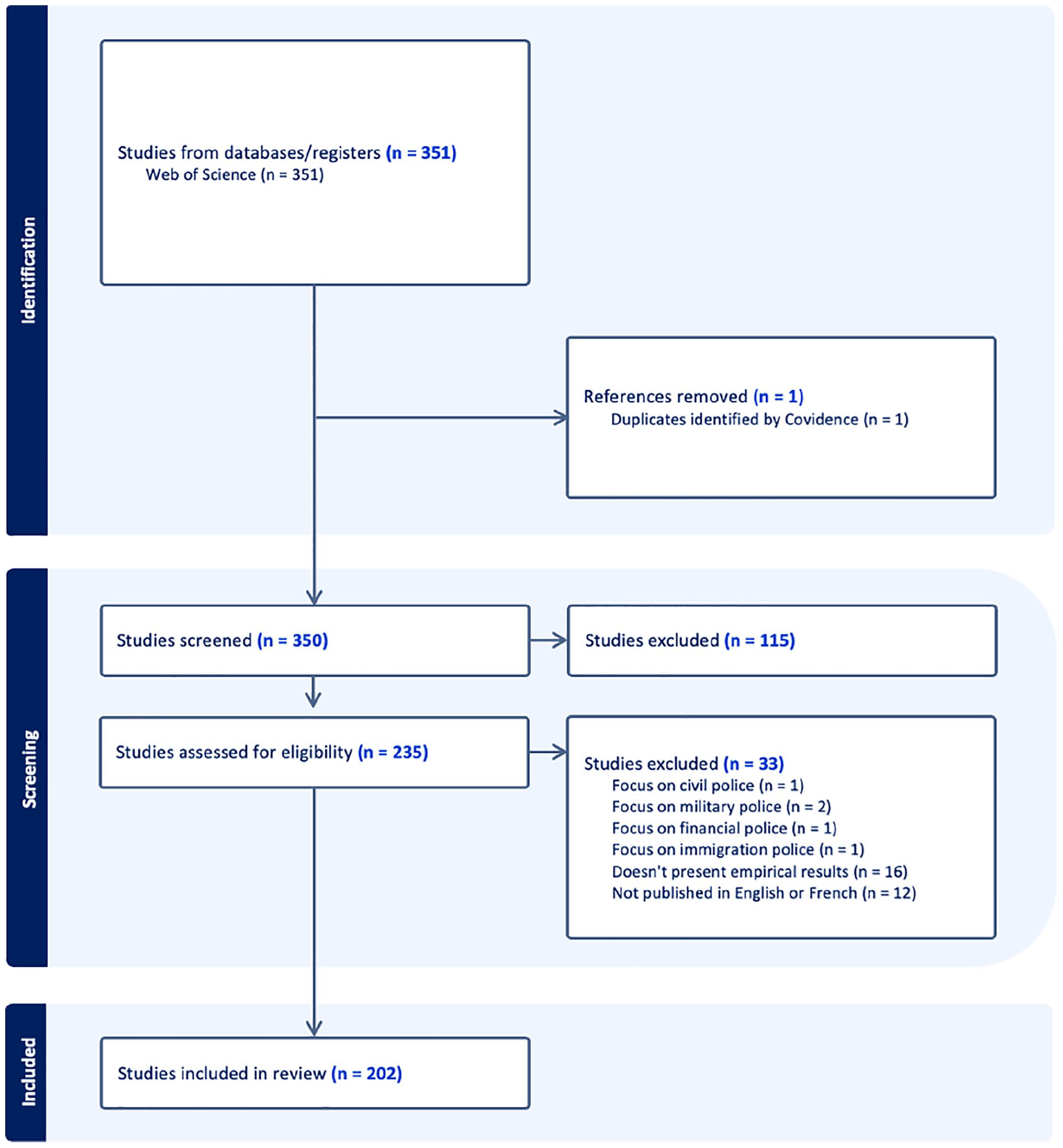
Prisma protocol selection to identify articles in public administration on policing
To code the eligible studies for the SLR, we used a combination of deductive and inductive analyses. First, we utilized a data extraction form to deductively analyze the studies according to the following pre-determined categories: the author(s), publication year, title, journal, abstract, research question, country, the focus of the study (i.e., key themes and subthemes), research method and design, and the practical recommendations.
Specifically, the categorization of the key themes and sub-themes needs further clarification. To identify the study’s focus (i.e., the key themes and sub-themes), we used the framework method. This content analysis strategy produces a matrix structure for various aspects of the qualitative data. This structure helps identify themes and their interrelationships, giving researchers a more comprehensive view of a large sample of articles (Zolnoori et al., 2019).
We utilized a deductive-inductive approach to generate the matrix for the studies’ themes. Zolnoori et al. (2019) recommend this approach for studying existing knowledge in a new context, allowing room for previously unidentified dimensions of data to emerge. Since there are no prior SLRs on policing in PA, this approach suits this study’s objectives. In our SLR, we coded articles along many of the same dimensions as Shen et al. (2023) thematic review.
Firstly, we identified key themes using Hong’s (2012) typology as our thematical framework for the deductive analysis. Studies were classified into one of the three categories: symbolic representativeness, police behavior, or police management, and then into one of the three periods (before 2020, 2020, and after 2020).
Secondly, we identified subthemes, which are more specific than key themes, by using open coding to inductively analyze the abstracts, titles, and keywords of the studies. We did this without any preconceived expectations, allowing themes to emerge organically. The initial codes were grouped into sub-themes through an iterative process until overarching conceptual themes emerged. Our aim was to provide a more comprehensive view of policing research topics within the PA literature. We sought to identify innovative PA research areas on police issues that may be understudied and warrant further exploration. To ensure the data’s reliability, two authors coded the studies to ensure consistency in the way articles were coded. Any disagreement regarding how a particular study was coded was discussed until a consensus was reached.
Results and Analysis
Most SLR present their results for the full timespan they selected. Our results could be appreciated that way, as we will first present our overall results. As detailed previously, we have chosen to augment our analyses with temporal comparisons of the descriptive tables presented in this section.
Characteristics of Police Studies in Public Administration
We commence this section by highlighting several key trends discerned within our data. Table 1 displays the distribution of articles by publication year, country, and journal. The first highlight is the notable uptick in the number of articles from 2021 to 2023, compared with the period from 2017 to 2020. From 2021 to 2023, the number of empirical articles more than doubled. This suggests that there was a substantial increase in attention toward police, and the topic gained popularity within the Public Administration literature.
Distribution of Articles by Year of Publication and Journal

We also found that the 202 eligible studies were found in 37 journals; however, close to half of the publications on policing (n = 97) appeared in only five journals. The five journals with the most policing articles are Public Administration Review (n = 31), Public Management Review (n = 23), American Review of Public Administration (n = 20), Governance (n = 12), and Public Administration (n = 11). Police research mostly comes from the more generalist (and prominent) Public Administration journals that cover a broad range of topics, rather than specialized journals.
Table 2, in the context of geography, shows that while police research has global relevance, the primary focus remains on the U.S. and Europe. Specifically, over half of all police research in this study (n = 104) is based in the U.S. Conversely, Mexico, South America, and African countries are noticeably underrepresented, raising questions about the applicability of Public Administration knowledge on policing in these regions (de Geus et al., 2020).
Distribution of Articles by Country Studied

The notable underrepresentation of research from Latin American and African countries in systematic literature reviews aligns with observations made by other scholars. Cucciniello et al. (2017) suggest that researchers in these regions might publish their work in languages other than English. Additionally, they speculate that these regions, consisting largely of developing countries, may produce a smaller volume of academic research overall. Furthermore, conducting research on certain “sensitive” topics like policing can be difficult in these countries due to potential restrictions on data access by authorities seeking to avoid scrutiny and oversight.
The significant representation of police research from the U.S. is expected. With over 18,000 public safety-related agencies operating under five different branches of governance (U.S. Department of Justice, 2016), the American criminal justice system is known for its fragmentation in jurisdiction, function, and culture (Oakerson & Parks, 1988). Studies show U.S. police officers vary in their training (e.g., Cohen, 2021), culture, and general management practices (e.g., Yi & Cui, 2019). This decentralization is a distinct feature of police systems, making it hard to create universally applicable research for the entire U.S. police force. This might explain the increased focus on U.S. policing in research. The high proportion of U.S. studies in our sample prompts questions about the applicability of this knowledge to policing issues and challenges in our field.
Research Question 1: What Areas of Policing are Researched in PA Literature?
As noted earlier, we sorted the Public Administration studies on policing into three main research streams suggested by Hong (2012). The matrix of themes and the three time periods mentioned above is presented in Table 3. The first category includes 50 police articles that focus on the symbolic representation of the police and citizens’ perceptions. The second category, comprising 54 articles, examines police behavior. The third and largest category, consisting of 114 studies (more than half of the total sample), concentrates on the management of police organizations.
Distribution of Themes and Subthemes by Period of Publication

The strong focus on the management of police organizations was consistent across all time periods, perhaps because this group of studies is more heterogeneous than the others. Nonetheless, the Chi-square test and Fisher’s exact sum rank test (not shown) revealed that none of the three themes are relatively more frequent in one of the three periods compared to the other.
The process of classifying codes into subthemes yielded seven overarching conceptual subthemes (see Table 3). There were no differences between the joint distribution of the subthemes in the three periods (Chi2 (6) = 11.8, Pr = 0.07). A Student t-test between 2017 and 2020 and 2021 to 2023 does not find a difference in relative frequencies either, according to Fisher’s exact sum rank test (Chi2 (1) = 0.441, Pr = 0.507; Fisher’s exact sum rank test = 0.568). This means that the growth of articles on representation, policing, and social issues, and the relative disaffection for questions of policing, workforce, and community relations, are not large enough to change the mix of subthemes that are studied. Time will tell is the uptick of studies about “community relations” and “representation” will become mainstays in the pages of our journals. No subtheme dominates the research agenda of Public Administration since 2017.
While trying to classify the subthemes into the overarching three key themes, we realized they were not mutually exclusive and could overlap. For instance, studies on police technologies, a subtheme, could sometimes address police behavior, while being associated with police management in another study. Therefore, the seven identified subthemes were not classified within the three main categories suggested by Hong (2012). While this classification system is not perfect and contains some arbitrariness, as with any typology, we believe that these conceptual subthemes offer a deeper understanding of the focus areas in Public Administration literature on policing. As a result, it also highlights the police topics that have been under-studied.
Research Question 2: What Theories are Utilized to Research Police in PA Literature?
We compiled theories from all articles in our sample. To make sense of our findings, we sought an existing list of theories for comparison. We used Hattke and Vogel’s (2023) list of theories employed in public policy and public management journals to compare the theoretical frameworks of the studies in our sample. This approach ensures we do not have a bias toward newer theories; instead, we are simply comparing our results with a previous study.
Table 4 summarizes the key theories used in our dataset compared to those identified by Hattke and Vogel (2023). We used the theory as the unit of analysis, meaning a study that used two theories counted as two rather than one. We coded generously, even when theories were invoked rather than applied meticulously, adding up to 193 theories. We also credited theoretical bricolage if the source of the framework was explicit. The theory written in gray were not encountered once in the 202 articles we coded.
Theories and Theoretical Frameworks of Policing Articles in Public Administration Journals, 2017 to 2023

Note. Adapted from Hattke and Vogel (2023, p. 1546), as some theories had a frequency of “0.” *means that it was not from Hattke and Vogel (2023, p. 1546).
Our first observation is that 64 out of the 202 (33.2%) empirical articles did not utilize theories or theoretical frameworks, at least no clear ones. The limited use of theories to justify hypotheses is not unusual in Public Administration even if it proved less frequent in systematic review on policy entrepreneurship (17%; Aviram et al., 2020, p. 39), race and gender (24%; Pandey et al., 2023, p. 23), and internal auditing in the public sector (51%; Nerantzidis et al., 2022, p. 195).
Second, the choice of theories used in police studies differs from the mainstream public management theories reported by Hattke and Vogel (2023). Many of the theories they mentioned were not mobilized even once for policing studies during the 2017 to 2023 period: democratic theory, contingency theory, systems theory, effective government theory, the behavioral theory of the firm, goal setting theory, and social learning theory. That is why they do not appear in Table 4.
On the other hand, institutional theory was the most popular of the mainstream theories, with 3.1% (n = 6) of studies using it.
Moreover, three theories that were not listed as the most frequent in Public Administration as a whole (Hattke & Vogel, 2023) were frequently used in Public Administration research on policing: representative bureaucracy theory in 15% of studies (n = 29), Street-level bureaucracy theory in 8.3% of studies (n = 15), and to a much lower degree, public values theory in 1.6% of studies (n = 3).
Interestingly, a copious number of theories and theoretical frameworks used in police studies (30.6%, n = 59) had no discernible pattern or recurring elements, as we only met them once or twice in our sample. That is why they are not listed in Table 4. These are represented under “other theories and frameworks” in Table 4. As an illustration, in the 2017 to 2020 period, we found studies that have used, among others, role-episode theory, complexity theory, fiscal federalism theory, responsiveness theory, and the spiral of silence theory, the gendered organization framework, organizational innovation theory, occupational stress theory, and symbolic politics theory. Lastly, in the 2021 to 2023 period, we identified field theory, technologies-in-practice theory, the three-step accountability framework, procedural justice theory, and racial threat theory, among many others.
A systematic review of 11,417 articles in 13 journals between 1997 and 2015 denoted that the most cited theories in Public Administration relate respectively to performance, governance, networks, participation, and collaboration (St. Clair et al., 2017). However, our findings suggest that theories guiding police research in Public Administration do not align with other studies in the discipline at large. This could imply a multidisciplinary approach to studying policing in Public Administration. It is also possible that police departments are perceived as distinct from other civilian agencies.
Research Question 3: What Data and Methodologies are Employed to Research Police in PA Literature?
Concerning methodology, the results indicate that most policing studies employed a quantitative methodology (63.9%, n = 129), with half of these utilizing surveys for data collection (52.7% of n = 129, 68). Further, 106 quantitative studies used some kind of multivariate regression analysis, linear or loglinear. Only four quantitative studied used randomization prior to their quantitative analysis. From the studies that used qualitative data (27.2%, n = 55), most used interviews as the research methodology (n = 31). Qualitative articles also utilized qualitative approaches such as content analysis (n = 13), case studies (n = 7), focus groups (n = 7) and (rarely) ethnographies (n = 5). We also identified 18 (8.9%) mixed-method studies, which utilized interviews (n = 9), and OLS, logistic or other kind of regressions (n = 9). Table 5 provides the findings in terms of the research method used in our sample.
Data Sources and Methods Used for Policing Articles in Public Administration Journals, 2017 to 2023

Have research methods changed after 2020? The answer is negative. This holds true for qualitative, quantitative, and mixed-methods portfolios. The distribution of methods has remained consistent, as evidenced by the variety of methods used. This consistency also applies to specific methods, as demonstrated by paired comparisons of specific items from Table 5. Perhaps in time, the minor increases in case studies and qualitative content analyses will gain momentum and become popular approaches. However, police cruisers ride-alongs, a staple in criminology research, remains uncommon in Public Administrative research. As street-level bureaucrats, police officers are more often interviewed and surveyed than observed at work.
Our exploration led us to find an overwhelming number of variations in the unit of analysis, which posed a significant challenge when we attempted to summarize and categorize them in a succinct and comprehensible typology. This complexity made it difficult to draw clear boundaries and distinctions, turning the task into a daunting endeavor. Studies’ unit of analysis included, among others, crime stats, work teams, a single police department or academy, a single police operation, a single fatal incident, homeless of one city, the citizens of one city, police stops, police departments in all major cities, police officers in a certain state, and police officers in a country. Researchers interested in policing approach their object of study from diverse angles indeed.
Our research on sampling methods revealed similar variability in the data. These methods ranged from single case studie and a few interviews, to hundreds of survey respondents and tens of thousands of police stops. Scholars from all levels and perspectives in Public Administration study policing.
Regarding the data, 22 articles (10.9%) studied police officers alongside other public servants outside of policing. These authors argued that police officers are frontline workers and part of the broader public sector employees. Moreover, about a third of the articles (34.2%, n = 69) partially utilized administrative data for their analyses. That is, these studies did not primarily depend on self-reported data, such as officers’ perceptions. Almost 40% of the articles used surveys (n = 80) to delve into the perceptions of the respondents. That is important when performance is measured subjectively, as the effect sizes of collaboration networks—to take one example—are smaller when measured of administrative data compared with subjective measures (Lee & Hung, 2022, p. 369).
The duration of the studies ranged from 1 month to several years. Nearly a third of the studies (31.7%, n = 64) did not specify the data collection period. We grouped the results of those that did into three categories: data collected within the same year (1 year); data collected between 2 and 10 years; and data collected over more than 10 years. These categories represented 43.5%, 41.3%, and 15.2% of the studies, respectively. Our analysis shows that mixed-methods studies tend to use data collected over longer periods. Specifically, 17.2% of quantitative studies and 14.3% of mixed-methods studies utilized data collected over more than 10 years. The remaining long-term studies were qualitative, accounting for 9.7%.
Data collected within the same year were evenly distributed among mixed-methods (43.5%), quantitative (43.0%), and qualitative studies (41.9%). Cross-sectional studies have limitations and that studying the impacts of initiatives, programs, policies, and especially reforms, requires time. This is due to the fact that the costs and benefits of changes may not be immediate or occur on the same timeline. Despite the inherent limits, the large share of cross-sectional research design is found in systematic review of other topics, like organizational size and performance (Walker et al., 2024, p. 39) in the public sector.
Research Question 4: What Practical Recommendations are Offered for Police in PA Literature?
Public Administration scholars often claim that their research is highly relevant to the world of practice. In this section, we attempt to analyze the “so-what” question in police studies. In other words, how do researchers effectively translate their empirical findings into practical recommendations? To answer these questions, we extracted the specific recommendations for practice from each study.
To analyze the “so what” question, we used Bushouse and Sowa’s (2012) typology about the presence and clarity of practical recommendations. They used these five categories: (i) Yes, (ii) Yes but Could be Better, (iii) No but Should, (iv) No and Should Not, and (v) Excluded (Bushouse and Sowa, 2012, p. 501). Since we did not include purely conceptual articles in our sample, we did not use that fifth category.
In our sample, there were no essays, thus no articles needed to be excluded. Eleven articles did not have any recommendations, but they were conceptual exercises based on data (iv), so they did not require any. Only one out of five articles did not attempt (iii) to provide practical recommendations (20.3%, n = 41). Three-quarters of the articles (74.3%, n = 150) offered some form of recommendation (i + ii). However, out of that total, 36 articles (17.8% of the total) provided concrete recommendations (i). Here, we measured the presence of recommendations, and the nature of its applicability, and not if the substance of a recommendation contradicts the findings of meta-analyses. Out of the 202 articles, 114 (56.4%) included at least one recommendation, albeit they could have been better articulated (ii) to make them actionable. The recommendations themselves can be consulted in Appendix B.
Table 6 shows the proportion of articles up to 2020 and after, categorized by the presence and nature of the recommendations offered. The Chi-square test and Fisher’s exact sum rank test (not shown) suggest that the proportions of practical recommendations in the four categories do not significantly change from one period to the next. In other words, they neither improved nor deteriorated after the events of 2020.
Presence of Practical Recommendations Used for Policing Articles in Public Administration Journals, 2017 to 2023

Source. Bushouse and Sowa (2012).
Our reading revealed that authors frequently invited readers to “consider,” “be aware of,” or “pay attention” to various ideas or potential outcomes, such as the value of collaboration or the importance of workforce diversity. However, these recommendations often failed to specify the intended audience, using broad terms like “policymakers” and “public leaders.” In aspirational-type recommendations, authors often encouraged behavioral, performance, and motivational changes through “effective leadership practices” or a “strong organizational culture.” However, these recommendations lacked clarity due to the vague definitions of “good,” “strong,” or “effective” leadership and culture. The most practical suggestions frequently involved improving officers’ skills and knowledge through training and development. However, these recommendations often lacked details about the necessary training content to achieve this objective.
Discussion, Research Agenda, and Conclusion
As expected, our systematic literature review presented descriptive analyses of many dimensions of more than 200 articles on policing in Public Administration journals. Our results highlight key findings that set the stage for further research. Firstly, the significance of police research in Public Administration is becoming more acknowledged. This is evident in the surge of studies on police. In the 3 years from 2021 to 2023, the number of articles on policing in Public Administration journals increased by more than 40% compared to 2020 and the 3 years prior (119 vs. 83). It is uncertain whether the increased focus on police research after 2020 is due to a heightened interest among Public Administration scholars or a shift in journal editors’ publication preferences. However, for a subject traditionally seen as separate from Public Administration (Fleming, 2008), we find this development to be encouraging. It remains to be seen if this trend signifies the start of an academic paradigm shift in Public Administration.
While the number of police studies has increased, it seems that the impetus driving these studies goes beyond studying policing as a public profession on its own, serving more as a “setting” or “context” for researchers to peruse other Public Administration research topics. A prominent example of this is the use of police officers as a “case of” street-level bureaucrats as if authors are trying to convey the subtext that this study is not really about police but is merely an example of street-level bureaucracy and, therefore, deserves to be published in a Public Administration journal. Some might say that managing the state’s monopoly on legitimate violence does not need an introduction. This is because police organizations are public entities, much like any other local government (Fleming, 2008). As such, they should be studied with the same intensity as other public professions. Another argument is that we need to understand the specific issues with the policing system from a Public Administration lens and develop evidence-based strategies to enhance law enforcement practices. We are of two minds about embracing the study of police administration as a signature theme in Public Administration research deserving its own investigation, rather than use it as a backdrop to other topics. At present, the gap between the theories mobilized by researchers on policing compared to the rest of the discipline is an argument about the otherness of policing compared to other public services. Police officers are rightfully seen as street-level bureaucrats, but not considered as blue-collar workers, which they are (Kruyen & Sowa, 2023, p. 526) in the rank and files. Public Administration research ignores blue collar workers in the public sector (Kruyen & Sowa, 2023, p. 523).
However, although authors utilized various research methods, it appears that most police studies in Public Administration predominantly used quantitative methods, particularly survey research. While this trend aligns with the general Public Administration scholarship (Ritz et al., 2016), there are two gaps that scholars interested in contributing to police research should consider, plus a path not taken. The first gap is the need for more rigor in quantitative methods used for police studies in Public Administration. Contrary to the criminology scholarship, which utilizes big data analytics over long periods, most studies in our sample still rely heavily on cross-sectional data. Big data secondary sources were largely absent from our sample. More analysis of big data secondary sources, such as the National Decertification Index (NDI), the FBI’s Uniform Crime Reports (UCR), and The Bureau of Justice Statistics (BJS), alone or combined with other governmental data, would be significant for understanding the factors that influence police decision making and for making policy decisions. They also offer researchers measures that are less subjective than “fear of crime,” to provide but one example.
The second gap is the need for more police studies utilizing qualitative methods. This is especially true for longitudinal design that can assess causality, like comparative-historical analysis, process tracing, and systematic social observation of dashcams and body-worn cameras. Clearly, qualitative studies are important in Public Administration scholarship in general. However, they are especially important for learning from police officers in discussion, and especially observations, who are traditionally considered a “hard to track” or “hidden” population. Combining several qualitative data collection efforts can offer insights into enduring challenges, like identification policies on police uniforms (Dwyer, 2020). The term “hidden” population typically refers to disadvantaged and disenfranchised social groups, like the homeless and criminal offenders (Wiebel, 1990). It can also apply to other hard-to-reach groups. Scholars generally agree that law enforcement has a substantial subculture (Paoline, 2004). This subculture often displays a strong “us-versus-them” mentality and high suspiciousness toward “outsiders,” making it challenging to examine using traditional research methods. Therefore, qualitative research is paramount for obtaining a nuanced understanding of police officers as frontline public workers that cannot be effectively measured through surveys, especially with policing being such a controversial topic nowadays. We opine that a great many articles are based on citizens’ views of policing. Citizen surveys, especially with the advent of cheap survey platforms, are easy to conduct. Huey (2016) observed than in her systematic review, every study on police-community relations were done exclusively from the public’s point of view (p. 12). We are not calling for more survey experiment of mTurkers without captcha or other tests permitting bots to react to paper vignettes. Research on police officers view of the public, and subgroups of the public, would be valuable. We particularly think that interviewing police officers who recently left one police department for another, especially if the department they left went through an important budget cut, or had high turnover of officers, or if the crime rate was on an upswing trajectory, would be valuable to document the shortage of officers in some police departments.
This brings us to the path not taken. Documenting the management elements behind policing tactics that work, like problem-oriented policing (Hinkle et al., 2020) could produce actionable knowledge for police managers. Divesting our attention from programs that fail to move the needle on criminality, and second-responders programs (Petersen et al., 2022)—teams of police officers with social service workers, victim advocates, or counselors—could preserve our limited resources on how best to manage the implementation of public programs that create public value.
Third, the majority of police studies come from the United States. This is expected for reasons mentioned earlier, but the issue is more extensive than it appears. Our SLR suggests that the vast majority of these studies take place in a single state or even one local academy. The comparative angle of policing across countries and continents is rarely explored, with only 11 comparative studies. The comparative approach is critical for our understanding of the similarities and differences between police systems in different geographic settings, especially given empirical evidence (mainly in the criminal justice literature) that police practices and occupational culture are not as universal or monolithic as historically considered by scholars. Without comparison, it is possible to overfit a model and ignore that the force or variable identified as a cause is absent from another jurisdiction country with a similar level of outcome. The comparative approach holds the potential for promising avenues for research that should be at the forefront of policing research. It can explore interesting research questions such as how different governmental structures and democracies influence police organizations, how community-oriented policing is implemented across countries and affects legitimacy and trust building, how different police initial and on the job training affect outcomes of interests, or what factors influence frontline police officers’ service delivery decision-making. Furthermore, without a comparative approach to understanding the heterogeneity among police systems, new measurements and typologies cannot be developed, and therefore, police research is hindered.
Interestingly, comparative policing is also an understudied research field in the criminal justice and criminology literature (Roche & Fleming, 2022). According to these authors (Roche & Fleming, 2022), the reason comparative policing studies are rarely conducted is because academics lack “the tools, theories, concepts, and data to engage in comparative analysis” (p. 256). Specifically, they argue that policing research suffers from a conceptual ambiguity surrounding the constructs that create and regulate police organizations, such as accountability, trust and legitimacy, and decentralization (Roche & Fleming, 2022).
This is where the Public Administration research community can be of great value to policing research and contribute to the development of viable comparative methods in policing. After all, what discipline is more suitable than Public Administration to identify and test such concepts for a systematic understanding of police-government and police-citizens relations?
Lastly, we address our findings regarding practical recommendations in police studies. Reviewers and editors in an applied field should compel researchers to offer practical recommendation with actionable details. Public Administration Quarterly specifically asks authors to list practical implications right after the abstract. As researchers of an applied discipline, Public Administration scholars have the responsibility of translating their empirical findings into actionable recommendations for practice. Indeed, most leading Public Administration journals require authors to include some type of practical recommendations section in their study. However, to our surprise, we found these sections to be the weakest area of police research in Public Administration, with most recommendations being too abstract and missing the actionable indications that practitioners need.
Russo et al. (2023, p. 1627) refer to this as “an issue of narrative” and explain that the problem is with what researchers believe is practical and how they express it. In their “guide to writing impactful practical implications,” they suggest that researchers use the W-H questions as a guiding framework to ensure that the most important elements of a recommendation are covered. Specifically, researchers should thrive to address Why the recommendation is offered, What it endorses, When and Where it is most applicable, to Whom it is addressed, and How it is framed (Russo et al., 2023).
The recommendations we found in our sample rarely addressed these questions and often sounded more like concluding remarks or hopeful wishes. Such was the recommendation (wish?) for officers to “improve their conduct” or for an “overall police reform.” Such recommendations are (rightfully) viewed by police practitioners as lacking pragmatism and drive them to perceive academics as elitists who are detached from reality.
Police professionals, like other practitioners in the public sector, are tasked with developing and implementing policies to ensure the smooth delivery of public services. As an applied discipline, Public Administration scholars should provide them with the knowledge they need to be successful in this task. Specifically, in a time of polarizing controversies surrounding police-public relations, the police profession is in dire need of an evidence-based approach to improve its practices while navigating through challenges related to trust and accountability. This SLR serves as a call for Public Administration editors, reviewers, and scholars to stop the limited attention to practical recommendations in police studies and try to emphasize the practical aspects of effectively managing organizations while addressing real-world challenges within the public sector.
Supplemental Material
sj-docx-1-paq-10.1177_07349149241308567 – Supplemental material for Policing and Public Administration: A Systematic Review and a Research Agenda
Supplemental material, sj-docx-1-paq-10.1177_07349149241308567 for Policing and Public Administration: A Systematic Review and a Research Agenda by Étienne Charbonneau, Galia Cohen and Brigitte Poirier in Public Administration Quarterly
Supplemental Material
sj-pdf-2-paq-10.1177_07349149241308567 – Supplemental material for Policing and Public Administration: A Systematic Review and a Research Agenda
Supplemental material, sj-pdf-2-paq-10.1177_07349149241308567 for Policing and Public Administration: A Systematic Review and a Research Agenda by Étienne Charbonneau, Galia Cohen and Brigitte Poirier in Public Administration Quarterly
Footnotes
Declaration of Conflicting Interests
The author(s) declared no potential conflicts of interest with respect to the research, authorship, and/or publication of this article.
Funding
The author(s) disclosed receipt of the following financial support for the research, authorship, and/or publication of this article: Étienne Charbonneau acknowledges funding from Power Corporation and the Canada Research Chairs program.

Supplemental Material
Supplemental material for this article is available online.
Notes
References
Supplementary Material
Please find the following supplemental material available below.
For Open Access articles published under a Creative Commons License, all supplemental material carries the same license as the article it is associated with.
For non-Open Access articles published, all supplemental material carries a non-exclusive license, and permission requests for re-use of supplemental material or any part of supplemental material shall be sent directly to the copyright owner as specified in the copyright notice associated with the article.
