




Abstract
Authorities in the People’s Republic of China communicate with citizens using an estimated 600,000 Sina Weibo microblogs. This study reports on a study of Chinese citizens’ adoption of microblogs to interact with the government. Adoption results from trust and peer pressure in smaller-network ties (densely knit, pervasive social networks surrounding individual citizens). Larger-network ties (trust in institutions at large, such as the Chinese Communist Party, executive organizations, the judicial system, the media, etc.) are not associated with the adoption of microblogging. Furthermore, higher levels of anxiety are correlated with lower levels of use intention, and this finding underlines the impact of the Chinese authority’s surveillance and control activities on the lives of individual Chinese citizens. Based on these findings, we outline a theory of why citizens use microblogs to interact with the government and suggest avenues for further research into microblogs, state–citizen communication patterns and technology adoption.
Points for practitioners
Our research identifies trust in individual civil servants, citizens’ anxiety and peer pressure as drivers of Chinese citizens’ intentions to use the Weibo microblogging platform to interact with the Chinese government. This insight allows practitioners to better understand citizens’ drivers and obstacles in the use of social media in state–citizen relations in China.
Introduction
The government of China is an avid user of microblogs (Ma, 2014; Schlæger and Jiang, 2014). In this context, microblogs refer to social-networking services like Sina Weibo, Tencent, People’s Net and Xinhua Net, through which users – individuals, businesses and government agencies alike – can post, share and comment upon messages that are limited to 140 characters, pictures or videos. Academic literatures have extensively researched the motivations of Chinese officials, agencies and the Chinese Communist Party (CCP) (Harwit, 2014; Ma, 2014; Meng et al., 2017; Schlaeger and Jiang, 2014) to use the estimated 600,000 government and CCP microblogs (Qin, Strömberg, and Wu, 2017), as well as authorities’ practices to regulate and control communication on microblogs (Harwitt, 2014; King et al., 2013; Qin et al., 2017). However, Chinese citizens’ motivations and uses have gone largely unnoticed (with Medaglia and Zhu’s (2016) study being a notable exception). It is the express intention of our article to fill this gap and to produce and test an explanation of Chinese citizens’ adoption of microblogs to interact with the government. Moreover, by constructing and testing such an explanation, it is also our ambition to reflect on how new technology-enabled forms of interaction, deliberation and communication fit into the state–citizen communication patterns of authoritarian governance regimes. China is an interesting case in this regard because it combines an authoritarian regime with a large user base that is described in the literature as being, on average, young, social and outspoken (Hassid, 2012).
The rise of Weibo microblogs in China and the response by Chinese authorities
China’s political structure
The People’s Republic of China (PRC) is governed through two interlocking power structures: the CCP, headed by the Politbureau and its Standing Committee; and a government apparatus headed at the national level by a premier who presides over the State Council. The CCP–government structures parallel one another in various administrative tiers: the central level (including autonomous regions (of which Tibet is one) and special autonomous regions (Hong Kong and Macau)), provinces, prefectures, counties, districts, and towns and sub-districts. Central-level leaders are recruited from CCP cadres and appointed by higher hierarchical echelons. Since the reforms of the 1980s, village elections and public administrative hearings have taken place more frequently. Overall, the CCP has emphasized the importance of the Internet for gaining insights into citizen preferences (Meng et al., 2017). While findings show a strong guiding policy from the central government on interaction with citizens, which would suggest centralization, we find that the pace and the methods used vary for each provincial government (Wu and Bauer, 2010).
The rise of microblogs
China witnessed the first Internet applications in the 1980s. Initially, network applications emphasized use in academic circles. In 2006, Chinese citizens became aware of the American microblogging platform Twitter. Twitter was soon accompanied by Chinese counterparts like Fanfou, Digu and Jiwai (Harwit, 2014; Qin et al., 2017). In 2009, in response to riots in the Xinjiang Uyghur autonomous region, the Chinese government blocked Twitter and shut down most domestic microblogging services. In late 2009, Sina Weibo, a hybrid of Twitter and Facebook, entered the scene and soon became the most popular platform in China, with the number of users peaking at over 600 million in 2014 (Harwit, 2014), of whom 85% accessed Weibo through their mobile device (Chiu et al., 2012; Koetse, 2015). While Sina Weibo’s user experience is mostly comparable to Twitter, the degree of interaction is higher and more comparable with Facebook. Weibo includes a trending topic list compiled through computer-based user participation, as well as staff choices, which causes some items to be distributed more than others. Furthermore, posts are censored by keyword blacklisting and manual staff monitoring, with automated filtering efforts being in place as an auxiliary method (King et al., 2013). King, Pan and Roberts note that keyword blocking and automated filtering methods can relatively easily be outsmarted by using analogies and metaphors, but hand censoring is not easily evaded. Moreover, in order for users to make full use of microblogs, they are required to register; hence, users who publish content deemed sensitive by the authorities are easily identified (Harwit, 2014).
Government response to citizens using microblogs to interact with the government
Harwit (2014) states that almost from the launch of electronic networks in the 1980s, the CCP’s Central Publicity Department and the State Council Information Office issued directives to lower-level branches of government ordering specific agencies to censor sensitive content and sanction perpetrators. However, in subsequent years, technological opportunities (e.g. the emergence of microblogs) and the political climate changed. Surveillance has continued to exist and is practised by both information officers and Internet monitors at all levels of government, as well as by censors employed by private Internet service providers (King et al., 2013). However, since about 2011, many local authorities have also embraced Sina Weibo as an information channel for public service announcements and as a propaganda space. One observable behaviour is that many agencies started to post human-interest stories and morning and afternoon general wisdom sayings (Hao et al., 2016; Liu, 2013; Schlæger and Jiang, 2014). More importantly, since 2011, authorities have become more tolerant of ‘citizen voice’ related to local issues such as corruption by local officials, illegal land seizures and ecological disasters. King, Pan and Roberts (2013) provided empirical evidence suggesting that the Chinese authorities nowadays allow a range of expressions of positive and negative comments about the state, its policies and its leaders. Schlaeger and Jiang (2014) reported that more and more individual local political and administrative leaders are actively using microblogs to ‘gauge the water’ (Cairns and Carlson, 2016; Qin et al., 2017), using technologies like Sina Weibo as a ‘beta institution’ with which new ways to incorporate citizens’ suggestions and complaints into policies are experimented with (Ma, 2014; Schlaeger and Jiang, 2014; Sullivan, 2014). Data from a survey experiment conducted by Meng, Pan and Yang (2017) showed that more than half of the surveyed administrative and political leaders are receptive to suggestions expressed through microblog channels, but their willingness to incorporate citizens’ suggestions into policies (and inversely the probability that citizens are ignored or sanctioned) depends on social contention and risk that criticism turns into social protest (Hassid, 2012; Li et al., 2016, 2017). If the authorities find or suspect that collective movements are in evidence, they will most likely intensify censorship and may have officials and a so-called ‘50-cent party’ of trolls (some trolls are paid at a piece rate of 50 fen) ‘occupy’ social media (Cairns and Carlson, 2016; Qin et al., 2017) in order to prevent social protests from gaining traction (Cai, 2010; Cairns and Carlson, 2016; Qin et al., 2017). Sullivan (2014) notes that possibly the biggest fear of the Chinese authorities is the emergence of a coalition of laid-off workers, dispossessed homeowners, unemployed graduates, hungry farmers and minority ethnic and religious groups that may challenge political stability and the regime’s hold on power; if this happens, censors will attempt to clip the social ties of the movement rather than block media altogether (King et al., 2013).
Adoption and diffusion of microblogs in China
Underpinnings of a theory on Chinese citizens’ adoption of microblogs to interact with the government
The interaction of the Chinese authorities with microblogs is rather complex (Qin et al., 2017). Microblogs are being used as a source of information through which the authorities experiment with learning about public sentiments, and as a propaganda space through which citizen discontent is contained within tolerable limits – practices referred to as ‘consultative Leninism’ (Tsang, 2009) or ‘networked authoritarianism’ (MacKinnon, 2011; Tsai, 2016). The literature also documents how online discontent occasionally transforms into visible protests (Deng et al., 2015); however, an explanation as to why relatively ordinary Chinese citizens either do or do not adopt microblogs like Sina Weibo in their interactions with the government is lacking. This gap is also observed in studies focusing on citizens’ social media use in Western contexts (Susanto and Goodwin, 2013; Welch and Fulla, 2015). In the following sections, we will develop and test a theory of Chinese citizens’ adoption of microblogs (and Sina Weibo in particular) in their interaction with the authorities.
In the more generic technology adoption literature, frequently used starting points are theories and models like the ‘technology acceptance model’ (TAM), the ‘theory of reasoned action’ (TRA), the ‘motivational model’, the ‘theory of planned behaviour’ (TPB), the combined TPB–TAM, the ‘PC utilization’ model, ‘innovation diffusion theory’ and ‘social cognitive theory’. The ‘unified theory of acceptance and use of technology’ (UTAUT and UTAUT2) (see Venkatesh et al., 2016) integrates many variables from the aforementioned theories into a model that features an individual’s ‘intention to use’ as a mediator in the relation between an individual’s actual use of a specific technology as an outcome variable and a set of predictors like the user’s expectancy, ease of use, peer pressure, habit and the availability of resources. UTAUT and comparable models have been used to explain, among other things, Chinese consumers’ use of mobile commerce platforms, as well as citizens’ use of government websites in a variety of national contexts (Homburg, 2019; Yang et al., 2018). In general, the UTAUT and UTAUT2 models are suitable for explaining the adoption of specific services (and in an e-government context, especially electronic transactions) given, in principle, the voluntary use of the technology or service at hand.
There are reasons, however, to question the validity of the UTAUT model for explaining the adoption of microblogs by Chinese citizens to interact with the government in the Chinese context. As was put forward in the previous section, characteristic of this context is the gradual experimentation by the Chinese authorities with receptivity towards citizens’ grievances (Schlaeger and Jiang’s (2014) concept of ‘beta-institutions’), which coincides with a legacy of totalitarianism and the practice of censorship, online policing and, at times, the physical repression of collective action. As a result, Chinese citizens can be viewed as individually free to express themselves on microblogs but collectively chained (King et al., 2013). The willingness of citizens to express their preferences undoubtedly differs from that in a consolidate democracy (Meng et al., 2017), implying that Chinese citizens can be expected to express circumscribed sets of preferences in the face of the possible sanctioning of online behaviours deemed inappropriate by the Chinese authorities. In other words, Chinese citizens can be expected to have to deal with balancing new opportunities through which sentiments may be vented with the risks of being confronted with censorship and prosecution.
Conceptualization and hypothesis development
Adoption: Intention to use
In our conceptualization of the adoption of microblogs by Chinese citizens, we conceptualize adoption as the degree to which Sina Weibo is mentally accepted by a Chinese citizen as a channel to communicate with the government. We follow a widely used practice in adoption research by measuring ‘acceptance’ as an individual’s intention to use Sina Weibo because intentions are more validly measured in questionnaires than behaviours are, and previous studies have shown that intentions are adequate proxies of actual behaviours (De Lange and Homburg, 2017). Furthermore, measuring intentions in a questionnaire to be administered in a target population of Chinese citizens proved to be less sensitive than measuring actual behaviours. In order to explain Chinese citizens’ adoption of Sina Weibo to interact with the government, we hypothesized that ‘intention to use’ Sina Weibo to interact with government is correlated with a number of variables, which are discussed in more detail in the following.
Peer pressure
Peer pressure is hypothesized to impact Chinese citizens’ adoption of Sina Weibo as CCP and government communications have emphasized the importance and relevance of Sina Weibo as a channel through which public sentiments are to be communicated (Harwit, 2014; Qin et al., 2017). In general, adoption theories have generally identified above-individual considerations, more specifically, conformation to the expectations of nearest and dearest people, as an important predictor of the adoption of technology (Carter and Bélanger, 2005; Venkatesh et al., 2016a). We assume that this impact might be even more prevalent in authoritarian systems. We therefore hypothesize that the higher the pressure to be recognized as a user of Sina Weibo that an individual Chinese citizen perceives, the higher the intention to use Sina Weibo to interact with the government will be.
Anxiety
A second relevant construct is a user’s perception of or belief in the fallibility of a specific technology that he or she is about to be using. In this study, it is assumed that anxiety is an individual’s general negative affective emotion of unease or arousal in the way in which one deals with technology, where unease and arousal are related to consequences that the citizen may be confronted with that are beyond the control of an individual citizen (Rana et al., 2013, 2016). As was discussed earlier, censorship, bans or prosecution may follow social media activity deemed inappropriate by the Chinese authorities, which underlines the relevance of anxiety as a predictor of adoption (Wang et al., 2012). We therefore hypothesize that the higher an individual’s level of anxiety towards microblogs, the lower the intention to use Sina Weibo to interact with the government will be.
Trust
The concept of trust is prevalent in many adoption studies, including but not limited to studies of electronic government services (Carter and Bélanger, 2005; Venkatesh et al., 2011). The concept of trust is used in many contexts and therefore notoriously hard to define (Frederiksen, 2014). Although anxiety and trust may be thought of as overlapping concepts, trust is an individual’s belief that exists only in reference to other individuals or institutions, and is therefore different from anxiety, defined as an individual, internalized negative affective emotion. In this study, we conceptualize trust of a citizen A in party B as A’s notion of safety associated with A’s expectation that B will refrain from exploiting A’s vulnerabilities in the presence of B’s power to do so (in other words, A expects B to be reliable) (Pavlou and Gefen, 2005). By accepting vulnerability, A possesses trust; by refraining from exploiting vulnerability, B is trustworthy.
Trust and trustworthiness in relation to microblogs in China has at least two meanings. Following Yang and Tang (2010), a first meaning is a sociological interpretation of trust related as the degree to which citizens have positive expectations of the motivations of administrative, legal and societal institutions, such as the CCP, the government apparatus, councils, courts, associations, the media and complaints bureaus. We will refer to the term institutional trust in this context and associate this type of trust with the ties that individual citizens may have with larger overarching societal structures (so-called larger-network ties). Hence, an individual displays a high level of institutional trust if he or she thinks that the authorities – at considerable physical distance, or minimally at arm’s length, from citizens – will not negatively affect individuals’ lives, even if the authorities possess the right and means to do so. We hypothesize that the higher an individual’s level of institutional trust, the higher the intention to use Sina Weibo to interact with the government will be.
Following Poppo, Zhou and Li (2016) and Reich-Graefe (2014), a second meaning is that trust is relevant in interpersonal relationships. In this more psychological connotation, trust is an expectation that other persons or officials refrain from opportunistic behaviours. In a Chinese context, interpersonal trust is considered to be of the utmost relevance as trust in officials protects citizens against administrative hurdles or unforeseen risks. Therefore, an intricate and pervasive relational network is a cultural phenomenon that is vital in daily life in China. This network (guanxi) consists of feelings of empathy and solidarity (ganqing), reliability and sincerity (renqing) and reliance (xinren) (Yen et al., 2011).
Interpersonal trust is relevant for explaining citizens’ adoption of Sina Weibo since there is empirical evidence that many Chinese government officials are receptive to citizens’ sentiments on Sina Weibo but may respond in unfavourable ways (i.e. engage in opportunistic behaviours) to citizens if citizens’ sentiments are perceived as a threat to social order. The potential threat is personified by specific individuals, or develops in relations with specific persons, so called smaller-network ties. We hypothesize that the higher an individual’s level of interpersonal trust in government officials, the higher the intention to use Sina Weibo to interact with the government will be.
Methodology and measurement
Questionnaire design, data collection and data-screening procedures
In order to construct an explanation, a first step was to conduct a survey with which the various variables could be measured in a sample of Chinese citizens. To ensure the validity of the measurements as much as possible, this study adopted and slightly modified related questions asked as Likert items in prior studies on peer pressure (Venkatesh et al., 2011), interpersonal trust (Poppo et al., 2016; Reich-Graefe, 2014), institutional trust (Yang and Tang, 2010), anxiety (Venkatesh et al., 2011) and use intention (Venkatesh et al., 2012). A 71-item questionnaire was developed in the English language, translated into Mandarin Chinese and then translated back into English by an independent translator so that the quality of the translation could be checked. Furthermore, the questionnaire was piloted among various Chinese students living and working near the researchers’ domicile.
A second step involved the selection of a region within which respondents could be targeted. Given the vast size and cultural variety that exists in China, we decided to limit the data collection to a specific province and selected Hunan province, located in South-Central China. Hunan, home to 68 million inhabitants (estimated in 2017) and 41 ethnic groups, has a fairly well-developed education system, and Hunan government institutions have shown ample experience with social media: the city of Changsha’s CCP committee spearheaded the shaping of online debates as early as in 2004 (Harwit, 2014), while Hunan’s High Court and Changsha Police services received national awards from the Sina corporation for their microblogs. This is not to say that Hunan excels in comparison with other provinces. We aim for neither comparison nor generalization; rather, we merely aim to demonstrate that Hunan fits the criterion of having experience with social media.
Subsequently, as a third step, various China-based companies specializing in marketing and opinion polling were contacted; the perceived sensitivity of the subject matter turned out to be prohibitive for many companies to carry out the survey. Eventually, data were gathered between 13 February and 21 February 2017 by a Shanghai-based survey company using an online survey tool.
Data were scanned and screened for kurtosis and unengaged responses based on standard deviations of Likert items and the time it took for respondents to complete the survey (M = 12.6 minutes, SD = 24.9 minutes). Data from five respondents were dropped because of distrustful characteristics (age). Ten unexpected missing values were replaced by the median of nearby data points following general data-screening guidelines (Gaskin, 2017). Responses from 1572 citizens from Hunan province could be used for further analysis.
Descriptive results
Demographics
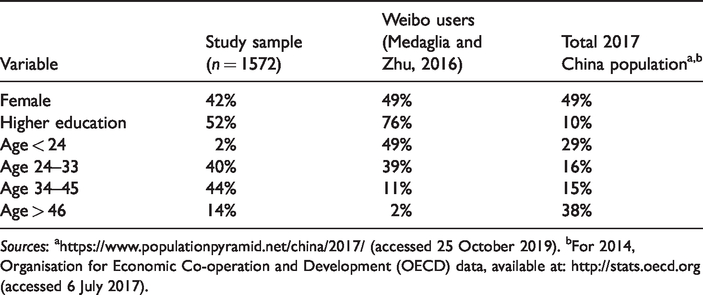
Respondents were 914 men (58%) and 658 women aged 15 to 67 (men: M = 36.9, SD = 8.4; women: M = 34.6, SD = 7.0). The majority of the respondents (86%) reported living in an urban area. Professional activities included going to school (3%), working in the public sector (30%), working in the private sector (60%), keeping house (3%) and something else (2%). The highest level of completed education was reported as junior high school and below (2%), senior high school (8%), college (37%), university (49%) and postgraduate (3%). Monthly salary ranged as follows: less than RMB 2000 (3%), 2001–5000 RMB (23%), 5001–8000 RMB (39%), 8001–12,000 RMB (27%) and above 12,000 RMB (6%). Table 1 shows the comparison of gender, education level and age compared to Weibo users and the Chinese population.
Comparison of the characteristics of the study sample, Weibo users and the total Chinese population as regards gender, education and age.
Sources: ahttps://www.populationpyramid.net/china/2017/ (accessed 25 October 2019). bFor 2014, Organisation for Economic Co-operation and Development (OECD) data, available at: http://stats.oecd.org (accessed 6 July 2017).
While Hunan province covers a large area and holds a large population, and we did manage to sample across various age groups, income groups and gender groups, we cannot claim that findings do justice to regional differences, which might exist within Hunan province, or to differences in the whole of China (see Table 1): highly educated people and middle-aged people seem to be over-represented. This could be regarded as a limitation that should be explored further in future research.
Use of social media
Almost all respondents were registered Sina Weibo users (97%), and 72% of all respondents reported using Weibo services about once a day or more. Organizational government Sina Weibo accounts (i.e. accounts used with reference to civil service law, excluding accounts opened by CCP and organizational cadres) were used by 90% of respondents. Of all respondents, 57% answered that they used government Sina Weibo accounts at least once a week or more, with gender (p < .001), age (p < .001), income (p < .001) and education (p < .001) affecting government Sina Weibo frequency of use (chi square = 213.164, p < .001, df = 10, Nagelkerke’s R2 = .171). Figure 1 displays the reported topics that respondents use most (with a maximum of three options). Apparently, topics of state–citizen interaction on Weibo cover many issues, with no clear dominance of specific areas of discussion.
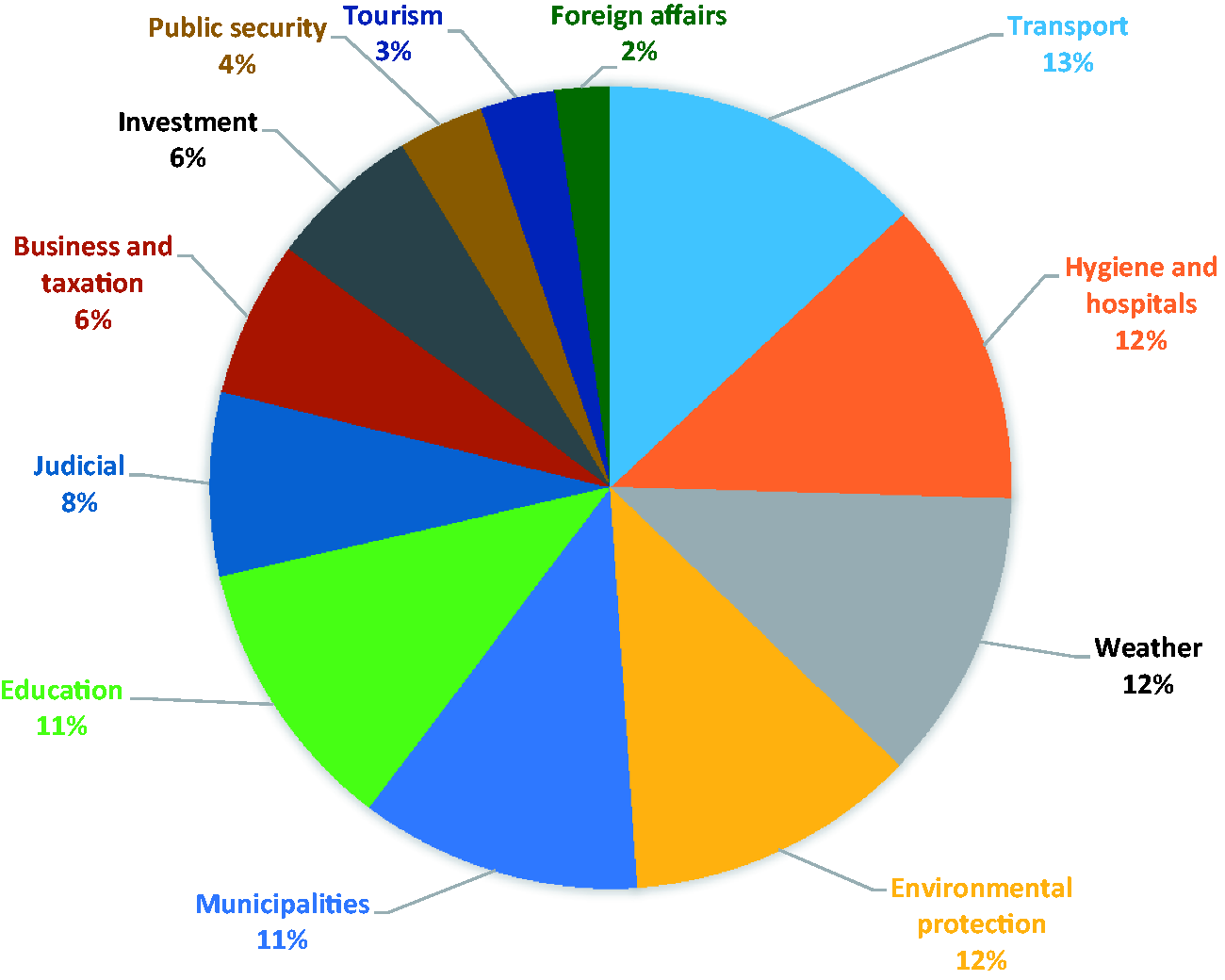
Citizen use of government Weibo, by topic area.
Analysis and hypothesis testing
Results of the exploratory factor analysis and reliability analysis
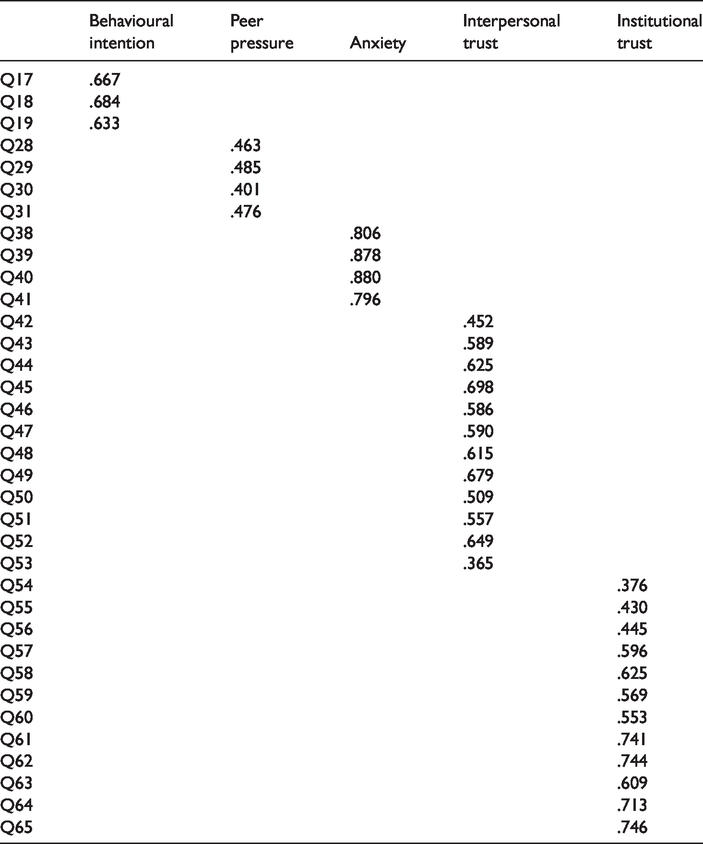
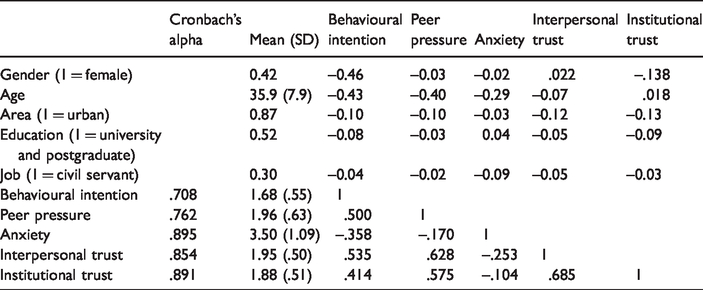
As there is little empirical research on government-initiated social media use in China considering interpersonal trust, institutional trust and anxiety, we carried out an exploratory factor analysis in order to identify the underlying structure of the measured variables in the questionnaire. First of all, the factorability of all Likert items in the questionnaire was examined. A cross-table analysis of all items showed that many items correlated by at least .3 with at least one other item, suggesting factorability. The Kaiser-Meyer-Olkin measure of sampling adequacy was .968 and thus well above the commonly recommended value of .6, and Bartlett’s test of sphericity was significant (χ2 (1176) = 31145.577, p < .0001). The diagonals of the anti-image correlation matrix were above .5, with the exception of the items on anxiety. Finally, the communalities were all above .3, further confirming that each item shared at least some common variance with other items. Given the aforementioned considerations, factor analysis was deemed to be suitable with all items. Factor analysis was carried out using the maximum likelihood extraction method since the variables were generally normally distributed. Given two potentially correlated trust variables, and a possibly related anxiety variable, we used oblique rotation (which is inclusive of orthogonal rotation) to allow for possibly correlated factors. Also, since the data set was relatively large (more than 1500 observations), we decided to opt for Promax rotation. In the course of the factor analysis, the inclusion of all items did not result in a simple factor structure. Only after the elimination of items could a five-factor solution explaining 44.9% of the variance be identified (see Table 2). Subsequently, the internal consistency of the identified factors was measured using Cronbach’s alpha (see Table 3). All measures for consistency were acceptable; no improvements could be made by dropping items from the scales. Subsequently, composite scores were created for each of the factors based on the mean of the items’ factor loadings greater than .3. Table 3 reports the mean values, standard deviations and correlations between the aforementioned scales.
Results of factor analysis (maximum likelihood extraction, Promax rotation).
Reliability, means, standard deviations and bivariate correlations of the variables.
Multiple linear regression analysis
In order to test a basic multivariate model with one dependent variable (behavioural intention) and four independent variables, we conducted a multiple linear regression analysis. Before the actual regression was implemented, we checked the following model assumptions for multiple regression analysis following guidelines set out by Field (2009). Multicollinearity was checked by inspecting the correlations of the independent variables in Table 3 and by inspecting the variance inflation factor (VIF) values of each independent variable. As none of the correlations are above .7 and all VIFs were below 4, this assumption is met. Homoscedasticity was checked using a scatter plot of standardized residuals and predicted values; no anomalies were found. Independent errors were checked using the Durbin-Watson statistic, and the value of 1.910 revealed no problems associated with this assumption. The assumption of normally distributed errors was tested via the inspection of unstandardized residuals. Although the Shapiro-Wilk test for normality (SW = .972, df = 1572, p < 0.01) suggested that normality was not met, inspection of the Q-Q plot revealed a relatively normal distribution, and we concluded that this assumption was also met.
The impacts of the variables of peer pressure, anxiety, interpersonal trust and institutional trust on behavioural intention to use social media to communicate with the government (controlling for age and gender, as well as subsequently for urban/rural residency, level of education and not working in the public sector) were assessed using multiple linear regression analysis. A significant regression equation was found for age and gender (F (2, 1569) = 3.645, p < 0.05; R2 = 0.003), age, gender, living area, level of education and working in the public sector (F (5, 1566) = 6.805, p < 0.001; R2 = 0.021), as well as for age, gender, living area, level of education, working in the public sector, peer pressure, anxiety, interpersonal trust and institutional trust (F (9, 1562) = 112.507, p < 0.001; R2 = 0.411). The coefficients and significance levels of the various independent variables are reported in Table 4. In summary, we can state that the hypotheses regarding the impact of anxiety (negatively), peer pressure and interpersonal trust are supported, whereas the hypothesis regarding the impact of institutional trust on Chinese citizens’ adoption of Sina Weibo does not receive support.
Regression results on behavioural intention.
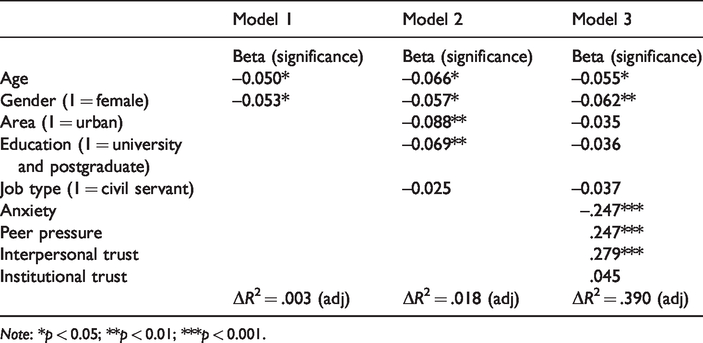
Note: *p < 0.05; **p < 0.01; ***p < 0.001.
Conclusion
The results presented in the previous section provide core components of a theory that explains why Chinese citizens, living in an authoritarian governance regime, adopt Sina Weibo to interact with the authorities. By doing so, it corroborates and specifies the determinants of Chinese citizens’ adoption of microblogging that were suggested in qualitative, small-n and more descriptive studies of microblogging in China (Harwit, 2014; Schlaeger and Jiang, 2014; Sullivan, 2014). Taken together, the analysis points to the relevance of an individual citizen’s immediate social environment (think of expected behaviours that emerge from pressures from one’s nearest and dearest, and beliefs in the trustworthy, benevolent behaviours of government officials) in explaining Chinese citizens’ adoption of microblogging to interact with the government. Adoption does not result from technological opportunity alone; rather, smaller-network ties consisting of feelings of belonging with relation to one’s nearest and dearest, as well as expectations of officials’ sincerity, do impact or at least enable an individual’s adoption of microblogging in state–citizen relations. Larger-network ties (trust in institutions at large, such as the CCP, executive organizations, the judicial system, the media, etc.) are not associated with the adoption of microblogging. This finding underlines the importance of densely knit, pervasive social networks (guanxi) surrounding individual citizens in explaining how Chinese citizens engage with authorities in citizen–state interactions using new electronic communication channels.
A noteworthy feature of microblogging use in a Chinese authoritarian state context is the potential of censorship and surveillance exercised by government information officials and censors working at Internet service providers. Empirical evidence shows that there is a variance in Chinese citizens’ reported levels of anxiety. Furthermore, as higher levels of anxiety are correlated with lower levels of use intention, anxiety limits citizens’ adoption of microblogging. This finding underlines the impact of the Chinese authority’s surveillance and control activities on the lives of individual Chinese citizens, and urges academics and social media practitioners alike to reflect on how political context may affect technology use in state–citizen relations in China, and arguably also in other contexts.
Limitations and research directions
The findings and subsequent discussions give rise to a number of directions for future research. A first limitation concerns the possibilities of generalizing the findings across the domain of the PRC. We have partly derived relevant variables (anxiety, peer pressure and a sociological and psychological notion of trust) from the context of the authoritarian governance system that is characteristic of the dual CCP–government structure that is prevalent in the whole of the PRC. In order to control for possible larger cultural differences throughout the vast country of China, we chose to develop and test hypotheses using data gathered in one (still huge and populous) province: Hunan province. Given China’s omnipresent CCP–government apparatus, it may be tempting to generalize findings across the whole of China. However, there exists large socio-economic and ethnic diversity in China, and since our theorizing concerns Chinese citizens’ online motives, behaviours and perhaps implicit coping mechanisms, considerable discretion must be considered in order to prevent generalizations based on statistical inferences only.
A second limitation has to do with the false attribution of findings to context. In this article, we have used inspiration from existing accounts of microblogging in China, adoption theories and psychological ideas to develop and subsequently test hypotheses. Theorizing and testing enabled the conclusion that the pervasive networks described in other Chinese literatures as guanxi are relevant to explaining the adoption of microblogging. There may be a rival explanation stating that dense networks consisting of smaller-network ties are relevant for explaining microblogging adoption and what digital state–citizen relations look like, both in various authoritarian regimes and in consolidated democracies alike. Moreover, some renditions of the UTAUT focusing on electronic government transactions feature variables like peer pressure and trust, also suggesting a role for smaller-network ties in explaining the adoption of technologies in state–citizen relations outside the particular Chinese context.
A third limitation concerns the method, that is, the survey, that was used in this particular study. It has been observed in the literature that along with many other social science methods like interviewing and observations, surveys as a social-scientific method are more challenging to administer in China than in other contexts. Respondents are likely to be familiar with filling in surveys that are administered by governments, and when invited to participate in a scientific study, Chinese citizens are likely to let privacy concerns influence their responses. This is a possible source of bias that could have occurred in the data set. Triangulation through additional interviews could be considered as a means to notice and if necessary correct for such bias, though it has been noted that researchers are sometimes in the position of having to read tea leaves to ascertain what respondents really believe (King et al., 2013), thereby introducing new forms of biases.
If we reflect on this particular study and take the limitations seriously, there are avenues for further research that we would like to suggest. A first research direction is comparative research of the use of microblogging in various political governance systems. This study has demonstrated the validity of constructs like peer pressure, interpersonal trust and anxiety in an authoritarian governance system like China. The conclusions from this study urge replication in other contexts, such as Western liberal democracies or, for instance, in transitional states in Eastern Europe, in order to come up with more robust, informative and realistic theories about how and why citizens use microblogging and other forms of social media to interact with the government, and vice versa.
A second research direction has to do with the type of variables that this study has identified as determinants of the adoption of microblogging in a political context. At large, we see that ‘smaller-network ties’ and anxiety are important for understanding why citizens use microblogs in a Chinese context. This finding urges e-government researchers working with adoption models like UTAUT to focus on persuasive and normative pressures as determinants of technologies in state–citizen relations, rather than perhaps overly rational variables like performance expectancy and ease of use, which the e-government adoption literature has arguably inherited from UTAUT’s legacy in more generic technology adoption studies.
A third avenue for research is to elaborate the concept of trust in government. E-government researchers have begun to include ‘trust’ in explanatory theories of the adoption of all kinds of e-government technologies. This study has identified various components of ‘trust’, and it could arguably be useful to furthermore analyse the multilayered concept of trust in government, for instance, in terms of beliefs relating to: (1) the competence and/or consideration of individual government officials; (2) executive organizations having appropriate procedures and safeguards in place; and (3) checks and balances between executive, judicial and legislative powers that enable the correction of administrative errors or abuse.
The results of this study, combined with the directions for research suggested earlier, highlight how new technologies like microblogs enable specific discourses and interactions in the state–citizen relations of authoritarian government regimes and in liberal democracies, as well as eventually cross-fertilization between the disciplines of political science, public administration and information systems. These academic disciplines have been ignoring each other’s contribution to the fascinating empirical field of microblogging and social media for far too long.
