




Abstract
This article relies on the literature on technology adoption and empirical studies on social media adoption in the public sector to analyze the case of Belgian municipalities. Our objective is threefold as we aim to: (a) provide a new approach to assess the adoption of social media platforms by governments, (b) describe the current situation in Belgium through the concept of “active adoption” and (c) determine the main factors that relate to the uptake of Facebook in Belgian municipalities over 10,000 inhabitants. To achieve these objectives, we used software to retrieve quantitative data regarding Facebook adoption and institutionalization. Our results reveal that municipality size, median age and longevity on the platform are positively associated with the adoption of Facebook. In contrast, median income is, surprisingly, negatively associated with several dimensions of active adoption. These findings contribute to the literature on the factors related to social media use. In addition, the new ways of uncovering social media adoption and institutionalization patterns provide a solid conceptual approach for future research. For practitioners, our study provides municipalities with a better assessment framework and offers them a new model to evaluate social media adoption, underlining the fundamental difference between registration and “active adoption”.
Points for practitioners
This article provides a new approach to assess social media adoption and institutionalization patterns in public organizations. It offers a framework to evaluate social media adoption, underlining the fundamental difference between registration and ‘active adoption’. It also identifies the main factors that relate to the uptake of Facebook in Belgian municipalities over 10,000 inhabitants: population size, median age, median income and social media-related variables – that is, activity on Twitter and Instagram – as well as longevity on the platform.
Introduction
Recently, there has been considerable growth of electronic government (e-government) projects using information and communications technology (ICTs) for service delivery and the provision of information. ICTs typically promote interconnectivity between governments and various stakeholders, and foster transparency and accountability processes (Guillamón et al., 2016; Picazo-Vela et al., 2012). Like any technological innovation, social media influence user behavior in terms of information seeking and use (Zheng and Zheng, 2014). The perceived value of social media in potentially lowering the bar to communicating with citizens has led to the adoption of social media by diverse public sector organizations (Faber et al., 2020). However, adoption differs from simple registration and use, and there exists a great variety of approaches to social media adoption and activity measurement. Despite the growing discussion about social media technologies, there is little evidence on social media adoption and usage (Wirtz et al. 2020).
This article contributes to the strand of research on digital communication of public sector organizations. More precisely, it aims at assessing the adoption patterns of social media platforms in Belgium through the analysis of the Facebook accounts of all municipalities with over 10,000 inhabitants. In this regard, our study contributes to the public administration (PA) literature on social media adoption and institutionalization in three ways. First, from a theoretical standpoint, it distinguishes registration from what we will call here “active adoption”: indeed, creating a social media account does not represent a real and complete adoption process in many cases. Second, it proposes a methodological approach to measure this “active adoption” of social media platforms through variables mobilized in several technology adoption models. And third, it elaborates on the factors that may relate to such active adoption at the local level, including a unique dataset of socio-demographic, economic and political variables in the undercommented Belgian case. Empirically, we use this dataset as well as social media metrics to better analyze the patterns of Belgian municipalities’ “active adoption” of Facebook in the period 2020–2022.
Therefore, our study aims at responding to the following research questions (RQs): how can social media adoption by local governments be accurately assessed (RQ1)? And what are the main factors that relate to this adoption in Belgian municipalities over 10,000 inhabitants (RQ2)? As mentioned above, both the literature on technology adoption and a quantitative analysis based on recent data will be used to respond to our RQs.
The article is structured as follows. The next section covers the existing literature on social media adoption and institutionalization in the public sector. The third section builds on these theoretical insights as well as technology adoption models to describe how we address and measure “active adoption”. The fourth section focuses on the factors that may be associated with the adoption of social media platforms and lists the research assumptions made here. The methodological aspects are detailed in the fifth section, while the empirical results are presented in the final section. The last part of the article is devoted to the discussion of our findings and the conclusion.
Literature review and theoretical approach
This section synthetizes the recent contributions regarding the adoption of social media and their “institutionalization” (Criado and Villodre, 2022) in public sector organizations. In the first sub-section, we present these two concepts, based on the existing literature. In the second sub-section, we open the debate about the very notion of adoption as it is addressed in recent articles, and we show that the concept needs to be revisited to include new dimensions. This effort will lead to a new approach to social media adoption, labelled as “active adoption”.
Social media adoption and institutionalization in the public sector
Theories of innovation and technology adoption in the public sector have mainly focused on adoption policies and the resulting uptake of new technologies (Mergel, 2016). In this regard, Rogers (2010) suggests that the implementation of innovation results from its incorporation into the regular activities of an organization and when it is no longer alien to the organization. Visibility and observability of innovative practices is thus important, so that diffusion and replication can occur (Mergel, 2016). Otherwise, it will lead to a discontinuance or failure of the innovation process. Adoption processes of technological innovations are thus not unidirectional in public bodies.
Social media tools face similar problems of adaptation to the organizational culture and institutional structure of public sector organizations, though differing in their technical features (Criado et al., 2013). Indeed, social media are owned by third parties. This constitutes a challenge for public managers as they have to rely on external technology platforms designed and hosted outside of government, which involves uncertainty of changes and uncontrollable cybersecurity risks that have to be mitigated by the platform providers (Mergel 2016). Public managers in charge of social media accounts are therefore exposed to constant changes and must deal with emergent citizen and employee behavior as well as potential public value distortions. It also necessitates different strategies and changes the role of governments from information controllers to dialogue facilitators (Criado et al., 2013).
Mergel (2013) writes that the uptake of social media platforms is influenced by four informal mechanisms rather than top-down management decisions. These mechanisms refer to: (1) the observation of citizens’ use of social media platforms, (2) passive observations of highly innovative departments and agencies, (3) active interaction with peers and (4) formal guidelines developed by lead agencies. The adoption process is thus impacted by institutional and organizational mechanisms that direct the degree and extent of social media adoption by public bodies (Mergel, 2016).
Mergel and Bretschneider (2013) have suggested a staged model to explain the organizational dynamics of social media adoption. This model ranges from stage 1 (“intrapreneurship and experimentation”), characterized by high degrees of testing, to stage 2 (“constructive chaos”) and stage 3 (“institutionalization”), leading to the formalization of communication on social media platforms. As mentioned by Criado and Villodre (2022), institutionalization is considered as a desirable output in the process of social media adoption and enactment within the public sector. It comprises the formal decision to gradually integrate social media inside the organization routines and procedures (Mergel, 2016).
Social media institutionalization refers to the formal decision to deliberately incorporate technological changes in the organization or to routinize them into the organizational processes (Mergel, 2016). The establishment of clear norms, guidelines and rules are key elements (Chen et al., 2016) as well as reaching a better level of coordination (Mergel, 2016). As a result of the institutionalization process, new roles, positions and sub-units can appear to control and more generally coordinate the communication strategy on social media. Considered as desirable, institutionalization can nevertheless cause a “red-tape effect” (Bozeman and Feeney, 2011) whereby organizational standards and guidelines become extremely inflexible, losing the ability to respond to future reorientations required by the changing context (Criado and Villodre, 2022). Social media adoption is thus a route departing from the earliest moments of integration in the organization, by public managers or employees, only ending when the formalization is completed and social media routinization is broadly spread in the organization (Mergel and Bretschneider, 2013).
Refining and redefining the notion of social media adoption
In the literature, most approaches to social media adoption in the public sector are based either on incomplete assessments of the situation or on subjective criteria. Indeed, recent contributions have relied mostly on website reviews and interviews to collect data, which does not allow for a comprehensive evaluation of social media adoption within public sector organizations. Certain contributions have preferred surveys, leading to the subjective appreciation of social media adoption and variations depending on the response rate and the data provided by the respondents (Ellison and Hardey 2014; Reddick and Norris, 2013).
Oftentimes, social media are often considered as adopted when they add logos to their website and/or when they have simply registered on a platform (e.g., Abdelsalam et al., 2013; Sharif et al., 2015). Consequently, registration, presence and activity on social media are often used as interchangeable terms and much confusion arises from this lack of clarity. However, clarity is needed since certain public bodies maintain a presence without any activity on social media platforms. There are several reasons for this inactivity that include, for example, lack of staff, tasks achieved by interns during their time spent in an organization, completion of a “tick the box” exercise, or lack of interest for the municipality (Mabillard et al., 2021).
The need for sound theoretical models in the fast-changing IT environment has been presented by Sharma and Mishra (2014), among others. These authors have suggested that researchers should focus on new areas of adoption such as antecedents and/or consequences to reach a more comprehensive understanding of what influences technology adoption and acceptance in different contexts. In this sense, our definition of “active adoption” of social media platforms provides a new approach that builds on existing models and brings more clarity. It may be mobilized by scholars and public managers regarding ICTs adoption (especially social media) in public sector organizations.
Towards a model of active adoption
The notion of active adoption aims at understanding the uptake of technology under the prism of adoption and diffusion by organizations. This new approach builds on both the notions of adoption and diffusion: adoption as the stage of selecting a technology for use by an individual or an organization (Carr, 1999, cited in Ali et al., 2022) and diffusion as the stage in which the technology spreads to general use and application (Rogers, 2010). It combines both approaches to offer a more accurate assessment of effective use of a technology as recommended by Sharma and Mishra (2014). Therefore, active adoption focuses on how the various features of a technology are recurrently and effectively used. Regarding social media, if simple registration is observed without any further use, organizations have probably not reached the stage of institutionalization necessary to diffuse technological use in the organizational community. This new approach distinguishes between the experimentation phase, in which organizations try to understand how the technology works, and the beginning of a more advanced phase, in which organizations will be able to use and diffuse the technology itself.
To build the measurement model of active adoption, we relied on dimensions developed in the technology–organization–environment (TOE) framework (Tornatzky et al., 1990) and adapted in a research model developed by Lin and Lin (2008). In this study, technology diffusion is built on two notions: internal integration and external diffusion.
Internal integration is defined as the extent to which a technology is integrated with key internal organizational activities. In the case of social media, we consider that the recurrence of use and use of platform potentialities represent two relevant proxies in this regard. Diffusion can only be achieved once a technology is mastered (Lee et al., 1988). Thus, mastering a technology involves being able to regularly use its various potentialities. Regular use of a technology has always been considered as an essential indicator of adoption (Grover, 1993) as it refers to the objective of each adoption process. External diffusion refers to the use of a technology with external stakeholders. Regarding social media, the situation is peculiar since citizens and governments enjoy the same access to the platforms. Nevertheless, the use of these platforms is aimed at communicating with the population. Consequently, we include outreach as an indicator of external diffusion of information.
Therefore, our response to RQ1 highlights the need to address social media adoption through a measurement model that includes adoption as well as diffusion to be more representative of real and effective adoption. This model builds on the factors presented above, and that results from the gaps identified in the contributions presented above. It includes: (a) the recurrence of use, measured through the number of posts per month on Facebook, (b) the intensity of the use potentialities offered by Facebook to communicate on this platform and (c) a criterion of efficacy, as wide as outreach is essential to the successful uptake of social media platforms in the case of public sector communication. Table 1 presents the metrics that were considered to measure active adoption in the specific case of Facebook.
Categories and indicators used for developing a quantitative assessment of social media active adoption by local governments.
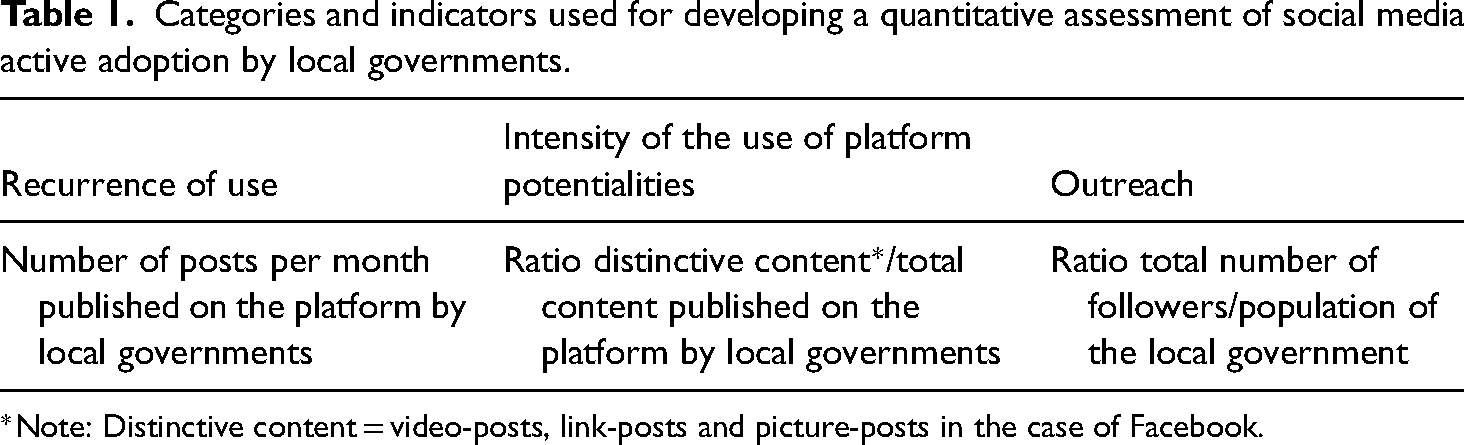
*Note: Distinctive content = video-posts, link-posts and picture-posts in the case of Facebook.
Research assumptions
This article also aims at enriching the analysis of active adoption of social media platforms from an empirical perspective. In this regard, determinants commonly found in the PA literature will be used here to assess the association between socio-demographic, political and technology-related factors and the dimensions of active adoption of Facebook in Belgian municipalities. The assumptions developed below rely on the evidence presented in recent contributions on social media platforms adoption, usage and activity in government. Since several factors (especially political ones) can strongly differ from one country to another, the corresponding assumptions will be adapted to the Belgian case.
Despite its increasing interest for social media use in the public sector, research has yet to provide a comprehensive assessment of the motivations that lead local governments to take up these new channels. Certain scholars have emphasized the role of the organizational dimension by highlighting the impact of internal dynamics and institutional arrangements of governmental organizations (Mergel, 2016). Others have highlighted the importance of leadership capabilities of elected and/or appointed executives (Lee and Kwak, 2012), or have focused on grassroots demands for increased e-participation (Reddick and Norris, 2013). Socio-demographic characteristics have also often been addressed in the literature through socio-economic variables, which include the population size of municipalities, population density, age and education. Finally, Silva et al. (2019) have focused on the relationship between social media use by local governments in Portugal and political factors more particularly (weight of left-wing parties, political competition, electoral participation).
However, there is no contribution (to the extent of our knowledge) that has examined social media adoption and activity using all the determinants listed above. This can be explained by contextual differences, the limited availability of several variables at the local level, and replicability concerns when certain indicators do not mean the same thing in diverse settings (e.g., various government types exist in certain countries, while there are no differences in others). Moreover, it is sometimes difficult to compare certain variables, such as political ideology, across different countries. For these reasons, while we partly rely on the variables used in the literature (and especially in Anglo-Saxon and Iberic countries), we adapt our assumptions to the Belgian case. These variables are used here as potential correlates to municipalities’ active adoption of Facebook, which means: (1) how recurrently the platform is used, (2) with its various technical features and (3) how it has fulfilled its primary objective of reaching users. Therefore, while we will systematically refer to the literature to elaborate on our assumptions, we will also consider the difficulties mentioned above.
First, we consider the characteristics of the municipalities’ population. Previous studies have found a positive relationship between population size and information diffusion by municipalities (e.g., Guillamón et al., 2016). In the Belgian case, we assume that municipality size is positively associated with the three dimensions of active adoption of Facebook. In addition, analytical models typically include age (Faber et al., 2020), since older people are less likely to get involved digitally and adopt forms of e-government, as well as income, since online interaction with governments tends to be more common amongst citizens with higher incomes (Metallo et al., 2020). Moreover, people with higher economic status are more likely to have access to new technologies and to acquire knowledge (Guillamón et al., 2016). Consequently, we assume here that median age is negatively, and median income positively, associated with the dimensions of active adoption.
Second, we consider social media-related factors. Faber et al. (2020) have investigated the relationship between the longevity on a particular social media platform and the recurrence of use. Their findings highlight a more intensive use towards interaction when municipalities have adopted Twitter for a long time. This may imply that, at least to some extent, municipalities seem to make more effective use of social media platforms when they are better acquainted with them, and that they may use them more often as they get more experienced. In addition, the adoption of a social media platform can be significantly related to the use of others, as underlined by Bhatia and Mabillard (2021). As a result, we will further explore the assumptions that there is a positive association between the longevity on Facebook and the dimensions of active adoption of this platform, and between the activity on Twitter and Instagram and the active adoption of Facebook.
Third, we consider the role of political incentives in stimulating the use of social media platforms by municipalities. We argue with Faber et al. (2020) that public managers experience the influence of the political leaders’ preferences, who may or may not foster social media adoption and institutionalization. In this regard, prior research has highlighted the differences in engagement between men and women (e.g., Taipale, 2013), stating than men are usually more active than women. Accordingly, the gender of the mayor may be positively correlated with social media platforms adoption and use, as proposed by Guillamón et al. (2016). Moreover, as young mayors are more prone to use social media platforms (Silva et al., 2019), we hypothesize that such mayors are more likely to engage in communication on these platforms. Finally, we include mayors’ education here, following the evidence provided by Silva et al. (2019), describing a more intense use of Facebook in municipalities governed by mayors holding a university degree. Thus, we make the following assumptions: the mayor's age is negatively associated with the dimensions of active adoption of Facebook; there is positive association between the mayor's gender and active adoption; and there is a positive association between the mayor's level of education and the dimensions of active adoption of Facebook.
Method
As mentioned earlier, our article relies on the literature to propose a new way of addressing the issue of social media adoption in the public sector. Moreover, existing contributions are also mobilized to explain how active adoption of Facebook varies across Belgian municipalities with the help of variables identified and tested in other countries. In this section, we detail how the data were collected, and how they will be used in our analysis.
Data collection
Initial information regarding Belgian municipalities was gathered from Statbel, the Belgian statistical office 1 in January 2020. We decided to focus on the municipalities with more than 10,000 inhabitants, as prior research has shown that informal channels still prevail in small entities (Mabillard et al., 2021), and that bigger municipalities are more active on social media (Haro-de-Rosario et al., 2018). Most characteristics of the Belgian municipalities have been either directly collected on the Statbel website (e.g., population size, median age), or on the regional statistics portals (e.g., turnout rate in the last elections), or on other sources (e.g., socio-demographic features of the municipal executive and of the mayor). In addition, we contacted the municipalities when we did not have access to certain information. A couple of them did not want to provide the requested information because of privacy rights. All data sources are presented in the findings section.
Regarding Facebook specifically, we first browsed all municipalities’ websites to search for logos. Then, we made an additional search on Google, and on Facebook when needed. This data collection process follows previous similar approaches developed in contributions from Bhatia and Mabillard (2021) and from Ellison and Hardey (2014). Then, we retrieved data related to the presence, use and activity of all municipalities on Facebook using the online software FanPage Karma, already used in prior research (e.g., Mori et al., 2021). Such data were used to build our dependent variables (the three dimensions of active adoption). As the software allows for time selection, we decided to focus our analysis on a two-year period (31 January 2020 to 31 January 2022). This range was preferred owing to the availability of the other data and the fact that Belgian municipalities were affected by the Covid-19 pandemic for the whole period. We included municipalities that registered on Facebook before 31 January 2020; taking a two-year period enabled municipalities that joined Facebook later to become familiar with the platform and to accumulate followers.
Data analysis
As the aim of our empirical analysis is to assess the association between socio-demographic, political and social media-related variables and Facebook adoption, we built the concept of active adoption, that contains three variables. As presented in Table 2, active adoption refers to the number of Facebook posts per month, the proportion of picture-posts, video-posts and link-posts on the total number of posts, and the proportion of Facebook followers compared with the municipal population (for the period 2020–2022). Except for the population, all other items were retrieved from FanPage Karma in February 2022. FanPage Karma is a network service used to monitor activities and content on social media sites such as Facebook, Twitter or Instagram that facilitates data export to Excel spreadsheet.
Measurement of variables and descriptive statistics (Jan. 2020–Jan. 2022).
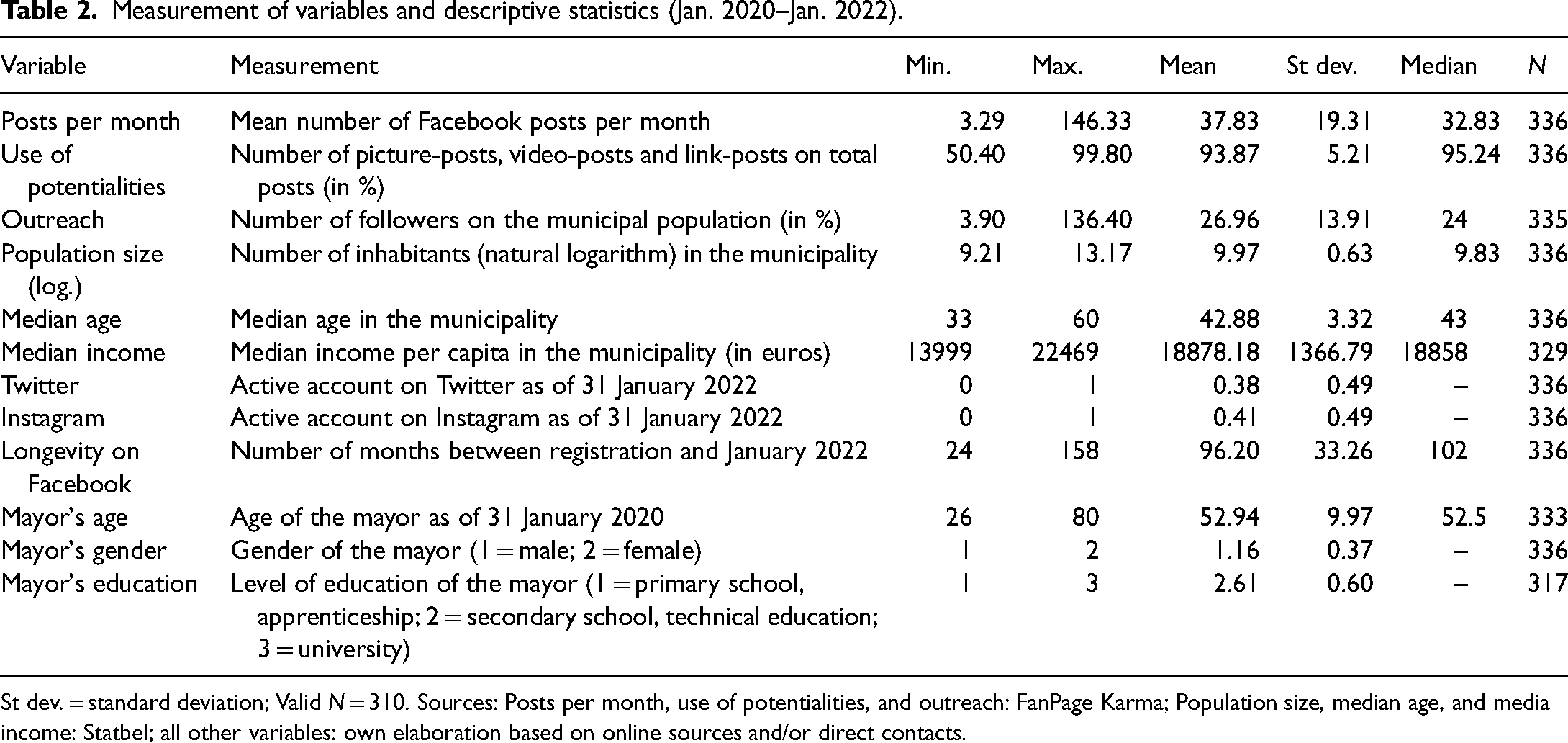
St dev. = standard deviation; Valid N = 310. Sources: Posts per month, use of potentialities, and outreach: FanPage Karma; Population size, median age, and media income: Statbel; all other variables: own elaboration based on online sources and/or direct contacts.
Correlation analysis is preferred here to test the associations between the socio-demographic, political and social media-related factors identified in the literature and active adoption of Facebook. We analyze the three dimensions of active adoption separately for several reasons. Constructing an aggregated “index” of active adoption would have resulted in information loss; it would have posed the question of an arbitrary threshold (at what point is Facebook “actively adopted”?); and it would have raised the issue of combining the dimensions and making sense out of this combination. This approach is preferred to underline the main factors that can be identified as potential drivers of the active adoption of Facebook in Belgium, thereby providing answers to RQ2.
Findings
First, descriptive statistics are presented in this section. As observed in a different setting (Maziashvili et al., 2022), we note that most Belgian municipalities have adopted Facebook: as of January 2020, 336 municipalities out of 364 with more than 10,000 inhabitants had registered on the platform (see Table 2). However, they can strongly differ according to the dimensions of active adoption considered. While some municipalities post messages every 10 days, others post new content up to four times per day. The number of followers can also vary strongly between municipalities. Interestingly, in rare cases, the number of followers exceeds the total population of the municipality, showing that the account raises interest beyond the municipal borders. In contrast, almost all municipalities tend to use the potentialities offered by the platform frequently and intensively, with a very high mean for the sample (93.87%). This result is compelling since we did not particularly expect such a high level of digital maturity on this specific aspect.
Other interesting findings from the descriptive statistics include the high proportion of male mayors, their mean age (over 50 years old) and their high level of education (mean = 2.61 on a 1–3 scale). Large variance is observed on the other variables, since there are “young” and much “older” municipalities, and enormous differences in terms of median income, that can nearly double between the “poorest” and the “richest” municipalities. Regarding social media specifically, there are more Instagram accounts than Twitter ones, a trend that continued to evolve in this direction in recent years.
Pairwise correlation matrix.
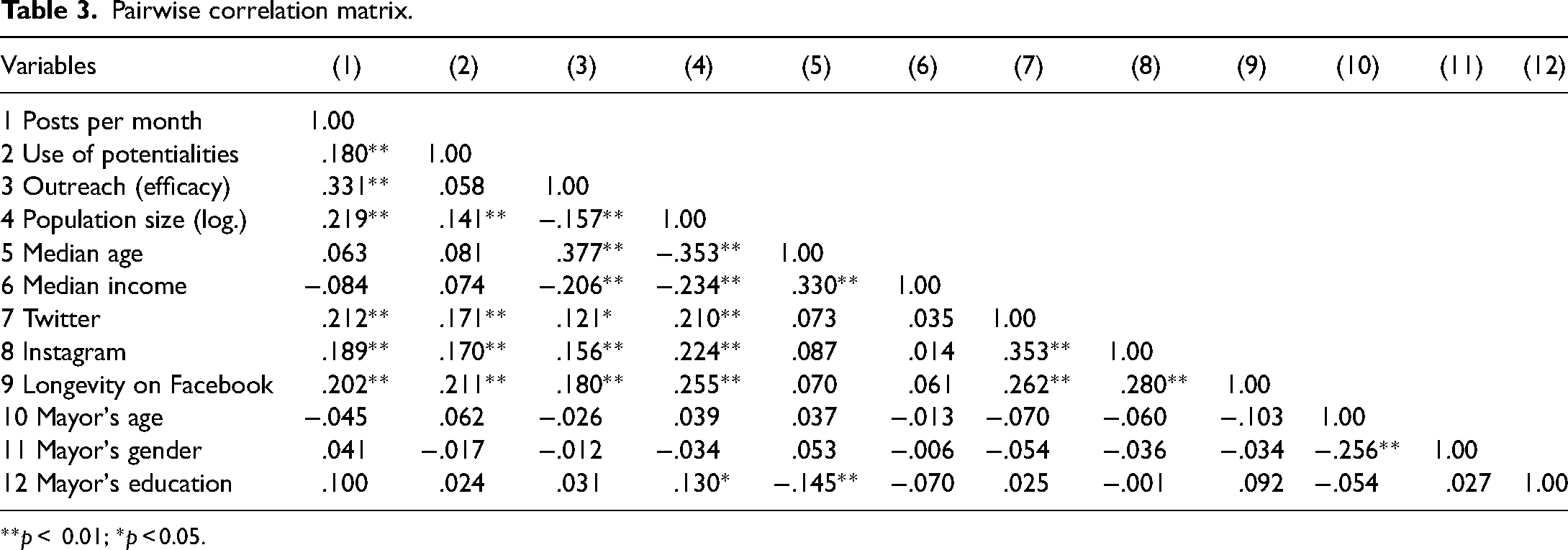
**p < 0.01; *p < 0.05.
Second, the correlation analysis reveals that the number of posts per month is moderately and significantly correlated with the other two dimensions of active adoption. However, these other variables, the use of potentialities and the communication outreach of the municipality are not significantly associated. This result is in line with our rationale, since we wanted to capture different dimensions of active adoption, and not gather them into an aggregated index that would have led to losses of information and lack of coherence. We also see that population size is significantly correlated with the three dependent variables, but negatively with outreach. The variables related to social media are positively correlated with each other, suggesting more active adoption in municipalities registered on other platforms and on Facebook for a long time. Finally, while characteristics of the population seem to be associated, to some extent, with the dependent variables, mayors’ characteristics do not seem to play a role in the active adoption of Facebook in Belgian municipalities (Table 3).
The positive association between population size and both the number of posts per month and the use of potentialities is in line with the findings from Guillamón et al. (2016) and Silva et al. (2019) regarding citizen engagement on government Facebook accounts. This can be mainly explained by the larger resources available in big municipalities compared with the smaller ones. However, outreach is negatively associated with municipality size; this may be explained by the relatively low number of citizens that actively follow Facebook accounts, which may in turn have an impact on the followers/population ratio in large municipalities. Another assumption that we can make relates to the positive relationship between outreach and median age: indeed, it may well be that the characteristics of the population (in terms of age and income) play a more important role than municipality size.
In addition, the positive and significant association between longevity on the platform and the use of potentialities indicates a potential learning process over time. This corroborates the results observed by Faber et al. (2020) regarding Twitter in the Netherlands, as they found a positive relationship between the longevity on Twitter and the increasing use for interaction. Finally, the mayors’ characteristics do not seem to play any role in the active adoption of Facebook in Belgian municipalities. This observation aligns with the findings identified in prior research (e.g., Guillamón et al., 2016).
Discussion and conclusion
In this contribution, we examined adoption and institutionalization of social media in Belgian municipalities through the lens of active adoption. The first contribution to the literature relies on the provision of a new, theoretical but usable framework to investigate social media adoption in public sector organizations. Based on our analysis, our second contribution to the field refers to the identification of factors that are significantly associated with the dimensions of active adoption. Such factors include population size, median age, median income and social media-related variables – that is, activity on Twitter and Instagram – as well as longevity on Facebook.
As shown in previous studies, municipality size and consequently the resources available to communicate externally may play a central role in explaining the recurrent use of the platform. We can assume that, as mentioned by Mergel (2013), over time the importance of social media efforts resulted in the allocation of additional resources. With such resources, new organizational structures are created and actively work on institutionalizing social media use. Normative standards such as social media policies or strategies that provide guidance on the mission of the organization thus influence active adoption of social media platforms (Facebook in this case) in a positive way. This goes in line with the longevity on the platform being important for the use of potentialities. Indeed, municipalities seem to make a more effective use of a social media once resources have been invested, and they can start mastering the platform's potentialities.
The positive association between median age and outreach, as well as the negative association between median income and outreach, indicate that municipalities with poorer residents tend to have more followers. Such an observation corroborates the findings from Metallo et al. (2020), who found that the lower the level of citizens’ income, the higher their engagement on the municipality's Facebook page. This could be explained by the fact that Facebook is free, easily accessible, easy to use and very popular among the various strata of the population. The non-significant association between the mayors’ characteristics and active adoption of Facebook partly match the findings presented in previous studies. For instance, Hatipoğlu et al. (2020) did not find any significant relationship between this variable and engagement on Twitter. This difference could be explained by the fact that adoption is a former step compared with engagement, which is much more influenced by personal willingness. These results represent a significant contribution to the literature as they add to the current debate on the determinants of social media usage at the local level.
In view of these results, the Belgian case taught us a few lessons about the concept of active adoption and its related factors. First, the wide range of observations show that municipalities are adopting social media in various ways, and tend to do so according to their resources, favoring more activity in large municipalities as observed by Mergel (2016). Second, we note that outreach is negatively associated with population size (Mossberger et al., 2013); this highlights the need to distinguish the three dimensions of active adoption, and to carry out additional research built on this finding. For instance, the popularity of a small but touristic municipality, or a strong “community effect” in a given place, may explain the high figures observed in outreach, and may provide an explanation to certain outliers. Third, a positive emulation seems to be created by the simultaneous activity of municipalities on several platforms, which calls for a better understanding of the municipalities’ social media and general communication strategy, and their effects on social media institutionalization (Wukich, 2022). And fourth, active adoption seems to be influenced by the characteristics of the population, as we observed higher figures regarding outreach especially in “younger” and “poorer” municipalities (Reddick and Norris, 2013). This provides a compelling path for future research, as this result may change according to the social media platform included in the analysis.
We acknowledge that our research meets with limitations. The first one refers to the study of Facebook accounts exclusively here, owing to their prevalence in Belgium. Nevertheless, we are convinced that the concept of active adoption as defined here can be extended to other platforms, such as Twitter or Instagram, through a refinement of certain indicators. A second limitation relates to the difficulty of measuring outreach since we do not have data about each post's consultation, and we do not know if all followers include municipal residents only. The number of followers is also an indicator used that can be misleading. Indeed, it is sometimes artificially increased by non-municipal residents, municipality workers, or fake and accidental users. However, other research (e.g., Lovari and Parisi, 2015) have shown that most followers of a municipality live in that municipality. Our measurement is therefore the best possible one given the technical constraints. The third limitation is linked to the use of the TOE Framework as a theoretical basis for the measurement model of active adoption. As underlined by some authors (e.g., Baker, 2011), this framework is sometimes considered excessively generic. We think that our use of the framework is nevertheless an added value for the literature as it assigns the framework to a new theoretical application (social media “active adoption”) and test it in an empirical setting. The fourth limitation refers to the limited scope of the empirical analysis. We have preferred correlations here owing to the scarce literature on the issue, and the limited existing theoretical background. We built mainly on empirical evidence identified in similar research, focusing on social media use and citizen engagement, to identify potential correlations between the dimensions of active adoption and related factors (used ambitiously as predictors in prior research). We have found certain compelling results that call for a better understanding of the relationship between social media active adoption and related factors. Additional research based on our study is therefore needed to extend theoretical knowledge about this issue. It will certainly require qualitative input to uncover the reasons that explain the significant relationships between the variables analyzed here from a purely quantitative perspective.
Finally, we present the implications of our research for theory and practice. From a theoretical perspective, we add to the existing literature by expanding on the concept of adoption and developing the notion of “active adoption”. We make a clear distinction between registration and adoption, and we propose a new way of envisioning adoption patterns through dimensions related to recurrence of use, intensity of the use of platform potentialities and outreach. Practitioners could take advantage of this effort to refine the concept of technology adoption to better assess their capacity to properly use and institutionalize ICTs in general and especially social media platforms in their municipality. Further efforts should include a better measurement of the audience, to better assess the success of certain types of posts, and to make sure to reach the targeted audience in certain circumstances.
Footnotes
Declaration of conflicting interests
The author(s) declared no potential conflicts of interest with respect to the research, authorship, and/or publication of this article.
Funding
The author(s) received no financial support for the research, authorship, and/or publication of this article
