




Abstract
This study investigates variability across 31 European countries in the gender composition of engineering and computing (“tech”) occupations, and possible sociocultural drivers of this variability. As previously documented for other STEM domains and geographies, the largest tech gender gaps are in the most affluent societies of Europe (which are also most postmaterialist and gender-liberal culturally). Multilevel regression models explore key attitudinal and socioeconomic predictors of this gender segregation that have been identified through previous comparative research. Results show that men, but not women, who espouse postmaterialist values have higher odds of working in engineering or computing, and that the gender-specific effects of postmaterialist values account for a substantial share of cross-country variability. Findings are consistent with research suggesting a heightened salience of gender math stereotypes to career aspirations in societies that valorize individual self-expression and “doing what you love.”
Engineering and computing are among the most strongly gender segregated occupations in advanced industrial labor markets; they are also among the most lucrative, prestigious, and rapidly growing (Chow and Charles, 2020; Lechman and Popowska, 2022; Neely et al., 2023). In the affluent West, men’s overrepresentation is so extreme that people commonly presume these fields to be naturally and universally masculine (Ensmenger, 2015; Faulkner, 2000). Segregation by gender is also inflected by other inequalities, including race, ethnicity, and class. In the United States, for example, it is not simply men, but economically advantaged white, Asian, and Asian American men who are numerically dominant in engineering and computing (Alegria, 2020; Chow, 2023; Ma and Liu, 2017; Neely et al., 2023; Sassler et al., 2017).
Recent comparative research has revealed yet another cross-cutting axis of segregation: national context. The gendering of scientific, technical, engineering, and mathematical (STEM) fields varies across countries, with the most extreme gender segregation of mathematically intensive fields found in affluent, reputably gender-egalitarian societies (Charles and Bradley, 2009; Chow and Charles, 2020; Lee et al., 2024). This pattern, recently dubbed the “gender equality paradox” (e.g. Stoet and Geary, 2018), has been widely reported by academics and public intellectuals, including on popular social media platforms.
But questions remain about the mechanisms underlying cross-national variability. Efforts toward generalization have been complicated by the fact that different studies have investigated different gender gaps (e.g. in STEM overall, specific STEM fields, STEM-related aspirations, self-concepts, personality traits, educational outcomes, occupational outcomes). Explanatory analyses have been confounded, moreover, by challenges in distinguishing independent effects of the diverse, highly intercorrelated sociocultural dimensions of Western affluence, and in generalizing macro-level relationships to countries with vastly different social, economic, and cultural traditions (Berggren and Bergh, 2025).
The present study focuses on the especially large and consequential gender gap in engineering and computing (“tech”) occupations, and its variation across 31 European countries. Of particular interest, based on previous research, is how the tech gender gap varies with attitudinal and demographic characteristics of individual men and women—especially postmaterialist and gender liberal values and material security. The relative socioeconomic and regional homogeneity of this European sample provides for a conservative estimate of contextual variability, while also reducing cross-societal differences in labor market structure, educational systems, and access to technology that can complicate comparisons of socioeconomic processes between developed and developing societies.
Based on data from the European Values Study, results reveal variation in the gendering of engineering and computing occupations that follows the “paradoxical” pattern previously reported for other empirical domains (e.g. field of study, mathematical affinity and aspirations) and for countries spanning a broader socioeconomic range and regional distribution: the gender gap tends to be larger in more affluent, gender liberal societies. Multilevel models exploring possible mechanisms suggest a segregating effect of postmaterialist values, with espousal of postmaterialist beliefs increasing men’s but not women’s likelihood of working in engineering or computing jobs. The gender-specific effects of postmaterialist values account for a substantial share of variability across Europe in the tech gender gap. Results are consistent with the argument that cultural stereotypes about the intrinsically gendered nature of persons and occupations may become more salient to career aspirations in affluent societies that valorize self-expression through work and “doing what you love.” They also suggest that societal affluence may be accompanied by decreases in some forms of gender inequality and increases in others.
Why study engineering and computing occupations?
A 50-country comparative study of occupational gender distributions found that women’s representation in the computing sector in 2017 was weakest in the regions of Europe and North American and strongest in the African and Asian Pacific regions (Chow and Charles, 2020; on engineering, see also Charles and Bradley, 2009; Cheryan et al., 2017; Lee et al., 2024). Extremely skewed gender ratios in engineering and computing fields have spurred myriad research and policy initiatives by governments, non-governmental organizations, and industry leaders in affluent Western societies. Besides concerns about advancing gender equity in pay and employment opportunities, efforts to broaden access to these fields have been motivated by interests in ameliorating labor shortages that may threaten national prosperity and competitiveness, and in diversifying the life experiences and perspectives of those who develop and apply the technology that increasingly shapes our social, economic, and political lives.
As women’s share of university graduates has grown, some STEM fields, especially biology, chemistry, and the related medical professions, have become more gender integrated. Computer science and engineering degree programs, by contrast, have remained strongly, and in some cases increasingly, dominated by men in the affluent West (Charles and Bradley, 2009; England and Li, 2006; Sassler et al., 2017). University fields of study have shown little gender integration in Europe since 2010, and high-tech occupations have become increasingly segregated in many countries, contributing to a persistent gender wage gap (European Institute for Gender Equality 2024; Lechman and Popowska, 2022). Previous comparative studies have mainly focused on the gender segregation of STEM aspirations and fields of study, but evidence is growing that degrees in computer science and engineering are often not enough to recruit and retain women on these lucrative career paths (Lechman and Popowska, 2022; Sassler et al., 2017). Occupational outcomes provide a more accurate measure of materially and socially relevant country differences.
Why does the gender gap vary?
The tendency for women’s representation in STEM fields to vary inversely with societal affluence is well documented (Breda et al., 2020; Charles and Bradley, 2009; Chow and Charles, 2020; Lee et al., 2024; Stoet and Geary, 2018). This negative correlation is surprising to many, because it is at odds with popular and academic assumptions that gender equality increases uniformly across all indicators with advancing socioeconomic modernization (Inglehart and Norris, 2003; Jackson, 1998). The so-called gender equality paradox is less paradoxical if gender equality is conceptualized as a multidimensional, rather than a unitary, phenomenon.
Major sociocultural shifts accompany broad-based existential security. These include diffusion of “postmaterialist values,” a term coined by political scientist Ronald Inglehart (1997, 2018) to describe declining cultural emphasis on material concerns in favor of quality of life and individual self-expression values. Through a decades-long cross-national research program, Inglehart and his collaborators documented an increasing tendency for people to treat school and work as vehicles for self-realization, and a decreasing focus on extrinsic, pecuniary job rewards as societal affluence grows. Their comparative-historical analyses also revealed a strong association between societal affluence and the liberalization of attitudes about gender roles (Inglehart and Norris, 2003).
Inglehart’s work emphasized gender-equalizing effects of societal affluence and postmaterialist values, including women’s increasing access to labor markets, education, and politics. Other social scientists have posited segregating effects within these institutions (Charles and Bradley, 2009; Siy et al., 2023; Stoet and Geary, 2018, 2022; Yalcinkaya and Adams, 2022). With respect to scientific and technical fields, three main arguments have been advanced.
The first argument suggests gender-segregating effects of postmaterialist values, specifically those valorizing self-expressive career choices in the affluent West. This is evident, for example, in popular exhortations that we follow our passions and do what we love in making educational and occupational choices (Cech, 2021; Li et al., 2021; Pagis, 2021; Tokumitsu, 2015). Although career aspirations and affinities (“passions”) are often represented as intrinsic individual traits, experimental and survey research shows that they can be influenced by stereotypes, including cultural beliefs about intrinsic gender differences and the fundamental masculinity or femininity of social roles (Correll, 2004; Dieckman et al. 2010; Eagly and Koenig, 2021; Schmader, 2023). Some of these stereotypes, such as those holding that mathematically intensive tasks are by nature masculine (“gender math stereotypes”), appear to be more widespread in advanced industrial societies (Breda et al., 2020). Gender scholars have suggested, moreover, that the especially strong emphasis on passion-following in the affluent West may increase the salience of these sorts of stereotypes and bias self-assessments and aspirations in the direction of gender-conforming work (Abu-Asaad et al., 2025; Blair-Loy et al., 2024; Cech, 2021; Charles and Bradley, 2009; Siy et al., 2023; Yalcinkaya and Adams, 2022).
Postmaterialist values may influence occupational outcomes through both macro- and micro-level processes: People may make gender-conforming career choices because they live in a culture that celebrates “doing what you love” (and they expect to love gender-conforming pursuits more), or because their own internalized self-expressive orientations lead them toward gender-conforming work (i.e. they believe that this work is better suited to their individual aptitudes and affinities). Materialist values, by contrast, should lead both men and women toward potentially lucrative fields (resulting, for example, in a smaller tech gender gap).
A second ideological correlate of societal affluence is gender liberalism: an acceptance of gender equality, conceptualized with respect to individual-choice norms (Berkovitch and Bradley, 1999; Inglehart, 2018; Inglehart and Norris, 2003). Proponents of the gender equality paradox have typically conceptualized and measured gender equality in liberal terms—as procedural equality and equal individual rights in public-sphere institutions. Evolutionary psychologists Stoet and Geary (2018) have interpreted cross-national variability in the STEM gender gap from a perspective that equates women’s formally free choice with optimization of core individual preferences. Specifically, they suggest that women who have more rights and opportunities are empowered to reject mathematically intensive fields (e.g. in favor of people-oriented pursuits that make use of their relatively strong verbal abilities). While the relationship between gender liberalism and STEM gender gaps has been theorized mostly at the country level (i.e. with reference to national gender equality gradients), a plausible micro-level version of Stoet and Geary’s argument would be that women with gender-liberal attitudes will feel freer to exercise their career preferences, including for non-STEM occupations.
Recent research shows that the seemingly free choices made in gender-liberal societies may be biased by cultural stereotypes about men’s and women’s natural aptitudes and affinities and about the intrinsic gendering of social roles (Charles and Bradley, 2009; Eagly and Koenig, 2021; Schmader, 2023). These “gender-essentialist” stereotypes coexist alongside gender-liberal ideals in affluent Western societies (Cotter et al., 2011; Breda et al., 2020; Grunow et al., 2018; Knight and Brinton, 2017; Napp, 2023). This suggests another interpretation of the correlation between gender liberalism and the tech gender gap: that beliefs about gender difference, rather than actual gender difference drives variability in STEM outcomes.
A third explanation for variability in the STEM gender gap, recently offered by Stoet and Geary (2022), is that material security itself causes increased segregation of mathematically intensive fields by reducing exposure to economic risks and allowing more people to “aspire to occupations they are intrinsically interested in” (p. 1). By this account, the removal of economic constraints will shift career outcomes in gender-specific ways because boys are more likely than girls to aspire to things-oriented fields and girls are more likely than boys to aspire to people-oriented fields. Intrinsic interest is a contested concept in social science, but reduced exposure to economic risk could, by the same logic, facilitate realization of interests that are socially constructed (Correll, 2004; Eagly and Koenig, 2021; Ridgeway and Correll, 2004; Risman, 2004; Schmader, 2023).
Social scientists have generally framed this argument at the macro-societal level, but it is also plausible that socioeconomic security at the individual level influences the gendering of fields. For example, personal material security implies less economic pressure (especially for girls and women) to pursue lucrative engineering and computing occupations, just as living in a society characterized by broad-based affluence might reduce cultural expectations for the pursuit of lucrative, secure career paths. Previous research shows that experiences growing up and parental socioeconomic status influence work values, career aspirations, and socioeconomic risk aversion (Hitlin, 2006; Keijer, 2021; Kohn et al., 1986). Respondents’ socioeconomic status later in life may be less formative and may be more a consequence than a cause of careers launched during early adulthood.
The current exploratory study aims to describe variability in engineering and computing gender gaps across European countries, and to assess the diverse attitudinal and socioeconomic relationships that have been identified previously using more regionally and socioeconomically diverse country samples. Results should point to directions for future causal analysis of specific micro-and macro-level effects on the gender segregation of tech fields.
Research questions
Survey data available through the European Values Study allow measurement of material security and postmaterialist values at the individual and country levels. I use these data, along with diverse controls, to explore incumbency in engineering and computing occupations for occupationally active men and women in 31 European countries.
The first analytic step is to describe variability across European countries in the gender composition of engineering and computing occupations:
Research question 1. How does the gender gap in engineering and computing occupations vary across European societies, and what are its country-level correlates?
The second analytical step is to explore the individual-level mechanisms that may drive observed cross-national differences. Besides possible country-level effects, variability in tech gender gaps likely reflect gendered effects of individual traits that are differentially distributed across countries. For example, if holding postmaterialist or gender liberal attitudes, or experiencing material security during formative years differentially influences men’s and women’s orientations toward engineering and computing work, we might expect greater gender segregation of these occupations in countries where more people hold these attitudes or more people experienced material security growing up. This leads me to ask:
Research question 2. To what extent can gendered effects of individual values and material conditions account for variability within and across European societies in the engineering and computing gender gap?
Data and methods
The survey data used to address these questions are from the latest available wave of the restricted-use file of the European Values Study (EVS), a repeated cross-sectional survey of European countries. The analytic sample is restricted to occupationally active (currently employed or self-employed) respondents in 31 countries surveyed in wave 5 (i.e. 2017–2020) or, in four cases, wave 4 (2008–2010). 1 Countries surveyed in previous waves are not considered, due to the small size of the computing sector in earlier decades (waves 1–3) and the unavailability of detailed occupational data (waves 1 and 2). To improve statistical inference, countries with fewer than thirty respondents in engineering or computing are excluded. 2 Results are presented with EVS-provided weights applied, but are similar using unweighted data.
The European Values Study has important advantages for the present analysis. Most crucially, the restricted-use file includes detailed occupational data at the minor group (3 digit) level of the International Standard Classification of Occupations, ISCO. The EVS also includes key attitudinal variables, for example on postmaterialism, gender liberalism, and work values. More broadly, the similarity of European countries with respect to regional location, Western cultures, and growth of the high-tech economic sector allows more precise identification of potential drivers of cross-national variability in the engineering and computing gender gap. This sample sets up a relatively conservative test of the gender equality paradox (by restricting attention to countries toward the top of the affluence distribution).
Measurement
The dependent variable for the regression models, incumbency in an engineering or computing (“tech”) occupation, is based on coding of respondents’ current job to the 2008 version of the International Standard Classification of Occupations (ISCO-08). I used the Ganzeboom-Treiman conversion tool to harmonize the ISCO (88 and 08) codes between survey waves 4 and 5 (Ganzeboom and Treiman, 2021). A binary indicator is coded 1 for respondents working in the following ISCO-08 professional and associate-professional occupations: Engineering Professionals (ISCO 214), Electrotechnology Engineers (215), Physical and Engineering Science Technicians (311), Software and Applications Developers and Analysts (251), Database and Network Professionals (252), Information and Communications Technology Operations and User Support Technicians (351), Telecommunications and Broadcasting Technicians (352), and other Information and Communications Professionals and Technicians (250, 350).
Individual-level predictors of incumbency in an engineering or computing occupation are measured as follows:
Gender is coded 1 for women, 0 for men, based on responses to a survey question that presented a binary choice: “Are you a man or a woman?”
Respondents are classified as materialist, postmaterialist, or mixed based on their rankings of “maintaining order in the nation” (A), “fighting rising prices” (B), “giving people more say in decisions on the government” (C), and “protecting freedom of speech” (D) as the most important national priorities. Following Inglehart (1997), those who selected items A and B as the first and second most important national priorities are classified as materialists, those selecting C and D are classified as postmaterialists, and those selecting both a “materialist” and a “postmaterialist” item are classified as mixed.
Gender liberalism is measured as respondents’ disagreement or strong disagreement with the statement, “when jobs are scarce, men have more right to a job than women.” This assesses support for the individualist, rights-based understanding of gender equality that typically underlies references to the “gender equality paradox.” Supplemmentary models, discussed further on, considered different measures of gender ideology with similar results.
Nonpecuniary work values, a commonly referenced aspect of postmaterialist values, are measured as respondent’s omission of “good pay” in response to the prompt: “Here are some aspects of a job that people say are important. Please look at them and tell me which ones you personally think are important in a job.” Respondents were not limited in how many job characteristics they could select. 3 Persons were coded 1 if they did NOT select good pay as one option.
To measure respondents’ material security during formative years, I use the available data on their parents’ socioeconomic status, specifically parental education (university completion by least one parent = 1) 4 and immigration status (first- or second-generation immigrant = 1). EVS includes no data on parental income or wealth. In sensitivity tests, I considered a more subjective measure of material security: respondents’ perception of whether their parents had problems making ends meet while they were growing up. 5
Socio-demographic controls include age (in years, a proxy for work experience), educational attainment (university degree = 1, a standard measure of labor market qualification), and parenthood (at least one child = 1, a proxy for family obligations). Also included is a measure of employment status (full-time employed, part-time employed, or self-employed), which allows me to model variability in the tech gender gap while holding constant cross-national differences in women’s labor force attachment. Conclusions are unchanged in supplementary models that omit employment status (which might be a cause or consequence of tech employment).
Focal country-level covariates include measures of societal affluence, as well as attitudinal and demographic data aggregated from the EVS. They are measured as follows:
Country scores on societal affluence are based on the United Nation Development Program’s Human Development Index (HDI) 6 recorded for the first year of the relevant survey (2017 or 2008). Based on measures of life expectancy, educational attainment, and national income, HDI is the most widely used composite indicator of national prosperity.
Societal postmaterialism, measured as the proportion of respondents classified as postmaterialist, is based on the full micro-level European Values Study sample for the respective country-year, weighted to be nationally representative.
Societal gender-liberalism, measured as the proportion disagreeing that men have more right to scarce jobs, is also based on the full micro-level European Values Study sample for the respective country-year, weighted to be nationally representative.
Country-level indicators included in supplementary analyses include nonpecuniary job values (proportion of respondents not selecting “good pay” as one important job characteristic), women’s labor force participation (women’s percent share of the labor force), and size of the tech sector (engineering and computing workers, as % of the total labor force). These values are all based on aggregations from the full micro-level European Values Study samples for the respective country-year, weighted to be nationally representative.
Table 1 presents country scores for each macro-level variable. The strong intercorrelations of societal affluence, postmaterialism, gender liberalism, and nonpecuniary job values at the country level can be seen in the lower panel of Table 1.
Country characteristics.
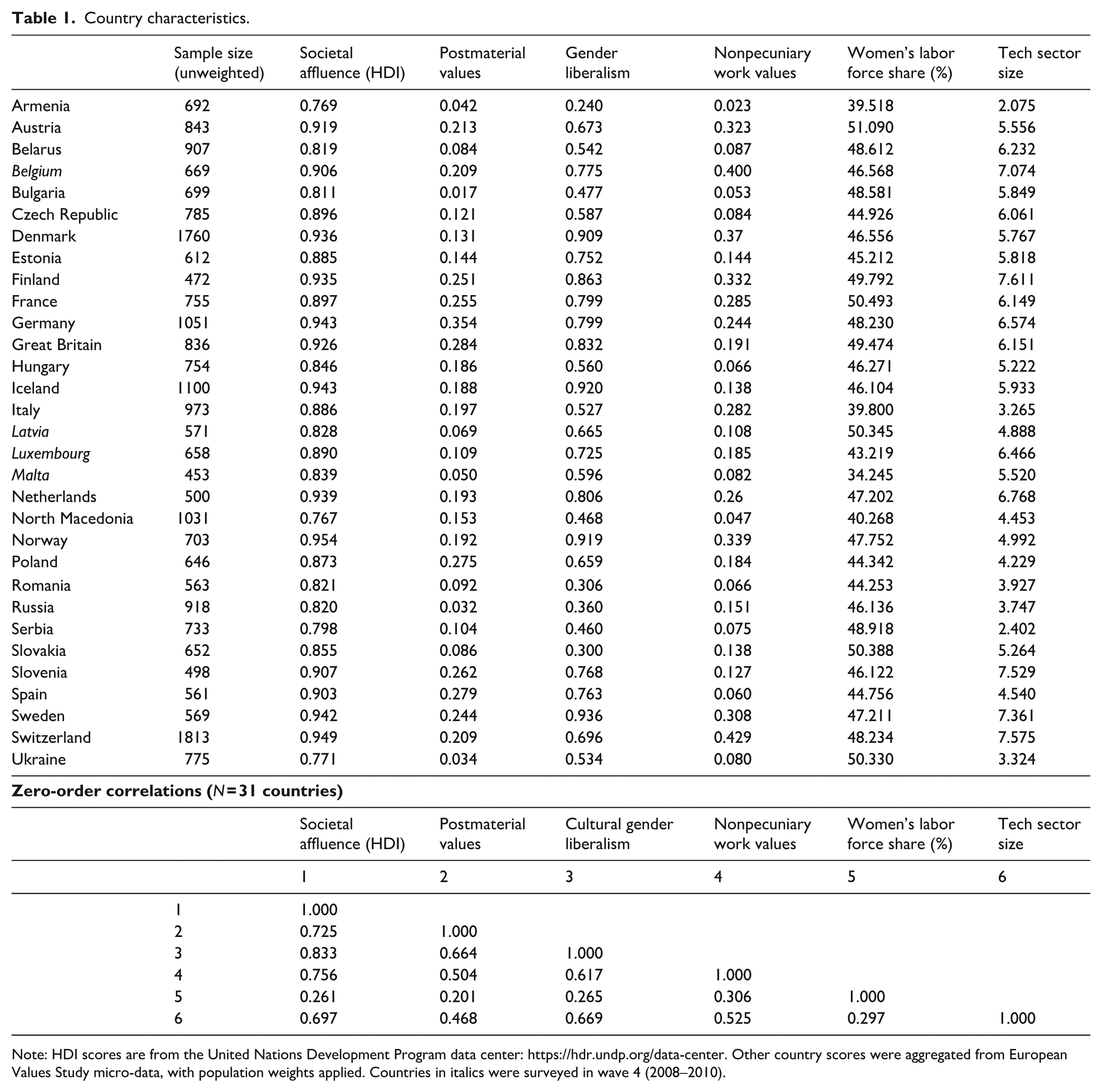
Note: HDI scores are from the United Nations Development Program data center: https://hdr.undp.org/data-center. Other country scores were aggregated from European Values Study micro-data, with population weights applied. Countries in italics were surveyed in wave 4 (2008–2010).
Analytical approach
The analysis is based on a series of logistic regression analyses (with robust standard errors) predicting men’s and women’s log odds of engineering and computing work, conditional on employment. Focal covariates include individual- and country-level measures of postmaterialism, gender-liberalism, and material security and their interactions with gender. Fixed country effects control for unobserved country-level heterogeneity. Since each country is surveyed only once, any difference across survey years in the gendering of engineering and computing occupations is captured by country fixed effects. Substantive conclusions are confirmed by sensitivity tests using a random country-effects specification and controls for survey wave.
A first set of analyses addresses research question 1 by describing how the gender composition of engineering and computing occupations varies across European countries, and by assessing relationships with macro-level correlates of the STEM gender gap that have been identified through previous research. In addition to country fixed effects, these models include cross-level interactions of respondent gender with societal measures of affluence, postmaterialism, and gender liberalism, respectively.
A second set of analyses investigates how respondents’ own attitudinal and socioeconomic characteristics map on to their odds of engineering and computing work, and the extent to which country differences in individual-level traits can account for variability within and between European societies in the engineering and computing gender gap. Of particular interest, based on previous research, are gender-specific relationships with postmaterialist values, gender liberalism, and/or the socioeconomic security respondents experienced growing up.
Results
Uneven gender gaps across Europe
Research question 1 is addressed through descriptive modeling of variability across 31 European countries in the engineering and computing (“tech”) gender gap. Table 2 shows selected coefficients and fit statistics from these analyses (see Supplemental Table A1 for the full set of coefficients). Model 1 includes fixed effects for country and gender. The gender coefficient gives the difference between women and men in log-odds of engineering and computing work, averaged across the 31 countries; its exponentiated value implies 79 percent lower odds of women than men working in engineering and computing ((exp. -1.548) = 0.213). Average marginal effects calculated from this model gives average probabilities of engineering and computing occupations of .105 for men and .025 for women.
Models predicting engineering and computing employment in 31 European countries.
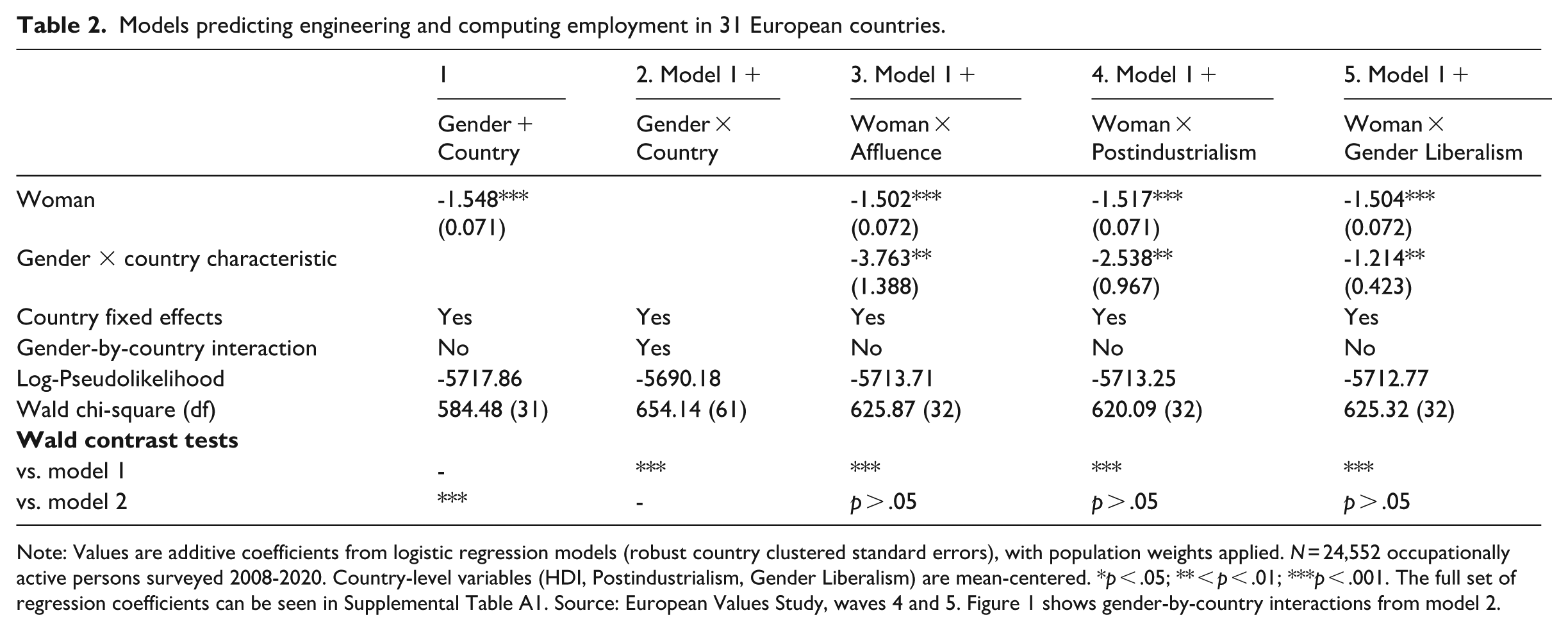
Note: Values are additive coefficients from logistic regression models (robust country clustered standard errors), with population weights applied. N = 24,552 occupationally active persons surveyed 2008-2020. Country-level variables (HDI, Postindustrialism, Gender Liberalism) are mean-centered. *p < .05; ** < p < .01; ***p < .001. The full set of regression coefficients can be seen in Supplemental Table A1. Source: European Values Study, waves 4 and 5. Figure 1 shows gender-by-country interactions from model 2.
Model 2 adds a gender-by-country interaction, which allows tech gender ratios to vary freely across countries. The Wald chi-square statistic for model 2 shows significantly improved fit (p < .001) relative to model 1 (which constrained tech occupations to have the same gender composition in all 31 countries). 7 Figure 1 displays the woman-to-man odds ratios derived from model 2. All values are below 1.00, indicating lower odds for women than men of engineering and computing work in all 31 countries. But the degree of underrepresentation varies considerably. In Latvia, Russia, and Romania, women are about 40 percent less likely than men to do engineering or computing work (odds ratios ≈ 0.60); in France, Norway, and the Czech Republic, they are about 90 percent less likely (odds ratios ≈ 0.10). Consistent with previous cross-national research, Figure 1 shows that women’s representation in engineering and computing work is generally weaker in the most affluent societies of Europe, including in some reputably gender-progressive Scandinavian countries.
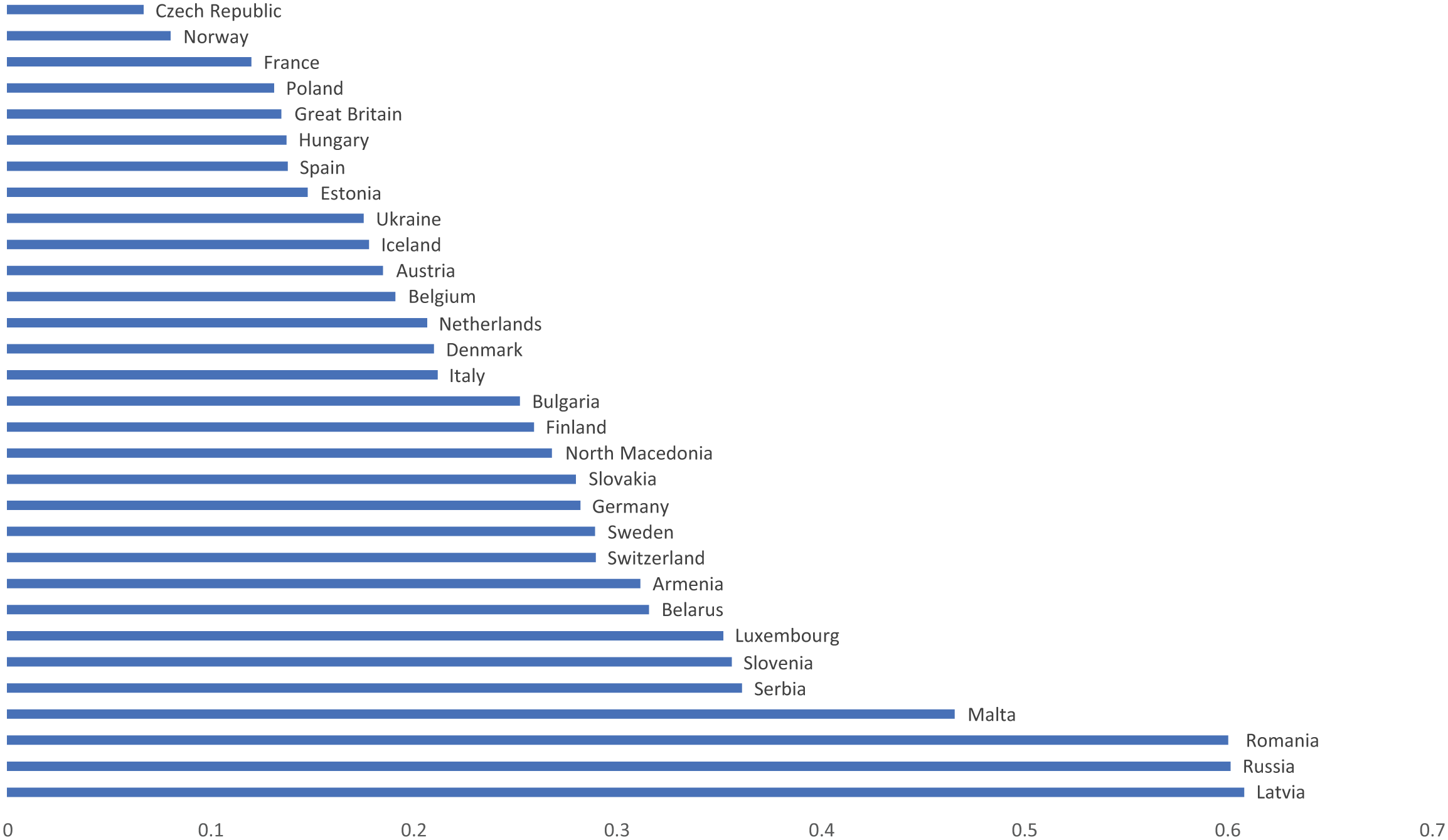
Women/men odds ratios of engineering and computing work.
The remaining columns of Table 2 explore correlations of selected country-level characteristics with the odds ratios shown in Figure 1. Model 3 replaces the gender-by-country terms in model 2 with a single gender-by-HDI interaction, using country scores on the UNDP’s Human Development Index. Confirming impressions from Figure 1, these results show a decrease of approximately 31 percent in women’s relative odds of tech employment ((exp. -.376) = .687) with every 0.1-point increase in HDI (approximately the HDI difference between Slovakia and Norway). Models 4 and 5 explore gender interactions for two cultural correlates of HDI: postmaterialist values and gender liberalism. Significant negative interactions are found for these variables as well, consistent with arguments that they operate as cultural mediators between societal affluence and the gender composition of STEM fields (Charles and Bradley 2009; Siy et al., 2023; Stoet and Geary, 2018; Yalcinkaya and Adams, 2022).
Compared to model 1, models 3-5 yield significantly larger Wald chi-square statistics (p < .001) and do so expending only 1 degree of freedom (compared to 30 df between models 2 and 1). The difference in Wald between model 3 and model 2 (which includes a full set of gender-by-country interaction terms) is not statistically significant (28.27, 31 df), and the same holds for models 4 and 5 relative to model 2. This means that societal affluence (and/or its cultural correlates) captures a substantial share of cross-national variability in the engineering and computing gender gap.
Sensitivity tests with random country effects, shown in Supplemental Table A2 (models 1–3), confirm significant interactions of gender with country-level measures of affluence, postmaterialism, and gender liberalism. Gender interactions with other macro-level correlates of societal affluence, including nonpecuniary work values, women’s labor force participation (a measure of gender equality in outcomes), and size of the engineering and computing sector, are shown in the same table. None are statistically significant (Supplemental Table A2, models 4-6). Whether using a fixed or a random-effects specification, no significant interactions emerge in models that include more than one cross-level interaction term. This is not surprising, given the strong intercorrelations among macro-level variables (Table 1) and the number of countries considered.
The analysis presented in Table 2 shows that engineering and computing occupations are more strongly masculine gendered in countries with higher levels of affluence, postmaterialism, and gender liberalism. The present data do not allow independent influences of these macro-level variables to be disentangled, due to their strong intercorrelations and the limited degrees of freedom at the country level. It cannot be determined, for example, whether societal affluence operates directly on the gendering of engineering and computing work or is mediated by the accompanying cultural value changes.
Individual-level predictors of engineering and computing work
The micro-level mechanisms driving variability in the tech gender gap are more readily identified with the EVS microdata. To address research question 2, I explore relationships of individual-level traits to occupational outcomes though a series of multilevel regression models. Of particular interest, given previous research on this topic, are respondents’ attitudes related to postmaterialism and gender liberalism, and their early-life experiences of material (in)security.
Table 3 shows descriptive statistics for individual-level variables broken down by gender, with EVS-provided weights applied. Most Europeans espouse a mixture of materialist and postmaterialist values, and these values do not differ significantly by gender (although unweighted results, presented in Supplemental Table A3, show a slightly higher mean postmaterialist score for men). With respect to work values, most men and women selected “good pay” as an important job characteristic, but men were somewhat more likely to do so (83% vs 80%), consistent with gendered breadwinner norms and expectations. Supplementary analyses showed that pecuniary and nonpecuniary job values are not mutually exclusive and that the vast majority of respondents (86% in wave 5) affirmed the importance of multiple job characteristics. Table 3 also shows that women are more likely than men to affirm gender equality in job rights, to have a university degree, and to work part time.
Descriptive statistics on individual-level variables.
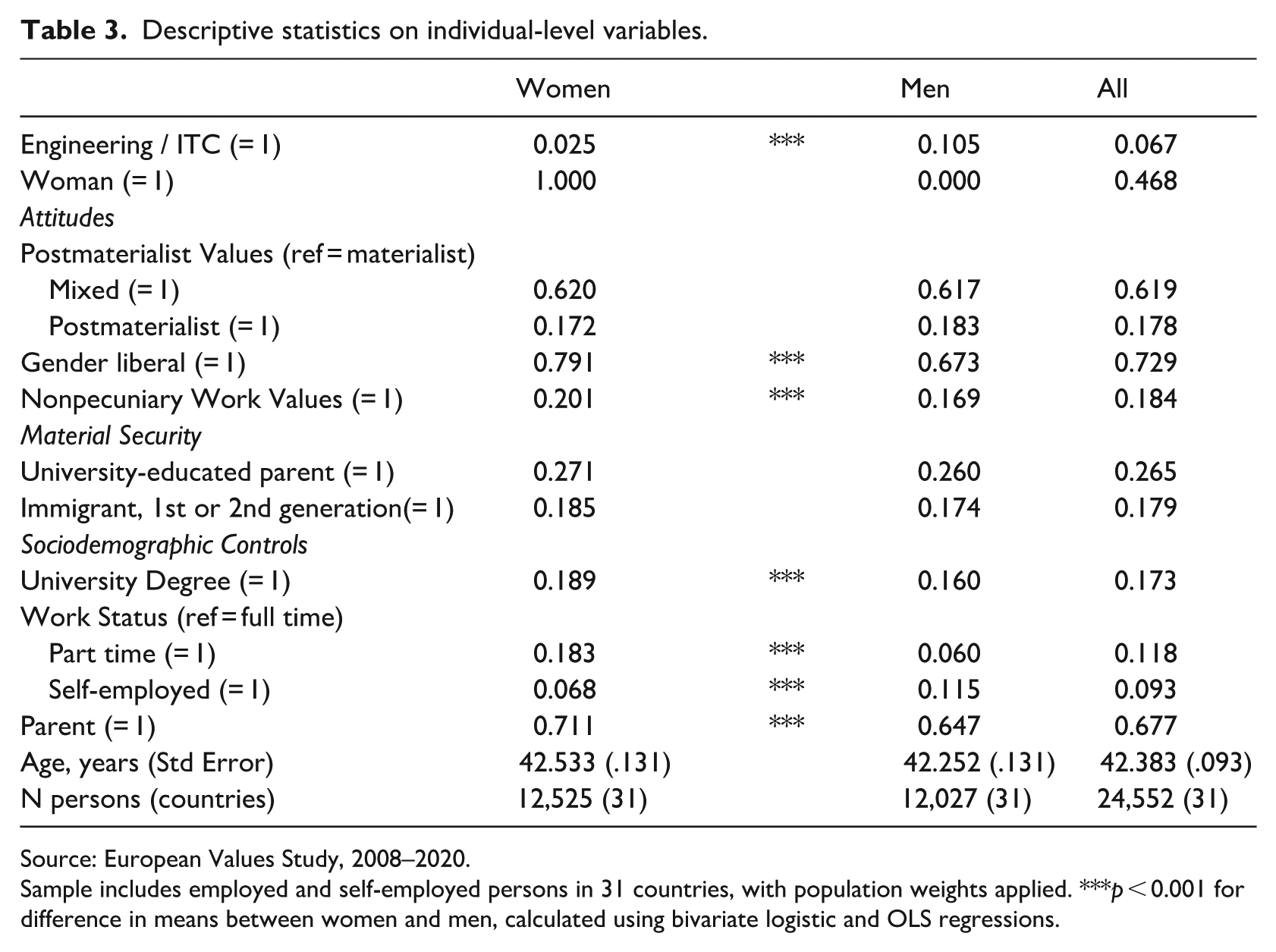
Source: European Values Study, 2008–2020.
Sample includes employed and self-employed persons in 31 countries, with population weights applied. ***p < 0.001 for difference in means between women and men, calculated using bivariate logistic and OLS regressions.
Multilevel regression models allow gender differences in engineering and computing employment to be measured while accounting for individuals’ nonpecuniary work values, gender liberalism, and employment status. Table 4 presents logistic coefficients and fit statistics for two single-gender models and four pooled-gender models. All include fixed country effects, which absorb the main effects of unmeasured country-level characteristics, such as women’s employment rate, size of the engineering and computing sector, national income, and cultural values. Wald statistics for the pooled models show that addition of the individual-level covariates significantly improves predictive power, relative to models 1 and 2 of Table 2.
Models predicting employment in engineering/computing occupations.
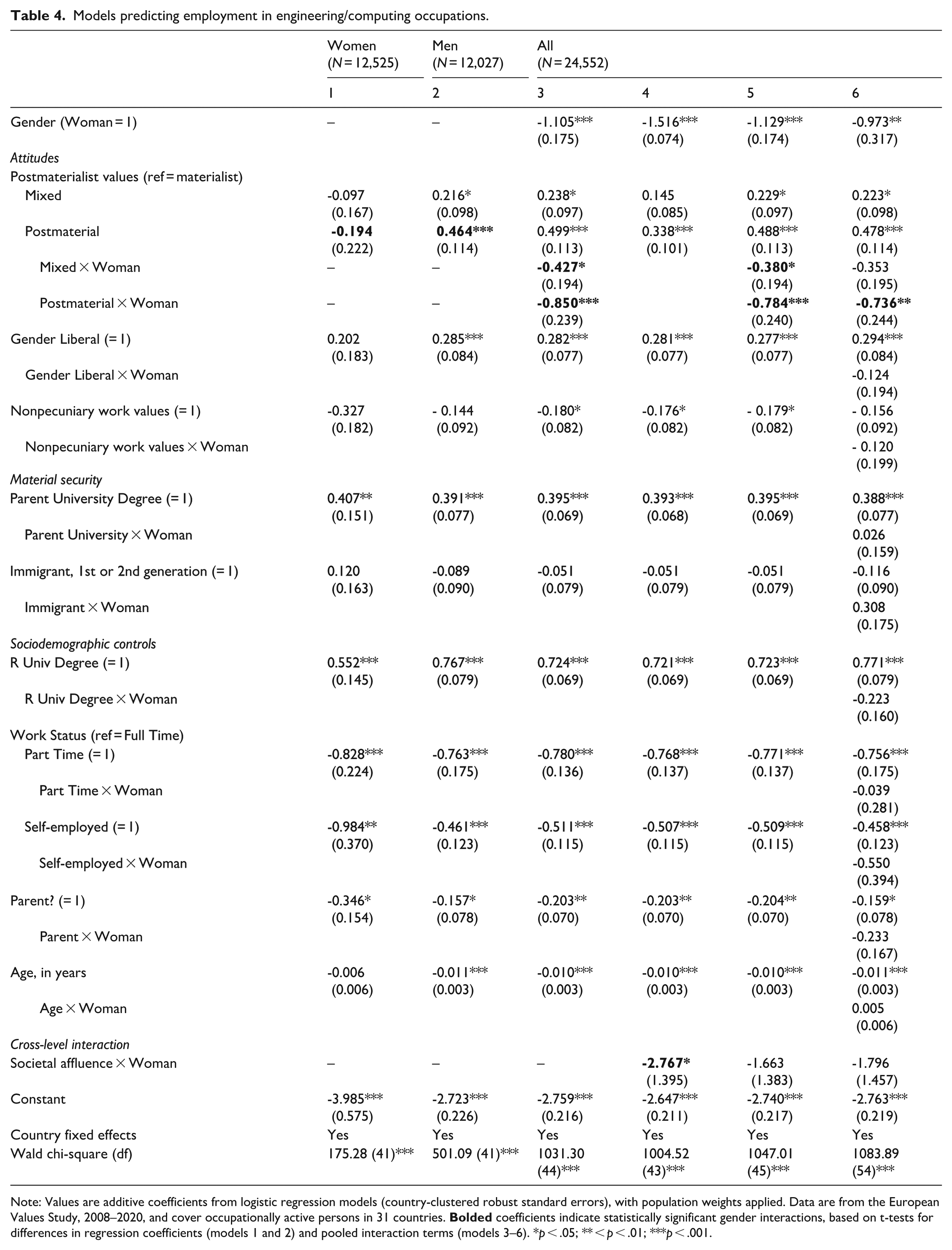
Note: Values are additive coefficients from logistic regression models (country-clustered robust standard errors), with population weights applied. Data are from the European Values Study, 2008–2020, and cover occupationally active persons in 31 countries.
Bolded coefficients indicate statistically significant gender interactions, based on t-tests (models 1 and 2) and pooled interaction terms (models 3–6). T-tests for equality of regression coefficients between men and women show a significant difference for only one predictor of tech employment: postmaterialist attitudes (t = 2.643, p = .004). 8 Consistent with arguments positing a gendering effect of postmaterialist values, men who hold attitudes classified as postmaterialist show about 60 percent higher odds of working in engineering or computing occupations than men who hold materialist values (exp(.464) = 1.590), while no significant relationship is found among women. A similar (although weaker) pattern is found for mixed (relative to materialist) values.
Another cultural correlate of societal affluence is gender liberalism (Inglehart and Norris, 2003), measured here as affirmation that women have equal rights to jobs in times of scarcity. Regression results show a positive association of gender liberalism with tech employment for both women and men (statistically significant only for men), and descriptive statistics in Table 3 show a greater prevalence of gender-liberal attitudes among women. Taken together, these findings make gender liberalism a poor candidate for explaining men’s stronger representation in engineering and computing occupations in affluent, gender-liberal societies. Although not statistically significant, the positive coefficient in model 1 of Table 4 is inconsistent with the idea that gender-liberal ideals provide women with freedom to reject lucrative STEM work and pursue their true interests (which would suggest a negative coefficient). 9 Conclusions are unchanged in sensitivity tests that replace gender liberalism with a composite measure of domestic-sphere gender egalitarianism. 10
A frequently discussed manifestation of postmaterialist value systems is increased emphasis on nonpecuniary, rather than pecuniary, job rewards. Nonpecuniary work values, might contribute to a larger gender gap in engineering and computing if they influenced women’s tech outcomes more than men’s (e.g. because women were less likely than men to value nonpecuniary aspects of tech work). But Table 4 provides no evidence of this gender difference; predicted effects of nonpecuniary job values do not differ significantly by gender, including in supplementary models where they are measured at the country level (Supplemental Table A2). Tables 3 and 4 together do suggest another way in which job values might affect the gendering of tech employment: through men’s greater propensity to hold pecuniary job values (Δ = 0.032 in Table 3). According to model 1 of Table 4, raising women’s valuation of good pay to equal men’s would increase women’s odds of tech employment by about 1 percent (0.327(0.032) = 0.0105; exp.= 1.0106).
Coefficients for material security growing up do not differ significantly by gender. The odds of engineering and computing work are positively associated with parental education and unrelated to parents’ immigration status for both men and women (see also Uunk, 2023 on the absence of gendered parental wealth effects). In supplementary models, a subjective measure of childhood material security—respondents’ perception of whether their parents had problems making ends meet while they were growing up—likewise showed no significant interaction with gender. It is possible that material security experienced later in life (e.g. during early adulthood) influences career outcomes in ways not captured by parental socioeconomic status.
Some control variables are predictive of engineering and computing work, but none show gender-specific relationships. Interestingly, parenthood is negatively associated with engineering and computing work for both men and women, suggesting that the work culture in these occupations may be inhospitable to fathers as well as mothers (Cech and Blair-Loy, 2019). Other standard socio-demographic predictors of labor market outcomes—employment status, age, and education—also show similar relationships for men and women.
The remaining models (3–6) use the full sample to explore gender interactions. Model 3 confirms the gender-specific association of postmaterialist values with tech employment, showing that odds of engineering and computing work are higher among men, but not women, who espouse postmaterialist (and to a lesser extent mixed) attitudes. Results are consistent with a gendering effect of postmaterialist values on orientations toward STEM careers (Charles and Bradley, 2009; Siy et al., 2023; Yalcinkaya and Adams, 2022).
The power of individual-level characteristics to explain cross-national differences in the tech gender gap can be assessed further by considering change across models in the relevant cross-level interaction terms. It is notable, first, that the association of societal affluence with the engineering and computing gender gap weakens when individual-level characteristics are considered. This is evident in comparing the HDI-by-gender coefficient between model 4 of Table 3 and model 3 of Table 2 (−2.767 and −3.763, respectively). This HDI-by-gender coefficient attenuates further in model 5, which allows the association between postmaterialism and occupational outcome to vary by gender (model 4 effectively constrains associations between individual-level characteristics and tech outcomes to be the same for men and women). The flattening HDI gradient between models 4 and 5 can be seen in Supplemental Figure A1, which graphs the women-to-men odds ratio of engineering and computing work at three different HDI levels first without and then with the gender-by-postmaterialism interaction. 11
Supplementary analyses reveal, moreover, that adding the individual-level postmaterialism-by-gender interaction to model 2 of Table 2 absorbs enough cross-national variability that the gender-by-country interaction terms are no longer jointly significant at the 5 percent confidence level (Wald chi-square: 40.70, 30 df, p = .056). In other words, the gender-specific effects of individual postmaterialist values account for a substantial share of cross-national variability in the engineering and computing gender gap across Europe.
Model 6 of Table 4 allows all individual-level relationships to vary by gender. Results confirm that postmaterialism is the only individual-level covariate that interacts significantly with gender. Figure 2 shows the probability of tech employment predicted from model 6, broken down by individual postmaterialism status and gender, with all other covariates set to their mean or modal categories. As expected, predicted probabilities are much lower for women across the board, and increase continuously for men from materialist, to mixed, to postmaterialist status.
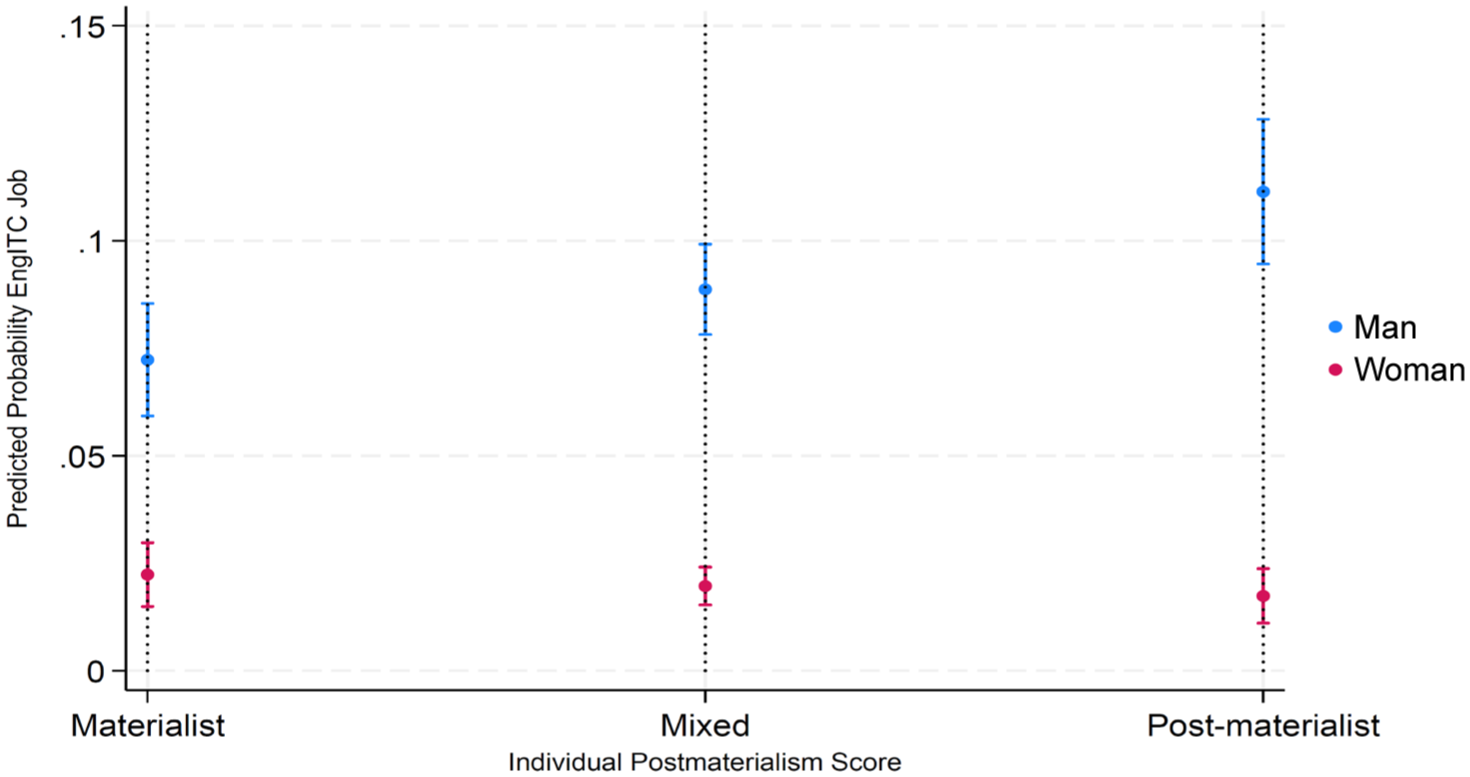
Predictive margins, individual postmaterialism by gender.
Conclusion
This study uses data from the European Values Study to pose two questions related to the gender gap in engineering and computing occupations. The first, on the contours of variability across Europe, is addressed through a descriptive mapping of country-specific gender gaps. Results show that women are underrepresented in engineering and computing (“tech”) in all 31 countries considered, but that the degree of their underrepresentation varies considerably. Consistent with analyses of more socioeconomically diverse country samples and other STEM outcomes, gender gaps in tech occupations are largest in the most affluent societies of Europe (which are also the most postmaterialist and gender-liberal culturally).
The second research question concerns individual-level drivers of tech gender gaps, specifically how men’s and women’s own values and socioeconomic experiences influence their odds of engineering and computing work, and how these factors might contribute to variability across European countries in the size of the gender gap. Of the individual-level traits considered, only postmaterialism shows a gender interaction that is consistent with the observed cross-national patterns. Results of multilevel models show that men, but not women, who espouse postmaterialist values have higher odds of working in engineering or computing, and that these gender-specific effects account for a substantial share of variability across Europe in the tech gender gap.
One specific manifestation of postmaterialist values in affluent societies is reduced emphasis on material job rewards in favor of intrinsic, self-expressive rewards. Not surprisingly, respondents who espouse nonpecuniary work values (i.e. who do not select “good pay” as one important job characteristic) are less likely to work in lucrative engineering and computing occupations. This relationship does not differ by gender. But the greater prevalence of nonpecuniary work values among women may contribute to their weaker presence in engineering and computing occupations. In other words, men’s higher valuation of good pay may account for some of the tech gender gap in affluent societies.
Regression results provide no evidence that gender liberal beliefs or material security growing up, at least when measured at the individual level, contribute to a “paradoxical” widening of the tech gender gap in affluent societies (Stoet and Geary, 2018). The present study, along with other recent analyses, point to other cultural correlates of Western affluence, including postmaterialism, gender math stereotypes, and religious culture, as more plausible drivers of STEM gender gaps (see also Berggren and Bergh, 2025; Breda et al., 2020). 12 The idea that women have greater latitude to indulge their intrinsic preferences for non-STEM work when they are freed from economic constraints and illiberal gender norms seems plausible on its face. But this interpretation is not supported by this or other data. Previous research shows that the gender gap in STEM preferences also varies across countries, with girls in less affluent societies more likely than their advanced-industrial counterparts to report enjoying mathematically intensive work, being good at it, and aspiring to mathematically related careers (Abu-Asaad et al., 2025; Charles, 2017; Siy et al., 2023). It is possible that these preferences are falsely reported or reflect girls’ resignation to the pursuit of practical careers under conditions of economic precarity, but this has not been demonstrated so far. Rather than treating gendered preferences as individual traits that are fixed, most gender scholars emphasize their contextual contingency and sensitivity to prevailing gender structures and stereotypes (Cheryan et al., 2017; Correll, 2004; Dieckman et al., 2010; O’Keefe et al., 2018; Risman, 2004; Thébaud et al., 2025). Future experimental research could provide more direct causal evidence on how beliefs about gender-specific affinities for particular work tasks affect educational and occupational aspirations of men and women in affluent postmaterialist societies.
Observed patterns of cross-national variability in STEM outcomes seem less paradoxical if the multifaceted nature of gender is considered. Gender equality does not vary on a single continuum, but in multidimensional space, with countries more equal on some indicators and less equal on others (Bradley and Khor, 1993; Charles 2011; Pettit and Hook, 2009; Rotem and Boyle, 2024). Recent research shows, for instance, that the gender liberalism that accompanies broad-based affluence coexists with persistent gender-essentialist stereotypes (Breda et al., 2020; Knight and Brinton, 2017; Napp, 2023; Scarborough et al., 2019). In “different but equal” gender regimes, taken for granted understandings of masculinity and femininity influence the way organizations and jobs are structured and the way people behave within them. This in turn reinforces beliefs about the innateness of gender difference and the inevitability of gender segregation (Mickey, 2022; Ridgeway and Correll, 2004; Thébaud and Taylor, 2021).
On the possible gendering effects of postmaterialist values
Postmaterialism describes the transformation of cultural and individual values that occurs as existential security concerns become less pressing, most notably the growing emphasis on quality of life and individual self-expression (Inglehart, 2018). These values are manifested in popular discourse that treats school and work as vehicles for self-realization—for example in the cultural ideal that people follow their passions in making educational and occupational choices. Results of the present study are consistent with arguments that these self-expressive ideals contribute to larger STEM gender gaps (Blair-Loy et al., 2024; Charles and Bradley, 2009; Siy et al., 2023; Yalcinkaya and Adams, 2022). Specifically, they suggest that espousal of postmaterialist values makes European men, but not women, more likely to pursue engineering and computing work.
In societies that valorize individual self-expression and “doing what you love,” cultural stereotypes about the intrinsic masculinity of mathematically intensive work likely influence career aspirations and outcomes in gender-conforming directions. Because people often do not know in advance what they will love or be good at, their beliefs about what like-gendered people do or feel can be important determinants of self-assessed abilities and affinities (Cech, 2021; Correll, 2004; Pagis, 2021; Thébaud and Charles, 2018; Wynn and Correll, 2017). This sets up a vicious cycle between gender stereotyping and occupational gender segregation, where people then experience highly unequal outcomes as expressions of their own intrinsic affinities and aptitudes, rather than the product of pervasive gender stereotyping and structural constraints (Charles and Bradley, 2009; Eagly and Koenig, 2021; Schmader, 2023). In postmaterialist societies, understandings of educational and occupational careers as vehicles for individual self-expression may supercharge these gendered processes.
EVS survey results show that vast majorities of occupationally active European men and women affirm the importance of both pecuniary and nonpecuniary job rewards. It is thus not the rejection of material job rewards that distinguishes engineering and computing workers from other workers. It appears, rather, that the (real or imagined) nonpecuniary characteristics of engineering and computing occupations may align better with men’s than women’s self-assessed aptitudes and affinities and their understandings of what will allow them to realize their true selves.
Limitations and future research directions
Results suggest several areas for future research. One set of open questions pertains to how people come to understand fields as individually self-expressive or not, and how these understandings are influenced by prevailing gender stereotypes. In the United States, passion-seeking women may be deterred from engineering and computing fields by images of masculine “hackers” (Cheryan et al., 2017; Ensmenger, 2015; Wynn and Correll, 2017), by a cultural dualism that casts technical work as low in (feminized) social/altruistic values (Cheryan et al., 2017; Faulkner, 2000), and by a work culture that is perceived as incompatible with parenthood (Cech and Blair-Loy, 2019; Thébaud and Taylor, 2021). Whether true or not, such cultural depictions decrease women’s and girls’ sense of belonging in technical fields and their aspirations to pursue tech-related work.
Researchers could extend comparative analysis of the tech gender gap by incorporating direct measures of self-expressive career motivations and gender-essentialist stereotypes, especially stereotypes about the masculinity of math and science. 13 While survey items on the importance of specific intrinsic job rewards (e.g. “interesting,” or “meets one’s abilities”) are useful, cross-societal differences in self-expressive motivation would be better assessed by questioning respondents more directly on the importance of passion-seeking or “doing what they love.”
Drawing conclusions from previous comparative research has been complicated, moreover, because different studies have considered different gender gaps (e.g. gaps within different STEM fields and/or within different analytical domains such as occupations, fields of study, aspirations, math self-concepts, personality traits), each of which may operate according to its own causal logic (Berggren and Bergh, 2025; Charles and Grusky, 2004; Erdmann et al., 2023; Yalcinkaya and Adams, 2022). Given this multidimensionality, a research design that considers the possibility that different forms of gender inequality rise and fall independently will be more analytically fruitful than a framework that assumes that countries vary on a single traditional to egalitarian continuum (Breda et al., 2020; Charles et al., 2023; Grunow et al., 2018; Knight and Brinton, 2017; Napp, 2023; Rotem and Boyle, 2024; Scarborough et al., 2019).
Societal affluence is correlated with other institutional characteristics that may affect career outcomes in gender-specific ways, independent of value change. These include differences in the gender pay gap, industrial structure, and laws and policies. Recent comparative research has also identified mathematics performance culture (e.g. average mathematics achievement) as a possible structural driver of cross-national variability in STEM gender gaps (Mann and DiPrete, 2016; Marsh et al., 2021 but see Charles, 2017). These relationships and their underlying mechanisms should be explored in greater detail.
Causal conclusions are limited by the cross-sectional design of this study. Other types of comparative and historical data, including longitudinal and panel surveys and multi-sited experiments, would allow effects of self-expressive ideals and gender stereotypes to be measured over time, across birth cohorts, and over the life course while excluding other confounding effects (Erdmann et al., 2023; Fors et al., 2020). A newer wave of EVS survey data could provide additional evidence on the evolution of tech labor markets and postmaterialist values in European countries that are currently experiencing major socioeconomic shifts and expansion of their engineering and computing sectors.
The composition of engineering and computing work also varies across other demographic axes that intersect with gender and may vary by country. These include race, nativity, and sexuality (Alegria, 2020; Cech and Waidzunas, 2021; Chow, 2023; Ma and Liu, 2017; Oh, 2025). US-based research suggests that postmaterialist norms to “do what you love” may also support increased incursion of racial stereotypes/hierarchies into educational and career choices (Rao and Neely, 2019; Wilson, 2022). More cross-cultural research is needed on how self-expressive ideals and the cultural logic of work passion may affect the tech and non-tech careers of ethnoracial and sexual minorities and multiply marginalized people.
Supplemental Material
sj-xlsx-1-cos-10.1177_00207152251372850 – Supplemental material for Minding the gap(s): The uneven gendering of engineering and computing work across Europe
Supplemental material, sj-xlsx-1-cos-10.1177_00207152251372850 for Minding the gap(s): The uneven gendering of engineering and computing work across Europe by Maria Charles in International Journal of Comparative Sociology
Footnotes
Funding
The author disclosed receipt of the following financial support for the research, authorship, and/or publication of this article: The authors received no financial support directed toward the research, authorship, and/or publication of this article.

Supplemental material
Supplemental material for this article is available online.
Notes
References
Supplementary Material
Please find the following supplemental material available below.
For Open Access articles published under a Creative Commons License, all supplemental material carries the same license as the article it is associated with.
For non-Open Access articles published, all supplemental material carries a non-exclusive license, and permission requests for re-use of supplemental material or any part of supplemental material shall be sent directly to the copyright owner as specified in the copyright notice associated with the article.
