




Abstract
Classical notions suggest that immigrants tend to be more risk-taking than those who remain in their country of origin, but conditions of forced migration may limit this selectivity. Identifying systematic personality differences between refugees and other immigrants is crucial, as traits such as risk orientation may contribute to differences in integration behavior. This study investigates selectivity in risk orientation among refugees from the IAB-BAMF-SOEP Survey of Refugees in Germany and other immigrants from the IAB-SOEP Migration Sample, and examines its role in language acquisition through growth curve models. The selectivity measures are based on data from the World Values Survey for the population in immigrants’ countries of origin. The findings show no systematic differences in selectivity in risk orientation by migration motive; instead, the degree of selectivity varies by country of origin. In terms of language proficiency growth, the longitudinal findings indicate that individuals selected in risk-taking demonstrate greater improvements in language skills, as increased exposure to German through daily interactions, language courses, and labor market participation accumulates throughout their stay in the receiving country.
Introduction
The global number of international immigrants has steadily increased, although the COVID-19 pandemic temporarily disrupted human mobility. In Europe, Germany has been the primary destination for immigrants seeking humanitarian protection, particularly in 2015 (UNHCR, 2021). In most other years, international migration to Germany has been predominantly driven by European Union (EU) citizens. For instance, in 2021, around 581,000 immigrants arrived from other EU member states, while approximately 148,000 were asylum seekers from mostly non-Western regions such as the Middle East and Africa. Migration patterns shifted again in 2022, when around 829,000 refugees arrived from Ukraine due to displacement by the Russian invasion, which surpassed the approximately 612,000 EU immigrants who arrived that year (BMI, 2023).
In response to the elevated number of immigrants to Germany in 2015, the German Federal Office for Migration and Refugees (BAMF) significantly increased the capacity of language courses. At the same time, many non-governmental organizations amplified opportunities for refugees to learn the German language, in order to support their incorporation into the German society (Kosyakova and Brenzel, 2020). In addition, German language courses, which had initially only been accessible to immigrants with a residence permit and insufficient knowledge of German since 2005, were expanded in 2015 to include newly arrived refugees with a high probability of asylum recognition and those with a temporary residence permit (Duldung) (BMI, 2023).
Indeed, the successful integration of both recent refugees and other immigrants largely depends on their proficiency in the language of the receiving country, regardless of their different migration motives and legal status. Early language acquisition upon arrival is a catalyst for other dimensions of integration. For example, knowledge of the language of the receiving country can facilitate access to employment (Bakker et al., 2017), enable regular contact with members of the receiving society (Martinovic et al., 2009), and determine access to education (Schipolowski et al., 2021; Stanat and Edele, 2016).
Although the mechanisms of language acquisition are presumed to be the same for refugees and other immigrants, group-specific progress may arise due to variations in conditions and endowments with resources that are relevant for language learning (Kogan and Kalter, 2020; Kristen and Seuring, 2021; van Tubergen and Kalmijn, 2009). For instance, refugees typically arrive at the receiving country with lower linguistic fluency in the language of the receiving country because their migration movement is often less planned and prepared compared to other immigrants, who are more likely to possess premigration language skills (Kristen and Seuring, 2021). However, refugees tend to attend language courses at a higher rate after arrival compared to other immigrants and can rapidly improve their language skills, which enables them to catch up with other immigrants after a certain length of stay (Kosyakova et al., 2022; Kristen and Seuring, 2021). Furthermore, refugees tend to arrive at a younger age, a factor that has been shown to be associated with more rapid language acquisition (Kosyakova et al., 2022; Spörlein and Kristen, 2019). Moreover, their limited prospects of returning to their country of origin may incentivize them to invest more time and effort in learning the language of the receiving country, whereas other immigrants, who often retain the option of returning to their country of origin, may be less incentivized to do so (van Tubergen and Kalmijn, 2009). However, refugees and other immigrants may also differ in term of other, less researched factors, such as their personality, more specifically the personality trait of risk orientation, which can influence how individuals learn and respond to learning situations.
Language acquisition involves taking risks (Moody, 1988). It entails actively seeking out situations in which one is exposed to a new language and making mistakes in order to receive corrective feedback. This can be challenging for risk-averse individuals. As people with different personality types have different learning behaviors and benefit from them in different ways, a variety of structured learning situations and opportunities for exposure to the language of the destination country should be provided to facilitate language acquisition, particularly when there are systematic personality differences between migrant groups.
This article challenges the classical notion that immigrants are drawn from the most motivated, ambitious, or risk-tolerant segments of their country of origin (Boneva and Frieze, 2001; Chiswick, 1999; Jaeger et al., 2010). While positive selectivity in risk orientation may apply to voluntary immigrants, this is less likely to be applicable in situations of forced migration, such as wars, violent conflicts, and human rights violations, in which individuals often have no choice but to leave their country. Consequently, if risk orientation contributes to differences in integration behavior, such as acquiring the language of the receiving country, it is important to identify systematic personality differences between refugees and other immigrants in order to understand unequal integration outcomes.
Thus, the first objective of this article is to describe the selectivity in risk orientation of recently arrived refugees and other immigrants to Germany and to examine whether refugees and other immigrants differ in this regard. Relative assessments of immigrants’ risk orientation in comparison with the population that remains in their country of origin can be used to account for national-level differences in risk orientation (Falk et al., 2018). This is because immigrants from low-risk countries with medium levels of risk-taking may still represent the more risk-tolerant segment of their country of origin, analogous to immigrants from high-risk countries with high levels of risk-taking.
The second objective of this article goes beyond merely describing immigrants’ personalities and consists of investigating whether selectivity in risk-taking is advantageous when acquiring the language of the receiving country. Based on a general model of language acquisition (Chiswick and Miller, 1995, 2001), we expect that individuals selected in risk-taking possess more effective learning strategies, which enable them to enhance their language proficiency at a more rapid rate. Assuming an indirect effect of selectivity in risk orientation on language proficiency, we also hypothesize that risk-taking increases the frequency of exposure to both structured learning situations, such as language courses, and unstructured learning situations such as everyday interactions with native speakers, both of which have been demonstrated to enhance language proficiency.
To date, research on the relationship between immigrants’ personality traits and language proficiency remains limited. Some studies have identified traits such as integrative motivation (Svanes, 1987), openness, conscientiousness, extraversion (Kosyakova and Laible, 2022; Verhoeven and Vermeer, 2002), locus of control (Kosyakova and Laible, 2022), resilience (Kosyakova and Laible, 2022), reciprocity (Hahn et al., 2019), and risk orientation (Hahn et al., 2019; Kosyakova and Laible, 2022) as factors that influence language acquisition among immigrant learners. However, Asfar et al. (2019) found no evidence that openness or conscientiousness contribute to language acquisition among Syrian and Eritrean refugees in the Netherlands. Beyond language proficiency, personality traits have also been linked to other integration outcomes. For example, Hahn et al. (2019) demonstrated that risk-taking is associated with a higher likelihood of employment, whereas Laible and Brenzel (2022) found that risk orientation had no effect on immigrants’ wages. Similarly, Thum (2014) identified a positive relationship between immigrants’ sense of control over their lives and likelihood of employment.
In this study, the empirical analysis was based on panel data from first-generation refugees and other immigrants who had been in Germany for less than 5 years at the time of the first observation. Specifically, we used data from the IAB-BAMF-SOEP Survey of Refugees in Germany and the IAB-SOEP Migration Sample. In addition, data from the World Values Survey (WVS) provided information on the populations of immigrants’ countries of origin. Our sample included 2247 refugees and other immigrants from non-Western countries (Iran, Iraq, Pakistan, and Nigeria), EU member states (Bulgaria, Poland, Romania, and Spain), and other countries (Russia, Ukraine and Turkey). The main analysis was based on growth curve models to track changes in immigrants’ language proficiency over the duration of their stay in the receiving country.
Context
After World War II, Germany, like Belgium, France, Luxembourg, the Netherlands, and Sweden, became a destination for so-called guest workers during the economic boom of the 1950s. Although they were initially recruited as temporary workers, some of these immigrants from Italy, Greece, Spain, Portugal, the former Yugoslavia, Turkey, Algeria, Morocco, and Tunisia permanently settled in Germany and brought their families in the country. Since the 1990s, Germany has also received ethnic German immigrants from Eastern Europe and labor immigrants from newly acceded EU member states (Triandafyllidou and Gropas, 2016). In 2015 and 2016, Germany emerged as the main European destination for asylum seekers (BMI, 2023). Unlike Belgium, France, the Netherlands, Portugal, and the United Kingdom, Germany has received comparatively few postcolonial immigrants (Van Mol and de Valk, 2016). Moreover, compared to the European countries that formerly sent guest workers, Germany has a substantially larger immigrant population.
The rules and conditions under which immigrants acquire rights differ between EU countries because they are shaped by national political norms and electoral dynamics (Ersanilli and Koopmans, 2011). The Migration Integration Policy Index (MIPEX) captures these differences by evaluating immigrants’ access to rights and opportunities, such as economic and political participation, anti-discrimination measures, and long-term settlement. Germany’s integration policy is considered to be relatively favorable, comparable to those of France, Italy, the Netherlands, and the United Kingdom. By contrast, Sweden, Portugal, Finland, and Belgium have more economically and socially liberal policies, while Denmark, Greece, Austria, and Hungary, Bulgaria, and Poland are more politically restrictive (Solano and Huddleston, 2020). It is important to note that the MIPEX does not evaluate asylum-specific policies, and that favorable integration policies do not necessarily lead to intended integration outcomes (Solano et al., 2023). Germany’s integration policy has also been described as ethnically assimilationist, with limited access to citizenship and low recognition of diversity. This contrasts with France’s civic- assimilationist model, which provides easier access to legal rights, and the Netherlands’ multiculturalist model, which also encompasses accessible legal rights and high levels of diversity (Ersanilli and Koopmans, 2011).
Across Europe, mandatory language acquisition is a core component of integration policies and a key indicator of access to rights, given varying implementation at entry, settlement, and naturalization (Neureiter, 2019). While EU citizens benefit from freedom of movement, non-EU nationals in Germany require a CEFR B2-level language proficiency for permanent settlement, except high-skilled workers, self-employed, and their families. Asylum seekers are not required to demonstrate language proficiency upon arrival; however, language courses are mandatory during the settlement process, and those who are granted protection can apply for permanent residence upon demonstrating sufficient proficiency in German. Germany’s citizenship policy is relatively restrictive and requires B1-level German proficiency and knowledge of the country’s history, culture, and political system, which is similar to requirements in the United Kingdom, Austria, and Denmark. By contrast, Italy and France have fewer requirements, while Ireland and Sweden have none, and treat citizenship as an enabler of integration rather than a reward (Goodman, 2010).
Theoretical background
Risk orientation and migration
Migration inherently involves risk-taking, for refugees and other immigrants (Williams and Baláž, 2012). Thus, risk orientation is relevant in migration decision-making (Czaika et al., 2021). Empirical research has found that both national and international immigrants tend to be more risk-taking than non-movers (Akgüç et al., 2016; Jaeger et al., 2010; Lübke et al., 2021). Moreover, risk-tolerant individuals are more likely to choose culturally distant destinations compared to risk-averse individuals (Fouarge et al., 2019). Studies that focus on highly educated voluntary international immigrants have also shown that they exhibit greater risk-taking than those who remain in their country of origin (Gibson and McKenzie, 2009; Vandor, 2021). By contrast, Polavieja et al. (2018), who examined a wider range of destination and origin countries and different selectivity characteristics, did not observe consistent attitudinal selectivity patterns across different European receiving countries. Notably, most of the above studies only focused on voluntary immigrants who move without constraints, which leaves a gap in understanding of whether this positive selection in risk-taking extends to forced immigrants such as refugees.
Given the distinct conditions associated with their migration, refugees and other immigrants may differ in their selectivity with regard to risk orientation. Compared to refugees, other immigrants typically leave their country of origin voluntarily and with greater planning and preparation. Despite this preparation, their migratory movement still entails uncertainty and requires a certain willingness to take risks (Czaika et al., 2021). Immigrants often have less information about the destination country than their current residence (Jaeger et al., 2010). They face potential failure to achieve better living conditions and must leave behind established support networks (Lübke et al., 2021). Those who are more risk-tolerant may perceive the risks and uncertainties associated with migration as less threatening and be better able to cope with them (Jaeger et al., 2010; Lübke et al., 2021; Williams and Baláž, 2012). Therefore, we formulated the following hypothesis: Other immigrants are selected in risk-taking (Hypothesis H1). In other words, they are more likely to come from the specific segment of the population in their country of origin that is more inclined to take risks.
By contrast to voluntary migration, forced migration is primarily driven by precarious living conditions in the country of origin due to the threat of death or loss of freedom (Kuhnt, 2019). In the absence of viable alternatives to migration, risk orientation may influence refugees’ decision about where to migrate more than it influences decisions about whether to migrate. Among refugees who possess the resources to leave a conflict zone, the majority choose to stay in neighboring countries, with only a small proportion moving on to Europe. Refugees’ decisions about where to migrate are also often influenced by external constraints, including the limited opportunities offered by smugglers, financial resources, and political interventions (Mallett and Hagen-Zanker, 2018). Given these conditions, the question arises as to whether refugees are selected at all.
Predicting selectivity patterns in risk orientation among refugees who migrate to Western European receiving countries is less straightforward than for other immigrants. For many refugees, migration to Europe may represent the least risky option, as it offers them protection and the prospect of asylum. This suggests that, contrary to other immigrants, refugees are selected in risk aversion (Hypothesis H2a). However, the migration process itself involves risks and uncertainties. Transit routes can be dangerous, and cultural distance may deter risk-averse individuals from migrating to Europe. Some refugees alter their initial migration plans in response to extreme situations during transit, including traumatic experiences of sexual or economic exploitation, violence at the hands of human traffickers, or the risk of death (Wissink et al., 2013). For risk-averse individuals, neighboring countries may be a more appealing option than migration to Europe and offer relatively safe environments with shorter travel distances, reduced transit risks, and greater cultural and linguistic proximity. This would support the hypothesis that, similar to other immigrants, refugees are selected in risk-taking (H2b). Nonetheless, the safety of neighboring countries is not guaranteed, as conflicts can spread beyond national borders, which could deter risk-averse individuals from settling there. This supports Hypothesis H2a. Therefore, the selectivity patterns observed among refugees may differ from those among other immigrants.
Risk orientation and integration
Do immigrants who come from the segment of the population in their country of origin that is more risk-taking have an advantage in acquiring the language of their receiving country? Studies that explicitly address risk orientation and its role in language learning have mostly focused on the classroom context, that is, second language learning at school (Cervantes, 2013; Zhang, 2008). However, these findings are largely inconclusive and have limited transferability to this study, given that the conditions under which immigrants learn the language of their receiving country profoundly differ from those in educational environments. To our knowledge, Kosyakova and Laible (2022) are the only authors to have addressed the impact of personality traits on language proficiency. Using data from the IAB-BAMF-SOEP survey of recent refugees in Germany, they demonstrated that higher levels of risk-taking are associated with greater proficiency in the language of the destination country. Building on their work, this study focuses on risk orientation as a key personality trait that influences language acquisition among both refugees and other immigrants. In recognition that immigrants are not randomly selected from the population of their country of origin (Lee, 1966), we also examine patterns of immigrant selectivity. In doing so, we integrate the concept of immigrant selectivity into broader discussions on how personality traits shape integration across migrant groups.
To explain how risk orientation may influence language acquisition, we relied on a general model of language proficiency as the outcome of cumulative investments, which applies to both refugees and other immigrants. According to this model, individual differences in language skills arise from variations in incentives, learning efficiency, and exposure to the language of the receiving country (Chiswick and Miller, 1995, 2001). Although risk orientation influences motivation, efficiency in learning, and exposure to the language of the receiving country, migration- and integration-specific factors further differentiate the learning trajectories of migrant groups, as elaborated in the next section.
How risk orientation influences language acquisition
Our central argument is that risk-tolerant selected individuals may have an advantage in learning a new language due to their greater exposure to the language of the receiving country, compared to risk-averse selected individuals. This exposure is shaped by both the amount of time spent using the language and the intensity with which it is used by the individual or others around them (Chiswick and Miller, 1995). Immigrants can increase their exposure through structured contexts such as language classes and unstructured situations such as using the language in everyday life (Kristen and Seuring, 2021).
In terms of exposure duration, we expect that risk-tolerant selected individuals would demonstrate greater progress in language acquisition over time compared to those selected in risk aversion because they are more likely to participate in structured situations such as language courses and in unstructured situations such as frequent face-to-face and interactive language practice in the workplace (Brown, 2008; Kristen and Seuring, 2021; van Tubergen and Kalmijn, 2009). Consequently, the relationship between risk orientation and language proficiency may be mediated by the extent to which risk-tolerant selected individuals engage in daily interactions, language courses, and labor market activities, all of which increase exposure to the language of the receiving country.
In addition to the level of exposure, risk orientation may also affect the intensity with which the language of the receiving country is learned. Risk-tolerant individuals may adopt a more effective learning style when interacting with members of the receiving society in various settings, such as, at work, in language courses, or in everyday life (Cervantes, 2013). They may also be more outgoing or uninhibited, traits which Scheible and Rother (2017) showed are associated with greater success in language acquisition. In addition, risk-tolerant individuals are less likely to be fearful of negative reactions when making mistakes (Beebe, 1983; Cervantes, 2013) and may be more willing to risk being wrong, without the fear of missing the point or embarrassing themselves (Brown, 2008; Cervantes, 2013). Rather than focusing on ensuring that every linguistic detail correct, they prioritize overall progress in communication and fluency (Kniffka and Siebert-Ott, 2012).
Personality traits have also been linked to social communication skills. It is expected that individuals selected in risk-taking would be less deterred by their limited language skills and engage more frequently with people from different cultural backgrounds compared to individuals selected in risk aversion (Hahn et al., 2019; Ramdhonee and Bhowon, 2012). Consequently, they may have more frequent opportunities for inter-ethnic contact because they actively seek them out, whereas individuals selected in risk aversion tend to remain passive (Hahn et al., 2019). For example, individuals selected in risk-taking are more likely to actively seek job opportunities and participate in education and training programs, which provide additional language exposure through interactions with colleagues, clients, and classmates. However, some immigrants work in highly segregated sectors with few opportunities to interact with native speakers. Conversely, individuals who are selected in risk aversion may perceive deficient linguistic skills as a barrier to social interaction, thereby restricting their opportunities for inter-ethnic contact.
Those arguments regarding learning styles are also related to the mechanism of learning efficiency. Risk-tolerant selected individuals may be more efficient learners of a new language, particularly in group settings with unfamiliar people, such as a classroom, as they are less likely to feel anxious about practicing. By contrast, risk-averse selected individuals may be more prone to language class anxiety, which can hinder their progress and active participation in language classes. The attributes associated with a more successful learning style should not only be advantageous in structured learning situations but also everyday social interactions, such as communicating with others in the language of the receiving country.
This led us to hypothesize that risk-tolerant selected immigrants show greater improvements in language learning over the duration of their stay in the receiving country compared to risk-averse selected immigrants (Hypothesis H3). Furthermore, based on our central argument of exposure, we hypothesized that risk-tolerant selected immigrants become proficient more rapidly because they are more frequently exposed to the language of the receiving country (Hypothesis H4). Therefore, differences in risk orientation between refugees and other immigrants may contribute to differences in their language acquisition progress. However, any such differences must be considered alongside other migration- and integration-specific factors that differentiate between refugees and other immigrants and shape their language acquisition.
How migration- and integration-specific factors influence language acquisition
As discussed above, conditions specific to refugees or other immigrants may play an additional role in generating patterns of integration. Even after arriving in the receiving country, refugees continue to face risks and uncertainties. In Germany, the asylum process can take a considerable amount of time (Kosyakova and Brenzel, 2020), and recognition rates for asylum applications can vary considerably. This uncertainty over refugees’ long-term prospects for staying in the destination country can discourage them from investing in specific skills such as language proficiency. Consequently, they tend to face greater difficulty adjusting to their new environment and learning the language of the receiving country (Kosyakova et al., 2022; Kristen and Seuring, 2021) compared to other immigrants, most of whom are EU citizens who can enter and work in Germany with a secure residence permit. By contrast, non-EU citizens require a visa to immigrate to and work in Germany (BMI, 2023).
Non-EU immigrants with insufficient language skills are required to attend German language courses. However, although refugees participate in language courses more frequently than other immigrants, they may be less likely to benefit from them. This discrepancy can be attributed to their generally lower level of formal education and prior learning experience compared to other immigrants. Language courses are accompanied by integration courses that provide basic knowledge about the German legal system, history, values, and culture. These courses conclude with a test on listening, reading, writing and speaking German, with the aim of achieving a B1-level language certificate. Specialized courses are also available for illiterate individuals, parents, young adults, and professionals. Germany’s structured provision of language course contrasts with that of many other EU member states, such as Spain, Sweden, Italy, Poland, and Portugal, where participation is not mandatory for immigrants with insufficient language skills (OECD, 2021).
Compared to other immigrants, refugees also experience delayed labor market entry, with refugee women facing particularly long delays. This can be attributed to a lack of relevant resources, especially human capital, including language skills and formal educational qualifications (Salikutluk et al., 2016). Furthermore, legal access to the German labor market varies between migrant groups. While other immigrants with residence permits can access the labor market immediately upon arrival, refugees often face delays due to the lengthy asylum recognition process.
A similar challenge applies to refugees’ social interactions with members of the receiving society. Limited language proficiency prevents immigrants from engaging in regular contact with Germans (van Tubergen and Kalmijn, 2009), and refugees typically arrive with lower linguistic fluency in the language of the receiving country than other immigrants (Kristen and Seuring, 2021). This can delay their social integration.
Data and methods
Data
In this study, the empirical analysis was based on multiple data sources. The IAB-BAMF-SOEP Survey of Refugees in Germany (2016–2019) is an annually conducted survey that began in 2016. It encompasses immigrants aged 18 and older who arrived in Germany between 2013 and 2016 and submitted their asylum application by the end of June 2016. The survey is based on a sample from the German Central Register of Foreigners (AZR) with an oversampling of migrant groups that are assumed to have a high probability of remaining in Germany. Women and individuals over the age of 30 were also oversampled (Brücker et al., 2016).
The IAB-SOEP Migration Sample, a survey which has been conducted annually since 2013, surveys households in which at least one individual either immigrated to Germany after 1995 or has parents who immigrated to Germany. It is drawn from the IAB Integrated Employment Biographies sample and overrepresents certain origin groups, including Poland, Romania, Russia, Spain, and Turkey, and new immigrants who arrived between 2010 and 2013 (Brücker et al., 2014).
To focus on the integration of immigrants shortly after their arrival, the sample was limited to first-generation immigrants who had resided in Germany for less than 5 years at the time of their first interview and were between 18 and 55 years of age at the time of their arrival in Germany. Furthermore, this study only includes individuals from origin countries for which reference data on the non-migrated population were available in the World Values Survey V (2005–2009) and VI (2010-2014) (Haerpfer et al., 2022), as these data sets were necessary for calculating the selectivity profiles. The sample included 2417 individuals.
Accordingly, respondents in the IAB-BAMF-SOEP sample originated from non-Western countries: Iran, Iraq, Pakistan, Nigeria, and one Western country Russia. Respondents in the IAB-SOEP Migration sample originated from EU member states such as Bulgaria, Poland, Romania, and Spain, and other European countries, including Russia, Ukraine, and Turkey. They also included refugees from the aforementioned countries.
Dependent variable
To measure Language proficiency in German, respondents were asked three self-assessment questions about their speaking, writing, and reading skills in each survey wave. The discrete variables were recorded on a 5-point scale as follows: “(1) Not at all,” “(2) Poorly,” “(3) Fairly,” “(4) Good” to “(5) Very good.” However, the data sources used in this study did not encompass objective test measures of German proficiency, which would have been ideal for the current research endeavor. Subjective self-assessments have been shown to be prone to bias (see Edele et al., 2015). In the context of this study, this could be particularly problematic if risk-tolerant individuals were more inclined to overestimate their language skills. However, we are not aware of research that confirms a positive relationship between risk orientation and the overestimation of language proficiency in self-assessments.
Selectivity in risk orientation
The independent variable, Selectivity in risk orientation, was based on the following question: “How do you rate yourself personally? In general, are you someone who is ready to take risks or do you try to avoid risks?.” Respondents were asked to rate their willingness to take risks on an 11-point scale ranging from “(0) not at all willing to take risks” to “(10) very willing to take risks.” To make the responses comparable to the country of origin data, they were recoded to a 6-point scale. In this scale, (1) represented risk aversion and (6) represented risk tolerance. The middle category of the original scale was randomly assigned to either “(3) risk aversion” or “(4) risk tolerance.”
The World Value Survey (WVS) provided reference data using a similar question, namely “Adventure and taking risks are important to this person; to have an exciting life.” Despite the absence of the terms “adventure” and “excitement” in the IAB-BAMF-SOEP or IAB-SOEP sample questions, previous research suggests that both measures can be used to reliably predict general risk orientation. For instance, Dohmen et al. (2011) demonstrated that risk orientation is a relatively stable personality trait across different contexts, such as financial decision-making or driving behavior.
One might assume that, particularly in the case of refugees, the dangerous journey to the destination country or the uncertainty that ensues after migration could influence their risk orientation. If risk orientation was highly malleable, this might be the source of the observed selectivity rather than self-selection per se. However, if personality traits are relatively stable, external shocks should have minimal effects on selectivity. However, the literature on risk orientation malleability is far from unanimous. Chantarat et al. (2019) found increased risk aversion after a disaster among rice-farming households in Cambodia, while Hanaoka et al. (2018) observed that men exposed to intense earthquakes became slightly more risk-tolerant, whereas women became more risk-averse. Moreover, Kim and Lee (2014) investigated children exposed to war and compared them to children of the same age who lived in relatively safe areas. They found that risk orientation was more malleable during childhood.
To address this limitation of possible malleability of risk orientation, we restricted our sample to individuals who had been in Germany for fewer than 5 years at the time of their first interview and aged 18 to 55 at arrival. We assumed that the proportion of the general personality trait of risk orientation that remains stable is greater in adulthood, once risk orientation has been formed in childhood. In addition, we expected that changes in risk orientation are unlikely to occur over such a short period. Importantly, immigrants’ risk orientation was not correlated with their year of arrival. However, we cannot completely reject the possibility of malleability.
Following Ichou’s (2014) approach, we calculated immigrants’ selectivity in risk orientation by adapting his method of educational selectivity to selectivity in personality traits. By combining data from both immigrants’ receiving country and country of origin, we created an individual-level index of selectivity in risk orientation. This index places each immigrant within their respective gender- and age-specific distribution in their country of origin, while controlling for cohort effects and demographic variations in risk orientation. Previous research has indicated that risk orientation is related to gender and age, with a tendency among women and older individuals to be more risk-averse, on average (Dohmen et al., 2011).
More precisely, the resulting selectivity index ranged from 0 to 1 on a continuous scale, representing a percentile that indicated the proportion of individuals in the country of origin who were the same age and gender as the immigrants and had a lower willingness to take risks, plus half the percentage of individuals with the same level of risk orientation. From a substantive perspective, a value of 0.8, for instance, indicated that 80 percent of individuals in the origin population were either more risk-averse or had the same level of risk orientation as the immigrant.
We preferred the relative measure of immigrants’ risk orientation to the absolute measure because the former accounts for cross-national differences in risk orientation. Comparing absolute levels could lead to an underestimation of the extent to which immigrants represent the segment of the population in their country of origin that is more likely to take risks and engage in risk behavior. For instance, an immigrant from a low-risk country with a medium level of risk-taking may still be among the most risk-tolerant in their origin country, as similar to an immigrant from a high-risk country with a high level of risk-taking. These national differences may arise from demographic composition shaped by past migration or cultural variations in survey response styles (van de Vijver and Tanzer, 2004). Ensuring cross-national comparability requires latent constructs such as risk orientation to have equivalent meaning across contexts (Milfont and Fischer, 2010), which is difficult to achieve with absolute values.
Although premigration contexts are relevant, data limitations often mean that scholars rarely consider the context of an immigrants’ origin country when analyzing the effect of personality traits or attitudes on integration outcomes. This study addresses cross-national measurement variance by situating immigrants’ personality traits within their premigration context to provide deeper insights on who migrates to the receiving country.
Independent variables
Several control variables are used to account for language acquisition indicators: premigration destination country’s language proficiency, post-migration exposure to the destination country’s language through language or integration course participation, contact frequency with receiving society members, labor market participation in the receiving country, attainment in educational institutions in Germany, language use with family, friends or in media, and partnership with a German. Individuals with inter-ethnic partners were more likely to speak German and use their spouse’s German-speaking social networks to expand their own. Residence permits and intention to permanently reside in Germany served as indicators of long-term residence prospects in Germany, which may motivate individuals to invest in learning the local language. In terms of individuals’ language learning efficiency, we assumed that younger age at migration, higher cognitive ability as measured through a symbol- digit test, and higher educational attainment were associated with greater proficiency in the language of the destination country. However, as Spörlein and Kristen (2019) noted, formal education levels may not reliably reflect language learning efficiency among refugees since higher levels of formal education are less common in non-Western countries of origin. Additional controls included the respondents’ duration of stay, measured in months since arrival, gender, and the presence of children under age 6 in the household.
Analytical strategy
To model individual trajectories in language acquisition based on the time-invariant characteristic of selectivity in risk orientation using longitudinal data, which was our primary analytical goal, we relied on random effects growth curve models (Allison, 2009). These enabled us to estimate individual trajectories of change in language proficiency over immigrants’ duration of stay in the destination country. For these individual trajectories, we specified a random intercept and a random slope for time, which allowed us to capture variations in both initial language proficiency levels and rates of language acquisition. Furthermore, we accounted for correlations between the random slopes and intercepts, for instance, individuals with higher initial language proficiency (intercept) may exhibit lower rates of improvement (slopes) over time. Coefficients of time-varying variables indicated differences in language acquisition between individuals over the duration of stay, while coefficients of time-invariant variables indicated differences in language acquisition between individuals (for variables: risk orientation relative, age at migration, cognitive skills, premigration proficiency). Missing values in the model variables were multiply imputed (M = 25) using chained equations and predictive mean matching.
Previous studies on immigrant selectivity mainly focused on educational attainment and examined whether relative education has an effect beyond the absolute measure. These studies have shown that relative education captures substantially different characteristics than those captured by the absolute measure of education, particularly when immigrants originate from countries with varying educational opportunities. In such cases, an intermediate level of education might represent a relatively advanced level of education in a country where the average level of education is low due to limited opportunities (Ichou, 2014; Spörlein et al., 2020; Welker, 2022).
By contrast, for less context-dependent attributes such as personality traits, the difference between absolute and relative measurement is marginal, although cross-national differences do exist. For example, the populations of Iran and Nigeria are more risk-taking than the global mean (Falk et al., 2018). However, it is not statistically feasible to examine the effect of selectivity in risk orientation beyond the absolute measurement of risk orientation due to multicollinearity (see Tables 1A and 2A in the Supplemental Appendix: correlation of r = 0.96 among refugees and r = 0.94 among other immigrants). Including both measures in the model (see Table 4A in the Supplemental Appendix) made it difficult to disentangle their effects. For this reason, we only included the relative measurement, without controlling for the absolute measurement. Our study shows that, when immigrant selectivity is not considered, including personality traits in multivariate analyses to draw conclusions about the effect of personality on integration outcomes introduces only slight bias.
Results
Selectivity in risk orientation
With regard to the first research objective, which is to describe the risk selectivity profiles of recent refugees and other immigrants to Germany, Figure 1 presents density distributions of risk orientation relative to the populations in respondents’ countries of origin. The distributions on the right represent refugees, while those on the left represent other immigrants. Overall, the figure demonstrates that the full spectrum of risk orientation was represented among immigrants to Germany.
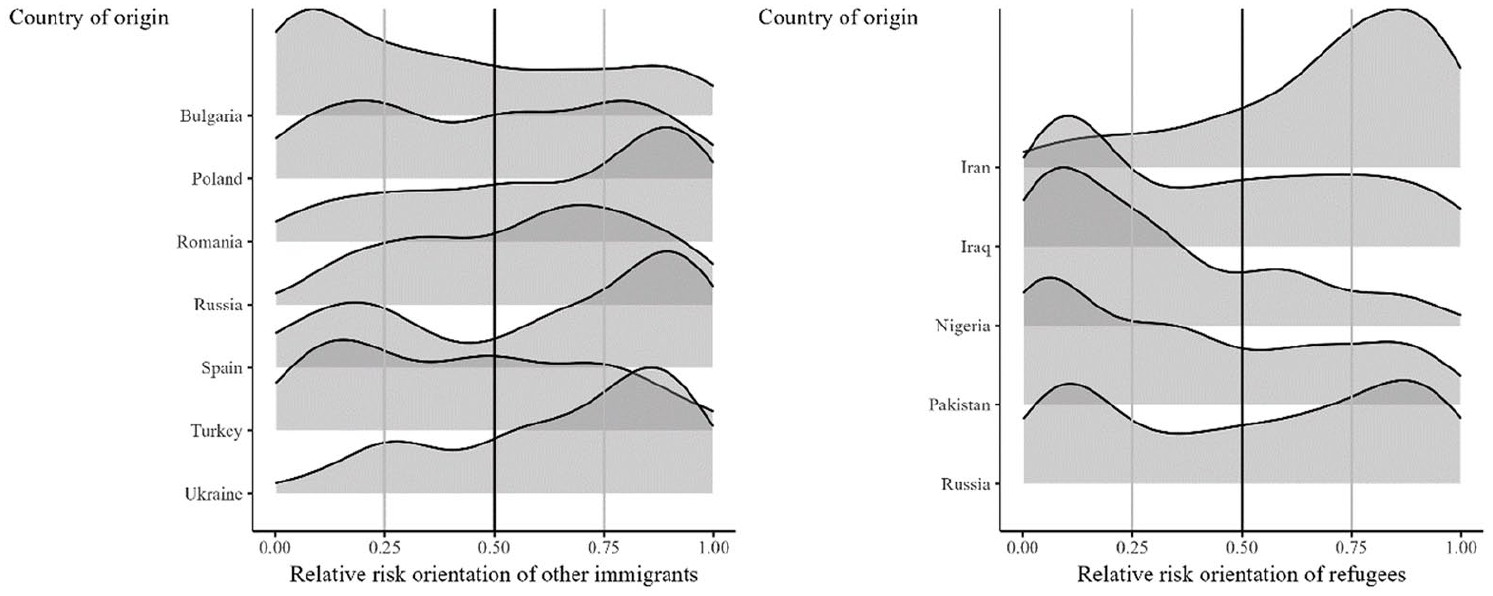
Density distribution of immigrants’ risk orientation relative to the population in their origin countries (selectivity index in risk orientation) for the sample of refugees and other immigrants, separated by country of origin.
The proportion of immigrants selected in risk aversion, as defined by selectivity values below 0.5, was 76 percent for refugees from Nigeria, 65 percent for refugees from Pakistan, and 56 percent for refugees from Iraq. This indicates, for example, that 24 percent of immigrants from Nigeria were more risk-taking and 76 percent more risk-averse than the reference population in Nigeria. Among other immigrants, those on average selected in risk aversion originated from Bulgaria (65%) and Turkey (55%). Conversely, the proportion of migrant groups selected in risk-taking, with most immigrants having selectivity values above 0.5, ranged from 75 percent among other immigrants from Ukraine to 56 percent among immigrants from Poland, with other immigrants from Romania and Spain falling between these values. Among refugees, Iranians displayed with 80 percent a particularly high degree of selection for risk-taking.
It was challenging to compare migrant groups with different migration motives, given that the majority of other immigrants originated not from the same countries as refugees. However, Russian immigrants provided a basis for comparison. Contrary to the prevailing assumptions in migration research, that immigrants are more risk-taking than those who remain in their country of origin (Chiswick, 1999; Jaeger et al., 2010), the proportion of risk-averse selected Russian refugees with values below 0.5 was 50 percent, while the proportion of risk-averse other Russian immigrants was 43 percent. Russian refugees’ and other Russian immigrants’ selectivity did not greatly differ in proportion. Heterogeneous selectivity patterns indicated that there were no systematic differences in the degree of selectivity in risk orientation according to migration motive. Instead, selectivity substantially varied between and within origin groups. This prevented us from making reliable statements about selectivity in risk orientation according to migration motive. Therefore, Hypothesis H1, which proposed that other immigrants are selected in risk-taking, can be confirmed for immigrants from Ukraine, Spain, Russia, Romania, and Poland, but not for those from Turkey and Bulgaria. In addition, Hypothesis H2a, which proposed that contrary to other immigrants, refugees are selected in risk aversion, was confirmed for immigrants from Nigeria, Pakistan, and Iraq. Finally, the alternative Hypothesis H2b, which proposed that similar to other immigrants, refugees are selected in risk-taking, was confirmed for immigrants from Iran.
Relationship between selectivity in risk orientation and integration
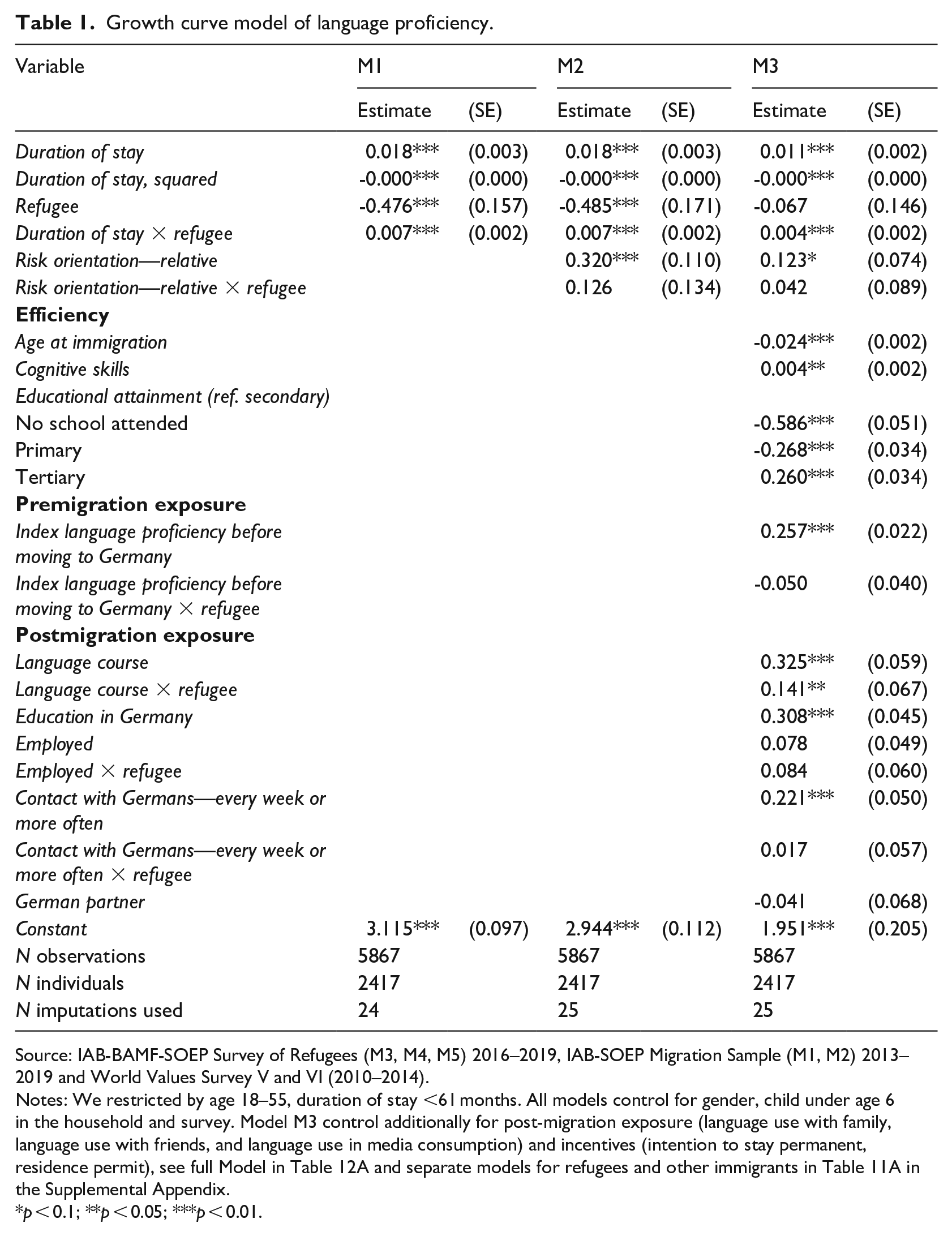
Next, we analyzed changes in self-reported language acquisition among immigrants over their duration of stay in Germany. This constitutes the examination of the second research objective. Table 1 presents the results of the growth curve models results for language proficiency; separate models for refugees and other immigrants are available in the Supplemental Appendix.
Growth curve model of language proficiency.
Source: IAB-BAMF-SOEP Survey of Refugees (M3, M4, M5) 2016–2019, IAB-SOEP Migration Sample (M1, M2) 2013–2019 and World Values Survey V and VI (2010–2014).
Notes: We restricted by age 18–55, duration of stay <61 months. All models control for gender, child under age 6 in the household and survey. Model M3 control additionally for post-migration exposure (language use with family, language use with friends, and language use in media consumption) and incentives (intention to stay permanent, residence permit), see full Model in Table 12A and separate models for refugees and other immigrants in Table 11A in the Supplemental Appendix.
p < 0.1; **p < 0.05; ***p < 0.01.
Prior to addressing Hypothesis H3, Model M1 demonstrates that immigrants’ proficiency in German improved with duration of stay. However, the interaction between duration of stay and refugee status indicated that refugees improved at a more rapid rate compared to other immigratns. This narrowed the initial gap in language proficiency between refugees and other immigrants, whereby refugees had a lower level of language skills at their first observation (see Table 3A in the Supplemental Appendix). As language learning progresses most rapidly during the early years after arrival and the pace of acquiring new skills declines over time (Kosyakova and Laible, 2022; Kristen and Seuring, 2021; van Tubergen and Kalmijn, 2009), it can be concluded that refugees had greater potential to enhance their language skills over their duration of stay in Germany than other immigrants.
Model M2 presents the testing of Hypothesis H3, which was used to assess the effect of selectivity in risk orientation on cultural integration. This hypothesis was supported by the finding that individuals selected in risk-taking demonstrated greater improvements in language proficiency over their duration of stay in the receiving country. The study did not reveal any significant differences between refugees and other immigrants, which indicated that the personality trait risk orientation had a similar influence on language learning across both migrant groups.
Model M3 included efficiency, incentives, and premigration exposure variables, which largely accounted for substantial differences in language proficiency between refugees and other immigrants, as evidenced by the refugee coefficient, which declined and became non-significant in comparison with Model M2. Moreover, these additional variables partially explained why risk-tolerant selected individuals became proficient more rapidly than other immigrants. Regarding efficiency, younger age at arrival and higher cognitive skills, as measured through educational attainment in the country of origin and cognitive skill tests, were found to enhance language acquisition. Descriptive statistics showed that refugees score slightly lower on cognitive skills and were less likely to have tertiary education than other immigrants (see Table 3A in the Supplemental Appendix). In terms of incentives, immigrants without permanent residence status in the receiving country exhibited lower growth in language skill compared to immigrants with permanent residence status. This was a disadvantage for refugees, as nearly all other immigrants held residence permits. Premigration language proficiency, which was higher among other immigrants than among refugees, positively influenced post-migration language learning. In terms of post-migration exposure to German, both structured learning situations, such as attending language courses or educational institutions, and unstructured learning situations, such as regular contact with members of the receiving society and in the workplace, were positively related to language proficiency growth. Participation in language courses was found to have a particularly strong effect on the growth of language skills among refugees compared to other immigrants. No differences were observed for the other mediating factors. Notably, language courses have been mandatory for refugees in Germany since 2005, which explains their higher participation rate.
To examine in detail whether risk-tolerant selected immigrants acquired language skills more rapidly due to increased post-migration exposure to the language of the receiving country compared to than risk-averse selected immigrants (Hypothesis H4), we conducted additional mediation analyses separately by migration motive, language knowledge, and exposure situations. Figure 2 illustrates the key regression coefficients and their respective confidence intervals, highlighting the most relevant findings. The mediation analyses were used to assess the extent to which the relationship between risk orientation selectivity and language acquisition was explained by immigrants’ engagement in activities that fostered exposure to the language of the receiving country, such as language courses, social interactions with members of the receiving society, and labor market participation (referred to as mediators).
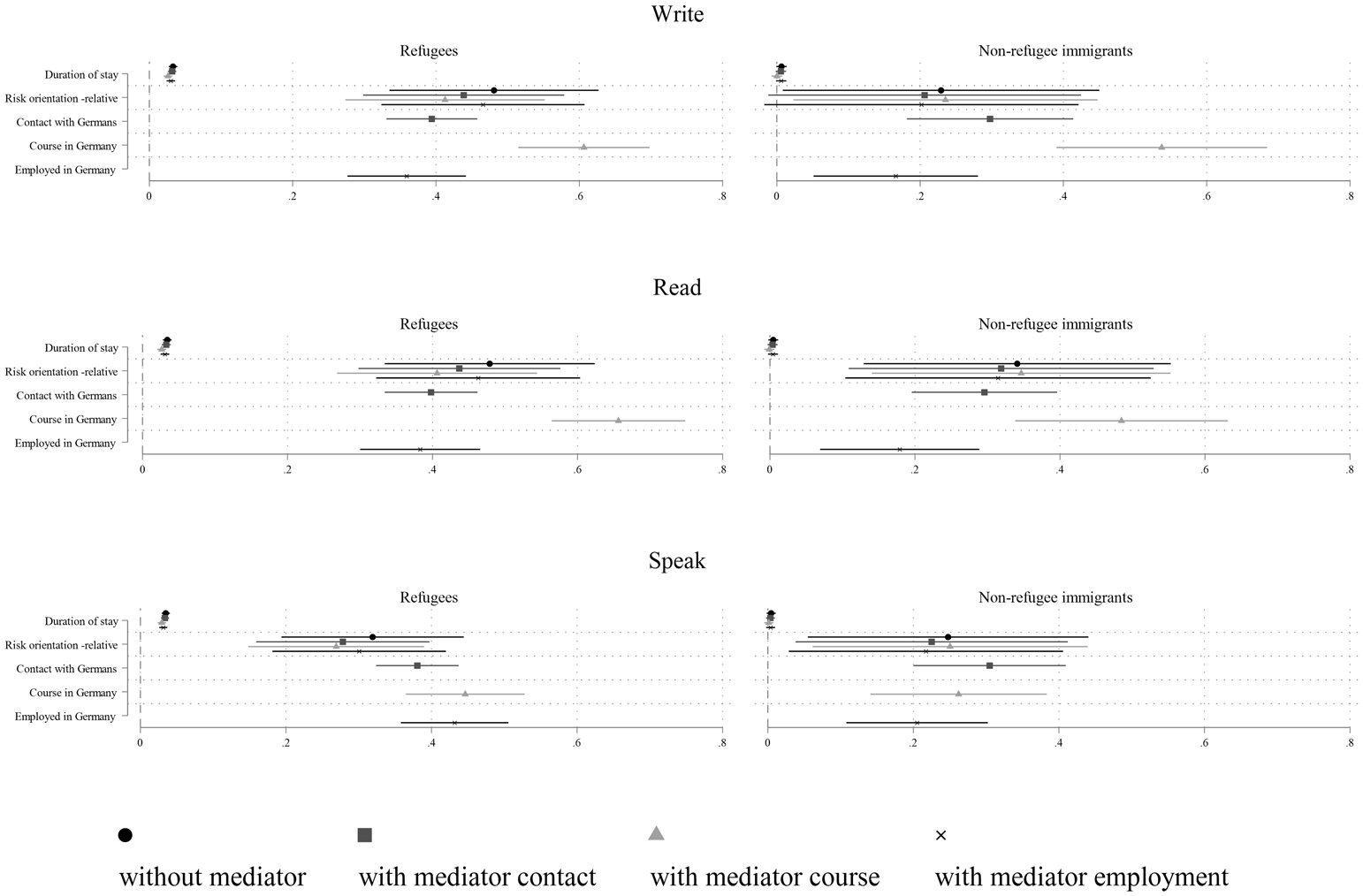
Coefficient plot of growth curve estimated models with mediated effects on German language proficiency for the sample of refugees and other immigrants.
Compared to the models reported in Table 1, this differentiated analysis was also used to investigate whether the mediating effect of exposure to the language of the receiving country varied across distinct language skills in reading, writing, and speaking (see Models 5.1A to 6.4A in the Supplemental Appendix). When the total effect of risk orientation selectivity on language skill growth was reduced after accounting for exposure, as illustrated by the distance between the direct effect (without mediator) and the indirect effect (with mediator) in Figure 2, this suggested that exposure served as a mediating mechanism through which risk orientation selectivity influenced language acquisition.
The mediation analyses demonstrated that the pathways of exposure to the language of the receiving country varied by migration group. Refugees selected for risk-taking were found to acquire German language skills in writing, reading, and speaking more rapidly than refugees selected for risk aversion. This was primarily due to their greater participation in language courses, compared with other mediators: contact and employment. With regard to speaking skills, the mediators contact and course had a similarly strong mediating effects. By contrast, other immigrants selected for risk-taking tended to improve their language skills primarily through exposure at work and contact with the German-speaking receiving society. However, the mediating effect among other immigrants was slightly weaker than among refugees. However, most refugees in the sample were unemployed, which limited their opportunities for workplace-based language learning. Among other immigrants, language courses played a less important role in explaining the relationship between risk-taking and language proficiency.
Overall, relative risk orientation was found to influence language acquisition through increased exposure to German, which provided support for Hypothesis H4. For other immigrants, everyday interactions and workplace communication, including speaking with customers or colleagues, and engaging in writing and reading activities in German, served as key mediators. For refugees, language courses played a more prominent role.
Conclusion
Migration and integration inherently involve risk-taking. This article examines the risk orientation of newly arrived refugees and other immigrants in Germany relative to the populations of their country of origin. Our findings challenged the classical notion that immigrants are more risk-taking than those who remain in their country of origin. A comparison of Russian refugees and other immigrants revealed no systematic differences in risk orientation between migrant groups with different migration motives. However, Hypothesis H1, which proposed that other immigrants are selected in risk-taking, holds for immigrants from Poland, Romania, Spain, and Ukraine, but not for those from Bulgaria and Turkey. The Hypothesis H2a, which suggests that contrary to other immigrants, refugees are selected in risk aversion, is supported for refugees from Iraq, Pakistan, and Nigeria. By contrast, the alternative Hypothesis H2b that similar to other immigrants, refugees are selected in risk-taking was only supported for refugees from Iran. Consistent with Polavieja et al.’s (2018) results, we found that the degree of selectivity varied by country of origin rather than migration motive.
Migration-related decisions and, in turn, selectivity profiles are shaped not only by general migration conditions that are specific to refugees and other immigrants but also by individual characteristics such as monetary resources and social networks in the destination country. For example, a large proportion of Russian, Turkish, and Polish immigrants already reside in Germany, which could reduce the perceived migration risks for subsequent arrivals, and influence selectivity patterns. In addition, among refugees, risk orientation may shift in response to threats, which potentially leads to an underestimation of selectivity. Nevertheless, our examination of relative measures of risk orientation showed that selectivity in personality is complex and non-universal.
Regarding integration, our findings suggest that risk-tolerant selected refugees and other immigrants have an advantage in acquiring the destination country’s language, which supports Hypothesis H3, because of their more frequent exposure to the destination country’s language, which supports Hypothesis H4. The first finding aligns with Kosyakova and Laible’s (2022) research on absolute risk orientation among refugees. Exposure to German varies according to the type of structured or unstructured situations and opportunities that immigrants regularly access. Among other immigrants, those selected for risk-taking benefit from employment, particularly in terms of their speaking skills. In contrast, refugees, who had comparatively lower employment rates and were more likely to participate in language courses, primarily improved their writing and reading skills through language course participation. Thus, personality plays a role in immigrants’ integration into the receiving society. Although personality traits did not systematically differ by migration motive, significant variations existed across respondents’ countries of origin, which potentially affected integration barriers for certain groups.
This study has certain limitations related to the datasets used. Self-reported assessments of language proficiency may be biased, as discussed by Edele et al. (2015). In addition, comparing data from different sources presents a challenge. Further research is needed to obtain more robust findings on the role of personality traits in biased self-assessments in general and in relation to language skills in particular. This highlights the importance of maintaining certain standards in survey data collection, both quantity and quality. Measuring identical constructs by using different scales is a tedious barrier to researchers conducting comparisons.
Data availability constraints also affected conclusions about immigrant selectivity. Directly testing differences in selectivity between migrant groups would require a comparison of refugees and other immigrants from the same country of origin. However, given the available data and sufficient sample sizes, this comparison was only feasible for Russian immigrants. Future research could address this limitation by comparing the characteristics of Ukrainian immigrants prior to the Russian invasion with those of Ukrainian refugees after this event. While this study shows that other Ukrainian immigrants were highly selected for risk-taking, an examination of Ukrainian refugees may reveal a lower degree.
While personality traits do not prevent immigrants from participating in language courses, risk-averse selected individuals may need additional support to establish informal contact with German speakers. Expanding volunteer initiatives could be an example of best practices in this regard. The wave of volunteer support for Ukrainian refugees in 2022 demonstrated the potential for structured frameworks that facilitate low-threshold interactions between refugees and volunteers, which could benefit the integration of newcomers in Germany. However, volunteer support alone is insufficient for successful social integration and, more specifically, the acquisition of the receiving country’s language. It is the responsibility of policymakers to ensure that all immigrants are able to participate in language learning opportunities, as research has highlighted the beneficial role of structured exposure to the language of the destination country (e.g. Kosyakova et al., 2022). In practice, this is most often achieved through participation in language courses. However, this requires maintaining an adequate supply of language courses and expanding them when necessary.
Supplemental Material
sj-docx-1-cos-10.1177_00207152251368245 – Supplemental material for Migrant selectivity in risk orientation and language proficiency: A comparative study of recent refugees and other immigrants in Germany
Supplemental material, sj-docx-1-cos-10.1177_00207152251368245 for Migrant selectivity in risk orientation and language proficiency: A comparative study of recent refugees and other immigrants in Germany by Ann-Marie Ullein and Jörg Welker in International Journal of Comparative Sociology
Footnotes
Author contributions
A-M.U. was the major contributor in writing the manuscript and analyzed and interpreted the data. J.W. contributed to in developing and writing the section about risk orientation and integration. All authors read and approved the final manuscript.
Funding
The authors disclosed receipt of the following financial support for the research, authorship, and/or publication of this article: This work was supported by the Deutsche Forschungsgemeinschaft (DFG, German Research Foundation)—under Grant 417512162. The DFG was not involved in decisions regarding the research process or the publication.

Availability of data and materials
The datasets supporting the conclusions of this article are available by FDZ SOEP (DOI: 10.5684/soep.iab-bamf-soep-mig.2019 and 10.5684/soep.iab-soep-mig.2019) and World Value Survey (DOI: 10.4232/1.14804).
Supplemental material
Supplemental material for this article is available online.
References
Supplementary Material
Please find the following supplemental material available below.
For Open Access articles published under a Creative Commons License, all supplemental material carries the same license as the article it is associated with.
For non-Open Access articles published, all supplemental material carries a non-exclusive license, and permission requests for re-use of supplemental material or any part of supplemental material shall be sent directly to the copyright owner as specified in the copyright notice associated with the article.
