



Abstract
For young refugees of school age, the acquisition of language skills in the main language of the host country is linked to their educational integration. Opportunities to learn the destination language are structured by legislative and regulatory frameworks established in the host country, especially in the domains of education and asylum policy. In our study we investigate the German case and test if (1) shorter waiting times of school enrolment, (2) integration into regular classes instead of separate refugee classes, and (3) a secure residence status are positively correlated with second language skills of young refugees. Empirically, we use data of the first survey wave of the ReGES study (Refugees in the German Educational System) which surveys adolescent refugees aged 14–16. We apply cross-sectional analyses for four federal states (Bavaria, North Rhine-Westphalia, Rhineland-Palatinate, Saxony). We restrict the sample to youths who currently attend regular classes. The analysis comprises N = 1097 students. Our findings reveal that prolonged waiting times for school enrollment and insecure residence status are significantly associated with fewer destination language skills. Furthermore, young refugees who attended preparatory classes earlier remain to have lower German language proficiency in regular classes compared to those who did never. Remaining significant differences between federal states indicate that more educational legislation than the ones regarded could contribute to additional differences in destination language skills.
Introduction
In the wake of the rapid increase in global refugee migration, Germany has become one of the most important destination countries for refugees worldwide (UNHCR, 2023). A quarter of the asylum seekers who arrived in Germany during the European refugee influx of 2015–2018, mainly from Syria, Afghanistan, and Iraq, were minors (German Federal Statistical Office, 2019). The majority of refugee families intends to stay permanently in Germany (Brücker et al., 2020). The PISA studies underlined that, not only in Germany but in most OECD countries, educational success depends on whether immigrant youths can speak, read, and write the language of the destination country (Agirdag and Vanlaar, 2018). For young refugees in particular, the importance of destination-language skills for their educational and vocational integration has been emphasized (Cerna, 2019). Refugees typically develop proficiency in the language of the host country after migration (Kristen and Seuring, 2021) and their opportunities to learn the destination language depend on legislative and regulatory frameworks of linguistic integration in the destination country's institutional context (Chiswick and Miller, 2001; Foged et al., 2022).
In most countries, young refugees primarily acquire second language skills in the destination country's schools. Between countries, however, language support for immigrant youths is approached differently (Christensen and Stanat, 2007) and teaching the majority language as a second language is not necessarily a regular subject in standardized curricula (Crul et al., 2019). As in many other European countries, education in Germany is organized between different administrative levels (national, federal states, local, organizations), but unlike many other countries, education in Germany is not legislated at the national level, but at the federal state level. Federal states vary in how they determine the timing of school enrollment and the type of initial schooling for newly arrived school-age immigrants with insufficient German language skills (Will et al., 2022), but they allow schools to decide on whether to establish preparatory classes (Korntheuer and Damm, 2020), which leads to differences between federal states as well as between organizations (e.g. schools). National policies, such as asylum legislation, can also impact destination-language skills because granting or declining a secure residence status to individuals may affect their motivation to learn a second language. With regard to the time of school enrollment, type of schooling, and legal status, whether these institutional conditions are related to the acquisition of German language skills among young refugees has not yet been investigated. Previous studies suggest that type of schooling and legal status affect the educational success of young refugees (Höckel and Schilling, 2022; Homuth et al., 2020). Given its complex policy configurations across different administrative levels affecting second language proficiency, Germany is not only an interesting case for countries with a similar territorial division of responsibilities but also for those countries that administer education and asylum at the same policy level (e.g. mainly at the national level).
Research on the relationship between second language proficiency of young refugees and policy instruments in migration and education legislation is still scarce. It contributes to the understanding of how policies can affect early integration outcomes, particularly second language acquisition. Although we focus solely on the German context, the policy implications also apply to other OECD countries and their policies designed to promote educational integration. On the one hand, institutions can enable educational integration by providing second language learning opportunities through specific legislation. On the other, certain legislation could also limit second language learning opportunities which are particularly difficult for refugee families to compensate for: temporary residency restrictions can prevent them from moving between (territorial) institutional contexts (Baba et al., 2024), refugee families have little influence on waiting times in the asylum process (Will et al., 2022), and schooling-related legislation for newly arrived immigrants restricts parental decisions about placement into types of schools and types of classes (Massumi, 2019).
The aim of this study is to investigate the role of institutional conditions for German language skills of young refugees. We focus on three conditions: (1) waiting time until school enrollment, (2) placement in preparatory/refugee classes, and (3) residence status. We examine whether shorter waiting times for school enrollment, integration into regular classes instead of separate refugee classes, and a secure residence status are positively correlated with German language skills of young refugees. Therefore, our research question is: Are different institutional conditions (waiting times for school enrollment, type of class, legal status) related to the individual acquisition of German language skills by young refugees?
For our analyses, we use the first survey wave of Refugees in the German Educational System (ReGES) on adolescent refugees who are aged 14–16 (Refugee Cohort 2). ReGES provides survey data for five German federal states. Our sample of analyses (N = 1097) comprises the four area states (Flächenländer) in ReGES: Bavaria, North Rhine-Westphalia, Rhineland-Palatinate, and Saxony (excluding Hamburg). We combine the survey data with administrative data on the local level by the German Federal Statistical Office. Methodologically, the ReGES data offer the great advantage of including test results on skills in the target language (German). First, we develop our theoretical assumptions regarding institutional frameworks in education and asylum across different administrative levels and their relationship with second language acquisition. Secondly, in the empirical part of this paper, we describe our analytical approach, analyses, and results. Lastly, we discuss the results of our study.
Theoretical framework
In the model of language attainment, skills in the majority language of the host country are viewed as human capital and immigrants can invest in these skills (Chiswick and Miller, 2001). Destination-language proficiency is assumed to be a function of efficiency, incentives, and exposure (van Tubergen and Kalmijn, 2005). 1 Efficiency refers to the degree to which immigrants are able to improve their language skills and depends on cognitive capacities for processing the learning input (Chiswick and Miller, 2001; Seuring and Will, 2022). Incentives to learn a new language arise when acquisition increases expected future gains in the host country (such as wages). Opportunity structures in the destination country create exposure to the destination language and allow learners to hear, study, and use the second language through interactions (van Tubergen and Kalmijn, 2005). Generally, such opportunity structures are bound into contexts (Blau, 1994; Elder et al., 2003; Giddens, 1984) and can be linked to territories. Territorial contexts are administrative units that feature institutions that guarantee certain rights and restrict agency within a delimited space on the basis of authority (Herrschaft) and objectified legal orders (Lepsius, 2017; Schelsky, 2022). Individuals are bound into these contexts and inherent opportunity structures through for instance citizenship, residency, and formal membership. Institutions of various domains within a territorial context contribute to the creation of opportunity structures. For opportunities available to young refugees to learn a second language, some key domains are (formal) education and asylum institutions as well as the policies and instruments pertaining to these. Institutions are governed and organized on different administrative levels that can interconnect.
In Germany, education and asylum institutions are mainly located at both the national level and the federal state level. Depending on the domain, these administrative levels have varying degrees of power when it comes to producing opportunity structures. For instance, education falls under the dominance of the 16 German federal states while asylum procedures are the responsibility of the German national state—that is, the Federal Office for Migration and Refugees (BAMF). To some extent, institutions at these levels are interconnected and co-produce opportunities to acquire majority language skills (Oehlert and Kuhlmann, 2024). Interconnections arise, for example, in cases where the integration of refugees depends on asylum policies, like those that govern access to education. Upon their arrival in Germany, refugees must live in reception centers according to national asylum law (§ 47AsylG). In most federal states, compulsory schooling for refugee children and youths is suspended until the end of a waiting period or until they are assigned to a municipality (Autorengruppe Bildungsberichterstattung, 2024: 133)—in other words, once refugee families can move out of reception centers. Additionally, asylum procedures in Germany have affected waiting times for school enrollment (Franz, 2024): in 2015/2016, federal state requirements for admission to school could not always be met and school-age refugees had to wait longer for their school enrollment than legally guaranteed by the host federal state (Will et al., 2022). This was due to the high number of asylum applications in Germany (Vianelli et al., 2022). In 2017, asylum procedures took an average of 13.2 months (BAMF, 2018) to process.
Interconnections also arise when responsibilities for education are shared among different levels. For example, federal states determine whether young refugees are taught in a preparatory class separately from other students (“separate schooling”). However, they also set thresholds above which schools can decide to introduce preparatory classes, depending on the number of refugee students enrolled. Within the institutional framework of federal states, organizations (schools) are assigned responsibilities and tasks related to education which they can to some extent shape independently. This institutional framework contributes to variations at the organizational level concerning schooling for refugees. In the context of education and asylum, the local level—districts and municipalities—is less involved in these domains. Although refugee integration is partly a local responsibility (Dekker et al., 2015), districts have limited authority over education and asylum legislation (Khalil et al., 2022; Tjaden and Spörlein, 2023).
While institutions often create opportunity structures, they can also formally restrict choice and agency by putting restrictions or rules in place. To pursue opportunities and meet requirements, individuals need to make use of their individual resources. In some cases, however, agency is entirely restricted under threat of legal sanctions—especially in the field of education (e.g. enforcing compulsory schooling) (Kohli, 1985). It is therefore often impossible for refugee families to choose in certain situations (for instance, between schooling in regular classes as against preparatory classes for their children) (Will and Homuth, 2020). Although refugees’ human and social capital have been shown to influence, for example, decisions regarding asylum applications and the length of asylum procedures (Kosyakova and Brücker, 2020), the restricting power of institutions at different administrative levels is usually more dominant.
In the next step, we build assumptions about how destination-language proficiency of young refugees can depend on these particular policies.
Waiting time until school enrollment
After their arrival in Germany, asylum seekers receive a residence permit for the duration of the asylum procedure and are assigned to a federal state (or rather to its designated reception center), according to a nationwide distribution key (§ 45 AsylG). Asylum seekers must remain in a reception center until a decision is made on their asylum application but for no longer than 18 months (§ 47 AsylG). Afterwards they are assigned to a municipality, which is also based on a distribution key covering each federal state (Schmid, 2024). Regarding the start of schooling for newly arrived immigrants (including asylum seekers), laws and regulations vary across the 16 German federal states. However, the legal requirements governing the duration until school enrollment can be grouped into three types: schooling either starts immediately, after refugees have been assigned to a municipality, or after a fixed time period (such as three months). In an overview of the various regulations covering the duration until school enrollment between German federal states, Will et al. (2022) found that the average waiting time was seven months; federal states with fixed periods had on average longer waiting times than required by law. In many federal states, schooling does not usually begin immediately because a change of school, which would be necessary after assignment to a municipality, should ideally be avoided (DIMR, 2017). Longer waiting times can prevent early learning of the German language from the time of arrival. Early language instruction for immigrants has been found to have a positive, long-term impact on second language skills (Hoehne and Michalowski, 2016). We therefore assume that longer waiting times are negatively associated with German language proficiency of young refugees.
Type of class
Federal states also organize school integration by means of models that range from immersion (direct integration into regular classes), partial integration, and parallel/separate schooling (Massumi et al., 2023). The latter are also referred to as preparatory classes, “welcome classes,” “refugee classes,” or “newcomer classes.” According to figures from the IAB-BAMF-SOEP Survey of Refugees, one in three refugee students was taught exclusively in a (separate) preparatory class, while around one in five said that they had initially attended a mixed class (Pagel and Edele, 2022). The implementation of preparatory classes differs among the federal states and conditions at the local level can also influence whether preparatory classes are introduced (Emmerich et al., 2020). Young refugees are more likely to attend a preparatory class if the concentration of refugees in the district is high, suggesting that such classes are put in place more often in locations where the number of refugees is high (Will and Becker, 2025). Separate schooling is mainly targeted at recently arrived students whose German language skills are not sufficient to follow the curriculum in regular classes (Plöger and Barakos, 2021). In some federal states, the duration can be up to two years (Massumi et al., 2023). Preparatory classes are viewed as a safe space where quick language acquisition is enabled (Pagel and Edele, 2022). However, they are highly controversial (Reich, 2017) and their effect on German language acquisition has not yet been satisfactorily clarified. Initial evidence indicates that separate preparatory classes worsen the educational achievements of young refugees while schooling in regular classes fosters their achievements (Höckel and Schilling, 2022). Different models of school integration may therefore relate to unequal chances of formal German language acquisition in school.
Generally, newly arrived immigrants with poor German language skills are more likely to attend preparatory classes and their proficiency level would be expected to increase over time. However, refugee students who previously attended preparatory classes and are now learning in regular classes could nevertheless have lower German language skills than their refugee peers who have never attended a preparatory class. The latter received German lessons in regular classes and were able to cumulatively improve their already more proficient German language skills. In this case, preparatory classes were not successful in compensating for the initially unequal levels of German language skills among refugee students. This could also be because additional German learning opportunities with native peers do not arise from learning in separate classes. In contrast, equalization in German language skills would strongly emphasize the intensive support structure in the preparatory classes to promote German language skills. Overall, we expect either a compensatory effect of attending preparatory classes or persistent differences in German language skills.
Legal status
At the end of the asylum procedure, refugees receive either a positive or a negative asylum decision that can impact their acquisition of the German language. While 1.3 million refugees in Germany received a permission to reside between 2013 and 2022 (BAMF, 2023), 224,768 are tolerated persons (Deutscher Bundestag, 2023: 26) who are required to leave the country but cannot be deported for legal or factual reasons (§ 60a AufenthG). A tolerated status (Duldung) is considered insecure because a toleration merely suspends deportation temporarily without granting residence rights. In general, opportunities to participate in school are not legally dependent on residence status because schooling is compulsory for school-age refugees (including tolerated children and youths) in all federal states—compulsory schooling is, however, often suspended during the asylum process. Nevertheless, the legal status may contribute to individual or family decisions regarding whether or not to invest in second language skills. People with an insecure residence status may view future gains from investments in their human capital as unlikely due to the latent threat of deportation. They may therefore refrain from investing in their education. In contrast, being in education can also promote prospects for staying because German asylum authorities may grant a temporary permit to stay in cases where tolerated persons are in vocational training and education. Therefore, refugee families with tolerated status could also have mid- or long-term incentives to invest in second language skills for their children. Empirically, the objective legal status of refugees in Germany has been found to be positively associated with educational achievement; there is, however, a negative relationship between educational achievement and a residence status that is subjectively perceived as insecure by refugee respondents (Homuth et al., 2020). Overall, we assume a negative association between an insecure residence status and German language skills of young refugees.
Data and methods
Database
For our empirical analysis, we used the first wave from the “ReGES—Refugees in the German Educational System” survey (SUF 3.0.0) at the individual level (level 1) of the adolescents cohort (RC2) (Will et al., 2021). The survey started in 2017, and interviews were carried out in early 2018. The panel study currently consists of seven waves. ReGES provides data on children (RC1) and adolescents (RC2) who had migrated to Germany after 2014. To obtain the sample for the ReGES study, the respondents were selected from municipalities’ general population registers in 120 districts across five federal states: Bavaria, Hamburg, North Rhine-Westphalia, Rhineland-Palatinate, and Saxony (for further details, see Steinhauer et al., 2019). In ReGES, the federal states were selected because of the pronounced contrasts in educational legislation (Will et al., 2021).
In Germany, the federal states have different responsibilities for accommodating refugees from certain countries of origin. Countries of origin with the highest influx, such as Syria and Afghanistan, are covered by all federal states. Rarer countries of origin, on the other hand, are only assigned to a few or just one federal state (Schmid, 2024: 261). Therefore, some countries of origin are over-represented in the ReGES survey. Due to the sampling procedure, which over-represents nationals from the ten most common origin countries of refugees in Germany in 2015 and 2016 with high prospects of being granted asylum, refugee adolescents with a secure resident status are over-represented. The ReGES data are representative for the federal states surveyed.
Analytical sample
The ReGES cohort for adolescents (RC2) surveys young refugees aged 14 to 16 who immigrated to Germany after 1 January 2014, have resided in Germany for a minimum of three months, have either applied for asylum or intend to do so, are enrolled in a secondary school, and live in a household under the care of a responsible parent or guardian, meaning that unaccompanied minors were not surveyed (Will et al. 2018: 12). Our analysis includes only adolescents who have successfully completed the language test and who, at the time of the survey, were being taught in a regular class. Furthermore, respondents residing in Hamburg were excluded from the study: Hamburg is both a federal state and a municipality, such that effects are indistinguishable. We use data from the language test, which is the test covering receptive vocabulary in German, from the first wave in 2018, and apply cross-sectional data analyses. 2 The original sample of the first survey wave comprised N = 2415 respondents, and N = 1451 youths participated in the language test. After restricting the sample to respondents not residing in Hamburg and not being currently taught in preparatory classes, our analyses are based on N = 1097 valid observations at the individual level (level 1), distributed across a total of N = 82 districts (level 2).
Dependent variable
To assess German language proficiency and skills, we use each adolescent's receptive German-language vocabulary, measured through a vocabulary test. The vocabulary test, administered during the first wave, is based on the German version of the fourth edition of the Peabody Picture Vocabulary Test (PPVT-4) and assesses the receptive vocabulary of adolescents (Lenhard et al., 2015). It comprises a total of 228 items, each consisting of four pictures, accompanied by single word that corresponds to only one of them. By matching the word with its corresponding pictures, the respondent's German language proficiency can be evaluated. In the end, a score is generated based on the number of correct answers. The variable used is based on the sum score with weighted likelihood estimates (Warm, 1989) (Mean: 0, SD: 1). Of the N = 2415 survey participants, only youths who had sufficient proficiency in one of the four languages used in the panel survey to present the instructions were tested. The tests were administered to a total of 2016 respondents (Obry et al., 2021). For the scaling of the PPVT-4, however, only participants who completed the test in full (N = 1451)—that is, until the “dropout” criterion was reached—and who had passed at least one item set were taken into account (Lenhard et al., 2015). 3 These specifications might lead to a tendency for people who have at least a basic understanding of German to be included in the analytical sample. In the total sample (N = 2415), German proficiency is likely to be lower than among the youths tested. As a result, the associations to be analyzed may to a certain extent be overestimated. We conducted robustness checks using an alternative German language test that focuses on knowledge of German grammar (TROG-D; Fox-Boyer, 2016) and in which an additional 282 respondents participated (N = 1379). Although this test only measures German language skills in the area of grammar, the multivariate results were comparable to those of PPVT-4. Additionally, we examined self-assessed German language skills (“How well do you understand German?,” on a scale from “1: very good” to “5: not at all”) of N = 1728 respondents, where we also found comparable associations. Nevertheless, we continue to use PPVT-4 for our analyses, as the correlation between self-assessed German language skills and those measured in the tests is only moderate in ReGES and respondents have been shown to overestimate their ability to understand German (Schild, 2024). This indicates that self-assessed German language skills could reflect motivation to learn German rather than actual individual skill levels.
Independent variables
At level 1, the individual level, we analyze three independent variables. First, the waiting time until school enrollment in Germany is measured in months and calculated as the difference between the month and year of first enrollment and the month and year of arrival in Germany. Plausibility checks were conducted to ensure that the date of school enrollment must not be before the date of arrival (6% did not meet the criterion and were assigned “missing value”). No significant non-linear relationship between waiting time until enrollment and German language skills was found. The second variable is the type of class attended. We distinguish whether the students have ever attended a preparatory class or have always been learning in regular classes (0: no, 1: yes). Third, legal status is dummy-coded with “secured residence status” (0) assigned to those who are recognized as refugees, whose asylum application has been accepted, or who have received another type of protection status. An “insecure residence status” (1) includes those people whose asylum application was denied and have to leave Germany, whose application was denied and cannot leave Germany for legal or factual reasons (tolerated status), who have not yet received a decision on their asylum application (i.e. a residence permit), and those who have not yet submitted an application.
In addition, we include control variables at level 1. The selection is based on the study results of Will et al. (2022). We control for the respondents’ social origin by including the highest International Socio-Economic Index (ISEI) and the highest International Standard Classification of Education (ISCED) of their parents. For the highest ISEI, we use parental information on the highest occupational class in the country of origin according to the International Standard Classification of Occupations (ISCO-08). The occupations are transformed into the continuous ISEI scale (11.56–88.96). The ISCED index is based on the CAMCES (Computer-Assisted Measurement and Coding of Education in Surveys) instrument, with alternative coding (Schneider et al., 2018), by which qualifications acquired in different countries can be coded according to the ISCED scheme. The highest level of parental education is categorized into “no/less than primary education,” “primary education,” “secondary education I + II,” and “post-secondary/tertiary education.” Cases with no formal education are grouped with cases with less than primary education. We also control for academic performance in the country of origin, which is self-assessed by the students and measured on a continuous scale (0–100), gender (0: male, 1: female), age upon arrival (in months), 4 year of arrival (2014, 2015, 2016, 2017), country of origin (Syria, Afghanistan, Iraq, other countries), and the type of school attended (0: other schools, 1: upper secondary school, Gymnasium), and the four federal states in our sample (Bavaria, North Rhine-Westphalia, Rhineland-Palatinate, and Saxony). To control for possible confounding effects from spatial concentrations, for example from urbanity or rurality, we include squared and unsquared population density (inhabitants per km2) at the district level (level 2).
In our analytical sample (Table 1), the majority of respondents originates from Syria (76.9%), arrived in 2015 (56.2%), has on average waited 6.77 months for school enrollment, has a secure residence status (66%), and did not attend a preparatory class (61%). Approximately 79% of the 14–16-year-old refugees did not attend a secondary school in their country of origin.
Sample characteristics and description.
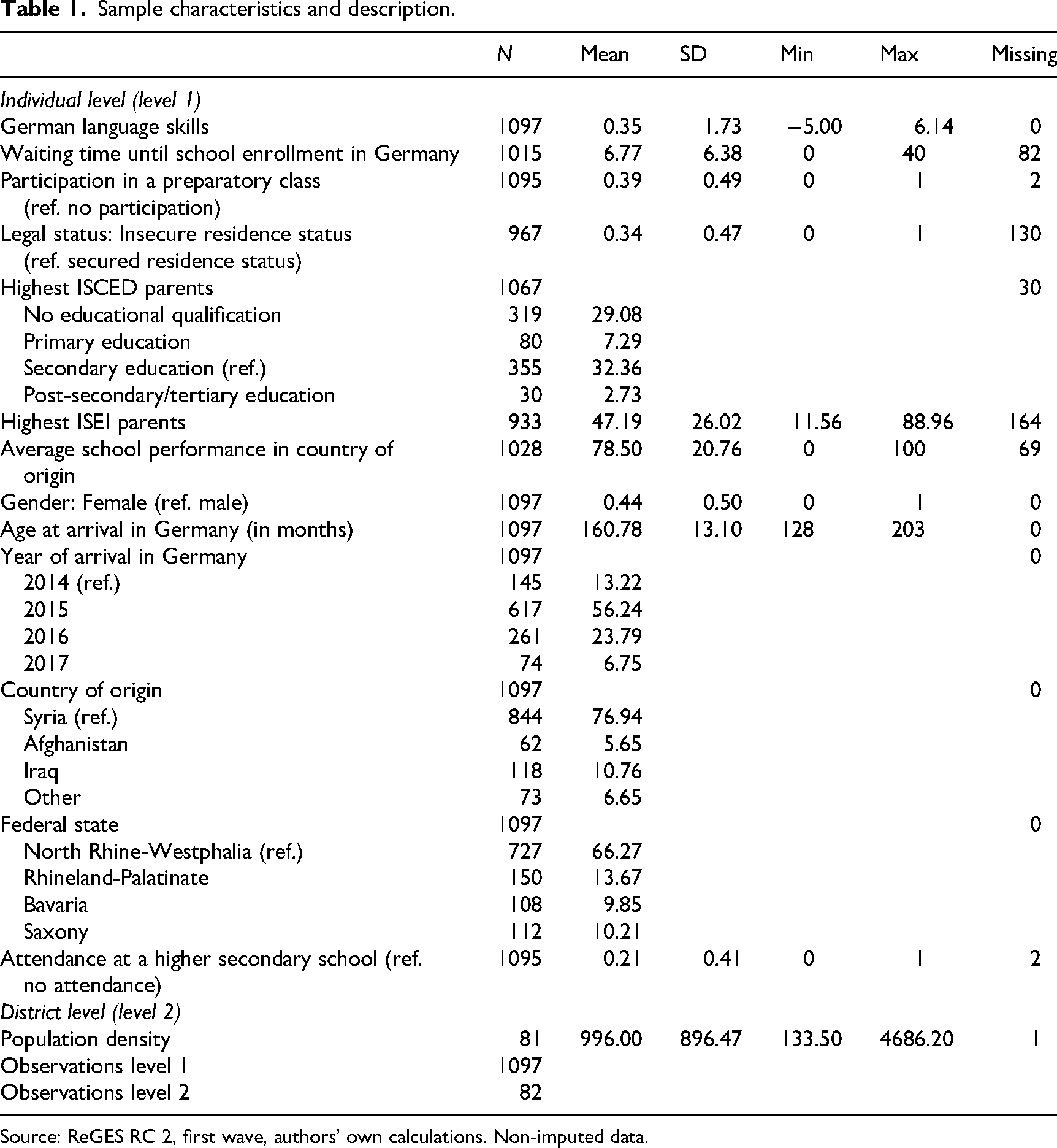
Source: ReGES RC 2, first wave, authors’ own calculations. Non-imputed data.
Analytical approach
For our empirical analysis, we examine the association between waiting time until school enrollment, residence status, and placement in preparatory classes with the German language skills of the young refugees. To account for the hierarchical structure of our data (districts), we estimate linear multilevel models (random intercept models). The estimation model captures unobserved differences between districts in the dependent variable (y) by including a random intercept. This helps reduce bias due to influences on the district level that affect y. We use iterated chained equations (White et al., 2011) to multiply impute missing data for all independent variables (m = 50). We imputed separately at level 1 and level 2. We use cluster-robust standard errors.
We estimate four models (Table 2). In a random-intercept-only model (model 0), we assess the intraclass correlation (ICC)—that is, the variation in German language skills on the district level. In Model 1, the four federal states are included. The aim is to examine whether the overall policy of a federal state is related to language skills of young refugees. Model 2 cumulatively tests the three predictors (waiting time until school enrollment, residence status, placement in preparatory classes), controlling for federal states. Model 3 includes the remaining control variables on levels 1 and 2.
Linear random intercept model (level 1: individuals, level 2: districts) of the receptive vocabulary of German language of young refugees.
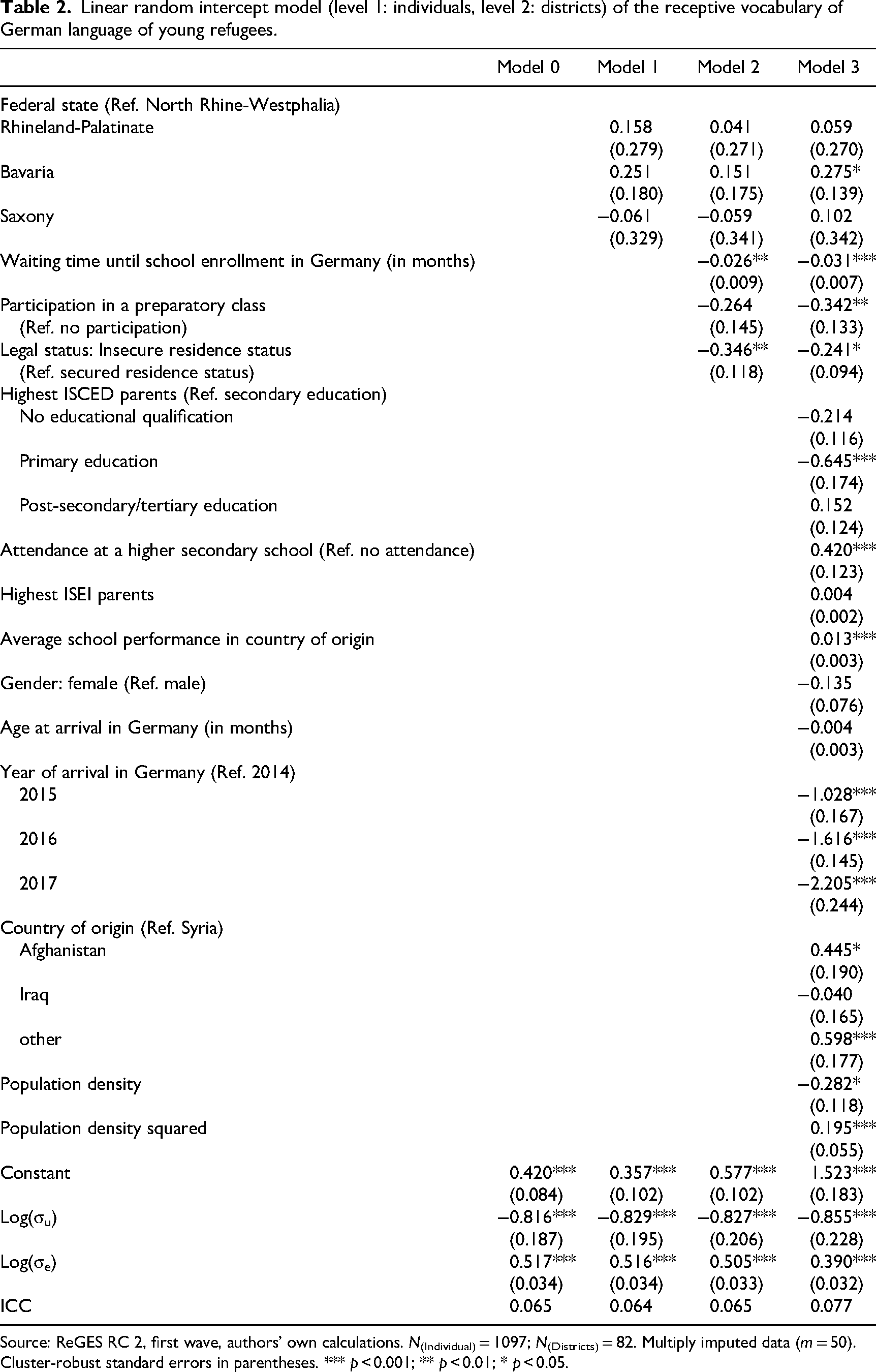
Source: ReGES RC 2, first wave, authors’ own calculations. N(Individual) = 1097; N(Districts) = 82. Multiply imputed data (m = 50). Cluster-robust standard errors in parentheses. *** p < 0.001; ** p < 0.01; * p < 0.05.
As a sensitivity analysis, we estimated the models only for respondents who originate from Syria (Table 3 in the Appendix). As some origin countries of refugees are exclusively allocated to certain federal states and municipalities, mainly those origin countries with few refugees (Gundacker et al., 2024), being affected by certain policies might not be random across origin countries. Those origin countries are included in the category “other” in the control variable “country of origin.” Syria is one of the largest origin groups of refugees in Germany and Syrians have always been distributed across all the German federal states. This group is therefore most likely to be affected by all analyzed institutional conditions and makes it possible to assess (possible) selection in place of residence in the data.
Results
Model 0 (Table 2) indicates that variation in German language proficiency across German districts is significant (σu) but small: we find that only 6.5% of the variability in the receptive vocabulary of German language occurs between districts. Regarding federal states, we find no significant differences in language skills between North Rhine-Westphalia (reference group) and the other federal states in model 1 (for further analyses, see Table 4 in the Appendix). We also tested all pairwise comparisons of federal states and Scheffé tests indicated no significant group mean differences in destination-language skills.
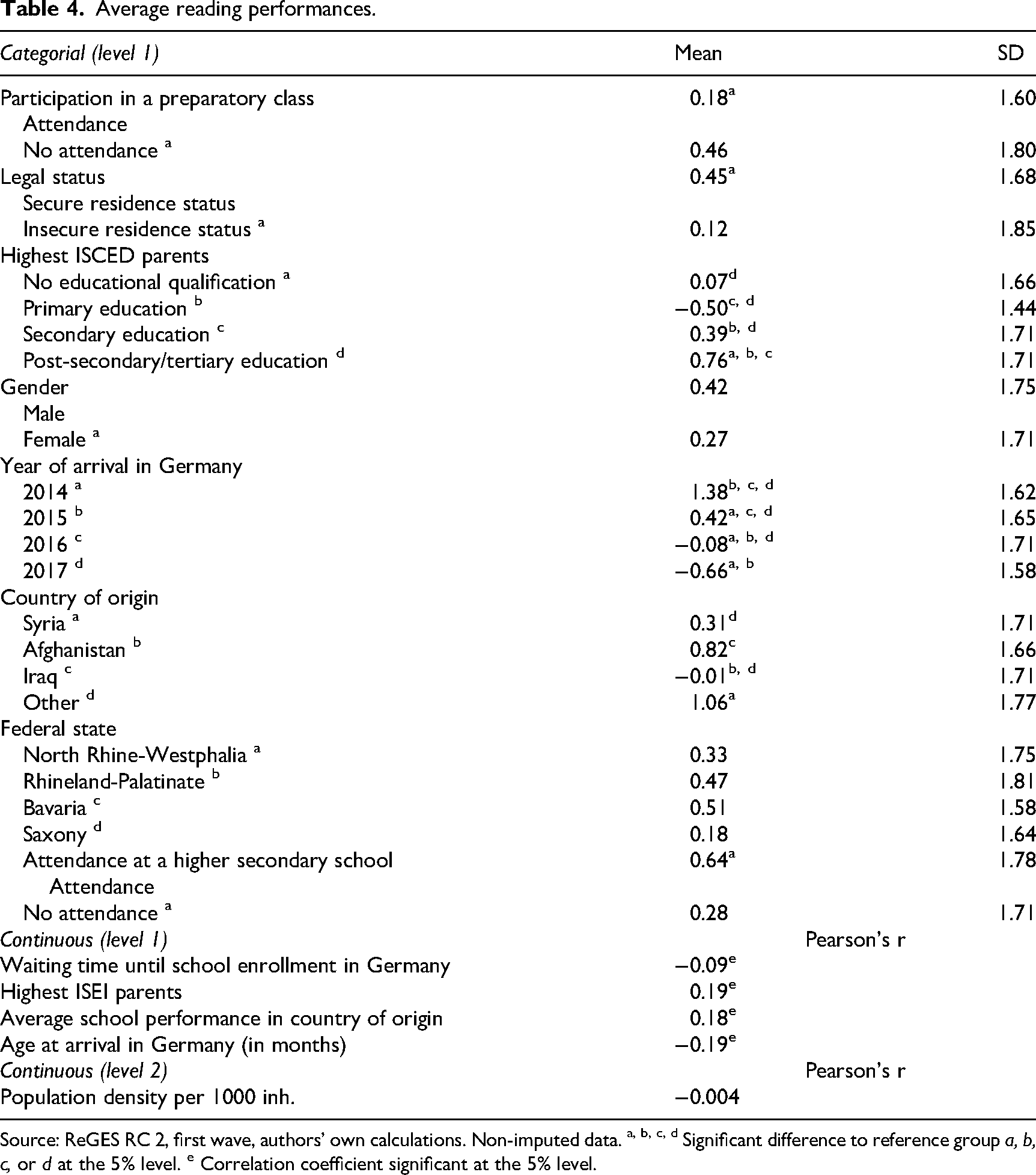
Descriptively (Table 4 in the Appendix), destination-language skills are significantly negatively associated with those with longer waiting times until school enrollment. Second language skills are also significantly lower for young refugees with an insecure residence status and who attended a preparatory class prior to regular schooling (note that all results refer to students who are taught in regular classes at the time of the survey). In model 2 of the multivariate analyses (Table 3), waiting time until school enrollment in Germany and an insecure legal status remain significant, even when controlling for federal states. Attending a preparatory class is not significant at p < 0.05.
When individual and family resources are included (model 3), the coefficient for attending a preparatory class is also statistically significant. This suggests that refugee students who were initially taught in a preparatory class still have significantly lower skills in regular classes at the time of the survey than their refugee peers who never attended a preparatory class, when controlling for third variables. Between model 2 and model 3, coefficients for waiting time until school enrollment in Germany, an insecure legal status, and attending a preparatory class change in size. However, the differences between coefficients across the models are only numerical and not statistically significant at p < 0.05. 5 Overall, including individual and family resources of young refugees (e.g. parental ISEI and ISCED, school performance in country of origin) in model 3 does not substantially change the association between German language skills and waiting times for school enrollment, residence status, and placement in preparatory classes. 6 Regarding federal states, the destination-language skills of young refugees residing in Bavaria are significantly higher compared to North Rhine-Westphalia when we control for differences in social origin, school performance in country of origin, type of school attended in Germany, year of arrival, country of origin, and population density in a respondent's district.
In the sensitivity analysis, estimations were conducted for Syrian refugees to assess potential selectivity in the sample. The main model (model 2) in Table 3 demonstrates that all coefficients (waiting times for school enrollment, type of class, legal status) have the same direction of association as observed in the main analysis (model 3 of Table 2). The robust results show that differences in second language proficiency are unlikely to be driven by spatial selectivity across origin groups in the sample.
Conclusion
In this study, we examined the role of institutional conditions for destination-language skills of young refugees in Germany. Skills in the majority language of the host country are crucial for their educational integration and their dependence on institutional frameworks has only been sparsely studied. Institutional conditions that can affect acquisition of second language skills of young refugees are mainly part of (formal) education and asylum policy. We focused on three conditions: waiting time until school enrollment, type of class (placement in preparatory class vs regular class), and residence status. We expected that longer waiting times for school enrollment and an insecure residence status correspond with lower destination-language skills in regular classes; prior attendance in preparatory classes was assumed to be associated with either fewer or persistent differences in destination-language skills in regular classes. For our empirical investigations, we analyzed the receptive vocabulary to assess young refugees’ German language skills and applied multilevel analyses using cross-sectional data from the first wave (2018) of the ReGES survey on 14–16-year-old refugees, nested in districts, across four German federal states.
Our analyses indicated that longer waiting times for school enrollment coincide with lower destination-language skills. On the one hand, the timing of the school enrollment of asylum seekers is regulated by the federal states, leading to regional variations. On the other hand, certain refugee cohorts experienced particularly long waiting periods due to asylum procedure backlogs in 2015/2016 and therefore faced even longer waiting times before their schooling could begin. After controlling for the year of arrival and federal states, we found that the relationship between longer waiting times and destination-language skills remained statistically significant. This highlights the fact that distinct legislation on school access co-contributes to linguistic integration.
Empirically, an insecure residence status was also associated with lower proficiency in the destination language. This indicates that an insecure legal status, such as tolerated status, may correspond with a lesser motivation to attain destination-language skills due to the possibility of being deported. Unfortunately, ReGES did not survey second language learning motivation of refugee students, which would have allowed us to test this expectation.
Furthermore, prior attending a preparatory class is associated with a lower receptive German vocabulary in students attending regular classes compared to young refugees who had never attended a preparatory class. Our results therefore do not support assumptions of equalization of destination-language skills in regular classes between these two groups. However, our empirical design limits conclusions on the evidence of preparatory classes. To accurately assess the impact of preparatory classes on German language acquisition, either longitudinal analyses (Höckel and Schilling, 2022) or estimations based on a quasi-random distribution of asylum seekers across districts (Damm, 2014) are necessary. Due to a high non-response rate in the seventh survey wave of ReGES, which included a follow-up language test, we were unable to investigate this further. Our study design does not allow us to definitively conclude that preparatory classes as an institutional instrument of educational policy are suitable or unsuitable when it comes to educational integration.
After controlling for individual and family resources, the coefficients of the three institutional conditions were statistically significant, which emphasizes the influence of the institutional conditions analyzed here in constraining the agency of refugee families. Refugees in Germany are generally subject to strict regulations and conditions regarding their place of residence, which they often cannot change, especially during the asylum procedure and, in some cases, even after being accorded protected status. The territorial context to which refugee families are assigned limits opportunities for their children's schooling. As a result, refugee families face greater restrictions in their education-related decision-making compared to non-refugee families.
Descriptively, significant differences in second language skills between federal states were not found. In the multivariate analyses, however, we found that young refugees had significantly more destination-language skills in Bavaria than in North Rhine-Westphalia when we controlled for institutional conditions (waiting times, insecure residence status, placement in preparatory classes) as well as for third variables on the individual and district level. This indicates that the different education systems of the federal states and their specific education-related legislation could contribute to additional differences in destination-language skills beyond the three institutional conditions considered here. To further analyze this, additional federal states need to be examined. Although federal states set legal frameworks on implementing separate schooling of young refugees with insufficient German language skills, schools themselves ultimately decide whether to establish preparatory classes. This serves as another possible reason why most of the analyzed federal states did not significantly differ in terms of young refugees’ destination-language skills: the organizational level is responsible for organizing and teaching the second language, which might lead to variations in students’ destination-language skills at this level. Moreover, schools may also provide additional German language tuition. The data from the ReGES survey only provide information at the school level for a small number of respondents, and therefore the role of organizations could not be comprehensively analyzed. Districts, representing another administrative level, appear to play a minor role in second language acquisition because variation in language skills between districts was found to be minimal. This finding is consistent with studies using other survey data on refugees’ second language acquisition (Kanas and Kosyakova, 2023). Overall, this supports the conclusion that schools co-determine the schooling of young refugees within the legal regulations of the federal state to whose territory the schools belong. However, further empirical evidence is needed to confirm this.
The results are limited to the extent that they do not provide causal evidence. Additionally, the ReGES study could not include young refugees who did not speak any of the available languages into which the questionnaire was translated or who lacked the requisite knowledge of German required to participate in the language test. Nevertheless, using the PPVT-4 is preferable to self-assessed German language skills, as respondents in the ReGES study tend to overestimate their proficiency in German.
We arrive at two main conclusions that are not only relevant for Germany, but are also pertinent from an international perspective. Firstly, Germany's institutional framework affects the acquisition of destination-language skills of young refugees as a result both of national and of federal state legislation. In our study, this was shown in three ways: (A) National policies on asylum appear to (indirectly) influence individual acquisition of second language skills depending on the legal status. This is exemplified by the different protection status among origin groups: while 88% of Syrian refugees received a secure residence status (mostly subsidiary protection), 50% of Iraqi refugees were rejected, leaving them with an insecure legal status (BAMF, 2024). This suggests that national policies on granting asylum affect origin groups differently, thus creating different prospects of staying and varying degrees of incentivization to learn the destination language. This also applies to other countries because this is a general mechanism. 7 (B) National policies influence federal state legislation on education as most federal states align their schooling policies with asylum policies decided at the national level. This is illustrated by federal state legislation on waiting times which is tied to national asylum laws: both the national level and the federal state level co-contribute to postponing formal second language learning opportunities for newly arrived young refugees. Such interconnections between education and asylum policies can be also important for countries where these domains are governed at the same level, as the degree of interrelatedness is crucial. (C) In Germany's decentralized education system, education is governed by the federal states, and this includes individual states’ legislation on the schooling of young refugees on their territories. Regarding preparatory classes, federal states’ education policies assign the responsibility for organizing the education of young refugees to schools, which creates variation in second language opportunities on subsidiary scales in terms of organizational level. This is an important result, as the organizational level (for instance, school districts and schools) has a far more dominant influence on education in many other countries.
Secondly, institutional conditions for language learning opportunities such as waiting times and legal status can, to some extent, be influenced by policymakers. The EU directive for the schooling of refugees (Directive 2013/33/EU of the European Parliament and of the Council of 26 June 2013) allows not only the German federal states but also all EU member states flexibility when it comes to determining waiting times for enrolling in schools, and this contributes to a situation with various regulations ranging from immediate enrollment, waiting time after arrival, or enrollment after being allocated to a municipality. Empirically, legislation governing the latter criterion was found to result in the longest waiting period until schooling could commence (Will et al., 2022). Nevertheless, the extent of refugee immigration and capacities of authorities can limit the possibilities of influencing waiting times through specific policies. Concerning legal status, tolerance or tolerated status has been criticized for its manifold disadvantages in terms of the inclusion of refugees (Schütze, 2022). Currently, German migration legislation is pursuing different directions on this issue, as it aims both to increase the number of deportations for rejected asylum seekers and improve the living situation for tolerated persons (Kluth, 2021). Since this legislation is the responsibility of different administrative levels, coordinated policy efforts across these levels are necessary in order to promote linguistic and educational integration of young refugees in Germany.
Footnotes
Acknowledgements
We would like to thank the reviewers, the EDIREG team, especially Melanie Olczyk, Hannah Glinka, and Franziska Meyer as well as Reinhold Sackmann and his team for their valuable feedback on earlier versions of this paper.

Funding
The authors disclosed receipt of the following financial support for the research, authorship, and/or publication of this article: This research was funded by the German Federal Ministry of Education and Research (BMBF), grant number: 01JG2107.
Declaration of conflicting interests
The authors declared no potential conflicts of interest with respect to the research, authorship, and/or publication of this article.
Data availability statement
The data that support the findings of this study are openly available (doi:10.5157/ReGES:RC2:SUF:3.0.0).
Notes
Author biographies
Appendix
Sensitivity analysis: young refugees originating from Syria. Source: ReGES RC 2, first wave, authors’ own calculations. N(Individual) = 844; N(Districts) = 82. Multiply imputed data (m = 50). Cluster-robust standard errors in parentheses. ***p < 0.001; **p < 0.01; *p < 0.05. Average reading performances. Source: ReGES RC 2, first wave, authors’ own calculations. Non-imputed data. a, b, c, d Significant difference to reference group a, b, c, or d at the 5% level. e Correlation coefficient significant at the 5% level.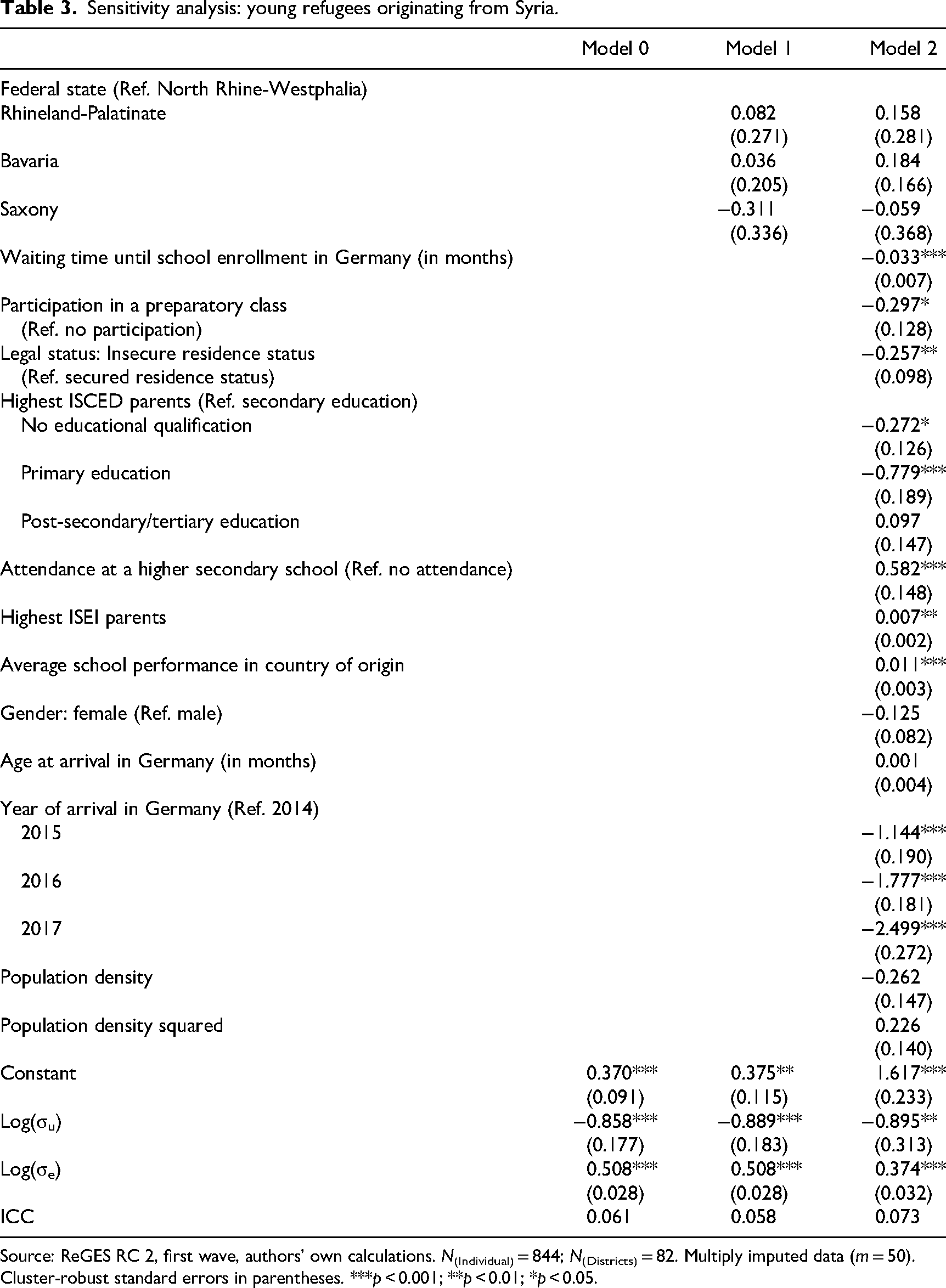
Model 0
Model 1
Model 2
Federal state (Ref. North Rhine-Westphalia)
Rhineland-Palatinate
0.082
0.158
Bavaria
0.036
0.184
Saxony
−0.311
−0.059
Waiting time until school enrollment in Germany (in months)
−0.033***
Participation in a preparatory class
−0.297*
Legal status: Insecure residence status
−0.257**
Highest ISCED parents (Ref. secondary education)
No educational qualification
−0.272*
Primary education
−0.779***
Post-secondary/tertiary education
0.097
Attendance at a higher secondary school (Ref. no attendance)
0.582***
Highest ISEI parents
0.007**
Average school performance in country of origin
0.011***
Gender: female (Ref. male)
−0.125
Age at arrival in Germany (in months)
0.001
Year of arrival in Germany (Ref. 2014)
2015
−1.144***
2016
−1.777***
2017
−2.499***
Population density
−0.262
Population density squared
0.226
Constant
0.370***
0.375**
1.617***
Log(σu)
−0.858***
−0.889***
−0.895**
Log(σe)
0.508***
0.508***
0.374***
ICC
0.061
0.058
0.073
Categorial (level 1)
Mean
SD
Participation in a preparatory class
0.18a
1.60
No attendance a
0.46
1.80
Legal status
0.45a
1.68
Insecure residence status a
0.12
1.85
Highest ISCED parents
No educational qualification a
0.07d
1.66
Primary education b
−0.50c, d
1.44
Secondary education c
0.39b, d
1.71
Post-secondary/tertiary education d
0.76a, b, c
1.71
Gender
0.42
1.75
Female a
0.27
1.71
Year of arrival in Germany
2014 a
1.38b, c, d
1.62
2015 b
0.42a, c, d
1.65
2016 c
−0.08a, b, d
1.71
2017 d
−0.66a, b
1.58
Country of origin
Syria a
0.31d
1.71
Afghanistan b
0.82c
1.66
Iraq c
−0.01b, d
1.71
Other d
1.06a
1.77
Federal state
North Rhine-Westphalia a
0.33
1.75
Rhineland-Palatinate b
0.47
1.81
Bavaria c
0.51
1.58
Saxony d
0.18
1.64
Attendance at a higher secondary school
0.64a
1.78
No attendance a
0.28
1.71
Continuous (level 1)
Pearson's r
Waiting time until school enrollment in Germany
−0.09e
Highest ISEI parents
0.19e
Average school performance in country of origin
0.18e
Age at arrival in Germany (in months)
−0.19e
Continuous (level 2)
Pearson's r
Population density per 1000 inh.
−0.004