




Abstract
This study uses a multidimensional approach to identify gender ideologies and investigate their association with work-family arrangements among mothers of dependent children in Poland and western Germany. Based on data from the Generations and Gender Survey, we apply ordinal latent class analysis and identify five gender ideology classes: (1) traditional, (2) intensive parenting, (3) ambivalent, (4) moderately egalitarian, and (5) strongly egalitarian. In both countries, we find that the intensive parenting class resembles the traditional class in terms of lower maternal employment, a more gendered division of housework and childcare, and a smaller probability of using formal childcare, whereas the ambivalent respondents mostly practice work-care arrangements that are similar to the moderately egalitarian class. With respect to informal care, mothers who identify with strong egalitarianism significantly differ from the traditional class in western Germany, but they do not in Poland—thus highlighting the role of the cultural and institutional context in explaining the complex links between mothers’ gender ideologies and work-family arrangements.
Keywords
Introduction
Since the mid-1990s, in many post-industrial societies, the decline of traditional (i.e. gender-segregated) gender ideologies has slowed down or even come to a halt (Cotter et al., 2011). As a result, scholars have started to question the coherence of the concept of egalitarianism itself (Orloff, 2016) and have argued for the need to distinguish declining beliefs in male primacy from more persistent notions of gender essentialism (Knight and Brinton, 2017), newly emerging “norms of choice” in the gender division of labor (Orloff, 2016), and ideals of “intensive parenting” and “new fatherhood” (Gregory and Milner, 2011; Wall, 2010). Correspondingly, a number of recent empirical studies on attitudinal landscapes in rich post-industrial societies have provided evidence for the multidimensionality of gender ideologies and have argued that a simple continuum from traditional to egalitarian only insufficiently captures the variation in gender ideologies across time and space (Barth and Trübner, 2018; Dernberger and Pepin, 2020; Grunow et al., 2018; Knight and Brinton, 2017; Lankes, 2022; Scarborough et al., 2019; Van Damme and Pavlopoulos, 2022; Yamaguchi, 2000; Yang, 2023; Yu and Lee, 2013).
Concerning the link between gender ideologies and work-family arrangements, numerous studies provide evidence that gender beliefs held by mothers and fathers are significantly correlated with variations in work-family arrangements (for a review, see the study by Davis and Greenstein, 2009). This correlation results from the mutually reinforcing nature of individuals’ desire for consistency between their actions and beliefs (see the study by Festinger, 1957; Gross and Niman, 1975; Schober and Scott, 2012). The mutually reinforcing nature of mechanisms makes it difficult to empirically disentangle to what extent gender ideologies shape work-family arrangements and to what extent they are themselves shaped by the feasibility of work-family arrangements given existing structural constraints.
To date, most of the studies that link gender ideologies and work- or family-related arrangements apply a unidimensional approach to conceptualize and measure gender ideologies that focus on the traditional vs egalitarian continuum of attitudes toward gender roles (e.g. see the study by Berrington et al., 2008; Kaufman and Bair, 2021; Steiber and Haas, 2009). The mixed findings of these studies may possibly be the result of not having captured the multidimensionality of gender ideologies. Multidimensional constructs of gender ideologies have not yet been applied to studies on relationships between gender ideologies and different domains of maternal work-family arrangements, such as the use of formal and informal care or the division of unpaid labor in working families. It thus remains an open question, how the diverse maternal work-family arrangements, such as the work intensity of mothers, their engagement in housework and childcare, as well as the use of (in)formal care, are related to gender ideologies as identified on the multidimensional space. Addressing this question is the first goal of our article.
One of the main barriers in addressing this question is that the datasets used for the identification of classes of multidimensional gender ideologies—that is, the European Values Study (EVS) and World Values Survey (WVS) (see the study by Grunow et al., 2018; Knight and Brinton, 2017; Van Damme and Pavlopoulos, 2022)—lack information on the division of unpaid labor and the use of formal and informal childcare. The only aspect of work-family arrangements included in these datasets is the information on maternal employment. Therefore, so far, only the relationships between multidimensional gender ideologies and mothers’ employment status were explored (e.g. see the study by Van Damme and Pavlopoulos, 2022).
Our study aims to shed light on the relationships between multidimensional gender ideologies and work-family arrangements by going beyond mothers’ employment status and also explore the gender division of housework and childcare responsibilities as well as the use of formal and informal childcare. To this aim, we employ the Generations and Gender Survey (GGS) which offers both, a series of attitudinal questions related to gender roles that can be used to identify multidimensional classes of gender ideologies and a rich set of variables capturing several dimensions of work-family arrangements, for example, mothers’ engagement in paid and unpaid labor or the use of formal and informal childcare. Moreover, the use of the GGS has one additional advantage—the answers to the attitudinal questions of an ordinal nature are based on a 5-point Likert-type scale, including a neither/nor option. This way respondents are not forced to agree or disagree with the attitudinal statements they are confronted with, but they are also allowed to stay neutral toward them. Thus, our data allow us to potentially also identify an “ambivalent” gender ideology class—similar to what Yang (2023) has found for China.
However, our ambition is not only to offer the first study that links multidimensional gender ideologies to diverse work-family arrangements, but we further seek to explore the role of the cultural and institutional context in explaining the complex links between multidimensional gender ideologies to work-family arrangements. To accomplish this second goal of our article, we focus on mothers with dependent children in two countries: Poland and (western) Germany. Concentrating on two countries (rather than attempting to explore relationships between multidimensional gender ideologies and work-family arrangements across a large number of countries) allows us to formulate more specific hypotheses on whether and how a specific cultural and institutional context affects the links between multidimensional gender ideologies and work-family arrangements and to test these with respect to a whole set of work-family arrangements, that is, employment status and working hours, division of housework and childcare, and the use of formal and informal childcare. While the GGS also includes several other Eastern and Western European countries, a larger cross-nationally comparative research design would not allow to explore the breadth of gendered work-family arrangements and would have to focus on specific domains instead.
We choose Poland and (western) Germany for our cross-country comparison for two main reasons. First, the two countries are both similar and different with respect to the prevailing gender ideologies, as highlighted by evidence from previous studies that found a high level of diversity in terms of the presence of gender ideology classes (Grunow et al., 2018; Lohmann and Zagel, 2016). At the same time, we expect the chosen countries to be characterized by substantial presence (at least 15% in each country) of the main contrasting classes (e.g. traditional and sameness feminism in Van Damme and Pavlopoulos, 2022), as well as study-specific classes that are important for exploring work-family arrangements (e.g. intensive parenting in Grunow et al., 2018). Second and from a methodological perspective, the two countries are also characterized by a balance between similarities and differences in their cultural and institutional contexts, thus enabling us to formulate specific hypotheses on differences in the links between multidimensional gender ideologies and work-family arrangements between these countries. Specifically, western Germany and Poland, despite sharing relatively traditional ideological background, differ significantly in the continuity of their economic and political development and the presence of contrasting ideological influences. Western Germany experienced gradual and consistent liberalization and reforms promoting maternal employment and gender equality (Stahl and Schober, 2018). In contrast, Poland’s post-communist legacies were combined with the strong influence of Polish Catholic Church, which led to reinforcement of traditional gender roles and, until recently, deterioration of access to early institutional childcare (e.g. see the study by Heinen and Portet, 2009; Javornik, 2014; Lohmann and Zagel, 2016). We focus on western Germany instead of Germany as a whole because of the profound and persistent differences in work-family arrangement cultures and practices between East and West Germany dating back to different institutional setups before re-unification (Gangl and Ziefle, 2015; Sprengholz et al., 2022).
Despite using a distinct set of attitudinal items, a different data set, and a reduced sample of respondents, we identify multidimensional gender ideology classes that bear strong similarities to those identified in previous studies of European countries (Begall et al., 2023; Grunow et al., 2018; Knight and Brinton, 2017; Van Damme and Pavlopoulos, 2022). In addition, we identify a latent class of mothers’ gender ideologies, akin to the “ambivalent class” detected by Yang (2023) for China. Linking mothers’ gender ideologies to work-family arrangements, we find that strong egalitarianism consistently predicts higher maternal employment, a less gendered division of housework, and a greater probability of using formal childcare than using the traditional and intensive parenting classes, in both countries. Regarding informal care, mothers who identify with strong egalitarianism significantly differ from the traditional class in western Germany, but not in Poland. We interpret this by discussing the role of the cultural and institutional context.
In the remainder of our article, we proceed as follows. First, we provide a review of the literature with respect to both the identification of multidimensional gender ideologies and the links between (unidimensional) gender ideologies and work-family arrangements. In the next step, we provide our conceptual framework and derive our hypotheses, focusing first on general expectations concerning the link between multidimensional gender ideologies and work-family arrangements and then delving deeper into the role of the cultural and institutional context. Next, we present our data and method and our results. More specifically and drawing on previous studies (e.g. Grunow et al., 2018; Knight and Brinton, 2017; Van Damme and Pavlopoulos, 2022), we apply ordinal latent class analysis (LCA) to identify latent classes of gender ideologies for mothers with dependent children living in our countries of interest and relate our findings to previous studies. Further we investigate how the identified multidimensional gender ideologies relate to work-family arrangements in terms of mothers’ employment status and working hours, their share in housework and childcare responsibilities, and the use of formal and informal childcare. Finally, we assess the predictive power of the multidimensional gender ideologies to predict work-family arrangements by comparing it with the predictive power of a continuous gender ideology measure, to assess the comparative value of the multidimensional approach to gender ideologies to explain work-family arrangements of families with dependent children. The final section provides a discussion and concludes.
Literature review
Multidimensional gender ideologies
Previous studies on several European countries that identified gender ideology classes based on LCA distinguished two classes that correspond to two opposite ends in the unidimensional approach—the traditional and the egalitarian, and two to three classes that cannot be reduced to a unidimensional approach (Begall et al., 2023; Grunow et al., 2018; Knight and Brinton, 2017; Van Damme and Pavlopoulos, 2022).
The traditional class tends to generally report low to medium support for women’s roles in the workforce and especially oppose the employment of mothers with young children. It also attributes a high level of importance of having children for women and see family work as mothers’ main responsibility and area of competence. The egalitarian class (also termed sameness feminism) (Van Damme and Pavlopoulos, 2022), to the contrary, embraces ideals of a gender equal division of market and family work.
With respect to the other gender ideology classes, several studies identified one class that scores middle to high on the support for women’s involvement in paid work while at the same time regarding women as the main care provider and believing in gendered traits. Such a class has been referred to as difference feminism (Van Damme and Pavlopoulos, 2022), egalitarian familism (Knight and Brinton, 2017), or conflicted egalitarian (Barth and Trübner, 2018).
Another gender ideology class that has been identified repeatedly is one that signals a strong belief in individual choice, no matter what the outcome of division of labor for couples would be. While the corresponding respondents provided “egalitarian answers” on most of the items, they perceived being a housewife as equally fulfilling as working for pay and agree only moderately with the importance for women to have a job and contribute to household income. This class was termed flexible egalitarianism (Knight and Brinton, 2017), egalitarian essentialism (Grunow et al., 2018), third-wave feminism (Van Damme and Pavlopoulos, 2022), or choice egalitarianism (Begall et al., 2023).
In addition, several articles also identified intensive parenting or intensive mothering classes that combine ambivalent attitudes regarding maternal employment and fears of negative consequences for children and vary in their views about fathers’ involvement in childcare. The characteristics of intensive parenting/mothering classes, however, differ across studies. The study by Grunow et al. (2018) is based on eight European countries and points out that the intensive parenting class prioritizes family over paid work by disapproving of maternal employment yet, at the same time, believing that men should contribute to care and household work. The intensive mothering class identified by Begall et al. (2023) in the study on 36 European countries expresses less confidence in fathers’ childrearing skills. In German-speaking countries, two studies have identified similar intensive mothering (Sievers and Warner, 2023) and child-oriented traditional groups (Barth and Trübner, 2018)—mainly based on the rejection of maternal employment for young children.
Depending even more strongly on the countries included, another class identified by some articles include a moderate traditional (Grunow et al., 2018) or a familialistic class (Begall et al., 2023), both attaching great importance to the family sphere for women but holding more ambivalent attitudes toward working mothers and varying in their level of confidence in men’s domestic skills.
Using LCA on data from the Chinese General Social Survey (2010–2017), Yang (2023) found partly similar classes to the egalitarian, traditional, egalitarian essentialist, and the familialistic classes found in the European context. However, interestingly, the latter three classes were all characterized by beliefs in intrinsic gender differences including men’s superior competence over women but, at the same time, also supported neotraditional arrangements of household labor where both husband and wife should contribute. While previous European studies mostly used scales without a middle category or disregarded the answers on the middle category of a Likert-type scale (Sievers and Warner, 2023), Yang (2023) coded the middle category separately and, as a result, also found an ambivalent class which tends to mostly choose the middle category on all items. She suggested that either social desirability might lead some gender-traditionalists to hide themselves in ambivalent answers or that people in this group are struggling to adapt to a conflicted gender culture in contemporary China.
Concerning our country comparison, for (western) Germany, previous studies have pointed to a substantial prevalence of egalitarian views co-existing with persistent traditional and moderately traditional groups and increasing shares of intensive parenting or mothering (Barth and Trübner, 2018; Begall et al., 2023; Grunow et al., 2018; Sievers and Warner, 2023). Poland, in comparison, has been found to include a relatively large share of difference feminism or familialistic views (Begall et al., 2023; Van Damme et al., 2022) with high support for women’s earning contributions while at the same time regarding women as the main care providers alongside smaller shares of traditional and egalitarian. Also, intensive parenting or transitional ideologies have been found to be quite widespread (Grunow et al., 2018; Van Damme et al., 2022). In most previous studies, choice egalitarianism or third-wave feminism was embraced only by a small minority in Germany and Poland (Begall et al., 2023; Grunow et al., 2018; Van Damme and Pavlopoulos, 2022).
Gender ideologies and work-family arrangements
Several studies have explored how a unidimensional construct of egalitarian versus traditional gender ideologies relates to actual work-family arrangements (e.g. see the study by Berrington et al., 2008; García-Faroldi, 2017; Jappens and Van Bavel, 2012; Nitsche and Grunow, 2018; Sanchez and Thomson, 1997; Schober, 2013; Schober and Scott, 2012; Van Gameren, 2013; Weckström, 2014). The overwhelming majority of these studies provide evidence of positive relationships between more egalitarian gender ideologies and female employment (e.g. Berrington et al., 2008; García-Faroldi, 2017; Schober and Scott, 2012), as well as a less traditional division of housework and childcare (e.g. Sanchez and Thomson, 1997; Schober, 2013; Weckström, 2014). Findings for formal childcare have been mixed: While Van Gameren (2013) showed that in the Netherlands, parents who approved of non-parental childcare and working mothers were more likely to use formal childcare, Jappens and van Bavel (2012) found in their study on 23 European countries that gender ideologies at the individual level were not related to the use of formal childcare. The lack of consistency in these findings may be the result of differences between the countries analyzed, but it may also originate from the simplified, unidimensional operationalisation in measuring gender ideologies.
While some studies have attempted to explore how different aspects of gender ideologies relate to work-family arrangements (e.g. see the study by Büchau et al., 2023; Nitsche and Grunow, 2018; Van Gameren, 2013), none have considered multidimensionality by taking into account latent classes of gender ideologies in explaining work-family arrangements.
Conceptual framework
Our conceptual framework relies on two pillars: First, we formulate more general expectations on the links between multidimensional gender ideologies and work-family arrangements (section 3.1). Second, we explore whether and to what extent the links might be moderated by the cultural and institutional context (section 3.2).
Relationships between multidimensional gender ideologies and work-family arrangements—general expectations
Individual gender ideologies are continuously re-produced in day-to-day interactions and individual practises, such as work-family arrangements of families (Risman, 2004; West and Zimmerman, 1987). Gender ideologies are formed early in life and change mostly during adolescence and early adulthood after which they tend to be more stable (Davis, 2007; Fan and Marini, 2000). Therefore, it is reasonable to expect that gender ideologies influence outcomes in the labor market and domestic work practices of adults (e.g. Platt and Polavieja, 2016; Sanchez and Thomson, 1997; Schober, 2013). However, parents also frequently change their gender ideologies after important life course events, such as childbirths, especially when their employment or domestic work practices do not correspond with their beliefs (e.g. Baxter et al., 2015; Schober and Scott, 2012).
Traditional ideologies have been argued to promote a gender-specific division of roles regarding family responsibilities, domestic tasks, and paid work, whereas egalitarian beliefs (sameness feminism) favor a non-gendered division of roles (Davis and Greenstein, 2009; Van Damme et al., 2022). This leads us to the formulation of our first hypothesis:
Hypothesis 1 (H1). Mothers with egalitarian gender ideologies are more likely to be employed (H1a), to work longer hours (H1b), to share housework (H1c) and childcare (H1d) in a less-gendered way, and to use formal (H1e) as well as informal childcare (H1f) more often than mothers with traditional gender ideologies.
Other gender ideologies (than traditional and egalitarian) consist of less-consistent and more ambivalent attitudes regarding men’s and women’s traits and responsibilities in work and care roles (Van Damme et al., 2022). Therefore, the expectations about the relationships between these gender ideology classes and work-family arrangements are far from trivial. As difference feminism puts a particular emphasis on women’s responsibility for family work while supporting dual earning, we would expect the labor market participation and working hours of this class to not differ significantly from the egalitarian class. By contrast, people endorsing difference feminism or third wave feminism are likely to share unpaid family work less equally and use formal childcare less than the egalitarian class but more than the traditional class, partly because of their higher maternal employment. We expect this class to make quite frequent use of informal childcare by other family members, as this is in line with the familialistic values of difference feminism while facilitating maternal employment. Based on this reasoning, we formulate our second hypothesis:
Hypothesis 2 (H2). Mothers who believe in difference feminism and/or third-wave feminism will be more likely to be employed (H2a) and to work longer hours (H2b) than mothers with traditional gender ideologies. Yet, these mothers will share housework (H2c) and childcare (H2d) in a more gendered way than the egalitarian class but more equally than the traditional class. They will also use formal childcare (H2e) more often than mothers with traditional gender ideologies and less often than the egalitarian class, whereas their probability of using informal care will be higher than that for the traditional class but similar to that of the egalitarian class (H2f).
Mothers who embrace intensive parenting or mothering beliefs tend to be convinced of the superiority of parental or maternal care for optimally fostering children’s development (Diabaté and Beringer, 2018). As a result, they are likely to prefer caring for their children themselves and may not differ significantly from the group of women with the most traditional gender ideologies with respect to maternal employment, gender division of housework, and the use of formal and informal childcare. For the division of childcare, however, one would expect mothers who embrace intensive parenting or mothering views to fall between the egalitarian class and the traditional class. While intensive parenting does endorse the engagement of the father in childcare, the role of the mother in childcare is still central in this gender ideology (Grunow et al., 2018). Even involved fathers might be more likely to embrace traditional ideas about childcare than mothers. Fathers themselves are less likely reduce their working hours and still tend to spend less time on childcare than involved mothers (Hays, 1996; Wall, 2010). All this leads us to our third hypothesis:
Hypothesis 3 (H3). Mothers who embrace intensive parenting or mothering are less likely to be employed (H3a), more likely to work shorter working hours (H3b), to practice a more gendered division of housework (H3c) and childcare (H3d), and to be less likely to use formal (H3e) or informal childcare (H3f) than mothers with egalitarian gender ideologies. At the same time, mothers who embrace intensive parenting or mothering may share childcare in a less gendered way than the mothers with traditional gender ideologies.
Figure 1 in the Online Supplemental Material graphically summarizes the expected links between gender ideologies and work-family arrangements as formulated in the above hypotheses.
The role of country context for relationships between gender ideology classes and work-family arrangements: Western Germany and Poland compared
The gender structure consisting of gendered institutions and cultural logics influence gendered expectations that individuals encounter in day-to-day interactions (Risman, 2004). The gender structure of the different country contexts in Poland and western Germany in the first two decades of the 21st century constrains and shapes the way how multidimensional gender ideologies relate to work-family arrangements (Risman, 2004).
Poland and western Germany are interesting cases to examine how gender ideologies relate to work-family arrangements because both are characterized by different varieties of egalitarianisms, as it was found in these two countries in previous studies (i.e. Grunow et al., 2018; Knight and Brinton, 2017; Van Damme and Pavlopoulos, 2022). Furthermore, up until the respective observation periods, both contexts have been characterized as rather traditional in terms of their family policy regimes and gender ideologies (Grunow et al., 2018; Lohmann and Zagel, 2016). Data from 2010, analyzed by Román and Ophir (2024), show that mothers spend about twice as much time on housework as fathers both in Poland and Germany. Therefore, the phrasing of the commonly used gender ideology measures that focus on (dis)agreement with relatively traditional positions is less likely to result in underestimating the variation at the egalitarian end of the spectrum than for countries with greater prevalence of egalitarian beliefs.
While Poland and western Germany—in the periods we analyze—share similarities in terms of the prevalence of relatively traditional ideological influences, they differ substantially in the continuity of their economic and political development and the presence and endurance of contrasting ideological influences. These, as we argue below, are likely to impact the strength of the relationships between multidimensional gender ideology classes and actual work-family arrangements.
Since the second World War, a growing share of western Germany’s population has not experienced existential material deprivation during their formative years, which resulted in gradual and relatively uniform cultural change from traditional to egalitarian values (Inglehart, 2018). Until the mid-2000s, the pace of change has been gradual but rather slow, which may be partly due to the predominantly explicitly familialistic policy (Lohmann and Zagel, 2016), characterized by joint taxation for couples favoring the male breadwinner family model, long and low-paid parental leave entitlements, and a lack of state-subsidized childcare services (Hook, 2015; Joecks, 2021; Keck and Saraceno, 2013). As part of a paradigm shift toward optional familialism, during the observation period 2005–2008, the German government introduced a major parental leave reform and started to expand the availability of state-subsidized childcare (Stahl and Schober, 2018). These reforms aimed at facilitating maternal employment and increasing paternal childcare involvement. All these relatively harmonious changes, both in the institutional and cultural spheres, together with no major economic deprivation periods lead us to the expectation that work-family arrangements will be aligned with maternal gender ideologies in this country. In other words, hypotheses H1–H3 will be particularly true in case of western Germany.
Poland, in contrast, has been subject to contrasting ideological influences and major economic and institutional transformations for several decades. The legacy of state socialism and, later, the economic necessity of the period of institutional and economic transformation of the 1990s were reasons for advocating women’s employment and denying male supremacy (Fidelis, 2004; Jarska, 2019). However, the enduring presence of a powerful Polish Catholic Church has for several centuries been denying egalitarian ideals, promoting gender essentialism and intensive mothering ideology (e.g. see the study by Heinen and Portet, 2009). The Polish Catholic Church’s narratives, however, focussed more on gender essentialism in the family sphere than on men’s privileges in the public sphere. All this means that it is reasonable to expect that maternal employment in Poland is rather driven by economic necessities or opportunities to find employment than by mothers’ gender ideology, thus weakening the link between gender ideologies and maternal employment in Poland as compared to Germany. Therefore, we formulate our fourth hypothesis:
Hypothesis 4 (H4). The relationship between gender ideology classes and maternal employment is weaker in Poland than that in western Germany. In particular, we expect the difference in the employment of mothers who hold egalitarian beliefs and mothers who hold traditional or intensive parenting or mothering beliefs to be smaller in Poland than in western Germany.
In Poland, since state socialism, mothers have faced strong expectations that women should be engaged in the labor market, while having poor access to institutional care for young children (Javornik, 2014). Polish family support policies, until very recently, have been classified as implicitly familialistic (Javornik, 2014; Lohmann and Zagel, 2016; Szelewa, 2016) insofar as the state “neither offered defamilialization nor actively supported the caring function of the family through any kind of familialistic policy” (Leitner, 2003: 359). As a result of a low retirement age (60 years for women) and the dominant view that children below the age of three should be cared for by family (Saxonberg, 2014), grandparental (informal) care has been commonly used by parents in Poland, with over one third using it on a daily basis (Bordone et al., 2017). The percentage of children covered by informal childcare in Poland has been twice as large as that in Germany (Mills et al., 2014). According to Eurostat data, in 2012, about 26% of children under the age of three in Germany were in formal childcare, compared to about 6% in Poland. As a result of the dominant ideal of grandparental, particularly grandmaternal, childcare in Poland, all gender ideology classes of mothers in Poland are likely to regularly use informal care irrespective of their views on maternal employment and gender roles in the home, whereas in western Germany, informal care use is likely to depend more strongly on the ideological support of maternal employment and the varying shortage of formal care and the extent of redistribution of maternal care to fathers. Therefore, we formulate our fifth hypothesis:
Hypothesis 5 (H5). The relationship between gender ideology classes and the use of informal childcare among mothers is weaker in Poland than that in western Germany. In particular, we expect the difference in the use of informal care between mothers who hold egalitarian beliefs and those who hold traditional beliefs or intensive parenting or mothering beliefs to be smaller in Poland than that in western Germany.
Finally, the gender revolution in the private sphere has stalled more persistently in Poland and has not been supported by recent gender equality–promoting reforms, as has been the case in western Germany. As a result, Polish women with egalitarian gender ideologies may face greater obstacles in realizing a gender equal division of family work in practice. Therefore, we expect that gender ideologies may be less strongly associated with the division of unpaid work in Poland than in western Germany. Thus, we formulate our final hypothesis:
Hypothesis 6 (H6). The relationship between gender ideology classes and the gendered division of housework (H6a) and childcare (H6b) is weaker in Poland than in western Germany. In particular, we expect the difference in the division of unpaid work between mothers who hold egalitarian beliefs and mothers who hold traditional or intensive parenting or mothering beliefs to be smaller in Poland than in western Germany.
Data and methods
The data for our study are based on the first and second waves of the GGS in Poland and western Germany. The GGS is a European survey focusing on topics related to children and care arrangements, work, attitudes, and everyday life. The data were collected in 2005 and 2008 for western Germany, and in 2010 and 2014 for Poland.
As the pace of change in gender beliefs has generally slowed down, and as changes in gendered practices over the past two decades have been described as rather incremental in most European countries (Altintas and Sullivan, 2016; Barth and Trübner, 2018; Sievers and Warner, 2023; Sullivan et al., 2018), the data of the GGS survey rounds we use can provide insights into how different gender ideology classes relate to work-family arrangements in the two country contexts, beyond providing a historical snapshot.
In our study, we include mothers with at least one child up to the age of 10, assuming these typically face considerable demands of reconciling employment and childcare responsibilities. Our final sample consists of 4,871 observations of mothers, 3,307 from the Polish sample and 1,564 from the western German sample. About half of the two samples completed the survey in both years, so we use a pooled sample and account for the nesting structure of the data.
Analytical approach
First, we identify multidimensional classes of gender ideologies by applying LCA, as used by Knight and Brinton (2017), Grunow et al. (2018), and Van Damme and Pavlopoulos (2022). LCA is an explorative method aimed at shedding light on the potential nuances and multidimensional aspects of gender ideology. However, in contrast to dichotomized variables (agree versus disagree) and similar to Yang (2023), we exploit the opportunities given by GGS dataset (5-point Likert-type scales applied to attitudinal questions) and use the ordered categories of our variables from strongly agree to strongly disagree. This approach enables us to avoid information loss (Yamaguchi, 2000) and allows us to potentially also find an ambivalent class, as Yang (2023) did for China.
To identify whether a given response pattern can be included in a latent class for our repeated cross-sectional data, we calculate the probability of an observed response pattern as the product of the probability of belonging to a class conditional on the observed year and the probability density of the responses of the case across each indicator (Vermunt et al., 2008). This means that we apply a model with multiple responses nested within time points and within groups (Vermunt, 2008).
To account for the cluster error structure of our data resulting from the panel component (some individuals were interviewed twice), we used clustered standard errors in the LCA. We further tested for measurement equivalence across the two countries via the multi-group LCA. As Grunow et al. (2018) and Van Damme and Pavlopoulos (2022) have shown country differences in class membership, we need to ensure that our investigated concept is comparable across the selected groups to draw valid conclusions. Testing for measurement equivalence helps us to judge if we can draw valid comparative conclusions (Clogg and Goodman, 1984; Eid et al., 2003; Lukac et al., 2019). Therefore, we perform measurement equivalence tests with multi-group latent class models in a stepwise manner. We used three different variables—observed (indicator) variables, unobserved variables (latent classes), and a grouping variable. At each step, we evaluated the change in model fit by the Akaike information criterion (AIC) and Bayesian information criterion (BIC). Since our model with higher level of measurement equivalence does not significantly deteriorate the model fit, we conclude that we have a particular level of measurement equivalence, indicating that potential differences in latent class structure between time points and countries do not constrain our estimations. Table S1 in the Online Supplemental Material shows the AIC and BIC for the different models. To contrast our results with a more conventional approach, we apply factor analysis to create a unidimensional continuous measure of gender ideologies. A similar procedure was applied by Dantlgraber et al. (2016). Third, we analyze how (multidimensional and unidimensional) gender ideologies link to maternal employment status and working hours, the gender division of housework and childcare, and the use of formal and informal childcare, respectively, by applying ordinary least squares (OLS) regressions and logistic regressions with robust standard errors and year fixed effects for the Polish and the western German sample. In addition, we conduct tests for interaction effects involving a country context dummy variable. Multidimensional gender ideologies are represented by continuous classes using the posterior predicted probability that an individual is a member of a certain class. We further test population-equilibrated cross-sectional weights in all models and find the results to be robust. All analyses were conducted in STATA16. LCA requires a large sample size for reliable results; however, our sample size for western Germany caused convergence issues in STATA16, leading us to use a pooled sample for Poland and western Germany.
Measuring gender ideologies
To capture multidimensional gender ideologies, we focused on the following seven statements that are regarded as suitable indicators of gender ideologies in the private and public spheres (e.g. see the study by Davis and Greenstein, 2009) and related to both paid and unpaid work: “A woman has to have children in order to be fulfilled”(Q1), “Looking after the home or family is just as fulfilling as working for pay” (Q2), “If parents divorce, it is better for the child to stay with the mother than with the father” (Q3), “Children often suffer because their fathers concentrate too much on their work” (Q4), “A pre-school child is likely to suffer if his or her mother works”(Q5), “If a woman earns more than her partner, it is not good for the relationship” (Q6), and “When jobs are scarce, men should have more right to a job than women” (Q7). Items Q1, Q2, Q5, and Q7 have also been used by Knight and Brinton (2017) and/or by Grunow et al. (2018), with minor variations in the phrasing of the statements Q1 and Q2. Items Q3 and Q4 have not been used by these authors but correspond with other questions used by them, which refer to gender essentialism with respect to childcare and father’s role in childcare, respectively. Respondents were asked to what extent they agree with these statements on a five-point Likert-type scale ranging from “strongly agree,” over “agree,” “neither nor,”’ and “disagree,” to “strongly disagree.” All items were included in the surveys in Poland and in western Germany at each data-collection point.
Operationalizing work-family arrangements
We construct six dependent variables that cover three major aspects of work-family arrangements: maternal employment status and working hours; gender division of housework and childcare; and the use of formal and informal childcare. Our binary indicator employment status takes the value of one if the woman reports being (self-)employed at the time of the interview, and zero otherwise. On average, 67 and 56 percent of mothers in our sample are employed in Poland and western Germany, respectively. Weekly working hours for those who were (self-)employed are used as a second dependent variable. Mothers’ mean weekly working hours in our Polish and western German sample amount to 38 hours and 30 hours, respectively.
To capture the gender division of housework, we create a standardized summative index on the basis of three questions on who is responsible for shopping for food, for preparing meals, and for washing the dishes, respectively. The factor loadings were significant (p < .01) and greater than 0.60, Cronbach’s alpha is .73, thus substantiating the variables as a valid indicator of the underlying construct that we want to measure. Similarly, we created a standardized summative index for the gender division of childcare on the basis of four questions on who is responsible for putting the children to bed, playing with them, dressing them, and taking care of them when sick. A Cronbach’s alpha of .821 was attained for this scale, and all factor loadings were significant (p < .01) and greater than 0.50, thus indicating a valid measurement of our underlying construct. Responses to the single items for the gender division of housework and childcare were re-coded as follows: 1 = always mother, 2 = usually mother, 3 = equal division between mother and father, and 4 = mostly father. Hence, for both indices, higher values indicate a less-gendered distribution of household and childcare tasks, respectively. The average division of housework and childcare is slightly more traditional in Poland (0.62 and −0.65) than in western Germany (0.70 and 0.76), and both indices were z-standardized, with negative values indicating a more traditional division of housework and childcare.
Two binary variables indicate the use of formal and informal care, respectively. Formal care captures any regular institutional or paid childcare arrangement, whereas informal care includes care by relatives or friends or other people for whom caring for children is not a job. The percentage of mothers in our sample who use formal childcare in Poland (42%) is lower than that in western Germany (51%). The frequency of using informal childcare is with just over 40 percent and is very similar across the two country samples. The descriptive statistics of all the variables, including controls, are shown in Table 1.
Summary of descriptives.
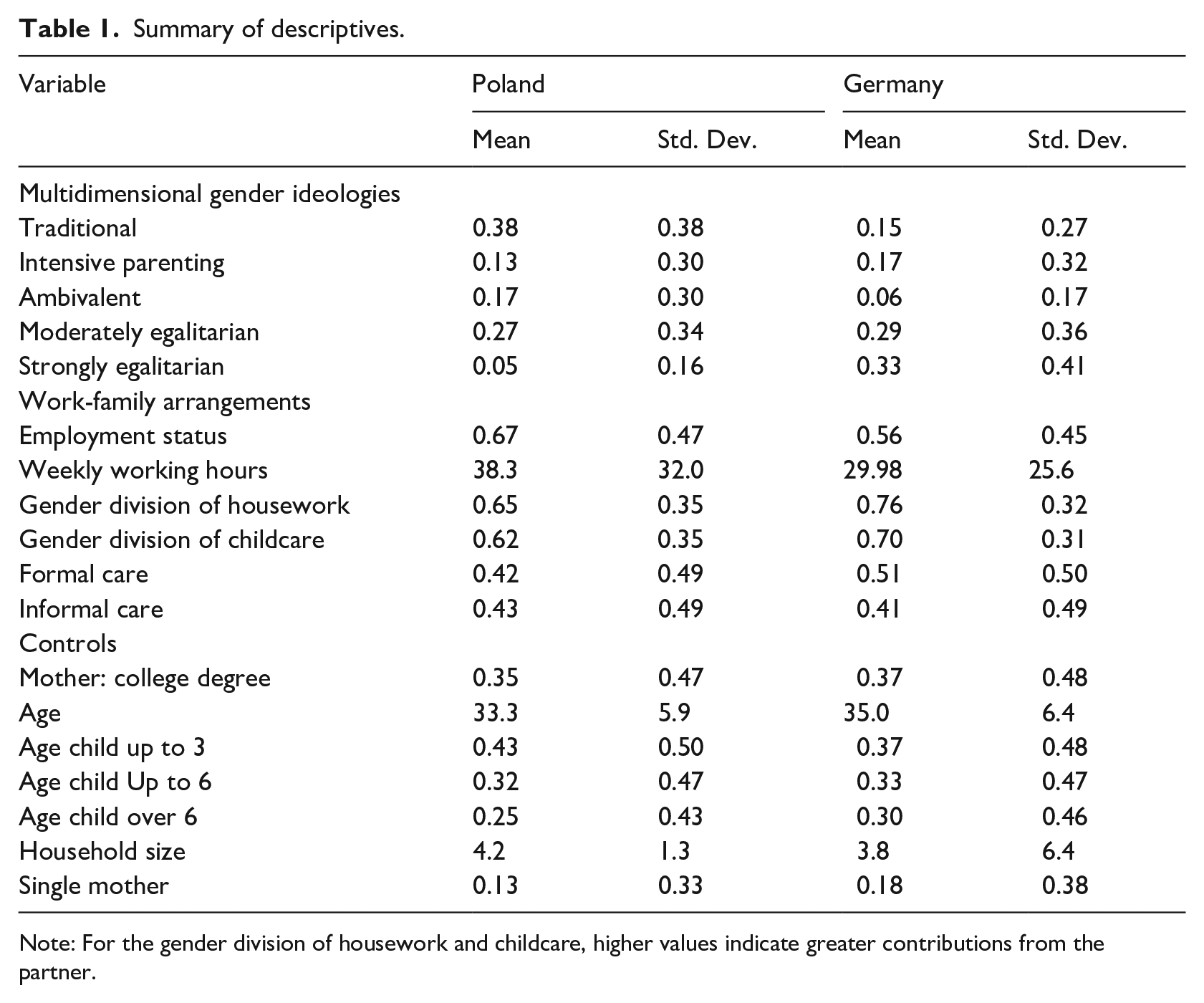
Note: For the gender division of housework and childcare, higher values indicate greater contributions from the partner.
Control variables
To account for differences in the sample composition in each country, we control for several demographic and family characteristics. Using binary variables, we distinguish mothers who have completed tertiary education (mother: college degree) from those with lower levels of education. Furthermore, we consider the age of the mother at the time of the interview. Family characteristics include dummy variables for the different age categories of the youngest child (0–3 years: age child up to 3; 4–6 years: age child up to 6; 7–9 years: age child over 6). Household size is measured as the number of people living in the household and whether the respondent lives together with her partner or not (single mother). Unfortunately, we cannot include the income of the mothers or households because the corresponding variables have too many missing values (2/3 of the sample size).
Results
Identification of gender ideology classes
After running the LCA, we used measures of model fit to decide on the appropriate number of gender ideology classes. The decrease in the BIC from a three-class to a four-class and subsequently a five-class model clearly yielded the latter as the preferable solution (Table 2). Models for six or more classes did not converge.
LCA analysis: Akaike’s information (AIC) and Bayesian information criteria (BIC).
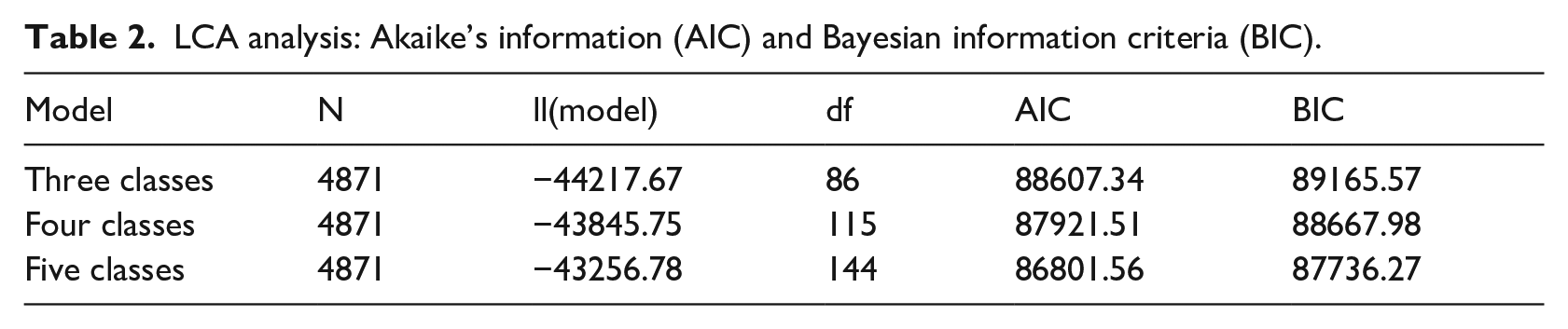
To characterize the classes, we calculated the predicted probabilities conditional on latent class membership. Table 3 presents the item response probabilities conditional on latent class membership. The five latent classes identified can be described as follows: (1) traditional, (2) intensive parenting, (3) ambivalent, (4) moderately egalitarian, and (5) strongly egalitarian. Even though we used a slightly different set of attitudinal items and a different dataset (GGS, not EVS/WVS) and applied our analysis to Polish and western German mothers only, the results show classes that resemble those found in previous studies. Previous literature has likewise identified traditional vs more or less egalitarian gender ideologies as bookends of a unidimensional spectrum of gender ideologies and a separate intensive parenting (or transitional) class as an additional, orthogonal, gender ideology. In our study, we additionally identify one specific latent class of mothers who are ambivalent across most of the statements. This, we believe, is not merely a result of the 5-point Likert-type scale applied in the attitudinal questions used in GGS, enabling respondents to stay neutral toward these statements (i.e. neither agree nor disagree) but also a result of the cultural and institutional context of our countries of interest (Poland in particular), as we discuss in more detail below.
Item response probabilities conditional on latent class membership.
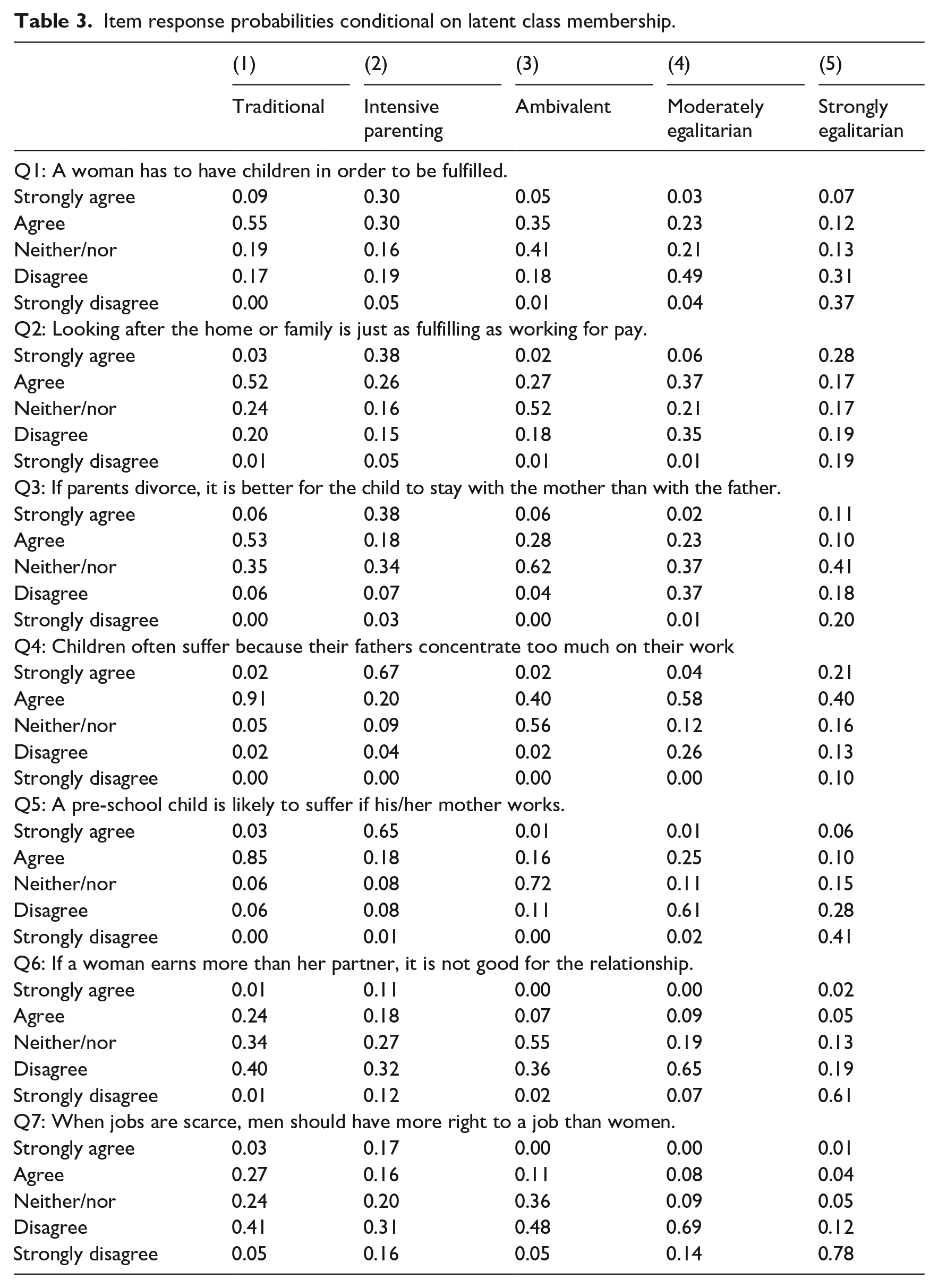
The first and largest class is the traditional one, capturing 30% of the pooled sample (Poland: 38%, western Germany: 15%). Respondents in this class tend to hold traditional beliefs on women’s roles at home and at work across all items (Table 3). This class resembles the traditional class found by previous studies (Begall et al., 2023; Grunow et al., 2018; Knight and Brinton, 2017; Van Damme and Pavlopoulos, 2022).
The second class captures 15% of the pooled sample (Poland: 13%, western Germany: 17%). This is a rather traditional class regarding the private sphere, but with a stronger focus on parent-child relationships than the previous one. We refer to it as the intensive parenting class because associated respondents tend to strongly agree that children often suffer when the mother works and when the father concentrates too much on work. This class is similar to the intensive parenting class found by Grunow et al. (2018), and to the familialistic class found by Begall et al. (2023). While our theoretical framework recognized the distinctiveness of intensive mothering and intensive parenting, our subsequent empirical analysis primarily addresses the broader intensive parenting ideology as identified in our LCA.
The third class consists of 14% of the pooled sample (Poland: 17%, western Germany: 6%) and is characterized by ambivalent individuals that neither agree nor disagree on most of the seven gender ideology statements. The ambivalence may result from a neutrality or undecidedness, that is, from either rejecting the normative imperative implied by the statements or being indifferent toward them, which both may result from the exposure to contrasting ideological influences or growing norms of choice about work-family arrangements in European societies. By neither agreeing nor disagreeing, this class shows some similarity with the flexible or choice egalitarianism or third-wave feminism found in previous studies (Begall et al., 2023; Grunow et al., 2018; Knight and Brinton, 2017; Van Damme and Pavlopoulos, 2022). However, the greater prevalence of this ambivalent class in Poland than in western Germany and that the neither/nor answers dominate even for statements relating to acceptance/support of maternal employment suggest that the ambivalent class we identified captures a substantively different meaning than the choice egalitarian group found in previous studies. It shows similarities to the ambivalent class identified by Yang (2023) for China. One might argue that the ambivalent class is a methodological artifact, and respondents choose the neutral category because they do not want to invest the effort of choosing a substantive answer or of social desirability. To account for that, we tested if mothers in the ambivalent class tend to give neutral answers in other item batteries (not included in our study but present in GGS database), such as, for example, “Marriage is an outdated institution” or “It is important for a funeral to include a religious ceremony.” However, they show that mothers we studied have strong opinions on these items. This supports our belief that the identification of the ambivalent class is not a methodological artifact.
The fourth class is the second largest, capturing 28% of the pooled sample (Poland: 27%, western Germany: 29%). It is characterized by moderately egalitarian views on women’s and mothers’ employment (Q6, Q7, and Q8), as well as on children benefiting from fathers’ involvement, while responses are evenly distributed between agreeing and disagreeing with the statement that looking after home/family is as fulfilling as working for pay and neutral as to whether children should stay with the mother after a divorce. This class seems to be close to the third-wave feminism or choice egalitarianism classes identified by previous studies (Begall et al., 2023; Van Damme and Pavlopoulos, 2022), with a twist toward the difference feminism class (Van Damme and Pavlopoulos, 2022). As this class does not seem to be characterized by strong differences across dimensions of public and private spheres, we refer to it as moderately egalitarian.
The fifth class comprises 13% of the pooled sample (Poland: 5%, western Germany: 33%). Individuals’ responses for this class can be understood as strongly egalitarian, in both private and public spheres. Yet, the majority also expresses strong agreement that looking after home/family is as fulfilling as working for pay. This last class also seems to be close to the third-wave feminist class identified by Van Damme and Pavlopoulos (2022) but leaning toward the sameness feminism class identified by these authors. In western Germany, the historical context of rising economic prosperity and the recent paradigm shift toward less familialistic policies may explain the greater prevalence of strong egalitarianism in western Germany than in Poland.
The five classes show some interesting differences regarding education and family characteristics. Mothers with a college degree are overrepresented in the moderately egalitarian and strongly egalitarian class, compared to the traditional, intensive parenting or ambivalent classes. A significantly larger percentage of mothers in the traditional class have young children below the age of three in their household compared to the strongly egalitarian class. Single mothers are overrepresented in the strongly egalitarian class compared to the other classes.
To be able to contrast our results on how the multidimensional gender ideologies link to work/family practices, we also constructed a unidimensional variable on gender ideologies. Based on exploratory factor analysis, all seven gender ideology items load on one factor (see Table S2 in the Online Supplemental Material for the factor loadings). A Cronbach’s alpha of .68 points to adequate reliability. To facilitate interpretation, we z-standardized the factor for the regressions. Higher values for the factor indicate greater traditionalism.
Gender ideologies and work-family arrangements
Table 4 presents the results of regression models for maternal employment and working hours separately for both countries, including demographic and family characteristics and year dummies as controls. For the logistic regression models, we present average marginal effects. Our second hypothesis focused on mothers who support difference feminism or third wave feminism. However, we did not find any such difference feminism or third-wave feminism class characterized by strong differences across dimensions of public and private spheres, and therefore are unable to test H2.
Associations of gender ideologies with the probability of being employed and weekly working hours of mothers, by country.
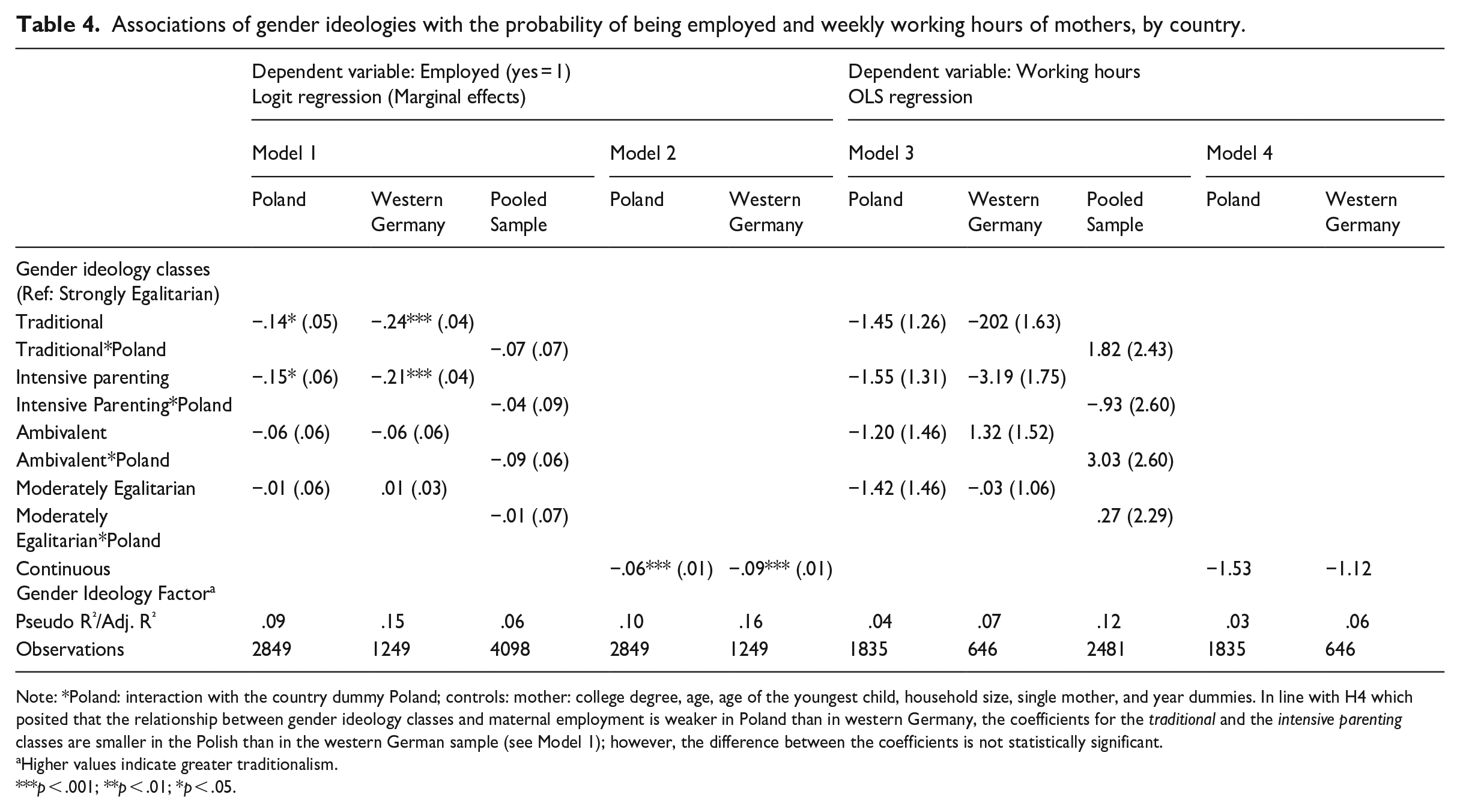
Note: *Poland: interaction with the country dummy Poland; controls: mother: college degree, age, age of the youngest child, household size, single mother, and year dummies. In line with H4 which posited that the relationship between gender ideology classes and maternal employment is weaker in Poland than in western Germany, the coefficients for the traditional and the intensive parenting classes are smaller in the Polish than in the western German sample (see Model 1); however, the difference between the coefficients is not statistically significant.
Higher values indicate greater traditionalism.
p < .001; **p < .01; *p < .05.
Our Hypotheses 1a and 3a expected mothers of the egalitarian class to be more attached to the labor market than mothers of the traditional and intensive parenting classes. In line with H1a and H3a, the results show that the traditional class and the intensive parenting class, respectively, are between 14 and 24 percentage points less likely to be employed than the strongly egalitarian class in both countries (Model 1). By contrast, the employment probability among the moderately egalitarian class is nearly the same as that among the strongly egalitarian class. Model 3 shows that there are no significant differences between the classes in reported working hours in both the countries. Hence, Model 3 finds no support for H1b and H3b in so far as gender ideology classes are not significantly associated with working hours in both countries.
Table 5 presents the results for the gender division of housework and childcare. We expected egalitarian mothers to divide housework and childcare in a less gendered way than the traditional and intensive parenting classes, with the class of difference or third wave feminism falling in between traditional and egalitarian. In western Germany, but not in Poland, the traditional class and the intensive parenting class practice a significantly more gendered division of housework than the strongly egalitarian class, with differences amounting to 23 and 33 percent of a standard deviation, respectively (Model 5). In western Germany, the moderately egalitarian class falls roughly half-way between the strongly egalitarian and the traditional classes. H1c and H3c therefore receive support for western Germany, but not for Poland. The differences found for the two countries are in line with H6a that suggested the relationship between gender ideology classes and the gendered division of housework (H6a) among mothers to be weaker in Poland than in western Germany. However, additional analyses with country interaction effects showed that these country differences are not statistically significant (see Model 5).
The results for the division of childcare show that the traditional class and the intensive parenting class practice a more gendered division of childcare than the strongly egalitarian class in both countries (Model 7). The differences are with 24 and 29 percent of a standard deviation, respectively; slightly larger in Poland than in western Germany with about 20 percent of a standard deviation. The findings contradict our prediction of a less gendered division of childcare among the intensive parenting class compared to the traditional class of mothers. We found no significant differences in the division of childcare between the traditional class and the intensive parenting class (Model 7) in both western Germany and Poland. The division of childcare of the moderately egalitarian class does not differ from that of the strongly egalitarian class in either country. Hence, our results support H1d and H3d at least partly. The differences found for the two countries do not support H6b, which suggested that the relationship between gender ideology classes and gendered division of childcare among mothers will be weaker in Poland than in western Germany. Moreover, additional analyses with country interaction effects showed that country differences are not statistically significant (see Model 7).
Associations of gender ideologies with the gendered division of housework and childcare.
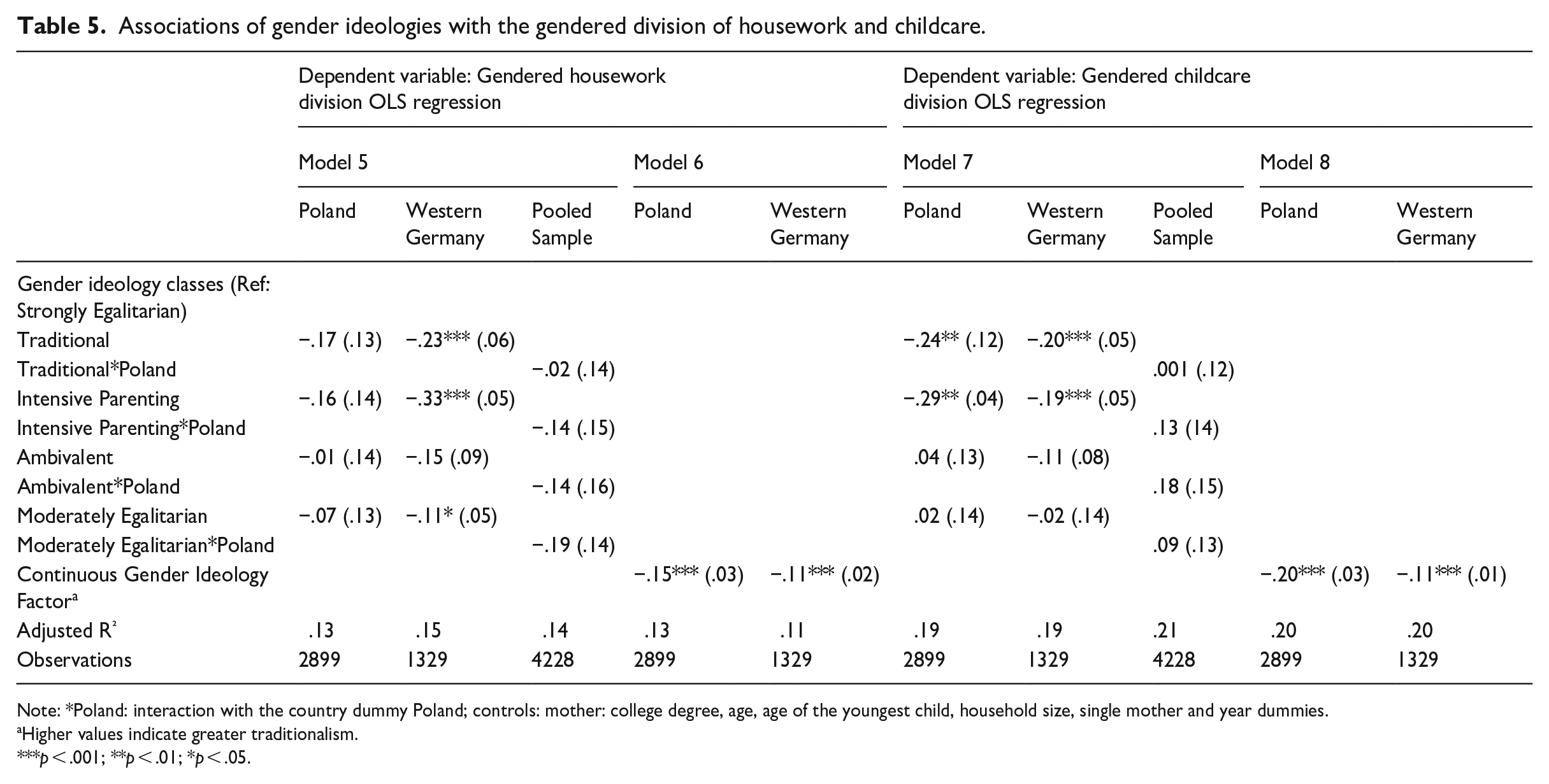
Note: *Poland: interaction with the country dummy Poland; controls: mother: college degree, age, age of the youngest child, household size, single mother and year dummies.
Higher values indicate greater traditionalism.
p < .001; **p < .01; *p < .05.
As Table 6 shows, the traditional, intensive parenting, and moderately egalitarian classes are significantly less likely to use formal childcare than the strongly egalitarian class in both countries (Model 9). The differences between classes range from 11 to 25 percentage points and are in line with H1e and H3e. For Poland, we also find the ambivalent class to have a 17-percentage-point lower probability of using formal childcare than the strongly egalitarian class. We find no country differences in the pooled sample.
Associations of gender ideologies with the probability of using formal and informal childcare, by country.
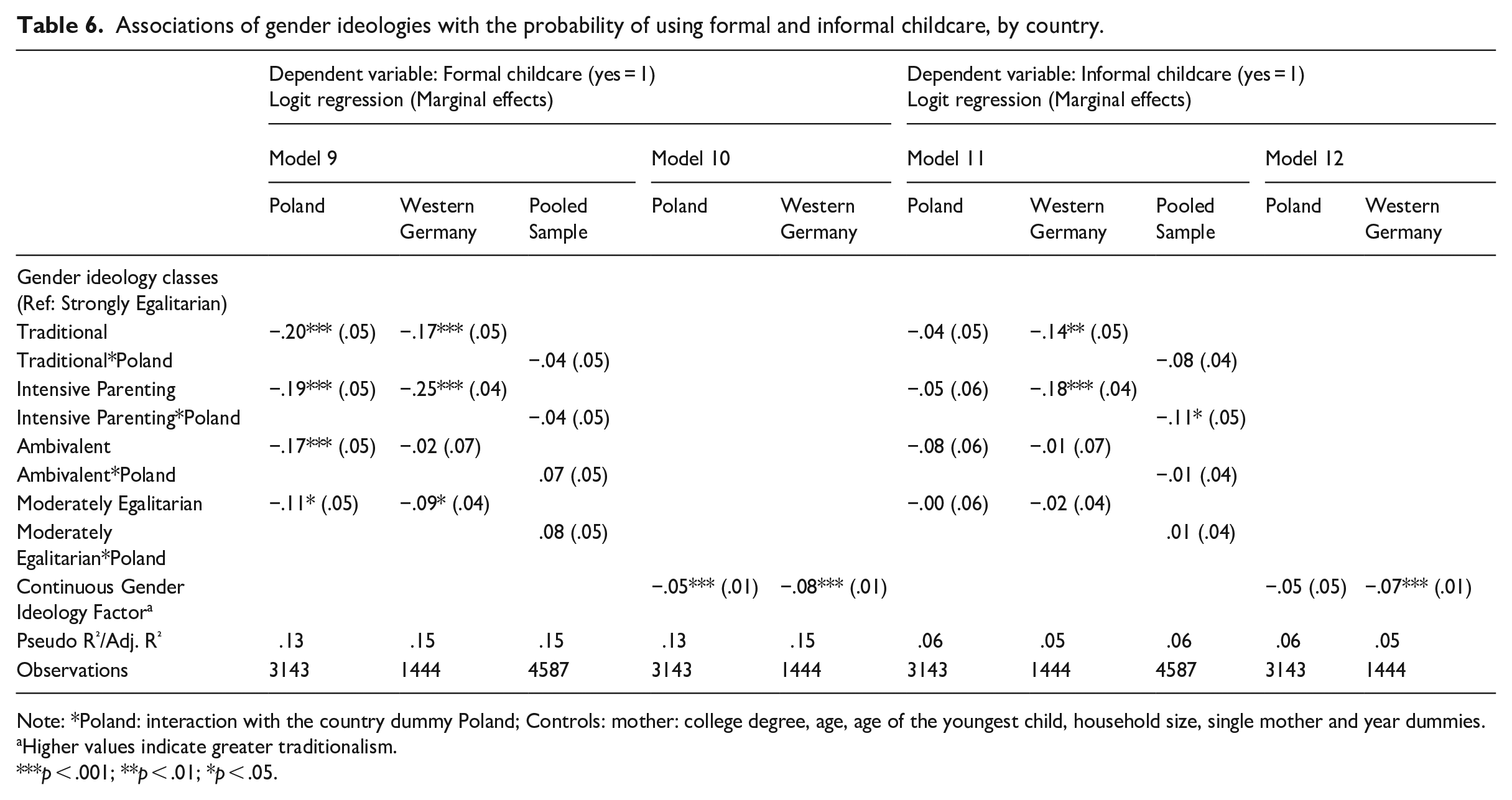
Note: *Poland: interaction with the country dummy Poland; Controls: mother: college degree, age, age of the youngest child, household size, single mother and year dummies.
Higher values indicate greater traditionalism.
p < .001; **p < .01; *p < .05.
In western Germany, but not in Poland, the traditional class as well as intensive parenting class are 14 and 18 percentage points less likely to use informal care than the strongly egalitarian class (Model 11). H1f and H3f are therefore only supported for western Germany but not for Poland. In line with H3f, the probability of informal care use among the moderately egalitarian mothers is very similar to that among the strongly egalitarians.
The country differences found here (Model 11) are in line with H5 that suggested the relationship between gender ideology classes and the use of informal childcare among mothers to be weaker in Poland than in western Germany. In particular, we expected the difference in the use of informal care between mothers with egalitarian gender ideologies and those with traditional or intensive parenting gender ideologies to be smaller in Poland than in western Germany. Additional analyses with country interaction effects showed that the differences between those with strongly egalitarian gender ideologies and those with intensive parenting gender ideologies are statistically significant. We find no significant differences between mothers with strongly egalitarian gender ideologies and those with traditional gender ideologies. Therefore, we conclude that H5 is partly supported by our empirical findings.
The continuous gender ideology factor shows significant associations with all outcomes except for maternal working hours and the use of informal care in Poland (Models 2, 4, 6, 8, 10, and 12 in Tables 4–6). More egalitarian gender ideologies by one standard deviation are associated with a lower maternal employment probability of 6 and 9 percentage points in Poland and western Germany, respectively, whereas the association with working hours is significant neither for western Germany nor for Poland. The associations of more egalitarian gender ideologies with a more gender equal division of housework and childcare range between 11 and 20 percent of a standard deviation. Mothers with more egalitarian gender ideologies are more likely to use formal care by 5 and 8 percentage points in Poland and western Germany, respectively. In western Germany, the probability of using informal care is 7 percentage points for mothers with more egalitarian gender ideologies, whereas the association is not significant in Poland.
The goodness-of-fit statistics across all tables and models indicate a similar explanatory power, irrespective of whether gender ideologies are considered as latent class categories or as a continuous factor. The only exception is Model 5 for the gender division of housework in western Germany, for which the larger R2 of 0.15 indicates a better fit than for Model 6 (R2 of 0.11) with the continuous gender ideology factor. The largely similar fit of the models irrespective of the operationalization as latent class categories or continuous factor can be explained by the mostly similar rank positions of the five gender ideology classes across all outcomes: The intensive parenting class shows work-family arrangements that are largely similar to or even slightly more gendered than the traditional class. The work-family arrangements of mothers who belong to the ambivalent class are similar to those of the moderately egalitarian class, irrespective of whether they concern gender arrangements in the public or private sphere.
Discussion and conclusion
In our study, we extend the literature on the links between gender ideologies and work-family arrangements in several ways: First, we are the first to apply a multidimensional approach to measuring gender ideologies in exploring these links. Second, we explore the role of the cultural and institutional context in explaining the complex links between multidimensional gender ideologies and work-family arrangements in a cross-national comparison where we focus on two different cultural and institutional contexts: Poland and western Germany. Third, we comparatively assess the predictive power of the multidimensional gender ideologies in explaining work-family arrangements in comparison to the predictive power of a unidimensional continuous factor.
Even though using a different set of attitudinal items, a different data set, and a narrowed sample of respondents, we identified multidimensional gender ideology classes that, in principle, closely resemble the ones found in previous studies of European countries (Begall et al., 2023; Grunow et al., 2018; Knight and Brinton, 2017; Van Damme and Pavlopoulos, 2022). In addition, we identified one latent class of mothers which is similar to the ambivalent class that Yang (2023) found for China. Mothers in this class are ambivalent across most of the statements, with the class being more prevalent in Poland than in Western Germany. This class is dominated by individuals that neither agree nor disagree on most of the attitudinal statements—either rejecting the normative imperative implied by these statements or being truly indifferent toward them. This, as we argued, may be the effect of Polish mothers being confronted with contrasting influences of state socialism, economic transformation, and narratives of the Catholic Church that resulted in the formation of more ambiguous or less prescriptive gender ideologies in this country (Sjöberg, 2009). The identification of this class was possible, as the GGS data offer a five-point Likert-type scale in answers to attitudinal questions, thus allowing respondents to neither agree nor disagree with the attitudinal statements. Most previous studies either excluded the middle category of “neither/nor” answers (Sievers and Warner, 2023) or used WVS or the European Values Survey with four-item scales without a “neither/nor” category, and thus, respondents were not able to remain neutral to the attitudinal statements they were confronted with.
While exploiting the ordinal scale of the GGS-items does not—in principal—question the results of previous studies on multidimensional gender ideologies, our results suggest that future studies on multidimensional gender ideologies may consider using datasets that offer five-point Likert-type scales in attitudinal questions and enable the consideration of neutral or indecisive attitudes toward gender roles across societies. The existence of a separate ambivalent class and its relevance across European societies is yet to be explored in further studies. The smaller size of the ambivalent class in western Germany compared to Poland may indicate that binary measures of gender ideology could be more accurate in western Germany than in other, more eastern countries or regions.
Our results on relationships between multidimensional classes of gender ideologies show that strong egalitarianism consistently predicts a greater probability of being employed and a greater probability of using formal care in both countries. However, we have found no relationship between multidimensional gender ideologies and the intensity of work among employed mothers. This, we believe, is because of the little variation in the number of hours worked by employed mothers within the two countries under consideration. In Poland, the economic necessity drives women to choose full-time work once they decided to work. Therefore, even in the traditional class, the average number of weekly working hours among mothers in Poland is 38 hours. In Germany, on the contrary, a mother who combines work and childcare through part-time work is the social norm. Even in the strongly egalitarian class, the average number of weekly working hours in Germany is only 30.
For the gender division of housework and the use of informal care, we found that mothers who identify with strong egalitarianism significantly vary from the traditional class in western Germany, but not in Poland. While a continuous gender ideology measure predicts the gender division of housework and childcare also in Poland, the use of informal care is independent of mothers’ gender ideologies, irrespective of how they are measured. This is in line with the strong norm of the Polish grandmother serving as the widely used and primary source of informal childcare (Heinen and Wator, 2006). This underlines the importance of the cultural and institutional context in understanding the links between gender ideologies and work-family arrangements.
In Poland and western Germany, mothers who identify most strongly with the intensive parenting class generally resemble those with traditional beliefs across all outcome measures in both countries. Despite greater emphasis placed on fathers’ childcare involvement in mothers’ responses in surveys as well as in previous qualitative studies, we do not find that childcare is divided in a less-gendered way in families where mothers identify with intensive parenting (see Table S3 in the Online Supplemental Material). In line with previous studies for Germany (Diabaté and Beringer, 2018), mothers in the intensive parenting class are less likely to use formal and informal childcare than the strongly egalitarian mothers. These results are plausible given that these mothers probably have a strong preference for caring for their children themselves.
Interestingly, in both countries, the ambivalent class mostly practices work and care arrangements similar to the moderately egalitarian mothers and does not vary significantly from the strongly egalitarian class. However, in Poland, mothers in this class are less likely to use formal childcare than mothers with strongly egalitarian gender ideologies. This may be due to the restricted availability of formal care, especially for very young children, which shapes usage patterns for all but the strongly egalitarian mothers. Again, this finding stresses the importance of including contextual analysis in understanding better the relationships between gender ideologies and work-family practices.
Comparing the predictive power of the latent classes with a continuous gender ideology factor, we find very similar model fit statistics across most outcomes. This is in line with the finding that the moderately egalitarian class mostly falls in-between traditional and strongly egalitarian in terms of attitudes toward women’s roles in the labor market and at home, as well as practiced work-family arrangements. The intensive parenting class and the ambivalent class mostly do not vary significantly in their empirical predictions of work-family arrangements from the traditional class and the strongly or moderately egalitarian classes, respectively. Furthermore, the traditional, moderately egalitarian, and strongly egalitarian classes in sum comprise about over 70 percent of the respondents in Poland and western Germany. Hence, the majority of respondents in both countries report gender ideologies that are in line with a unidimensional conceptualization of traditional to strongly egalitarian gender ideologies.
We conclude that considering multiple dimensions of gender ideologies is probably most likely to be beneficial for a more nuanced understanding of how cultural change shapes gender ideologies, especially in country contexts with contrasting ideological influences. It may also contribute to the literature by highlighting that large or unidimensional country-comparison studies may not fully capture the nuances of care as a dimension separate from work. Ideally, though, measurements of gender ideologies should be purposefully designed to capture different dimensions of gender ideologies. These would allow us to better measure conceptually important alternative gender ideology dimensions, such as gender essentialism, choice egalitarianism, and more nuanced measures of intensive parenting and mothering, which can only be roughly approximated by existing attitudinal statements of social surveys. Future studies should therefore consider different dimensions of gender ideologies already at the survey design stage and develop new items to tap into different dimensions.
Our results also underline that accounting for multidimensionality in gender ideologies may be more important in contexts with major economic and political transitions and contrasting ideological influences, like that of Poland, thus resulting in a greater variation of gender ideologies and probably less-consistent relationships with work-family arrangements.
As any study, this one also has its limitations. In our pooled cross-sectional analyses, we can only estimate correlations and cannot identify causal relationships. Furthermore, our data were collected at varying time points for the two countries, and the most recent data are from 2008 (western Germany) and 2014 (Poland). Over the past decade, Germany has continuously expanded its policy support for dual-earner/dual-career families, especially in terms of availability of formal day-care. Therefore, gender ideologies in the two countries may have diverged more strongly than during the observation periods of this analysis, and also the relationship with the use of formal care may have changed as a result of greater availability and acceptance. A shortage of formal childcare spots leads to a greater reliance on informal childcare, which highlights the challenges for mothers with egalitarian ideologies facing limited options of formal childcare. Furthermore, as only one member of the household was interviewed as part of the GGS, we were unable to consider gender ideologies of mothers’ partners, which have been shown to also matter in previous studies (e.g. Liss et al., 2013). A promising avenue for future research would be to identify latent gender ideology classes based on both partners’ ideologies. Furthermore, some gender ideology classes would be predicted to impact specific combinations of paid work and unpaid work or childcare, which we were unable to examine due to sample size limitations. Future studies should seek to explore such multidimensional outcomes of work-family arrangements. Furthermore, given that intensive parenting beliefs have also been argued to be multidimensional (Liss et al., 2013), our restricted set of items has clear limitations in capturing the complexity of this concept. Finally, it is important to note that our results may be influenced by economic necessity, as we cannot account for the potential influence of income on the relationship between gender ideology and outcomes of work-family arrangements. Economic constraints may play an important role in shaping both maternal employment and childcare decisions. For example, families with lower incomes may prioritize economic survival over ideological orientation, leading to childcare choices driven by necessity rather than ideological preference (Brines, 1994). In the context of western Germany, economic stability has generally been higher than that in Poland, allowing ideological influences to be observed more clearly. Conversely, in regions where economic necessity is more acute, the relationship between gender ideology and childcare choices may be more complex.
Overall, our study makes an important contribution to the literature by investigating how multidimensional gender ideologies correlate with work-family arrangements in western Germany and Poland in the first two decades of the 21st century. Based on a slightly different set of items and wider answer options than previous studies, we identify similar latent classes of mothers’ gender ideologies as reported in previous literature, thereby adding new insights. While our results are in line with previous studies, we point to some benefits of using LCA based on five-item ordinal scales which allow for neutral or indecisive responses. This enabled us to identify a class of individuals whose gender ideologies are probably influenced by growing norms of choice, which support various gender arrangements, provided these are being freely chosen. At the same time, our findings suggest that—as long as multidimensional gender ideologies are mainly derived from commonly used survey items rather than questions that tap into specific dimensions—accounting for multidimensional latent classes of gender ideologies may offer limited advantages compared to using a unidimensional continuous measure in terms of explanatory power for most work-family arrangements. Ideally, longitudinal cross-nationally comparative research is required to explore how multidimensional gender ideologies relate to work-family arrangements in a wider range of contexts.
Supplemental Material
sj-docx-1-cos-10.1177_00207152241293463 – Supplemental material for Multidimensional gender ideologies: How do they relate to work-family arrangements of mothers with dependent children in Poland and western Germany?
Supplemental material, sj-docx-1-cos-10.1177_00207152241293463 for Multidimensional gender ideologies: How do they relate to work-family arrangements of mothers with dependent children in Poland and western Germany? by Jasmin Joecks, Anna Kurowska, Kerstin Pull and Pia Schober in International Journal of Comparative Sociology
Footnotes
Declaration of conflicting interests
The author(s) declared no potential conflicts of interest with respect to the research, authorship, and/or publication of this article.
Funding
The author(s) disclosed receipt of the following financial support for the research, authorship, and/or publication of this article: This work was funded by the German Research Foundation (DFG) and the Narodowe Centrum Nauki (NCN) under grant number 2016/23/G/HS4/01664.

Supplemental material
Supplemental material for this article is available online.
Data availability statement
The data that support the findings of this study are available from the GGS (Gender Generation Survey). Restrictions apply to the availability of these data, which were used under license for this study. Data are available from the authors conditional on the permission of the GGS.
References
Supplementary Material
Please find the following supplemental material available below.
For Open Access articles published under a Creative Commons License, all supplemental material carries the same license as the article it is associated with.
For non-Open Access articles published, all supplemental material carries a non-exclusive license, and permission requests for re-use of supplemental material or any part of supplemental material shall be sent directly to the copyright owner as specified in the copyright notice associated with the article.
