




Abstract
This article focuses on coercive debt, a form of economic abuse inflicted on women belonging to an indigenous-national minority by their partners/ex-partners. Coercive debt isolates and controls women, making it difficult for them to build a life free of their abuser even after separation, and impeding their ability to meet basic needs, such as housing, employment and amenities. Through a series of semi-structured in-depth interviews conducted in 2022 with Arab-Palestinian women in Israel, along with an analysis of several legal cases (n = 21), we uncovered the mechanism, dynamics, and implications of economic abuse manifested as coercive debt from the women’s subjective perspective. Our findings were then examined against the backdrop of these women’s multiple positions of marginality, vulnerability, and civic exclusion due to their belonging to a minority group. This study enhances the understanding of the predicament faced by minority women in coercive debt, shedding light on the specific difficulties and barriers they encounter.
Keywords
Introduction
Although debt may be an integral part of any person’s economic management, it was not until recent decades that the phenomenon was recognized as a social issue, and has been steadily gaining academic interest (Krumer-Nevo et al., 2017). This study seeks to investigate the specific form of abuse known as coercive debt, as part of a wider state of economic abuse inflicted on Arab-Palestinian women in Israel by their partners/ex-partners, as a case study of women belonging to an indigenous-national minority. Most previous studies dealing with domestic violence (DV) against Arab-Palestinian women in Israel have focused on physical, sexual, and psychological violence (Alnabilsy and Elias., 2019; Haj-Yahia, 2000), and only a few have so far focused on economic abuse 1 (Alnabilsy and Elias, 2019; Meler, 2016; Meler et al., 2022). In general, it can be argued that economic abuse is a relatively hidden or often “invisible” form of abuse within intimate partner relationships (Postmus et al., 2020). Focusing on “coercive debts” presents the challenge of calling attention to the nuances of economic abuse and underlining its potential damage to the victims. Regardless of being defined by researchers as part of the expressions of economic abuse, it is even more elusive.
Economic abuse can occur in all social classes, but cultural and social contexts endorsing male dominance over family resources may exacerbate it. Gender expectations regarding women’s family roles and labor market participation, especially in traditional and conservative societies, limit their access to economic capital and decision-making. This prevents women from recognizing and defining such behaviors as deviating from the normative range of marital life, and as economic abuse. Despite the increasing recognition, there remains ambiguity about the essence, circumstances, and consequences of this phenomenon (Benjamin et al., 2023; Meler, 2019).
Not many qualitative studies have been conducted with women belonging to indigenous-national minorities suffering from coercive debts, exposing their various voices and examining the intersection of gender, class, and ethno-national marginal positions in their experiences (Anitha, 2019). Therefore, emphasizing the challenges and barriers unique to Arab-Palestinian women in Israel who face coercive debts, suffering from powerful economic, social and political exclusion, is innovative. Understanding “coercive debt” from their subjective perspective as a challenge anchored in their intersectional social location (ethno-nationality, education, class, employment), as well as in relation to their civil status as a minority, thus strengthening their marginality, will contribute to a deeper understanding of the phenomenon.
Women’s financial independence is a key element in the feminist struggle for equal rights. Economic abuse is one aspect of a broader discussion of women’s financial rights and independence from spouse and family. Economic abuse does not usually occur on its own, normally accompanied by other types of violence. Like other types of DV (physical, sexual, or psychological), economic abuse involves behaviors and practices by the partner or other relatives, aimed at maintaining power and control, and has long-term effects and implications on women’s physical and mental health (Anitha, 2019).
The analytical framework of this study is based on Stark’s (2007) conceptualization of the phenomenon of “coercive control.” Coercive debts are a common manifestation of this phenomenon, since they are imposed on women in violent relationships. Stark’s definition of coercive control extends far beyond the mere disciplining of women or even their physical domination. He coined this term to refer to a range of behaviors which affect a level of subjugation in women’s personal lives.
In 2020, Postmus and her colleagues reviewed 46 peer-reviewed articles referring to economic abuse from a range of countries across six continents. The majority of articles (17) discussed research conducted in the United States, and the rest in other countries. The researchers concluded that, as with all manifestations of intimate partner violence (IPV), economic abuse affects women from all socio-economic groups and geographic locations. However, there is no doubt that intersections of vulnerability include disability, older people, indigeneity and certain cultural, racial or ethnic backgrounds. More recently (Postmus et al., 2022), using the United Nations Multi-Country Study on Men and Violence in Asia and the Pacific, the study identified the prevalence of men’s use of IPV with a focus on economic abuse and its association with food scarcity and other variables, such as drinking problems, depressive symptoms and gender inequality beliefs toward their partners, showing that under these circumstances men were more likely to perpetrate economic abuse.
Coercive debt is even worse among women who belong to indigenous-national minority groups. Uninvolved in the creation of the debts themselves, they are unable to cover or refinance them due to both structural and non-structural violent situations. Their abuse must therefore be examined against the background of multiple positions of marginality in their family and community, or civil inequality and discrimination (Surviving Economic Abuse (SEA), 2022; Stark, 2007).
Indeed, Stark (2007) claims that the root of women’s subordination lies in structural barriers, such as financial deprivation and isolation from support. This claim is of particular significance to this study, which focuses on women belonging to a national minority suffering economic, social, and political exclusion, namely Arab-Palestinian women living in Israel. The discussion must, therefore, be set against the backdrop of their gender status as women and their civil status as members of a national minority, as well as the unequal welfare regulations designed along ethno-national lines, their employment and housing situation, and their poverty and economic hardships (Alnabilsy and Elias, 2019; Mahajne, 2018; Meler, 2023). The fact that they are subject to differential protection is a decisive factor in increasing their vulnerability and the reproduction of social and economic inequality (Alnabilsy et al., 2023; Haddad-Haj-Yahya et al., 2021), as their civil status ramifications could exacerbate their circumstances when confronted with economic abuse.
Hence, the contribution of the study is not only theoretical, but also practical. The phenomenon of coerced debts and insolvency proceedings in Israeli households has so far been largely overlooked, and any research on these issues is novel, particularly among Arab-Palestinian women. These goals support previous studies (Bernstein et al., 2022; Postmus et al., 2020; Vyas et al., 2015), which argued that even less is known about these patterns of economic abuse in diverse cultural contexts, where gender role expectations may or may not directly influence what is understood as economic abuse.
Financial issues in marital relationships
The distribution of financial resources within households affects women significantly. This, combined with the position of each spouse in the labor market, can compound inequalities between partners, highlighting the connection among finances, power dynamics and marital inequality (Pahl, 1983, 1997; Postmus et al., 2011; Roman and Vogler, 1999). The patriarchal approach of coverture, a 19th-century law, denied wives property rights (Vogler, 1994), whereas the Convention on the Elimination of All Forms of Discrimination Against Women enacted in the 1980s (CEDAW, 2010) promotes equal property rights for both genders. In addition, the prevailing norms dictate a woman’s ability to obtain, utilize, and maintain economic assets, which may jeopardize her financial stability and independence (Postmus et al., 2011). Therefore, understanding economic abuse requires a comprehensive investigation of how household resources are managed within social and cultural frameworks.
The organization of family finances includes distributing earnings for expenses and savings, while overt and covert mechanisms may grant one spouse exclusive financial control. Typically, the spouse making major decisions about income distribution wields significant financial power (Pahl, 1983; Vogler, 1994). Pahl (1983) outlines the following five income management systems based on prevailing family and community norms, varying regarding joint decision-making and personal spending access: (1) Female whole-wage system—wives manage funds except for husband’s personal spending, (2) male whole-wage system—husbands manage funds, leaving non-earning wives without personal spending, (3) housekeeping allowance system—husbands manage most funds except for wife’s housekeeping allowance, (4) joint pooling system—couples manage pooled funds jointly, (5) independent management system—both partners have separate incomes, each responsible for specific expenditures without full access to household funds.
These characteristics of retaining control over financial resources, alongside restriction and subordination of women’s labor market participation and lack of individual income or unfavorable income management for women, cause a lack of economic independence for women (Adams et al., 2008; Meler, 2019). This is a problematic situation, which may negatively influence the couple’s economic wellbeing and that of their children.
Israel introduced the Women’s Equal Rights civil law in 1951, affirming married women’s full property rights. However, in Israel, there are dual legal systems—civil and religious. Israel’s civil law grants women property rights, but the religious courts restrict them. Jewish and Muslim women lack property rights under religious law despite legal support, forcing them to maneuver between the systems for their rights (Renan-Barzilai, 2017). Understanding this legal context is important, as it sheds light on how the Israeli legal context (in all religions) facilitates misconduct by male partners.
The gender-related construction of marriage and divorce, as perceived, interpreted, and implemented in the different religious courts in Israel, causes women’s inferiority and over-vulnerability. This leads to the perception of marriage as a unilateral deal, where the man buys the woman and not the other way round, in turn leading to inequality and discrimination regarding the couple’s debts during their married life, as well as serious restrictions on the divorce proceedings causing women harm (Halperin-Kadri, 2000).
Economic abuse including coercive debts
Domestic violence can take many forms, not always involving physical violence. For example, it might entail behaviors that control a woman’s ability to acquire, use, or maintain economic resources, thus threatening her financial security (Adams et al., 2008). In an attempt to exert control, the abuser may restrict access to economic resources by interfering with employment, dictating expenditure, and/or regulating access to financial information. Abusers can further exploit their partners’ resources, for example, by stealing their money or property, “freeloading” by refusing to contribute their income to cover expenses, or generating debt in their partners’ names through fraud or coercion (Adams et al., 2008). Some abusers regularly dictate their partners’ choices and control their everyday actions, becoming violent or threatening violence if their demands are not met. This pattern of behavior is a form of abuse known as coercive control (SEA, 2022).
In many Western countries, statistics reveal alarming rates of financial abuse within cases of DV. In the United Kingdom, one in six women has experienced financial abuse, while in the United States, 95% of DV situations involve financial mistreatment, often leaving victim-survivors burdened with significant personal debt. An Australian survey shows that 16% of women experience economic abuse (Adams et al., 2020; Glenn and Kutin, 2021; SEA, 2023). Research consistently shows that between 94% and 99% of women seeking help due to partner violence have also encountered financial abuse (Adams et al., 2020; Adams et al., 2008; Postmus et al., 2011). Using a secondary analysis of data collected from men across six countries in Asia and the Pacific, Postmus et al. (2022) found that over one in five men have perpetrated economic abuse at least once during their adult life, with one-third also perpetrating psychological abuse to control their partners.
Coercive control is the intimidation, isolation and control of another person, almost always perpetrated by a male abuser against a female victim (SEA, 2022; Sharp-Jeffs and Learmonth, 2017; Stark, 2007). One way in which coercive control can intersect with economic abuse is through coerced debts, which include practices such as issuing credit cards in women’s names without their knowledge, pressuring them to take out loans for their partners, creating debts under a joint household for which the women are liable, and/or tricking them into signing guarantees or using property as collateral for a loan. A coerced debt indicates that economic control and financial abuse are at play, as it prevents women and their children from being financially autonomous by withholding or threatening to withhold the financial support necessary for meeting reasonable living expenses. Coerced debts lead to poor credit ratings, making it hard to build an independent life, free of the abuser, even after separation. Poor credit prevents the woman from being able to ensure her basic needs in order to end the relationship, such as housing, employment, and different services (Adams et al., 2020; Littwin, 2012). This issue is a global social problem, increasing poverty and economic exclusion. There are many complex psycho-social implications to living in debt, such as harm to one’s mental and physical health, curtailing the central realms of life, and damage to self-perception and family life. All these testify to the multi-dimensional injuries suffered by debtors (Bernstein et al., 2022; Krumer-Nevo et al., 2017).
In the United Kingdom, one in 10 adults has experienced a partner putting debts in their name, leading to an average individual debt of over £20,000 for victim-survivors of DV. On average, victim-survivors carry around seven debts, each averaging more than £3000. Refuge, a DV charity, estimates the collective debt related to economic abuse in the United Kingdom to be £14.4 billion (SEA, 2023). Similarly, in the United States, a 2020 study among survivors of DV revealed that 37% were coerced into taking loans or making unwanted credit purchases. In another study conducted among female callers to the National DV Hotline, 52% reported partners fraudulently accumulating debts in their names. This encompassed 22% debts from fraudulent transactions and 43% from coercive transactions (Adams et al., 2020). In Australia, an online survey (n = 958) reported that 11% of the women respondents had experienced coerced debt (Glenn and Kutin, 2021).
When perpetrators keep the existence of coerced debt secret, they prevent their victims from repaying the debts in a timely manner. When coerced debts go unpaid, the result is poor credit and a troubled credit history. However, even if the victim is aware of the debt and is paying it back, this added financial burden restricts the resources available to meet their family’s other needs. In this financial situation, it is extremely difficult to start a new life away from the abuser. Lack of financial resources is emerging as a primary reason for women who stay in abusive relationships (Adams et al., 2020). Adams and her colleagues (2020) emphasized that coerced debt might pose a significant financial obstacle when attempting to exit an abusive relationship. The burden of debt could potentially play a pivotal role in determining whether individuals stay or leave such a relationship.
Stark’s (2007) argument of gender inequality highlights the connection between public and private life. Women are more vulnerable to coercive control in their private life, due to their subordinate position in the larger social structure. Economic inequality in all forms—occupational segregation, a glass ceiling and the wage gap, make it difficult for women to leave abusive relationships. Moreover, societal gender norms delegate greater responsibility for domestic duties and childcare to women, thereby justifying men’s control over them in domestic life.
Economic abuse including coercive debts in Israel and in Arab-Palestinian society
Although Israel has not joined the Istanbul Convention, it has enacted on 1991 the Prevention of Family Violence Act to address violence between partners and provide support to victims. However, there is no specific law in Israel addressing economic abuse or coerced debts. Institutional recognition of economic abuse and coerced debts has been growing recently, with courts and banks beginning to acknowledge the need for flexibility in handling cases involving female debtors affected by economic abuse (Bernstein et al., 2022; Yassour-Borochowitz et al., 2021). The lack of organized legislation has left courts and enforcement agencies unfamiliar with the issue, and explicit references to economic abuse are rare within social service guidelines. Only when a social worker formally recognizes a woman as a victim of economic abuse does she become eligible for certain protections, such as Income Security from National Insurance and the ability to separate her bank account from her partner’s. Social workers in local authorities’ social services departments outline treatment for victims, sometimes in collaboration with feminist organizations, banks or legal clinics (Bernstein et al., 2022). Treatment may also involve DV prevention centers focusing on individualized care for physical or emotional abuse cases. The absence of specific legislation targeting economic violence complicates efforts by service providers to assist women affected solely by this form of abuse (Yassour-Borochowitz et al., 2021).
Debt is a common issue for many individuals and families in Israel, with studies highlighting the link between poverty and accumulating substantial debts. In 2019, the Enforcement and Collection Authority (ECA) handled over half a million individual debtors above 18, representing 9% of the adult population (Aharoni et al., 2021). Another ECA study which focused on debtors in Arab-Palestinian society found that their percentage among debtors is higher than their percentage in the population, with most debtors being men (Golan, 2018). Debtors cited poor economic management, inability to repay loans, excessive credit use, business failures, loss of income, and obligations as guarantors as causes of debt. Notably, female debtors often managed household finances but incurred debts due to their partners taking on obligations without their knowledge. This aligns with Benjamin et al. (2023), who state that economic abuse is a gendered phenomenon where men exploit their partners’ trust in financial matters, leading to debts in the women’s names.
Similarly, a survey conducted by the Women’s Spirit 2 organization in 2018 exposed that approximately one-third of the population knows individuals subjected to economic abuse. Notably, women exhibit greater familiarity with the concept and with victims of economic abuse within their communities. However, over the past two decades, Israel has not conducted a comprehensive, standardized survey to chart IPV. The little information that does exist is drawn from reports by women’s organizations, the Knesset (the Israeli parliament), and police data. While these data may not fully capture reality, and although it can therefore be argued that the data are lacking in the Israeli context, the analysis of available data suggests a higher incidence of violence among minority women (both Jewish and non-Jewish), as compared to their representation in the general population (Yassour-Borochowitz et al., 2021).
In addition, data provided by previous studies (Alnabilsy and Elias, 2019; Meler, 2019; Sa’ar, 2017) indicate the common perception among Arab-Palestinians that women are not supposed to handle money or be involved in processes related to the family financial management or decision-making, despite the changes in social perceptions and the division of roles between spouses. Given the preceding description, Benjamin and her colleagues (2023) illustrated how economic abuse derives its influence from societal perspectives, which establish gender distinctions as hierarchical, thus enabling economic abuse to sustain its uncertainty. Another direction strengthening this explanation is related to data indicating that 70% of women victims of violence in Israel are also in debt, in many cases resulting from economic abuse (Rubinstein, 2016).
Arab-Palestinian women in Israel
Arab-Palestinians constitute a national minority in Israel (21.1% of the general population; Israel Central Bureau of Statistics (ICBS), 2024). Unlike other post-industrial countries, Israel has not developed a civic nation composed of all of its citizens irrespective of ethnicity and religion. There is no all-inclusive Israeli citizenship and nationalism. The Orientalist perspective prevalent since the beginning of Zionist settlement at the end of the 19th century is expressed in different but complementary ways in the attitude toward the Arabs, forming the basis for understanding inequality in Israeli society and the alienated and excluded status of its Arab minority (Raz-Krakotzkin, 2017). Therefore, in general, Arab-Palestinian citizens suffer from discrimination and oppression by Jewish Israeli society, and are deeply divided from it (Sikkuy-Aufoq, 2019; Smooha, 2019).
Despite social changes in Arab-Palestinian society over the past decade regarding employment, education, family patterns and gender relations, and notwithstanding the heterogeneity of the Arab-Palestinian society in Israel in various aspects, women in this society are subject to multiple marginalities as compared to other sectors in society. The women’s position is influenced by their civil status—despite holding formal citizenship status, they belong, on one hand, to an indigenous-national minority, and on the other hand, to the Arab, Islamic and Middle Eastern culture, which upholds patriarchal norms related to gender and family relations (Alnabilsy et al., 2022; Meler, 2023; Sa’ar, 2017). This highlights the realization that recurrent civil exclusion frequently strengthens patriarchal frameworks, perceived as fundamental and essential for maintaining unity against the dominant majority.
In addition, and in a way that emphasizes their marginality in relation to other women in Israeli society, the welfare state is also a decisive factor for Arab-Palestinian women in shaping and reproducing socio-economic inequality. The two parallel public welfare services policies, have in practice created, over time, differential protection against market forces for different populations according to origin, nationality and citizenship, employing both official and unofficial exclusionary practices toward disadvantaged social groups (Mahajne, 2018).
Although the proportion of Arab-Palestinian women participating in the work force is affected by their place of residence (urban or rural), as well as by district, their proportion in the labor market is lower (41.8%) than the 74.2% of employed Jewish women (Ministry of Labor, 2023). In Israeli society, in general, the family forms the basis of individuals’ lives, which has implications for the status of women as wives and mothers (Alnabilsy et al., 2022).
Moreover, the civil status of Arab-Palestinians, alongside the characterization of the state as a mixed national-ethnic society and an ethnic democracy (Smooha, 2019), has strengthened religious traditions. Furthermore, according to Sa’ar (2020), in the name of “cultural sensitivity,” or with the intention of preserving the status quo, critical thinking is often suppressed, leaving Arab-Palestinian society in a state of backwardness. Since the state encourages patriarchal social components to preserve the borders of the Jewish collective and maintains non-intervention policies relating to cultural customs preserving Arab enclaves, Arab-Palestinian women’s lives in Israel are shaped by patriarchal conceptions of gender relations.
Much like Israeli society at large, the division between paid work and housework in Arab-Palestinian society is based on the patriarchal gender script (Sa’ar, 2017). This concept refers to a cultural schema that shapes feminine/masculine normality at the intersection of family, the labor market and the state. This social expectation of women to be the children’s primary care-taker, and of men to be the main provider/breadwinner, affects women’s lifestyle and employment patterns. This gender script was also formed due to built-in obstructions, with women’s positions following the conservative culture, the marginalization and the socio-economic structure, which destine them to low employment rates and high rates of part-time or unstable jobs and harmful employment (Gender Index, 2022). This gender script echoes the norms that women need not develop economic independence, but have to look instead for stability and security from their partner, and the man handles all financial matters, despite the increasing contribution of women to the family economy. Thus, women’s dependence on their family members and partners remains very high, and their ability to negotiate it is limited (Meler, 2019).
As a result of these perceptions, many women manage the household budget based on a permanent allowance from their spouses (Pahl, 1983). They have no knowledge of the accounts, and in many cases are even excluded from the family bank account. Likewise, they have no equal or direct access to any property or other economic resources. Another aspect of women’s economic dependence in Arab-Palestinian society is residential arrangements. Many Arab-Palestinian towns lack land due to various institutional practices of discrimination and deprivation which create spatial limitations. These economic and political barriers all contribute to the patrilocal principle, according to which married women live in their husband’s family’s household. Therefore, women find themselves in a situation in which they have no security or stability in terms of residence, and when separating from or divorcing their husbands they are liable to find themselves ejected from their homes and left without a roof over their heads. These living arrangements serve as an additional patriarchal tool for control and close supervision.
The economic dependence of women and their exclusion from family assets is also rooted in a phenomenon that has become increasingly prevalent in the last decade, whereby many Arab-Palestinian women are denied their part in the family inheritance or relinquish it willingly, despite religious and civil law regarding women’s right to inherit. This is sometimes seen as an advantage to women, as part of a “package deal” in which they are able to convert their rights to real estate from their origin family to other benefits, such as money or social support (e.g. the future support of her brother in case she divorces). This custom is also anchored in marriage patterns and in the fact that men often encourage their partners to relinquish the inheritance, in order to avoid being involved in a property owned by the woman’s brother, or out of considerations of local male politics or the fear of family condemnation (Meler, 2016). Such arrangements reinforce another layer of women’s dependency on their families, and in particular, on their brothers, subordinating them to local patriarchal arrangements.
Moreover, in cases of violence, there is often an expectation placed on women to manage their struggles within the family and seek assistance from relatives, particularly men from their family, rather than disclosing their situation outside the family circle (Alnabilsy and Elias, 2019; Meler, 2023). Residence in the husband’s family home, as well as the relinquishment or exclusion from origin family inheritance, is thus both liable to contribute to and intensify the economic distress of Arab-Palestinian women in case of a divorce. Intertwined with a policy that subjects them to discrimination, exclusion and abandonment, women are never entirely independent. Moreover, they are likely to be left vulnerable, as they are led to avail themselves of help from the family and close social networks only.
In Arab-Palestinian communities, where structural factors, inequality, discrimination and exclusion are prevalent, families often close ranks and reinforce cultural structures. As a result, the family remains a crucial social and economic institution, with women expected to uphold it (Meler, 2019; Sa’ar, 2017). Similarly, to gift economy cycles, support from relatives fosters dependency and commitment, leading to increased oppression through close supervision, routine criticism and privacy violations (Meler, 2014).
While there are other women in Israel who face entrenched patriarchal structures and endure economic abuse, the civil status of Arab women exacerbates their feelings of alienation and avoidance. This may explain the social context in which barriers are strengthened due to alienation from the establishment, often leading these women to seek a solution internally, within their communities, through religious entities and leaders or community-affiliated organizations, instead of turning to governmental institutions. Due to their marginalized status, it is obvious to many Arab-Palestinians that even though the Israeli law is on their side, normatively speaking, their rights are not guaranteed (Alnabilsy et al., 2022; Meler, 2023). Consequently, Arab-Palestinian women often avoid seeking help from welfare services in Israel, viewing them as disruptors of family ties. In addition, a recent report (Batshon, 2021) highlights Israel’s failure to adequately protect and prosecute domestic violence cases, with a high percentage of Arab-Palestinian women reporting dissatisfaction with the legal system’s response. This lack of action reinforces the perception that the state does not meet its international obligations. The interplay of structural and cultural barriers, coupled with insufficient services and infrastructure, may deter women from seeking further assistance from governmental services, thus aggravating their situation (Alnabilsy and Elias, 2019; Alnabilsy et al., 2023).
One of the main structural obstacles for women in general, and those in the socio-geographic periphery specifically, is lack of access to transport (Sa’ar, 2017). The spatial barrier caused by the geographic segregation of the Arab-Palestinian population, and the distance from large centers of employment which increases the cost of the daily commute, make integrating into the labor force more difficult (Bleikh, 2018). Moreover, limited access to transportation is likely to make it even harder for women who suffer from abuse to show up for official proceedings related to their case.
Another barrier for women, in terms of their ability to integrate into the labor market independent of family support or be available to deal with proceedings related to their debts, is insufficient childcare options. Limited childcare narrows the breadth of possibilities for working women in Israel, particularly Arab-Palestinian women, making it difficult for them to have an independent life away from their small children (Sikkuy-Aufoq, 2019). Welfare centers and services are not sufficiently available to Arab-Palestinian women, a fact which constitutes yet another barrier that should be taken into consideration (Mahajne, 2018). Additional studies point to gaps between strong and weak municipal authorities, as well as between Jewish and Arab authorities, in terms of responding to their residents’ welfare needs (Avgar, 2017). Despite the data pointing to a higher demand for welfare services, under-utilization of these services in Arab-Palestinian society is well-known, and recent studies validate this perception. These assertions find support in the rise of poverty rates within Arab society, largely stemming from unequal distribution of welfare funds, both nationally and locally (Alnabilsy et al., 2023; Haddad-Haj-Yahya et al., 2021), similarly to minorities in other national-ethnic mixed societies which tend to utilize state services to a lesser extent than majority groups, preferring to use informal services within their communities. This is due to a lack of trust in the quality of the services and the people providing them, perceived as belonging to the majority group (Avgar, 2017; Alnabilsy et al., 2021). Another barrier is the necessity to use Hebrew (the official language in Israel) when contacting the authorities, in which 59% of Arab-Palestinian women have an intermediate or weak level of competency, or no competency at all (ICBS, 2021). Lack of command of Hebrew makes it difficult for women to submit applications or monthly reports by themselves.
Finally, another issue is the gap between the Jewish and Arab-Palestinian populations in terms of digital access (Ganayem, 2018). Indeed, a study by the ECA (Golan, 2018) dealing with debts in Arab-Palestinian society, found that only 4% of those in debt reported that they use the digital services offered by the ECA. The gaps in both language and digital access likely mean that the rate of women in debt who can independently use digital services in Hebrew for their insolvency proceedings is even smaller.
The data presented above show that Arab-Palestinian women, as a case study of women belonging to an indigenous-national minority, suffer from intersecting obstructions, namely an intersect between internal barriers related to conservative cultural and religious expectations regarding their position within the family, reflecting their subordination resulting from their economic and political conditions, in addition to “cultural” and normative factors (e.g. Abdulrahim, 1992). Their distinct location (class, religion, education, occupation, marital status and place of residence), relevant to their position in the family and in society, is manifested through women’s struggle with economic abuse, coerced debts and insolvency proceedings. The result of all the structural and cultural barriers they face as minority women is that they refrain from turning to the justice system, even regarding detrimental issues, and even when doing so may possibly provide them with relief and assistance. With regard to debt, following previous studies it can be assumed that women in general and minority group women in particular rarely demand their rights.
Using the theoretical background and social context outlined earlier can improve understanding of the challenges faced by Arab-Palestinian women experiencing coercive debt. By considering their unique intersections of vulnerabilities, we can better address economic abuse by partners or ex-partners. Further research on innovative aspects of economic abuse is necessary. Consequently, our research aims are as follows:
To assess and analyze the findings within the broad context of coercive debts. This includes a description of the problem and its prevalence among Arab-Palestinian women in Israel, as a case study about women with a minority status. We aim to deepen the understanding of the barriers hindering these women’s ability to deal with and resolve coercive debts as it emerges from their subjective perspective.
To determine directions for follow-up research on the professional action necessary to help women who experience economic abuse, especially in relation to coerced debts and insolvency proceedings, both at the policy level and at the individual level, adapted to distinct locations.
Methods
Participants
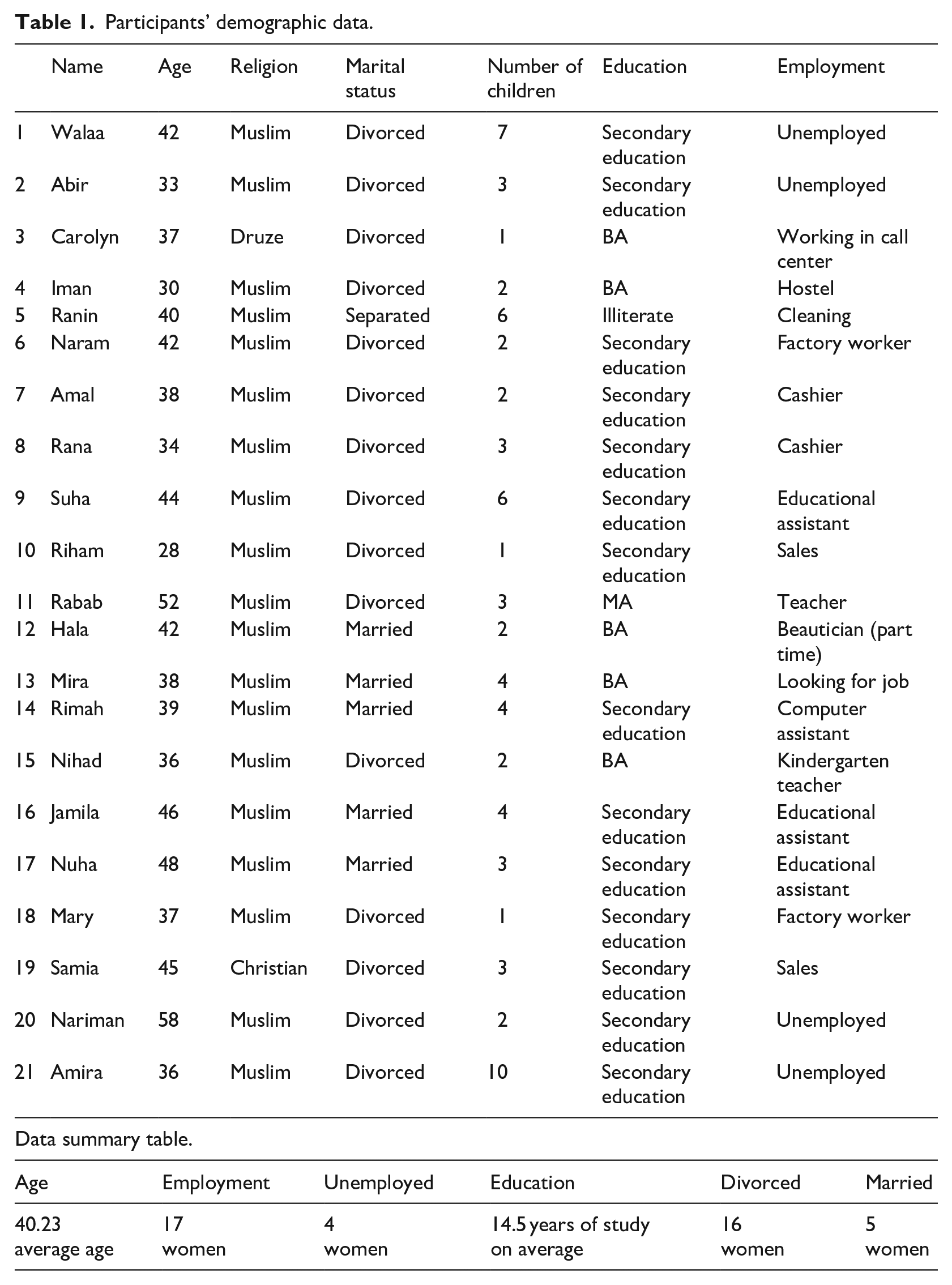
This qualitative study, conducted in 2022, draws on 16 semi-structured in-depth interviews, as well as the analysis of five legal cases, in total studying 21 Arab-Palestinian women in Israel. Due to the highly sensitive topic and the multiple vulnerabilities these women are experiencing, as well as the women’s fear that their participation in the study may harm their family members, the number of participants is relatively limited. Conducting a mixed-methods study and finding respondents and legal cases was difficult. Participants were aged 28–52 and live in various rural and urban locations in different districts. The interviewees have diverse educational backgrounds (master’s degree (n = 1), bachelor’s degree (n = 4), secondary and elementary education (n = 15)) and all were employed and mothers. Five were married and 16 divorced (See Table 1).
Participants’ demographic data.
Procedure
Participants were recruited through Arab-Palestinian feminist organizations, acquaintances, a call to recruit interviewees on social networks and the snowball method, whereby every interviewee is asked to suggest another potential interviewee. The interviewees were informed about the study’s objectives and importance, as well as the means for maintaining confidentiality and anonymity. Finding interviewees proved to be challenging, since many women who experience economic abuse, especially debts, were afraid not only of revealing the story on a personal level, but also of the consequences for their relationship with their family or exposure to their extended family. Due to its complexity, the process of recruiting interviewees for the study was a gradual one, and lasted about a year. We first conducted a non-binding introductory conversation with the woman in order to explain the study to her, followed by the interview. Happily, from the moment the women agreed to be interviewed, we encountered no cancelations or regrets. All participants explicitly expressed their consent to participate in the study and the importance they ascribed to research regarding this topic. These women conveyed that, despite previous attempts to seek support for their issues, this was one of the rare instances where they felt truly heard regarding their experiences of economic abuse. They also expressed a desire to contribute their stories to support other women who may be hesitant or ashamed to speak up. Moreover, they expressed hope and optimism that sharing their experiences would aid other women in dealing with similar challenges. As survivors of abuse, their willingness to participate demonstrates resilience and strength. In addition, many of the interviewed women had undergone divorce and endured prolonged experiences of violence, having already initiated the process of breaking free from the cycle of abuse. Thus, at the time of our interviews, as IPV survivors they were more open to participating in research with informed consent.
From a methodological perspective, while the interview setting may mirror the marginalized woman’s interaction with institutional bureaucracy, it also presents an opportunity for rectification (Krumer-Nevo, 2002). To allow for authentic free expression, especially for these underprivileged women, we chose an in-depth semi-structured interviewing technique, as is commonly practiced in the feminist literature, enabling us to explore and raise issues that are not a part of public or accepted academic discourse (Reinharz, 1992). During the face-to-face interviews, the range of emotions conveyed by the interviewees, along with their personal anecdotes about their experiences, serve to substantiate their words, eliminating any doubt regarding their sincerity. These women who choose to share their experiences despite facing marginality and violence are asserting their agency and striving for change by using their voices. From a feminist perspective, such an analysis is essential to understand various family and gender-related issues, such as partnership, equality, human rights, and the effects of international legislation. The interviews lasted at least 60 minutes each, and were conducted in Hebrew and Arabic as required. From a methodological perspective, both insiders (Arab-Palestinian interviewers) and outsiders (a Jewish interviewer) served as interviewers. Identity components influence the research design, whereby interviewers from within the collective, or those representing the dominant other, are liable to affect the interview situation and determine conversation structure (e.g. Meler, 2023). To obtain the most stratifying, diverse and rich results, we chose a research design combining interviewers from the inside and the outside.
In each interview, the participant was able to direct the conversation. She was asked questions about her socio-economic status, her employment, her own financial conduct and that of her family, gender relations, economic transparency, expenditures, financing and debts, situations of violence she has experienced, and the sources of assistance she could benefit from.
In order to achieve more insight into the phenomenon of coerced debt, we chose to integrate into our study a secondary analysis of data extrapolated from legal records of the Collection System Authority (2021–2024)—five court cases dealing with divorced Arab-Palestinian women, survivors of economic abuse, who are in debt or in insolvency processes. Such decisions of enforcement are not published in Israel in judgments databases, as they are not considered binding judgments. That is why we conducted a random search in legal databases according to the keywords: violence, bankruptcy, insolvency, debts. Over the past 5 years, no additional decisions were found. However, these legal texts, as Hacker (2005) argues, may be a source of sociological investigation of the relationship between the law and social order. The judicial texts were written based on a certain cultural context, therefore reflecting value perceptions in relation to the issues under consideration. This may also teach us about barriers and the existing structure of opportunities in light of the policies being implemented and the existing legal options available to these women.
The analysis followed Charmaz’s (2003) methods, which are based on division into key categories in an attempt to understand the women’s experience during marriage, gender relations, the spouses’ financial conduct, and the woman’s involvement in the family’s economic activities. By analyzing the interviews and considering the structural and cultural contexts the themes emerged.
Findings
The “Findings” section presents three central themes which emerged from the interviews and the court cases we analyzed. Elements ranging from “cultural baggage,” to the socio-economic and political conditions of women from a minority group, relations with the state, and the interplay among these factors. The first describes the way in which the centrality of the institution of marriage and motherhood in society means that women may enter into marriages in which economic abuse is already inherent; the second theme continues the previous theme, focusing on the married life of women who suffer from economic abuse; and the third theme discusses the challenges divorced women who are survivors of economic abuse face when they endeavor to begin a fresh phase in their lives.
Seeds of economic abuse
From the interviews we conducted and the court cases we analyzed, we learned about a recurring phenomenon among our interviewees in which was clearly present in the way they described their experiences, which highlights the disadvantaged position of women in a society where marriage and motherhood are seen as the ideal roles and ultimate goals, even before securing their future through education and employment. Furthermore, from their responses, it is evident that they played their part in the gender script by their initial agreement to enter a marriage which already contained the seeds of economic abuse, hardship, and struggles with debts they did not create. Amal described it as follows: . . . The marriage was match-made. My husband had a house before the marriage and he owed on the mortgage he had on it. A large amount. I married knowing beforehand that he had this debt, and I said to myself that the two of us will help each other, the debt will be covered and everything will be O.K . . . The truth is that I very much wanted to get married to have children. (38, divorce+2, high-school education, cashier)
Admittedly, Amal was aware of her husband’s economic situation before they married, but she said that she wanted very much to get married and be a mother. This interpretation of Amal’s words does not universally apply to all young people in Arab-Palestinian society in Israel. However, in the social-class position where it is frowned upon for young individuals to engage in romantic relationships outside of marriage, marrying at a relatively young age is often a prevalent choice. Furthermore, as a young woman she did not fully understand the meaning involved in changing her status to a married woman that will soon become an economic partner in the household, and in this case, a household that carries debts and is subject to financial sanctions. It can therefore be argued that her lack of economic literacy about the repercussions of debts led her to supposedly knowingly tie herself to an economic system in which there are injuries and complexities. A longing for marriage despite her young age, and the lack of experience that also leads to a superficial and quick acquaintance, also appears in Samia’s description: We met before we got married, altogether 3-4 months. And we decided to get married. You know a young girl of 20 . . . I was kind of insecure, who will marry me? I’m short and I have a long nose . . . I didn’t understand much about the financial problems . . . the money . . . My mother told me at the time: he has no money. You are used to a certain level but who understands this thing? Really, at first I didn’t understand it. I wanted to get married, I wanted to wear the white dress and I wanted to make a big show. There was no discussion between us about the future, what the expectations are, what we want, what . . . there was no time for this discussion. We used to go to a restaurant and hang out . . . everything was fun fun fun, and after a month I got pregnant with twins. (45, divorce+3, high-school education, sales)
Samia’s words reaffirm the powerful social forces that push young women into marriage without fully knowing their partner or understanding crucial aspects about them. She came from a relatively financially affluent background, recalling in an interview her acquaintance with a guy who had no financial means. Growing up in a lavishly indulged environment, she interpreted her mother’s comment as teasing and viewed her decision to marry him as a form of defiance. In addition, she mentioned in the interview that her father wholeheartedly endorsed the marriage. Due to the prevailing social notions regarding relations between the sexes without marriage, he believed it was unconventional for a young girl to go around with a suitor and deemed it preferable for her to be married, despite their brief acquaintance.
Economic abuse is intertwined within married life
Although most of the interviewees were divorced, a large part of their words referred to their marriage and how they experienced economic abuse as married women. This is evident in Rana’s description: I worked all day, but my husband totally controlled my bank account. I was born into the way [culture] that the woman had to be submissive to the husband and not to object, so I was afraid of him, I wouldn’t have objected to his controlling the account. I didn’t have any control over my bank account. He held the credit card, the checks- bought his brother a television, his mother a telephone using my account, and he had standing orders that bounced. The situation got entangled to the point where my account was foreclosed and I had a no-exit order preventing me from leaving the country . . . (34, divorced+3, high-school education, cashier and kitchen assistant)
Rana’s words emphasize the highly influential part gender roles and social norms play in influencing women’s bargaining power (e.g. Vyas et al., 2015). Like Rana, other interviewees described a situation whereby they were not involved in the family’s financial management during their marriage, did not play an active part in economic decision-making processes, and did not have financial autonomy even if they had paid employment. For example, Carolyn indicated a lack of economic independence and unequal access to family property and financial resources: When I was married, I was not active in the joint account and I didn’t know anything about our account, because he managed it, and I didn’t even know the code for it . . . he controlled everything on the account . . . all the money was “his,” there was no money of mine, even though I worked; I was forbidden to say “this is my money.” (37, divorced+1, B.A., call center representative)
Not only does Carolyn point out her lack of involvement in managing the family finances, she also uses the phrase “the money was ‘his’ and I could not say this money was ‘mine’.” Despite the common model among married couples of pooling their finances, whereby all income flows into a joint account from which all expenses are paid, as defined by Pahl (1997), economic and ideological or discursive factors also play a part in financial management within a marriage (Roman and Vogler, 1999). As emerged from the interviews, money allocation and management of the family’s budget are often gendered (e.g. Meler, 2019). From Carolyn’s words, it can be understood that her partner’s financial control persisted, even though she had paid employment: During the marriage, there were many things that I didn’t do because he had conservative complex conceptions ( ). Anything I asked for, he refused and said “no,” and didn’t allow me to do anything. I gave up so as not to make problems.
Reading between the lines, it becomes clear that this is not just about financial restrictions, but also about feelings of fear and apprehension that indicate economic abuse. Carolyn’s spouse made all major decisions concerning income distribution and had financial control. The couple both maintained the idea that the man is the main breadwinner, and that the woman’s income did not increase her power as far as decision-making, since it was considered less important than her husband’s income (e.g. Pahl, 1997). Similarly, Amal described it as follows: We worked endlessly to close our debt, and thank God we succeeded and were on our feet after a short time. The debt stemmed from the fact that he didn’t pay his mortgage and there was a guarantee on the house, so we fought to keep the house. He was responsible and worked and earned money, but on the other hand did a lot of foolish things and involved himself in one business or another. That was my problem with him. Then he decided to start a business requiring a large sum of money . . . I tried to convince him not to do it but didn’t succeed, he lost all the money within two months . . . I was very angry that we were forced to lose everything after we had to work several jobs in order to close the debt. We stopped putting the wages into the bank account . . . and we got to bankruptcy . . . I also was dragged to bankruptcy . . . (38, divorce+2, high-school education, cashier)
Throughout her marriage, Amal was not an equal partner in the economic decisions her husband made, and was, in fact, more like an “extra” actor in the family’s economic system, although she worked and was an active player in repayment of the family debts.
Like Amal, other women overwhelmingly reported that their income did not give them any more say or “voice” in household decision making (e.g. Meler, 2019; Vyas et al., 2015). Entanglement in debt that occurred without the woman’s knowledge or her having any control over the circumstances which led to it is described by Abir, a 33-year-old divorced woman with three children, who married at the age of 21. Abir told us that the debts began before her divorce. While pregnant, she was asked by her husband to sign various bank documents. As soon as she signed a bank guarantee in her husband’s favor, without understanding and without being told the amount, she became his guarantor, and remains so to this day. Throughout her marriage, she signed similar guarantees several times without understanding, believing, based on the explanations she received, that these were routine banking procedures required of a spouse. The husband began to borrow money in the gray market, becoming entangled in additional debts, and exerted enormous pressure on Abir to ask her parents for money. He used verbal abuse against her, prevented her from studying and made it difficult for her to find work. Her debts today amount to about NIS 253,000 (~$70,141), and there are three Enforcement cases against her.
A married life saturated with economic abuse on various levels also emerges from Nuha’s description: I worked all the time (since the beginning of my marriage), and due to the pressures, I never knew how much I earned. I had a visa and I am the one who went to buy the clothes, shoes, everything that was missing, I did all the things. When did I look after myself? As the eldest son started studying and had to fill out forms and hand in slips. Until then, I wouldn’t even open my pay slip, I didn’t know what was going on there. And there I found out that I get a salary of 12,000 NIS (~$3326) compared to my husband’s salary of 5-6 thousand NIS, when he sits at home for three days, and I am under a load of cleaning and cooking and all that, and I also constantly have to check with him about my expenses, “why are you wasting this and that . . .” Even my personal stuff, I wouldn’t do. It was a shock for me, that for 10 years I have been working and earning like this and he just sits and pampers himself. Q: And the financial management was in his account? Or is it a joint account? Nuha: No, not shared. He manages my account, he told me at the time that it was temporary and every time we repeated the same things, we agreed to remove him from my account and he did not agree. The last time he dragged me for real was two years ago. It happened in front of the people and it was very embarrassing, he forcibly dragged me by my hand to leave the bank, and the security came thinking something had happened, and then I had to leave the bank. (48, married+3, high-school education, educational assistant)
Nuha’s description embodies many characteristics of women who suffer from economic abuse. Lack of involvement in the household’s financial management, ongoing monitoring of expenses, a large contribution of the woman to the family income as a result of hard work, but in practice, there is management by the man of the woman’s account, and physical violence accompanying economic abuse.
The challenge of getting back on one’s feet
After the divorce (which is a complex process in itself), women start to understand the consequences of their oblivion regarding their economic state, as they only understand in retrospect that during the marriage, their husband was already deep in debt as he spent money beyond his economic capabilities. Furthermore, for many the economic problems worsened after the divorce. Carolyn, like other women we interviewed, was not only in debt, but also did not receive the alimony she was awarded by the court: After the divorce, he didn’t support us financially because his economic situation was not at all good, and I also did not get alimony, and after some time I discovered that there were debts that he involved me in as well as himself . . . (37, divorced+1, BA, call-center representative)
The following examples demonstrate those “entanglements,” as Carolyn describes them, or debts that only become known to them after the divorce, originating in their lack of involvement in the financial management when married, and their implications for the wellbeing of life as a divorcee and a single mother. Thus, Rana described this situation: My husband didn’t pay the electricity bill, the property tax—the standing order bounced, and because of that I accumulated debts after the marriage (34, divorced+3, high-school education, cashier and kitchen assistant)
Amal, like Rana and other women, continues to be hurt by economic crises and debts, and has difficulty extricating herself from this economic abuse: I told him that it was hard to pay this sum. The girls are with me, I pay the rent. It is difficult for me . . . he should have to pay me NIS 3,400 (~$940) alimony that the court determined. I get NIS 2,400 (~$665) from National Insurance and he has to pay me NIS 1000 (~$277) every month. As of now, he paid alimony only twice. And from the NIS 50,000 (~13,862) dowry after the divorce, he only paid NIS 10,000 (~$2770). I have been divorced for a year-and-a-half already, and until now I received only NIS 10,000 (~$2770). He used to give me the money in cash. One month paying and one month not, once he was sick and didn’t work for a few months. I was even ashamed to ask him for the money. I was considerate of him sometimes. . . . (38, divorce+2, high-school education, cashier)
From the interviews, it emerged that the women continue to suffer from economic abuse even after the separation or divorce, and struggle with poverty. Previous debts hinder economic stabilization of many women after their divorce, like in the case of Iman, aged 30, divorced for 2 years and a mother of two, who has a Bachelor’s degree and works in professional care. At the time of her marriage, Iman had completed a BA degree and began specialization studies, but left them in the middle because of family pressure. After years in a difficult marriage, she was forced to escape from her home one night due to a violent physical attack by her husband. She escaped by the skin of her teeth to her parents’ home, while her daughters stayed with their father at first. She lived in her parents’ home, sharing a room with her daughters when they were with her. Over time, following numerous endeavors on her behalf and repeated attempts to convince her parents and her brothers, she built herself and her daughters a separate residential unit in her parents’ yard, using her salary and with the help of loans from her brothers. After 2 years, when construction was complete, she got custody of her daughters and decided to go back and finish the training degree she had begun. She then discovered she had an old tuition debt of NIS 2000 (~$550). While married, she herself was not involved in any economic management or payment of bills, like tuition; it was all her husband’s responsibility and under his control. She did not know that her husband neglected to pay the bills, and thus was not aware of this debt. She later discovered that there were other debts to various authorities in her name. The new-old debts prevented Iman from completing her studies, as she could no longer afford to do so.
As in Iman’s case, many divorced women discover debts of which they were often previously unaware. This position puts them at an economic disadvantage that causes them to be dependent on the support of other men in their family. Moreover, although she received support, it was not a genuine gift, but rather part of a discourse that created a demand for reciprocity. Previous research (Meler, 2014) shows that family support is driven by obligation and a demand for repayment. Due to economic constraints and lack of government public housing solutions for single mothers in Arab-Palestinian settlements (Meler, 2023), while they are compelled to rely on family support systems, the act of “giving” is accompanied by a demand for obedience and comprehensive supervision, which impairs women’s ability to maintain their boundaries and their children’s freedom.
A similar issue of old debts also emerged in Walla’s description. Walla, a 42-year-old mother of seven, became entangled in debt due to a joint account she had with her husband while she was still married. Her remarks indicate that the shared account was opened by her husband, and she had no access to it. At the time of opening, the account she had no fixed income, but later, due to her husband’s financial troubles, he opened another account in her name only and started withdrawing money from it, promising to pay the money back. She later discovered that some of the money had been withdrawn for the family’s living needs, without her knowledge. Now, after the separation, she does not yet have a ruling entitling her to child support, and she now receives an income of NIS 3300 (~$914). She lives in an apartment that has no electricity, and the electricity company will not connect it due to the husband’s debts. Her total debts today amount to approximately NIS 110,000 [~$30,500], as well as eight Writ of Execution cases. Walla’s case demonstrates multiple economically abusive behaviors, such as spending money on behalf of spouses without their knowledge, creating debts under a joint household knowing the victim will be responsible, tricking victims into signing guarantees, and utilizing property as loan collateral (e.g. Rubinstein, 2016). In addition, she faces cumulative debts to authorities which hinder her ability to provide basic necessities (e.g. connection to the electricity grid), also forcing her to deal with the ECA. Like Walla, women who suffer from economic abuse sometimes find it difficult to rehabilitate themselves and develop an independent life, even after breaking up with an abusive partner. Sometimes they cannot hold a regular job (because they cannot deposit their salary in a foreclosed bank account), and they become dependent on other people for their financial transactions. These limitations add to their growing debts, and they are unable to reach a financial settlement. Furthermore, these women are sometimes declared debtors due to the debts, and may therefore find it difficult to support their children and are thus likely to return to a cycle of abuse due to a new situation of economic dependence (Meler et al., 2022).
As reflected in the interviews and legal proceedings, survivors of economic abuse may belong to all social strata. However, a low level of education and lack of Hebrew competency may hinder women’s integration into the labor market, as well as prevent them from developing a social-feminist awareness and learning of new laws designed to enhance gender equality and prevent DV (e.g. Erten and Keskin, 2022). As shown in the cases above, coerced debts made it difficult for women to rehabilitate themselves and start a new life, independent of relatives or other people (Meler et al., 2022). In addition, recently Arab-Palestinian families are shown to be over-represented among families living in poverty in Israel, and their poverty is more severe and persists for longer. In the absence of state assistance, dealing with daughters of the family in hardship is sometimes also a burden for their family of origin (Meler, 2023). The analysis of these cases makes it clear that the assimilation of gender thinking is required in order to understand the struggles of women from different backgrounds and the barriers they face in relation to their economic issues, and in order to formulate any policy to assist the economic rehabilitation of these women (e.g. Yassour-Borochowitz et al., 2021).
Discussion
This study focused on a previously scarcely researched topic—coercive debts imposed on women belonging to indigenous-national minorities by partners/ex-partners as part of abusive relationships and without their involvement in the creation of the debt. This is part of a phenomenon defined as economic abuse, which includes complex situations in which the perpetrator prevents his partner’s involvement in financial management and attempts to control her ability to obtain or use economic resources, or sabotages these to his advantage (Alnabilsy, 2013; Meler, 2016, 2019; Renan-Barzilay, 2017; Stark, 2007).
From previous studies (Adams et al., 2020; Postmus et al., 2011; Yassour-Borochowitz et al., 2021), it emerges that women encountering economic abuse confront distinct challenges. Recognizing the significance of gender perspective for analysis is crucial, however, our research advances beyond this by reaffirming previous studies that underscore the meaning that multiple marginality (societal gender expectations, education, class and ethno-national location) play in putting up barriers to women’s economic self-sufficiency. Finances are a gendered arena in our culture, with men typically socialized to be in charge of money. Women still face greater challenges managing their finances due to social conditioning reinforcing women’s beliefs of their inability to manage money, resulting in a reliance on men to do so (Anthes and Most, 2000). Similarly, Stark (2007) emphasizes the relational and gendered context of DV that makes these tactics difficult to detect, as the “means and effects are easily confused with the range of sacrifices women are expected to make in their roles as homemakers, parents and sexual partners” (p. 230).
As with all manifestations of DV, economic abuse, in general, and coercive debts, in particular, affect women from all socio-economic groups, ethno-nationalities and geographic locations. However, this study focuses on women belonging to indigenous-national minorities. The intersecting aspects of low socio-economic status, low education, and belonging to a minority group may result in women not always being aware of their rights; and therefore, despite their great needs which require an increased response, they use the existing services less, contact the relevant authorities less and encounter challenges in asserting their rights (Yassour-Borochowitz et al., 2021).
Therefore, understanding the intersections of vulnerability among certain cultural and/or ethno-national backgrounds or minority groups is undoubtedly significant for better understanding of the complexities and challenges women of distinct backgrounds face (Postmus et al., 2020). Indeed, the positioning of Arab-Palestinian women between harm and gender-based violence within Arab-Palestinian society, and gender inequality and exclusion in public life and welfare, intensifies their vulnerability and makes it difficult for them to leave a violent relationship and cope with financial debt (Alnabilsy and Elias, 2019; Stark, 2007).
Interviews with women in abusive relationships offer valuable contribution regarding their subjective perspective into the dynamics of coercive debt, and the unique challenges faced by indigenous-national minority women in such circumstances. The study findings reinforce the profound concern that in structures of familial inequality, when women have no access to family money or decision-making, this may lead to situations in which they are also liable to fall into debt due to their spouse’s economic conduct (Alnabilsy and Elias, 2019; Meler, 2016; 2019: Meler et al., 2022; Sa’ar, 2017). However, by focusing on women from a concrete socio-political context, this may also be seen as a biased perspective on marital life in general or within Arab-Palestinian culture specifically. Despite the existence of distinct patterns in abusive marriages, it is important to recognize the limitations of this viewpoint. Nevertheless, this is a qualitative study intended to raise the voice of women from distinct locations who suffer from economic abuse. Accordingly, we aim to adopt Abdulrahim’s (1992) nuanced perspective, which illustrates how “traditional” models of community and continuity may be occasionally obscured, yet also at times reaffirmed and bolstered through the distancing of these models, thereby perpetuating unequal marital patterns.
In addition, due to a gender script (Sa’ar, 2017), according to which domestic tasks and childcare are women’s responsibility, even when they have paid employment, they find it difficult to contend with the financial burden related to the debt, and are often drawn into situations of new debts. Without subsidized childcare, women find it hard to integrate into the labor market, or be available to manage proceedings connected with their debt and insolvency. The occupational hardship of Arab-Palestinian women, along with their relatively low wages, are liable to prevent them from paying their debts, or even complying with payment orders given as part of the insolvency proceedings. In essence, it is crucial to provide support services attuned to the specific challenges faced by Arab-Palestinian women, considering both gender-related and national barriers. These services should acknowledge the inequality experienced by Arab-Palestinian women as a national and gender minority, constraining their ability to break free from the shackles of coercive debt. The interviews have further shown that the lack of Hebrew competency of many Arab-Palestinian women affects their ability to handle the bureaucratic processes, such as filling out forms and submitting applications.
Moreover, the interviews reveal the absence of awareness of their legal rights among women who are socio-culturally excluded and alienated from the Israeli legal system. This prevents them from seeking help from the authorities, however, little of this is available. Similarly, Erten and Keskin (2022) claim that the scope of legal knowledge among people differs due to their different political knowledge, civic knowledge, and awareness of their civil rights and duties. Due to the vulnerable context described earlier in the case of Arab-Palestinian women, living in the geographic periphery prevents them from accessing various public services, thus even when they seek help and start procedures in an attempt to find solutions, they require both time and financial resources for transportation which they often lack. They have difficulty finding the time to submit requests and appear at legislative discussions, exhausting their earning capacity and complying with payment orders, sometimes due to the inability to hold a paid full-time job. Internal supervision by their community prevents Arab-Palestinian women in debt from walking around in public unsupervised, which is extremely limiting. Women are limited in terms of opening procedures of insolvency by themselves without their partner’s/family’s agreement, appearing at deliberations and meetings, or participating in a course for proper economic management without their husband’s/family’s consent. Even if the husband/family do consent, in some cases, women are required to be accompanied by a man because it entails traveling to a city with an ethno-national diverse population. In addition, these obstructions to mobility and limitations of movement in the public sphere make it difficult for women to show up for procedures in court or at the ECA, as required for insolvency procedures.
The case of coercive debts among Arab-Palestinian women is confirmed by previous studies showing that women from minority communities are at greatest risk of experiencing financial challenges and poor economic self-sufficiency (Johnson and Sherraden, 2007). As part of a minority group, these women are forced to deal with structural and cultural barriers that escalate their vulnerability and expose them to economic abuse.
In conclusion, gender awareness and recognition of the needs of women from an intersectionality perspective, understanding their distinct locations and the ways their lives are hurt by economic abuse, is the starting point to formulating appropriate policy and offering the right assistance to these women entangled in debt. Indeed, the contribution of this study is not only theoretical but also related to policy. The study sheds light on the unique difficulties and obstacles of Arab-Palestinian women who experience economic abuse as a case study of women belonging to indigenous-national minorities.
Accordingly, our research yields several practical recommendations: First, in order to improve language accessibility for indebted minority women who struggle with managing their situation in the official language, we recommend that welfare workers assist these women in completing official forms and necessary reports, or in drafting letters to authorities. This effort requires a team of professionals proficient in the minority language.
Second, the study’s insights may contribute to the formulation of appropriate legal regulations and banking rules which take into consideration debt and insolvency situations as a result of abusive situations, and the implementation of tailored regulations that consider power dynamics and imbalances inherent in debt situations stemming from economic abuse. Third, there is a need for further development of intervention plans, for example, enhancing linguistic accessibility and promoting financial literacy, particularly targeting young girls and women.
To sum up, this study aids in developing a value index to examine a range of economic relations between couples, from behavior considered normative to that which “crosses a red line.”
Future research should focus on interviews with policy makers, social workers, legislators and banking officials, to find out how awareness and support can be increased at all stages and in different spheres, for example, in promoting financial literacy among young women even before marriage, as a decisive step in reducing women’s vulnerability.
Footnotes
Declaration of conflicting interests
The author(s) declared no potential conflicts of interest with respect to the research, authorship, and/or publication of this article.
Funding
The author(s) received no financial support for the research, authorship, and/or publication of this article.

Data availability statement
Data sharing not applicable to this article as no datasets were generated or analyzed during this study. This is a qualitative study based on interviews we made. All identifying details were anonymized, and names were replaced with pseudonyms. The study consents with the IRB ethical guidelines of the relevant institutions.