




Abstract
Women’s low political participation remains a problem in many parts of the globe. Previous research within the African context has examined the gender gap, focusing on individual-level factors. Still, the gender gap persists after controlling for the usual barriers (resource, attitudinal, social, and cultural). We complement prior studies by exploring the impact of an overlooked factor—institutions. We theorize that the gender gap in political participation in Africa depends on the specific institutional context and nature of the institutions themselves. Focusing on electoral systems, gender quotas, and their inclusive outcomes (increase in women’s numbers in national assemblies), we hypothesize that in countries with proportional (PR) electoral systems, gender quotas should encourage higher participation among women and yield small to no gender gap. Using five waves of Afrobarometer data covering 32 African countries, the multilevel regression results reveal nuanced effects of institutions on the gender gap in both electoral and non-electoral participation. First, compared with majoritarian systems, we find that PR electoral systems help erase the gender gap only for electoral participation (voting). In contrast, for non-electoral participation, PR electoral systems show no significant impact on reducing the gender gap. Second, we find no evidence to support the hypothesis that gender quotas reduce the gender gap in electoral and non-electoral participation. Third, where women’s representation in legislatures exceeds 20 percent, there is a reversal of the gender gap for voting. However, for non-electoral activity, improving women’s presence in national legislatures proves more effective in reversing the gender gap only for those belonging to a political party. For other activities, such as joining others to raise issues, protest actions, and attend community meetings, the gender gap persists but diminishes, with women holding 20–45 percent of seats.
Introduction
Gender equality is a prerequisite for a peaceful, healthy society (The Sustainable Development Goals report, 2023) as well as a more inclusive and representative democracy (Ballington, 2005: 24) in both established and emerging democracies, particularly those in Africa, where women comprise 50.1 percent of the 1.17 billion people (World Bank, 2019). 1 In this regard, African countries have signed the Protocol to the African Charter on Human Rights and People’s Rights on the Rights of Women in Africa. Furthermore, African countries have signed international treaties such as the 1979 Convention on the Elimination of All Forms of Discrimination Against Women and the 1995 United Nations Beijing Platform for Action, which commits countries to improving gender equality, women’s political empowerment, and political participation. African countries’ commitment to advanced gender equality has resulted in improvements in some areas, such as education and health/survival, where the gender gap has been closed by 85.3 percent and 97.2 percent, respectively (World Economic Forum, 2022: 18).
Still, one area where the gender gap persists and is the focus of this article is political participation. In Africa, as in many parts of the world, women are known to participate in politics at a lower rate than men. 2 Thus, the gender gap in political participation is used here to describe the substantial gap or differences that exist between men and women when it comes to engaging in politics. Research has identified several factors contributing to the gender gap, including resources, political attitudes, and social and cultural stereotypes (see Páez-Bernal and Kittilson, 2022). However, across the African continent, studies find the gender gap prevails even after controlling for these individual-level characteristics, albeit cross-national variation in the size of the gap. Moreover, the gender gap is small for voting compared with non-electoral political participation (Coffe and Bolzendahl, 2011; Isaksson et al., 2014). Our article extends existing studies on the gender gap in political participation in Africa, posing three interconnected questions: (1) why are women less inclined to participate in politics? (2) what accounts for the difference in gender disparities across countries? (3) why is there a slight gender disparity in some political activities but not in others?
To answer these questions, we advocate moving beyond individual-level explanations to offer a more precise explanation for the low rate of women’s participation and its variations across countries, emphasizing the importance of political institutions. In fact, we contend the gender gap in political participation in Africa depends on the specific institutional context and nature of the institutions themselves. The focus on institutions, particularly in the African context, seems relevant because their origins can be traced back to historical legacies such as colonialism. 3 Most African countries were not only colonized by countries such as France, Germany, Britain, Portugal, and Spain, but colonialism has long been considered to impact institutions (Acemoglu and Robinson, 2012). Moreover, the legacy of colonial institutions includes the promotion of patriarchal culture and norms, which we contend might ultimately spill over into the political sphere, especially when it comes to the participation of women in politics.
To further elucidate, MacLean (2010) and Conklin (2000) contend the French style of colonization in Africa was particularly intrusive, as it tended to promote assimilation and a conservative vision of community built around the nuclear family. Furthermore, the French conception of citizenship was decidedly male. However, the British approach to colonialism was less interventionist. Still, it was equally not tended to consider women much at all. In addition, Acemoglu and Robinson (2012) state that most African institutions were designed to serve the extractive 4 purpose of colonialism. With many African countries inheriting extractive institutions (i.e. political and economic) that were borne out of colonialism, the limited focus on institutions and how they might impact the gender gap in political participation seems highly motivated. Thus, focusing on electoral systems, gender quotas, and their inclusive outcomes (increase in women’s representation in national assemblies), we hypothesize that countries with proportional (PR) electoral systems and gender quotas should produce higher participation among women and yield small to no gender gap. We test these hypotheses by drawing on five rounds of data conducted by the Afrobarometer (AB) from 2005 to 2018 for some 32 African countries. Our article contributes to the literature on the gender gap and political participation. We extend the study of institutions and their relationship with women’s political participation in Africa. Previous research has largely focused on Western democracies (e.g. the United States and Western Europe) and, to a lesser extent, newer democracies, notably those of Latin America. In addition, by focusing on a longer period, 5 we provide a more comprehensive understanding of the impact of institutions on the gender gap in political participation in Africa in terms of the scope of data use and the number of dependent variables examined.
Previous research: explanatory factors for the gender gap in political participation
In the words of Dalton (2000: 57), democracy is not just a spectator sport—it requires the active involvement/participation of its citizens. Political participation is activities ordinary citizens undertake to influence political outcomes (Teorell et al., 2007). Specifically, these activities include electoral (voting) and non-electoral activities that take place beyond the electoral period, such as protest action, contacting, petitions, boycotts, joining others to raise issues, and attending meetings (Verba et al., 1978). Influenced initially by studies from established Western democracies, particularly those of the United States and Western Europe, scholars have long noted women’s low engagement in politics and have developed explanations, which can be categorized into individual, contextual and institutional.
First, among the individual-level explanations, a vast body of studies drawn from the civic voluntarism model suggests gender gaps in political participation are rooted in differences in resource access (Verba et al., 1995). Accordingly, women are less likely to participate due to a lack of access to education, income, and employment opportunities, which limits their ability to gain the skills and resources required to participate (Schlozman et al., 1999). Next, cultural and social norms hinder women’s participation. Cultural and social norms rooted in patriarchal culture and religion emphasize traditional gender roles and stereotypes. As a result, attitudes toward women’s participation are shaped in a way that prioritizes family and domestic responsibilities over political involvement (Shvedova, 2005). In addition, attitudinal factors such as political interest can explain why women participate less. For example, studies have shown that women and men tend to differ in their level of political interest, with men reporting a higher level of interest than women and, therefore, participating at a higher rate (Alexander and Coffé, 2018; Fraile and Gómez, 2017).
Second, studies underscored the salience of political context or contextual factors in explaining women’s low participation. Contextual explanations focus on factors like democracy, societal gender norms, and economic development (Desposato and Norrander, 2009; Inglehart and Norris, 2003). For example, studies contend the level of democracy can impact the political participation of men and women differently (Coffé and Dille, 2015). In political systems that are less free or open, issues such as political violence may have a more pronounced and negative effect on women’s participation than on men’s (Collier and Vicente, 2009). Next, previous research suggests gender norms can limit women’s political participation. Specifically, Inglehart and Norris (2003) state that societal gender norms, such as those that measure political empowerment and labor market/force, create inequalities that spill into the political arena. This implies that in countries where gender norms are not hostile, women should be more liberated and, therefore, more likely to participate. Finally, authors contend that a country’s economic development moderates the perception of women’s roles (Inglehart and Norris, 2003). In particular, these studies show that the wealthier a nation is, the more egalitarian the gender attitudes toward women are and, therefore, the more likely women are to engage in politics.
Third, beyond the individual and contextual explanation, a prominent line of research that accounts for the gender gap in political participation focuses on the role of institutions. The institutional perspective suggests that adopting institutions that make participation easier can incentivize marginalized groups, particularly women, to participate more Kittilson and Schwindt-Bayer (2012). Specifically, research suggests the adoption of inclusive electoral institutions such as PR electoral systems, gender quotas, and compulsory voting laws with sanctions. Relatedly, those that promote women’s representation in national assemblies affect men and women differently and help reduce the gender gap in both electoral and non-electoral participation (Córdova and Rangel, 2017; Kittilson and Schwindt-Bayer, 2012; Krook, 2014; Norris, 2006). However, we admit that empirical studies exploring the role of electoral institutions, notably gender quotas, produce mixed results. In the preceding section, we revisit the issues and provide detailed insights into our expectation that institutions play a significant role in fostering women’s participation and contribute to reducing the gender gap. This perspective is particularly relevant in the African context, where such analyses are infrequent.
Gender gaps in political participation in Africa: empirical record
As demonstrated above, research on the gender gap in political participation has been dominated by studies from Western democracies. However, over 30 years since most African countries began having regular multiparty elections, a handful of studies have begun examining the gender gap in political participation, focusing on both electoral and non-electoral participation. First, Coffe and Bolzendahl (2011: 253) can be credited as the first to examine the gender gap in political participation in Africa. Drawing on AB Round 3 data for some 18 countries and relying heavily on individual-level explanations, they found a significant gender gap in voting in 10 of the 18 countries, with women less likely to vote. In contrast, for a non-electoral mode of participation, such as collective actions and political contact, the authors found women were less likely than men to engage regardless of their socioeconomic resources or political attitudes. Second, Isaksson et al. (2014: 308), based on AB Round 4 data for some 20 African countries, found that women were 3.4 percentage points less likely to vote than men. In contrast, they were 12 percentage points less likely to join others to raise issues. Third, Hern (2020: 295) finds a large and substantial gender gap in non-electoral participation compared with voting. Specifically, the author finds women are 16 percent less likely to report a partisan preference, 49 percent less likely to contact a government official, and 30 percent less likely to attend community meetings.
Building on the studies mentioned above, we provide an updated picture of the gender gap in political participation across the continent for a longer period (14 years). To achieve this objective, we focus on five rounds of data from the AB AB data between 2005 and 2018 for some 32 African countries. Utilizing multiple rounds of the AB data enables us to identify changes in women’s political participation over time. In addition, we focus on a more comprehensive set of political activities: voting, join raise issues, attend community meetings, political contact, protest action and belonging to a political party (see method section for how these variables are operationalized). Furthermore, in evaluating the gender gap in political participation for the 14 years, we control only for the usual individual barriers, namely socioeconomic, attitudinal, and social, that have been the focus of previous studies.
Relying on mixed-effect regression, Table 1 (Models 1–6) shows the result of the gender gap in political participation across both electoral and non-electoral modes of engagement. Starting with electoral participation (voting), the coefficient is negative and statistically significant, suggesting women are less likely to vote. In particular, we find that the marginal effect of gender on voting is 2 percentage points lower for women (0.75) than for men (0.77), indicating that women are 2 percentage points less likely to vote than men across the 14 years examined. Next, turning to non-electoral participation, we find the coefficient estimate for women and our five participatory activities: join others to raise issues, attend community meetings, political contact, protesting, and party membership, is negative and statistically significant, indicating women are less likely to engage in these activities than men. The predicted probability indicates that women are 9, 7, 10, 2, and 5 percentage points less likely to join others to raise an issue, attend a community meeting, make political contact, protest action and belong to a political party than men, respectively. Largely, the result in Table 1 retold a familiar story, providing additional evidence for a gender gap in political participation in Africa. However, controlling for the usual barriers, the gender gap is more pronounced for non-electoral participation than electoral participation (Coffe and Bolzendahl, 2011; Hern, 2020; Isaksson et al., 2014).
Gender and political participation in Africa (2005–2018).
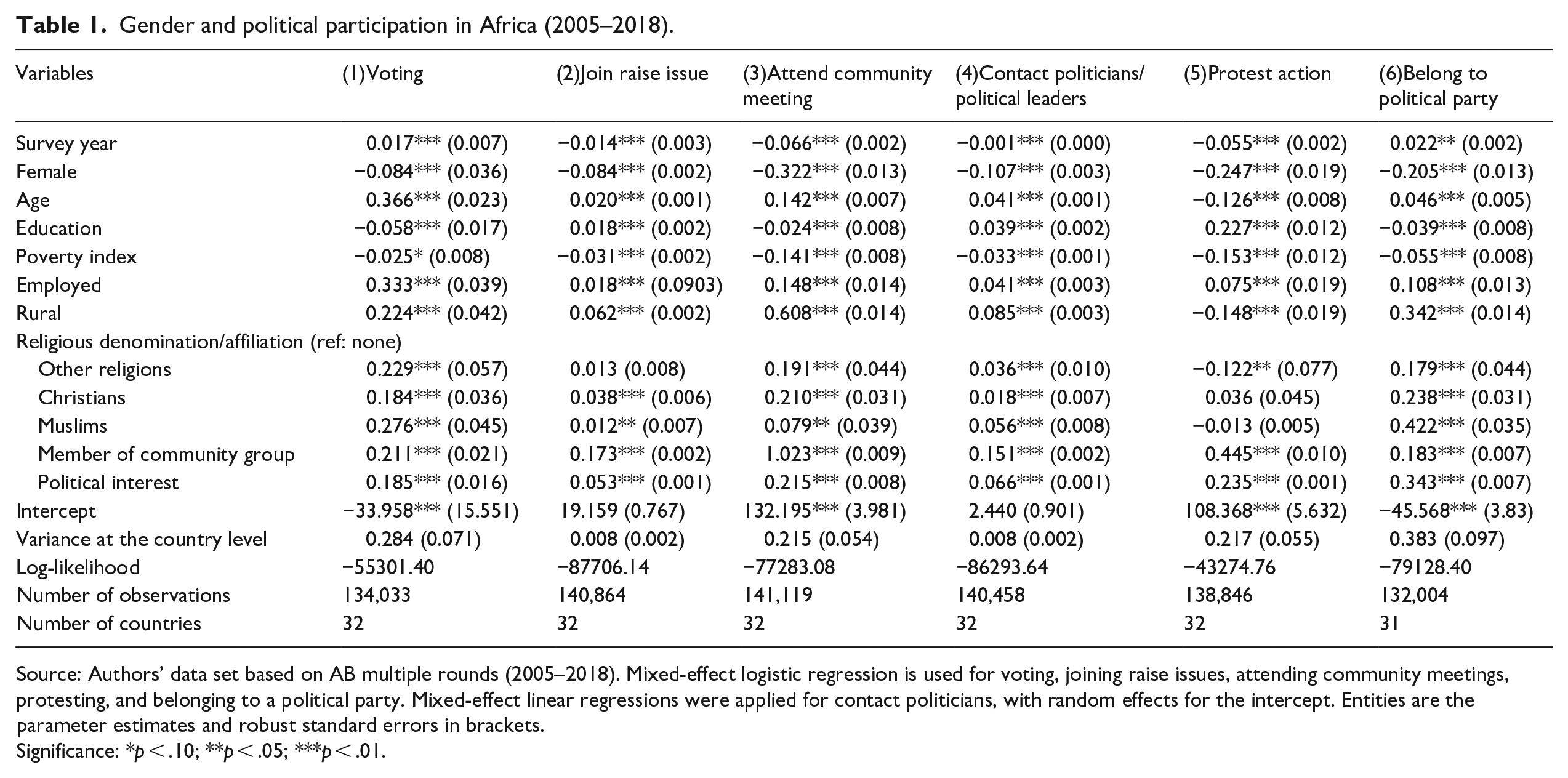
Source: Authors’ data set based on AB multiple rounds (2005–2018). Mixed-effect logistic regression is used for voting, joining raise issues, attending community meetings, protesting, and belonging to a political party. Mixed-effect linear regressions were applied for contact politicians, with random effects for the intercept. Entities are the parameter estimates and robust standard errors in brackets.
Significance: *p < .10; **p < .05; ***p < .01.
Overall, Table 1 shows the pattern of the gender gap across modes of participation for the whole region. Still, we argue for the need to examine the extent of the gender gap across individual countries, and this seems relevant given that previous studies mention cross-national variation in the gender gap for both electoral and non-electoral participation. Table 2 presents the country-country variation in the gender gap for voting. However, due to space limits, we do not present the results for engaging in non-electoral political activities for female and male respondents. But, these additional estimations are available in the Supplemental Material (see Tables A1 to A5). Table 2 6 explores the gender gap in voting across individual countries, with three patterns worth elucidating. First are a group of countries where women are less likely to vote. This includes 23 of the 32 countries. The second includes 8 of the 32 countries (Botswana, Cape Verde, Lesotho, Malawi, Namibia, São Tomé and Príncipe, Sierra Leone, and South Africa), where the gender gap is reversed (i.e. these groups are countries marked in bold). Finally, the third is a group of countries with no gender difference in voting; this includes 1 of the 32 countries (Senegal). This result warrants asking what factors could explain why women are more likely to vote in some countries than others.
Predicted probabilities of voting by gender and country.
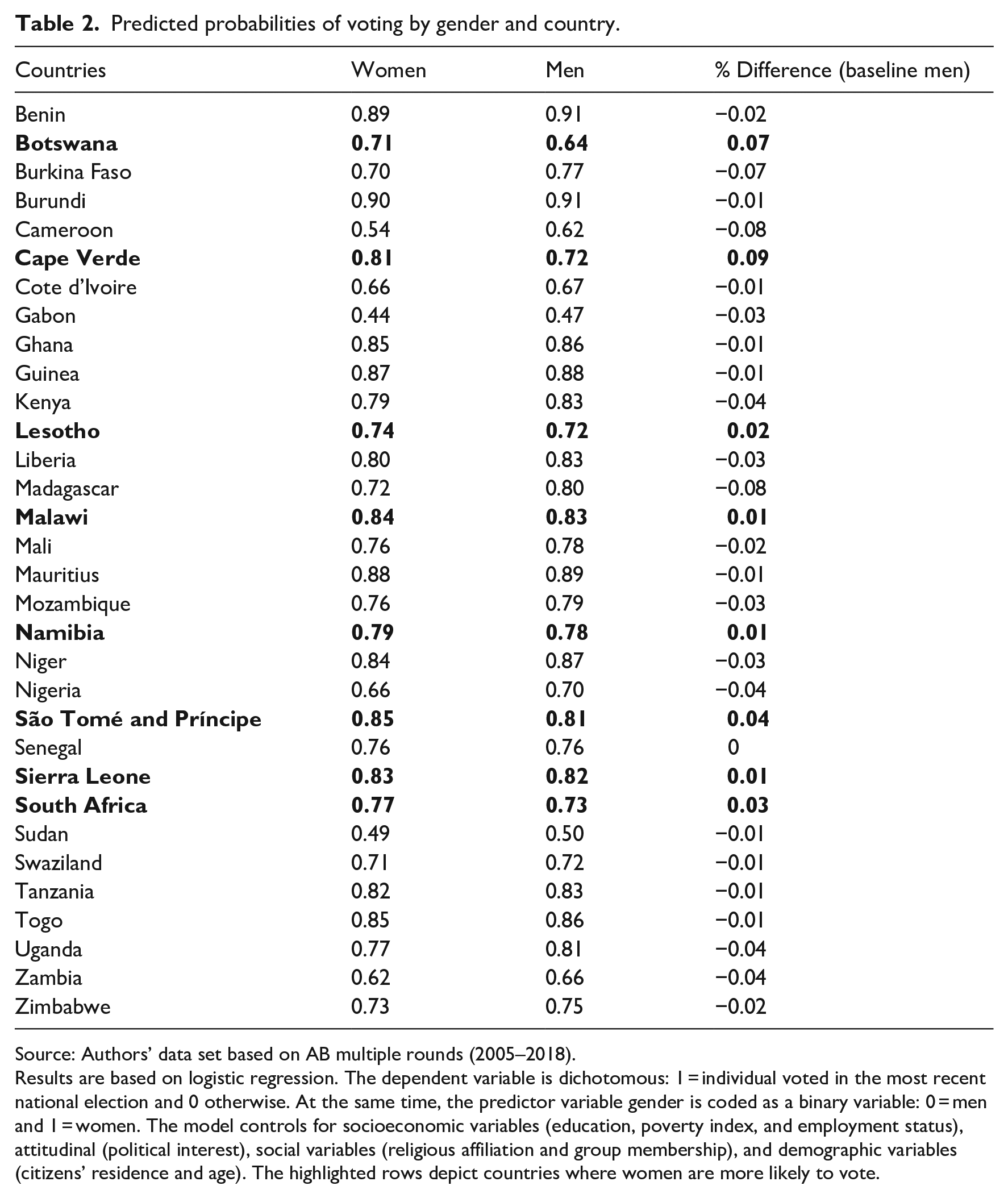
Source: Authors’ data set based on AB multiple rounds (2005–2018).
Results are based on logistic regression. The dependent variable is dichotomous: 1 = individual voted in the most recent national election and 0 otherwise. At the same time, the predictor variable gender is coded as a binary variable: 0 = men and 1 = women. The model controls for socioeconomic variables (education, poverty index, and employment status), attitudinal (political interest), social variables (religious affiliation and group membership), and demographic variables (citizens’ residence and age). The highlighted rows depict countries where women are more likely to vote.
In this article, we argue that addressing this question requires analysts to examine the nature of institutions across these countries. We find support for this assertion, as reflected in Table 2, where among the eight countries where the gender gap is reversed for voting, five have either adopted gender quotas, the PR electoral system or have a higher share of women in national assemblies (see Table A9 in the Supplemental Material for the specific types of institutions existing across these countries).
In sum, the findings in Tables 1 and 2 and prior works confirm women participate less in politics, even after controlling for individual-level explanations. However, not only are there cross-national variations in the size of the gap, but more importantly, the gender gap is small in voting (albeit there is no such gender gap in some countries, while in others, the gender gap was slightly reversed). In contrast, the gender gap is more substantial for non-electoral participation. To account for the gender gap in political participation, as we noted, studies across Africa have centered heavily on individual-level explanations. Although we agree that individual factors matter in explaining the gender gap, we suggest that researchers consider explanations beyond the individual level. At best, the individual level can only measure (subjective) approval of institutional norms, for example, due to social learning. Thus, institutional norms may operate through mechanisms that require measurement at levels other than the individual level. Thus, we consider the lack of attention to institutional factors a knowledge gap in previous research. We find the inattention surprising as research on Western countries suggests the importance of institutional factors such as the proportional electoral system, compulsory voting laws and gender quotas. Therefore, we contribute to previous research by focusing on electoral institutions to explain the gender gap in political participation.
Theoretical framework and hypotheses: institutions and the gender gap in political participation
Our study departs from institutional theory. We define institutions as socially constituted rules, including laws, norms, and conventions of expected behaviors that persist over time (Goodin, 1996: 19; Nee and Swedberg, 2005; Scott, 2013). In what follows, we examine why and how formal institutions such as electoral systems and gender quotas should influence the gender gap. However, we expect these two institutions to promote inclusive norms that reduce political participation costs for marginalized social categories (i.e. women), which means that the importance of electoral systems and gender quotas ought to be indirect (gender norms and party competition) rather than direct. Specifically, institutions such as the electoral system and gender quotas promote inclusive gender norms as opposed to non-inclusive gender norms (or gender stereotypes). We emphasize inclusive gender norms as no African country has compulsory voting laws (i.e. with legal sanctions). Therefore, the mechanisms of the electoral system and gender quotas ought to depend on the monitoring and sanctioning of inclusive gender norms (e.g. approval of women’s rights). Inclusive gender norms ought to undermine the disapproval of inclusive gender norms (i.e. remove gossiping, naming, shaming, guilt, threats, etc.). For example, inclusive gender norms should reduce the cost of women’s political participation in non-electoral politics. As inclusive gender norms incentivize women’s right to participate in community meetings or other visible political behaviors. Institutions may also contribute to the social learning of inclusive civic norms and obligations. For example, “the duty to vote” (Córdova and Rangel, 2017; Kittilson and Schwindt-Bayer, 2012; Krook, 2014; Norris, 2006). However, we do admit that the causal direction might not be quite apparent. For instance, Karam and Lovenduski (2005) discuss the various ways in which an increase in the number of women in parliament can enhance conditions for improved gender equality. Pioneer women initially learn the rules, then utilize them, and ultimately change them. Women in politics build networks with each other, with men, and with organizations, which is how they succeed in enhancing opportunities for women in society (Karam and Lovenduski, 2005). Hence, both the supply and demand for female candidates are influenced by the level of female representation. The fact that female representation varies between countries attests to the importance of the wider political context (Krook, 2010). We assume that institutions play a crucial role in creating favorable conditions for women.
In the following sections, we will elaborate on three separate hypotheses for closing the gender gap in political participation. The first two address the direct effects of the electoral system and gender quotas. The third addresses the effects of inclusive outcomes, the indirect effect on political participation from increased female representation.
Electoral systems
Beyond inclusive gender norms, institutions such as the electoral system regulate greater party competition. Party competition emphasizes how social categories interact with parties to promote their issues. This means that competition between parties indicates competition between the interests of social categories (including women or women’s movements). Thus, researchers usually use the electoral system to measure party competition. Most researchers agree on three types of electoral systems: plurality (or first past the post) systems, majority systems, and proportional (PR) systems (Blais and Masicotte, 1996). In plurality systems, the candidate receiving the most votes is elected, while in a majority system, a majority of the votes is required to be elected. Nevertheless, we focus on the difference between plurality/majority systems, on one hand, and PR electoral systems, on the other. Previous research has supported the claim that PR electoral systems encourage women’s political participation in Western countries (Beauregard, 2014; Lijphart, 1999; Powell, 2000).
First, we contend that greater party competition (i.e. PR electoral systems) incentivizes parties to mobilize marginalized social categories such as women. Second, greater party competition (i.e. PR electoral systems) implies that more parties may mobilize their issues, such as women’s rights, notably abortion, divorce, equal pay, and policing domestic violence (Lipset, 2000). Third, women may thus use their voting rights to make demands from parties. Women’s demands will provide greater incentives for parties to advance gender issues and make them salient in their election campaigns to mobilize female voters. Thus, party competition encourages political parties to support women’s rights and gender equality to a greater extent. This leads to our first hypothesis.
Hypothesis 1. Compared with plurality and majority systems, we expect PR electoral systems to encourage women to participate more and help produce small to no gender differences in political participation.
Gender quotas
Gender quotas refer to affirmative measures designed to address women’s low political participation and representation (Dahlerup, 2006). Researchers have proposed various typologies of gender quotas, here summarized in three different types: reserved seat quotas, electoral candidate quotas, and political party quotas (Rosen, 2017). However, on an overall level, the kinds of quotas differ between different parts of the world, including Africa (International Institute for Democracy and Electoral Assistance, 2021: 43–44). For example, electoral candidate quotas are common in Latin America, voluntary party quotas are mainly used in Western Europe, and reserved seats are predominantly adopted in Africa and the Middle East (Rosen, 2017). We contend that the effect of gender quotas depends on more than the specific type of implementation. According to Dahlerup (2005), three criteria need to be fulfilled for gender quotas to succeed in increasing female representation. First, the quota system must be compatible with the election system. Even with gender quotas, it is harder for women to get elected in majority systems compared with PR electoral systems. Second, rules about the ranking of the candidates need to be established. If it is possible to opt out of female candidates, it does not help to quota them on the list. Third, there must be sanctions so that disobedience against the quota system is not possible. Thus, a law stating, for example, 30 per cent of women in parliament does not automatically give such a result (Dahlerup, 2005).
However, we recognize that gender quotas potentially will change gender norms in the long run. Changing the political culture takes time, and gender quotas do not offer a “shortcut” or “quick fix” (Rosen, 2017). Gender quotas may fail to gain normative legitimacy (i.e. approval) among citizens. Previous research on Western countries indicates mixed results, as gender quotas may have unintended consequences (Kittilson and Schwindt-Bayer, 2012; Stockemer and Sundström, 2021; Zetterberg, 2009). Such unintended consequences imply that gender quotas may have a heterogeneous influence on political participation. For example, gender quotas may reduce interest in politics and thus alienate voters (Clayton, 2015). It is important to discern that gender quotas do not guarantee gender-equal representation and perhaps not even the right remedy for an unequal parliamentary assembly. If the root of the problem is that women lack political experience and competence, then education is needed to promote women’s place in politics. If the problem is institutions that are obstacles for women, then the solution is to change the institutions (Dahlerup, 2005). Although gender quotas may not be a universal remedy, studies in African countries have shown promising results. Previous research on African countries suggests that increasing the number of women in legislative offices helps foster women’s engagement in political interests, talking about politics and political contact (Barnes and Burchard, 2012; Hern, 2020). Thus, our second hypothesis addresses the direct effect of gender quotas on female political participation.
Hypothesis 2. We hypothesize that women would participate more in countries with gender quotas, producing small to no gender differences in political participation.
Inclusive outcomes
As discussed above, party competition in PR electoral systems will make parties more likely to nominate and support women candidates, which, in turn, mobilizes women to participate. Alternatively, parties will elect female representatives to attract female voters as this may increase women’s identification with the parties (Blais and Masicotte, 1996; Kittilson and Schwindt-Bayer, 2012: 19; Skorge, 2023). Empirical findings confirm that PR electoral systems tend to result in higher levels of women’s representation compared with plurality and majority systems (Karp and Banducci, 2008; Kittilson and Schwindt-Bayer, 2012; Krook, 2009). This means that party competition may promote inclusive gender norms and democratic norms and cultivate democratic values (Kittilson and Schwindt-Bayer, 2012). Based on this finding, we expect this to also hold in the African context.
Also, the enforcement of gender quotas signals the government’s commitment to address the under-representation of women in politics. In other words, gender quotas symbolize the ambition to reduce gender differences in politics (Kittilson and Schwindt-Bayer, 2012),as more women in governments will help provide role models for women in society, propelling women’s participation (Wolbrecht and Campbell, 2007). Thus, having more women in public office might imply that women’s interests, issues, and voices are better represented in government (Karp and Banducci, 2008). As such, gender quotas can change gender norms to promote more inclusive ones in politics. More inclusive gender norms would promote women’s participation in politics. Gender approval of women’s rights reduces the cost of political participation (Kittilson, 2005). Similarly, countries with gender quotas tend to elect more women in office than countries without quotas (International Institute for Democracy and Electoral Assistance, 2021: 43–44). Thus, the unintended negative consequences described above may be specific to Western countries. Taken together, these considerations lead to our third working hypothesis:
Hypothesis 3. We expect an increase in women’s representation should foster women’s participation, producing small to no gender difference in political participation.
Data and method
Data
The data for this study were drawn from the Afrobarometer data (AB), 7 a survey research project that aims to measure African citizens’ attitudes, opinions, and values. Data for the empirical analysis are drawn from five rounds (Rounds 3, 4, 5, 6, and 7) conducted between 2005 and 2018 covering some 32 African countries. 8 The decision to focus on these countries was made because they have been surveyed more frequently by the AB data, with a more consistent presence in the survey. The full list of countries included in the study is reported in the Supplemental Material (see Table A6).
Dependent variables
The key dependent variable in our study is political participation. Political participation is a multidimensional activity consisting of electoral and non-electoral activities that citizens can rely upon to influence governmental actions and policy/ or convey their political preferences (Verba et al., 1978). Drawing on the AB survey data, we focus on six participatory activities which AB pollsters declared to have taken part in, notably voting, joining others to raise issues, attending community meetings, protest action, belonging to a political party and political contact. 9 For ease of interpretation and comparability across modes of political participation and models, except for political contact, all our dependent variables (voting, join others to raise issues, attending community meetings, protest action, belonging to a political party) are collapsed into dichotomous variables (i.e. 1 = a participant and 0 = not a participant equal). 10 However, political contact is a sum scale measure of five items, all asking how often an individual has contacted any of the following: a local government councilor, a member of parliament, a traditional ruler/chief, an official of a government agency and a political party official for help to solve a problem or to give them their views.
Respondents could choose between four answers for each question, running from (0) never to (3) often. Since all five items have a categorical, ordinal scale, we used multiple correspondence analysis to reduce the dimensions to the needed one for categorical data. Thus, political contact is measured as continuous interval variables after performing multiple correspondence analyses on ordinal variables. Lower values (0) were associated with low participation, and higher values with high/frequent participation (3). Figure 1 demonstrates that voting remains the most widely spread political activity, with 71 percent of all respondents reporting that they have voted in their country’s most recent national elections. Joining others to raise issues (51%), attending community meetings (61%), and being a member of a political party (56%), however, are rather common among AB pollsters. 11
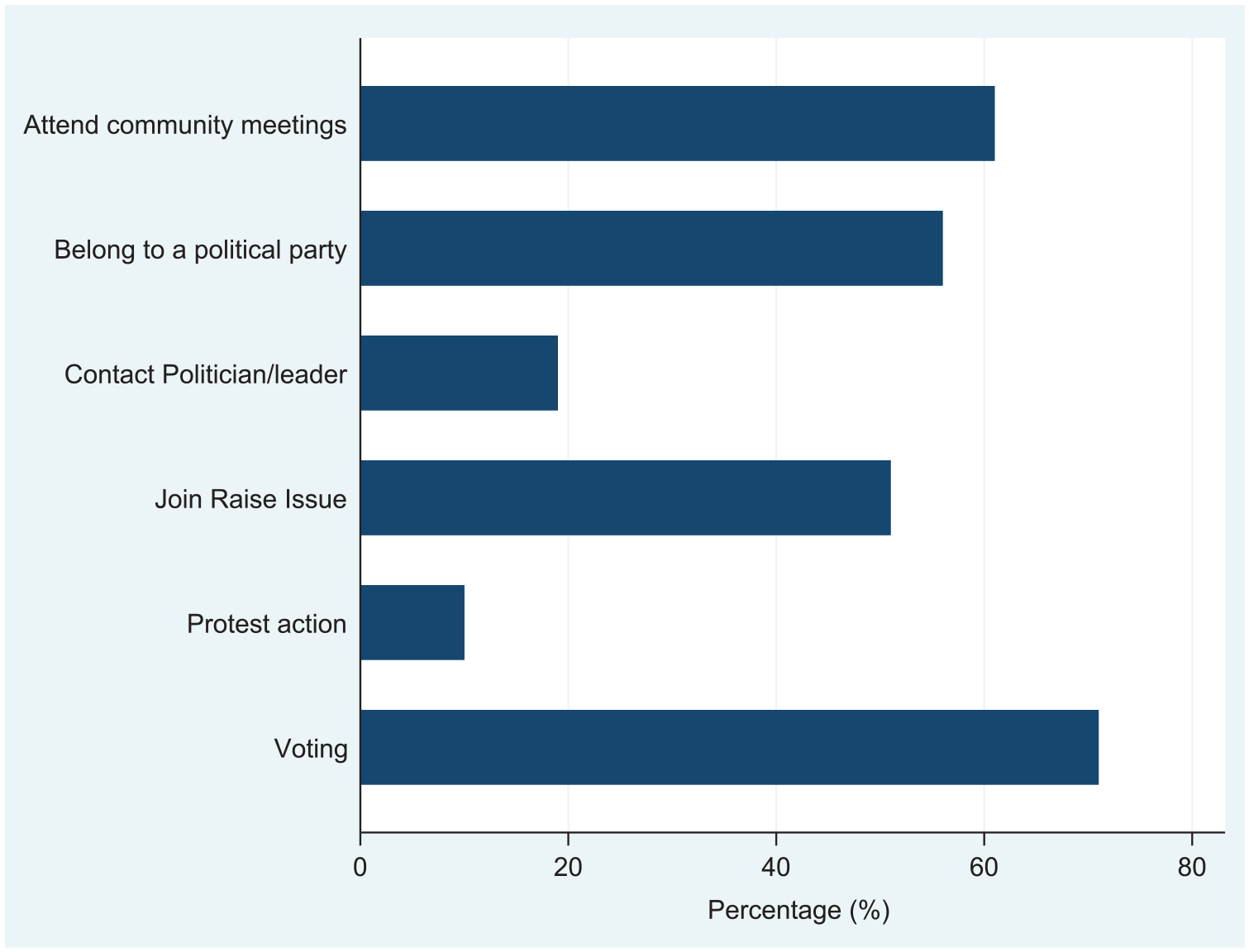
Occurrence of political participation acts.
Independent variables
Our first independent variable is gender. We operationalized gender as a binary variable coded 1 for females and 0 for males (reference category). In contrast, the main independent variables of interest are electoral institutions (electoral system and gender quotas) and their inclusive outcome (share of women in the national legislature). The electoral system is measured as a categorical variable, with 0 coded as majoritarian systems consisting of plurality/first past the post systems, 1 for a mixed electoral system, and 2 for a PR electoral system. Gender quotas 12 are a dummy variable coded 1 for countries with legal gender quotas and 0 otherwise. Finally, the share of women in office is measured as the percentage of women in the national legislature before the survey year. 13
Control variables
We control for several individual and contextual level variables previously suggested to influence political behavior and, more particularly, the gender gap (Tambe, 2021; Tambe and Kopacheva, 2023; Brady et al., 1995; Coffé and Bolzendahl, 2010; Coffé and Dille, 2015; Desposato and Norrander, 2009; Inglehart and Norris, 2003). First, at the individual level, we control for relevant sociodemographic variables such as education, employment status, and lived poverty index as a proxy for income, age, and place of residence. Second, we control political interests as an attitudinal variable. Third, we include a control for religious affiliation for social and cultural variables. Fourth, we control for mobilization influences through membership in community groups. Except for this, we control for the survey year measuring differing years the AB survey was conducted in each country. Turning to the contextual level variables, we control the level of democracy, gender equality, and economic development. The V-Dem liberal democratization index measures the level of democracy. Next, our gender inequality measure is derived using the gender inequality index developed by the United Nations Development Program. Finally, the level of economic development is measured by gross domestic product (GDP) per capita. 14 Table A9 (see Supplemental Material) presents how the African countries differ across key institutional and contextual indicators.
Empirical strategy
To investigate the impact of electoral institutions and their inclusive outcomes on the extent of the gender gap in political participation in Africa, we rely on multilevel modeling techniques to help account for the nested nature of our data (Sneijders and Bosker, 2012). We used mixed-effect logistic regression for binary dependent variables (voting, attending community meetings, joining raise issues, protesting, and belonging to a political party) and mixed-effect linear regression for continuous dependent variables (political contact). 15 Furthermore, we take full advantage of the features of the multilevel level by fitting a random effect for the intercept for the country and a random varying slope design, which allows for the effect of gender on political participation to vary by country (Heisig and Schaeffer, 2019; Mitchell, 2021). Our design strategy is more appropriate and corresponds with our expectations about country differences regarding the relationship between gender and political participation. Along this line, we include cross-level interaction to examine the moderating effect of the electoral system, gender quotas, and women’s share in the legislature on the gender gap. This enables us to understand how these factors affect the gender gap in political participation differently across our sample. Snijders, T. A. B., & Bosker, R. (2012). Multilevel analysis: An introduction to basic and advanced multilevel modeling. Los Angeles, CA: Sage.
Results
Table 3 displays a multilevel regression predicting the impact of electoral institutions and their inclusive outcomes on the gender gap in political participation. We present the main results in three steps. First, we analyze the effect of gender on both electoral and non-electoral participation. Second, we explore the influence of electoral institution variables on both forms of participation. Third, we examine how electoral institutions moderate the gender gap, considering the impact of electoral systems, gender quotas, and inclusive outcomes. Finally, we conclude by presenting results for control variables, encompassing both individual and contextual factors.
The effect of electoral institutions on gender gap in political participation in Africa.
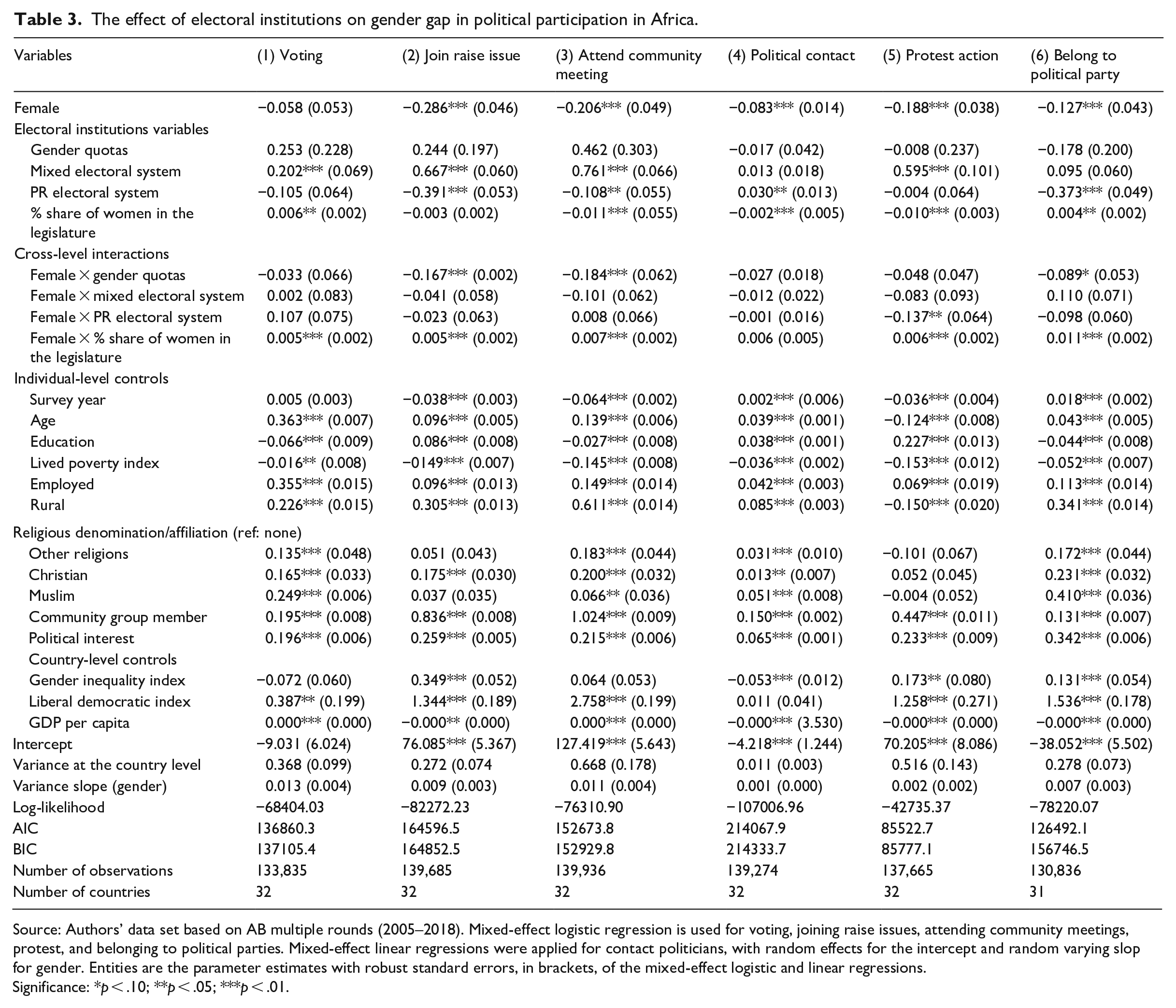
Source: Authors’ data set based on AB multiple rounds (2005–2018).
Mixed-effect logistic regression is used for voting, joining raise issues, attending community meetings, protest, and belonging to political parties. Mixed-effect linear regressions were applied for contact politicians, with random effects for the intercept and random varying slop for gender. Entities are the parameter estimates with robust standard errors, in brackets, of the mixed-effect logistic and linear regressions.
Significance: *p < .10; **p < .05; ***p < .01.
Main results
First, we examine the impact of gender on electoral and non-electoral participation. In Table 3, Column 2, the coefficient for the effect of gender on voting is negative but not statistically significant. This means there is no significant difference in the probability of voting between men and women. However, moving away from electoral participation (Table 3, Columns 3–7), all other forms of non-electoral political participation exhibit a negative and statistically significant coefficient, indicating that women are less likely to engage in these activities than men. Figure 2 shows men’s and women’s predicted probabilities of participating in each political activity when other variables are held at their mean values. The predicted probability indicates a relatively small gender gap for voting, aligning with previous findings of limited or no gender gap and sometimes a reversal of the gender gap in voting in established and some newer democracies of Western Europe, the United States, Latin America, and East Asia (Carreras, 2018; Kostelka et al., 2019; Liu, 2022). However, in non-electoral participation, except for protest action, a substantial gender gap exists in activities such as joining others to raise issues, attending community meetings, making political contacts, and belonging to a political party (Coffe and Bolzendahl, 2011; Hern, 2020; Isaksson et al., 2014). 16
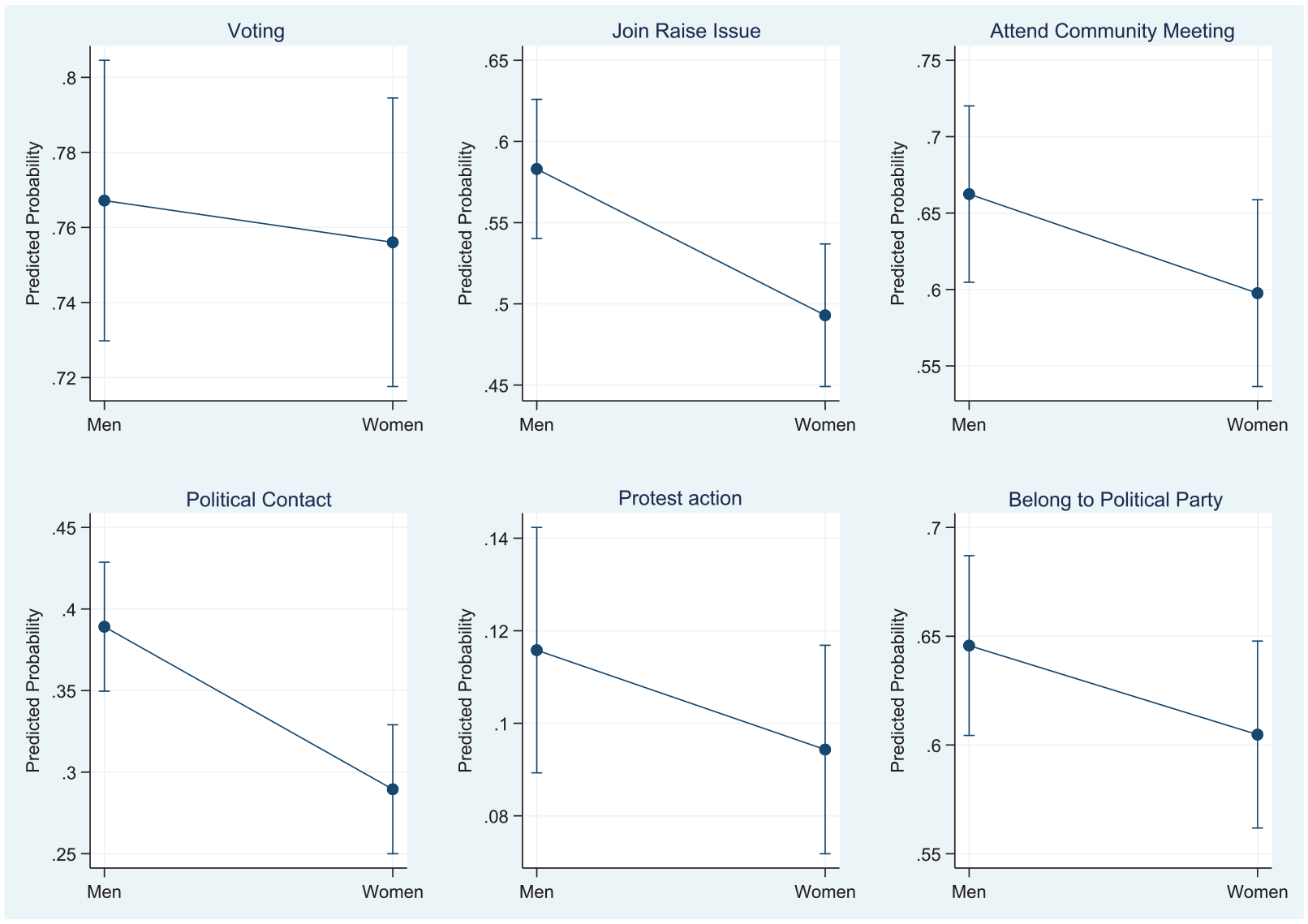
Predicted probability of political participation by gender (with 95% confidence intervals).
Second, we investigate the influence of electoral institution variables—electoral systems, gender quotas, and the share of women’s representation in national assemblies on both electoral and non-electoral participation. Regarding the impact of gender quotas on electoral participation, we find the coefficient estimate is positive and nonsignificant. For non-electoral participation, the effect of gender quotas is positive and nonsignificant only for joining other raise issues. However, it is negatively signed but nonsignificant for political contact, protest action, and political party membership. The lack of significant effect suggests the relationship between gender quotas and political participation cannot be implied.
Next, we examine the impact of the electoral system, starting with electoral participation. The PR electoral system exhibits a negative but nonsignificant influence on voting. However, for non-electoral participatory activities, particularly political contact, the coefficient is positive and statistically significant, indicating a higher likelihood of contacting political leaders in countries with a PR electoral system. For other non-electoral activities—joining others to raise issues, attending community meetings, protest action, and political party membership—the coefficient is negative and significant. Finally, examining the share of women in national assemblies, the analysis indicates a positive and statistically significant relationship for voting. This suggests people are more likely to vote in national elections as the share of women in national assemblies increases. However, for non-electoral participation, except for belonging to a political party where the effect is positive and significant, still for remaining activities such as joining others to raise issues, attending community meetings, political contact and protests, the coefficient is negative and, in most instances, significant. Overall, the result in Table 3 reveals that the effect of electoral institutional variables—electoral systems, gender quotas, and the share of women’s representation in national assemblies on various forms of political participation are quite distinct.
Third, the relationship between institutional variables and participatory actions demonstrates that some electoral variables influence political engagement. Still, these findings do not tell us whether these institutional variables have a contingent effect on the gender gap for electoral and non-electoral participation. To investigate whether electoral systems, gender quotas, and women’s representation favor women’s participation and thus ultimately narrow the gender gap, we resort to cross-level interactions. Recall our hypotheses that women would participate more in countries with PR electoral systems and gender quotas, producing small to no gender differences in political participation. Relatedly, we hypothesize that increasing women’s representation should foster women’s participation, producing small to no gender differences in political participation. Suppose the coefficient of cross-level interactions is positive and statistically significant. In that case, it suggests that the electoral institutions’ variable(s) have a significantly different effect on women and men, indicating that the gender gap varies by the country’s institutional context.
First, beginning with the cross-interaction between the electoral system and gender, focusing first on electoral participation, Table 3 shows that the PR electoral system has a nonsignificant effect on gender but runs in the expected direction (i.e. positive effect). Figure 3 visually illustrates these results, suggesting that the gender gap in voting is erased in PR electoral systems compared with majoritarian systems. In particular, women are 1 percent more likely to vote than men in countries with PR electoral systems than in majoritarian electoral systems. This finding aligns with comparative studies, such as those by Kittilson and Schwindt-Bayer (2012), indicating that proportional electoral systems tend to result in a smaller gender gap. While the result partially confirms hypothesis 1, caution is warranted due to the nonsignificant coefficient for the interaction. To validate our modeling strategy, we conducted a sensitivity analysis by separately adding the cross-level interaction between electoral institution variables and gender in a step-wise process. Supplemental Table B1 reports that these interactions yield similar results in Table 3.
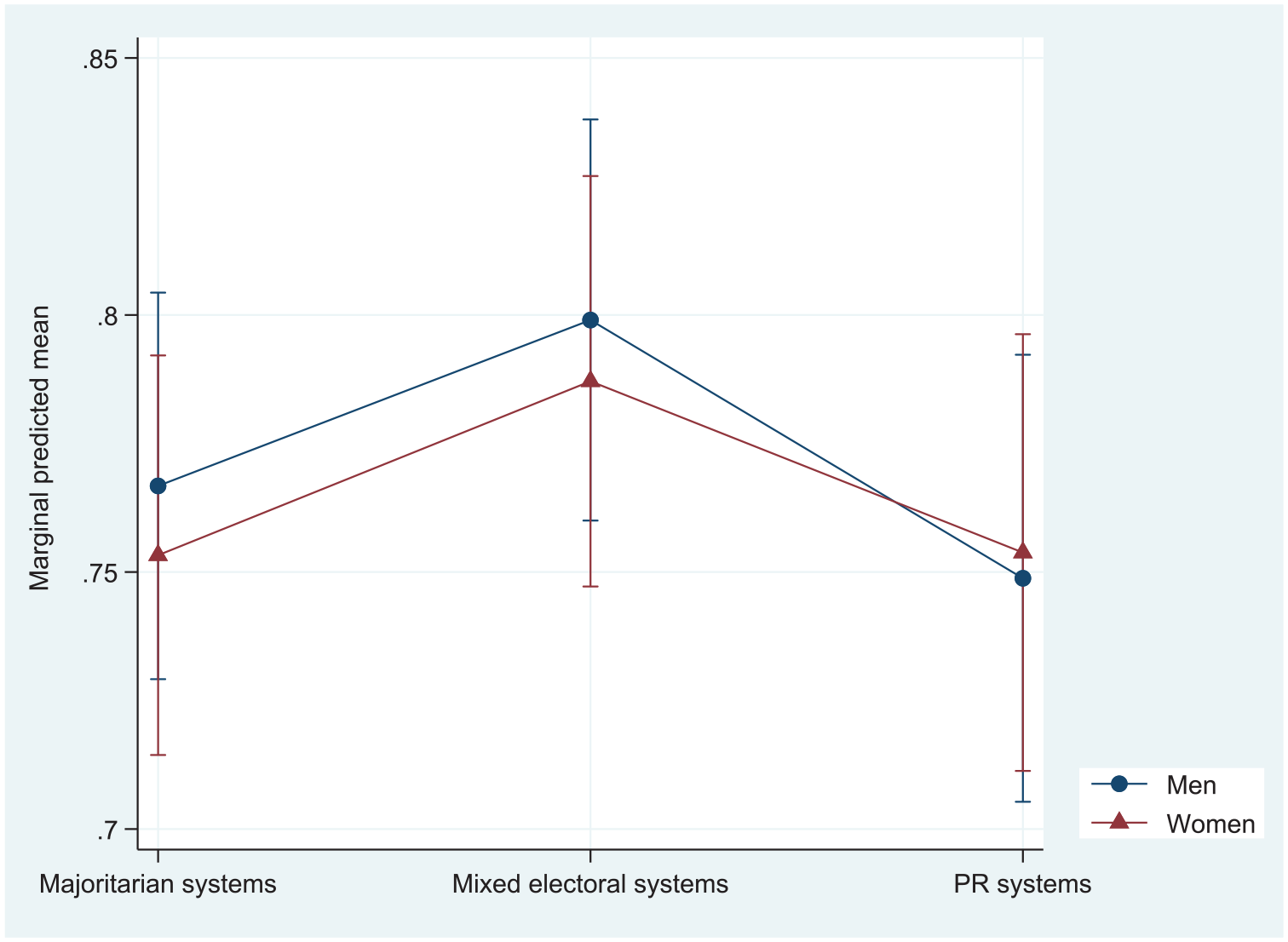
Cross-level interactions between men and women and voting by electoral systems (with 95% confidence intervals).
Notably, the cross-level interaction between gender and the electoral system on voting is statistically significant at the 0.05 level. This result affirms Hypothesis 1, explaining why women in South Africa, São Tomé and Príncipe, Lesotho, and Cape Verde are more likely to vote than men. In contrast, regarding the cross-level interaction between the electoral system and non-electoral participation, Table 3 (Columns 3–7) shows that the PR electoral system has a significant interaction with gender for protest action and has a negative effect. In contrast, for the remaining non-electoral activities, such as join others to raise issues, attend community meetings, political contact and belong to a political party, the cross-level interaction between gender and the PR electoral system is nonsignificant in some instances but generally not in the hypothesized direction (i.e. all have a negative effect). If anything, this result aligns with prior studies that find PR electoral systems are associated with a larger gender gap than plurality systems (Beauregard, 2014).
Second, moving to the cross-interaction between gender quotas and gender and starting with voting, Table 3 shows that gender quotas do not significantly interact with a respondent’s gender, and it has a negative effect. In contrast, for non-electoral participation, gender quotas significantly interact with gender for joining others to raise issues, attending community meetings, and belonging to a political party, but it has a negative effect. At the same time, the effect of political contact and protest action is a negative sign but nonsignificant. Based on these findings, we can confirm hypothesis 2 is rejected. However, to increase confidence in the result, we estimate a model with an alternative measure of gender quotas (party quotas). The result reported in Table A10 (see Supplemental Material) supports the idea that adopting party quotas does not increase women’s political participation or narrow the gender gap.
Overall, the result suggests that, if anything, gender quotas may have a negative effect on the gender gap in these political activities in Africa, which is consistent with the findings of Clayton (2015), who found that the adoption of gender quotas had no effect or might even reduce women’s political engagement in some contexts. Simultaneously, this result challenges assertions that gender quotas function as affirmative action measures to enhance the representation of elected women and promote gender equality. 17 Instead, studies suggest that quotas are frequently utilized for political expediency rather than leveling the playing field (Dahlerup, 2005). Furthermore, this result might reflect that many African countries have introduced quotas, yet there is no reliable data/information to demonstrate that quotas have been actually implemented (Dahlerup, 2006). 18 To substantiate, most countries have introduced legislated candidate quotas and reserved seats across our sample. For these quotas to be fully implemented, they must be mandated through national constitutions or electoral legislation. However, in the majority of these countries (e.g. Burkina Faso, Ivory Coast, Mali, and Niger) this is not the case.
Finally, rounding up the cross-level interaction between gender and our measure of the inclusive outcome of the electoral institutions (share of women in the legislature), we observe the interaction between the percentage share of women in the legislature and gender is positive and statistically significant for five political activities (i.e. voting, join raise issues, attend community meeting, protest action, and belonging to a political party) except for political contact where it is positive and nonsignificant. This result suggests women are more likely to participate as the percentage of women in national legislature increases (Barnes and Burchard, 2012; Desposato and Norrander, 2009). To fully evaluate the impact of the share of women in the legislature on the gender gap, we provide a graph of the marginal effect that men and women participate in politics (see Figure 4). Figure 4 indicates a more substantial effect of the percentage share of women in the legislature on the gender gap in voting, join others raise issues and belonging to a political party.
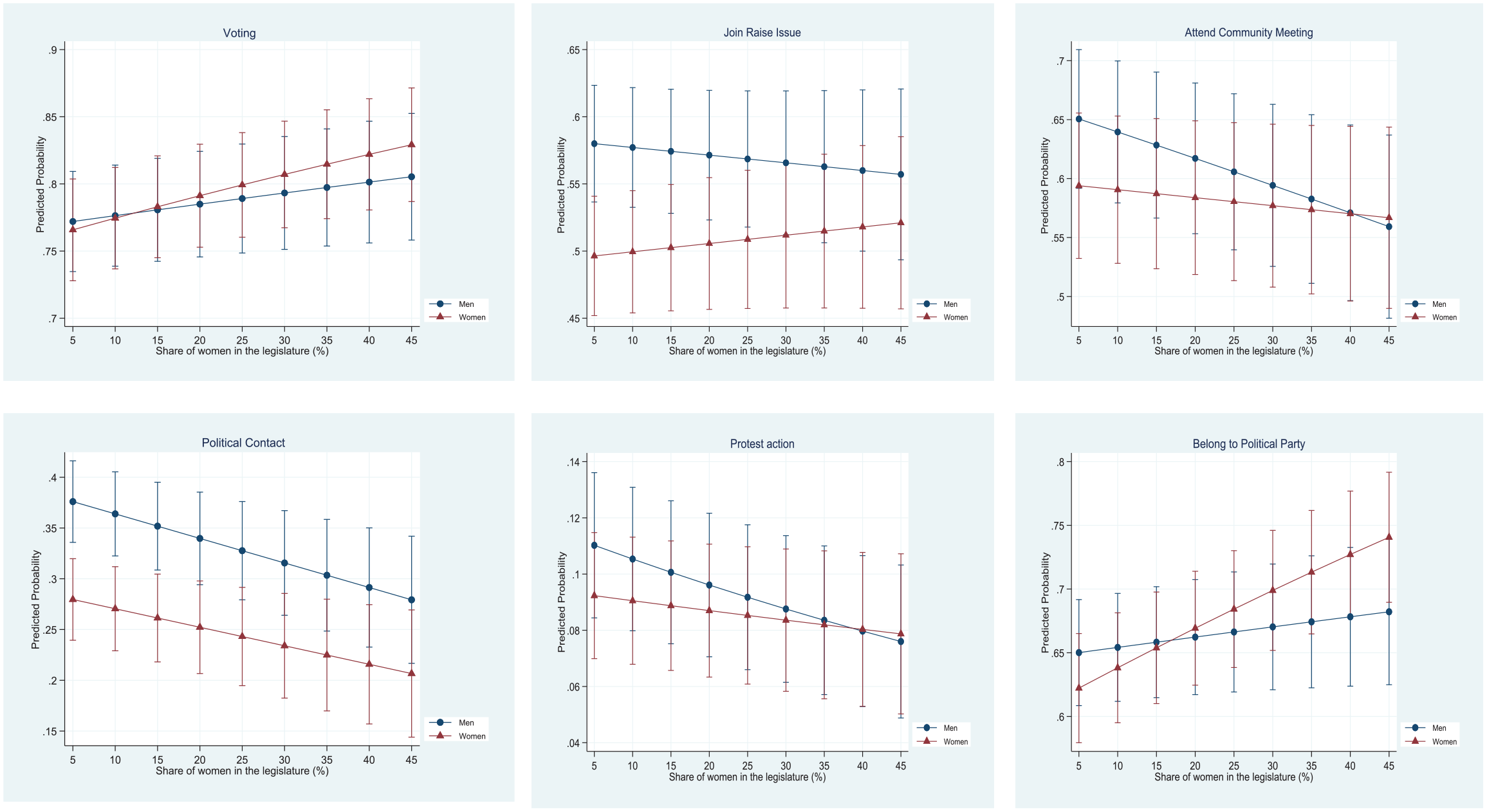
Cross-level interactions between men and women political participation at different levels of the percentage of share of women in legislature (with 95% confidence intervals).
First, for voting, the upward-sloping line in the graph indicates that the likelihood of men and women voting increases with the rising percentage share of women in the legislature. However, the slope is steeper for women than for men, signifying that as the percentage share of women in the legislature increases, so does women’s participation. Specifically, once women occupy 20 percent or more seats in the national legislature, the gender gap is eliminated, with women being between 1 percent and 2 percent more likely to vote than men.
Next, for non-electoral participation, starting with joining others raise issues, the slope of the relationship between the marginal effect of men joining others to raise issues and the percentage share of women in national legislature is almost flat. This result indicates that an increase in the share of women in the national legislature does not affect men joining others to raise issues. But, at the same time, that of women is slightly upward-sloping, indicating as the percentage of women in the national legislature increases, women are more likely to join others to raise issues. The distance in the predicted probability for men to join others to raise an issue is 17 percent higher than women at the lowest percentage share of women in the legislature (when only 5 percent of women occupy their legislature). In contrast, the slope of women is positive and upward, suggesting a decrease in the gender gap as the percentage of women in the legislature increases. To be clear, once women occupy almost 40 percent and 45 percent of their national legislature, the gender gap in joining others to raise an issue reduces by 8–6 percentage points, respectively.
Furthermore, in terms of belonging to a political party, the findings indicate that the impact of women in the legislature is more pronounced for women than for men and that the gender gap in political party membership is smaller in countries with more women in the national legislature. For example, Figure 4 shows a significant gender gap favoring men of nearly 4 percent while only 5 percent of women occupy seats in their legislature. Still, this gap diminished and even reversed when 20 percent or more women began to occupy seats in their national assemblies. Specifically, once women occupy almost 20–45 percent of the national legislature, they are between 1 and 5 percentage points more likely to belong to a political party than men. Finally, for the remaining forms of political participation—attending a community meeting, contacting politicians, and protest action—Figure 4 suggests that the percentage share of women in the legislature and gender has a negative effect. However, while the figure shows that the share of women in the legislature negatively impacts both women and men, it has a significantly larger negative effect on men than women for attending community meetings and participating in protests. In contrast, contacting politicians significantly negatively affects women more than men.
Result of control variables
In this article, our primary goal was to examine the influence of institutions on the gender gap in political participation. To ensure a comprehensive analysis, we incorporated various individual and country contextual variables in our model estimation, drawing from insights in the comparative literature survey that are known to impact the gender gap. First, by examining individual-level variables, the multilevel model reveals that individual socioeconomic, cultural, and attitudinal factors correlate with specific political activities but do not uniformly correlate with all activities. For electoral participation, resource variables like education exhibit a negative and statistically significant relationship with voting. This result is consistent with prior studies across the African context, which found no significant effect between education and voting. These studies suggest that individuals with lower levels of education are more likely to vote (Isaksson et al., 2014; Reichenberg and Tambe, 2022; Tambe, 2024). In contrast, for non-electoral participation, except for attending community meetings and belonging to political parties, we find that individuals with higher levels of education are more likely to join others to raise issues, participate in protests, and contact their politicians.
Relatedly, our proxy for income, represented by the lived poverty index, does not correlate with voting. This holds for all non-electoral participation as well. This result supports the finding that those who declare never experiencing material poverty are less likely to vote in national elections and engage in other political activities (Tambe, 2024). However, being employed is associated with higher engagement in both electoral and non-electoral participation. In interpreting this result, unlike education and material poverty, we argue that employment is a significant factor that may hinder women’s participation. A recent report on the World Employment and Social Outlook suggests that the global job gap is particularly large for women in developing countries, especially African countries (International Labour Organization, 2023). 19 Turning to the social, cultural, and mobilization variables, we find that individual religious denominations and being a community group consistently lead to higher levels of engagement in both electoral and non-electoral participation (see Tambe, 2017; 2021). Furthermore, the attitudinal variable (political interest) shows a significant and statistically significant relationship between political interest in electoral and non-electoral participation.
Finally, rounding up with country contextual variables, Table 3 illustrates that some contextual indicators significantly affect political participation while others do not. Specifically, the only contextual factor that consistently leads to higher political participation across all models of political action is regime type, measured by the liberal democratic index. An increase in the liberal democratic index encourages individual engagement in voting and other activities beyond the electoral period (see, Tambe and Kopacheva, 2023). Turning to the economic factor, a country’s GDP per capita positively affects voting. In contrast, non-electoral participation, except for attending community meetings, has a negative and significant effect on protest action, joining others to raise issues, political contact and belonging to a political party. Finally, the measure of the gender inequality index has a negative but nonsignificant effect on voting. Meanwhile, for non-electoral participation, except for political contact, the effect is positive and statistically significant for joining others to raise issues, protest, or belong to a political party, indicating individuals are more likely to engage in these activities across countries that are more gender equal.
Conclusion
In this article, we extend prior studies that have examined the gender gap in political participation in Africa by focusing on the impact of institutional factors to answer three related questions: (1) Why are women less inclined to participate in politics? (2) What accounts for the difference in gender disparities across countries? (3) Why is there a slight gender disparity in some political activities but not in others? Theoretically, we have hypothesized countries with PR electoral systems, gender quotas, and inclusiveness outcomes should encourage higher participation rates among women in both electoral and non-electoral activities, thereby producing a small to no gender gap. Overall, our analysis of the effect of institutions on the extent of the gender gap provides support only for the hypothesis that the PR electoral system and the increase in the share of women in national assemblies help erase the gender gap only for electoral participation (voting). In particular, the result from our multilevel analysis indicates that in countries with PR electoral systems and those where women’s representation in national assemblies exceeds 20 percent, the gender gap in voting is completely erased. The explanation for this could be that when the number of women in parliament is still small, they tend to share characteristics with men, as male traits are often favored in the election process. As the number and proportion of women increase, so does their social representation. The elected women become more representative of the women in their constituencies (Karam and Lovenduski, 2005). In contrast, we find no support for the hypothesis regarding gender quotas. This confirms Dahlerup’s (2005) finding that gender quotas are not enough. To be effective, the quotas must be compatible with the electoral system, there must be rules for the ranking on the lists, and there must be sanctions against violations of the quota system.
Moving to non-electoral participation, we find no support for the hypothesis that the PR electoral system and gender quotas are relevant for reducing the gender gap in political participation. However, we found that inclusive electoral institutions, which increase the percentage of women in national legislatures, are more effective for small to no gender gaps in some non-electoral activities but not others. In particular, increasing women’s representation matters in helping erase the gender gap only in belonging to a political party. Krook (2010) discusses the supply and demand aspects of women in politics. She concludes that the “political market” is far from perfect. However, an increase in female party members would enhance the supply of female candidates. The impetus to launch such a development could reasonably begin with an increase in female parliamentarians, who gradually adapt the political discourse to be more inclusive of women (Karam and Lovenduski, 2005). In contrast, for other activities such as joining other raise issues, protest actions, and attending community, the gender gap prevails albeit being partly reduced once women occupy 25 percent of seats and above. This could be an effect of the critical mass theory. When the proportion of women reaches a critical mass, it launches an acceleration process that improves conditions for all women (Dahlerup, 1988; Karam and Lovenduski, 2005).
These findings leave some interesting avenues for future research and policy implications. First, our results suggest that the impact of electoral institutions on the gender gap in political participation is not uniform and may depend on the specific context and mode of political activity being considered. Therefore, future research is needed to understand the specific mechanism through which these institutions affect the gender gap in political participation to identify effective strategies for closing the gap. One way of achieving this would be to focus more on case studies to investigate the causal mechanism properly. Our results also have some policy implications. We note that many countries in Africa have adopted gender quotas without seeing significant gains for women. This confirms what Dahlerup (2005) and Rosen (2017) point out, that gender quotas are not an easy path to gender equality in politics. Given our findings that an increase in the share of women in national legislature is more effective for reducing the gender gap in political participation, there is a need for the government to be more committed to increasing women’s representation in office to make these quotas more effective. It is also important to consider what Rosen (2017) writes about gender quotas as a way to make quick changes. If gender quotas are introduced because there are external expectations of being able to demonstrate gender equality, perhaps the gender-equal political representation does not reflect the perceptions and culture of the electorate.
Supplemental Material
sj-doc-1-cos-10.1177_00207152241253206 – Supplemental material for Addressing the gender gap: Impact of institutions on women’s political participation in Africa
Supplemental material, sj-doc-1-cos-10.1177_00207152241253206 for Addressing the gender gap: Impact of institutions on women’s political participation in Africa by Elvis Bisong Tambe and Johanna Jormfeldt in International Journal of Comparative Sociology
Footnotes
Acknowledgements
An earlier version of this paper was presented at the Higher Research Seminar in the Department of Political Science at Linnaeus University. We would like to express our gratitude to the seminar participants for their valuable feedback and suggestions. We would also like to extend a special thanks to Olof Reichenberg for his helpful comments and suggestions on how to incorporate the feedback from the reviewers. Lastly, we would like to thank the editor Phillip A. Hough and the six anonymous reviewers for their insightful suggestions to improve the article.
Declaration of conflicting interests
The author(s) declared no potential conflicts of interest with respect to the research, authorship, and/or publication of this article.
Funding
The author(s) received no financial support for the research, authorship, and/or publication of this article.

Data availability statements
Supplemental material
Supplemental material for this article is available online.
Notes
References
Supplementary Material
Please find the following supplemental material available below.
For Open Access articles published under a Creative Commons License, all supplemental material carries the same license as the article it is associated with.
For non-Open Access articles published, all supplemental material carries a non-exclusive license, and permission requests for re-use of supplemental material or any part of supplemental material shall be sent directly to the copyright owner as specified in the copyright notice associated with the article.
