




Abstract
One of the earliest demands of Indian women’s organisations in the pre-Independence period was the right to be elected to legislative bodies. Yet, almost a century later, a vast gender gap persists in terms of women’s presence at all levels of governance. Why is it important to include women in political and policy decision-making bodies, beyond the issue of equality? Do women representatives necessarily represent women’s interests? Indeed, how do we define women’s interests and how can they be represented best? And how much presence makes for effective representation? This paper addresses these questions, both conceptually and based on empirical evidence.
Keywords
A History of Absence
The gendered history of governance in India is marked more by women’s absence than presence, leaving aside the roles of queens and consorts. In the late nineteenth and early twentieth centuries, women’s presence in the everyday institutions of governance was rare. In fact, women are largely absent even from historical writings on governance, apart from accounts of women’s struggle for suffrage and a place in the legislatures from the 1920s. For example, there is little indication of women’s presence in customary institutions of village decision-making, such as in caste and tribal councils, gram sabhas or village courts, from the limited information available by gender. Gleaning dozens of ethnographies and colonial accounts, especially some 30 volumes of Castes and Tribes of India relating to different regions, 1 I found that women were almost entirely excluded from caste and tribal councils, with rare exceptions such as among the Santals in eastern India and the matrilineal Garos of Meghalaya. Even the pre-independence statutory village councils set up in the 1920s made no space for women (Buch, 2000).
This changed somewhat with India’s Independence when, in the 1950s, as part of decentralised governance, the Central Council of Local Government recommended that block panchayats co-opt two women to work among women and children. Several government committees, such as the Balvantray Mehta and Santhanam Committees, also recommended the inclusion of at least two women, since one woman, it was argued, would feel isolated and ‘be unable to express herself freely’ (cited in Buch, 2000, p. 35). Several states then enacted laws to include two token women in local governance. In fact, policy directives requiring at least two women in local institutions of governance became the norm, although many ignored even this in practice.
In 1993, however, the situation changed dramatically when the 73rd and 74th Constitutional Amendments reserved one-third seats for women in all Panchayati Raj institutions and municipalities, with seats for Scheduled Caste and Scheduled Tribe women within this one-third. Also, a third of all constituencies in a state would have women heads of village councils (pradhans). As a result, at the start, over a million village women (including about 86,000 chairs and vice chairs) were elected. They had statutory powers, but their budgetary allocations were restricted (Babu, 2009). Importantly, the village council chairs (pradhans) were randomly assigned within the state, to be rotated every five years. The random assignment created what economists today call a ‘natural experiment’. This provided the basis of a rich body of studies by economists and political scientists. In most non-formal institutions of governance, such as forest protection committees, however, the norm of two token women continued for many years.
Women’s entry into legislatures was both easier and more difficult than their entry into panchayats. The complex history of this shift is detailed in Agarwal (2010), but some highlights are warranted here. In the 1920s, a range of emergent women’s organisations raised a demand for women’s right to vote and to stand for elections. Women’s growing visibility in the anti-colonial struggle also strengthened their case. As a result, prior to Independence, women gained restricted entry into provincial councils (Everett, 1979) and federal legislatures (Sikri, 1960). Although their numbers were small, they were symbolically important in so far as women were recognised as a constituency, but based on the idea that their lives and interests were so different from men’s that they needed separate representation, especially to deal with so-called women’s issues, such as family and child welfare. This hyphenation of women and children has unfortunately persisted within policymaking circles, while women’s numbers in legislatures and the parliament have remained low.
Extent of Presence: Parliament, State Legislators
Consider first women’s presence in the Lok Sabha or lower house of parliament. The figures remain low, despite an upward trend from 1951, with the proportion of women members of parliament (MPs) rising from 4.5 per cent in the first Lok Sabha in 1951 to 14.4 per cent in the 17th Lok Sabha in 2019 (see Figure 1 ).
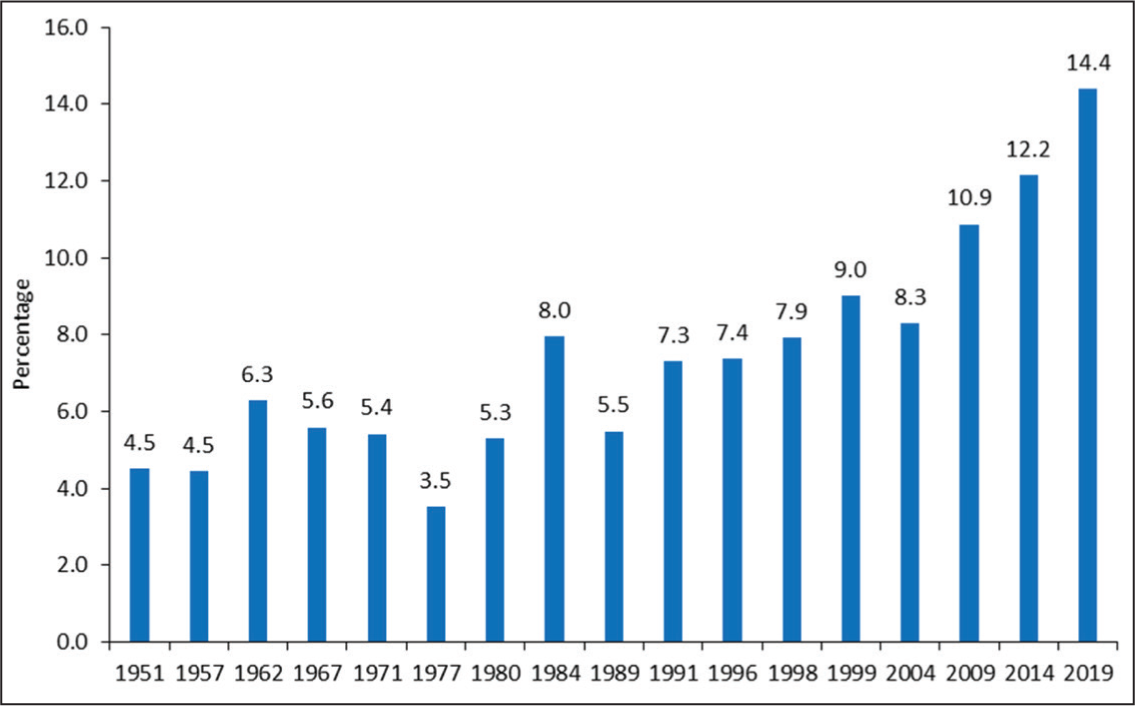
Sources: Rao (2019); Election Commission of India data.
The situation in the Rajya Sabha, the upper house, is even more dismal ( Table 1 ). The highest percentage reached was 12.7 in 2014 and even this fell to 10.2 in 2020.
In state legislatures, the percentages in the year 2000 ranged from 13.6 in West Bengal to zero in Mizoram and Nagaland. Even in largely matrilineal Meghalaya, the percentage was only 5.1 ( Table 2 ). These numbers show a vast gap between the current situation and the 33 per cent reservation of seats in parliament that women’s groups have long been lobbying for.
Women Members of Parliament in the Rajya Sabha, 1952–2020.
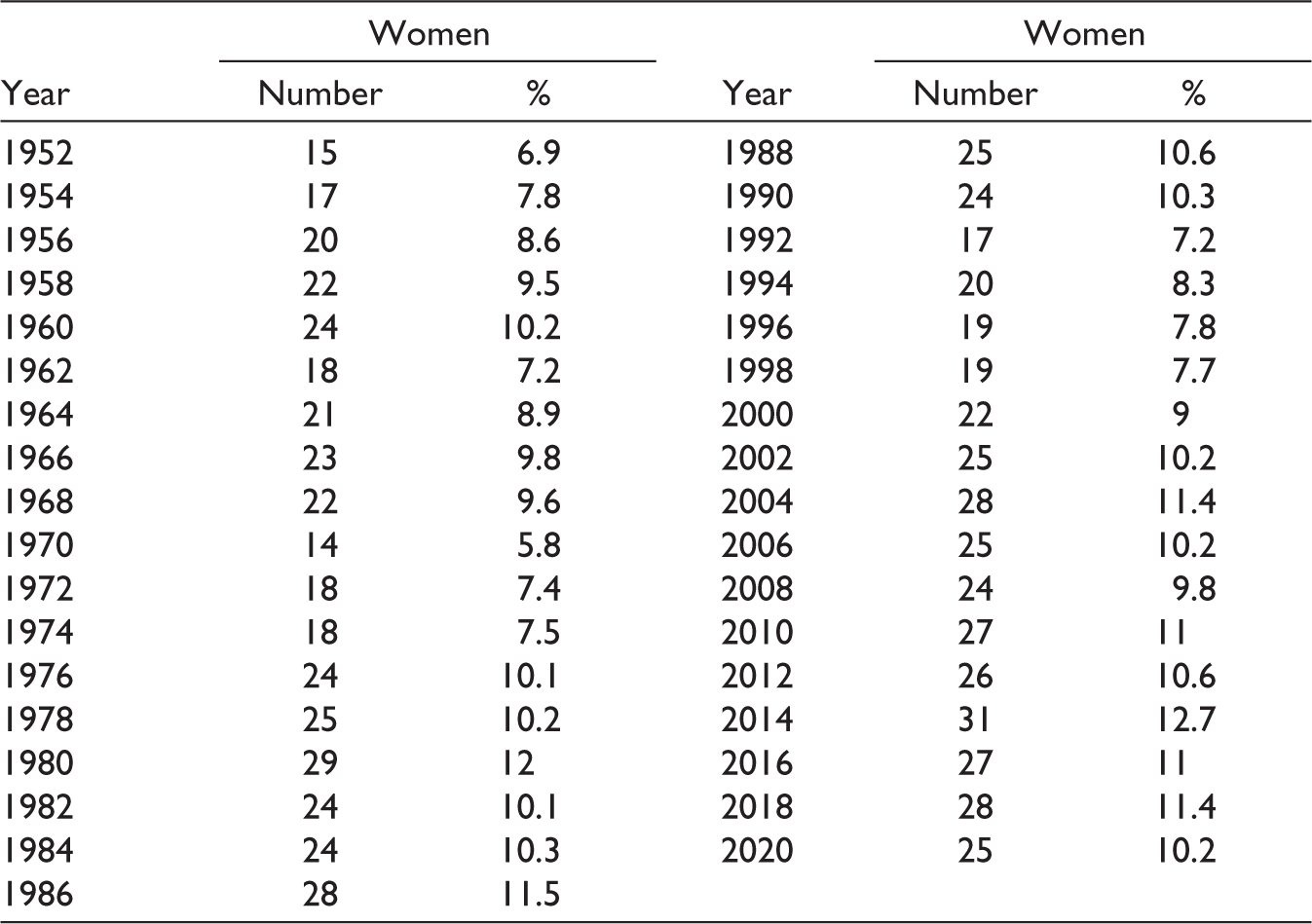
Source: Krishnaswamy (2019).
Note: Total number of women members elected/nominated to the Rajya Sabha, including those having served more than one term.
Women Members of State Legislative Assemblies, 2020.
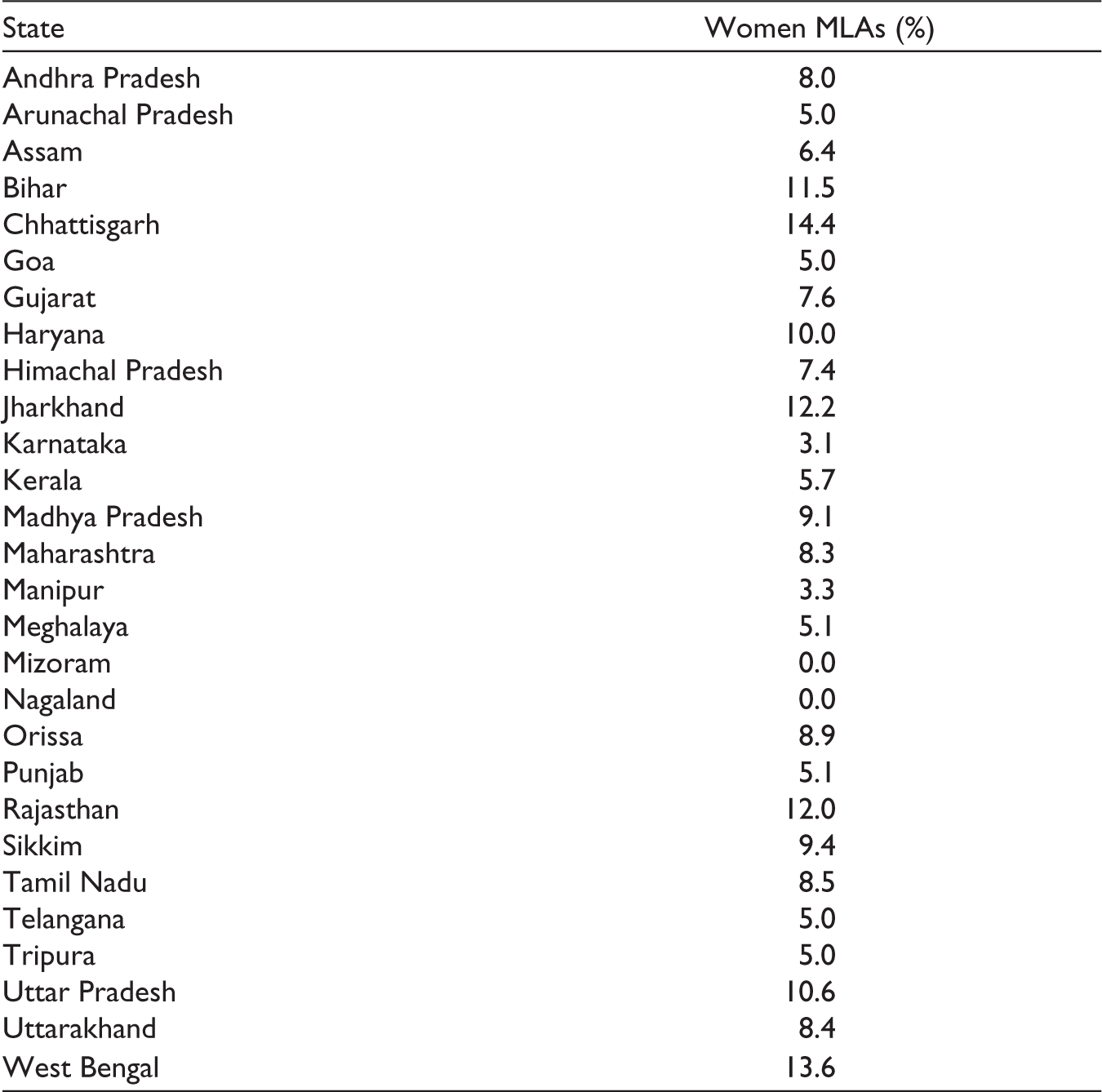
Source: Compiled by the author from data given in: Election Commission of India.
In fact, even globally, we find low percentages of female legislators. By the latest Inter-Parliamentary Union’s (IPU) report, Women in Parliament in 2021 (IPU, 2021), as of 1 January 2022, women constituted only 26.1 per cent of all parliamentarians. The figure was 31.9 per cent in countries with quotas and 19.5 per cent in countries with no quotas (see also Pande & Ford, 2011).
The Question of Critical Mass
Why do numbers matter? To begin with, the presence of other women can help women overcome their reticence and participate more effectively in public forums. In the 1990s, this was reported even among US legislators, although for India this is not surprising, given conservative social norms which encourage a gender segregation of public space and discourage women from speaking in public forums, especially in village meetings. As an illustration, some women I interviewed in the early 2000s in a Gujarat village, where the forest committees had only two token women, said explicitly that larger numbers would help:
It helps to have more women because then women will not be dominated or feel shy. After all, if there is only one woman and ten men, how will she speak? Women need each other to be able to speak. (Women’s group, Gujarat, cited in Agarwal, 2010, pp. 206–207)
Participation in a public forum is, in fact, a complex concept which can range from nominal to empowered. Consider the typology in Table 3 .
Typology of Participation.
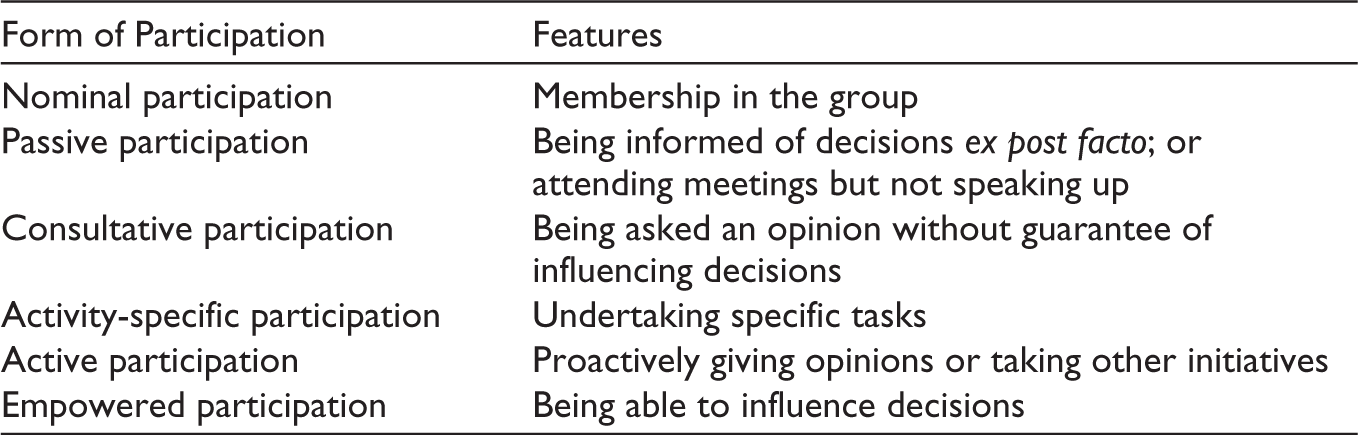
Source: Adapted from Agarwal (2001).
In an institution, simply being a member would count as nominal participation. You may move from there to passive participation (listen in but not speak) and further to consultative participation (be asked to express an opinion). You may even be active in terms of taking on tasks or other initiatives proactively. But to count as ‘empowered’ and be seen to participate effectively, you should be able to influence the decisions made at least some of the time.
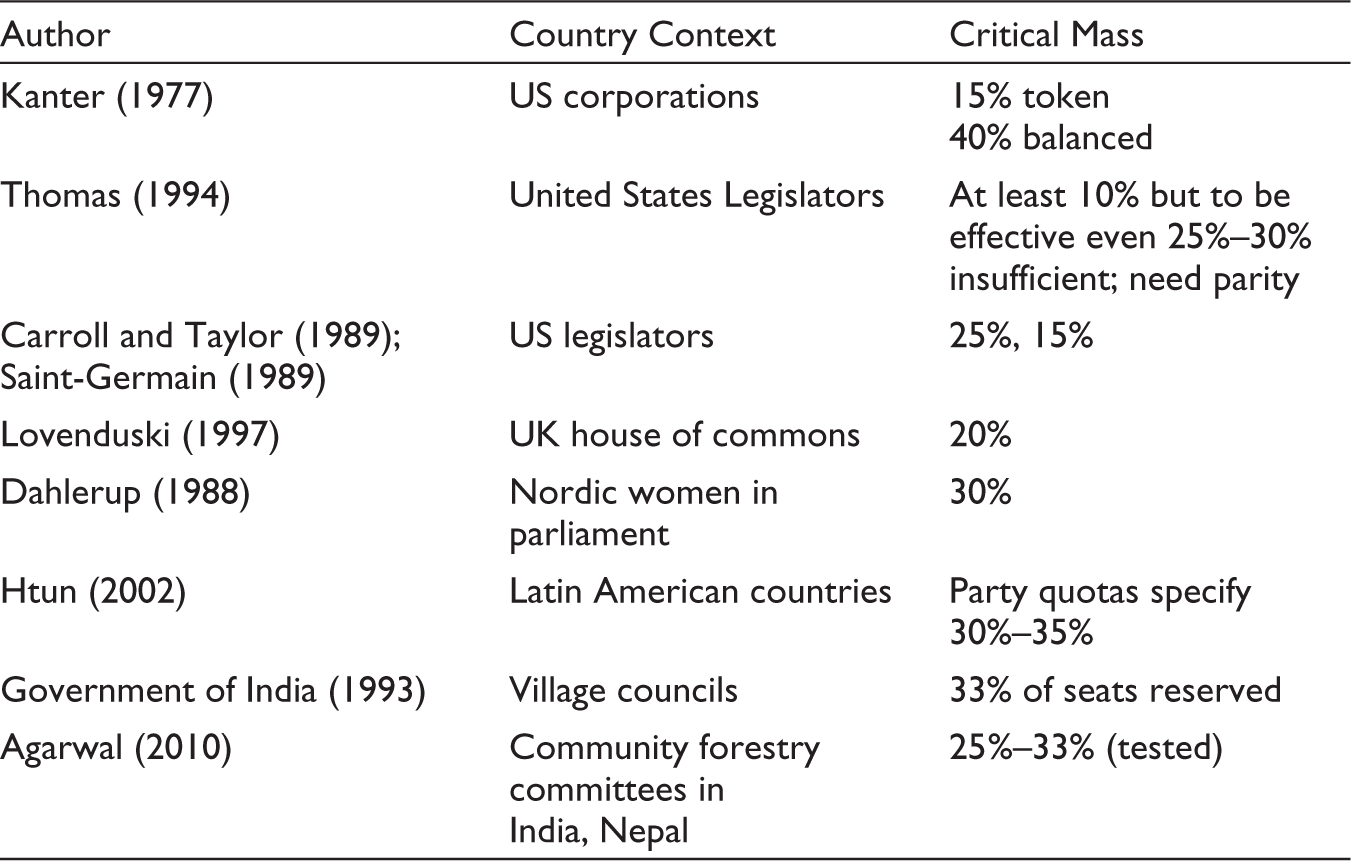
So, what would it take for women to feel empowered and participate effectively in public forums? For a start, it has long been argued that women would be more effective if they were present in a critical mass―a term borrowed from physics but now used commonly by social scientists. There is, however, no universal agreement on what would constitute a critical mass. Estimates (or guesstimates) range between 15 per cent and 50 per cent (see Table 4 ). Rosabeth Kanter, in her 1977 book Men and Women of the Corporation, was perhaps the earliest to focus on this issue arguing that in industrial corporations, we need 40–50 per cent women for effectiveness while 15 per cent women would merely constitute a token presence. Other scholars mention 15–35 per cent in the context of western legislatures. Meanwhile, globally, 33 per cent has become the magic figure in lobbying for gender quotas, be it for parliaments or village councils.
Critical Mass: Varying Assertions or Estimates.
Source: Compiled by the author.
Where did this figure come from? It appears to have been first proposed by Drude Dahlerup, a Danish sociologist who observed in the 1980s that when the proportion of women in the Scandinavian parliament increased from a small minority to a third, the culture of interaction became less aggressive, the timings of crucial meetings took account of women’s childcare responsibility, and so on (Dahlerup, 1988). Later, several authors proposed a range of figures, but almost none empirically tested for critical mass.
My study of community forestry in India and Nepal was an exception, in that I did measure critical mass and found that 25–33 per cent was indeed the critical percentage—groups with one-third women in the executive committees (ECs) of forest management groups were significantly more likely to attend meetings, speak up at them, and hold leadership positions (see Agarwal, 2010, chapter 5). But we would expect these percentages to vary somewhat by country and context.
Several countries have meanwhile reserved one-third or more seats in village councils. In South Asia, for example, apart from India, Bangladesh, Nepal and Pakistan also have seats reserved for women in local institutions in diverse ways (Rai, 2005; IDEA International database 2 ). This is a big shift from the 1940s when panchayats had no women and from the 1960s when some panchayats had two women. In India today, all panchayats have one-third women members, following the 1990s constitutional amendments mentioned above, and some states have subsequently moved to 50 per cent reservation. In fact, even in some of the states with one-third reservation, women’s presence has been increasing beyond the reserved proportions, as people have been voting for them in unreserved constituencies. In 2017, in 14 states, over 50 per cent of the village pradhans were female.
Impact of Women’s Presence in Governance
Conceptually, a wide range of arguments can be made in favour of enhancing women’s presence in governance. First, in a democratic society, equality and voice have intrinsic worth. The inclusion of a diversity of people is important and especially of those who are socially disadvantaged by gender, caste or race.
Second, beyond equality it is argued that women’s presence will improve the process of governance by changing group dynamics. For example, many assert that women can change the culture of interaction in public bodies and improve gender dynamics. Women are perceived to be more cooperative and less corrupt. Many also see them as likely to bring more moral values to the public domain and encourage less aggressive behaviour among men.
Third, women are expected to have different policy priorities from men and cater more to women’s interests. In the 1920s, the argument made to support Indian women’s entry into legislatures was that ‘women’s lives and interests are so different from men’s that they need separate representation’ (Forbes, 1979). In fact, studies of legislators in some western democracies do show that women give more priority than their male colleagues to laws that promote women’s equality and family welfare, such as through bills for health, education and childcare. 3
Fourth, women being elected to leadership positions and participating in public decision-making can empower both them and the women they represent. The representatives can become more self-confident and hence more effective. They can also serve as role models for other women.
This conceptualisation of the impact of women’s presence is based partly on assumptions and partly on descriptive evidence from western legislatures. But what is the ground evidence for India?
The strongest India-related evidence comes from studies by a small group of social scientists, especially economists. This body of evidence is based on rigorous methodology, is peer-reviewed, often published in major journals, and covers both longitudinal and cross-sectional analysis. It could of course be asked: why are economists even interested in what is normally the domain of political scientists? Perhaps the most important reason is that economists are interested in policymaking and hence in policy makers (be they village pradhans or legislators). In addition, the random allocation of reserved seats for village pradhans in India creates, as I had mentioned earlier, a ‘natural experiment’, which can help establish causation without conducting actual experiments such as through randomised control trials. In fact, to my knowledge, the first use of the village pradhan data as a ‘natural experiment’ was by Raghabendra Chattopadhyay and Esther Duflo (2004), in their paper on the policy impact of women pradhans who had been elected in village councils that had been reserved randomly for women. They focussed on Rajasthan and West Bengal.
Below, I provide an illustration of studies, separating out the results for legislatures and village bodies. We will consider the effect on four aspects—participation, corruption, policy focus and empowerment.
Participation
There are two aspects to participation—the ability of women leaders to themselves participate effectively and the ability of village women to participate in meetings led by women leaders. The first relates to critical mass and can be assessed from parliamentary and legislative assembly meetings and my community forestry data; the second relates to village pradhan data.
Several studies find that women legislators (be it in parliament or state assemblies) tend to participate rather little in debates or introduce bills. This was noted even in the 1980s. As an example, in the eighth Lok Sabha (1985–1989), female MPs, who constituted only 8 per cent of MPs, spoke up less than 5 per cent in short-duration discussions and less than 10 per cent in longer duration ones (Kumari & Dubey, 1994, p. 82). Usually, the same few women spoke and none raised issues specifically concerning women. Similarly, women’s participation in state assembly proceedings was found to be low (see Singh & Pundir, 2002, for UP over the period 1952–1996; and Bhatt, 1995, across several states). The studies attribute this to the legislators being small in number as well as their need to vote as their party did.
In my study of community forestry ECs in the villages of Gujarat (India) and Nepal, however, I could test for critical mass and found that EC women were significantly more likely to attend meetings, speak up at them, and serve in leadership positions if women constituted 25–33 per cent of the EC (Agarwal, 2010).
The second type of participation effect relates to women as citizens. Here village women are found more likely to speak up in gram sabha (village assembly) meetings where the pradhan is a woman (Ban & Rao, 2008; Beaman et al., 2011; Chattopadhyay & Duflo, 2004; Deininger et al., 2015). Women pradhans are also found to be more socially approachable than male pradhans.
None of the village council studies, however, take note of the fact that village councils already have one-third women councillors as regular members. It is likely that the woman pradhan is more empowered in their presence than if she were heading an all-male panchayat. This aspect needs more recognition when making inferences on the impact of women pradhans.
Corruption
A second expected benefit of women’s presence in governance lies in the likelihood of reduced corruption. A study of 4,265 state assembly constituencies over two decades (1992–2012) found that the rate at which women MLAs accumulated assets was 10 percentage points lower per annum than did male MLAs (Bhaskaran et al., 2018). Similarly, for village councils, Beaman et al.’s (2011) study of 11 states found that villagers in female pradhan villages were less likely to have paid a bribe than in male pradhan villages.
Policy Priorities and Outcomes
Women’s presence in legislative assemblies and in village councils is also found to affect policy priorities and outcomes.
Women legislators are found to improve the economic performance in their constituencies more than male legislators. For instance, Bhaskaran et al. (2018) in their earlier mentioned study argue that women legislators raised annual GDP growth in their constituencies by about 1.8 percentage points per year more than male legislators. 4 The authors associate this with the earlier cited finding that women legislators are less likely to be criminal or corrupt. This study also found that while male and female legislators were equally likely to negotiate for major federal road-building projects, women were more likely to oversee completion. Both aspects point to better policy outcomes.
Several studies also point to improved health and educational outcomes. Female legislators are found to favour health and education more than males (Bhalotra & Clots-Figueras, 2014; Clots-Figueras, 2012). Moreover, Bhalotra and Clots-Figueras (2014) find that a 10 percentage point increase in women’s representation leads to 2.1 percentage point reduction in neonatal mortality in the districts from which they were elected.
In village councils again, women pradhans much more than male pradhans are found to prioritise public goods such as drinking water, roads, sanitation, irrigation and schools (Beaman et al., 2011; Chattopadhyay & Duflo, 2004). And in community forestry groups, I found that forest conservation outcomes were significantly better by several indicators, where the ECs had a critical mass of women or only women (Agarwal, 2009, 2010).
Empowerment
The presence of a woman pradhan empowers village women more generally. A study of 17 states over the period 1985–2007 found that in villages with a woman pradhan, village women were more likely to report violent crimes against women, even though there was no overall deterioration in law and order (Mani et al., 2011). Other studies find that female pradhans serve as role models (Pande & Ford, 2011), improve perceptions of women as leaders (Beaman et al., 2009) and enhance educational aspirations of girls and their parents (Beaman et al., 2012). 5 Moreover, women’s presence in decision-making positions demonstrates to male villagers that women are capable of functioning effectively in public positions.
More generally, public participation can increase women’s capabilities, as qualitative evidence indicates. A group of women in one Gujarat village told me, for instance, that, ‘If we step out of the house, we become more aware, we become more vocal, we get more information, we gain more exposure, we get more respect…’ (Agarwal, 2010).
In other words, there is substantial evidence that female presence in the public office tends to:
Promote gender equality in governance, empower women and improve democratic functioning and inclusion; Reduce corruption, increase economic growth and enhance efficiency in governance; Prioritise spending on infrastructure, such as roads, health, education, drinking water and sanitation; and Reduce neonatal mortality.
Women’s Specific Interests
Notwithstanding this substantial evidence on the gains of including more women in governance, a key question remains. To what extent do women representatives address women’s specific interests?
True, infrastructure improvement brings overall benefits, including for women. Hence, piped drinking water, better sanitation or more schools are of general interest from which women and girls also gain, possibly disproportionately on some counts. Piped water, for example, would save women and girls the effort of fetching water over long distances. But roads tend to benefit men more since they travel more, unless women get employment in road-making. More importantly, major gender-specific issues remain unaddressed, such as the gender job gap, gender wage gap, gender property/land ownership gap, domestic violence, sexual harassment in travel and work spaces, the digital gap and so on. In other words, there appears to be little evidence that women representatives in India particularly focus on women’s issues. Why don’t they do so?
The answer appears to lie in both internal and external constraints. Internal constraints can take several forms. To begin with, often women do not see themselves as mandated to represent women and are uncomfortable with raising issues seen as ‘women’s issues’. Second, women’s other identities based on, say, religion or caste, may matter more. Third, women leaders may engage little with women’s associations or civil society to assess gender priorities. These constraints can affect women leaders at all levels, be they legislators or pradhans.
External constraints add to internal ones. Typically, in India, political parties rather than individual legislators decide priorities, and women citizens are not seen as a significant constituency, unlike, say, caste groups. Political parties also usually give little importance to private members’ bills. In village councils, similarly, women pradhans are restricted by a pre-given list of ‘subjects’ and very few states include women and development as a subject. The pradhans are also constrained financially in most states with funds typically being tied to pre-given projects (Babu, 2009; Ghosh & Pramanik, 2007).
Among these constraints, a woman leader’s understanding of whom she is expected to represent is especially important. Based on interviews with women legislators, Singer (2007) observed, for instance, that, ‘Many prominent women politicians eschewed the label of woman politician, both during elections and in office’. Similarly, Shirin Rai (1997, and personal communication in 2006), drawing on detailed interviews with many women parliamentarians, noted that none saw herself as representing women or their particular interests. Typically, legislators felt bound by their party’s agendas and priorities. Few had any stated links with autonomous women’s organisations (although they may have known some feminist activists in a personal capacity).
In village councils, similarly, Vijaylakshmi (2003), based on her research on panchayats in Karnataka, observes that women councillors felt ‘their bargaining power would be considerably reduced if they took up gender-specific issues which were not supported by other members or political functionaries’ and ‘since gender interests were not an electoral issue in politics…the representatives did not…act for women.’ In other regions too, as in north India, it was observed that women councillors raised general issues rather than female-specific ones (Buch, 1999).
Similarly, Lama-Rewal, in her study of municipal councillors in the city of Calcutta, noted that ‘most women councillors…do not want to advocate women’s interests because they do not consider them, or they do not want to appear as if they considered them, a major issue’ (2001, p. 36, my emphasis). Hence increasing women’s presence in public office need not lead to a focus on women’s issues or promote women’s specific interests. Exceptions to this are limited to particular regions such as Himachal Pradesh where women councillors were found to be much more empowered and gender-aware than in the neighbouring state of Haryana 6 and Kerala, where 10 per cent of the village council budget is set aside for a women-component plan, and where the state’s poverty alleviation programme, Kudumbashree, is specifically women-centric (Agarwal, 2020).
Here two conceptual distinctions can also prove useful. First is the distinction between implicitly shared interests and an explicit recognition of interests. Where women implicitly share common interests, even increasing their numbers can have effect. For example, village women dependent on forests for firewood have a common interest in greater extraction of firewood, across poor and well-off households. Here, I found that women could effectively influence the forest use rules to allow greater extraction simply by the power of numbers (Agarwal, 2015). But, in most contexts, an explicit recognition of common interests would be more effective. This brings me to the second distinction, ‘women-in-themselves’ versus ‘women-for-themselves’ and further ‘women-for-other-women’.
Women-in-themselves can simply mean a group of women as a descriptive category. But women-for-themselves means that women recognise their common interests and act collectively. For example, Indian women parliamentarians have come together several times across party lines to lobby for the Women’s Reservation Bill, to seek one-third seats in Parliament. However, even if one-third seats were reserved for women legislators, so that they had a critical mass in terms of numbers in parliament, it would not guarantee that they would represent ordinary women’s interests. For effectively representing other women’s interests (‘women-for-other-women’), representatives need to go beyond personal self-interest and beyond their class and caste identities, to make common cause with diversely disadvantaged women, based on ideas and ideals.
Establishing Common Cause and Strategic Alliances
Indeed, presence and representation are not equivalent. Conceptually you can take two extreme positions with regard to representation. It can be argued that each person must herself be present in decision-making, since none can be represented by another, as no two people’s experience is the same. On the other hand, it could also be argued, as political scientist Anne Philips elaborates, that ‘one person may easily stand for another’, as long as there is ‘a congruity in political beliefs and ideals’ (Phillips, 1995, p. 6). This implies that a person does not have to be personally present in a decision-making forum for her interests to be represented.
Both extremes are clearly untenable. Especially in large populations, we cannot all represent ourselves. We need a representative, and having women representatives has intrinsic worth for gender equality while also bringing in women’s specific experience, especially given shared gender norms. For example, conservative social norms and negative ideas about women’s capabilities cut across class and caste. Women across classes face domestic violence. These shared problems could help bridge differences among women to make common cause, simply on the basis of a common gender identity. But this may not be enough in all contexts. To effectively represent the interest of women as citizens, the representative must share women voters’ concerns and priorities and not just their gender.
The demand for quotas for women in legislatures or village councils assumes that a shared gender identity also implies shared interests or ideas. Indeed, we often assume a commonality of interests based on ascriptive categories such as caste, gender and religion. But is this assumption valid? As we have seen, identities and ideas need not be congruent. To effectively represent women’s interests, ideas matter, not just presence. As Philips (1998, p. 48) reminds us,
The biggest mistake is to set up ideas as the opposite of political presence…or worry exclusively about the people without giving a thought to their policies and ideas. Ideas can be the cement for establishing common cause despite material and cultural difference.
There are many examples which show that shared ideas can help people make common cause across diversity to promote women’s interests. For example, a number of Indian men in the late nineteenth and early twentieth centuries promoted or supported social welfare reform, such as for widow remarriage, elimination of sati and advancing women’s education and inheritance rights. Similarly, women divided by class or caste have made common cause and forged strategic alliances with one another in a range of social movements, both in the early twentieth century and in the 1980s.
In the 1930s and 1940s, for instance, Indian women in politics had close links with women’s organisations. Again in the 1980s, the Dahej Virodhi Chetna Manch (anti-dowry platform) was constituted by women’s wings of political parties across party lines and also linked with autonomous women’s organisations and individuals. And during its first term in office (2004–2008), the United Progressive Alliance passed two major pieces of legislation benefitting women. These were the Hindu Succession Amendment Act (2005) and the Protection of Women from Domestic Violence Act, 2005. Both Acts were promoted by civil society with support from some gender-progressive MPs (including male MPs). 7
These examples demonstrate that alliances are possible across differences—structural or political. Yet given that such alliances remain historically episodic rather than regular, additional steps would be needed for them to become more established. To begin with, for civil society organisations to effectively mediate between female citizens and political representatives, they need to set in place mechanisms for identifying diverse women’s needs, in order to arrive at a more unified perspective on priorities than exists at present. Next, processes of accountability and communication are needed between civil society and political representatives.
On accountability, for example, civil society organisations need to hold both female and male representatives accountable to uphold women’s interests and issues. This could take various forms—scrutiny of election manifestoes, asking candidates where they stand on various aspects of gender inequality, raising similar questions via the media and generally highlighting women as a constituency whose needs and interests should carry weight. Figure 2 presents this idea of accountability schematically.
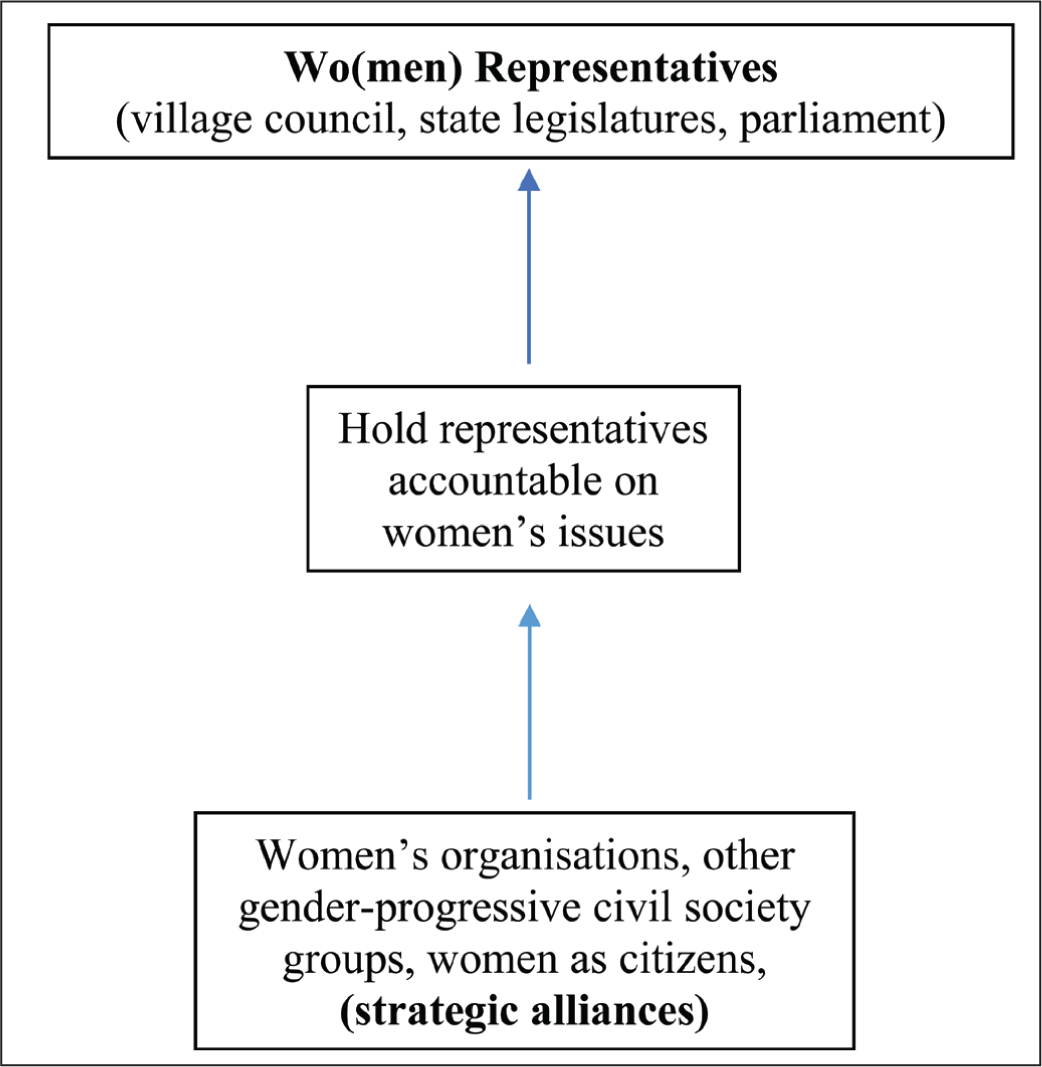
Source: The author.
In turn, to understand what women as citizens across diverse classes want, political representatives would need to proactively connect with civil society (women’s organisations, grassroots groups, public intellectuals and so on). It is notable that women legislators in countries that have actively engaged with women’s concerns have tended to be those with close prior links with women’s organisations. Cases in point are the United States, Australia and South Africa at particular junctures in their history. These examples are detailed in Agarwal (2010) but also need mention here.
In the United States, Carroll (2003) found that many of the women state senators and state representatives she interviewed in 2001 had been members of women’s organisations and maintained those links after being elected. This provided the legislators with ongoing access to a perspective on women’s interests and made them more accountable toward those interests. In Australia, in the 1970s, women’s organisations provided key support to the Labour Party’s election campaign. Hence, many women, including from working-class backgrounds, were appointed as government advisers and in the bureaucracy, which helped focus more policy attention on poor women’s interests (Eisenstein, 1995). In South Africa, women’s, organisations played critical roles in the anti-apartheid struggle. This gave them bargaining power when the post-apartheid government was formed, and many women activists were inducted into positions that enabled them to promote measures for gender equality (Britton, 2002, 2006).
In other words, a common feature of cases where political representatives are found to successfully represent women’s interests are those where the representatives have consulted with, even partnered with civil society, and vice versa. These two-way links between legislators and gender-progressive groups (and individuals) can also make policymakers more accountable to women. In India, we have seen rather little of this kind of engagement on a systematic basis. For presence to lead to effective representation, this would need to change.
Conclusion
The presence of women in political and policy decision-making is important for achieving gender equality, effective democracy, relevant policy priorities and better policy outcomes. To be effective, however, women need to be present in sufficient numbers in political and policymaking institutions; that is, they need to constitute a critical mass. At the same time, this alone cannot guarantee that women representatives will represent women’s interests. Congruity of ideas and other-regarding values, not just presence, is necessary for effectively representing diverse women’s interests. Also, we need a culture wherein gender-progressive civil society groups, on the one hand, have the pulse of what women as citizens need, and, on the other hand, hold representatives (both women and men) accountable for tackling persistent gender inequalities. Essentially, to transform women’s presence into effective representation requires a two-way ongoing interaction between political representatives and civil society in all its plurality.
Footnotes
Declaration of Conflicting Interests
The author declared no potential conflicts of interest with respect to the research, authorship and/or publication of this article.
Funding
The author received no financial support for the research, authorship and/or publication of this article.
*This text is based on the Social Change Golden Jubilee Lecture 2022, delivered by the author on 22 February 2022.