




Abstract
This article examines the role of institutional trust in current European societies. Based on a secondary data analysis of Eurobarometer data (response rate 39.6%), it maps institutional trust repertoires and analyzes their consequences for a crisis that disturbed public life immensely in 2020 and 2021—the COVID-19 pandemic and the measures to fight this. Methodologically, it applies a multilevel latent class analysis of 18 institutions. Taking inspiration from “cultural backlash” theory, the explanatory analyses incorporate socio-political values and geographical identifications. The results show that there are seven different trust repertoires in the European Union (EU) countries, ranging from 24 percent mostly trustful to 11 percent mostly distrustful. EU Countries can be clustered into four classes, each with specific repertoire distributions. Particularly satisfaction with one’s own life and world developments is associated with higher trust. Compliance with COVID-19 policies is most likely when citizens trust both national political institutions and media institutions; other institutions matter less. Country health expenditure has a limited effect on the reception of COVID-19 policies but does influence membership of trust repertoires.
Introduction
The COVID-19 pandemic that broke out in March 2020 and lasted until May 2023 1 cost millions of lives across the world, and led to a major disruption of public life, local and global economies, and all kinds of institutional processes. From the start, there has been a remarkable number of scientific studies examining not only the medical side of the disease but also the social and political consequences of the pandemic. 2 Scholars documented and monitored particularly the way citizens reacted to, first, the measures that governments took in an attempt to contain spreading of the disease—via restrictions to public life, lockdowns, and compulsory behavioral change such as social distancing, and wearing face shields—and, second, to the vaccination programs (e.g. Egger et al., 2021; Sabat et al., 2020).
The pandemic provided a test case—at an almost unprecedented yet horridly realistic scale—to study social responses to a sudden “shock to the system” particularly in relation to trust. Institutional trust is often conceived of in terms of expectations of future behavior: the confidence of citizens that a specific institution performs in a competent and satisfactory manner and will continue to do so (Misztal, 1996; Van der Meer, 2018). Yet, the major disruption of the pandemic and its dangers led responsible institutions in society to take unconventional measures and policy actions and break with those expectations. Who was willing to comply, and under which circumstances, with this improvised policy was often the object of study.
Although the outcomes of many of these studies confirm the expected positive relationship between compliance and institutional trust (e.g. Han et al., 2023; Lee, 2022; Trent et al., 2022; Zimand-Sheiner et al., 2021), they also come with limitations. On the one hand, they often focus on singular conceptions and measures of trust: political trust, media trust, or trust in science (an exception concerns the study of Baekgaard et al., 2020). Yet, institutions had different roles in solving the crisis at hand. Whereas political and governmental bodies were responsible for shaping the response to the pandemic (showing leadership, incorporating advice from health experts, and considering the public interest), the media were expected to provide balanced information on the pandemic and measures to fight it, and law-enforcements agents were charged with maintaining newly developed emergency rules (Murphy, 2020). On the other hand, previous COVID-19 studies tend to ignore the broader societal developments that have influenced institutional trust in recent years. Political polarization and the rise of right-wing populism have ignited a “cultural backlash” against progressive-liberal values and mainstream societal institutions in recent years (Carreras et al., 2019; Inguanzo et al., 2021; Norris and Inglehart, 2019). Arguably, some of the resistance against COVID-19 measures (Wood et al., 2022) tapped into that undercurrent.
Given these considerations, the article has two main goals. First, it aims to map and explain patterns of institutional trust during the COVID-19 pandemic in Europe. As such, it contributes to studies of institutional trust by analyzing a broader range of institutions and mapping the patterns that exist in institutional trust using a repertoire approach. Taking a cue from the observation that most people use culture as a “tool kit” and select from their “cultural repertoires” what works at a specific situation (Swidler, 2001), scholars have suggested the usefulness of repertoires for the study of, among other things, media use (Tóth et al., 2023), but also trust (Rothstein, 2005: 37–38). For example, Tóth et al. (2023) show that media repertoires in Eastern Europe range from media that are open liberal anti-government to media that can be seen as closed conservative pro-government. Here, we look for repertoires in the type of institutional trust that citizens hold. Which Europeans adhere to which trust repertoires is examined by incorporating country characteristics, socio-demographics, and value orientations associated with cultural backlash.
The second aim is to zoom in on the relationship between trust repertories and the way individuals evaluate COVID-19 policies. More specifically, it examines which combinations of trusted (or mistrusted) institutions are most strongly correlated with positive and negative receptions of COVID-19 measures. Again, the explanatory analyses take into account country characteristics, socio-demographics, and value orientations.
The article employs a secondary analysis of data derived from Eurobarometer 94.3, collected in spring 2021. This implies, first, that the focus is on countries from the European Union (EU), and, second, that only institutions and value orientations can be addressed that are measured in the data. Trust repertoires are examined using the Step3 approach in latent class analysis (LCA) in a multilevel design, which also allows finding structures in trust repertoires at the country level.
Repertoires of institutional trust
Institutional trust can be seen as a specific dimension of social capital (e.g. Coleman, 1988; Putnam, 2000; Rothstein, 2005), which has been defined as “. . . features of social organization such as networks, norms and social trust that facilitate coordination and cooperation for mutual benefit” Putnam (1995: 67). 3 Despite the multidimensional nature of the social capital concept, some scholars emphasize particularly the importance of trust for the well-being of a society or group of people (Glatz and Eder, 2020; Rothstein, 2005). Social or generalized trust—capturing the confidence that persons have in other individuals—is important as it stimulates contacts with others contributing to social cohesion (Misztal, 1996; Uslaner, 2002; Uslaner, 2018). Yet, regarding the COVID-19 crisis, institutional trust—capturing the confidence that persons have in systemic or organizational agents, such as government, parliament, police, or science—seems more relevant. Institutional trust addresses individuals’ faith in the “rules of the game” as set in a specific (part of) society or organization (Ostrom and Ahn, 2009; Shockley et al., 2015; Uslaner, 2018). Thus, whereas generalized trust is more stable and linked to cultural traditions in a specific social context, institutional trust is more fluctuating and depends on the performance of the institution (Mishler and Rose, 2001; Misztal, 1996; Uslaner, 2018; Van der Meer, 2018).
For the case of COVID-19, institutions played crucial yet divergent roles in dealing with the crisis. The different responsibilities reflect to some degree the dimensions in institutional trust found in previous empirical studies: confidence of citizens across the world tends to cluster in partisan political institutions (e.g. parliament), neutral and order institutions (e.g. police), and power-checking institutions (e.g. media) (Rothstein and Stolle, 2008; see also Mari et al., 2022). Other studies distinguish further between representative political institutions and administrative institutions (Rothstein, 2005) and extend the range via public service institutions and international institutions (Tan and Tambyah, 2011) or knowledge producers, security institutions, and financial institutions (Liu et al., 2018).
However, various forms of institutional trust are often kept apart in research due to interdisciplinary boundaries and methodological choices (particularly the use of the factor analysis approach) (Shockley et al., 2015). 4 A more comparative approach is important for at least three reasons. First, it acknowledges both the different roles institutions play and variations in cultural repertoires of citizens (understandings, values, habits, etc.) that steer actions (Swidler, 2001). Second, trust in administrative or implementing institutions is generally higher than in representative institutions (Liu et al., 2018; Rothstein, 2005: 110; Tan and Tambyah, 2011), making it relevant to be able to distinguish their contributions. Third, focusing exclusively on levels of trust limits the theoretical interpretation. In contrast, examination of an individual’s response pattern across various institutions allows more insight into whether they are cynical (mainly being distrustful), critical (mixing trust and distrust), or compliant (mainly being trustful) (Wu and Wilkes, 2018). In line with these arguments, two recent studies examined patterns of institutional trust (Liu et al., 2018; Wu and Wilkes, 2018). Relying on World Value Survey data, Wu and Wilkes (2018: 118) show that globally the majority of citizens can be conceived as critical citizens (about 85%) compared with 7 percent cynics and 8 percent compliants (Wu and Wilkes, 2018: 118). While the authors view their a priori design as preferable to a posteriori, more inductive approaches, one can criticize the rather arbitrary nature of allocating responses into one of the three categories. Liu et al. (2018), on the contrary, employ confirmatory factor analysis and latent profile analysis to find seven trust dimensions, and subsequently four profiles (low trust, moderate trust, low institutional trust, and high trust). Yet, in their study, it is not clear whether the level of trust interacts with the pattern of trust.
This article builds upon these previous studies by applying a response pattern approach, using a multilevel LCA model that enables us to find both dimensions at the individual and country levels, and incorporating a wider variety of institutions relevant for the COVID-19 case (including multiple media, health and medical staff, and international organizations). The first research question is: Which repertoires of institutional trust exist among citizens in the EU?
Explaining trust repertoires in times of cultural backlash
The political landscape in many countries, also in Europe, has become more fragmented and ideologically divided, due to the rise of populist movements (Citrin and Stoker, 2018; Wilson et al., 2020). A development that has been described as a “cultural backlash” against value change toward more post-material and socially liberal values in Western countries since the 1960s (Norris and Inglehart, 2019). This article cannot claim to study the full range of dimensions associated with cultural backlash but will focus on value orientations associated with cultural backlash that can be probed via the available data (see the “Method” section). Note that Norris and Inglehart (2019) mainly focus on the value aspect; institutional trust is likely to be lower among cultural backlash supporters but can also be lower among critical progressive citizens, making it conceptually distinct from cultural backlash.
First, cultural backlash encapsulates certain socio-political values. Norris and Inglehart (2019) conceptualize cultural backlash specifically as a rejection of “socially liberal values” (p.33) or a “progressive agenda” (p.43). That is, individuals supporting populist movements oppose environmental protection, sexual liberalization, gender equality, and cosmopolitanism and consider democracy and human rights as less important than economic growth and sticking to traditional moral values (pp. 33–49). It is expected that citizens with more progressive value orientations will have more trust (though not full trust levels, in line with Wu and Wilkes’ (2018) notion on critical citizens).
Second, parallel to the rise of right-wing populist parties, many EU countries have seen the rise of anti-EU membership sentiments—in the United Kingdom culminating in Brexit. This trend is likely to set trust in national political bodies apart from international political bodies. Most right-wing populist parties also deploy law-and-order discourses (Norris and Inglehart, 2019) which may imply that security institutions such as police, army, and justice system are viewed differently by some citizens than other political institutions. At the same time, it is expected that citizens who have a larger identification with Europe and/or the EU will place more trust in international institutions than citizens who predominantly identify with the national or local level.
The second research question is: How can we explain membership of institutional trust repertoires via socio-political values and geographical identifications?
Institutional trust and the COVID-19 crisis
Previous studies have shown how institutional trust can affect citizens’ attitudes and behavior (e.g. Habibov et al., 2018). Arguably, in times of crisis, institutional trust is being tested in an extraordinary manner. The COVID-19 crisis has all the hallmarks of a disaster to which authorities need to respond, within the delicate boundaries of, on the one hand, the uncertainty of the effectivity of emergency measures, and, on the other hand, the importance of having citizens comply with the emergency measures. Authorities need the trust of citizens that the measures are appropriate, necessary, and ultimately effective, in order for them to cooperate (Boin et al., 2005). It is known that citizens with lower levels of political trust are more likely to be associated with law non-compliance than those who do trust governmental bodies (Marien and Hooghe, 2011). Unfortunately, the credibility of authorities during a crisis not only depends on the (first) response to the crisis and the timing of the messages but also on the prior trust relation between political agents and citizens (Boin et al., 2005).
During and after COVID-19, various studies have been done to examine how the trust of citizens in political and other relevant institutions developed. Perlstein and Verboord (2021) found through analyzing Twitter data in the initial stages of the pandemic that assertive crisis responses and proactive communication were generally positively received, while responses that seemed hesitant or showing underestimation met more criticism and led to more polarization in sentiments. Yet, there seems to be an important distinction between perceptions of governments doing “too little” or “too much”: the former is to some degree shaped by factual parameters, the latter is more ideologically driven (Rieger and Wang, 2021). Arguably, among certain groups, belief in political viewpoints and/or political beliefs remained unchanged during the COVID-19 but affected opinions regarding the way COVID-19 is handled. Particularly among supporters of populist politics, trust in science declined during the crisis (Hamilton and Safford, 2021).
Other studies have analyzed how trust affects the way citizens comply with measures. These studies consistently show that higher trust in government regarding COVID-19 control was associated with higher adoption of preventive health behaviors and prosocial behaviors (Han et al., 2023) and greater likelihood of willingness to receive the vaccine (Trent et al., 2022). Most studies, however, focus on single institutions when examining the role of trust and do not take socio-political values or viewpoints into account. Since it is not known beforehand which repertoires exist, this article poses the following, and third, research question: To what extent do institutional trust repertoires, socio-political values, and geographical identifications, predict citizens’ reception of institutional responses to the COVID-19 crisis, both in terms of measures and vaccination?
Method
The data which are employed to answer the research questions come from the Eurobarometer survey 94.3, which was conducted in February 2021, and released at the end of 2021. Only EU countries were selected from the data set because for non-EU countries, a limited selection of questions was asked. The sample used concerns in a total of 28 European countries and 25,549 individual respondents (response rate of 39.6%). 5 As often in cross-national studies, the response rates differ across countries, which is why a weight variable is used in the explanatory analyses. For more details on the survey design, see Table A1.
Institutional trust was asked via two questions. First, “how much trust do you have in certain media?” was asked for (a) the written press, (b) radio, (c) television, (d) the Internet, and I online social networks. Second, “how much trust do you have in certain institutions?” was asked for (a) political parties, (b) justice/ the [national] legal system, (c) the police, (d) the army (e) public administration in [country], (f) regional or local public authorities, (g) health and medical staff in [country], (h) the [national] government, (i) the [national parliament], (j) the EU, (k) The United Nations, (l) NATO, and (m) The European Parliament. For all institutions, the answer categories were tend to trust and tend not to trust.
Explanatory variables
Two value orientations associated with cultural backlash are measured (given the availability in the used Eurobarometer data set). Identification with the geographical area is measured via two indicators: identification with our town and country, consisting of two items (M = 2.41; standard deviation (SD) = 0.63; Cronbach’s alpha = .672), and identification with Europe, consisting of three items (M = 1.88; SD = 0.74; Cronbach’s alpha = .833) (see Tables A3 and A4 for more details). Socio-political values are measured via two indicators that were constructed based upon a factor analysis of 17 items which probed respondents’ opinions on a range of societal issues (globalization, free trade, gender equality, importance of citizens’ voice, etc.) (see Table A5 for details). These indicators are labeled pro-globalization, consisting of four items (M = 2.69; SD = 0.84; Cronbach’s alpha = .765) and social-democracy support, consisting of six items (M = 3.36; SD = 0.67; Cronbach’s alpha = .680) (see Table A6).
Control variables
Several covariates are included to control for alternative explanations of repertoire membership and reception of COVID-19 responses. There is evidence that there is a growing divergence in political trust between more rural and urban areas in Europe (Mitsch et al., 2021). We thus control for the size of residence (three categories: rural area/village, small/medium town, and large town/city). We control for relative income (difficulty paying the bills in three categories: most of the time, sometimes, and never) to make sure satisfaction with personal life cannot be attributed to the financial situation. Public reactions to the lockdown as well as citizens’ institutional trust have also been associated with political orientation (e.g. Bromme et al., 2022). This variable is measured with a question that asks respondents to place themselves on a scale from left (1) to right (10) (M = 5.34; SD = 2.10). Next, we control for both satisfaction with one’s personal life and with the state of the world since these can also (negatively) affect levels of trust (see also Catterberg and Moreno, 2006). To some degree, these might be related to discontent associated with cultural backlash (e.g. Carreras et al., 2019; Norris and Inglehart, 2019). However, the Eurobarometer questions do not make explicit what the nature of the (dis)satisfaction is, which obfuscates further interpretation. Satisfaction with the world is measured via six items that all inquire about how pessimistic/optimistic citizens are about the situation in their country and beyond (M = 2.11; SD = 1.07; Cronbach’s alpha = .765). Satisfaction with one’s personal life is measured via five items that probe the personal situation of the citizen and/or their household (M = 2.52; SD = 0.90; Cronbach’s alpha = .741) (see Table A2 for more details).
Finally, we include the standard demographic variables: biological sex (coded as female); age (coded in four categories: 15–25, 26–44, 45–64, and 65+); and educational level (20 categories). Age could pick up generational differences in trust (Brosius et al., 2022; Norris and Inglehart, 2019), although it should be clear that the data are cross-sectional so it is not possible to distinguish between cohort and lifecycle effects. Education is often found to be a positive predictor of political trust (Kolczyńska, 2020; Noordzij et al., 2019), but a negative predictor of media trust (Hanitzsch et al., 2018; Tsfati and Ariely, 2014), perhaps because higher educated adopt a more critical stance toward media reports.
Finally, it is possible that both trust levels as well as reactions to COVID-19 measures are influenced by the extent to which governments invest in the quality of their institutions, specifically the health sector. At the country level, we therefore control for the health expenditure in 2020 based on Organisation for Economic Co-operation and Development (OECD) data in total US dollars per capita.
Outcome variables: reception of COVID-19 responses
The survey contains several indicators of citizens’ perceptions of institutional responses to the COVID-19 crisis. Four of these are used in the study as outcome variables: two concern perceptions of political measures to contain the pandemic and two concern attitudes toward vaccination. The first response is the satisfaction with the measures. The survey asked “In general, how satisfied are you with the measures taken to fight the Coronavirus pandemic by (a) the [nationality] government, (b) regional and local authorities in [country], and (c) the European Union.” Answer categories are (0) not at all satisfied, (1) not very satisfied, (2) fairly satisfied, and (3) very satisfied. The mean score was taken (M = 1.44; SD = 0.72; Cronbach’s alpha = .797).
The second variable concerns the degree to which respondents think that the restriction measures were justified. The question was: “Thinking about the restriction measures taken by the public authorities in [country] to fight the Coronavirus and its effects, would you say that they were: (1) absolutely justified, (2) somewhat justified, (3) not very justified, (4) not at all justified.” This variable is treated as an ordinal variable.
Third, the attitude toward COVID-19 vaccines is probed via four statements: “COVID-19 vaccines are being developed, tested, and authorised too quickly to be safe” (reversed), “COVID-19 vaccines could have long term side-effects that we do not know yet” (reversed), “A vaccine is the only way to end the pandemic,” and “You do not understand why people are reluctant to get vaccinated.” Four original answering categories ran from Totally disagree to Totally agree, but to limit missing values the “Don’t know” category was included as the middle category (M = 2.05; SD = 1.02; Cronbach’s alpha = .717).
The fourth variable concerned the intention if and when they want to be vaccinated: (1) never, (2) later, (3) some time in 2021, (4) as soon as possible, and (5) already vaccinated. This variable was recoded by combining categories 2 and 3, as well as 4 and 5, and treated as a nominal variable (see Table A7 for all summary statistics).
Analysis
LCA is employed in order to find the clusters of institutional trust. Similar to factor analysis, LCA estimates how items can be grouped together based upon similarities in the co-occurrences of items within individuals (Vermunt and Magidson, 2002). In factor analysis this is done using correlation analysis requiring variables at ordinal measurement level or higher; LCA applies maximum likelihood estimation and can also be applied to nominal variables. Besides finding clusters of items, LCA simultaneously estimates the probabilities of individuals belonging to the clusters. Using LCA avoids assumptions of linear continuums among the latent dimensions (compared with, e.g. factor analysis). Both horizontal and vertical patterns in the responses of individuals can be retrieved, which (a) provides more insight into what trust means (diffuse support of the system or evaluations of specific institutions) (Wu and Wilkes, 2018) and (b) seems apt in times where polarization can manifest itself along different dimensions.
The Step3 approach was employed: (a) estimation of the optimal number of latent classes via the cluster option, (b) saving the latent classes into a new data file, and (c) conducting analyses in which the latent classes are dependent variable (model with covariates) or predictors of another dependent variable (distal outcome model). The data have a nested structure since respondents are embedded in countries. Since previous studies have shown the large country differences in various forms of institutional trust (e.g. Tsfati and Ariely, 2014; Van der Meer and Hakhverdian, 2017), it is recommended to allow the model parameters to differ across groups—in other words, estimate random effects (Vermunt, 2003). Thus, the multilevel latent class model was employed to simultaneously identify country and individual segments (e.g. Fagginger Auer et al., 2016). The non-parametric approach was used since this requires less strong distributional assumptions (Vermunt, 2003).
Results
Comparing trust in 2021 with the pre-pandemic year 2019
Before examining which trust patterns are found in 2021, it is relevant to check to what extent institutional trust was affected by the pandemic. The percentage of people who claim they tend to trust various institutions as found in February/March 2021 in the 28 countries is compared with that in November/December 2019 (Eurobarometer 92.3). The results are depicted in Figure 1. As can be seen, there is little difference between the two years. For some institutions, trust even seems to be slightly higher in 2021 than in 2019. This is probably due to a “rallying around the flag” effect (Baekgaard et al., 2020). Of course, these are not differences at the individual level since panel data are unavailable.
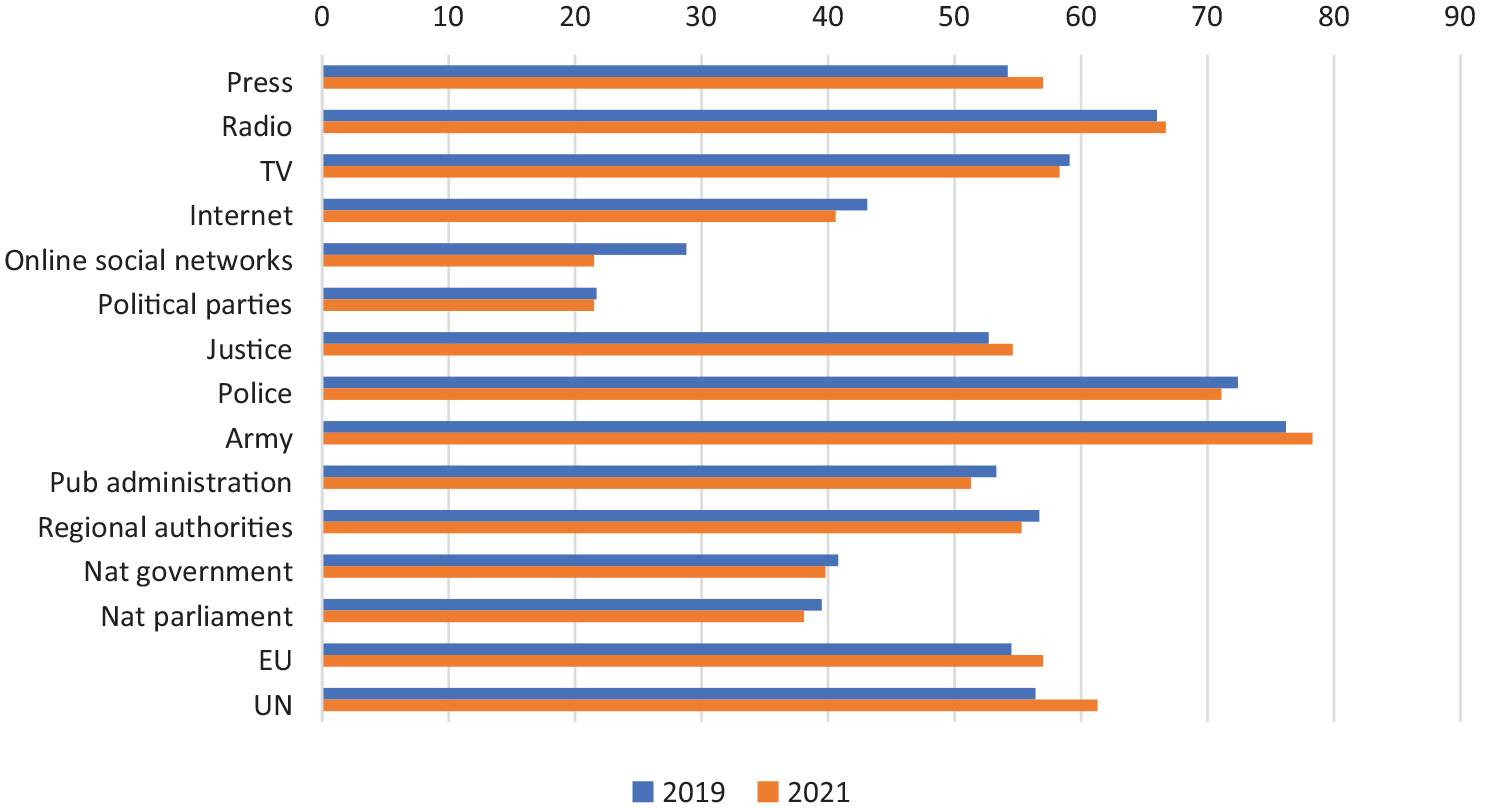
Trust in institutions in Europe: 2019 versus 2021.
Mapping trust repertoires
Various models were estimated to decide on the number of latent classes (see Table A8). The reported test statistics and information criteria show that the multilevel structure, which includes non-parametric random effects, improves model fit. Also, the Bayesian Information Criterions (BICs) and the Akaike Information Criterions (AICs) continue to decrease when more clusters are distinguished, but the decline starts slowing down after clusters 7 (individual level) and 4 (group level). The entropy R2 remains higher than 0.80. The interpretation of the results becomes slightly more complex for eight individual clusters or five group clusters. For the sake of a more parsimonious solution, we continue with a solution of seven individual clusters and four group clusters.
Description of institutional trust clusters
Figure 2 presents the seven clusters which were found (see also Table A9 in the Supplemental Materials). Overall, two types of institutions are less distinctive: online social networks and the Internet have low probabilities in all clusters (cf. Liu and Lu, 2020), while the police, the army, and health and medical staff (cf. “public service institutions,” Tan and Tambyah, 2011) are trusted by almost all clusters. The largest cluster (with a class probability of 0.24, i.e. containing 24% of the respondents) consists of citizens who tend to trust most institutions, except for social media, and with slightly lower probabilities for Internet and political parties. This cluster is therefore labeled Mostly trustful.
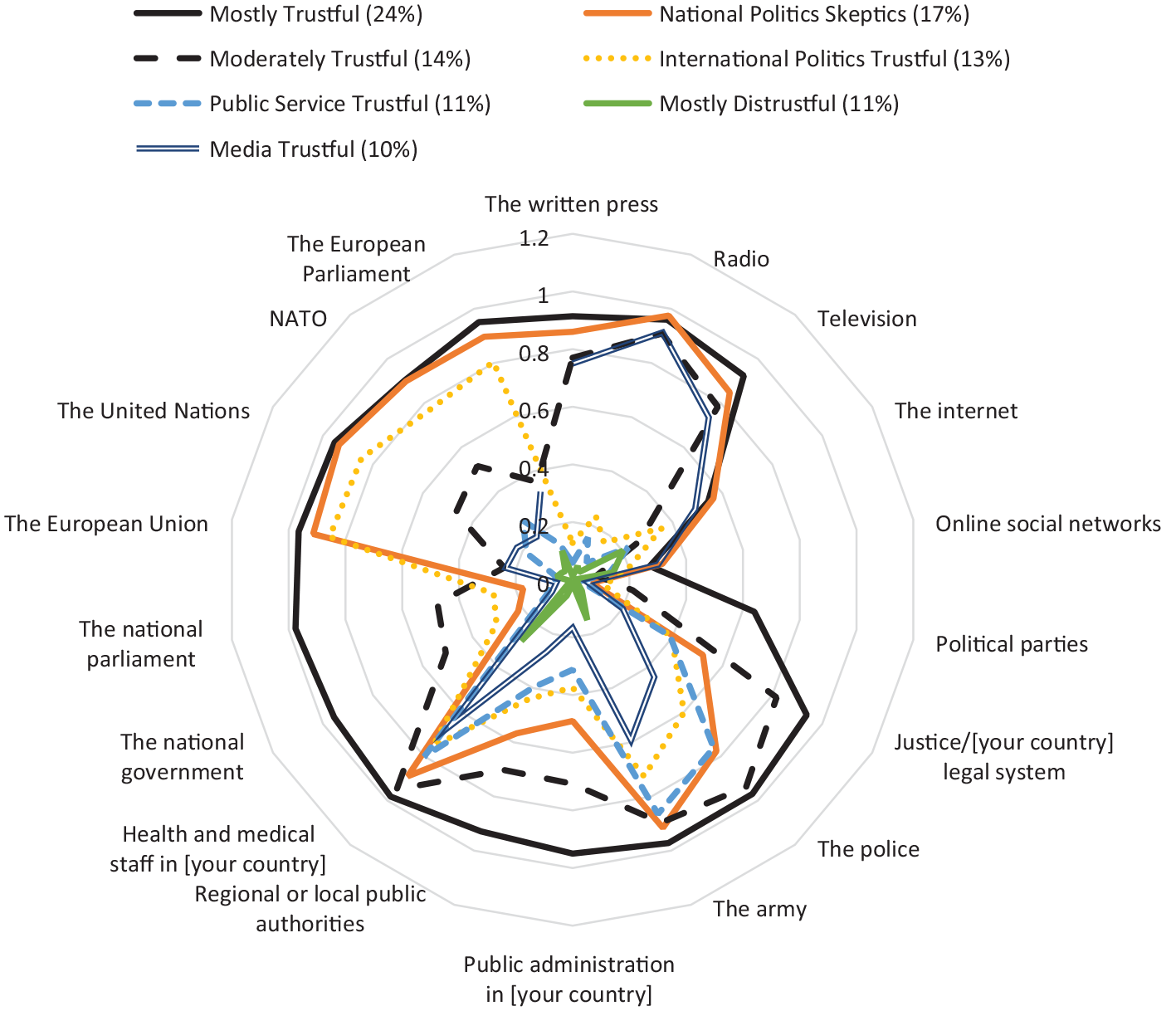
Profile plot institutional trust repertoires.
The second largest cluster (class size is 17%) is characterized by a high probability of trusting traditional media, police, army, health and medical staff, and international political institutions, but a low probability of trusting social media, political parties, national government, and national parliament. This group is labeled National politics skeptics. The third largest cluster (class probability of 0.14) resembles cluster 1, but trust levels are slightly lower and do not include all institutions, which is why cluster 3 is labeled Moderately trustful.
Clusters 4 and 5 also resemble each other. Both are characterized by a high probability of not trusting the media, and national politics, but considerable trust in public service institutions. The difference is that cluster 4 also expresses trust in international political institutions and cluster 5 does not. Cluster 4 (13% of the sample) is labeled International politics trustful, and cluster 5 (11% of the sample) Public service trustful.
Cluster 6 contains about 11 percent of the respondents and shows only low probabilities of trusting institutions. In other words, this group states in their answers that they tend not to trust (hardly) any of the institutions mentioned. It is the only cluster in which even the public service institutions (police, army, health) are hardly trusted. This cluster is thus labeled Mostly distrustful.
Finally, the last cluster in size (10%) shows distrust toward all national and international political institutions as well as the juridical system. There is some trust toward the public service institutions, but what sets this cluster apart are the high trust levels for media-related items. Since the media seem to be the primary point of trust in this cluster, we call this group Media trustful.
Comparing countries
How do countries differ regarding institutional trust? Table 1 presents the group-level latent classes (GClasses) which were estimated in the multilevel LCA (for the individual country scores, see Figure A1 in the Supplemental Materials). Countries have been clustered according to the distribution of latent classes at level 1. GClass 1 consists of Italy, Greece, Spain, Cyprus, Latvia, Slovakia, Slovenia, Bulgaria, and Croatia. This group of countries is characterized by relatively many national politics skeptics (21.5%) and mostly distrustful (almost 20%). GClass 2 contains Belgium, France, Ireland, Germany East, Czechia, Austria, and Estonia. Here, clusters 1–3 take up most of the population, implying that many citizens are moderately to mostly trustful or mainly distrust national politics. There is, however, a substantial group (17%) that only trusts public service institutions.
Country clusters of trust repertoires.
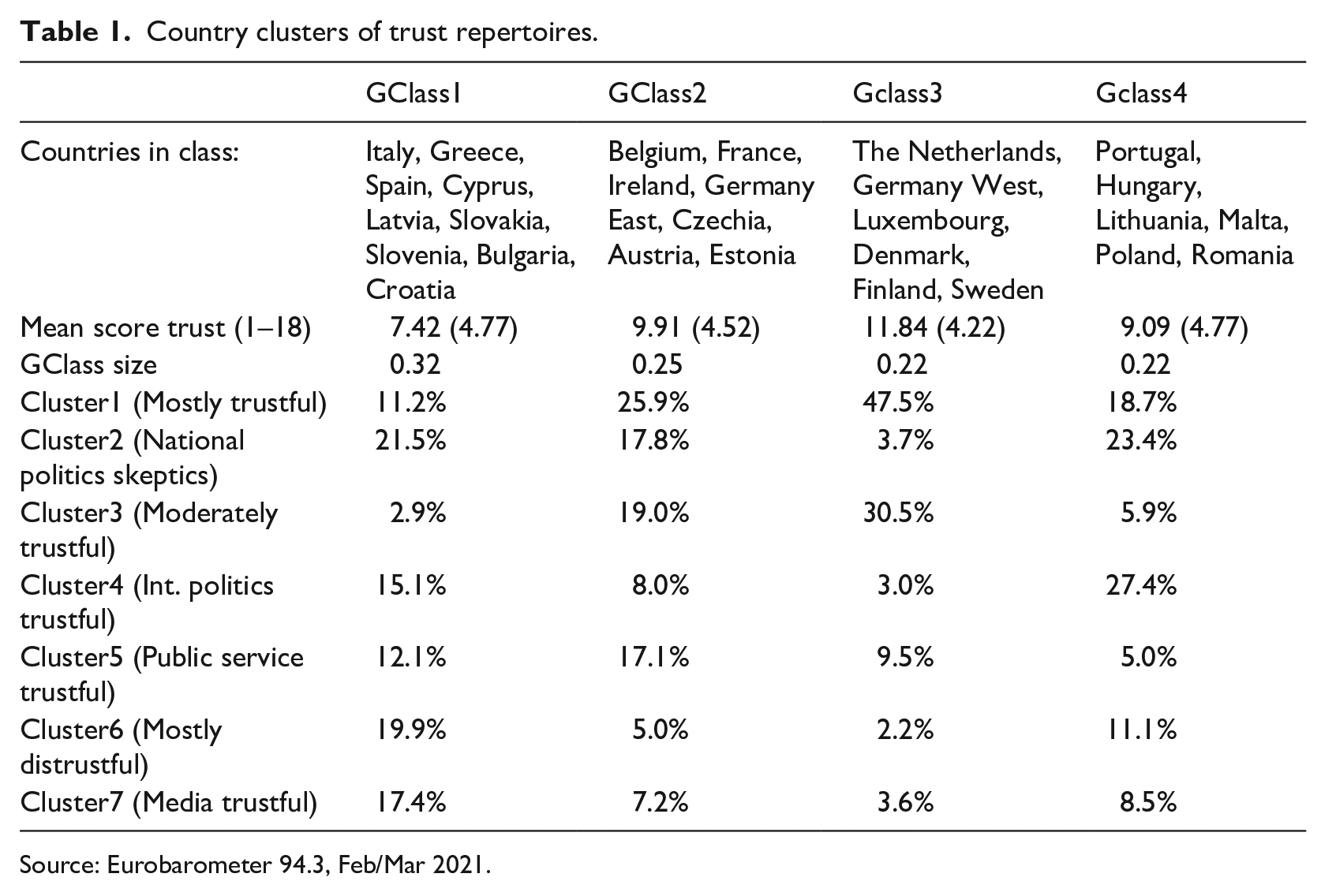
Source: Eurobarometer 94.3, Feb/Mar 2021.
GClass 3 consists of the traditional high-trust countries: the Netherlands, Germany West, Luxembourg, Denmark, Finland, and Sweden. More than three-quarters of the population in these countries tend to be moderately to mostly Trustful. The group that only trusts public service institutions is about 10 percent. The final group of countries—GClass 4—is Portugal, Hungary, Lithuania, Malta, Poland, and Romania. Their overall trust level resembles that of GClass 2, but here there are more national politics skeptics (C#2) (23%) and more international politics trustful (C#4) (27%) than in the other classes.
Overall, these results are in line with previous studies showing that Nordic and West-European countries in general tend to show the highest trust levels in Europe, while institutional trust is lower in Southern and Eastern European countries (Van der Meer and Hakhverdian, 2017). Furthermore, there is an association with the Economist Intelligence Unit (EIU) democracy index: GClass 3 consists of countries classified as best performing democracies, followed by GClass 2 (see Table A1). GClass 1 and GClass 4 both contain more “flawed democracies,” according to the EIU classification.
Explaining membership of clusters
Table 2 displays the outcomes of the explanatory models for cluster membership. All predictors except difficulty paying have significant effect, based upon the Wald statistics. Value orientations help to predict the membership of trust clusters. The group of Mostly trustful (C#1) consists of citizens who are satisfied with their own life and with how the world is developing, who both identify with Europe and their own national and regional origin, and who are in favor of globalization. The Moderately trustful (C#3), who have similar, though slightly lower trust patterns, are more satisfied with their own life than with world developments. They only identify with the national and regional origin, but European identity is negatively associated with this cluster. There is no association with socio-political values.
Predicting membership of trust repertoires in Europe (N = 25,047; 28 countries).
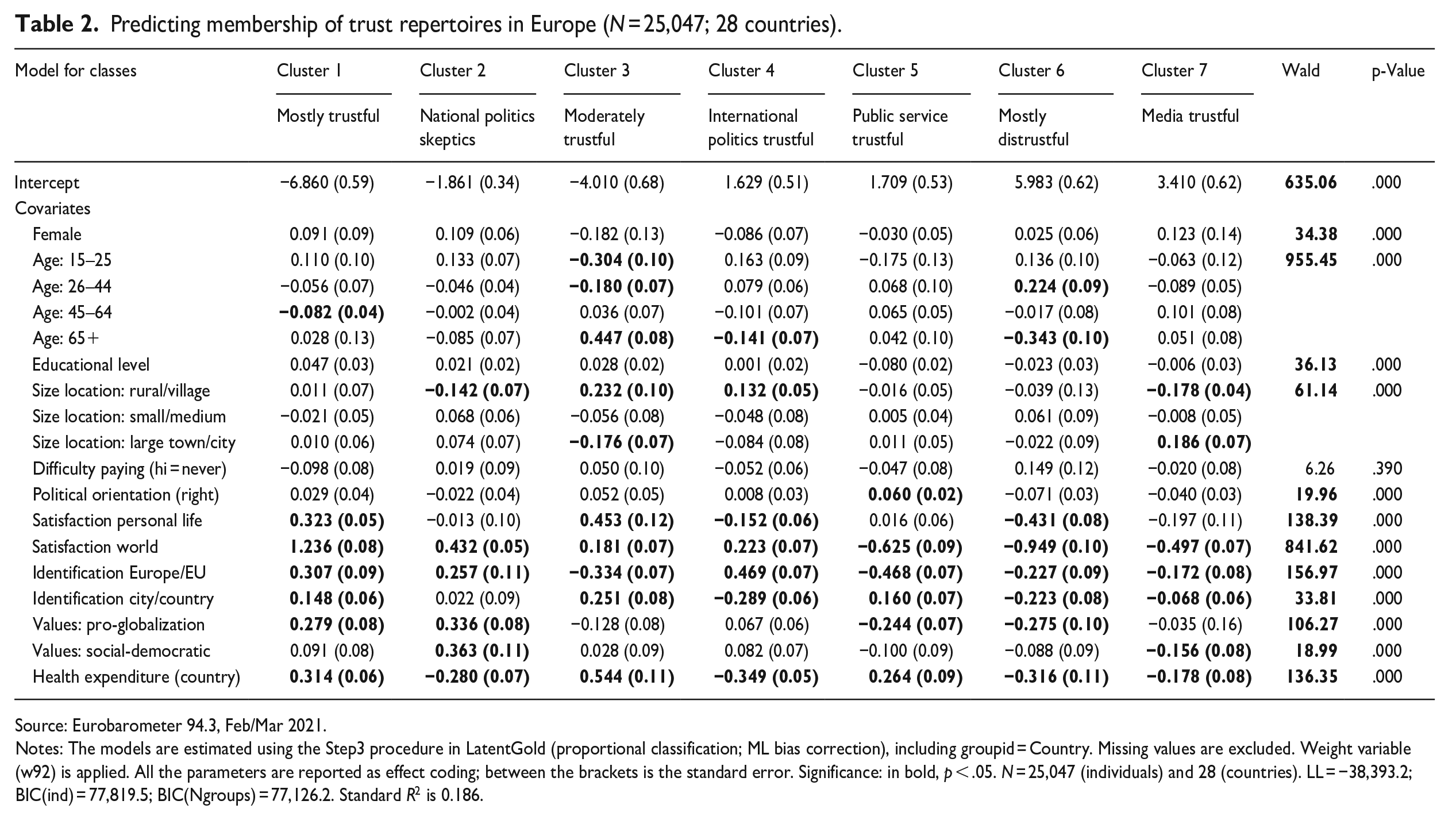
Source: Eurobarometer 94.3, Feb/Mar 2021.
Notes: The models are estimated using the Step3 procedure in LatentGold (proportional classification; ML bias correction), including groupid = Country. Missing values are excluded. Weight variable (w92) is applied. All the parameters are reported as effect coding; between the brackets is the standard error. Significance: in bold, p < .05. N = 25,047 (individuals) and 28 (countries). LL = −38,393.2; BIC(ind) = 77,819.5; BIC(Ngroups) = 77,126.2. Standard R2 is 0.186.
When we turn to two clusters with more varied response patterns, but still quite positive (C#2 and C#4), we see again positive predictions from satisfaction with the world and identification with Europe. These clusters share a skepticism for national politics, and—particularly Cluster 4—higher trust in international political institutions. They differ in terms of values and satisfaction with one’s personal life. National politics skeptics are both relatively more often pro-globalization and more social-democratic, while citizens who trust international institutions are less satisfied with their personal life.
The last three clusters—which are arguably overall less trustful—are to a large degree typified by negative predictions. In other words, cluster members are less satisfied with their life and the world, show less identification with Europe and their country and region (except C#5), and are more critical toward globalization as well as anti-social democratic. The predictive coefficients are—unsurprisingly—the strongest for C#6, the least trustful of all clusters.
Three aspects of these findings are worth highlighting. First, some indicators clearly map onto specific response patterns. Satisfaction with the world and identification with Europe predict clusters in which trust in international institutions is high or moderate (C#1 to C#4). Satisfaction with one’s personal life is mainly present in the broader clusters C#1 and C#3. Second, citizens who endorse more social-democratic values are often critically trustful (C#2), yet their opposites are more likely to show broad distrust, supporting the thesis on the cultural backlash against progressive values. Third, although value orientations diminish many effects of demographic variables (see Table A10 in Supplemental Materials), some differences remain. Citizens aged 15–25 and 26–44 are less likely to belong to the Moderately trustful (C#3), and, in the case of the latter, more likely to be Mostly distrustful (C#6). For citizens aged 65+, it is the opposite: more often Moderately trustful, less often Mostly distrustful. Persons living in rural areas or villages are more trustful than persons living in large towns or cities, with the only exception of the Media trustful (C#7): here city people express more trust.
Comparing countries
The control variable health expenditure in the country also contributes to the explanation of cluster memberships. Citizens from countries in which more money is spent on health care are more likely to belong to the Mostly trustful (C#1), Moderately trustful (C#3), and Public service trustful (C#5). Furthermore, separate models were estimated for the four latent country classes, to assess whether explanations differed (see Table A11 in the Supplemental Materials). First, based upon the explained variances, it appears that the model better predicts membership in GClass3 (high-trust countries) and GClass2 (moderately trusting countries). Second, for many variables, significant differences in direction are found, implying cross-national distinctions. One example concerns satisfaction with one’s personal life: in high-trust countries (GClass 3), this does not predict being very distrustful, perhaps because less satisfied persons still trust the media (coefficient = –0.244 for C#7). Identification with Europe also plays out differently across countries: in contrast to the other clusters, in GClass4, more Europe-minded are more likely to be distrustful, perhaps because, in some of these countries (Hungary and Poland), citizens trust European institutions more than national institutions.
Third, GClass2 and GClass3 seem to have, overall, more significant outcomes for the demographic variables than GClass1 and GClass4, suggesting that there are relatively many differences between social groups (unexplained by value orientations associated with cultural backlash), perhaps due to higher levels of individualization and lower social coherence. For example, the role of age as a divisive factor hardly seems to matter in GClass1.
Predicting receptions of the COVID-19 responses
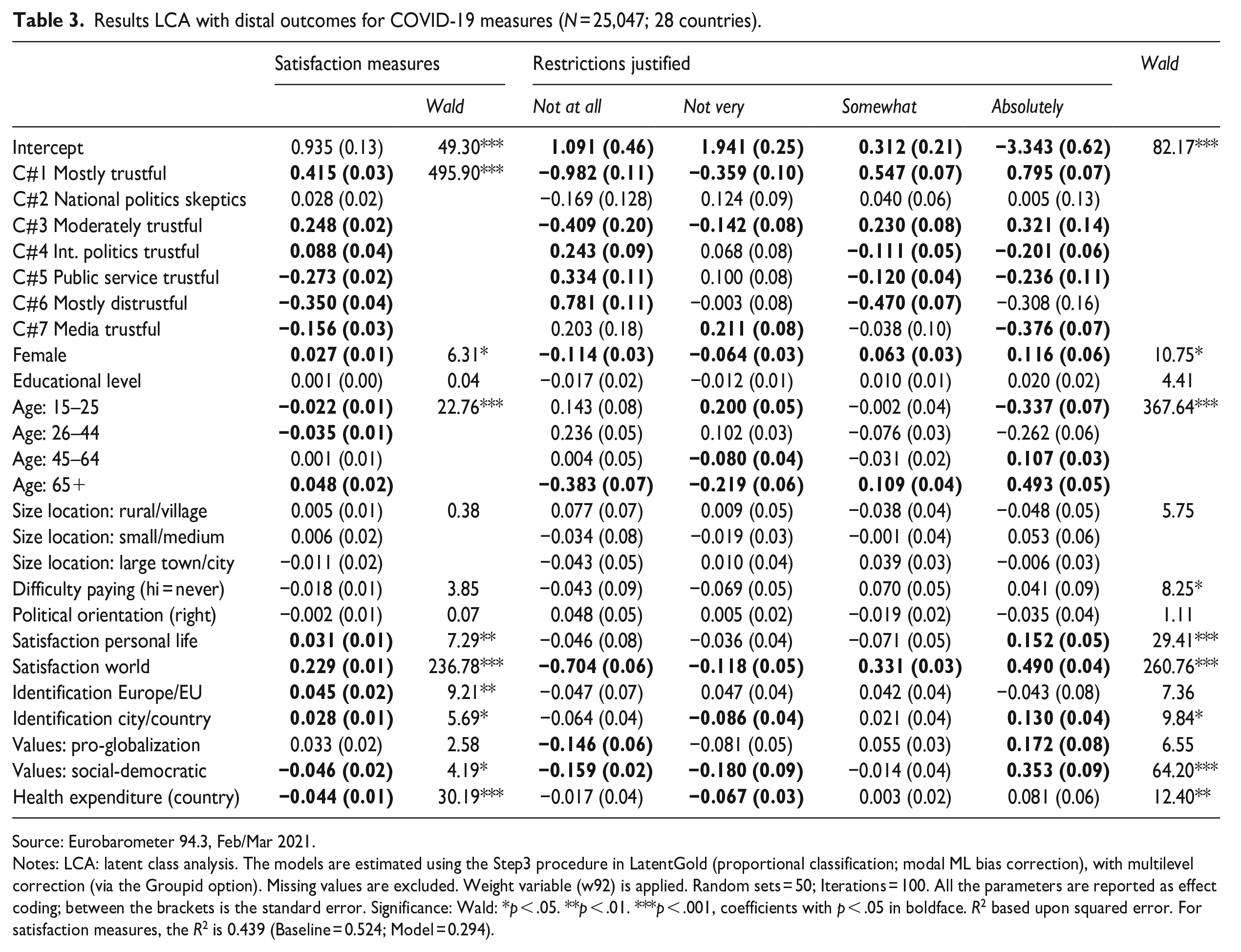
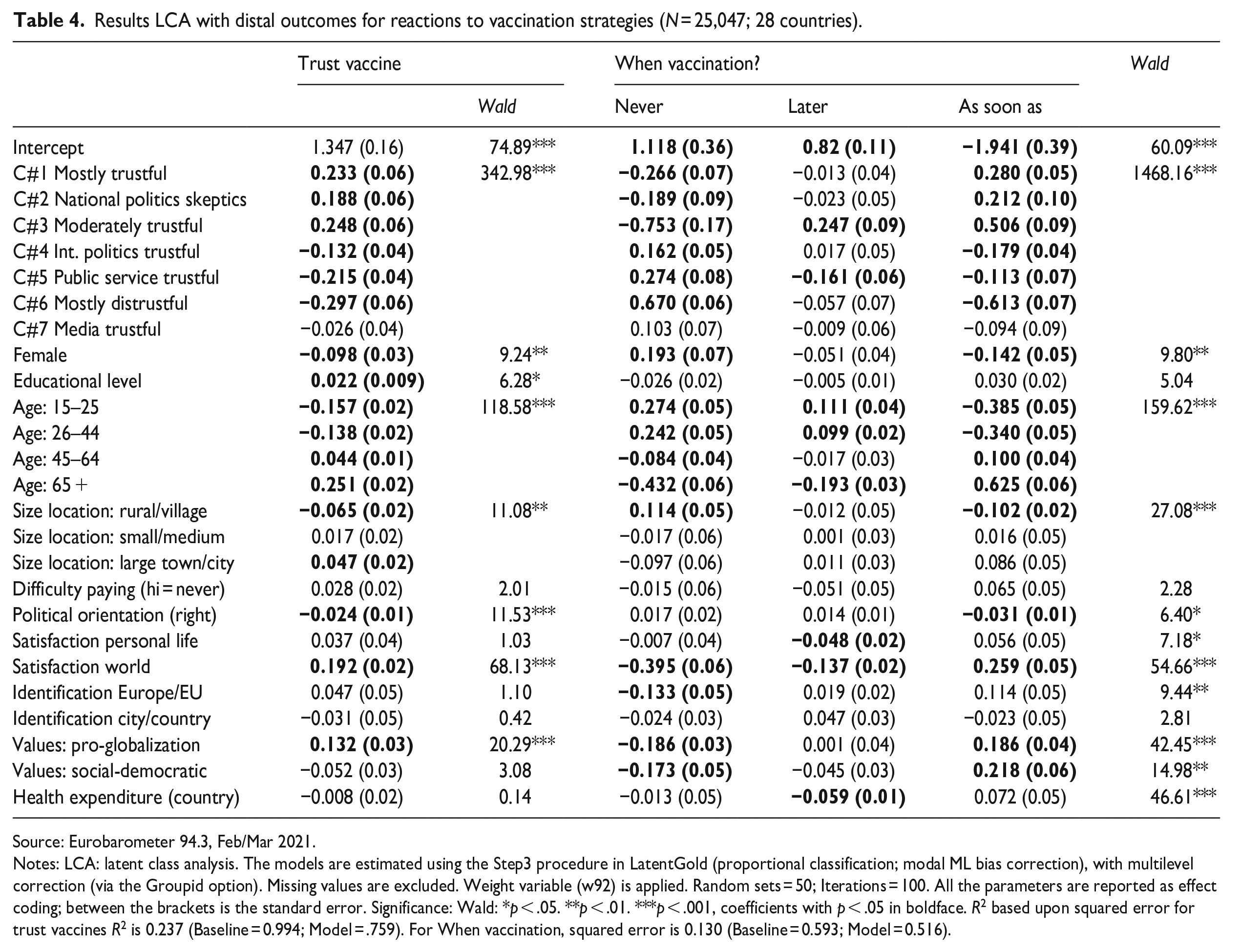
Tables 3 and 4 present the results of four multilevel LCAs with distal outcomes. As can be observed, the trust repertoires are significantly related to how citizens perceive both COVID-19 measures and vaccination programs. Furthermore, the reactions are mostly consistent across the four topics, while relevant distinctions can be seen between the various repertoires. The Mostly distrustful (cluster #4) are most negative toward all institutional responses: they are least satisfied with the measures (coefficient = –0.350), find the restrictions not at all justified (coefficient = 0.781), do not trust the vaccines (coefficient = –0.297), and are most inclined to say “never” to be vaccinated (coefficient = 0.541). Importantly, the Public service trustful and the International politics trustful—both of whom also distrust the majority of institutions, including national politics and media—resemble these patterns, but in more toned-down variations. The National politics skeptics are undecided on measures and restrictions but trust vaccination programs. This suggests that a broad basis of institutional trust is important, but that some institutions—international politics and public service ones—are less crucial. Even the trust in health and medical staff (also present in C#4 and C#5) in itself is not a necessary condition. It is particularly distrust of the main national-level political institutions in combination with distrust in media which is harmful for getting support for crisis measures.
Results LCA with distal outcomes for COVID-19 measures (N = 25,047; 28 countries).
Source: Eurobarometer 94.3, Feb/Mar 2021.
Notes: LCA: latent class analysis. The models are estimated using the Step3 procedure in LatentGold (proportional classification; modal ML bias correction), with multilevel correction (via the Groupid option). Missing values are excluded. Weight variable (w92) is applied. Random sets = 50; Iterations = 100. All the parameters are reported as effect coding; between the brackets is the standard error. Significance: Wald: *p < .05. **p < .01. ***p < .001, coefficients with p < .05 in boldface. R2 based upon squared error. For satisfaction measures, the R2 is 0.439 (Baseline = 0.524; Model = 0.294).
Results LCA with distal outcomes for reactions to vaccination strategies (N = 25,047; 28 countries).
Source: Eurobarometer 94.3, Feb/Mar 2021.
Notes: LCA: latent class analysis. The models are estimated using the Step3 procedure in LatentGold (proportional classification; modal ML bias correction), with multilevel correction (via the Groupid option). Missing values are excluded. Weight variable (w92) is applied. Random sets = 50; Iterations = 100. All the parameters are reported as effect coding; between the brackets is the standard error. Significance: Wald: *p < .05. **p < .01. ***p < .001, coefficients with p < .05 in boldface. R2 based upon squared error for trust vaccines R2 is 0.237 (Baseline = 0.994; Model = .759). For When vaccination, squared error is 0.130 (Baseline = 0.593; Model = 0.516).
The Mostly trustful and Moderately trustful resemble each other in being accepting of measures and positive toward vaccination. Interestingly, the Moderately trustful express slightly more outspoken opinions regarding the trust in vaccines (coefficient = 0.248) and are more eager to get vaccinated (coefficient = 0.371). The Media trustful display less explicit patterns in their reactions, although they tend to be on the negative side of the spectrum, particularly for the measures.
Value orientations have some additional predictive power. Socio-political values do mostly have a positive impact. Despite the negative association of endorsing social-democratic values with satisfaction of the measures, restrictions are seen as justified by this group and they do want to be vaccinated. Geographical identification matters less. There is no difference between European and country/city identification for satisfaction with the measures (both positive), while for the other variables, the results are less clear.
Finally, some differences between social groups still remain in the models. What stands out are the age differences: the youngest group rejects not only the measures but also the vaccination program. Only above the age of 45, citizens become more positive and compliant. For the size of the living location, there is a sharp distinction between measures and vaccination programs: rural areas do not differ from large towns and cities with regard to the measures, but they do for vaccination. The former express less trust and less inclination to get the vaccine. Note that these differences cannot be explained by value orientations.
Comparing countries
All models include the country-level variable Health expenditure, which is negatively related to satisfaction with measures (coefficient = –0.044): more money spent on health care, less satisfaction. At the same time, richer countries are less likely to say restrictions are not very justified (coefficient = –0.067) and less likely to postpone vaccinations (–0.058). Like predicting memberships, separate models were estimated for the four latent country clusters to examine whether explanations differed (see Tables A12 and A13 in Supplemental Materials). 6 Whereas the explained variance for satisfaction with measures was relatively high for all country clusters, it was lower and more fluctuating for trust in vaccines. The coefficients of the cluster memberships are quite consistent in their effects on satisfaction with measures as well as trust in vaccines. Value orientations differ in various ways, but these are all about significance: there are no (significant) opposite directions of coefficients. Also, except for a few examples (Satisfaction with world developments; being pro-globalization in GClass1; being pro-citizen rights in GClass4), most country cluster effects differ for Satisfaction with measures and Trust in vaccines, suggesting that different mechanisms were at play.
Conclusion
This article examined the role of institutional trust in current European societies: it maps institutional trust repertoires and analyzes their consequences for a crisis that disturbed public life immensely in 2020 and 2021—the COVID-19 pandemic and the measures to fight this. Extending previous work on institutional trust and COVID-19, the analysis incorporates value orientations associated with cultural backlash (Norris and Inglehart, 2019) in predicting trust and the reception of institutional COVID-19 responses.
For most institutions, trust levels in 27 EU member states in spring 2021—during the COVID-19 pandemic—are similar to those in 2019, before the pandemic, suggesting that at the societal level, no major decline in trust occurred. Examining the 2021 data in more detail discloses seven different trust repertoires. There is little coherence in how trust is spread among European citizens: a large majority that is trustful across the board does not exist. On the extreme ends, we find the Mostly trustful (24% of the population) and the Mostly distrustful (11%). These groups are quite consistent in expressing either trust or distrust toward (almost) all institutions, reflecting what Wu and Wilkes (2018) label the “compliants” and “cynics,” but in slightly more nuanced ways. Two other clusters that express relatively much trust are the Moderately trustful (14%) and the National political skeptics (17%), who restrict their lower confidence to national politics and/or international politics institutions. The last three clusters concern citizens who are overall not very trustful, but who have specific trust in either international political institutions (13%), public service institutions (police, army, health) (11%), or the media (10%).
Membership of clusters can to some degree be predicted by value orientations of respondents. That is, citizens’ geographical identifications, which have been signaled as an important driver of populist movements (Norris and Inglehart, 2019), also affect the type of institutional trust one adheres to. The evidence for socio-political values is less clear, but this might be related to the limitations of the employed Eurobarometer data. Still, endorsing social-democratic values increases the probability of being “critical but trustful” and decreases the chances to be overall distrustful (or cynical). Clearly, how people are doing in life is shaping trust strongly: trust is hampered by lower levels of satisfaction with one’s own life and world developments. This seems to invoke a clear policy recommendation: investing in institutional trust implies investing in citizens’ life chances (cf. Glatz and Eder, 2020) by, for example, by tackling social inequalities.
It should be highlighted that—independent of value orientations—age is an important predictor, particularly in the high-trust countries. This contrasts the outcomes of Brosius et al. (2022) who find no differences in the levels of media trust between generations. In this study, however, younger persons (under 45) are less likely to be moderately trustful, and the 26–44 category is more likely to be distrustful, which to some degree resembles findings by Norris and Inglehart (2019). We find some evidence for the difference between rural areas and bigger cities, but education seems less important than in studies focusing on political trust levels (e.g. Kolczyńska, 2020; Noordzij et al., 2019). On the one hand, this could imply that both high educated and low educated adhere trust to various institutional actors; on the other hand, it could be the consequence of other studies not controlling for value orientations.
The relevance of institutional trust repertoires becomes more pressing when the perceptions of COVID-19 responses are analyzed. Citizens with different trust repertoires also perceive COVID-19 responses distinctively—both in terms of measures and vaccination programs. Particularly the combination of not trusting national politics and not the media appears to be invoking the most negative reaction to (all) COVID-19-related responses. This is a slightly more nuanced than previous studies mainly pointing at politics (Han et al., 2023; Trent et al., 2022). In the current results, the National politics skeptics did not show negative receptions of the measures. It was the repertoires in which also other institutions were distrusted, especially media, that turned against COVID-19 measures. These results suggest that in times of crisis, concerted efforts of institutions to deal with the crisis are hugely important.
What about country differences? Inspection of the cluster sizes suggests that most of the European population still belongs to one of the three most trustful clusters. However, it is also apparent that trust in national political institutions (political parties, national government, national parliament) is low in most clusters. Yet distinctions between countries should not be ignored. Employing the multilevel cluster option shows that institutional trust repertoires are patterned to a large degree according to how well democracy functions in countries. The best-functioning democracies (Scandinavian countries, the Netherlands, and Germany) group together, just like a group of mostly central European countries that do relatively well. Only Southern and Eastern countries with lower democracy indexes mix in ways that need further examination. Country health expenditure had clear predictive power for trust repertoire membership—in higher spending countries citizens are more likely to be trustful—but less so for COVID-19 reception (perhaps the most impact is mediated via institutional trust). Since health expenditure is higher in well-functioning democracies, it is difficult to disentangle their impacts, but at the same time reiterates that improving the quality of institutions is beneficial for trust.
Taking a multilevel LCA approach to institutional trust not only enabled us to distinguish the “cynical, critical and compliant” (Wu and Wilkes, 2018) but also disentangle the relevance of different institutions. Representative (political) institutions at the national level and the media appear to have had crucial roles in how COVID-19 measures and vaccination strategies were digested. Studying trust repertoires also helps to tease out how manifestations of growing societal polarization—concretized in this article by value orientations associated with cultural backlash—precisely boosts or hinders institutional trust.
Some limitations to this study need to be mentioned. Data from Eurobarometer were used, and these have certain downsides regarding measurement precision and scope of institutions. The variables measuring trust only consisted of two categories: while this triggers a clear discrete choice, a more nuanced spectrum of answering options would have been preferable. Also, Eurobarometer data have limited measurements of value orientations. With regard to the analyses, causality is always a problem with cross-sectional data: while it is assumed that institutional trust informs responses to a crisis (Boin et al., 2005), we cannot eliminate the possibility that reactions to COVID-19 policies have influenced the degree to which individuals trust institutions. Still, comparing pre-pandemic (2019) data with the 2021 data showed that overall trust levels have—on average—remained quite stable. Of course, it is likely that the most distrustful and critical citizens have not participated in the survey. This issue is, however, a general problem in survey research (Hendra and Hill, 2019), and perhaps more broadly in any type of research originating from institutions. Finally, future research could re-examine, with different data, whether similar trust repertoires can be observed in other contexts or time frames, and the extent to which they are also associated with other contentious societal dilemmas.
Supplemental Material
sj-docx-1-cos-10.1177_00207152231223730 – Supplemental material for Trust repertoires and the reception of institutional responses to the COVID-19 crisis in Europe: A latent class analysis
Supplemental material, sj-docx-1-cos-10.1177_00207152231223730 for Trust repertoires and the reception of institutional responses to the COVID-19 crisis in Europe: A latent class analysis by Marc Verboord in International Journal of Comparative Sociology
Footnotes
Funding
The author(s) disclosed receipt of the following financial support for the research, authorship, and/or publication of this article: This project has received funding from the European Union’s Horizon 2020 research and innovation program under grant agreement no. 870691.

Supplemental material
Supplemental material for this article is available online.
Notes
References
Supplementary Material
Please find the following supplemental material available below.
For Open Access articles published under a Creative Commons License, all supplemental material carries the same license as the article it is associated with.
For non-Open Access articles published, all supplemental material carries a non-exclusive license, and permission requests for re-use of supplemental material or any part of supplemental material shall be sent directly to the copyright owner as specified in the copyright notice associated with the article.
