



Abstract
Many countries worldwide have seen populist resentment against scientists, which can manifest as “science-related populist attitudes” among the population. These attitudes can be assumed to divide populations into multiple segments—each endorsing or rejecting different facets of science-related populism, with segment sizes and characteristics varying between countries and cultural contexts. This study tests this with a secondary analysis of four public opinion surveys from Austria, Germany, Switzerland, and Taiwan (total N = 4598), combining a Most Similar Systems Design (MSSD) and a Most Different Systems Design (MDSD). It uses fixed-effects latent class analysis to demonstrate that Austrian, German, Swiss, and Taiwanese publics can be grouped into three segments: Full-Fledged Populists, People-Centric Non-Populists, and Deferent Anti-Populists. A large majority in all countries can be classified as Non-Populist or Anti-Populists, whereas Populists, who support the entire spectrum of science-related populism, make up the smallest segment. Bayesian regression shows that Populists are older and more likely to support right-leaning political views. Cross-country and cross-cultural comparisons reveal differences in segment sizes and characteristics: For example, Populists are more prevalent in Austria, while Germany has a large proportion of Anti-Populists. These are less widespread in Taiwan, where Non-Populists form a particularly big segment. The findings can be explained with national political, cultural, and historical contexts to some degree. Eventually, they are discussed against the backdrop implications for science communication and future scholarship on public science skepticism.
Keywords
Introduction
Pundits have expressed concern about public reservations of scientific expertise in many countries. Some of these reservations derive from politically motivated resentment against science (Ecker et al., 2022), whereas others tie into populist worldviews—that is, beliefs that a “political establishment” deprives “common people” of their say in political decision-making (Mudde, 2007). Such “science-related populist attitudes” (Mede et al., 2021: 273) suggest that the common sense of ordinary people is superior to allegedly useless knowledge of scientists, experts, and other members of allegedly immoral academic elites. Science-related populists therefore claim that common people, rather than academic elites, should determine what is deemed true knowledge and how it is produced (Mede and Schäfer, 2020).
Science-related populist attitudes and similar phenomena were observed in different contexts, for example, in public opinion about scientific expertise on COVID-19 (Staerklé et al., 2022). Most studies centered on European nations like Austria, Germany, and Switzerland, where right-wing parties challenged scientists and their knowledge claims (e.g. Eberl et al., 2023). Yet there are also populist reservations against science outside Western cultures, for example, in the Philippines (Lasco, 2020) and Indonesia (Mietzner, 2020). One intriguing but underexplored case is Taiwan—a country where science and technological innovation play a major role in society (Li and Tsai, 2019). On one hand, Taiwan has been regarded as resilient to populism, as there is “no ideological space for populism in Taiwan” (Yen, 2021: 162). But on the other hand, it has seen a “rise of populist politician influence” (Yang and Michael Hsiao, 2021: 13), populist election campaigning (Lin et al., 2023), an emergence of a “populist-democratic culture with ‘anti-intellectual’ or ‘anti-expert’ policy-making” (Shyu, 2008: 131), and a high prevalence of false, misleading, and commonsensical information about a range of issues including science (Fominaya, 2022; Rauchfleisch et al., 2022), which may have cultivated science-related populist attitudes among the population.
Importantly, scholarship suggests variations of science-related populism both within and between cultures: For example, populist criticism of scientific expertise often coincides with right-leaning political positions in European countries like Germany (Boecher et al., 2022), but barely maps onto the left-right spectrum in many East Asian nations like Taiwan (Hsiao et al., 2017). After all, the categories “left” and “right” have different meanings and less importance in countries like Taiwan (Jou, 2010). Science-related populism also likely differs among culturally similar countries: It might emphasize participatory demands toward science in countries with a direct democratic system, such as Switzerland (Mede et al., 2022), and anti-academic views in countries with comparatively strong reservations against scientists, such as Austria (European Commission, 2021).
However, the existing literature only allows tentative assumptions about cross-national and cross-cultural variations of science-related populist attitudes: First, there is little empirical research on science-related populism specifically, while findings on similar phenomena, such as populist attitudes toward politics, are limited as to how well they apply to populist attitudes toward science, because these phenomena have crucial differences (Eberl et al., 2023). Accordingly, current research on science-related populist attitudes, let alone their cross-national variability, is to some degree still in an exploratory stage (Mede et al., 2022). Second, the few existing studies on science-related populism specifically have only studied Western countries so far and did not compare them with non-Western countries. Non-Western countries, however, provide different conditions for science-related populism, because they offer other “opportunity structures” for populist ideas (Boudreau, 1996: 176) and public reservations against scholarly expertise (Ho, 2011). For example, a substantial body of sociological scholarship has demonstrated how narratives of (counter-)expertise (Au et al., 2022), conflicts of lay and elite knowledge (Fan, 2023), and scientific controversies (Lei, 2021) differ between Asian and Western countries. Moreover, it has been found that European and East Asian publics differ in their affinity to political populism (Norris, 2020) and critical attitudes toward science (Mede, 2022a). Third, research has focused on public support for science-related populism rather than opposition against it, such as “anti-populism” (Markou, 2021: 201). Fourth, existing studies often analyzed science-related populist attitudes in their entirety rather than single components (Wintterlin et al., 2022), albeit endorsement for specific aspects bears the potential to evolve into “full-fledged” populism and is thus worth exploring (Mede et al., 2022: 3). Fifth, scholars mostly studied average levels of science-related populist attitudes among the population (Mede and Schäfer, 2022) and have not analyzed how these attitudes split populations into different segments—that is, into distinct groups whose members are similar to those of the same group but different from those of other groups in terms of how strongly they favor or reject science-related populism. Such segmentation analyses have become increasingly important, as they address the pluralization of public opinion on science (Schäfer and Metag, 2021), help identify target groups of science communication (Füchslin, 2019), and respond to calls for the social sciences to disaggregate multi-faceted sentiments in public opinion (see Bonikowski and DiMaggio, 2016).
I address these limitations with a secondary analysis of four national population surveys in Austria, Germany, Switzerland, and Taiwan, that is, in three Western countries in Europe and a non-Western country in East Asia. Unlike most previous research, I also focus on opposition to science-related populism, distinguish different components thereof, and apply multilevel latent class analysis to identify population segments that differ in their attitudes toward science-related populism (Clogg and Goodman, 1985). I will thus provide a first intercultural, more fine-grained, and methodologically innovative, international comparison of science-related populism.
Literature review and research questions
Populism, criticism, and distrust toward science
Scholars from different disciplines diagnosed an affinity of populism and critical orientations toward science, scientists, and the scientific epistemology (Bellolio, 2022; Rekker, 2021; Zapp, 2022). Some suggested that the core idea of populism—a moral antagonism between virtuous citizens and evil political elites that is due to elites overruling political power claims of the common people—resonates with beliefs assuming a fundamental conflict between virtuous citizens and academic elites that is due to scholars, intellectuals, and experts overruling commonsensical knowledge claims of “ordinary people” (Staerklé et al., 2022: 917). Mede and Schäfer (2020) conceptualized these beliefs as “science-related populism.” Science-related populism regards gut feelings and everyday experiences of ordinary people as superior to the expertise of allegedly immoral academic elites—that is, as superior to the knowledge that scholars, researchers, and experts accumulate by means of systematic inquiry and adherence to established scientific norms. Therefore, science-related populists perceive authority of academic elites over decision-making in scientific research and truth-speaking in society as illegitimate, and demand that ordinary people should have this authority instead.
Individual support for science-related populism was conceived as “science-related populist attitudes” (Mede and Schäfer, 2020). Mede et al. (2021) conceptualized these attitudes as a four-dimensional construct and developed the SciPop Scale to measure them in surveys and experiments. The four components of science-related populist attitudes include:
Beliefs that “ordinary people” are virtuous, rely on common sense, and form a homogeneous collective within society (conceptions of the ordinary people).
Beliefs that “academic elites” are immoral, conspire with other elites, and produce useless knowledge (conceptions of the academic elite).
Demands that the people, not academic elites, should decide on research goals, agendas, and methods (demands for decision-making sovereignty).
Demands that the people, not academic elites, should determine what society considers as “true knowledge” (demands for truth-speaking sovereignty).
Science-related populism has overlaps but also important dissimilarities with related phenomena like political populism or (dis)trust in science: In contrast to political populism, it does not center on a perceived illegitimacy of political elites and political power claims, but on a perceived illegitimacy of decision-making and knowledge claims of experts beyond policy-making processes (Mede and Schäfer, 2020). Science-related populism is also different from distrust toward scientists, because it not only criticizes their alleged sovereignty over knowledge production processes, but suggests an alternative to them, that is, civic participation or even authority within these processes (Mede et al., 2022). 1 Political populism and (dis)trust in science are not only conceptually but also empirically dissimilar from science-related populism: Survey research shows that support for science-related populism is distinct from support for political populism (Eberl et al., 2023) and does not correlate significantly with trust in science when controlling for confounding variables, which indicates that the two rely different psychological mechanisms (Mede et al., 2022).
Empirical evidence on science-related populist attitudes is limited: So far, few studies have used the SciPop Scale to examine science-related populist attitudes among the general population. They show that these attitudes occur in different scientific contexts, including vaccination and the COVID-19 pandemic, and in different countries, including the Netherlands, Austria, Germany, and Switzerland (Hameleers and Van der Meer, 2021; Kohler and Koinig, 2022; Mede and Schäfer, 2022; Wintterlin et al., 2022). This caused concerns among scholars, policy-makers, and science communicators, who worried that (science-related) populism will undermine the status of scientific expertise in society, deliberative discourse about science, and democracy more generally (Bellolio, 2022). However, populist demands toward science may not be detrimental per se: Scholars argued that single aspects of populism articulate legitimate reservations toward decision-makers and thus described it as a “corrective for democracy” (Rovira Kaltwasser, 2012: 184).
Segmenting populations based on populist and science-related attitudes
The four components of science-related populist attitudes can be assumed to vary in how much they resonate among different segments of the population—that is, among different social groups with high within-group homogeneity and high between-group heterogeneity. This is because certain facets of populist ideas and critical orientations toward science align more with some people’s socialization, personal identities, and social realities, and less with others’ (Brossard and Nisbet, 2007; Krämer, 2017; see Bourdieu, 1984; Tajfel and Turner, 1986). The anti-establishment component of populism, for example, was considered more attractive to lower-educated population groups, as they might blame educated elites of upholding a meritocratic order that requires university education for access to power and wealth (Spruyt et al., 2016). Skeptical positions toward climate science and gender studies seem more appealing to supporters of the political “right” (i.e. political actors that prioritize economic growth and traditional morality over environmental protection and cultural diversity), at least in many Western countries, whereas such skepticism may also shape the agendas of left-leaning actors in non-Western countries (Krämer and Klingler, 2020; Lewis et al., 2019; Steiner, 2023). Hence, it can be assumed that populist attitudes toward science fragment or even polarize publics into different segments that vary in their size and sociodemographic and attitudinal characteristics (see Schäfer and Metag, 2021).
Empirical research corroborates this assumption: For example, it was found that certain aspects of populism (Hameleers and de Vreese, 2020) and immorality perceptions of scientists (Rutjens and Heine, 2016) vary in how much they appeal to different population groups. This informed further research that explored how such variation divides publics into different clusters. A key method of this research is segmentation analysis, such as latent class analysis, which uses survey data to categorize respondents into different classes with high within-class homogeneity and high between-class heterogeneity (Vermunt, 2003).
Segmentation analyses have been applied in a wide range of mostly explorative social science studies, including populism and science communication research (Füchslin, 2019; Schmidt et al., 2021). They yielded three findings that are instructive for my study: First, they show that different components of populism and attitudes toward scientific issues like COVID-19 vaccination or climate change split populations into different segments (e.g. Agley and Xiao, 2021; Klinger et al., 2022a; Reinemann et al., 2022; Richardson et al., 2023; Rountree and Prentice, 2022; Thaker et al., 2023). For example, Schmidt et al. (2021) identified five groups of citizens in Switzerland, with each group supporting or opposing one or multiple components of political populism. “Radical Anti-Elite Populists,” for instance, supported anti-establishment claims like “Politicians talk too much and take too little action,” whereas “Direct Democracy Devotees” rejected most populism components except for demands for more popular power in policy-making. Rothmund et al. (2022) classified Germans into four segments that differed in how much (pseudo)scientific claims about the COVID-19 pandemic appeal to them: The “Alarmed” segment had strong agreement with claims about measures to prevent the pandemic, whereas the “Doubtful” segment was prone to conspiracy beliefs, for example.
Second, segmentation studies indicate that the segments differ in their size, that is, in how many respondents of a population (or sample) are assigned to them. Schmidt et al.’s (2021) “Radical Anti-Elite Populists” make up only 13.5% of their sample, while the majority consists of “Moderate Populists” or “Individuals with Populist Tendencies.” Further research found that just small parts of the German and Australian public can be classified as “Dismissive” of scientific claims about climate change, whereas sizable portions fall into segments that are “Cautious” or “Alarmed” about it (Klinger et al., 2022a; Richardson et al., 2023). This is plausible given that population groups with presumably less socially acceptable attitudes—such as anti-elite beliefs—tend to be smaller, whereas less extreme views are often more widespread (Van Prooijen and Krouwel, 2019).
Third, segmentation analyses based on populist and science-related attitudes show that the segments differ in their sociodemographic characteristics (e.g. age, gender, education), sociopolitical worldviews (e.g. political orientation, trust in science), and the degree to which they deem scientific expertise important for their lives (e.g. being at risk for illnesses like COVID-19; e.g. Agley and Xiao, 2021; Klinger et al., 2022b; Reinemann et al., 2022; Rountree and Prentice, 2022; Schäfer et al., 2018; Thaker et al., 2023). Swiss “Radical-Universal Populists,” for example, tended to have lower education and more sympathy with right-wing views (Schmidt et al., 2021). Another segmentation analysis of the Swiss population showed that “Extreme Believers” in conspiracy theories about the COVID-19 pandemic were more likely to believe that the public should rely more on common sense when dealing with the pandemic—which resonates with demands for truth-speaking sovereignty of science-related populism (Schäfer et al., 2022). They also tended to be lower educated, have low trust in science, and support right-wing positions, which corresponds with studies showing that trust in science is a correlate of education, political ideology, and rejection of conspiracy theories (Bromme et al., 2022; Lee, 2021; Rothmund et al., 2022).
Overall, existing scholarship suggests that affinity and opposition to (political) populism and (critical) views of science (a) divide populations into different segments, which (b) differ in size, and (c) sociodemographic and attitudinal characteristics. However, it is unclear if this also applies to affinity and opposition to science-related populism in particular—first, because there is mixed evidence on the identification of segments: Some studies found five segments of public perceptions of climate change (Klinger et al., 2022a), for example, whereas others identified only three (Detenber et al., 2016). Second, research is inconclusive about the size of these segments: Schmidt et al. (2021) suggest that more than 50% of Swiss citizens have at least moderate populist attitudes, whereas other research, albeit using different data and methods, indicates much lower rates (Wuttke et al., 2022). Third, there are ambiguous findings on the correlates of segment membership: For example, Germans classified as “Doubtful” about preventive measures against the COVID-19 pandemic tended to have higher education in one study (Reinemann et al., 2022) but lower education in another (Rothmund et al., 2022). Fourth, many studies focused exclusively on support for these worldviews, despite recent calls for more research on opposition to them. For example, scholars suggested that we need more evidence on “anti-populism”—that is, resistance to populist attitudes and rhetoric—to understand democratic resilience (Markou, 2021; Meléndez and Rovira Kaltwasser, 2021; Moffitt, 2018). Fifth, and importantly, most of the above-mentioned research has not studied science-related populist attitudes specifically, but examined similar yet eventually different worldviews, such as political populism (Schmidt et al., 2021). Accordingly, much research on populist beliefs about science is explorative to some degree, and even comparative studies on similar worldviews often avoid confirmatory, hypothesis-testing research designs when “exploring regional patterns of variance,” for example (Van Hauwaert et al., 2019: 303). In sum, the ambiguities and shortcomings of previous scholarship prevent me from setting up informed hypotheses on how science-related populist attitudes divide populations into different segments. Following the approach of similar studies (e.g. Schmidt et al., 2021), I will therefore employ an explorative study design that tests the following research questions:
Segments of affinity and opposition to science-related populism in comparison: differences between countries and cultures
Another caveat of previous segmentation research on populist and science-related attitudes is that it focused on European or Anglo-American societies, although exceptions exist: Guenther and Weingart (2018) identified six segments of positive and negative attitudes toward science in South Africa, and Detenber et al. (2016) found three segments of public perceptions of climate change in Singapore. However, segmentation researchers studied almost only single countries—except Klinger et al. (2022a), for example, who show that survey samples from Germany, New Zealand, the United States, and Australia can be segmented into similar segments based on their attitudes toward climate change (see also Verner et al., 2023). Still, this research provides limited insights as to whether and how science-related populist attitudes vary cross-nationally and cross-culturally.
On one hand, such variation is plausible, because populist attitudes and critical views of science often differ between countries, both in their prevalence among the population and in terms of explanatory factors of prevalence (e.g. Staerklé et al., 2022). These differences may likely occur for countries whose social, political, and media cultures differ (Mede, 2022a), but also for countries with similar cultural conditions (Pauwels, 2014). For example, country-level factors like climate policy-making, volume of media coverage on climate change, and vulnerability to global warming presumably affect how populations can be segmented along climate change perceptions (Klinger et al., 2022a). This is because these factors shape national “opportunity structures,” that is, contextual conditions that capture the “openness or accessibility” of a culture to the emergence of social movements or public sentiments like science-related populism (Arzheimer and Carter, 2006: 422).
On the other hand, science-related populist attitudes can be conceived as fundamental orientations toward science that may transcend cultural differences between both different and similar countries (Wintterlin et al., 2022). Therefore, they might follow patterns that are, to some extent, independent of country contexts—similar to what has been suggested for political populist attitudes (Rovira Kaltwasser and Van Hauwaert, 2020).
In sum, the literature is inconclusive as to how population segments of affinity and opposition to science-related populism differ cross-nationally and cross-culturally. I explore this with a comparison of “most-different” and “most-similar” (Anckar, 2020: 33) countries:
The cases: Austria, Germany, Switzerland, and Taiwan
Countries selected for this secondary analysis are Austria, Germany, Switzerland, and Taiwan. I chose them for three reasons: First, Austria, Germany, Switzerland, and Taiwan are the only countries for which survey data on science-related populist attitudes were available.
Second, Austria, Germany, and Switzerland represent prime examples of countries where science-related populism has affected public opinion (Eberl et al., 2023; Kohler and Koinig, 2022; Mede and Schäfer, 2022). Taiwan, on the other hand, was selected as a special but under-researched case outside Europe. Generally, there is considerable evidence on populism and science criticism in various non-European regions, including Latin America, Africa—and also Asia: Indonesia, India, the Philippines, and Japan, for example, have shown populist and anti-science tendencies (Bellolio, 2022; Lasco, 2020; Mietzner, 2020; Yoshida, 2020). Taiwan, however, seems to be somewhat idiosyncratic: Some maintain that populism has not played an important role in politics and society (Yen, 2021). Others identified a growing prevalence of populist ideas, “anti-expert” resentment, and pseudo-scientific disinformation in public discourse, which may have nurtured science-related populism or single facets thereof (Fominaya, 2022; Hsu, 2023; Shyu, 2008: 131).
Third, Austria, Germany, Switzerland, and Taiwan allow me to leverage the advantages of two established study designs used in comparative sociological and political research: the Most Similar Systems Design (MSSD) and the Most Different Systems Design (MDSD). The MSSD approach suggests that explaining country differences of a phenomenon requires researchers to select countries which presumably differ in terms of this phenomenon but are otherwise as similar as possible, so as to keep extraneous variables constant. The MDSD approach advises researchers to compare countries that are as different as possible—and then identify extraneous variables that lead to similar phenomena in otherwise different contexts. The MSSD and the MDSD approach have limitations, but combining them compensates some of them (Anckar, 2020). Therefore, my analysis integrates an MSSD and an MDSD into a single research design to compare Austria, Germany, and Switzerland, that is, three “most-similar” countries, among each other as well as with Taiwan, which can be considered “most-different” from them, as I will explain in the following.
Austria, Germany, and Switzerland are very similar in terms of political structures and societal values. All of them are multi-party democracies whose right-leaning contenders have often challenged scientific expertise (Eberl et al., 2023). They show similar levels of public trust in science and scientists (Wellcome Trust, 2021) 2 and had similar infection rates and containment policies during the COVID-19 pandemic, which is when the data underlying this study were collected (Our World in Data, 2023). However, Austria, Germany, and Switzerland likely differ in their affinity to science-related populism: Austria has more people perceiving scientists as unintelligent, narrow-minded, and dishonest than Germany and Switzerland (European Commission, 2021). Germany exhibits relatively low support for technocratic governments (Chiru and Enyedi, 2022: 107). Switzerland scores comparatively high in public affinity to populist demands for popular sovereignty (Wuttke et al., 2022). Moreover, populist parties in all three countries differ in voter support: The Swiss People’s Party (SVP) obtained a vote share of 26% in the most recent national elections, the Austrian FPÖ (Freedom Party of Austria) received 16%, and the German AfD (Alternative for Germany) retained 10% (Bedock et al., 2023).
Taiwan differs clearly from Austria, Germany, and Switzerland: Self-expression values, such as demands for participation in politics and society, have been described as less important in Taiwan than in European countries (Inglehart and Welzel, 2010). This might cause Taiwan to be less susceptible to populism, which emphasizes such demands. Indeed, public support for populism has not yet been considered a major issue in Taiwan: Throughout past decades, it had proven relatively resilient against populism (Croissant and Kim, 2020). Neither of the two dominating parties KMT and DPP rely strongly populist rhetoric (Norris, 2020), let alone right-wing populist rhetoric, since left and right are less meaningful political categories in Taiwan—although there is some overlap between left-leaning ideas and the agendas of the Democratic Progressive Party (Hsiao et al., 2017). Some political actors nevertheless emphasize certain aspects of populism: Scholars diagnosed a “populist-democratic culture,” suggesting that Taiwanese populism is mainly driven by demands for popular sovereignty (Shyu, 2008: 130). Others described how KMT’s presidential candidate Han Kuo-Yu appeals to the “suffering ordinary people” and distances himself from “traditional political elites” (Wang, 2020), which indicates that Taiwanese populists promote the anti-establishment component of populism. Populist ideas also seem to resonate among parts of the Taiwanese public: Surveys indicate that segments of the population support anti-establishment claims (Yen, 2021) and hold populist attitudes toward politics (Jungkunz et al., 2021). Further research indicates that Taiwan may also be prone to public reservations toward science specifically: It shows substantially lower public trust in science and scientists (Wellcome Trust, 2021) 3 and stronger skepticism of news coverage on scientific issues than many other countries worldwide (Funk et al., 2020). Moreover, Taiwanese have comparatively high exposure to disinformation, which might facilitate public support for non-scientific ideas (Rauchfleisch et al., 2022). This has been particularly visible during the COVID-19 pandemic (Chen et al., 2022), which hit Taiwan significantly less severe at the time of data collection, with close to zero registered infections as of then (Our World in Data, 2023).
Data and method
Data
I tested the research questions with a secondary analysis of four national population surveys in Austria, Germany, Switzerland, and Taiwan (total N = 4598). All analyses can be reproduced with the materials shared publicly at the Open Science Framework: https://osf.io/prfh7. Data from Austria are from the 21st wave of the Austrian Corona Panel Project (Kittel et al., 2021). Data from Switzerland were provided by the Science Barometer Switzerland (Schäfer et al., 2021). Data from Germany and Taiwan were collected by colleagues and myself for a research project on social media communication. All surveys were online surveys fielded during the COVID-19 pandemic (Austria: March 2021; Germany, Switzerland, Taiwan: November 2020). Respondents were recruited from online panels by the polling companies (Austria: Marketagent, Germany: Respondi, Switzerland: Demoscope, Taiwan: Rakuten Insight). Table 1 shows the sample sizes and sociodemographic characteristics of the overall sample, country samples, and country populations. The Swiss sample was relatively small (n = 166). This is arguably less problematic for the analyses underlying this article, because they were robust to small subsample sizes, used the pooled data for estimating overall and country-level parameters, or employed weights for country sample sizes (see the “Analytical procedures” section). However, it led to higher standard errors for Swiss regression parameters, which means that inferences about segment characteristics have less confidence for Switzerland.
Sample and population characteristics.
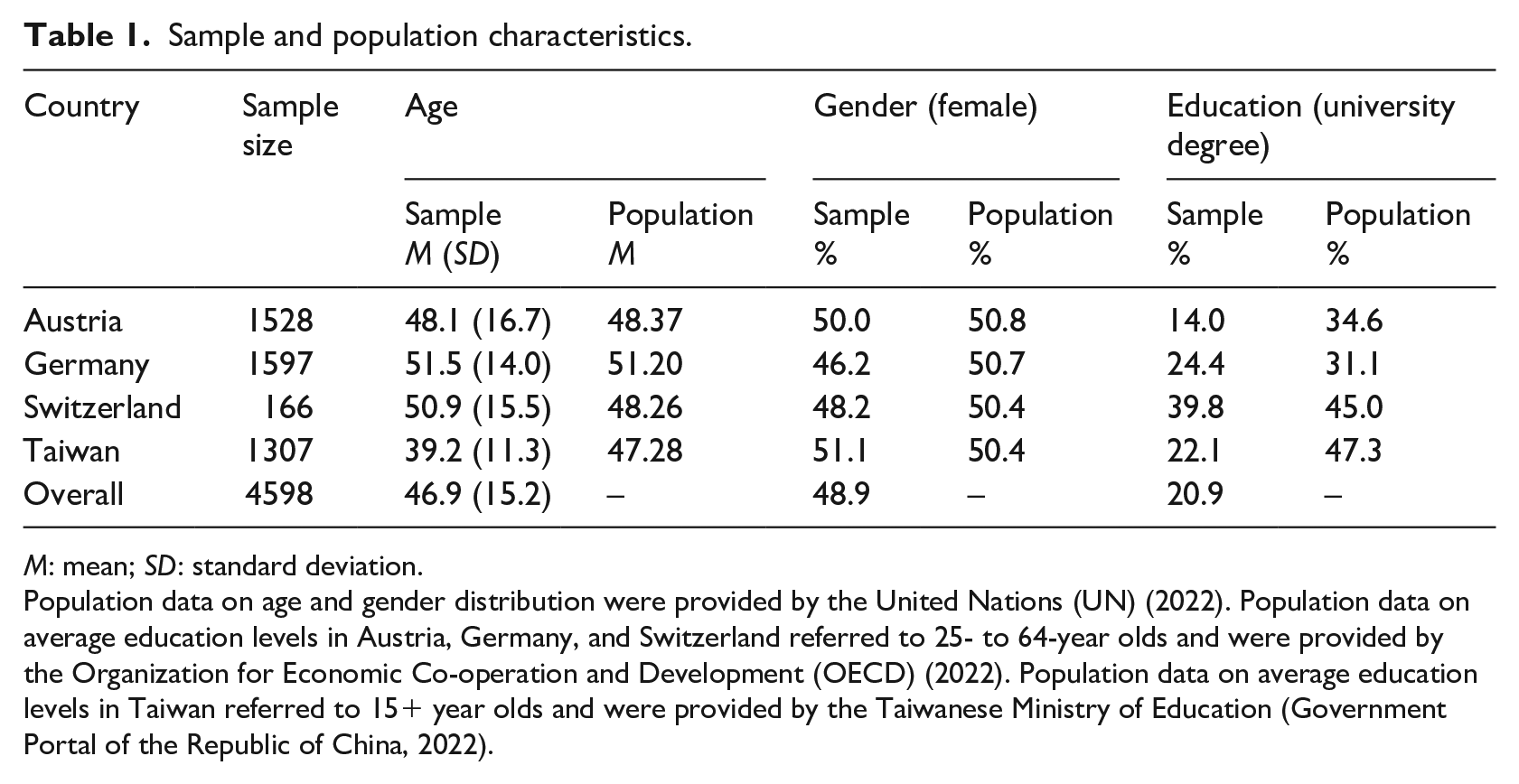
M: mean; SD: standard deviation.
Population data on age and gender distribution were provided by the United Nations (UN) (2022). Population data on average education levels in Austria, Germany, and Switzerland referred to 25- to 64-year olds and were provided by the Organization for Economic Co-operation and Development (OECD) (2022). Population data on average education levels in Taiwan referred to 15+ year olds and were provided by the Taiwanese Ministry of Education (Government Portal of the Republic of China, 2022).
The surveys drew on non-probability samples, therefore I inspected if distributions of age, gender, and education matched distributions of the target populations (Austria: residents aged 14+ years, Germany: 18+ years, Switzerland: 15+ years, and Taiwan: 18+ years). All samples were almost representative in terms of age and gender, except the Taiwanese sample, which was younger than the target population (see Table 1). Education levels of samples and target populations deviated in all surveys, however: Respondents were less likely to have a university degree, especially Austrian and Taiwanese respondents. I accounted for this imbalance in the analyses (see the “Analytical Procedures” section), as university education is likely a predictor of rejecting science-related populism (Mede et al., 2022). The overall sample was still rather balanced in terms of age (M = 46.9, SD = 15.2), gender (48.9% female), and education (20.9% university degree).
Measures
My secondary analysis included the following variables: eight items measuring science-related populist attitudes (Mede et al., 2021), four items measuring sociodemographic covariates (age, gender, education, and COVID-19 risk group), and two items measuring attitudinal covariates (political orientation and trust in science). I selected these covariates as they were found to explain variation in support for science-related populism (Kohler and Koinig, 2022; Mede et al., 2022; Mede and Schäfer, 2022; Wintterlin et al., 2022). Other covariates of science-related populist attitudes, such as religiosity, scientific literacy, and interest in science (Mede et al., 2022), were not available in all surveys.
Science-related populist attitudes were measured with the SciPop Scale (Mede et al., 2021). The scale consists of four two-item subscales that capture agreement with the four key ideas of science-related populism (1 = complete disagreement, 5 = complete agreement), that is, positive conceptions of the ordinary people (e.g. “What unites the ordinary people is that they trust their common sense in everyday life”), negative conceptions of the academic elite (e.g. “Scientists are only after their own advantage”), demands for decision-making sovereignty (e.g. “The people should have influence on the work of scientists”), and demands for truth-speaking sovereignty (e.g. “We should rely more on common sense and less on scientific studies”; see Supplementary Table S1 for all items). Covariates included age (continuous, in years), gender (binary, 1 = female), education (binary, 1 = university degree), COVID-19 risk group (binary, 1 = true), political orientation (continuous, 1 = left-leaning – 5 = right-leaning), and trust in science (continuous, 1 = no trust–5 = high trust).4,5
Analytical procedures
To identify segments of affinity and opposition to the four components of science-related populism (RQ1a) and compare their size (RQ1b), I relied on fixed-effects latent class analysis (FE-LCA). FE-LCA accounts for multilevel structures in empirical data by computing group-specific values for class prevalences and/or item-response probabilities (Clogg and Goodman, 1985). As such, it can be used to estimate country-specific latent class analysis (LCA) model parameters and has been successfully applied in research on public perceptions of science in Austria, Germany, and Taiwan (Hsieh et al., 2013; Mutz et al., 2013; Mutz and Daniel, 2013). My FE-LCA models contained the four subscale scores of the SciPop Scale as indicator variables (mean values), included random intercepts across level-2 groups (countries), controlled for education (as sample and population distributions deviated from each other, see Table 1), and were fitted with the R package glca (version 1.3.3; Kim et al., 2022). 6 The FE-LCAs relied on the overall sample, which means that smaller country samples (e.g. the Swiss sample) contributed less to the model than large country samples (e.g. the German sample). Also, the ratio of the country sample sizes did not mirror the ratio of the actual population sizes of the respective countries. Both these limitations are not severe issues, however, because my analyses did not intend to provide estimates that are representative for the combined population of Austria, Germany, Switzerland, and Taiwan in that sense that they account for the fact that the actual sizes of their individual populations differ. Rather, the four cases serve as useful “vehicles” to explore public opinion dynamics around science-related populism more generally—even if the degree to which they inform such exploration varies and despite case selection not being random but partially motivated by practical reasons.
To test how the segments identified in the RQ1a analysis differ in terms of their sociodemographic and attitudinal profiles (RQ1c), I ran Bayesian 7 logistic regressions with the full sample using the R package brms (version 2.18.0; Bürkner, 2022). These regressions predicted segment membership with the six covariates (scaled to M = 0 and SD = 1) and included frequency weights to account for different sample sizes across countries. To explore segment characteristics across countries (RQ2a and RQ2b), I compared country-specific class prevalences and fitted four separate Bayesian regression models that estimated the effects of the covariates on segment membership in Austria, Germany, Switzerland, and Taiwan, respectively. Because there is mixed evidence as to how the covariates relate to science-related populist attitudes (Mede et al., 2021; Mede et al., 2022; Wintterlin et al., 2022), all models used non-informative priors, which does not compromise statistical robustness given the large sample size (Gelman and Hill, 2007).
Results and discussion
Segments of affinity and opposition to science-related populism: identification, size, and sociodemographic and attitudinal characteristics
Segment Identification (RQ1a). Established recommendations for latent class modeling (Weller et al., 2020) suggest that (dis)agreement with the four components of science-related populism divides the Austrian, German, Swiss, and Taiwanese samples into three segments. The three-class FE-LCA model had the highest class distinctiveness (entropy = 0.77) among all models with two throughout 10 classes (see Table 2). It also had the lowest Bayesian information criterion (BIC = 68,714.90) and the lowest consistent Akaike information criterion (CAIC = 69,108.90). In addition, the three-class model allowed for a most plausible interpretation of latent classes. Other potentially acceptable models were a seven-class model, which had the lowest Akaike information criterion (AIC = 65,624.06), and a nine-class model, which performed significantly better than all other models (likelihood-ratio χ2 tests: p < .05). However, the AIC was found to be less informative for model selection than the CAIC, especially in scenarios with n > 1000 cases, therefore I decided against the seven-class model (Nylund et al., 2007). A nine-class model would not have allowed plausible interpretations and contained considerably small classes, therefore I decided against it (Weller et al., 2020).
Goodness-of-fit statistics of fixed-effects latent class analysis models.
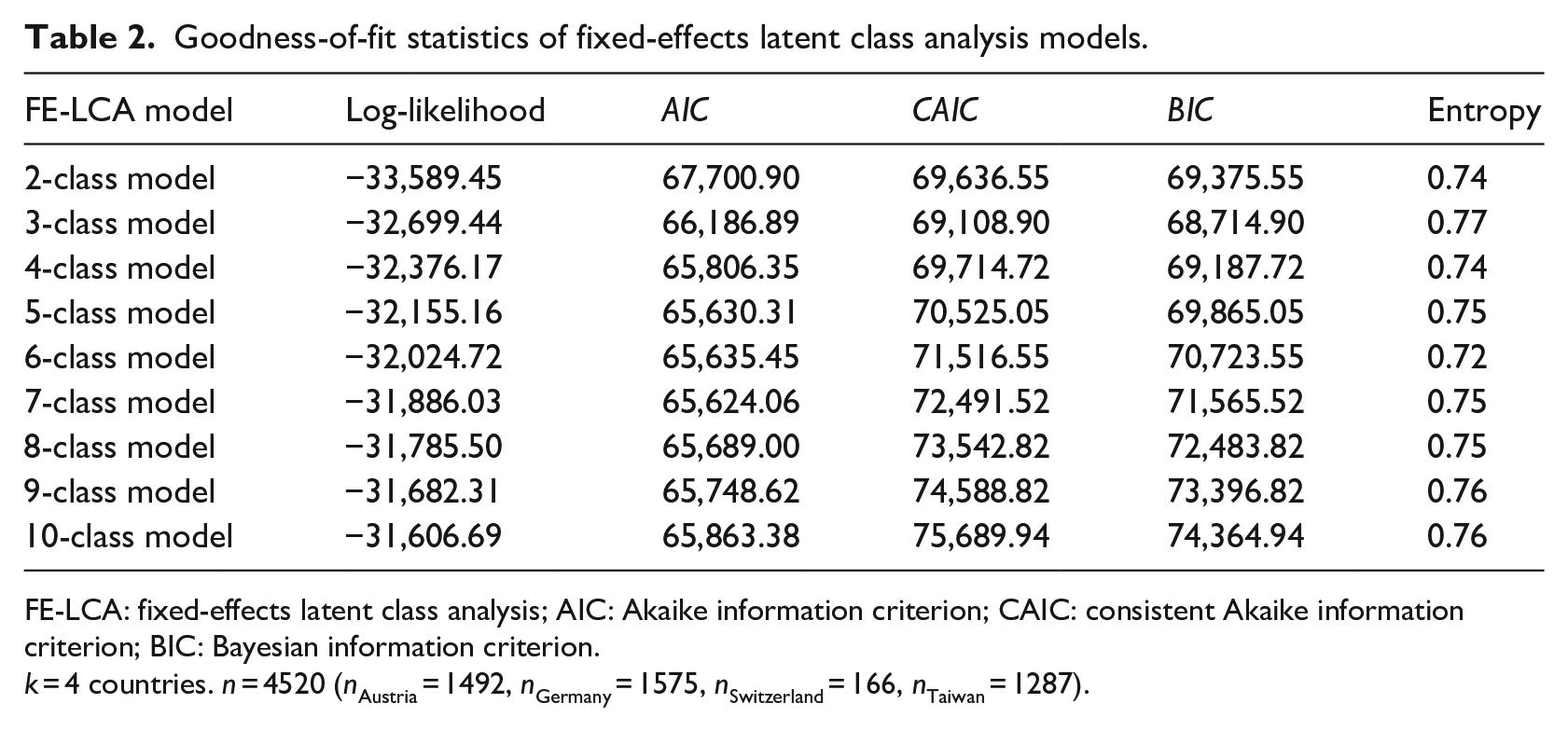
FE-LCA: fixed-effects latent class analysis; AIC: Akaike information criterion; CAIC: consistent Akaike information criterion; BIC: Bayesian information criterion.
k = 4 countries. n = 4520 (nAustria = 1492, nGermany = 1575, nSwitzerland = 166, nTaiwan = 1287).
To test if the fit of the three-class model could be further improved, I compared it with a constrained three-class model that assumed measurement invariance of the SciPop Scale items across countries (Kim et al., 2022). The measurement-invariant model showed significantly better fit parameters than the measurement-variant model (log-likelihood = –33,046.86, AIC = 66,305.73, CAIC = 67,091.85, BIC = 66,985.85, entropy = 0.80, log-likelihood deviance = 694.84, df = 288, p < .001). Therefore, I retained it for the further analyses.
Members of the three segments differ clearly in terms of their conceptions of the ordinary people, conceptions of the academic elite, demands for decision-making sovereignty, and demands for truth-speaking sovereignty (see Figure 1). They can be labeled as Full-Fledged Populists, People-Centric Non-Populists, and Deferent Anti-Populists.
Full-Fledged Populists agree strongly that ordinary people trust common sense and are good and honest (M = 4.23, SD = 0.69). They are more likely than members of other segments to believe that academic elites are selfish and conspire with other elites (M = 3.99, SD = 0.88). Many want to have influence on the work and decisions of scientists (M = 3.77, SD = 0.92). They are also inclined—and substantially more inclined than others—to claim that common sense is superior to the scientific epistemology (M = 4.18, SD = 0.67). Accordingly, Full-Fledged Populists support each component of science-related populism. This means that they comply even with a conservative definition of populism, which requires the presence of every populism component to diagnose “full-fledged populism” (Weyland, 1999: 380) and forbids populism diagnoses in case of absence of one or multiple components (Wuttke et al., 2020).
People-Centric Non-Populists support conceptions of a homogeneous and virtuous people (M = 3.34, SD = 0.72). However, they are indifferent or even slightly critical toward claims which insinuate that academic elites are immoral (M = 2.71, SD = 0.69), suggest that ordinary people should have a say in scientific decision-making (M = 2.50, SD = 0.77), or demand that scientific studies should be deemed inferior to common sense (M = 2.70, SD = 0.67). They are therefore neither full supporters nor strong opponents of science-related populism, but rather “non-populists” (Mudde, 2007: 34). Nevertheless, they are prone to endorse favorable conceptions of the ordinary people, which have been conceived as “people-centrism” (Bertsou and Caramani, 2022: 8).
Deferent Anti-Populists oppose every component of science-related populism: They do not hold people-centric views (M = 2.48, SD = 1.04), reject criticism of academic elites (M = 1.52, SD = 0.61), and refuse to demand a right to determine scientific decisions (M = 1.54, SD = 0.71) and true knowledge (M = 1.38, SD = 0.51). They rather seem to exhibit a “deference to scientific authority” (Brossard and Nisbet, 2007: 24), as they accept—or obey to—the decision-making and truth-speaking claims of scientists. This renders them inclined to what has been described as “anti-populism” (Moffitt, 2018: 4).
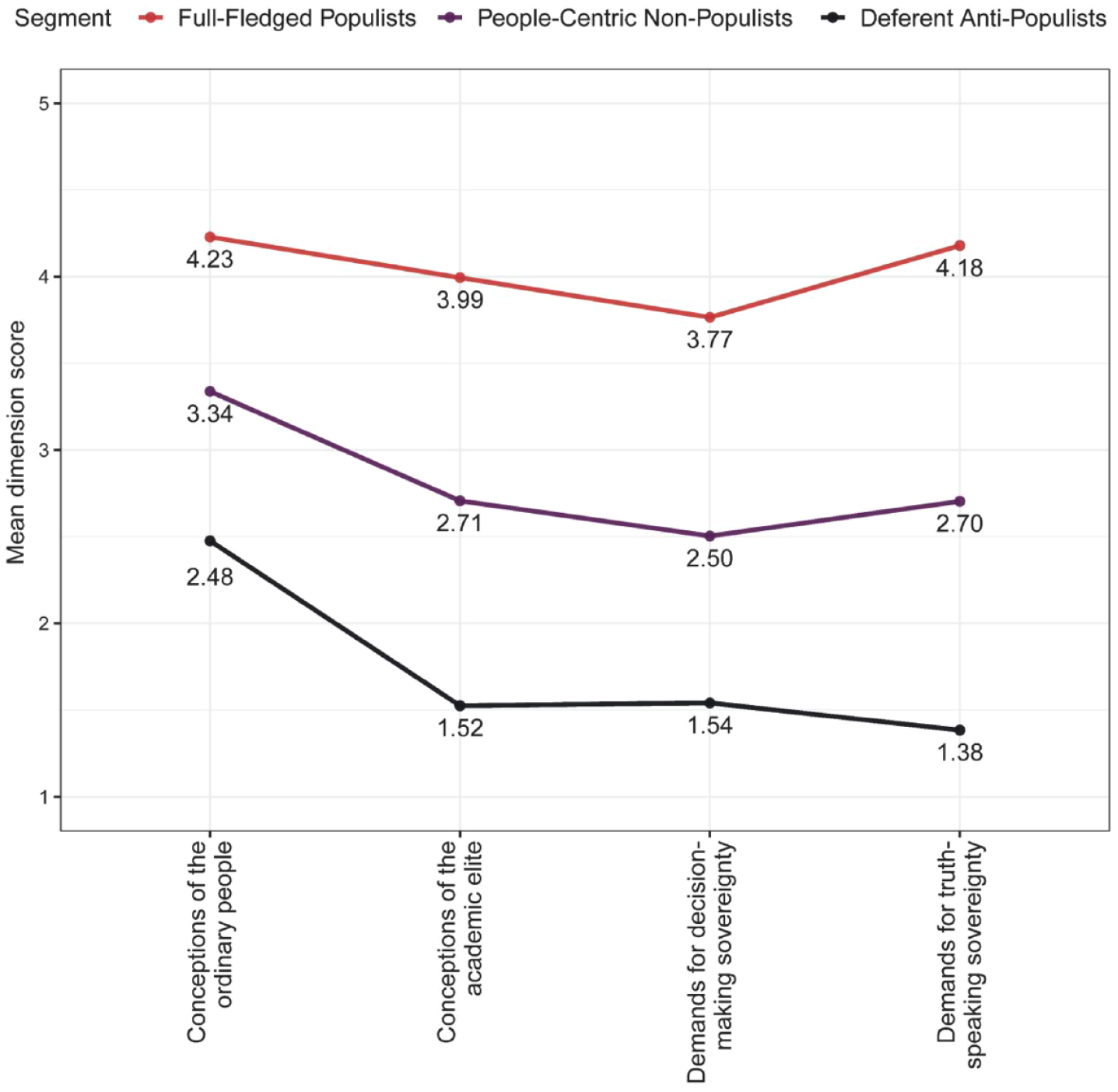
Mean scores on the subscales of the SciPop Scale across segments (full sample).
These findings show that different groups of the Austrian, German, Swiss, and Taiwanese publics support or oppose different facets of science-related populism. While some people endorse it entirely, others approve only single components, are indifferent, or reject single or multiple components. The dimensions of science-related populism thus vary in their appeal to the population—similar to what was found for political populism (Schmidt et al., 2021), climate change skepticism (Thaker et al., 2023), and conspiracy claims about the COVID-19 pandemic (Schäfer et al., 2022).
Segment Sizes (RQ1b). The analyses show that Full-Fledged Populists are a minority: Across all four countries, only one sixth of respondents can be classified as proponents of science-related populism in its entirety (n = 739, 16.32%; see Figure 2). People-Centric Non-Populists represent the largest segment, with more than half of all respondents being assigned to it (n = 2528, 55.96%). Deferent Anti-Populists are less widespread, but still make up more than one quarter of the overall sample (n = 1253, 27.71%).
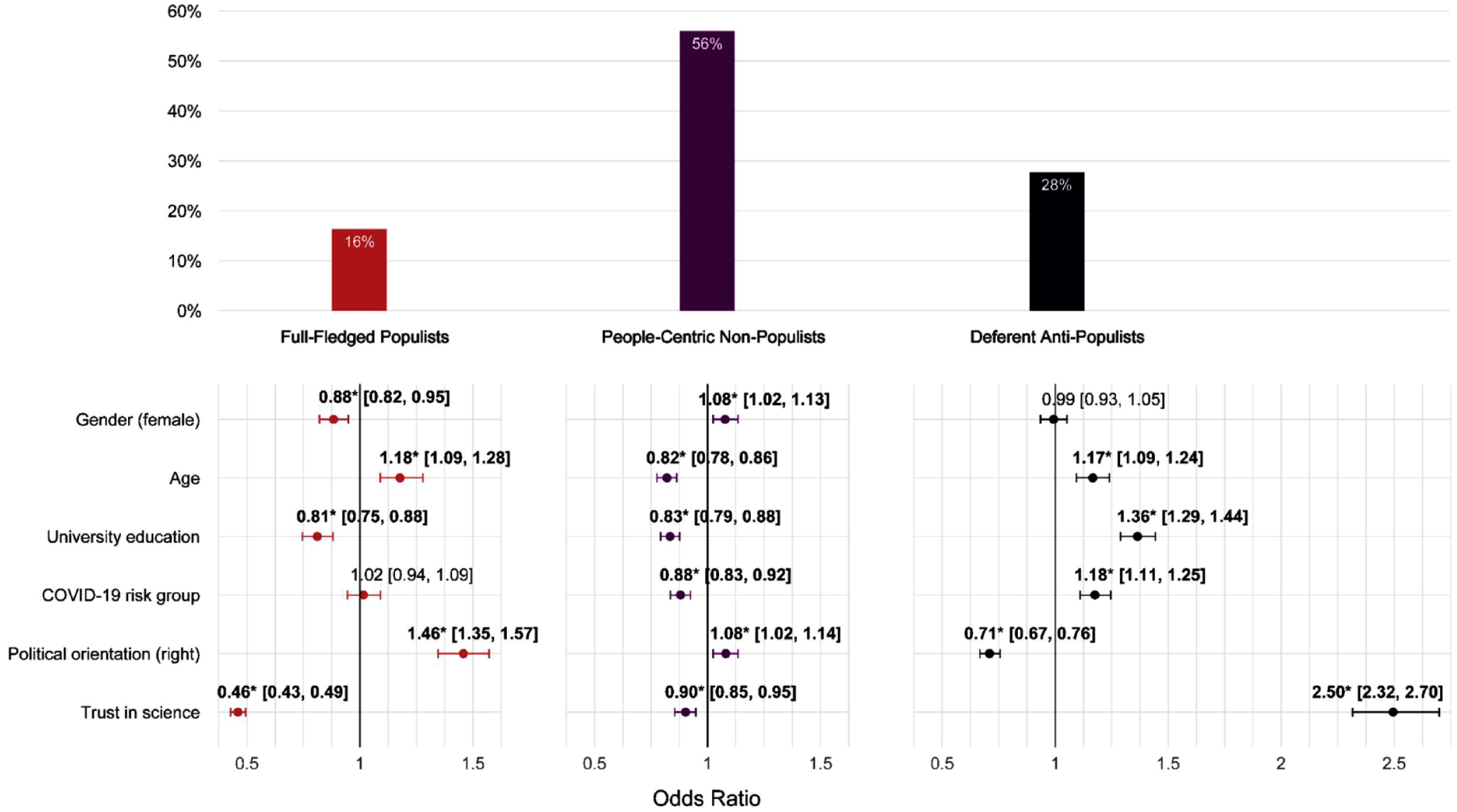
Size of segments and covariates of segment membership in the full sample.
These results indicate that a large majority of respondents are not prone or even resilient against science-related populism. This resonates with similar comparative analyses of technocratic attitudes, whose results suggest that “people haven’t had enough of experts” in many European countries (Bertsou and Caramani, 2022: 5). That being said, it is debatable if technocratic and populist beliefs actually preclude each other or partially overlap (Bickerton and Accetti, 2017). More widespread are “non-populist” attitudes, that is, neither endorsement nor disapproval of science-related populism, as well as “anti-populist” orientations toward science. These orientations seem to combine a general rejection of populist ideas (Moffitt, 2018) with “deference to scientific authority,” that is, pro-science views suggesting that “citizens should not develop their own ideas about what is good or bad relative to a scientific controversy because legitimate authorities have already laid down the rules” (Brossard and Nisbet, 2007: 30). A general rejection of populist ideas and a deference to science may be two reasons for why Deferent Anti-Populists are more resilient against science-related populism. Other reasons could be trust in quality journalism, which often challenges populist claims (see Humprecht et al., 2020; Staender et al., 2022).
Segment Characteristics (RQ1c). Results of Bayesian logistic regressions show that sociodemographic and attitudinal covariates of segment membership vary clearly. Full-Fledged Populists are substantially more likely than others to be male, older, and lower-educated (see Figure 2 and Supplementary Tables S7 and S8), which corresponds with findings on political populism (Rovira Kaltwasser and Van Hauwaert, 2020). In addition, their attitudes toward politics and science differ remarkably from those of Non- and Anti-Populists: Full-Fledged Populists are about twice as likely as others to identify with politically right-leaning views (OR = 1.46, 89% CI: 1.35–1.57) and have lower trust in science 8 (OR = 0.46, 89% CI: 0.43–0.49). People-Centric Non-Populists also differ from members of other segments in terms of their sociodemographic characteristics, political orientation, and trust in science, albeit less strongly. Unlike Full-Fledged Populists, they tend to be female and younger than others—but similar to Populists, Non-Populists are less likely to have a university degree, prefer left-leaning political positions, and trust science. Deferent Anti-Populists are rather distinct from members of other segments: They are significantly more likely to be older, have university education, identify with left-leaning positions, and have high trust in science. Moreover, they have an 18% higher chance of being at high risk of getting seriously ill from COVID-19 (OR = 1.18, 89% CI: 1.11–1.25). In sum, political orientation and trust in science seem to be important drivers of susceptibility and resilience to science-related populism, which is plausible given that criticism and appreciation of academic expertise often converge with political agendas (Lee, 2021).
All results on the identification, sizes, and characteristics of the segments in the overall sample (RQ1a–c) have two limitations: First, they only apply to the four societies included in the analysis; their external validity remains to be explored in further studies. Second, the RQ1 results are stronger driven by the European societies and their specific cultures than by the Asian society, because the FE-LCAs and logistic regression were based on three European countries and only one Asian country. Future research should therefore aim to achieve a more cross-culturally balanced case distribution.
Segment differences between Austria, Germany, Switzerland, and Taiwan
Differences between most-similar countries (RQ2a). Further analyses show that segment sizes and characteristics differ clearly between Austria, Germany, and Switzerland (“most-similar countries”). Austria has a considerably higher proportion of Full-Fledged Populists (21.8%) than Germany (14.3%) and Switzerland (7.5%; see Figure 3 and Supplementary Table S6). This may be because Austrians are more likely to hold unfavorable attitudes toward scientists compared to Germans and the Swiss (European Commission, 2021). It might also be an artifact of the sample characteristics: Compared to the Austrian population, Austrian respondents were much more likely to have no university degree, which can foster science-related populist attitudes (Mede et al., 2022), whereas German and Swiss respondents were only slightly less likely to have no university degree than the national populations. However, this artifact is arguably less severe, because the FE-LCAs controlled for education and because all samples were skewed toward the same direction (i.e. toward low education).
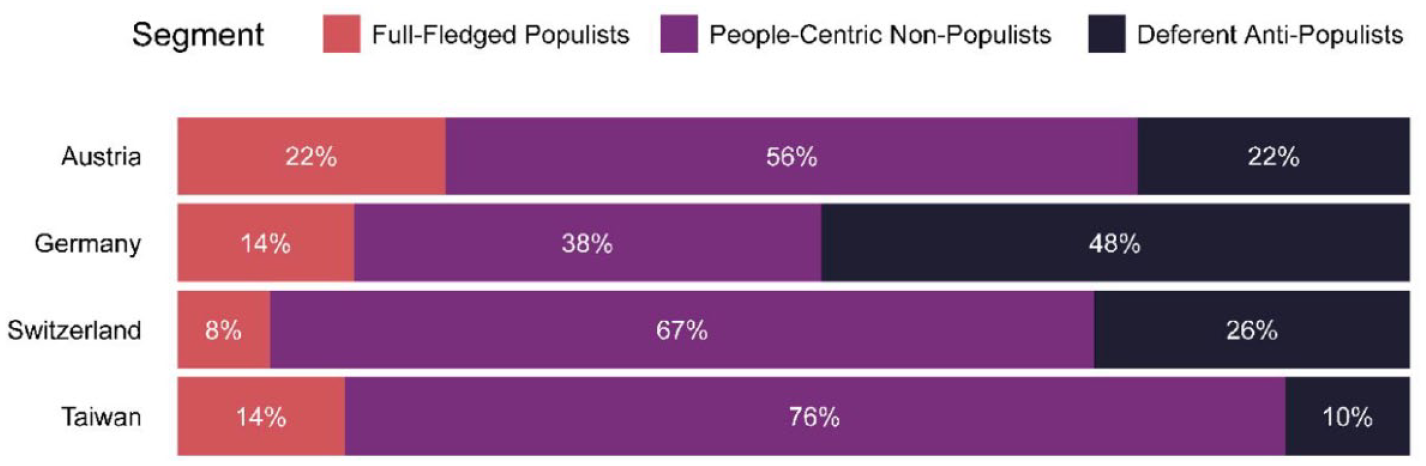
Segment sizes across countries.
People-Centric Non-Populists are less common in Germany (38.0%) and more common in Switzerland (66.9%), which could be due to its direct democratic system that may have nurtured people-centrism, that is, one component of populist attitudes (Albertazzi, 2008). And while Deferent Anti-Populists account for about a quarter of the Austrian and Swiss samples, they make up almost half of the German sample. This might indicate that the higher education system of Germany is more likely than that of Austria and Switzerland to cultivate pro-science views among the population. Notably, Full-Fledged Populists form the smallest segment in all European countries.
Full-Fledged Populists, People-Centric Non-Populists, and Deferent Anti-Populists show national differences not only in their prevalence, but also in their sociodemographic and attitudinal characteristics (see Figure 4 and Supplementary Table S9). Among the three most-similar countries, Populists tend to be older than others in Austria (OR = 1.25, 89% CI: 1.10–1.42), but not in Germany and Switzerland. Non-Populists, on the other hand, are more likely to have low trust in science in Germany (OR = 0.67, 89% CI: 0.61–0.74) and high trust in Austria (OR = 1.29, 89% CI: 1.19–1.41). Anti-Populists are younger in Austria (OR = 0.87, 89% CI: 0.77–0.98) and report a higher risk for severe COVID-19 infections in Switzerland (OR = 1.69, 89% CI: 1.50–2.41). Yet overall, covariates of segment membership show similar patterns across the three European countries: In both Austria, Germany, and Switzerland, Populists are more prone to support right-leaning political views and have low trust in science, Non-Populists do not differ significantly from others in terms of gender and age, and Anti-Populists tend to have higher education, left-leaning views, and high trust in science.
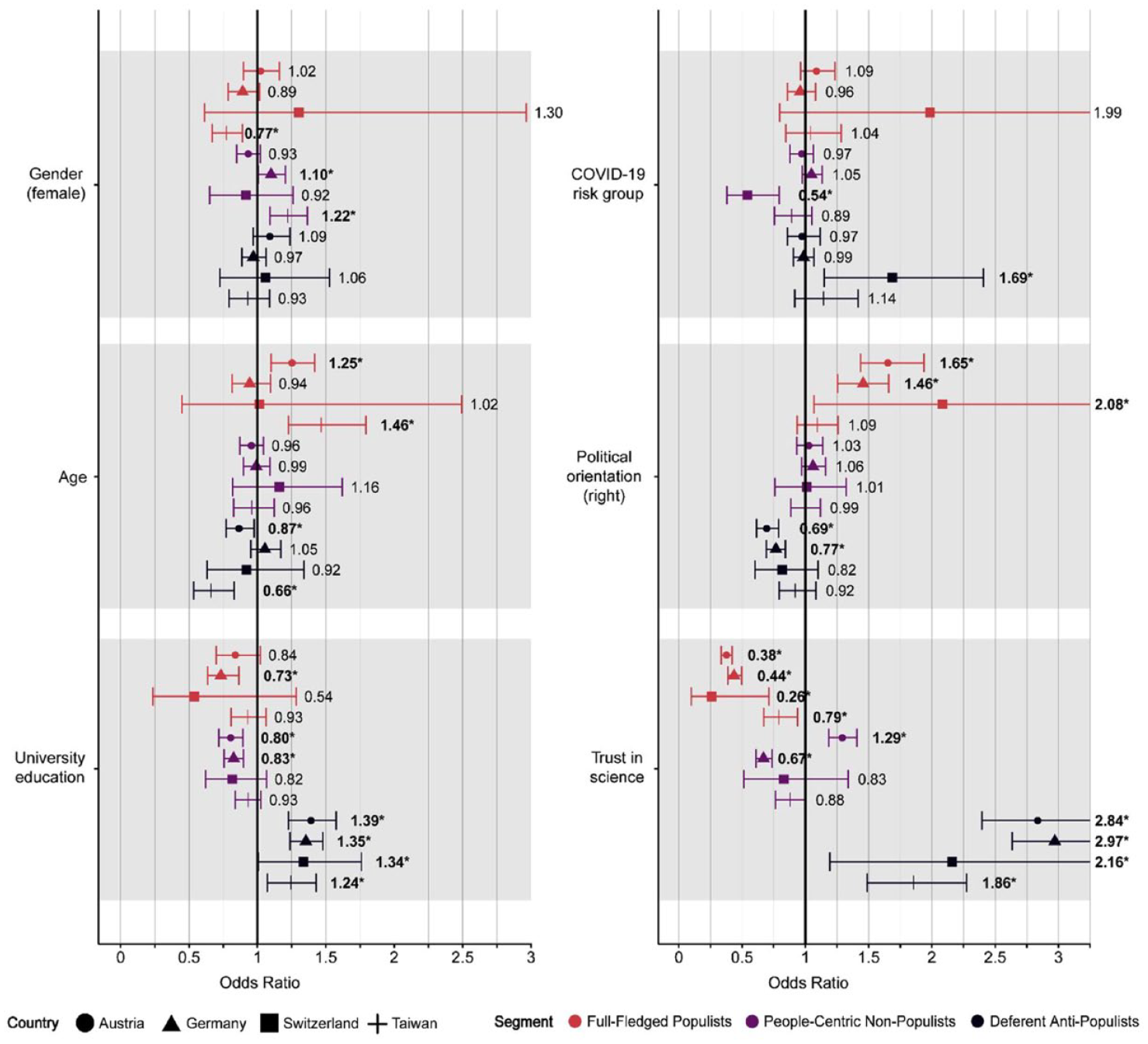
Dot charts showing effects of covariates on segment membership across countries.
Differences between most-different countries (RQ2b). Taiwan shows noteworthy differences to Austria, Germany, and Switzerland (“most-different countries”). For example, it has a larger share of People-Centric Non-Populists (76.3%) and only a small faction of Deferent. Anti-Populists (10.1%). This could be due to lower public trust in science (see footnote 3), higher agreement that people “depend too much on science” (Appendix of Mede, 2022a: 8), and a decreasing “cultural authority of science” among younger people, which were slightly overrepresented in the Taiwanese sample (Li and Tsai, 2019: 192). Perhaps, Taiwanese anti-populism is also undermined by large amounts of disinformation in public discourse (Rauchfleisch et al., 2022) and commonsensical or anti-intellectual content in online media (Fominaya, 2022), which may cultivate (populist) criticism or distrust of climate science, epidemiology, and other fields among a population that has one of the highest Internet adoption rates worldwide (Allgaier, 2019; Chen et al., 2022; Rauchfleisch and Chi, 2020). Another explanation for the low number of Anti-Populists in Taiwan could be that the Taiwanese sample—relative to the other samples—was more biased toward respondents without university education, which likely correlates with anti-populism.
At the same time, I find many People-Centric Non-Populists in Taiwan, who value the virtues and demands of “the ordinary people” (Mede and Schäfer, 2020: 480) but do not endorse other components of science-related populism. This may be because Taiwanese political culture has traditionally lacked actors invoking the full range of populist ideas (Norris, 2020), but hosted grassroots activism (Fominaya, 2022) and civic bottom-up demands (Yang and Michael Hsiao, 2021), some of which revolved around epistemic controversies specifically: Case studies on industry waste dumping and typhoon disaster governance, for example, demonstrate how civic activists and local communities problematize knowledge claims of official authorities and advocate for the virtues of their own expertise (Fan, 2015, 2023).
Further results show that Taiwanese Populists tend to be older men (OR = 1.46, 89% CI: 1.23–1.79; OR = 0.77, 89% CI: 0.67–0.89), whereas age and gender are barely associated with full-fledged populism in the three European countries. Moreover, political orientation does not play a significant role for science-related populist attitudes in Taiwan: For example, Taiwanese Anti-Populists are not substantially more prone to left-leaning views (OR = 0.92, 89% CI: 0.79–1.09), whereas Austrian, German, and Swiss Anti-Populists are. Populist opposition to scientific expertise may thus not be precluded to (Western conceptions of) left-leaning or right-leaning positions in Taiwanese politics. This corresponds with sociological analyses suggesting that historically, populist ideas have emerged at different points of the ideological spectrum in Taiwan (Hsu, 2023). In Austria, Germany, and Switzerland, however, much science criticism has recently been entrenched in right-leaning populist agendas, particularly during the COVID-19 pandemic, when the surveys were conducted (Lamour and Carls, 2022). Another explanation for a missing link between left-right political orientation and science-related populism in Taiwan could be that “left” and “right” are less meaningful categories for Taiwanese voters (Jou, 2010). Cleavages in Taiwanese politics rather go along liberal versus conservative, independence from versus reunification with China, and communist versus democratic positions—with “left” and “right” ideas at either position (Hsiao et al., 2017). These cleavages might be more useful to explain segment membership: For example, scholars diagnosed an affinity of populist ideas and opposition to conservative elites (Wang, 2020) and reunification with China (Shyu, 2008).
However, Taiwan and the European countries still have similarities: Across both cultural contexts, Full-Fledged Populists are a minority and have low trust in science, while Deferent Non-Populists are more likely have high trust in science (see Figures 3–4 and Supplementary Tables S7 and S9). After all, trust in science is a covariate of segment membership in all four countries. This is generally plausible as science-related populism and distrust toward science share common conceptual roots, as both adopt a critical perspective toward science. Meanwhile, the fact that trust in science is a similarly influential predictor of segment membership across most-similar and most-different countries suggests that the link of trust and science-related populism is politically and culturally invariant. However, there are single country differences in how trust and populism relate to each other: For example, trust in science is higher among Austrian but lower among German People-Centric Non-Populists (see Figure 4). This is further evidence that trust is a distinct and thus useful covariate of science-related populism. However, trust in science and its association with science-related populism may not necessarily be temporally invariant: In many countries, including Germany and Switzerland, public trust in science and rejection of science-related populism grew substantially in the early phase of the COVID-19 pandemic, but went back to pre-pandemic levels thereafter (Bromme et al., 2022; Mede and Schäfer, 2022). The ability of trust in science to explain segment membership may thus have waned in the months after data collection in 2020–2021.
Conclusion
Populist ideas about science, which were conceptualized as “science-related populism” (Mede and Schäfer, 2020: 473), have challenged scholars, academic institutions, and the status of science in society worldwide. Research provided first empirical evidence on these ideas, but barely examined public opposition against them, single facets of science-related populism, non-Western countries, and cross-national and cross-cultural differences—albeit such differences are likely to expect (Mede et al., 2022). I addressed these caveats with a secondary analysis of population surveys in Austria, Germany, Switzerland, and Taiwan. It used FE-LCA (Clogg and Goodman, 1985), a combination of an MSSD and an MDSD (Anckar, 2020), and Bayesian methods (Bürkner, 2022), aiming to take segmentation analysis of public opinion about science “to the next level” (Füchslin, 2019: 854).
The analysis provides four key findings: First, affinity and opposition to the components of science-related populism dissociate publics into distinct segments, that is, Full-Fledged Populists, People-Centric Non-Populists, Deferent Anti-Populists. Second, “full-fledged” (Weyland, 1999: 380) populists are a minority in the four national and two cultural contexts explored in this study, whereas “non-populist” (Mudde, 2007: 35) and “anti-populist” (Markou, 2021: 201) attitudes are considerably more widespread. Third, full-fledged populism, non-populism, and anti-populism are not equally distributed across different groups of the population: For example, groups with right-leaning views and low trust in science are more likely to support full-fledged populism. Fourth, segments of affinity and opposition to science-related populism differ across Austria, Germany, Switzerland, and Taiwan—and so do, correlatively, the size and characteristics of the three segments.
This study is subject to limitations that must be considered when assessing the results. Two limitations are that the subsample and population distributions deviated for certain sociodemographic characteristics (e.g. age for Taiwan) and that these deviations were not consistent across all countries (e.g. higher educated people were more under-sampled in Austria than in Switzerland). Moreover, there were minor differences in question wordings between the surveys—but only for single covariates like trust in science, whereas the central measure, the SciPop Scale, had the same form in all countries, with the original version used in Switzerland, Germany, and Austria (Mede et al., 2021), and the Chinese version translated by native speakers familiar with the research topic. Another minor caveat is that the Austrian data were collected 4 months after the other countries. This time difference may have altered the “opportunity structure” for science-related populism—albeit presumably only slightly, since the Austrian, German, and Swiss surveys took place under similar conditions, as all survey periods fell in COVID-19 infection waves (Germany and Switzerland: fall 2020 wave; Austria: spring 2021 wave; Our World in Data, 2023). Further shortcomings include the small Swiss sample size that caused higher standard errors, and potential robustness issues of FE-LCA modeling due to only k = 4 level-2 groups.
Most of these limitations are common for comparative secondary analyses that are confined to use existing data and draw on different data sources. They should be addressed in future research that rests on original data. This research may also want to improve other caveats of this study: I chose four specific cases that are not representative for larger cultural contexts (e.g. individualistic vs collectivist cultures) or world regions (e.g. Western vs non-Western countries). Other non-Western countries than Taiwan, for example, in Africa or Latin America, likely provide very different “opportunity structures” to science-related populism (Arzheimer and Carter, 2006). Moreover, analyses at the aggregate level of the full data did not consider that small subsamples contributed less explanatory value to the FE-LCA models than large subsamples. They did also not consider whether the extent to which each country’s data explained the total variance of segment sizes and regression parameters corresponded with the relative size of their populations. Thus, the analyses served primarily the purpose of exploring public opinion segments with the best data available, albeit being limited by the specificities of these data. Follow-up studies could address these issues by systematically sampling multiple countries with most-different and most-similar cultures from all world regions and by involving samples that reflect actual population sizes. In addition, such studies could examine further segment membership covariates that were not available in the data underlying the analysis, for example, beliefs in collective wisdom of the people (Bak-Coleman et al., 2022) or scientific literacy (Mede et al., 2022).
Future research must also validate the study findings outside the particular context of the COVID-19 pandemic, during which scientific expertise became increasingly important in public discourse, which might have magnified the “strength” (Howe and Krosnick, 2017) of attitudes to science, including science-related populist attitudes. This could have caused survey respondents to be less likely to answer “don’t know” to the items of the SciPop Scale and more likely to select scale endpoints. Post-pandemic studies, however, may observe more don’t know answers and less variance of answer behavior, and might thus find less meaningful segments and weaker covariates of segment membership. Moreover, public opposition to science-related populism has been significantly lower in countries like Switzerland outside the pandemic (Mede and Schäfer, 2022), which means that future segmentation analyses might find a smaller number of Deferent Anti-Populists.
A further starting point for follow-up scholarship is to study another layer of variations of science-related populism, for example, variations across different scientific issues (e.g. vaccination, climate change, genetic engineering; see Rutjens et al., 2018) and reference objects (e.g. scientific institutions, specific scientists, scientific methods; see Achterberg et al., 2017). For example, Full-Fledged Populists may criticize epidemiologists, climate scientists, and gender scholars, as they deem them ideologically biased (Krämer and Klingler, 2020), but be supportive of less politicized natural sciences (Schrøder, 2022). Meanwhile, Deferent Anti-Populists might accept the epistemic authority of a general academic elite but criticize certain scientific methods they use, such as animal experiments (Strauss, 2018). Importantly, research on these nuances may want to employ other methods than standardized surveys: Ethnography, diary studies, or qualitative interviews, for instance, would lend themselves to explore how members of the segments perceive different disciplines and scientists (Au and Eyal, 2022), how country specificities like local events or medialized experts shape their views (Fan, 2015; Lo and Peters, 2015), and what they deem as “science” in the first place (Koch et al., 2020).
Overall, my analysis may inform further reflections about the role of science in different societies and population groups—and about science communication in particular, which is being increasingly analyzed against the backdrop of a diversification, pluralization, fragmentation, or polarization of science communication audiences (Schäfer and Metag, 2021). My findings provide additional evidence for the need to employ target-group specific science communication strategies: For example, they suggest that strategies aiming to prevent science-related populism may be more successful if they are tailored toward right-leaning audiences. This may be difficult to achieve due to deep-rooted motivations, ideological reservations, and partisan reasoning among these audiences, but successful interventions against ideologically motivated rejection of scientific expertise do exist (Ecker et al., 2022). The results also indicate that the effectiveness of such interventions is conditioned by the political and cultural context: For example, interventions against science-related populism focusing on right-leaning milieus may be less efficient in a country like Taiwan, where full-fledged populism is not a function of left-right self-identification. There, these interventions would follow a “scattergun” rather than a “rifle approach” to science communication (Körfgen et al., 2019: 556). However, measures against science-related populism should not only target Full-Fledged Populists, but also those who might be vulnerable to science-related populism yet not endorse it completely (People-Centric Non-Populists) and those who are already resilient to it (Deferent Anti-Populists), for example, by encouraging them to build up and cultivate resilience in their social surroundings (e.g. friends and families) and communicative environments (e.g. social media).
After all, scholars, policy-makers, and science communication practitioners should discuss normative questions of interventions against science-related populism (see Mede et al., 2023). For example, they may consider that complete rejection of science-related populism and strong deference to science might not be desirable in contemporary democracies (see Rovira Kaltwasser, 2012), as certain aspects of populist ideation “raise legitimate questions about how decision-making processes within societal institutions (e.g. science) can account for the interests of the general population” (Mede, 2022b: 48). Along similar lines, scholars contended that worldviews that challenge organized science—such as science-related populism—are, to some degree, “potentially valuable” and may “deserve serious scrutiny” (Grodzicka and Harambam, 2021: 4). Accordingly, a certain degree of “healthy skepticism” may be more worthwhile than “blind trust” in science (O’Brien et al., 2021). From this perspective, limited degrees or single aspects of science-related populism can be conceived as a helpful corrective within democracy. It may thus be more reasonable to achieve non-populist than anti-populist publics. Eventually, such discussions should reflect on how societal structures, media ecologies, and scientists themselves have responsibility for the emergence of populist reservations against academic expertise (Scheufele, 2022).
Supplemental Material
sj-pdf-1-cos-10.1177_00207152231200188 – Supplemental material for Variations of science-related populism in comparative perspective: A multilevel segmentation analysis of supporters and opponents of populist demands toward science
Supplemental material, sj-pdf-1-cos-10.1177_00207152231200188 for Variations of science-related populism in comparative perspective: A multilevel segmentation analysis of supporters and opponents of populist demands toward science by Niels G Mede in International Journal of Comparative Sociology
Footnotes
Acknowledgements
The author thanks all reviewers and the editor for their comments and suggestions during the review process, which improved the article signficantly. He is also very grateful to all colleagues who led or financed the surveys analyzed in this study and shared the data sets. These colleagues include Julia Metag and Mike S. Schäfer (Switzerland), Bernhard Kittel, Sylvia Kritzinger, Hajo Boomgaarden, Barbara Prainsack, and the Austrian Coronal Panel Project Team (Austria), Julia Metag (Germany), and Adrian Rauchfleisch (Taiwan). Moreover, the author thanks Mike S. Schäfer for providing very helpful feedback on the conceptualization of this study and earlier versions of the manuscript.
Data availability and replication materials

Declaration of conflicting interests
The author(s) declared no potential conflicts of interest with respect to the research, authorship, and/or publication of this article.
Funding
The author disclosed receipt of the following financial support for the research, authorship, and/or publication of this article: This secondary analysis received no grant from any funding agency in the public, commercial, or not-for-profit sectors. The surveys analyzed in this study were financed by the Austrian Science Fund (Austrian survey), the Swiss Academies of Arts and Sciences (Swiss survey), the University of Münster, the University of Zurich, and the National Taiwan University (German and Taiwanese surveys).
Ethical approval
This article does not contain any studies with human participants or animals performed by the author. Ethical approval was therefore not required.
Supplemental material
Supplemental material for this article is available online.
Notes
References
Supplementary Material
Please find the following supplemental material available below.
For Open Access articles published under a Creative Commons License, all supplemental material carries the same license as the article it is associated with.
For non-Open Access articles published, all supplemental material carries a non-exclusive license, and permission requests for re-use of supplemental material or any part of supplemental material shall be sent directly to the copyright owner as specified in the copyright notice associated with the article.
