



Abstract
This article explores trust dynamics among a coalition of civil society organizations called Unite Behind that formed in Cape Town, South Africa, in late 2017. Unite Behind was established to demand more accountability from a state marred by corruption—and specifically for the resignation of then President Jacob Zuma. When Zuma resigned, the coalition attempted to transition to a social movement campaigning for social justice but declined as a coalition into an organization of sorts. Taking trust as a positive belief in the reliability, truth or ability of an actor or entity, this article argues that conceptions of political and social/generalized trust are of less importance in explaining the rise and fall of Unite Behind than a combination of personal trust in particular leaders, and a form of particularized trust, namely, trust in other organizations. This notion of organizational trust as a form of particularized trust is of potential wider importance to the analysis of civil society network co-ordination.
Introduction
Popular mobilization through civil society formations has profoundly impacted South African politics in both the apartheid and anti-apartheid eras. Key examples include the anti-apartheid mobilization termed the “defiance campaign” associated with the United Democratic Front (UDF), a coalition of civil society organizations, and the Congress of South African Trade Unions (COSATU) that joined to form the so-called mass democratic movement in the late 1980s (Seekings, 2000). A few years after the advent of democracy in 1994, the Treatment Action Campaign (TAC) led a broad coalition of national and international civil society, unions, and professional organizations to successfully pressurize the South African government to change its policies on HIV-Aids to administer anti-retroviral drugs to five million people, the most people living with HIV globally (Friedman and Mottiar, 2005). While, with democratization, the conditions under which popular mobilization in civil society have changed from the overtly racist and oppressive to more inclusive and democratic, the traditions of organizing down time retain clear threads, or what Rossi (2023) terms a “stock of legacies.” Key here are a liberatory ideology focused on shared key objectives; the formation of a broad united front of international allies and national mass-based civil society organizations, trade unions, and professional organizations; and the use of protest and disruption alongside participation and reasoning, while engaging through the media and in person on the ground to win public support.
This article explores a recent, and largely unsuccessful, attempt to form a new social movement around social justice in the tradition of the UDF and the TAC, called Unite Behind. By the mid-2010s, the living conditions of most South Africans were worsening, unemployment was reaching its highest ever levels, and government services were unable to keep up with popular demand. Combined with a series of revelations of “state capture,” or corruption, by a network associated with President Zuma, conditions appeared conducive for a new social movement able to unite a range of progressive organizations behind the demand for social justice for poor, black South Africans. Informed by this vision, Unite Behind was launched in Cape Town in 2017. Also auspicious for Unite Behind was the leadership figure of the coalition: Zackie Achmat. Having been a young activist in the UDF in the 1980s, Achmat rose to lead the TAC to its spectacular achievements at the turn of the century. He was now poised to lead a new social movement that promised to take on South Africa’s greatest challenge: the inequality and poverty experienced by most of its people.
Unite Behind emerged quite quickly over the course of a few months after being conceived in April 2017 and grew rapidly in its affiliates during the year, coming to include well regarded South Africa civil society organizations, the TAC, Social Justice Coalition (SJC), UDF veterans, Reclaim the City (RTC), Ndifuna Ukwazi, Equal Education (EE), The People’s Health Movement, and Section 27, among others. The core of the coalition were like-minded, pro-poor, civil society organizations, most of which had emerged from networks around Zackie Achmat that formed the TAC. As Achmat (2022) put it, “the SJC, EE, Ndifuna Ukwazi, and TAC all grew out the same family of personal and political relationships.” However, the coalition also included organizations that were more conservative and business-orientated such as Save-SA or liberal-rights based in orientation like the Right to Know Campaign.
The primary goal of the Unite Behind coalition was to hold President Zuma to account on corruption charges, and especially to stop a proposed nuclear deal with Russia. At that point secondary goals were listed as addressing a range of social injustices: inequality, unemployment, colonial legacies, apartheid spatial planning, and crime and gender-based violence. Unite Behind’s official launch took the form of leading a “#People’s March” on 7 August 2017 which denounced state capture, and supported a vote of no confidence in Jacob Zuma proposed for the following day in Parliament. Although Zuma survived the vote of no confidence, he fell from power a few months later when he was replaced by Cyril Ramaphosa as party leader at the African National Congress (ANC) in December 2017. Effectively then, within 3 months of its formation, the Unite Behind coalition had achieved one of its key goals.
Importantly, rather than disband, Unite Behind decided to press ahead with other aspects of state capture, as well as the social justice component of its program. This was to take the form of a series of campaigns linked to the sectoral organizations that comprised the coalition. The first of these was the #fixourtrains campaign of late 2017 to early 2018. It was followed by the #SafeCommunitesNow and #LandJusticeNow campaigns, but even by early 2018 the enthusiasm for Unite Behind among its member affiliates was waning. In part this was linked to the founding leader and struggle icon, Zackie Achmat effectively withdrawing from Unite Behind following allegations that he defended a leader of EE accused of sexual harassment. Just as importantly, however, the senior leadership of Unite Behind failed to identify both the collective goals that could unite the coalition and secure a functional organizational structure and processes that could reduce rather than exacerbate tensions among member organizations. In the absence of this unifying purpose, and centripetal structure, organizational trust in Unite Behind declined with member organizations increasingly focused on their organization’s own goals and programs, leaving Unite Behind to wither as a coalition. Notably, today Unite Behind continues but as an organization in its own right, rather than as a coalition of organizations (Achmat, 2022).
Despite mostly returning to member organization work, most members of Unite Behind continue to express high levels of confidence in the overall vision of ending state capture, fighting for social justice, and the strategy of using a broad front to challenge state policy, as well as the tactics of popular confrontation combined with expert engagement. The problem, our research shows, was not so much a lack of social trust, or trust in particular activists, nor was it the inability of strategies to generate trust. Rather the problem was the lack of a common short- to medium-term goals that aligned organizational with coalition programs in a way that reinforced working together, as well as a policy and organizational framework than enabled addressing concerns about how the goals were implemented. In the absence of these, member organizations perceived a growing tension between their agendas and that of the coalition, and this undermined trust in the coalition. This is a story about the importance of organizational trust.
This insight suggests that a trust analysis of coalition politics needs to proceed at four levels of politics: ideology or aim, objectives or goals, strategy, and tactics. In the case of Unite Behind, trust was undermined by the failure to align member organization and coalition programs around a common goal for the coalition. This is a form of particularized trust in the shared agendas of fellow organizations, and it is key to the success of any coalition or social movement. The need to build organizational trust is of heightened importance in the operating environment of South African civil society, where government regulation and especially donor conditionalities often do not incentivize coalition and movement behavior.
In making this case, we begin by outlining relevant theories of coalition formation, trust, and civil society strategies. We then move to the methodology of the article, before presenting the case framed in terms of the key themes emergent from the theory discussion.
Theoretical framing
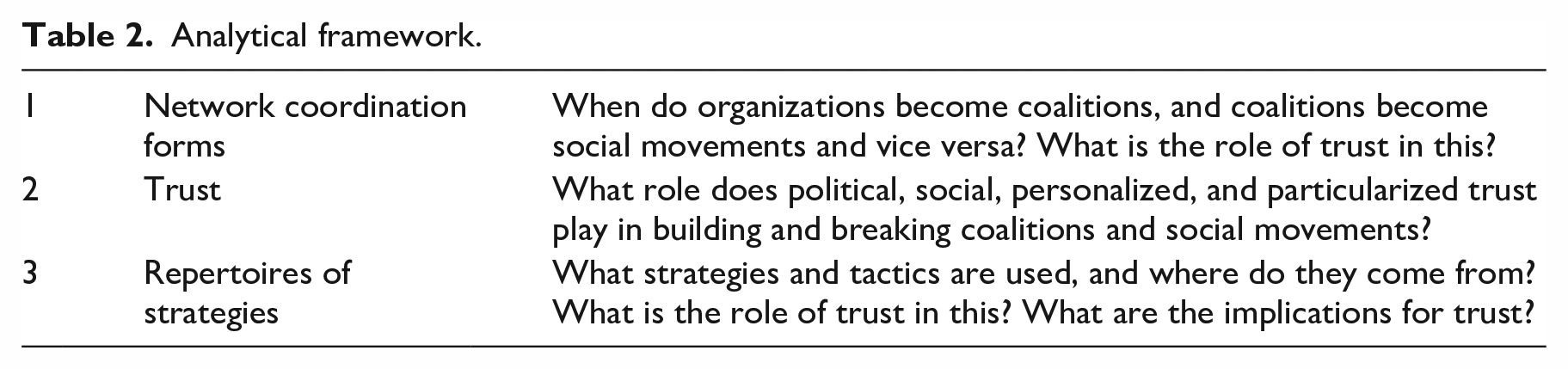
The analytical framework for this article is informed by three theoretical literatures relevant to the topic. The first is the literature on the forms of civil society “network coordination” that identifies dynamics around resource sharing and boundary formation as definitive of different kinds of civil society networks. The second is the literature on trust, and especially the distinctions between political, social, personal, and particularized notions of trust. The third is the literature on civil society politics that differentiates contentious politics from other strategic choices, and the lessons of previous struggles, as important to understanding how social movements engage in politics. From these three literatures we identify three analytical concepts as central to unpacking our case: the conditions under which a coalition is likely to become a social movement, or dissolve back into component organizations; the dynamic interplay of political, social, personal and particularized trust in coalition politics; and finally, the strategic choices of the coalition, informed by lessons of the past, including but not limited to engagement in protest.
Coalitions as a form of civil society network
For Diani (2015: 12–13) civil society is a “field” that “comprises all voluntary organizations engaged in the promotion of collective action and the production of collective goods.” This field is imaged as a “a distinct societal sphere alongside state, economy, and private life.” Diani argues for a network analysis of social fields like civil society, making the case that examining the ties that bind civil society associations allows for the identification of “modes of coordination.” These are defined as “the relational processes through which resources are allocated within a certain collectivity, decisions are taken, collective representations elaborated, and feelings of solidarity and mutual obligation forged” (Diani, 2015: 13–14). To create a typology of modes of coordination, Diani identifies two analytical dimensions: resource allocation and boundary definition. Where the former refers to resources conventionally understood like money, it also includes powerful positions and formal offices. The latter refers to the identity of organizations, or lack thereof, that emerge for participants in the networks of civil society. From the intersection of these two, Diani generates the following typology (Diani, 2015: 15–16):
Typology of modes of coordination of civil society (Diani 2012: 110).
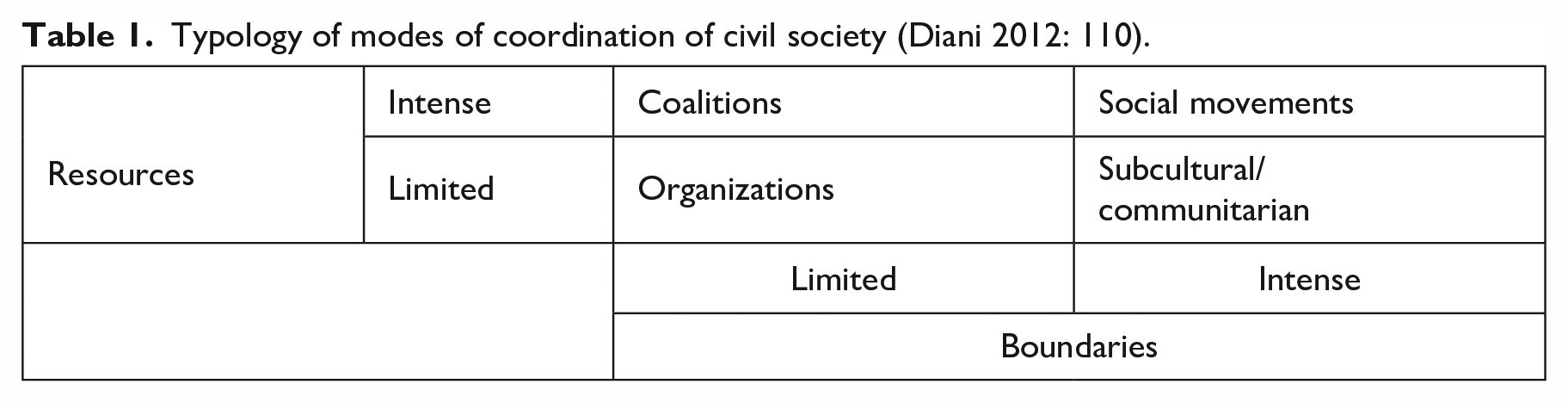
The two modes of coordination that concern us most in this article are the “coalition” and “social movement” types. For Diani (2015: 18–19) social movement coordination involves the intersection of (1) dense networks of “informal interorganizational exchanges and processes of boundary definition that operate at the level of broad collectivities rather than specific groups/organizations, through dense interpersonal networks and multiple affiliations,” and (2) forms of resource allocation appropriate to alliance work of a much greater extent than other modes of coordination. Even then, the social movement idea comprises a range of formally distinct organizations that contribute differentially, and at different times on different projects. For Diani, there is no individual membership of a social movement.
In contrast, coalitions have less of a commitment to a common cause than social movements (Diani, 2015: 22). Thus, one cannot think of social movements without thinking of coalitions, but coalitions need not amount to social movements. As Diani puts it: The boundary definition processes on which coalitions are founded are temporary and locally circumscribed, which is not the case for social movements. It is still necessary to define a “collective us” and a “collective them,” yet these definitions do not span time and space as in the case of social movements. They are mainly driven by circumscribed, instrumental preoccupations. Throughout the process of collective action, participants’ loyalties and priorities remain firmly within the boundaries of specific organizations, and there are no attempts to forge broader and deeper bonds. (Diani)
Diani identifies the significance of “circumscribed, instrumental preoccupations”—in our case “goals”—as key to effective coalitions. We argue that this is exactly what was missing in the latter half of Unite Behind’s story. The capacity to maintain both a “home” organizational identity and program, at the same time as participating in a wider coalition or movement that is pursuing a different program, presents questions of divided identities, loyalties, and resources. Hence it also raises questions relevant to trust and, as we demonstrate below, trust in the agendas of fellow organizations.
Trust
Trust within any organizational structure is essential to ensuring that the goals or desired outcomes for a movement are achieved. Common definitions of trust share components such as that the “truster” must have some level of faith or confidence in the future nature of others, whether individuals, a group, or an institution (Uslaner, 2018: 6–7). In addition, however, we operationalize trust to mean a positive form of faith or confidence, rather than just predictability. Trust emerges when we experience people, organizations, and contexts where truths are confirmed, people keep their word, organizations fulfill their promises, and the like. Trust becomes possible when we know truth claims may be wrong, people may lie, and organizations may fail us. Trust is thus something that emerges from a set of positive experiences of practices that confirm promises down time and trust is then applied to future behavior. Trust is accumulated and then can be spent.
The literature on trust classically distinguishes between political and social trust. Political trust is trust in political authority, although there are often important differences between trust in a particular government and trust in the less-partisan institutions of state (Uslaner, 2018: 4). In contrast, social trust is trust that other people, whom you do not know personally, share the same values as you and will act according to these values. As Newton et al. (2018: p. 37) point out, social trust is also important for trust in institutions—and thus for political trust—as “effective government rests not just on the consent of the governed, as Confucius and Hobbes pointed out, but also on the ability of citizens to rub along together with a degree of mutual understanding.”
The notion of social trust is a generalized notion, and is sometimes called generalized trust (Uslaner, 2018: 4). This can be contrasted with personalized trust—which is trust in people one knows personally, or trust in specific institutions for specific things (Uslaner, 2018). Particularized trust “extends to people who are like us (on the basis of ethnicity or religion), whether we know them personally or not” (Newton et al., 2018: 40). While voluntary associations of the kind that are the subject of social movement studies have long been of interest in trust studies, this is mostly from the perspective of these organizations as spaces for building social or generalized trust, sometimes framed as “social capital” (Newton et al., 2018: 42–3), and the significance of this social trust for political trust in democracy—hence Tocqueville’s famous phrase that community organizations are “free schools for democracy.”
In this article, we are concerned less with civil society formations as learning spaces for individuals, but more about how trust, and the lack of trust, enables and disables different kinds of collaboration between formally independent organizations in a policy environment that mostly incentivizes individualized programs over co-operation across organizational identities and programs. We frame this as a type of particularized trust that we term “organizational trust”: that is, it involves trust in entities (organizations) that “are like us” rather than in the public in general (social trust), or in particular leaders or activists (personal trust). When speaking of organizational trust respondents noted how organizations, as opposed to individuals, were perceived as honoring the explicit and implicit norms of coalition work: being honest about their agendas, specifying what they can and cannot do collectively, and doing what they promise, rather than deceiving, free-riding, or exploiting coalition partners for their own organizational ends.
In what follows, we show how this notion of organizational trust is important to coalition politics. Trust both enables coalition building and is an outcome of effective coalition politics. More specifically, organizational trust is an outcome of defining common goals for coalition partners in a mutually beneficial way. Key here is that civil society organizations believe they will benefit rather than be harmed from co-operating in ways other than serve their immediate interests. Evidence of a trustworthy commitment might include the commitment of senior leaders and resources to the common project, and ongoing processes on engagement to identify common goals and a common program of action. Converse to this trust-building process is a trust-destroying process where organizations are perceived as using the coalition for their own ends, or participating in bad faith, or free-riding.
The repertoire of strategies and stock of legacies
Finally, important for understanding the politics around boundary definition in our case are Rossi’s (2023) concepts of “repertoire of strategies,” and the stock of legacies. “Repertoire of strategies” is defined in relation to Charles Tilley’s “repertoire of contention” (Rossi, 2023: 2). Where the latter refers to a general strategy composed of disruptive acts performed in public space, that come to be used recurrently down time, Rossi’s “repertoire of strategies” refers to the broader collection of strategies used by social movements to achieve their goals—including non-contentious acts. Such strategies, such the use of violence, or the refusal to use violence, can be choices that divide movements and undermine trust by revealing competing values.
Both the repertoire of contention and of strategies are informed by the “stock of legacies” which Rossi (2015) defines as the lessons of past struggles which through the sedimentation of what is lived and perceived to be lived as well as what is intentionally learned, produces an accumulation of experience that adds or eliminates specific strategies from the repertoire of strategies as both a self-conscious and oblivious process. (p. 4)
Thus, resistance practices from the past will resonate more immediately in the present, and are likely to be regarded as more trustworthy, if they have been tried, tested, and worked, than new, untested strategies. Again, it is not hard to see how strategic choices and their historical legacy come with significant trust implications.
These theoretical resources direct us to three conceptual framings for analysis.
Analytical framework.
Methodology and methods
This is a qualitative study orientated to accessing knowledge as “understanding a world of behaviour through an interpretation of meanings, beliefs and ideas that give people reasons for acting” (Halperin and Heath, 2017: 42). More specifically we are looking to understand the subjective experience of participants in Unite Behind in respect of trust which, as noted above, is the notion that people have some kind of positive faith in others—and is thus a subjectively framed definition. Importantly, the study surfaced the particular meanings of trust important to the coalition in the case to mean faith in particular leaders (personal trust) and in fellow organizations co-operating under conditions of organizational risk (organizational trust). This is a conceptual distinction evident in actual discursive practice rather than one that emerges from measuring existing notions of trust. Below we demonstrate the evidence for these two conceptions of trust.
In addition to an interpretivist approach to the research problem, the study has chosen the case of Unite Behind in South Africa. We feel that it presents an interesting example through which to explore trust dynamics in social movement and coalition politics—a relatively under-studied thematic. Hence, it is an exploratory kind of case study which, as identified by Yin (2010), is most appropriate when there is not one kind of clear outcome evident from the case. This feature is evident both in the mixed fortunes of Unite Behind politically, and the evidence of moments of both high and low trust in the short history of the coalition.
Data collection proceeded through a variety of techniques, primarily document collection from online sources including media websites, the Unite Behind website and others, and elite interviews with 11 leaders of organizations directly involved with the governance of Unite Behind, including two former office bearers of Unite Behind. An interview with the founder of Unite Behind, Zackie Achmat, was seminal and took the form of a life history. Data analysis proceeded deductively using the theoretical framework of the project on various key concepts of trust to interpret the documents and interviews.
Analysis: Building trust requires an overarching common goal
As noted in the introduction, the history of Unite Behind is one of two phases: The short but effective period in 2017 leading up to the launch of the coalition and the resignation of Zuma, and then a longer period of decline, when the coalition largely dissolves back into its component organizations. Key to phase one is a process of building organizational trust through leadership engagement, in which personal trust was central, to develop a common goal as a coalition, as well as organizational structures and processes to oversee the implementation of the goal. Key to Phase 2 is a trust-breaking process driven both by a loss of personal trust in key leaders, but also the failure to clarify a new common goal as a social movement, and to institutionalize organizational structures and processes that could reinforce rather than undermine coalition politics. Thus, two kinds of leadership failure were behind the decline of Unite Behind—a perceived moral failing—but perhaps more importantly, also an institutional failure to clearly define and align coalition and member organization goals and practices.
Uniting Behind: Trust building in the coalition, April–December 2017
Central to understanding the story of trust for Unite Behind are two important contextual points. The first is the history of anti-apartheid struggle in South Africa that left a rich and shared “stock of legacies” for civil society activism (White, 2008). More relevant to Unite Behind was that the history of struggle had spawned a number of like-minded organizations that shared a broadly progressive, pro-poor ideological position, well-established traditions of strategies and tactics for engaging the state, and well-known organizations and leaders associated with key periods of effective mobilization against both the apartheid and post-apartheid states. As noted in the introduction, the most important of these organizations was the TAC that famously led the charge to change government policy on distributing anti-retroviral drugs to people living with HIV around the turn of the century. While the TAC declined somewhat following its success, it spawned several kindred organizations from the same network of activists who shared very similar ideological and strategic orientations. These included EE in the education sector, the SJC that focuses mostly on sanitation, Ndifuna Ukwazi which organizes around housing issues, and the RTC that organizes around neo-liberal segregation of the Cape Town.
The second, and countervailing point, is the transformation of the civil society sector in post-apartheid times to become more regulated and professionalized under the impact of government regulation—especially financial regulation—as well as donor requirements for very specific activities linked to specific budget commitments on an annual basis. This “NGOization” of South African civil society has had the perhaps unintended effect of creating significant barriers to ad hoc activities, cross-organizational co-operation, and increased competition for scarce resources in the sector (Hearn, 2000; Mueller-Hirth, 2020; Sinwell, 2013). As Respondent One noted, “as much as NGOs might know each other, they often compete with others for access to communities, access to funding, and even access to government.”
This then was the context in which Unite Behind emerged in 2017. On the one hand, high levels of personal trust in other activists and leaders, and a shared stock of legacies enabled coalition formation, but on the other, organization-specific institutional incentives of the sector placed important financial and bureaucratic constraints on coalition activities. In such a contradictory context, it would be impossible for a coalition to emerge organically. What was required was a process of engagement between key leaders in these organizations to define a common goal, new organizational structures, processes, and the consequent re-distribution of resources, to align the coalition interests with those of the member organizations. This allowed for forms of co-operation that were perceived as win–win versus those that could become win–lose.
From the moment that Unite Behind was mooted at Achmed Kathrada’s funeral in April 2017 to its launch in November 2017, this process of engagement took place. Central to driving this was the person of Zackie Achmat, arguably South Africa’s most famous and well-respected civil society leader. However, as important as personal trust in Zackie was to get the process going, what made it successful was sufficient consensus on the organizational questions posed by coalition formation. It was the established of the particularized organizational trust that the coalition would work to the benefit of participating organizations that carried the day, rather than just blind faith in Zackie. Hence, the spur to the formation of Unite Behind was, in the words of its prime mover, Zackie Achmat, the experience of state capture in the late 2000s: State capture happened and it became a real problem, and I constantly tried to persuade people to form a coalition. There were probably two or three of us who saw.. a very urgent need of it . . .Because we were involved in a range of organisations we were capable of convincing the Social Justice Coalition, Equal Education, Ndifuna Ukwazi and Reclaim the City to help pull people together into a new organisation, and because I have a long history with a range of organisations . . . it wasn’t difficult to convince them because everyone saw the urgency of it . . . We found it relatively easy to raise a little bit of money from funders . . . local funders not international funders because we decided we were not going to take money from international funders in this battle. (Zackie Achmat)
While the core of Unite Behind was quickly established through high levels of personal trust in Zackie Achmat, other organizations not directly linked to the TAC stable were engaged to join, including the UDF veterans, liberal organizations like the Right To Know Campaign, Parliament Watch, and South African First, environmental organizations and smaller, often more radical formations like the Alternative Information and Development Center (see https://unitebehind.org.za/about/affiliates/). Thus, despite its reasonably homogeneous core, Unite Behind ended up becoming quite a diverse coalition ideologically, thematically, and in terms of the size and significance of its member organizations. The secret to this, according to Achmat was defining a common goal: Coalitions are all about compromise or negotiating a consensus—let me not say compromise—it’s negotiating a consensus. The UDF was foundational in the lessons that we learned . . . I’ve always been able to work with people of different ideologies . . . It’s about working across issues like class and race, but always to defend the vulnerable and advancing the rights of vulnerable people. That then was the basis on which Unite Behind was formed. That sort of approach to it. (Achmat)
This process of coalition building was not straightforward for Achmat, who noted, “It was a nightmare trying to get Social Justice Coalition, Equal Education . . . to work with SaveSA. They all refused to. They said it was too black bourgeois. That never really took off . . .” In the words of one respondent (5), ideologically Unite Behind was “an assorted package of biscuits.” However, as Achmat noted, “there were some things on which the more left and the more liberal members agreed, and that was state capture.” This then became the common goal that bound the coalition together in 2017. While personal trust in Zackie helped make the coalition, trust in the coalition was built among member organizations through collaborating on the common objective of holding the state to account by challenging President Zuma specifically. As Respondent 4 said: In any coalition there is a need to work with affiliates one does not fully trust, or around them. We had to accept that some organisations would not get along. Some would even explain why. Could not reconcile. Just like paraffin and water. If you want to act that they are not like paraffin and water, then you are lying. Sometimes you had to bite the bullet and move on. (Respondent 4)
Importantly, Respondent 4 added that trust building worked “when we could address the doubts we had about each other, about the campaign, about the formation of UB, about the objectives, about who funds UB and what are their interests.” On this basis then, a common goal, and the role of various organization in relation to the coalition, could be defined.
A point of tension in the Unite Behind’s early phase concerned differences of political trust that threatened to undermine the consolidation of particularized trust between organizations. This was evident in divergent attitudes among member organizations of Unite Behind toward the state, and the ruling ANC. Thus, where most member organizational were critical of the failures of the state, and had low trust in the ANC in general, some were critical only of the dominant faction in the party symbolized by President Zuma, and had trust in the contending faction of the ANC. Thus Respondent 4 stated, “there was too much focus on Zuma as an individual. He was the bus driver of the ANC, but the entire bus is corrupt . . . Now the same corruption charges are coming up in Ramaphosa.” Respondent 8 agreed that their organization wanted a broader approach to change: “I think, you know, because as an NGO we were very reluctant to join anyone who wanted to remove Jacob Zuma because . . . we don’t like to identify individuals, we prefer to identify governance system issues.” Hence, taking a position against Zuma does not address state capture more widely, and Unite Behind ran the risk of “being perceived of as being used by a particular faction of the ANC” (Respondent 4). In this regard, Respondent 3 offered a contending view, “What do you say to a member who says I’m uncomfortable with a campaign that says Zuma must fall as an ANC member. How do you deal with that member? If you expel then you won’t have an organization.”
Another manifestation of this tension was that it became clear some leaders in Unite Behind had relations with politicians within the ANC. Respondent 4 noted: There were senior leaders of the ANC at times that would show up in these meetings . . . and there’s nothing as much annoying to sit in a meeting organised by civil society organisation and a politician walks in, or one rep from one organisation says . . . guys sorry, can I just raise something, a particular politician wants to have some five-minute slot with us. (Respondent 4)
Relatedly, some affiliates of Unite Behind were members of the tripartite alliance—a formal alliance between the ANC, the South African Communist Party (SACP), and the COSATU. This made it extremely difficult to adopt a common position against government versus against Zuma and created very time-consuming processes of consultation around adopting any public position (Respondent 1).
Given that Zuma was displaced as the ANC leader just a few months after the launch of Unite Behind this tension did not have time to develop significantly, but we do not believe that these political trust tensions were the main reason for the failure of Unite Behind to transition from a coalition to a social movement. For this, we must turn to the perceived moral and institutional failings of leadership that led to the erosion of both personal and organizational trust in the coalition.
Falling apart: Trust breaking in the coalition, January 2018–present
The first public sense that Unite Behind may be in some difficulty emerged in May 2018 when allegations of sexual harassment by a leader in one of the affiliates, EE, surfaced, and Zackie Achmat was accused of defending the accused rather than the survivors of the harassment. Achmat (2022) vigorously denies wrongdoing, stating that he acted ethically, and was falsely accused, describing the experience as the most painful of his life. Member organizations split internally over what position to take on the issue, but it is clear that moral outrage and shock undermined faith in Achmat, who stood down from his leadership role for over 2 years. Respondent 9 said, “Unite Behind asked him to step down. Asked Zackie Achmat to step down because he supported this guy in his bid to prove his innocence.” The issue spiraled into a public controversy, and eventually the EE leader resigned . . . and Achmat issued an apology (https://www.702.co.za/articles/328917/equal-education-sexual-harassment-report-caused-some-unhappiness). In respect of this controversy Respondent 4 stated: There was a huge trust deficit due to the sexual harassment case. We had a loss of faith in Unite Behind linked to a loss of faith in handling of this case. Furthermore, some affiliates also started to fail for their own reasons and so could not bring people to meetings and campaigns and Unite Behind became a drain rather than an asset. (Respondent 4)
In addition to undermining personal trust in Zackie Achmat, the sexual harassment scandal also removed from Unite Behind a key leader capable of overseeing the reinvention of the coalition after the fall of Zuma. As noted above, it was really the common resentment of Zuma that held together the coalition in 2017, and now with Zuma gone, the coalition required a process of defining a new goal and activities that member organizations could support and participate in. The consequence of this withdrawal was that this process of defining a new coalition goal, and the role of various organizations in it, did not occur.
What happened, instead, was a delegation of leadership responsibilities to more junior staff, and to the Unite Behind secretariate who had neither the experience nor the authority in their affiliate organizations to make the coalition work. Furthermore, powerful leaders “would dip in occasionally and shake things up but then disappear again” (Respondent 3). These powerful leaders could dominate the formal structures of Unite Behind when they wanted but were too busy or chose not to play an overt and consistent leadership role (Respondents 4 and 5) and yet this was exactly what was required by the complex internal politics of the coalition. In the words of Respondent 5, the affiliates did not send their directors, but junior members who were unable to make decisions for affiliates drive the organization. The main leaders were too busy running their own NGOS, making sure their staff get paid, playing a wait and see game to see what happened with Unite Behind. As one senior leader quipped, “I’ll only come there when the rice is cooked . . . it must be the time for dishing up.”
In the initial few months of Unite Behind, the key leaders of member organizations participated in negotiating the organizational formation of the coalition, and also the goal setting, strategies, and tactics of the coalition. By 2019 this had changed. The organizational structures in Unite Behind included a secretariate (Respondents 3 and 4) with a small number of professional staff and a budget. There was a Central (Respondent 5) or Co-ordinating (Respondent 1 and 3) Committee that comprised two leaders from each affiliate. This was the forum meant to drive the organization strategically. The Central Committee met quarterly and was seen “a flat structure” (Respondent 3). There was an Annual General Meeting (AGM) which was the highest structure of the coalition, intended to meet annually, and every second year would elect the Central Committee members. The challenge here was that the leaders of the Unite Behind affiliates no longer attended these meetings, and those in mid-level leadership, who did attend, did not have the authority to make decisions on behalf of their organizations. Thus, decision-making was moribund (Respondent 1).
According to Zackie Achmat, the fundamental problem was that this organizational structure of Unite Behind was wrongly designed in ways that would encourage centrifugal rather than centripetal interests: The weakest was the structure, and then the crash that came which was the Equal Education scandal. We had a co-ordinating committee which was every organisation. At one stage it was 23, we tried to work by consensus. It became increasingly difficult to organise. Then we had silly arguments. There were ideological differences and these started creeping in . . . A better way to do it, in hindsight, would be not to rely on organisational mandates, but for organisations to give a general mandate, and then have a smaller elected leadership who don’t have to carry the mandate of their organisations but the general mandate of all organisations . . . What we need to learn from is structures like the UDF, where organisations come together for a national general council every three months, but you have an executive that is elected with the confidence of . . . as many of the organisations as possible . . . to carry forward the mandate of the coalition. And so we made a mistake there.
This organizational weakness meant that when operational issues emerged, members began to feel that Unite Behind was no longer a “win–win” space in which these issues could be addressed effectively. But the deeper problem was that there had been no process of defining a new goal for this phase of the coalition, and associated program, structures, and processes that worked for all member organizations. Consequently, down time member organizations began to lose faith in the programs of Unite Behind that seemed to benefit some organizations to the cost of others. This experience was articulated by respondents as a tension between Unite Behind as a coalition of organizations versus an emerging practice where Unite Behind began to behave as an organization in its own right.
From 2018, the coalition decided to embark on a series of sectoral-focused campaigns, all linked to larger social justice issues, but defined by the leading member organizations in the coalition. Thus, the plan was to start with the #FixOurTrains campaign, then move to the #SafeCommunitesNow identified by the SJC, and then the #LandJusticeNow campaign. Quite soon, however, disgruntlement grew as some member organizations felt like they were being used by Unite Behind leaders just to deliver protesters to the march about trains. As Respondent 3 stated, “we can’t just take our members who are school students out of school to campaign for trains.” Respondent 2 added, “we felt that all we were good for was to bring the masses . . . Bringing people as protest cows. People are not just protest cows.”
The problem with Unite Behind was not that these campaigns did not work, so much as that member organizations “could not see themselves in the campaigns.” As Respondent 1 said: #fixourtrains was developed as an example of state capture, but some people could not see themselves in this campaign, e.g., housing movement people. It was the same for land, and women’s issues . . . There were too many issues, not commonly packaged . . . We failed to define goals at the outset. (Respondent 1)
These tensions escalated as time passed, and with subsequent campaigns various member organizations could not understand why they were being asked to provide members to go to protest an issue on housing when they were working with school students.
The problem was that many organizations felt that Unite Behind “never clarified what can we bring to UB versus what can we get from UB? We felt that we had to participate in campaigns we did not identify strongly with.” And this participating was experienced in organizational terms as to the cost of many, and the benefit of a few. They also noted that there was “a historical tendency of coalitions to become organisations like the Right To Know campaign and Social Justice Coalition, for example.” The consequence of this down time was a decline in trust.
Trust should be everything in an organisation. If you are not trusted by members or constituencies then the organisation will die. There was no sense of ownership of Unite Behind by affiliates. There must be trust from people who are experiencing this issue. (Respondent 1)
Importantly, the decline in trust was not necessarily personalized. Thus, many respondents were members of multiple organizations, and had a history of working within the sector, and being networked across formal organizational divides. Indeed, several respondents reported that the issue was not a personal one with activists in fellow organizations so much as how the organization was behaving in the coalition (Respondents 6, 7, and 8). As Respondent 2 observed: with those people, because, you know, when you’ve been working with people for a long time, then there’s always that long-established relationship of trust. But, with new people, I feel like there was then an opportunity lost in terms of building trust because slowly but surely organizations started to pull out of Unite Behind. (Respondent 2)
This confusion and contestation about the organizational status and processes of Unite Behind led to the decline of the coalition—a decline linked to growing organizational distrust. Attendance at Central Committee meetings dropped, most high-status leaders stepped away from the coalition, and several funders withdrew. By 2019 some affiliates officially left—and many subsequently unofficially stopped participating due to Covid-19 (Respondent 1). Attempts were made to co-opt higher status people onto the leadership structures, but it was too little too late, and by the first elective congress in 2019, the coalition was effectively defunct as a force for contentious politics. As Respondent 3 put it, “Trust goes in two ways. Trust that you can raise the issue you want as part of UB, and the trust that they will raise national issues and link them to struggles on the ground.”
The decline of Unite Behind was not inevitable as most of the member organizations of Unite Behind—if not all—shared significant overlap in their repertoire of strategies and trust linked to these. They had a similar ideological stance; they had a common admiration of Zackie Achmat; they often had good pre-existing organizational relations; and they all supported the broad front strategy that tactically deployed both contentious and participatory tactics. Hence, in respect of ideology, respondents noted that Unite Behind “enabled affiliates to identify the root cause of their common struggles, for example, taking most of the [government] budget to get nuclear power, or the loss of state money for fixing pit latrines to state capture” (Respondent 1). Other respondents observed that the idea of a broad front around social justice made sense as “we were generally working in the same communities for the benefit of poor, black people” (Respondent 5); that a broad front could “overcome working in silos” (Respondent 2), and that there was a “similar impact of state capture on all sectors” (Respondent 4).
Strategically, many respondents saw the opportunity of formalizing working relations among affiliates as being in the common organizational interest for funding and similar kinds of support (Respondent 5), like greater efficiencies through collaboration (Respondents 4 and 5). Almost all respondents saw the coalition as enabling greater impact. As Respondent 5 put it, “we could have a bigger voice, amplify community voice . . . We could minimise potential confusion in communities between different NGOs with different agendas.” Notably, many in the civil society sector already had close relations, and several Unite Behind affiliates (SJC, EE, Right To Know campaign) could be seen as family offspring from the TAC as their leaders had been in the TAC and were trained in the strategies and tactics of the TAC.
Finally, in terms of tactics, respondents affirmed the combination of contention and participation to build pressure on government. Thus, the first campaign of Unite Behind, after Zuma was removed, the #fixourtrains campaign, involved “forming transport committees in the communities to call for trains to be fixed . . . there were marches . . . we formed WhatsApp grounds to report on activities on each line, how the trains were running or not” (Respondent 5). Another tactic was protests and sit-ins. Respondent 1 comments, “We blocked President Cyril Ramaphosa when he left PRASA in Cape Town in 2019 to see the new trains. We used this to bring the issue to the attention of government.” Aligned with mass organization and protest was the use of the courts to challenge government decision-making on the trains. As Respondent 1 observed, “taking government to court . . . is where most of our successes were . . . We won three or so times against (then Minster of Transport) Mbalula.” This combination of tactics was very effective with various Ministers attending national meetings of #fixourtrains campaign, and also led to the disbanding of the first board of PRASA (the Passenger Rail Association of South Africa) (Respondent 1).
The problem was more specific: After Zuma resigned, Unite Behind failed to establish a new common goal that all affiliates could align with their organizational goals in a way that made co-operation a positive sum game rather than a zero-sum game. They also lacked the appropriate organizational structures and processes to reverse this trend. The growing perception that participation in Unite Behind came at a cost to member organizations is what led to a loss of particularized trust in the coalition.
Conclusion
The case of Unite Behind demonstrates the importance of both personal trust in other people, and particularized trust in other organizations, for coalition politics in the South African context. On the one hand, personal trust in key leaders was part of the “stock of legacies” that Unite Behind could draw on, but on the other, particularized trust in fellow organizations was undermined by the NGOization of the civil society sector. In such a context, co-operation to form a coalition or social movement requires significant processes of trust-building to align organizational goals and interests even when there is much by the way of shared histories, identities, and ideologies.
This noted, the case of Unite Behind still serves as an excellent example of how personal trust can be mobilized to generate a process of building organizational trust in a challenging institutional context—provided there is a common binding goal, and an organization structure and processes to implement the program toward this goal. This process of goal definition and internal organization is also a trust-building process that involves integrating emotional and moral sentiment with interests and institutional reflection. Conversely, the falling apart of Unite Behind due to a moral crisis and organizational failures around defining a new common goal and an integrating structure, also, affirm the significance of personal and particularized trust, and their moral, emotional, interest, and institutional dimensions.
Returning to our framework of four elements of politics in relation to coalitions—ideology, objectives, strategy, and tactics—we see that ideologically, most organizations that comprised Unite Behind share a commitment to social justice for poor, black South Africans, albeit some individuals may identify as more left or more centrist politically. Strategically, all respondents recognized the value of working in a broad front kind of way, consistent with the “stock of legacies” widely held in living memory by political activists in South Africa. Tactically, all endorse the judicious combination of mass organization, mobilization, and protest alongside engagement in state structures, the use of courts, and inviting international partners to pressure the South African state. The key point is that what was missing from this list was the work to define and align the collective goals of the coalition with those of member organizations in an institutional context unfriendly to this kind of work.
Integral to this story of what Diani terms “network co-ordination,” we identify the impact of both political, social trust, personal, and particularized trust. In our case, relations of political trust and social/generalized trust remain relatively unchanged for the activists who have lived through the Unite Behind experience. In terms of political trust, most respondents have always held, and continue to hold, low confidence in the South African state and the ruling party, although some important divides endure. Furthermore, most activists who know each other personally continue to hold positive views of each other, and many have moved across the various civil society organizations in Unite Behind down time. Finally, most have not changed their views, good or bad, of the South African public at large. Rather, the key aspects of trust that were relevant to the rise and fall of Unite Behind were personal trust in particular leaders and particularized trust between organizations. It is this latter aspect of organizational trust, linked to the particular network co-ordinating challenge of defining and aligning common and particular goals that may be of relevant to understanding wider processes of coalition and social movement formation.
