




Abstract
How is organizational trust preserved during times of disruption? We address this question, building on the concept of active trust which views trust as an ongoing accomplishment constituted by reflexive actors. Drawing on a multi-case study of four organizations that experienced major disruption in response to the global financial crisis of 2009, we contribute to trust theory in three ways. First, we extend beyond the current focus on trust building and repair by developing conceptual understanding of trust preservation as a distinct phenomenon. Second, we develop a theoretical model that explains how organizational actors accomplish the preservation of employees’ trust in their organization. We identify three trust preservation practices used in the successful case organizations – cognitive bridging, emotional embodying and inclusive enacting – and show that organizational members’ understanding of the established foundations of trust in the organization, and their ability to mobilize these, are critical to the preservation of trust. Third, we position trust preservation as a manifestation and extension of active trust, and show that for trust to be preserved in disruptive contexts, both familiarization and transformation of existing trust practices are required.
Introduction
A substantial body of research indicates that trust within organizations facilitates social exchange, cooperation and effective organizing (e.g. Dirks & Ferrin, 2001; Fulmer & Gelfand, 2012; Mayer, Davis, & Schoorman, 1995; McEvily, Perrone & Zaheer, 2003) and it is well accepted that business, government and civic society rely on a workable degree of trust in order to function. Organizational trust is particularly important during periods of disruption, as it facilitates the ability of organizational members to successfully navigate and respond constructively to challenging events and associated change, and underpins organizational agility and resilience (e.g. Balogun, Hope Hailey, & Gustafsson, 2015; McLain & Hackman, 1999; Mishra & Spreitzer, 1998; Oreg, Bartunek, Lee, & Do, 2018). Yet contexts of disruption, triggered by events such as economic crises, technological advances and strategic change initiatives, threaten employee trust in the organization (Kiefer, 2005; Maguire & Phillips, 2008; Mishra & Mishra, 1994; Sørensen, Hasle & Pejtersen, 2011; Spreitzer & Mishra, 2002; Stahl & Sitkin, 2005).
The importance of, and challenge to, trust during disruption raises the pertinent question of how organizational members can preserve trust in such periods. This question is highly relevant given the rate at which organizations are facing disruption (Morgeson, Mitchell, & Liu, 2015). We came to this focus on trust preservation unexpectantly. Initially our multi-case study aimed to examine how organizations engaged with trust during major disruption stemming from the global financial crisis in 2009. These organizations faced a high likelihood of a major downsizing and therefore a potential breach of employee trust. To our surprise, our data revealed that in three of our four case organizations, management neither sought to build nor repair trust. Rather their focus was on preserving established trust in the employee–organization relationship.
Empirical insights into how organizational members build and repair trust are well developed (Bachmann, Gillespie, & Priem, 2015; Dirks, Lewicki, & Zaheer, 2009; Kramer & Lewicki, 2010). However, these literatures focus largely on strategies aimed at achieving a change in the state of trust in the relationship, rather than its preservation. This prompted us to develop theoretical and empirical understanding of what we call the preservation of organizational trust. To do so, we draw on the concept of active trust (Child & Möllering, 2003; Giddens, 1990, 1994; Luhmann, 1988, 2017), which views trust as an ongoing accomplishment that requires continuous reproduction by reflexive actors (Möllering, 2006, 2013). Our empirical insights were generated through an examination of four organizations that experienced significant disruption during the global financial crisis. We draw on interviews and focus groups with 94 informants, ranging from shopfloor employees to senior executives.
Our paper makes three key contributions to the literature on organizational trust. First, we advance a conceptual understanding of the phenomenon of trust preservation and show how it is distinct from trust building and repair. Second, we develop a conceptual model that explains how organizational actors accomplish the preservation of employees’ trust in the organization, in a context of disruption where this trust is threatened. We identify key preservation practices and show why an understanding of and ability to mobilize established trust foundations in the organization is critical to trust preservation. Third, we extend understanding of active trust practices by showing that they have both familiar and transformative elements.
Employee Trust in Organizations
Trust is commonly defined as ‘a psychological state that comprises the intention to accept vulnerability based upon positive expectations of the intentions or behavior of another’ (Rousseau, Sitkin, Burt, & Carmerer, 1998, p. 395). As this definition highlights, with its focus on vulnerability, trust is particularly relevant in contexts of uncertainty and risk (Luhmann, 1988; Mayer et al., 1995). Indeed, complete knowledge or certainty, or the absence of risk in the relationship, would eliminate the need for trust (Lewis & Weigert, 1985). As Möllering (2006, p. 11) argues, at its heart trust requires a ‘leap of faith’: ‘suspending irreducible social vulnerability and uncertainty as if they were favorably resolved’.
Trust in organizational contexts has been studied in relation to multiple referents (e.g. peers, leaders, organizations) and levels of analysis (i.e. individual or collective that is trusting; see Fulmer & Gelfand, 2012). Our focus is on intra-organizational trust: that is, employees’ trust in their employing organization. Employees include all organizational members employed by the organization, irrespective of their role or hierarchical position (Weibel et al., 2015). Gillespie and Dietz (2009) argue that employees’ trust in their organization is influenced by the trust-warranting properties of multiple organizational members (e.g. senior leaders, line management, peers) and multiple organizational components (e.g. HR systems, policies and practices, culture, strategy). In accordance, we view intra-organizational trust as a meso concept influenced by micro-level psychological processes, behaviours and group dynamics, and macro-level organizational structures and arrangements (Dietz, 2011; Gillespie & Dietz, 2009; Rousseau et al., 1998). This aligns with Grey and Garsten’s (2001, p. 233) conceptualization of intra-organizational trust as a ‘precarious, socially constructed accomplishment enacted through the interplay of social or discursive structures, including those of work organizations, and individual subjects’.
While we have noted that trust affords benefits to organizations and their actors, it is important to note that trust in not inherently good. Trust can be a ‘poisoned chalice’ that enables manipulation, obligations and exploitation (Skinner, Dietz, & Weibel, 2014). Culbert and McDonough (1986) highlight that trust is not interest-free, but rather it is in management’s interest that employees trust the organizational system because it increases performance and effectiveness. Accordingly, intra-organizational trust is a source of power and control that can have productive and repressive effects on employees, depending on how it is exercised (Grey & Garsten, 2001; Siebert, Martin, Bozic, & Docherty, 2015).
To date, research on intra-organizational trust has largely focused on two trust processes: trust building and trust repair. We briefly review these literatures to contextualize and distinguish the concept of trust preservation.
Trust building
The primary aim of trust building (or trust development) is to increase trust to a future higher state, in recognition that the current state of trust in the relationship is in some way limited (Hernandez, Long, & Sitkin, 2014; Kramer & Lewicki, 2010; Lewicki, Tomlinson, & Gillespie, 2006). Studies have identified many behaviours, factors and conditions which support trust building in organizational contexts. This work has examined new relationships with no or limited relationship history (Schaubroeck, Peng, & Hannah, 2013; van der Werff & Buckley, 2017), existing relationships where trust is limited or underdeveloped and there is a desire to enhance trust (Colquitt, LePine, Zapata, & Wild, 2011; Sloan & Oliver, 2013) and contexts where institutional support for trust is under-developed (Child & Möllering, 2003). This literature delineates presumptive and institutional bases of trust that are impersonal (e.g. rules, roles, norms) from relational or interaction-based trust, which is grounded in direct interactions and knowledge of the other party (Bachmann & Inkpen, 2011; Kramer & Lewicki, 2010; Lewicki et al., 2006; Rousseau et al., 1998). Importantly, most research on trust building makes little reference to heightened vulnerability or disruption in the relationship.
This research tends to view trustors as ‘vigilant social perceivers’ who evaluate the ‘cumulative presence or absence of cues’ about the ‘trust-warranting properties’ of other social actors and situations (Kramer & Lewicki, 2010, p. 257). Mayer and colleagues’ (1995) seminal model views trust as a decision informed by three dimensions of trustworthiness: ability, benevolence and integrity. Adapting these dimensions to the organizational level, Gillespie and Dietz (2009, p. 128) argue that employees’ assessments of their organization’s trustworthiness are based on the organization’s collective competencies and characteristics that enable it to meet its goals and responsibilities (i.e. ability), the care and concern shown for the well-being of employees and other stakeholders (i.e. benevolence), and the organization’s adherence to commonly accepted moral principles, such as honesty and fairness (i.e. integrity). Further factors found to initiate and build employees’ trust include managerial behaviours such as sharing and delegation of control and communication (Culbert & McDonough, 1986; Whitener, Brodt, Korsgaard, & Werner, 1998), emotion regulation (Williams, 2007) and processes, controls and structural parameters that govern their relationship (Searle et al., 2011; Weibel et al., 2015).
Trust repair
In contrast to trust building, trust repair is primarily concerned with restoring trust to a past state following a breach or violation that damaged trust (Kramer & Lewicki, 2010). The focus is on activities aimed to ‘return the relationship to a positive state’ (Dirks et al., 2009, p. 69). After a trust violation, vulnerability, risk and uncertainty are salient characteristics of the relationship (Lewicki & Brinsfield, 2017). Trust betrayal is typically associated with negative emotions such as anger, cynicism and defensiveness (Kiefer, 2005; Lewicki, McAllister, & Bies, 1998), as well as ‘paranoid cognitions’ characterized by hypervigilance towards potential future untrustworthy behaviour (Gillespie & Dietz, 2009; Kramer, 1999) and a tendency to privilege negative evidence over positive evidence (Kim, Ferrin, Cooper, & Dirks, 2004).
Research on trust repair identifies strategies taken by one or both parties to restore trust after a violation (Bachmann et al., 2015). Dirks et al. (2009) summarize three main strategies: (1) changing attributions, where the violator seeks to re-cast understanding of the violation events to present themselves in a more trustworthy light through tactics such as denials, explanations and social accounts; (2) social equilibrium which involves engaging in social rituals (e.g. apologizing, punishment and penance, offering compensation) to atone for the violation and restore balance in the relationship; and (3) structural approaches designed to prevent future violations (e.g. changing incentives and control mechanisms). These reactive tactics repair trust in interpersonal (e.g. Kim et al., 2004; Korsgaard, Brodt, & Whitener, 2002) and organizational referents (e.g. Dietz & Gillespie, 2011; Eberl, Geiger, & Aßländer, 2015; Gillespie, Dietz, & Lockey, 2014; Gillespie & Sierbert, 2018).
Although these literatures provide valuable insight on building and repairing organizational trust, understanding of trust preservation is limited. While there is likely to be some overlap in the processes, practices and mechanisms that build, repair and preserve trust, to date there is little conceptual or empirical research focused on trust preservation itself. To develop this conceptual understanding, we draw on the notion of active trust.
Active trust
The notion of ‘active trust’ is grounded in the work of sociologists such as Giddens (1990, 1994) and Luhmann (1988, 2017; see also Child & Möllering, 2003; Kroeger, 2019; Möllering, 2006, 2013). From this perspective, trust is an ongoing accomplishment, continuously worked on by actors. For Luhmann, active trust is informed by previous interactions and exchanges in reference to familiar sources of trust, such as social rules and institutional procedures that constitute social systems. For trust to be constituted, actors draw on these sources to inform different trust strategies, for example, by influencing the conditions in which people are situated through open, intimate and intensive communication (Giddens, 1994), or creating ‘access points’ for direct interaction between ‘experts’ representing a system, such as leaders, and organizational actors more widely (Giddens, 1990, p. 83). However, actors do not passively accept these trust foundations but rather have the ability to consciously and reflexively shape them and ‘as a result, make trust more or less likely’ (Child & Möllering, 2003, p. 70). The conceptualization of active trust, thus, emphasizes the active role of organizational members in the constitution of trust.
Active trust suggests that trust is ongoing, requiring continuous reproduction even once established (Möllering, 2006, 2013). For Giddens (1990), this reconstitution of trust is particularly important in contexts of late modernity which are inheritably unstable. According to Luhmann, active trust always requires a process of familiarization where actors ‘reintroduce the unfamiliar into the familiar’ (Luhmann, 1988, p. 95) because ‘trust is only possible in a familiar world’ (Luhmann, 2017, p. 23). Child and Möllering’s (2003) empirical application of active trust shows how foreign managers developed trust with local operators through familiarization by engaging in three active trust strategies: establishing personal rapport with local staff, recruiting managers locally, and importing familiar practices and standards from their own context. Further, Grimpe (2019, p. 104) highlights the importance of contextualization practices for reproducing the familiar, conceptualizing active trust as ‘trustors’ ongoing (re)creations of relevant context’. Relatedly, Kasten (2018) proposes that the maintenance of identification-based trust requires ongoing trustful behaviour that reaffirms the socio-emotional foundation of the relationship.
Conceptualizing Trust Preservation
Building on this work, we conceptualize trust preservation as a manifestation and an extension of active trust: a manifestation due to its focus on reproducing established trust, and an extension because it has distinctive elements. Specifically, we propose that for trust to require active preservation, there needs to be a jolt – a discrepant or surprising event (Meyer, 1982; Weick, 1993) – that disrupts the context in which the relationship is embedded. These jolts are significant because they disrupt familiar, habitualized ways of thinking and feeling about the relationship and its presumed stability (e.g. Morgeson et al., 2015; Weick, 1993) and trigger a heightened sense of vulnerability and uncertainty in the relationship – or in Luhmann’s (1988) terms, the possibility of a sudden collapse of confidence and trust. Importantly, jolts trigger conscious awareness of the need to actively preserve trust. For example, in the context of an employee–organization relationship, a jolt may be in the form of a merger, significant downsizing, work automation, or a scandal. Smaller jolts such as change in senior leadership or one’s direct supervisor may matter too. In these contexts, trust is not yet broken, rather it is in a state of suspension as employees seek reassurance that the practices and understandings that underpin trust will be retained and continued trust is warranted. Drawing on these theoretical insights, we therefore conceptualize trust preservation as active practices to preserve established trust in the relationship, triggered by a jolt that heightens uncertainty and vulnerability in the relationship.
This definition of trust preservation suggests that it conceptually differs from trust building and repair in important ways (see Table 1). First, for trust to be preserved, it must be established in the relationship. This is significant because, as emphasized by the active trust literature, the establishment of trust in a relationship requires learning and building a relationship history and set of expectations which informs the way trust can be reconstituted over time (Möllering, 2006). As such, the actions required to preserve established trust in a relationship may differ from the strategies required to initiate and build trust.
Conceptual Distinctions between Trust Building, Trust Repair and Trust Preservation 1 .
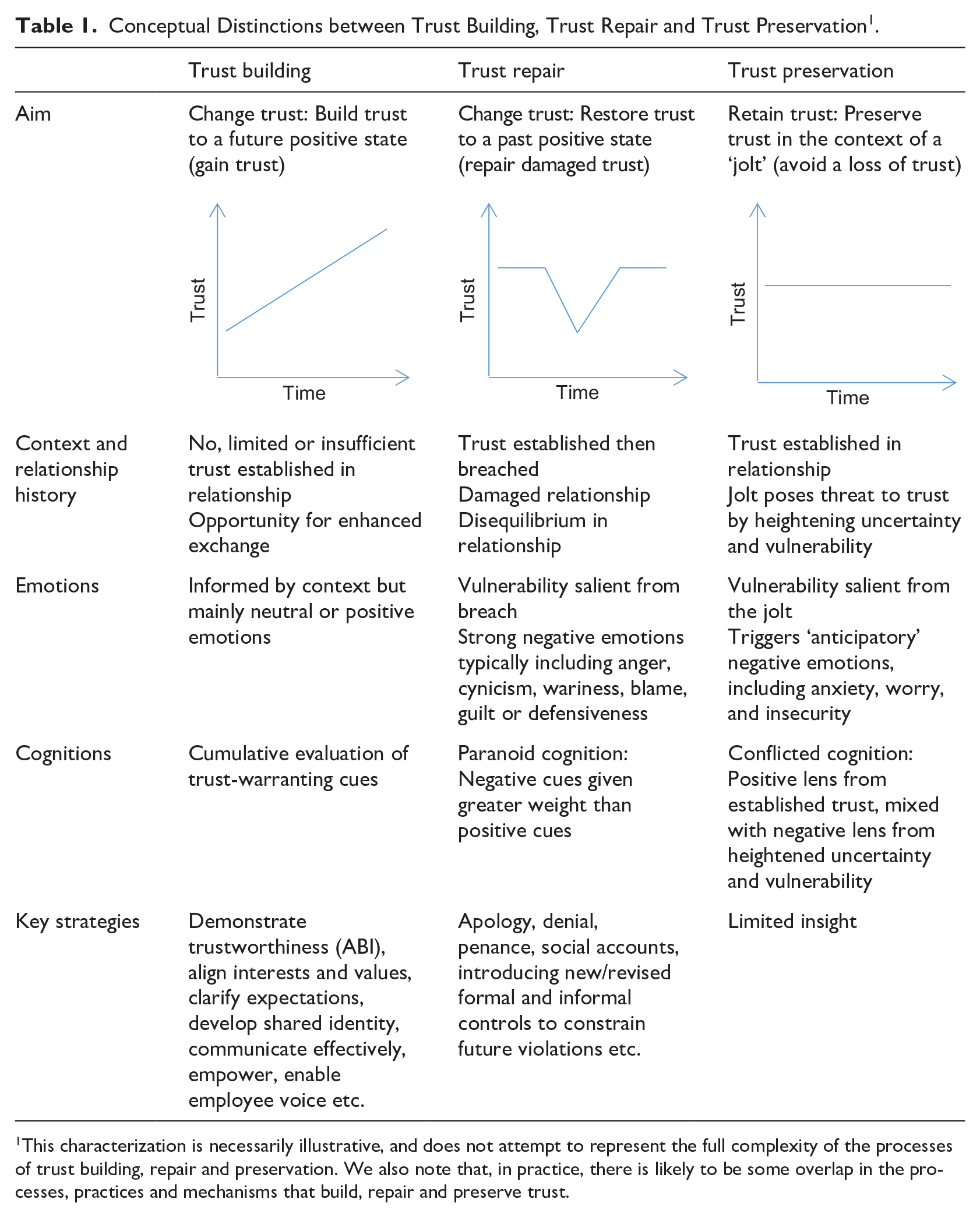
This characterization is necessarily illustrative, and does not attempt to represent the full complexity of the processes of trust building, repair and preservation. We also note that, in practice, there is likely to be some overlap in the processes, practices and mechanisms that build, repair and preserve trust.
Second, whereas trust building seeks to gain trust, trust preservation aims to protect established trust. Trust preservation occurs in the context of a jolt that heightens salience of the vulnerability and uncertainty in the relationship. Importantly, the relationship itself has not changed, rather only the context in which the relationship is embedded. Hence, because trust has not been breached or lost, preservation is distinct from trust repair, where the aim is to restore damaged trust to a past positive state in response to a trust breach. In contrast to breached relationships, where parties experience strong negative emotions (e.g. anger, blame, guilt), trust preservation occurs in the context of an established trusting relationship, where salient emotions are associated with concerns about the future (e.g. anxiety, concern). Hence, trust repair strategies such as apologies, denials and penance are unlikely to be appropriate or viable for trust preservation.
In sum, there are reasons to believe that the phenomenon of trust preservation differs from trust building and repair. Hence, our aim is to develop an empirically informed theoretical understanding of how intra-organizational trust preservation can be accomplished by asking: Which practices do organizational leaders and members use to actively preserve employee trust in the organization during periods of disruption?
Research Methods
To generate robust theoretical understanding of this underexplored phenomena, we use a qualitative multi-case study design (Eisenhardt, 1989; Eisenhardt & Graebner, 2007; Walsh & Bartunek, 2011). Qualitative data allows us to emphasize ‘(a) contextualization, (b) vivid description, (c) dynamic (and possible causal) structuring of the organizational member’s socially constructed world, and (d) the worldviews of the people under study’ (Lee, 1999, p. 43, cited in Maguire & Phillips, 2008).
Our data came from a larger research project investigating organizational trust during the global financial crisis. These organizations faced a common jolt: the economic shock resulted in significant funding and revenue cuts which disrupted existing ways of operating, making organizational transformation necessary. In three organizations, employee trust was preserved during the disruption. This ‘rare and unique’ quality made them ideal for theoretical sampling (Eisenhardt, 1989). To strengthen theory building, we added a contrasting case where organizational trust declined. Our four cases represented different industries, including retail (RetailCo), manufacturing (EnCorp) and public services (a local city council – CityCouncil and central government department – GovDept) to enable more generalizable explanations. Each organization had a history of participating in research and an interest in understanding organizational trust during disruption.
Data collection
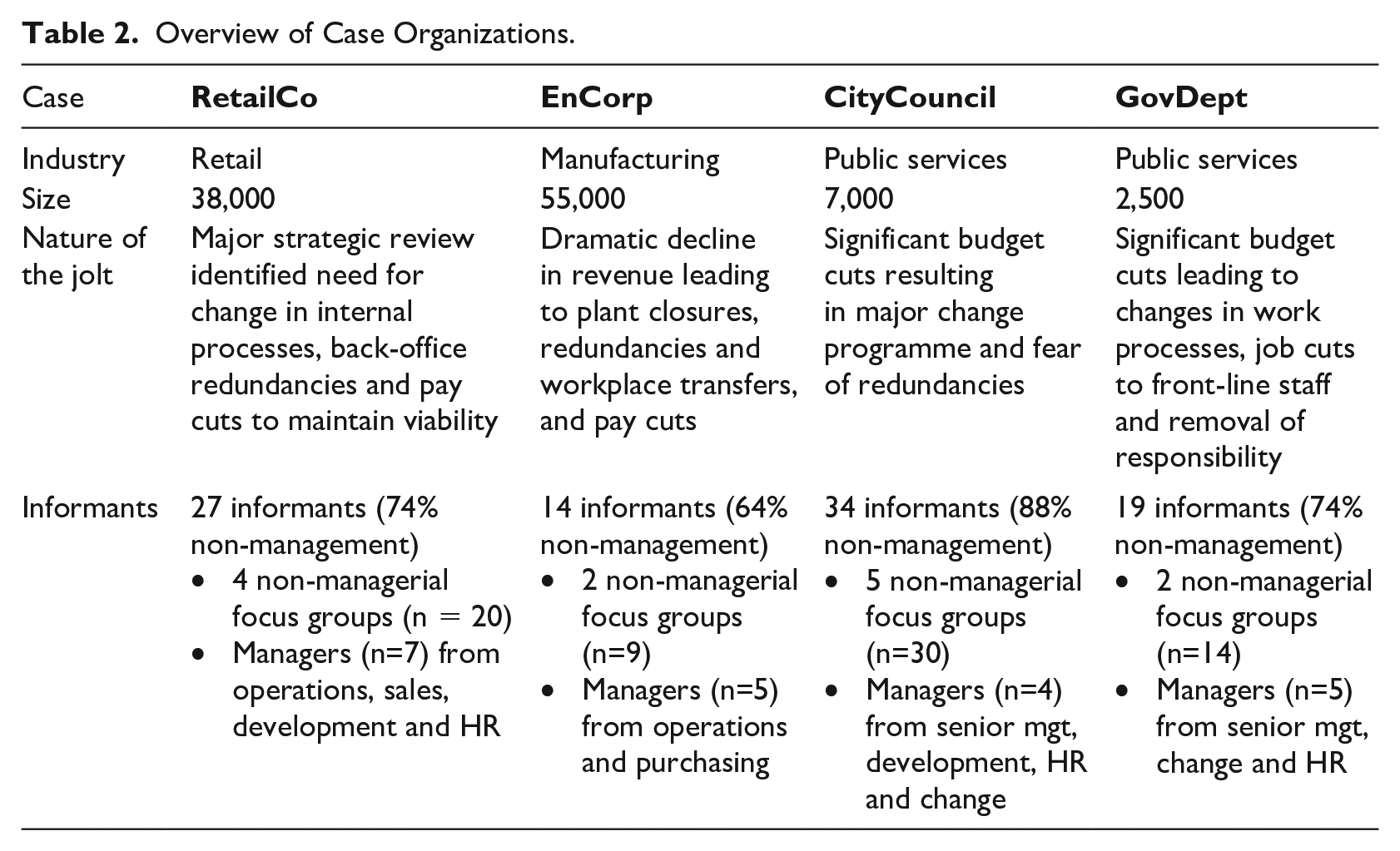
We gathered testimonies from a representation of employees at each organization using semi-structured focus groups and interviews during a time when the disruption had largely been navigated but was still fresh in the minds of our participants. We conducted thirteen 90-minute focus groups involving 73 non-managerial employees (‘E’, four to ten participants per focus group) and 21 one-hour interviews with leaders and managers (‘M’). To capture different perspectives, managers were sampled from diverse functions (e.g. senior management, human resources, operations) identified as actively involved in the organization’s response to the disruption, and front-line employees (e.g. workforce representatives, junior employees, team leaders) were sampled from various locations and functions identified as directly affected by the changes. In total, 94 organizational members participated in this research, of whom 78% were non-managerial employees, providing a large dataset of diverse experiences. Table 2 provides an overview of the data collection.
Overview of Case Organizations.
All participants were assured of confidentiality and anonymity of any quotes used. The interview and focus group semi-structured protocol included questions on employees’ trust in their organization before the jolt (e.g. How would you characterize trust in the organization prior to [the precipitating challenge]?), the impact of the financial crisis and organizational interventions on trust (e.g. How did this impact on employee trust in the organization?), how the organization sought to manage trust (e.g. What, if any, specific practices or processes influenced trust in the organization?) and where effective strategies were described, why these practices were effective (e.g. Why do you think those interventions were successful in maintaining/repairing trust?). The interview protocol also asked how the organization sought to manage the threat to trust over the disruptive period (e.g. Which specific strategies are being used to manage trust?). All interviews and focus groups were recorded and transcribed. Data collection stopped once theoretical saturation was achieved (Eisenhardt, 1989).
Data analysis
Our data analysis involved four stages.
Stage 1: Case analysis. We first considered each organization on a case-by-case basis (Miles & Huberman, 1994). Working closely with interview transcripts enabled in-depth understanding of the meaning of trust, the jolt and threats to trust, the actions taken by organizational members, and whether and how trust was preserved. We created and collaboratively refined case summaries to organize the empirical material (Eisenhardt, 1989), and noted that at RetailCo, CityCouncil and EnCorp, organizational members generally experienced trust as preserved during the disruptive period, whereas by contrast, trust in GovDept eroded.
Stage 2: Coding. Next, we coded the data to identify practices associated with trust preservation, as well as delineating conditions and mechanisms underpinning preservation. We created a list of first-order codes on a case-by-case basis which we iteratively refined to confirm that the codes captured participants’ descriptions. We identified different practices, triggered by the jolt, which interviewees described as influential for trust during challenging times, as well as organization-specific elements perceived to be critical for trust. Following an abductive approach (Timmermans & Tavory, 2012), we examined the literatures on trust building and repair (e.g. Kramer & Lewicki, 2010; Mayer et al., 1995; Whitener et al., 1998) and active trust (e.g. Giddens, 1990, 1994; Luhmann, 1988, 2017; Möllering, 2006, 2013) to delineate conceptual differences and similarities and to refine our analysis.
Stage 3: Cross-case comparison. The codes identified guided the third analytical stage. We searched for patterns which distinguished organizations – differentiating the successful from the unsuccessful. We also refined the three aggregate components underpinning the preservation of organizational trust: conditional factors, trust preservation practices and enabling mechanisms (see Figure 1).
Stage 4: Model development. Finally, we interrogated the data to understand how the components interrelated to accomplish trust preservation. Following several iterative stages between data and literature, as well as extensive conversations between the authors, we arrived at the final model of organizational trust preservation (Figure 2). Tables 3 to 6 of the online appendix show data that support our concepts and findings.
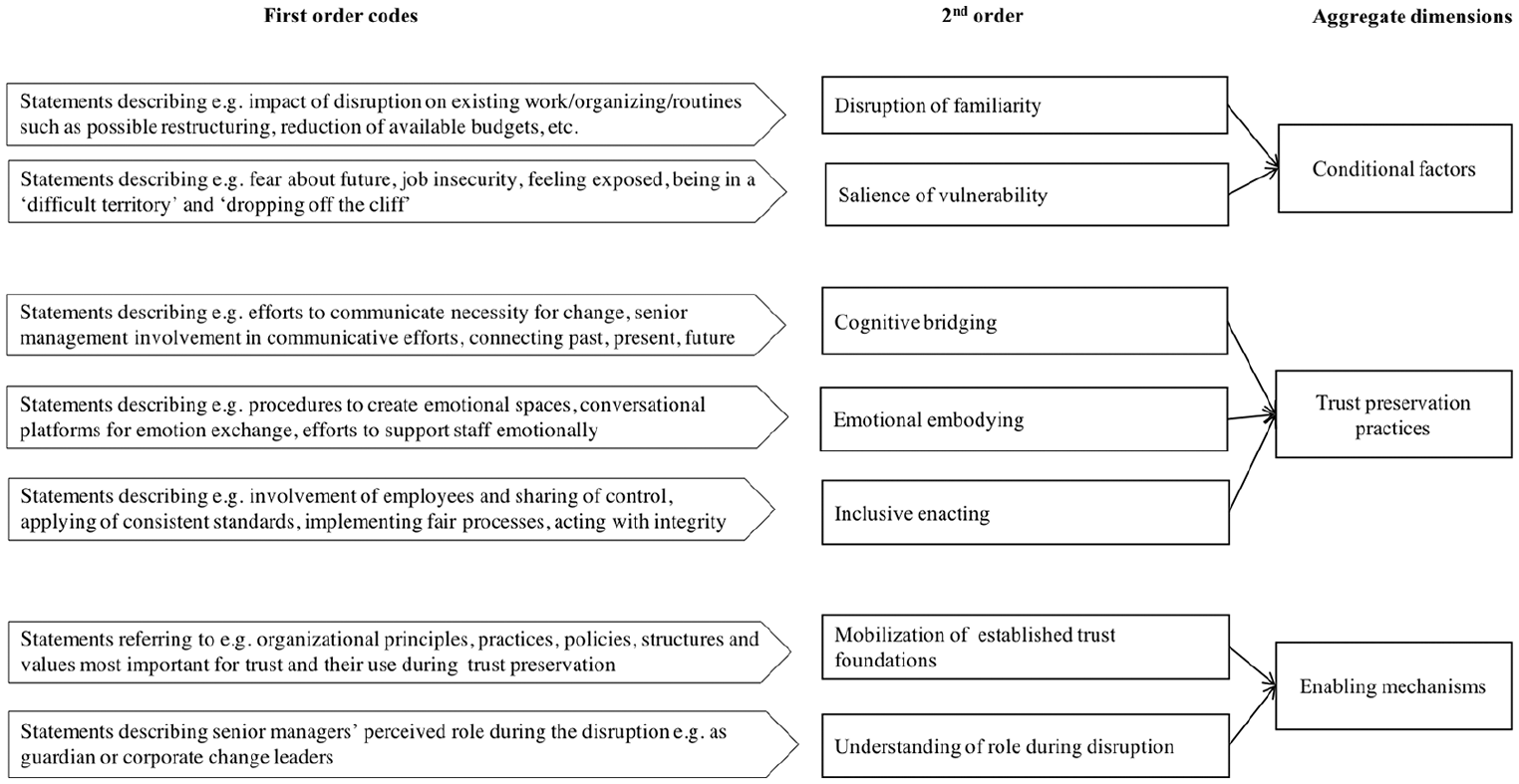
Data Structure.
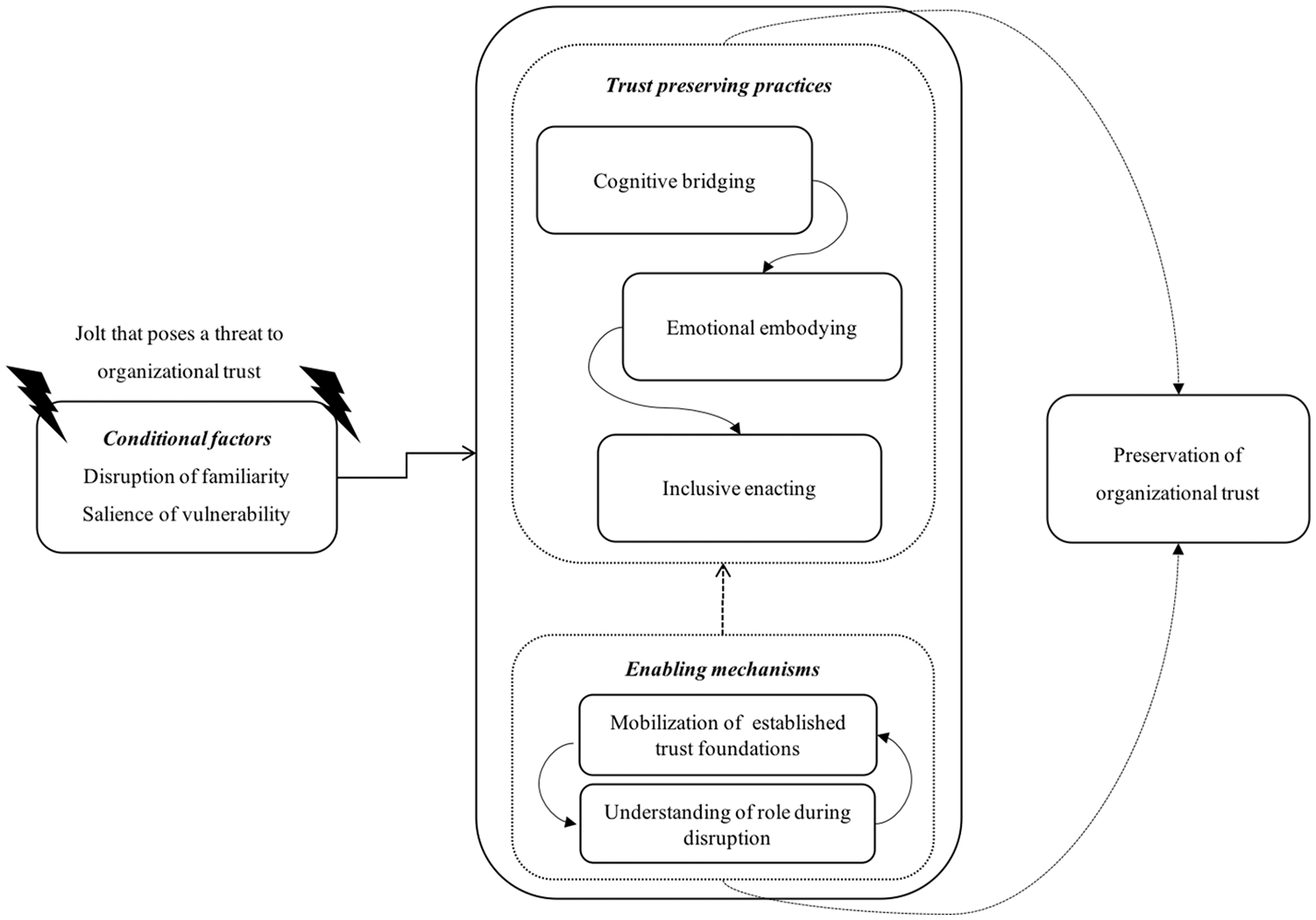
Model of Organizational Trust Preservation.
Findings
In this section, we explain and illustrate the three main components underpinning our model: conditional factors preceding trust preservation, the trust preservation practices themselves, and the enabling mechanisms informing these practices.
Conditional factors
In each case, trust preservation was preceded by an external jolt triggering two conditional factors: (1) disruption of familiarity and (2) salience of vulnerability. The disruption of familiarity stemmed from the economic crisis and its challenge to the ongoing viability of each organization. This temporarily questioned familiar and automatic ways of trusting, heightening the salience of vulnerability in the employee–organization relationship. It also created uncertainty about the future and triggered negative emotional responses among organizational members, particularly in relation to job security and working conditions. Together, these interrelated factors posed a threat to employees’ trust in the organization. These factors manifested in each case organization as follows.
RetailCo (RC) is an employee-owned partnership employing 38,000 members in department stores at the time of research. A strategic review revealed that if the retail division continued with its existing business model, it would threaten the financial viability of the partnership. This jolt made it clear to management that a new approach was needed. There were suggestions that significant pay cuts and downsizing of back-office jobs was required to enhance efficiency, although in its long history the partnership had never faced a major job loss. Such a move was a direct challenge to the organization’s mission statement ‘Principle #1’: The Partnership’s ultimate purpose is the happiness of all its members, through their worthwhile and satisfying employment in a successful business. Because the Partnership is owned in trust for its members, they share the responsibilities of ownership as well as its rewards – profit, knowledge and power.
The consequence was heightened vulnerability and uncertainty among partners: ‘We didn’t know how it was going to affect the individual, the team, and the branch itself. It was unknown territory’ (E4 RC), which threatened existing trust relations, ‘I think trust generally [was] under a fair bit of strain’ (E6 RC).
EnCorp (EC) is a 255-year-old engineering company employing approximately 50,000 people over 23 countries at the time of data collection. EnCorp is designed as a matrix, so that at the plant level there is autonomy, ‘on a day-to-day basis, the plants run themselves’ (M1 EC). As a result of the global recession, EnCorp’s Driveline division was hit suddenly by a large decline in orders. To maintain viability, senior managers recognized the need for large-scale transformation. For instance, in response to the decline in sales, which one union official likened to EnCorp ‘dropping off a cliff’, there were suggestions that 60 percent of the workforce would be affected by redundancies and pay cuts which created insecurity about future employment, ‘I was worrying for my job’ (E3 EC).
CityCouncil (CC), a local government body in an economically deprived region of northern England, employed about 7,000 people. During the financial crisis, it became evident that a reduction in the council’s central government grant was inevitable following cuts necessitated by the government bailout of the banks. £58m was cut from CityCouncil’s £745m annual budget, with further cuts threatened. This drastic budget reduction was likely to impact large parts of the workforce, inducing fear and uncertainty among employees who were not sure of the consequences these changes would bring, ‘There was obviously likely to be cuts. You couldn’t tell how you were going to be affected’ (E8 CC) and ‘I felt quite vulnerable within the council’ (E6 CC).
GovDept (GD), a central government department, employed around 2,500 people directly plus thousands more through associated agencies. Similar to CityCouncil, government budget cuts resulted in a £3bn reduction in GovDept’s £17bn budget over three years. GovDept was also forced to absorb a complex merger of rival departments with significant impact on modes of operating, and felt under pressure from the media and politicians. These events created uncertainty and employees felt they were entering ‘difficult territory’ (E1 GD). They feared that their department might be abolished, and hence focused on driving efficiency by stripping out processes, creating considerable job uncertainty. Further, the loss of an important work portfolio to another department made employees feel exposed and wary.
Trust preserving practices
Confronted with the disruption to familiarity and the associated heightened experience of vulnerability and uncertainty, organizational members recognized the need for deliberate action to preserve trust. Our analysis revealed that managers responded by engaging in three trust preserving practices: (1) cognitive bridging, (2) emotional embodying and (3) inclusive enacting.
Cognitive bridging
The first practice aimed to help organizational members cope with uncertainty by developing shared understanding of the need for change and positive associations towards the future in a way that connected with the organization’s past. These were attempts to shift cognitions to facilitate coping with the disruption by creating a sense of continuity between the organization’s past, present and future. In other words, creating a cognitive bridge for people to ‘walk over’ (Williams, 2007), by explaining why the status quo of the past was no longer viable given the present disruptive context, by providing information on how the organization would transition from the present uncertainty to a more certain and positive future, and by specifying what the organization in the future would look like.
Senior members sought to develop employees’ understanding of the disruptive events and the associated necessity of change by explaining openly why the status quo was commercially or operationally untenable, ‘changing your business means that people have to understand why you’re changing’ (M2 RC). This was amplified through personal communications. For example, RetailCo’s senior leaders used national roadshows to explain the planned changes directly to local staff: We went on roadshows around the country. The managing director of every shop stood alongside a Board member and shared the vision and the interpretation of that vision for their shop of the business. It was a stark realization that if sales were going to be flat and costs continued to rise – he called it his pincer movement – that only one thing was going to happen to our profit. It really garnered the troops around the fact that we were going to have to face tough decisions, but there was an incredibly rational reason why. (M2 RC)
The use of the ‘pincer movement’ metaphor strengthened understanding of the need for change that ‘got everybody immediately into the intellectual place’ (M2 RC). As a RetailCo employee stated: ‘We knew that we needed to change the business because the model, as strong as it is, wouldn't be resilient enough against where the world was changing’ (E3 RC). However, while communications were generally perceived to be handled well, perceptions differed across branches: ‘It’s not for every branch but this branch, it’s handled very, very well’ (E7 RC); ‘The language used centrally was very misleading. At the last moment they said, “Oh, by the way we’re cutting your pay by 20%.” That really came as an afterthought – they weren’t upfront with that’ (E8 RC).
At EnCorp, senior management communicated directly with affected plants when announcing the need for change, while union officials held conversations with staff at the local level. Communication became ‘more frequent so that [..] people were aware it was changing and therefore could understand the reasons for the change’ (M4 EC). The emphasis on communicating honestly and openly was overall received positively and helped to facilitate trust relations: ‘We trust the management because they are showing us hard, cold facts’ (M5 EC).
In contrast, CityCouncil’s approach to communication had some early shortcomings. Prior to the initiation of a communication strategy, information access varied across the directorates with participants finding out ‘second-hand’, creating spaces for ‘rumours’ to emerge (E1 CC). Later in the process, senior managers used a more consistent and honest communication process to enable a deeper and more mature conversation. One manager referred to colleagues being told: ‘The ‘givens’ [..] We were open and transparent about that.’ (M1 CC). Similarly, one employee suggested that later in the process ‘the feedback from managers seemed more open and focused on what they were doing’ (E9 CC).
Cognitive bridging also involved articulating a positive future vision, reducing the negative impact perceived in the present. For example, RetailCo’s senior managers designed the ‘Branch of the Future’ (‘BoF’) which aimed to create a successful organization that was financially sustainable in the long term: ‘It was about a long-term shift in what branches were about. Hence it was called Branch of the Future’ (M1 RC). This fostered commitment among RetailCo’s partners for the proposed changes: ‘I think everyone realized what needed to be done’ (E2 RC).
Similarly, one of EnCorp’s affected plants was established as a ‘Centre of Excellence’ creating ‘a sustainable vision of a future with high skills and employment’ (M1 EC). The emphasis on sustainability again was important for trust preservation because it demonstrated the organization’s commitment to investing in its employees and provided evidence that existing trust relations were important in the future: ‘[It provided] actual evidence that the parent company does see there’s a future in the plant because they could’ve easily shut it’ (M2 EC).
CityCouncil’s Switch initiative was designed to recognize employees’ existing skills and attributes and find a suitable fit for the future. One manager explained: ‘Switch stands for “staff, working, in, transition in change’. It’s a strengths-based framework, assessing their strengths and moving them from a job that they are currently doing to a role that we need them to do in the future’ (M1 CC). While generally interviewees suggested that the intention behind Switch had been positive, some expressed concerns about how capabilities were being matched: ‘You’ve been matched to this job and you think “oh great”. Then you read all the way down, it says you need these qualifications which you haven’t got, so why do they match you to it in the first place?’ (E9 CC). Employees who were matched to jobs for which they did not possess necessary qualifications felt under-valued which challenged their trust in senior management (Culbert & McDonough, 1986). As these initial inconsistencies were remedied by management over time, employees began to see Switch in a more positive light: Everything that’s new, there’s going to be flaws in the system, but they have tried to correct it, they have definitely tried to amend it. So, it’s more suitable to everyone. Now, we are matched more on our level. (E8 CC)
In contrast, for GovDept’s employees the changes lacked a clearly articulated rationale, future vision and effective planning. Employees felt that managers failed to justify the necessity of quick change and were not upfront. Even managers discussed how they tried to ‘sugarcoat things’. Further, employees felt the use of cartoons in the communication strategy to be infantilizing, negatively influencing perceptions of GovDept and sending cues that the organization was not trustworthy.
In sum, cognitive bridging involved practices that facilitated organizational members to cope with uncertainty and vulnerability by developing their understanding of the present situation in an open, honest and respectful manner, and provided a positive future vision so that the question ‘Who will we be as an organization in the future?’ could be answered positively, in a way that highlighted continuity in the organization’s core purpose and values.
Emotional embodying
Emotional embodying involves prioritizing emotions triggered by the jolt by creating spaces for emotions to be shared, worked through and shifted. It includes individual and collective efforts to create social environments where employees feel cared for and where their emotional responses take priority.
In the three trust preserving organizations, this was actively supported by concrete actions. For example, a RetailCo partner recounted how her ‘diary was just cleared’ as affected partners became her priority over ‘every other appointment’. Senior managers recognized that shifting organizational members’ negative emotional states to more positive ones would require considerable time and support: ‘Let’s make time to care for them. Don’t expect them to make the emotional leap at the same pace they’re making the intellectual leap’ (M7 RC). Importantly, for those who had concerns about RetailCo’s communication, the emphasis on personal support helped to balance the perceived negative effects: ‘The support you got within the local branch was excellent. If you weren’t happy, you could speak to your [line manager] or personnel. People were easily accessible.’
At CityCouncil, the budget cuts and subsequent transformational change programme evoked worry and cynicism among organizational members who were concerned about job losses and occupational retraining. In response, senior managers created conversational platforms for people to share their concerns and work through defensive feelings, in recognition that unresolved feelings could lead to withdrawal. They also welcomed critique on the proposed changes: ‘I’ve got to take it on the chin and I’ve got to listen’ (M2 CC). This approach set the foundations for more cooperative interaction. Employees also frequently referenced the support and coaching they received on the Switch programme. Many had been employed in their respective roles for a large part of their careers and were concerned about their ability to fulfil new responsibilities. Coaching allowed them to shift from uncertainty to believing in their capabilities.
Yet, while many employees on the programme experienced the new role as an opportunity, ‘It’s just absolutely been the most exhilarating experience of my life’ (E10 CC), some were more cynical, suggesting that senior managers used Switch as a PR strategy to cover up redundancies and ‘save face’ (E9 CC). For these interviewees, Switch was mainly politically motivated: ‘They don’t want to be seen to be failing’ (E9 CC) as local ‘politicians didn’t want any redundancies’ (E11 CC), also because the council was an important employer in the city. Nevertheless, there seemed to be a general consensus that generating significant savings was an economic necessity and not easy. Many proposed that despite possible criticism, overall decision-makers at CityCouncil had good intentions, ‘at least they’re trying to do something’ (E12 CC). Some even concluded that the programme provided direct evidence of CityCouncil’s benevolence: ‘Switch has provided the evidence that they do actually care’ (E15 CC). Another employee explained: I wouldn’t be here if the Council hadn’t done what was done. So, to me, as much as I might not like everything else that the process goes through, fundamentally the Council are doing the best they can for its employees. (E13 CC)
EnCorp’s commitment to supporting staff emotionally during the disruptive period was manifested in the financial resources dedicated to support employees who faced displacement and redundancy. Many of EnCorp’s workforce were local breadwinners and concerned about their ability to find alternative employment in the region. To reduce ambiguity, senior managers communicated their positive intentions to all employees at the outset: ‘Right from day one, we said “If you’re displaced as a result of this, we will support you.” We will put in a considerable amount of investment. We’re talking hundreds of thousands of pounds were spent on outplacement support’ (M1 EC). However, some employees criticized senior management’s communication of redundancies prior to Christmas as lacking in care and compassion: When you’ve got adults crying in front of you, it’s hard to try and console them. But you know, we wouldn’t criticise the company on the fact that they did get the Job Centre in, they did get people’s CVs [..] The only thing I’ve criticised the company about, is when we let 50 people go at Christmas. We had a bit of a row over it. (E7 EC)
At the same time, employees recognized that redundancies were a time of hardship and suffering for those being let go, regardless of how well management handled it: ‘We thought it was done correctly but, obviously if you’re losing your job, nothing’s done correctly’ (E7 EC).
By contrast, in GovDept, emotions were largely ignored, even denied. For example, HR staff did not think it right to ‘mollycoddle people too much’ and put the focus on process rather than people. GovDept’s emphasis on a quick change process also meant that people ‘never actually had a chance to grieve’ (M1 GD). Further, managers were willing to ‘take a hit for the team’ only if it was linked to performance outputs, ‘if I can actually see a deliverable coming out the other end of the machine’, but rejected the idea of working through emotions at a personal level, ‘[I won’t] just stand there and be someone else’s emotional punch bag’ (E2 GD). The outcome was that many employees at GovDept became increasingly cynical.
Inclusive enacting
This practice describes attempts to involve organizational members in decisions, giving them voice throughout the disruption, as well as to create processes that were fair and consistent. These were important for reducing employees’ sense of vulnerability by enabling collectivity and enhancing a sense of personal control (Kasten, 2018). As a result, people felt they had a say in how the organization was changing, and principles of fairness and integrity were being enacted.
The trust preserving organizations set up robust consultative structures and processes to involve people. Leaders understood that different stakeholder groups had a legitimate right and need to be heard. One EnCorp manager suggested: ‘It’s all about the involvement that you have with the people. You listen to them and they actually feel that they’re having some influence on that outcome.’ (M2 EC). In CityCouncil, senior management also initiated frequent discussions with employees, constructing the workforce (generally via their representatives) as active participants in the organization’s response to the disruption, even if they did not always act according to their suggestions: We’ve not just imposed anything. They’ve occasionally argued with the process and sometimes when we’ve looked at it, we’ve reviewed it and we’ve changed it. Sometimes we’ve said no, we need to stick to it for this reason. (M2 CC)
This sense of empowerment increased employees’ belief in their capability to cope with uncertainty. In RetailCo this manifested itself in a two-way relationship: senior managers had responsibilities, but so did the workforce. One HR manager described it as an ‘adult/adult relationship’ of ‘sharing responsibility for your future’ (M7 RC).
By contrast, in GovDept decision-making around organizational responses to the funding cuts was centralized. Employees were neither involved in the process, nor had control over its timescale: ‘From our point of view, there’s a very general feeling of “being done to” by the corporate centre. You hadn’t really been involved in sorting out the process’ (E3 GD). The decision to use external consultants to manage the difficult aspects of the change reinforced this passive feeling. This removed leaders’ responsibility, effectively bypassed staff representatives and ultimately emasculated the workforce.
Inclusive enacting also involved a deliberate focus on consistently applying standards and principles. For example, in RetailCo every employee facing redundancy was offered redeployment, with policies in place to maintain their pay: ‘We have a really consistent approach which means that everyone is treated fairly. . . that’s really important in terms of trust’ (E16 RC). Further, in EnCorp, everyone, regardless of hierarchy, had both shorter working hours and an associated 25 percent pay cut. This was generally judged as a fair approach because it meant that fewer workers lost jobs: ‘It could have been worse. Although we lost a number of people, we could have lost a lot more but, as a shop floor, we all agreed to do a four day week’ (E5 EC).
In addition, every worker had to go through an assessment process to determine whether their job was to be made redundant or not. Union officials were involved in this process, they had ‘seen people’s assessments’ and through that involvement made ‘sure that they were scored correctly’ (E7 EC). These actions created an environment of solidarity and reinforced principles of integrity and consistency which contributed to the preservation of trust.
Likewise, at CityCouncil, the design of the internal labour market programme Switch sought to uphold principles of fairness through the assignment of roles. First, they stopped all external recruitment, prioritizing options for internal staff and hence creating a more secure employment environment. When a job vacancy arose, job matching software helped fit current employees with existing capabilities and experience to the vacancy. Designed to be as objective as possible, the process was judged positively by employees and trade unions ‘I think the principle of the system is pretty much sound’ (E13 CC), resulting in high participation: ‘It got a lot of trust. . .I volunteered to join Switch. A lot of people did’ (E20 CC). It was broadly perceived as leaving little room for favouritism and individual agendas of managers: ‘Managers cannot interfere with it, and they cannot “cherry-pick” either; it’s an objective process, which was seen as a real plus by the trade unions’ (M2 CC). However, some employees disagreed. They suggested that individual middle-level managers used Switch for their own interests: ‘Managers are manipulating that process because they are using the Switch officers to cover up their job. That’s supposed to be an absolute no-no’ (E14 CC), challenging perceived trustworthiness of some of CityCouncil’s managers and processes.
In contrast, a curious trade-off was observed at GovDept where line managers defied principles of fairness and integrity. There were several instances of line managers misusing the rating systems as a means of pursuing their own agendas and favouring their own teams, which undermined the fair implementation of this policy. These actions made it a ‘disruptive process’ creating ‘huge challenges around convincing staff that it really was fair and transparent’ (M2 GD). The impact on trust was clear as an HR manager reflected: ‘There was a lot of breakdown of trust because people were applying different standards’ (M3 GD).
Enabling mechanisms
Our analysis revealed two enabling dynamics that supported the preservation of trust.
The first, mobilization of the organization’s established trust foundations, describes how managers identified the central elements through which trust had been constituted in the past, and enacted, adapted and amplified these through active trust preservation practices, to bring a sense of familiarity into the uncertain present and future. These trust foundations are informed by the social practices, processes, structures, values and principles, stories and rituals formed through (past) interactions, that constitute trust between employees and the organization, and its (re)constitution over time. As such, these established trust foundations inform members’ future expectations of the organization.
The second, managers’ understanding of role during disruption, describes how managers perceive their role during the period of disruption. We observed that in the three successful cases, managers saw themselves as guardians, protectors and stewards of the organization first, and change actors second. We found that these two mechanisms were interrelated in how they enabled trust preservation practices.
At RetailCo, one of the key trust foundations was Principle #1 which outlines the purpose of the partnership as the collective ‘happiness of all its members, through their worthwhile and satisfying employment in a successful business’. Leaders were aware of the importance of Principle #1 and it was frequently referred to, signalling its relevance and amplification during the period of disruption. Leaders actively connected this principle to the need to shift from the present ‘paternalistic’ culture to a future ‘adult-to-adult’ culture to ensure long-term sustainability: Principle #1 talks about a successful business as one which generates sufficient profit for the next generation. So, everything that you do, the way you operate has to be to create a sustainable business. (M1 RC)
For trust to be preserved, the partnership ethos had to be protected at any cost: ‘The nature of co-ownership – there is a trust that those principles will be upheld. That’s where trust is hugely important’ (M4 RC). However, senior managers also recognized that given the changed external environment, RetailCo needed to transform. Yet, they were clear that this transformation needed to protect the organization’s legacy, viewing the past as a positive that required adaptation: ‘We’re trying to build from what we had into the right form of new’ (M7 RC). Importantly, given the organization’s history, employees expected senior leaders to exercise benevolence, caring about the well-being of its members, even in the context of redundancies. Those in charge were aware of this and combined their communication with an explicitly caring approach, to amplify their benevolent orientation. This became known as ‘loving partners over the line’ (M2 RC).
EnCorp’s established trust foundations were different. Here, a unionized culture and strong personal relationships between line managers, workers and trade unions at the local plant level were important elements that constituted trust. EnCorp management understood this and explicitly used existing communication and consultation practices with the unions to facilitate proposed actions: It’s a strong union culture [..] I am 100% committed to having a weekly meeting with the shop stewards in my area, telling them what’s going on, how things are progressing, listening to their gripes and having that rapport with them. (M2 EC)
Being involved made union officials feel valued by senior management. Further, throughout the crisis, senior EnCorp leaders adopted a protective role, ‘We’re here to support the business, that’s what we see our role as’ (M3 EC), a pledge they took seriously; ‘EnCorp is still fully committed to the UK’ (M1 EC). Despite the challenging circumstances, they managed to safeguard EnCorp’s image as a successful regional employer, which employees appreciated.
An important foundation of trust at CityCouncil was the explicit recognition and belief in the value of each individual. The Switch initiative could have challenged this because it relocated employees into new roles, potentially reducing the value of their skills and knowledge. However, senior leaders sought to mobilize and amplify a strength-based approach in their trust preservation practices: ‘We took a decision that we would stop recruiting externally [. . .] you have to find what we’ve got internally and grow them into the role’ (M2 CC). Importantly, for employees who felt that they realized personal aspirations through Switch, it reinforced trust in senior managers: ‘You get a lot of trust. I feel a lot like they’ve looked after us’ (E4 CC). However, those employees who did not feel developed in their reassigned roles felt more equivocal.
Although CityCouncil’s leaders understood the need for cuts, they saw it as an opportunity to protect staff and community interests. Historically, CityCouncil had acted with integrity and care towards the city’s inhabitants. This ‘authentic CityCouncil style’ was a source of pride for employees, providing an anchor during uncertain times, with employees reporting the organization had preserved this positive image through the disruption. This was achieved because leaders perceived themselves as guardians of the organization’s values of being ‘proud, decent and together’, which they mobilized in their practices: ‘The council is choosing to manage that change in a particular way which I believe, reinforces those values of being decent and together in particular’ (M1 CC).
In contrast, leaders at GovDept failed to identify that trust in the civil service organization had been built on fairness, integrity and respect for individuals’ competency. This was reinforced by senior management who led people to ‘believe we should expect it to be fair’ because ‘it’s part of what we do, it’s public sector’ (E6 GD). Yet, this critical trust foundation was not enacted. Rather, employees felt that ‘people who lost their jobs didn’t lose them for a fair reason’ and that senior managers had little concern for ‘people’s lives’ (E6 GD). Further, many council members had considerable professional expertise and experience, yet, senior government officials started to question these abilities and engaged in monitoring behaviours: ‘You tend to get micromanaged by them if they don’t trust you to work properly’ (E1 GD). As a result of these failures to recognize, draw on and enact established foundations of trust during the disruption, employee trust suffered. This approach was informed by senior managers’ understanding of their role as ‘corporate’ change leaders who were required to ‘demonstrate their active behavioral leadership strongly’ (M1 GD). They interpreted the crisis as an opportunity to transform the way things were done at GovDept by ‘being corporate’ and acting ‘fast and furiously’, with little concern for preserving GovDept’s collective legacy. Instead, managers were described as focused on protecting their personal status and future.
Preservation of organizational trust
Through these three interactive components (conditional factors, trust preserving practices and enabling mechanisms), trust preservation was accomplished in RetailCo, EnCorp and CityCouncil. Trust ‘didn’t change significantly’ (M1 EC), ‘remained high’ (E4 CC), ‘I’ve not lost my trust’ (E7 RC) and in some cases even increased: On our partner survey, during the year where we had the Branch of the Future Program, which made a significant number of partners redundant, the scores increased on the [trust] questions. (M1 RC)
This was in contrast to GovDept, where the general view was ‘most people completely lost trust’ (E7 GD).
Importantly, trust preservation had both familiar and transformational aspects. The familiar aspects were achieved by drawing on, adapting and amplifying established foundations of trust in the enactment of trust preservation practices. The transformative aspects represented the new practices, stories and relational history created through the process of navigating the disruption.
Following the disruption, in RetailCo and EnCorp trust in the organizations’ ability to steward the workforce through difficult situations was more robust. Partners in RetailCo agreed that the changes were ‘right for the business’ and suggested that ‘because it was handled so well, you felt even better after’ (E4 RC). There was also a sense that RetailCo had managed to safeguard its concern and care for each individual. Similarly, even employees who had challenged managerial decisions agreed that trust had not changed for them: ‘My querying of some of the decisions and some of the things that are going on have made me step back and look. But I don’t think the overall trust has changed. No, my trust hasn’t changed’ (E8 RC). There was a sense of hope and anticipation among employees at EnCorp who moved from uncertainty in response to the disruptive events into a safer space: ‘I’ve seen morale’s up from what it was. I think people know that the business is secure’ (E6 EC).
Many CityCouncil employees suggested that going through the Switch programme had positively influenced and reinforced their trust with the council, leaving them feeling valued: ‘I don’t think trust levels were ever low. I always thought they were quite high to be honest. From my point of view, it’s worked out perfectly’ (E9 CC) and ‘I trust the organization as a whole one hundred per cent. My health and well-being went up one hundred per cent as a result’ (E10 CC).
In contrast, in GovDept, ignoring established trust foundations, over-emphasizing change at the expense of guardianship and failing to effectively engage in any of the trust preservation practices led to the breakdown of trust instead of its preservation.
Discussion
Organizations are increasingly operating in disruptive environments that pose a threat to organizational trust. This study aimed to understand how organizational members accomplish the preservation of employees’ trust during times of disruption. This is theoretically valuable because despite the long-standing interest in practices of organizational trust building and repair, understanding of trust preservation remains limited. Our study makes three contributions to trust theory.
First, we contribute to trust theory by advancing a conceptual understanding of trust preservation. We define it as active practices to preserve established trust in the relationship, triggered by a jolt that heightens uncertainty and vulnerability in the relationship. This conceptualization distinguishes trust preservation from trust building and trust repair based on its aim, context and relationship history, emotions, cognitions and practices (see Table 1). Specifically, trust preservation aims to protect existing trust and avoid a loss of trust, rather than building trust to a future higher state, or restoring damaged trust to a past level after a violation. In contrast to trust building scenarios where there is no or insufficient trust in the relationship, trust preservation occurs in the context of established trust within a personalized relationship. Trust preservation is triggered by a jolt that changes the context in which this trusting relationship is embedded. This jolt disrupts familiarity, heightening the trustor’s sense of vulnerability and uncertainty in the relationship, and creating conflicting cognitions and emotions due to the coexistence of a positive lens from established trust and a negative lens from the uncertain and disruptive context. In this changed context, trustors find themselves in a state of suspension seeking reassurance that trust continues to be warranted in the relationship.
We do not suggest that trust preservation requires maintaining trust at exactly equal levels throughout the disruptive period. Rather, our data shows that trust evolves during preservation, sometimes wavering, then steadying, at times strengthening or remaining constant. We envision trust preservation as operating within a range in which trust can vary somewhat in strength. Importantly, unlike trust repair scenarios, in trust preservation contexts a breach in the relationship has not occurred and is still avoidable – only the context of the relationship is disrupted by the jolt, not (yet) the relationship itself. Our case materials highlight that leaders often frame trust preservation in terms of what they perceive is best for the sustained survival of the organization overall. Despite attempts to act with integrity and care, individual employees may suffer during disruptive times, particularly during redundancies. Organizational members will also vary in how they perceive trust preservation efforts leading to different responses. As such, we contend that in trust preservation scenarios, organizational members seek to preserve trust at the collective level for the majority by engaging in active and conscious practices that aim to avoid the erosion of organizational trust as a result of a jolt.
By laying this conceptual foundation, we shift theoretical attention beyond the traditional focus on trust building and repair (e.g. Fulmer & Gelfand, 2012; Kramer & Lewicki, 2010; Lewicki et al., 2006; Rousseau et al., 1998) towards a third dynamic – trust preservation. While our empirical focus is on the preservation of intra-organizational trust, we frame our definition and conceptualization of trust preservation broadly in line with our view that this concept and phenomenon occurs across levels and types of trust relationships. Another important aspect to clarify is the role of internal versus external jolts. Our empirical cases focused only on external jolts, specifically a sharp reduction in revenue due to the global financial crisis. There are reasons to expect that if employees had attributed the jolt to internal causes, it may have been experienced as a trust breach by management. Future research is required to examine how an internal attribution for the jolt may influence trust preservation scenarios.
Our second contribution is the development of a conceptual model of trust preservation, which provides a first understanding of how trust preservation is accomplished in organizations facing disruption (Figure 2). We identify three distinct components important for trust preservation: conditional factors, trust preservation practices and enabling mechanisms. Trust preservation is triggered by a jolt – a significant event that can vary in size and magnitude that threatens established trust by disrupting organizational members’ sense of familiarity, and making vulnerability in the employee–organization relationship salient (conditional factors). This prompts more conscious awareness of the need to engage in active trust preservation practices – cognitive bridging, emotional embodying and inclusive enacting – which collectively reduce vulnerability and uncertainty.
In contrast to trust building and trust repair strategies, these practices have been largely undertheorized. We show that trust preservation practices are socially embedded involving relational exchanges between organizational members, and represent organizational attempts to create ‘access points’ for interaction between management and employees (Giddens, 1990). For employees, these practices demonstrate ability, benevolence and integrity (Mayer et al., 1995; Whitener et al., 1998). As such they may not be exclusive to trust preservation but could also be drawn on to build and repair trust. However, these practices are particularly important in trust preservation contexts for several reasons. First, cognitive bridging enables organizational members to shift attention from the current uncertainty resulting from the disruption towards a more positive view of the future that builds on the organization’s legacy. Second, emotional embodying facilitates employees to cope emotionally with the uncertainty and ambiguity triggered by the jolt by creating spaces, structures and support that help them work through emotions and develop coping capabilities (Kasten, 2018; Oreg et al., 2018; Sloan & Oliver, 2013; Williams, 2007). Third, inclusive enacting is important in contexts of vulnerability and uncertainty because it enables collective sensemaking and exchange by giving voice, sharing control and ensuring fair procedures (Holland, Cooper, Pyman, & Teicher, 2012; Korsgaard et al., 2002; Mishra & Spreitzer, 1998).
Further, our model shows how trust preservation was supported by two interdependent enabling mechanisms: mobilization of the organization’s established foundations of trust and leaders’ understanding of their role. We found that the core foundations of trust in the organization need to be protected, enacted and amplified in times of disruption for trust to be preserved. These foundations are resources that organizational actors can mobilize to create a sense of familiarity in contexts of uncertainty (Luhmann, 2017). Honouring and protecting these trust foundations signals predictability and constitutes a process of familiarization that supports trust preservation. Mobilization requires actors to be reflexive and knowledgeable in understanding the specific trust foundations in their organization (i.e. principles, values, practices and/or structures that underpin organizational trust), skilful in assembling these foundations (Weick, 1993) and able to enact them in a way that is reflective of the complexity of a changing context. Organizational members’ understanding of their role during the disruption forms an important part of this reflexive practice. In the trust preserving organizations, managers perceived themselves as guardians and protectors of the organization during disruption who understood the need to safeguard the organization’s legacy, rather than as change agents. As such, managers had agency in how to respond: they could preserve, breach or even sacrifice trust.
Our findings further show that power and political dynamics shape the accomplishment of trust preservation (Grey & Garsten, 2001; Siebert et al., 2015). Trust preservation practices were typically initiated by actors in power, mostly managers. Viewed critically, trust was a source of managerial power used to advance organizational agendas (Siebert et al., 2015). For example, managers at both CityCouncil and RetailCo used powerful scripts and rhetoric that drew on employees’ internalized organizational values and identity to influence them to follow the change agenda (Grey & Garsten, 2001). Nevertheless, our findings show that trust preservation requires the active acceptance, involvement and legitimization of employees in non-managerial roles. Employees have agency to withdraw their trust by interpreting situations and actions as unworthy of continued trust. This was apparent in some CityCouncil employees who became cynical when they did not feel their skills were appropriately recognized during job reassignments (see also Culbert & McDonough, 1986). These employees needed further evidence to continue to trust the organization. As such, we suggest that organizational members across hierarchical levels influence whether and how trust preservation is accomplished.
Third, by conceptualizing trust preservation as both a manifestation and extension of active trust, our study advances understanding of active trust practices with implications for the literature on active trust (Child & Möllering, 2003; Giddens, 1990, 1994; Luhmann, 1988, 2017; Möllering, 2006, 2013). By attending to the conditional factors that trigger the need for trust preservation, we highlight the importance of the broader context in which organizational trust preservation is embedded. Active trust scholars have acknowledged the instability and uncertainty characterizing modernity (Giddens, 1990) but have not investigated these conditions or theorized their impact on trust (see Grimpe, 2019, for an exception). We propose that for active trust preservation to be required (as opposed to routine trust maintenance), a significant disruption is needed, akin to a ‘jolt’ (Meyer, 1982). We theorize that jolts disrupt employees’ familiar ways of thinking about and trusting their organization by heightening vulnerability and uncertainty in the employment relationship, which in turn triggers proactive and conscious attempts to preserve trust.
Importantly, while the notion of active trust generally emphasizes habitual trust engagement, privileging established structures and interactions that reintroduce familiarity (Luhmann, 2017), we argue that preserving trust in the context of salient vulnerability and uncertainty requires both the mobilization and transformation of familiar established foundations of trust: that is, habitual ways of reconstituting trust are no longer sufficient in times of disruption. Rather, adapted meaning systems and relational practices need to be created and enacted to reassure and enable employees to uphold confident positive expectations of the organization’s future conduct (Weick, 1993). Hence for trust to be preserved, organizational members need to develop and enact practices which draw on but also adapt and amplify the organization’s existing trust foundations to the context of the jolt, possibly even creating new modes and bases of trust (Luhmann, 2017). Hence, these practices are shaped by the social context of the relationship. We propose that the manner in which intra-organizational trust was constituted both enables and restricts trust preservation practices. For example, to preserve trust at RetailCo, leaders arguably would always have to protect core principles of the Partnership model because it is a foundational element of employees’ trust. Hence, an implication of our model is that an organization’s unique set of established trust foundations influences the specific form that trust preservation can take. In sum, we suggest that while familiarization is important for intra-organizational trust to be preserved, so is transformation of existing trust practices.
Boundary conditions and future research
Our study revealed boundary conditions which suggest avenues for future research. Our data were collected when disruptive events were still recent but had largely been navigated. While this retrospective case study design was effective for identifying suitable cases of trust preservation, and has been recommended to overcome difficulties of field research access during crises and disruption (Gillespie & Dietz, 2009), we recommend future studies adopt a longitudinal and processual design that enables the ‘real-time’ examination of trust preservation (Möllering, 2013; van der Werff & Buckley, 2017). This would capture the perspective of employees who leave the organization during the disruptive period and inform understanding of trust preservation dynamics. Second, we studied trust preservation at the organizational level and the extent to which our model and the dynamics and practices identified translate to other levels and referents requires investigation. However, there are reasons to suggest that some dynamics may be relevant across levels. For example, a trust preservation scenario at the interpersonal level could be a manager telling a subordinate that she or he was passed over for promotion. To preserve trust in the context of this ‘jolt’, the manager could mobilize and reaffirm the pre-existing relationship and use practices such as explaining the outcome respectfully, supporting the recipient through the distress by enabling emotions and inclusively exploring future career plans and paths.
Conclusion
Managing trust in contexts of disruption is a process fraught with challenges, as evidenced by the fact that employee trust is often lost during such periods. Given the increasing rate and pace with which organizations are facing disruption, it is important to deepen understanding of how trust preservation can be accomplished. Our case study findings and conceptual model show that intra-organizational trust can be preserved through a set of active trust preservation practices, combined with mobilization and transformation of the organization’s established trust foundations, which collectively serve to reduce salient vulnerability and reintroduce familiarity in the employee–organization relationship, despite the disrupted context. Our study advances trust theory by extending the notion of active trust and identifying how trust preservation is conceptually distinct from trust building and repair.
Supplemental Material
Tables_3_to_6_online_appendix_CA – Supplemental material for Preserving Organizational Trust During Disruption
Supplemental material, Tables_3_to_6_online_appendix_CA for Preserving Organizational Trust During Disruption by Stefanie Gustafsson, Nicole Gillespie, Rosalind Searle, Veronica Hope Hailey and Graham Dietz in Organization Studies
Footnotes
Funding
This research was funded by the Chartered Institute of Personnel and Development (CIPD) in the UK.
Note
Graham Dietz sadly passed away during the course of the research project. We would like to express our deepest gratitude for his contributions to this paper. We are indebted to Guido Möllering and our anonymous reviewers for their helpful feedback during the review process.
Supplemental material
Supplemental material for this article is available online.
Author biographies
References
Supplementary Material
Please find the following supplemental material available below.
For Open Access articles published under a Creative Commons License, all supplemental material carries the same license as the article it is associated with.
For non-Open Access articles published, all supplemental material carries a non-exclusive license, and permission requests for re-use of supplemental material or any part of supplemental material shall be sent directly to the copyright owner as specified in the copyright notice associated with the article.
