




Abstract
The collapse of the Fundão dam of the Samarco, Vale, and BPH Billiton mining companies in 2015 resulted in the spillage of unprecedented tailings in the Rio Doce Basin, Brazil. It was a disaster of multiple dimensions, generating conflicts between the affected community, mining companies, the government, and the justice system in the search for solutions to recover and repair the damage. Meanwhile, a governance system was created to conduct disaster responses and conflict resolution between those actors. In this article, we investigate how skilled actors in the affected field act to influence disaster governance by producing consequences for policy decisions. The analysis highlights the role of coalitions and action repertories in cooperative and conflicting relationships in the affected people's field. Through mixed-method research, four years of the socio-environmental disaster (2015–2019) were examined through interviews with activists, documentary research, and analysis of protest events. The main argument is that the mobilization of non-state actors in the affected field has influenced disaster governance and the content of compensation policies. Mobilization combined social skills and action repertoires and formed political coalitions to influence decision-making processes. The article contributes to expanding the understanding of the dynamics of political disputes among non-state actors, proposing to broaden the understanding of the repertoires of non-state actors in coalitions to generate consequences for political decisions.
Introduction
The Rio Doce disaster provoked by the collapse of the Fundão dam by Samarco, Vale, and BPH Billiton caused the biggest mining tailings disaster ever recorded in the world (Bowker and Chambers 2015). It happened on November 5, 2015, in Mariana, State of Minas Gerais, Brazil. The disaster compromised the terrestrial, aquatic, and maritime ecosystems of the Rio Doce Basin and the Atlantic Ocean, leaving 19 lethal victims and affecting the lives of hundreds of others in the states of Minas Gerais and Espírito Santo. Multiple and complex impacts affected the fishing production chain, food security and population health, local livelihoods and labor relations, and social organization.
The mining market and the State's actions are recognized for their inefficiency or ignorance regarding the guarantees and rights of the population in the face of the political and economic interests of companies and governments. Mining policy in Brazil—or lack thereof, has traditionally been marked by neo-extractivist incentives in favor of the “commoditization” of ore. As a result, companies’ safety, impact, capacity, and resilience to deal with environmental constraints in large complexes have historically been neglected (Santos 2019).
Studies have pointed to the continuity of the disaster over time, identifying the increase in damage and losses, the prolongation of socioeconomic and psychosocial impacts, and the dynamics of social abandonment during repairs (Marchezini 2014; Valencio 2012). Extrajudicial instruments for negotiated conflict resolution characterize the governance of the Rio Doce disaster. Furthermore, in May 2016, the Brazilian federal and State governments reached an extrajudicial agreement establishing a disaster governance system based on restoration, mitigation, and damage compensation programs through the Renova Foundation—a private entity responsible for implementation. The hybrid governance system also established an Interfederative Committee (CIF) and its technical councils for monitoring and inspection, resulting in a peculiar combination of corporate governance and public and social misgovernance (Gurza Lavalle et al. 2022).
While companies and authorities stipulated the rules of a negotiated resolution, people affected by the disaster were deprived of the right to participate in defining the institutionality of governance, the content of damages, and reparatory and compensation programs (Carlos 2019; Losekann and Milanez 2018). New forms of mobilization were generated based on threats and opportunities, coalitions and protests of non-state actors, and social movements (SM) that evolved independently of the governance system. How did these actors mobilize civilians, interact with institutional bodies and actors, trigger strategies, and establish coalitions aimed at political change?
This article analyzes mobilization dynamics through strategic action fields (SAFs) built from milestones, interactions, and objectives that gave meaning to the struggle repertoires of those affected in the face of the governance model. SAFs are orders socially constructed by social processes and practices, which include the definition of relevant rules, resources, and the ability between actors to influence or restrict actions and disputes (Fligstein and McAdam 2011, 2012). SAF has proven to be a helpful approach that expands the instrumentalist perspective of political process theory (McAdam, Tarrow, and Tilly 2001; Tilly and Tarrow 2007) that focuses on the relationship with the political system as the center of the dynamics of SM.
The research shows how the collective actions of those affected, permeated by skills and resources, establish coalitions and shaped action repertoires capable of influencing political decisions about the disaster. Therefore, we contribute to a theoretical discussion that expands state structures and does not reduce politics to the formal political system (Ancelovici 2021).
This article is structured in six sections. After the introduction, we move on to the theoretical framework that discusses the SAF, political coalitions, and action repertoires. The research methodology is presented in the third section. In the “Results” section, we present the analysis of the SAF and coalitions, followed by the examination of the action repertoires implemented by organizations and SM. In the “Discussion: coalitions, repertoires, and political consequences” section, we articulate the analysis of coalitions and repertoires of those affected and debate the correlations between the meaning of the demands expressed in the strategy repertoires and the changes in the established governance system, inferring the political consequences on the decisions of the authorities. In the “Conclusion” section, we summarize the research's main findings and essential contributions to expand the instrumental approach to the political process towards an organizational approach based on competitive advantage.
Theoretical assumptions
This article proposes a framework that connects the SAF theory (Fligstein and McAdam 2011) with the Political Process approach 1 (McAdam, Tarrow, and Tilly 2001; Tilly and Tarrow 2007) to examine the strategy of those affected to change the governance system disaster. The investigation emphasizes the role of political coalitions and strategic repertoires in the context of cooperative and conflicting relationships through how the field of affected people produces consequences for political decisions. The literature investigates how SM matter for policy change (Amenta et al. 2010). Studies have shown different types of effects of movements accentuating the social, cultural, political, institutional, and market consequences (Bosi, Giugni, and Uba 2016).
Strategy is a buzzword present in different literature. The literature on SM, business strategy, and policy studies has been dedicated to debating political strategy and coalitions. However, the term needs to be elaborated from the point of view of the relationships between the actors and the context in which the action takes place beyond the central objective. Thus, according to Hess (2023), a comprehensive definition of the political strategy includes an action plan that involves collective or individual agents, means, and tactics to achieve a goal, such as social change, and the renewal of tactics in the face of the reaction of opposing coalitions.
Therefore, action agents result from a composition of coalitions and can establish institutional repertoires of action and extra-institutional repertoires (Hess 2023). Therefore, at this actor-centered meso level, the SAF approach helps understand how social actors struggle to achieve positions of power, challenge or disrupt the social order, and why some actors succeed and others do not. Concerning acquired and renewed competencies, identity, and social resources, in its relational sense, the political process approach explains the confrontational performance of actors through repertoires in a culturally rooted process conditioned by the political environment.
Bringing these definitions together, one can identify a set of constituent units from both kinds of literature that help to understand how agency is constructed through a coalition or a network of coalitions and how strategy is relatively modified through repertoires. That is, in a social field composed of relationships of cooperation and conflict with other actors (Hess 2023).
Strategic action fields and coalitions
According to the relational approach, SAFs are socially constructed by processes that pervade the institutionalization of meanings, identities, rules, and organizational forms. A field includes the following social items: (a) incumbents, challengers, and the governance units that format the rules; (b) social skill of resource mobilization, identity, interaction, and sharing; (c) an extended field that incorporates the complex web of subfields; (d) transformations, positions, and coalitions. It means that the boundaries of the SAFs are not fixed but move depending on the circumstances and the matter at stake (Fligstein and McAdam 2011). These dynamics of conflict between fields occur amidst types of coalitions based on coercion, competition, or cooperation; the dynamics’ rules are organized through governance units (Fligstein and McAdam 2011, 2012).
In SAF theory, a political coalition reflects an alliance between two or more groups in response to other groups. The typical view of political coalitions is that they are based on cooperation, which can be based on shared interests or identity. Hence, cooperation is a central element that qualifies the coalition. The political coalition is based on shared interests or mutual identification, whose construction requires social skill to convince the other to adhere to the collective interest. Skills are common characteristics of actors who use coalitions as exceptional strategies to organize fields, which contain explicit agreements between groups about the nature of the field and the distribution of gains and losses among the groups (Fligstein and McAdam 2011). Coalitions can form fields that are more robust and able to compete with others. 2
Several scholars point out the role of coalitions in policy outcomes. Elgin and Weible (2013) argue that challengers’ policy outcomes stem from conflicts and negotiations captained by coalitions. Additionally, Hess (2019) highlights three dimensions of policy influence: the goals and target of action (government, public opinion, and business), the meanings and strategies of action (institutional and extra-institutional), and the agents of action (coalition formation and composition). The interaction between these dimensions indicates that political strategy includes goals, targets, meaning, agents, and context (Hess 2019).
Therefore, political strategies are related to coalitions (Hess 2019), as the interaction consists of an action plan by collective and individual agents, means, and specific tactics to achieve a political objective or social change in a specific historical context. Furthermore, the idea of the agent is understood broadly, including SM and coalitions (Hess 2023).
In this perspective, understanding how the SAF-affected influence political decisions requires exploring the interaction between coalition formation and the choice of action repertoires through political strategies. On the one hand, bringing together the theory of fields is advantageous because it goes beyond the conflict relationship with the political system, including cooperation between state actors and non-state. On the other hand, the studies of SM elucidate that the choice of strategies and tactics is not guided only by goals or context but by the actors’ legacy of strategies (Tilly 2006; Rossi 2015).
Repertoires of strategies
Repertoires of contention were conceived within the framework of the political process, a dominant theory in the study of social movement strategies and tactics. It is “the limited, familiar, historically created arrays of claim-making performances that, under most circumstances, greatly circumscribe how people engage in contentious politics” (Tilly 2006, vii). The repertoire includes a set of strategies, tactics, and performances triggered by challengers in a given historical context and political confrontation that allow the expression of political agendas and demands (Tilly 2006). In specific episodes, activists select limited subsets of learned actions and tactics from a broader set of possible practices. In this approach, interactions with opponents and allies and political opportunities and constraints are constitutive of repertoires (Tilly and Tarrow 2007).
Although repertoire is a historicized concept, it does not address the reasons and motives for choices and decisions, nor their link to traditions and experiments (Jasper 2015). Furthermore, the repertoire seems limited to disruptive actions in the public sphere, neglecting other actions that occur behind the scenes of the conflict, in other spheres, and that occurred in the past.
Thus, the concept of strategic repertoire (Rossi 2015) emphasizes the use of tactics such as public strategic action and non-public strategies that correspond to the “legacy stock” based on previous experiences and learning. Strategic repertoire encompasses disruptive and non-disruptive forms of conflict or even institutional and extra-institutional repertoire.
The political action strategies and tactics that make up the repertoires are not purely instrumental or expressive, nor only historically conditioned, but are interactively co-produced by SM and public authorities in a mutually constitutive process to alter the order of social fields.
In this article, strategic action repertoires are mobilized by non-state actors through coalitions with state actors to generate political consequences. In this dynamic, actors accumulate learning, experience, alliances, and collaboration with social organizations and political institutions.
SAFs give meaning to relationships of conflict, cooperation, and change in social order in which individual and collective actors interact; the action agents’ objectives, targets, meanings, and strategies explain the dimensions of political influence. The set of strategies, tactics, and performances adopted by actors result in publicly visible and non-visible strategic repertoires capable of resulting in political consequences. Therefore, while SAF is an appropriate concept to explain changes between fields of action, composed of actors and their coalitions, the concept of strategy repertoires explains the choices of tactics and performances between certain actors in their different coalitions to generate competitive advantage and results in political decision-making.
Concerning the question research, the influence of coalitions and SAF-affected people's repertoires on the decisions of authorities and companies was gauged via a correlational perspective (Bosi, Giugni, and Uba 2016), i.e. by establishing associations between the meanings of repertoires and changes in governance and compensation policies.
Methods
The empirical research combined qualitative and quantitative methods to investigate four years after the Rio Doce disaster (2015–2019), considering the affected territories in Espírito Santo, Brazil. Three main techniques were used: (a) interviews with activists from SM and civil organizations for diagnosis of coalitions; (b) documentary research and content analysis of primary sources official; and (c) protest event analysis (PEA) in newspaper news in digital media of the period, to identify the repertoires of strategies and their meanings.
The interviews were applied to 44 activists, representatives of 36 civil society organizations (CSO) and SM, selected through non-random sampling that considered the centrality position of the actor in the CSO/SM. The interviews with activists were conducted on-site between May and September 2018 in Colatina, Linhares, Baixo Guandú, Vitória, and São Mateus. The number of interviews was based on a previous survey of existing CSOs/SMs and complemented by the “snowball” technique, forming a representative sample of the universe. Individuals from 16 CSOs/SMs segments were interviewed: fishermen, residents, trade, artisans, the environment commission, nongovernmental organizations (NGOs), the environmental forum, the civil society forum, affected people's commission, the Rio Doce committee, religious organization, education movement, health movement, Movement of People Affected by Dams (MAB), Movement of Small Farmers (MPA) and rural workers’ union.
The documentary research and content analysis of primary sources, such as official documents, court decisions, and reports without previous analytical treatment, was carried out during the 4-y period of the Rio Doce disaster (2015–2019). Documentary analysis investigated the decisions of authorities and corporations and their changes over time.
The PEA in newspaper news (Koopmans and Rucht 2002) was executed through keyword-scraping. 3 , for the period from November 5, 2015 to August 2019. Four journalistic sources were used: Folha de Vitória, Século Diário, G1 News Portal, and Carta Capital. In addition, there is the website of the MAB as a bias control on journalistic information. 4 In total, 572 news stories were found. However, only 123 stories contained valid descriptions with the definition of a protest event. The PEA accounted for 151 classified events.
The classification of the news had events as a unit of analysis, and there may be more than one event within the same news or even within the same protest. The definition of event used to validate the news followed the recommendations of Fillieule and Jiménez (2003, 273), according to which constitutes a protest event: “collective public action regarding issues in which explicit concerns (…) are expressed as a central dimension, organized by non-state instigators with the explicit purpose of critique or dissent together with societal and or political demands”. This broad definition of the concept allows for identifying both institutional and extra-institutional repertoire of action over time.
The information obtained was processed using Statistical Package for the Social Sciences (SPSS) and Qualitative Research Software (QSR/NVIVO) databases. Data from different techniques and databases (interviews, documents, and PEA) were triangulated to establish the association between the coalitions, the strategic repertoires, and changes in governance and compensation policies.
Results
Fields of action and coalition
This section addresses the formation of coalitions and the evolution of the strategic fields of the Rio Doce disaster. Two fields were identified: market fields composed of incumbents—companies, Fundação Renova, and the State; field of affected composed of challengers—SMs, CSOs, and agents of the justice system. The disaster led to a new configuration in negotiations between these groups, with key episodes, such as the out-of-court settlements, marking significant changes in the influence and stability of the SAF-affected within the disaster governance system. SAF-affected has evolved from a fragmented and disorganized field to a more cohesive and influential field, thanks to the formation of strategic coalitions and the ability to influence the terms and conditions of disaster damage repair.
The strategic action field of the people affected and the formation of coalitions
In the Rio Doce disaster, we identified the emergence, transformation, and stability in the field of negotiated conflict resolution, in which diverse actors confront and interact based on their resources and abilities. The SAFs and segments in dispute are as follows: (a) SAF-market or incumbents composed of the mining companies, Renova Foundation, and the State; and (b) SAF-affected or challengers constituted by the affected people, SMs, CSOs, and agents of the justice system (Santos 2019).
The disaster has enabled a new negotiation arrangement among the State, companies, social movements, and affected communities. The conflict relations between the SAF-market and the SAF-affected are orbited around the episodes of the constitution of the Terms of Adjustment of Conduct (TACs). The TACs worked as mechanisms for negotiated conflict resolution (Santos 2019), i.e., as units of governance (Fligstein and McAdam 2012) that establish the rules for conflict resolution. In this systemic governance structure, market and state actors, entities, and social movements contend for power resources in the decision-making, formulating, and implementing compensation policies for disaster damage. The constitution of TACs was the target of the political processes of confrontation and coalition, determinants in the configuration of the field of those affected with a view to amplifying their influence on political decisions.
Coalitions and repertoires were mutually constituted to influence compensation policies. The interactions between coalitions and repertoires were combined through relations of cooperation and contestation, observable in the different moments of formation of the SAF-affected, as well as in its emergence, transformation, and stability in the face of the disaster's governance system. The Rio Doce disaster is characterized by a particular configuration of conflict, with coalitions and repertoires of strategies that had repercussions on the negotiated resolution of the conflict through changes in the TACs aimed at repairing the damage.
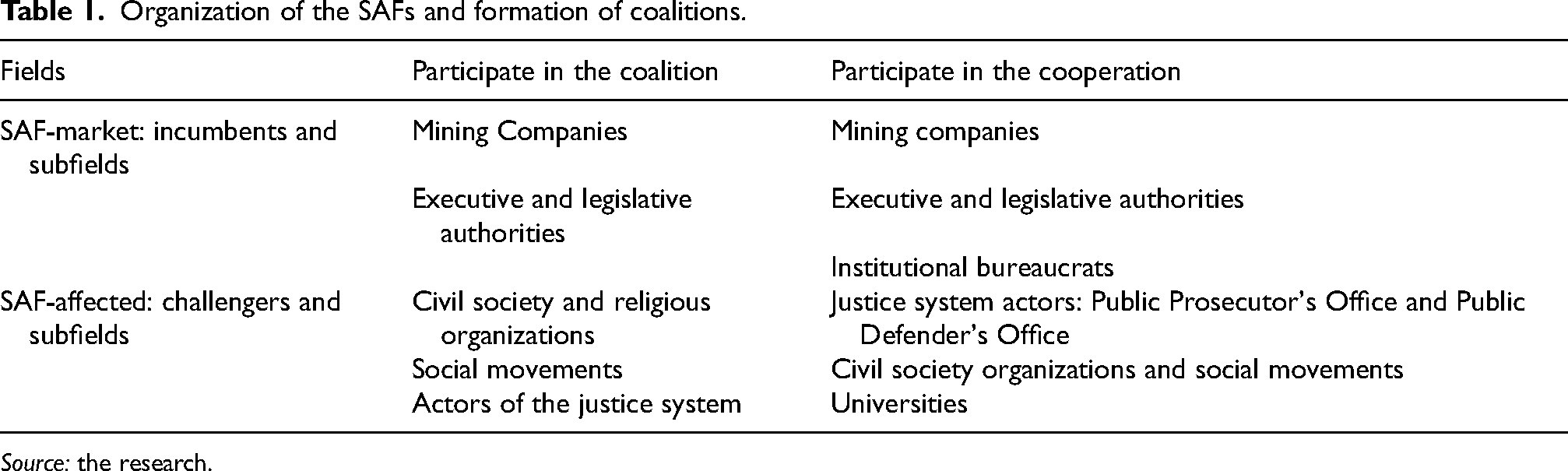
The conflict governance units were created to determine the rules of conflict resolution through the TACs. As they became the target of disputes between the SAF-market and the SAF-affected, the organizational systematization of the fields from the interactions among actors made it possible to identify the role of coalitions in defining a repertoire of strategies (see Table 1).
Organization of the SAFs and formation of coalitions.
Source: the research.
Coalitions define the hierarchy between the SAFs in a continuous process of disputes for resources and maintaining cohesion among actors, as the incumbent field is constantly testing the power limit of the other groups. Such competition is a continuous and noticeable process in the circuit of the constitution of TACs (Santos 2019): incumbents act to reproduce their dominant position, and during the conflict, challengers learn how to defend their positions.
Three episodes of the constitution of the TACs portray the contentious disputes among actors: (i) the first TTAC (Transaction and Conduct Adjustment Term), as a scenario of shock and rupture of the social order; (ii) the second TAP (Preliminary Adjustment Term) and TAP Addendum reflected changes of the affected field allowing to reach some political consequences; and (iii) the TAC Governance as stability and consolidation of the disaster governance system.
The TTAC as a scenario of shock and rupture of the social order and the emergence of the SAFs
The emergence and constitution of SAFs occurred after the signature of the Transaction and Conduct Adjustment Term (TTAC) in March 2016. Justified by providing procedural speed, the TTAC had the function of proposing compensation and mitigation measures for the damage caused to the affected population, assigning new obligations to the companies, as well as a plan for identification, registration, income maintenance, and support to the affected people, specifically for the territories of the Rio Doce channel.
The TTAC signed in 2016 was settled among government agencies, the union, Minas Gerais (MG) and Espírito Santo (ES) states, and the companies Samarco, Vale, and BHP Billiton. By such an instrument, 42 socioeconomic and socio-environmental programs were created for the recovery and compensation of damages to be conducted by the Renova Foundation, of a private nature, and by the Interfederative Committee (CIF) and Technical Chambers composed of state authorities for validation, monitoring and inspection (Zorzal, Cayres, and Souza 2019). It follows that the affected population was excluded from formulating this agreement, at the time, lacking the resources to influence the governance model. With this governance, “the nature of the relationships between the various actors became evident, as well as how the power relations between them are organized” (Zorzal, Cayres, and Souza 2019, 475) notably asymmetric between the SAF-market and SAF-affected actors.
The TTAC created a hybrid governance system composed of public and private actors, namely the Interfederative Committee and the Renova Foundation. This disaster management model produced a peculiar combination of corporate governance and public and social misgovernance; on the one hand, it generated severe limitations of public control and enforcement and, on the other hand, it produced disorganizing effects on the state capacities of municipalities and states and the capacities of action of social actors (Gurza Lavalle et al. 2022).
Various organizations and social movements criticized the TTAC and the Renova Foundation for their lack of legitimacy among those affected. Many of these concerns motivated the protests promoted by civil organizations and social movements. The Federal Prosecutor's Office (MPF) intervened by demanding emergency solutions from Samarco and the review of the decision on the disaster governance system for the inclusion of those affected in the TTAC negotiation spheres, having filed a public civil law case in May 2016 against Samarco, Vale and BHP Billiton, State of MG and Federal Union. The first alliances between the actors in the affected field were established around this dispute, and coalitions were formed.
The mining companies that constituted the SAF-market have historically been recognized as possessing political and economic resources that make them capable of bargaining interests and ownership in confrontations with the political authorities of the states and the union. Companies in the mining sector have historically been among the major donors of electoral campaigns (Guimarães, Milanez, and Ribeiro 2019).
The cooperation among SAF-market actors allowed the mobilization of resources that led to their appropriation and control of the governance system to shield themselves from threats to their interests. Cooperation with government authorities and bureaucrats reinforced its historic coalition with the State (Table 1).
The SAF-affected was structured based on coercion from the incumbents, i.e. the skillful actors of the field of the companies. It is a field that emerged from the disaster and is in transformation, being constructed based on cooperation among social movements, affected populations, and CSO, whose coalition was forged with the resources and skills of actors from the justice system, the Movement of People Affected by Dams (MAB) and religious organizations of the Catholic Church. The absence of rules characterizes the emergence of SAFs, as their purposes were still in dispute (Fligstein and McAdam 2011). As for the SAF-affected, at this stage of shock and rupture of the social order, there still needed to be alignment between the actions of those affected and an engagement capable of defining joint projects and coordinating collective action. However, an essential role in mobilizing those affected was already played by social movements such as MAB and FCDRD (Capixaba Forum for the Defense of Rio Doce) (Carlos 2019; Losekann 2017).
The emergence of SAF-affected was motivated by the shock and coercion of skilled actors of the field of the companies and State with the establishment of the TTAC, which preserved as much as possible the position of power of the incumbents, to the detriment of the evident need for total compensation of the disaster. In this scenario of imbalance in power and resource relations between the disputed fields, the activities of the Renova Foundation and the Interfederative Committee were initiated.
In addition to the mobilizations promoted by social movements and civil organizations, the creation of the Grupo Interdefensorial do Rio Doce (GIRD) among Public Defender's Office (DP) in the states of ES and MG was imperative in articulating dispersed alliances between communities, CSO, entities religious and social movements. This promoted sharing beliefs around everyday purposes in SAF-affected (Table 1).
The GIRD defined action vectors and judicial strategies to support the reports collected in the communities, request accountability from the government, disseminate education on rights in the communities aiming at recognition as affected, encouraging “social mobilization as an instrument for claiming rights,” and incentivizing the participation in mobilization spaces created by the communities and publicizing the discussions (GIRD 2017, 7–8).
The threat and containment of SAF-market boosted the emergence of SAF-affected. In response, skilled actors in the justice system fostered coalition and social mobilization among those affected through a repertoire of strategies (Rossi 2015). (…) the need to provoke the public authorities to supervise the institution it created. From the social point of view, favoring social mobilization and the protagonism of the affected communities allowed the awareness of the condition of the individual as affected and holder of specific rights, as well as the collectivization of the issue (GIRD 2017, 9).
The state field is a dense collection of subfields and even though there are hierarchical relationships between them, the actors of the justice system have established cooperation among themselves, such as the Public Defender's Office (DP) and Prosecutor's Office (MP) (GIRD 2017). Linked with MAB, FCDRD, religious entities, and civil associations, the DP of ES was a vital driving force behind the coalition in this emergency stage of the SAF-affected. Although competition is a common feature between the fields, during the functioning of the disaster governance system, the affected field was transformed, reinforcing coalitions, cooperation, and using repertoires to defend their rights and add power resources.
The TAP and the transformations in the SAF-affected
In January 2017, the MPF and the mining companies Samarco, Vale, and BHP Billiton signed the Term of Preliminary Adjustment (TAP) which defined the conditions for expertise and technical advice to carry out socio-environmental and socioeconomic diagnoses in order to mark the 42 repair programs of the TTAC.
Independent technical diagnoses should be presented to the MPF for evaluation and public disclosure. Other relevant measures were: reviewing the mapping of indigenous peoples and quilombolas in the Rio Doce basin, reviewing the registry of the affected population and the methodology used, considering community consultation and participation in the matter; collaboration with local public agencies, support for public hearings, and assistance in repairing the rights of affected communities. The changes show the ability of the SAF-affected to influence the repair process via coalitions and cooperation.
A strategy was initiated, flanked by actors from the justice system subfield, mainly the Public Prosecutor's Office and the Public Defender's Office, to interpret all the potential impacts of the disaster and consider the alternative options for acting in response to the predecessor TTAC. Between November 2015 and January 2017, the Federal and State Prosecutors and State and Federal Public Defenders triggered joint investigations, held public hearings in the affected municipalities and legislative bodies, and installed actions to maintain essential public services for the population.
It is worth highlighting the relative success of SAF-affected strategies in the Rio Doce basin, especially recognizing the Espírito Santo coastline as an affected area. The state Public Defenders’ Office consolidated cooperation with the Union's Public Defender's Office and jointly issued a technical recommendation note to Renova and the CIF to recognize the coast and immediately implement recovery programs in the corresponding area. In February 2017, ICMBio (Chico Mendes Institute for Biodiversity Conservation) presented another technical note driven by the role of public defenders. In March of the same year, the CIF accepted the technical note and imposed Deliberation N. 58 on the Renova Foundation (GIRD 2017). It is noteworthy that the action of the public defenders was accompanied by public protests led by MAB, FCDRD (Forum Foz Norte and Foz Sul), and the fishermen's association demanding recognition of the coast. In this aspect, “the sit-in tactic was used by MAB activists at a CIF meeting in Belo Horizonte to pressure government authorities to recognize the coast of Espírito Santo as affected by the disaster” (Carlos 2019, 22).
The changes in the TTAC were political consequences of the repertoire of strategies and internal coalitions of the SAF-affected, between the MAB, the Capixaba Forum for the Defense of Rio Doce, religious entities and civil organizations in the territories, as well as the coalition with the subfield of the justice system, supported by cooperation between the Public Prosecutor's Office and the Public Defender's Office. In this scenario, a more comprehensive network of potential alliances with nearby subfields, such as human rights and environmental organizations that got involved with the SAF-affected, is noticeable.
Even with the determination of independent technical expertise to advise the MPF, the people affected continue to be excluded from any participatory process in the governance system. Nevertheless, social movements continued to articulate around the violation of the rights of those affected, denouncing individual negotiations between those affected and the Renova Foundation and the entity's attempt to demobilize collective efforts and the empowerment of those affected (MAB 2017).
In November 2017, an Addendum to TAP was signed by the MPF, the Public Ministry of MG, and the mining companies to make the socioeconomic and socio-environmental axes more precise and include the proposed participation of those affected. The TAP Addendum indicated the replacement of the company that operated in the analysis and assessment of the socioeconomic axis and the possibility of technical assistance for the affected population.
The guiding principle of the changes was centered on the people affected to guarantee access to Justice and participation in the compensation processes and the rights they hold (Roland et al. 2018, 13). Transparency, accessible language, and adequate access to information became a requirement in adapting to the communities’ reality. The new conditions of compensation based on the communities’ territorialized relations and the right to association were made explicit with the TAP Addendum, encouraging collective negotiations by hiring advisory services from entities by free choice.
The people affected began to recognize the threat signals collectively and built the cognitive meanings associated with the disaster, especially the “identity of those affected.” This perception was collectively constructed with the support of social movements and religious entities of the Catholic Church, “such as the MAB and the FCDRD, acted as incubators for the content movement influencing their organizational and identarian formation” (Carlos 2020, 686). In addition, cooperation with MP and DP actors contributed to solidifying everyday actions along the lines of a repertoire of strategies.
The Brazil Human Rights Fund and the Getúlio Vargas Foundation took over the organization of technical assistance to the affected population, public hearings, and consultations, in addition to the assessment of socioeconomic data related to the way of life of those affected. The Observers Forum was also created, whose consultative role should promote participation and social control in the evaluations carried out by the contracted entities. The forum was composed of representatives from civil society, those affected, universities, and traditional communities under the responsibility of the MPF.
During the implementation of the disaster governance system, the SAF-affected was mobilized by internal alliances, motivated by the threat to the affected's collective interests. Then, there was a dynamic of transformation in the field driven by skilled actors willing to guarantee cooperation among the different groups, especially those in the justice system.
TAC governance: consolidation of the disaster governance system and stability in the fields
Despite the changes in the terms of conduct adjustment, the resolution on filing public civil actions by the MPF needed to be revised. The governance system created with the TTAC neither included any instance of participation by the people affected nor even provided for public hearings. The participation of those affected was limited to the Advisory Council of the Renova Foundation. Furthermore, the TTAC had yet to be ratified by MPF.
A draft participatory assessment to embody TAC Governance was jointly constructed by the task force of the MPF and of the DP of MG, ES, and Union. 5 The changes proposed by the justice system included the participation of the people affected in all stages of the compensation process, interfering in the activities of the Renova Foundation. They were included in TAC Governance through the following participatory arrangement: (i) participation in three CIF seats; (ii) participation in three chairs of the Technical Chamber that assists the committee; (iii) two seats on the Trustee Council of the Renova Foundation; (iv) participation of seven affected persons in the local commissions and regional chambers to be implemented; (v) participation in technical assistance; and (vi) participation in the Observers Forum. The participation arrangement included the collaboration of those affected in improving the programs being carried out by Renova. In addition, it provided attention to traditional indigenous and quilombola communities, the renegotiation of programs, and the integral compensation of damages.
The changes to the TAC Governance defined new positions of power in the disaster governance system and ensured the participation of the people affected in the reparation process. The transformations in the arena of negotiated conflict resolution showed that the field of those affected experienced specific stability and that coalition strategies, in previous episodes, have spread. The cooperation between skilled actors in the justice system and coalitions in civil society resulted in the reformulation of conflict resolution instruments as a political consequence.
New power features have been added to the disaster governance system, allowing those affected to reach higher decision-making power. TAC Governance consolidated the governance system, comprising Renova Foundation with an Advisory Council and a Trustee Council; Interfederative Committee with Executive Council and Technical Chambers; Observers Forum; Technical assistance; and local commissions and regional chambers.
The dynamics among actors evidenced the capacities of the SAF-affected, insofar as skilled actors such as political entrepreneurs used technical resources, knowledge, and beliefs to support learning guided by political strategies of action among those affected. In the coalition, the SAF-affected actors learned through the interaction between their belief system and the contact with the technical elements, as “(…) skilled actors negotiate and interact in the circuits of Terms and their margins” (Santos 2019, 156).
In turn, the relative success of the transformations driven by the SAF-affected is due to the actors’ ability to configure political coalitions. The alliances were formalized through committees, forums, working groups, and inter-institutional groups, which the actors took as a common framework and repertoire of strategies. In other words, it was a coalition between actors who shared beliefs and coordinated actions over time. The affected field experienced a dynamic of incremental changes, passing through multiple levels of alliances and coalitions, becoming a more organized opposition with more power resources.
Repertoires through coalitions in the fields
In this section, we discuss the repertoires of strategies used by SAF-affected actors four years after the socio-environmental disaster, from 2015 to 2019. Strategies and tactics of political contestation used to influence the authorities’ decisions were identified. The repertoires include various forms of institutional and extra-institutional action and indicate an evolution of action strategies related to different repertoires used at specific moments.
Repertoires of strategies in SAF-affected
The mobilized actors
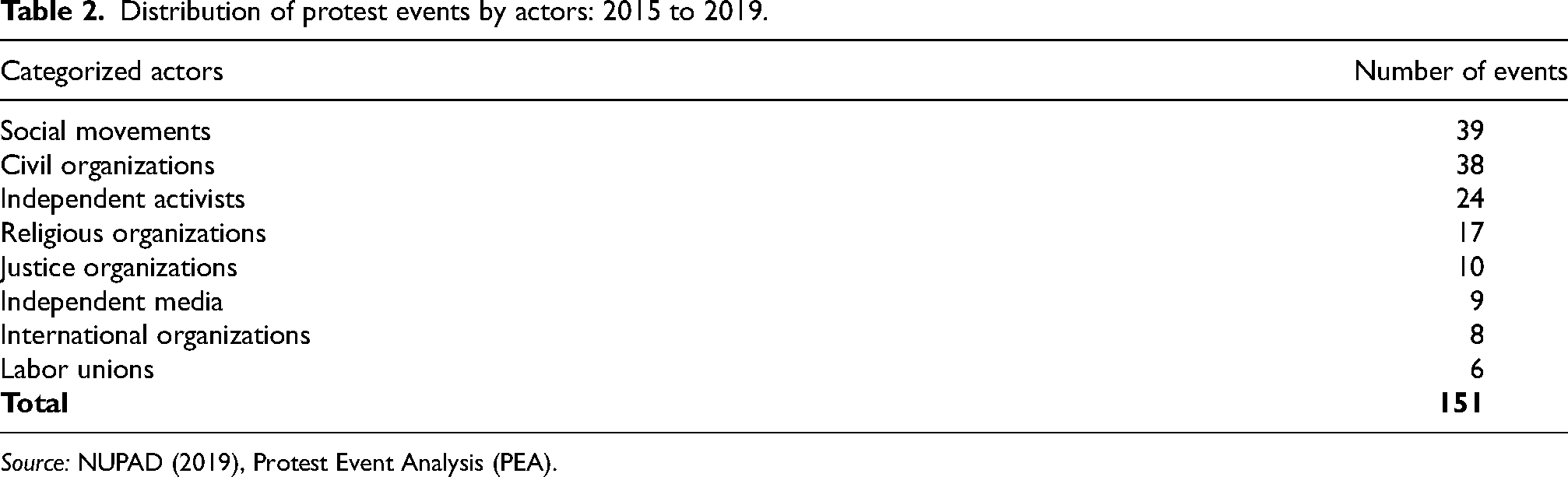
Based on the protest event analysis (PEA), the investigation considers protests as forms of contention, including extra-institutional and institutional action. Over the course of 2015 to 2019, the protest events were promoted by various civil society actors, such as social movements, civil organizations, religious organizations, and labor unions. However, institutional allies include justice organizations, international organizations, and independent media. Events promoted by independent activists such as artists, athletes, residents, and professionals were also present. Table 2 shows the distribution of protest events by mobilized actors.
Distribution of protest events by actors: 2015 to 2019.
Source: NUPAD (2019), Protest Event Analysis (PEA).
From the total of 151 events classified in the PEA, the social movements category promoted the most significant number of them, with 39 protest events in the period, most of them carried out by the MAB, with 26 events, followed by the FCDRD, which was linked to the Human Rights Movement with 12 events, being a protest by the Landless Rural Workers Movement (MST). The civil organizations category, which followed closely with 38 protest events, includes neighborhood associations, fishermen, culture, surfers, and the Frente Capixaba de Lutas. Among these, fishermen's associations were predominant with 18 events, followed by neighborhood associations (nine events). Religious organizations promoted 17 protests, mainly from the Catholic Church (14 events), such as the Diocese of Colatina, Cáritas, and the Pastoral Fisheries Commission (CPP), in addition to the Evangelical Church with three cases. In justice organizations, the MPF and the DP of Espírito Santo stand out, with ten events, while the international organizations, with eight protests, concerning the United Nations (UN), International Union for Conservation of Nature (UICN), student and lawyer groups abroad. In the independent media, the protest events were promoted by publications Carta Capital, Causa Operária, and Século Diário, totaling 9 cases. Finally, protests promoted by independent activists such as affected residents, artists, athletes, and self-employed professionals concentrated on 24 events. Regarding organizational formalization, most actors are formalized (78% of cases), and the remainder are not (Table 2).
The targets of protests are decision-makers in 95% of cases. PEA identified the three companies responsible for the collapse of the mining tailings dam: Samarco in 132 events, Vale in 111 events, and BHP Billiton in 97 of them. The Renova Foundation, created to carry out reparation and compensation programs, was identified as the target of protests in 38 events. The State is also an opponent: the Executive is cited in 43 events, the Judiciary in 31, and the Legislative in seven events. Nevertheless, Renova's centrality in the governance model made it the main target of the protests.
Protest events, repertoires, and tactics
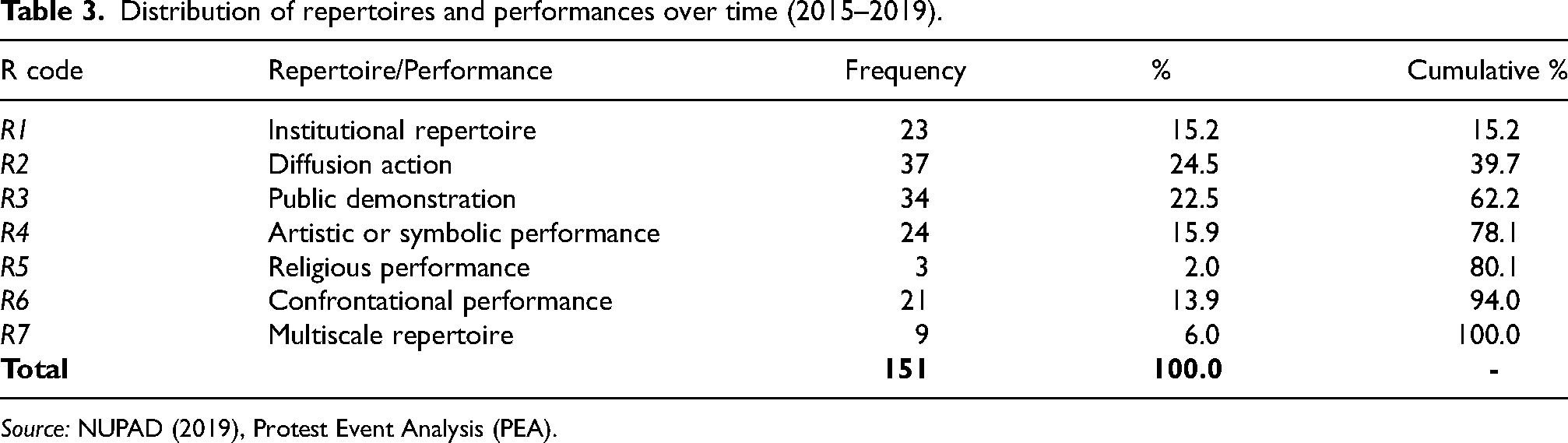
The classification of protest events into repertoires of contention, which aggregated a set of strategic and tactical actions, led to seven types of repertoires and performances: (R1) institutional repertoire, (R2) diffusion action, (R3) public demonstration, (R4) artistic or symbolic performance, (R5) religious performance, (R6) confrontational performance, and (R7) multiscale repertoire (Table 2).
According to the frequency of events triggered over time, the diffusion of action stands out with 37 events (24.5% of the total of 151 protests), namely proselytism (propaganda and motivational acts) and regimentation (creation of a new organization) (Table 3). This was followed by the public demonstration, with 34 events (22.5%), as in March, demonstration, concentration, and meeting. Then, it was artistic or symbolic performance, with 24 events (15.9%), as follows: visual performance, artistic performance, non-artistic body performance, and sound performance. The institutional repertoire closely followed the latter, with 23 events (15.2%), e.g., judicial performance, lobbying, participatory institution, and negotiation table. With 21 events (13.9%), the confrontation performance was recorded, consisting of public acts, blocking, occupation, and depredation. The multiscale repertoire included nine events (6% of the total), consisting of interstellar or cross-border performances. Finally, the religious performance held three events (2%), formed by performances explicitly oriented by religious practices or symbols.
Distribution of repertoires and performances over time (2015–2019).
Source: NUPAD (2019), Protest Event Analysis (PEA).
The actors mostly used the diffusion action, followed by public demonstration; the most minor used were religious performance and multiscale performance. Artistic or symbolic performances, institutional repertoire, and confrontational performances have similar uses.
The distribution of the repertoires of strategies according to their institutionality shows that 79% of the events (119) are extra-institutional, 15% (23 events) are institutional, and 6% (9 events) are multiscale. 6 The SAF-affected actors’ combination of extra-institutional, institutional, and multiscale repertoires is an essential finding of this research (Carlos 2022). 7
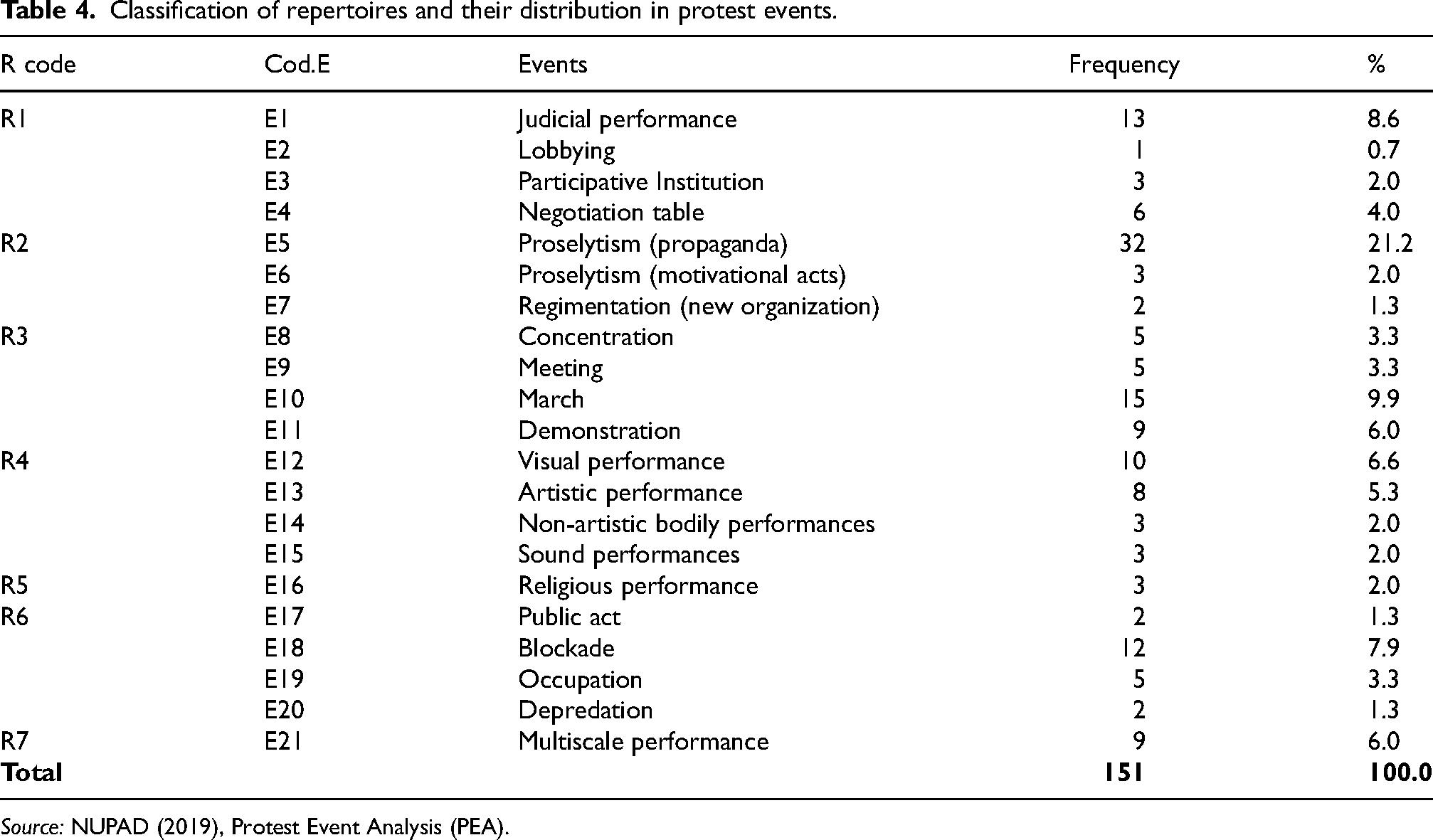
In addition, Table 4 shows the composition of the seven repertoires according to 21 protest events, indicating the quantitative distribution in each period. Of the 151 events cataloged by the PEA, 32 are proselytism (propaganda), which is the most used by actors, as well as March (15), judicial performance (13), blockade (12), and visual performance (10). In contrast, lobbying, regimentation, public acts, and depredation are the least frequent events.
Classification of repertoires and their distribution in protest events.
Source: NUPAD (2019), Protest Event Analysis (PEA).
Analyzing the distribution of protest events by type of actors makes it possible to inquire about the frequency with which each actor used a tactic. For example, proselytism (E5) is the most used tactic by independent media, but also by MAB, FCDRD, and religious organizations, while March (E10) is more mobilized by MAB, in addition to civil and religious organizations; judicial performance (E1) is used by justice organizations, but also by civil, international and activist organizations. 8 ; and blockade (E18) and demonstration (E11) are used mainly by civil organizations, MAB, and unions; visual performance (E12) is mainly used by artists and self-employed professionals, as well as artistic performance (E13). Civil organizations also use the latter, and multiscale performance (E21) is used mainly by international organizations and FCDRD.
From the point of view of the diversity of tactics and strategies used, civil organizations and the MAB are those with greater plurality in the types of events, connecting extra-institutional and institutional actions. With a predominance of extra-institutional tactics in its repertoire, the MAB also uses lobbying and negotiation tables.
Cycle of contention and changes over time
The analysis of the evolution of protests over time demonstrated the continuous development of events, with some peaks of mobilization, characterizing a “cycle of contention” (Tarrow 1998; Della Porta 2013). 9 From 2015 to 2019, the highest peak occurred on the disaster's third anniversary in November 2018, accounting for 24 events. This peak even surpasses the mobilization of the dam failure, which summed up 15 and 17 events in November and December 2015, respectively (Figure 1). It is essential to highlight that there were protests every month in the period, with at least one event. In the first year, in addition to the anniversary, the TTAC signing month also concentrated on eight protest events in March 2016. In the second year, 2017, the anniversary month registered nine protests. We note that the third year of the disaster was marked by the signing of the TAC Governance by mining companies, federal and State governments, justice institutions, and environmental agencies, in July 2018. On that occasion, eight protests were registered.
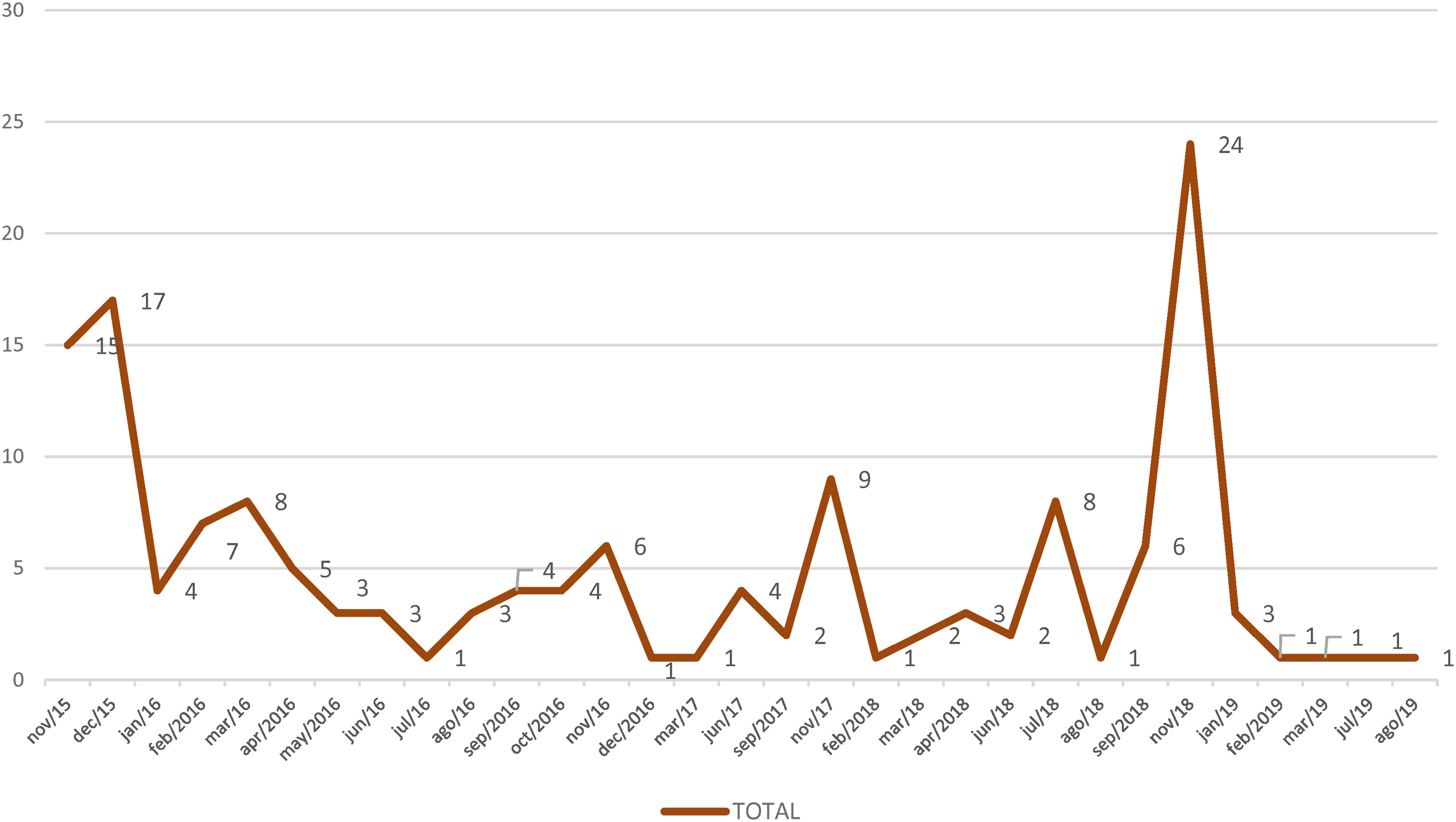
Cycle of contention over time: 2015 to 2019.
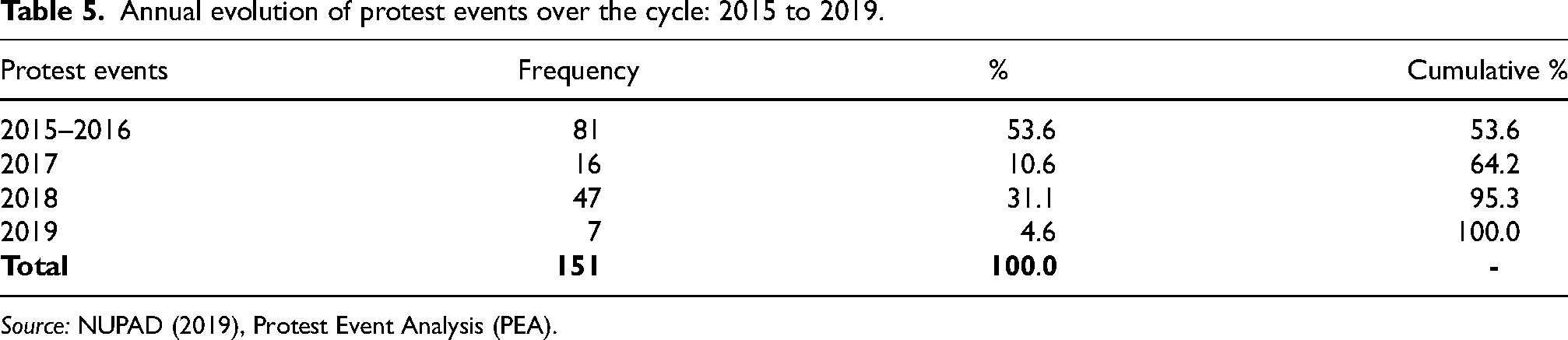
The annual evolution of protest events (Table 5) confirms the year of the dam breach (Nov. 2015 to 2016) as the most frequent, with 53% of the events in the period (81), followed by the third year of the disaster (2018) which totaled 47 protests, or 31% of the total. Comparatively, the second year of the disaster (2017) showed a low number of events held, concentrating only 10% of the cycle, lower still in the fourth year (2019), with nine events. 10 Considering the cumulative percentage, 95% of the events of the protest wave occurred until 2018. In the following year, protests cooled down.
Annual evolution of protest events over the cycle: 2015 to 2019.
Source: NUPAD (2019), Protest Event Analysis (PEA).
In the protest wave, repertoires and performances by actors occurred inconstantly; some were used systematically over time, and others with discontinuous use. As Figure 2 shows, the diffusion action was progressively triggered, distributing itself from the first year of the disaster (2016), with continuity in the second (2017) and intensification throughout the third (2018). Public demonstrations also accompanied the intensification of events at the peaks of mobilization in the anniversaries, especially with marches. Also, confrontational performances were used with less intensity throughout the period, generally to pressure authorities and open negotiation through blockades. The institutional repertoire occurred sparsely in moments of opportunities for political negotiation, such as the episode of the dam breach (2015–2016) and the approval of the TAC Governance (2018). Artistic or symbolic performances were more numerous in the first year of the disaster, especially at the dam breach and arrival of the tailings mud in Regência/ES, with concentration also on the disaster's third anniversary, as was religious performance. Finally, the multiscale repertoire was more intense during the dam failure and on the disaster's third anniversary (Figure 2).
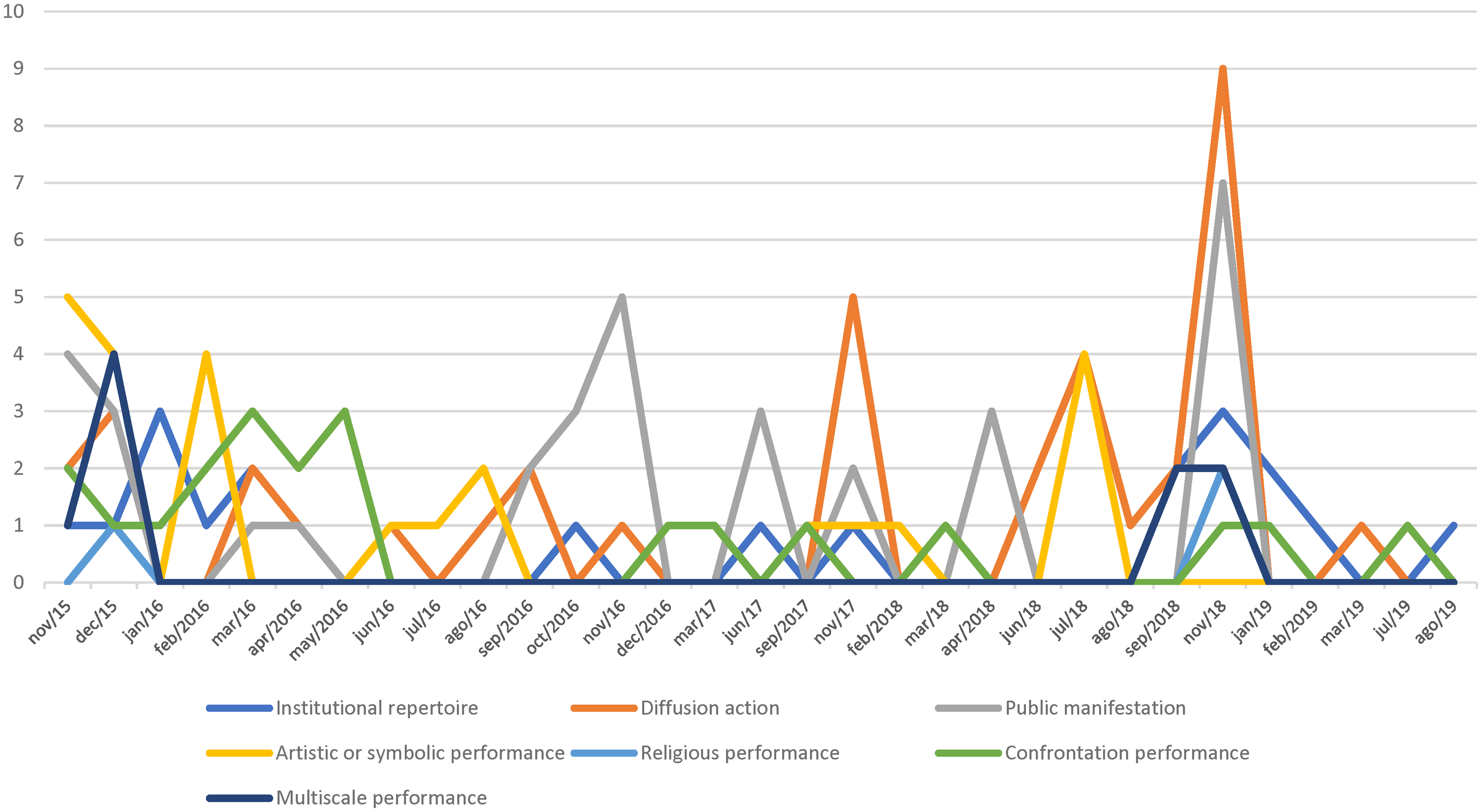
Repertoires and performances over the cycle of contention: 2015 to 2019.
In the month of the anniversary of the disaster, they have concentrated not only the most significant number of events but also the most incredible diversity of repertoires. In this period of the cycle of contention, the combination of multiple repertoires intensified, amplifying the pressure on the authorities and companies to defend the rights of those affected. Diffusion actions, public demonstrations, artistic or symbolic performances, and institutional repertoires consisted of a recurrent combination in the anniversaries of the cycle. In addition to these, the confrontation and multiscale performances, on the third anniversary, promoted an amplification of the diversification of repertoires only analogous to the shock episode of the Fundão dam collapse (Figure 2).
The meanings attributed to repertoire and tactics expressed the demands of the mobilized actors and may change over time. This meaning also reveals actors’ motivations in using repertoires, revealing what an action carries at the cognitive and symbolic levels (Benford and Snow 2000). It gives sense to the repertoire of contention undertaken by the actors, putting demands and claims on the agenda, indicating the intention of the actors to strategically use the various tactics to achieve the outcomes of collective action.
Analyzing the meanings attributed to the protest verbalized the actors’ demands and motivations. The most meaning was “to require compensation,” followed by “to denounce,” “to demand indemnity,” “to gain visibility,” and “to avoid oblivion.” Together, these meanings represent 53% of the motivations involved in the protests. Other categories of meaning are also important, referring to the consequences of the disaster for the environment and livelihoods: safe water, disaster impacts, loss of livelihood, violation of human rights, mud contamination, and health effects. Others are still concerned about the accountability and punishment of mining companies, the recognition of those affected, and the guarantee of rights. Finally, the frameworks referred to social struggles with a view to results in compensation policies, such as resistance to injustices, protest, internationalization, and obtaining technical assistance.
The analysis of the meanings of protests over time showed no significant variation in the motivations attributed to the events in the period. However, it points out some variations in the demands. According to Figure 3, the most mentioned meaning, “to require compensation,” appears distributed in the four years of the disaster, as well as “to denounce,” “to gain visibility,” “to avoid oblivion,” “disaster impacts,” and “to ensure rights.” The third most cited “to demand indemnity” appeared in the first year of the disaster and remains in the third and fourth years, as well as “to hold mining companies accountable.” Therefore, the categories of protest motivation as a form of struggle (resistance; protest) also remained throughout the period, although “internationalization” only appeared in the first and fourth years.
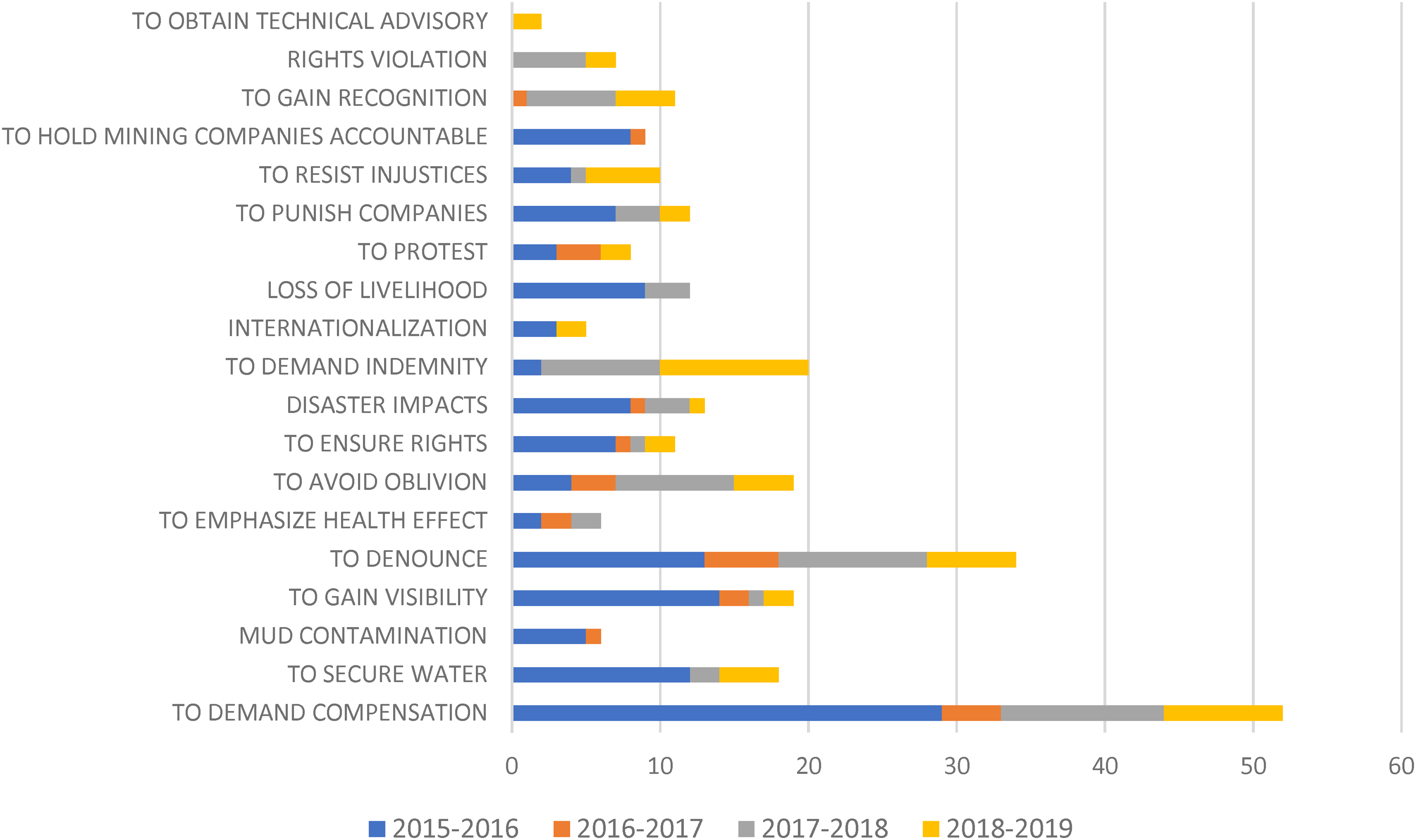
Meanings in protest events over time: 2015 to 2019.
On the other hand, the demand for recognition of new territories and affected populations emerged in protests only in 2016 after signing the TTAC agreement restricting the right to reparation to the municipalities along the Doce River and excluding the coastal region of Espírito Santo. While the claim for technical assistance arose in the protests from 2018, in the context of the signing of the TAC Governance (see Figure 3). The permanence of most meanings over the protest wave may indicate the non-resolution of the socioeconomic and socio-environmental problems resulting from the disaster by mining companies through the Renova Foundation.
Discussion: coalitions, repertoires, and political consequences
In this section, we inquire at which moments of the political process the actors in the affected field formed coalitions and undertook strategy repertoires, seeking to infer the role of alliance and the choice of tactics in the consequences of political decisions. The perspective of SAFs made it possible to identify ways of combining coalitions and the SAF-affected people's repertoires throughout their emergence, transformation, and consolidation.
This article analyzed the constitution of the SAF-affected, its coalitions, and repertoires to influence disaster governance and obtain results (outcomes) in the compensation policies. Therefore, the objective of the SAF-affected political strategy was to produce results in the decisions of the authorities, allowing inferences about the political consequences of the repertoires of contention.
A political strategy can combine different instruments mobilized by players to engage in construction around the objectives. This means that, given the temporality of the constitution of the SAF-affected, from the shock, the transformations, and the stability of the field, the coalitions and the skilled actors combined different repertoires and tactics to obtain advantages. As was seen, the political strategy involved the combination of institutional and extra-institutional repertoires over the protest wave. We observe that the “agency” of strategic actions is given in constructing coalitions, alliances, and cooperation relationships. Therefore, coalitions change over time, considering the conflict relations inherent in the field, whose agency is relationally constructed.
Changes in the SAF-affected were accompanied by transformations in the coalitions, as shown. From the point of view of political consequences, the analysis shows that SAF-affected has formulated a broad political strategy. As the confrontation progressed, the dispute for power resources around the TACs expanded, and the repertoire of actions was changed to a repertoire of strategies. The choice for a specific strategy was based on the trajectory of social movements and the stock of legacies (Rossi 2015), in addition to opportunities and constraints to encourage and discourage collective action (Tarrow 1998).
Examining the coalitions established in the SAF-affected allowed identifying the stock of legacy triggered by the actors when undertaking particular action repertoires. The various segments of civil society stand out in these coalitions, such as fishermen's associations, social movements, environmental organizations, and local entities. Coalitions circumscribe a set of experiences, repertoires, and performances of past and learned struggles, interactively connecting coalitions to the choice of action repertoires.
In this process, actors make use of repertoires of strategies, tactics, and performances based on the stock of legacies produced from the accumulation of experiences of past struggles and through the sedimentation of the lived (Rossi 2015), at the same time combined with the new resources of the skilled actors in the field, particularly in the justice system. Coalitions changed positions, and challengers were repositioned in the field to produce consequences in governance and reparation policies. Since the combination of coalitions (Hess 2019) and a repertoire of strategies (Rossi 2015) can achieve changes in policy decisions, the analysis of the negotiated resolution field over time shows how actors interact based on alliances, resources, skills, and repertoires.
The fishing population of the coastal region of Espírito Santo, for example, impacted for decades by large undertakings by national and international companies (Knox and Trigueiro 2011), has in fishing associations an essential segment of social mobilization, given the damage to their social, economic, and cultural dynamics. In addition to the historical organization of the fishing segment and its stock of experiences, the arrival of MAB in Espírito Santo stands out with its past of alliances and repertoires. MAB brought together other actors with an associative and activism trajectory, as well as participation in other organizations or local associations, exceptionally under a framework of coercion and repression by the companies that propelled the expansion and territorialization of the movement in the affected areas through organizational innovation processes (Carlos 2020, 685). In its diffusion to ES, the MAB reproduced its historical alliances, such as Via Campesina, the MPA, and the MST (Araújo 2021). In addition, it combined its repertoire of lived experiences, triggering a stock of legacies, selecting and re-adapting past strategies.
The historical roots of political strategies are associated with the stock of legacies of SAF-affected coalitions, which were linked through dynamic interactions with skilled actors in the justice system and religious entities as prominent supporters or organizers of mobilization activities after the dam failure.
The ability to articulate the SAF-affected strategies repertoires, perceive the political opportunities for action, and define their position in the political confrontation is mediated by the actors’ knowledge of the possibilities and the limits. The process of adjusting repertoires, tactics, and the composition of coalitions, whether through internal alliances or cooperation, also depends on the opportunities and threats cognitively perceived by the actors in the courses of action (Tarrow 1998; Della Porta 2013). Not by chance, institutional and extra-institutional repertoires were combined, triggering different protest events whose recurrent combinations focus on the anniversaries of the disaster.
The political strategy of the SAF-affected employed a repertoire of strategies associated with the predominant coalitions. Considering the reformulations in the TACs over time, Table 6 indicates the evolution of the repertoire of strategies according to the skillful actors, alliances, coalitions, cooperation, and chosen tactics.
Evolution of repertoires and coalitions through changes in SAF-affected.
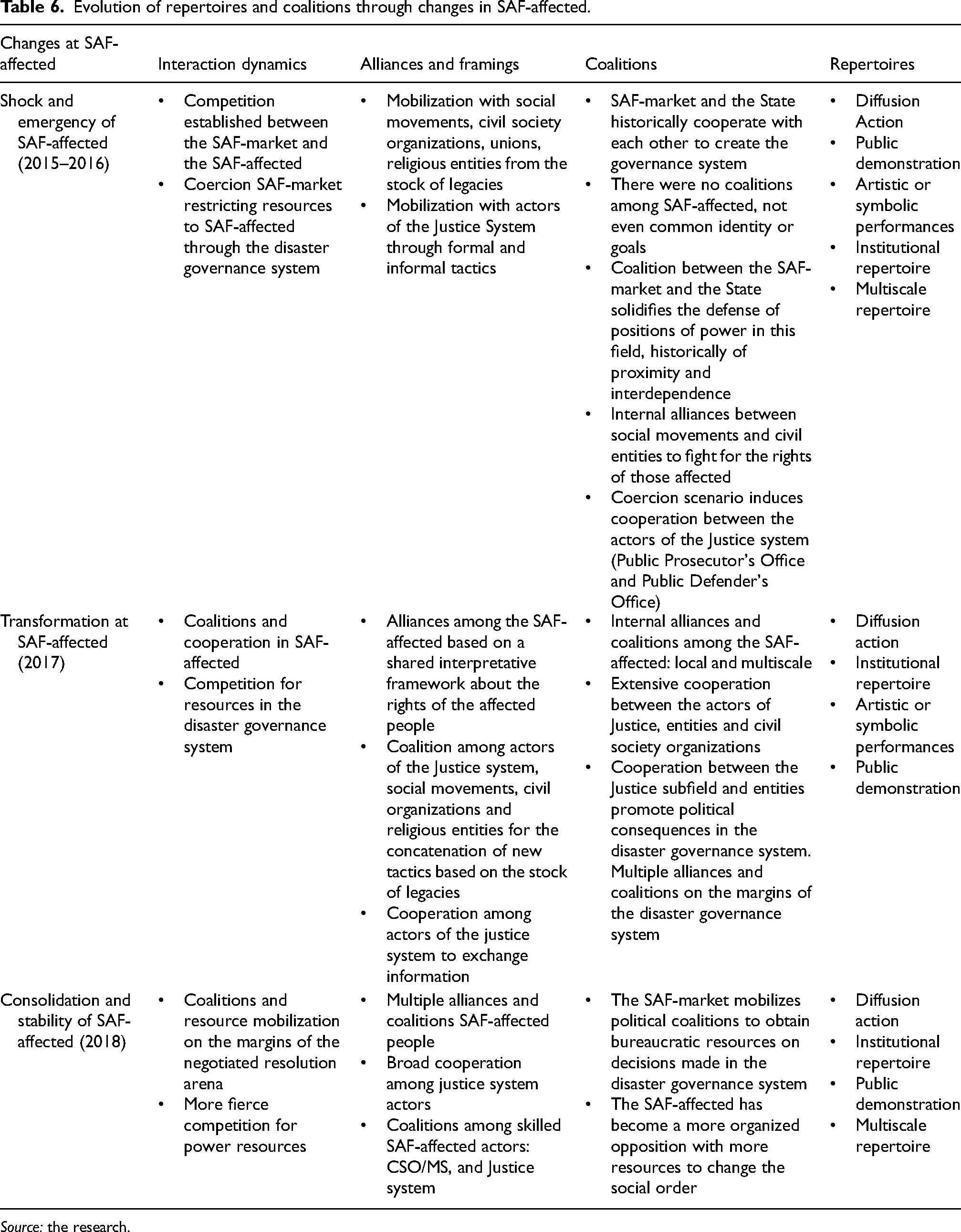
Source: the research.
The SAF-affected coalitions were forged by alliances and cooperation with skilled actors, highlighting religious organizations and actors in the justice system. Coalitions between social movements, environmentalists, and local entities used tactics of proselytism and regimentation with the support of religious organizations. Coalitions between social movements used marches as tactics and with the support of religious organizations. Diffusion actions were progressively used as part of the framework and cohesion of the SAF-affected.
While marches, demonstrations, concentration, and meetings were used as tactics by social movement coalitions, associations, and local entities, repertoires of public demonstrations and confrontations also accompanied the intensity peaks of protest events. Coalitions among social movements, environmental movements, and local entities used judicial performance tactics as part of an institutional repertoire used in the windows of political opportunity. Repertoires composed of religious and multiscale performances occurred less frequently by coalitions of religious entities, movements, and CSO. Artistic or symbolic performances were used to open up political opportunities, particularly at disaster anniversary events.
This combination of repertoires revealed that coalitions and alliances can function as categories of collaborative adversaries (Whittier 2018), given that the State as a political society is omnipresent in most fields and is in a position of authority over the social order. In particular, in a collaborative interaction, there may be ideological opposition, as in cooperation with religious entities and especially with the organs of the justice system, the tension between the actors becomes evident, as they possibly have greater access to circles and power elites than any counterpart of the coalition.
However, cooperation for public mobilization, as in the subfield of the justice system, shows extensive and frequent communication that generates continuous interaction, promotes competing interests and the exchange of information, a level of resources that involves deliberation processes, such as public hearings, workshops and consultations that lead to mutually beneficial results. Acting cooperatively provides resources and rewards for field members and helps structure and order the field. As the coalition favors implementing formal mechanisms, it facilitates and involves trust and norms of reciprocity that help maintain alliances and cooperation until results emerge (Ogrodnik 2020).
The changes in the organization of SAF-affected indicated that, after the shock of the disaster, the first alliances and coalitions were formed between civil and religious organizations and social movements, adding to the cooperation with the actors of the justice system. During the period of transformation of the SAF-affected, cooperation between actors in the justice system and coalitions of civil organizations and social movements made it possible to obtain formal resources, such as the Observers Forum, the hiring of technical assistance to the affected populations, the support to public hearings with communities and prior consultations. The relative stability of the SAF-affected is marked by the political coalition between actors of the justice system and CSO, whose creation of participation arrangements of those affected in TAC Governance, such as local commissions and regional forums, evidenced the increase in the degree of internal trust, the leveling of tensions, the increase of mutual commitment and cooperative behavior (Ostrom et al. 2007 apud Ogrodnik 2020). However, the stability of a field only extends to the consensus among actors (Fligstein and McAdam 2011).
The interaction between the coalitions and the SAF-affected repertoires drove changes in disaster governance. The main one occurred with the approval of the TAC Governance in 2018, a moment of consolidation and stability of the coalitions in the field of those affected and the peak of the protest cycle. Signed by mining companies, federal and State governments, justice institutions, and environmental agencies, the new agreement was considered an achievement by social movements, organizations of the affected, justice agencies, and supporters for incorporating significant social demands. In particular, the TAC Governance provided for the changing the definition and execution of the various actions, programs, and projects for repairing damage; creation of spaces for the participation of those affected and the hiring of technical assistance; and renegotiation of programs already underway under the responsibility of the Renova Foundation.
The results are linked to the combined use of extra-institutional, institutional, and multiscale repertoires over time, such as diffusion action, public demonstration, institutional repertoire, and multiscale performance. The year of the new agreement approval that includes these demands on disaster governance was 2018, even though many still need to be implemented. In this study, political coalitions and repertoires of contention correlated in explaining the political consequences of the SAF-affected the authorities’ decisions, with a view to compensation rights.
Conclusion
This article sought to investigate the political consequences of the SAF-affected on the decisions of authorities and companies in the context of the Rio Doce disaster, inquiring about the role of coalitions and repertoires of contention. The complementarity between the SAF and contentious politics approaches offered an analytical advantage to the study, as in addition to revealing the complex network of structuring coalitions and cooperation in the field of those affected, it favored the dynamic and interactive apprehension of the repertoires, their strategies, meanings, and historical legacy. Thus, the articulation built among the approaches made it possible to encompass the connection between coalitions and repertoires embodied in a field of actors and strategies that go beyond social movement organizations or a specific actor.
The inclusion of the affected field in the research design allowed the identification of coalitions in specific moments and the involvement of rules, objectives, identities, and complex arrangements of alliances and cooperation. Transcending the focus on social movements, the study identified coalitions between these civil society actors and institutional actors of Justice, such as public ministries and public defenders, in addition to alliances with civil organizations and religious entities. This research allowed us to apprehend the processes of extraordinary alliances with social movements and organizations, as in the case of cooperation with actors in the justice system.
As shown in the PEA in digital media news, the use of multiple repertoires by SAF-affected characterized a wave of protests over the four years of the disaster (2015 to 2019). The mobilized actors performed in a combined way, articulating extra-institutional, institutional, and multiscale repertoires in an interactive and contingent process. The repertoires were classified as diffusion action, public demonstration, artistic or symbolic performance, religious performance, confrontation performance, institutional repertoire, and multiscale repertoire, and composed of several tactics, strategic actions, and performances. Promoted by social movements, civil organizations, religious organizations, and labor unions, as well as justice system organizations, international bodies, and independent activists, the protest events took place continuously over time and focused on the anniversaries of the disaster.
The correlation between the repertoires of contention and the consequences in the decisions of authorities and companies extends to the role of political coalitions. Thus, coalitions and repertoires dynamically interact in producing political consequences on disaster governance. The relational focus of these dimensions allowed them to be conceived as mutually constitutive in the production of political results on decisions. The convergence of the most significant impact between the two interrelated factors occurred in 2018: on the one hand, there was the stability of the SAF-affected and the durability of the political coalition and, on the other, the peak of the protest cycle. These interconnected factors converged to the political consequences of the SAF-affected disaster governance through the approval of the TAC Governance, which incorporated essential claims from the affected people.
The analysis revealed that forming alliances and coalitions was an essential addition to the strategies repertoire, as in the case of diffusion action and the institutional repertoire, as a necessary tactical to achieve the objectives. Even if ideologically opposed, the coalition established a collaborative relationship among actors. It contextualized the structure of alliances as a distinct phenomenon capable of establishing preferential strategies and achieving political consequences as social organizations and movements gained access to the arenas from which they are typically excluded. Coalitions and cooperation allowed for strategic advantages, such as informational, organizational, and network tactical resources, which increased the affected field's organizational capacity, stability, and political results. By collaborating with justice actors, those affected acquired resources to act outside the governance system, and by collaborating with social movements and different organizations, they could leverage their campaigns over the protest cycle and obtain political outcomes.
The analysis showed that as a new framework for collective action was forged, identities and practices emerged with the affected field, and coalitions shared interpretations and solutions about the problem. As a field, existing divisions were supplanted momentarily by the need to obtain power resources and achieve political consequences on the authorities’ decisions.
This study focused on the role of coalitions and repertoires of strategies to gain support and achieve a specific political objective, namely, the change in the TAC regulations. It is beyond its scope to infer the influence of the affected field in the implementation of repair and compensation programs under the responsibility of companies through the Renova Foundation. Such policy implementation stage may require another type of coalition and other repertoires, such as an amplified coalition to recruit partners in executive bodies and the Renova Foundation. After all, as Hess (2019) pointed out, the reach of influence in the implementation may require partners in the opposing companies. Finally, the combination of coalitions and repertoires in producing political consequences, given its effectiveness in the Rio Doce disaster, requires systematic comparison with other case studies and contexts.
Footnotes
Declaration of Conflicting Interests
The authors declared no potential conflicts of interest with respect to the research, authorship, and/or publication of this article.
Funding
The authors disclosed receipt of the following financial support for the research, authorship, and/or publication of this article: This work was supported by the Conselho Nacional de Desenvolvimento Científico e Tecnológico, Coordenação de Aperfeiçoamento de Pessoal de Nível Superior, Fundação de Amparo à Pesquisa e Inovação do Espírito Santo.
