



Abstract
This article uses the Trudeau Government’s decision not to nominate General Jonathan Vance to the position of Chair of the Military Committee (CMC) as a basis to examine the extent to which states should fear alliance contributions. The authors examine if the decision could have been based on fears of expected yet “tacit” pressures to accept greater responsibilities and costs within the overall alliance framework. By analyzing “traditional” NATO alliance contribution data from 2002–2020 through six previous CMCs, this research examines whether incumbency in the CMC position is linked to an increase in material contributions to the alliance. The results of the analyses show that there is no direct relation between an alliance member holding the CMC position and increased alliance contributions. Nonetheless, this study contributes to the field of collective defence through an acknowledgement that states may not fear unstated alliance commitments and obligations as much as theoretically understood.
On 23 July 2020, General Jonathan Vance, Canada’s Chief of the Defence Staff (CDS), unexpectedly submitted his resignation to the Minister of National Defence and the Prime Minster of Canada. Among the Canadian and NATO defence community, there was a great deal of public speculation that Vance’s resignation was in response to the prime minister’s decision not to submit Vance’s name for consideration as NATO’s next Chair of the Military Committee (CMC). 1 Vance, the longest serving CDS in Canadian history, who had been characterized as “Canada’s most well-known warrior in more than half a century,” 2 did not want to continue serving the government if he was to be denied this opportunity. While there remains some ambiguity as to who was aware of the situation, 3 prior to the allegations of abuses of power which significantly tarnished his reputation, Vance was considered a “strong favourite for the key job in Brussels.” 4 Yet, for unknown reasons, Prime Minister Justin Trudeau declined to nominate his own CDS. This sparked a discussion, and subsequently an important research question, as to why a NATO member in good standing (after past service in Bosnia, Afghanistan, Libya, and presently engaged in Eastern Europe) would not want to nominate an individual who at the time was considered a highly qualified and long-serving general officer to a high-profile, prestigious, and potentially influential position. 5
Vance’s nomination to NATO’s most senior military position would have had positive implications for Canada within the world’s largest military alliance. In addition to gaining significant influence and prestige for the country, Vance’s nomination would have demonstrated Canada’s interest in maintaining strong ties with NATO at time when the US Trump administration was casting doubt on Canada’s commitment to the alliance. 6 Having the highly qualified General Vance as the CMC would also have been beneficial for NATO, which was facing numerous challenges stemming from the current security environment as well as the ongoing COVID-19 pandemic. At the time, Vance brought with him a wealth of institutional and operational experiences and over 39 years of service. He was perceived as being “highly respected among Canada’s closest allies” and “would have been a welcome figure in Brussels, especially in light of NATO’s recent desire to increase transatlantic relations.” 7 Additionally, for a member state like Canada, which is often keen to highlight alliance contributions that would redirect attention from the fact that successive governments have not met NATO’s 2% GDP defence spending target, nominating General Vance would have been another way to visibly contribute to the alliance in the short term—although this paper attempts to determine at what potential costs or with what unstated obligations.
Prior to the emergence of allegations of Vance’s inappropriate behaviour with a subordinate officer, 8 there was some public speculation that it was simply not Canada’s turn to hold the CMC position and that another NATO member state should be considered instead, that other alliance members may be interested in nominating their own candidate, or that after recently losing the campaign for a UN seat at the Security Council, Prime Minister Trudeau was not willing to risk another humiliating loss on the international stage. Others speculated that after making some significant promises during the 2015 election, pursuing the CMC seat after campaigning to place more emphasis on the UN (and less on NATO) might be framed in Canadian political circles as another policy reversal. However, there is little available empirical evidence to substantiate these claims and they lie beyond the scope of this paper. Using alliance theory, this paper seeks to look past these speculations and examine the decision from another perspective, arguing that the Liberal government, regardless of the candidate, was in fact unwilling to risk the potential of assuming the tacit burden of any additional commitments which would have been required by states who held the CMC seat.
Theoretically, regardless of the type, military alliances must involve some promise or guarantee to use force to achieve a common goal. 9 Additionally, within an alliance there must be a promise of cooperation with the other members. But to reach a consensus, allies must typically bargain in order to reach a common policy agreement. 10 This requires a certain level of commitment from the states that accept leading positions within an alliance. As Glenn Snyder notes, there are two reasons why states would fear commitment and obligation to a military alliance. The first is that in the event of conflict, states may not be able to trust allies to come to their defence (buck passing), and second, states may be compelled to participate in the alliance and be forced to accept costs and losses when military action is not in their own national interest (chain-ganging). 11 As Thomas Jefferson once opined, “peace, commerce, and honest friendship with all nations; entangling alliances with none.” 12 Extrapolating from the latter argument, the authors suggest that some states may be hesitant to participate in certain aspects of military alliances, such as accepting a senior military position, when there is a fear of being forced to assume additional obligations to the alliance and, importantly, additional costs to the state—not only during periods of conflict, but also during periods of relative peace. Recently in the Canadian context, there has been an admission that one of principal reasons the Liberal government did not support sending a force commander to Mali with the United Nations Multidimensional Integrated Stabilization Mission (MINUSMA) in March 2017 was a perception that after Afghanistan, Canada would “end up owning all of Mali’s problems.” 13 Despite contributing limited resources, there was a concern that the government would be seen as assuming responsibility for the expensive and unsolvable problems that afflicted failed states. Additionally (prior to Russia’s 24 February 2022 physical invasion of Ukraine), NATO faced a broad range of challenges and threats. An unpredictable American administration, an assertive Russia seeking to annex Crimea and destabilize eastern Ukraine, a deteriorating security situation in the Middle East and Africa, the proliferation of weapons of mass destruction, cyber-attacks, and threats to energy supplies 14 were all “unspoken expectations” that the Liberal government did not want to assume on behalf of the alliance, and which hypothetically would have necessitated additional military contributions and spending (preferring instead to focus on other concerns such as climate change, Indigenous rights, and the plight of the middle class).
In the NATO context, there is currently a dearth of research surrounding the role and expectations of the CMC. The contributions that might be expected of the state that holds the most senior military position in NATO remain ambiguous as well. Theoretically, while the NATO alliance does not make overt demands on members, and acknowledges that the alliance’s decision-making process remains an extension of the member state’s internal bureaucracy (rather than as a binding international body), states will still have concerns regarding their alliance commitments and being drawn into conflict, but we inquire as to whether contributing states should also be apprehensive about making alliance commitments which require even a small commitment of personnel and resources, as the additional commitment could have additional acknowledged but unspoken responsibilities and obligations. This paper seeks to address an important gap in contemporary research regarding NATO by examining if there are unstated normative obligations to filling senior NATO positions, and if these commitments could potentially explain what factors deter a state from nominating a candidate to fill key alliance positions. In this case, we use Gunnar Björnsson and Bengt Brülde’s theoretical approach which sees normative responsibilities as having a central role in moral thinking, and which can force agents to “ground requirements and to act and react in certain ways.” 15 By normative, this paper proposes that any costs associated with the CMC position are not stated obligations, but rather tacit, informal, or expected correlated behaviours based on established norms (such as an increased defence spending and additional troop contributions to operations by states that hold senior positions within the alliance). We have chosen this approach due to the structure of NATO’s charter, Article 5, which stipulates that: “if such an armed attack occurs, each of them, in exercise of the right of individual or collective self-defence recognised by Article 51 of the Charter of the United Nations, will assist the Party or Parties so attacked by taking forthwith, individually and in concert with the other Parties, such action as it deems necessary [italics added], including the use of armed force, to restore and maintain the security of the North Atlantic area.” 16 Article is framed in such a way that no member state can be forced to contribute to the alliance, therefore making all contributions normative to a certain extent. Hypothetically, if Canada were to seek and obtain NATO’s CMC position, then there would be expected or “normative” pressures to accept greater roles, responsibilities, and costs within the overall alliance framework, potentially to set an example to and/or motivate other alliance members with respect to their own spending and commitments as deemed necessary.
The authors have identified a small “gap” in the academic literature regarding the NATO alliance, and contend that there is scope for quantitative research into examining the normative behaviour of states whose Chief of the Defence Staff (CHoD) has been nominated to the position of the CMC. In order to test the hypothesis above, this paper will examine the costs associated with a country’s incumbency in the CMC position by looking at two key independent variables: defence spending and operational contributions. Ceteris paribus, the more additional costs that are found to be associated with the position, the less likely the chance that alliance members, especially free-riders, will nominate their candidate for that position.
Using the scenario in which the Liberal government declined to forward General Vance’s name for the CMC as an starting point of inquiry, we ask if accepting the CMC role creates short-term unspoken expectations for the contributing member state which may serve to deter a nomination (and by extension hypothetically determine why General Henault was nominated by the Conservative government in 2005, during a period when the Canadian government was willing to make large commitments to the alliance in Afghanistan). The authors propose that this conceptual approach will determine if the CMC role leads to higher levels of tacit defence spending and operational commitments in the incumbent CMC’s state.
Following the introduction, this paper proceeds in four parts. The first section reviews the structure of the Military Committee and analyzes the role and responsibilities of its Chair, thereby establishing both a theoretical understanding of NATO’s institutional dynamics and demonstrating the significance of the CMC position. The second section of the paper focuses on methodology and the operationalization of two independent variables to explain how the data collection was conducted. The third section discusses the results of the analysis and their implications. The last section of the paper concludes by affirming that the CMC position in fact does not have a significant normative deterrent on such variables as defence spending and troop contributions. Therefore, we conclude that, while we are unable to determine if the Trudeau government did not move forward with the nomination of General Vance for the position of CMC due to a fear of additional normative obligations, other alliance members in the future should not be deterred from nominating their own candidates.
Testing the theory: Why would a NATO member want the CMC position?
The discussion that follows is an engagement with theory-testing. While several notable publications have recently discussed NATO and its internal decision-making mechanisms, the majority have focused on either burden sharing within the alliance, or on the alliance’s ability to survive and focus on future challenges in a changing security environment. Douglas Bland’s seminal piece in the field attempts to measure the Committee’s influence in the policy processes of NATO, but with variable conclusions. 17 Timothy Andrews Sayle discusses the work of executive leaders, high-level diplomats, and institutional functionaries within NATO but concludes that in the face of crises, it was the alliance’s structure based on resilience and flexibility that “emerged as the true hallmarks of NATO.” 18 Paul Poast examines the purpose of alliance treaties and recognizes the importance of negotiations within the alliance (and that negotiations can fail). 19 Mira Rapp-Hooper discusses the success of America’s system of alliances and how the principles of allied defence, deterrence, and assurance maintained the peace at lower material and political costs than critics claim. 20 Paul Buteux, in a recently re-released publication, focuses on theatre nuclear force modernisation and argues that NATO’s strategic posture resulted from agreements on alliance strategy that may in fact have been related only indirectly to the actual military posture of the alliance. 21 And Benjamin Zyla argues that Canadian alliance contributions have been driven by strong normative principles to assist failed states rather than by a desire to influence the United States. 22 However, scholarly research has yet to address the role or importance of individual positions within the alliance and their potential influence on alliance contributions. This is a significant oversight.
At this point, it becomes important to establish that NATO’s structure is divided into two streams: political and military. On one hand, the political stream is composed of senior diplomatic officials who cooperate and consult with one another to establish overall policy for the alliance. On the other hand, the military stream is composed of various headquarters ranging from strategic commands (such as Allied Command Operations [ACO] and Allied Command Transformation [ACT]) to tactical commands (such as the Air, Land and Maritime Commands), all of which act as physical platforms for the alliance. 23 Both the political and military streams are headed by their own committees: the North Atlantic Council (NAC) and the Military Committee (MC) respectively.
The MC, as a permanent body comprised of all NATO member states’ CHoDs, often finds itself working under the shadow of the larger and more imposing NAC. That being said, the MC still has a significant impact and plays an important strategic and operational advisory role, with the CMC acting as the senior advisor to the Secretary General. 24 The Chair of the MC is the most senior military officer within NATO. As an important advisory position, the member state that holds this office is in a key position to influence both alliance policy and strategy regarding longstanding strategic issues such as NATO operations, defence cooperation between NATO and the European Union (EU), burden sharing, and consolidation of NATO’s position on deterrence and defence. 25 Over the past decade, the CMC has played an active role in a wide range of issues including “the implementation of the NATO Readiness Action Plan, the Assurance and Adaptation measures, NATO’s reinvigorated deterrence and defence posture, the Projecting Stability concept, the enhanced Forward Presence in the Baltic States and Poland, the tailored Forward Presence in Bulgaria and Romania, and the smooth transition from the International Security Assistance Force in Afghanistan to the Resolute Support Mission.” 26 Most recently, the CMC has played a role in publicly supporting NATO’s resolve and solidarity in and around Ukraine when the Russian military built up forces in April 2021. 27 In addition to working with member states on pressing issues, the CMC also plays an important role in keeping specific discussion items off the NATO agenda (such as whether to engage in the Arctic or not). Therefore, all member states should have an interest both in who holds the position and in potentially pursuing the Chair.
In order for the MC to begin the advisory process, the NAC must first demand formal advice on a specific issue or topic (as a political-civilian body the NAC will specify the terms and scope of the advice to be provided by the MC). Upon receipt of the request, the MC will draft policy recommendations and strategic directives based on the alliance’s established consensus approach. 28 In short, the MC cannot proceed with a recommendation to the NAC unless every member agrees, but states can abstain, oppose a recommendation, or withdraw their support at any time during the process, often requiring a potentially lengthy and complex process of negotiation over which the CMC holds an undetermined amount of influence.
Additionally, the MC is made up of military representatives of each member state whose CHoDs meet only three times a year (twice in Brussels and once in a select member country). In times of war or crisis, such as the recent conflict in Eastern Ukraine and Crimea, the MC can meet more frequently. Led by the CMC, the MC is the senior military authority within the alliance behind the NAC. According to NATO, the MC’s official role is to act as “the primary source of military advice to the North Atlantic Council.” 29 While this is a rather broad goal, the MC’s roles and responsibilities can be further divided into two categories: offering military advice to the NAC and providing direction to NATO’s two strategic level HQs (ACT and ACO). As such, the MC should be considered an essential link between NATO’s military commands and the rest of the alliance, potentially bridging the civ-mil expertise gap often found in the civilian bodies, 30 acting as an advisory body, and operating as a policymaking body. 31 While the MC does not make policy per se, its influence on policy is significant (in the form of strategic directives), especially on operational matters. According to NATO, the MC’s strategic direction role is primarily used to make “recommendations on the use of military force, the implementation of contingency plans and the development of appropriate rules of engagement.” 32 For example, the MC, led by the CMC, played a pivotal role in the development of recent NATO operations in both Kosovo and Afghanistan.
As the head of the MC, the CMC acts as both the spokesperson and the representative of the MC. When the MC is in session, the CMC is responsible to guide the committee towards a recommendation. Upon completion of the advisory decision-making process, the CMC is the individual who will report the advice and/or directives of the MC to the NAC and the Secretary General. 33 When military policies are enacted by the NAC, the CMC is responsible for informing the implicated NATO commanders. In other words, the CMC acts as the liaison between the political and military streams of NATO, thus embodying one of the most significant roles in civil-military relations within the Alliance. 34 The CMC is the only individual with such significant influence across both streams of NATO. This access makes the Chair a powerful position to hold, and potentially gives the providing state additional visibility and influence in matters including both civ-mil relations and alliance collaboration. 35 Theoretically, such a powerful role in the alliance will come with short-term normative commitments (expectations of commitment based on values, ideals, and beliefs rather than on any prescribed obligations or standards) to the nominating state that correspond with the influence and prestige of the position.
Which member state holds the Chair is decided through a vote among the NATO CHoDs. First, national governments must consult with their CHoDs in order to determine whether they would like to be considered for the Chair. In the case of General Vance, he had made his interest in the position known to his colleagues and superiors soon after becoming CDS and as early as 2016. 36 If a country’s CHoD expresses the desire to be nominated, that country’s government must then decide whether or not they want to proceed with the nomination. As such, a CHoD must not only desire to be on the ballot, but his or her government must also support the bid. 37 In Canada, because of our constitutional structure which grants the prime ministers the power of Crown Prerogative (authority exercised by the political executive and not the parliament), the position of the CDS and subsequently the nomination for CMC would be done through an order-in-council (where decisions are made through Cabinet under the prime minister and then formally approved by the governor general). Notably only military officers who have been the CHoD in their own country are eligible (or in the case of Iceland, the Director of the Defence Department 38 ). Moreover, because the position of Supreme Allied Commander Europe (SACEUR) is always held by an American general officer, the position of CMC is traditionally held by a non-US officer (the Deputy Chair of the Military Committee is also always a United States officer). 39 Once all interested national governments have put forward the name of their CHoD, the MC meets and the NATO ChoDs elect the new Chair. The country of origin of the CMC would then be in a position to lead the other NATO member states by persuasion and example, thus putting pressure on the host-nation to increase its own defence contributions to the Alliance in terms of defence spending and troop contributions (caveats notwithstanding 40 ). Some states may not want to accept this additional normative commitment to the alliance and would then decline to put forward an interested national candidate.
Aside from national defence spending and the 2% GDP target, NATO member states currently contribute to the alliance budget through a common funding program according to an agreed-upon cost-share formula based on gross national income. 41 NATO has its own civilian budget worth €258.9 million within the alliance’s total military budget of €1.61 billion for 2021 which accounts for personnel, operating costs, and programme expenditures at NATO headquarters. 42 The alliance’s military budget is then used to fund select operations, the NATO strategic command centre, common training, and research initiatives. In addition to the civil and military budgets, the Alliance also funds the NATO Security Investment Programme (NSIP), which covers major construction as well as command and control system investments. However, this spending is external to overall defence spending by NATO members, which totalled more than €9 billion in 2020. 43 While notable, because of the cost-sharing formula there is little fear of additional normative contributions.
At the time of writing, Canada can be seen as an active NATO member through its command of the NATO-led mission in Iraq, as well as its ongoing commitment to the Enhanced Forward Presence (eFP) Task Force in the Baltics. This begs the question that if Canada is such an active member of NATO, why then would the Trudeau government decline to nominate the CDS? Again, prior to the allegations of inappropriate behaviour, General Vance, with almost 40 years of experience, including command of the Canadian Task Force in Kandahar, Afghanistan in 2009 and 2010, command of the Canadian Joint Operations Command, command of the Allied Joint Force Command Naples, and culminating with 6 years as the CDS in Canada, would have been an ideal candidate, if not at least a competitive one. 44 In order to test this hypothesis, this paper will analyze two “traditional” independent variables closely linked to NATO member’s performance within the alliance: military expenditure and troop contributions.
Methodology
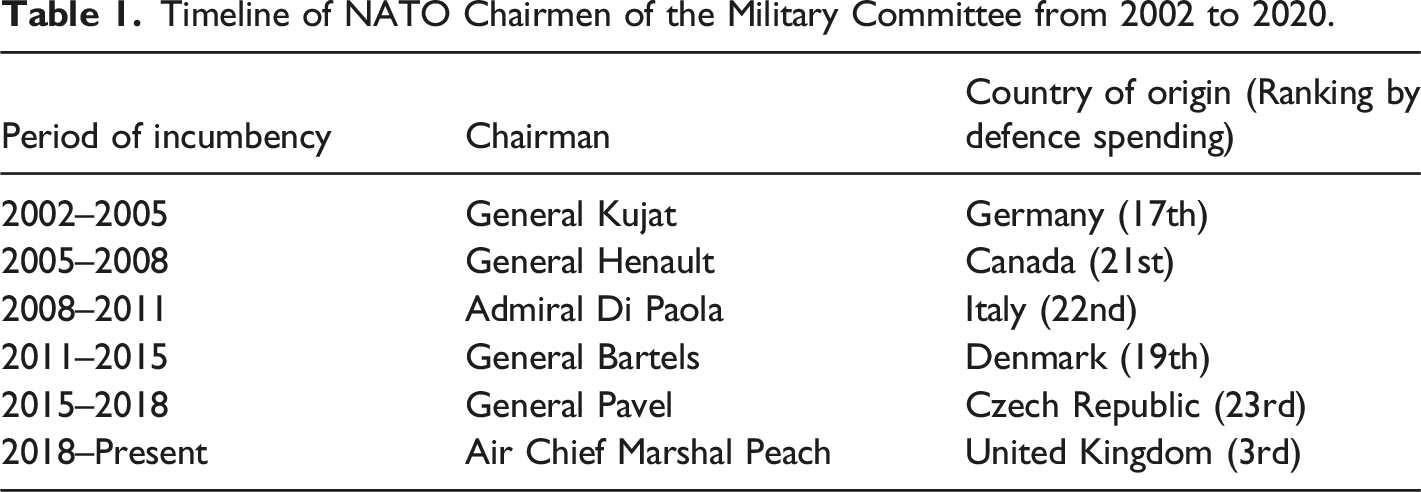
Timeline of NATO Chairmen of the Military Committee from 2002 to 2020.
Having examined the literature surrounding the determinants of defence spending and troop contribution, it became clear that the decision-making environment for both of these variables is complex and dynamic.
47
This allows for the possibility that incumbency in NATO’s most senior military position is among those factors, and an analysis which seeks to establish a correlation between the dependent variables (increased defence spending and increased NATO operational commitments) is certainly possible. This scope allowed us to research both stability and variation in CMCs under different structural conditions and across two decades of NATO operations. The selected six cases were similar, to the extent that they all constituted Western NATO states that nominated their CHoDs for the CMC position through what Éric Tremblay and Bill Bentley called an “integrated and educated community of practice” reflecting the robust yet iterative nature of NATO’s decision-making through consensus.
48
At the same time, as is required for comparative small-N analysis, the cases vary in contrast space as they involve different governments, each with different economic constraints and operating under different
Data collection
To compare effectively the impact of incumbency in the CMC position on defence expenditure and troop contributions, it is necessary to operationalize both independent variables. Since the focus of the paper is on observing the relationship between a specific NATO position and corresponding contributions to the alliance, quantitative research techniques were used. For the purpose of this analysis, defence expenditure data will be measured in constant (2018 prices, adjusted for inflation) using US dollars. Using constant prices and one currency will facilitate comparison by eliminating the effect of multi-currencies and inflation. Our research relied on existing readily available secondary sources. All defence expenditure data is taken from the Singapore International Peace Research Institute’s database on national military expenditure (SIPRI). 50 For troop contribution, a data set of the number of troops contributed to NATO operations by member states was created using data from the Military Balance Journal. 51 The data set includes the specific number of individual soldiers deployed on NATO operations for each member state from 2002 to 2020. It excludes troops that were posted to NATO Headquarters in Brussels, or any other NATO body within Europe. In other words, the data set is limited to the troops on active military operations led by NATO and omits other operations such as UN or unilateral deployments. In this context, if the hypothesis is accurate, and pressing normative obligations to those states who host the CMC positions exist, a pattern of increased defence spending and troop contributions in CMC hosting states should become apparent shortly after their candidate assumes office.
For troop contributions, each annual edition of the Military Balance Journal was consulted to gather the specific number of troops on NATO-led missions for each NATO member. After gathering the troop contribution data for every NATO member from 2002 onwards, the data was grouped by incumbency period and the growth rate for each state over that incumbency period was computed. Then, the growth rate for every NATO member, except for the member incumbent in the CMC position, was summed up to create a “rest of NATO” growth rate. The growth rate for the incumbent state was labelled “incumbent member.” This last step was repeated for each incumbency period presented in Table 3.1. The final data set included two variables: one troop contribution growth rate for the incumbent member and one growth rate for the rest of NATO.
With regards to military expenditure, a similar procedure was followed. Instead of the Military Balance Journal, the data for military expenditure was gathered using the SIPRI Military Expenditure Database. Annual military expenditure from 2002 to 2019 was gathered for each NATO member state. Growth rates for every state were computed and an aggregate growth rate for each incumbency period was defined. Like for troop contributions, the growth rates for military expenditure were then grouped by incumbent versus not incumbent. The final data set included the growth rates for two variables: incumbent CMC state and rest of NATO.
Limitations of current research
This research presents some shortcomings. First, the analysis did not account for possible confounding variables. Previous research shows that economic, security, and political factors are significant determinants of defence expenditure and contributions to NATO. 52 The analysis did not include these external factors which could have an impact on the two independent variables observed in this research. The literature on defence spending and troop contribution makes it clear that each state is influenced by differing factors. 53 In order for the present results to be internally validated, the analysis should account for every possible variable that can influence defence expenditure and troop contributions. Controlling for these variables would reduce the possibility for confounding effects by external factors.
Second, the analysis did not account for individual differences between states. The use of growth rates facilitates inter-state comparison, but it does not account for the national circumstances of individual member states. Such circumstances are often unique to each state. Examples of personal circumstances which may have had a confounding effect on the analysis include the rise of conflict in a specific geographical area. Turkey, for instance, may see a larger increase in defence expenditure and decrease in troop contribution because of intensifying conflicts closer to home, 54 and Greece as an additional example will have its defence expenditures appear as a large percentage of its national economy due to its shrinking GDP. 55 All member states have differing national situations which may influence their defence expenditure or troop contribution to NATO.
Third, the current research did not account for all types of commitments. As previously discussed, contributions to NATO are not only material or financial. Specific hard contributions (excluding exercises) were exclusively used for this research because of the quantification dilemma surrounding soft commitments. As a result, this research cannot confirm that the position of CMC does not incur any soft costs to the host country. Rather, it can confirm that holding the position of CMC does not incur any hard costs for the country of origin (forcing the incumbent to alter its commitments to a level above the NATO average) during the period of incumbency.
Results
The growth rate of both defence expenditure and troop contribution over the period of 2002–2020 was computed and aggregated by period of CMC incumbency. Table 1 presents a timeline of CMC mandates during this period. By computing the growth rate for each variable, unwanted effects linked to variations in the size of member states are eliminated. Analyzing the raw data would have seen significant differences between large states who contribute much more to NATO simply because of their economic and military capabilities. By analyzing growth rates in percentages, all states are put under equivalent and comparable ratios.
The analysis was limited to six different incumbency periods from 2002 to 2020. Growth rates for the countries of origin were computed based on who held the position during the incumbency period. For a single period of incumbency, the growth rate corresponds to the 3- or 4-year average growth rate. The growth rates of non-incumbent members were averaged to create a “rest of NATO” rate. In all, six different growth rates were computed using yearly data of both troop contribution and military expenditure.
Defence expenditure
The computed growth rates for defence expenditure are illustrated in Figure 1. In order for there to be an effect between incumbency and defence expenditure, the growth rate of the incumbent member state has to be greater than the rest of NATO. As Figure 1 clearly illustrates, the military expenditure growth rate is only greater for the incumbent country three out of the six incumbency periods. Of those three instances, only once was the difference in growth rate larger than 1.5% (2015–2018). In fact, the three instances where the “rest of NATO” growth rate is larger than that of the incumbent member, the gap between them is over 3%. The largest gap in growth rate is during the 2018–2020 incumbency period, where NATO members increased their spending an average of 9.47% while the UK (incumbent in the CMC position) increased its spending by a mere 2.48%, a difference of nearly 7%. Military expenditure growth rate for country incumbent in CMC and NATO. Data from SIPRI Military Expenditure Database.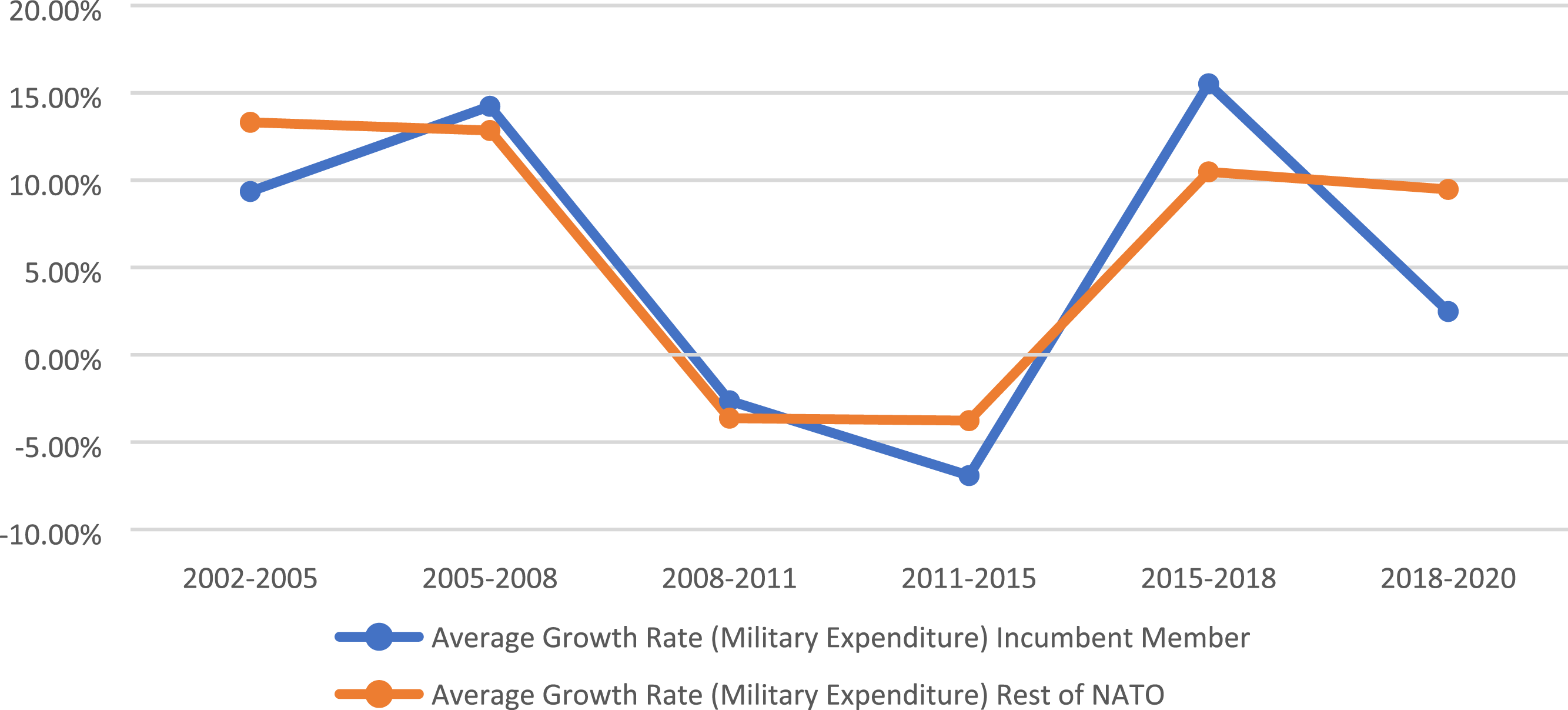
During the 2002–2005 incumbency period, Germany’s military expenditure grew on average 9.35% while the rest of NATO saw an average increase of 13.3%. As the CMC incumbent, Germany’s growth rate was smaller than that of the rest of NATO. The following two incumbency periods saw very little difference in military expenditure growth rates. From 2005–2008, Canada’s military expenditure growth rate stood at 14.2% while the rest of NATO was at 12.8%. Then from 2008 to 2011, Italy had a military expenditure growth rate of −2.6%. The rest of NATO had a similar growth rate, at −3.6%. The 2011–2015 incumbency period saw a higher growth rate for the rest of NATO (−3.7%) compared to Denmark, the CMC incumbent (−6.9%). The 2015–2018 incumbency period was different, however, with the Czech Republic reporting a military expenditure growth rate of 15.5%, higher than the 10.4% reported by the rest of NATO. Lastly, during its incumbency, the UK had a military expenditure growth rate of 2.4%, lower than the 9.4% growth rate for the rest of NATO.
Overall, the growth rate of incumbent member states and the rest of NATO follows a consistent trend. When spending decreases, it is the case for all members; and when spending increases, it tends to increase for all members as well. The results clearly demonstrate that the hypothesis is not supported by the data when it comes to military expenditure.
Troop contributions
The percentage change rates in troop contributions are illustrated in Figure 2. If incumbency in the CMC had a significant troop contribution cost, the growth rate for the incumbent member would be greater than that of the rest of NATO. With that being said, Figure 2 clearly shows no significant differences between the country holding the Chair and other NATO members. The only period where both groups differ greatly is 2005–2008, when Canadian general Raymond Henault held the position. However, the difference in growth rate favours Canada—not the rest of NATO—for this period. This goes against the hypothesis posited earlier in this text. For the other periods, the gap remains negligible (less than 20%). Troop contribution growth rate for country incumbent in CMC and NATO. Data from Military Balance Journal.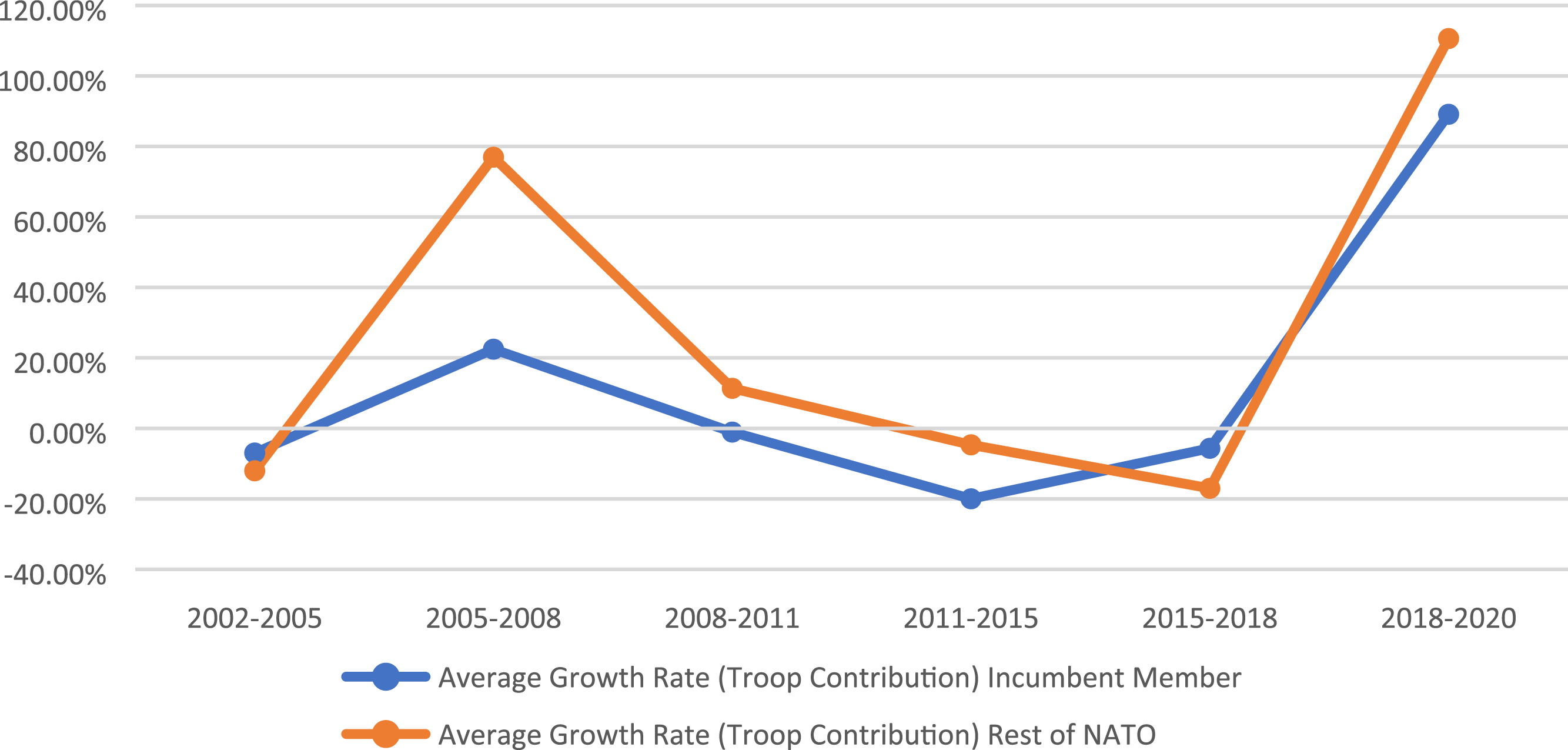
The first incumbency period (2002–2005) saw a very small difference in growth rates of troop contributions between the incumbent (Germany, −6.9%) and the rest of NATO (−12%). For Canada’s incumbency period, however, the difference was large, with Canada having a troop contribution growth rate of 22.4% while the rest of NATO had one of 76.9%. For the next two incumbency periods, the differences were moderate with Italy (2008–2011) having a −1% growth rate compared to the rest of NATO sitting at 11.37%, and Denmark (2011–2015) having a −19.9% growth rate compared to −4.66% for the rest of NATO. The 2015–2018 incumbency period is different, with the incumbent state of the Czech Republic reporting a larger growth rate (−5.6%) than the rest of NATO (−17%). The last incumbency period, 2018–2020, saw a growth rate of 89.1% for the incumbent state (UK) and a growth rate of 110.6% for the rest of NATO.
Other than the 2005–2008 incumbency period, the results of the analysis of troop contribution reveal a mostly consistent trend in growth rate. Most of the time, the “rest of NATO” growth rate is larger than the incumbent member. When that is not the case, the difference in growth rate is less than 12% (2015–2018).
Discussion
The results show that incumbency in the CMC position does not incur any significant material costs for the country of origin when compared to the rest of NATO. That was the case for two key variables related to NATO member contributions: defence expenditure and troop contribution. These findings go against the hypothesis put forth in this research. Indeed, there are no observable costs associated with the Chair over the specific time period. However, this does not mean that the results are less important simply because they do not support the desired hypothesis.
Germany’s incumbency in the CMC from 2002 to 2005 was marked by significant internal dilemmas within NATO. The US-led operational responses to 9/11 were indeed opposed by several states including Germany and France. This opposition to engaging in US-led operations may partly explain why Germany’s alliance contribution growth rates were trending in the negative. The rest of NATO was also divided between states that supported US operations and those that did not. These situational factors could have influenced the contributions of alliance members, making it difficult to draw conclusions regarding the normative implications of holding the CMC position.
From 2005 to 2008, the position of CMC was held by Canada. During that time, NATO launched and maintained multiple operations in the Middle East, specifically the International Security Assistance Force (ISAF)’s transition out of Kabul to the four regional commands. During this timeframe, NATO assumed responsibility for ISAF and its transformation to become the NATO forces headquarters in Afghanistan (as opposed to the co-existence of ISAF and the American Combined Forces Command – Afghanistan). Because it was a Canadian goal at the time to support the transition to a NATO force, there was a rough order of preference for Canadian military commitments favouring multilateral NATO missions over unilateral operations commanded by a single state such as the US. 56 The Canadian CMC was well-positioned to aid alliance efforts at that time. However, much like previous operations, not all members agreed with the decision for NATO to take part in missions in the Middle East. Canada, for instance, objected to the US-led mission in Iraq along with other key alliance members such as Germany. These objections meant fewer troops, if any, were contributed by these states to ongoing NATO operations. In the end, this incumbency period was characterized by large increases in troop contributions for NATO members, with the exception of states that opposed military operations. Defence expenditure also increased substantially over this period.
Italy’s incumbency in the position of CMC from 2008 to 2011 was marked by the financial crisis. These financially difficult times led to decreasing military expenditure for all NATO member states, regardless of their incumbency in senior positions. Military operations also decreased in size due to budget constraints, leading to few changes in troop contributions for NATO members. The incumbency period of 2011–2015 can also be characterized by economic hardships. Recovering from the financial crisis, NATO member states did not prioritize defence spending, meaning military expenditure and troop contributions did not see significant growth. This was true of all NATO member states, including the CMC incumbent state of Denmark.
The Czech Republic held the CMC position from 2015 to 2018. During that period, member states started increasing military spending to return to pre-financial-crisis levels. Both the CMC incumbent member and the rest of NATO had military expenditure grow more than 10% over the 4-year period. With that being said, troop contribution remained stagnant for all members, most likely due to the lack of new NATO-led operations.
The last incumbency period covered by this study is from 2018 to 2020, when the UK held the CMC position. This period saw several new NATO-led operations in Central and Eastern Europe as well as the Middle East. Exercises and operations began in Romania, Bulgaria, and the Ukraine, to name but a few. These new operations concurrently resulted in a large increase in troop contributions from NATO members of all ranks. These operational contributions were matched by increases in military spending as well. The UK’s increase, while not as large as the rest of NATO, was still important.
Conclusion
While the results of this research show that the CMC position does not have a significant economic deterrent due to variables such as defence spending and troop contributions, it remains possible that additional political or security deterrents may exist. As Kristin Campbell et al. note, studies that demonstrate null results are an important part of the research process and are fundamental to informing future research questions to be tested. 57 While the authors had hoped to confirm our hypothesis, the results still offer a novel finding. The absence of competitiveness surrounding the position does not match its potential for prestige and advantages, making this null result useful, both in terms of policy and attracting NATO members to the CMC position, and in terms of theory and promoting the research question itself for additional study.
Future research should focus on analyzing different potential domestic variables which may act as deterrents, such as political divisions, level of democracy, and security position within states who have nominated chairpersons. Previous studies have established links between such political and security factors and the contribution of members to the Alliance. 58 It is possible that these factors are, in addition to being determinants of economic contribution, determinants of who holds positions such as the CMC. This research focused on the highest military position within NATO: that of Chair of the Military Committee. The position of CMC is an influential one, but it remains subordinate to the civilian stream of NATO and the Secretary General. Future research should therefore also focus on the position of Secretary General and other senior positions within NATO and on whether these positions can be influential in motivating other states to increase their alliance contributions. Future quantitative researchers may want to consider any potential time differences in military contributions. It is indeed possible that increases in military spending or operational contributions caused by incumbency in senior positions may emerge over a number of years rather than immediately. This means that future contributions could be linked to the efforts of previous CMCs. Additionally, future researchers may want to take advantage of additional data (SIPRI data is available from 1949 and The Military Balance from 1959) to expand the sample size to examine other periods of NATO operations during the Cold War or the 1990s. The analysis was limited to the post-9/11 era and covered only six incumbency periods from 2002 to 2020. Expanding the data set to include years preceding 9/11 could potentially highlight differences between the pre- and post-9/11 periods. While a different operating environment, expanding the data and including previous decades, may potentially change the null result, at the very least it would contribute to a more robust statistical analysis. Moreover, if future research is able to measure and quantify soft contributions to the Alliance, then further analyses will be able to explore the potential soft costs of holding the Chair. Lastly, future research should also examine other high-ranking military and civilian positions to see if they impact NATO contributions.
While the results of the present analysis do not provide a definite answer to the initial research question, the results remain informative and valuable. This study still contributes to the knowledge in the field of collective defence through an acknowledgement that states may not fear chain-ganging through unstated alliance commitments as much as previously believed and that alliance members in the future should not be deterred from nominating their own candidates. Rather there is a desire among smaller states to appear as non-free-riders and mark strategic contributions to the alliance. Additionally, there is merit in excluding causal variables that makes this research potentially valuable to scholars in the field.
While appearing dated today, several articles have ruled out the argument that this decision on the part of the Trudeau government stemmed from Vance’s inability to be elected to the position or to fulfill the duties adequately. 59 Additional news articles hinted at the idea that General Vance was exactly what NATO needed for its next Chair—and that he would have brought necessary expertise and experience to deal with the ongoing defence challenges surrounding the COVID-19 pandemic. 60 Ultimately, the Trudeau government did not move forward with the nomination of General Vance for the position of CMC, and Lieutenant-Admiral Robert Bauer of the Royal Netherlands Navy was appointed to the position on 25 June 2021.
Unfortunately, this research was unable to determine why the Trudeau government did not move forward with the nomination of General Vance for the position of CMC. However, considering all of the remaining research gaps, the authors conclude that the principal research question—why did the Trudeau government decide not to move forward with the nomination of General Vance for the position of Chair of the Military Committee?—remains pertinent and has a broader application than previously thought. This question merits additional research and an answer, especially considering the significant influence and positive implications this nomination would have had for the current Liberal government within the alliance.
Understanding the mechanisms which drove the decision not to recommend General Vance for the CMC position remains important for contemporary and future decision-makers, both Canadian and NATO (not to mention scholars, the interested public, and the media). As such, we conclude that the conceptual framework proposed in this paper may serve as a possible basis not only for future research concerning chain-ganging in alliances but also more broadly for research concerning the demands placed on positions of authority in alliances and coalitions.
Footnotes
Declaration of conflicting interests
The author(s) declared no potential conflicts of interest with respect to the research, authorship, and/or publication of this article.
Funding
The author(s) received no financial support for the research, authorship, and/or publication of this article.
