




Abstract
What drives consumer activism during trade disputes? We investigate this important and timely question using a survey experiment in the context of the recent Canada–US trade dispute. We find that Canadians are more likely to express willingness to take punitive actions in the form of boycotting during a trade conflict when they learn that Americans are taking such actions (retaliation), when many fellow citizens are taking such actions (peer pressure), and when they are rallied by their government (elite cue). Among the three conditions, peer pressure has the largest effect. These findings contribute to our understanding of the microfoundations of consumer activism during international trade disputes. They also have important policy implications in a world where both protectionism and populism are rising.
Consumer activism is defined as consumer movements that seek to influence the behaviour of companies through activities such as boycotts. 1 Consumer activism has a long history, dating back at least to the free-produce movement, an international boycott of rum and sugar produced by slave labour in the late eighteenth century. 2 With the surge of trade protectionism and disputes around the world today, consumer activism is also rising in response. In the summer of 2019, Japan and South Korea were embroiled in a bitter trade dispute triggered by Japan’s export restriction on key chemicals for semiconductor production. Angry consumers in South Korea destroyed vehicles bearing the logos of Japanese carmakers, poured Japanese beer down the drain, and compelled supermarkets to clear their shelves of foodstuffs from Japan. 3 Elsewhere, China has also been locked in an escalating trade war with the US since the summer of 2018. A recent survey found that 56 percent of Chinese consumers have boycotted an American product “to show support for China.” 4
Given its long history and prevalence, consumer activism, and its source and consequences, have been the subject of academic research in many fields. Scholars of International Relations (IR), for example, have examined the consequences of consumer boycotts for cross-border trade when political tensions increase between countries, whereas scholars of marketing science have looked into reasons for consumer activism against multinational corporations. 5 What is less explored, especially in light of rising trade disputes around the world, is why individual consumers would react to economic tensions or trade disputes that do not immediately affect their own welfare. In the example above, Japan’s reduction of the shipment of hydrogen fluoride should not affect in any substantial way the daily life of South Korean consumers, at least in the short term. On the contrary, for Korean consumers, boycotting Japanese goods would incur costs, such as paying higher prices and changing purchasing habits. What, then, motivates consumer activism during trade disputes?
In this article, we take a first step toward understanding the microfoundations of consumer activism in trade disputes by integrating the IR and marketing science literatures. We identify three causal factors that could motivate consumer activism in a trade dispute: retaliation, peer pressure, and elite cue. Specifically, we hypothesize that consumers should be more likely to express intentions to boycott or reduce purchasing foreign goods and services when they know that consumers in the other country have already taken punitive actions (retaliation), when many of their fellow consumers have already taken punitive actions (peer pressure), and when their governments have encouraged them to take such actions (elite cue).
We test these hypotheses by fielding a survey experiment in Canada in the context of the Canada–US trade dispute in 2018, when the US raised tariffs on Canadian steel and aluminum products at the end of May, followed by Canadian retaliatory tariffs on American steel, aluminum, and various other products in July. Selecting Canada as the case of inquiry presents a harder test for establishing the causal links between the three proposed causal factors and consumer activism because Canada and the US are close allies, unlike in the case of trade disputes between China and Japan or between China and the US.
Our survey experiment was administered to a sample of 1161 Canadian adults in February 2019. As we detail in the survey design below, each respondent first read the background information describing the trade dispute. We then randomly assigned the respondents to three treatment groups, where they read additional information regarding how American consumers, their compatriots, or the Canadian government responded in a similar, hypothetical dispute, and a control group, where no additional information was given. Afterwards, we asked respondents whether or not they intended to reduce or stop buying American products. Comparing the responses between the treatment and control groups enables us to evaluate the causal effect of the three conditions on the stated actions of consumer activism independent of any potential confounding factors.
The results show that all of the three treatment conditions increase Canadian consumers’ propensity to take more punitive actions in the form of boycotting against the US. Among them, peer pressure has the largest and most robust effect. Furthermore, using qualitative responses in the open-ended, follow-up questions in the survey, we find that consumers in the treatment groups are motivated to boycott because doing so not only is considered “fair,” but also would help support Canadian workers and producers, a reasoning consistent with the logic of “buycott.” 6 Taken together, what we find in this research does not bode well for the world economy at a time when both trade tensions and populist sentiments are rising across many major economies, even among countries that are traditional political and economic allies, such as Canada and the US.
The rest of this paper is organized as follows. We first provide a brief overview of the extant literatures, which are used to derive the three hypotheses for empirical examination. Next, we lay out the context and design of the survey experiment and present our findings. We conclude with directions for future research.
Literatures and hypotheses
That consumers take punitive economic actions during state-level conflicts is nothing new. Chinese consumers repeatedly boycotted Japanese goods in the 1930s before the outbreak of total war, and so did Arab consumers against Israel after the formation of the Jewish state in 1948. Traditional allies are not immune to consumer activism either. For instance, French and American consumers both engaged in boycotting goods and services from the other side during their governments’ diplomatic imbroglio over the American decision to invade Iraq in 2003. 7
As consumer boycotts are essentially “commercial weapons” 8 that governments can exploit, scholars of IR and international economics have incorporated them into their theories and empirical inquiries on the relationship between business and politics. 9 Yet, existing studies have almost exclusively focused on the effects of boycott on macro-level outcomes such as imports and exports, and are generally silent about the microfoundations of consumer behaviours. What motivates consumers to take it upon themselves to punish the foreign country in either a political or economic dispute, even though doing so may involve costly changes to their habitual consumption behaviour? This important question is often assumed but not empirically established in the existing IR literature.
Scholars of marketing science, in contrast, have primarily focused on the topic of “consumer animosity” or “political consumerism” at the individual level, exploring the conditions under which consumers are more likely to curtail the consumption of foreign goods and services or boycott them altogether. 10 In these studies, the targets of consumer boycotts are often multinational corporations, whose products present environmental, safety, and humanitarian concerns. 11
Nevertheless, there is reason to believe that the underlying logic of consumer animosity should also apply when the boycott target is a nation state in the context of trade disputes. Drawing on insights from the scholarship in marketing research and integrating them with the study of IR, we identify three potential factors that are most likely to motivate consumers to consider engaging in punitive behaviours during trade disputes: retaliation, peer pressure, and elite cue.
A key principle in international trade relations is reciprocity, i.e., a strategy in which countries reward cooperative initiatives (positive reciprocity) and punish noncooperative behaviours (negative reciprocity) from other countries. 12 Individual actions against foreign countries, such as boycotting, can be understood as negative reciprocity in the form of retaliation “taken in return for an injury or offense.” 13 A calculating process, retaliation involves an evaluation of whether another party’s action is harmful or wrong, 14 the assignment of specific targets, and the selection of strategies. 15
Retaliation also has deeper psychological roots. A general trigger for retaliatory activities is the perception of injustice or unfairness, which has distributional, procedural, and interactional dimensions. 16 In the realm of consumer activism, these three dimensions can be seen as related to the fairness of a transactional outcome, the service provider’s policy and its execution, and the service provider’s treatment of the consumer. 17 Among them, the interactional (i.e., interpersonal) dimension is found to be at the root of retaliatory behaviour. 18
Although the literature on consumer activism understandably places consumer–firm interactions at the centre of empirical analysis, we argue that the same psychological foundations should also underpin consumer activism and retaliatory behaviours during a trade dispute. Specifically, when consumers believe that tariffs are being imposed on their country unfairly, that their country’s trading partners are acting in defiance of existing trade agreements, and, in particular, that consumers in other countries are boycotting their goods and services without legitimate reasons, they can be motivated to reciprocate in kind, just as if they would against a firm. This yields our first hypothesis:
There is also indirect evidence for the role of peer pressure in changing consumer behaviours. For example, Li and Liu find that exports of visible Japanese products to China, i.e., products that are more likely to be seen by peers, such as automobiles and cameras, experienced more dramatic drops during the 2012 territorial dispute between the two Asian neighbours.
22
Their finding is consistent with the argument made in Rea that boycott participation is most likely for goods and services that are publicly purchased and consumed. In addition, Castelló and Mihelj look at how consumers signal their nationalistic positions.
23
One dimension of consumer nationalism involves symbolic behaviour and statements, such as wearing T-shirts with the national flag. Symbolic gestures are important as they signal non-participants to take part as well. The more of their peers behaving symbolically, the more willing an individual would be to partake in political actions such as boycotts. This discussion leads to our second hypothesis:
The actual content of an elite cue also matters in shaping the public’s policy preferences and can determine how far political leaders can legitimize their policies. 29 For the Canada–US case (which we describe in more detail in the next section), although the Canadian prime minister never explicitly called for a boycott, he did say, when responding to questions about Canadians’ boycott of American goods and cancellation of trips to the US, that he was “always one to encourage Canadians to discover [their] extraordinary country, to take vacations here at home, to continue to buy Canadian.” 30
While Trudeau was understandably diplomatic about the situation, local politicians in Canada did not shy away from sending a less subtle message. For example, Ottawa Mayor Jim Watson announced he’d boycott the annual Fourth of July party at the American embassy over US tariffs because he was “not happy with the direction of the American government and their constant attacks on [his] country.”
31
Similarly, when commenting on why his town was actively encouraging residents to stop buying American products and to buy Canadian alternatives wherever possible, the mayor of Halton Hills replied: “We don’t want to see families negatively affected by ideology and protectionism … if you don’t push back against a bully, he will know who to pick on.”
32
This rounds up our last hypothesis:
Research context and design
During his presidential campaign in Pennsylvania in June 2016, Donald Trump claimed that the US should regain its “economic independence.” 33 Key to that objective, according to Trump, was to change American trade policy, which had been hurting American workers and increasing US dependence on foreign countries. Still, it shocked many when President Trump actually took on close American allies such as Canada. In early 2018, the US began raising tariffs on steel and aluminum imports from multiple countries, and Canada was initially exempted for a few months. However, by the end of May that year, Canada was also hit with the same set of tariffs: 25 percent on steel and 10 percent on aluminum. The day after the imposition of the tariffs, Prime Minster Justin Trudeau called the American action “a turning point in the Canada-U.S. relationship.” 34 A month later, on 1 July, Canada imposed C$16.6 billion retaliatory tariffs on American imports, including steel and aluminum, as well as a long list of basic consumer goods, such as orange juice and dishwashers. 35
These tariffs had immediate impacts on Canada’s imports and exports. According to Statistics Canada, Canadian exports of steel and aluminum to the US decreased immediately following the implementation of US tariffs, declining 37.8 percent and 4.6 percent, respectively, in June 2018. Similarly, after Canada began collecting retaliatory tariffs, imports of US steel products fell sharply in July (–38.3 percent) and August 2018 (−10.8 percent). Canada’s imports of other tariffed products from the US also declined by 22 percent in July. 36
The trade dispute also became personal and polemical. During the G7 Summit in Quebec in early June of 2018, Trudeau stated that he found the American tariffs, imposed on Canadian steel and aluminum under the name of protecting national security, “insulting.” 37 In response, Trump called his Canadian counterpart “very dishonest and weak” and “instructed US Representatives not to endorse the Communique (of G7).” 38 A number of top Trump officials followed suit by continuing the tirade on national television. Chief presidential economic adviser Larry Kudlow described Trudeau as a “double-crosser,” while White House trade adviser Peter Navarro charged that “there’s a special place in hell” for the Canadian prime minister. 39
As tensions escalated, many Canadians took things into their own hands by striking back with clear acts of resistance. For example, LaLa Bistro, a family restaurant in Quebec, was one of the many Canadian businesses that boycotted California wines, American ketchup, and other American products. 40 Similarly, a retired journalist from Alberta vowed to buy as many Canadian-made items as possible, proclaiming that, although he “would miss Twizzlers, it’s a sacrifice [he was] willing to make.” 41 Others reportedly cancelled their trips to the US. A public relations consultant from Montreal, for example, decided to explore new regions of Canada for vacation instead of their traditional destinations down south because “contributing to the U.S. economy frankly did not feel right.” 42
To find out whether our hypothesized conditions motivated such consumer activism as described above, we implemented a survey experiment to a sample of 1,161 Canadian adults (age 18+) between 4 and 19 February 2019. Conducting the survey in Canada offers two advantages for testing our hypotheses. First, it presents a harder test because Canada and the US are close allies, unlike in the case of trade wars between China and the US. Furthermore, whereas scholars have found that boycotts of foreign goods often result from xenophobic and ethnocentric sentiments, 43 the two countries in our case to a large extent reduce this possibility given their deep cultural, historical, and geographical proximities.
We recruited subjects from Qualtrics’ online opt-in panel, which has become an increasingly popular method of survey participant recruitment. Our sample of 1161 respondents were drawn randomly from the online panel using proportional allocation by three strata on age, gender, and geographical location that match the most recent Canadian census conducted in 2016. 44 The average age in our sample is 48, compared with 48.5 for the national average of Canadian adults. The male to female ratio of our sample is 48.1 to 51.9, compared with 48.6 to 51.4 in the census. Even though the sample is not nationally representative, it is appropriate for our purpose in establishing causal relationships between treatment conditions and outcome measures, according to the American Association of Public Opinion Research’s guideline on non-probability samples. 45 Recent studies have further demonstrated the validity of online convenient and opt-in samples by successfully replicating experiments conducted on probability samples using nonrandom samples. 46 The flow of the survey procedure is described in Figure 1.
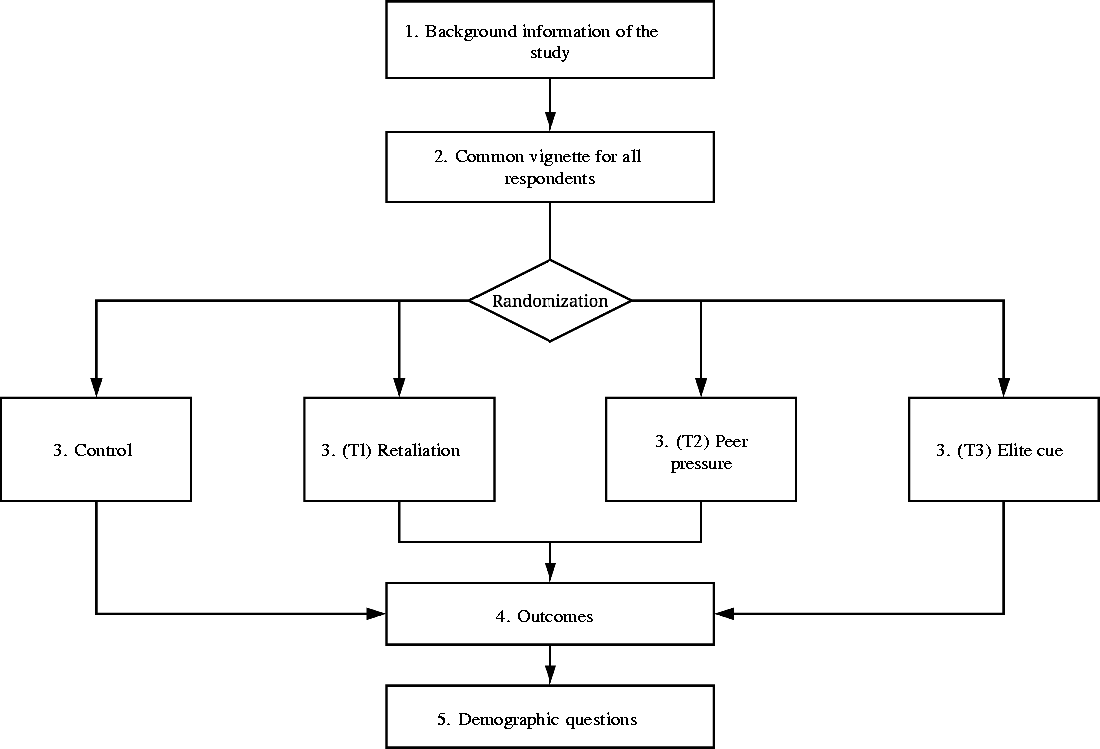
Flow of survey experiment.
After reading the background and consent information of the study (step 1), respondents read the following vignette (step 2) describing the recent trade dispute between Canada and the US: Trade relations between Canada and the US have become much more strained since President Trump took office in 2016. In May 2018, the US government imposed high tariffs on Canadian steel and aluminium as part of Trump’s “America First” policy. In response, Canada implemented retaliatory tariffs in June on US imports, covering 229 goods, including steel, aluminium, and a variety of other products, such as inflatable boats, yogurt, whiskies, candles, and sleeping bags. And when Prime Minister Trudeau defended Canada, saying that Canada “won’t be pushed around,” Trump accused him of being “meek and mild” and “dishonest and weak.”
47
After reading the vignette, respondents were randomly assigned into either the control group or one of the three treatment groups—“retaliation,” “peer pressure,” and “elite cue”—which correspond to the three hypotheses (step 3). In the treatment groups, respondents read additional information regarding how American consumers, their compatriots, or the Canadian government responded in a similar, hypothetical dispute. The exact wordings in the control and treatment conditions are as follows: [ [ [ [
The last part of the survey contained follow-up questions that asked respondents to elaborate on the reasons for their decisions. Information about respondents’ demographic and socioeconomic status was also solicited (step 5). Table A-1 in the Appendix provides summary statistics and a balance check of these variables in the sample by experimental groups.
Findings
Table 1 summarizes the number and percentage of respondents for each of the four action choices in the full sample and by treatment groups. Looking, first, at the full sample in the last column, we see that the average level of consumer activism is very high. Only 19 percent of all respondents indicated that they would “do nothing.” The majority of the respondents (39 percent) said they would “reduce the purchase of American products substantially” and another 28 percent selected the most extreme option of “boycott.” The latter number may seem high, but it is consistent with previous studies of consumer boycott. For example, Farah and Newman (2009) find that around 32 percent of their survey respondents had participated in boycott or were still boycotting in their study on consumer boycott conducted in Lebanon. 48
Summary of respondent choices by treatment groups.
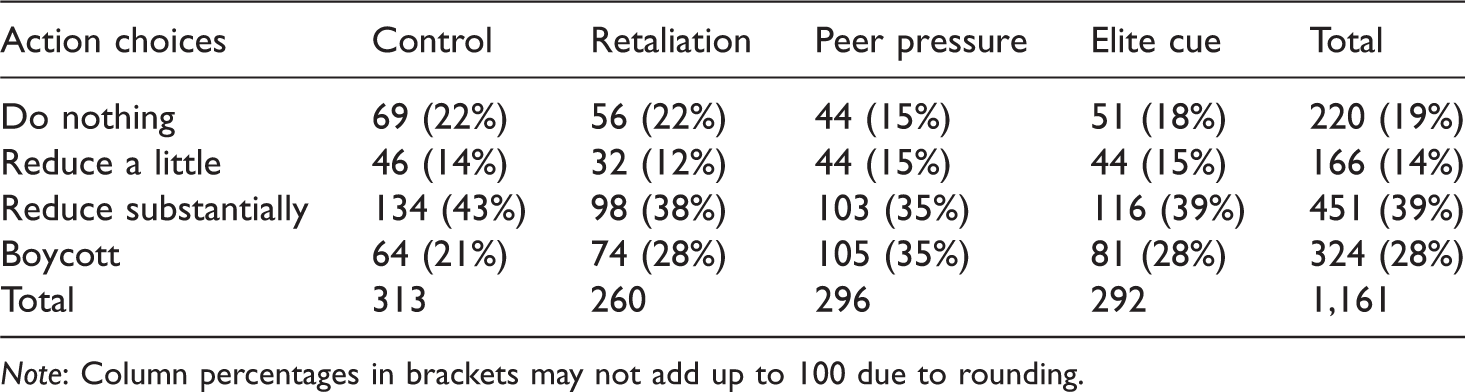
Note: Column percentages in brackets may not add up to 100 due to rounding.
Although the general level of consumer animosity detected in our sample is high, the responses vary considerably when we disaggregate them by the treatment and control groups. In particular, all of the treatment conditions lead to increases in the proportion of respondents who picked the boycott option, but the difference is the largest for those in the peer pressure group. In contrast, for the other three options, the number of respondents in the treatment groups are either comparable (in the case of “reduce a little”) or smaller than the control group (in the case of “do nothing” and “reduce substantially”). Thus, it appears that all three treatment conditions galvanize consumers toward the most extreme version of consumer activism. In particular, compared with the control group, almost twice as many respondents are willing to boycott American goods when they hear that other Canadians are already boycotting.
Figure 2 visualizes the information in Table 1 by plotting the percentages of respondents choosing the four outcomes in the control and treatment groups. Also plotted are the 95 percent confidence intervals, which can be used to evaluate whether the differences are statistically significant.
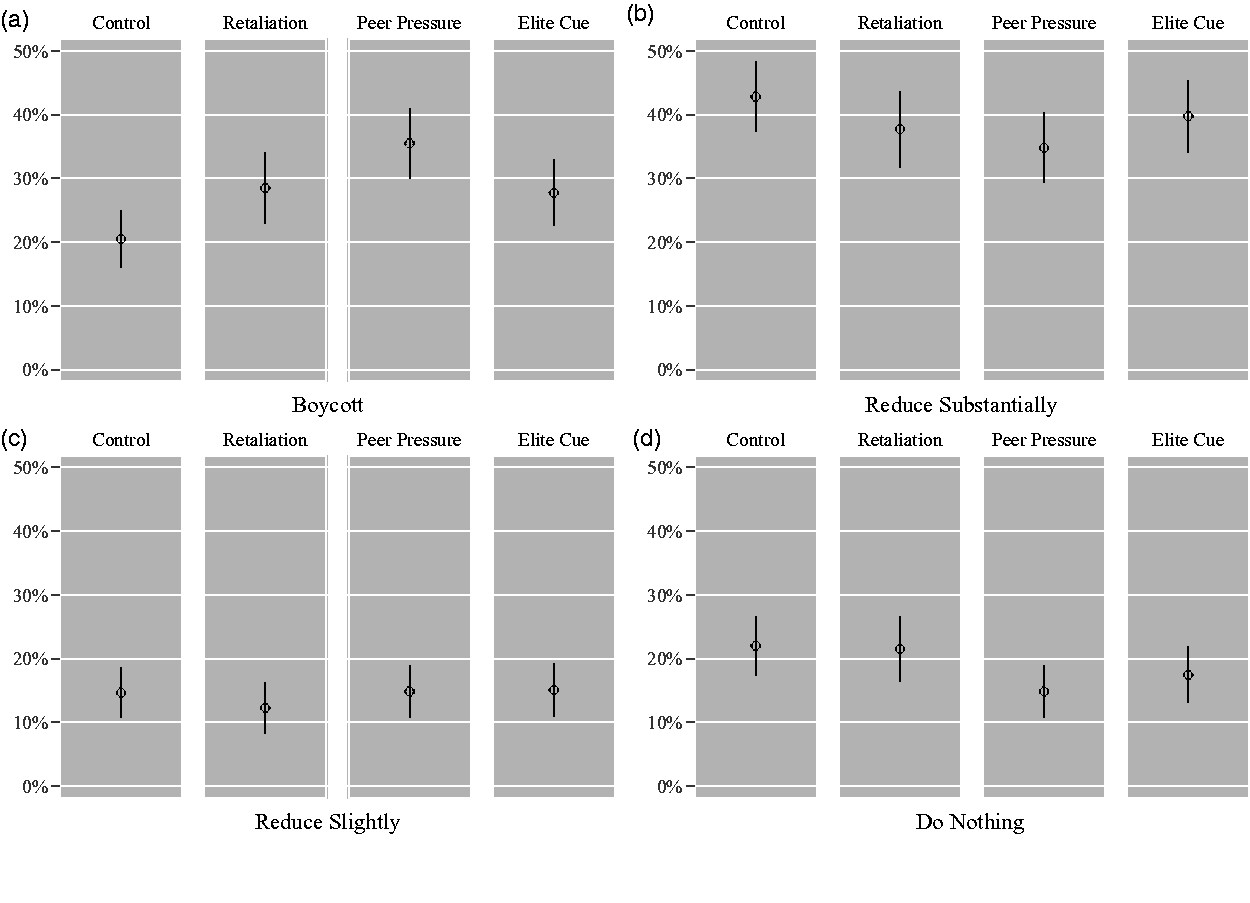
Treatment effects on expressed choice of action in trade disputes.Note: The dots represent the percentages of respondents for the four action choices across the treatment groups. The bars are 95 percent confidence intervals. Source: Authors’ survey.
Focusing, first, on the boycott option in Figure 2(a), we can see that only 20 percent of the respondents in the control group said that they would boycott American goods. In the three treatment groups, many more respondents picked the boycott option: 28 percent in both the retaliation and the elite cue treatment groups, and nearly twice as many (35 percent) in the peer pressure treatment group. The differences between the treatment and control groups are all statistically significant (p < 0.05), lending support to the three hypotheses. Furthermore, the differences between the peer pressure treatment group and the other treatment groups are also statistically significant (p < 0.05), suggesting that hearing of fellow Canadians who are already boycotting provides a much stronger motivation for respondents to follow suit.
In terms of the other three outcomes, shown in Figure 2(b), 2(c), and 2(d), there are no statistically significant differences between the treatment and control groups except in the case of the peer pressure treatment group, where fewer respondents chose to do nothing or to reduce their purchase substantially (15 percent and 35 percent) than those in the control group (22 percent and 43 percent). In other words, peer pressure has a significant effect in both directions, motivating consumers to shift away from milder responses toward more antagonistic responses during trade disputes.
So far, we have examined the causal effects of our treatment variables in changing respondents’ action choices. In the survey, we also asked each respondent to elaborate on the reasons behind their stated choices of action. Using this open-ended question, we probe further into the motivations of consumer boycott under different treatment conditions. To do so, we focus on those respondents who expressed willingness to boycott American goods (N = 324). Reviewing their texts for this question, we identify three main reasons given for their intention to boycott.
The first reason, shared by nearly one-third of the respondents (32 percent), falls broadly in the category of “Canada first.” Many respondents saw this as an opportunity to support Canadian producers and business, especially if they were already “trying to buy local as much as [they] can,” and it was “the right time that [Canadians] support [their] own local products to boost Canada’s own economy.” These reasonings follow a similar logic of “buycott,” 49 whereby consumers support businesses that exhibit desirable behaviour by increasing their purchase of goods produced by these businesses. In the context of the trade dispute, not buying American goods means more money can be spent on items made in Canada.
The second reason, offered by over a quarter of the respondents (27 percent), concerns President Trump and, to a lesser extent, the US. These respondents expressed their collective displeasure at the US president and his actions. The third reason, held by another group of respondents (17 percent), is one of “tit-for-tat.” Respondents with this view believed that boycotting American goods is “only fair,” and that Canadians should “hit [the US] the same way.”
Figure 3 plots the distributions of the three main reasons (Canada first, Trump, tit-for-tat) for the boycotters in the control and treatment groups. Several patterns are noteworthy. First, the large majority (60 percent) of respondents in the control group cited Trump as their reason for boycotting. Many of them got quite riled up in the open-ended question, resorting to coarse language when describing the American president. In contrast, respondents in the treatment groups were not as emotional: less than 30 percent of them cited Trump as the motivation for their intention to boycott. Second, respondents in the treatment groups were more likely than those in the control group to say their decision to boycott American goods was to help the Canadian economy and people. Interestingly, the difference was most substantial for those who learned that American consumers were boycotting as well. Finally, relative to the control group and the retaliation group, peer pressure, and elite cue both increased the number of respondents who justified their choice with the “tit-for-tat” logic.
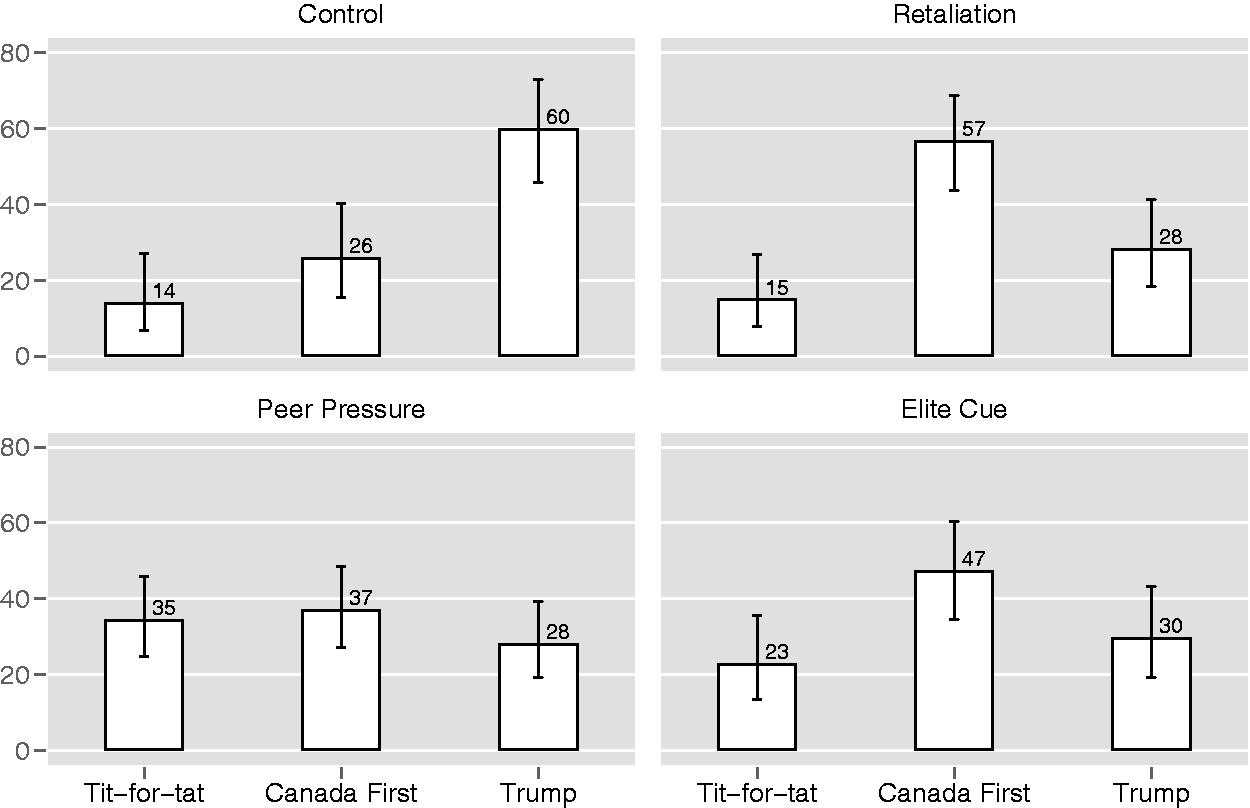
Reasons for boycott by treatment groups.Note: This figure plots the percentages of the different reasons given by respondents as well as the 95 percent error bars. Source: Authors’ survey.
Conclusion
In this study, we have identified and tested the effects of three conditions—retaliation, peer pressure, and elite cue—under which consumers are more likely to take punitive actions during a trade dispute. We did so through a survey experiment in Canada in the context of the 2018 Canada–US trade dispute. Although we find that all three treatment conditions increase expressed intention to boycott, peer pressure stands out as having the strongest effect. These findings suggest that, in today’s world where populism and protectionism are rising in tandem, consumer activism can occur in a government-initiated trade dispute, even one between traditional allies that share deep economic ties, security interests, and ideological values. Our findings may also be very much relevant to and can shed light on the domestic sources and microdynamics of other types of interstate conflicts beyond trade disputes, such as those involving enduring historical and territorial disputes.
Of course, much remains to be done in future research. First, scholars should explore how interactions between different treatment conditions could drive consumer activism. Second, given the increasing frequency of trade disputes around the world today, it will be useful to see whether our findings can be generalized to other country contexts. Finally, one important limitation of this study is that what we find are stated preferences, which could be subject to well-known issues in self-reported survey responses, such as social desirability bias, satisficing, and other cognitive biases. 50 Future research should explore the link between preference and behaviours by connecting survey experiments with behavioural data on real-world decision making. 51
Footnotes
Declaration of Conflicting Interests
The authors declared no potential conflicts of interest with respect to the research, authorship, and/or publication of this article.
Funding
The authors disclosed receipt of the following financial support for the research, authorship, and/or publication of this article: This work was supported by Government of Canada, Social Sciences and Humanities Research Council of Canada 430-2018-00410.

1
Robert V. Kozinets and Jay M. Handelman, “Adversaries of consumption: Consumer movements, activism, and ideology,” Journal of Consumer Research 31, no. 3 (2004): 691–704.
2
Julie L. Holcomb, Moral Commerce: Quakers and the Transatlantic Boycott of the Slave Labor Economy (Ithaca, NY: Cornell University Press, 2016).
3
4
5
Christina L. Davis and Sophie Meunier, “Business as usual? Economic responses to political tensions,” American Journal of Political Science 55, no. 3 (2001): 628–646; and Kyle Endres and Costas Panagopoulos, “Boycotts, buycotts, and political consumerism in America,” Research & Politics 4, no.4 (2017): 1–9.
6
Lisa A. Neilson, “Boycott or buycott? Understanding political consumerism,” Journal of Consumer Behavior 9, no. 3 (2010): 214–227.
7
Davis and Meunier, “Business as usual?”
8
Brian M. Pollins, “Conflict, cooperation, and commerce: The effect of international political interactions on bilateral trade flows,” American Journal of Political Science 33, no. 3 (1989): 737–761.
9
Kilian Heilmann, “Does political conflict hurt trade? Evidence from consumer boycotts,” Journal of International Economics 99 (2016): 179–191; Scott L. Kastner, “When do conflicting political relations affect international trade?” Journal of Conflict Resolution 5, no. 4 (2007): 644–688; and Sonal S. Pandya and Rajakumar Venkatesan, “French roast: Consumer response to international conflict – evidence from supermarket scanner data,” Review of Economics and Statistics 98, no. 1 (March 2016): 42–56.
10
Mincheol Shin, “The animosity model of foreign product purchase revisited: Does it work in Korea?” Journal of Empirical Generalisations in Marketing Science 6, no. 1 (2001); and Edwin J. Nijssen and Susan P. Douglas, “Examining the animosity model in a country with a high level of foreign trade,” International Journal of Research in Marketing 21, no. 1 (March 2004): 23–38.
11
Jill Gabrielle Klein, Richard Ettenson, and Marlene D. Morris, “The animosity model of foreign product purchase: An empirical test in the People’s Republic of China,” Journal of Marketing 62, no. 1 (1998): 89–100; and Jill Gabrielle Klein, N. Craig Smith, and Andrew John, “Why we boycott: Consumer motivations for boycott participation,” Journal of Marketing 68 (2004): 92–109.
12
Robert Axelrod, Evolution of Cooperation (New York: Basic Books, 1984); Robert Keohane, “Reciprocity in international relations,” International Organization 40, no.1 (1986): 1–27.
13
American Heritage Dictionary of the English Language, 4th ed. (Boston, MA: Houghton Mifflin, 2000).
14
Sabine Keuster, Christian Homburg, and Thomas S. Roberson, “Retaliatory behaviour to new product entry,” Journal of Marketing 63, no. 4 (1999): 90–106.
15
K. Aquino, T.M. Tripp and R.J. Bies, “How employees respond to personal offense: The effects of blame attribution, offender status, and victim status on revenge and reconciliation in the workplace,” Journal of Applied Psychology 86, no. 1 (2001): 52–59.
16
Stephen S. Tax, Stephen W. Brown, and Murali Chandrashekaran, “Customer evaluations of service complaint experiences: Implications for relationship marketing,” Journal of Marketing, 62, no. 2 (April 1998): 60–76.
17
Ibid.
18
Venessa Funches, Melissa Markley, and Lenita Davis, “Reprisal, retribution and requital: Investigating customer reciprocity,” Journal of Business Research 62, no. 2 (2009): 231–238.
19
Gilbert A. Churchill Jr. and George P. Moschis, “Television and interpersonal influences on adolescent consumer learning,” Journal of Consumer Research 6, no. 1 (1979): 23–35.
20
Stefano Dellavigna, John A. List, Ulrike Malmendier, and Gautam Rao, “Voting to tell others,” Review of Economic Studies 84, no 1 (2017): 143–181; and Alan S. Gerber, Donald P. Green, and Christopher W. Larimer, “Social pressure and voter turnout: Evidence from a large-scale field experiment,” American Political Science Review 102, no. 1 (2008): 33–48.
21
Sankar Sen, Zeynep Gürhan-Canli, and Vicki Morwitz, “Withholding consumption: A social dilemma perspective on consumer boycotts,” Journal of Consumer Research 28, no. 3 (2001): 399–417; and Monroe Friedman, Consumer Boycotts (New York, NY: Routledge, 1999).
22
Xiaojun Li and Adam Y. Liu, “Business as usual? Economic responses to political tensions between China and Japan,” International Relations of the Asia-Pacific 19, no. 2 (2019): 213–236.
23
Enric Castelló and Sabina Mihelj, “Selling and consuming the nation – understanding consumer nationalism,” Journal of Consumer Culture 18, no. 4 (2017): 558–576.
24
Adam J. Berinsky, In Times of War: Understanding American Public Opinion from World War II to Iraq (Chicago, IL: University of Chicago Press, 2009); and Tetsuya Matsubayashi, “Do politicians shape public opinion?” British Journal of Political Science 43, no. 2 (2013): 451–478.
25
Matthew A. Baum and Tim J. Groeling, War Stories: The Causes and Consequences of Public Views of War (Princeton, NJ: Princeton University Press, 2010).
26
John H. Aldrich, Christopher Gelpi, Peter Feaver, Jason Reifler, and Kristin Thompson Sharp, “Foreign policy and the electoral connection,” Annual Review of Political Science 9 (2006): 477–502.
27
Sung Chul Jung, “Foreign targets and diversionary conflict,” International Studies Quarterly 58, no. 3 (2014): 566–578; and Julia Grauvogel and Christian von Soest, “Claims to legitimacy count: Why sanctions fail to instigate democratization in authoritarian regimes,” European Journal of Political Research 53, no. 4 (2014): 635–653.
28
29
Ronald R. Krebs, Narrative and the Making of US National Security (Cambridge, UK: Cambridge University Press, 2015).
30
31
32
33
34
35
Ibid.
36
37
38
Ibid.
39
40
41
42
Moore and Weibe, “Angry about tariffs and insults, Canadians vow to boycott U.S. goods and travel.”
43
Murat Hakan Altintas, Bahar F. Kurtulmusoglu, Hans Ruediger Kaufmann, Serkan Killic, and T. Harcar, “Consumer boycotts of foreign products: A metric model,” The Protection of Consumer Rights in the Field of Economic Services of General Interest 15, no. 34 (2013): 485–504.
44
As this is a nonprobability sample, a response rate cannot be calculated.
45
Reg J. Baker, Michael Brick, Nancy A. Bates, Mike Battaglia, Mick P. Couper, Jill A. Dever, Krista J. Gile, and Roger Tourangeau, “Summary report of the AAPOR task force on non-probability sampling,” Journal of Survey Statistics and Methodology 1, no. 2 (2013): 90–143.
46
Adam J. Berinsky, Gregory A. Huber, and Gabriel S. Lenz, “Evaluating online labor markets for experimental research: Amazon’s mechanical turk,” Political Analysis 20, no. 3 (2012): 351–368.; and Taylor C. Boas, Dino P. Christenson, and David M. Glick, “Recruiting large online samples in the United States and India: Facebook, mechanical Turk, and Qualtrics,” Political Science Research and Methods 8, no. 2 (2020): 232–250.
47
Lela Moore and Lindsey Wiebe, “Angry about tariffs and insults, Canadians vow to boycott U.S. goods and travel.”
48
Maya F. Farah and Andrew J. Newman, “Exploring consumer boycott intelligence using a socio-cognitive approach,” Journal of Business Research 63, no. 4 (2009): 347–355.
49
Lisa A. Neilson, “Boycott or buycott?”
50
Jon A. Kronick, Charles M. Judd, and Bernd Wittenbrink, “The measurement of attitudes,” in Dolores Albarracín, Blair T. Johnson, and Mark. P. Zanna, eds. The Handbook of Attitudes (New York, NY: Psychology Press. 2014), 21–78.; and Norbert Schwarz, “Self-reports: How the questions shape the answers,” American Psychologist 54, no. 2 (1999): 93–105.
51
Jens Hainmueller, Dominik Hangartner, and Teppei Yamamoto, “Validating vignette and conjoint survey experiments against real-world behaviour,” Proceedings of the National Academy of Sciences 112, no. 8 (2015): 2395–2400.