




Abstract
This article theorizes and tests how different types of interstate conflict across borders affect trade between disputing parties and trade diversion with third parties. Building on theories of borders as institutions, we differentiate the effects of two types of international disputes – border disputes and escalated militarized disputes – and draw on 60 years of trade and conflict data to test the effects of these disputes on bilateral and third-party trade flows. We find that border disputes and militarized disputes each depress trade flows between the disputing countries. However, legal border disputes are associated with increased trade diversion with non-disputing countries, which may fully offset the forgone bilateral trade, whereas militarized disputes have the opposite effect. These results show that actors engaged in trade can offset bilateral trade losses from a border dispute by expanding trade with third parties not involved in the dispute, but the same cannot be said of offsetting the losses from militarized disputes. The fact that border disputes and militarized disputes have opposite effects on trade diversion highlights the importance of examining both the type of dispute and the type of trade flows that are affected when studying conflict and trade and evaluating the potentially pacifying incentives of international trade.
Introduction
How do political conflicts affect international economic relations and what role do economic relations have in shaping the trajectory of conflicts? These questions have garnered significant attention from scholars examining how international economic relations affect the likelihood of war (Gilpin, 1987; Mansfield & Pevehouse, 2000; Kinne, 2012), and those interested in how political and military tensions affect trade relations (Pollins, 1989; Barbieri & Levy, 1999; Anderton & Carter, 2001; Kastner, 2007; Davis & Meunier, 2011). While scholarship on these issues has contributed a great deal to our understanding of trade and conflict, there is also a growing literature addressing political conflict, trade diversion, and international borders. Scholars have suggested that mutually recognized borders can provide joint-gains that incentivize the resolution of border disputes (Simmons, 1999; Schultz, 2015) and that borders help coordinate economic activities (Carter & Goemans, 2018). With Russia’s invasion of Ukraine in 2014, and the continuing conflict, the importance of understanding the costs of territorial conflict have risen. Importantly, the costs are not just borne by the disputing parties but can also spread to third parties. For example, Crozet & Hinz (2020) find that Western countries saw a significant decline in trade following Russia’s annexation of Crimea, partially attributed to the costs of international sanctions. Whether due to the direct damage of war, increased risks associated with border crossings, or the spillover of international sanctions, international conflicts have the ability to reshape international trade patterns.
This article examines how conflict over international borders, and broader military conflict, affects the economic flows between disputing parties and their economic relations with non-disputants. We find that border disputes have a significant negative effect on trade between the disputing parties, but actors engaged in trade are able to offset ‘foregone’ trade resulting from border disputes through trade diversion to non-disputing countries. However, traders are not able to engage in trade diversion for all disputes. When we compare the effects of militarized disputes to legal border disputes, it becomes clear that the two types of disputes function in fundamentally different ways. Both have a negative effect on trade between the disputing parties, but actors are much more effective at offsetting lost trade from border disputes than from militarized disputes. By analyzing both the type of dispute and the trade relationships of disputing and non-disputing countries, we present new insights into the relationships between international borders, disputes, and economic incentives for peace and conflict.
We also contribute to another literature that examines the relationship between trade and conflict, analyzing the effects of increased economic interdependence on the likelihood of war and conflict (Morrow, 1999; Mansfield & Pevehouse, 2000; Kinne, 2014). Specific to territorial conflict, the literature connects territory and economic flows by emphasizing the opportunity costs of border disputes due to lost economic gains, which suggests there should be strong incentives to avoid and resolve border disputes (Simmons, 2005; Lee & Mitchell, 2012; Schultz, 2015). We build from this literature by examining states’ complete trade portfolios, providing a new perspective to debates surrounding international trade and conflict. We find that joint economic gains provided by stable, mutually recognized borders provide incentives to avoid border disputes, but states engaged in border disputes are also able to divert trade and offset losses. By contrast, we find that states in escalated military disputes experience depressed trade with both disputing and non-disputing countries, which highlights the need to evaluate both the type of conflict and the type of trade flows, particularly trade diversion to non-disputants, when analyzing the connections between trade and conflict.
Borders and trade: Theory and practice
When evaluating how border disputes affect international trade, it’s helpful to consider how borders, and their management, shape the behavior and incentives of firms and states. At the most basic level, international borders are the demarcations that define the geographic boundaries of sovereignty, specifying the territory in which the laws and procedures of one state apply, and where those of another state begin. This means that actors conducting transactions across borders must comply with the laws of countries on both sides of the border, and manage the transition from one to the other. Given the additional challenges of conducting business across borders, it is well established that a ‘border effect’ exists that slows and reduces international trade (Helliwell, 1997), though the magnitude of the border effect has declined over time with the increasing stability of borders and the policies governing them (Franco-Bedoya & Frohm, 2022).
When borders are mutually recognized and accepted, they have the ability to foster international trade flows (Simmons, 2005; Schultz, 2015; Carter & Goemans, 2018). Simmons notes that mutually accepted borders ‘reduce risks to property rights and actually encourage cross-border economic relations, producing benefits for economies on both sides of the border’ (Simmons, 2005: 824). Although well-functioning borders can facilitate trade, international transactions are potentially challenging and costly (Schultz, 2015: 134), and are made more difficult if they are governed by unpredictable border policies. For example, Roberts et al. (2014) have found that wait times at border crossings can result in tens of millions of dollars of lost economic opportunities for countries and Aker et al. (2014) find that border frictions can contribute to significant price increases.
When a border is disputed, it can generate heightened costs and risks to firms conducting business. Simmons (2005) highlights that disputed borders often lead to jurisdictional uncertainty, which occurs when actors face questions of whose laws to follow and what protections they are afforded in a given space or territory. This is most likely to occur when the de facto sovereignty is contested in a particular area. However, there may also be significant uncertainty even when there is not an active contest over possession of the territory, but instead there may be underlying uncertainty over de jure sovereignty, raising the question of whose laws and regulations apply. When jurisdictional uncertainty is high, economic agents face greater risks and higher transaction costs, which can lead to decreased cross-border trade flows. For example, a case of jurisdictional uncertainty caused significant political and economic tensions between Nicaragua and Costa Rica. The two countries disagreed over rights to remote swamp lands, adding to tensions that had simmered over jurisdictional authority of the San Juan river for over 150 years (Miller & Rogers, 2010). The President of the Inter-American Dialogue, Michael Shifter, noted that ‘[t]hese small situations can become much more complicated. There is the trade question, the immigration question, the connections between both societies. All that could suffer’ (Miller & Rogers, 2010). Even in the absence of military conflict, legal border disputes, such as the one between Nicaragua and Costa Rica, jeopardize the stability of a border and create jurisdictional uncertainty, which we argue increases the risks and costs to economic actors conducting trade across the border and undermines the ease with which trade can flow between the countries.
While jurisdictional uncertainty is likely limited to the contested territory, border disputes also generate policy uncertainty that increases the risks and costs of doing business across the entire border. Policy uncertainty results from the unpredictable nature of government policies over a disputed border (Simmons, 2005: 828). When contesting a border, a government is more likely to close the border, restrict trade flows, increase tariffs, or otherwise alter the status quo, than if it was an uncontested border. Typically, these policy changes, such as increased tariffs, are not limited to the region being disputed, and instead are applied to the entire border. This means that even a relatively small border dispute can increase policy uncertainty that affects the entire trading relationship. Those conducting business across a contested border face an increased probability that their transactions will be delayed or stopped, or that the costs of doing business will increase. Francisco Villagran Kramer, the former Vice President of Guatemala and international trade and legal scholar, highlighted this point when discussing the border disputes between El Salvador and Honduras, and Honduras and Nicaragua in 2001. Kramer noted that border crossings between the disputing countries ‘take forever’ (Elton, 2001). Kramer emphasized that, in contrast to the disputed borders, ‘Guatemala and El Salvador don’t have a border dispute, and they have put in place mechanisms so that people and merchandise can move across the border quickly and easily’ (Elton, 2001). As these examples suggest, border disputes create jurisdictional and policy uncertainty, which can raise concerns among firms that undermine their willingness or ability to conduct trade across the border. 1
Given that mutually recognized borders provide joint economic gains to the states sharing the border, it follows that uncertainty over the stability and durability of the border institution should reduce the economic gains provided by the border. We follow Huth (1996) and others (Huth, Croco & Appel, 2011; Carter, Wellhausen & Huth, 2019) in defining a border dispute as a conflict between states over the physical demarcation of national sovereignty. Specifically, a border dispute occurs when a state’s executive leaders claim territory in another state or contest another state’s sovereignty, and the targeted government’s leadership rejects the claim (Carter, Wellhausen & Huth, 2019: 62).
If a dispute undermines the functioning of the border, the effect on trade should be greatest for those conducting business across the contested border. For example, if countries A and B experience a border dispute, firms in country A who ex ante exported to country B are likely to experience higher costs and risks for continued exports to B. This means the firms in country A will either have to raise prices to offset the heightened costs and risks, or seek alternative trading opportunities that are now relatively more profitable. In either case, the volume of exports from firms in country A to B is expected to decline given the onset of the border dispute, and the associated increase in costs and risks. Of course, the inverse would also be true, resulting in a decline in exports from country B to country A. In practice, business officials emphasize these challenges, noting that ‘the stepped-up tensions over the disputed territory increase the risk of government officials striking down proposed business deals’ and that this undermines the willingness of businesses across the border from doing business with each other (Wong, 2009). Although this argument is not novel, it is one of the core expectations for the effects of border disputes on trade, so we specify it in the following hypothesis.
H1: A border dispute will decrease trade flows between the disputing parties.
We now move to the more innovative portion of our theory, which examines border disputes’ broader effects on international economic relations. We analyze whether economic actors engage in trade diversion to non-disputing countries to avoid the risks and uncertainty associated with a disputed border. When the risks and costs of doing business across a disputed border undermine the profitability of the trade relationship, we expect traders to seek alternative economic opportunities and divert trade (Bohmelt, 2010; Gowa & Hicks, 2017).
Alternative trade opportunities will take two forms. First, existing international trade patterns could be maintained if goods are shipped over different routes, so that they enter the country through a different border, thus avoiding the risks and uncertainty associated with the disputed border. This would allow trade partners to continue their existing relations, but at a presumably higher cost resulting from less efficient shipping routes. The availability of alternative shipping routes and their cost-effectiveness is dependent on factors such as geography, available infrastructure, and regulations associated with alternative routes.
The second likely response is to develop new trade relations that can substitute for those lost due to a border dispute. This theory explicitly highlights the importance of trade diversion during a border dispute – a concept that earlier research left untested and largely unexamined.
2
The possibility of trade diversion has been examined elsewhere, but the focus of such literature has typically been on the effect of war on trade diversion (Gowa & Hicks, 2017). However, in their analysis of the effects of the Great War on trade patterns, Gowa & Hicks (2017) suggest that ‘an actual outbreak of war is not necessary to induce states to take into account the likely availability of substitutes’. Similarly, we argue that the actual, and expected, risks and costs of a border dispute can lead actors to divert trade to pursue more reliable trade partners. While the availability of potential substitutes will vary, on average, we expect that traders will seek to develop or expand alternative trade relationships in order to reduce their exposure to doing business across a contested border. For example, if countries A and C enter into a border dispute, we expect that firms in country A will increase their exports to country B. In this situation, we also expect that there would be more opportunities for firms in country B to export to country A, since A is expected to receive fewer imports from country C.
H2: A border dispute will lead to trade diversion, increasing trade flows with non-disputing third parties.
When considering Hypothesis 2, it is worth noting that the logic leading to H2 is based on actors shifting their trade relationships to non-disputing third parties, as opposed to trade continuing to occur between the same trade partners, but through different shipping routes. This distinction means that changes in aggregate trade flows, which is the level specified in H2 and measured in our empirical tests, only captures one of the two mechanisms through which trade diversion may occur. This means that our estimates of trade diversion are conservative, since it is possible the trade that does persist between countries A and B is (partially) diverted over new trade routes, while still flowing between the same two trading partners. Since we focus on measuring the macro shifts in trade flows that occur when traders change trade partners, our analysis addresses a major component of trade diversion, though still represents a conservative estimate of the total effect of disputes on trade since the other mechanism is left to be examined in future work.
Militarized disputes and trade diversion
We also consider the effects of other types of conflict, specifically escalated militarized disputes, on trade disruption and diversion to assess the similarities and differences between legal border disputes and militarized disputes. Numerous studies have examined the effects of militarized conflict on trade between disputing parties (Barbieri & Levy, 1999; Gowa & Hicks, 2017; Grinberg, 2021), though there is much less work examining the effects of militarized conflict on trade diversion. 3 Not surprisingly, states that are engaged in military conflict with one another, especially conflicts that escalate to war, typically reduce trade with each other. Gowa & Hicks (2017) show that enemies during the Great War saw their trade with each other dramatically decline. This is likely to occur because a state chooses to limit trade with the adversary to prevent its enemy from acquiring resources that could be used against it, and is most likely if the state can cut off trade without undermining its own security (Grinberg, 2021). We would also expect trade to decline between disputants for reasons that extend beyond the conscious choice of political leaders. For example, militarized conflict may destroy trade routes, heighten the risks of conducting trade, and/or raise the cost of insurance for those engaged in trade (Grinberg, 2021), each of which will lead to a decrease in trade between disputing countries.
Consistent with earlier research, we expect that militarized disputes, especially those that result in casualties, will disrupt trade between the disputing parties (Simmons, 2005). Militarized conflict increases both the physical and economic risks to those in the areas of the conflict, and is also likely to be associated with trade restrictions between the disputing countries (Glick & Taylor, 2010). Importantly, even the perceived risks associated with militarized conflicts can be enough to reduce trade, since actors strategically incorporate expected risks into their business practices. In this manner, firms may reduce trade with a country because they perceive the risks to be too high. This means that even when the conflict environment may still be permissive of trade, trade may decline because firms deem the potential risks and costs to be untenable.
The same strategic logic of profit maximization that leads firms to reduce trade between disputing countries, should also incentivize them to pursue trade diversion. As the risks and costs of doing business with one country increase, trade with other countries becomes relatively more appealing. From a purely economic perspective, we can assume that firms will seek out new, or expanded, trade relationships when a conflict reduces the relative value of other trade relationships. Furthermore, states may also have an incentive to facilitate trade diversion to sustain their economic well-being and the supply of necessary goods and industrial inputs if a conflict jeopardizes existing supply chains. These mechanisms, at both the firm and state levels, lead us to expect an increase in trade to third parties when states are involved in escalated militarized disputes.
While the idea of trade diversion during war is not new, to what extent countries successfully divert trade during war, and militarized conflicts short of war, remains a contested question. Feldman & Sadeh (2018) argue that states use trade policy to strategically divert trade to friendly countries, though they also recognize that private motivations of firms and households may undermine the state’s efforts. In the case of World War I, actors substituted trade away from enemies, and instead sought to trade more with other countries to secure critical resources. This led to increased trade among allies and between the northern neutral countries and the Central Powers (Gowa & Hicks, 2017: 654). Consistent with the trade diversion that occurred during the Great War, we argue that actors engaged in trade should seek to divert trade to third parties when faced with increased risks to trading with a disputing country. This follows the same strategic logic that underlies H2, though the mechanisms that contribute to trade disruption between the disputing parties may be more expansive in an escalated militarized dispute, as opposed to a legal border dispute.
H3: States engaged in fatal militarized disputes will experience trade diversion, increasing trade flows with non-disputing third parties.
While there are strong theoretical reasons firms and states will pursue trade diversion when involved in a border dispute or fatal militarized dispute, fatal militarized disputes are distinct from diplomatic border disputes in a number of ways, which leads us to consider a competing theoretical expectation. When states engage in escalated militarized conflict, it is likely to lead to broader political and economic disruptions that may depress the country’s overall trade, including trade with non-disputing third parties. Whereas a legal dispute over a border increases uncertainty and risk for the specific border by generating jurisdictional and policy uncertainty, militarized disputes often create broader uncertainty and disruptions that increase the costs and risks of engaging in trade that extend beyond the disputing parties. Li & Sacko (2002: 14) note that militarized disputes may ‘interfere with transportation, communication, and the smooth functioning of the market’ and can result in damages to trade and disruptions to financial and payment systems, even when militarized conflict intensity is relatively low. These disruptions are not necessarily limited to the countries engaged in the dispute. Instead they are likely to increase the costs and risks of conducting trade, not only between the disputing parties, but also between the disputants and non-disputants.
In addition to the aforementioned mechanisms, there are also indirect effects of escalated militarized disputes that can undermine trade. When a country is engaged in a militarized conflict, even if the dispute remains at relatively low levels of escalation, it can alter other actors’ perceptions of the risks of doing business in the country. As noted by Grinberg (2021), militarized disputes can heighten the perceived risks of doing business with a country, which can lead to higher insurance rates and other forms of economic friction that depress trade. Military crises are also likely to lead to sanctions, such as in the Russia–Ukraine conflict, which can further increase the uncertainty and risks of conducting international trade (Giumelli, Hoffmann & Książczaková, 2021). Given these potential disruptions, we recognize that there are significant pressures that may affect traders’ abilities to engage in trade diversion, which pushes against the logic that motivated Hypothesis 3.
It is also possible that militarized disputes, especially those at high levels of escalation, such as war, will reduce trade between disputants and third parties if the conflict destroys the buying power and/or production capabilities of the country engaged in the conflict. Glick & Taylor (2010: 102) note that ‘wars generate a large negative externality through trade destruction’ and that the effect can persist after the war, depending on the postwar circumstances and the country’s ability to rebuild. In contrast to Gowa & Hicks (2017), Glick & Taylor (2010) find that wars significantly reduce trade with neutral third parties, with the estimated losses being about 12%. This evidence is consistent with the theory that militarized disputes generate greater financial and physical risks that extend beyond the disputing countries, and thus are likely to have a negative effect on trade with non-disputing third parties. However, it remains debated whether militarized conflicts that fall short of war have destabilizing effects that undermine the ability of actors to divert trade to third parties. While the risks and costs of trade during a militarized dispute will vary depending on the specific situation, we present a competing expectation to H3, which is that escalated militarized disputes will have negative externalities that, on average, will outweigh actors’ abilities to divert trade.
H4: States engaged in fatal militarized disputes will have reduced trade with non-disputing third parties.
Data and methods
To test the effects of border disputes and militarized disputes on trade, we use the gravity model of trade. The gravity model is widely used across economics and political science for analyzing trade flows and lends itself well to testing our core hypotheses. Not only has the gravity model produced consistent empirical results across decades of economic research on interstate trade, 4 but it is also consistent with more recent advances of theories of international trade (Anderson, 2010, 2011). 5
Because we are interested in patterns of trade flows between countries experiencing border disputes and also in trade diversion with all potential trade partners, we conduct analysis on two different subsets of countries. Our initial analysis focuses on the effects of border and militarized disputes on trade disruption between the disputing parties. Given the focus on borders, we limit our initial analysis to those countries that are contiguous with each other, including those separated by no more than 400 miles of water. This is consistent with existing research on territorial disputes (Simmons, 2005; Lee & Mitchell, 2012), and allows us to focus on a set of countries that could plausibly experience a border dispute. We then extend our analysis to include trade patterns with all potential trade partners, since trade diversion is not limited to neighboring countries.
We test our hypotheses with a dataset of 1,063,522 directed trade dyads between 1950 and 2010. 6 The data are based on the Correlates of War bilateral trade data (version 4.0) (Barbieri, Keshk & Pollins, 2009; Barbieri & Keshk, 2016). The data used throughout the article are directed trade flows, which measure the value of exports from country A to country B. We also rely on data for border disputes from Huth, Croco & Appel (2011), expanded by Carter, Wellhausen & Huth (2019) to include observations through 2010. 7 Border disputes are defined identically in this article as in the preceding two, namely as ‘when (1) official executive state leaders lay claim to the territory of another state or contest its very sovereignty; and (2) in response, the targeted government’s leadership rejects the territorial claims of the adversary’.
We augment these data with a variety of other traditional dyadic indicators. Specifically, we include variables for interstate alliances (Correlates of War, version 4.1) (Gibler, 2008), a direct state contiguity indicator (Correlates of War, version 3.2) (Stinnett et al., 2002), and an indicator for dyadic militarized interstate disputes (Correlates of War, version 3.1), defined in this article identically to the original article as ‘united historical cases of conflict in which the threat, display or use of military force short of war by one member state is explicitly directed towards the government, official representatives, official forces, property, or territory of another state. Disputes are composed of incidents that range in intensity from threats to use force to actual combat short of war’ (Maoz et al., 2019). We consider fatal disputes as recorded militarized interstate disputes with any reported number of fatalities.
We also include dyadic variables from other recent research which are directly relevant to disputes and trade flows, including the presence of a border wall (Carter & Poast, 2020), 8 distance between capital cities among states (Gleditsch, 2013), expanded GDP and population data (Fariss, Anders & Markowitz, 2020), 9 enduring rivalry data (Diehl, Goertz & Gallegos, 2021), UNGA ideal point data (Voeten, 2012), and polity scores for regime type (Marshall, Gurr & Jaggers, 2019). While many of the variables are standard for gravity models, including rivalry allows us to also control for the enmity that states may have for one another, which could influence the interactions of the countries. Across all variables included in our main and expanded models, ADF tests exhibit no unit roots, suggesting the time series is stationary, and models report average variance inflation factors (VIFs) below 2, suggesting no meaningful collinearity issues.
To test the diversionary effects of border and fatal militarized disputes, we identify alternative border disputes and alternative fatal militarized disputes for each directed dyad-year in the dataset. We measure these as the total count of each type of dispute that country A and country B are engaged in outside of their respective dyadic relationship. As such, if country A is actively in a border dispute with country C, and country B is in a border dispute with country D, the variable for alternative border disputes in the directed dyad for countries A and B would take a value of 2 in that year. The same logic applies to fatal militarized disputes. This measurement approach allows us to estimate the diversionary effects of border and fatal militarized disputes as a function of their spillover effects into other dyads in a given year. Our main models present results using a count variable for both alternative border disputes and fatal militarized disputes, but we also present robustness tests which rely on a binary indicator in the Online appendix (see Table A.9).
Model specification
Before proceeding to our tests, we briefly discuss the framework of the gravity model. In its simplest form, the gravity model estimates flows of trade between pairs of states as a function of interstate indicators such as joint GDP, joint population, and interstate distance. These central predictors have a long history of accurately estimating pairwise trade among countries, though additional predictors have been added to refine the gravity model further, such as openness to trade, trade agreements, defense alliances, and other influences on pairwise trade. Other refinements in the gravity model include procedures for appropriately clustering standard errors and employing fixed effects, with the newest theoretical advances leading scholars to adopt directed-dyad fixed effects and country-year fixed effects (Carter & Goemans, 2018). Collectively, these specifications have made the gravity model a workhorse in political science and economics research on interstate trade.
We rely on standard gravity model controls in all models of trade disruption and diversion, namely joint GDP, joint population, and interstate distance. We also include an indicator for dyadic trade openness, which we estimate as the total sum of trade for country A and B, minus trade between A and B, divided by the sum GDP for countries A and B. We log the value of GDP, population, interstate distance, and trade flows for main analysis per standard approaches. 10 We test the consistency of our results in these gravity models with augmented models including other covariates, namely binary indicators for a defense alliance, border barrier, preferential trade agreement, interstate rivalry, and whether both countries are in the WTO for each directed dyad-year in the data. We also conduct robustness tests where we vary the fixed effects specifications, sampling constraints, and use alternative measures for key variables, showing that the results are quite robust.
Our model is guided by the theoretical question we are testing. The primary specification for gravity models of trade includes directed flows between pairs of countries in order to account for factors that exist both at the level of the dyad and at the level of each member in the pair (Hicks & Martin, 2015). While border disputes exist at the level of the dyad itself, alternate border disputes exist and are measured at the state level, not dyad. More simply, pairs of countries may only ever be in one border dispute together at a given time; this is internal to the pair and exists at the level of the pair. However, that pair may be affected by a variable number of border disputes; one member may have another border dispute with a third country (implying one alternate dispute); both may have a dispute with one other country each (implying two alternate disputes); and both or either may have multiple border disputes with other countries (implying three or more alternate disputes). Each alternate dispute serves as an additional pathway that would lead to trade diversion, and as such theoretically operates on a count basis, not a binary basis. Although earlier work studying the effect of disputes on dyadic trade predicts undirected trade flows with limited fixed effects specifications (Simmons, 2005), more recent work has shown the value of using fixed effects specifications that control for country-level variables that vary by year (exporter-year fixed effects) and time-invariant dyad-level factors (directed-dyad fixed effects) (Carter & Poast, 2020).
As discussed in the preceding section, we anticipate that foregone within-dyad directed trade for countries experiencing a border dispute is offset by trade diversion to other trading partners. We expect that the directed exports lost within a border dispute are not gone, but rather move to a separate trading relationship. While other research has studied countries’ trade diversion generally, we test whether a border dispute between countries A and B affects export flows from A to C and from B to C, specifically, accounting for all third-party countries beyond A and B. If border disputes disrupt exports in both directions within a pair of states, then the diversionary effects of border disputes should require exporting firms in both countries A and B to identify alternate trade outlets; per our theory, these import and export flows would both divert to firms in other countries, C, D, etc.
Our theory of the effects of border disputes on trade also informs how we identified other components of our preferred specifications for the gravity model. When measuring the effects of these disputes on directed export flows between pairs of countries, our primary model includes both directed dyad and exporter-year fixed effects in order to control for unobserved variation at both levels. As we discuss at length in the results section, we test the robustness of our primary specification with a broad battery of other models, varying the sample subsets, standard error clustering approaches, and various methods of accounting for time that include polynomial time trends and year fixed effects. Our baseline specification of the models comports with current best practices of ‘us[ing] the method that most closely fits the question asked’ (Hicks & Martin, 2015: 92), while building on the field’s most recent advances in gravity models.
It is important to recognize that the issue of appropriate model specification for disruptive and diversionary effects on trade remains contested in political science and economics research. As shown in a recent review article on the issue, disruptive effects of disputes on trade can vary by the single or multi-way fixed effects added to a basic model (Schultz, 2015: 139). In fact, as discussed in recent research which expands data on territorial disputes, the differences in results across model specifications can help to disaggregate the theoretically unique effects stemming from different causes in qualitatively distinct types of disputes (Schultz, 2017: 1580). Because our work seeks to explain the general disruption and diversion which is associated with border disputes writ large, our main specification follows current best practices established in this field’s most recent publications (Schultz, 2017; Carter & Poast, 2020).
Main results
Disputes and trade disruption
Main gravity models for trade disruption among contiguous dyads
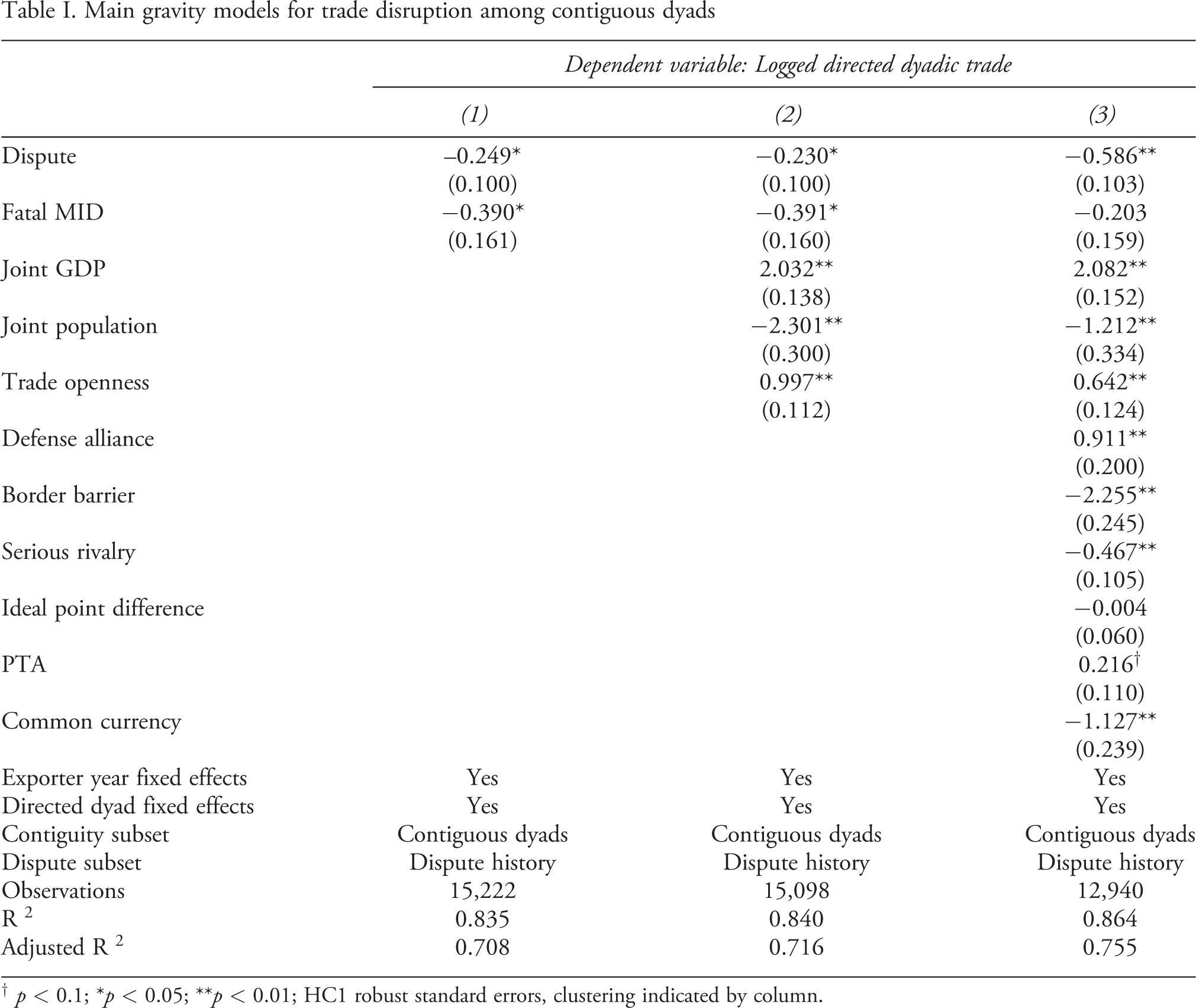
The results replicate both earlier work on the disruptive effects of border disputes (Simmons, 2005), and other more recent results in dyadic trade disruption, namely in the significant negative effects of a border barrier, like a wall, on trade (Carter & Poast, 2020). 13
We next evaluate the robustness of our findings to a variety of model specifications. We show in Table A.2 of the Online appendix the results in Table I are robust when we move away from using exporter-year fixed effects, and instead employ polynomial and year fixed effects time specifications. We also show in Online appendix Table A.3 that these results are consistent when we estimate these models with traditional standard errors, HC1 robust standard errors, or standard errors clustered on either the exporter or dyad, suggesting strongly that these results are not a function of overpowered measurement strategies. Furthermore, as shown in Table A.4, our primary effects remain consistent when we vary the sample of dyads included in the model, restricting to contiguous or all dyads, and to dyads with or without any history of dispute. These results suggest our main effects are not a by-product of a unique sample baseline. Finally, as we show in Table A.5, our estimates are consistent when specified on subset data from Schultz (2017), showing that predictors regarding the scope of border and territory under dispute are equally significant predictors of trade.
We are also interested in evaluating the timing of trade disruptions relative to border disputes. Two important questions deserve attention with regard to timing. The first is whether the onset of border disputes is related to the economic relations of neighboring countries. Lee & Mitchell (2012: 675) examine this issue, focusing on the role of FDI, and find that ‘monadic and bilateral FDI flows have no effect on states’ decisions to start new [territorial] issue claims’, though higher levels of FDI are associated with a reduced likelihood that territorial claims violently escalate. If trade and FDI have similar effects on the likelihood of territorial disputes, then increased trade should not significantly affect the likelihood of a border dispute.
In order to assess the potential for reverse predictability of changes in trade and dyadic dispute onset, we also tested for Granger causality in these panels. Granger causality simply tests whether one panel of data can significantly predict another, comparing two models which each include lagged observations of the predicted variable, one of which includes lagged observations of the Granger causal variable. These results indicate that across 1, 5, 10, and 20-year panel lags, dyadic disputes Granger cause trade disruption, with respective F-statistic values of 6.2 (p < 0.01), 2.3 (p < 0.05), 1.7 (p < 0.1), and 2.2 (p < 0.01). We register similar results with comparable tests of Granger causality between trade flows and alternate border disputes. While these results do not allow us to rule out reverse causality in our panel data, we argue that existing theoretical frameworks for Granger causality, and our supplementary fixed effects tests, strongly suggest reverse causality is not driving our main results.
Theoretically, Li & Sacko (2002) emphasize that firms anticipate disputes and adjust their trade patterns accordingly, as is also noted by Gowa & Hicks (2017). With regard to border disputes, one might expect the main effect of a border dispute to take place after the onset of the dispute; however, the anticipatory effect, which is likely to occur shortly preceding the onset of a dispute, limits the value of Granger causality tests, since firms are likely to begin decreasing trade prior to the official onset of the dispute. 14 That said, we recognize that there are additional reasons we may be concerned that the onset of border disputes is endogenous to trade flows. For example, increased trade between countries is associated with more positive views toward the other country, which may reduce the likelihood of dispute escalation (Kleinberg & Fordham, 2010). To address this concern, we include a control for the enmity between the countries using a measure of rivalry and also a measure of preference similarity, in addition to our directed dyad fixed effects which would capture any dyad-invariant relations between the countries. We also seek to address potential endogeneity concerns by using a series of lags ranging from one to 20 years. This approach also has the added benefit of shedding light on a second time-related question, which is how long the effects of a border dispute persist. As we show in Table A.1, the effects of a border dispute remain significant for at least ten years, though they become insignificant at 20 years. These results give us greater confidence that border disputes are associated with declining trade, and that the onset of a border dispute is not simply endogenous to trade flows. 15 This is particularly strong evidence given the results we register with appropriate fixed effects and standard error clustering in our main models, which are not accommodated in Granger causality tests.
Alternate disputes and trade diversion
Main gravity models for trade diversion among dyads
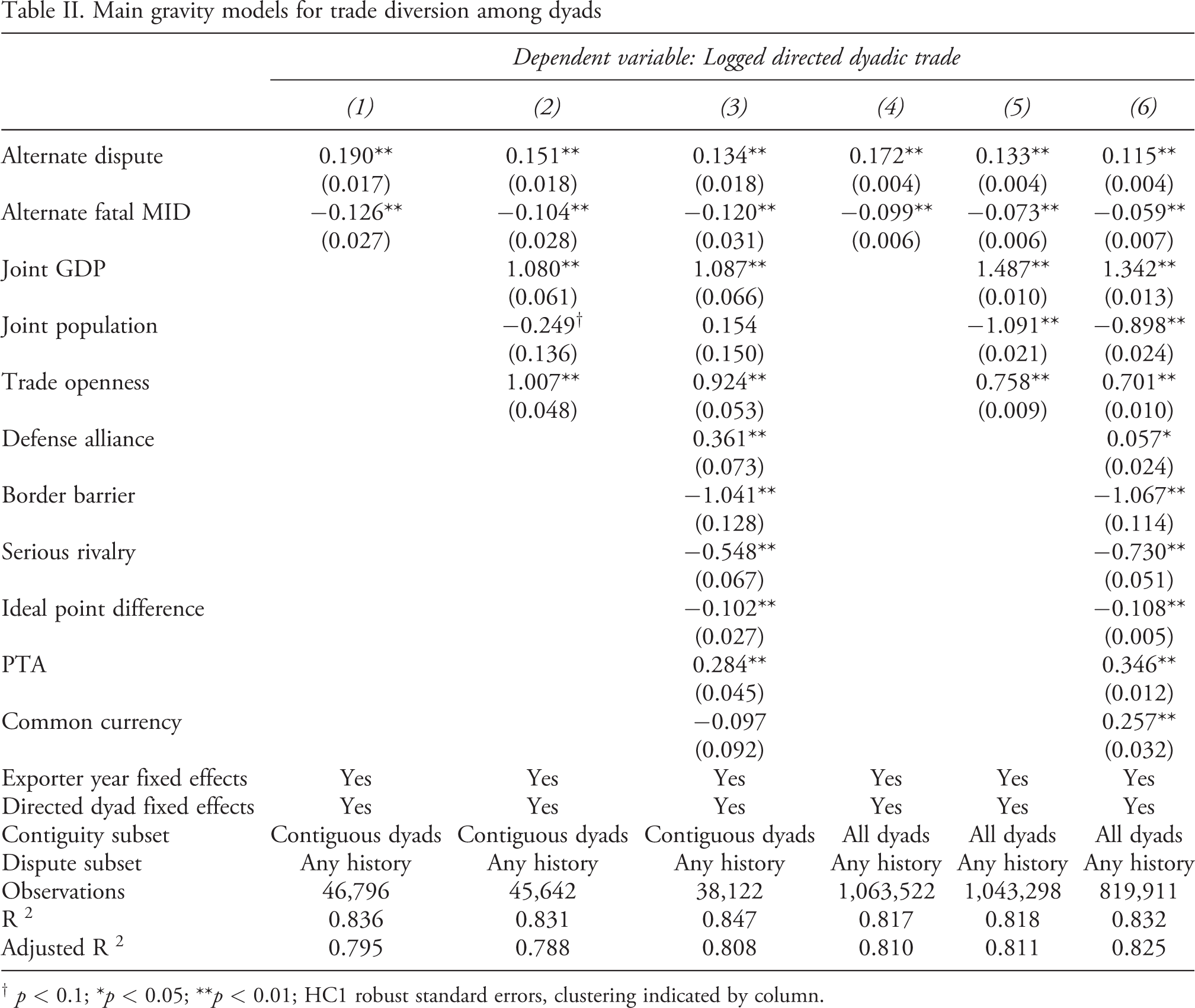
In contrast to the effect of border disputes, we find that fatal militarized disputes have a negative and significant effect on third-party trade. This suggests that there is a qualitative difference in the disruptive effects of these two types of disputes. Whereas our results show that firms and countries facing border disputes are able to offset lost dyadic trade by increasing trade with non-disputing third parties, this is not the case with fatal militarized disputes. In our models with only contiguous dyads, each alternate fatal militarized dispute is associated with 11% lower trade (Model 3). We obtain a smaller estimate of 6% lower third-party trade in the expanded model for all dyads (Model 6).
When comparing our competing hypothesis, it is clear that Hypothesis 3 is not supported, and that the results are consistent with Hypothesis 4, suggesting that the disruptive forces of fatal militarized disputes lead to broader political and economic risks that outweigh firms’ and countries’ ability to offset foregone bilateral trade through trade diversion. These effects are robust to a broad number of alternative specifications. As we show in Table A.6 in the Online appendix, the positive effects of alternate border disputes are consistent when we drop the exporter-year fixed effects and use polynomial year terms, year fixed effects, and a wide range of variable lags. In Table A.7, all of our primary results remain consistent when specified with traditional standard errors, HC1 robust standard errors, and standard errors clustered on exporter or dyad levels. Furthermore, as we show in Table A.8, all of our primary effects remain consistent and significant when we vary the sample of dyads included in the model. This includes varying the sample across models, specifying samples of dyads that are, or are not, contiguous (contiguity), and that have or have not had any history of disputes (dispute history). Finally, as we show in Table A.9, our alternate dispute predictors remain significant and comparable when we specify a binary indicator for any alternate border dispute or alternate fatal MID, as compared to the count variable in our main specifications.
Conclusion
Our findings confirm the disruptive effects of border disputes, showing that the joint gains afforded to countries sharing a mutually recognized border are lost when that border is legally disputed. Even after controlling for militarized disputes, we find that border disputes disrupt trade between disputing parties. However, our results show that these losses are not zero-sum, as we find that actors are able to offset economic loses of border disputes through trade diversion to non-disputing states. While some have argued that lost trade between disputing parties creates a strong incentive to resolve disputes, countries’ ability to increase third-party trade when facing a border dispute suggests that the incentives to resolve such disputes are likely weaker than previously thought. While our research adds to the growing literature in international relations that studies the costs of border disputes and trade disruption (Simmons, 2005; Schultz, 2015; Carter & Goemans, 2018), these results provide a note of caution regarding the palliative incentives of lost bilateral trade during border disputes.
By contrast, we find that countries experiencing fatal militarized disputes are generally unable to offset foregone bilateral trade. While both border disputes and fatal militarized disputes are associated with trade disruption between the disputing parties, fatal militarized disputes appear to cause broader upheaval and are associated with lower bilateral and third-party trade. From one perspective, this result is surprising since we might have expected firms and states to have more need for trade diversion when facing fatal militarized disputes compared to border disputes. On the other hand, fatal militarized disputes are likely to cause greater political and economic uncertainty, which is consistent with lower overall trade, and may even disrupt the underlying productive processes which precede cross-border trade flows. The fact that we find that border disputes and militarized disputes have opposite effects on trade diversion highlights the importance of examining both the type of dispute and the type of trade flows that are affected when studying conflict and trade.
Our findings yield both hopeful and troubling implications for international political stability and economic relations. That a fatal militarized dispute is associated with significant economic loses between the disputing parties, which are not offset through third-party trade, supports the argument that states are economically better off when they avoid or resolve those disputes. There are thus strong economic incentives for states to resolve militarized disputes. By contrast, the economic consequences of border disputes push in opposite directions, and can be interpreted through divergent frames. Given that countries can offset losses from border disputes, it suggests that such disputes do not inhibit the overall ability of a country, or its firms, to engage in international business, which is positive news from an economic growth and development perspective. Conversely, this means states have less incentive to resolve these disputes, potentially contributing to the prolonged duration of many border disputes.
These results and implications leave open several avenues for future research. First, while our results show that trade diversion can offset the costs of border disputes to disputing parties, our methodological framework limits the degree to which we can explore where this diverted trade flows. In this respect, future work should leverage alternate methodological instruments – notably network analysis – to examine where trade diversion takes place as a result of other border disputes in the trading network. Second, and by extension, the nuances of different kinds of border disputes should be leveraged for heterogeneous effect estimation in future analyses on trade disruption and diversion. Namely, as border disputes vary qualitatively (e.g. whether the disputed border is a result of colonial legacies or longstanding armed conflict), these qualitative differences should be explored with respect to their effects on the magnitude and breadth of disruptive and diversionary effects on trade.
Footnotes
Replication data

Acknowledgements
We thank David Carter, Michael Kennwick, Dorothy Kronick, Patrick Shea, Paul Poast, Austin Wright, and Huei-Jyun Ye for valuable feedback and assistance on this project. We are also grateful to the numerous people who shared feedback and suggestions on earlier versions of this article. We also thank Emma Guard for her assistance on the project.