




Abstract
This paper studies the delay partial synchronization for mutual delay-coupled Boolean networks. First, the mutual delay-coupled Boolean network model is presented. Second, some necessary and sufficient conditions are derived to ensure the delay partial synchronization of the mutual delay-coupled Boolean networks. The upper bound of synchronization time is obtained. Finally, an example is provided to illustrate the efficiency of the theoretical analysis.
Introduction
The Boolean network (BN) model is proposed by Kauffman, which mainly describes the gene regulatory network and the biological system. 1 In recent years, this model is widely used in the biology system, the physical system,2,3 and so on. BN model is the discrete-time system, which is based on digraph.4,5 In BN, the state of each gene is 0 or 1 at a certain moment. The state of each node at the next moment is determined by the states of the other nodes. The relationship between two nodes is the logical operation, which include AND, OR, NOT, and XOR. It is difficult to calculate and analyze in logical domain.
Semi-tensor product (STP) is a new matrix multiplication by which logical operations are converted to algebraic operations and BN is converted to the linear system. 6 The STP has become a basic tool to study the BN. 7 Classical control theories and methods can be used to describe and study BNs. In recent years, BN has become a research topic in the field of the automation and control. Ding et al. (2018) and Cheng et al. (2018) used the randomly generated BN to study the distribution of gene regulation models,8,9 study the controllability of the BN, 10 study the complete synchronization of BN, 11 design a variable structure controller to stabilize the BN, 12 study the sufficient and necessary conditions for synchronization of the switched BN with pulse, 13 study the optimal control problem of Boolean control networks, 14 discuss the relationship between the sensitivity of updating rules of BNs and the distribution of smoothness.
Synchronization is one of the natural phenomena which shows that the states of the two systems can eventually reach consensus. Synchronization is a basic characteristic of the complex systems, which exists in natural and artificial systems. 15 In past years, there were other research results, for example, synchronization of neural networks via pinning control,16–18 function projective synchronization of the complex networks,19–21 outer synchronization between two hybrid-coupled delayed networks, 22 synchronization of the delay partial differential systems with coupled neutral-type, 23 synchronization of the systems with different orders, 24 and robust synchronization control for chaotic systems with fractional-order. 25 With the rapid development of the system biology, BN is one of the important models for studying biological system and gene regulation network. 26 Synchronous control for BN is one of the research topics.27,28 Synchronization of the BN is extensively applied to many fields, such as gene regulatory network, physics, and biology.29,30 In recent years, synchronization of the BN has achieved many research results, such as the delay synchronization of the temporal BNs, 31 the anti-synchronization of the two-coupled BNs, 32 the synchronization of the mutual-coupled temporal BNs, 28 the synchronization of the BNs via state feedback controller, 33 and the synchronization of the switched BNs. 12
There is a coupling relationship between systems, and delay is an unavoidable phenomenon.8,34 Most of the BN models did not consider mutual delay-coupled. In recent works, one of the new BNs called mutual-coupled temporal BNs has been proposed, which can be used to describe biological systems (Wei and Xie, 2018).28,35 The synchronization of mutual-coupled BNs has been investigated (Wei and Xie, 2018).10,28 So far, most of the research on synchronization of BNs focuses on complete synchronization. In some cases, not all variables of the systems can be completely synchronized, which show partial synchronization. 36 Partial synchronization has a wide range of applications, such as communication, seismology, and neural networks. 37 The interconnected (mutual-coupled) systems show the phenomenon of delay which is called the delay coupling. There are few reports on delay partial synchronization of mutual delay-coupled BNs. Therefore, the delay partial synchronization of the mutual-coupled BNs is an important research content. In this paper, the mutual-coupled BNs are presented, and the delay partial synchronization for mutual delay-coupled BNs is investigated.
The rest of this paper is arranged follows. In section “Preliminaries,” some basic concepts of STP are introduced. In section “The model description,” two mutual delay-coupled BN models are presented. In section “Main results,” the main results are deduced. In section “Illustrative example,” an example is given to verify the validity of theoretical analysis. Finally, section “Conclusion” gives the conclusion of this paper.
Preliminaries
In this section, the necessary concept and basic properties of STP are introduced. The contents of STP are introduced in detail in the literature.35,38
Definition 1
The operation of the STP of two matrices

where
Remark 1
When
Lemma 1
The STP has the following properties: 33
Let
If
Some STP operations are summarized as follows: 33
The swap matrix


2.
Lemma 2
A logical function is
The model description
Two mutual delay-coupled BN models with n nodes are described as follows


where
Definition 2
Two mutual delay-coupled BNs (2a) and (2b) are said to achieve delay partial synchronization if there is a positive integer

holds for all
Setting


where
Main results
Before presenting some sufficient and necessary conditions for delay partial synchronization, some auxiliary results are introduced.
Lemma 3
Let
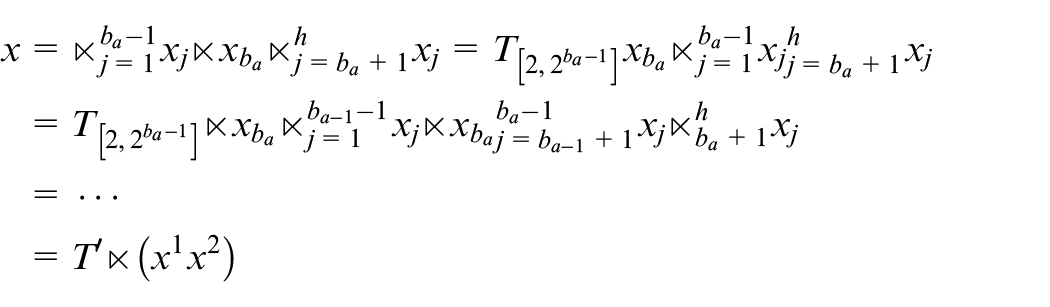
Proof
According to formula (1)
Since

which completes the proof of Lemma 3.
Lemma 4
Let


where
Proof
According to the dummy matrix, the following equation holds


According to formula (3a), we can yield

According to formulas (3a) and (3b)

By iterating formula (9)

According to formulas (10) and (8), formula (4) holds. The proof process of formula (5) is similar to that of formula (4). The proof of formula (5) is omitted.
The algebraic criterion of the delay partial synchronization for BNs (2a) and (2b) is presented in the following.
Theorem 1
Logic functions (2a) and (2b) can be transformed into algebraic representations of the network models (3a) and (3b). Then, the BNs (2a) and (2b) realize delay partial synchronization if and only if there is a positive integer z such that

Proof
Sufficiency: when formula (11) holds for z, then

According to formula (11)

so

Therefore, formulas (2a) and (2b) can achieve the partial synchronization.
2. Necessity: according to Definition 2, if formulas (2a) and (2b) achieve delay partial synchronization, there exists a positive integer k such that

which shows the validity of formula (11). The proof is completed. In the following section, the upper bound k is derived by another synchronization method.
Let a new variable

In the following, the preliminary criterion is presented.
Lemma 5
If
Proof
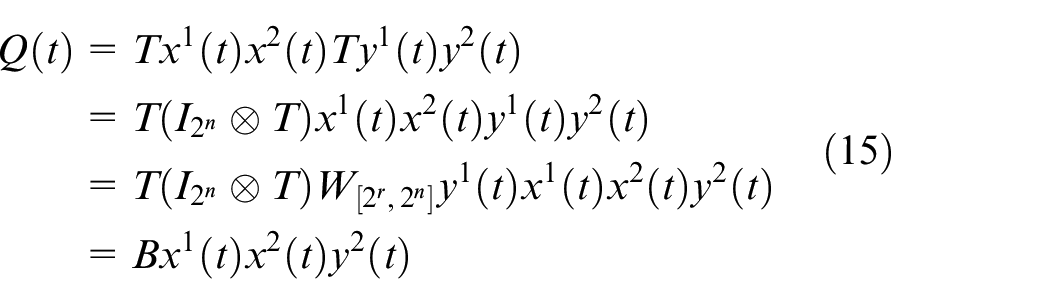
The map from
which shows
By setting
Remark 2
On the basis of Lemma 5, two mutual delay-coupled BNs can achieve delay partial synchronization from the kth time step, then
Remark 3
If BNs (2a) and (2b) achieve delay complete synchronization, then

Therefore

So, in the following,
Theorem 2
The delay partial synchronization occurs between BNs (2a) and (2b) if and only if there exists a positive integer k such as

If k0 is the smallest positive integer and satisfies formula (16), then

Proof
The proof is composed of sufficiency and necessity:
Sufficiency: if formula (16) holds for some positive integer k, then

Since

So, BNs (2a) and (2b) achieve delay partial synchronization.
2. Necessity: it holds based on the proof of sufficiency obviously.
In the following section, the validity of formula (16) is illustrated.
The matrix

Then, there is an integer

which can show

This contradicts the minimality of
Illustrative example
The time delay may take different values as required. In this example, model delay and synchronization delay are 1. However, the model delay and synchronization delay may take other values as required. We consider the following BNs (19a) and (19b) as mutual delay-coupled BNs


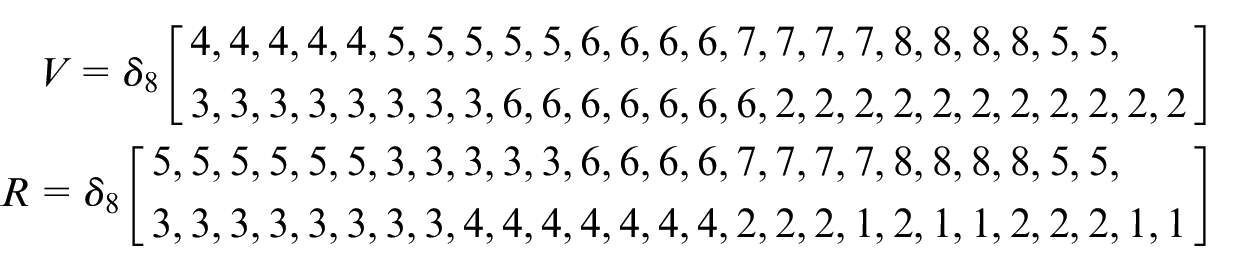
where


where
So

Therefore, the nodes
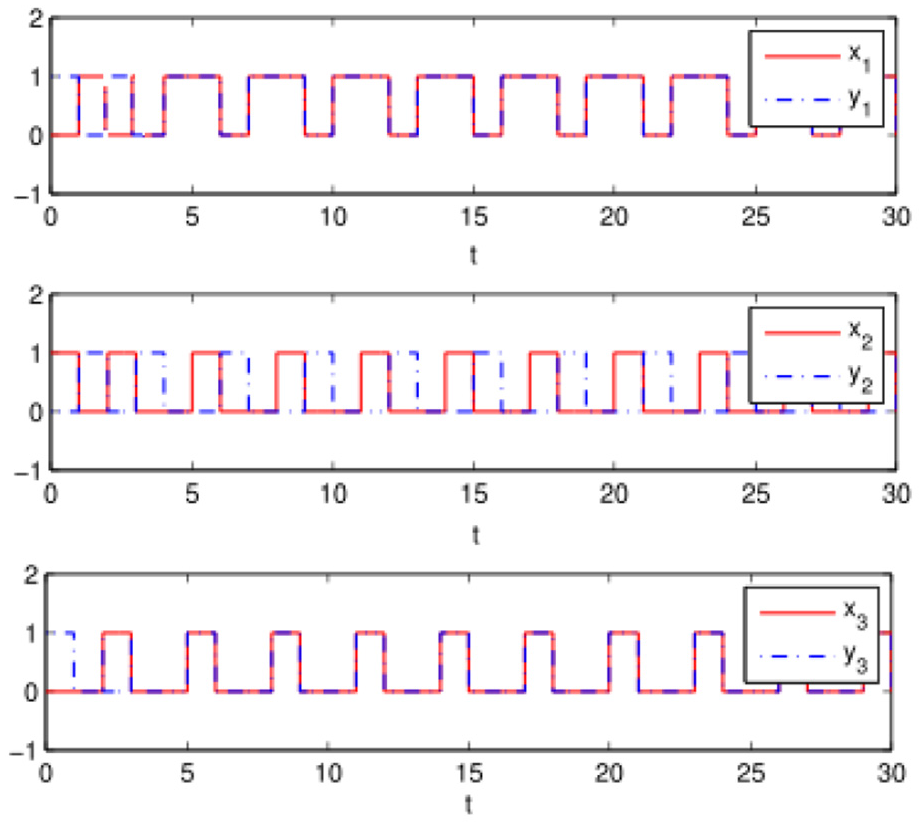
The state trajectory of the BNs (19a) and (19b) when
Conclusion
In this paper, the mutual delay-coupled BNs have been proposed, and the delay partial synchronization of mutual delay-coupled BNs has been investigated based on the STP technique. The sufficient and necessary conditions for delay partial synchronization of the mutual delay-coupled BNs have been established. The mutual delay-coupled BNs realize the delay partial synchronization when STP of the nodes of the two mutual delay-coupled BNs is equal. The upper bound of time for delay partial synchronization has been deduced by recursive relation and proof by contradiction. An example is provided to verify the efficiency of the theoretical analysis.
Footnotes
Declaration of conflicting interests
The author(s) declared no potential conflicts of interest with respect to the research, authorship, and/or publication of this article.
Funding
The author(s) disclosed receipt of the following financial support for the research, authorship, and/or publication of this article: Q.W. got support from the National Natural Science Foundation of China (no. 61640223), the 13th five-year science and technology project of Education Department of Jilin Province (no. JJKH20190646KJ), and the Doctor Start-up capital of the Beihua University (no. 199500096); C.-J.X. got support from the key scientific research projects in the Science and Technology Development Plan of Jilin Province (no. 20160204033GX); and W.S. got support from the 13th five-year science and technology project of Education Department of Jilin Province (no. JJKH20190647KJ).
