




Abstract
This study focuses on multi-criteria decision-making theory to pick vacuum cleaner available in the Indian market. The choice of a vacuum cleaner for the customer is an intricate decision-making, the problem involving multiple conflicting criteria such as the cost of the vacuum cleaner, dust bag capacity, power consumption, and so on. The simple methodology based on the Technique for Order Preference by Similarity to Ideal Solution method is presented to choose a vacuum cleaner. Based on data collection, eight different companies/brands are considered with 26 diverse models. The ranks of the different alternatives obtained with Technique for Order Preference by Similarity to Ideal Solution method are presented. The result reveals that the alternative Karcher WD 3.200 comes out to be the first choice, followed by Karcher WD 4.200 and Eureka Forbes Sensi. This approach based upon multi-criteria decision-making is very beneficial for retailer and wholesalers to help consumers/customers for purchasing their product/item or the consumer itself can make use of this simple methodology. The established proof-of-concept could be further used in the different domains of engineering, science, and management, wherein the decision-making could be biased and vague.
Keywords
Introduction
Multiple attribute/criteria decision-making is aspired to achieve best alternative from the various alternatives in which various (contradictory) objectives are to be attained concurrently. Decision-making is the procedure of picking a probable alternative from all the accessible alternatives. It can be generally divided into two groups: multi-objective decision-making (MODM) if the problem is related to design and multi-criteria decision-making (MCDM) if the problem is related to selection. These methods have four major parts: the first part is alternative, second part consists of attribute/criteria, third part includes weight or relative significance of every attribute/criteria, and fourth part measures the performance of alternatives with respect to the attribute/criteria. 1 There are various different methods of MCDM, but Technique for Order Preference by Similarity to Ideal Solution (TOPSIS) method was commonly used for selection purpose. Athawale and Chakrabortyin 2 and Dawal et al. 3 applied a TOPSIS method–based approach to machine tool selection. Similarly, Dawal et al. 3 applied MADM for CNC (computer numerical control) machine tool selection in a flexible manufacturing company based on the integration of the improved, consistent fuzzy analytical hierarchal process (AHP) and TOPSIS method. Furthermore, Kumar et al. 4 used AHP and VIKOR methods to optimize CNC machining parameters. Wu et al. 5 applied a group decision-making framework based on the fuzzy VIKOR approach for machine tool selection with linguistic information. Reportedly, in 2016, 6 the researchers developed an MADM method for robot selection with fuzzy sets. Amin and Rajhans 7 coupled AHP with TOPSIS method for prioritization and selection of suppliers in the automotive industry. Moreover, Karim and Karmaker 8 used AHP and TOPSIS method to select a machine tool. In the selection of eco-friendly material, the fuzzy TOPSIS method was used by the researchers. 9 In the investigation conducted by Özcan et al., 10 AHP coupled with TOPSIS method was used for maintenance strategy selection in hydroelectric power plants. Furthermore, TOPSIS has been used for risk evaluation, 11 best World XI test cricket team, 12 selection of fertilizer, 13 green supplier from the agricultural food industry, 14 manufacturing information system to outsource projects, 15 and so on. Similarly, Zhang et al. 16 and Sanjay et al. 17 used TOPSIS method based on a fuzzy covering approximation space to select biological nano-materials and to select best composite laminate, respectively.
From the above-reviewed literature, it has been analyzed that the applications of TOPSIS method are huge and it was widely applied for the selection of optimal processes and items/products used in engineering applications and in common use. In this study, an attempt has been made for using the TOPSIS method for the selection of a suitable appliance on the basis of various acknowledgeable associated attributes.
Selection of the benchmark
A vacuum cleaner, also referred as hoover or sweeper, has been selected in the study as an engineering benchmark that uses an air pump, usually a centrifugal pump, to generate a partial vacuum to suck up dirt and dust from floors and other surfaces. The tiny particles then get trapped in bags, canisters, or filters and are disposed off in the later stage. These are used in homes and in industries, and are present in a variety of sizes and models such as wheeled canister models for home use, small battery-powered hand-held devices, domestic central vacuum cleaners, large stationary industrial appliances, and self-propelled vacuum trucks for removal of contaminated soil.
Vacuum cleaner, nowadays, has become an essential part of the home. There are various companies in India such as LG, Samsung, Eureka Forbes, Philips, and so on that are supplying a number of different models of vacuum cleaner. The vacuum cleaners have a range of criteria connected with it, for example, cost of vacuum cleaner (CVC), dust bag capacity, power consumption, weight, and its size. There are two types of criteria: beneficial and non-beneficial, for example, the dust bag capacity of the vacuum cleaner must be larger, which is a beneficial criterion and its cost must be lower, which is a non-beneficial criterion. In the present study, five attributes are considered for vacuum cleaner selection:
CVC in Indian Rupees (INR);
Dust bag capacity of vacuum cleaner (DBCVC) in liters;
Power consumed by vacuum cleaner (PCVC) in watts;
Weight of vacuum cleaner (WVC) in kg; and
Dimensions of vacuum cleaner: length (L), width (W), and height (H) considered in terms of volume of the vacuum cleaner (VVC) in cm3.
The CVC, PCVC, WVC, and VVC are non-beneficial criteria and the DBCVC is a beneficial criterion. So, the TOPSIS method is used to select the best alternative from 26 available alternatives.
Order preferences by similarity: ideal solution TOPSIS method
This method was initially anticipated by Hwang and Yoon 18 in 1981. The additional expansion of the method was completed by Yoon in 1987, and further expansion was done by Hwang et al. 19 This method is based on the notion that the elected preference/alternative ought to have the minimum divergence from the positive perfect solution and the maximum geometric divergence from the negative perfect solution. This technique includes determining the weights, normalizing, geometric distance, and ideal solutions of every attribute. In MCDM problems, normalization is performed because the parameters or criteria are frequently of incompatible dimensions. The TOPSIS technique has the provision of compensatory methods that permit trade-offs among attributes, where a bad effect of one attribute is compensated by the best result of another attribute. The step-by-step methodological procedure used in this method is illustrated below:20,21
Step 1: Select the object and work on analyzing the parameters on which the various attributes/characters could be quantified or recognized.
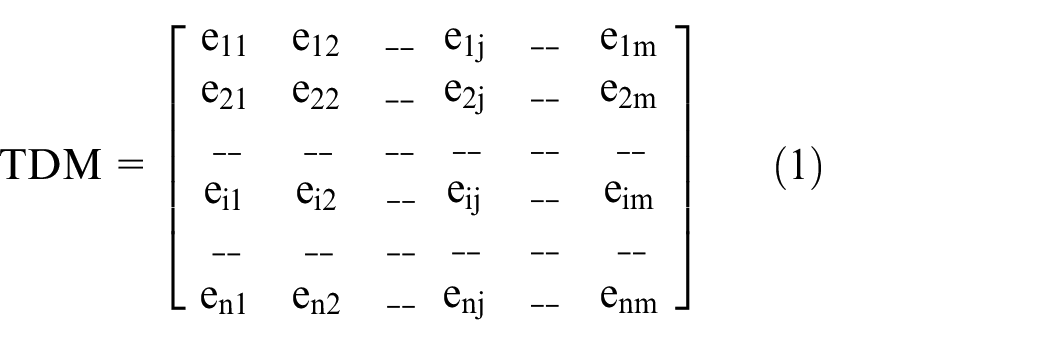
Step 2: Equation (1) displays the decision matrix used in the methodology. Here, every row has been assigned to one alternative or option (vacuum cleaner), and every column to one attribute (cost, dust bag capacity, power consumption, etc.). Consequently, input of the matrix will be equal to the total number of cells available in the same and is represented by eij (eij: i = alternatives “n” and j = attributes “m”).
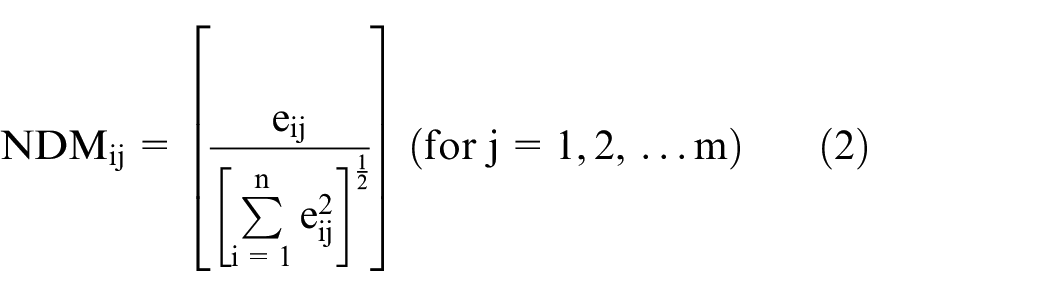
Step 3: Apply vector normalization for the formulation of normalized decision matrix “NDMij,” refer equation (2)
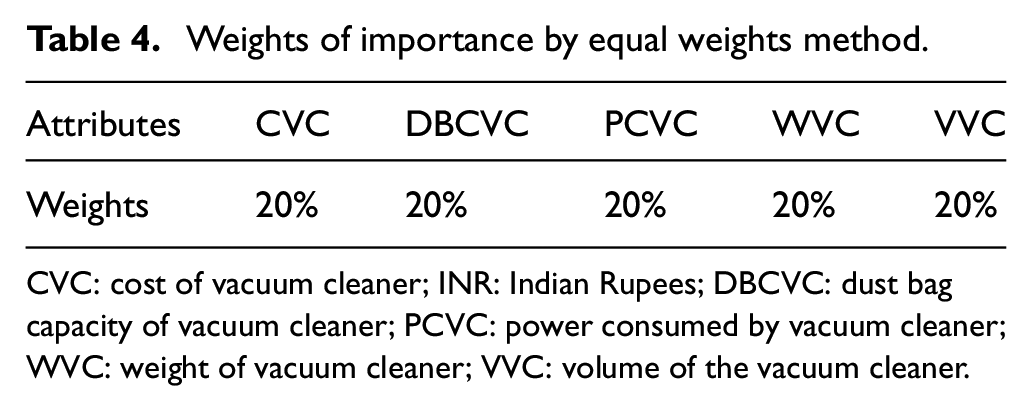
Step 4: In this step, weights are required to be allocated to the selected attributes, which are the function of the objective/object. Noticeably, the magnitude of the weight allocated would be further a function of its importance with regard to the output performance. Moreover, aggregation weight allocated to the attributes, such as wj (where
Equal weights method
In this method, weights of the selected input attribute can be calculated by using equation (3)

Since, in the current study, numbers of attributes are five, therefore, the weight assigned to the individual attribute is given in equation (4)

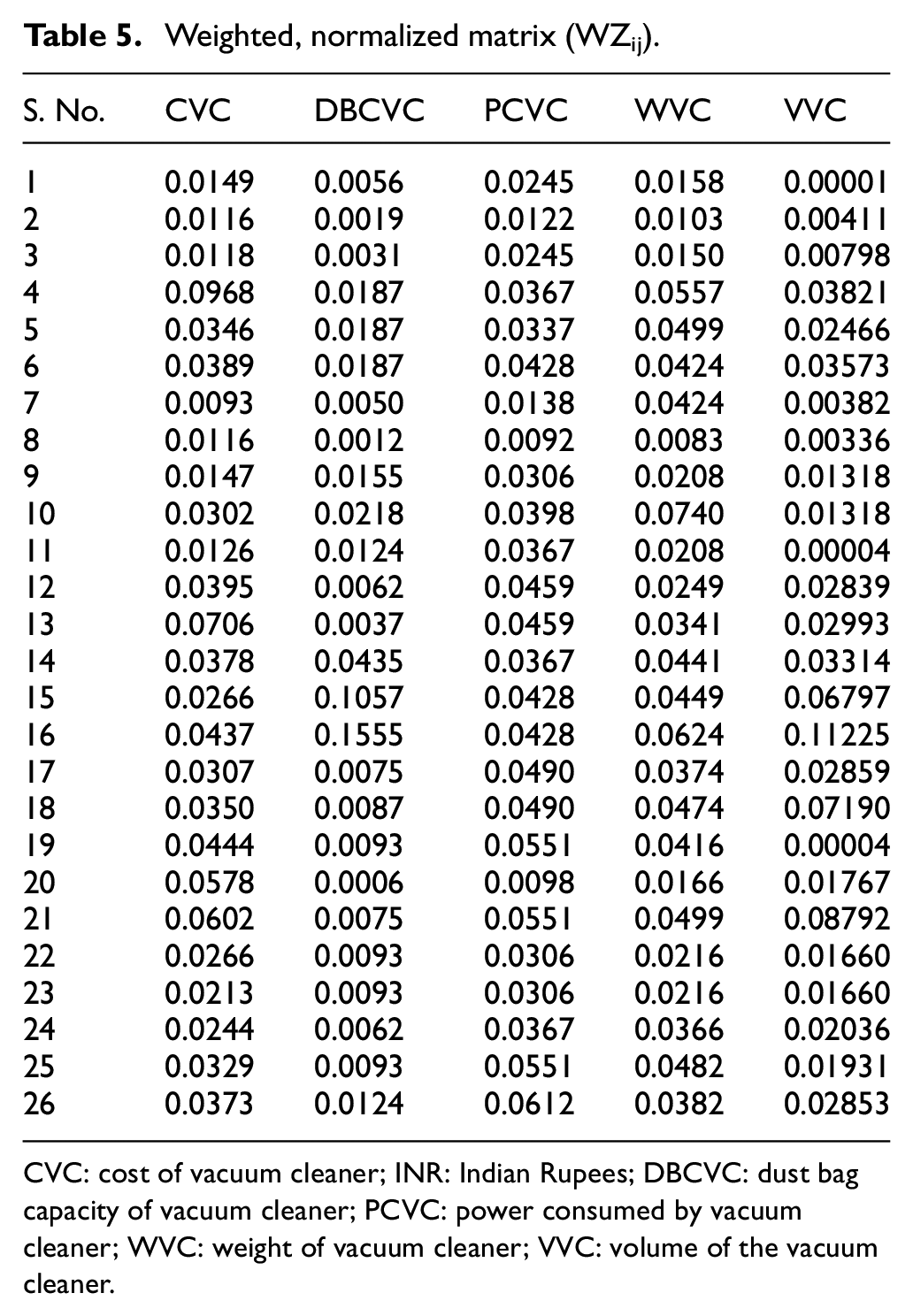
Step 5: In order to find out the normalized matrix component (WZij), the elements presented in the columns of NDMij are multiplied with their respective assigned weight, wj. As a result, the new normalized matrix WZij will be

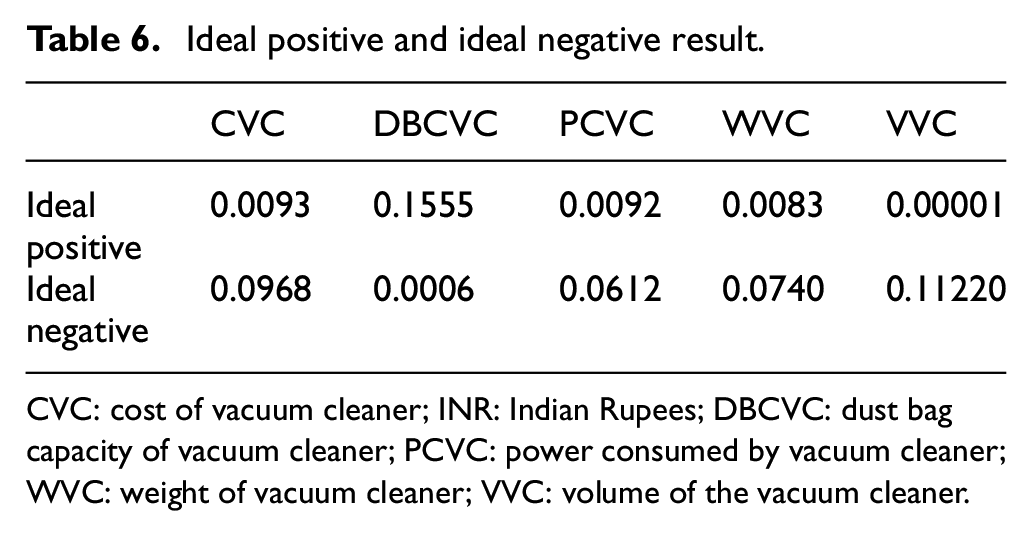
Step 6: In the step, it is necessary to find out the idealbest (Z+) and idealworst (Z–) solutions with the help of equations (6) and (7), respectively. Here, Z+ and Z–solutions are the utmost and least value among all alternative values, respectively


where j and j′ are concerned with the beneficial (m) and non-beneficial attributes (m′), respectively.
Step 7: Formulate separation measures (Sm) with the help of Euclidean distance, as given in equation (8)


Step 8: Calculate the relative closeness (R-Ci) of all alternatives representing the ideal solution by following equation (10)

Step 9: In this step, a set of alternatives is produced in the descending order, per the value of R-Ci representing the most favored and least favored feasible solutions.
Selection of vacuum cleaner:decision-making with TOPSIS
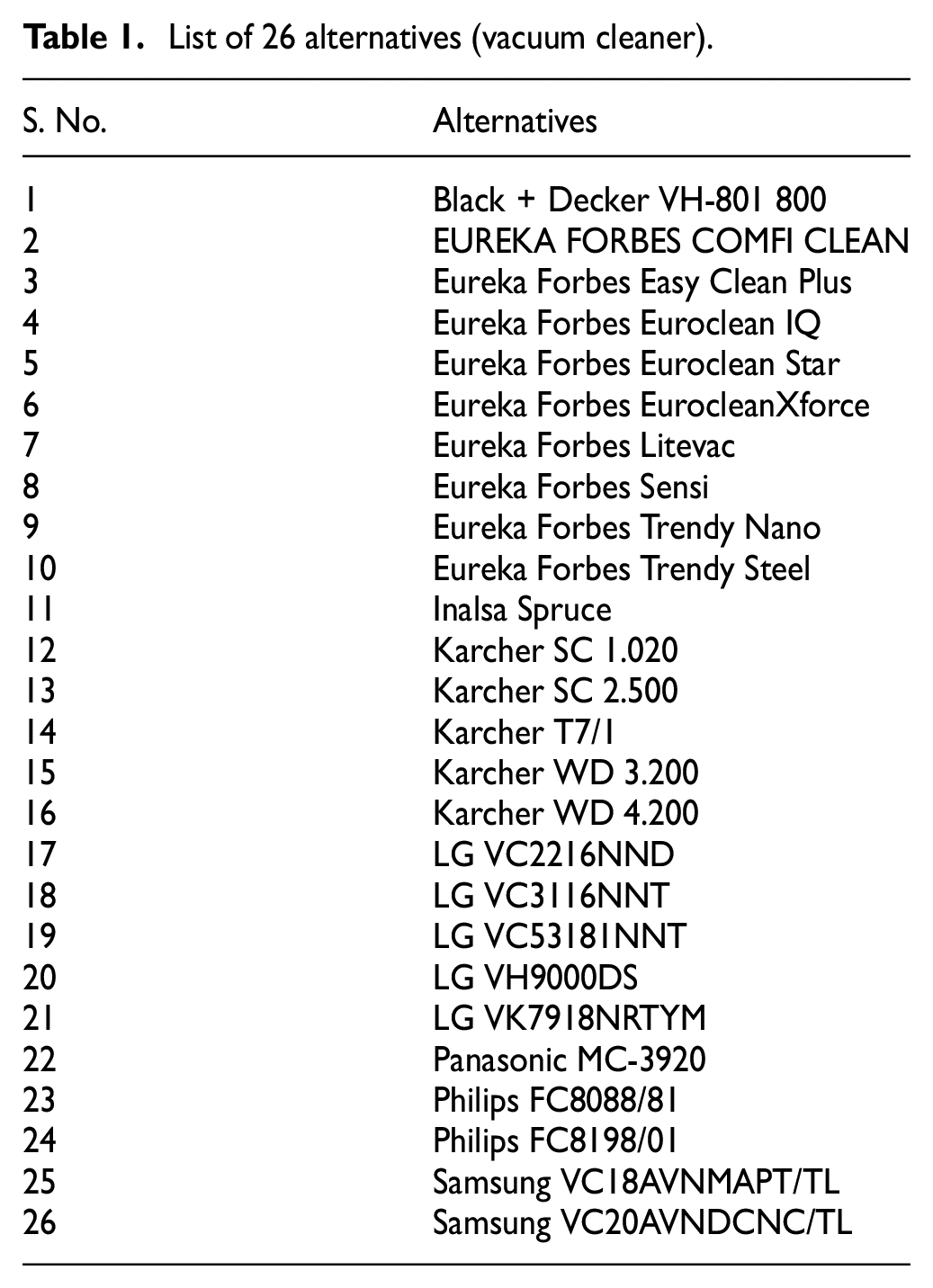
Different alternatives of the vacuum cleaner with serial number are shown in Table 1. The data collected on the vacuum cleaner for eight companies with 26 different models are tabulated in Table 2 along with the five different criteria considered (CVC, DBCVC, PCVC, WVC, and VVC) as per steps 1 and 2 and this Table 2 is the decision matrix of different alternatives/criteria for selection of the best alternative as per equation (1). The criterion considered in selecting the appropriate vacuum cleaner having different units and dimensions, which are first normalized; the NDMij obtained by equation (2) for TOPSIS method is shown in Table 3. The CVC, PCVC, WVC, and VVC are “the lower the better” type attributes, that is, non-beneficial and the DBCVC is “the higher the better” type attributes, that is, beneficial. The calculations have been recorded up to the fourth level of the decimal.
List of 26 alternatives (vacuum cleaner).
Decision matrix for 26 vacuum cleaners.
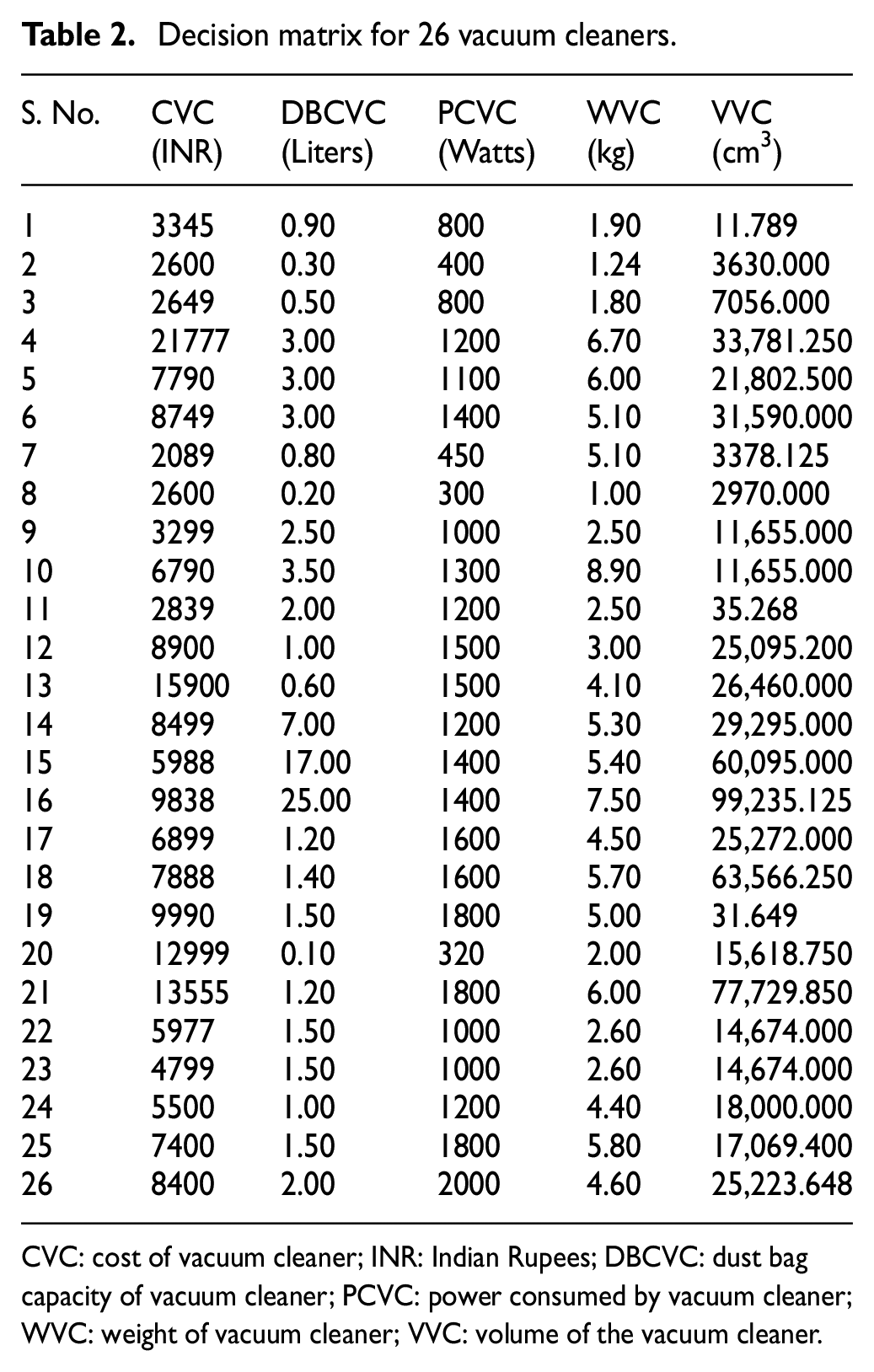
CVC: cost of vacuum cleaner; INR: Indian Rupees; DBCVC: dust bag capacity of vacuum cleaner; PCVC: power consumed by vacuum cleaner; WVC: weight of vacuum cleaner; VVC: volume of the vacuum cleaner.
Normalized decision matrix (NDMij).
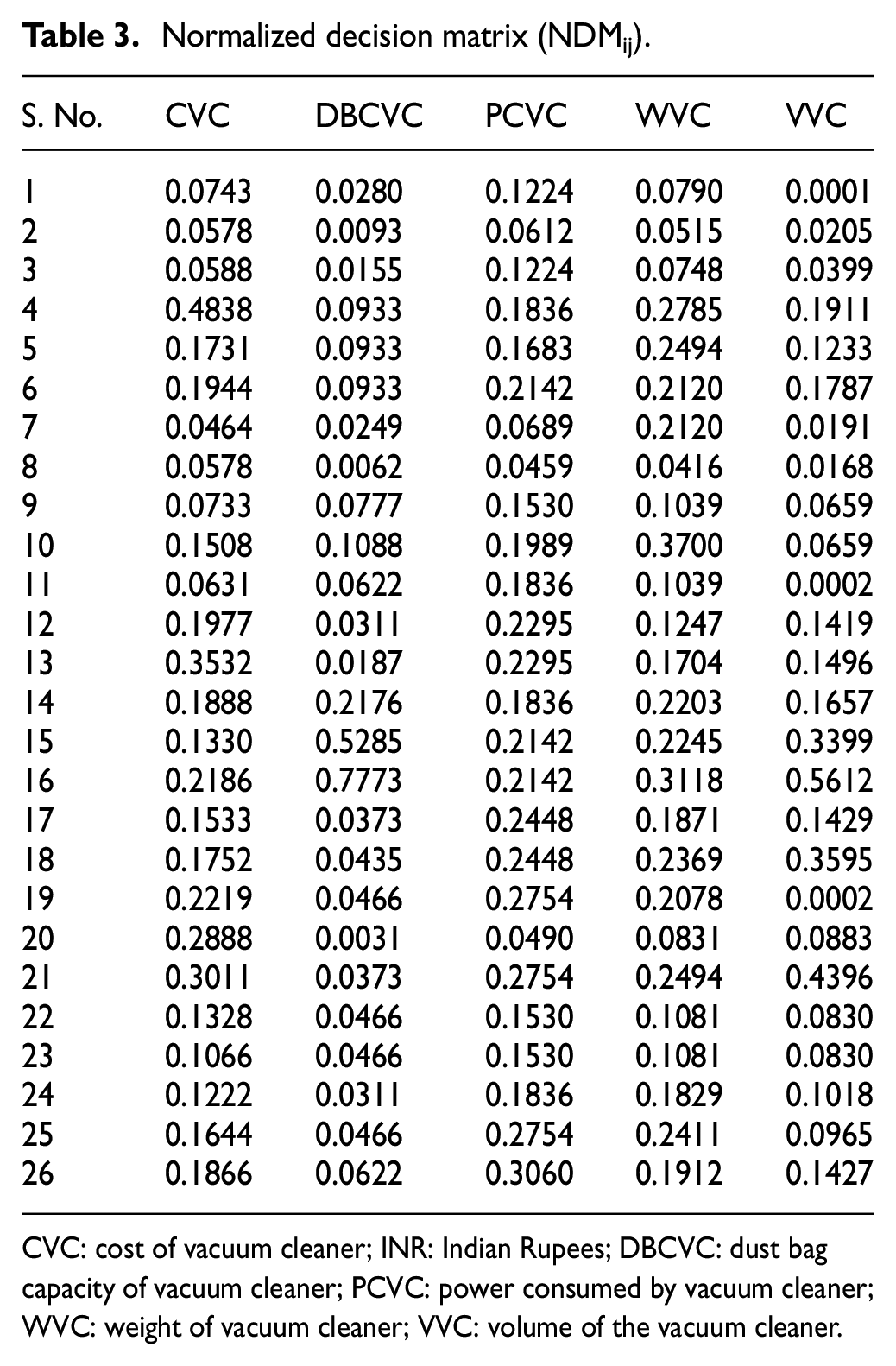
CVC: cost of vacuum cleaner; INR: Indian Rupees; DBCVC: dust bag capacity of vacuum cleaner; PCVC: power consumed by vacuum cleaner; WVC: weight of vacuum cleaner; VVC: volume of the vacuum cleaner.
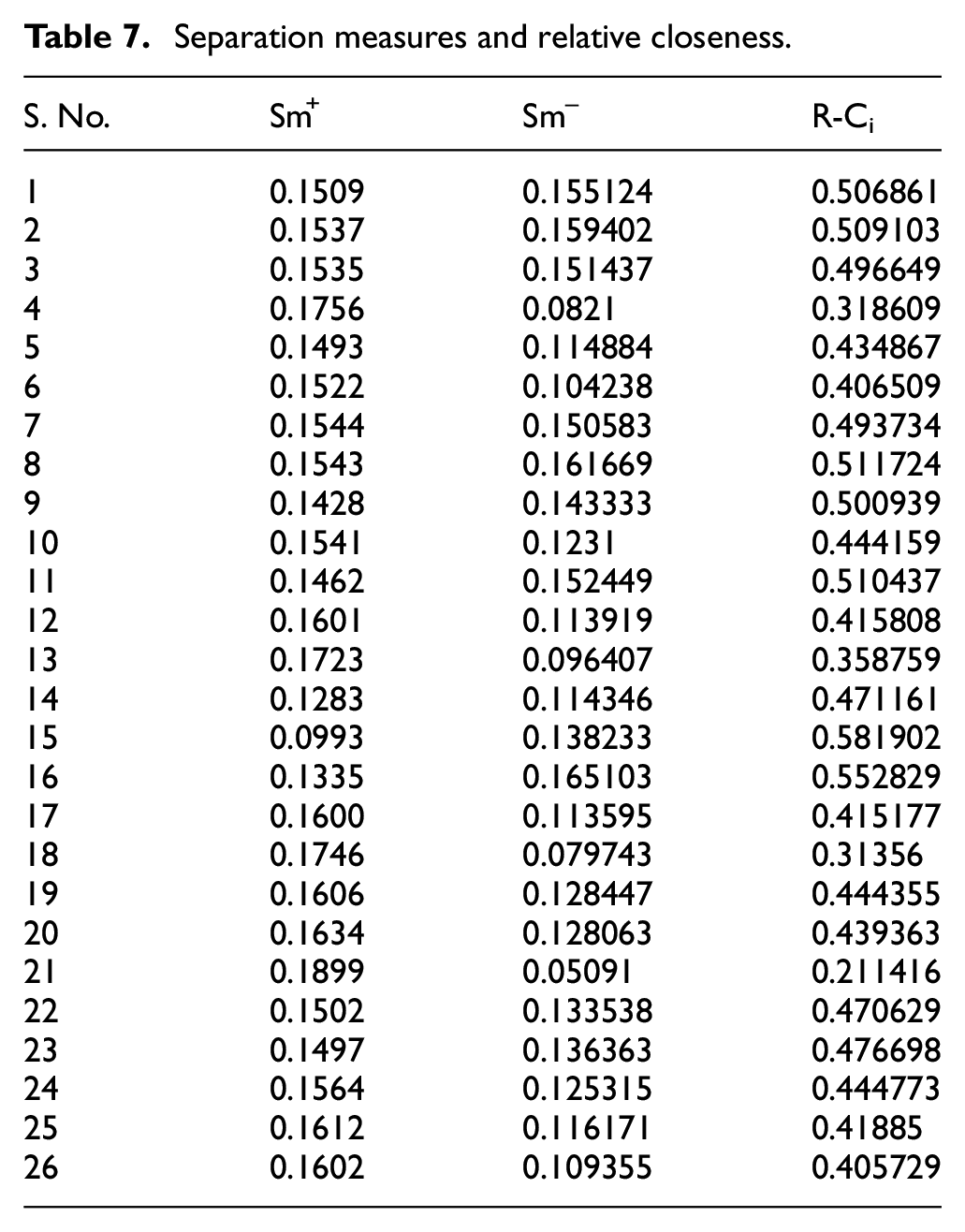
The step 4 is applied to calculate the weights of importance to the attributes by equal weights method. In this study, a weight assigned to each attribute, as determined in equation (3), is 0.20, refer Table 4. The values of the weighted normalized matrix WZij, from equation (5), are given in Table 5. The Z+ and Z– solutions are tabulated in Table 6. Furthermore, the values for Smi+ and Smi– of all criteria with respect to their Z+ and Z– solutions have been calculated to define the R-Ci, refer Table 7. The rank of each alternative from 1 to 26 in the descending order is given in Table 8 as per step 9 along with their original serial number in the decision matrix and the name of the company/ brand.
Weights of importance by equal weights method.
CVC: cost of vacuum cleaner; INR: Indian Rupees; DBCVC: dust bag capacity of vacuum cleaner; PCVC: power consumed by vacuum cleaner; WVC: weight of vacuum cleaner; VVC: volume of the vacuum cleaner.
Weighted, normalized matrix (WZij).
CVC: cost of vacuum cleaner; INR: Indian Rupees; DBCVC: dust bag capacity of vacuum cleaner; PCVC: power consumed by vacuum cleaner; WVC: weight of vacuum cleaner; VVC: volume of the vacuum cleaner.
Ideal positive and ideal negative result.
CVC: cost of vacuum cleaner; INR: Indian Rupees; DBCVC: dust bag capacity of vacuum cleaner; PCVC: power consumed by vacuum cleaner; WVC: weight of vacuum cleaner; VVC: volume of the vacuum cleaner.
Separation measures and relative closeness.
Rank of alternative and relative closeness in descending order.
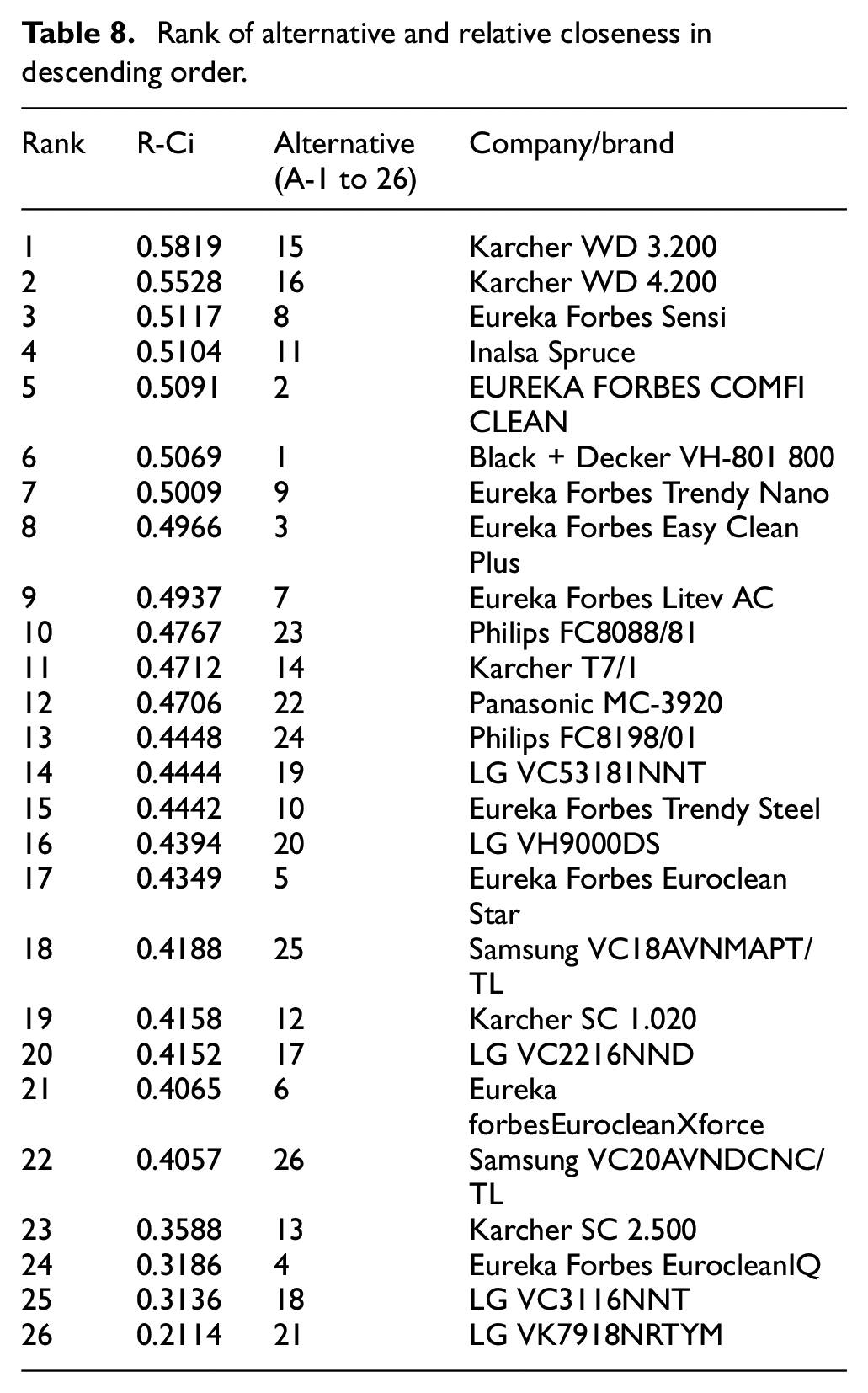
Table 8 shows that the alternative (Karcher WD 3.200) placed at serial number 15 in the decision matrix with R-Ci value of 0.5819 comes out to be at rank 1 and becomes the first choice of the decision-maker (retailer/wholesaler/consumer itself) to purchase it and the alternative Karcher WD 4.200 placed at serial number 16 in the decision matrix with R-Ci value of 0.5528 comes out to be at rank 2 and becomes the second choice and similarly the alternative Eureka Forbes Sensi placed at serial number 8 in the decision matrix with R-Ci value of 0.5117 comes out to be at rank 3 and becomes the third choice for the decision-maker. In the same way, the other alternative choices can be seen from the Table 8.
The graph in Figure 1 shows the R-Ci achieved for each alternative, that is, vacuum cleaner with TOPSIS method. From Figure 1, it is clear that R-Ci is maximum for alternative number 15; as a result, it comes out to be the first choice for the decision-maker and graph also shows that the second choice comes out to be alternative number 16. The other rankings can also be seen from Figure 1.
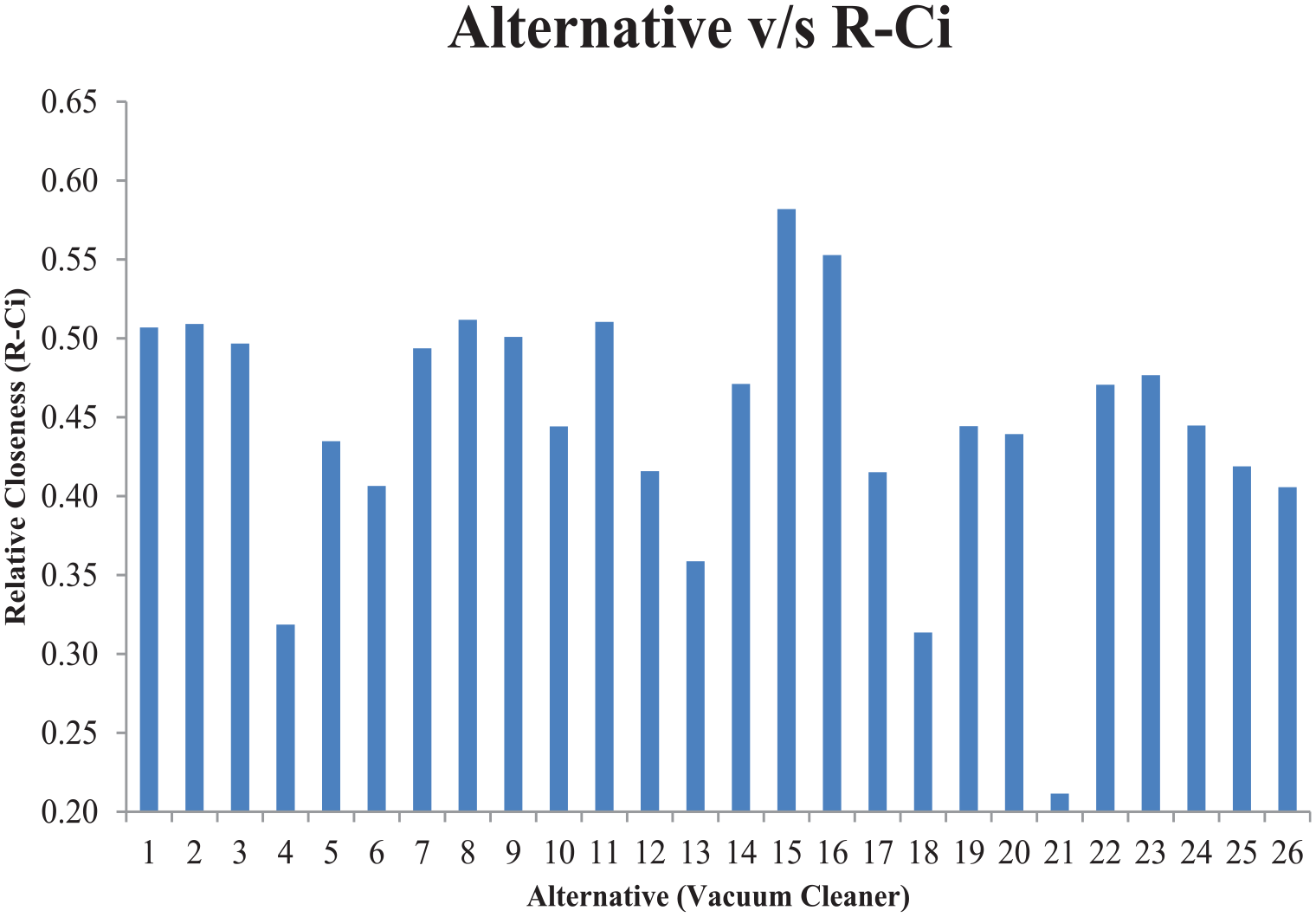
Plot for relative closeness achieved for each alternative.
Table 8 also shows the rank of the company: the first rank goes to Karcher as two models are placed in the first two positions and the second position goes to Eureka Forbes and third to Inalsa. The last rank was assigned to alternative LG VK7918NRTYM placed at serial number 21 in the decision matrix with R-Ci value 0.2114. These ranks are obtained with the equal assignment of the weights of importance to the criteria and these ranks can change if the decision-maker alters the weights of importance. 1
With this, the top five alternatives based upon the TOPSIS method along with their attribute values, with equal weights method, have been shortlisted. Figures 2–6 show price, dust bag capacity, power consumption, weight, and VVC along with error bars with standard error.
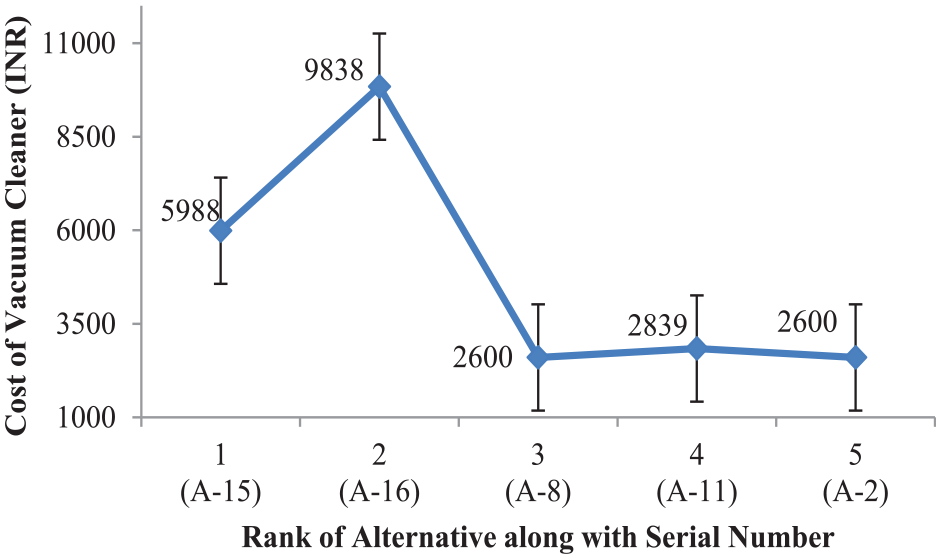
Plot for the cost of top five alternatives.
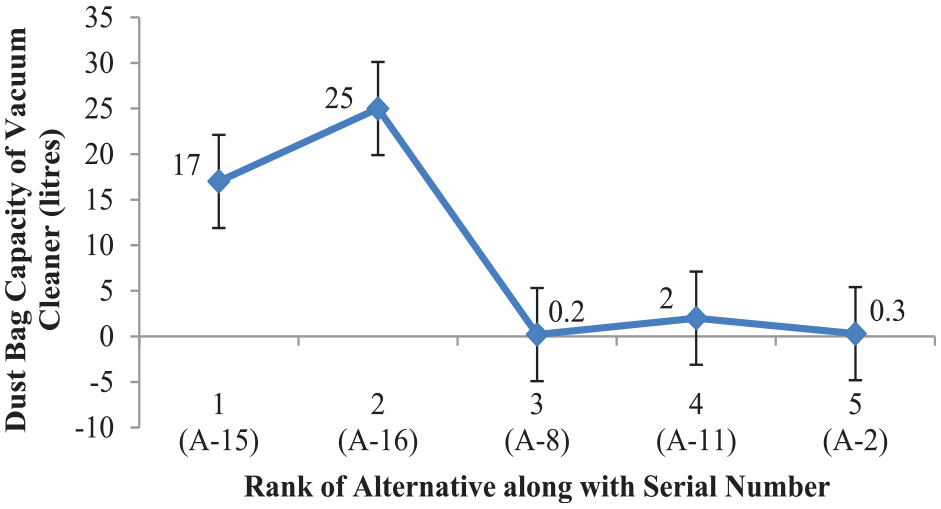
Plot for the dust bag capacity of top five alternatives.
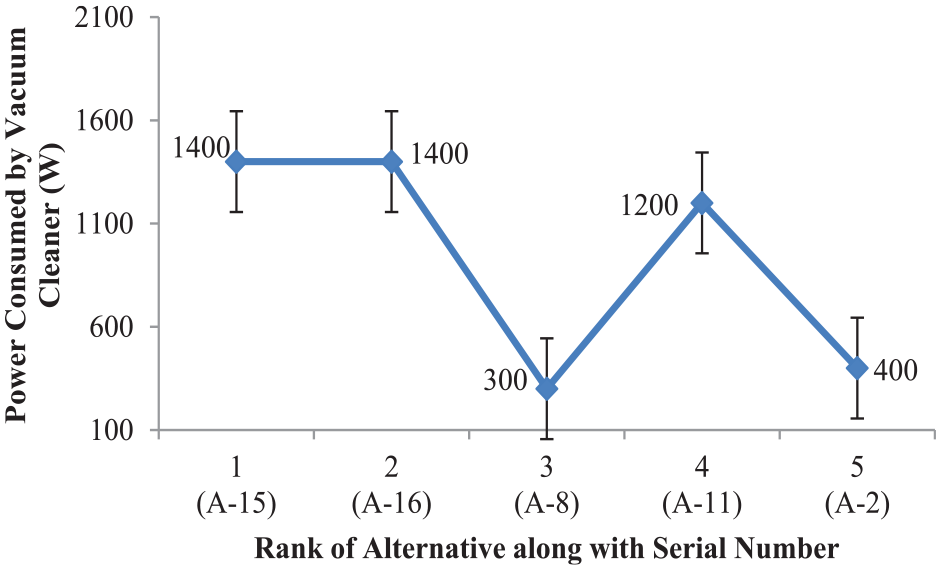
Plot for the power consumption of top five alternatives.
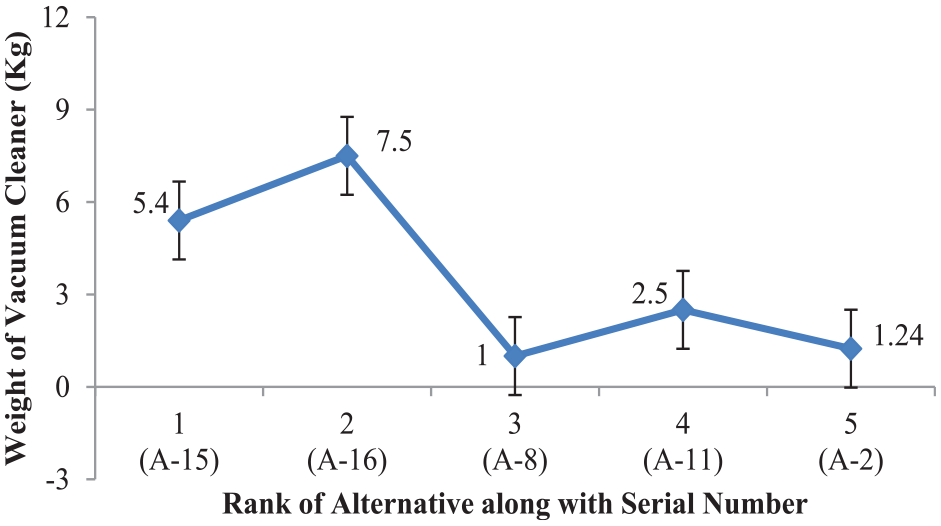
Plot for the weight of top five alternatives.
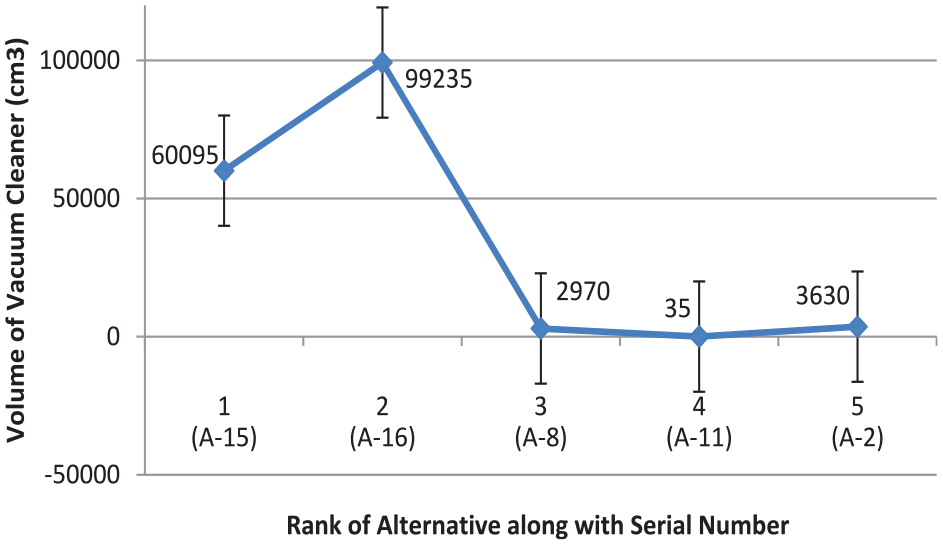
Plot for the volume of top five alternatives.
Therefore, in a situation when the very first alternative to rank 1 is not available in the market to purchase, then, the next alternative can be picked, and similarly if the second is also not available.
Conclusion
TOPSIS method was applied to choose the best alternative of vacuum cleaner from 26 models of eight different companies. Results reveal that the Karcher WD 3.200 with INR 5988, dust bag capacity 17 L, volume 340 × 350 × 505 mm3, weight 5.4 kg, and power consumption 1400 watts comes out to be the first choice for the decision-maker. This model has other features such as cord length of 4 m, permanent type bag, and 1-year warranty. The Karcher WD 4.200 comes out to be the second choice, followed by Eureka Forbes Sensi. This MCDM approach based upon TOPSIS method is easy to put into practice as it could be performed on Microsoft Office. Consequently, this approach of MCDM can be successfully involved in explaining several kinds of decision-making glitches when numerous criteria/alternatives are present. This approach based upon MCDM is very beneficial for retailer and wholesalers to help consumers/customers for purchasing their product/item or the consumer itself can make use of this simple methodology.
The methodology applied in this study to select the best alternative of the vacuum cleaner is very effortless, coherent, and has superior computational competence. As a result, it can be easily applied to select other engineering applications such as selection of machine tools, robots, supplier selection, material selection, cutting tools and lubricant selection, and so on. Furthermore, a fuzzy TOPSIS-based methodology might be established to assist the professionals to take decisions in the occurrence of vague and imperfect data and the effect of variation of weights of importance can be studied.
Footnotes
Declaration of conflicting interest
The author(s) declared no potential conflicts of interest with respect to the research, authorship, and/or publication of this article.
Funding
The author(s) received no financial support for the research, authorship, and/or publication of this article.
