



Abstract
Supplier selection problem has a major regard in terms of the performance of supply chain of an organization. Several various approaches were proposed, including the analytic hierarchy process, fuzzy analytic hierarchy process, and fuzzy technique for order of preference by similarity to ideal solution (TOPSIS). However, no comparative researches of these three approaches related to the supplier selection problem have been carried out. Therefore, this article proposes a methodology to evaluate the selected approaches. The evaluation was conducted based on the following factors: agility during the decision process, computational complexity, number of criteria and alternative suppliers, and adequacy in supporting a group decision. The methodology is implemented in X company. The results show that each approach is convenient to the supplier evaluation and selection problem, particularly toward the support of group decision-making and uncertainty modeling. In terms of computational complexity, analytic hierarchy process performs better than fuzzy TOPSIS and fuzzy analytic hierarchy process. Moreover, the fuzzy TOPSIS approach is better suited to the supplier evaluation and selection in terms of agility during the decision process, the number of criteria and alternative suppliers, and the adequacy in supporting a group decision.
Keywords
Introduction
Supply chain management (SCM) is a methodology for incorporating the agent elements of an association in order to make a general arrangement for the association, while fulfilling the administration approach and maintaining the greatest conceivable reduction in cost based on an unreliable understanding of the conditions of a rival association. Purchasing commands a critical position in many associations because the acquired parts, segments, and supplies commonly msake up 40%–60% of the offers of its items. The most essential procedure of the purchasing function is the productive choice of suppliers, because doing so brings about noteworthy investment funds for the association. The issue of supplier choice can be essentially characterized as picking the correct supplier(s) for certain items or material gatherings. In many organizations, the cost of crude materials and parts can represent up to 70% of the aggregate costs. In this way, keeping in mind the end goal of decreasing the costs identified with supply acquisition, organizations should work with suppliers that give the required material speedier, less expensive, and superior to contenders. Supplier determination utilizes an expansive correlation of suppliers with a typical arrangement of criteria and measures. It can be seen as a multi-criteria issue, which incorporates both quantitative and subjective criteria. Numerous criteria have been utilized as a part of the supplier selection issue. With a specific end goal of choosing the best supplier, two inquiries should be made. The first is what criteria will be utilized as a part of a supplier assessment? The second is what are the evaluation approaches that will be utilized to choose a supplier?
Several articles propose the use of different evaluation multi-criteria decision-making (MCDM) approaches to the supplier selection problem. These approaches are analytic hierarchy process (AHP), 1 technique for order of preference by similarity to ideal solution (TOPSIS), 2 ViseKriterijumska Optimizacija I Kompromisno Resenje (VIKOR), 3 elimination and choice translating reality (ELECTRE), 4 preference ranking organization method for enrichment evaluation (PROMETHEE), 5 data envelopment analysis (DEA), 6 simple additive weighting (SAW), 7 simple multi-attribute rating technique (SMART), 8 case-based reasoning (CBR), 9 and multi-attribute utility theory (MAUT), 10 approaches based on fuzzy set theory, 11 and so on.
It is obvious from the literature review that earlier studies have mostly focused on MCDM approaches such as AHP, fuzzy AHP, and fuzzy TOPSIS for supplier evaluation. However, it is necessary to do a comparative assessment of various approaches with regard to supplier selection. To overcome this gap, the aim of this article is to implement a comparative analysis of such methods conducted to the supplier evaluation and selection problem. A comparison of the methods will then be made considering the following factors: agility during the decision process, computational complexity, adequacy with regard to changes in alternatives or criteria, agility in terms of the decision process, computational complexity, the number of criteria and alternative suppliers applied, and the adequacy in supporting group decision-making.
The remainder of this article is structured as follows. In section “Literature review,” a literature review of the supplier selection criteria and approaches is described. Section “Methodology” details the methodology applied in this article as well as some concepts related to fuzzy set theory and the AHP, fuzzy AHP, and fuzzy TOPSIS approaches. Section “Case study” provides the results of applying the proposed approaches to a real case study. Section “Comparative analysis of proposed approaches” introduces the comparative analyses of the proposed approaches. Finally, some concluding remarks and areas of future work are provided in section “Conclusion and future work.”
Literature review
Two particular significance issues are considered to select the best supplier. One is what criteria should be used and the other is regarding the method used to compare suppliers. Weber et al. 12 demonstrated that the selection of a supplier is complicated by the different criteria that should be considered. Meanwhile, various approaches can be utilized to do a selection. Analyses of the two cases of supplier evaluation and selection have attracted the interest of much academics and purchasers since the 1960s.
Criteria in supplier selection
Chen et al. 13 recommended that there are important variations in terms of financial standing and technological capability among auto assemblers, indirect suppliers, and direct suppliers, but no diversity in delivery, flexibility, relationship, reliability, quality, and price. In most of the researches listed, the major criteria for supplier evaluation and selection are the quality, service, cost, delivery, relationship, capacity, customer requirements, and flexibility. Studies published from 1995 to 2005 focused on quality, finance, service, delivery, relationships, technology, facility, management, and products. Environmental escalated in 2007, becoming primary supplier evaluation and selection criteria. Risk factors involved in supplier selection also gained prominence in 2007. Benefits, opportunities, communication, and risks (BOCR) constitute the tools needful for gauging a supplier evaluation and selection.
Supplier selection approaches
Weber et al. 12 classified quantitative methods to supplier evaluation and selection into four different categories: linear weight models, mathematical programming models, statistical/probabilistic methods, and integrated methods. Their researches showed that with linear weighted models, a weight is typically assigned on each criterion (typically determined subjectively), where the total score for each supplier is summed based on the performance of each criterion multiplied by the weight. Mathematical programming models involve linear, mixed integer, and goal programming. Statistical approaches involve methods such as a stochastic economic order quantity (EOQ) model and cluster analysis. Other methods such the fuzzy set theory, integrated methods, and activity-based costing are used. AHP is one of the approaches used under a linear weighted model. AHP is a MCDM approach that supplies a scope that can work using multiple criteria. Numerous studies have been carried out in the area of supplier selection using AHP.14–22 Interpretive structural modeling (ISM) is also another technique, which was implemented for supplier evaluation and selection. The objective of this technique is to identify the relationships among items and build the model of problem.23,24 Min 25 and Rao et al. 26 used a multi-attribute utility method for supplier evaluation and selection, which is another approach for determining the relative weights of attributes. Mani et al. 27 focused on socially sustainable supplier evaluation and selection through social parameters utilizing AHP for decision-making. A new AHP approach called D-AHP has been projected to solve the supplier evaluation and selection problem by utilizing D numbers to extend the classical AHP approach. 28 Rezaei et al. 29 proposed a robust two-phased funnel methodology for selecting suppliers, along with fuzzy AHP, through which the suppliers are assessed against the main criteria and sub-criteria. Dweiri et al. 30 proposed a decision-support model for supplier evaluation and selection regarding AHP. Their proposed methodology is stated as follows: (1) Identification of the main criteria (quality, price, service, and delivery) is achieved utilizing a literature review and ranking the main criteria regarding expert opinions utilizing AHP for the start of the model. (2) The second stage in their developed methodology is the recognizing of sub-criteria and ranking them regarding the main criteria. (3) The final stage includes a sensitivity analysis conducted to inspect the robustness of a decision utilizing expert choice software.
A study by Lo and Sudjatmika 31 put forward a new fuzzy analytic hierarchy process (FAHP) for an effective assessment of suppliers using bell-shaped membership functions. According to mathematical programming models, Chaudhry et al. 32 provided a model that can help in supplier evaluation and selection with price breaks using linear and mixed binary integer programming. Some studies20,33–37 also used the above tools to solve the problem of supplier evaluation and selection. Ng 38 used a weighted linear program to construct a model that can solve the problem of supplier selection with regard to supply quality, variety, delivery, reciprocal of distance, and reciprocal of price index. The study by Van der Rhee et al. 39 provided a resultant multinomial legit model of discrete choice analysis (DCA) that can be used to determine the influence of flexibility, cost, service features, and delivery on supplier selection. Mixed-integer programming was applied by Sawik 40 and deals with the combined scheduling of customer orders and selection of suppliers for single, dual, and multiple objective suppliers. The paper by Sanayei et al. 3 proposed a model to solve MCDM problems utilizing the VIKOR method. Moghaddam 41 conducted a multi-objective optimization model to deal with the supplier selection process and optimized the number of products in a closed-loop supply chain network. The paper by Bohner and Minner 42 synchronized the problem of supplier selection; their study was formulated as a mixed-integer linear problem, which is solved using a full factorial design. Using a statistical approach, analysis of variance (ANOVA), and multivariate ANOVA (MANOVA), Swift 43 studied a single- and multi-supplier selection strategy and identified the variation among the product technical support, price, and cost. Mummalaneni et al. 44 utilized a conjoint analysis to discover the “preferences and trade-offs supplier evaluation and selection” of Chinese purchasing managers. Verma and Pullman 45 employed a DCA to check the choice of suppliers. A confirmatory factor analysis and a path analysis are used to empirically inspect the relationships among the supplier selection criteria, supplier participation of the design teams, and a continuous improvement program, customer satisfaction, and overall performance of the firm. 46 Riedl et al. 47 conducted a MANOVA for supplier selection.
Through an integrated approach, the combination of quality function deployment (QFD) and AHP was improved to select the best suppliers in a strategic manner. 48 Rouyendegh and Saputro 49 developed a robust fuzzy method with a multi-criteria group decision-making framework for suppliers to select the integrated QFD and data envelopment analysis. Karsak and Dursun 50 described a hybrid technique for suppliers to select and allocate orders. This technique integrates the multi-choice goal programming and fuzzy TOPSIS to avoid any thoughtlessness in the decision-making process. A study by Fallahpour et al. 51 aimed at utilizing a combination of AHP with multi-expression programming for introducing supplier selection and evaluation methods. Tavana et al. 52 presented a novel hybrid fuzzy MCDM method that combines an adaptive neuro-fuzzy inference system (ANFIS) and artificial neural network (ANN) to deal with the selection criteria and alternative ranking problems. Luthra et al. 22 developed a framework to evaluate the selection of potential suppliers by applying a combination of AHP and VIKOR, a multi-criteria optimization and compromise solution approach. Wan et al. 53 investigated a type of MCDM problem with two-level criteria and proposed a novel hybrid approach integrating the 2-tuple linguistic analytic network process (TL-ANP) and interval 2-tuple ELECTRE-II (IT-ELECTRE II). In the study of Li et al., 54 a conjunctive MCDM approach for cloud service supplier selection of manufacturing enterprise was developed. Neural network is used to realize the expert importance degree determination; fuzzy AHP is used to compute the subjective weight; and CRITIC (CRiteria Importance Through Inter-criteria Correlation) is used to define the objective weight. TOPSIS is used to arrange the suppliers by their weighted index-value matrix. The integration of fuzzy set theory into VIKOR, TOPSIS, and gray relational analysis (GRA) methods was thoroughly discussed by Banaeian et al. 55 The work of Jain et al. 56 displays the selection of headlamp supplier using incorporated fuzzy MCDM approaches: AHP and TOPSIS.
Methodology
In this section, an MCDM tool is illustrated to support the decision-makers in evaluating and selecting the best supplier among the list of competing suppliers. It contains four major elements: (1) the criteria used in the evaluation of all competing suppliers; (2) a list of competing suppliers and their impact on each criterion, the data of which are gathered from supplier selection experts in the purchasing department as well as through related studies; (3) the MCDM tool utilizing the three approaches, that is, AHP, fuzzy AHP, and fuzzy TOPSIS, to assist the decision-maker in comparing and evaluating the various supplier alternatives based on the gathered data regarding the company criteria and supplier benefits; and (4) a comparison between the three approaches to select the best one for the supplier evaluation and selection problem. The developed methodology is shown in Figure 1. The methodology proposed above can be executed based on the following procedures:
1. Gather the wanted data from the purchasing department, end users, and supplier selection experts in the selected company. The collected data involve the following: The most important criteria used for the evaluation process; A list of competing suppliers; Development of a scoring system for evaluation purposes; The impact of competing suppliers on all criteria and sub-criteria.
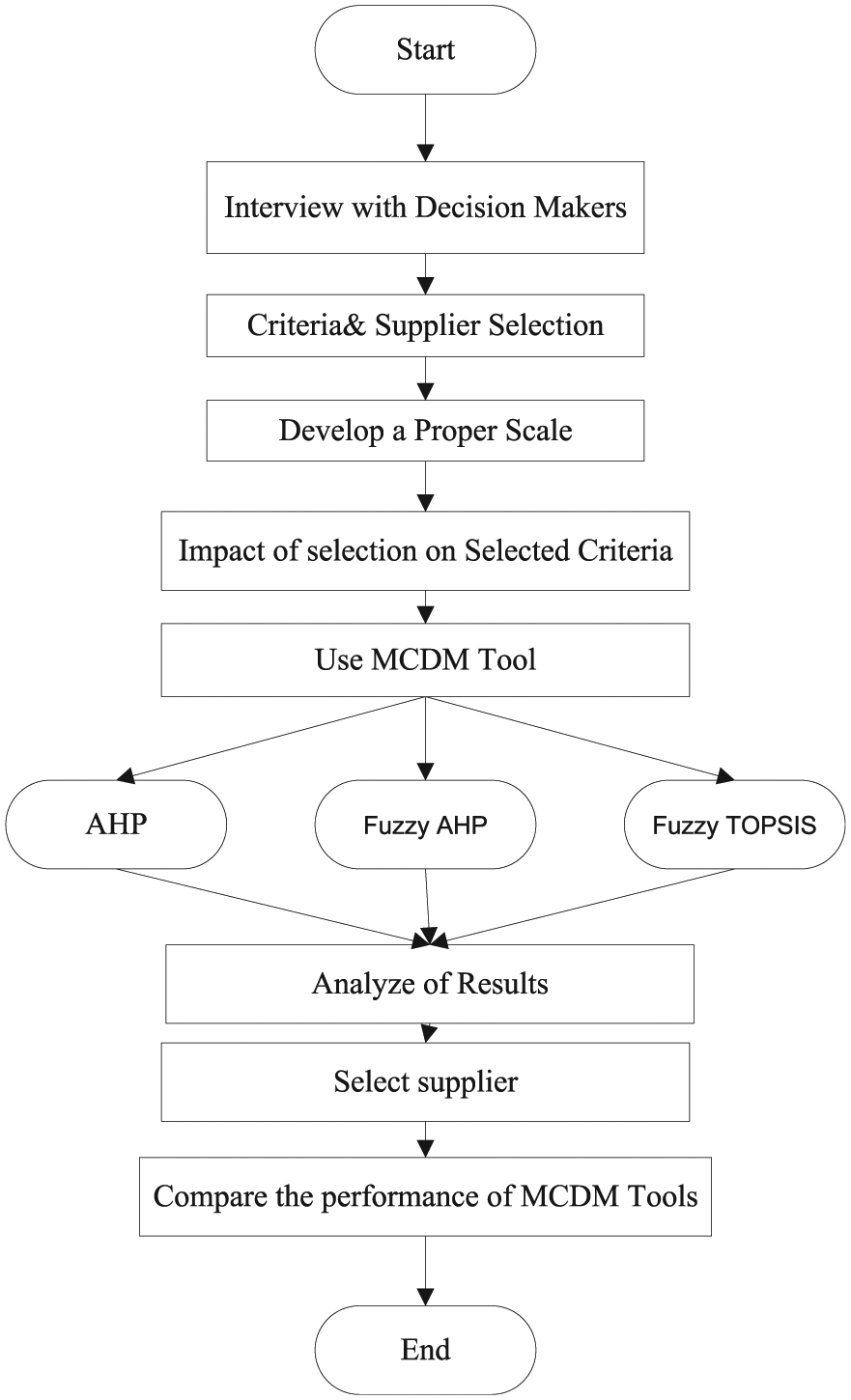
Proposed methodology flow chart.
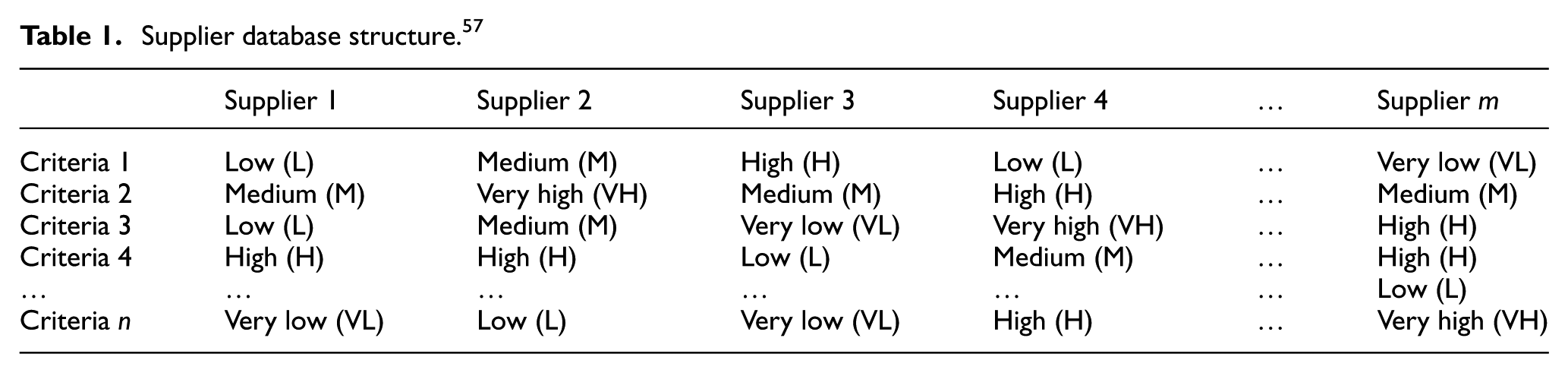
Assess the extracted criteria for each supplier using the proposed supplier database. The supplier database includes the chosen suppliers and their contributions to the selected criteria. The data in this database are gathered from the studies based on the supplier selection process, surveys distributed to candidate supplier experts, and face-to-face interviews. The obtained data from the experts are transformed into fuzzy form data based on a designed fuzzy scale to remove the subjectivity of the data for using as inputs to the fuzzy TOPSIS and fuzzy AHP. The database is structured as shown in Table 1.
2. Rank the criteria based on the expert inputs. The structured format of this procedure is shown in Table 2.
3. Run the proposed models of AHP, fuzzy AHP, and fuzzy TOPSIS using the acquired data from Tables 1 and 2 to perform the desired computations and comparisons.
4. Compare the three proposed approaches to choose the best one for the supplier evaluation and selection problem based on its adequacy regarding changes to agility during the decision process, computational complexity, number of criteria and alternative suppliers, and adequacy in supporting a group decision.
Supplier database structure. 57
Input form decision-maker for importance.

Analytical hierarchy process
The study of Nydick and Hill 1 defined AHP as an approach utilized for supplier evaluation and selection problem and included the following procedures:
Identify the criteria and sub-criteria for the assessment of suppliers;
Based on relative importance, build pairwise comparisons of the criteria in accomplishing the goal and calculate the weights or priorities of the criteria;
Identify measures, which present the accomplishment of criteria by each supplier;
Based on step 3, for suppliers, build the pairwise comparisons of the relative importance with regard to the criteria, and then calculate the corresponding weights;
Based on the results of steps 2 and 4, for each supplier, calculate the weights in accomplishing the hierarchy goal.
Fuzzy AHP approach
Let X = x1, x2, …, xm be an object set and G = g1, g2, …, gn be a goal set. According to the method by Chang, 58 each object is taken and extent analysis for each goal is performed, respectively. Therefore, m extent analysis values for each object can be obtained through equation (1)

where
The implementation of FAHP uses the following steps: 58
Step 1. The value of the fuzzy synthetic extent with respect to the ith object is defined through equation (2)

To obtain
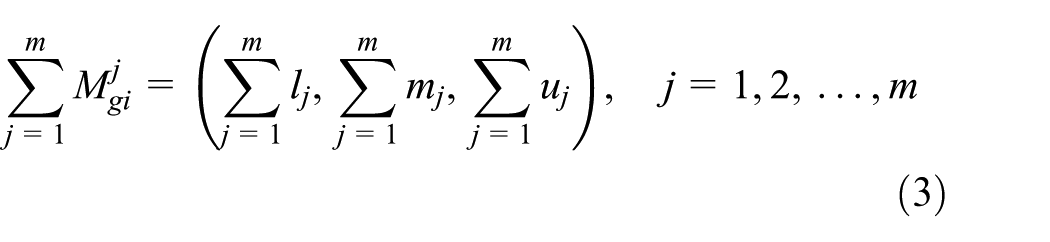
To calculate
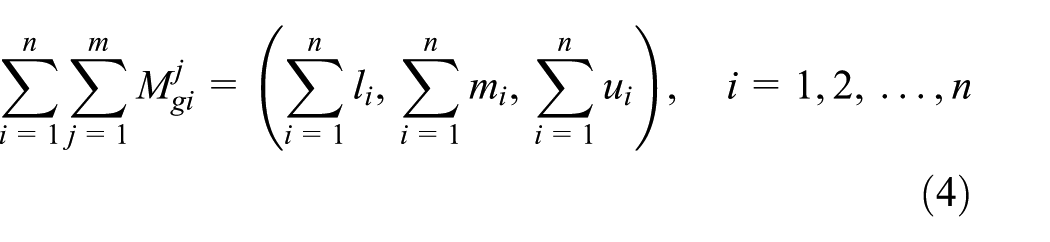
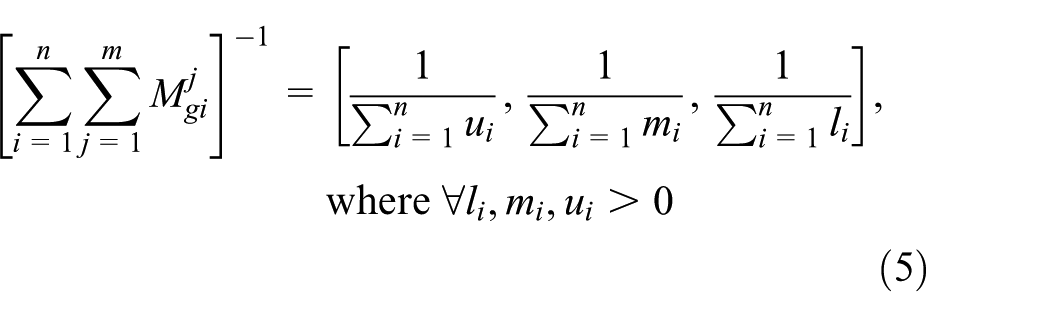
The inverse of the vector is then computed using equation (5)
Step 2. The degree of possibility of

where x and y are the values on the axis of membership function. Equation (6) can be expressed through equations (7) and (8) as


Here, d is the ordinate of the highest intersection point D between
Step 3. The degree of possibility for a convex fuzzy number greater than k convex numbers

Assume that

For

where
Step 4. Through normalization, the normalized weight vectors are given in equation (12)

where W is a non-fuzzy number.
Step 5. Rank the normalized values to select the best supplier.

Intersection between M1 and M2.
The information elicitation from experts and users is a very boring task, particularly when using the FAHP. This needs developing many pairwise comparisons. To overcome this issue, Al-Ahmari 57 suggested that for the users and decision-makers, build a pairwise comparison for the various measures of linguistic. This can be conducted through a single table utilizing Table 2. The pairwise comparison of the linguistic measures of the decision-maker is illustrated in Table 3, where Cij denotes the importance of scale i with respect to scale j. The TFNs for the fuzzy numbers are illustrated in Table 4.
Linguistic measure comparisons for the decision-maker.

VL: very low; L: low; M: medium; H: high; VH: very high.
Fuzzy number membership function.

TFN: triangular fuzzy number.
Fuzzy TOPSIS approach
Fuzzy TOPSIS approach was developed by Chen
2
to fix MCDM problems under doubt. Linguistic variables are utilized by the decision-makers, Dr (r = 1, …, k), to estimate the criteria weights and the ratings of alternatives. Thus,
Step 1. Collect the criteria and sub-criteria weights and ratings of alternatives that were offered by k decision-makers, as shown in equations (13) and (14), respectively


Step 2. Combine the fuzzy decision matrix of the criteria (


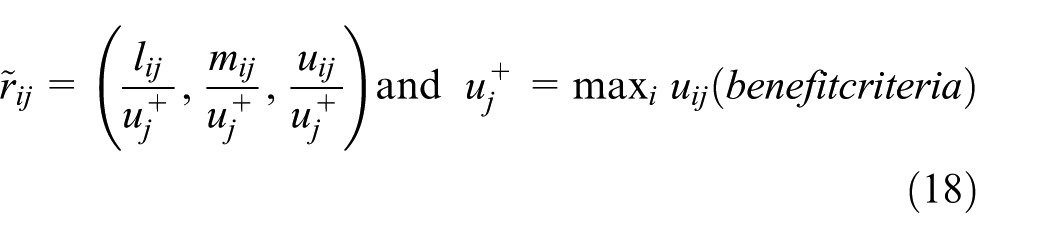
Step 3. Using a linear scale transformation, normalize the fuzzy decision matrix of the alternatives (


Step 4. Calculate the weighted normalized decision matrix,

Here,

Step 5. Identify the fuzzy positive ideal solution (FPIS, A+) and the fuzzy negative ideal solution (FNIS, A−) based on equations (22) and (23)


where
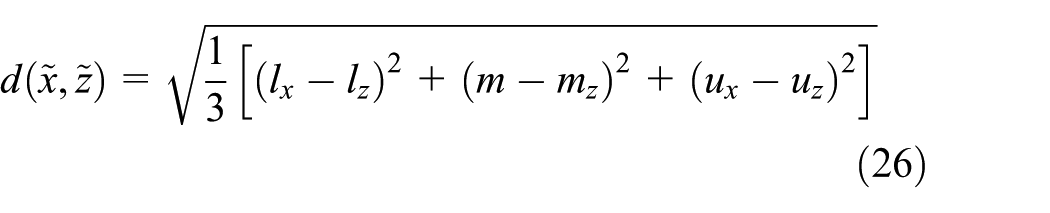
Step 6. Compute the distance


where d(.,.) denotes the distance between two fuzzy numbers based on a vertex approach. For TFNs, this can be shown by equation (26)
Step 7. Calculate the closeness coefficient,

Step 8. According to the closeness coefficient,
Case study
Background
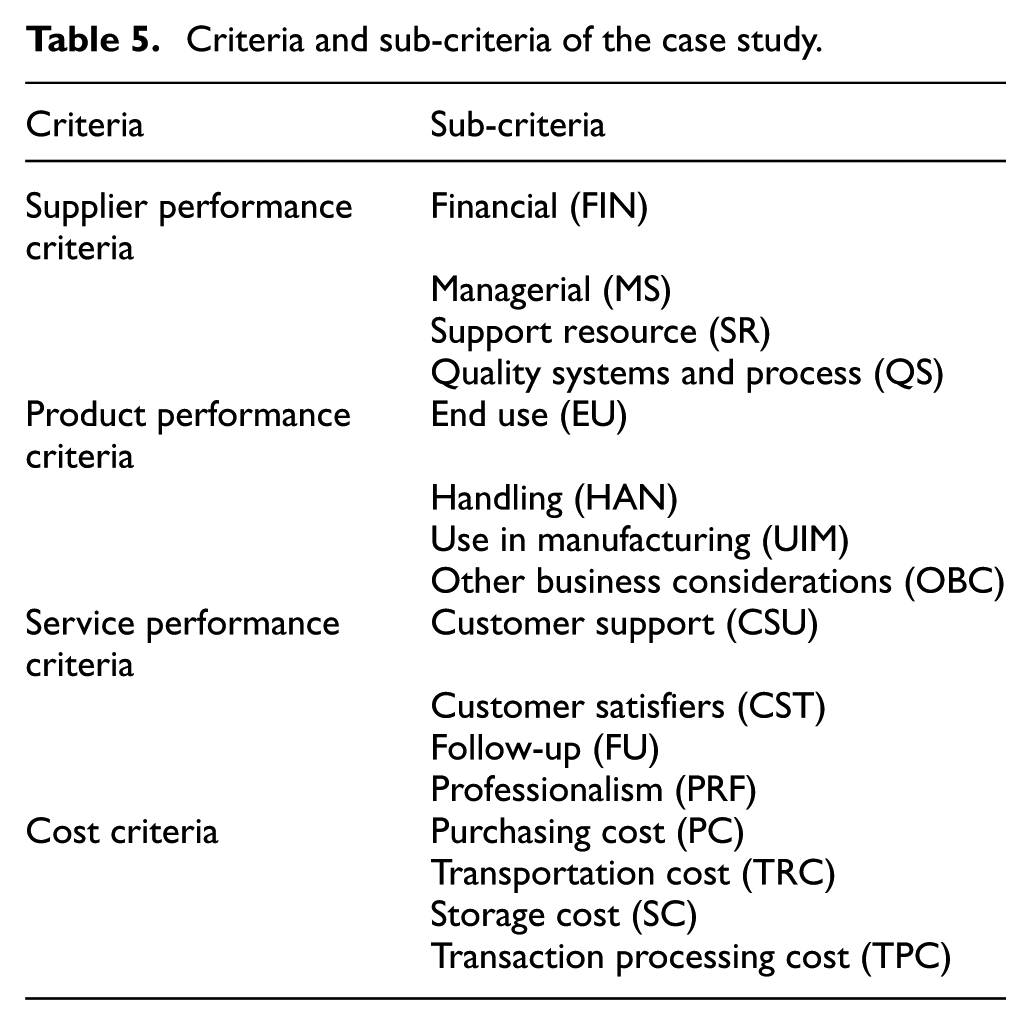
X company produces chemicals through six units according to its annual report (2007): basic chemicals, intermediates, polymers (polyolefins, PVC, and polyester), specialized products, fertilizers, and metals (steel, along with stakes in aluminum companies). It is one of the world’s largest makers of polyethylene and polypropylene, and the majority (70%) is owned by the Saudi government (company annual report, 2007). At the end of each year, the company forms an expert committee to evaluate the performance of its suppliers during the past year to reward the best supplier among the list of competing suppliers for certain commodities. The committee consists of employees from the purchasing department, research and development section, and end users of the selected commodities. The aim of this process is to reward the best supplier and encourage the other suppliers to enhance their performance in order to be eligible to supply the company with the commodity in the future. As an example, the material (X) used for a spare part in a company catalyst plant is considered as the area of application for the proposed method. The goal is to select the best supplier among four competing suppliers. To apply this method, two questions should be answered. The first question is how many suppliers will provide the material? Under a single supplier, all quantities are ordered from one supplier. Under multiple suppliers, different quantities are ordered from different suppliers due to certain constraints. The second question is what are the criteria that will be used to evaluate and select the best supplier? For the first question, due to company’s security policy, and for internal reasons, material X should be ordered from a single source. The criteria used to evaluate the best suppliers are those utilized by Kahraman et al. 59 with certain modifications, as agreed upon by the purchasing department, the decision-maker, in the company. These criteria are divided into supplier performance, product performance, service performance, and cost criteria. The supplier performance criteria are divided into financial strength, management approach and capability, technical ability, support resources, and quality systems. The product performance criteria are classified into the end use, handling, use in manufacturing, and other business considerations. The service performance criteria are classified into customer support, customer satisfiers, follow-up, and professionalism. The cost criteria are divided into the purchase price, transportation cost, storage cost, and transaction processing cost. Table 5 shows the selected criteria and sub-criteria of the case study. The AHP applied to the case study is shown in Figure 3.
Criteria and sub-criteria of the case study.

AHP used in case study.
Data analysis
To assess the suppliers according to the company’s selection criteria, measures of selected criteria need to be developed. A unanimity should be formed within the organization or team regarding the standards, measures, and approaches utilized to compare or rate suppliers. A company needs to propose efficient measures for all of its chosen criteria. The decision-maker decides on the importance levels of the chosen criteria utilizing a scale in which VL = very low importance, L = low, M = medium, H = high, and VH = very high. These importance levels are transformed into their associated fuzzy numbers utilizing the proposed program. These criteria and sub-criteria with their importance and associated fuzzy numbers are shown in Table 6. In addition, an evaluation of the suppliers regarding the sub-criteria of the main criteria is presented in Table 7.
TFN matrix relevant to the criteria and sub-criteria.

TFN: triangular fuzzy number; FIN: financial; MS: managerial; QS: quality systems and process; SR: support resource; HAN: handling; UIM: use in manufacturing; OBC: other business considerations; EU: end use; FU: follow-up; CSU: customer support; CST: customer satisfiers; PRF: professionalism; PC: purchasing cost; TRC: transportation cost; SC: storage cost; TPC: transaction processing cost.
Supplier’s evaluation regarding the sub-criteria of the criteria.

FIN: financial; MS: managerial; QS: quality systems and process; SR: support resource; HAN: handling; UIM: use in manufacturing; OBC: other business considerations; EU: end use; FU: follow-up; CSU: customer support; CST: customer satisfiers; PRF: professionalism; PC: purchasing cost; TRC: transportation cost; SC: storage cost; TPC: transaction processing cost.
Fuzzy AHP application
The fuzzy synthetic extent value regarding each criterion is computed utilizing the formula for the operations of algebraic of the fuzzy set and equation (2). The various values of the fuzzy synthetic extent regarding the four main criteria are represented by SSC, SPP, SSP, and SCC, respectively

The possibility degree of Si over Sj (i≠j) can be defined through equation (7). SSC ≥ SPP = 0 and SSC ≥ SSP = 1

Using equation (8), the minimum possibility degree can be presented as follows

Thus, the weight vector is given as

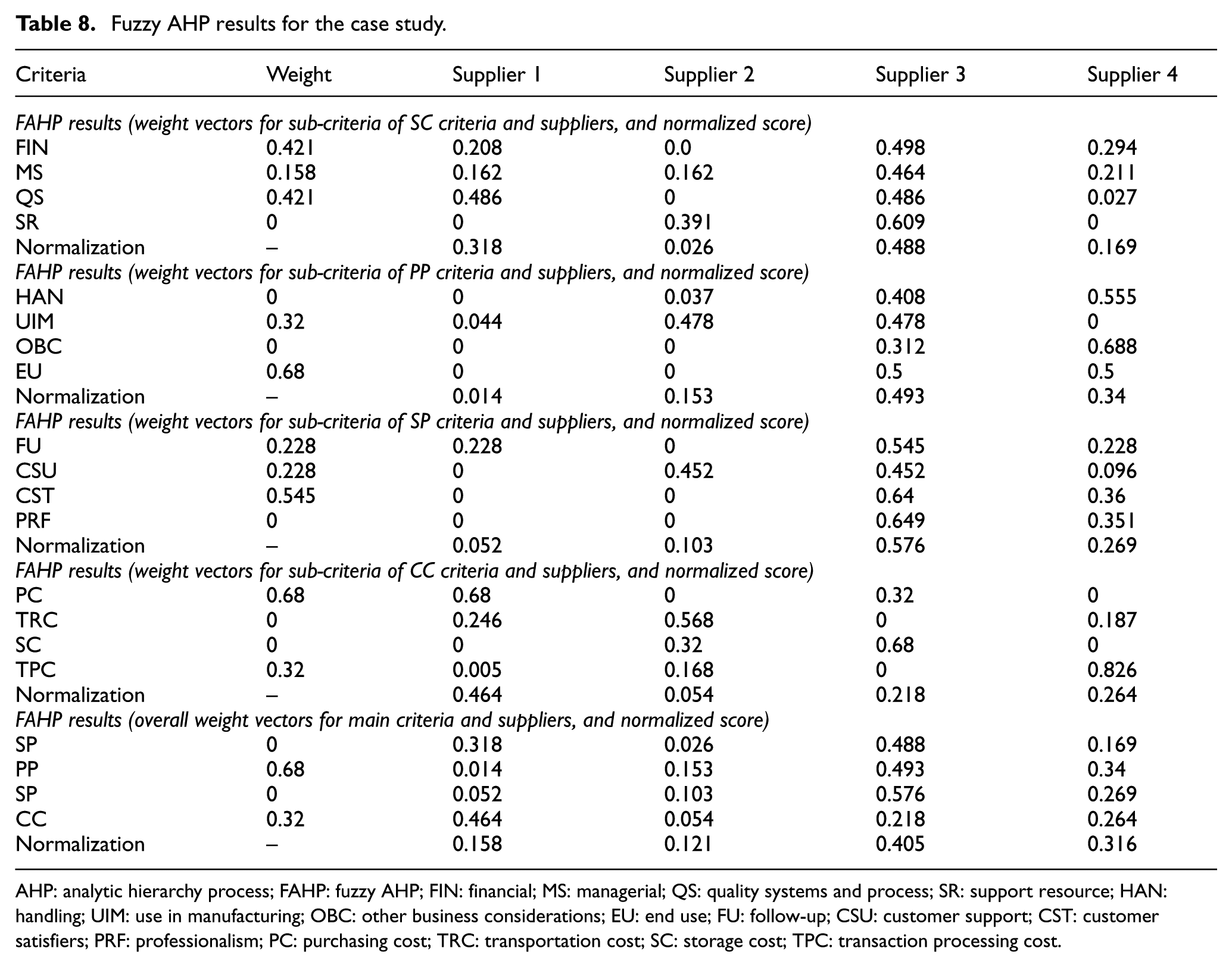
The above weighed vector indicates that the second criterion (product performance) is the most important criterion selected. According to this evaluation, the two main criteria in the first level are “product performance” and “cost criteria” with an importance value of 0.68 and 0.32, respectively.
The developed computerized tool conducts the desired computations based on the various procedure of FAHP to get the weight vectors of every evaluated alternative supplier for every chosen criterion. The weight vector of the four suppliers (illustrated in Table 8) regarding to the “financial aspect” criterion is calculated as (0.208, 0.00, 0.498, 0.294). It is clear from the above weighed vector that supplier 3 obtains a value of 0.498 (the maximum value in this vector) and is the most convenient supplier for the special “financial aspect” criterion. All results of the identified suppliers and the selected main and sub-criteria are presented in Table 8. Finally, the final normalized scores for all alternative suppliers are illustrated in the last row of Table 8 as the overall weight vectors for the main criteria and suppliers. According to this final score, supplier 3 obtains a value of 0.405 and is the best supplier for this case study.
Fuzzy AHP results for the case study.
AHP: analytic hierarchy process; FAHP: fuzzy AHP; FIN: financial; MS: managerial; QS: quality systems and process; SR: support resource; HAN: handling; UIM: use in manufacturing; OBC: other business considerations; EU: end use; FU: follow-up; CSU: customer support; CST: customer satisfiers; PRF: professionalism; PC: purchasing cost; TRC: transportation cost; SC: storage cost; TPC: transaction processing cost.
AHP application
The given case study was solved utilizing AHP. With AHP, the preference degree of the decision-maker regarding the selection of each pairwise comparison is constructed using crisp values acquired from Table 6. The importance scale is transformed into crisp values as VL = 1, L = 3, M = 5, H = 7, and VH = 9. The pairwise comparisons are performed according to the recent developments in AHP methodology. 57 The pairwise comparisons between each of the two selected criteria are made utilizing the values of their importance made from the following formula
IF objective(i) importance ≥ objective(j) importance THEN
PW(i, j) = objective(i) importance − objective(j) importance + 1
PW(j, i) = 1/PW(i, j)
ELSE
PW(j, i) = objective(j) importance − objective(i) importance + 1
PW(i, j) = 1/PW(j, i)
END IF
where PW(j, i) is the value of pairwise comparison between i and j. Table 9 shows the evaluation matrix relevant to the main criteria and sub-criteria.
Evaluation matrix relevant to the main criteria and sub-criteria.

FIN: financial; MS: managerial; QS: quality systems and process; SR: support resource; HAN: handling; UIM: use in manufacturing; OBC: other business considerations; EU: end use; FU: follow-up; CSU: customer support; CST: customer satisfiers; PRF: professionalism; PC: purchasing cost; TRC: transportation cost; SC: storage cost; TPC: transaction processing cost.
The weight vectors for the sub-criteria are calculated. Table 10 shows the summary of the resulting weight vectors for the main criteria, sub-criteria, and overall weight vectors. It is clear that the “product performance” is the most important criterion for company with regard to the selected material. According to the ranking of the suppliers, supplier 3 is the best supplier for this case study with the largest overall score of 0.413. The criteria of the firm selected are consistent with the supplier capabilities. Although supplier 3 did not have the highest weight with respect to the cost criteria (for both FAHP and AHP), it is still the best supplier among all of the competing suppliers regarding the overall evaluation.
AHP results for the case study.

AHP: analytic hierarchy process; FIN: financial; MS: managerial; QS: quality systems and process; SR: support resource; HAN: handling; UIM: use in manufacturing; OBC: other business considerations; EU: end use; FU: follow-up; CSU: customer support; CST: customer satisfiers; PRF: professionalism; PC: purchasing cost; TRC: transportation cost; SC: storage cost; TPC: transaction processing cost.
Fuzzy TOPSIS application
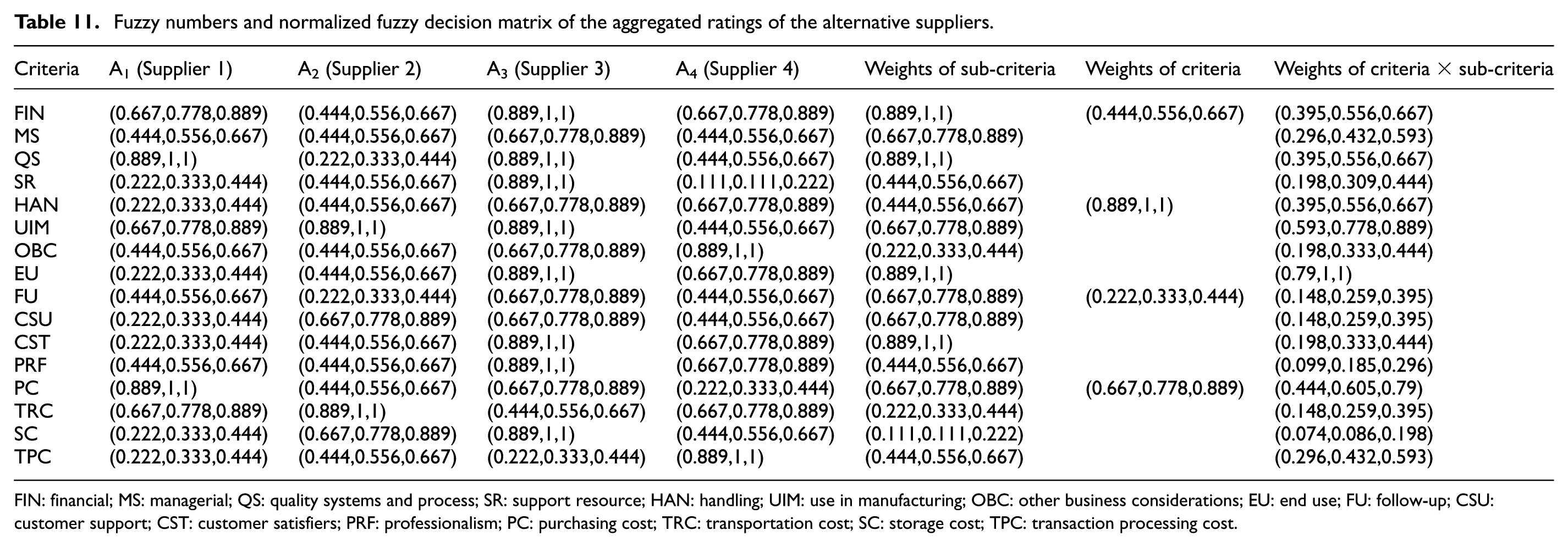
According to the linguistic terms, the decision-makers perform assessment of the weight of the criteria and the supplier’s ratings; TFNs were utilized to identify the linguistic values of these variables, as indicated in Tables 6 and 7. Table 11 shows the TFN aggregation of the judgments and normalized fuzzy decision matrix of the weights of the main criteria, sub-criteria, and the supplier’s ratings. The weighted normalized fuzzy decision matrix is shown in Table 12. Based on the study by Chen, 2 FPIS, A+ and FNIS, A− are expressed as

Fuzzy numbers and normalized fuzzy decision matrix of the aggregated ratings of the alternative suppliers.
FIN: financial; MS: managerial; QS: quality systems and process; SR: support resource; HAN: handling; UIM: use in manufacturing; OBC: other business considerations; EU: end use; FU: follow-up; CSU: customer support; CST: customer satisfiers; PRF: professionalism; PC: purchasing cost; TRC: transportation cost; SC: storage cost; TPC: transaction processing cost.
Weighted normalized fuzzy decision matrix.

FIN: financial; MS: managerial; QS: quality systems and process; SR: support resource; HAN: handling; UIM: use in manufacturing; OBC: other business considerations; EU: end use; FU: follow-up; CSU: customer support; CST: customer satisfiers; PRF: professionalism; PC: purchasing cost; TRC: transportation cost; SC: storage cost; TPC: transaction processing cost.
The distances
Rating distances of every alternative from A+ regarding every criterion.

FIN: financial; MS: managerial; QS: quality systems and process; SR: support resource; HAN: handling; UIM: use in manufacturing; OBC: other business considerations; EU: end use; FU: follow-up; CSU: customer support; CST: customer satisfiers; PRF: professionalism; PC: purchasing cost; TRC: transportation cost; SC: storage cost; TPC: transaction processing cost.
Ratings distances of every alternative from A− regarding every criterion.

FIN: financial; MS: managerial; QS: quality systems and process; SR: support resource; HAN: handling; UIM: use in manufacturing; OBC: other business considerations; EU: end use; FU: follow-up; CSU: customer support; CST: customer satisfiers; PRF: professionalism; PC: purchasing cost; TRC: transportation cost; SC: storage cost; TPC: transaction processing cost.
Outranking of alternative suppliers based on fuzzy TOPSIS.

TOPSIS: technique for order of preference by similarity to ideal solution.
In the final obtained results for FAHP, AHP, and fuzzy TOPSIS, the alternative suppliers are ranked based on their respective weights regarding the selected criteria by the decision-maker (see Table 16 and Figure 4). The presented methodology concluded that supplier 3 is considered in the case study.
Overall supplier scores using AHP, fuzzy AHP, and fuzzy TOPSIS.

AHP: analytic hierarchy process; TOPSIS: technique for order of preference by similarity to ideal solution.

Overall supplier scores using AHP, fuzzy AHP, and fuzzy TOPSIS.
Comparative analysis of the proposed approaches
The comparison of all considered approaches was conducted based on the following factors: agility during the decision process, computational complexity, number of criteria and alternative suppliers, and adequacy in supporting a group decision.
Agility during the decision process
The number of judgments desired from decision-makers for all approaches is assessed by this factor. Let m be the number of criteria, and n be the number of suppliers, in the AHP and fuzzy AHP approaches, for a decision matrix Ai × i, the required number of judgments is as follows

Because there are m matrices of size n×n (one for every decision criterion), moreover to the decision matrix of size m×m with regard to the criteria weight, and ms×ms with regard to the sub-criteria weight, the total required number of judgments is given in equation (29)

In the fuzzy TOPSIS approach, a total of m judgments for each of the n alternatives are desired, moreover to the decision matrix of size m×m with regard to the criteria weight, and ms×ms with regard to the sub-criteria weight, it can be represented as equation (30)

Considering equations (29) and (30), Figure 5 shows the number of judgments for two techniques when the number of alternatives and the criteria differ from two to nine. It can be observed that, as the number of alternatives and criteria increase, the number of desired judgments when utilizing AHP and fuzzy AHP is large and more prominent than when utilizing fuzzy TOPSIS. Thus, in the case study, fuzzy TOPSIS needed 84 judgments, whereas AHP and fuzzy AHP needed 126 judgments. Thus, it can be stated that the fuzzy TOPSIS strategy performs better than the AHP and fuzzy AHP strategies in terms of the level of communication with decision-makers for data gathering. Based on previous results, fuzzy TOPSIS provides more noteworthy dexterity in the choice procedure than AHP and fuzzy AHP.
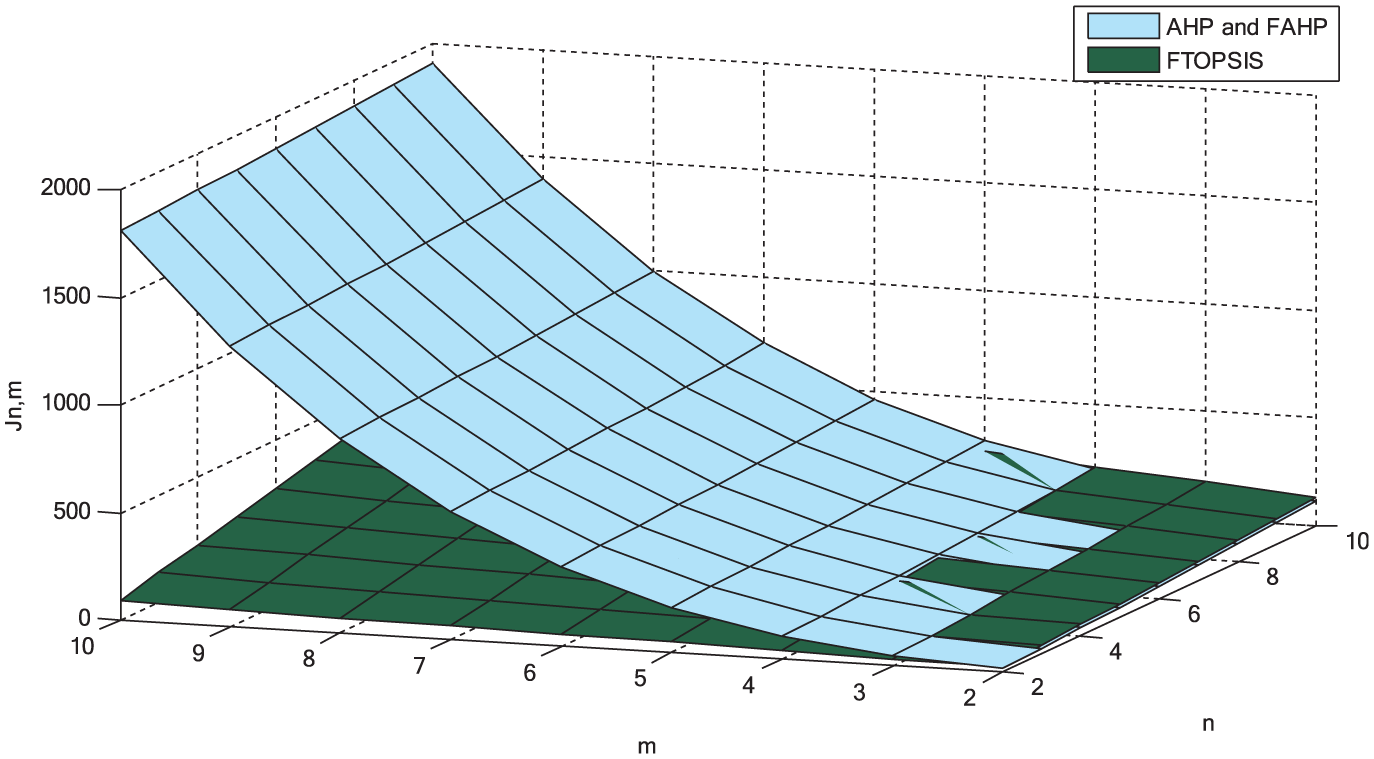
Comparative analysis with respect to agility during the decision process.
Computational complexity
In this section, the complexity of computation of all techniques is assessed considering the time intricacy. Similar to the study of Chang, 60 the time intricacy, T, is assessed in light of the number of augmentations inside the calculations. In this article, logical and exponentiation operations are moreover utilized as a gauge of the time complexity. Considering there are n elective suppliers, m criteria, and ms sub-criteria, the AHP technique requires m(m+ 1) +n(m+ 1) operations to determine the AHP-engineered degree for all choice grids, and finally nm operations are required to process the execution worldwide. In this manner, the time complexity (TAHP) of the AHP approach is communicated through equation (31)

The fuzzy AHP approach requires 6m(n + 1) operations to calculate the fuzzy synthetic extent to all the decision matrices, nm(n− 1) + n(n− 1) to calculate the possibility degrees, n(m + 1) to normalize the vector

Moreover, fuzzy TOPSIS approach needs 3nm operations to calculate the normalized decision matrix, 3nm operations to calculate the weighted decision matrix, 7nm operations to calculate the distances d+, and 7nm operations to calculate the distances d−. Therefore, the time complexity, TFuzzy TOPSIS, of the fuzzy TOPSIS approach is expressed through equation (33)

Figure 6 shows the variety of complexity as an element of the number of choices for the various number of criteria for all techniques. It can be observed that, overall, AHP shows better performance than fuzzy AHP and fuzzy TOPSIS; additionally, fuzzy AHP shows better performance than fuzzy TOPSIS. In the case study, the AHP strategy needed 404 operations, the fuzzy AHP technique needed 816 operations, and the fuzzy TOPSIS technique required 1280 operations.

Comparative analysis with respect to the time complexity.
Number of criteria and alternative suppliers
The fuzzy TOPSIS strategy does not force any confinements regarding the number of options or criteria utilized as a part of the determination procedure. However, a similar examination of the AHP and fuzzy AHP approaches shows that they do force certain impediments with regard to the number of criteria and options. Saaty 61 proposed that the number of criteria or other options to be contrasted when utilizing AHP be restricted to nine so as to not force a trade-off with human judgment and its consistency. This recommendation is applied similar to the fuzzy AHP approach. In the applied case, using the four main criteria, four sub-criteria for each main criterion, and four choices, the utilizations of the AHP and fuzzy AHP methodologies were impeccably feasible. Despite the fact that the restriction regarding the number of main and sub-criteria can be reduced by applying them to the AHP and fuzzy AHP pecking-order structures, the number of options forces a genuine confinement. Consequently, the decision of the technique relies on the particularities of the current conditions. For example, while choosing another supplier for another item, with numerous potential providers, the use of fuzzy TOPSIS results in a superior decision.
Adequacy in supporting group decision-making
All approaches allow judgment gathering for greater than one decision-maker. According to the fuzzy TOPSIS approach, gathering of various judgments is performed based on equations (34) and (35) for the criteria weights and the alternative supplier ratings


here, k indicates the decision-makers.
In the case of fuzzy AHP, despite the fact that this is not expressly considered in the technique proposed by Chang, 60 the author recommends that a collection be made by utilizing the mathematical average of the judgments. Because the measure of information desired by the fuzzy AHP technique is more noteworthy than that desired by fuzzy TOPSIS, expanding the number of decision-makers will bring about a larger increment in the time unpredictability of fuzzy AHP when contrasted with the fuzzy TOPSIS strategy. In this manner, although both techniques support group decision-making, due to the effect on the time complexity, the fuzzy TOPSIS strategy is determined to be the best. Despite the fact that both strategies register a collection in light of the fuzzy arithmetic mean, an optional approach is weighting the judgments of the distinctive decision-makers and the total information by determining the weighted average, for example, the procurement crew will be better prepared to judge the execution of the suppliers, and in this way, their judgments may be more significant than those of others not as familiar with the acquisition process. Table 17 shows the summarized findings for comparative analysis of AHP, fuzzy AHP, and fuzzy TOPSIS. Note that the comparative results will be affected if the input data are changed.
Summarized comparative analysis of AHP, fuzzy AHP, and fuzzy TOPSIS.

AHP: analytic hierarchy process; TOPSIS: technique for order of preference by similarity to ideal solution.
Conclusion and future work
In this article, an MCDM tool was developed to select the best supplier at X company. To develop this tool, two questions were answered. First, what criteria should be considered to evaluate each supplier? Second, what methodology should be used to select the best supplier? A literature review was conducted regarding these two questions. Several various approaches have been proposed, including the AHP, fuzzy AHP, and fuzzy TOPSIS. Because classical AHP does not reflect the human thought process, the fuzzy AHP method was proposed to overcome the weakness of classic AHP. Fuzzy AHP and fuzzy TOPSIS have been used to assist decision-makers in companies in supplier selection process. The proposed methodology combines databases for suppliers obtained from experts and previous studies, along with MCDM tools (AHP, fuzzy AHP, and fuzzy TOPSIS) to be used for evaluations and comparisons of the criteria and alternative suppliers of different companies. In the proposed methodology, both qualitative and quantitative factors of the system criteria and supplier benefits are considered. This methodology was supported using a program to facilitate the application and supply the desired computational precision.
A real case study was presented in this article to validate the suggested methodology. One material (X) used in a spare part was selected from the company plant. Four competing suppliers were evaluated against four main criteria, each of which contains four sub-criteria. It was found that supplier 3 was evaluated to be the best among all of the competing suppliers with regard to all of the proposed approaches. However, the comparative analysis showed that, in terms of computational complexity, AHP performs better than fuzzy AHP and fuzzy TOPSIS. Moreover, the fuzzy TOPSIS approach is better suited to the supplier selection problem with respect to agility during the decision process, the number of criteria and alternative suppliers, and adequacy with regard to the support group decision. Therefore, this article contributes to the introduction of a methodology for helping practitioners and researchers select more efficient methods to the supplier selection problem. An expansion of the research reported in this thesis can evolve in the following directions:
The suggested methodology can be expanded to cover multiple suppliers and assist decision-makers in determining different quoted quantities from each supplier.
The suggested methodology can be extended to cover multiple layers of criteria.
The suggested methodology can be applied to different selection techniques.
Footnotes
Handling Editor: Wu Naiqi
Declaration of conflicting interests
The author(s) declared no potential conflicts of interest with respect to the research, authorship, and/or publication of this article.
Funding
The author(s) disclosed receipt of the following financial support for the research, authorship, and/or publication of this article: The authors extend their appreciation to the Deanship of Scientific Research at King Saud University for funding this work through the Research Project No. NFG-15-03-09.
